Implications
For 28 872 positive diagnoses of gestation, 2898 losses were recorded, that is, a global rate of gestation interruption of 9.12%. The etiology of these interruptions is mainly extrinsic: the year and month of insemination, as well as region. The intrinsic causes that are implicated are breed of the father (heavy breeds except the hypermetric ones lose fewer pregnancies than warm-blooded breeds), age of the mother (losses are mower in mares of 7 to 10 years of age) and status (mares with foals have fewer pregnancy losses than mares not having foaled the previous year), as well as fetuses with consanguinity (when this increases, the pregnancy losses increase as well). However, the additive effect is extremely low; it corresponds to a heritability below 5% and few effects of environment, common to breeding mares, were identified. This therefore gives little hope of being able to select against the ‘gestation loss’ trait.
Introduction
It was shown by an economical inquiry conducted by the ‘REFErences’ network in France (2010) that the low economical performance of horse breeding is in great part explained by the low performances in reproduction. We analyzed some factors of variation of numerical productivity (Langlois and Blouin, Reference Langlois and Blouin2004). Here, because of the national service of gestation diagnosis by ultrasound developed by the national studs, we have the possibility (unique in the word) to study some factors of pregnancy losses on a very large scale with the same statistical methods. This is the objective of this paper.
Joining mating files with those of birth recordings has already shown (Langlois and Blouin, Reference Langlois and Blouin2004; Sairanen et al., Reference Sairanen, Nivola, Katila, Virtala and Ojala2009) variation factors for the numerical productivity of breeding mares on a large scale. However, this numerical productivity is a global zootechnical parameter that results from fertilization, rate of early embryonic resorption, abortion rate, stillbirth rate and even sometimes the breeder's choice to not record a foal's birth. In France, the National studs have set up a service for gestation diagnosis using transrectal ultrasound for all breeds. Immediately after being developed, this method was used by pioneers to measure the incidence of gestation loss on the mare (Chevalier and Palmer, Reference Chevalier and Palmer1982). These authors observed 69 gestation losses for 1295 positive ultrasounds, that is, a 5.3% loss.
A first ultrasound is performed between 14 and 20 days following insemination. Then, a positive result is as a rule verified before endometrial cupula formation (43 to 45 days after fertilization). It is therefore possible to evaluate gestation losses that occur between blastocyte immobilization and birth recordings using the files from the ultrasound results and foal birth recordings, which represent a large number of fertilizations. In this paper, we will present the variation factors for these gestation losses.
Material and methods
Material
The ultrasound diagnosis of the gestation service of the Haras Nationaux is available all over France. For the 2005, 2006 and 2007 breeding seasons, 31 770 mares were declared pregnant by ultrasound, but only 28 872 had a foal declared at birth. Some breeding mares were fertilized several times during these three breeding seasons. Indeed, there were only 23 017 different mares, that is, 1.4 observations on average per mare.
Methods
For each mare declared pregnant during a particular year, a bimodal variable was created that was equal to 1 if the positive ultrasound diagnosis was followed by a birth record and 0 if no birth record was made.
The study of the factors of variation was performed by logistic regression (SAS Institute, 2003), which is the appropriate method for bimodal variables. A certain number of simplified models were previously applied to regroup the effects and remove the non-significant effects from the final analysis. This model was applied by adding a random effect for the mare using the Genmod procedure (SAS Institute, 2003), to obtain an idea of the mother's effect and its repeatability, as well as the father's effect in order to evaluate heritability.
The fixed effects examined were the following:
The father's breed: a total of five warm-blooded breeds and eight cold-blooded breeds were distinguished. The following are the warm-blooded breeds: Thoroughbreds (PS), Arab (AR), Anglo-Arab (AA), French trotter (TF) and French saddle breeds (SF). The following are the draught breeds: Percheron (PER), Boulonnais (BOU), Breton (BRE), Normandy Cob (CBN), Comtois (COM), Ardennais (ARD), Trait du Nord (TDN) and Auxois (AUX).
Preliminary analyses allowed the following regroupings: for draught horses, the heavy breeds (PER + BOU), average-sized breeds (BRE + CBN), light breeds (COM) and all Ardennais type (ARD + TDN + AUX). For warm-blooded breeds, we did not find it necessary to distinguish between AR and AA for the reproductive characters.
We therefore obtained eight groups of breeds for the fathers for which the most numerous BRE + CBN served as a reference.
The mother's breed: in order to avoid multiplying the levels, only two modalities were examined; the mother's breed was identical to that of the father or it was different. As the advantage of crossbreeding did not appear significant, it was abandoned.
The mother's status: this includes whether or not the mare has a foal with her. Mares with foals served as references.
The mother's age: the seven following categories were retained: younger or equal to 2 years; between 3 and 4 years; 5 to 6 years; 7 to 10 years was the reference; 11 to 15 years; 16 to 20 years; 21 years or older.
The last mating month: January to February; March; April; May was the reference; June; July to December; that is, six levels.
1. Year of mating: 2005 was taken as the reference; 2006 and 2007, that is, three levels.
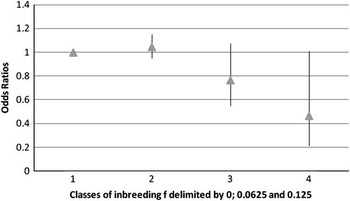
2. Inbreeding: that of the mother and of the foal to be born was calculated using the PEDIG software (Boichard, Reference Boichard2002). The equivalent number of completely known generations for birth year 2008 varied from 2.5 for French saddle to 8.9 for Thoroughbred for warm-blooded breed and from 4.6 for Ardennes to 7.4 for Comtois for cold-blooded breeds. This is a relatively profound information that shows that close inbreeding is taken into account in any case even if as usual remote inbreeding could mostly escape. Four categories were made according to the consanguinity value f: f = 0 reference; f > 0 and ⩽0.0625; f > 0.0625 and ⩽0.125; f > 0.125. Only one coefficient for consanguinity of the foal to be born was significant. The inbreeding effect of the mother was abandoned.
3. The region effect: this was considered on the 95-department level, 22 regions or a logical regrouping of these regions as a function of the preliminary results observed on the department level. Here is how we proposed the 10 following regions:
(i) Alsace + Champagne Ardennes + Lorraine + Franche comté
(ii) Brittany
(iii) Basse Normandy + Haute Normandy + Pays de Loire (the reference)
(iv) Ile de France + Nord pas de Calais + Picardie
(v) Région Centre + Limousin + Charente Poitou
(vi) Aquitaine + Midi Pyrénées without the mountain departments (09, 64, 65) and Aveyron (12)
(vii) Auvergne and Aveyron (12) and Lozère (48)
(viii) Bourgogne + Rhône Alpes without the mountain departments (07, 38, 73 and 74)
(ix) Corse + Languedoc Roussillon + Provence Alpes Cote d'Azur without the mountain departments (05, 48 and 66)
(x) A 10th fictive region was created with the following mountain departments: 05, 07, 09, 38, 64, 65, 66, 73, 74.
For the presentation of the results, we chose to determine the odds ratios (OR), which were calculated by determining the exponential of the logistical regression coefficients. They express the increase or decrease of chances to obtain a specific value of the bimodal variable for a certain level taken as the reference. For the variation factors with positive effects, OR > 1. If this effect is negative OR < 1 and the reference level will be OR = 1.
For the study of variation factors, only the results corresponding to the complete model are presented:
The declaration of a product = effect of the father's breed (8 levels) = effect of the mother's status (2) + the effect of the mother's age (7) + the effect of the mating month (6) + year effect (3) + inbreeding effect of the product to be born (4) + region effect (95/10) + residual effect.
The adjustment of the effects was obtained using the PROC LOGISTIC procedure of SAS Institute (2003).
Results
Globally, gestation losses, as we have defined them, were equal to 2898 for a total number of mares of 31 770, that is, 9.12%.
Effect of the father's breed
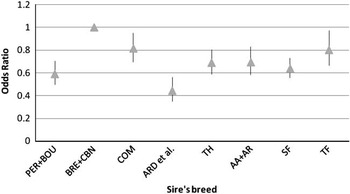
When warm-blooded breeds and cold-blooded breeds were considered together, the products of warm-blooded breeds were more often lost (OR = 0.925) before the birth recordings than were the products of draught breeds (OR = 1). This, however, cannot be generalized for all heavy breeds. Boulonnais and Percheron breeds and the Ardennes-type breeds in particular had significantly lower results than the other heavy breeds. Among warm-blooded breeds, the French trotter seemed to have a better performance but equal to that of the Comtois. Arab and Anglo-Arab, Thoroughbred and French saddle breeds cannot be distinguished from each other. The Breton and Normandy cob are significantly above the other breeds. They had fewer gestation losses after a positive ultrasound diagnosis (Figure 1).
The effects of the father's breed expressed as an odds ratio. PER + BOUL = Percheron + Boulonnais; BRE + CBN = Breton + Cob Normand; ARD et al. = Ardennes + Trait du Nord + Auxois; TH = Thoroughbred; AA + AR = Anglo-Arab + Arab; SF = Selle Français (French Saddle); TF = Trotteur Français (French Trotter).

The status of the mother
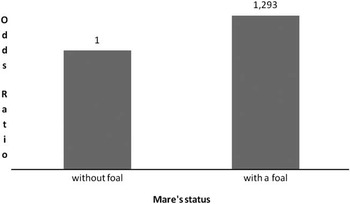
We observed a highly significant advantage of mares with foals as compared with mares without foals: pregnant mares with foals at feet had a better chance of bringing their pregnancy to term than mares without foals (Figure 2).
Effect of mare's status, with or without foals, expressed as an odds ratio.

Effect of the age of the mothers
If age classes ⩾21 years are excluded, as they are poorly estimated and subject to selection bias, we observed that maintaining gestation reaches a maximum for mares whose age is between 7 and 10 years. Gestation losses were more frequent before or after these ages (Figure 3).
Effects of age classes of the mother expressed as an odds ratio. ⩽2y = 2 years old and less; 3 to 4y = 3 to 4 years old; 5 to 6y (ref) = 5 to 6 years old (the reference); 7 to 10y = 7 to 10 years old; 11 to 15y = 11 to 15 years old; 16 to 20y = 16 to 20 years old; >20y = older than 20 years.

Effect of breeding month
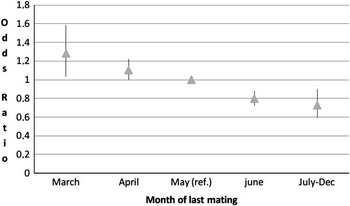
If January and February are excluded, which are poorly estimated because of the lack of data and for which a too high value necessitates shrinking the values of the other months, a decrease in the breeding animals’ success was observed, in terms of gestation success. This depends on whether the fertilization occurred in March or later in the season (Figure 4).
Effects of season of the last mating expressed as an odds ratio.

Year effect
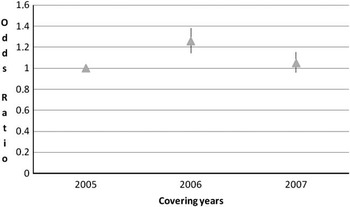
During 2006, there were highly significant fewer gestation losses than the years 2005 and 2007 (Figure 5).
Effect of year expressed as an odds ratio.

Effect of inbreeding on foal birth
The chances for survival of a foal decreased when the consanguinity coefficient was >0.0625, whereas the consanguinity of the mare did not seem to have an effect. Gestation losses, which were still low at the beginning, become highly significant when f was >0.125 (Figure 6).
Effect of consanguinity level expressed as an odds ratio. Class 1 = f = 0; class 2 = 0 < f ⩽ 0.0625; class 3 = 0.0625 < f ⩽ 0.125; class 4 = f > 0.125.

Department and region effect
A department-by-department analysis shows few significant differences when the Manche (50) was the reference. Only two of them, departments 72 and 43, had significantly higher results and 10 had significantly lower results (05, 07, 09, 20, 37, 42, 52, 60, 89 and 94).
However, grouping the departments into 10 large regions, as indicated above, gave greater cohesion to the results. The East and the Mountain regions had significantly lower performances when compared with the larger reference zone, which included Normandy and the Pays de Loire (Figure 7).
Effect of the 10 regions on rate of early gestation losses. (In yellow the two regions having significantly higher losses than the High and Low Normandy region and Pays de la Loire.)

Estimation of the repeatability of the results per mare and per paternal component
The results obtained for the fixed effects by the PROC GENMOD procedure of SAS Institute (2003), when the random mother or father effects are added, were identical. They will only be considered under the angle of variance for which they provide access.
Adding a random component because of the mother or father allowed the estimation of an intra-class mother correlation of 3.7%, whereas the intra-class correlation of the father was evaluated at 1.3%. In the first case, 23 017 breeding mares with 1 to 3 observations were available and in the second 1020 stallions with 1 to 302 observations. These two estimations were coherent and do not leave hope that selection will reduce gestation losses. This result was a common result as the traits associated with fertility have themselves already undergone a very strong automatic selection pressure and only conserve very little additive genetic variability. They therefore have a low heritability.
Discussion
The overall rate of loss measured here (9.1%) was comparable to that reported by other authors: 7.2% in Thoroughbreds in England (Morris and Allen, Reference Morris and Allen2002; Allen et al., Reference Allen, Brown, Wright and Wilsher2007) or in Australia (Bruck et al., Reference Bruck, Anderson and Hyland1993) and 8.6% in different breeds in a review article (Vanderwall, Reference Vanderwall2008). However, it was lower than those observed for Thoroughbreds in India, 19% (Sharma et al., Reference Sharma, Dhaliwal and Dadarwal2010) or 12% in South Korea (Yang and Cho, Reference Yang and Cho2007).
The comparison of the observed effects with those published in 2004 (Langlois and Blouin, Reference Langlois and Blouin2004) for numerical productivity of breeding mares revealed similarities and differences. In the previous study, draught horses had a lower numerical productivity than that of Thoroughbreds. However, here, they had a significantly lower early gestation loss. The lower losses of the Breton and Normandy Cob, however, did not have a notable effect on their numerical productivity. In addition, the high rates of gestation losses of the Boulonnais and Percheron and in particular the group of Ardennes, Trait du Nord and Auxois had little incidence on the overall productivity results as measured in the first study. It is important to recall that these effects, even though very marked, had an effect on less than 10% of the overall result and that they may be compensated for by a higher fertility rate. It is noteworthy that in unusually developed breeds, birthing difficulties are suggested to explain their greater gestation losses. Indeed, a partial epidemiological study on 185 gestations (Chaffaux et al., Reference Chaffaux, Dugardin, Pitel, Hendrikx, Laugier and et Valon2011; Figure 8) showed the great influence of stillbirth on fetal losses.
Fetal losses according to the month of gestation (n = 185).

For warm-blooded breeds, the lower rate of gestation loss in the French trotter confirms its overall greater global efficacy; however, the differences in numerical productivity observed in the first study between Thoroughbreds and saddle breeds end here for gestation losses.
The advantage of mares with foals over mares without foals was, however, of the same order in both studies (OR no. 1.35 as compared with 1.30 here). This confirms that lactation does not have an influence on the rate of loss of gestation products (Vanderwall, Reference Vanderwall2008). This may be explained by the fact that the mares without foals include in fact virgin mares, a priori fertile, and mares that remained not gestating during the preceding season, a priori less fertile or even sterile. However, Allen et al. (Reference Allen, Brown, Wright and Wilsher2007) did not find this difference for English Thoroughbred mares with foals and without foals.
The effect of the age of the mother on gestation loss was not studied with the same precision as that in the first study on numerical productivity, forcing larger classes with higher standard deviations. However, the existence of a certain parallelism remains. Whereas numerical productivity reaches a maximum between 4 and 6 years of age, for gestation loss the minimum is reached later near 7 years with a higher persistence. Fertility is therefore first affected by the age of the mare; the rate of fetal loss is affected later. This age effect of the breeding mare on the rate of gestation loss was observed in an identical manner by all authors (Allen et al., Reference Allen, Brown, Wright and Wilsher2007; Yang and Cho, Reference Yang and Cho2007; Vanderwall, Reference Vanderwall2008; Sharma et al. Reference Sharma, Dhaliwal and Dadarwal2010). During the genital life of a mare, her stock of oocytes loses their capacity to be fertilized more rapidly than the ageing of their oviducts and uterus. This explains why the rate of fertilization decreases more rapidly, like the numerical productivity, than the increase in gestation loss (Ball et al., 1987).
The season effect of reproduction is parallel in both studies. Here we may suppose that the hormonal state of the mare induced by the day/night rhythm influences both the fertilizing conditions and maintaining of gestation. The same effect was observed in South Korea by Yang and Cho (Reference Yang and Cho2007). However, in India where the day/night variations are less important, this season effect was not observed; the rate of loss was identical all throughout the year (Sharma et al., Reference Sharma, Dhaliwal and Dadarwal2010). One must, however, remember that at the beginning of the season a larger number of mares that in the previous year were sterile were inseminated and presented higher gestation loss rates than the others, which may partly explain these lower results in March to April.
The year effect, limited here to 3 years, did not reveal any general tendency to improvement, nor deterioration as in the previous study. This confirms that the loss during gestation is independent of technical improvements. They are permanent on the contrary to numerical productivity, which benefitted from the increasing improvements in ultrasound scan and artificial insemination during the period. Indeed, the increase in fertility rate observed was attributed to an increased technicality of reproduction. However, the important effect of the year 2006 marked by a significantly lower rate of gestation loss shows that the climate, feeding and/or epidemiology can have a high influence on gestation loss.
It is this type of an effect that was sought for in the regional differences of gestation loss rate. The department scale shows little differences. Contrarily as we expected, we could therefore not show the regions with endemic infectious diseases. However, it seems that the Large East zone and the Mountain zones with a harsh climate, with a less rich feeding in winter show significantly higher losses than in the oceanic and Mediterranean zones.
The effect of foal consanguinity shown in previous studies on numerical productivity was confirmed here on the rate of gestation loss. However, the additive genetic effect was extremely low, corresponding to heritability below 5%. It is in fact not possible to identify many environmental effects common to the same mare because the mare's component of variance is of the same order of magnitude as the sire's component.
These results show that it is essentially the environmental factors that are at the origin of the loss of fertility products. Even though the genetic effects are involved as the consanguinity effect shows, it is mainly at the level of allele interactions expressed by dominance and epistasis and probably not at the level of additive effects. We can therefore obtain positive effects by crossbreeding, even though here they did not appear to be significant, when we studied the mother's breed identical to or different from the father's breed. However, nothing should be expected from selection.
Conclusion
In this study, we show that between the moment when a mare was diagnosed as being pregnant by ultrasound and the moment of birth declaration ∼10% of the products were lost. The factors that are implicated in these losses are essentially extrinsic; they depend mainly on the environment. They are mainly region, month of insemination and year. Certain effects are, however, intrinsic, being associated with the mother: her age and if she is with or without a foal, the breed of the father and fetus (its consanguinity). We may not, however, determine strong genetic effects allowing selection on this trait. If these genetic effects do exist, it is via gene interactions that are by dominance or epistasy, therefore explaining the negative effect of consanguinity. A distinction between these different causes of gestation losses (embryo mortality, miscarriage, stillbirth, neonatal death) may help explain this problem.
Acknowledgment
The authors are grateful to Dr Bénédicte Ferry-Abitbol for providing them the list of the gestating mares observed by ultrasound rectal examination from 2005 to 2007.