There is a wonderful insight in Heaven's broad and simple sunshine. While we give [photography] credit only for depicting the merest surface, it actually brings out the secret character with a truth that no painter would ever venture upon, even could he detect it. There is, at least, no flattery in my humble line of art. Now, here is a likeness which I have taken over and over again, and still with no better result. Yet the original wears, to common eyes, a very different expression …Footnote 1
Since its invention, photography has held a fascination for American writers, and, indeed, some of the most noteworthy commentators on photography have been American essayists, novelists and poets. From Edgar Allen Poe's essay “The Daguerreotype” (1840) to James Agee's Let Us Now Praise Famous Men (1941) and Susan Sontag's On Photography (1977), American writers have expressed a unique fascination with the medium. The reasons for this may lie in this passage from Nathaniel Hawthorne's romance The House of Seven Gables (1851), for, as Holgrave, the book's protagonist, expresses in his monologue on “his art” of daguerreotypy, the photographic image suggests itself as something of a spiritual X-ray, allowing its beholder to see into the nature of its subject. Directing young Phoebe (his listener in this scene) to look at a likeness which he has taken over and over again, Holgrave instructs the girl to see, as it were, into the nature of the photographic subject: in this case, the duplicitous Judge Pyncheon. In effect, what Holgrave attempts to teach Phoebe is to use the photograph as a method of detection. Indeed, as Carol Schloss recognizes, Holgrave is Hawthorne's answer to the criminal detective, for he is “someone who can find the real culprit” by means of his photographs.Footnote 2 As Schloss goes on to observe, this is because Holgrave sees “holographically.” Thus his art involves the detection of essential character: a character that is “holographic,” in that it lies below the two-dimensional photographic surface.
Whilst Hawthorne's romance is foremost a work of fiction, at the very least it expresses a notion of photography that was held by the American public before and after the American Civil War. As Alan Trachtenberg explains, from the first appearance of daguerreotypes in the United States, photography became one of the principle mediums used in the examination and acquisition of “character.” “What was needed,” writes Trachtenberg,
was confidence that the eye could reliably discern inner character from outer appearance. Some writers on photography articulated it as a system based on the popular fads of phrenology and physiognomy, which claimed to derive knowledge about inner traits from external evidence – in phrenology, from the configuration of the brain as traced by bumps on the skull. Photographers adopted the notion that the exterior of a person might reveal inner character, and conventionalized it in a sentimental repertoire of expressed poses.Footnote 3
In nineteenth-century America the photographic camera becomes, then, an instrument used to read the essential nature of its subject. Allied with such pseudosciences as phrenology and physiognomy, photography becomes the source of an empirical body of evidence, in that photographs can be catalogued, stockpiled and compared for pseudoscientific purposes.
As David S. Reynolds recognizes, the American public's fascination with the pseudosciences extended to Hawthorne, who – along with Poe, Melville and Whitman – “gave highly individualistic reinterpretations of various pseudoscientific principles.”Footnote 4 In Beneath the American Renaissance, Reynolds identifies descriptions of such pseudosciences as mesmerism and spiritualism both in The House of Seven Gables and The Blithedale Romance. However, while Reynolds recognizes Hawthorne's interest in the pseudosciences of mesmerism and spiritualism, he pays little attention to the relationship between Holgrave's daguerreotypes and physiognomy. In many respects, this is understandable. In reading the photograph of the judge, Holgrave does not use any physiognomic jargon, nor does he identify the character of judge with any of the man's physical features, and this may account for why Holgrave's reading does not catch Reynolds's attention; Hawthorne is not interested in the connection between the pseudosciences and photography per se. At least, he is not interested in describing this connection in any technical sense. For Hawthorne, Holgrave's “art” is employed as a plot device and little more.
However, while Hawthorne uses photography and physiognomy as elements of fiction, at least one of his contemporaries attempts to perform an actual physiognomic reading in a literary work, and to do this by way of a photograph. I am speaking of Herman Melville, whose poem “On the Photograph of a Corps Commander” from Battle-Pieces (1866) engages in a physiognomic examination of an actual photograph.Footnote 5 In this poem, Melville's speaker describes a photographic portrait of an unnamed Civil War general, whom he terms “a Corps Commander.” In this description, the speaker hails the photograph as a modern-day spiritual icon that has the power to reveal how its subject's spirit and Nature itself have come together to produce a visage of perfect manliness. This constellation makes the poem a unique artifact in the American canon, as it is one of the few pieces of American literature that actually attempts to employ the pseudosciences in a nonfictive sense. It is also unique because the poem may be the first description of a real photograph in American verse – possibly in international verse. This possibility is even further enriched by the traditions that the poem partakes in, for Melville attempts, in “On the Photograph of a Corps Commander,” to renovate older poetic genres and to link these genres with the new medium of photography. The most central of these genres is ekphrasis: the literary description of a piece of visual art. Returning to this ancient genre, Melville employs it in combination with the antique trope of the epideixis, or the poetic celebration of a heroic personage. As we will see from an examination of the poem, by linking these elements “On the Photograph of a Corps Commander” transplants the Renaissance concepts of masculinity, portraiture and poetic form into the American landscape and forecasts the way that these concepts will manifest in American photography.
As the formal structure of the poem and its antiquated diction suggest, Melville would return to an older kind of verse: one whose formal structures are employed for honoring a national hero. While such verse was not unheard of in the nineteenth century (one has only to think of Tennyson's “Ode on the Death of the Duke of Wellington”), there are a number of elements in Melville's poem that suggest that he modeled “Corps Commander” on older Renaissance examples. Reading the poem, one thinks of such sonnets as Petro Aretino's ekphrasis of Titian's portrait of Francesco Maria della Rovere, Duke of Urbino. Alternatively, there are Shakespeare's imaginary portraits of the Greek heroes at Troy in The Rape of Lucrece.
In any event, Melville's poem corresponds to the convention of ekphrasis at the time of the Renaissance, in which a poet described a painted portrait in order to celebrate the character of that portrait's subject. As John Hollander explains, during the Renaissance such ekphrases functioned to gloss the “Sacrament” of the subject:
A portrait may look like what its subject looks like, but it is frequently praised in the Renaissance, for example, as looking like – and thereby revealing – what a person is (generating what the Book of Common Prayer calls a “Sacrament”, “an outward and visible sign of an inward and spiritual grace”). A fictional story about an occasion on which trompe l'oeil actually fools a viewer is one thing. Another matter is that of a poem that praises subject and painter together by showing how the artist gets to the character or essence of the subject by means of detail – how the psychological or moral notion is revealed “in” a bit of facial feature, co-existing perhaps with the glossing of emblematic details surrounding the face.Footnote 6
Hollander's description of the ekphrasis of Renaissance portraits calls to mind Holgrave's art of detecting character. Reading the Sacrament of a painted portrait is comparable to “detecting” the character of a face in a photograph; using the visual image as a means for reading, both the reader of a Sacrament and a detective such as Holgrave can gloss the subject of a visual image.
However, what is lacking both in Hollander's description of this process and in Holgrave's practice of it is what we might term “a scientific method.” Neither Hollander nor Holgrave relate how such a gloss was accomplished. In his poem, Melville's speaker sets out to provide us with a description of this scientific method. Employing the jargon of physiognomy and phrenology, the poem provides a series of instructions designed to educate its reader in these methods and apply them to photographic images.
This work begins with the speaker's insistence that the reader should “look,” “trace” and “scan” the nobility of the Corps Commander in his photograph. Following these instructions, the reader is initiated, so to speak, into the mysteries of photographic reading. He or she is instructed on where in the photograph to look for the man's courage, nobility and ancestral heritage – all of which are said to have come together to produce the Commander's heroic deeds at the Battle of the Wilderness in Spotsylvania, Virginia.
In each of these sentences, there is a departure from the particular into the abstract – from the phenomenal to the essential. The poem's opening line “Man is manly” establishes the essential gesture of every sentence that follows it. From the image of this particular man, the reader may abstract the universality of manliness. From the Commander's head, the reader can recognize the essence of a warrior's “carriage.” From his frame, the reader can see the very “dilation” of bravery. However, most notable of all is how the image is lit not by natural forms of light, nor by the artificial lights of a studio. It is lit by the Corps Commander's soul. Like the glow from a light-box lit behind an X-ray, the soul shines through to reveal all.
What is so fascinating about this stanza is how its six lines manage to merge physiognomy, hegemonic essentialisms, photography and Platonic metaphysics into a series of connected ideas. Employing such physiognomic jargon as the “dilation of the frame,” the speaker would seem to join such famous nineteenth-century phrenologists as Orson and Lorenzo Fowler in the lyceum of physiognomy, for his argument parallels the arguments of such pseudoscientists: reading the Corps Commander's physical features, we can discover the essence of manliness. Such an argument calls to mind the numerous phrenological charts that mapped the surfaces of the human head, identifying certain areas as having influence or relating to the inner workings of the brain (Figure 1). Though the speaker does not go into the strictest detail about how we may chart this manliness on the Commander's head, the use of this jargon and the reference to the head calls such work to mind.
Webster's Academic Dictionary, 1895, vs. “Phrenology.”

Initially, we might dismiss these allusions to phrenology as merely antique and idiosyncratic, and thus dismiss Melville's poem outright. However, in its allusion to the pseudosciences, the poem may be said to expound some of the basic essentialisms of twentieth-century scientific disciplines, such as sociobiology. As W. R. Connell explains, one of the central concepts of sociobiology is sex-role theory, in which it is maintained that genre roles are “linked to a structure defined by biological difference, the dichotomy of male and female – not to a structure defined by social relations.”Footnote 7 As Connell goes on to relate, in this type of biological categorization, a man behaves manly because physically he is a man, while a woman behaves womanly because physically she is a woman. This sort of circular logic figures sociobiology – in Connell's words – as “entirely fictional.”Footnote 8 Others might go so far as to identify it as pseudoscientific.
While the issue lies beyond the immediate scope of this discussion and beyond my own expertise, the problems that Connell recognizes in sociobiology and sex-role theory do parallel the problems of logic one encounters in Melville's poem. And this might explain why Melville turns to a photograph. Simply said, Melville must have understood that the physical presence of an individual man cannot and does not guarantee that that man will demonstrate perfect manliness. But the presence of a still photograph of that man does support such a claim, especially if we appreciate how many nineteenth-century intellectuals came to regard photographs as images of Platonic truth.
In his essay “The Stereoscope and the Stereograph” (1859), Melville's friend and fellow writer Oliver Wendell Holmes declares, “We should be led on too far, if we develop our belief as to the transformations to be wrought by this greatest of human triumphs over earthly conditions, the divorce of form and substance.”Footnote 9 Holmes's belief assigns photography the work of the Platonic philosopher. Regarding the camera as a device capable of producing an image “divorced” from the shadowy world of substance, Holmes's notion implies that the photograph is not corrupted by the doubly shadowy world of mimesis. Rather, the chemical event that produces a photograph achieves what Plato sought to achieve through his Dialectic: access to true form unhindered by human misrepresentations. For Holmes, then, a photograph is not a substantial object at all; it is a record of the eidos, or the Platonic form of an object.
Melville brings Holmes's concept of photography to his epideixis. Opting to describe the photograph of the Corps Commander instead of the actual man, the poem argues that this is a visual representation that records the very eidos of manliness, and thus it is superior to any description of the actual man. Not only does this argument figure the photograph as something of a revelation – a vision of Plato's realm of the spheres – and thus justify the emotive opening of the poem, the argument also overcomes the circular logic in the line “man is manly,” for, by specifying that he is writing about a photograph, the speaker expects his readers to understand that such an image has the power to reveal this sort of manliness.
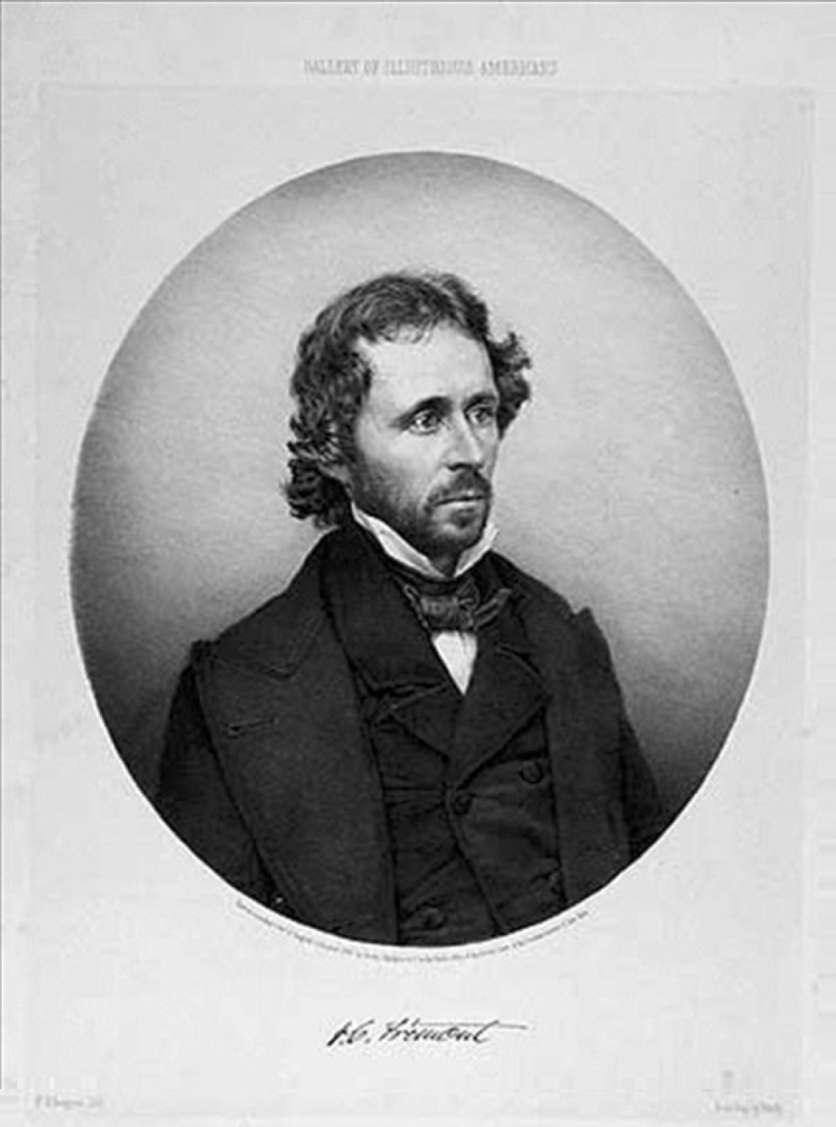
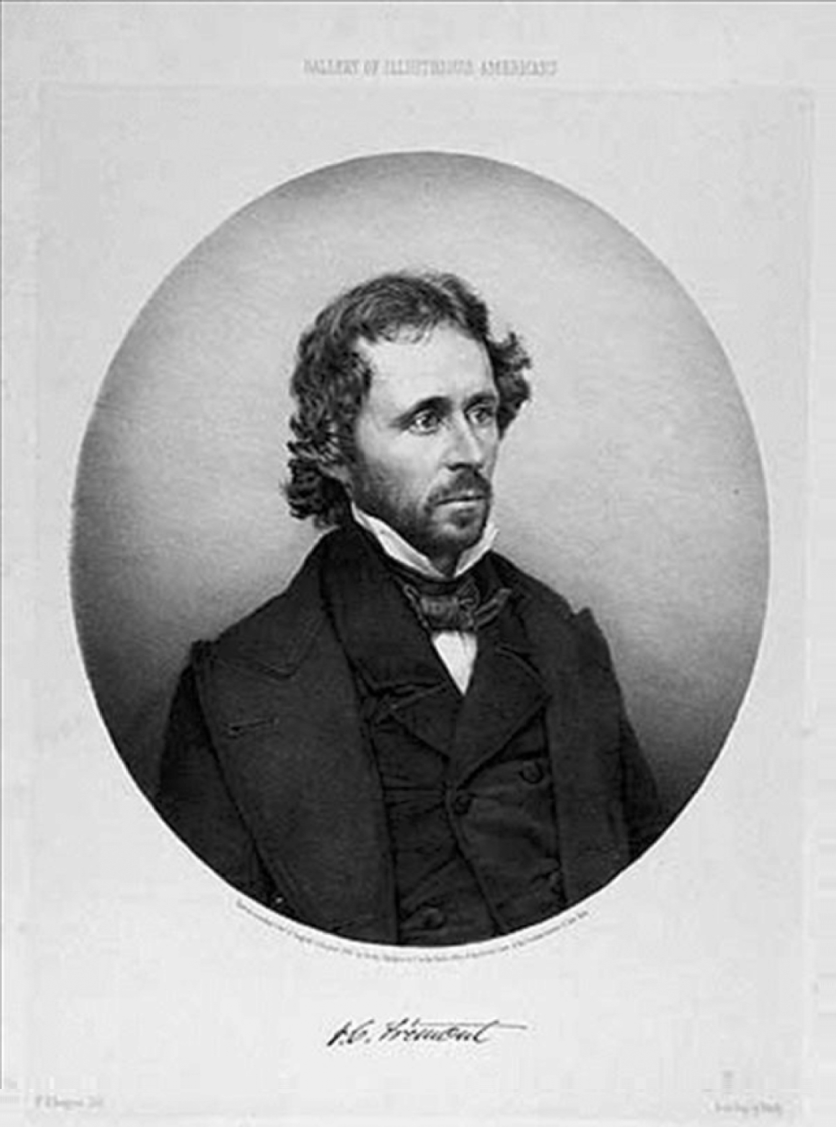
As Trachtenberg relates, not only were such Platonic attitudes as Holmes's commonplace in antebellum America, they were bolstered by nineteenth-century photographers who “adopted the notion that the exterior of a person might reveal inner character” and thus began to conventionalize their trade with “a sentimental repertoire of expressed poses.”Footnote 10 Trachtenberg goes on to relate how these poses were modeled on photographs of famous Americans. One of the best-known sources of these photographic models was Mathew Brady's The Gallery of Illustrious Americans, a book containing fifty portraits of prominent Americans from the antebellum period (Figure 2). The book's portraits were daguerreotypes taken by Brady, which were then copied as lithographs by F. D'Avignon. The purpose of Illustrious Americans was to provide the Anglo-Saxon, Protestant American public with models of pure-blood fathers. Studying and copying the poses of these illustrious men, antebellum Americans could measure themselves against – and thus distinguish themselves from – the steady flow of immigrants from Ireland, Eastern Europe, and Asia, and slaves from Africa.
Mathew Brady and F. D'Avignon, “John C. Frémont,” lithograph taken from photographic print, 1850, in Mathew Brady and F. D’ Avignon, The Gallery of Illustrious Americans, Containing the Portraits and Biographical Sketches of Twenty-four of the Most Eminent Citizens of the American Republic, since the Death of Washington, ed. C. E. Lester, New York: C. E. Lester and M. B. Brady, 1850.
The speaker of Melville's poem celebrates the photograph of the Corps Commander as another portrait of another illustrious American, and he calls on the reader to perform similar kinds of copycat posing. Just as Brady's book provided its possessors with racial schema, so the photograph of the Corps Commander provides its viewers with a schema. Copying the Commander's pose, men may become “manly.”
The second stanza of the poem might be said to describe how this copycat transformation occurs, in that it attempts to delineate how the spirit of manliness comes into contact with Nature itself:
The speaker argues that the photograph reveals how the Commander's soul and the natural world interact. I return again to the idea of an X-ray, for nowhere in the poem is that idea more appropriate than here. Looking into the photograph, the viewer witnesses how “the spirit molds the form.” There is no more active verb in the poem than “mold” and no more abstract description than the one found in this stanza.
What makes the stanza all the more fascinating is that its lines are not merely descriptive. They suggest that this photograph holds within it a certain remedy for the remiss man. What is cheering and warming about looking at this photograph is that one can imitate it, and thus one may be able to “mold” one's own remiss state into something that approximates the Commander's perfection. Should a man with a “remiss” soul “look upon a chief like this,” he might enact in himself the process that perfected the Commander. This process would involve something of a reversal: The Commander's body is perfected from its inner spirit outwards, but the man who assumes the pose of the Commander would have to perfect himself from the outside in. Assuming the pose of the Commander, the remiss man learns, then, how to “mold” his physical body into a better specimen, and thus improve the shape of his soul.
The theme figures Melville's poem to be something of a self-help text: a sort of exercise program designed to make remiss men manly. If this comparison seems off-handed, we have only to consider the description of the Corps Commander in relation to modern descriptions of the stereotypical American male. As Erving Goffman describes such stereotypes, they involve a singular definition of masculinity in which
there is only one complete unblushing male in America: a young, married, white, urban, northern, heterosexual, Protestant, father, of college education, fully employed, of good complexion, weight, and height, and a decent record in sports … Any male who fails to qualify in any one of these ways is likely to view himself – during moments at least – as unworthy, incomplete, and inferior.Footnote 11
The stereotype that Goffman describes is a familiar one. One has but to consider a protagonist such as Ayn Rand's Howard Roark or the roles played by a film star such as Gary Cooper to recognize this stereotype. However, “Corps Commander” does more than reiterate the stereotype. The poem couches it in Neoplatonics. It argues that the photograph of the Corps Commander presents us with an eidos that reveals all other men as “remiss.” However, the speaker would seem to declaim, “There is help for the remiss! If only they will mold themselves into the pose of this man, then they too may be manly!”
One of the most ingenious aspects of the poem is the way that Melville employs poetic structure to reflect this sort of molding. The conformity of nature to spirit, for instance, is reflected in the stanza's rhymes and in the syntax. Completing the interlocking abab rhymes, the word “remiss” may be said to iconographically pose in a manner that imitates the position of the word “this.” Thus the rhyme enacts the remiss man's imitation of the Commander's perfection, as it imposes an outer structure upon the inner workings of the stanza. This imitation is further substantiated in the syntax: the stanza is divided into two parts, each one taking up three lines. The first part of the stanza addresses the work of the soul; the second addresses the outer disposition of Nature. As the rhyme between “this” and “remiss” spans the division between these parts, the imitative relationship reflected in the rhyme serves to connect them. In this way, the stanza realizes the essential depth revealed by the photograph: Reading down the stanza, the reader may be said to penetrate the stanzaic surface, accessing its depth. From this spiritual level, the reader passes even deeper, moving from the architectonics of the poem into the architectonics of Nature itself. From here, the reader is made privy to the structural relationship between Nature and the spirit. The ambition of this stanza, then, is to describe a passage from the material surface of the photograph to a cosmic perspective. Looking upon the photograph, we gain access to the very workings of creation.
After illustrating the metaphysical aspects of the photograph, in the next stanza Melville moves on to the issues of lineage and bloodline. The suggestion is that, by reading the photograph, one is able to catch sight of the ancestry of the man:
Again, a physiognomic reading of the image suggests itself. “Trace back his lineage,” the speaker commands. It is an order that inspires us to imagine the speaker raising his finger to indicate the curvature of the Commander's brow or to cross-reference the shape of his skull on a phrenology chart. In any event, the photograph remains a surface that elicits depth. What has changed is the physical nature of this depth. Previously in the poem, the essential aspects of the photograph were described as elements we had to look “into” or “upon” to see. We looked “upon” the commander “in whom the spirit molds the form.” In this stanza, we do not look “upon” or see “in.” Instead, the “knightly Norman fires” and the men of Agincourt “come down” to us. The shift transforms the photograph into a corridor out of which arrives the genius of white manhood.
However, at this point in the poem, Melville departs from his own phrenological agenda, for, unlike a phrenologist who would itemize his subject's racial pedigree, Melville proceeds with a series of literary allusions. At the heart of these allusions is a reference to the Crispin's Day's speech from Shakespeare's Henry V. The image that Melville seeks to evoke is the “band of brothers” (what Henry V calls himself and his hopelessly outnumbered troops in his speech, so as to draw them together before the battle of Agincourt). Melville would echo this speech in the poem's final line: “And feel the bonds that draw.” In effect, the line would transform the photograph of the Corps Commander into a silent image that has the same rallying power as Henry has in his speech. Looking into this image, the speaker argues, the viewer feels compelled to join this brotherhood; and, according to the poem, the entrance into this brotherhood corresponds with the highest level of manly achievement.
In one respect, these literary allusions have the effect of deflating the argument of the poem, in that, rather than continuing to pursue his physiognomic methodology and its Neoplatonic underpinnings, Melville's speaker has opted for the rhetoric of allusions, but the allusion to Shakespeare does not only relate the effects of European Renaissance literature on American poems such as “Corps Commander.” Melville's allusion also allows us to chart the way that European portraits of manliness were disseminated into the rhetoric of American literature. As R. W. Connell also recognizes, the portrait of masculinity that has become part of American culture originates in the era of absolute monarchies when the issues of masculinity and nationalism became increasingly embroiled with one another. It is no coincidence that, in searching for a literary work that best illustrates this development, Connell turns to Henry V, recognizing the play as one in which national identity, warfare and masculinity merge.Footnote 12 That Melville alludes to this play in his poem and that he engages in the kind of ekphrasis that he does calls our attention to how “Corps Commander” marks the transference of the Renaissance ideals of manliness, nationhood, warfare and portraiture to the American scene.
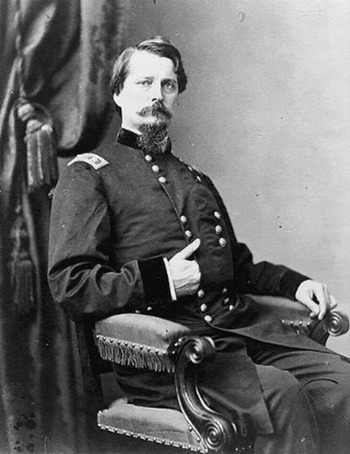
However, what differs between Melville's poem and Shakespeare's play is the way Shakespeare clearly identifies his hero as Henry V, while Melville's speaker does not reveal the identity of the Corps Commander. This omission is one of the great mysteries of the poem. Battle-Pieces was not published with lithographic illustrations (the only means in 1866 for reproducing photographs), and therefore no picture accompanies Melville's poem. One possible explanation for this omission is that Melville wrote the poem believing that his readers would know who the Corps Commander was. In 1866, Melville may have been right in making this assumption. By way of the few references the poem makes in its first stanza, Melville's readers could have identified the leader of the charge at Spotsylvania by his reputation alone. The American Civil War was covered closely by the press, and the names of its heroes were part of daily parlance. Possibly the very mention of Spotsylvania implied the name of this Corps Commander. The possibility is upheld by one of Melville's biographers, Stanton Garner. Garner has identified the Corps Commander as General Winfield Scott Hancock and the photographer as either Mathew Brady himself or one of Brady's team of skilled photographers (Figure 3).Footnote 13 In his discussion of the composition of the poem, Garner justifies Melville's use of the photograph by saying that Melville may never have met Hancock, and so he did not wish to suggest that he had. Thus Melville described Brady's photograph of him.Footnote 14 However, while Garner's assertion seems plausible, it does not explain why Melville does not identify the photograph as a portrait of Hancock. It would not have been pretentious on Melville's part had he entitled his poem “On a Photograph of General Hancock.” Such a title would not have implied that he knew Hancock.
Mathew Brady, “General Winfield Scott Hancock,” 1864, Library of Congress.

An alternative possibility is that Melville saw Brady's photograph as a threat to its own ekphrasis. How can a photograph of a man in a uniform sitting in a chair symbolize universal manliness? How does the face that stares back at us have “a warrior's carriage”? What is less “remiss” in this “eagle mien” than in others? The actual photograph inspires such questions. Melville may well have known this, and so he may well have intuited what W. J. T. Mitchell describes as one of the central elements of ekphrasis. According to Mitchell, in order for ekphrasis to work, “the textual other [the picture that is being described] must remain completely alien; it can never be present, but must be conjured up as a potent absence or a fictive, figural present.”Footnote 15 Mitchell is describing a text–image rivalry in which, were the visual image to appear, it would completely outstrip its ekphrasis. In the case of Melville's poem, Mitchell's observation is all too appropriate. Even while “Corps Commander” celebrates the photograph it describes, in order for it to accomplish this it must escape the banality of Brady's portrait, re-creating this portrait in language.
However, while Mitchell's mandate about ekphrasis answers the question, there remains another possibility as to why Melville excludes the identities of Hancock and Brady. If we return to the principal drive of this poem, recognizing that this drive is ever directed toward abstraction, we recognize how this poem is finally designed to hail an anonymous American masculinity: a masculinity that the speaker strives to describe as a racial and national attribute, not an individual one. Such an effort entails the denial of the individual in a manner that corresponds to Holmes's divorce of form from substance. In short, it is impossible for this speaker to hail General Hancock as a personage to whom one is drawn, for such a declaration would individuate one man amongst the many. In celebrating Hancock's photograph as the image of an anonymous Corps Commander, however, Melville elevates the Commander to a level that, as the poem argues, is but one step below Christ himself:
The power of these final lines does not come from their effect as great poetry; there is much about them that fails to impress. But they are powerful if only in the way that they illustrate the American idealization of violence.
The comparison drawn in the final stanza between the Commander and Christ is a problematic one, when we consider that the soldier's deeds are not the savior's. Killing on the battlefield is not synonymous with sacrifice on the Cross, and yet Melville does not hesitate to make this suggestion, expecting, as he does so many other times in the poem, that the reader “understands.” In this way, “Corps Commander” may reveal more about the American idealization of violence than it does about the photograph it describes, in that the equation that equates Christ with the warrior would seem to correspond to Michael S. Kimmel's insights into how violence has become an acceptable and even cherished aspect of American life. Kimmel writes,
Although we commonly think that all states require the use of violence – that the creation and maintenance of politics requires both a police force and military to subdue both ourselves and others – the equation of violence and masculinity remains particularly strong for Americans. The United States has a long and bloody history specifically of genre violence, in which both individual men and Americans as a nation have demonstrated and proved manhood. It's not just our political and military leaders – although, as we have seen, they certainly have had their issues as well. One psychologist [Wayne Ewing] speakers of a “civic advocacy of violence as socially acceptable, appropriate and necessary.” Our most venerated cultural heroes were soldiers – or, at least, the actors who played them in the movies.Footnote 16
In the poem, Melville's speaker may be said to be upholding the American “civil advocacy of violence” that Ewing describes, in that he associates violence with Christ himself. Placing Christ only one step beyond the Corps Commander, the speaker calls for the readers – his white, Anglo-Saxon, Protestant, Northern, male readers – to venerate this soldier as though he were an archangel one link away from the Savior in the Great Chain of Being. However, in using a photograph for this purpose, Melville's speaker would seem to be unwittingly guilty of violating the iconoclastic tenets of Anglo-American religion. Rather than endorsing the standardized iconoclasm of North American Protestantism, the poetic speaker embraces an idol-like image, venerating it in a manner that calls to mind the ekphrastic literature of the Byzantines or the Catholic Church of the Middle Ages, and, indeed, this similarity is not coincidental. For, if Melville did model his poem after the ekphrases of the Renaissance, his influences stem from this sort of iconophilic tradition.
Celebrating the photograph of the Corps Commander as the image of Christ-like warrior, Melville's speaker celebrates it as something akin to the Volto Santo (“The Holy Face of Christ” as depicted in the Veil of St. Veronica). This comparison is not as outlandish as it may at first seem, given that Melville's poem describes a photograph. The Volto Santo and other sacred relics such as the Shroud of Turin were reputed to have been made without the assistance of human hands. They were acheiropoieton, “unhandmade” things, being created by having come into contact with a divine personage. (Veronica's napkin is marked with an image after wiping the brow of Christ.) When we consider how transcendent photography was to Hawthorne, Holmes and Melville – as well as for the nineteenth-century American public – we understand how it is possible for the speaker to hail the photograph of the Corps Commander as a sacred image of American masculinity, and to elevate this image to the level that he does: like the ancient penates such as the Volto Santo and Image of Edessa, which were famed for having the power to protect the cities in which they were kept, the photograph of the Commander has the power to protect the Union. This is even further substantiated by Melville's allusion to the Templars, who quested after certain relics during the Crusades in order to return them to Europe for the purposes of veneration and divine protection.Footnote 17
This is not the first examination of how photography has influenced American letters. In her In Visible Light (1987), Carol Schloss traces this development through American fiction and nonfiction from Hawthorne's romance to the work of Norman Mailer. However, focussing her study on works of prose, Schloss does not trace the way that photography is dealt with in American verse, nor does her study directly identify how the words “photograph,” “photography,” “camera,” “snapshot” and even “daguerreotype” may well have introduced into American letters a new series of metonyms for truth.
When we consider later American poems that engage in ekphrases of photographs, we come to recognize that while the pseudosciences are no longer invoked in these poems, these words are; and each time they are, they are meant to signify an absolute sort of truth. Consider Robert Lowell's “For the Union Dead” (1964), which ends, in part, on a meditation of a photograph of Hiroshima after the atomic blast: a photograph that Lowell's speaker claims depicts “The Rock of Ages.”Footnote 18 Or consider Kate Daniels's “Testimony of Simone Weil” (1998), in which Daniels – speaking in the persona of Weil – equates “taking up the camera” as “an act of faith.”Footnote 19 These examples are not isolated. Rather, I maintain that they employ the same metonymy Melville does, and that, in so doing, they employ a new topos of the rhetoric of American – if not international – verse.
In referring to this metonymy as a topos, I am, of course, likening it to the topics of ancient rhetoric. Speaking of the influence of these topics, Ernst Robert Curtius describes them as “clichés,” which could be “used in any form of literature” and which “spread to all spheres of life with which literature deals and to which it gives form.”Footnote 20 When we consider how Melville's poem is a crossroads for the issues of the pseudosciences, masculinity, portraiture, literature and Neoplatonic philosophy, we understand that these “spheres of life” – to use Curtius's phrase – meet in this poem in the word “photograph.” Without the presence of this word, Melville's epideixis teeters on the brink of meaninglessness. Therefore the word becomes an imbroglio, a knot which entangles the ancient and the modern, religion and pseudoscience, as well as literature and philosophy. “On the Photograph of a Corps Commander” does not seek to disentangle the metonymic knot that is photography. Rather, it hails it, celebrating the camera's image as a radiant node of truth.