Introduction
Dementia is a major health and social challenge, and is one of Australia's National Health Priority Areas. Over 350,000 Australians are estimated to be living with dementia, and this number is expected to continue to grow (Alzheimer's Australia, 2016). People with dementia are high users of hospital services, with 25% having at least one hospital stay each year (Australian Institute of Health and Welfare, 2013). In hospital, people with dementia have poorer outcomes compared to people without dementia, including longer length of stay and greater risk of in-hospital complications, including falls, pressure injuries, delirium, and death (Bail et al., Reference Bail2013; Tropea et al., Reference Tropea, LoGiudice, Liew, Gorelik and Brand2016). Studies have also shown hospitalized people with dementia are not always receiving best practice or quality dementia care (Sampson et al., Reference Sampson, Gould, Lee and Blanchard2006; Wenger et al., Reference Wenger2007).
Improving the quality of dementia care in hospitals and associated outcomes is imperative. To assist clinicians in delivery of best practice dementia care in hospital, we proposed to develop a multidisciplinary Dementia Care Pathway (the pathway) for use on acute medical wards at two hospitals in Victoria, Australia. Care or clinical pathways “. . .are structured multidisciplinary care plans used by health services to detail essential steps in the care of patients with a specific clinical problem. They aim to link evidence to practice and optimize clinical outcomes while maximizing clinical efficiency” (Rotter et al., Reference Rotter2010). Emergency departments and general medical units were the focus of the pathway activities, as this is where the majority of people with dementia are present and are admitted to at the two hospital sites. Multidisciplinary staff including medical, nursing, pharmacy, and allied health staff (physiotherapy, social work, occupational therapy, speech therapy, and dieticians) from these departments were involved in the pathway project activities. The pathway project involved assessing current practice, identifying barriers, and facilitators to implementation of best practice dementia care, developing a new pathway document to fill gaps in current practice, selecting and tailoring implementation strategies, pilot implementation at two sites, and evaluating the pathway (process and outcome evaluation).
The Knowledge-To-Action-Cycle (KTAC) was used to guide the pathway development and implementation (Straus and Holroyd-Leduc, Reference Straus and Holroyd-Leduc2008; Canadian Institutes of Health Research (CIHR), 2014). The KTAC represents phases of activities (milestones) that are needed for knowledge applications to achieve a practice change. According to the KTAC, prior to developing and implementing the pathway, barriers to knowledge use should be assessed. Knowledge translation interventions can then be tailored to specific barriers and facilitators for change. Barriers to knowledge use can be categorized according to knowledge (lack of familiarity and awareness), attitude/motivation (lack of self-efficacy and agreement), and practitioner behavior (Cabana et al., Reference Cabana1999); and external barriers, including environmental factors, organizational structures, time constraints, and patient factors can influence these categories.
Prior to implementing the pathway, current practice and barriers to implementing best practice dementia carer was assessed using multiple methods, including a staff survey, carer focus group, direct clinical observation, and process mapping the typical patient journey for a person with dementia. This paper reports on results from the staff survey to assess hospital staff knowledge, attitudes and perceived barriers, and facilitators to implementing best practice dementia care.
Methods
Setting and sample
A survey of two hospitals in Victoria, Australia was undertaken between July and September 2014, as part of the Dementia Care Pathway for use in acute care project. The survey targeted multidisciplinary staff from the emergency departments and medical units at both hospitals.
The hospitals that participated in the survey comprised of one major metropolitan hospital with over 500 beds (Hospital A), and one large regional hospital with up to 100 beds (Hospital B). Each hospital had an aged care service with consultant geriatricians. Hospital A has geriatricians consulting on each general medical unit, as well as a geriatrician available for consultations as part of the Consultant Liaison Rehabilitation and Aged Care service. Hospital B had a geriatric consult service provided from a larger regional hospital, with visits and video-conferencing link up with a consultant geriatrician or aged care registrar twice a week.
At the time of the survey, neither of the hospitals had locally developed procedures in place to guide care of people with dementia, or regular training on dementia care. Both hospitals had participated in the Dementia Care in Hospitals Program in 2008, and at the time of the survey, Hospital B was utilizing the Cognitive Impairment Identifier (Ballarat Health Service, 2016). However, there had not been ongoing staff education since the project's conclusion.
Survey design and administration
The survey was designed by the pathway project team which comprised of aged care and general medical clinicians and academics. The survey included 17 items: 3 items about respondents’ current role, work area, and years of experience, 9 Likert scale items, and 3 open ended items. See the Supplementary material for copy of the survey tool.
The five-point Likert scale items (very low to very high) asked those surveyed: to rate their confidence in (i) recognizing a person has dementia, (ii) assessing cognition using a standardized measure; to rate their knowledge of (iii) common symptoms associated with dementia and (iv) best practice dementia care; (v) to rate their job satisfaction in caring for people with dementia; (vi) to rate the hospital's capacity to care for people with dementia, (vii) to rate the support available to staff to provide dementia care in terms of access to experts, services, leadership, equipment, and training; and to rate the dementia friendliness of (viii) the ward environment you work in, and (ix) the overall hospital environment.
Open-ended questions asked participants to list important aspects in caring for people with dementia, barriers and facilitators to implementing best practice dementia care at their hospital, as well as any ideas that could be implemented to improve the quality of dementia care. Respondents could give multiple answers to the open-ended questions.
Emails with a “SurveyMonkey” link (https://www.surveymonkey.com/; last accessed 18 July 2016) were distributed at Hospital A by the medical unit and emergency department nurse unit managers, heads of medical units, and pharmacy and allied health managers. At Hospital B, emails with the Survey Monkey link were emailed directly to all nursing staff, and distributed by the hospital medical offices (HMO) manager, and pharmacy and allied health managers. Hard copies were made available on the targeted wards in staff rooms and in staff pigeon holes at both the hospitals.
Up to two reminder emails were sent by the project staff via managers or by directly emailing staff from participating wards. Responses were collected over a four-week period during July–August 2014 for Hospital A and August–September 2014 for Hospital B.
Descriptive analyses were conducted in Microsoft Office Excel 2010. Responses to open-ended questions were analyzed according to identified themes. The project was approved by the Melbourne Health Human Research Ethics Committee (HREC number 2014.052).
Results
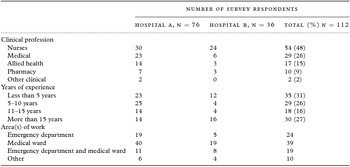
A total of 112 survey responses were received, 76 from Hospital A and 36 from Hospital B. Exact participation rates were unknown as opportunistic sampling was used at both the hospitals. Table 1 summarizes the respondents’ profession, years of experience, and work area. The largest group of respondents was nurses, followed by medical staff.
Survey respondents’ clinical profession, years of experience and area of work

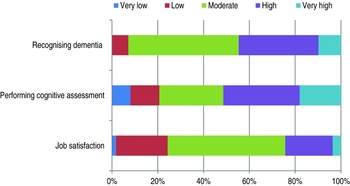
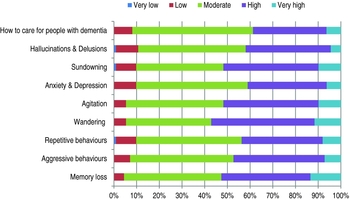
Confidence, satisfaction and self-rated knowledge (Figures 1 and 2)
Most respondents rated their confidence in recognizing a person has dementia and in performing a cognitive assessment as moderate or high. Over 50% of respondents rated their job satisfaction in caring for someone with dementia as moderate, and 23% rated their job satisfaction as low.
Responses to confidence in recognizing a person has dementia, performing a cognitive assessment and job satisfaction in caring for people with dementia (N = 112).

Responses to self-rated knowledge of how to care for people with dementia and common symptoms of dementia (N = 112).

When asked to rate their knowledge of how to care for someone with dementia, 53% rated it as moderate and 32% as high. Nine respondents rated their knowledge of how to care for someone with dementia as low – six were junior staff with less than 5 years’ experience, and three were staff with more than 15 years’ experience.
Overall, most respondents rated their knowledge of common symptoms of dementia as moderate or high. 10% or more of respondents rated their knowledge of hallucinations and delusions, sundowning, repetitive behaviors, and anxiety and depression as low or very low, and over 50% of respondents rated their knowledge of wandering, agitation, sundowning, and memory loss as high or very high.
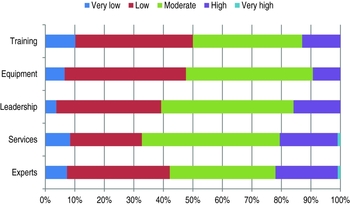
Available support, health service capacity, hospital and ward environment (Figures 3 and 4)
Respondents were asked to rate the support available at the hospital in terms of training, equipment, leadership, and aged care and dementia services and experts. Availability of training and equipment scored the poorest, with approximately half the respondents rating availability to these supports as low or very low. Over half of the respondents from Hospital A rated access to aged care and dementia services, and leadership as moderate (51% and 54%, respectively), and 51% of respondents from Hospital B rated access to training and equipment as low.
Responses to “How would you rate the support available to you at (name of hospital) in caring for people with dementia in terms of the following areas?” (N = 112).

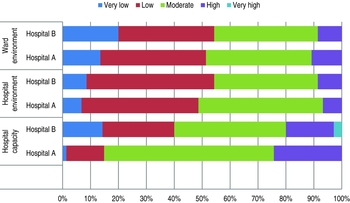
Hospital's capacity to care for people with dementia, dementia-friendly hospital environment and ward environment.

61% of Hospital A respondents and 40% of Hospital B respondents rated their hospital's capacity to care for people with dementia as moderate. Results for rating the “dementia friendliness” of the overall hospital environment and the ward environment were similar for the two hospitals.
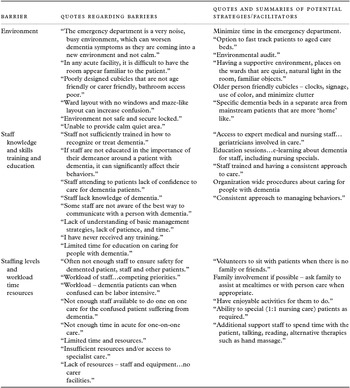
Identified barriers to and facilitators of implementing best practice dementia care (Table 2)
A total of 79 staff completed the open-ended question on barriers to implementing best practice dementia care. The following barriers were identified: environment (66%), staff knowledge and skills (27%), staffing levels and workload (25%), resources and funding (20%), time (18%), and the fast pace or ward culture (10%). Other factors were also identified by 10% or less of respondents, including bed access and bed moves, lack of carer facilities, lack of training and education, access to specialist care, and lack of patient activities, communication within team and with family, and high care needs as barriers.
Quotations from open-ended question to identify barriers to providing best practice dementia care

A total of 64 staff completed the question on facilitators for implementing best practice dementia care. Responses varied between the sites, with access to aged care and dementia services being the facilitator most often listed by Hospital A respondents (33%), and cognitive assessment and cognitive impairment identifier the most frequently listed facilitator by Hospital B respondents (23%). Respondents from both the hospitals identified aged care friendly unit, single rooms and high visibility rooms (22%), wandering alarm and sensor mats (20%), skilled staff and staff awareness (14%), and orientation equipment (13%) as facilitators.
Discussion
This study reports on the results of a survey that aimed to explore hospital staff perceived knowledge and confidence in dementia care, and barriers and facilitators to providing best practice dementia care. Most respondents rated their knowledge of caring for someone with dementia and their confidence in recognizing a person has dementia as moderate. Identified barriers included external factors such as the environment, insufficient time, inadequate staffing levels and workload, as well as factors associated with staff skills and knowledge. Identified facilitators included system-level factors such as good access to aged care and dementia services, equipment including wandering alarms, sensor alarms, clocks and communication boards, and good access to specialist inpatient care.
Our study builds on the limited research exploring hospital staff knowledge and perceived barriers to implementing best practice and quality dementia care in hospital. Borbasi and colleagues (Reference Borbasi, Jones, Lockwood and Emden2006) through semi-structured interviews explored 25 acute hospital staff experiences and perspectives on caring for people with dementia, including characteristics of actual practice and participants’ thoughts on best practice (Borbasi et al., Reference Borbasi, Jones, Lockwood and Emden2006). Like our findings, the hospital environment was described as unfamiliar, unsafe, and overstimulating for people with dementia, which can worsen their confusion. The layout of the ward, limited staff knowledge and understanding of dementia, and an overworked and under-resourced system were reported as major constraints to best practice dementia care.
Fessey (Reference Fessey2007) assessed level of knowledge and understanding of caring for patients with dementia in 49 hospital nurses using a questionnaire (Fessey, Reference Fessey2007). 85% of nurses felt they “only partly” had the skills and knowledge to care effectively for people with dementia. The findings demonstrated that nurses had some knowledge and ability in delivering person-centered dementia care, but more education, support, and communication is required. The following four themes emerged: attitudes toward dementia and implemented care, time, and staffing were seen as important in the delivery of individual care needs, the need to understand the person's behavior in order to provide effective care, and variation in nurses’ knowledge and understanding of dementia.
Galvin et al. (Reference Galvin, Kuntemeier, Al-Hammadi, Germino, Murphy-White and McGillick2010) assessed hospital staff knowledge, confidence, attitudes, and practices before and after implementing an educational program designed to improve care of hospitalized patients with dementia (Galvin et al., Reference Galvin, Kuntemeier, Al-Hammadi, Germino, Murphy-White and McGillick2010). Results of the pre-test survey found 73% of staff rated their ability to assess and recognize dementia between not at all and reasonably, 72% of staff rated their ability to manage care between not at all and reasonably, and 57% agreed it was difficult to work with dementia patients. Like our study, insufficient time and training were perceived barriers to providing best practice care: 37% agreed that they did not have enough time to provide comprehensive dementia care, and 23% felt they had not received sufficient training to take care of people with dementia.
Caring for people with dementia can be challenging, and has been linked to low job satisfaction and staff burnout. Studies set in residential care have shown that training staff can be an effective method of improving well-being, and programs helping staff to manage challenging behavior appear to be the most beneficial (Spector et al., Reference Spector, Revolta and Orrell2016). Robust studies in the hospital setting assessing the impact of staff training on burnout and job satisfaction as well as patient outcomes are lacking.
Based on our study findings, targeted interventions to change practice and minimize the identified barriers need to be selected and developed. To improve staff knowledge of best practice dementia care, development of educational interventions that employ multiple methods, such as use of multimedia presentations, use of clinical scenarios, and vignettes, as well as interventions that increase the interactivity of the sessions will have greater impact on uptake of knowledge and best practice dementia care.
Respondents listed a broad range of environmental factors that impact on provision of care, including factors related to the physical built environment such as access to natural light, and factors associated with over-stimulation from noise, unfamiliar people, fast pace of the ward. Principles of designing environments for people with dementia and environmental audit tools have been developed (Dementia Enabling Environments, 2016). To improve the environment of the ward and hospital, further details need to be explored. For example, are clinical staff, hospital executives and facilities management aware of these design principles and what can be done at the bed-side, ward level, and organization level to maximize these principles?
Simple environmental modifications that are not too costly such as ensuring appropriate lighting for time of day, use of signage with both pictures and words, clocks and calendars, and creating a more personal space (family to bring in photos, patients own night and day clothes) have the potential to be easily implemented in the acute hospital setting. Other changes (such as a circuit for patients to walk around, wander safely, and space where patients can eat away from the bedside) may not be as readily achieved but should be considered in future ward design, maintenance work, or ongoing strategic planning. Hospital policies to minimize bed moves, minimize time spent in noisy emergency departments or to prevent hospital admissions, such as hospital management in the home also need to be explored.
This study has a number of limitations. The survey was developed by the project team, and psychometric properties of the survey instrument were not tested as part of the study. To increase the response rate, the survey was kept as brief as possible and did not explore topics in great detail. We also recognize the survey assessed self-reported or perceived knowledge of dementia and that this may not be a true measure of knowledge of dementia. Finally, the sample size was a convenience sample and may have resulted in biases. Nevertheless, the survey findings provided useful information for the pathway project, and used in conjunction with process mapping, direct clinical observation, and stakeholder input provided valuable information for the pathway development and implementation.
Conclusion
Staff surveyed reported the environment, staff knowledge and skills, and access to training and equipment as barriers to implementing best practice dementia care. Self-reported knowledge and confidence in caring for people with dementia were rated as moderate by most survey respondents. Findings from the survey can be used to inform locally tailored interventions to improve uptake of best practice dementia care.
Conflict of interest declaration
None.
Description of authors’ role
All authors contributed to survey development, study design, and drafting of the paper. J. Tropea coordinated the survey dissemination and collection, and carried out the data analysis.
Acknowledgments
The authors would like to acknowledge the staff who participated in the survey, the Dementia Care Pathway for use in acute care Advisory Group and the Department of Health and Human Services Victoria, Australia for funding the project.
Supplementary material
To view supplementary material for this article, please visit https://doi.org/10.1017/S104161021600185X