Introduction
Public health practitioners are experts in assessing and monitoring the health status of diverse populations; investigating and addressing community and population-level health problems; 1 and developing programmatic interventions to prevent or mitigate the effects of disease transmission. 2 These areas of expertise are aligned with two of the three core functions of public health as set out in the 10 Essential Public Health Services (10 EPHS), a longstanding but evolving framework that outlines the efforts public health entities and practitioners “should undertake” in order to “carry out the mission of public health” and “protect and promote the health of all people in all communities.” 3
The third core function outlined in the 10 EPHS is policy development. 4 It calls on public health practitioners to analyze and develop laws and policies that impact health, partner with and support communities, communicate on a broad scale about public health laws and policies, and utilize legal and regulatory actions. 5 The application of these skills is important because law and policy are foundational to the institutions, practices, and distribution of resources that shape health — and are, accordingly, determinants of health.Reference Weber and Pepin 6
Law and policy are not intuitive, however, and require exposure and skill-building. Governmental public health practitioners who responded to the 2024 Public Health Workforce Interests and Needs Survey indicated that they require additional investment and capacity-building in legal and other policy development skills, such as engaging in and applying systems thinking to address health challenges.Reference Erwin and Brownson 7 Relatedly, practitioners seek practical skills that would allow them to explore and demonstrate how laws and policies influence health outcomes, especially when addressing social determinants of health and health equity.Reference Schneider, McCann and Foster 8 In short, public health practitioners observe how policies influence or shape health outcomes, and they seek training and technical assistance to develop a practical understanding of the legal dimensions of those policies.Reference Burris 9
Since 2015, the Centers for Disease Control and Prevention (CDC), and specifically, its Office of Public Health Law Services (OPHLS), in partnership with ChangeLab Solutions (ChangeLab), Temple University’s Center for Public Health Law Research (CPHLR), and other organizations, has worked to increase the legal and policy capacity of public health practitioners and their partners. One of these efforts has been developing and implementing the State, Tribal, Local, and Territorial Legal Epidemiology Learning Cohort (Learning Cohort). 10 This paper provides an overview of the Learning Cohort, spotlights the efforts of three project teams from its most recent iteration, which took place from 2023 to 2024, and offers perspectives for the future. It also reflects the most recent collaboration between OPHLS and ChangeLab to administer a learning cohort.
Defining Legal Epidemiology
Legal epidemiology is the study of law as a factor in the cause, distribution, and prevention of disease and injury in a population — or more simply, the scientific study of laws and policies to examine their potential effects on population health.Reference Ramanathan 11 Legal epidemiology is comprised of three different elements: legal etiology, legal prevention and control, and policy surveillance.Reference Barbero 12 Legal etiology explores how law constructs the social, economic, and physical environments in which people live. 13 Zoning laws are an example. Legal prevention and control considers how law shapes health institutions and systems and can be used “as a tool of intervention.” 14 Smoke-free laws are an example. The third element of legal epidemiology is policy surveillance, which includes scientific legal mapping, or the systematic, transparent, replicable, precise, and measurable collection, analysis, and mapping of laws across jurisdictions and over time. 15
Legal analysis and evaluation are time-intensive and complex processes. 16 As a result, the Learning Cohort is devoted primarily to one of these elements: legal mapping. While the Learning Cohort introduces participants to all components that are necessary for ensuring the scientific integrity of their projects, such as designing a research question, drafting background research memoranda, and keeping a research protocol, teams devote most of their time to legal mapping. 17 This process includes identifying, reading, analyzing, and systematically coding the text of laws and policies. Legal mapping results in rigorous cross-sectional and longitudinal legal datasets that can be used to increase knowledge of laws across jurisdictions, thereby strengthening the understanding of public health practitioners and others about the content of laws relevant to public health. 18 In short, legal mapping data informs practitioners about what laws say and invite them to examine what those laws might do. These datasets form a critical backbone, along with health outcomes data, of evaluation studies that explore the potential impacts of laws and policies on the health of communities that practitioners serve. Because the foundation setting for conducting legal mapping is time intensive, teams are unable to complete evaluation studies during the eleven- to twelve-month time period. We hope that future iterations of the Learning Cohort will have the requisite resources to continue such work.
Learning Cohort teams not only develop concrete skills in legal and policy research, but also create resources, such as logic models and publicly accessible datasets that inform their work, help them identify innovative practices, and inform their engagement with local and state policymakers and their communities. 19
Background on the Legal Epidemiology Learning Cohort
Although still relatively new, legal epidemiology is a growing field of study, with numerous peer-reviewed articles published every year.Reference Pepin 20 Much of that important work is driven by researchers in academic research settings. In parallel with legal epidemiology’s increasing recognition and acceptance in academic circles, we have anecdotally observed an uptick in interest among members of the public health workforce in legal mapping and legal epidemiology. Teams seek to examine how laws and policies can help address community-level public health needs or improve local public health governance. These assessments are typically smaller in scope due to constraints on time and financial resources.
Anecdotally, we noted increased requests from health departments and researchers, including nonlawyers, for training and technical assistance to conduct assessments in practice-based public health settings; they seek to identify legal and policy origins of acute public health problems that affect the local jurisdictions they serve. This heightened interest in legal epidemiology was also informed by the COVID-19 pandemic.Reference Burris 21 Public health practitioners and others recognized that historic and contemporary laws and policies were tied to the social, economic, geographic, and other disparate conditions that caused some communities to experience excess deaths.Reference Oppel 22
Over the last ten years, OPHLS has developed partnerships with ChangeLab, CPHLR, and others in response to demand from the field for more practice-based legal epidemiology and other policy tools. This work has helped to generate a robust collection of legal epidemiology resources and programs. These include free, on-demand training courses available via the Public Health Law Academy (PHLA) 23 as well as five-year-long legal epidemiology Learning Cohorts (see Figure 1). These trainings and Learning Cohorts have increased legal epidemiology competencies among members of the public health workforce 24 and created a network of public health practitioners who have the knowledge, skills, tools, and abilities to translate legal epidemiology evidence into action. 25
Map of States where Legal Epidemiology Learning Cohort Health Departments and Other Organizations are Based.

Figure 1. Long description
A legend on the left defines three categories. Solid dark purple represents Past Participants. Teal with diagonal stripes represents Both Past and Current Participants. Solid teal represents Current Participants. A note at the bottom left states Regional Designation including L H D s and orgs.
On the map, the distribution is as follows.
In the West and Southwest, W A is teal with stripes. O R, C A, C O, T X, and O K are solid purple.
In the Midwest and Central regions, N E and W I are solid teal. K S is solid teal. M O and I L are solid purple.
In the East and Southeast, P A is solid purple. K Y and G A are teal with stripes. S C is solid teal.
All other states are shown in light gray, indicating no participation status.
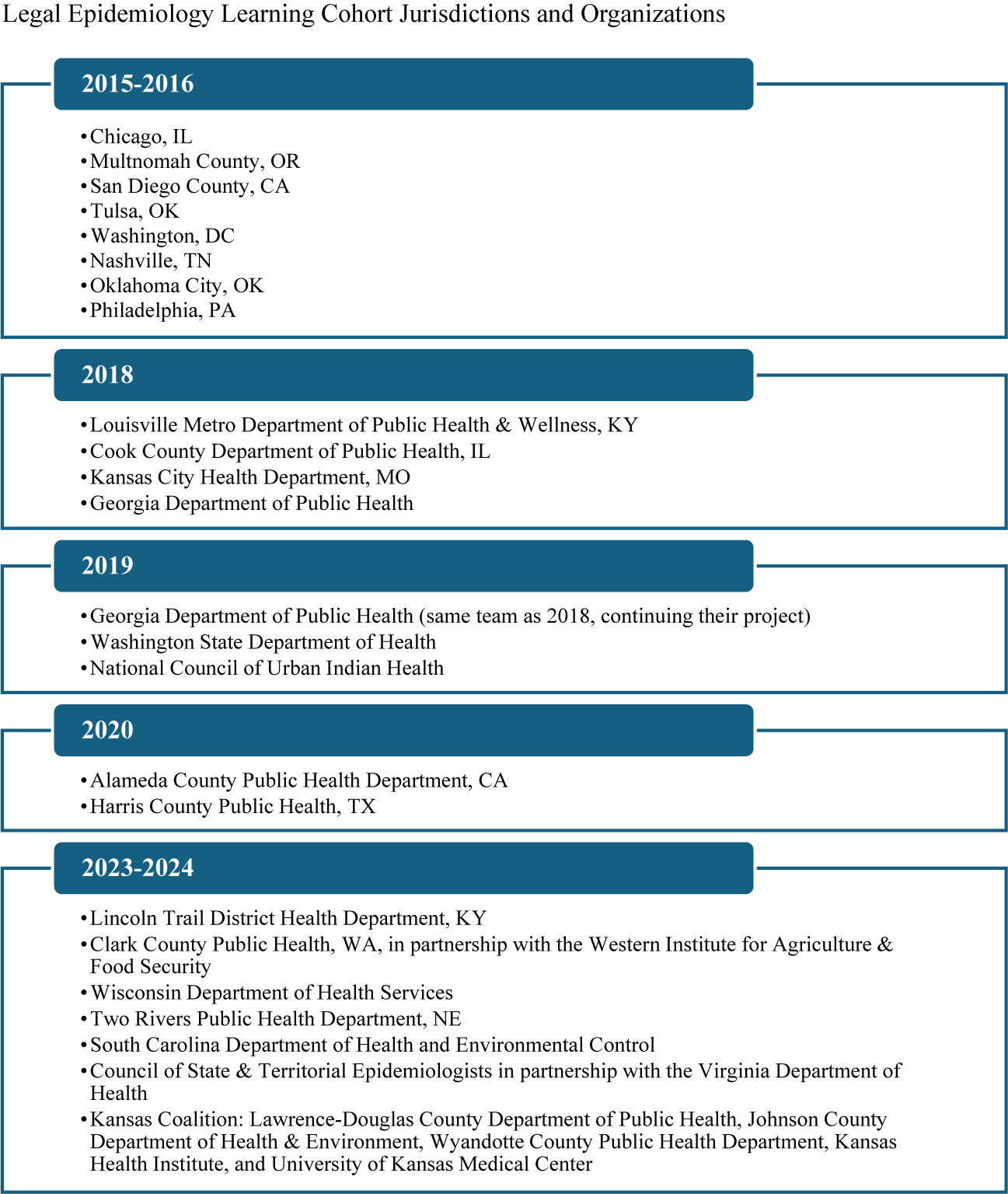
Since its inception, the Learning Cohort has hosted twenty-four teams located across the United States, with representation from local, regional, and state health departments; non-governmental organizations; and academic institutions, among others (see Figure 2). Throughout every Learning Cohort, participants work in transdisciplinary teams that include members with diverse skillsets and varying degrees of legal and policy knowledge to respond to local public health challenges.Reference Michel, Rieckhoff and Crespo 26 Project teams do not always have a lawyer, but they typically do have a champion in their organization’s leadership, and a team member who is dedicated to moving the project forward. Participants determine the composition of their teams, sometimes partnering with practitioners or subject matter experts from outside organizations. They assess the time and availability of staff members, the kinds of quantitative and qualitative expertise their topics might require, and the availability of organizational or external legal counsel.
Legal Epidemiology Learning Cohort Jurisdictions and Organizations.

Figure 2. Long description
The flowchart is divided into five chronological sections.
* 2015-2016: Lists Chicago, I L; Multnomah County, O R; San Diego County, C A; Tulsa, O K; Washington, D C; Nashville, T N; Oklahoma City, O K; and Philadelphia, P A.
* 2018: Lists Louisville Metro Department of Public Health & Wellness, K Y; Cook County Department of Public Health, I L; Kansas City Health Department, M O; and Georgia Department of Public Health.
* 2019: Lists Georgia Department of Public Health (same team as 2018, continuing their project); Washington State Department of Health; and National Council of Urban Indian Health.
* 2020: Lists Alameda County Public Health Department, C A; and Harris County Public Health, T X.
* 2023-2024: Lists Lincoln Trail District Health Department, K Y; Clark County Public Health, W A, in partnership with the Western Institute for Agriculture & Food Security; Wisconsin Department of Health Services; Two Rivers Public Health Department, N E; South Carolina Department of Health and Environmental Control; Council of State & Territorial Epidemiologists in partnership with the Virginia Department of Health; and the Kansas Coalition, which includes Lawrence-Douglas County Department of Public Health, Johnson County Department of Health & Environment, Wyandotte County Public Health Department, Kansas Health Institute, and University of Kansas Medical Center.
In 2022, ChangeLab initiated the first ever national recruiting effort for the March 2023–February 2024 Learning Cohort. (Previous participants had learned about and become involved in the program through some combination of word of mouth and interest expressed to ChangeLab, CPHLR, or OPHLS.) The application was downloaded over 500 times from the ChangeLab website and garnered interest from individuals working at local, state, federal, and international levels. ChangeLab, with limited support from OPHLS, selected seven teams from among 45 completed applications. They were selected because of their diverse geographic locations, proposed topics, capacity to commit personnel to the project, and other factors. Teams were invited to describe the topics they hoped to pursue as members of the Learning Cohort, but they were not held to those topics; indeed, some teams modified their topics after the program started. (Neither Changelab nor OPHLS played a role in the teams’ decision-making.) All selected teams comprised a diverse cross section of state and local health departments and their partners from urban and rural jurisdictions across the country; all teams considered health equity issues embedded in their proposed projects. 27
For the 2023–2024 Learning Cohort, each team received a mentor or pair of mentors, all of whom were CDC staff, credentialed as lawyers, and experienced with conducting legal mapping and/or legal evaluation studies. The Learning Cohort coordinators attempted to match teams with mentors who had overlapping subject matter expertise, but such matches were not always possible. Mentors provided individualized technical assistance, feedback, and other support throughout the program. Teams attended an introductory two-day in-person kickoff session (with a virtual component) at the CDC’s Roybal campus in Atlanta where they connected with each other, began to learn about specific elements of legal epidemiology, and collaborated with each other to further develop their project topics.
During the subsequent eleven months, teams participated in monthly virtual training sessions that were ninety minutes to two hours long. The Learning Cohort’s curriculum included a legal epidemiology workbook developed by ChangeLab and OPHLS in tandem with the sessions. Sessions covered the main elements of setting up a legal epidemiology assessment: (1) developing a research question; (2) formulating a hypothesis; (3) logic modelling; (4) drafting a background research memorandum; (5) clarifying the scope of the research; (6) developing coding questions; (7) identifying relevant laws and/or regulations; (8) conducting additional qualitative research; (9) coding the law and tracking divergences; (10) gathering legal evaluation data. 28
In between monthly training sessions, teams attended individualized technical assistance sessions with their mentors to discuss project-specific questions. They also had an opportunity to attend drop-in office hours to confer with other teams and OPHLS mentors. Project teams also received training on CDC’s Public Health Law Information Portal (PHLIP), which they used for their legal data collection. 29 PHLIP is a CDC-administered, web-based, publicly accessible tool built for conducting legal mapping projects; it allows researchers to upload copies of laws, build coding questions, complete coding, track explanations for coding decisions, and produce datasets, among other activities. Additionally, each team received a small stipend of US$20,000 to support its work. The stipend could also be used to hire additional team members. For example, one team hired a fellow who was studying both public health and law.
One unique aspect of the Learning Cohort curriculum is that it emphasizes the importance of community engagement throughout the legal epidemiology process, from selecting a research question to learning about relevant contextual factors that can inform how to interpret and disseminate results. Such engagement can help to ensure that projects have practical value for communities. Many of the Learning Cohort teams solicited community input on their projects either by partnering directly with community-based organizations on the research, or by using surveys, interviews, and other strategies to build background knowledge on their topics.
Surveys administered before and after the Learning Cohort showed that participants’ knowledge, skills, and abilities for many legal epidemiology competencies increased (the surveys assessed readiness, scoping, research, and analysis). Additionally, on the post-cohort survey, just over 90% of respondents agreed or strongly agreed with the statement, “The monthly virtual training sessions were helpful in moving my legal epidemiology study forward.” One hundred percent of respondents agreed or strongly agreed with the statement, “Legal epidemiology methods and concepts are relevant to my work.” When asked which aspects were most relevant, respondents mentioned, among other things: (1) understanding and describing the impact of public health policies on health outcomes; (2) educating and engaging community members about the potential health impacts of laws; (3) providing neutral, unbiased information to decision makers for use in developing effective policies; (4) having data and proven methods to support or decline support for a policy position; (5) providing decision makers with policy examples from peer jurisdictions, collected through systematic methods; and (6) advocating for legislative, regulatory, and other policy changes. Additionally, 100% of respondents answered “yes” to the question, “I have decided to use or advocate for legal epidemiology methods in my work.”
Spotlight on Recent Project Teams
The seven 2023–2024 Learning Cohort project teams included representatives from the following organizations.
-
1. Clark County Public Health Department in Washington State, working in partnership with the Western Institute for Agriculture and Food Security, comprised of experts in policy, epidemiology, strategic and urban planning; they sought to assess how county-level conservation easements and agricultural advisory bodies can protect and increase access to agricultural land, including for farmers of color;
-
2. The Council of State and Territorial Epidemiologists (CSTE), whose team included a lawyer and senior program analysts, partnered with the Virginia Department of Health’s State Epidemiologist, to assess how laws in six states facilitate or restrict sharing of identifiable health information between state public health agencies and Tribal public health authorities;
-
3. Lincoln Trail District Health Department in Kentucky (Lincoln Trail), whose team of a community epidemiologist, health impacts administrator, and chronic disease prevention manager examined state-level water testing requirements for private wells across ten states in anticipation of a major economic development project that could impact water quality;
-
4. South Carolina Department of Health and Environmental Control, whose team included an in-house lawyer, an epidemiologist, a surveillance coordinator, and multiple department leaders, conducted a fifty-state scan of laws addressing maternal and neonatal transport;
-
5. Two Rivers Public Health Department in Nebraska, whose team included the health department director, an epidemiologist, a planning supervisor, and contract attorneys, explored potential differences in outcomes between local control of food safety certification and centralized or state-led processes;
-
6. Wisconsin Department of Health Services, whose team members worked in policy, state health plan coordination, and epidemiology, conducted a systematic mapping of state-level ballot initiative laws across jurisdictions in the Midwest; and
-
7. A Kansas coalition of organizations that included the University of Kansas Medical Center, the Kansas Health Institute, and three local health departments: Lawrence-Douglas County Public Health, Johnson County Department of Health and Environment, and Wyandotte County Public Health Department (the Kansas Coalition). Their transdisciplinary team studied the health impacts of state-level laws that preempt localities from adopting policies related to minimum wage.
Project teams worked on a diverse range of topics, addressing food policy and food access, data-sharing between Tribal health authorities and state public health entities, public regulation of private water systems, laws relevant to civic engagement, and laws that have implications for maternal and child health. 30 The teams used their learnings and data in a variety of ways, for example to inform state-level regulatory changes, the implementation of state health improvement plans, or to help educate community members and decision makers about their topics. Three of these project teams — Lincoln Trail, CSTE, and the Kansas Coalition — briefly summarize their work below.
Lincoln Trail District Health Department (Lincoln Trail)
In 1974, Congress passed the Safe Drinking Water Act (SDWA), empowering the US Environmental Protection Agency to establish national standards for drinking water to protect against health risks from contaminants. 31 These regulations apply only to public water systems, leaving an estimated 23 million households with private wells responsible for their own water safety and requiring homeowners to conduct periodic testing, among other efforts. 32 Private wells can be vulnerable to contamination by potentially carcinogenic chemicals, pathogens, and natural contaminants such as arsenic and radium. 33 These contaminants can enter groundwater through various means, including man-made disasters as well as “household plumbing and service lines, mining operations, petroleum refineries, electronics manufacturers, municipal waste disposal, and cement plants.” 34
Lincoln Trail’s team became inspired to study state-level laws governing private wells that were not federally regulated under the SDWA after local community members raised concerns about the potential impacts that construction of a new electric vehicle battery plant could have on their groundwater. The Lincoln Trail team learned the plant would be on land near private homes and businesses in an area of Kentucky with a high concentration of private wells. They were interested in the potential environmental, health, and economic risks for residents who maintain their own water supplies. Moreover, they were concerned about the potential effects that water contamination might have on all residents, but especially those communities with concentrated lower incomes who often face disproportionate exposure to environmental pollution.
The team conducted a scientific legal mapping assessment of state laws governing private residential well water in ten jurisdictions as of December 2023. For geographic variability, the team chose two states from each of the five regions in the United States (Oregon, Wyoming, Arizona, Texas, Kansas, Minnesota, Kentucky, North Carolina, New Jersey, and Rhode Island). They asked, among other questions, whether state laws address private residential well water testing, set minimum standards for testing for arsenic, and impose testing requirements after new well construction or during real estate transactions.
They supplemented their research by conducting site visits with wastewater treatment officials. They also developed a survey to assess homeowner experience with well water testing and worked closely with community partners at outreach events and through social media platforms to disseminate the survey to residents. These efforts helped the team to identify gaps in their own state’s laws that did not impose adequate testing requirements that may leave people who obtain drinking water from private wells vulnerable. They also learned that community residents perceived well water to be safer than public water, and by extension, were not testing their water with regularity. By sharing what they learned with local policymakers and local leaders such as public health officials, community organizers, and the governing board of health, the team aims to foster greater collaboration and informed decision-making by both policymakers and communities. This engagement with local policymakers, including city council members and health department representatives, will help ensure that future decisions are grounded in evidence and align with the community’s needs and priorities.
Through participation in this Learning Cohort, the Lincoln Trail team sought to gain insight into how laws and legal frameworks influence public health outcomes, policies, and practices; to develop skills in identifying relevant statutes, regulations, and case law that affect public health; and to learn techniques for collecting, analyzing, and interpreting legal data to assess the effectiveness and impact of public health laws. The team is confident that it successfully achieved these goals and learned the critical significance of deploying legal mapping to advance health equity that ensures that all community members, regardless of socioeconomic status, race, geographic location, housing infrastructure, or other factors, can achieve optimal health outcomes.
Looking ahead, the research team aims to expand the assessment of laws regulating private residential well water across all 50 states. This effort will be conducted in partnership with a CDC Public Health Law Fellow or Extern. The team also hopes to evaluate these laws in relation to specific health outcomes, such as bladder cancer prevalence, and to expand, develop, and enhance community education about well water testing rules. Finally, they aim to empower and engage the community by sharing this concrete data with local community health organizations and by fostering collaboration to collectively strengthen well water testing regulations and support protective measures.
Council of State and Territorial Epidemiologists (CSTE)
The interpretation of state privacy laws governing identifiable health data has a significant impact on the ability of Tribal public health authorities to access the data they need to fulfill their public health responsibilities. 35 Tribal nations and Tribal Epidemiology Centers (TECs) have public health authority status under federal law to access identifiable data to make timely and evidence-based public health decisions; 36 however, they are still frequently restricted from or experience long delays when seeking to access data collected by state or local public health authorities despite having similar or greater authority than those agencies under federal law. 37 CSTE is a member-based organization that works to advance public health policy and increase epidemiologic capacity. Its council is comprised of member states and territories representing public health epidemiologists. 38 As the professional home of applied epidemiologists, support for and interest in the project was widespread within CSTE, among its members, and numerous partner organizations.
As part of the Learning Cohort, a team of staff from the CSTE national office and a CSTE member — the State Epidemiologist of Virginia — examined relevant state-level statutes and regulations that govern the sharing of identifiable health information between state and Tribal public health authorities in six states: Florida, Alaska, Oklahoma, New Mexico, South Dakota, and California. The team chose these states to have a broad geographic representation of states with federally recognized Tribes, to repeat some states examined in prior research (FL, OK, and SD),Reference Hodge, Kaufman and Jaques 39 and to capture states with large numbers of Tribes or large Tribal populations. By participating in the Learning Cohort, the team hoped to learn legal epidemiology methods to share widely among their membership, and to understand the intersection of law, policy, and public health with Tribal sovereignty and health authority. In addition to learning methodological skills, the CSTE team further understood the sources of gaps present in data-sharing between Tribal health authorities and state and local health departments.
As central actors in the public health system, states hold crucial data for public health activities (such as protected health information) that Tribal health authorities do not have and may otherwise be unable to access. For their part, Tribal nations hold sovereign rights to protect the health and well-being of their people, and Tribal health authorities can serve as highly effective force multipliers for public health with their expertise and community connections. However, some state laws and misinterpretations of federal law frequently prevent those entities from exercising their authority. For example, Tribal nations and Tribal health organizations in one of the states examined reported that their requests for data from their state health department are consistently delayed or sometimes denied despite state laws that permit sharing with Tribal health authorities. This highlights a crucial equity issue: without the data they need and have legal rights to access, Tribal health authorities are unable to take effective public health action to address health inequities or public health emergencies in their communities.
CSTE has been able to apply legal epidemiology methods and legal literacy skills to a wide range of reports from partners and national institutes that CSTE staff are often asked to review. The CSTE research team aims to expand this project to scientifically map Tribal data-sharing laws across the 36 states in which federally recognized Tribes operate. The team has engaged and learned from Tribal and state partners during this research effort, and it aims to confirm and share conclusions with the TECs, State Epidemiologists, and other Tribal partners through workshops, conference presentations, and other methods. Finally, the Learning Cohort highlighted for the CSTE team the importance of relationship-building between epidemiologists, public health attorneys, and Tribal partners. These skill sets and perspectives are needed early and often when navigating or discussing how laws might impact community health.
The Kansas Coalition
The Kansas Coalition was a multi-jurisdictional partnership consisting of a transdisciplinary staff from three local health departments and a state health institute. Each partner had previous experiences in which efforts to address social determinants of health through locally driven solutions were restricted or stopped by state-level preemption. Preemption is “a legal doctrine in which a higher level of government may limit or even eliminate the power of a lower level of government to regulate a specific issue.” 40 For example, the federal government, through the Clean Air Act, preempts, with some exceptions and opportunities for waiver, states from setting their own emissions standards for new motor vehicles. The Kansas team was motivated by the impact of the state’s laws preempting local minimum wage and sick leave policies on populations that were most at-risk during the COVID-19 pandemic.
The Kansas Coalition wanted to learn more about the legal foundation and processes for preemption. Its members completed a project that examined state-level preemption of city or county laws that attempted to establish a local minimum wage that was different from the state or federal one. The team mapped the presence of state-level policies preempting local jurisdictions from establishing a local minimum wage and examined distinct characteristics of the existing laws. The group plans to continue this project by conducting evaluation research to understand the possible impact of state-level preemption on locally determined minimum wages. Further, the team hopes to continue to apply these methods to explore how state-level preemption impedes localities’ ability to address other social determinants of health (e.g., restrictions on zoning for low-income housing).
The team hoped that participation in the Learning Cohort would increase staff capacity to conduct legal epidemiology and policy analysis to advance policies that will improve the health of Kansans. The team worked to elevate the concept of legal epidemiology within each partner organization and to enhance understanding of how legal epidemiology can be integrated into public health practice in local governmental public health settings. The team members conducted presentations and summarized their project efforts and findings for their respective organizations. Participation expanded connections among coalition members and helped build shared experience collaborating on policy initiatives across jurisdictions. The team aims to continue applying these skills to increase workforce capacity on policy development.
Summary Reflections: What’s Next for the Legal Epidemiology in Practice-Based Settings?
After partnering on five Learning Cohorts, ChangeLab and OPHLS have identified several successes and opportunities to continue this work. The Learning Cohorts indicate that legal epidemiology is salient to the work of governmental public health practitioners and their partners. 41 For example, participants have noted that legal epidemiology has helped with the following: strengthening relationships within and outside of their health departments by developing and sharing research; creating new opportunities for collaboration; demonstrating health department efforts to address community concerns; and beginning to expand legal literacy and policy development skills within their organizations. Current and past project teams have also deployed their research findings in various ways (e.g., to inform regulatory action, conduct health impact planning, and pursue development of specific policies). Some teams have also developed datasets that are now publicly available. 42 Several teams have presented their research and experiences before both local and national audiences (e.g., the 2019 and 2020 American Public Health Association Annual Meeting, the 2022 and 2024 Public Health Law Practitioners Convening, and the 2024 CSTE Annual Conference).
The Learning Cohorts demonstrate that it is possible for public health practitioners representing a broad spectrum of skillsets, prior education, and expertise to learn and effectively apply legal mapping and other legal epidemiology methods. They indicate that this learning experience can help public health practitioners from diverse backgrounds develop important skills in reading, analyzing, and interpreting laws and policies and examining their effect on public health challenges, and applying these skills to work toward change in their communities. Developing these skills does not diminish the importance of lawyers in legal epidemiology projects, but rather shows that law and policy can be made accessible for individuals who are not lawyers — and can develop and strengthen relationships between lawyers and jurisdictions. Indeed, the 2023–2024 Learning Cohort provided a window into both these outcomes: Two of the teams included dedicated lawyers, and one was able to draw upon contract legal support.
Notably, the Learning Cohorts also demonstrated that public health practitioners can be motivated and excited to conduct legal mapping and legal epidemiology research. The most recent Learning Cohort took place during a time when public health workers have been experiencing unprecedented levels of burnout.Reference McMillin and Kovach 43 Nevertheless, the program received considerable interest and commitment from public health department practitioners around the country. This enthusiasm reflected the dedication of these practitioners to increase their capabilities in line with the 10 Essential Public Health Services and their awareness that law and policy are important tools for responding to community priorities and improving health.
While the Learning Cohort reflects considerable successes, ChangeLab and OPHLS have identified several consistent structural challenges across the five Learning Cohorts that the two organizations have conducted in partnership based on observations and informal feedback from participants. They include: (1) resource constraints on staff time and funding, resulting from decades-long underinvestment in public health departments;Reference Eger and House 44 (2) high staff turnover within local and state public health agencies;Reference Weiss 45 (3) competing priorities, especially during public health emergencies; (4) limited access to attorney support for public health policy work, including legal epidemiology and other types of policy analysis; (5) limited understanding about the value of legal epidemiology among governmental and organizational leadership; (6) lack of trust toward the concept of equity and policy from elected and other public officials and leaders in government.Reference Wolf 46 These challenges have become even more acute recently as efforts to divest from and limit the authority of public health agencies, staff, and research have intensified.Reference Ahmed 47
OPHLS and ChangeLab have collaborated to develop resources that can support long-term changes. For example, we administered a public health law fellowship program to help advance career pathways for health department staff working on law and policy. The PHLA provides training materials that can reach diverse public health and law audiences — and beyond — because they are free and accessible. We are exploring opportunities for Master of Public Health and other academic programs to train future practitioners in public health law. 48 These efforts can support the uptake and sustainability of legal epidemiology as a core health department function. In the short term, new practical strategies may help to meet practitioners where they are and to expand their understanding of legal epidemiology. Accordingly, OPHLS and ChangeLab have worked to: (1) develop tools to help practitioners assess their readiness to engage in legal epidemiology and whether legal epidemiology or an alternative policy analysis tool would best meet their needs; (2) explore how to refine, simplify, and promote legal epidemiology methods (or a streamlined approach to conducting assessments) that can be tailored depending on a practitioner’s goals, policy and planning timelines, and available resources; (3) cultivate interest in and support for legal epidemiology among governmental, academic, and organizational leadership, through dissemination of research and public engagement.
The success of the Learning Cohorts marks an opportunity to expand the policy skills of public health practitioners and strengthen policy development in alignment with the 10 Essential Public Health Services. The Learning Cohort exemplifies efforts to invest in the skills and capacity of the public health workforce, in governmental and adjacent organizations, and to serve the health needs and strengthen the governance needs within our communities and broader society. In a moment of great public confusion about public health practitioners and the important work they do, this is an important time to document and uplift their efforts in the Learning Cohort and comparable programs.
Funding Disclosure
This work was supported by the Centers for Disease Control and Prevention of the US Department of Health and Human Services (HHS) as part of a financial assistance award totaling US$210,000 with 100 percent funded by CDC/HHS. The contents are those of the authors and do not necessarily represent the official views of, nor an endorsement by, CDC/HHS or the US Government. Taylor Pinsent received a stipend from CSTE during the development of this manuscript.
Conflicts of Interest
No conflicts to disclose.