I. INTRODUCTION
Among the numerous multicomponent metallic glassy alloy systems that have recently been discovered, the most important are those based on Zr,Reference Huang, Zheng, He and Shen1–Reference Pecker and Johnson4 Mg,Reference Kyeong, Kim, Lee and Park5,Reference Laws, Shamlaye, Cao, Sciluna and Ferry6 and La.Reference Lee, Li and Schuh7,Reference Bednarcik, Curfs, SiKorski, Franz and Jiang8 These metallic glassy alloys make it possible to cast bulk amorphous samples at a cooling rate less than 100 K/s, pointing at the engineering applications of bulk amorphous alloys as structural materials. To extend their applications, the alloy design, property evaluation, and manufacturing process improvements of metallic glassy alloys need to be further developed and studied.
The Zr-based bulk metallic glass (BMG) alloy system is one of the more prominent metallic glassy alloys due to their wear resistance, corrosion resistance, fracture toughness, and yield strength.Reference Inoue, Fan, Saida and Zhang2,Reference Hufnagel9–Reference Lowhaphandu, Ludrosky, Montgomery and Lewandowski17 To fulfill the recent demanding, the special needs such as high glass forming ability (GFA) together with a wide supercooled liquid region, some multicomponent alloys based on Zr-based BMG alloys have been investigated.Reference Gilbert, Lipmann and Ritchie18–Reference Saotome, Miwa, Zhang and Inoue21 The commercial amorphous alloy Vitreloy™ (Pasadena, California), Zr41.2Ti13.8Cu12.5Ni10Be22.5, can be cast at very low cooling rates of about 1 K/s and a fully amorphous rod up to 14 mm in diameter can be fabricated.Reference Pecker and Johnson4,Reference Wang, Landes, Peker and Liaw11 From a practical point of view, one of the crucial properties of Zr-based BMG alloys is the possibility of achieving complex shape or net shape through the significant viscous flow inherent to supercooled liquids with lower working stress,Reference Pecker and Johnson4,Reference Saotome, Miwa, Zhang and Inoue21–Reference Schroers, Pham, Peker, Paton and Curtis23 and these BMG alloys are potential micromaterials due to their superior mechanical properties. For example, the BMG alloys can be used as high-strength gears, microdies, spring laminations, microengine parts, turbo charger wheel, and turbine blades for mechanical and aerospace application as well as fishing rods, golf club heads and shafts in sport industry.Reference Weinert, Biermann and Bergmann24 In addition, Zr-based BMG alloys also have demonstrated promising potential in biomedical applications, such as surgical instruments, scalpels, dental braces, bone plates, and other biomaterials.Reference Huang, Cao, Meyer, Liaw, Garlea, Dunlap, Zhang and Heb25,Reference Buzzi, Jin, Uggowitzer, Tosatti, Geber and Löffler26 From the machining point of view, the Zr44Ti11Cu10Ni10Be25 BMG alloy can be selected as a material for a net-shaped blow molding process.Reference Schroers, Pham, Peker, Paton and Curtis23 Recently, electro-discharge machining (EDM), which has been proved to be a useful technique for machining implants and modifying their surfaces,Reference Chen, Lin, Chen and Ou27,Reference Zinelis28 has been used to form nanoporous titanium oxide as well as bioactive titanium on pure Ti metal.Reference Peng, Ou, Lin, Pan and Wang29 Most of the research focused on the machinability of BMG alloys machined by traditional machining, for example, cutting and milling. But, little is known about some aspects of these materials' machining behavior when using EDM, and it is important to understand the machining characteristics of these BMG alloys at room temperature in view of their special uses.Reference Chen, Zhang, Zhang and Chen30
EDM is an electro-thermal process in which the material is removed by electro-discharges occurring between the workpiece and a tool electrode immersed in a liquid dielectric medium. These electro-discharges melt and vaporize minute amounts of the workpiece, which are then swept away by the dielectric. Thus, EDM can provide an effective technique for machining intricate and complex shapes in conductive materials. In the present study, we aim to explore the machinability of a Zr38.5Ti16.5Cu15.25Ni9.75Be20 BMG alloy using EDM. The microstructure, composition, hardness, and roughness of the electro-discharge machined (EDMed) surfaces are also discussed.
II. EXPERIMENTAL PROCEDURE
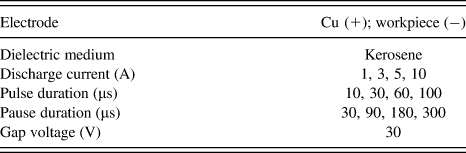
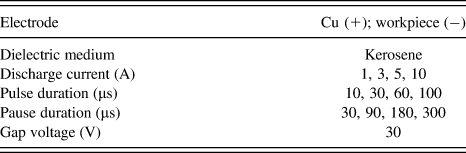
The Zr38.5Ti16.5Cu15.25Ni9.75Be20 BMG alloy, denoted as Zr-BMG and obtained from the Industrial Technology Research Institute in Taiwan, was prepared by arc melting, followed by die casting into plates in an argon atmosphere. The dimensions of the plates are 3 mm in thickness, 100 mm in length, and 55 mm in height. All Zr-BMG plates were mechanically polished with SiC sandpaper (180, 240, 400, 600, and 800 grit). The purity of each element was higher than 99.9%. The heat released or absorbed during the crystallizations was investigated by differential scanning calorimetry (DSC) on a 2910-TA Instrument equipment (Taipei, Taiwan). The running temperature range was from 25 to 550 °C with a heating rate of 20 °C/min. The EDM specimens were performed on a die-sinking EDM machine, model LS-250C, made by Lien-Sheng Co. (Taipei, Taiwan). The operation parameters used in this study are presented in Table I. In this study, the EDM was used to manufacture fine-machined products. Hence, a pulse current in the range of 1–10 A with a pulse duration of 10–100 μs was chosen. The microstructures of EDMed surfaces were examined by x-ray diffraction (XRD), transmission electron microscopy (TEM), scanning electron microscopy (SEM), and secondary electron image (SEI) techniques. The x-ray analyses of EDMed surfaces were performed at room temperature by a Siemens D5000 XRD (Munich, Germany) using Cu Kα radiation. The power was 30 kV × 20 mA and the 2θ scanning rate was 3 °C/min. The morphologies of EDMed surfaces were observed using a Hitachi S3000M SEM (Tokyo, Japan) with EDS facility. Selected area diffraction patterns (SADPs) and TEM images were examined using a PHILIPS CM-200 TWIN microscope (Amsterdam, Netherlands) equipped with a conventional double-tilting stage. A Talysurf profilometer (Leicester, UK) was used to quantitatively evaluate the roughness of the EDMed surface, presented by R a. The cut-off is selected as 0.8 mm. For each piece, the average of readings taken at seven places on the machining plane was chosen as the surface roughness value. Before the surface hardness testing, the EDMed specimens were mounted, ground, and polished to a smooth surface. All specimens were cleaned ultrasonically with alcohol and/or distilled water to remove polishing particles. The hardness measurements were made manually with a regular microvickers pyramid diamond indenter at 25 g load and 15 s dwell time in a Misutoyo MVK-H1 machine (Tokyo, Japan). For each specimen, the average hardness value was taken from at least five test readings.
Machining parameters of EDM in this study.
III. RESULTS AND DISCUSSION
A. EDM machinability of the Zr-BMG alloy
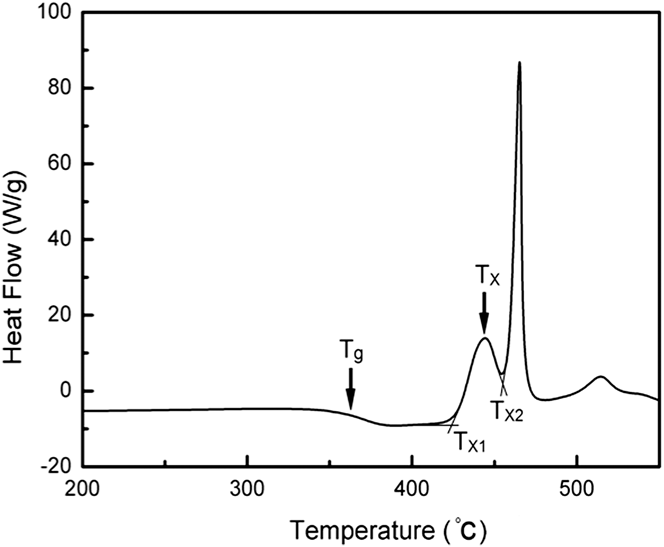
Figure 1 shows the experimental results of DSC measurement for the as-received (as-cast) Zr-BMG alloy. In the DSC curve, two peaks can be observed at around 430 °C (Tx1) and 455 °C (Tx2), which are related to crystallization of the amorphous alloy. Peaks Tx1 and Tx2 indicate that two different phases can be crystallized from the amorphous phase. A slight change in the DSC curve slope can be found at 362 °C, corresponding to the glass transition temperature (T g). The DSC curve indicates that this BMG alloy has a wide supercooled liquid range ΔT(=Tx1 − T g) about 68 °C. The higher ΔT means that this metallic glass alloy has higher GFA. In other words, the larger supercooling liquid region can be used for fabricating micro-parts or micro-dies under lower loads.Reference Saotome, Miwa, Zhang and Inoue21
DSC curves of as-received Zr-BMG alloy.

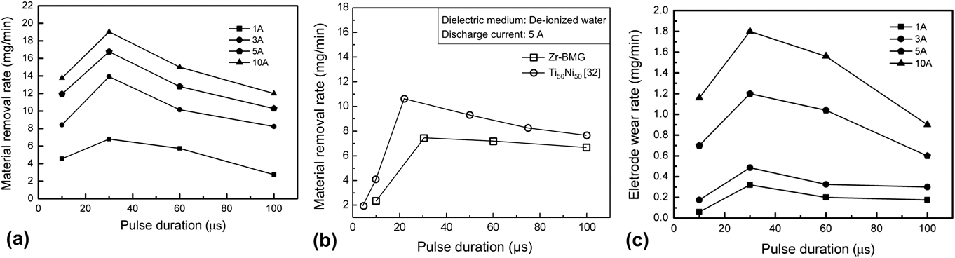
Many machining parameters, such as the discharge current I P, pulse duration τP, electrode polarity, and electrode material, can significantly influence the EDM performance. In the present study, we examine the effects of some of the most important parameters implicated in EDM of Zr-BMG alloy, including discharge current I P and pulse duration τP. Figure 2(a) compares the material removal rate (MRR) versus the pulse duration at various discharge currents for this alloy. In general, higher electro-discharge energy provides the higher MRR. With increased peak current, more energy can be discharged, which causes more material melting and vaporizing on the machining area. This will clearly increase the impulsive force of the expanded dielectric medium and obtain a higher MRR. Furthermore, Fig. 2(a) shows that for various discharge currents, the MRRs initially grow with the pulse duration to reach maximum values and then decrease to constant values. It is expected that the MRR should increase with growing pulse duration because the higher accumulated electro-discharge energy will more rapidly melt and evaporate the material. Moreover, an extended pulse duration will reduce the energy density of the discharge spots by expanding the plasma channel.Reference Gadalla and Bozkurt31 The area covered by EDM is widened and the average energy density is decreased, reducing the MRR. Hence, there appears an optimal pulse duration, saying τP = 30 μs in Fig. 2(a), to have a maximum MRR. In our previous study, a commercially dental restorative material, Ti50Ni50 alloy, has been EDMed in deionized water, and its EDM characteristic has also been investigated. Figure 2(b) compares the MRR of Zr-BMG and Ti50Ni50 alloyReference Wu32 EDMed in deionized water at a discharge current of 5 A. The MMR of Zr-BMG is less than that of Ti50Ni50 at various pulse durations. A previous study has indicated that the MRR feature is related to the melting temperature of the workpiece.Reference Lin, Lin and Cheng33 Materials with lower melting temperature, leading to more melting and evaporation, will therefore cause a higher MRR. Zr-based BMG alloy has a higher melting temperature than Ti50Ni50 alloy, and therefore, it shows a lower MRR.
(a) MRR versus the pulse duration for the Zr-BMG alloy. (b) MRR versus the pulse duration for the Zr-BMG alloy and Ti50Ni50 alloy EDMed at I P = 5 A in deionized water.Reference Wu32 (c) EWR versus pulse duration at various discharge currents for the Zr-BMG alloy.
Based on the specimens mentioned previously under EDM fabrication, the Cu electrode will also slightly melt and evaporate. To enhance the high accuracy and efficiency of EDM, it is important to investigate the consumption of electrode material. Figure 2(c) depicts the electrode wear rate (EWR) versus the pulse duration at various discharge currents for the Zr-BMG alloy. It indicates that the EWR initially increases, reaches a maximum value, and then decreases with growing pulse duration. This change of the EWR with pulse duration reveals a tendency similar to that of the MRR with pulse duration shown in Fig. 2(a). The electro-discharge energy mode also has a significant effect on the EWR.
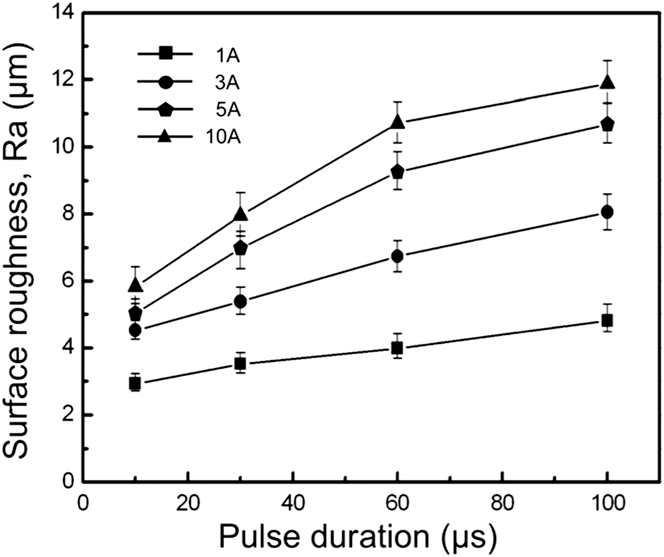
As mentioned above, the electro-discharge energy mode in the EDM process, involving the discharge current I P and pulse duration τP, can also affect the work material's surface roughness. Figure 3 presents the roughness of the EDMed surface versus the pulse duration τP at various discharge currents I P for the Zr-BMG alloy. The surface roughness of the machined surface varies from 2.8 to 12 μm. These results demonstrate that higher discharge current and pulse duration will lead to a rougher EDMed surface. The greater discharge current is conducted into the machining zone, and the more surface erosion of the workpiece is created. This phenomenon will result in a deterioration of the surface roughness. Furthermore, the longer pulse duration gives greater discharge energy to melt and penetrate deeper into the material, causing greater surface roughness on the workpiece. Accordingly, EDM can be used to produce surface finish through the action of an electrical discharge of lower discharge current I P and shorter pulse duration τP between the tool and the workpiece, but this approach takes more time.
Surface roughness versus pulse duration at various discharge currents for the Zr-BMG alloy.
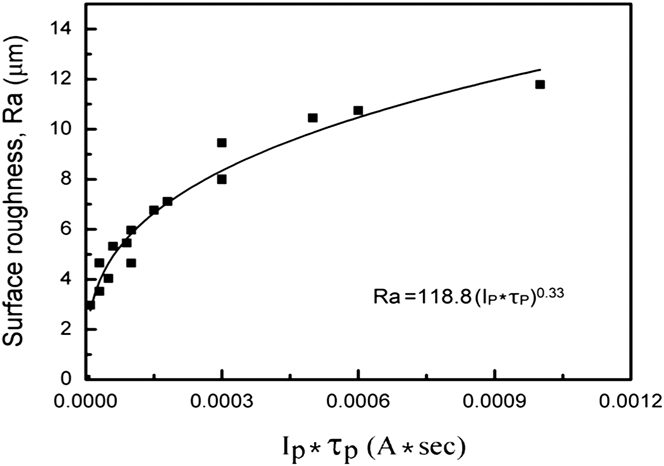
Figure 4 shows the surface roughness R a versus the product of the discharge current I P and pulse duration τP for Zr-BMG alloy. The roughness of an EDMed surface increases with growing pulse energy. This feature is found to obey an empirical equation of R a = β (I P × τP)α, where the constants β and α depend on the tool–work material combination, including the electrode materials, work material's structures, mechanical properties, thermal properties, and the electro-discharge energy mode.Reference Jeswani34,Reference Rebelo, Morao Dias, Kermer and Lebrun35 From the curves shown in Fig. 3, the roughness of the EDMed surface is found to follow the equation R a = 118.8 (I P × τP)0.33 for this alloy. Similar characteristics also occur when EDM of a rectangular steelReference Rebelo, Morao Dias, Kermer and Lebrun35 and Cu–Be alloys.Reference Rebelo, Morao Dias, Kermer and Lebrun36 Furthermore, comparing with Wu'sReference Wu32 study, under the same machining parameters of EDM (I P × τP), the Zr-BMG alloy has a higher surface roughness than Ti49.4Ni50.2Al0.4 alloy.
Surface roughness versus the product of I P and τP for the EDMed Zr-BMG alloy.
B. Surface microstructures and composition analysis of Zr-BMG alloy after the EDM process
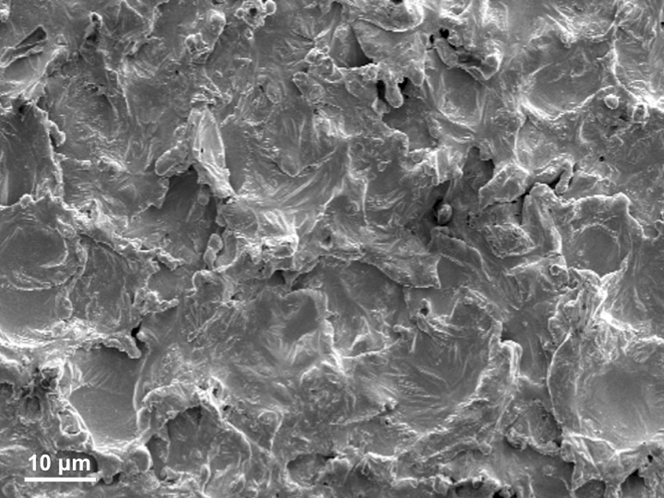
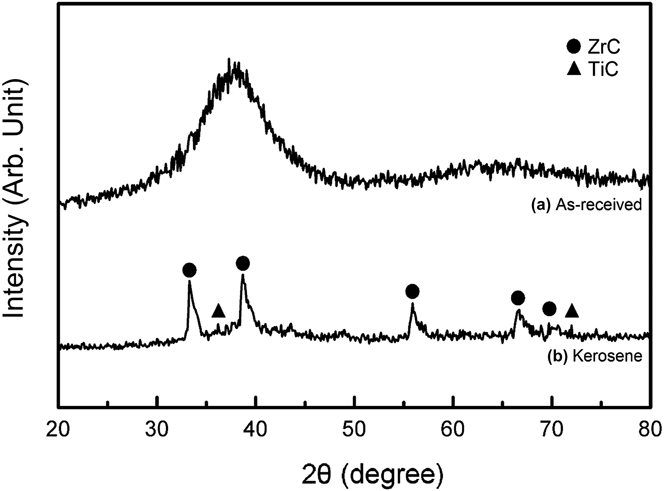
EDM sparks erode the surfaces randomly. Due to the thermal nature of the process, the EDMed surface of the Zr-BMG alloy is characterized by discharge craters, melting drops, and recast materials, as shown in Fig. 5. The XRD patterns of the Zr-BMG alloy are depicted in Fig. 6. These results indicate that one corresponds to an amorphous phase and the other to a crystalline phase on the EDMed surface for this alloy. The principal crystalline phases consist of ZrC and TiC, as shown in Fig. 6(b). The formation of carbides ZrC and TiC is ascribed to Zr and Ti atoms having high chemical affinity with C atoms. Zr-based BMG alloys have been demonstrated to be nontoxic because a thin zirconium oxide film naturally forms on the alloy surface.Reference Huang, Cao, Meyer, Liaw, Garlea, Dunlap, Zhang and Heb25,Reference Buzzi, Jin, Uggowitzer, Tosatti, Geber and Löffler26 After EDM, the surface composition of the Zr-based BMG alloy obviously changed to comprise ZrC and TiC. For ZrC, it exhibited a better cytocompatibility than NiTi alloyReference Chu, Ji, Yin, Pu, Lin and Chu37 and corrosion resistance than 316L stainless steel in phosphate buffered saline.Reference Ding, Zhang, Zhang and Jin38 Ti and C are nontoxic elements, and they can further promote faster osteointegrationReference Shtansky, Gloushankova, Bashkova, Petrzhik, Sheveiko, Kiryukhantsev-Korneev, Reshetov, Grigoryan and Levashov39; therefore, TiC has been considered as a protective film coated on biomedical implants. Moreover, it is demonstrated that TiC coating has improved cytocompatibility than pure Ti by in vitro testReference Brama, Rhodes, Hunt, Ricci, Teghil, Migliaccio, Rocca, Leccisotti, Lioi, Scandurra, De Maria, Ferro, Pu, Panzini, Politi and Scandurr40,Reference Balázsi, Vandrovcová, Bačáková and Balázsi41 and has good osteointegration with rabbit femur.Reference Dibitonto42
SEM micrograph of the EDMed surface for the Zr-BMG alloy.
XRD patterns of the EDMed surface layer for the Zr-BMG alloy.
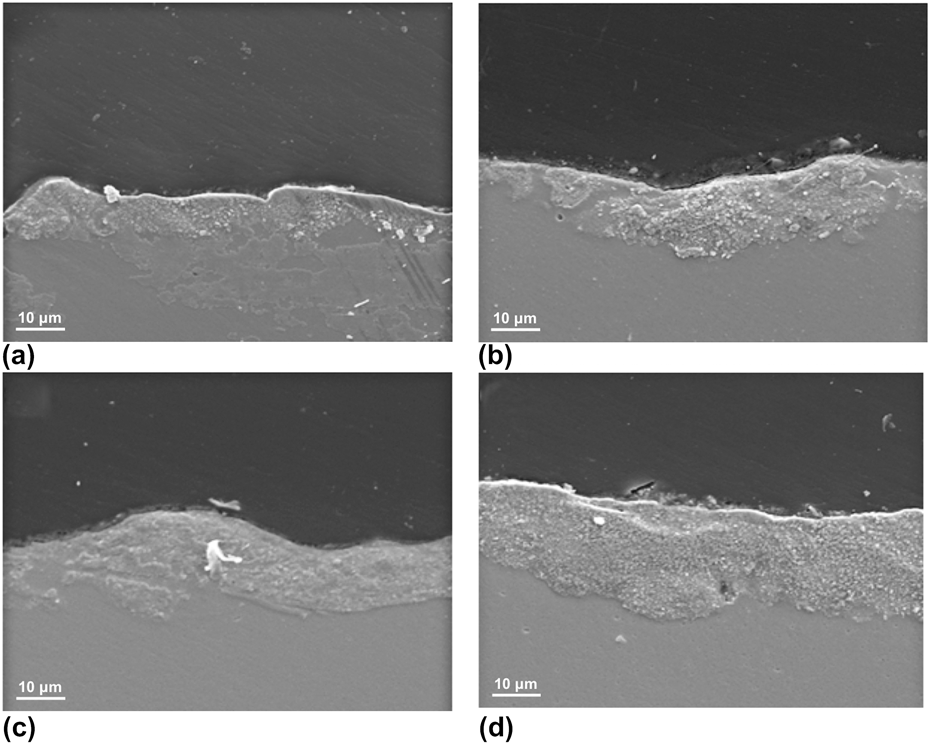
As mentioned above, a large amount of recast materials is deposited on the EDMed surface of the Zr-BMG alloy. Figures 7(a)–7(d) reveal the cross-sectional SEI micrographs near the EDMed surface layer for this alloy under the conditions of I P = 5 A and τP = 10, 30, 60, 100 μs, respectively. Carefully examining Figs. 7(a)–7(d), it indicates that the thickness of the recast layer increases with increasing pulse duration, but reaches a critical value at a maximum MRR at τP = 30 μs. This is explained below. During EDM, the electrode-discharge plasma channel is composed of electron and ion flows. In the early stage, the electron flow is dominant in the plasma channel, and hence, the cathode (workpiece) has lower electro-discharge energy. At the same time, the ratio of positive ion flow in the plasma channel increases with growing pulse durationReference Dibitonto42 and the electro-discharge energy of the workpiece increases, and hence, the thickness of the recast layer grows in the initial pulse duration (≤10 μs). Thereafter, for the optimal pulse duration at the maximal MRR, the thickness of the recast layer can reach a critical value, depending on the flushing of the dielectric medium that removes debris from the discharge zone, as shown in Fig. 7(b). An over-long pulse duration (≥60 μs) will have relatively high accumulated electro-discharge energy. This causes more material to be melted and resolidified, and more of the kerosene dielectric medium be dissolved and deposited on the EDMed surface. If this molten material is not swept away from the surface by the dielectric, it will solidify during the cooling process and form a recast layer. Therefore, the thickness of the recast layer is further increased.
Cross-sectional SEI micrographs near the EDMed surface layer for the Zr-BMG alloy under the conditions of I P = 5 A and τP = (a) 10 μs, (b) 30 μs, (c) 60 μs, and (d) 100 μs.
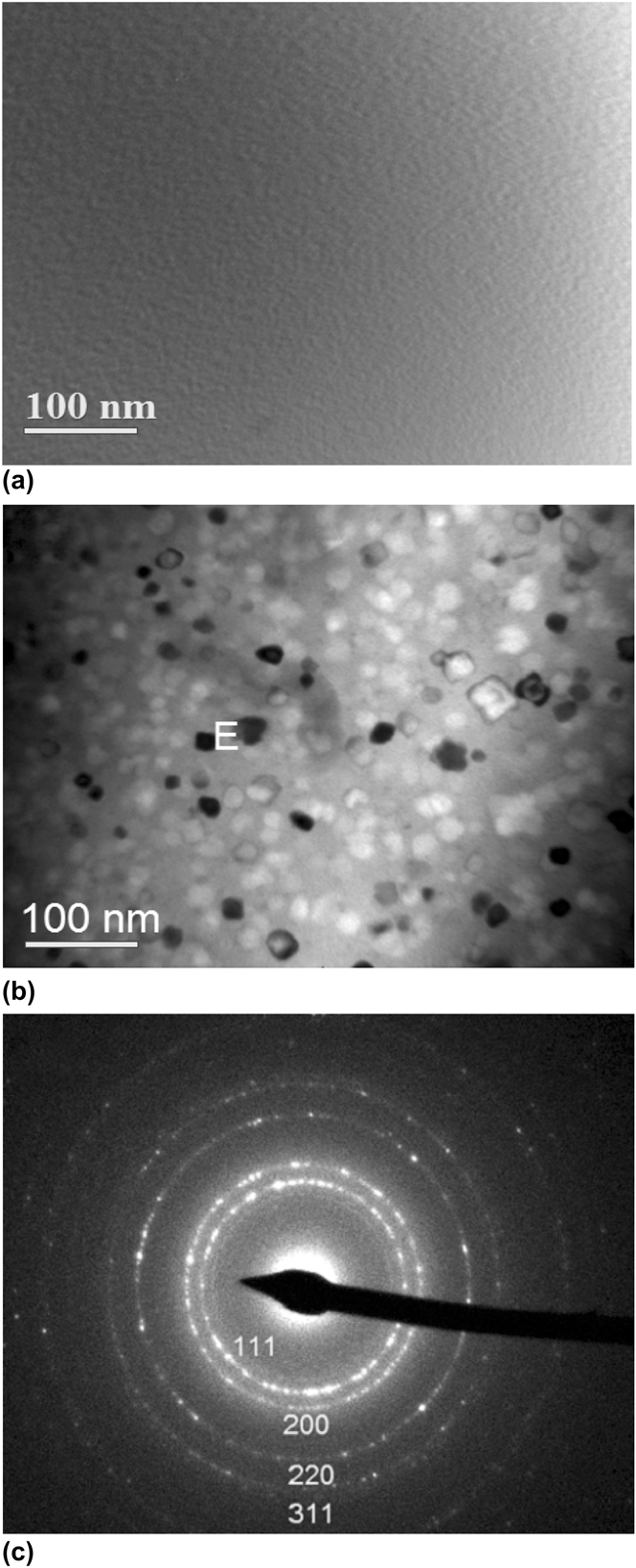
Figures 8(a) and 8(b) show the TEM bright-field images of the amorphous phase in an as-cast specimen and the crystalline phase on the recast layer for the EDMed Zr-BMG alloy, respectively. From Figs. 6(a) and 8(a), no crystalline particles embedded in the amorphous matrix can be found. However, many nanocarbides, ZrC, are found to exist in the recast layer, as shown in Fig. 8(b) with the SADP depicted in Fig. 8(c). The specimen's hardness near the outer surface can reach 605 Hv for the EDMed Zr-BMG alloy, but only 508 Hv for the as-cast one. This surface hardening effect arises from the formation of the carbides, ZrC and TiC, and the deposition particles of the consumed electrode in the recast layer. A similar surface hardening effect can occur in the micro-EDMed La62Al14Ni12Cu12 and Cu46Zr44Al7Y3 alloys.Reference Chen, Zhang, Zhang and Chen30 The hardness of the recast layer strongly depends on the hardness of the BMG alloys. Moreover, many debris can be seen surrounding the edge of the EDMed hole for La62Al14Ni12Cu12 alloy, but only little can be seen for Zr55Al10Ni5Cu30 and Cu46Zr44Al7Y3 alloys. It is because that Zr55Al10Ni5Cu30 and Cu46Zr44Al7Y3 alloys have higher melting temperatures than La-BMG alloy, and their lower fluidities result in less debris.Reference Chen, Zhang, Zhang and Chen30
TEM bright-field images of (a) as-cast Zr-BMG alloy, (b) EDMed Zr-BMG alloy, and (c) SADP taken from the area E in (b), showing ZrC carbides in the recast layer.
IV. CONCLUSION
The EDM characteristics of a Zr-BMG alloy have been investigated in this study. The important conclusions are as follows:
(1) The MRR of a Zr-BMG alloy in the EDM process significantly is related to the electro-discharge energy mode. It increases monotonically with growing discharge current, but appears at the optimal pulse duration, τP = 30 μs at I P = 10 A in this study, to have a maximum value. The EDMed Zr-BMG alloy demonstrates that increasing surface roughness as the discharge current and pulse duration increase. The roughness of EDMed surface increases with the discharge current and pulse duration and follows the empirical equation R a = β(I P × τP)α. Thus, a lower discharge current I P and a shorter pulse duration τP should be selected to have an excellent machined surface finish on a Zr-BMG alloy.
(2) The thickness of the recast layer increases in the early stage, reaches a critical value at the maximal MRR, and then grows in the extended pulse duration again. The recast layer consists of the carbides ZrC, TiC, and the deposition particles of the consumed Cu electrode and dissolved dielectric medium in the recast layer. The specimen's hardness near the outer surface can reach 605 Hv for EDMed Zr-BMG alloy, but the hardness of the matrix is not affected by the EDM process. This hardening effect is due to the formation of the carbides, ZrC and TiC, and the deposition particles of the consumed Cu electrode and the dissolved dielectric medium in the recast layer.
ACKNOWLEDGMENTS
The authors sincerely acknowledge the financial support of this research by the National Science Council (NSC), Republic of China, under Grants NSC 95-2221-E-151-013 and NSC 97-2221-E-151-024. The authors also thank the Taipei Medical University-Shuang Ho Hospital, under grant number TMU100-AE1-B19.