1 Nominal licensing and morphological marking
Minimalist approaches, like their Government and Binding counterparts, often implicitly assume some version of nominal licensing, whereby, even in languages lacking morphological case, overt referential DPs are restricted in their distribution in certain cross-linguistically stable ways (Vergnaud Reference Vergnaud, Freidin, Otero and Luisa Zubizarreta1977/2008, Chomsky Reference Chomsky1981).Footnote [2] While it is often called (abstract) ‘Case’, we refer to this phenomenon more neutrally as Vergnaud licensing, following Pesetsky (Reference Pesetsky2014), for reasons that will become clear shortly (see also Sigurðsson Reference Sigurðsson1991, McFadden Reference McFadden2004 among many others). According to mainstream generative theory, Vergnaud licensing accounts for the distribution of (overt referential) DPs and motivates phenomena such as A-movement (passivisation, raising and, for some, Control). Recent proposals, however, have argued for parameterisation of this property (Harford Perez Reference Harford Perez1985, Markman Reference Markman2009, Diercks Reference Diercks2012 and to some extent Baker Reference Baker2015). Specifically, Diercks (Reference Diercks2012) claims that some Bantu languages behave systematically as though they lack Vergnaud licensing, so that overt referential DPs are not subject to the same restricted distribution observed in other well-studied languages.
There has been much debate regarding the relationship between Vergnaud licensing and the salient morphological properties of case and agreement. While nominal licensing appears to be wholly divorced from morphological case in some languages (e.g. Icelandic), in many other languages the two things appear to be closely related (e.g. French) or at least partially connected (e.g. Walpiri – Legate 2008). This general tendency has led to the characterisation of this property in terms of uninterpretable/abstract Case features. It is perhaps for this reason that Vergnaud licensing has been most widely discussed in relation to languages with morphological case and agreement. What has been much less discussed is the status of Vergnaud licensing in caseless languages, both those which lack case but retain agreement and those lacking any such morphology. In this paper we focus precisely on this issue.
We first introduce the traditional motivations and diagnostics for nominal licensing in Section 2, listing nine diagnostic properties which have been attributed to Vergnaud licensing in languages such as English. By applying these to two Bantu languages in Section 3, we show that there is apparent variation in this family in terms of nominal licensing. Luganda, which is previously undescribed in relation to this issue, patterns with Zulu and the other languages discussed by Diercks (Reference Diercks2012) in failing a number of the Vergnaud-licensing diagnostics, whereas Makhuwa, recently described by Van der Wal (Reference Van der Wal2015a), consistently behaves as though its nominals must be licensed. These two languages both lack morphological case but display rich agreement and provide apparent evidence for the parameterisation of this property in the Bantu family. We then, in Section 4, consider four languages which have been classified as analytic because of their virtual lack of case/agreement morphology (Thai, Yoruba, Mandarin and Jamaican Creole) and assess their behavior with respect to Vergnaud licensing, before dismissing certain diagnostics as inapplicable or unreliable in Section 5. Although the diagnostics, which we adopt and adapt from the literature, face certain challenges when applied to these languages, we nonetheless conclude that these languages all pattern with Makhuwa rather than Luganda in displaying evidence of Vergnaud licensing. Section 6 summarises the results and reassesses the status of Vergnaud licensing in current theory, given these facts.
2 The evidence for Vergnaud licensing
Vergnaud (Reference Vergnaud, Freidin, Otero and Luisa Zubizarreta1977/2008) famously observed that morphological case in richly inflecting languages like Latin tracks very closely the distribution of overt nominals in languages lacking such morphology (e.g. English). This gave rise to the abstract Case proposal, one of the cornerstones of Government and Binding Theory, whereby nominals, unlike other phrases, require ‘licensing’ under government by a heterogeneous set of categories (transitive V, finite T, non-finite C and P). This requirement for nominal licensing is known as the Case Filter, and has recently been referred to as Vergnaud licensing to distinguish it from the processes determining morphological case (Pesetsky Reference Pesetsky2014). The reason for this is that it has long been known that in some well-studied languages morphological case does not track nominal licensing in all instances.
Icelandic is a good example of this (see Andrews Reference Andrews, Maling and Zaenen1976, Zaenen, Maling & Thráinsson Reference Zaenen, Maling and Thráinsson1985, Sigurðsson Reference Sigurðsson1991 among others), but the problem also arises in ‘morphologically ergative languages’, which have the same A- and A-bar properties as accusative languages (Anderson Reference Anderson and Li1976; Legate Reference Legate2008, Reference Legate2012 among many others). A full discussion of mismatches between case morphology and Vergnaud licensing would take us too far afield (see McFadden Reference McFadden2004 for extensive discussion). Note, however, that even in Icelandic, it has been argued that nominals still require Vergnaud licensing, though this functions independently of morphological case (Sigurðsson Reference Sigurðsson1991, Reference Sigurðsson2012).
In Icelandic, quirky dative objects are not inherently licensed, since they can raise to a subject position in passives, as illustrated in (1) below (see Zaenen et al. Reference Zaenen, Maling and Thráinsson1985 for convincing evidence that the dative is a genuine subject). As such, it is immediately clear that morphological case is distinct from Vergnaud licensing in the language. Moreover, quirky dative subjects of non-finite clauses are subject to further licensing constraints (compare (2) and (3)):


While the subjects in both (2) and (3) have quirky dative case, this does not, famously, serve to license them. In (2), the dative subject is presumably licensed by the matrix transitive verb via ECM. In (3), however, the matrix verb is intransitive and so the result is ungrammaticality (although an in-situ dative would be licensed in object base position as the associate of the expletive). While this is strong evidence against a close connection between morphological case and nominal licensing, as many have noted, it is arguably evidence for a more abstract nominal licensing requirement (see Sigurðsson Reference Sigurðsson2012 for this conclusion and a recent take on this issue).
Now consider ergativity. It is worth noting that in addition to morphologically ergative languages (e.g. Walpiri, Niuean), there are also so-called ‘syntactically ergative languages’: both those which display ergative A-bar properties (i.e. ban A-bar extraction of transitive subjects) but accusative A-properties (Tagalog, Chukchi), and those which display ergative A- and A-bar properties, the so-called high absolutive languages, which fail to license absolutive objects in non-finite clauses – Q’anjob’al, Seediq (see Aldridge Reference Aldridge2004, Reference Aldridge2008; Legate Reference Legate2008, Reference Legate2012; Deal Reference Deal, Alexiadou and Kiss2015; Coon, Pedro & Preminger Reference Coon, Pedro and Preminger2014; Sheehan Reference Sheehan2017). The contrast between high absolutive (high ABS) Q’anjob’al and low absolutive (low ABS) Chol (both Mayan languages) can be seen in: (i) the location of absolutive morphology on the aspect marker or verb respectively (4)–(5), (ii) the availability of absolutive case in aspectless nominalisations (6)–(7) and (iii) the possibility of A-bar extraction of the transitive ergative subject (8) (all data from Coon et al. Reference Coon, Pedro and Preminger2014, see also Tada Reference Tada1993). Note that for the external argument of a transitive predicate to be A-bar extracted in Q’anjob’al, the verb must be bear either antipassive or agent focus morphology:


The crucial point here, from our perspective, is the assumption, argued for by Coon et al., that, in Q’anjob’al, the object fails to be licensed in Aspectless nominalisations because absolutive Case is not available. The analysis proposed by Coon et al. (Reference Coon, Pedro and Preminger2014) for this is that absolutive agreement is the spell out of Agree with v in Chol and Agree with INFL in Q’anjob’al. Once again, then, this seems to highlight that while case/agreement and nominal licensing are not intrinsically linked (i.e. we can find mismatches), (i) there is some notion of nominal licensing which is common to many languages and (ii) this can be realised via morphological case (though it need not be). In Q’anjob’al, the relationship between agreement and licensing is transparent: ABS agreement is always the spell out of Agree with INFL, whereas in Chol it is opaque, as ABS agreement can be the spell out of Agree with either INFL (in intransitive contexts) or v (in transitive contexts).
This (imperfect) connection between Vergnaud licensing and morphological case/agreement in some languages has heavily influenced generative theory. Chomsky (Reference Chomsky1995, Reference Chomsky, Martin, Michaels and Uriagereka2000, Reference Chomsky2001) translates the Government and Binding Case Filter into a system in which uninterpretable Case features on DPs must be deleted for convergence. According to the Uniformity Principle, the default assumption is that this should be a universal property of natural language syntax, with what is parameterised being only how languages realise these syntactic dependencies in their morphology (Chomsky Reference Chomsky2001). Some languages realise both the [uCase] feature (as morphological case) and the verbal [uPhi] feature (as agreement), others realise only one or the other, and many languages realise neither. In other languages, like Icelandic, case morphology and licensing function semi-autonomously, but the feature relevant to Vergnaud licensing is still standardly assumed to be [uCase].
The original motivation for Vergnaud licensing is centred on the grammaticality/ungrammaticality of overt subject DPs in finite vs. non-finite clauses and the distribution of adpositions, with the latter assumed to reveal contexts where structural licensing is unavailable. In the course of more than four decades of research, however, many other surface properties have been attributed to Vergnaud licensing. In what follows we summarise nine potential diagnostics for nominal licensing, before applying these diagnostics to a variety of unrelated languages in order to assess its cross-linguistic status.
The diagnostics we take to be descriptive in nature, and we see them as a potential cluster of associated properties, based on the behavior of English and some other Indo-European languages. We use them to test the extent to which properties cluster together in languages lacking morphological case.Footnote [4] To the extent that some of them do, we assume that there must be an explanation for this. The current study is thus intended to form the basis of a more informed, theoretically-oriented discussion of nominal licensing in a broader range of languages than is usual.
While some of the diagnostics we discuss are widely assumed ((i)–(iii), (vi), (viii) and (ix)), others are less uniformly accepted ((iv), (v) and (vii)). We are nonetheless initially maximally inclusive here for methodological reasons, though we indicate some of the controversial issues for each diagnostic as we progress. The diagnostics are as follows:
(i) Non-finite clauses. Assuming that Vergnaud licensing as subject is dependent on some (language-specific) aspect of finiteness (agreement – Raposo Reference Raposo1987; Chomsky Reference Chomsky1995, Reference Chomsky2001; Quicoli Reference Quicoli and Freidin1996; tense – Haegeman Reference Haegeman, van Riemsdijk and Muysken1985; Iatridou Reference Iatridou1993; Varlokosta Reference Varlokosta1994; Martin Reference Martin1996; Pesetsky & Torrego Reference Pesetsky and Torrego2001, Reference Pesetsky, Torrego, Guéron and Lecarme2004; Alexiadou & Anagnostopoulou Reference Alexiadou, Anagnostopoulou, Alexiadou, Anagnostopoulou, Barbiers and Gärtner2002; clausal (in)dependence – Sitaridou Reference Sitaridou, Costa and Silva2006; aspect – Adger & Harbour Reference Adger and Harbour2007, Coon Reference Coon2013, Coon et al. Reference Coon, Pedro and Preminger2014; see also Cowper Reference Cowper2002, Landau Reference Landau2004 and Nikolaeva Reference Nikolaeva2007 on the broader notion of finiteness), if a language fails to permit overt referential DP subjects in a coherent class of independently diagnosable non-finite (i.e. agreementless/tenseless/aspectless) clauses, then the language has Vergnaud licensing. If it shows no such restriction then it may lack Vergnaud licensing. We examine three potential non-finite environments:Footnote [5]
(ia) Complements of raising verbs:

(ib) Complements of control verbs without Exceptional Case Marking or an overt complementiser:

(ic) Sentential subjects without an overt complementiser:

A potential fourth environment is non-finite adjunct clauses, such as in ‘*We got some money [John to buy pancakes]’. We have not included these since it is generally more difficult to establish the (non-)finite nature of adjunct clauses (see Haspelmath & König Reference Haspelmath and König1995). We do not, however, expect these to behave differently from complement clauses with respect to subject licensing.
(ii) Agreement. In a language with Vergnaud licensing in which morphology tracks the former, all else being equal, high agreement will track the grammatical function of subject (see Pesetsky & Torrego Reference Pesetsky and Torrego2001),Footnote [6] so (modulo quirky subjects) the presence of non-agreeing ‘subject’ DPs suggests the absence of Vergnaud licensing: unless there is some other licensing mechanism available for such subjects they remain unlicensed.Footnote [7] For example, in Standard English, the verb agrees with nominative subjects, even if they are in a postverbal position. As we shall see below, this is not true for all languages.Footnote [8]

(iii) Activity. According to the Activity Condition (Chomsky Reference Chomsky, Martin, Michaels and Uriagereka2000, Reference Chomsky2001), a DP cannot be targeted for
 $\unicode[STIX]{x03C6}$
-agreement or A-movement once it has been Vergnaud-licensed. If the language permits movement from a Vergnaud-licensed position to another A-position, this hyperactive movement suggest that the language lacks nominal licensing (see Carstens Reference Carstens2011). In English, for example, raising can take place only from non-finite complements (13b) as finite complements are subject licensing domains (13a).

(iv) Passive agents. If the agent-DP of a passive can be realised without special morphology or some alternative licensing mechanism such as a preposition (14), then Vergnaud licensing may not play a role in the language. Likewise, if the language has only a short passive and disallows the overt expression of the demoted external argument, then this indicates (indirectly) that the language has Vergnaud licensing, assuming the problem here is the lack of a licenser for the demoted agent-DP.

(v) Grammatical-function–based asymmetry. If a language has subject/object asymmetries (e.g. extraction asymmetries, that–trace effects) that cannot be accounted for by appealing to (a) information structure or (b) theta-role asymmetries, then these asymmetries may be due to Vergnaud licensing (Pesetsky & Torrego Reference Pesetsky and Torrego2001, Reference Pesetsky, Torrego, Guéron and Lecarme2004). If a language lacks such asymmetries, Vergnaud licensing may or may not play a role.Footnote
[9]
 $^{\text{,}}$
Footnote
[10]

Note that the existence of syntactic ergativity (discussed above) whereby such a restriction applies only to (transitive) ergative subjects, is strong evidence that the relevant notion here is related to Vergnaud licensing, which can in turn be reflected in surface morphology.Footnote [11]
(vi) Morphology. If a language has morphological case which does not track theta-roles or information structure then it may also have Vergnaud licensing, but not vice versa. At the heart of this is the observation that in English, as in many other languages, there is no stable correspondence between the morphological cases (Nominative, Accusative) and theta-roles (Agent, Theme, etc.).Footnote [12]

(vii) Anaphors. According to the dominant generative analysis, it is not possible to agree with anaphors (Rizzi Reference Rizzi1990, Woolford Reference Woolford1999). It follows that if a language has subject anaphors it cannot have subject agreement and by implication the subject cannot be Vergnaud-licensed, showing the absence of nominal licensing. Conversely, if a language displays a ban on subject anaphors, it follows that the language in question has subject agreement and hence presumably has Vergnaud licensing. English falls under this account as a language which has (limited) subject verb agreement and hence bans subject anaphors. Crucial in this regard is the contrast between (17c–d), which shows that subjects can contain non-nominative anaphors, so this is not a fact about binding domains:Footnote [13]

(viii) Assigners. Assuming that not all categories are licensers, if DPs in a given language pattern differently when they are the arguments of a coherent class of categories (i.e. verb/preposition as opposed to adjective/noun) then the language has Vergnaud licensing.

(ix) Assignees. Assuming that DPs need licensing but CPs do not (Stowell Reference Stowell1981), if DPs pattern differently from CPs in a given language in terms of their distribution/marking, then the language has Vergnaud licensing. If there is no such difference then either the language lacks Vergnaud licensing, or CPs also require licensing.

This list of nine diagnostics is by no means intended to be exhaustive, but as it is representative of the evidence in favour of abstract Case in a language like English, it serves as a starting point to examine the cross-linguistic status of Vergnaud licensing. Although some of these diagnostics are fairly controversial (see the footnotes and further discussion in Section 5), the relevant question here is whether these properties cluster together in a wider sample of languages. If they do (as we argue in this paper), then we submit that a unified account should be preferable as it is more parsimonious (see also Diercks Reference Diercks2012), though we acknowledge that Case Theory as it stands is somewhat deficient as an explanation for reasons to which we return below.
3 Parameterised nominal licensing in Bantu: Luganda vs. Makhuwa
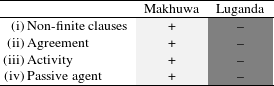
New data from Luganda (spoken in Uganda) show that this Bantu language patterns with the languages that Diercks (Reference Diercks2012) labels as ‘Caseless’ and which lack Vergnaud licensing in our terms, whereas the data for Makhuwa (spoken in Mozambique) show the opposite setting on most of our diagnostics (Van der Wal Reference Van der Wal2015a). This is summarised in Table 1. We present the evidence for the four relevant diagnostics in the remainder of this section.
Case diagnostics.

 $+=$
evidence of Case, –
 $=$
evidence of no Case; shading
 $=$
same value
3.1 DP subject of a non-finite clause
Assuming that only finite clauses are subject-licensing domains, a restriction on the presence of overt referential DP subjects in non-finite clauses is indicative of the presence of Vergnaud licensing, whereas the absence of such a restriction argues for its absence.Footnote [14] As mentioned above, we can test this restriction where clauses function as the complements of raising/control verbs and where they function as subjects.
Luganda freely allows overt subjects in non-finite (agreementless) complement clauses of raising verbs (20), as well as non-finite complements of control predicates (21), and overt DP subjects are grammatical in non-finite subject clauses (22), like the Bantu languages argued to lack Case by Diercks (Reference Diercks2012) (Digo, Swahili and Lubukusu).Footnote [15]


Makhuwa, however, patterns differently, failing to permit overt DP subjects in such contexts (Van der Wal Reference Van der Wal2015a). Makhuwa appears to lack raising-to-subject verbs, which leaves two environments to test. First, non-finite complements to control predicates cannot contain an overt subject (23a, b). Instead, a subjunctive (optative) needs to be used (23c).

Second, what seems to be an overt subject DP of a non-finite (agreementless) clausal subject is necessarily interpreted as a vocative followed by a pause (24b), that is, non-finite clausal subjects cannot themselves contain overt subjects, arguing for the presence of Case in Makhuwa.

This test thus diagnoses Luganda as a language where DPs do not need to be Vergnaud-licensed, whereas Makhuwa DPs are shown to require licensing.
3.2 Subject agreement
In Luganda, the ‘subject marker’ can agree with a preverbal subject, as in (25a), or with a preverbal locative when the logical subject occurs postverbally, as in (25b).

The postverbal logical subject omuwala ‘girl’ in the locative inversion construction (25b) is not licensed by agreement on the verb, nor does it behave like an object. As Diercks (Reference Diercks2012) summarises, there have been many proposals regarding how to account for this lack of licensing, but he suggests that the simplest and most elegant solution is to abandon Case for these languages: the postverbal DP simply does not need to be Vergnaud-licensed. The agreement on the verb has been argued to be more sensitive either to position (Baker Reference Baker2008 proposes that Agree in Bantu is always upward) or to information structure (Morimoto Reference Morimoto2006 proposes that this is topic agreement rather than subject agreement). Either way, the crucial point is that agreement does not track the grammatical function of subject in these languages, hence cannot be a reflex of Vergnaud licensing.
In Makhuwa, on the other hand, the verb always agrees with the subject regardless of whether the latter occupies a pre- or postverbal position, as shown in (26). We take this to be the result of agreement tracking licensing in this language (see more detailed discussion in Van der Wal Reference Van der Wal2015a).

This diagnostic again illustrates the difference between Luganda, which does not require its DPs to be Vergnaud licensed, and Makhuwa which does.
3.3 Activity
According to Chomsky (Reference Chomsky, Martin, Michaels and Uriagereka2000, Reference Chomsky2001) uninterpretable Case features serve to render DPs active for
 $\unicode[STIX]{x03C6}$
-agreement (the Activity Condition). Upon Agree, a DP’s uninterpretable Case feature is deleted and the DP thus becomes unavailable for further Agree relations of this kind. The empirical prediction of this account is that agreement with, and A-movement of, a Vergnaud-licensed DP should be blocked. It follows that if a language permits DPs to be active even after they have been licensed, as evidenced by hyperagreement and hyperraising, then the implication is that activity does not apply or at least that abstract Case does not function as an activator for DPs, which is consistent with a lack of abstract Case, or, in our terms, the irrelevance of Vergnaud licensing.Footnote
[18]
 $^{,}$
Footnote
[19]
In Luganda, hyperactivity is visible in complex tenses that have two inflected verbs which both agree with the subject as in (27a), and in hyperraising, where both the raising verb and the lower verb agree with the raised subject, as in (27b).

The possibility of idioms, as per (27a), shows that this is movement rather than base generation and concord (see also Carstens & Diercks Reference Carstens, Diercks, Kan, Moore-Cantwell and Staubs2013 on Lubukusu and Lusaamia). If Luganda has Vergnaud licensing then this A-movement from a licensed position would be unexpected.
Makhuwa, at first sight, appears to show multiple agreement in complex tenses as well, as shown in (28).

However, it can be shown that this is not a hyperactive construction. First, there are no real raising predicates in Makhuwa, second, the durative form never licenses an overt referential subject, and third, the lower verb in the durative form (kithelaka) can be shown to be a non-finite agreeing participle-like verb form (see the concord analysis in Henderson Reference Henderson, Arasanyin and Pemberton2006). Van der Wal (Reference Van der Wal2015a) discusses the correlates of finiteness in Makhuwa, concluding that it is not dependent on
 $\unicode[STIX]{x03C6}$
completeness or (semantic) tense, but rather on independent sentencehood. The lower dependent verb form (the durative kithelaka in (28)) does not show evidence of independent sentencehood, and is therefore not a finite verb, suggesting that there is no movement to multiple Case positions, hence no hyperagreement.
The same conclusion is reached: DPs must be Vergnaud-licensed in Makhuwa but not in Luganda.
3.4 Passive agent
In a typical passive, the agent is demoted from subject position. It is still part of the thematic structure, but it is not licensed by the verb and hence needs a preposition (‘by’ in English) to appear overtly. Thus, if a language allows the agent DP to surface without any such licensing, this is indicative of the lack of Vergnaud licensing, and vice versa. As expected by now, the two languages, once again, behave differently here.
Luganda allows the overt expression of the agent without any preposition or licensing ‘linker’, whereas in Makhuwa a preposition is required:

One could think that the function of the preposition is not only to license the agent, but to introduce the agent in the theta-structure of the verb, therefore not necessarily telling us anything about Case. However, the felicity of agent-oriented adverbs and purpose clauses in the Makhuwa passive, as presented in Van der Wal (Reference Van der Wal2015a), show that the agent argument is still present in the passive in Makhuwa even when not overtly expressed, and so the problem lies in its overt expression. This diagnostic is not discussed by Diercks (Reference Diercks2012), but a cursory glance suggests that at least some of the languages he discusses apparently pattern with Makhuwa rather than Luganda on this diagnostic, unexpectedly. The prediction is that in Lubukusu the agent-introducing preposition has a different non-licensing function unlike that which it has in Makhuwa. Further investigation is needed to ascertain whether this is the case.
The careful reader will note that we have only actually discussed four of our nine diagnostics here. The reason for this, as will become clear below, is that diagnostic (v) fails to be revealing in these languages, for reasons we outline in Section 4.3. Diagnostics (vi)–(ix) we argue to be problematic as cross-linguistic diagnostics of Vergnaud licensing, both in Bantu and beyond. We delay this discussion until Section 5, when we discuss all six of our languages together.
In conclusion, the Bantu languages Luganda and Makhuwa clearly pattern differently with respect to the above diagnostics, suggesting that DPs do not need to be Vergnaud-licensed in Luganda, whereas they do in Makhuwa. This is a very interesting result as it suggests that: (i) there is a cluster of surface properties associated with nominal licensing which pattern together; (ii) not all caseless languages pattern alike with respect to nominal licensing and (iii) even closely related languages pattern differently. Diercks’ proposed analysis is that the [uCase] feature is simply missing from DPs in languages like Lubukusu and Zulu (and Luganda) so that no licensing is required. Given the rich agreement morphology in Luganda and Makhuwa, moreover, it is easy to see how this featural difference could be acquired by a child. The very diagnostics discussed above would all lead the child to post [uCase] in Makhuwa but potentially not in Luganda.
Two interesting follow-up questions can now be asked: First, is the appearance of DPs unrestricted in a language without Vergnaud licensing (like Luganda)? Second, what happens in a language which lacks inflection altogether (i.e. neither case nor agreement): do we find the same parameterisation among analytic languages? The first question is addressed in Section 6.1 and the second question forms the core of our discussion in the next section.
4 Vergnaud licensing in languages without morphological case or agreement
To assess the status of Vergnaud-licensing in languages without agreement or case (on full DPs), we now apply the diagnostics to four analytic languages: Thai (Tai-Kadai, spoken in Thailand), Jamaican Creole (English lexifier Creole, spoken in Jamaica), Yoruba (Niger-Kordofanian, Benue-Congo, spoken in Nigeria), and Mandarin (Sino-Tibetan, Chinese, spoken in China). These languages were chosen as four unrelated but typologically similar languages for which we had access to native speaker informants. We used a uniform questionnaire in our elicitation with native speakers, and combined this with a survey of the available literature, grammars of the various languages and consultation with language specialists.
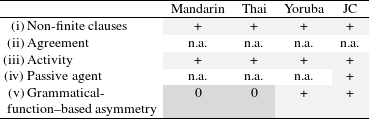
Of the nine diagnostics presented in Section 2, the second is, of course, not applicable to these languages as they uniformly lack verbal agreement and the final four turn out to be unreliable, as we shall see below. This leaves us with four (reliable) diagnostics to test the status of Vergnaud licensing in these languages: non-finite clauses, activity, grammatical-function–based asymmetries and licensing of the passive agent. We discuss these in detail in the following subsections – Table 2 summarises our results.
As is obvious from this table, only Jamaican Creole passes all of the relevant diagnostics, but all of the other languages pass at least two of them and show no negative values. Crucially, to the extent that they are applicable and informative, the diagnostics pattern together, suggesting that something limits the distribution of over referential subjects in all these languages.
Case diagnostics for analytical languages.

 $+=$
evidence of Case, –
 $=$
evidence of no Case, 0
 $=$
compatible with either, n.a.
 $=$
test cannot be applied, ?
 $=$
no data or unclear data, JC
 $=$
Jamaican Creole; shading
 $=$
same value
4.1 DP subject of a non-finite clause
As mentioned above, assuming that non-finite T does not have the ability to license subject DPs, if overt referential subject DPs are permitted in non-finite clauses, then this points to the absence of Vergnaud licensing, and vice versa.
A significant methodological obstacle arises in analytic languages as the distinction between finite and non-finite clauses in these languages is not straightforward. Even if there is a class of contexts which fail to license overt referential DP subjects, this cannot be taken as evidence for Case in the absence of some independent diagnostic for ‘non-finiteness’ lest the argument become circular. Fortunately, in all languages in our study, independent diagnostics for non-finiteness are available. Thai and Mandarin lack an overt marker of non-finiteness, but have tense/aspect markers which are restricted to finite clauses. The Thai irrealis marker càʔ and perfective marker laew are not possible in non-finite clauses (Jenks Reference Jenks2006) nor are the Mandarin modals hui ‘will’, neng ‘can’, keyi ‘may’ or yinggai ‘should’ (Huang Reference Huang, Jaeggli and Safir1989). Other potential finiteness diagnostics in Mandarin include the distribution/scope of the aspectual particles le and zai and the availability of object shift (see Huang Reference Huang1982, Reference Huang, Jaeggli and Safir1989; Li Reference Li1985, Reference Li1990; Tang Reference Tang1990; Tsai Reference Tsai1995; Tang Reference Tang2000; Paul Reference Paul2002; Lin Reference Lin2011; but also Hu, Pan & Xu 2001 for some objections). Yoruba has the non-finite marker láti which appears in the T position and which is incompatible with the finite complementiser pé (31), and Jamaican Creole uses the non-finite marker fi versus finite se or dat.

Once the finite/non-finite distinction is controlled for in this independent way, all four languages fail to license overt DPs as the subjects of non-finite clauses, providing evidence for the Vergnaud licensing.
In Yoruba, non-finite clauses cannot host overt DP subjects. We have not been able to find a genuine raising predicate in Yoruba. Predicates such as jo̩ ‘resemble/seem’ take finite complements (as indicated by the finite complementiser and the impossibility of the non-finite marker láti) and occur either with an expletive subject (32a) or in a copy-raising construction (32b), to which we return in Section 4.2:


We nonetheless find evidence that overt referential DPs are not licensed in non-finite clauses from the complements of control predicates. In control contexts, overt DPs are only possible if the preposition fún is present (superficially, at least, similarly to English ‘for’), and even then they are very marginal for one of our two informants. Note crucially that fún is not required where the subject of the clause is PRO:

Finite complements are also permitted in such contexts with overt DP subjects:

Finally, non-finite subject clauses, which are obligatorily extraposed, also cannot host an overt DP subject unless the preposition fún is present. Again, fún is only required where the clause has an overt referential subject:

Much like Yoruba and English, Jamaican Creole also shows a ban on overt subjects in non-finite clauses. Jamaican Creole again has copy-raising rather than true raising (see Section 4.2), but overt referential subjects in control contexts (38) are ungrammatical in the absence of the non-finite complementiser fi. Where a non-finite clause functions as a subject, however, the complementiser fi is required even where there is no overt subject, and so this context tells us nothing.Footnote [20] Note that there are two distinct fis here, one which is presumably a T element, which follows the subject and is generally optional and the other which precedes the subject and looks superficially like English for and Yoruba fún:


Thai again behaves similarly, though it lacks both (straightforward) raising verbs and non-finite clausal subjects. Nonfinite clausal subjects are not accepted, even without overt referential subjects, as shown in (40).

Instead, non-finite subject clauses are rendered via a nominalisation (41a), (42), a relative clause (41b) or via two paratactic clauses (41c), even when there is no overt subject.


This leaves us with one Thai context in which to test for the possibility of overt subjects in non-finite clauses: the complements of control predicates. In this context, an overt referential DP can be the subject of a finite complement clause (43a), but a benefactive marker is required to license the overt subject of a non-finite complement (43b). Without the benefactive marker, the sentence will be interpreted as two paratactic clauses (43c).

As mentioned above, we know that (43b) is non-finite and (43c) is finite, as the irrealis marker càʔ (b
 $^{\prime }$
, c
 $^{\prime }$
) and the perfect marker
 (b
 $^{\prime \prime }$
, c
 $^{\prime \prime }$
) can be added in the latter but not the former:

Mandarin Chinese paints a more complicated picture, which, however, we argue also provides potential evidence for Vergnaud licensing. The clausal complements of predicates such as sihu, hoaxing ‘seem’ and keneng ‘likely/probably’ can host overt referential subjects, but these are finite, as diagnosed by the possibility of them hosting modals (Huang Reference Huang, Jaeggli and Safir1989), and these morphemes do not in any case behave like verbs (J-w. Lin Reference Lin2010, Pan & Paul Reference Pan and Paul2014).

As such, although (44a) looks superficially like the pattern observed in Luganda, it is actually wholly distinct. The grammaticality of what looks like hyperraising in (44b) presents a different challenge related to activity, which we return to in Section 4.2. There is, however, a raising verb which appears to select non-finite complements. J. T. H. Lin (Reference Lin2011) argues that the modal hui is itself a genuine raising predicate which takes a non-finite TP complement and requires obligatory raising of the embedded subject:

As mentioned above, further diagnostics for finiteness in Mandarin include the distribution/scope of the aspectual particles le and zai and the availability of object shift (see Huang Reference Huang1982, Reference Huang, Jaeggli and Safir1989; Li Reference Li1990; Tang Reference Tang1990; Tsai Reference Tsai1995; Tang Reference Tang2000; Paul Reference Paul2002; Lin Reference Lin2011). Evidence that the complement in (45) is non-finite comes from its incompatibility with the perfect/inchoative particle le, as shown in (46) (from Lin Reference Lin2011). Examples of this kind, then, potentially support the idea that Mandarin has Case (though this is not Lin’s conclusion): a DP subject cannot be licensed in a non-finite clause.

With respect to the second non-finite context (control complements), Huang (Reference Huang, Jaeggli and Safir1989) shows that Chinese has genuine instances of obligatory control where the clause (i) is non-finite (as evidenced by the ungrammaticality of modals) and (ii) cannot host an overt subject (see also Grano Reference Grano2012 for a different analysis of these patterns).

These kinds of complements can be contrasted with finite complements which can host both a modal and an overt referential subject:

It is a point of variation between English and Mandarin which matrix predicates take a non-finite obligatory control complement of the kind in (47) vs. a finite complement of the kind in (48). Consider examples (49)–(50), for example, which involve what would be obligatory control predicates in English, but which take finite complements in Mandarin, according to our diagnostics.Footnote [21]

The same story holds in the third environment for our non-finite diagnostic. Mandarin subject clauses can also host overt DPs in the absence of any overt Case-marker:

But again, these sentential subjects can also host modals and so appear to be finite clauses, even where the subject is null and generic:

Taking into account these language-specific diagnostics for non-finiteness, there are no clear examples of overt DPs being hosted in the subject position of non-finite clauses in Mandarin.Footnote [22]
In summary, if nominative Case licensing is dependent on (some aspect of) finiteness, the ungrammaticality of overt subject DPs in (independently diagnosable) non-finite clauses is evidence for the relevance of Vergnaud licensing in these languages.
4.2 (Hyper)Activity
Hyperactive agreement (Carstens Reference Carstens2011) is not easy to diagnose in languages lacking verbal inflection. However, given that the languages under discussion all have clear finiteness diagnostics, it is nonetheless possible to ask whether hyperraising is possible.
Yoruba and JC do not permit hyperraising but do have copy raising:

Copy raising is observed in a diverse range of languages with and without morphological case (e.g. English, Swedish, Greek, Samoan, Hebrew, Irish, Haitain Creole, Igbo, Persian and Turkish – see Adesola Reference Adesola2005; Asudeh & Toivonen Reference Asudeh, Toivonen, Butt and King2006, Reference Asudeh and Toivonen2012 and the references cited therein). Although this phenomenon poses potential challenges for Case Theory, it is very generally analysed as a phenomenon distinct from hyperactivity: Potsdam & Runner (Reference Potsdam, Runner, Andronis, Ball, Elston and Neuvel2001) propose that in the English construction ‘John seems like he’s ill’, the matrix subject is a thematic argument of seem, base-generated in the matrix clause, and so no raising takes place. Note that in English, copy raising structures nonetheless alternate with an expletive, as Asudeh & Toivonen (Reference Asudeh, Toivonen, Butt and King2006: 3) note, making them look very similar to the Yoruba examples above:

Superficially, Mandarin and Thai appear to show hyperactivity:

Upon closer inspection, however, neither of these examples patterns with hyperraising. Keneng in the Mandarin examples is probably a sentential adverbial (Pan & Paul Reference Pan and Paul2014) rather than a raising verb. The interpretation of the Thai examples reveals them to be an example of copy raising (in a null subject language). As Asudeh & Toivonen (Reference Asudeh, Toivonen, Butt and King2006), note, copy raising, unlike (hyper)raising, fails what they call ‘the puzzle of the absent cook’. Consider a context where ‘A and B walk into Tom’s kitchen. There’s no sign of Tom, but there are various things bubbling away on the stove and there are several ingredients on the counter, apparently waiting to be used’. In such contexts, they note, it would be odd to use the copy-raising example in (58a), whereas the raising example in (58b) is wholly natural:

In Thai, the preferred contexts for the raised and non-raised subjects differ in such a way that a copy-raising analysis is most likely.

The apparent optionality in (56) would thus be wholly parallel with that observed in Jamaican Creole and Yoruba, with the additional complication that both the expletive and embedded subject are null in Thai.
In conclusion, while three of the four analytic languages display copy raising, none of them has hyperraising. For this reason we can tentatively conclude that in all four languages the Activity condition holds, which in turn is evidence that DPs are subject to Vergnaud licensing in these languages.
4.3 Grammatical-function–based asymmetries
The fourth diagnostic concerns asymmetries between arguments which require reference to grammatical functions. This diagnostic holds only unidirectionally: a language in which such asymmetries exist must have Vergnaud licensing, but in the absence of such asymmetries we cannot conclude anything about the relevance of Vergnaud licensing in a given language.
The first such asymmetry, observed in Jamaican Creole, is that–trace effects, which Pesetsky & Torrego (Reference Pesetsky and Torrego2001) attribute to asymmetries in Case-licensing, specifically to the fact that nominative case is a [uT] feature so that subject movement to specCP interacts with the C–T relation. Even in approaches such as that of Erlewine (Reference Erlewine2014, Reference Erlewine2016) which attribute the effect to anti-locality, it is the licensing of the subject which is responsible for subject movement to specTP:

Yoruba displays a similar subject/non-subject asymmetry. Unlike non-subject extraction, subject extraction in wh-questions or focus constructions requires the presence of a non-agreeing resumptive expletive pronoun (Adesola Reference Adesola2005, citing Carstens Reference Carstens1986, Pulleybank Reference Pulleybank and Borer1986):

We assume that expletive insertion of this kind avoids the that–trace effect as the argument can be extracted from its low post-verbal position (Rizzi Reference Rizzi1982). JC and Yoruba thus test positive on this diagnostic.
Yoruba furthermore shows a superficially very different grammatical process, which has also been argued to be sensitive to accusative Case: low tone deletion (LTD). LTD has been argued to take place only where the verb is followed by an overt accusative Case-marked XP (Carstens Reference Carstens1987, Déchaine Reference Déchaine2001, Ajíbóyè et al. Reference Ajíbóyè, Déchaine, Gick and Pulleyblank2011). Thus, DP complements of V trigger low tone deletion (62), but PP complements (63) and adjuncts (64) do not and nor do clausal complements:

As Déchaine (Reference Déchaine2001: 89) shows, there are even minimal pairs where the same DP triggers LTD where it functions as a complement but not where it is an adjunct:

In gerunds, postverbal (genitive) subjects fail to trigger LTD unlike complements (Déchaine Reference Déchaine2001: 89), presumably because only the latter have accusative Case.
Finally, bisyllabic verbs assign genitive Case (or more neutrally, select for inherent Case-marked genitive complements) and also fail to trigger LTD:

LTD can therefore be taken as further evidence for the role of Vergnaud licensing in Yoruba.
We have found no evidence for any GF-related asymmetry in Mandarin, Thai, Luganda or Makhuwa. This could be either because no such asymmetry exists or because we have simply failed to find it in these languages. Either way, the result would be consistent with these languages nonetheless having Vergnaud licensing and a concomitant notion of grammatical function. The status of that–trace effects remains undecided but even if it is a universal effect arising from something as deep as criterial freezing (Rizzi Reference Rizzi and Haegeman1997, Reference Rizzi and Shlonsky2015), then well studied languages, too, have well studied ways to circumvent this effect (see footnote 9 above). The lack of such an asymmetry can therefore not be taken as evidence against the relevance of Vergnaud licensing in a given language.
4.4 Passive agent
The obligatory licensing of an overt agent DP in a passive can only be tested if the language in question actually has a passive. This unfortunately makes this diagnostic inapplicable in three of our four analytic languages. Nonetheless, in Jamaican Creole, which does have a true passive, this diagnostic provides indirect evidence that DPs must be Vergnaud-licensed.
Yoruba lacks a passive, and the constructions that are often labelled passives in Thai and Mandarin have properties more reminiscent of tough-constructions (see Sudmuk Reference Sudmuk, Butt and King2003 for Thai and Huang 1999 for Mandarin, but see also Biggs Reference Biggs2014 for a critique of this analysis and an alternative view).Footnote [23] Thus the status of the ‘passive’ morphemes bei in Mandarin (68) and thùuk in Thai (69) is debatable. Furthermore, Thai thùuk is only used with adversatives (Filbeck Reference Filbeck1973, among others); in other contexts, a topicalisation construction (70) is used, making any test involving a passive inapplicable.

Jamaican Creole has a ‘short passive’ (Winford Reference Winford1993, LaCharité & Wellington Reference LaCharité and Wellington1999), but it does not allow for overt agent phrases.Footnote [24] One possible analysis of this fact is that overt referential agents cannot be overtly expressed because they cannot be licensed.Footnote [25] If so, then the ban on overt agents in JC passives can be taken as further evidence for the relevance of Vergnaud licensing in this language.

Note that it is not the case that JC lacks the relevant kind of preposition, as it actually allows a ‘by’-phrase with anti-causatives:

Where the agent is overtly expressed in Jamaican Creole, a focus construction seems to be used, rather than the passive:

Although this last diagnostic is not applicable to most of the analytic languages in our sample, then, the data for Jamaican Creole are suggestive. Morever, the other three diagnostics provide evidence in favour of nominal licensing in all four analytic languages. There seems to be no analytic language which patterns with Luganda in not requiring DPs to be Vergnaud-licensed. While further detailed investigation of other analytic languages is clearly necessary, we nonetheless take this to indicate that Vergnaud licensing is a pervasive feature of natural language, even in languages that lack case and agreement morphology.
5 Less reliable diagnostics
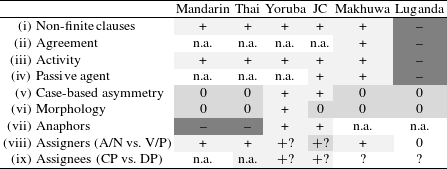
Thus far, we have discussed five diagnostics and applied them, where possible, to the six languages under discussion. There are, however, four further diagnostics introduced in Section 2 which we have not yet considered beyond their application to English. This is because we find these diagnostics to be less reliable when applied to the languages in our sample. We now discuss these diagnostics in turn, illustrating the problems with data from the six languages we examined, which pattern as in Table 3. One diagnostic is theoretically suspect, one yields contradictory results and the remaining two are difficult to apply in the languages in question for reasons to be discussed below.
Case diagnostics.

 $+=$
evidence of Vergnaud licensing, –
 $=$
evidence for lack of Vergnaud licensing, 0
 $=$
compatible with either, n.a.
 $=$
test cannot be applied, ?
 $=$
no data or unclear data, JC
 $=$
Jamaican Creole; shading
 $=$
same value
5.1 Morphological case
On a traditional view of morphological and abstract Case, the fact that a language has morphological case distinctions which track not theta-roles but grammatical functions tells us that said language has Vergnaud licensing (assuming with Legate Reference Legate2008 that morphology needs something to spell out).
None of the six languages under investigation mark morphological case on DPs. However, Yoruba has evidence of morphological case in its pronominal system, making a distinction between nominative, accusative and genitive in its weak (clitic) pronouns:Footnote [26]

Given traditional assumptions, this would entail that Yoruba tests positive for Vergnaud licensing on this diagnostic.Footnote [28]
However, as an anonymous JL referee points out, some theories of morphological case explicitly claim that morphological case is not parasitic on nominal licensing (see Marantz Reference Marantz, Westphal, Ao and Chae1991, Pesetsky Reference Pesetsky2014). If such approaches are correct, even for some languages, then it follows that the presence of morphological case cannot be taken as (indirect) evidence of Vergnaud licensing. Even if such approaches are shown to be misguided (which seems unlikely), the point stands that many languages show mismatches between morphological case and grammatical function, so morphology can be taken at best as a very unreliable indicator of abstract licensing. We discussed examples from Icelandic and morphologically but not syntactically ergative languages in Section 2, but the same point can be made with reference to differential case marking (e.g. Aissen Reference Aissen2003, Jelinek & Carnie Reference Jelinek, Carnie, Carnie, Harley and Willie2003, de Hoop & de Swart Reference de Hoop and de Swart2008, Dalrymple & Nikolaeva Reference Dalrymple and Nikolaeva2011 among many others) and co-dependent/inverse marking (Béjar & Rezac Reference Béjar and Rezac2009, Keine Reference Keine2010, Bárány Reference Bárány2015).
Moreover, the reverse also holds: the lack of morphological case cannot be taken as evidence for the lack of Vergnaud licensing either. Even according to Chomsky’s (Reference Chomsky, Martin, Michaels and Uriagereka2000, Reference Chomsky2001) formulation in Case Theoretic terms, it is made very explicit that syntactic dependencies need not always be realised morphologically. This means that whether a language has or lacks morphological case actually is uninformative as to whether it has Vergnaud licensing.
5.2 Anaphors
The ban on subject anaphors in (at least) English, Italian and Icelandic can directly (via morphology) or indirectly (via agreement) be attributed to Vergnaud licensing. Although early accounts of this effect attributed it to the accidental inexistence of nominative anaphors (Brame Reference Brame1977, Koster Reference Koster1978, Anderson Reference Anderson1982, Maling Reference Maling1984, Everaert Reference Everaert, Abraham, Kosmeijer and Reuland1991), the current dominant analysis in the generative literature attributes it to the Anaphor Agreement Effect (AAE), a general ban on agreeing with anaphors (Rizzi Reference Rizzi1990, Woolford Reference Woolford1999).Footnote [29]
The connection to Vergnaud licensing relies on the assumption that (i) agreement is indicative of Agree and (ii) Agree is dependent on activity, being brought about by the presence of an unvalued [uCase] feature, on a not-yet-licensed nominal (but see but see Preminger Reference Preminger2014, Baker Reference Baker2015, Bárány Reference Bárány2015 for the severing of Case and Agree). Given these assumptions, the availability of subject anaphors functions as a bidirectional diagnostic: if a language has subject anaphors it cannot have subject agreement and by implication cannot have abstract Case (or else the subject would be left unlicensed). Conversely, if a language displays a ban on subject anaphors, it follows that the language in question Agrees with the subject and hence must have Case.
This analysis turns out to be problematic in different ways. We first present the data from the Asian languages. Mandarin is well known to permit subject anaphors (Huang Reference Huang1982, Fisher Reference Fisher, Hammond, Moravcsik and Wirth1988):Footnote [30]

Under the approach just sketched, these data can be interpreted in one of three ways: (a) the AAE is correct, Mandarin lacks Vergnaud licensing and our previous diagnostics are unreliable; (b) the AAE is simply incorrect; or (c) the AAE has nothing to do with Vergnaud licensing but concerns morphological marking only. Option (c) is taken in current approaches to the AAE:

As Woolford (Reference Woolford1999) shows, the AAE holds not just of subjects but also of objects, with languages displaying a variety of ways to avoid the AAE (see also the overview in Sundaresan (Reference Sundaresan, Grosz and Patel-Grosz2016)). This would account, then, for the fact that objects can be anaphors if there is no morphological marking of object agreement, as indeed there isn’t in Jamaican Creole or Yoruba. However, under this morphological definition the AAE restriction on subject anaphors in Jamaican Creole and Yoruba cannot be accounted for:Footnote
[31]
 $^{,}$
Footnote
[32]
 $^{,}$
Footnote
[33]

If the AAE is about overt agreement then the Yoruba and JC pattern cannot be subsumed under this analysis, because these languages lack overt agreement and yet display the AAE. Considering that we have positive evidence for the presence of Vegnaud licensing from other tests, and considering that the relation between Vergnaud licensing and Agree/agreement is debated, we maintain that more research into the AAE is required before conclusions can be drawn but that the lack of subject anaphors should not be used as a diagnostic for Vergnaud licensing.
For the sake of completeness we show how this diagnostic is non-applicable in Thai, Luganda and Makhuwa. The AAE and its predictions would seem easiest to test in languages that do actually show agreement, but unfortunately, our two Bantu languages being pro-drop, (anaphoric) pronouns are not necessary (79a). When anaphors do occur, they are better analysed as intensifiers: in (79b) kyennyini, which could be thought of as an anaphoric pronoun, cannot appear without the strong pronoun ye.

The canonical reflexive in both languages is a morphological marker on the verb:

The diagnostic is equally non-applicable in Thai, but for a different reason. Thai seems to allow an anaphor in subject position (81), but upon closer inspection, this turns out to be a ‘protected anaphor’, i.e. the ‘body’ NP does not need to be locally bound, as shown by the long-distance binding in (82):


For multiple reasons then, this test fails as a diagnostic of Vergnaud licensing.
5.3 Assigners
In GB Theory, it was observed that in many languages some categories (verbs and adpositions) appear to be Case-licensers whereas others do not (adjectives and nouns). There are various methodological issues that make this diagnostic difficult to apply to the languages in our sample, and render it a rather dubious diagnostic for Vergnaud licensing.
A first point concerns the universality of categories: not all of the languages clearly display the four-way category distinction (Verb–Adjective–Noun–Adposition) familiar from Indo-European languages. We will not digress into the more fundamental issue of the cross-linguistic validity of syntactic categories (see Haspelmath Reference Haspelmath2010) but will assume, for sake of argument, that there are core categories with similar syntactic behaviour across languages (see Baker Reference Baker2003). One problem here is that there is a substantial risk of circularity in the establishment of the category of adjectives: the inability to license complements is often taken as the core diagnostic distinguishing adjectives/adverbs from verbs (in the absence of adverbs which modify only adjectives/adverbs and not verbs, such as very). We therefore need independent tests for the V/Adj distinction if this diagnostic is to be used as evidence for the presence of abstract Case, to avoid circularity.
A second point concerns the argument structure of nouns: what is the status of adpositions/linkers in noun phrases? Do nouns have arguments that need to be licensed by a linker or adposition (as in ‘fear of ghosts’) or is the linker actually required to introduce the argument in question? The argument structure of nominals is a theoretical issue that goes well beyond the aims of the current paper (see Grimshaw Reference Grimshaw1990, Kayne Reference Kayne and Kayne2010 among many others). More generally, the fact that linkers occur in contexts where it is not generally assumed that Case is required (e.g. adjectival/adverbial modification in some languages) suggests that the former might perform some other function than nominal licensing, as has been claimed for the Persian EZAFE construction (Ghomeshi Reference Ghomeshi1997, Karimi Reference Karimi2007).
These issues make it difficult to draw clear conclusions from this diagnostic. We can clearly see that none of the languages under investigation needs a linker with the complements of verbs or prepositions. The question is, then, whether nominal arguments of nouns and adjectives require a linker; if the presence of a linker with arguments of nouns and adjectives is taken to have licensing as its only function, then all of the languages under discussion show the effects of Vergnaud licensing, even Luganda. This, in addition to the point that linkers and adpositions are distinct grammatical entities (see Philip Reference Philip2013), suggests the unreliability of this diagnostic. We discuss the data for each of the languages to illustrate the problematic aspects of this diagnostic.
5.3.1 Mandarin
The most straightforward case study is Mandarin, where nominalisations (which unlike verbs are phrase-final) can only take nominal arguments if they are introduced by a preposition (Huang, Li & Li Reference Huang, Li and Li2009: 11–12):Footnote
[34]
 $^{\text{,}}$
Footnote
[35]

Despite certain similarities between verbs and adjectives, Huang et al. (Reference Huang, Li and Li2009: 22), building on much previous research, argue convincingly that the two categories can be distinguished, and that where Adj takes a complement, the latter must also be introduced by the preposition dui ‘on’:

In this way, adjectives/nouns contrast with verbs and adpositions in requiring nominal arguments to be introduced by a preposition, suggesting that DPs need to be Vergnaud-licensed in this language.Footnote [36]
5.3.2 Jamaican Creole, Yoruba and Thai
In spite of various methodological challenges, the evidence from JC, Yoruba and Thai, does suggest that DP arguments of N/A vs. V/P consistently behave differently.
In Jamaican Creole, nominal arguments of adjectives must be introduced by a preposition (85), whereas nouns (86), prepositions (87) and verbs can take DP arguments without a linker/preposition.


On the face of it, this contrast suggests that adjectives unlike other categories fail to be Vergnaud licensors. This is surprising in the contexts of the English contrasts, presented above as DP arguments of nouns do not need to be introduced by a linker, it seems, suggesting that nouns are themselves licensors. It is possible, however, that nouns in JC assign a structural Case, possibly a construct state or juxtaposition genitive, obviating the need for an adposition/linker. We leave a full investigation of this possibility to future research.
In Yoruba, we must distinguish between two types of nominals: possessors of kinship terms are introduced via a linker (88), whereas derived nominals (gerunds) can take a genitive argument (89), depending on the height of the nominalisation (Déchaine Reference Déchaine2001).


In the case of kinship terms, the ambiguity of interpretation suggests that the linker is simply a marker of adjunction, and so is probably unrelated to Vergnaud licensing.Footnote [37] The nominalisation facts are more obviously related to Vergnaud licensing. As Déchaine (Reference Déchaine2001) shows, when the target of nominalisation is the root V, as in (89), the subject surfaces with genitive case and the verbal root fails to undergo low tone deletion, which is a defining characteristic of verbs which licenses accusative case in the language (see Section 4.3), thus resulting in a fully nominal gerund. This gerund accordingly requires the genitive marker to introduce overt arguments. When nominalisation targets a higher verbal projection, above little v, the gerund assigns accusative case (as in English; see Abney Reference Abney1987), and the verb does undergo low tone deletion, as in (90).

In terms of the other categories, one challenge is that Yoruba has very few clear adjectives (Madugu Reference Madugu1976). The only clear cases are the items rere ‘good’ and ńlá ‘large’ which can only occur as attributive modifiers of nouns and cannot be used comparatively. Many adjectival concepts are actually rendered as stative verbs in Yoruba, which would entail that this diagnostic is not applicable in the language. There is, however, evidence for an adjective/noun vs. verb distinction if we consider the behaviour of gerunds (nominalised verbs) (Rowlands Reference Rowlands1969: 121), which can then be used as attributive adjectives (Rowlands Reference Rowlands1969, Madugu Reference Madugu1976). Crucial to the discussion at hand is the fact that these nominalised adjectives can only take nominal arguments introduced by an adposition, unlike verbs and adpositions, which can take bare DP arguments, again suggesting an asymmetry related to Vergnaud licensing.


In Thai, this diagnostic raises similar difficulties. We mention three. First, Thai ‘adjectives’ are flexible between being adjectival and verbal,Footnote [38] and can be characterised as adjectival predicates (Prasithrathsint Reference Prasithrathsint2000). Taking klua ‘afraid’ as an example, it behaves as an adjective in being awkward with the verbal auxiliary dâj ‘can’ (93) and allowing a superlative (94), but it functions as a verb in allowing aspectual auxiliaries (95) and not needing a copula in predication (96).


Consequently, the fact that an adjectival in Thai does not require (and cannot take) a marker, as in (97), does not reveal anything about the licensing by A vs. V assigners.

The words that do show primarily adjectival properties, as diagnosed by a number of other properties in Post (Reference Post2008), are adjectives that do not take complements, such as ‘heavy’, ‘clever’, or ‘beautiful’.
A second problematic aspect of this diagnostic in Thai is the fact that the possessive marker is optional for kinship terms, as in (98).

However, this optionality only surfaces for pronominal possessors and kinship terms (Huang & Jenks Reference Huang, Jenks and Santana-LaBarge2013), and disappears when an adjective intervenes (Peter Jenks, p.c.), suggesting again that a null construct case of juxtaposition genitive is at stake. Once we control for this possibility, the obligatory presence of the linker in examples like the following is arguably evidence of Vergnaud licensing:

Third, two types of nominalisation are available. Thai, like Yoruba, also has high and low nominalisation strategies (Jenks Reference Jenks2011, Reference Jenks2014). The high nominalisation is illustrated in (100) and (101). This can be thought of as a type of noun incorporation, or a high nominalisation where the verb retains the ability to assign accusative Case.Footnote [39]


Crucially, adding the possessive marker in (100) results in a reading of the modifier as a possessor, that is, in (102) it can no longer mean ‘fear of dogs’ but must be ‘the dog’s fear (of something else)’.

This suggests that the possessive marker is present only if the nominalisation targets a low node, i.e. when the verb cannot itself license the complement. If the presence of the marker depends on high vs. low nominalisation, we predict that the possessive correlates with other properties of high vs low nominalisation. The presence of an agent/causer is one such property. In low nominalisations the internal argument is licensed by the possessive marker, leaving no room for other arguments, whereas in high nominalisations the verb licenses the internal argument, which leaves room for an agent/causer to be licensed by the possessive marker.Footnote [40] In low nominalisations we thus find the obligatory presence of the possessive marker, the ungrammaticality of adding an overt agent/causer as in (103a), and the infelicitous continuation in (103b) implying an agent/causer:

In contrast, the high nominalisation (a V–N compound) counterpart in (104) allows for the presence of an agent/causer (marginally, but much better than the low nominalisation), and can felicitously be continued by a predicate indicating the presence of an external argument.

In summary, we encounter a potential effect of licensers in JC, Yoruba and Thai, particularly when we pay attention not only to common nouns, but also to nominalisations. In all cases, there are many further questions which require investigation, though, and the theoretical issues regarding the categorial status of nouns, verbs, prepositions and adjectives, as well as the debate around the argument structure of nouns and the licensing vs. introducing functions of linkers make the results of this diagnostic somewhat subjective.
5.3.3 Luganda and Makhuwa
Like most Bantu languages, Luganda and Makhuwa have a very limited inventory of adjectives, none of which can take complements.
For nominal arguments of nouns, a connective morpheme -
 $a$
is required in both languages, whereas nominal arguments of prepositions and verbs never require a connective or linker.

This asymmetry superficially suggests that there is a licensing requirement in both languages, but, as mentioned, only to the extent that the connective morpheme functions only a nominal licenser.
However, the pattern (and the diagnostic) is undermined by the wider distribution of linkers in the two languages. As is well known, there is a continuum between possession and modification, with many languages using the same linguistic strategy for both (see Nikolaeva & Spencer Reference Nikolaeva, Spencer, Brown, Chumakina and Corbett2012, Gil Reference Gil, Dryer and Haspelmath2013 for typological overviews). Specifically for the Bantu languages, Van de Velde (Reference Van de Velde, Carlier and Verstraete2013) shows that the connective morpheme is multifunctional in nominal modification, thus being similar to the ezafe construction. In short, it surfaces in many different kinds of nominal modification and seems to be unconnected to Vergnaud licensing. The multifunctionality in modification is illustrated for Makhuwa in (107).

The crucial question remains, nonetheless, whether the noun introduced by the linker is part of the argument structure of the modified noun (which would make the linker a case marker licensing the nominal complement of the noun, as Samiian Reference Samiian and Marashi1994 and Larson & Yamakido Reference Larson, Yamakido, McNally and Kennedy2008 argue for ezafe) or whether there is a different modification relation (as proposed by Ghomeshi Reference Ghomeshi1997, Karimi Reference Karimi2007 for ezafe, and den Dikken & Singhapreecha Reference den Dikken and Singhapreecha2004, den Dikken Reference den Dikken2006, and Philip Reference Philip2012 for linkers in general). Although it may be telling that the modifying element in these Bantu languages is always nominal, we find it difficult to conceptualise how ‘yellowness’ can be an argument of ‘fish’ that is merely licensed by the linker.
Furthermore, the connective morpheme also occurs in predication, which is unexpected if the connective were connected to Vergnaud licensing:Footnote [41]

Given its multifunctionality (see Van de Velde Reference Van de Velde, Carlier and Verstraete2013) and its use in predication, we take the connective construction in Luganda and Makhuwa not to reflect Vergnaud licensing.
Nevertheless, there is one environment in Makhuwa where the licensing of an NP argument in a nominal can be observed: non-subject relative clauses. Makhuwa relative clauses are best analysed as participles (Van der Wal Reference Van der Wal2010), that is, they are verbal up to a certain point (taking negation, tense and objects) but crucially function as nominals in the clause. This also entails that the subject of a non-subject relative in Makhuwa takes the possessive form: the participial can only license the subject by assigning genitive case to it, and the subject is encoded as possessive -aawe in (110).

This can be taken as evidence for the presence of Vergnaud licensing in Makhuwa: if nominals did not need licensing, the pronominal subject would be expected to come out as the personal pronoun yena, or the demonstrative ole, but not the possessive. In Luganda, no similar environment exists, as relative clauses are fully verbal, being introduced by a complementiser.
In conclusion, the postulated distinction between V/P and A/N in terms of their Case-assigning properties cannot straightforwardly be used as a diagnostic for Vergnaud licensing. If obligatory markers/linkers are related to merely licensing the overt appearance of an already present DP complement of A/N, this is evidence for the presence of Case. However, if such linkers perform other functions as well, such as the introduction of DP modifiers, the diagnostic is unreliable.
5.4 Assignees
In GB Theory it was also observed that, in many languages, DP complements to N/Adj necessitate the presence of a preposition or linker whereas CP complements do not. In Case Theory this was attributed to the idea that DPs require Case whereas CPs do not. Therefore, if a language shows an asymmetry between CP and DP complements, this can be taken as evidence for the presence of Case/Vergnaud licensing. In our sample, this diagnostic only gives a positive result for Jamaican Creole – but even then with a caveat. It is unreliable in Yoruba and Luganda, and not applicable in Mandarin and Thai (we have no data for Makhuwa), making this too a dubious diagnostic. This is unsurprising given that it also fails to be true in many more familiar languages (see Kayne Reference Kayne1975 on French, Plann Reference Plann1986 on Spanish, Sheehan Reference Sheehan2011 on English).
5.4.1 Jamaican Creole
Jamaican Creole is the only language with a clear result for this diagnostic, as it requires a marker for NP complements of adjectives (see (85) above) but not CP complements:

This is as expected if CPs do not need Case. However, the validity of this effect depends on the analysis of the linker/preposition, as discussed in Section 5.3.2.
5.4.2 Yoruba and Luganda
At first sight, Yoruba also displays an asymmetry between DP/CP complements of nominalised stative verbs/adjectives, with only the former requiring an adposition:

However, both CP and DP complements of nouns are introduced by linkers, as shown in (114), and the linkers can even sometimes surface in examples like (112b) and (113b).

There is thus no difference between CP and DP complements of nouns, and the unclear status of the linker renders the result of this diagnostic unreliable for Yoruba.
Luganda requires a connective marker for DP complements of nouns but not for CPs. As mentioned in Section 5.3.3 above, we do not take the connective to be related to Vergnaud licensing in this language, making this diagnostic irrelevant.

5.4.3 Mandarin and Thai
In Mandarin, genuine adjectives do not appear to accept clausal complements and neither do nouns, rendering this diagnostic inapplicable.Footnote [43]
Thai does not have adjectives taking CP complements, and it is questionable whether Thai has CP complements of nouns either. Jenks (Reference Jenks2011, Reference Jenks2014) argues that CPs attached to nouns are adjuncts, rather than complements, partly based on the fact that the ‘complement’ is required to follow the relative clause in (118).

Jenks concludes that the thîi-marked ‘complement’ is more like a nominal modifier. The marker thîi can then be analysed as a relative complementiser, as suggested in the translations in (119), or as a type-shifter which makes a predicate of the CP, as Jenks argues.

In summary, the reliability of this diagnostic depends on the status of the relevant linkers in the languages under discussion, and is in the majority of languages either inapplicable or unreliable. Only in Jamaican Creole do we find some suggestive evidence of a CP/DP asymmetry of the kind that has been attributed to Vergnaud licensing. Moreover, given the patterns in more familiar languages, which are less controversially taken to have Vergnaud licensing, it seems unlikely that there is a hard and fast DP/CP distinction of this kind more generally.
5.5 Summary of less reliable diagnostics
In this section we have reviewed diagnostics (vi)–(ix) and argued that while in some cases they are suggestive, they are, in general, less reliable as diagnostics of Vergnaud licensing. The problems with taking morphological case as a diagnostic for Vergnaud licensing are manifest and have been apparent throughout this paper. The diagnostic concerning anaphors faces the problem that it fails to pick out the right class of languages whether it concerns morphological agreement or Agree dependencies established for the purpose of Vergnaud licensing. Finally, the last two diagnostics also raise certain problems. In some instances, it is difficult to find independent evidence for the class of adjectives vs. verbs or even for nouns vs. adpostions and the presence in many of our languages of linkers in a wide range of contexts makes it seem unlikely that their presence is entirely due to Vergnaud licensing. Also, with the exception of Jamaican Creole, there does not seem to be a clear division whereby DPs but not CPs require licensing. This is unsurprising, given that this pattern fails to hold even in some well-studied European languages, arguably including French (Kayne Reference Kayne1975), Spanish (Plann Reference Plann1986) and English (Sheehan Reference Sheehan2011). The conclusion is that while there is a cluster of properties which seems to pattern together in our sample in distinguishing Luganda from the other languages, it is a smaller cluster of properties than those traditionally attributed to Vergnaud licensing.
6 Summary of results and discussion
The preceding discussion has taken nine purported diagnostics for Vergnaud licensing and applied them to four analytic languages which, on the surface, might be expected to lack nominal licensing, as they lack both case and agreement morphology. Relating these results back to the contrast between the Bantu languages Makhuwa and Luganda discussed in Section 3, it is striking that there is no evidence for the lack of Vergnaud licensing in any of these languages. To the extent that the diagostics are reliable, they show that all four of the analytic languages pattern with Makhuwa rather than Luganda in requiring DPs to be licensed. This may, of course, be an accident of the sample and further work should be carried out on other analytic languages to ascertain whether any such languages pattern with Luganda and the other Bantu languages discussed by Diercks (Reference Diercks2012). An interesting possibility, though, is that the paramerisation Diercks describes might only be available in languages with rich agreement, so that Vergnaud licensing applies as the default even in caseless languages. In any case, it clearly holds that there are caseless languages with a nominal licensing requirement. This is, of course, unsurprising on a view which divorces morphological case from Vergnaud licensing, but it serves to further highlight that the correct analysis of this effect is probably not best modeled in terms of uninterpretable Case features.
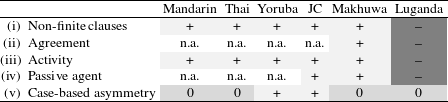
With respect to methodological issues, several challenges have arisen in the course of the above cross-linguistic investigation. As Baker & McCloskey (Reference Baker and McCloskey2007) note, when comparing typologically and genetically distinct languages, considerable care is required and diagnostics must be adjusted and adapted substantially. When this is done, however, we see that diagnostics (i)–(v) do seem to cluster together and can be used to diagnose a requirement for Vergnaud licensing (Table 4). Diagnostics (vi)–(ix), on the other hand, are more problematic for a variety of reasons, as summarised in Section 5.
All diagnostics.

 $+=$
evidence of Vergnaud licensing, –
 $=$
evidence for lack of Vergnaud licensing, 0
 $=$
compatible with either, n.a.
 $=$
test cannot be applied, ?
 $=$
no data or unclear data, JC
 $=$
Jamaican Creole; shading
 $=$
same value
Given the exceptional behaviour of Luganda in our current sample (and the Bantu languages Diercks discusses), it is actually attractive to reject the simple parameterisation account and entertain the possibility that the nominal licensing requirement is universal, but that languages like Luganda license nominals by some different (Bantu-specific) means. We explore this possibility in the following section before also assessing the broader theoretical import of our findings.
6.1 Rethinking the Bantu parameter
The diagnostic data from Luganda (and the languages studied by Diercks Reference Diercks2012) suggest that Vergnaud licensing does not play a role in these Bantu languages. Nevertheless, the distribution of DPs is not totally unrestricted in Luganda. To illustrate, consider Zulu and Luganda nominals. In both languages nominals can come in either of two forms: with or without the so-called augment (also referred to as the initial vowel). Halpert (Reference Halpert, Sloggett and Keine2013, Reference Halpert2015) shows for Zulu that nominals that lack the augment (muntu vs. u-muntu) have a very restricted distribution, similar to that of bare NPs in Romance languages:Footnote [45] augmentless nominals are licensed under negation, and only within the vP domain, whether in the lower or the higher clause, as illustrated in (121).

The contrast between (120a–b) shows that it is not sufficient for augmentless nominals to be in the scope of negation, they must also be contained in a vP, either by virtue of being an unaccusative subject or by raising into a higher vP.
The same appears to hold for Luganda, where initial research also suggests that augmentless nominals must be vP-internal. In Luganda, augmentless nouns are licensed not only by negation but also by focus, regardless of negation (Hyman & Katamba Reference Hyman, Katamba and Mchombo1993). DPs can never be augmentless in preverbal subject position or in left- or right-dislocated positions, suggesting a restriction to the clause-internal low domain (vP). Further evidence for this internal position is the fact that postverbal patients and recipients can be augmentless [–A] when in the same domain as the verb, but an augmentless noun cannot follow an augmented noun [+A], as shown in (121c).

This pattern would follow if something akin to Agree regulates the distribution of augmentless but not augmented nominals. In a model which permits multiple Agree, the patterns in (121a, d) follow straightforwardly. The difference between (121b–c) follows if augmented DPs act as defective interveners for the licensing of augmentless nominals, as such an augmentless nominal cannot be embedded lower than a vP-internal augmented DP, but the reverse is unproblematic.
Likewise, postverbal agents in locative inversion (122) and passives (123) can also be augmentless (Van der Wal & Namyalo Reference Van der Wal, Namyalo, Payne, Pacchiarotti and Bosire2016: 19). These agents are in-situ (Pak Reference Pak, Abner and Bishop2008), as evidenced by the verbal negation scoping over the quantified subject in (123): the reported interpretation is
 $\text{Neg}>\forall$
.

The implication seems to be that there is evidence for some kind of nominal licensing in Zulu and Luganda but that this mechanism is distinct from that observed in other languages (where it is connected to grammatical functions).
In the case of Zulu, Halpert (Reference Halpert, Sloggett and Keine2013, Reference Halpert2015) defends the universality of Vergnaud licensing and suggests that independent facts about the internal structure of Zulu DPs make licensing opaque in many contexts. She proposes that in Zulu the augment serves to inherently license DPs – possibly equivalent to DPs marked with inherent Case (KP), which also do not require licensing in some languages (Caha Reference Caha2009, McFadden Reference McFadden2015).Footnote [46] This DP-internal licensing thus distinguishes Zulu and Luganda from languages that do show the effects of Vergnaud licensing. To account for the restricted distribution of augmentless nominals in Zulu, Halpert proposes that there is only one licensing head in Zulu, L, which sits just above vP. This accounts for the fact that augmentless nominals are not licensed outside of vP (the contrast between (121a–b) shows that this not just because they function as NPIs).
For Luganda such a licensing head would need to be associated with focus. This is similar to the licensing of a postverbal subject in Xhosa transitive expletive constructions, which Carstens & Mletshe (Reference Carstens and Mletshe2015) propose is due to a Focus head just above vP. These analyses show the uncomfortable fit between Bantu syntax and traditional Vergnaud licensing.
An alternative is to abandon the grammatical-function–based notion of nominal licensing (i.e. traditional abstract Case or what we have referred to as Vergnaud licensing) and search for an alternative nominal licensing system in these languages. Since information structure is known to play a pervasive role in the syntax of Bantu languages (Downing & Hyman Reference Downing, Hyman, Féry and Ishihara2015, Van der Wal Reference Van der Wal2015c, Güldemann, Zerbian & Zimmermann Reference Güldemann, Zerbian and Zimmermann2015), the alternative licensing system might be hypothesised to be based upon one or more categories in information structure. For example, argument indexing on the verb and movement to the preverbal position need not be related to subject licensing: The preverbal position in many Bantu languages has been argued to be restricted to topical/non-focal elements (see, among others, Bokamba Reference Bokamba1976; Morimoto Reference Morimoto2000; Sabel & Zeller Reference Sabel, Zeller, Mugane, Hutchison and Worman2006; Zerbian Reference Zerbian2006, Reference Zerbian, Schwabe and Winkler2007; Van der Wal Reference Van der Wal2009; Yoneda Reference Yoneda2011), and ‘subject’ agreement has been argued to be directly related to topicality (Morimoto Reference Morimoto2006 for Kirundi), or indirectly via the requirement to agree with a higher, preverbal element (Baker Reference Baker2003, Reference Baker2008; Collins Reference Collins, Breitbarth and van Riemsdijk2004; Carstens Reference Carstens2005; Diercks Reference Diercks2011). We leave to future research the details of such an alternative licensing system, its relation with Vergnaud licensing, and its variation in further Bantu languages.
6.2 PRO, finiteness and Vergnaud licensing
Reviewing once more our results, it is certainly striking that in the analytic languages that we have discussed, most of which lack passives, there are only really three reliable diagnostics and only two that apply to all of the languages in question: the ban on overt referential subjects in non-finite clauses (diagnostic (i)) and the lack of hyperactivity (diagnostic (iii)). Neither of these diagnostics is without problems, even in languages with morphological case and both of them relate to the distribution of PRO/trace, a highly controversial topic, mired in controversy. Table 5 summarises the most reliable diagnostics for Vergnaud licensing.
Reliable diagnostics.

 $+=$
evidence of Vergnaud licensing, –
 $=$
evidence for lack of Vergnaud licensing, 0
 $=$
compatible with either, n.a.
 $=$
test cannot be applied, ?
 $=$
no data or unclear, JC
 $=$
Jamaican Creole; shading
 $=$
same value.
Diagnostic (iii) is challenged by copy raising and hyperraising in languages with and without morphological case. In fact, three of our analytic languages also have copy raising and none has clear evidence of raising. While the evidence suggests that copy raising does not actually involve movement (the ‘absent chef’-test discussed above), the virtual lack of true raising in the languages under discussion remains striking and potentially problematic. This is all the more the case because it means that we are reduced to control contexts to use as evidence, and there are alternative accounts of control that do not attribute it to nominal licensing.
In fact, diagnostic (i) faces significant challenges in well-studied languages. Icelandic, once again, is relevant as a language in which it can be shown that PRO can have a morphological case distinct from that of its controller (Thráinsson Reference Thráinsson1979, Sigurðsson Reference Sigurðsson2008, Bobaljik & Landau Reference Bobaljik and Landau2009 among many others). These well-known facts raise yet more challenges for the analysis of morphological case in Icelandic and provide further evidence that it is not directly connected to Vergnaud licensing. In fact, it has been questioned whether the distribution of PRO is best analysed as an effect of Vergnaud licensing at all. Russian shows essentially the same effect (Landau Reference Landau2008), as does European Portuguese (Sheehan to appear a).
It has long been noted that it is problematic to assume that PRO, the null subject of non-finite clauses, lacks Case (see Landau Reference Landau2006 for a summary of the discussion). An obvious challenge comes from the fact that in some languages PRO seems to have Case, or at least case (DAT in Russian, NOM in European Portuguese), as can be observed through secondary predication or agreement on inflected infinitives respectively:

Such facts show that, in some contexts, referential DPs are ruled out, despite the availability of Case, raising some problems for Case-based accounts of Control.
Landau (Reference Landau2004) proposes an alternative account for the distribution of PRO which attributes it to the nature of I in the host clause. According to his Control Calculus, I is specified as +/–Agr and +/–T leading to the Obligatory Control–No Control (OC–NC) generalisation (Landau Reference Landau2014: 10):

The problem with this descriptive generalisation in relation to agreementless languages like most of those in the current paper is that either (a) if we take morphology seriously, then all clauses are [–Agr] hence should be OC contexts, contrary to fact or (b) we are forced to posit covert [+Agr] in non-control contexts in an entirely circular fashion.Footnote [47] In fact, what we find is a clear split in these agreementless languages whereby only those contexts which can be independently diagnosed as non-finite require obligatory OC.
An alternative possibility, then, is to assume that in such languages, there is no [+/–Agr] specification so that what is relevant is merely [+/–T], with [+T] (diagnosed in the language-specific manners described above) being the NC context and [–T] leading to OC. The problem with this account, though, is that it still cannot account for the Luganda pattern. Why would it be that in Luganda, a language with [+/–Agr], some [–Agr] contexts would be a viable host for a referential DP? Landau’s Control Calculus therefore has no way of explaining the Luganda pattern, unless it is to be parameterised in surprising ways. It seems that we still need nominal licensing as an explanatory factor in our analysis of control, even if it is not the whole story.
While the simple biconditional relation between nominal licensing and referential DPs fails, a one-way implication nonetheless holds in this domain:

The fact that this implication holds only in one direction can be attributed to the fact that there appear to be two distinct kinds of obligatory control (OC), both within and across languages – see Cinque (Reference Cinque2006), Van Urk (Reference Van Urk2010), as well as Grano (Reference Grano2012), Sheehan (Reference Sheehan, Huang, Poole and Rysling2014, to appear a, b). In one kind of OC, which we call exhaustive OC (observed with Icelandic and Russian case transmission and EP uninflected infinitives), the exhaustively controlled subject has the properties of a trace and the dependency may possibly be derived via A-movement (as proposed by Hornstein Reference Hornstein1999). In the other kind of control, which we call pro OC, (observed with Icelandic and Russian case independence and EP inflected infinitives), the partially/exhaustively controlled subject does not behave like a trace but rather has its own features and is arguably Vergnaud-licensed, favouring an Agree-based account (roughly along the lines suggested by Landau Reference Landau2000, Reference Landau2004, et seq). Exhaustive OC has only an exhaustive reading, whereas pro OC permits also a partial control reading, all else being equal (see Sheehan to appear b). In the case of Exhaustive OC, the impossibility of an overt referential subject and the necessity of a control reading is explained by the lack of licensing and the necessity of A-movement (Hornstein Reference Hornstein1999). However, in the case of pro OC, the ban on an overt referential subject is due to other factors (Sheehan to appear b argues that the position of the controlled pro is crucial).
In terms of our diagnostics, this means that we cannot straightforwardly take a ban on overt referential DPs in non-finite OC contexts as evidence for Vergnaud licensing. Only a thorough investigation of the properties of OC in a given language can reveal for certain whether we are dealing with exhaustive OC or pro OC. At least in Mandarin, however, it seems that we are indeed dealing with the first kind of OC. Grano (Reference Grano2012: Chapter 5) shows that only exhaustive OC is found in Mandarin, in the complements of what Landau labels exhaustive control predicates. This is somewhat unsurprising. Given the lack of inflectional morphology in Mandarin it is difficult to see how a child could detect the availability of Vergnaud licensing in such contexts if overt referential subjects are systematically banned. A plausible hypothesis, then, is that these languages only have exhaustive OC, though this remains to be verified. While this topic clearly merits further research, it is striking that all of the languages except Luganda limit overt referential subjects to finite contexts (where finite is defined in independent language-specific ways). Given the parameterisation observed, Vergnaud licensing (however it is formalised) remains the best explanation for this fact at present.
7 Conclusions
In this paper we have taken nine potential diagnostics for Vergnaud licensing (abstract Case) and applied them to a number of languages without case and/or agreement morphology. Only five of these diagnostics turn out to be reliable indicators, suggesting that of the six languages under discussion only one, Luganda, consistently fails to show evidence for Vergnaud licensing. This parameterisation and the clustering of properties related to licensing require an explanation that we suggest should go beyond the traditional account in terms of abstract Case. We note also, in this regard, that many recent theories of case concern only morphological case marking, leaving aside the phenomenon of Vergnaud licensing. Nonetheless, the requirement for nominal licensing remains a pervasive feature of human languages.
Many questions remain for future research of course. What is the connection between (non-)finiteness and nominal licensing/PRO? What kind of Control is found in the languages under discussion? Why are passives unavailable in most of the languages under discussion? What is the explanation for the ban on nominative anaphors in Yoruba and Jamaican Creole and more generally? What is the function of the linker? What is the correct analysis of hyperraising and copy raising and how does this relate to nominal licensing more generally? Is there an alternative, possible discourse-driven, licensing system available in languages that test negative for Vergnaud licensing?
It is also vital that the discussed diagnostics are applied to further analytic languages beyond our sample. Recent research has shown the necessity and value of carrying out further systematic microcomparative research in Bantu languages. On a broader macrocomparative level we would like to find a non-Bantu language patterning like Luganda (see footnote 6). Testing of this kind will reveal whether the apparent clustering of the ‘nominal licensing property’ is robust cross-linguistically. With the increased interest in Dependent Case theory (Marantz Reference Marantz, Westphal, Ao and Chae1991, Baker Reference Baker2015) and the distinction between the realisation of case (‘M-case’) and some abstract licensing mechanism (‘Vergnaud licensing’, Pesetsky Reference Pesetsky2014), a reconsideration of this kind has become ever more pressing.
Finally, it is important that future work develops a more explanatory account of the nominal licensing requirement. Given the divorce between morphological case/agreement and abstract licensing, it seems likely that this explanation will not be formulated in terms of [Case] features. See Sheehan & van der Wal (Reference Sheehan, van der Wal, Kim, Umbal, Block, Chan, Cheng, Finney, Katz, Nickel-Thompson and Shorten2016) for the sketch of such an account.


 after polysyllabic verbs.


 as a predicate forming operator.