Introduction
Disability in elderly people is a complex outcome of interactions between individual health status and the physical, social and attitudinal environment. It poses an enormous burden on existing public health services worldwide. The estimates of disability range between 0.7% and 20% (Daniel, Reference Daniel2007). Currently, around 10% of the world population is disabled and 80% of them live in low- and middle-income countries (LMICs). Considering the magnitude of the problem, there is a dearth of research on disability in LMICs (UNESCAP, 2006).
Determinants of disability are heterogeneous and they vary across different countries. Studies from high-income countries have identified chronic diseases and depressive disorders as major determinants of disability among the elderly (Robinson, Reference Robinson1990; Crewe, Reference Crewe1991; Sauvaget et al., Reference Sauvaget, Yamada, Fujiwara, Sasaki and Mimori2002; Tas et al., Reference Taş2007; Balzi et al., Reference Balzi2010). The different context in LMICs – notably the lack of a social security net, limited access to health services, and poor nutrition, education and sanitation – demands specific understanding and interventions. Studies from LMICs have mostly involved relatively smaller sample sizes and lacked adequate statistical power to identify significant correlates for disability in the elderly population. They have tended to focus on the biomedical perspectives and have collected limited sociocultural data (Joshi et al., Reference Joshi, Kumar and Avasthi2003; Medhi et al., Reference Medhi, Hazarika, Borah and Mahanta2006; Srinivasan et al., Reference Srinivasan, Vaz and Thomas2010).
One large cross-national study from seven LMICs, including rural south India, investigated the contribution of chronic diseases towards disability among elderly and reported that dementia is the most important independent contributor in LMICs (Sousa et al., Reference Sousa2009). However, the study did not examine the socio-economic and local determinants which contribute to disability among the elderly. While the investigation identified common issues facing the elderly across nations, it did not highlight the local context nor identify particular environmental risk factors which could be modified (Sousa et al., Reference Sousa2009). Hence, in this study we aimed to examine simultaneously the biomedical as well as social determinants of disability among the elderly population in a rural south Indian community.
Methods
Study design
We employed a cross-sectional study to examine the determinants of disability among the elderly in a rural community. This study was a part of the 10/66 Dementia Research Group population-based studies (Prince et al., Reference Prince, Acosta, Chiu, Scazufca and Varghese2003). The methodology employed in this study has been reported elsewhere in detail (Jacob et al., Reference Jacob, Senthil Kumar, Gayathri, Abraham and Prince2007a; Sousa et al., Reference Sousa2009) and is only briefly mentioned here. The data from this study have also been analyzed as a part of the larger 10/66 investigation and reported elsewhere (Sousa et al., Reference Sousa2009).
Setting
We recruited the participants from the Kaniyambadi block of Vellore district, situated in the southern Indian state of Tamil Nadu, between February 2004 and June 2005. The block covers 127.4 square kilometers and includes 85 villages. The Department of Community Health, Christian Medical College, Vellore, has delivered a community health program in this block for the past five decades. It has a four-tier monitoring and a computerized surveillance system, which is updated monthly (Joseph et al., Reference Joseph, Joseph and Kamaraj1991). The community health workers, who live in the villages with the local community, provide the detailed health-related statistics. They were supervised by health aides, public health nurses and physicians.
Recruitment of participants
Participants above the age of 60 years were first identified using a computerized list and by door-to-door surveys. They were interviewed individually to ascertain their age. If the elderly individual did not know his or her own age accurately, we estimated their age by the historical calendar method (Jacob et al., Reference Jacob, Senthil Kumar, Gayathri, Abraham and Prince2007a). All consecutive elderly people aged over 65 years who consented to take part were enrolled as participants. We have already reported elsewhere the factors associated with dementia (Jacob et al., Reference Jacob, Senthil Kumar, Gayathri, Abraham and Prince2007a) and with depressive disorders (Rajkumar et al., Reference Rajkumar, Thangadurai, Senthilkumar, Gayathri, Prince and Jacob2009) among these participants.
Assessment
The following instruments were employed to assess the participants: (i) WHO Disability Assessment Scale II (WHODAS II) (World Health Organization, 2001; von Korff et al., Reference von Korff2008); (ii) Community Screening Instrument for Dementia (CSID) (Hall et al., Reference Hall, Hendrie and Brittain1993); (iii) Geriatric Mental State (GMS) (Copeland et al., Reference Copeland, Dewey and Griffith-Jones1986; Newman et al., Reference Newman, Sheldon and Bland1998); (iv) History and Aetiology Schedule Dementia Diagnosis and subtype (HAS-DDS) (Copeland et al., Reference Copeland, Prince, Wilson, Dewey, Payne and Gurland2002); (v) Modified CERAD 10-word list learning task (Ganguli et al., Reference Ganguli1996); and (vi) Neuropsychiatric Inventory (Cummings et al., Reference Cummings, Mega, Gray, Rosenberg-Thompson, Carusi and Gornbein1994) via a structured proforma to assess socio-demographic characteristics, past as well as current medical history, dietary habits, and anthropometrics. The participants were interviewed in their own homes. Each interview lasted about two hours. A second interview was scheduled if the participant reported tiredness or difficulty in concentration.
Translation of instruments, training of personnel and quality control procedures
The Tamil versions of WHODAS II and GMS have been employed in earlier studies (Rajkumar et al., Reference Rajkumar, Kumar and Thara1997). The process of translation and back translation of the other instruments followed standard procedures and focused on content, especially the conceptual, semantic as well as technical equivalence provided by bilingual translators. The training of research staff in terms of data collection and quality control procedures were in accordance with 10/66 Dementia Research Group norms for population-based studies (Prince et al., Reference Prince, Acosta, Chiu, Scazufca and Varghese2003; Jacob et al, Reference Jacob, Senthil Kumar, Gayathri, Abraham and Prince2007a). The Institutional Review Board of Christian Medical College, Vellore, India, approved this study.
Data analyses
We initially analyzed the sociodemographic data, medical history, disability status, cognitive profile and the psychopathology using descriptive statistics. We used the median of total score of WHODAS II to group participants into those with lower and higher disability. We converted the continuous exposure variables to categorical measures by splitting them into two categories using their median values (Ragin, Reference Ragin1994). We employed the computer algorithms developed by the 10/66 Dementia Research Group to diagnose dementia and depression, in accordance with DSM-IV criteria. We calculated the odds ratios (OR) with 95% confidence intervals for various hypothesized determinants. We performed backward conditional multiple logistic regression statistics using determinants, which were significant on bivariate analyses. We calculated the incidence rate ratios (IRR) with 95% confidence intervals for various hypothesized determinants, using Poisson regression models. We estimated the multivariate incidence rate ratios, adjusted for the effects of all bivariate significant variables, using multiple Poisson regression statistics with robust standard errors. The population attributable prevalence fraction (PAPF), when estimated from the prevalence ratios in cross-sectional studies, represents the proportion of prevalent disability that can be avoided if that exposure variable is removed from the population. We performed all analyses using the statistical software packages, Stata 11.0 and SPSS 16.0. We used the Stata aflogit command to estimate the individual and combined PAPF for all social as well as medical variables, from our Poisson regression models. We also employed the Stata estat gof command to confirm the goodness-of-fit of all Poisson regression models
Results
Participant characteristics
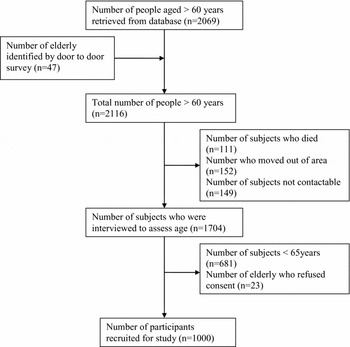
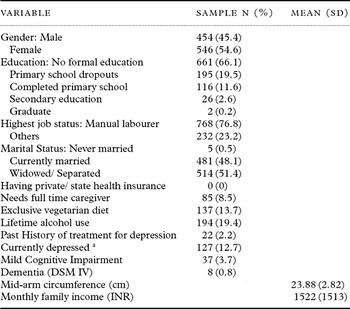
The details of recruitment are shown in Figure 1. The sociodemographic, psychiatric and disability profiles of the participants are presented in Table 1. The majority of the participants were women, widowed and with no formal education. The average age of the participants was 72.53 (SD 5.87) years. The participants (N = 1000) did not differ significantly from those elderly, who refused consent to participate (N = 23), on variables such as gender (χ2 = 1.02; df = 1; p = 0.31) and age (t = -0.51; df = 1021; p = 0.61).
The recruitment of elderly participants.

Sociodemographic and psychosocial profiles of the participants (n = 1000)

a Major depressive disorder, diagnosed by computerized algorithms derived from GMS; INR = Indian National Rupees; cm = centimeters.
Nature of disability among the elderly participants
Among the 1000 participants, only 23 (2.3%) did not have any form of disability (WHODAS II total score of 12). The mean of the WHODAS II total score was 23.39 (SD 8.39) and the median was 21. The total scores ranged from 12 to 60. Participants with a WHODAS II total score of ≤21 were defined as having a lower disability and those with scores ≥22 were defined as having a higher disability. In the lower disability group, 45.5% rated themselves as healthy over the previous 30 days, while only 4.5 % of the higher disabled rated themselves in this way. On average, members of the higher disabled group were totally disabled for a period of six days in the previous month and the lower disabled group totally disabled for a period of only 1.5 days. The lower disability group had much of their disability burden caused by locomotor difficulties (41.6%). As the severity of disability increased in higher disabled group, it progressively involved problems with activities of daily living and social participation (45.3%).
Factors associated with disability among the elderly participants
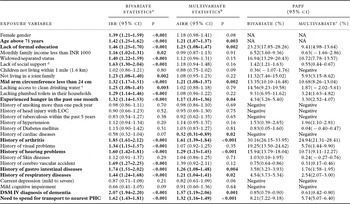
The bivariate and multivariate analyses for the determinants of disability and the PAPFs of all modifiable risk factors among the elderly participants are shown in Table 2. Advanced age, lack of formal education, hunger, poor nutrition, arthritis, hearing impairment, gastrointestinal and respiratory diseases, dementia and travel costs to access primary health facilities were significantly associated with higher levels of disability. All the modifiable exposure variables presented in Table 2 contributed to a total PAPF of 63.39% (95% CI 57.09–68.76%). The most parsimonious backward conditional logistic regression model identified the following determinants of disability among the elderly participants: age over 71 years (Adjusted Odds Ratio (AOR) 1.71; 95% CI 1.29–2.29; p<0.001), female gender (AOR 2.00; 95% CI 1.50–2.67; p<0.001), hunger (AOR 1.62; 95% CI 1.07–2.46; p = 0.02), poor nutrition (AOR 1.62; 95% CI 1.21–2.15; p = 0.001), arthritis (AOR 2.87; 95% CI 2.15–3.83; p<0.001), hearing impairment (AOR 2.01; 95% CI 1.48–2.74; p<0.001), gastrointestinal (AOR 3.37; 95% CI 1.48–7.65; p = 0.004) and respiratory diseases (AOR 1.83; 95% CI 1.12–2.97; p = 0.02) and travel cost to primary health facilities (AOR 2.46; 95% CI 1.61–3.77; p<0.001). These variables together could explain 27.7% of the variability observed in the disabilities in this elderly population (Negelkerke R2 = 0.277). Chronic illnesses like hypertension and diabetes were not associated with higher disability. Major depressive disorder was also not associated with higher disability among the elderly (OR 0.78; 95% CI 0.53–1.13; p = 0.19). Access to safe drinking water reduced the risk of higher disability (OR 0.66; 95% CI 0.50–0.86; p = 0.002).
Factors associated with disability among the higher disability group (N = 488) and the lower disability group (N = 512)

a Simple Poisson regression analyses with robust standard errors; b Adjusted for the effects of all bivariate significant exposure variables by multiple Poisson regression analyses with robust standard errors; c adjusted for the effects of all modifiable risk factors using multiple Poisson regression model; d Reportedly lacking any close friends or social networks; e Does not have state provided safe water taps at their households.
IRR = Incidence Rate Ratio; AIRR = Adjusted Incidence Rate Ratio; PAPF = Population Attributable Prevalence Fractions; NA = Not Applicable, because PAPF are calculated only for modifiable risk factors, INR = Indian currency (Rupees); LOC = loss of consciousness; PHC = Government Primary Health Center.
Secondary analyses
Disability progressively increased with advancing age. Second (69–71 years), third (72–75 years) and fourth (above 75 years) age quartiles increased the odds for disability as 0.98 (95% CI 0.69–1.34), 1.43 (95% CI 1.01–2.04) and 2.73 (95% CI 1.91–3.90) respectively, when compared with the youngest first quartile participants (65–68 years). WHODAS II total scores were significantly associated with the total health expenditure of our elderly participants over the previous three months (β 49.75; 95% CI 23.43–76.08; SE 13.42; P< 0.001), after adjusting for the effects of age, gender and level of education of the participants by multiple linear regression analysis. Poverty, defined by a total family income per month less than 1000 Indian rupees (INR) (US$ 22.23), was associated with higher levels of disability (OR 1.34; 95% CI 1.04–1.72; p = 0.02).
Discussion
Our study has identified the factors associated with higher levels of disability and their PAPFs among the elderly population in a rural south Indian community. Its strengths include larger sample size, the focus on social determinants and the ascertainment of disability using standardized assessment instruments. The possibility of selection bias was avoided by recruiting all eligible elderly individuals in a geographically defined rural community. Recall bias was minimized by collaborating with local community health workers and verifying the medical history with available medical records. Its limitation was its cross-sectional design and consequent temporal ambiguity.
Determinants of disability
As in previous studies, aging (Srinivasan et al., Reference Srinivasan, Vaz and Thomas2010; Sauvaget et al., Reference Sauvaget, Yamada, Fujiwara, Sasaki and Mimori2002), arthritis (Robinson, Reference Robinson1990; Sousa et al., Reference Sousa2009), hearing impairment (Sousa et al., Reference Sousa2009) and dementia (Prince et al., Reference Prince, Acosta, Chiu, Scazufca and Varghese2003; Sousa et al., Reference Sousa2009) proved to be significant risk factors. Additionally, experiencing hunger and having poor nutrition (as documented by mid-arm circumference), gastrointestinal as well as respiratory diseases and higher travel costs to access primary health facilities were found to increase the risk of higher disability. In contrast to studies from Western and high-income countries (Robinson, Reference Robinson1990), chronic illnesses (such as diabetes and hypertension) and cardiac illnesses did not increase the risk of disability among the elderly participants in our population. One possible explanation for this discrepancy is survival bias. The elderly in LMICs, who have meager financial resources and suffer chronic diseases, have limited health management options, leading to lower life expectancy. Unlike previous studies (Tas et al., Reference Taş2007; Sousa et al., Reference Sousa2009), depression did not cause more functional disability among the rural elderly. The meager expectations by families of their elderly relatives may have contributed towards high tolerance of depressive symptoms and functional impairment in our population (Rajkumar et al., Reference Rajkumar, Thangadurai, Senthilkumar, Gayathri, Prince and Jacob2009). Access to safe drinking water reduced the risk for higher disability, while poverty increased the risk for higher disability significantly.
Inconsistencies within international disability research
Disability is a common outcome produced by many heterogeneous social, economic and biomedical determinants. Determinants of disability in elderly populations differ between countries. Elderly men are more disabled in some countries (Balzi et al., Reference Balzi2010), while the women are at risk for higher disability in others (Al Hazzouri et al., Reference Al Hazzouri, Mehio Sibai, Chaaya, Mahfoud and Yount2011). Cognitive impairment leads to higher disability among elderly men in many countries (Al Hazzouri et al., Reference Al Hazzouri, Mehio Sibai, Chaaya, Mahfoud and Yount2011; Sousa et al., Reference Sousa2009), but not among those in Netherlands (Tas et al., Reference Taş2007). The association between disability and chronic diseases, such as hypertension and diabetes, is inconsistent across different countries (Tas et al., Reference Taş2007; Al Hazzouri et al., Reference Al Hazzouri, Mehio Sibai, Chaaya, Mahfoud and Yount2011; Sousa et al., Reference Sousa2009; Balzi et al., Reference Balzi2010). Depression increases the risk for higher disability in high-income countries (Tas et al., Reference Taş2007), but not in south India (Rajkumar et al., Reference Rajkumar, Thangadurai, Senthilkumar, Gayathri, Prince and Jacob2009). Association between disability and social determinants, such as education (Al Hazzouri et al., Reference Al Hazzouri, Mehio Sibai, Chaaya, Mahfoud and Yount2011; Balzi et al., Reference Balzi2010; Beydoun and Popkin, Reference Beydoun and Popkin2005), income (Tas et al., Reference Taş2007; Beydoun and Popkin, Reference Beydoun and Popkin2005) and marital status (Tas et al., Reference Taş2007; Al Hazzouri et al., Reference Al Hazzouri, Mehio Sibai, Chaaya, Mahfoud and Yount2011; Balzi et al., Reference Balzi2010) also varies in different countries.
Our results differ from the determinants of disability among the rural Indian elderly populations reported in a larger cross-national study (Sousa et al., Reference Sousa2009) due to the following reasons:
(i) The Sousa et al. study defined the categorical outcome of disability among the elderly population by using the 90th percentile of WHODAS II total scores, which identified a group of people with extreme disability; by contrast, we defined the cut-off using the 50th percentile (median) of WHODAS II total scores, which is standard practice in social science research (Ragin, Reference Ragin1994).
(ii) The Sousa et al. study documented relative risk estimates of various determinants, adjusted only for age, sex, education and marital status; here we have reported incidence rate ratios, adjusted for all bivariate significant determinants.
(iii) Prevalence rates of dementia vary widely depending on the case definitions chosen (Jacob et al., Reference Jacob, Senthil Kumar, Gayathri, Abraham and Prince2007a, Reference Jacob, Senthil Kumar, Gayathri, Abraham and Prince2007b; Stanley et al., Reference Stanley2009); the previous report used 10/66 education adjusted diagnostic criteria for dementia and obtained a prevalence rate of 10.6%, whereas we used the Diagnostic and Statistical Manual of Mental Disorders (DSM-IV) diagnostic criteria for dementia, which employs the criterion of social and occupation decline, and estimated its prevalence as only 0.8% and PAPF as 0.61%.
(iv) The Sousa et al. study employed Zero-inflated Negative Binomial Regression (ZINB), because they had excess zero values in their combined cross-national data. We did not have any inflating variables leading to certain zeros in our data. Only 2.3% (n = 23) of our participants had no score of disability (total score of zero in 0–4 scoring system or 12 in 1–5 scoring system of WHODAS II items). We performed the Vuong test, which has a standard normal distribution with large positive Z values favoring the zero inflated models and large negative Z values favoring the Poisson or negative binomial models. The Vuong test for our multiple Poisson regression model, including all bivariate significant determinants, gave a Z value of -0.06 (p = 0.52).
(v) Because we defined our outcome variable by the median value of WHODAS II total scores, our study design complied with the Poisson assumptions by ensuring equal 50% probability for a 0 or 1 score of disability, on each observation regardless of previous results.
(vi) Unlike the Sousa et al. study, we studied the associations between disability and various social determinants and evaluated a combined model including social and biomedical determinants to predict disability among elderly.
Studies seldom investigate social determinants, such as illiteracy, poor nutrition, hunger, access to safe drinking water, travel cost to primary health facilities and lack of social support, which are relevant to the needs in LMICs (Robinson, Reference Robinson1990; Crewe, Reference Crewe1991; Sauvaget et al., Reference Sauvaget, Yamada, Fujiwara, Sasaki and Mimori2002). This study has found that hunger, poor nutrition, lack of formal education and poverty were associated with disability among the elderly population. In large diverse countries, such as India, determinants of disability among the elderly also vary between populations living in different geographical areas (Joshi et al., Reference Joshi, Kumar and Avasthi2003; Medhi, et al., Reference Medhi, Hazarika, Borah and Mahanta2006; Srinivasan, et al., Reference Srinivasan, Vaz and Thomas2010). International disability research tends to overlook this reality and generalizing the findings of available cross-national studies may not serve the local needs in many LMICs. We highlight the need to evaluate local contexts to provide for locally relevant interventions and effective public health policies.
The need to study local issues and contexts
Pathways to disability are diverse, and the sociocultural context of coping with disability is complex. The heterogeneous nature of disability and its diverse social, economic and healthcare context make any generalization of findings from large cross-national studies inappropriate and the recommendation of specific solutions less than useful (Sousa et al., Reference Sousa2009). While cross-national studies highlight the common issues facing the elderly across regions and nations, there is a definite need to investigate local issues and contexts to determine relevant interventions and inputs. Large cross-national studies using similar protocols allow for comparison but may overlook region-specific issues. This study highlights the fact that modifiable social determinants attribute more disability among elderly people than do many medical diseases. There is a need to re-examine the importance of these sociocultural determinants rather than focusing on narrow biomedical perspectives. We need to look beyond the curative medical models dealing with geriatric diseases and to act on preventive approaches such as providing education, proper nutrition, sanitation and safe drinking water.
Though disability in elderly people is common, it is neither inevitable nor unmodifiable. The contribution of social determinants and individuals’ attitude towards disability are often the neglected issues. However, these are important potential modifiable factors associated with disability in the elderly. Social support, proper nutrition and better education may bring gross changes in the burden of disability. Education opens the doors to better health awareness, improved living conditions and socioeconomic security. Improving the literacy of a population may reduce the burden of disability. Social security programs and state-funded health insurance schemes should be an integral part of future welfare policies for the elderly living in LMICs. Interventions such as providing hearing aids may alleviate the disability burden of many elderly people; similarly, those with arthritis need special support services. Community-based disability prevention and rehabilitation strategies need to be implemented. Diagnosis of dementia in the rural communities of LMIC remains controversial (Jacob et al., Reference Jacob, Senthil Kumar, Gayathri, Abraham and Prince2007b), thereby necessitating community screening for dementia using locally validated instruments, especially addressing the needs of elderly people who lack formal education (Stanley et al., Reference Stanley2009). The cross-sectional nature of this study mandates the need for further longitudinal studies to confirm these associations. The efficacy of suggested social interventions should be assessed by appropriate intervention trials.
Conflict of interest
None.
Description of authors' roles
MP conceived this project. KSJ supervised and implemented the study. ASD, APR and KSJ analyzed the data and wrote the paper, and all authors were involved in its revision.
Acknowledgments
This study forms art of the population-based investigations of the 10/66 Dementia Research Group of Alzheimer's Disease International. It was supported by grants from the World Health Organization and from the Institute of Psychiatry, London. We thank all the study participants and their families for their cooperation, and also Mr Senthil Kumar, Ms Gayathri, Ms Kanagathara and Ms Symon for data collection.