


Introduction
The present paper sought to integrate core concepts from positive psychology (subjective well-being (SWB) and its components) within a clinical theoretical framework, namely rational emotive behaviour therapy (REBT). This line of research may lead to more efficient interventions, incorporating and targeting not only negative outcomes, but also positive concepts within the same model of psychological functioning.
As both Positive Psychology (Seligman and Csikszentmihalyi, Reference Seligman and Csikszentmihalyi2000) and Positive Clinical Psychology's (Wood and Tarrier, Reference Wood and Tarrier2010; Wood and Johnson, Reference Wood and Johnson2016) programmatic articles showed, the vast majority of psychotherapeutic approaches are focused almost exclusively on negative, pathological features of SWB, drastically neglecting the positive aspects of it. In order to overcome this issue, it seems that the best fitting, and also the most used conceptualization of SWB is the one provided by Diener (Reference Diener1984), which emphasizes two aspects of SWB, namely, the cognitive and affective components. The cognitive component of SWB is represented by satisfaction with one's life, while the affective component is seen as a ratio between positive and negative feelings (Diener, Reference Diener1984; Diener et al., Reference Diener, Oishi and Lucas2003; Luhmann et al., Reference Luhmann, Hofmann, Eid and Lucas2012; Vera-Villarroel et al., Reference Vera-Villarroel, Urzúa, Celis-Atenas and Silva2012; Diener et al., Reference Diener, Inglehart and Tay2013; Eldeleklioğlu, Reference Eldeleklioğlu2015). Although the definition of subjective well-being and its structure is debated, recent interest by international social and political institutions in this area has led to a greater research focus.
SWL represents a general evaluation of one's life and its quality, reflecting several personal criteria (Diener et al., Reference Diener, Inglehart and Tay2013). Reviews (see Diener et al., Reference Diener, Oishi and Lucas2003; Luhmann et al., Reference Luhmann, Hofmann, Eid and Lucas2012; Eldeleklioğlu, Reference Eldeleklioğlu2015) suggest that the most important variables that influence SWL are the meanings attached to one's life, social relationships, personality variables, income, life goals, and important life events. Moreover, many studies (see Vera-Villarroel et al., Reference Vera-Villarroel, Urzúa, Celis-Atenas and Silva2012; Eldeleklioğlu, Reference Eldeleklioğlu2015) have reported strong positive correlations between SWL and physical health, longevity, immune system functioning, life expectancy, and positive interpersonal relationships.
An important connection emphasized by research is the one between SWL and anxiety and depression. There are several articles demonstrating a medium-to-strong negative association between SWL and various measures of anxiety and depression in diverse populations, such as adolescents (Kinsella, Reference Kinsella2012), students (Samaranayake and Fernando, Reference Samaranayake and Fernando2011), adult men (Beutel et al., Reference Beutel, Glaesmer, Wiltink, Marian and Brähler2010), and healthy adults (Koivumaa-Honkanen et al., Reference Koivumaa-Honkanen, Kaprio, Honkanen, Viinamäki and Koskenvuo2004). The predominantly cross-sectional nature of existing studies means that it is not possible to determine if alterations in SWL precede changes in anxiety and depression or vice versa.
Both SWB and cognitive behaviour theories (CBT; e.g. Beck, Reference Beck1976; Ellis, Reference Ellis1994) focus on how cognitive and affective aspects of human functioning are interacting. Hence these two approaches share a significant amount of common ground regarding their basic assumptions. CBT theories underline the major role that cognitions play in determining emotions, behaviours, and some physiological responses. One of the most balanced forms of psychotherapy from the CBT family, regarding positive and negative aspects, is REBT (Ellis, Reference Ellis1962), especially due to its specific concept of functional/healthy negative emotions. Thus REBT seems to be a very promising option to become an integration platform for concepts coming from other complementary fields, such as SWB. The main aspects that distinguish REBT from other forms of CBT is that REBT hypothesizes that the most important determinants of emotions are evaluative beliefs (i.e. appraisals), rather than descriptions or inferences (see David and Cramer, Reference David, Cramer, David, Lynn and Ellis2009).
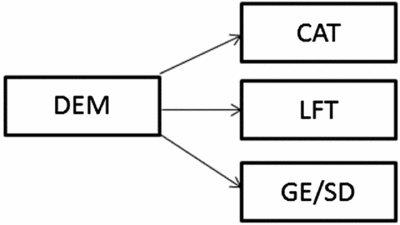
A central role in REBT theory is played by the ABC model (Walen et al., Reference Walen, DiGiuseppe and Dryden1992; Ellis, Reference Ellis1994; DiGiuseppe et al., Reference DiGiuseppe, Doyle, Dryden and Backx2014;). According to the ABC model, our emotions and behaviours (C: consequences) are not directly determined by life events (A: activating events), but rather by the way these events are cognitively processed and evaluated (B: beliefs) (David et al., Reference David, Lynn and Ellis2009). REBT states that our beliefs regarding a life event can be rational (theory of psychological health) or irrational (theory of psychopathology). Irrational beliefs are defined as evaluative cognitions without logical, empirical, and/or pragmatic support (David and Cramer, Reference David, Cramer, David, Lynn and Ellis2009). There are four categories of irrational beliefs (David et al., Reference David, Lynn and Ellis2009): (1) demandingness (DEM); (2) catastrophizing (CAT); (3) low frustration tolerance/frustration intolerance (LFT); and (4) global evaluations/self-downing (GE/SD). Numerous studies (see David et al., Reference David, Montgomery, Macavei and Bovbjerg2005; DiLorenzo et al., Reference DiLorenzo, David and Montgomery2007; Hyland et al., Reference Hyland, Shevlin, Adamson and Boduszek2014c) have indicated that the primary appraisal mechanism/irrational belief is represented by DEM, while CAT, LFT and GE/SD represent secondary appraisal mechanisms/irrational beliefs (see Fig. 1).
The organization of irrational beliefs. DEM, demandingness; CAT, catastrophizing; LFT, low frustration tolerance; GE/SD, global evaluation/self-downing.

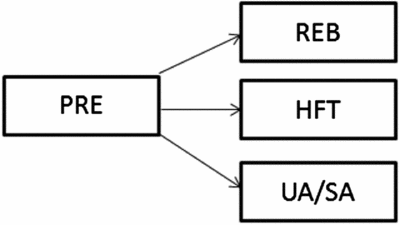
Contrastingly, rational beliefs (see Fig. 2) are flexible evaluative cognitions, which have logical, empirical and/or pragmatic support (David, Reference David, Lynn and Ellis2009). There are four types of rational beliefs: (1) preference (PRE); (2) realistic evaluation of badness (REB); (3) high frustration tolerance (HFT); and (4) unconditional acceptance/self-acceptance (UA/SA). Emerging research suggests that PRE represents the primary appraisal mechanism/rational belief, while REB, HFT and UA/SA are secondary appraisal mechanisms/rational beliefs (Hyland et al., Reference Hyland, Maguire, Shevlin and Boduszek2014a).
The organization of rational beliefs. PRE, preferences; REB, realistic evaluations of badness; HFT, high frustration tolerance; UA/SA, unconditional acceptance/self-acceptance.

REBT theory assumes that irrational beliefs are the proximal cause of dysfunctional feelings and maladaptive behaviours, while rational beliefs lead to functional emotions and adaptive behaviours. Another important aspect of REBT theory is that irrational and rational beliefs are conceptualized as qualitatively different constructs, meaning that high levels of irrational beliefs do not necessarily reflect low levels of rational beliefs, and vice versa (David, Reference David, Cautin and Lilienfeld2015). These assumptions of REBT were tested in numerous studies and the model received strong empirical support (for a review, see David, Reference David, Cautin and Lilienfeld2015)
The association between irrational beliefs and negative dysfunctional affective outcomes (REBT's theory of psychopathology) has received strong empirical support (see David, Reference David, Cautin and Lilienfeld2015), while the specific relationship between irrational beliefs and anxiety and depression has been demonstrated among a variety of populations (see David et al., Reference David, Lynn and Ellis2009; Bridges and Harnish, Reference Bridges and Harnish2010; David, Reference David, Cautin and Lilienfeld2015). On the other hand, there are only a few studies that have investigated the role of rational beliefs in protecting against dysfunctional feelings such as anxiety and depression (REBT's model of psychological health) (see Himle et al., Reference Himle, Thyer and Papsdorf1982; Hyland et al., 2014; Hyland et al., Reference Hyland, Maguire, Shevlin and Boduszek2014a).
Although empirical evidence indicates that irrational/rational beliefs and SWL, respectively, are strongly related to both anxiety and depressive symptomology, there is only one study (Ciarrochi, Reference Ciarrochi2004) that has investigated the relationship between these variables in the same design. The goal of that cross-sectional study was to test how irrational beliefs relate with several positive (including SWL) and negative (including anxiety and depression) measures of SWB (Ciarrochi, Reference Ciarrochi2004). Results indicated that GE/SD beliefs negatively predicted SWL, while DEM and GE/SD beliefs positively predicted levels of depression. Additionally, DEM beliefs were reported to be a positive predictor of anxiety (Ciarrochi, Reference Ciarrochi2004). Notably, the relation between SWL and anxiety and depression symptoms was not investigated. A limitation of this study was that it conceptualized irrational and rational beliefs as bipolar constructs rather than as two different constructs, as REBT theory states and outlines in its distinct theories of psychopathology and psychological health. Furthermore, the study did not distinguish between primary and secondary appraisals. Consequently, there currently exists no study which has investigated the complex relations among irrational and rational beliefs, SWL, and symptoms of anxiety and depression in a theoretically consistent manner.
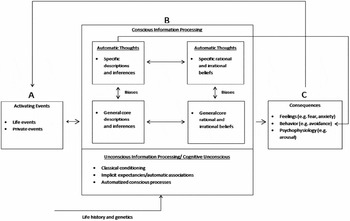
Recently, an expanded REBT ‘ABC’ model was developed (David, Reference David, Cautin and Lilienfeld2015), which emphasizes the distinction among different types of cognitive processes (see Fig. 3). This extended ABC model differentiates between unconscious and conscious processing. Moreover, the conscious processes are divided between ‘descriptions’ (e.g. ‘there are a lot of people in the room’) and ‘inferences’ (e.g. ‘these people hate me’) on one side, and ‘evaluations/appraisals’ (e.g. ‘they should not hate me and it is awful if they do’) on the other side. Both descriptions/inferences and evaluations/appraisals can be general or situationally specific. General beliefs bias perception during life events, generating specific descriptions, inferences, and beliefs in the form of automatic thoughts.
The extended ABC model of REBT (David, Reference David, Cautin and Lilienfeld2015).
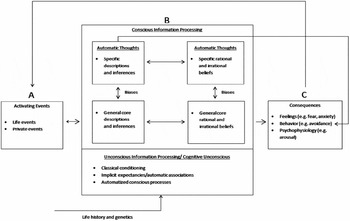
Given that SWL represents the cognitive component of SWB and is formed by specific descriptions/inferences and specific evaluative beliefs about one's life, SWL can be conceptualized as a form of automatic thoughts within REBT's expanded ABC model (David, Reference David, Cautin and Lilienfeld2015). Every cognitive component of the expanded ABC model can be characterized by different criteria, such as the degree of irrationality, content, homogeneity, and/or valence (David, Reference David, Cautin and Lilienfeld2015). Therefore, automatic thoughts about life too can be characterized by valence (i.e. positive vs negative). As such, SWL will represent the degree to which a person has positive or negative automatic thoughts about his/her life.
Overview of the current study
Testing the link between irrational/rational beliefs and the cognitive (SWL) and affective (symptoms of anxiety and depression) components of SWB may generate significant implications. First, showing that different types of information processes interact in predicting emotional outcomes, including depression and anxiety, can provide important empirical support for the expanded ABC model of REBT (David, Reference David, Cautin and Lilienfeld2015). Second, integrating a new variable such as SWL into the general REBT theoretical framework can inform clinical practice by providing clinicians with more comprehensive models in order to tackle symptoms of anxiety and depression. Third, the present study could enhance the connection between clinical psychology and positive psychology, following the milestones suggested by Wood and Tarrier (Reference Wood and Tarrier2010), which set the foundation of Positive Clinical Psychology. More specifically, the approach of Positive Clinical Psychology (Wood and Tarrier, Reference Wood and Tarrier2010; Wood and Johnson, Reference Wood and Johnson2016) argues for a more balanced focus on both positive and negative characteristics in both clinical practice and research in order to better predict and treat psychological disorders and increase psychological well-being.
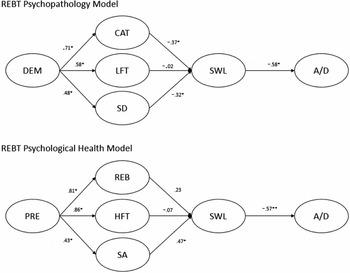
The main goal of this study was to test two REBT-based models that integrate the cognitive (SWL) and affective (symptoms of anxiety and depression) aspects of SWB within the framework provided by the expanded ABC model (David, Reference David, Cautin and Lilienfeld2015); specifically REBT's models of psychopathology (irrational beliefs) and psychological health (rational beliefs) (see Fig. 4). Specifically, this study sought to assess if general irrational/rational evaluative beliefs can predict the valence of automatic thoughts (SWL) and if SWL, in turn, can predict anxiety/depression symptoms. The validity of the two models was assessed using structural equation modelling (SEM) procedures. We had the following research objectives: (1) to test whether the two models provide an acceptable representation of the sample data; (2) to evaluate the predictive power of each model by determining the extent to which both models can explain variation in levels of anxiety/depression symptoms; and (3) to assess the direct and indirect effects of the various irrational and rational beliefs, respectively, on levels of anxiety/depression.
REBT psychopathology and psychological health models. DEM, demandingness; CAT, catastrophizing; LFT, low frustration tolerance; SD, self-downing; SWL, satisfaction with life; A/D, anxiety and depression symptoms; PRE, preferences; REB, realistic evaluations of badness; HFT, high frustration tolerance; SA, self-acceptance. *Effect is statistically significant (p < .05).

Method
Participants and procedures
The sample for the current study consisted of undergraduate psychology and computer science students recruited from four universities in the Republic of Ireland and Northern Ireland (N = 397). The sample included a similar number of men (n = 191, 49.6%) and women (n = 194, 50.4%) with an average age of 23.33 years (SD = 7.91, range 18–60 years). Students had spent on average 2.23 years at university (SD = 1.20, range 0–7 years) at the time of assessment. The majority of students lived in urban or suburban environments (n = 252, 65.7%) and were single (n = 315, 82%).
All participants were selected in an opportunistic fashion, and data were collected during the academic calendar from September 2013 to May 2014. Ethical approval was obtained from the ethical review board at the institution to which one of the authors belongs. All students under the age of 18 were excluded from the study. Participants were assured of confidentiality, instructed that they were under no obligation to participate, and could withdraw at any time. Participants completed questionnaires using a paper-and-pencil format in their regular lecture/laboratory setting. No inducements or incentives (e.g. course credit) were used to recruit volunteers.
Measures
The Attitudes and Belief Scale 2-Abbreviated Version (ABS-2-AV: Hyland et al., Reference Hyland, Shevlin, Adamson and Boduszek2014d) is a 24-item self-report measure of rational and irrational beliefs consistent with contemporary REBT theory. The ABS-2-AV was developed from the full 72-item Attitudes and Belief Scale 2 (DiGiuseppe et al., Reference DiGiuseppe, Leaf, Exner and Robin1988). The ABS-2-AV is intended to measure the four irrational belief processes (DEM, CAT, LFT and GE/SD) and the four rational belief processes (PRE, REB, HFT and UA/SA). Each rational and irrational belief process is measured via three items and all items are scored along a 5-point Likert scale from 1 (‘strongly disagree’) to 5 (‘strongly agree’). Higher scores in each case indicate greater endorsement of a given belief process. Previous psychometric assessments of the ABS-2-AV suggested that the questionnaire possesses satisfactory factorial validity and internal reliability (Hyland et al., Reference Hyland, Shevlin, Adamson and Boduszek2014d). Among the current sample, reliability estimates (Cronbach's alpha) for three of the four irrational belief processes were slightly low (DEM = .68; CAT = .67; LFT = .65; and GE/SD = .75). The reliability estimates for the four rational belief processes were mixed (PRE = .74; REB = .36; HFT = .52; and UA/SA = .77).
The Satisfaction with Life Scale (SWLS: Diener et al., Reference Diener, Emmons, Larsen and Griffin1985) contains five items measured on a 7-point Likert scale with higher scores reflecting more positive evaluations of the quality of one's life. Scores on the SWLS from 5 to 9 reflect extreme dissatisfaction with life, a score of 20 reflects a neutral point, and scores from 31 to 35 reflect extreme satisfaction with life (Pavot and Diener, Reference Pavot and Diener2008). The reliability and validity of the SWLS has been extensively demonstrated (Pavot and Diener, Reference Pavot and Diener2008). The internal reliability of the scale among the current sample was satisfactory (Cronbach's alpha = .86).
Symptoms of anxiety and depression were measured using the anxiety/depression subscale of the General Health Questionnaire-12 (GHQ-12: Goldberg and Williams, Reference Goldberg and Williams1988). The GHQ-12 is a 12-item self-report measure designed to assess non-psychotic psychiatric functioning. Previous confirmatory factor analytical studies (Shevlin and Adamson, Reference Shevlin and Adamson2006) indicated the presence of three correlated subscales: anxiety/depression, social dysfunctioning, and loss of confidence. The anxiety/depression subscale is measured using four items, and all items are scored on a 4-point Likert scale (0 to 3). Scores of anxiety/depression thus range from 0 to 12, and in this case lower scores reflect more intense symptoms. The psychometric properties of the GHQ-12 have been extensively supported (Shevlin and Adamson, Reference Shevlin and Adamson2006) and the internal reliability (Cronbach's alpha) of both the full scale (.89) and the anxiety/depression subscale (.80) among the current sample were satisfactory.
Analytical plan
Structural equation modelling (SEM) was used to test the REBT models (see Fig. 4). SEM is a combination of two analytical procedures: confirmatory factor analysis (CFA), which assesses the measurement component of a theoretical model, and path analysis, which assesses the relationships between latent variables within the model. A number of features make the use of SEM appropriate for the current analysis and these include: (1) the ability to control for random measurement error and thus improve the reliability of results, (2) the ability to test the congruence between the hypothesized model structures and the sample data therefore allowing falsification of the proposed model structures, and (3) the ability to simultaneously test for direct, indirect, and total effects between variables in the model (Kline, Reference Kline2011). The recommendations of Anderson and Gerbing (Reference Anderson and Gerbing1988) were followed and a two-stage modelling procedure was conducted. First, the validity of the measurement models were established, followed by an assessment of the structural models.
In order to test the validity of the measurement and structural components of each model, standard recommendations for determination of model fit were followed (Kline, Reference Kline2011). A chi square to degrees of freedom (χ2:d.f.) ratio of less than 3:1 suggests good model fit; comparative fit index (CFI) and Tucker Lewis index (TLI) values greater than .90 reflect acceptable model fit, and values greater than .95 reflect excellent fit; root mean square error of approximation with 90% confidence intervals (RMSEA 90% CI) and standardized root mean square residual (SRMR) values of 0.05 or less reflect excellent model fit, while values less than 0.08 reflect acceptable fit.
In order to test for indirect effects, we followed the recommendations of Preacher and Hayes (Reference Preacher and Hayes2008) and used bias-corrected (BC) bootstrapping techniques. Bootstrapping is a non-parametric resampling technique that does not assume multivariate normality of the sampling distribution, and allows for the production of confidence intervals around the observed indirect effects. To produce confidence intervals for the indirect effects in the current study, 1000 bootstrap samples were used. All analyses were conducted in Mplus version 7.0 (Muthén and Muthén, Reference Muthén and Muthén2013). The CFA procedures were estimated using robust maximum likelihood (MLR) estimation (Yuan and Bentler, Reference Yuan and Bentler2000); however, for the SEM analyses maximum likelihood estimation was used as the MLR estimator cannot be used when applying bootstrapping techniques.
Results
Descriptive statistics
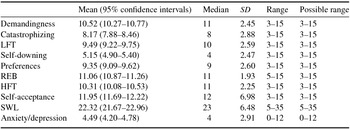
Measures of central tendency and variability for all variables in this study are given in Table 1. The current sample reported moderate levels of each of the irrational beliefs with the exception of GE/SD beliefs, which were low. For the rational beliefs, scores were in the moderate range with the exception of UA/SA beliefs, which were high. SWL scores were in the neutral range, and levels of anxiety/depression were moderate.
Descriptive statistics for all variables in the study

LFT, low frustration tolerance; REB, realistic evaluations of badness; HFT, high frustration tolerance; SWL, satisfaction with life; SD, standard deviation.
Measurement model of anxiety/depression (GHQ-12)
The three-factor model of the GHQ-12 previously indicated by Shevlin and Adamson (Reference Shevlin and Adamson2006) provided an excellent fit of the data (χ2 = 113.01, d.f. = 51, p < .001; CFI = .96; TLI = .94; RMSEA = .05 (95% CI = .04 to .07); SRMR = .04). The standardized factor loadings for each item on the anxiety/depression factor were all positive and statistically significant (p < .001), and the mean factor loading was .71.
Measurement model of SWLS
A one-factor model of the SWLS was tested in which all five indicators load onto a latent variable of ‘Satisfaction with Life’. This model provided an excellent fit of the data (χ2 = 5.82, d.f. = 5, p = .32; CFI = 1.00; TLI = 1.00; RMSEA = .02 (95% CI = .00 to .08); SRMR = .01). The standardized factor loadings for each item were all positive and statistically significant (p < .001), and the mean factor loading was .74.
Measurement model of irrational beliefs
CFA was applied in order to determine if the DEM, CAT, LFT and GE/SD latent variables were adequately measured via their respective items from the ABS-2-AV. A 4-factor model was thus tested in which each latent variable was measured via three items. The fit of the model to the data was unsatisfactory (χ2 = 163.63, d.f. = 48, p < .001; CFI = .88; TLI = .83; RMSEA = .08 (95% CI = .07 to .09); SRMR = .06). Inspection of the modification indices (MI) revealed that a prominent source of misfit related to a high cross-factor loading for item 3 (‘It's unbearable to fail at important things, and I can't stand not succeeding at them’). This item is intended to measure LFT beliefs but appeared to be measuring DEM beliefs. Based on the MI result, item 3 was removed and the model was re-tested. This re-specified model produced satisfactory model fit (χ2 = 51.73, d.f. = 38, p = .07; CFI = .98; TLI = .97; RMSEA = .03 (95% CI = .00 to .05); SRMR = .03). The standardized factor loadings were all positive, statistically significant (p < .001), and ranged from .57 to .83.
Measurement model of rational beliefs
CFA was applied in order to determine if the four latent rational belief variables (PRE, REB, HFT and UA/SA) were adequately measured via their respective items from the ABS-2-AV. A 4-factor model was tested in which each latent variable was measured via three items. The fit of this model to the data was generally acceptable (χ2 = 108.16, d.f. = 48, p < .001; CFI = .92; TLI = .89; RMSEA = .06 (95% CI = .04 to .07); SRMR = .05); however, inspection of the MI results indicated that a considerable residual covariance existed between item 7 (‘When life is hard and I feel uncomfortable, I realize it is not awful to feel uncomfortable or tense, only unfortunate and I can keep going’), which was intended to measure REB beliefs, and item 6 (‘I do not like to be uncomfortable, tense or nervous, but I can tolerate being tense’), which was intended to measure HFT beliefs. The high residual covariance between these two items was understandable in light of the fact that both items present the respective rational beliefs in the context of being uncomfortable. The decision was made to re-specify the measurement model with the inclusion of a residual covariance between the two items. This re-specified model produced satisfactory fit statistics (χ2 = 88.53, d.f. = 47, p < .001; CFI = .95; TLI = .93; RMSEA = .05 (95% CI = .03 to .06); SRMR = .04). The standardized factor loadings for each item were all positive, statistically significant (p < .01), and ranged from .24 to .82.
Structural model: the extended REBT model of psychopathology
The REBT model of psychopathology provided an adequate fit of the sample data based on all model fit results (χ2 = 373.78, d.f. = 163, p < .001; CFI = .92; TLI = .91; RMSEA = .06 (95% CI = .05 to .07); SRMR = .07). The model as a whole explained 34% of variance in levels of anxiety/depression, while the irrational beliefs explained 30% of variance in SWL scores.
Parameter estimates indicated that DEM beliefs positively predicted CAT beliefs (β = .71, p = .003), LFT beliefs (β = .58, p = .019), and GE/SD beliefs (β = .48, p = .011). Two of the three secondary irrational beliefs negatively, and significantly, predicted SWL score: CAT beliefs (β = −.37, p = .002) and GE/SD beliefs (β = –.32, p < .001). LFT beliefs was not a significant predictor of SWL (β = .02, p = .81). Finally, SWL demonstrated a significant, negative effect on levels of anxiety/depression (β = –.58, p < .001).
The indirect effect of DEM beliefs on anxiety/depression via CAT beliefs and SWL was significant (β = .15, SE = .05, 95% CI (bias corrected) = .05 to .26, p = .004). The indirect of DEM beliefs on anxiety/depression via SD beliefs and SWL was also significant (β = .09, SE = .03, 95% CI (bias corrected) = .04 to .14, p = .001).
Structural model: the extended REBT model of psychological health
Like the psychopathology model, REBT's psychological health model provided an adequate fit of the sample data based on all model fit indices (χ2 = 371.89, d.f. = 181, p < .001; CFI = .93; TLI = .92; RMSEA = .05 (95% CI = .04 to .06); SRMR = .06). The model as a whole explained 33% of variance in levels of anxiety/depression, while the rational belief factors explained 31% of variance in SWL scores.
Parameter estimates indicated that PRE beliefs positively predicted REB beliefs (β = .81, p = .001), HFT beliefs (β = .86, p = .006), and UA/SA beliefs (β = .43, p < .001). Only UA/SA beliefs significantly predicted SWL (β = .47, p < .001). REB beliefs (β = .23, p = .71) and HFT beliefs (β = .07, p = .91) had no significant relationship with SWL. Finally, SWL once again demonstrated a significant, negative effect on levels of anxiety/depression (β = –.57, p < .001). The only significant indirect effect in this model was the relationship between PRE beliefs and anxiety/depression via UA/SA beliefs and SWL (β = –.12, SE = .03, 95% CI (bias corrected) = .05 to .26, p = .004).
Discussion
This study aimed to assess the validity of the extended REBT models of psychopathology, and psychological health, and to integrate core concepts from positive psychology (SWB and its components, SWL and the affective component) within this theoretical framework. Initially, the dimensionality and factorial validity of all measures (ABS-2-AV, SWLS and GHQ-12) were established. CFA results revealed, for all of our instruments, factorial structures consistent with previous research.
Regarding the structural analyses, SEM results demonstrated adequate model fit for the REBT psychopathology model, with a χ2 to d.f. ratio of less than 3:1 reflecting a good fitting model and the CFI, TLI, RMSEA and SRMR results suggesting an acceptable fitting model. Moreover, the model as a whole explained 34% of variance in levels of anxiety/depression, while the irrational belief factors explained 30% of variance in SWL. These results add important evidence to the role of the different types of cognition, such general irrational evaluative beliefs and automatic thoughts (SWL), in the prediction of negative dysfunctional emotional outcomes (anxiety/depressive symptomology). Current findings suggest that if one has high levels of irrational beliefs, he/she will have more negative automatic thoughts about his/her life, which in turn will lead to greater symptoms of anxiety and depression. The observation that DEM beliefs positively predicted all other irrational beliefs (CAT, LFT, GE/SD) is congruent with previous research findings (David et al., Reference David, Montgomery, Macavei and Bovbjerg2005; DiLorenzo et al., Reference DiLorenzo, David and Montgomery2007; Hyland et al., Reference Hyland, Shevlin, Adamson and Boduszek2014c) and provides additional empirical support to REBT theory that DEM beliefs reflect the primary appraisal mechanism, while CAT, LFT and GE/SD reflect secondary appraisal mechanisms, in the development of psychological distress. Another interesting finding was the fact that CAT and GE/SD predicted levels of SWL. More precisely, high levels of catastrophic and self-downing evaluative beliefs are associated with more negative evaluations of one's own life. The analyses also indicated that DEM exerts its effect on anxiety/depression symptomology indirectly via CAT beliefs and SWL on one side, and GE/SD beliefs and SWL on the other side.
SEM results also supported the validity of REBT's model of psychological health. It too demonstrated good model fit according to the χ2 to d.f. ratio and the RMSEA results, while the CFI, TLI and SRMR results suggested acceptable representation of the sample data. The model as a whole explained 33% of variance in levels of anxiety/depression, while the rational beliefs explained 31% of variance in SWL scores. The psychological health model explained a significant proportion of variance in levels of anxiety/depression and SWL provides strong empirical support for the validity of REBT in general. Furthermore, the fact that PRE positively predicted REB, HFT and UA/SA is an important finding that contributes additional empirical support for REBT theory's hypothesized organization of rational beliefs, a model which has received scant empirical attention (Hyland et al., Reference Hyland, Maguire, Shevlin and Boduszek2014a). Only UA/SA beliefs predicted SWL, revealing that higher levels of unconditional acceptance of oneself are strongly related with greater life satisfaction. Also, PRE beliefs were predictive of lower levels of anxiety/depressive symptomology indirectly via UA/SA and SWL.
On the other hand, an unexpected result was the fact that HFT beliefs did not predict levels of SWL. According to REBT theory (Ellis, Reference Ellis1994; DiGiuseppe et al., Reference DiGiuseppe, Doyle, Dryden and Backx2014), HFT should help people reach their goals and achieve success. Taking into account that previous research showed that attaining life goals is an important predictor of SWL, it would be expected that HFT beliefs should predict increased levels of SWL. One reason for this result could be that SWL is also influenced by other variables such as: meanings attached to one's life, social relationships, personality variables, income, and important life events (see Diener et al., Reference Diener, Oishi and Lucas2003; Luhmann et al., Reference Luhmann, Hofmann, Eid and Lucas2012; Eldeleklioğlu, Reference Eldeleklioğlu2015). Hence even in the context where a person possesses high levels of HFT beliefs and accomplishes his/her goals, he/she can still be less satisfied with his/her life due to the above-mentioned factors.
An important, if unsurprising finding was that SWL demonstrated a significant, negative effect on levels of anxiety/depression. Thus if a person is more satisfied with his/her life, he/she will present fewer anxiety/depression symptoms.
Investigating the relation between irrational/rational beliefs and the cognitive (SWL) and affective (symptoms of anxiety and depression) components of SWB has a number of important implications. First, showing that different types of cognitive processes, such as general evaluative beliefs (irrational or rational) and automatic thoughts (SWL), interact in predicting certain emotional outcomes including depression and anxiety brings important empirical support for the expanded ABC model of REBT (David, Reference David, Cautin and Lilienfeld2015).
Second, integrating a new variable such as SWL into the general REBT theoretical framework can inform clinical practice by providing clinicians with more comprehensive models and tools in order to approach symptoms of anxiety and depression. Therefore, in efforts to decrease levels of anxiety and depression, a proximal target for intervention is SWL. In turn, in accordance with our results, efforts to increase levels of SWL should focus both on (i) lowering levels of demandingness, catastrophic, and self-downing beliefs, and (ii) developing preferential and self-acceptance beliefs.
Third, our findings contribute towards bridging the gap between clinical psychology and positive psychology. Even though the field of positive psychology has rapidly developed, the clinical applications from it have failed to substantially penetrate the clinical field. For example, a recent meta-analysis (Bolier et al., Reference Bolier, Haverman, Westerhof, Riper, Smit and Bohlmeijer2013) regarding the efficacy of positive psychology interventions revealed a small average effect sizes (d = .23 for depression and d = .34 for SWB). An effect size lower than d = .35 suggests that the effect does not have practical, ecological relevance. Moreover, the follow-up results revealed that the effects were not statistically significant for depression and were very small for SWB (d = .22) (Bolier et al., Reference Bolier, Haverman, Westerhof, Riper, Smit and Bohlmeijer2013). A very promising approach which could tackle this issue is the emerging field of Positive Clinical Psychology (Wood and Tarrier, Reference Wood and Tarrier2010; Wood and Johnson, Reference Wood and Johnson2016). The results of this study tend to endorse the assumptions of Positive Clinical Psychology, showing that negative and positive features interact in predicting emotional problems. Also, the fact that high levels of SWL are associated with lower levels of anxiety and depression advocates for Positive Clinical Psychology's hypothesis, which states that positive aspects could buffer the impact of negative ones on psychological distress levels. Therefore, integrating core concepts of positive psychology, such as SWB, into an evidence-based form of psychotherapy (REBT) could help to integrate the fields of clinical and positive psychology, leading to the development of more efficient and comprehensive clinical interventions.
One limitation of this study is that, because of its cross-sectional nature, we cannot draw firm conclusions regarding causality. Thus we do not know yet the directions of the relations among the variables included in our models and we were not able to test for mediating effects. Another limitation is represented by the fact that we measured anxiety and depression symptoms using self-report instruments, namely the GHQ-12 (Goldberg and Williams, Reference Goldberg and Williams1988). Moreover, our measures of irrational and rational beliefs could have been a source of bias for our results. Our instrument, the ABS-2-AV, was a poor measure of our constructs, so we had to eliminate an item for the irrational beliefs measurement model and to introduce a residual covariance for the rational beliefs measurement model. In order to confirm the validity of the extended REBT models of psychopathology and psychological health, future research should test it within longitudinal designs to appropriately assess the mediational hypotheses inherent to REBT theory. Moreover, future studies should include other categories of automatic thoughts beyond that of SWL.
In conclusion, current results offer important findings to literature linking clinical and positive psychology within a comprehensible evidenced-based theoretical framework for both researchers and clinicians. Continuing this line of research may lead to more efficient interventions, incorporating and targeting not only negative outcomes, but also positive concepts within the same model of psychological functioning.
Acknowledgements
Financial support: This paper is a result of research made possible by the financial support of the Sectoral Operational Programme for Human Resources Development 2007–2013, co-financed by the European Social Fund, under the project POSDRU/187/1.5/S/155383 ‘Quality, excellence, transnational mobility in doctoral research’.
Conflicts of interest: Horea-Radu Oltean, Philip Hyland, Frédérique Vallières and Daniel Ovidiu David have no conflicts of interest with respect to this publication.
Ethical statement: The present paper followed the Ethical Principles of Psychologists and Code of Conduct as set out by the APA: http://www.apa.org/ethics/code/. The project was approved by the National College of Ireland's Ethics Committee; reference number NCI-EC-2014-04.



Comments
No Comments have been published for this article.