In the fall of 1921, sixty-one Protestant missionaries from North America, Great Britain, Europe, Asia, and Africa assembled in Lake Mohonk, New York. They established the International Missionary Council (IMC), an unprecedented supranational structure of exchange and cooperation among Protestant missionary bodies that aspired to realize the concept of ecumenism, the unification of Christian churches around the world. In a world divided by nationalism, racism, and imperialism, the Council conceptualized its ecumenical mission primarily as an effort to create relations with ‘the developing indigenous churches on the field’. Behind this goal stood the idea that a new generation of Christians was emerging outside North America and Europe – Christianity’s historic home – and hopes that these Christians had the potential to remedy the long-standing corollary of missions to stabilize Western supremacy on a global scale. The IMC accordingly styled its founding as ‘the first time in modern missionary history’ that ‘the trend of thought on the part of so-called native leadership became fully vocal’.Footnote 1 Historians have widely called into question this claim, showing that the IMC’s ecumenical internationalism did not proceed with the same speed as its twin effort to ‘indigenize’ the Christian church. As Dana L. Robert argues, the plan for the ‘upbuilding of the younger churches as a part of the historic universal Christian community’ that was conceived upon the IMC’s founding did not bear fruit until the third world missionary conference in Madras in 1938, when Asians, Africans, and Latin Americans took their place next to the older Western denominations.Footnote 2
This article seeks to revise this understanding in historical scholarship by revisiting the Council’s claim from the perspective of the ‘native leadership’ it promoted. Drawing on a small body of research that sheds light on how Africa – and, by extension, black America – influenced the Council’s formation, I argue that the IMC’s concept of ‘native leadership’ was inspired by blacks from these areas in particular.Footnote 3 To illustrate the Council’s focus on promoting black leadership, I analyse the early history of the IMC regarding the interrelation it constructed between indigeneity and race. The first section situates the IMC in the long-standing vision among North American Protestant missionary organizations to promote a pan-African mission – a mission that entailed the idea that the Christian mission of African Americans was limited to the black populations of Africa in which they presumably originated. Against this background, the IMC’s mode of operation becomes visible as one that established ‘certain links’ between African Americans and Africans.Footnote 4 As I aim to show, the Council did not forge these links by expanding its membership to Africans and African Americans. It constructed them in its early debate and definition of the ‘indigenous’ church as grown by racially similar missionaries.
The latter half of the article shifts the focus to the conceptions of racial thinking that the Council promoted to address the global race problem. This revision entailed the construction of a ‘Southern Negro’ – a concept that emphasized the African American experience of racial segregation and, in turn, educational initiatives in racial uplift in the southern states of the US – which was widely accepted as a model for the interlinked reform of British colonial and missionary education in Africa.Footnote 5 The IMC’s role in implementing this reform effectively enabled the division of pan-Africanism from its original goal of achieving the global unity of blacks in contesting white dominance in the colonial and American contexts.Footnote 6 The transmission of a black leadership from the US south to colonized Africans, in close coordination with local mission boards and the Colonial Office, was an early building block for the Council to realize its geopolitical vision of creating a patchwork of non-imperial, indigenized missions around the globe.
In order to bring out the pan-African dimension of the IMC’s programme of indigenization, I use Sebastian Conrad’s definition of global history as a perspective that reflects on forms of ‘global integration’ by tracing ‘patterns of exchange that were regular and sustained’.Footnote 7 Taking this approach allows us to look beyond the widely acknowledged integration that the IMC forged among its members. It highlights the IMC’s role in Afro-diasporic exchanges that, as Paul Gilroy argues, since the onset of the transatlantic slave trade shaped a black Atlantic space that, in a similar way to the IMC, was not contained in national frameworks.Footnote 8
By showing how the IMC’s vision of indigenization came to incorporate pan-African trajectories, this article makes two interventions. One is to return attention to pan-Africanism in the history of global Christianity. A focus in the existing literature on the conflicts between – and, in the North American context, de facto segregation of – black and white missions and churches has moved the common grounds and disagreements that Christian communities probed regarding visions of pan-Africanism out of focus.Footnote 9 The historian Andrew E. Barnes has recently challenged this notion, showing how colonized Africans’ appropriation of Tuskegee, the school that the African American educator Booker T. Washington devised for the industrial education of former slaves in the reconstruction US south, summoned the attention of Christians from across racial and colonial divides. This attention penetrated deeply into ecumenical missionary forums, but the IMC brought the competing and conflicting visions of Tuskegee applications in Africa into harmony. Far from seeing Tuskegee, as Barnes argues, as ‘a strategy of social development via Christianization’ that Africans could use to challenge white supremacy, the IMC recast this educational pan-Africanism as ground for an interracial Christian consensus about the need for missionaries to raise ‘native leaders’ who could ‘indigenize’ the Christian churches that sprang from their labours abroad.Footnote 10
Secondly, linking ecumenism and pan-Africanism serves to widen the present understanding among historians of the factors that shaped the IMC’s programme of indigenization. Following the IMC’s public self-representation, most studies of the ecumenical missionary movement highlight its roots in nineteenth-century North American and European interdenominational groupings and link its institutionalization to the goals of post-war internationalism: to pacify international relations alongside the League of Nations, to grant people more self-determination along the lines of Woodrow Wilson’s Fourteen Points, to disassociate missions from nationalism and imperialism, and to de-emphasize ‘Western’ concepts of Christian belief and civilization.Footnote 11 Scholarship that considers IMC indigenization concludes that the programme was rejected as a ‘top-down approach’ by Western ecumenical thinkers and non-Western Christians alike.Footnote 12 Only by considering pan-Africanism as one path that ecumenical missionaries thought might lead to the goal of Christian indigenization can we gain a fuller understanding of how race figured in the picture. An examination of the ecumenical version of pan-Africanism shows that indigenization was conceptualized as working horizontally, by linking subjected populations in the diaspora to their home countries. Establishing this link was not only a matter of imposing notions of indigeneity as a form of ‘indirect rule’ that missionaries and colonial powers deployed in areas where their governance was notoriously limited.Footnote 13 A mission among subject populations also involved the remaking of the image of their ‘home’ countries. African Americans from the racially segregated US south were put forward as representatives of a black civilization that had developed within the West without assimilating to it. By promoting this idea, the IMC ultimately legitimized the superiority of the West in devising missionary projects for other areas and races.
Pan-Africanism and ecumenism in nineteenth-century North American Protestant missions
Often viewed as among the most important early proponents of ecumenism, nineteenth-century North American Protestant missionary societies offered an early Christian vision of pan-Africanism. Informed by racial theories and attempts to vindicate American slavery, they promoted the notion that black Americans had assimilated to Western culture and thereby became responsible for uplifting the heathen and undeveloped Africans to whom they were allegedly related. Sometimes referred to as ‘providential design’, this ideology added the idea of missions among racially similar people to the basic understanding of American missionary work as spreading a Western brand of Christian religion and civilization to backward populations.Footnote 14
Black and white American missionaries who carried this vision abroad did not necessarily mean to support the economic and political expansion of the US. As Kenneth S. Latourette put it, they were ‘part of the cultural outreach of the United States … insofar as they promote [American] ideals incidentally and unintentionally’.Footnote 15 An early example of this reciprocity was the establishment of Liberia in the 1820s by the American Colonization Society. Aiming to initiate the expatriation of the free slave population, the Society offered African Americans free passage and assistance after their arrival in exchange for their help in developing the settlement into an independent black republic. African American missionaries played a central role in this endeavour. As Jeannette Jones shows, they also served as cultural diplomats who helped expand US influence during the period of European colonization.Footnote 16
Denominational and interdenominational institutions organized the errand of black and white American missionaries into the world. Starting with the American Board of Commissioners for Foreign Missions in 1810, Congregationalist, Baptist, Methodist, Episcopalian, Presbyterian, and other churches founded foreign mission boards in the first half of the nineteenth century. These boards occasionally hired black missionaries to cover tropical areas of Africa, which presumably posed a health threat to whites. The mission boards of independent African American churches, including the African Methodist Episcopal (AME) Church and the National Baptist Convention, as well as student organizations like the Young Men’s Christian Association (YMCA), followed them.Footnote 17 In 1893, many of these organizations joined in forming the Foreign Missions Conference of North America (FMCNA), an interracial voluntary association for Protestant missionary cooperation, including Canadian organizations, that later represented North America in the IMC. Importantly, as an African American observer noted, North American interdenominationalism supported the understanding that the missionary was no longer ‘usually a White person’.Footnote 18 Founded in 1908 as a ‘reflex action from foreign missions’, the Federal Council of Churches of Christ in America made interracial fellowship a national priority.Footnote 19 According to William Hogg, these organizational trends signalled the birth of the ‘growing consciousness in all churches of the church universal conceived as a missionary community’ that defined the ecumenical movement.Footnote 20
In the late nineteenth century, black and white American missionary organizations increasingly used the conference format to coordinate and develop their missionary approaches. At a conference in New York City, held in April 1900, evangelical Protestants for the first time explicitly defined the conference consultations as the ‘ecumenical’ form of missionary cooperation. According to the proceedings, more than two thousand participants had come together to elaborate a ‘plan of campaign’ that covered ‘the whole area of the inhabited globe’. They concretized the planning aspect of ecumenism as a ‘method of concerted action’ among ‘people interested in a common object who desire to compare notes’ and as clearly distinguished from a scheme of representation that involved delegates from ‘all portions of the Church’.Footnote 21 Although white representatives of North American and European organizations dominated the gathering, three delegates of African American mission boards participated in the deliberations. All three contributed their notes to the panel on Africa, jointly asserting that African Americans alone should administer this field. The statements by the black representatives echoed the old providential beliefs and racial theories about their fitness to withstand African diseases and climates. But they also appealed to the new, ecumenical world order. A black pan-African mission, they argued, would contribute the first indigenized missionary project to the global coverage plan.Footnote 22
The pan-African vision of American Protestant missions would reappear on the agenda of the historic world missionary conference of 1910 in Edinburgh but cast in very different terms. A ‘scientific report’ put forward a version of pan-Africanism that was drawn from hundreds of responses that missionaries and native converts had given to a questionnaire about their experiences with using education as a means to ‘Christianize national life’.Footnote 23 The slogan ‘Africa for the Africans’ that was developed by African and African American anti-colonial agitators now meant that ‘races’ had to be developed through ‘their fellow-countrymen’, whereas Westerners could only help develop nations. The distinction between races and nations in the report reflected the perspective of white missionaries and church leaders, who intended to remove racial development from their missionary responsibilities. In this vein, the report noted the lack of competent ‘indigenous’ teachers, and pointed to the ‘highly qualified instructors’ at Hampton and Tuskegee, the two most famous schools for the industrial education of African Americans in the US south. Another finding, placed alongside this one, opened the pan-African dimension. The ‘prevailing opinion’ was that the need for such instruction was ‘especially urgent’ in Africa.Footnote 24
Alongside the ecumenical method of gathering and reducing ‘a mass of information and thought into an organic unity’, ecumenical missionaries shaped the broad consensus about Tuskegee graduates as the new ambassadors for bringing racial development into Africa.Footnote 25 After the image of Tuskegee was inserted into the commission reports that the conference’s chief organizer, the American Methodist John R. Mott, intended as the new basis for ‘thorough study and consultation’ among ‘the leaders of foreign missionary forces’, Mott’s co-organizer, Joseph H. Oldham, promoted the image through other channels.Footnote 26 As the editor of the International Review of Missions, the key forum for the ecumenical missionary movement’s interchange of thought and missionary science, launched in 1912, he published several articles that cast industrial schools in the US south as the new training ground for missionaries going to Africa.Footnote 27 In addition, two conferences, namely the ‘Negro Christian Student Conference’, held in Tuskegee in 1914, and an FMCNA conference on ‘The Christian occupation of Africa’ in 1917, helped publicize this idea. African American missionaries were thus no longer the only harbingers of pan-African ideas.Footnote 28
The ecumenical vision of pan-Africanism, born from bureaucratic procedures and a set of conference exchanges, developed within a much broader change of Christian opinions about human difference that characterized the ecumenical movement in the 1920s and 1930s. Voices from various camps expressed their appreciation of what they formerly rejected as inferior or ‘other’. Scholars of religion no longer conceived ‘indigenous faith’ as antithetical to Christianity, but considered its ethical achievements and possibilities as sources of knowledge and spirituality.Footnote 29 The Negro Journal of Religion, the first black interdenominational periodical of the US, praised acquaintances with unfamiliar people as a source of ‘enjoyment and enlightenment’ by which worthwhile contacts and new friendships began, while ingrained prejudices concerning conditions in different locations were corrected.Footnote 30 Instead of planting a Western concept of Christianity in heathen lands, ecumenicists constructed new frontiers for the project of evangelization. They aimed to address the ‘many-sided problems of human progress’, to end ‘Missions Imperialism’, and to push back against the rise of a ‘secularized civilization’.Footnote 31 As Edward C. Moore, an Edinburgh commission insider and left-wing representative in the missionary movement, put it, the appeal that ‘points of contact and of contrast’ had gained distinguished the ecumenical from the previous missionary generation.Footnote 32
The IMC, African representation, and the pitfalls of Christian indigenization
The IMC was the institution that gave these developments an organized form and direction. Founded in 1921 by a group of activists who had participated in the Edinburgh conference, it conceptualized missionary interaction in the period immediately after the First World War. Its constitution stipulated that missionary societies and boards, along with the churches that they represented at home and in the mission field, would remain in charge of determining their missionary policies. The IMC’s prime field of activity was to promote among them a spirit of fellowship, mutual understanding, and the desire to cooperate.
The sixty-one people who ratified the constitution of the IMC in Lake Mohonk established the organization as consisting of four elected ex-officio members and a body of seventy delegates, appointed by fourteen so-called national missionary organizations. The constitution defined these organizations as existing interdenominational structures that united missionary societies for consultation and cooperation on the national level. To include representatives from areas where no such organizations existed, the Council could nominate up to ten ‘co-opted members’. In the long term, the fruits of IMC indigenization programmes were supposed to replace this ad hoc representation. The constitution required the IMC to build up and seek cooperation with national missionary organizations that might come into existence.Footnote 33
In practice, as historical scholarship has acknowledged, this plan of organization stabilized the pre-war tradition of Western dominance in Protestant missionary internationalism. Throughout the interwar period, the offices of the Council remained in the hands of leading American and British architects of the ecumenical movement, including John R. Mott as the chairman and Joseph H. Oldham and Abbe L. Warnshuis as secretaries.Footnote 34 North American, British, and European representatives also dominated the ‘body’ of the Council, qua constitutional quota. The FMCNA appointed twenty delegates, and the Conference of Missionary Societies in Great Britain and Ireland fourteen. Twenty-one representatives came from European missionary organizations, including the Deutsche Evangelische Missions-ausschuss and the Société des missions evangéliques de Paris. A much smaller numerical share, of fifteen delegates, was given to other parts of the world. Five representatives came from white settler colonies (Australia, New Zealand, and South Africa); one delegate hailed from the Société Belge de missions protestante au Congo; and three each were drawn from national committees in Japan, China, and India (including Burma and Ceylon). That IMC members were ‘invited’ to make contributions to the Council’s funding that were proportional to the size of their delegation created a barrier for representatives of African and African American churches.Footnote 35
Alongside these national caucuses, two provisions of the constitution enabled the IMC to influence the representation of the non-Western delegations. One of them determined the representation of ‘nationals’ in the Council regarding its Asian members, from which a ‘native’ quorum of at least two (out of the three) representatives per country was required. While this rule expressed a commitment to enhance ‘native voices’ in the Council, it helped omit the representation of people from colonial areas. Thus, the delegates who represented the Belgian Congo and South Africa, then a British dominion, could still be nationals of the colonial metropoles.Footnote 36 The second, and more potent, tool to manipulate the IMC’s composition was the category of ‘co-opted members’. The constitution framed this category as an effort to give Africa, the Near East, and Latin America ‘the same rights and privileges as other members’, even though they lacked the kind of interdenominational missionary organizations that the IMC required. Importantly, the IMC could both nominate and cover the expenses of these representatives directly from a ‘special fund’ provided by North American and British members.Footnote 37
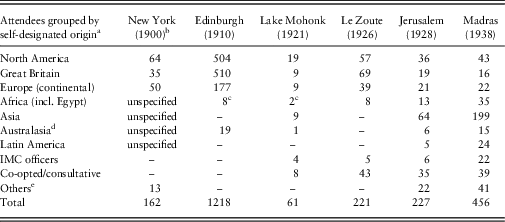
Judging from the lists of attendees of major ecumenical conferences between 1921 and 1938, the Council used these provisions less to represent churches in Africa than to involve pan-African actors. Among the co-opted members who frequently attended Council meetings from 1921 onwards were the missionary educators James E. K. Aggrey and Arthur W. Wilkie from the Gold Coast, the American philanthropist and expert on African American education Thomas Jesse Jones, and Robert Moton, the successor of Booker T. Washington as principal of Tuskegee. During the early 1920s, members of this group were the major advocates of reforming colonial education in Africa based on the principles of industrial education in the southern US.Footnote 38 The number of delegates from missions or churches in Africa who attended IMC conferences through regular channels, however, remained comparatively small. It rose from 2 to 35 attendees – whereas representatives from Asia grew from 9 to 199 (see Table 1). A closer look at these lists shows that not all delegates from Africa were Africans. The Jerusalem conference, for example, listed thirteen African representatives, but only six of them were strictly speaking indigenous. This smaller group included Sunday School Field Secretary Sheikh Metry S. Dewairy (representing Egypt), Henri Randzavola of the London Missionary Society (Madagascar), Assistant Bishop Adolphus Williamson Howells (Nigeria), Professor Davidson Don Tengo Jabavu (South Africa), the Superintendent of the Dutch Reformed Church Mission, W. H. Murray (Nyasaland), and County Chief and member of the Synod of the Church of Uganda Sirwano W. Kulubya (Buganda).Footnote 39 The ‘absence of Africa’ that Brian Stanley noted for the Edinburgh meeting thus continued in the 1920s and 1930s.Footnote 40 As an observer charged, missionary leaders still faced the challenge of transforming an ‘exclusively Anglo-Saxon’ into a ‘true international co-operation’.Footnote 41
Attendees present at selected ecumenical conferences

a The geographical categories in this table are drawn from the lists of attendees that are provided in conference reports. They do not refer to the attendees’ nationality but to the origin of their organization. Understandings of which countries and regions are encompassed in these categories vary between 1900 and 1939. Thus, the table shows tendencies in representation rather than absolute numbers.
b These numbers refer to mission boards.
c South Africa.
d Encompasses attendees from Australia, New Zealand, and Fiji.
e Encompasses representatives of students movements, fraternal delegates, editors of religious periodicals, and the ‘Near East’.
Sources: Thomas A. Askew, ‘The New York 1900 ecumenical missionary conference: a centennial reflection’, 2000, https://www.thefreelibrary.com/The New York 1900 Ecumenical Missionary Conference: A. Centennial...-a068157992 (consulted 20 February 2018); World Missionary Conference 1910, The history and records of the conference, Edinburgh: Oliphat, Anderson and Ferrier, 1910, pp. 39–71; ‘Extracts from the minutes of the meeting of the International Missionary Council held at Lake Mohonk’, pp. 229–33; Smith, Christian mission in Africa, pp. 180–8; World Mission of Christianity, Messages and recommendations of the enlarged meeting at the Jerusalem meeting of the International Missionary Council, March 24–April 8, 1928, London: International Missionary Council, pp. 87–96; IMC, Addresses and other records, New York: International Missionary Council, 1929, The Madras series, vol. 7, pp. 172–93.
The IMC’s engagement with African Christianity was closer when it exercised its functions.Footnote 42 One of them was to promote intellectual reflection on, and empirical analyses of, the total modern world mission. The efforts to gather and circulate missionary information, culminating, among other publications, in the Interpretative statistical survey of the world mission of Christianity (1938), brought competing forms of Christian indigenization to the Council’s attention.Footnote 43 This was most evident in Africa, where African Christianity had drastically risen from half a million to more than two million within less than three decades, thus superseding the growth rate in Asia.Footnote 44 The interpretations of these statistics that circulated through the IMC agreed that the growth was due to a strong indigenous element in African churches, but they varied regarding the meaning of this form of indigenization. The FMNCA broadly considered the development as shifting the ‘center of gravity of the Christian mission’ from ‘America, to the Church in Asia and Africa’.Footnote 45 Unaffiliated observers claimed that African Christians independently achieved what ecumenical missionaries envisioned: the creation of a ‘really African church’ that was self-supporting, self-governing, and self-propagating.Footnote 46 A more consensual notion in ecumenical missionary circles was that these indigenous churches took ‘separate roads’ from the ‘older Churches that have been fostering them’.Footnote 47
Behind the scenes, IMC members talked more frankly about the obstacles they faced in trying to build up African indigenous churches. The Lake Mohonk meeting unanimously acknowledged that the condescending attitudes that white Christian workers retained towards racially different Christians were the main problem. The discussion underscored this factor, as it brought to light the whites’ stereotypes about black Africans: supposedly, the Africans were greedy for power and money, they caused ‘accidents’, and they were too focused on denominationalism, which impeded their promotion in the ecumenical mission. Accordingly, the members differed on the question of how to overcome their reservations. Some advocated financial support as a method to strengthen their local offspring. This way, local churches would eventually cease to be a financial burden. White representatives from South and West Africa strongly discouraged throwing money at the problem. They advised involving more Africans in the propagation of the foreign denominations. Others who reported from visits to South Africa strengthened this intervention. They pointed to the ‘splendid capacities’ of missionary-school-educated Africans, who also had the best understanding of their own people. Thomas Jesse Jones, who joined the conference to present his approach to African education by means of African American models of industrial training, stressed the role of education in Christian indigenization. He demanded that missionaries give more thought to the training of ‘leaders’. The concept of native leadership formed a middle ground for most attendants. This group would encourage self-dependence and self-expression, while linking the indigenous church to the ‘experience, faith, organized power and money’ of the foreign missionary organizations that nurtured them.Footnote 48
The Jerusalem conference in 1928 gave the Lake Mohonk considerations concrete expression. Indigenous voices were limited from the start to an internal conversation among regular IMC members and ‘similar organizations in which the rising churches are represented’.Footnote 49 This rule positioned the IMC’s vision of indigenization in opposition to the Ethiopian movement in particular. The Ethiopian church originated in the 1890s in South Africa among black Africans who broke away from Methodist and Anglican churches that denied their African members leadership, and spread across sub-Saharan Africa, often on the heels of transatlantic pan-African agitation and independent African American missions.Footnote 50 The conference wanted to consult, instead, about the ‘relationship between older and younger churches’ in a world missionary context. The proceedings stated that it was of ‘common importance to all’ to define what was ‘meant by an indigenous church’.Footnote 51
Pre-circulated questionnaires and papers had pre-shaped a consensus. Rather than opening up to global variants, the meeting offered a narrow definition that stressed indigeneity as a concept that implied a lineage with dominant Christian traditions. A church was ‘truly indigenous’, it was stated, when its ‘expression in worship and service, in customs and in art and architecture incorporates the worthy characteristics of the people, while conserving at the same time the heritage of the Church in all lands and all ages’.Footnote 52 To a certain extent, the conference sided with the ‘top-down’ idea that ‘a really independent native church can be brought into being’ if only missionary strategies were altered. To this end, it recommended translations of the Bible into the vernacular, a devolution of responsibilities to locals, and the encouragement of self-expression. This missionary approach entailed a firm rejection of white patronage. It urged missionaries to refrain from treating ‘strange customs’ with ‘religious rigor’ and from confusing proselytizing with ‘Europeanization or Americanization’.Footnote 53 Taking this point further, however, the Jerusalem meeting also conceptualized this approach as encompassing the encouragement of ‘every race’ to express their missionary convictions. It argued that the alleged ‘desire’ of African Americans to witness for the gospel ‘in the homeland of their forefathers’ promised ‘profound satisfaction’.Footnote 54 The notions that the IMC associated with the indigenous church were thus quite different from the dynamism of Christianity in Africa at that time. The Council held up African American missions as the central model for achieving the ecumenical vision of indigenization, and defined indigenous African churches as its ‘separatist’ margins.
The race problem and the appeal of the ‘Southern Negro’
The second opening that the IMC saw towards an ecumenical pan-Africanism was the so-called race problem. Viewing racial discord as the most serious source of division among humankind, the IMC discerned in the race problem an approach to ordering Christian difference in global space that complemented indigenization. As John R. Mott lectured missionaries in Australia, ‘The race problem … is not simply a national question, but one of the widest international implications. It concerns not one race, but all races …. It is today a vital issue on every continent.’Footnote 55 With its intercontinental scope, the race problem was also located at the core of both the field work and the moral cause of the modern world mission to become ‘a great interracial movement’ by the very nature of the case.Footnote 56 Mott identified ‘race feeling or prejudice’ as the most severe obstacle for cooperation with the indigenous churches, and the Council’s responsibility to transform international and interracial relations in favour of ‘politically weaker people’.Footnote 57 The Jerusalem conference of 1928, after linking indigenization to the idea of missions among racially similar people, strongly endorsed Mott’s contention. The gathering condemned the Christian churches for not overcoming racial divides within their own ‘borders’. Missionaries thus had to step in as ‘the most creative force’ to teach them how worldwide interracial unity could be accomplished.Footnote 58
This creativity was, at first, demonstrated quite literally. An exuberant celebration of the racial diversity of the participants characterized the reports of IMC meetings. Writing for the International Review of Missions, Frank Lenwood reflected upon this trend in his discussion of the Lake Mohonk conference. Even one or two Africans and African Americans, he wrote, were enough to add ‘colour’ to the Council ‘for they were “black, black, black!”Footnote 59 Indeed, the conference minutes of Lake Mohonk overstated the presence of African representatives. They noted that a ‘Dutch baron and an English baronet looked across to the son of a West African chief. Representatives of Australian and South African societies looked across to those of Norway, Sweden and Finland. Yellow and brown and black of Africa looked into the eyes of blonde and brunette of Europe and North America.’Footnote 60 Presumably, the many ‘Africans’ mentioned in this description were James Aggrey and Robert Moton (actually an African American), who were both invited to the conference as co-opted members on account of their expertise on African American education, not as representatives of African field churches.Footnote 61
The overrepresentation of the number of blacks among the conference participants went hand in hand with the IMC’s more ambitious goal of eliminating the race problem by changing Christian public opinion. Its strategy was set out in several books and articles published between 1904 and 1926 that the IMC recommended to its members. Most of the works were written by American and British intellectuals who viewed the race problem from a Christian angle. Among them were the American Presbyterian missionary Robert E. Speer, the American religious leader from the US south Willis D. Weatherford, the American expert on African American education Thomas Jesse Jones, the British politician and historian James Bryce, the missionary and educator Sidney L. Gulick (who spent much of his life promoting American–Japanese relations), the British Quaker and expert on India John S. Hoyland, and the British missionary writer on ecumenism Basil Matthews.Footnote 62 The International Review of Missions also took up the issue. It featured book reviews and circulated reports on the race problem in South Africa and Honolulu, as well as theoretical treatises on how to rethink racial capacities.Footnote 63
To understand the consensus on the race problem that the IMC sought to establish within the Christian missionary public, it is helpful to consider one of its most featured and widely read studies. This was written in 1924 by the IMC secretary, Joseph H. Oldham, at the request of the United Council for Missionary Education and the Lake Mohonk meeting. Titled Christianity and the race problem, the book presented the Christian ideal for human society as a contrast to existing relations between the different races, and aimed to investigate the historical origins of these interactions.Footnote 64 This goal centred attention on European colonialism and North Atlantic scientific racism as the key factors in the promotion of the hostile and oppressive character of contemporary race relations. Oldham argued that the authority that modern science gained in justifying the colonial ‘doctrine of racialism’ had made its broad social acceptance almost ‘inevitable’. Alarmed in addition by the recent experience of the war and other forms of racist brutality, he painted a dire picture of racial science as creating ‘an atmosphere, in which the solution of racial problems may become impossible’.Footnote 65
Oldham saw a small possibility for Christians to influence the character of interracial relations in offering, and then widely circulating, a reinterpretation of the historical role of racial difference. This reinterpretation began with dissociating the idea of ‘race’ from its much-cited ancillary ‘problem’. As Oldham emphasized, race was a ‘real and unalterable dividing line’ between people. Christians thus had to promote racial divides as a positive feature, as opposed to making race the basis of a strict hierarchical order that had whites at the top.Footnote 66
To flesh out this new image of racial difference, Oldham drew on the repertoire that Christian religion offered to define human relations. Instead of white supremacy, Christian human relations evolved around ‘the supremacy of moral values’, combined with an appreciation for human personality and the dedication of life to the service of humanity.Footnote 67 A Christian society that adopted this perspective would accordingly be enhancing the ‘plasticity’ of human nature, individualism, and the common social purpose of racially different people. Thus race would not divide but enrich humanity, in analogy to a ‘body’ that had different parts with none of them being superior ‘since all are necessary … and … indispensable’.Footnote 68
Oldham’s view of races as shaping an organic unity offered new guidelines specifically for ecumenical missionary thinking. He demanded that missionaries embraced the perspective of cultural relativism by shifting their focus from physical continents to ‘new continents of human life and human activity’.Footnote 69 By this, he meant the interconnectivity that was growing due to colonialism, economic interdependency, and modern communication and transportation technology that had long cut across ingrained racial, imperial, and national boundaries, but had not yet found a Christian equivalent. The aim to discover a human geography that was different from such boundaries echoed the IMC’s indigenization approach. Oldham argued that the practical imperative for missionaries who adhered to the Christian ideal of preserving and enhancing racial difference was to safeguard the ‘native soil’ that defined the particular characteristics of their inhabitants – especially when these soils had come under the tutelage of colonial powers.Footnote 70
Oldham was aware that the correlation of race and space that he advanced not only challenged racial divides but entailed a vindication of the utility of racial segregation. By the 1920s, the image of racial segregation was widely associated with the American Jim Crow system – a set of laws that required the division of public space and infrastructures into black and white sections – as well as with the emerging South African apartheid system, as epitomes of modern racism. Oldham made an attempt to rehabilitate the image of racial segregation by associating it with Booker T. Washington’s famous analogy that races ‘can be as separate as the five fingers, and yet one hand in all things essential to mutual progress’. Oldham’s interpretation of this statement forged its similarity to the Christian notion of the ‘body’ as a unity in difference. While admitting that racial separation was not the ‘ultimate ideal’ of Christian society, he argued that it was still a means to furnish individual races with a space in which they could bring to bear their ‘integrity and distinctive character’ in the development of their ‘respective civilizations independently’, and, by doing so, make their ‘special and unique contribution to mankind’.Footnote 71 For Oldham, the world that Booker T. Washington had created in the US south was the best example. This world had developed, under the infamous conditions of US racial segregation, into a highly valuable ‘region of experience’ that gave new meaning to equality. It centred on the magnanimity of blacks who accepted their separation with humility, as opposed to stirring racial conflict. Popularizing the attitudes and approaches that blacks in the US south pursued to create their own civilization could, Oldham believed, ‘put a new face on many of our racial problems’.Footnote 72
During the 1920s, Oldham’s idea of re-evaluating racial segregation prompted IMC affiliates to investigate the factors that shaped black people’s magnanimity. Oldham himself pursued this approach in his role as the editor of the International Review of Missions. Shortly after the paper’s launch in 1912, he featured an article by A. G. Fraser, a British missionary in Ceylon who detailed the lessons he had drawn from visiting the Hampton Institute in Virginia.Footnote 73 In addition, he published articles by H. B. Frissel, the president of Hampton, and Booker T. Washington, the president of Tuskegee.Footnote 74 These texts directed the attention of the international missionary community to the role education that played in the making of what Frissel termed ‘Southern Negroes’, as a distinctive group within the broader category of black Americans.Footnote 75 The consensus that was put forth by these authors was that this group was emerging from industrial training – in trades, crafts, agriculture, and industry – rather than scholastic education, and that they were themselves looking towards Africa with a view to ‘planting the life’ that these schools created ‘out there again’.Footnote 76
This division of education was relevant to international ecumenical missionaries for two reasons. On the one hand, they thought that industrial schools could be readily adapted to the particular needs of students and to local conditions around the world. On the other hand, the focus on the practical value of knowledge appeared to offer a way to diminish the cultural imperialism that characterized the Western educational practices of book learning typically employed in mission schools. As A. G. Fraser put it, missionaries were still proud of the tradition of English public schools that they represented, but this education could not compete with the value and inspiration that Hampton and Tuskegee exemplified in ‘adapting’ the best ‘knowledge and civilization to the needs and understandings of its varying pupils’.Footnote 77
A similar fascination with the character of the black students who graduated from these schools emerged among ecumenical missionaries. The missionaries believed that industrial training had a profound impact on the students’ health, discipline, and demeanour, and that they possessed certain virtues that they had been able to acquire only because of their separation from white influences. Most commentators followed Oldham’s suggestion to view Booker T. Washington as the personification of the distinct ‘spirit of progress, self-help and cooperation, and a tradition of the dignity of manual labour’ that was now associated with black Americans from the US south.Footnote 78 In this vein, IMC-affiliated missionaries almost unanimously spoke of the ‘very admirable and valuable racial qualities’ they had found in blacks from the south. They praised the ‘extraordinary sanity … of the Negro leader’ and the ‘absence of any kind of sourness of disposition’, emphasizing that these features formed a stark ‘contrast to national and racial situations elsewhere’.Footnote 79 With these qualities, blacks from the south came into view as a crucial resource for the modern world mission. In the international missionary imagination, they represented both a different kind of Western civilization and a new possibility for linking ‘European and African peoples’, as well as ‘Negroes both in Africa and in the United States’.Footnote 80
Connecting African Christianity and African American missionaries
The promotion of the ‘Southern Negro’ as a leader and a decisive intermediary to remedy interracial divides coincided with international missionaries’ interest in enabling the transmission of Tuskegee into other contexts. Beginning with A. G. Fraser’s visit to Hampton in 1912, large numbers of international missionary visitors followed his example, believing that the African American educational experience was relevant to the diverse mission fields they came from. The AME Church even ran an article in its missionary journal to report that missionaries from Uganda, Nigeria, Nyasaland, Tanganyika, Northern Rhodesia, and India came to the US south to ‘observe what ideas may be implanted in their work’.Footnote 81 Intermingled with the growing cohort of admirers of Hampton and Tuskegee were those who were more assertive about limiting the new flows of ‘experience of Negro Education from the South lands’ to blacks in Africa.Footnote 82 Perhaps most influential in defining the boundaries for the transmission of Tuskegee was Thomas Jesse Jones. In his role as the head of two Phelps-Stokes Commissions to investigate the state of education in Africa in 1920 and 1924, he succeeded in embedding his interpretation of Tuskegee education in the reform of British missionary and government schools for the African native.Footnote 83
The IMC supplemented this agenda by devising new policies regarding the possibility of sending African Americans as missionaries into colonial territory. The idea of not only transferring models of industrial education but also using black southern graduates as missionaries had been discussed by the Council at its founding meeting. According to unpublished minutes, Robert Moton stated in the afternoon session of 3 October 1921 that ‘I can not but wonder if somehow God does not mean that the negroes from America shall go back and side by side with the white missionary and the native African civilize and Christianize that land.’ Anticipating that missionaries and colonial governments who condemned pan-Africanism would probably oppose the idea, he emphasized that these missionaries had to be ‘of course, the right kind of men’. He thus characterized them in the more popular image of African Americans as people who reacted to racist presumptions with humility and cooperation, just like Booker T. Washington always had.Footnote 84
The conference attendees showed themselves open to Moton’s suggestion, if not to the premise that African Americans, too, had legitimate evangelical ambitions. Rather, they discussed the proposition against the background of the attitudes that existed towards African American missionaries among Africans and colonial governments. The discussion revealed that missionaries had mixed experiences. French, Belgian, and Portuguese missionary societies that had already worked with African American staff had no problem with their admission but considered African American missionaries rather ineffective. Others who would have liked to get African Americans involved failed owing to immigration restrictions that existed, especially in the British empire and the Union of South Africa. As Joseph Oldham summarized, the admission of African Americans was ‘an international question of some complexity touching Portugal and France as well as England and the South African Government’.Footnote 85
Based on these initial findings, the IMC decided to investigate the feasibility of Moton’s proposal more thoroughly. Aiming to return to the matter at the next IMC meeting in Oxford in July 1923, members gathered information about the efficiency of African American workers in French, Belgian, and Portuguese colonies in Africa and devised a strategy to overcome the reservations and administrative obstacles that existed in British colonies. In a series of meetings with the Colonial Office in London, IMC representatives learned that the British were having difficulties with the ‘undesirable propaganda of the Marcus Garvey type’ and that they used a new immigration regulation that required non-British missionaries to declare their ‘loyal co-operation with the Government’ to exclude African Americans from their colonial territories.Footnote 86 To ‘set the mind of the colonial office at rest’, the IMC thus advised the FMNCA to withhold any immigration applications by African American missionaries for the time being, while seeking to win from the Colonial Office a modification in its immigration regulation.Footnote 87 This modification concerned the possibility of making a ‘distinction between Dr. Moton and Marcus Garvey’. As IMC representatives argued, such a distinction would allow British governors to avail themselves of the help of African Americans trained at Tuskegee, which some of them were known to be ‘anxious to have’.Footnote 88
North American mission boards that followed the request in the 1920s reaped sharp criticism from both white and black observers. The Foundation, the mouthpiece of a philanthropic organization that promoted black American missionary work on Africa, noted that the shrinking number of black American missionaries (12 out of a total of 1,500 American missionaries on the continent) must indicate that the majority of organizations did not have ‘a single American Negro’ in their ranks.Footnote 89 Black American observers accused these boards of acquiescing to a new and strict drawing of the colour line among Christians in the US. The pan-African agitator W. E. B. Du Bois argued that nothing illustrated this better than ‘the attitude of white churches today toward Christian missions in Africa’.Footnote 90 In addition to a resurgence of racism, American observers viewed the decline of the African American participation in missions as the surrender of mission boards to colonial reservations against African American missionaries as ‘dangerous’ to the colonial order, antagonistic to local governments, or a ‘failure’ as Christian missionaries.Footnote 91
Meanwhile, however, the British Colonial Office began to consider the idea of regarding Garvey and Moton as representatives of different groups of African Americans as ‘novel and interesting’ and requested that the IMC determine the grounds on which this distinction could reliably be made.Footnote 92 The IMC suggested that colonial administrators ascertained that candidates were thoroughly acquainted with the educational institutions in the US south that had proven to be ‘directly related to African needs’. To specify the qualifications that should be required of African Americans who desired to go to Africa as missionaries, the IMC adopted the list of qualities that Wallace Buttrick, a Rockefeller official who specialized in African American education in the US south, and Thomas Jesse Jones, head of the Phelps-Stokes Commission, had defined with Booker T. Washington in mind as a model. These qualifications were a spirit of interracial cooperation and meekness, strength of character, and knowledge and skill in manual labour and practical matters of daily life, as well as college education.Footnote 93 While colonial officials did not turn these requirements into hard prescriptions, they applied them in a few cases to admit African American missionaries into restricted British territories in east Africa.Footnote 94
Within the IMC, the question of African American missionaries remained on the agenda at its next regular meeting in Oxford in 1923, and at three special conferences on education and missions in Africa held in 1924 and 1925.Footnote 95 In these meetings a growing number of attendees from both sides of the colonial and racial divide advocated the inclusion of African American missionaries into the modern world mission. Their interest increased, especially regarding the influence that this could have on international and interracial relations. The African American YMCA missionary Max Yergan argued that the involvement of African American missionaries would be a sign that cooperation ‘of the right kind’ between white and black was possible in segregated South Africa.Footnote 96 In a similar vein, John Hope, president of Morehouse College, proposed that the integration of black missionaries from Tuskegee, Hampton, or Morehouse would be not only useful abroad but also a source of inspiration in approaching interracial relations in the US.Footnote 97
With these thoughts on improving the image of missions, colonial states, and American segregation in wide circulation, the IMC decided to settle the question at an extraordinary conference held in Le Zoute in 1926.Footnote 98 The conference, titled ‘The Christian mission in Africa’, explored, among other themes, the possibility of cooperation between missionaries and colonial governments in the field of education. In their new role as ‘Tuskegee types’, African American missionaries had become crucial to this project. The extremely large (thirty-four members) and prominent composition of the commission that formed to consider the role of African American missionaries in Africa reflected how relevant the topic had become. Among the committee members were leading African American missionaries in South Africa, including Max Yergan (YMCA) and John A. Gregg (AME Church), and the renowned African intellectual and educator John Dube, founder of the South African Native National Congress. This group met the major architects of the British indirect-rule system then in the making, including Frederick Lugard, who at the time also served in the League of Nations Permanent Mandates Commission, the Phelps-Stokes Commission members, and the director of native education in South Africa, Charles T. Loram. This constellation indicated that the question of African American missionaries in Africa had emerged into a project that required orchestration far beyond the IMC’s own indigenization project. On their behalf, it had to influence politics and stereotypes, and reconfigure existing pan-African connections. The result of this effort was, as Dube remarked, that ‘Negro leadership’ from the US and Africa claimed their place ‘among the leaders of the world’. Footnote 99
The resolution that the committee was supposed to compose had to cater to a disparate mix of interests that were now associated with the question of African American missionaries. Among these interests were colonial concerns about anti-colonial aspirations coming from either Africans or African Americans, as well as the worries of missionary societies that African American missionaries could turn out to be more successful or, if sent in large numbers, undermine the dominance of existing missions. These interests stood next to the interest of independent African American missionaries to improve their reputation in missionary and colonial circles, as well as the newly discovered joint ‘desire’ of black and white American missionary societies to orchestrate their activities in Africa. Allegedly their ambition was to give ‘the educated Negro an outlet for his zeal to render unselfish service and aiding in a natural and important way the cause of African evangelization, education and general welfare’.Footnote 100
The resolution adopted by the conference proposed closer cooperation between missions and colonial governments in monitoring the African American missionary movement in Africa. Projecting the vision of transforming Africa by means of ‘Tuskegee-type’ missionaries, it first encouraged governments and missionary societies to give African Americans a larger share in evangelistic, medical, and educational projects, if ‘qualified candidates’ were available. This proposition dismissed the African American missionaries then in Africa as lacking these qualifications, at least in the public perception. Adopting the call for interracial cooperation, it then demanded that white and black missionaries helped each other in practical matters. The remaining two points of the resolution defined how this practical help should work regarding the admission of African American missionaries into colonial territory. Their path to Africa was to be paved by so-called recognized missionary societies, a status that had to be granted by the colonial governments. In this role, these societies had the responsibility of selecting black American staff on the basis of their character and spirit of cooperation. The same procedure was proposed for independent black American mission boards. They were now supposed to send their missionaries via recognized missionary societies, and, perhaps to prevent black missions from drawing their membership from white mission churches, they were encouraged to focus on ‘unevangelized districts’.Footnote 101
The resolution was of little relevance to the African American missionary movement. As historians have shown, independent African American churches had long-standing and firm connections to Africans and mostly operated on their own. Nor did the resolution bring important changes in the racial composition of the modern world mission. According to David Killingray, the total number of African American missionaries in Africa may not have risen above a total of 600 people in the entire time between 1790 and 1980.Footnote 102 The IMC’s engagement with the issue of African American missionaries seems more relevant for its new visions of ordering human difference and imperial space. As the IMC reasserted in Jerusalem, the ‘desire’ of African Americans to witness to the gospel in their alleged homeland, Africa, was also a geopolitical scheme for an indigenized world mission structured by racial divides. If members of every race expressed their own missionary convictions in segregated spaces, they could remove long-standing hierarchies that stemmed from the binary of superior white Christians and inferior black heathens.Footnote 103
As shown in the previous sections, the IMC not only acknowledged African American missionaries in this idealized image. The Council also happened to notice their role in a much older pan-African connection, when it observed the unwanted rise of indigenous ‘separatist churches’ in Africa, the humiliating race problem in missions and churches, and the successes of strategies of adaptation. By defining the place that African American missionaries had within the modern world mission, Le Zoute marked the point at which these various images merged into a hegemonic ecumenical vision of pan-Africanism. The resolution shows that the IMC, as a forum of contacts and cooperation, brought together the diverse opinions and opposite goals of many actors in the idea of using African American missionaries as vehicles for bringing ideas associated with Booker T. Washington from the US south to sub-Saharan Africa. While this transfer of people never really happened, it grounded abstract ideals of non-imperial evangelism, interracial cooperation, and adapted education that informed the ecumenical missionary movement in specific soils and people.
Charged with these notions, African American missionaries likewise served to define the ideas that the IMC rejected. These ideas were anti-colonial pan-Africanisms, as represented by Marcus Garvey and the independent church movement in Africa, missionary imperialism, and Western notions of progress and civilization that built on secularization or white supremacy. The downside of the marriage between race and Christian indigenization was that it came at the expense of the IMC’s goal to separate missions from colonial power. In the 1920s, the IMC certainly linked the ecumenical vision of pan-Africanism to colonial education projects that paved the way for colonial administrations to monitor, suppress, and exclude pan-African movements more vigorously. As a set of interrelated concepts, IMC ideas of indigeneity and race thus functioned on various levels to define the transnational vision of the ‘Tuskegee-type’ missionary, as well as firm boundaries for the space they were supposed to administer.
Conclusion
In this article, I have offered an account of the early history of the IMC from the perspective of the pan-Africanism in which it originated and the ecumenical vision it began to promote during the 1920s. I have argued that, during this time, the concepts that the IMC developed of indigenization and race implied both Africans and African Americans. The interconnection that early ecumenists saw between these two concepts forged the role of a ‘native leader’ for the African American missionary in the big picture of ecumenical missions. This role was not very significant in terms of the number of people who filled it. However, the initially wide engagement of the IMC with pan-African ideas and their transatlantic routes of exchange deserves attention for illuminating new dimensions in the history of the Council’s founding and early operations.
Standard accounts maintain that North American Protestant missions were a central building block of ecumenical thinking and reorganization. Within this framework, as I have argued in the first section, the first image of African American missions to Africa also emerged. In section two I analysed the composition and tools of the Council, revealing that the representation of African churches remained low throughout the interwar period. Owing to the ‘filters’ that the Council applied to modify its membership, it rendered African representation primarily in the form of co-opted members. These filters highlight the IMC’s concept of indigenous churches in Africa from two angles. One was the rise of the Ethiopian movement, and the other was the definition of the ‘indigenous church’ it put forth. While African American missions were involved with the Ethiopian movement, the IMC acknowledged them in its own definition of indigenous churches. Based on this redefinition of African American missions, I have shown in the third part how the IMC redefined the image of the ‘American negro’ as integral to recasting racial segregation as a Christian programme of indigenization. In the early 1920s, the IMC took proactive steps to implement this vision. These efforts culminated in the first and last explicit statement, at the Le Zoute conference, regarding the attitudes and policies of the international missionary movement towards the involvement of the ‘American negro’ as a missionary.
While the interaction and intersection between pan-Africanism and ecumenism within the IMC lasted only for a brief period, they were important dimensions in formulating its lasting visions of native leaders, indigenous missions, and a new ecumenical worldview in which the ‘West’ was no longer easily set off against ‘the rest’. Thus, pan-Africanism was included in the patchwork of missionary projects that the movement as a whole aimed to create to cover the inhabited globe.
Elisabeth Engel is a research fellow in North American history at the German Historical Institute in Washington, DC. She received her PhD in modern history from the Freie Universität Berlin in 2014. Her research explores how the colonization of Africa by European powers shaped African American thought and black Atlantic interaction. She is the author of Encountering empire: African American missionaries in colonial Africa, 1900 to 1939 (2015).