Introduction
When considering dialectal variation in the UK, linguists have frequently considered the North/South divide and the linguistic markers separating the two regions (see for example Trudgill, Reference Trudgill1999; Wells, Reference Wells1986). But it has been noted that this is not a straightforward division (e.g. Beal, Reference Beal, Kortmann and Upton2008; Goodey, Gold, Duffett & Spencer, Reference Goodey, Gold, Duffett and Spencer1971; Montgomery, Reference Montgomery2007; Wales, Reference Wales, Watts and Trudgill2002). There are clear stereotypes for the North and South – but how do areas like the East Midlands fit into the picture? The boundaries between North and South are defined in different ways. Beal's linguistic North does not include the East Midlands (Beal, Reference Beal, Kortmann and Upton2008: 124–5), neither does Wales’ (Reference Wales, Watts and Trudgill2002: 48). Trudgill states that in traditional dialectology the East Midlands area falls under ‘Central’ dialects, which come under the ‘Southern’ branch, but in modern dialectology it falls in the ‘North’. Hughes, Trudgill & Watt (Reference Hughes, Trudgill and Watt2005: 70) include a map which has the East Midlands in the North. Linguistically, the question has been raised whether there is a clear North/South boundary (see for example Upton (Reference Upton, Markus, Iyeiri, Henberger and Chamson2012), where it is proposed that it is a transition zone). This paper revisits this question from the point of view of young people living in the East Midlands, to examine their sense of identity and whether this cultural divide is salient to them.
The East Midlands is a problematic area in its definition geographically, and people may have difficulty in relating this to their own sense of identity. It seems that for many, the North/South divide is a natural one (see for example Figure 1, where the man from the North shouts, ‘Oi, this fence should be further down!’), but what do non-linguists, and specifically young people, think?
Where is the North/South divide? (This illustration comes from a postcard sold by the Nottingham Tourist Office entitled ‘How to be British No. 2’ by Martyn Ford, www.lgpcards.com.)

Wales (Reference Wales2000) comments that although the East Midlands may be the geographical centre of England, it is not in any sense the perceived centre of England. It is an area which can be hard to locate perceptually and is referred to by Wales (Reference Wales2000: 7–8) as ‘neither here nor there’, and by Montgomery (Reference Montgomery2007: 352) as a ‘no-man's land’. It seems that a definition of where the East Midlands is and what to call it is problematic, and in due course this paper will deal with these issues to attempt to resolve them.
The geography of the East Midlands
The use of the term ‘East Midlands’ itself creates problems, with different terminology used to describe the area. We see the region being described in the literature as south Midlands (Britain, Reference Britain2007); North-west, East, South and West Midlands (Hughes et al., Reference Hughes, Trudgill and Watt2005); Central Midlands (Trudgill, Reference Trudgill1999), which is divided into West-Central and East-Central; and many indexes only include the term Midlands. Often terms are used without further clarification, so it is not always clear what is included in these descriptions. One edited collection (Britain, Reference Britain2007) contains the terms West Midlands, Central Midlands, South Midlands, the Midlands and north west Midlands in different chapters, whereas other studies also use county names (e.g. Leicestershire, northern Nottinghamshire and north east Derbyshire in Trudgill, Reference Trudgill1999: 42).
The Nomenclature of Territorial Units for Statistics (NUTS) 1 defines the East MidlandsFootnote 1 as containing the six counties shaded on Figure 2. However, there are problems with such definitions, as they are not universally agreed upon in the literature, with particular problems surrounding Lincolnshire and Northamptonshire (see for example Beckett, Reference Beckett1988: 2–3). According to NUTS, the East Midlands forms England's fourth largest region, spread over 15.500 km2, and consists of most of the eastern half of the traditional region of the Midlands. It has a population of just under 5 million people, making it one of the less populated regions of the UKFootnote 2. The region includes a variety of types of town and countryside, ranging from the uplands of north-west Derbyshire to the lower levels of the Lincolnshire fens in the east. Industrial growth and rise of trade (due to the establishment of new road, water and rail communications) increased the importance of East Midlands towns, and by 1900 a new population structure emerged, with Nottingham, Leicester and Derby (along with their satellites) as greatly expanded urban centres. Migration from the surrounding countryside led to further population growth in these towns. However, there was never a distinctive regional capital, because both Nottingham and Leicester dominated their individual counties (Beckett, Reference Beckett1988: 5).
The East Midlands (map from www.picturesofengland.com).
For this study, the ‘three shires’ – as they are sometimes referred to by local residents and businesses (referring to Nottinghamshire, Derbyshire and Leicestershire) – are examined, as they are frequently treated as the base of the East Midlands, both in official contexts and by many inhabitants. For example, the BBC East Midlands Today news programme, despite its title, currently excludes most of Northamptonshire, north Nottinghamshire and north Derbyshire, while most of Lincolnshire is covered by the BBC's Yorkshire and Lincolnshire region. Northamptonshire is part of the BBC East region, based in Norwich, and can also receive Central News East, with the south of the county receiving Thames Valley. Given the important role of local news media in representing and constructing regional identity, this suggests that the counties of Lincolnshire and Northamptonshire might be regarded as peripheral to the ‘core’ East Midlands region, with the locations used for this study seen to represent the East Midlands.
Language in the East Midlands
Linguistic varieties of the East Midlands are interesting, because the dialect is said to belong to the northern dialect area as it shares similar features with those of the North (Beal, Reference Beal, Kortmann and Upton2008: 124; Wells, Reference Wells1986: 350), but there are also shared features with varieties found in southern England (Hughes et al., Reference Hughes, Trudgill and Watt2005: 63).
There has been no regional survey of the dialects of the East Midlands since the Survey of English Dialects in the 1950s (Orton et al., Reference Orton, Dieth, Halliday, Barry, Tilling and Wakelin1962–71). Much of the research on language in the East Midlands comes from a historical angle, where the dialect has been studied in relation to the development of Standard English (e.g. Baugh & Cable, Reference Baugh and Cable2002; Fennell, Reference Fennell2001). However, its characteristics as a living and changing dialect in the recent past and at the present time have received little attention. It is striking that existing publications that aggregate the findings of earlier surveys and more recent localised studies presenting an overview of regional speech in the UK are either lacking up-to-date research data from the East Midlands or simply ignore the region (e.g. Britain, Reference Britain2007; Kortmann & Upton, Reference Kortmann and Upton2008). There are a few publications which focus on individual areas within the East Midlands, for example Foulkes & Docherty (Reference Foulkes, Docherty, Foulkes and Docherty1999) and Milroy (Reference Milroy1996), who focus on Derby, and Flynn (Reference Flynn2007), who examines Nottingham, as well as some which examine a specific linguistic feature over a wider area, such as Maidment (Reference Maidment and Windsor Lewis1995) and Upton (Reference Upton and Lewis1995, Reference Upton, Markus, Iyeiri, Henberger and Chamson2012). There are also some non-academic pieces which examine language in the area, such as Scollins & Titford (Reference Scollins and Titford2000), Wright (Reference Wright1986a and Reference Wright1986b), Stennett & Scollins (Reference Stennett and Scollins2006) and Beeton (Reference Beeton1999). Anecdotally it appears that language in the East Midlands remains distinctive (both within the region and compared to other regions), and local residents insist there is considerable difference, for instance, between speech in the major urban centres of Nottingham, Derby and Leicester (see for example Scollins & Titford, Reference Scollins and Titford2000: 5).
Methodology
The main goal of this study was to investigate where a group of East Midlands adolescents believe the linguistic North/South boundary to fall in the UK, and how they position themselves within this divide, i.e. do they think of themselves as ‘Northerners’ or ‘Southerners’, or as something else. The nature of the data collected meant that a great deal of preliminary processing was required, which will be described in the next section. This study combines methods from studies by scholars such as Long (Reference Long and Preston1999a, Reference Long and Preston1999b), Fought (Reference Fought, Long and Preston2002), Diercks (Reference Diercks, Long and Preston2002), Lance (Reference Lance and Preston1999) and Coupland et al. (Reference Coupland, Williams, Garrett and Preston1999) (for full details see Preston, Reference Preston1999).
I invited state secondary schools from across the East Midlands to take part in a study looking at language variation in the UK. For the study on which this paper is based, only Derbyshire, Leicestershire and Nottinghamshire were included. These counties include the three main urban centres of the region, containing the three largest cities, that is, Nottingham, Derby and Leicester, and as such as the most easily recognised centres of the East Midlands. Discussion of the further tasks undertaken by these students can be found in Braber (in preparation).
I asked permission to attend an hour-long class with students in their final year of school. These students were undertaking their final exams, A-Levels, and were around 17–18 years old. The aim was to engage with students’ opinions on language variation in the UK. Schools were not told in advance about considering the North/South divide or feelings of identification to avoid prior discussion and students influencing one another. When contacting schools in the region, I ensured that both rural and urban schools were approached. Two schools in Leicestershire, three in Derbyshire and five in Nottinghamshire agreed to participate. Some of the schools specifically asked for A-Level English classes to be involved, whereas other schools were happy for all A-Level students to take part. This meant that some schools only had small groups of students participating, while others had larger groups. In all, 327 students were involved in this study (of which 191 in Nottinghamshire, 85 in Derbyshire and 51 in Leicestershire). The locations of the schools can be seen in Figure 3 below.
Locations of the schools participating in the study (marked by the green circles).
Participants were given a map of the UK and were informed that we would be carrying out a number of tasks to do with language variation and attitudes towards accents, as well as listening to some accents. Students were told there were no right or wrong answers and that they should try to answer reflecting their own ideas and feelings, as it was their opinions that we were interested in. Students were encouraged to carry out this work alone, without consulting others in the class as others’ opinions may be different from their own. While carrying out these tasks, an overhead projector showed a map of the UK with some key cities marked (including Nottingham) as students are not always geographically aware of their own location.
The participants were asked to draw the North/South boundary (if they thought it existed) on the map given and then write next to the map whether they felt themselves to be Northern/Southern/Neither.
All 327 maps were projected onto one map (Figure 4) using Print Shop Pro 7, so that all student responses are visible from one map. This involved every map being scanned into this programme and allowed for the lines that the students drew to be processed in such a way that all maps could be layered on top of one another.
Where is the North/South divide?
Findings
North/South divide
In Figure 4 we see all 327 maps conflated in one map. This amalgamated figure illustrates the large range of different opinions held by all the students about where the North/South divide is found.
The lines on Figure 4 range from just below Glasgow to just above London. The darkest area, where most lines were drawn, is found in the area in which the East Midlands is located. Most of the students drew a single line on this map (only 1% left the map blank, showing that most students believed there is a North/South divide in the UK). Five per cent drew two lines to indicate that they felt there should be a Midlands area in between the North and the South (and often wrote a note next to the map that they felt that it was not a case of North vs. South, but that a separate Midlands area existed). Interestingly, 12 out of total 19 participants who drew this tri-partite division were from Derbyshire schools, and this can be compared to these students claiming a Midlander identity in the following task.
The main role of this map is to show the diversity of opinion on the concept of the North/South divide. For many, this divide passes straight through the East Midlands. Furthermore, it indicates how salient this divide is, which clearly contrasts with the next task asking about their own sense of identity, which many informants did not complete. The maps of individual respondents give other interesting insights, as there are some participants whose label of themselves (discussed in the following section) does not match up with their drawing of the North/South divide. For example, there are some people from Nottingham who called themselves Northerners, but their line on the map does not match this as it places Nottingham below the divide, which would suggest they thought of Nottingham as belonging to the South. These maps also indicate how few drew the tri-partite division, although more did go on to label themselves as a ‘Midlander’ in the following task. As with Dorling's North/South divide (Dorling, Reference Dorling2007), it seems for many that this divide passed right through the East Midlands. Only one participant drew an East/West divide, which is interesting, as many of the participants later talked about the differences between East and West Midlands and how they felt very little connection with the West Midlands.
The map suggests that these students assumed that there is a divide when questioned, but there also seems to be a disagreement about where it is situated. Only a small number distinguished a separate Midlands area (which is different in the next question). This may be the nature of working with young adults, who may be less likely to take their own initiative in some situations where adults disagree or feel uncertain. Further work has involved asking adults to make the same decisions, and this work is currently in progress (Braber & Davies, forthcoming).
This first task has shown that these East Midlands students agreed that there is a North/South divide but that there is no clear consensus about where this divide is found. The next task involved asking students about their own sense of identity in relation to the North/South divide.
Northerner/Southerner/Neither
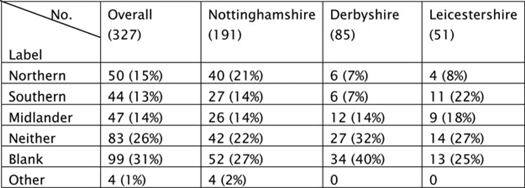
Once the students had been asked to draw the North/South divide, they were asked whether they considered themselves to be Northern/Southern/Neither. The results are illustrated in Table 1 (the overall figures are given and these are broken down into the three counties as there were differences between them). We can see that although the question asked whether students felt themselves to be Northern, Southern or Neither, the answers could be further sub-divided as some additionally wrote ‘Midlander’ or ‘East Midlander’ on the map.
Northern vs. Southern?
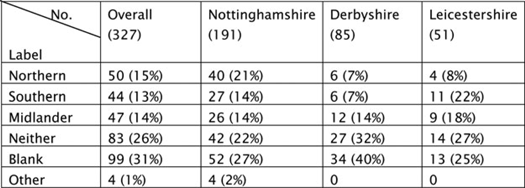
It seems that although most students agreed on the concept of a North/South divide in the UK as was shown in the previous task, many did not have an expressed affiliation with the North or the South. This question was left blank by almost a third of all participants. The category ‘Neither’ was the second most popular choice. These students specified by answering ‘Neither’ that they did not feel that they belong to ‘Northern’ or ‘Southern’, whereas the students leaving this question blank may be showing that although they feel they are aware of the divide, they are not sure about how this division applies to them and their own identity. The option of ‘Midlander’ or ‘East Midlander’ was not given in the question as it was believed this may lead the students to choose this answer, and this study was interested to see whether students would name this spontaneously. Looking at the overall figures, the totals for ‘Northern’, ‘Southern’ and ‘Midlander’ appear to be very similar to one another.
If we break this down into the individual counties, we can see some differences between the groupsFootnote 3. Of the Nottinghamshire participants (of which there were 191), almost half answered either ‘Neither’ or left this question blank. Forty participants (21%) labelled themselves as ‘Northern’, and a smaller proportion (14% for both) thought of themselves as ‘Southern’ or ‘Midlander’ (only 1% chose to define themselves as something else, e.g. English or British, which no other students used). So while 50% of the Nottinghamshire students did not feel themselves to belong to any particular category, a relatively high number felt ‘Northern’. Derbyshire showed a slightly different pattern. An overwhelming 72% felt themselves not to belong to any category or left the question blank. Compared to the Nottinghamshire students, fewer Derbyshire students selected ‘Northern’ (7%) or ‘Southern’ (7%), and a larger proportion gave themselves the label ‘Midlander’ (14%). Leicestershire was different again. Although again a larger proportion (52%) either left this question blank or gave the answer ‘Neither’, and a similar proportion labelled themselves ‘Midlander’ (18%) as compared to the other two counties, this group had the largest proportion of participants labelling themselves as ‘Southern’ (22%).
Overall, it seems that large numbers of students in the three counties seemed to be unsure about their identity as they left this question blank, although a large group believed themselves not to belong to these groups. It seems that most of the students were aware of the North/South divide, but many did not feel they belong to either side of that divide. It is therefore interesting to see that the actual divide itself was a salient one for these participants, but that they are less sure of their own categorisation.
Leaving aside the blank or ‘Neither’ categorisations, in Nottinghamshire many felt themselves to be ‘Northerner’, while in Derbyshire a high number identified themselves as ‘Midlander’. In Leicestershire many students believed themselves to be ‘Southerner’. Of these three counties, Leicestershire is geographically the most southern, which could have influenced these students in selecting this identity.
Discussion
This study shows that samples of sixth-year secondary school pupils in the East Midlands counties of Nottinghamshire, Derbyshire and Leicestershire generally felt that there is a North/South divide in the UK and were happy to draw a line illustrating it. However, these two tasks have shown that the East Midlands area may be problematic in terms of where it belongs or how people identify themselves with it. The area where this divide is identified varies greatly between informants, from the very north of England to the very south. As the participants in this study live very close to where researchers have suggested the North/South divide may fall (see Dorling, Reference Dorling2007), these results contradict the findings of Montgomery (Reference Montgomery2007: 64, 127) that people living closest to the North/South divide are more likely to agree about where the boundary lies as they have a vested interest in ‘knowing’ where it is. However, the ‘Midland’ group in Montgomery's study were from Crewe, which is in the very western-most part of the West Midlands, and there may be a distinction between these two areas.
Although almost all students were happy to state that there is a North/South divide (regardless of where it is placed), most students are less sure which group they belong to or say they do not feel as if they belong to the North or the South. Geographical location could play a role in this for some students, because students from the most southern county in these samples, Leicestershire, were more likely to label themselves as ‘Southern’ (rather than ‘Northern’ or ‘Midlander’), while those from Nottinghamshire were most likely to label themselves as ‘Northern’ and those from Derbyshire as ‘Midlander’. What is also interesting is that students did not comment on an East/West divide (see also Upton, Reference Upton, Markus, Iyeiri, Henberger and Chamson2012: 267), although there is a West Midlands that they could differentiate themselves from. A further issue which could be raised in the cases where the students answered ‘Neither’ is whether they felt themselves to belong to the East Midlands or Midlands, even though they have not specifically written this as some of the other students had done.
Future work could also include examining the zones where the majority of participants draw this line (as in Montgomery, Reference Montgomery2007) to further break down where this divide is believed to be by the majority of participants. Such work might include a qualitative element employing detailed questionnaires and focus groups with participants.
Wales comments that there are North/South stereotypes which may be “irritating” (Wales, Reference Wales2000: 15), but having an identity in opposition to another identity (i.e. being Northern as opposed to Southern, or Scottish as opposed to English) is important to many people – so what is happening to these participants? It is interesting that a relatively large proportion gave the term ‘Midlander’ even though this was not an option, as it shows that there is a sense of there being a separate identity rather than belonging to the North or South.
Conclusion
It seems clear that there is uncertainty about the position of the East Midlands and where it belongs in the country. The fact that a relatively high number of participants chose ‘Midlander’ is interesting as it suggests an idea of a separate (i.e. non-‘North/South’) identity. But there are limitations in understanding (from the present data) exactly what the students who said ‘Neither’ mean in their responses, and whether some may have felt unable to suggest ‘Midlander’ as it was not an option explicitly stated to them.
Intended future work will therefore include obtaining students’ responses to questions about language variation in the UK and how the East Midlands fits into this. Do they think there are ‘typical’ features of East Midlands language? This work will also include examining the ability of these students to recognise various accents from around the UK and to see how accurate they are at local varieties (see Braber, in preparation).
Further research which is suggested by the present enquiry would be to carry out work with adults to discover whether similar patterns are found on placing the North/South divide, how they would categorise themselves and how accurately they can identify local voices. This study did not explicitly consider travel experience or media influence, but these could also be interesting issues for future work.
NATALIE BRABER has a PhD from St Andrews
University. She is senior lecturer in Linguistics at Nottingham Trent University. Her
research specialism examines the link between language and identity, with a particular
focus on accents and dialects. She is interested in language variation in the East
Midlands, as well as the perception of language use there. A further area of interest is
the effect of emotion on language usage. Email: natalie.braber@ntu.ac.uk