Introduction
Flexible nasoendoscope has become an essential tool in otorhinolaryngology practice. Similar to rigid laryngoscopes, oesophagoscopes and bronchoscopes, flexible nasendoscopes can be contaminated with blood, body fluids, debris and micro-organisms with each use, and must be decontaminated prior to use in the next patient.Reference Foweraker 1 , Reference Esler, Baines, Wilkinson and Langford 2 However, the flexible nasoendoscopes commonly used in Otorhinolaryngology clinics does not have biopsy channels. This precludes the need for sterilisation.
There are different decontamination methods available, including chemical systems, endoscope sheaths, automated washing machines and autoclave sterilisation. Currently, there is no single best decontamination method, as each has its own merits and disadvantages. Because of this wide variety and the lack of specific decontamination guidelines, decontamination practices vary widely both within and outside the UK.Reference Lim and Gupta 3 – Reference Banfield and Hinton 5
The current ‘gold standard’ for decontamination of flexible nasendoscopes is automated washer within a designated, centralised decontamination unit. 6 However, this is not always possible due to the cost required to equip such units, as well as the additional staff needed to transport the endoscopes between the clinic and the decontamination unit.
A more economically viable option is cleaning with chlorine dioxides wipes. These are currently used in many UK hospitals, including our department. There has been no evidence that chlorine dioxide wipes cause harm to patients.Reference Esler, Baines, Wilkinson and Langford 2 , 6
Evidence on flexible nasendoscope decontamination is still lacking, and most current guidelines are based on evidence from, and standards for, gastroscopes.
In addition, in this era of economic uncertainty and National Health Service budgetary constraints, it is more important than ever to consider the cost-effectiveness of decontamination methods. However, patient safety should not be compromised.
This study compared the clinical efficacy and cost-effectiveness of chlorine dioxide wipes and automated washer, in accordance with the 2005 ENT-UK guidance on cleaning fibre-optic laryngoscopes, in order to guide ENT departments on their choice of flexible nasendoscope decontamination method. 7
Objective
We aimed to compare the clinical efficacy and cost-effectiveness of chlorine dioxide wipes versus automated washer, for the decontamination of flexible nasendoscopes.
Materials and methods
This sequential cohort study was divided into two parts. The first part was a controlled in vitro study examining the clinical efficacy of decontamination. The second part calculated the cost-effectiveness of the two decontamination methods.
Clinical efficacy
The study used the following materials: (1) three flexible nasendoscopes (no longer in clinical use); (2) a culture of Staphylococcus epidermidis (certified by the microbiology laboratory as safe for handling and safe for use outside the laboratory); (3) chlorine dioxide wipes; and (4) an automated washer (loaned from Tristel; Snailwell, Cambridgeshire, UK).
The following steps were taken to ensure validity and reliability. Decontamination of the flexible nasendoscopes with chlorine dioxide wipes was performed by trained ENT out-patient nurses, who regularly performed the decontamination process in the clinic according to the chlorine dioxide wipe manufacturer's instructions; decontamination was performed in a separate, clean room. Automated washer decontamination was performed according to standard instructions given by the manufacturer (Tristel), in the manufacturer's company laboratory. Observation and recording of results was done by one of the investigators.
Fifty sets of pre-decontamination and 50 sets of post-decontamination microbiological swab samples were obtained from both the chlorine dioxide wipe group and the automated washer group, as described below (power = 0.95).
The study lasted for five months, and received no external funding. It was approved by the hospital research and development department.
The chlorine dioxide wipe process used in the study comprised a three-stage chemical decontamination system. This included a pre-clean wipe that removed visible material and soil from the surface of the endoscope, a sporicidal wipe which killed bacteria, spores, viruses and fungi within a 30 second contact time, and a rinse wipe for removal of disinfection residue. This process has been shown to be safe for patients, users and the environment.
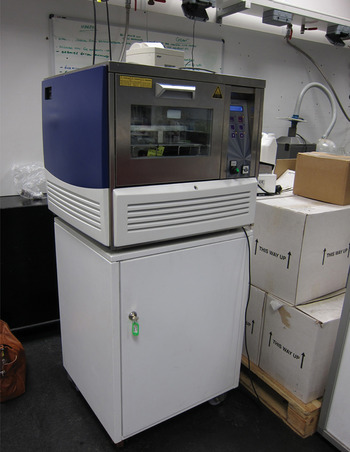
The automated washer (Figure 1) was a bench-top washer disinfector system which utilised a chlorine dioxide solution similar to that used in the chlorine dioxide wipe process, for the purpose of decontamination. However, the washer was operated based on a pre-set, automated protocol which was repeatable and could be regularly tested. The automated washer could decontaminate up to four endoscopes in each cycle, with each cycle lasting approximately 20 minutes.
The automated washer, pictured on top of a shelving unit.

Pre-decontamination and post-decontamination microbiological swabs were taken as follows.
The pre-decontamination swab was taken from the tip of the flexible nasendoscope.
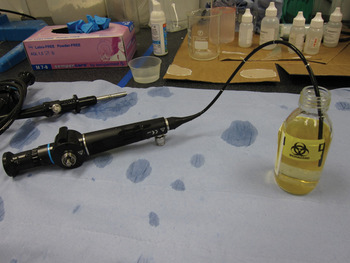
The flexible nasendoscope tip was subsequently dipped into an agar culture of S epidermidis for 2 minutes (Figure 2).
Immersion of the flexible nasendoscope tip into a culture of Staphylococcus epidermidis.

The whole flexible nasendoscope was then decontaminated using either chlorine dioxide wipes or the automated washer.
Following this, the post-decontamination microbiological swab was taken from the tip of the endoscope.
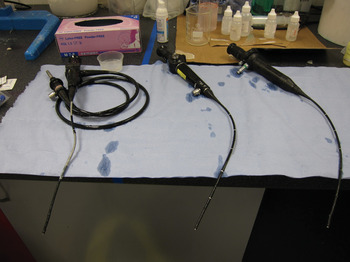
Apart from the decontamination process, the tip of the flexible nasendoscope was not handled (see Figure 3), in order to avoid contamination and thus prevent any bias of the final results.
The tips of the flexible nasendoscopes were left hanging in air and were not handled, so as not to affect the final results.

In testing the clinical efficacy of the decontamination processes, we attempted to simulate the real clinical setting as much as possible. Staphylococcus epidermidis was used as this is a commensal organism in the nasopharynx and larynx; in addition, it is safe for use outside the laboratory. A dipping time of 2 minutes was used to simulate the amount of time required to perform flexible nasendoscopy on a patient (i.e. the amount of time the flexible nasendoscope stays inside the patient).
The pre-decontamination swab had more significance in a real life setting. This is because, in the UK out-patient setting, flexible nasendoscopes are not kept in a sterile environment after decontamination, and are therefore liable to environmental contamination. Although Rejchrt et al. found a low incidence of bacterial growth (i.e. four positive assays out of 135) when gastroscopes and colonoscopes were kept in a dustproof cupboard for up to 5 days, no such study has been performed on flexible nasendoscopes.Reference Rejchrt, Cermal, Pavlatova, Mickova and Bures 8 Moreover, very little is known about flexible nasendoscope storage practices in different departments – storage in a dustproof cupboard may not be the usual practice.
Cost-effectiveness
Cost-effectiveness calculations were based on the operation of the decontamination system within one central ENT unit. Various preparation and maintenance costs were taken into account.
Results
The study was carried out over a three month period. Fifty pre-decontamination swabs and 50 post-decontamination swabs were taken for both the chlorine dioxide wipes group and the automated washer group.
Clinical efficacy
The pre-decontamination swabs (i.e. taken from the flexible nasendoscope tip before dipping in S epidermidis agar) showed S epidermidis growth in one swab out of 50 (2 per cent) in the chlorine dioxide wipe group and in four swabs out of 50 (8 per cent) in the automated washer group. This difference was not statistically significant (p = 0.375, McNemar test).
The post-decontamination swabs (i.e. taken after dipping the flexible nasendoscope tip in S epidermidis agar and then decontaminating the nasendoscope using one of the two study methods) showed S epidermidis growth in one out of 50 swabs (2 per cent) in the chlorine dioxide wipes group (χ2 = 46 (one degree of freedom), p < 0.0001) and in 14 out of 50 swabs (28 per cent) in the automated washer group (χ2 = 9.6 (one degree of freedom), p < 0.002). This difference was statistically significant (p < 0.0001, McNemar test).
Apart from S epidermidis, the microbiological swabs taken in this study also grew bacillus, diphtheroids, α haemolytic streptococci and coliforms. These were likely to be environmental contaminants. The pre-decontamination swabs for the two decontamination methods grew comparable numbers of non S epidermidis bacteria: non S epidermidis growth was seen in six out of 50 swabs (12 per cent) in the chlorine dioxide wipes group and in seven out of 50 swabs (14 per cent) in the automated washer group (χ2 = 0.111 (one degree of freedom), p = 0.739, Friedman test). The post-decontamination swabs also grew comparable numbers of non S epidermidis bacteria: non S epidermidis growth was seen in two out of 50 swabs (4 per cent) in the chlorine dioxide wipes group and in three out of 50 swabs (6 per cent) in the automated washer group (χ2 = 3.57 (one degree of freedom), p = 0.59, Friedman test). There were no statistically significant differences in swab growth, comparing the pre-decontamination and post-decontamination swabs for the 2 study methods.
Cost-effectiveness
Cost-effectiveness calculations were performed based on the assumption that the average clinic would use the nasendoscope seven times in the one session.Reference Lubbe and Fagan 4 Our department had three clinics per session and eight sessions per week, equating to approximately 168 washes per week and 8400 washes per year, assuming 50 working weeks per year.
The chlorine dioxide wipe system cost £3.60 per use. Each decontamination took approximately 2–3 minutes, and produced one decontaminated nasendoscope. This equated to a total cost of £30 240 per year.
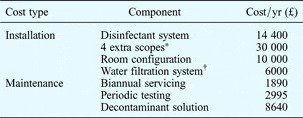
The automated washer system and its water filtration system cost £14 400 and £6000, respectively. The whole system could decontaminate up to four flexible nasendoscopes in each cycle, which took 18–20 minutes. However, the long duration of each decontamination cycle necessitated the provision of extra flexible nasendoscopes in order to avoid delay in the clinic. In addition to our clinic's three existing flexible nasendoscopes, we estimated conservatively that a further four flexible nasendoscopes would be required. At an estimated price of £7500 each (price range, £5000 to £10 000), these four nasendoscopes would cost a total of approximately £30 000. In addition, the out-patient clinic would need to be adapted to create space to house the automated washer. This would add approximately £10 000 to the installation cost, creating a total expenditure of £60 400.
The automated washer system also needed to be tested and maintained periodically to ensure its validity. Periodic testing would cost £2995 and biannual servicing would cost £1890. The chemical solution for the decontamination process would cost £3.60 per cycle. However, as each cycle cleaned four flexible nasendoscopes, the decontamination cost was reduced to £0.90 per scope. This therefore equated to an expenditure of £8640 per year.
Although the automated washer required a huge installation cost, once installed it would enable a saving of £16 715 per year. Thus, its installation costs would be recovered within 3.6 years of use. The manufacturers stated that the automated washer, in use, was designed to last for at least 10 years. Therefore, over a 10 year period the automated washer would enable an overall saving of approximately £107 000 (i.e. 6.4 years × £16 715 per year).
Discussion
In this in vitro study, the chlorine dioxide wipes appeared to be more efficacious for decontamination, compared with the automated washer. However, although the automated washer group showed more S epidermidis growth post-decontamination (with growth in 14/50 swabs, 28 per cent), compared with the chlorine dioxide wipe group, the majority of these positive swabs (11 of 14) grew only one S epidermidis colony, with the remaining three positive swabs growing three, four and 10 S epidermidis colonies.
It is uncertain whether this amount of S epidermidis growth, due to inadequate decontamination, is of any significance, and specifically whether it increases the risk of bacterial transmission and infection in patients. In the current literature, there are no reports linking inadequate flexible nasendoscope decontamination with disease transmission.Reference Lim and Gupta 3 , Reference Muscarella 9 There have been anecdotal reports of transmission of hepatitis B and C, human papillomavirus, and tuberculosis via gastroscopes, colonoscopes and bronchoscopes.Reference Birnie, Quigley, Clements, Follet and Watkinson 10 – Reference Michele, Cronin, Graham, Dwyer, Pope and Harrington 12 Flexible nasendoscopes are similar in nature to gastroscopes, colonoscopes and bronchoscopes in that they involve entry into a bodily orifice and contact with bodily fluids, blood and mucosa. There is therefore a hypothetical risk of similar disease transmission with flexible nasendoscopy. Hence, it is essential for all ENT departments to recognise this potential for disease transmission via flexible nasendoscopy, and to ensure that protocols are in place and enforced to maintain patient safety.
Studies have showed that manual decontamination is often inconsistent and liable to variation and inadequate completion.Reference Kaczmarek, Moore, McCrohan, Goldmann, Reynolds and Caquelin 13 , Reference Muscarella 14 Endoscopy-induced infection is usually due to procedural errors in decontamination.Reference Nelson, Jarvis, Rutala, Foxx-Orenstein, Isenberg and Dash 15 The automated washer has the advantage of allowing a standard protocol of decontamination to be applied each time, thereby removing the potential for human error. In addition, it also allows regular testing and revalidation of the decontamination process.
Furthermore, our cost calculation showed that the automated washer was the cheaper option in the long term. However, there are other obscure costs to consider when using the automated washer. These include repair costs in the event of breakdown, electricity costs and water bills. In addition, extra staff are needed for transportation of endoscopes if the automated washer is located outside the ENT out-patient department, as recommended by the Department of Health. 16 Despite these recommendations, it is general opinion that the automated washer is best placed within the ENT out-patient department, given the large turnover of flexible nasendoscopes.Reference Lubbe and Fagan 4 It has also been reported that endoscopes are liable to damage during transportation.Reference Lubbe and Fagan 4
Further consideration should be given to the fact that the automated washer is only cost-effective if four endoscopes are decontaminated in each cycle. This is because the chemical solution for each cycle costs £3.60. When divided by four endoscopes, each will cost only £0.90 to decontaminate. However, in a busy clinic it may not always be possible to wait for four endoscopes to be loaded before commencing the decontamination cycle, and this would inadvertently raise the cost of decontamination. This also means that the automated washer is more suited to settings with a larger volume of flexible nasendoscope use, such as the ENT clinic, rather than to in-patient wards or general practice surgeries with less frequent flexible nasendoscope use.
The chlorine dioxide wipe process has the advantage of no installation costs. It is also more mobile and can thus be taken to other wards or to the accident and emergency department and used to decontaminate the flexible nasendoscope immediately after use. In this study, it had better efficacy than the automated washer. Chlorine dioxide has been proven to be effective against Mycobacterium terrae and to be active against hepatitis C virus and human immunodeficiency virus after 30 seconds of contact time. 7
However, studies have shown that manual decontamination is often flawed and is highly variable in terms of technique and duration.Reference Banfield and Hinton 5 , Reference Muscarella 9 , Reference Muscarella 14 Our study had similar findings. In our department, flexible nasendoscope decontamination is performed using the chlorine dioxide wipe process, a three-part system consisting of a pre-clean wipe, a sporicidal wipe and a rinse wipe. For decontamination to be effective, all three steps must be completed in the correct sequence. All nursing staff members are trained to use the chlorine dioxide wipe process. Despite this, random checks carried out over the period of this study showed that on two out of five monthly inspections, there were unequal numbers of wipe sachets left at the end of the clinic session, indicating that some of the decontaminations had been incompletely performed.
-
• Flexible nasendoscope decontamination methods vary widely
-
• In this study, decontamination via chlorine dioxide wipes was more effective than automated washing
-
• However, automated washing was cheaper in the long term
In this study, bacteria other than S epidermidis were also grown. The incidence of these ‘contaminants’ was similar in both the chlorine dioxide wipe and automated washer groups. These other bacterial species included bacillus, diphtheroids, α haemolytic streptococci and coliforms. These are likely to be environmental contaminants, either from non-sterile gloves, sneezing or contact with non-sterile work surfaces. Although we performed an in vitro study, our findings are applicable to the real-life setting as flexible nasendoscopy is often performed with non-sterile gloves in a non-sterile setting. However, it is uncertain whether the observed amount of contaminant growth would be significant enough to cause disease transmission in patients.
Conclusion
Our study found that chlorine dioxide wipes were more efficacious in decontamination of flexible nasendoscopes compared with an automated washer. However, further studies are required to check the reproducibility of these results. Cost calculations showed that it would be cheaper to use the automated washer in the long term. Further studies on real patients are recommended to test the significance of improper decontamination and the actual risk of cross-infection.
Automated washer costs

*Flexible nasendoscopes, costing an estimated £7500 each. †Reverse Osmosis (RO) Plant (water filtration system). Yr = year
Overall cost comparison

Acknowledgement
We thank Mrs Cathy Hatch, Advanced Biomedical Scientist at Tameside Hospital NHS Foundation Trust, for her guidance and help in processing the microbiological swabs. Without her, we would not have been able to obtain the relevant data.
We are also grateful to Tristel Plc for the loan of the automated washer that enabled us to carry out this study.