


Introduction
American democracy’s boundaries have shifted over time as different groups gained or lost access to political, social, and civil rights. Historically, groups and individuals have been excluded based on economic class, religion, gender, and/or ethno-racial background. In other words, outsider status has been at the helm of political exclusion for various social groups. US immigration policy is often viewed as a racialized policy, but it has also excluded individuals based on other criteria. For example, while the Immigration Act of 1917 excluded certain immigrant groups from entering the United States based on their racial and ethnic background, Section 3 of this immigration policy also restricted entry based on perceived differences related to (then) undesirable traits like mental illness, intellectual disability, physical disability, political ideology, moral turpitude, or religious affiliation (United States, and United States Bureau of Immigration 1922). The US government implemented restrictive immigration policies to preserve the dominant group’s population hegemony (Masuoka and Junn Reference Masuoka and Junn2013). In other words, United States political elites and institutions have sought to maintain the archetype of a Western, White, European Protestant population to the exclusion of others.
Exclusionary experiences that are at the core of US immigration policy serve as the foundation for understanding various forms of outgroup cohesion. Here we offer a novel measure of immigrant cohesion, immigrant linked fate, that moves beyond the classic concept of racial linked fate. Immigrant linked fate examines the extent to which individuals (immigrants and nonimmigrants) have solidarity with immigrants, wherein individuals believe that what happens to immigrants will mutually impact their individual well-being in the United States. Recent research examines the relationship between immigrant linked fate and political participation among Latinos, Blacks, and Asians (Macías Mejía Reference Macías Mejía2024). Other studies examine the predictors of immigrant linked fate among Latinos and Asians but do not determine whether other groups with lower percentages of immigrants might also express immigrant linked fate (Kiang et al. Reference Kiang, Wilkinson and Juang2021; Macías Mejía Reference Macías Mejía2025). Research needs to expand our understanding of the predictors that influence immigrant linked fate, especially among other groups who also express immigrant linked fate, such as Black Americans. We do this by treating immigrant linked fate as a dependent variable and independent variable. First, we treat immigrant linked fate as a dependent variable by examining which variables influence the acquisition of immigrant linked fate. Next, we conduct an analysis that suggests racial linked fate and immigrant linked fate are distinct concepts and have an inverse relationship. We follow these analyses by treating immigrant linked fate as an independent variable and examine if immigrant linked fate influences immigration policy preferences. In this article we examine the following questions: Do Latinos, Blacks, and Asians express immigrant linked fate at similar levels? If so, what factors lead to the acquisition of immigrant linked fate? Does immigrant linked fate impact the political attitudes of those who espouse this form of solidarity?
To assess which factors lead to the acquisition of immigrant linked fate among Latinos, Blacks, and Asians, we use the measure of immigrant linked fate that is only available in the 2016 Collaborative Multi-racial Post-Election Survey (CMPS 2016). We use the concept of vicarious discrimination as the basis for our theoretical framework to explain why Latinos, Blacks, and Asians express immigrant linked fate when they, themselves, might not be immigrants or are detached from the immigrant experience. Unfortunately, we cannot examine White Americans, since the immigrant linked fate question was not asked of this group in the CMPS 2016 survey. We assess vicarious discrimination by including proxy measures of vicarious discrimination, such as perceived discrimination against US immigrants (Aboargob et al. Reference Aboargob, Ramirez and Volpert-Esmond2026; Volpert-Esmond and Aboargob Reference Volpert-Esmond and Aboargob2023). We also include a measure for discrimination experiences and a measure of exclusion (“feeling like an outsider”) as precursors for experiencing out-group status. Our logic is simple: If someone feels excluded from US society due to their status as a member of a non-White racial group, this can foster feelings of empathy among nonimmigrants toward immigrants, leading to immigrant solidarity.
Because immigrant linked fate is a novel extension of racial linked fate, we begin with a factor analysis of racial linked fate and immigrant linked fate which confirms that they are, indeed, distinct concepts. Further, we find that significant percentages of Latinos, Blacks, and Asians report immigrant linked fate, many in the absence of immigrant status. The key factors shaping immigrant linked fate are discrimination and outsider status. We also find an inverse relationship between racial linked fate and immigrant linked fate, those with high immigrant linked fate report low levels of racial linked fate. Lastly, our empirical analysis examines the utility of immigrant linked fate in defining policy positions. We find that Latinos, Blacks, and Asians who express immigrant linked fate are more likely to cite immigration policy as a top issue.
This study contributes to the linked fate literature by establishing a related, but distinct type of linked fate (immigrant linked fate) that is inversely related to racial linked fate. It also extends our knowledge on the factors that shape the development of immigrant linked fate across racial and ethnic minority groups. Our research also adds to the literature by moving beyond racial and pan-ethnic-linked fate to examine the development of immigrant solidarity among nonimmigrants through vicarious discrimination. Ultimately, we add a robust understanding to research on solidarity politics that moves beyond racial linked fate to examine immigrant solidarity, which is imperative for understanding the current US political administration as well as helps anchor our understanding of why individuals might engage in political mobilization to defend and support immigrant rights in the United States. Next, we review existing literature on social identity and linked fate, paying particular attention to the use of linked fate among Latinos, Blacks, and Asians.
Social Identity Theory and Linked Fate
Social identity theory (SIT) provides the foundation for understanding how nonimmigrants develop solidarity with immigrant groups and how this solidarity connects to established concepts of linked fate (McClain et al. Reference McClain, Jessica and Candis2009; Pérez Reference Pérez2021). SIT was developed to provide a framework for understanding how individuals derive a sense of identity and self-concept from their membership in social groups (Tajfel and Turner Reference Tajfel, Turner, Austin and Worchel1979). In political science, SIT is seen as a precursor for understanding the development of social identities and how they yield the creation of group membership attachments. SIT has been used to examine political phenomena, such as the role of political identities in developing political attitude formation and political behavior, partisan identities, broader identity categories, and the adoption of issue positions (Abrams Reference Abrams1994; Duck et al. Reference Duck, Hogg and Terry1995; Huddy Reference Huddy2001; as cited in Huddy et al. Reference Huddy, Mason and Horwitz2016; McClain et al. Reference McClain, Jessica and Candis2009; Pérez Reference Pérez2021). Recent work derived from SIT examines the development of a superordinate identity labeled people of color identity among racial and ethnic minority groups (Pérez Reference Pérez2021). SIT provides the theoretical foundation for understanding the reconceptualization of linked fate as in-group solidarity rather than viewing linked fate as a concrete identity (Pérez Reference Pérez2021; Pérez et al. Reference Pérez, Goldman, Huo, Nteta and Tropp2025). This gives us the basis for understanding immigrant linked fate as a new concept that measures solidarity with immigrants.
SIT is an antecedent to linked fate. To develop a sense of solidarity with a racial/ethnic in-group, an individual must cognitively identify with the racial/ethnic group in question. Linked fate is a “cognitive heuristic also grounded in SIT, which leads an individual to use the social standing of the group as a proxy for the wellbeing of the individual” (McClain et al. Reference McClain, Jessica and Candis2009, 477; Dawson Reference Dawson1994). Michael Dawson (Reference Dawson1994) developed linked fate by reconceptualizing prior work examining the sibling concept of “common fate” introduced by Gurin et al. (Reference Gurin, Hatchett and Jackson1989) in their book on Black political behavior to assess why Blacks have political cohesion (cited in White and Laird Reference White and Laird2020). For Blacks, linked fate operates as a heuristic whereby the saliency of race allows them to use the interests of the group as an efficient proxy for their own, individual interests.
Given the parsimonious and predictive nature of linked fate, the concept has been expanded to non-Black groups to assess in-group solidarity among non-Blacks and nonracial groups (especially gender groups) (Chan and Jasso Reference Chan and Jasso2023; Gay et al. Reference Gay, Hochschild and White2016; Pérez Reference Pérez2021; Sanchez and Masuoka Reference Sanchez and Masuoka2010). Among Latinos, research suggests that linked fate is not as strong or as stable as it is for Blacks (Sanchez et al. Reference Sanchez, Masuoka and Abrams2019; Sanchez and Vargas Reference Sanchez and Vargas2016; Macías Mejía Reference Macías Mejía2025, Reference Macías Mejía2024). This instability stems from experiences with the US racial order, varying acculturation levels, nativity, location, political context, language usage, phenotype, the division of labor, generational cohort, and segregation (Beltran Reference Beltran2010; Lavariega Monforti and Sanchez Reference Lavariega Monforti and Sanchez2010; Macías Mejía Reference Macías Mejía2025; Maltby et al. Reference Maltby, Rocha, Jones, Vannette and Fate2020; Sanchez and Vargas Reference Sanchez and Vargas2016; Simien Reference Simien2005). Scholars also argue that linked fate varies among Latinos as a result of situational circumstances (Pérez and Cobian Reference Pérez and Cobian2024). One way situational experiences are tied to fluctuations of linked fate among Latinos is through political context and location (where Latinos live) (Maltby et al. Reference Maltby, Rocha, Jones, Vannette and Fate2020). Native-born Latinos who live near large immigrant populations and with high rates of immigrant enforcement are more likely to express linked fate than native-born Latinos who do not live near high immigrant populations (Maltby et al. Reference Maltby, Rocha, Jones, Vannette and Fate2020). This differs from foreign-born Latinos who are not impacted by policy context (Maltby et al. Reference Maltby, Rocha, Jones, Vannette and Fate2020). Yet discrimination is highly predictive of linked fate among Latinos (Gutierrez et al. Reference Gutierrez, Ocampo, Barreto and Segura2019; Lu and Jones Reference Lu and Jones2019; Macías Mejía Reference Macías Mejía2025; Marsh and Ramirez Reference Marsh and Ramírez2019; Sanchez et al. Reference Sanchez, Masuoka and Abrams2019). Nevertheless, there is considerable evidence that Latinos express linked fate despite this variation.
Linked Fate among Asian Americans shares similar levels of instability as it does among Latinos (Chen and Chan Reference Chen and Chan2026). The histories of immigrant incorporation, immigration patterns, phenotype, diverse language usage, religion, division of labor, acculturation levels, and experiences with the racial order contribute to a weak pan-ethnic attachment to the Asian American label, which results in a weaker sense of linked fate among this group (Junn and Masuoka Reference Junn and Masuoka2008; Kim Reference Kim1999a; Masuoka and Junn Reference Masuoka and Junn2013). However, a more recent study using time-series analysis suggests that linked fate among Asian Americans post 2016 increased and remained elevated one year later as a direct result of Trump’s anti-Asian immigrant rhetoric and persistent discrimination (Le et al. Reference Le, Arora and Stout2020). Research consistently suggests that experiences with discrimination, shared racial experiences, external perceptions, and threat influence the expression of linked fate among Asian Americans (Chan et al. Reference Chan, Nguy and Masuoka2024; Chan and Jasso Reference Chan and Jasso2023; Chen and Chan 2026; Kiang et al. Reference Kiang, Wilkinson and Juang2021; Kim Reference Kim2024). Studies also suggest that this group’s expressions of linked fate may vary by national origin group (Huang Reference Huang2021). Yet even though Asian American linked fate is malleable, scholarship demonstrates that racial experiences and discrimination are fundamental motivators that heighten the sense of linked fate among this group. This brief discussion on the operations of linked fate across different racial and ethnic groups sets up our theory of why racial linked fate and immigrant linked fate diverge.
Differentiating Racial Linked Fate and Immigrant Linked Fate
To begin, we rely on Pérez’s (Reference Pérez2021) reconceptualization of racial linked fate, which argues that linked fate is not based solely on a tangible identity but rather forms due to common experiences that manifest as in-group solidarity (p. 18). When applying this perspective to immigrant linked fate, we similarly argue that immigrant linked fate is not a tangible identity but rather a measure of in-group solidarity with immigrants. Viewing the general concept of linked fate and immigrant linked fate as in-group solidarity is essential for understanding when nonimmigrants might develop solidarity with immigrants and points to factors that may help form this solidarity. First, we argue that racial linked fate is distinct from immigrant linked fate because they both rest on two different, yet parallel, realities in the US political and social order; one stems from phenotypical attributes seen as inferior that are used to justify systemic racial inequities and oppression, and the other from immigrant legal status. Racial minority groups are treated as second-class citizens and are excluded from the US political and social order because they do not belong to the dominant racial group (Whites) (Masuoka and Junn Reference Masuoka and Junn2013). Ultimately these general political and social experiences of exclusion may facilitate empathy that leads to solidarity whereby individuals vicariously experience the social and political exclusion of immigrants regardless of their individual immigrant status. We argue that these processes drive immigrant solidarity among nonimmigrants who have immigrant relatives, acquaintances, or who vicariously experience immigrant exclusion. Thus, even if they are not immigrants themselves, empathy and vicarious discrimination/exclusion may lead to a sense of immigrant solidarity and immigrant linked fate.
Current social and political hierarchies facilitate exclusion by preventing inclusion into dominant society. We argue that two distinct, but parallel, social hierarchies exist in the US—one based on racial identity and the other based on legal status. Both are types of exclusion that have utilized de jure and de facto means of enforcement. Racial exclusion is based on ascribed racial identity derived from phenotypical attributes and is historically related to civil rights. Exclusion based on legal status is related to the phenotypical attribution of legality as it relates to nativity and geography and its concomitant rights of access. The processes are remarkably similar but distinct. Regarding race, exclusion is based on inherent, unchangeable physical attributes, whereas, regarding legal status, exclusion is based on the presence or absence of adherence to a codified legal process. While physical attributes related to race and ethnicity are still used to ascribe legality and guide exclusion, legal status can be altered. In other words, legal status is neither fixed nor inherent. As a result, we expect an inverse relationship between racial linked fate and immigrant linked fate because distance from the immigrant experience or new legal status might result in greater expression of solidarity with an individual’s ethnoracial group rather than with immigrants. However, both function in ways that can exclude or include individual group members in social and political spheres.
Role of Social Exclusion
We define social exclusion as the process by which individuals are “blocked from economic resources, social services, or political opportunities” (Jordan Reference Jordan1996; Taket et al. Reference Taket, Crisp, Nevill, Lamaro, Graham and Barter-Godfrey2009; Cited in Lee Reference Lee2024, p. 194). Social exclusion is rooted in any perceivable difference affecting anyone based on racial and ethnic group background, immigrant status, sexual orientation, gender, and so forth. Immigrants and racial and ethnic minority groups are distinct social groups who share experiences of social exclusion. For instance, Latinos and Blacks were introduced to the United States by force. Those of African descent arrived in America as slaves. Latinos, specifically Mexicans and Puerto Ricans, arrived due to conquest and imperialism. Asians arrived primarily due to labor demands. Historically, these three groups were excluded from becoming US citizens and obtaining political, civil, and social rights. In contemporary America, while members of these groups may hold de jure citizenship, they do not benefit from de facto citizenship (Molina Reference Molina2014). Some past and present examples of the limitations of de facto citizenship include voting rights, segregation, and labor oppression.
Regardless of citizenship status, Latinos, Blacks, and Asians are also victims of racial discrimination and subjugation. Masuoka and Junn (Reference Masuoka and Junn2013) discuss in their book how the racial hierarchy in America is more of a “racial prism,” with Whites on top, Blacks at the bottom, and Asians above Latinos and Blacks but below and to the side of Whites. Latinos fall below Whites and Asians and to the side of them, but above Blacks. They propose the racial prism because it signals potential changes in the racial hierarchy while highlighting how Latinos and Asians are still “othered” and viewed as foreigners. The forever foreigner trope signals that social exclusion is also rooted in nativism and impacts who is perceived as belonging to the US based on citizenship.
In short, Blacks, Latinos, and Asians, regardless of nativity status and racial group, have faced social exclusion for generations. Whether this was from preventing land ownership, voting, and/or educational opportunities, these shared histories of oppression suggest shared experiences with general aspects of discrimination, marginalization, and persistent oppression.
Theoretical Framework of Vicarious Discrimination and Immigrant Solidarity
To understand why nonimmigrants might develop group solidarity with immigrants, we turn to the literature on vicarious discrimination. Vicarious discrimination occurs when an individual witnesses or learns about the discrimination experienced by others, such as friends, family, and/or strangers (Huynh et al. Reference Huynh, Huynh and Stein2017; Jochman et al. Reference Jochman, Cheadle, Goosby, Tomaso, Kozikowski and Nelson2019; Ozier et al. Reference Ozier, Taylor and Murphy2019 cited in Volpert-Esmond and Aboargob Reference Volpert-Esmond and Aboargob2023, p. 2). Vicarious discrimination suggests that discrimination can be experienced directly but also indirectly (Chan and Benner Reference Chan and Benner2026; Moody et al. Reference Moody, Tobin and Erving2022). Vicarious discrimination can be experienced in many forms, such as in person, online, and through hearing stories. (Volpert-Esmond and Aboargob Reference Volpert-Esmond and Aboargob2023). Though research is ongoing, one study suggests that vicarious discrimination may build empathy between out-group members of a dominant group (Aboargob et al. Reference Aboargob, Ramirez and Volpert-Esmond2026; Brown et al. Reference Brown, McField, Viltz and Oberle2026; Volpert-Esmond and Aboargob Reference Volpert-Esmond and Aboargob2023). The impact of vicarious discrimination can span several areas of an individual’s life and have several adverse effects, including negative health outcomes (Volpert-Esmond and Aboargob Reference Volpert-Esmond and Aboargob2023).
Of relevance here, several researchers have noted the relationship between engagement in political news and vicarious discrimination. Aboargob et al. (Reference Aboargob, Ramirez and Volpert-Esmond2026) found that Latino engagement in political news during the 2020 election led to experiences with vicarious discrimination and that vicarious discrimination had the adverse effect of increasing anxiety among Latinos (Aboargob et al. Reference Aboargob, Ramirez and Volpert-Esmond2026). Thus, we argue that among nonimmigrants from racial and ethnic backgrounds, vicarious discrimination can explain group solidarity with immigrants. This occurs because racial and ethnic group’s own experiences of social exclusion, when coupled with their vicarious experience of discrimination against immigrants, catalyze the development of immigrant linked fate. While we do not have direct measures for vicarious discrimination, we do include measures of both experienced and perceived immigrant discrimination to explore how discrimination may trigger solidarity among nonimmigrants toward immigrants. In sum, we argue that the development of immigrant linked fate stems from shared solidarity with immigrants due to personal experiences with discrimination and exclusion or vicarious discrimination built through exposure to the immigrant plight in media or social circles. Since racial linked fate and immigrant linked fate are distinct hierarchies of exclusion, with one anchored in ascribed racial identity and the other in legal status, we expect that racial and ethnic minorities will anchor their sense of solidarity primarily in either racial or immigrant solidarity rather than both simultaneously.
We test the following hypotheses:
Inverse Relationship between Racial Linked Fate and Immigrant Linked Fate Hypothesis
H1: Individuals who express higher levels of racial linked fate will express lower levels of immigrant linked fate, and vice versa, suggesting an inverse relationship between racial linked fate and immigrant linked fate.
Perceived Immigrant Discrimination Hypothesis
H2: Latinos, Blacks, and Asians who perceive discrimination against immigrants will be more likely to express immigrant linked fate when compared to Latinos, Blacks, and Asians who do not perceive discrimination against immigrants.
Experienced Discrimination due to Immigration Status Hypothesis
H3: Latinos, Blacks, and Asians who have experienced discrimination due to immigrant status are more likely to express immigrant linked fate when compared to Latinos, Blacks, and Asians who have not experienced discrimination due to immigrant status.
Social Exclusion Hypothesis
H4: Latinos, Blacks, and Asians who feel that they are outsiders are more likely to express immigrant linked fate when compared to Latinos, Blacks, and Asians who do not feel that they are outsiders.
Data and Methods
To examine the predictors of immigrant linked fate among Latinos, Asians, and Blacks, we employ the Collaborative Multiracial Post-Election Survey (CMPS) 2016 (Barreto et al. Reference Barreto, Frasure-Yokley, Vargas and Wong2017). Data were collected online between December 3, 2016 and February 15, 2017, with a total number of 10,145 respondents. The inclusion of immigrant linked fate, several discrimination measures, and the oversample of Latinos, Blacks, and Asians make the CMPS 2016 a particularly suitable dataset.Footnote 1 The CMPS 2016 includes 2,997 Latino respondents, 3,005 Asian respondents, and 3,099 Black respondents.Footnote 2
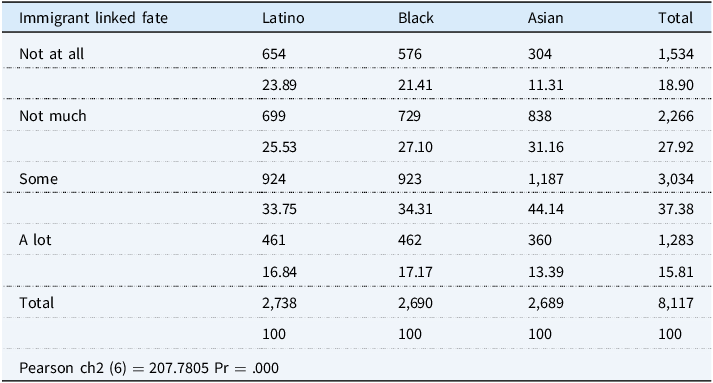
The dependent variable in our analysis is an ordinal measure of immigrant linked fate that asked respondents the following question: “What happens generally to immigrants in this country will have something to do with what happens in your life.” Codes ranged from 1 (“not at all”) to 4 (“a lot”). This question reproduces the standard linked fate question wording used in previous literature (see, for example, Dawson Reference Dawson1994; Masuoka Reference Masuoka2006; Sanchez and Masuoka Reference Sanchez and Masuoka2010; Sanchez et al. Reference Sanchez, Masuoka and Abrams2019). Table 1 displays the distribution of our dependent variable by Latino, Asian, and Black respondents.
Distribution of dependent variable, immigrant linked fate, by Latino, Asian, and Black respondents

Table 1. Long description
The table presents the distribution of responses to a question about immigrant linked fate among Latino, Black, and Asian respondents. It has four rows and five columns. The columns are labeled ‘Immigrant linked fate’, ‘Latino’, ‘Black’, ‘Asian’, and ‘Total’. The rows are labeled ‘Not at all’, ‘Not much’, ‘Some’, ‘A lot’, and include totals and percentages. Row 1: Not at all, Latino 654, Black 576, Asian 304, Total 1534, 23.89, 21.41, 11.31, 18.90. Row 2: Not much, Latino 699, Black 729, Asian 838, Total 2266, 25.53, 27.10, 31.16, 27.92. Row 3: Some, Latino 924, Black 923, Asian 1187, Total 3034, 33.75, 34.31, 44.14, 37.38. Row 4: A lot, Latino 461, Black 462, Asian 360, Total 1283, 16.84, 17.17, 13.39, 15.81. The table also includes a Pearson chi-square statistic and p-value.
For each of our three groups, the modal response for linked fate is “some,” with 44.14% of Asian respondents reporting “some” immigrant linked fate, followed by 33.75% of Latino respondents and 34.31% of Black respondents. Small percentages of each group, ranging from 11 to 24%, denied any feelings of immigrant linked fate. Suffice it to say, that the majority of Latino, Asian, and Black respondents felt some level of immigrant linked fate. It is important to note that when interpreting these statistics, only 24% of Latino respondents were foreign-born, 6.3% of Black respondents were foreign-born, but 45.6% of Asian respondents were foreign-born. Despite these differences, Latino and Black respondents have outsized feelings of immigrant linked fate, while Asian respondents have less than their foreign-born percentages might suggest. The distribution also points to distinctions in perceptions of closeness to immigrant populations among Latinos, Blacks, and Asians. Unfortunately, the CMPS 2016 does not include measures that assess “closeness to immigrants” for further examination.
Our key independent variables are two measures of discrimination that capture perceived and real experiences with immigrant discrimination. The first measure, perceived discrimination against immigrants in the US, is an ordinal measure with values ranging from 1, indicating “not very much” discrimination against immigrants in the United States to a value of 4, indicating “a lot” of discrimination against US immigrants. Respondents were asked, “How much discrimination is there in the United States today against each of the following groups: Immigrants?” Recall that we are using perceived discrimination as a proxy for vicarious discrimination (Aboargob et al. Reference Aboargob, Ramirez and Volpert-Esmond2026; Volpert-Esmond and Aboargob Reference Volpert-Esmond and Aboargob2023).
The second measure of discrimination taps into the personal experiences with immigrant-based discrimination. We labeled this variable personal experience immigrant discrimination, and it takes the value of one if an individual experiences discrimination based on immigrant status and zero if not. In our sample, roughly 9% of Latino and Asian respondents and 4.9% of Black respondents report being discriminated against based on immigrant status. It is important to note that while there is a close relationship between foreign-born status and experiencing immigrant-based discrimination, these experiences are not only reported by those who are foreign-born. Overall, 18% of our foreign-born Latino, Asian, and Black sample reported experiencing discrimination based on immigrant status, while nearly 6% of our native-born Latino, Asian, and Black sample reported the same experiences. This suggests that an immigrant-status version of street race is likely occurring.
To account for immigrant status, we include in our models measures of foreign-born status. For Asians and Latinos, we include a dichotomous variable, Foreign-Born, which asks respondents whether they were born in the United States or another country.Footnote 3 To more accurately account for the complex ancestries that have resulted from Black history with slavery, we include the variable, US Roots (Black), which takes a value of one if the respondent’s family has been in the United States for generations and zero if not. Importantly, 74% of Black respondents report family roots in the United States for generations.Footnote 4
Because experience with exclusion plays a key role in our theory, our models include an attitudinal measure of exclusion that asks respondents to what extent they feel like an outsider in the United States. Respondents were asked, “How much do you feel like an outsider in the United States?” Feel like an Outsider takes a value of one if the respondent never feels like an outsider, two if they rarely feel this way, three if they often feel like an outsider, and four if they always feel like an outsider. Prior studies demonstrate the role of exclusion in political behavior, suggesting to us that feeling like an outsider may have important group-based dimensions that facilitate these political behavioral outcomes (Masuoka and Junn Reference Masuoka and Junn2013).
In addition to our focal independent variables, we add a battery of controls. The descriptive information for each control can be found in Appendix A, organized by ethnoracial group. We control for the importance of respondent’s ethnoracial identities in their everyday lives. We include these measures as precursors to the formation of group identity. Those who feel that their individual racial or ethnic identity are important parts of themselves may feel exclusion more profoundly than those who do not. Unfortunately, the CMPS 2016 did not ask this question of Black respondents. However, Latinos and Asians were asked to what extent their race/ethnicity is important to themselves. Both variables are ordinal measures ranging from one, “not important at all,” to four, meaning “very important.”
We also control for the respondent’s level of interest in politics to capture the respondent’s political salience. We argue that those who are more interested, and therefore, more politically savvy, may be more likely to find solidarity with others who have been excluded. The models also include standard controls for socioeconomic status (SES): education, income, and employment status (Dawson Reference Dawson1994; Masuoka Reference Masuoka2006; Sanchez and Masuoka Reference Sanchez and Masuoka2010). Models also account for demographic factors like age and sex (male/female). Because “Latino” and “Asian” are pan-ethnic identities that encompass wide-ranging origins, we also include controls for each group’s top countries of origin/ancestry. Finally, we also consider the role of language use among Asian and Latino respondents. Specifically, we control for the language that the survey was taken in for Asians and Latinos.
Political identities like party identification and ideology often work in tandem with personal identities to generate political meaning and facilitate political behavior. In particular, the role of polarization and heightened ideological cues in 2016 are substantively important for any study of this time period. Therefore, we control for party identification and ideological positioning. The comparison category for political parties is “Republican.” The comparison category for ideology is “conservative.” Our results begin by presenting a factor analysis that validates our dependent variable, immigrant linked fate, as a distinct but related concept to racial linked fate. The analysis continues with an exploration of the factors that predict immigrant linked fate among Latinos, Blacks, and Asians using three ordinal logistic regression models. Note that we use odds ratios to interpret the coefficients (Long and Freese Reference Long and Freese2003). The analysis concludes by demonstrating that immigrant linked fate influences policy preferences. We analyze whether Latino, Black, and Asian respondents with expressions of immigrant linked fate are more likely to cite immigration policy as a top policy concern in the 2016 election than Latino, Black, and Asian respondents who do not express immigrant linked fate.
Results
Distinguishing Racial and Immigrant Linked Fate
Before delving into the multivariate analysis, we first assess whether immigrant linked fate is a distinct measure from racial linked fate. In other words, we seek to establish discriminant validity for our measure of immigrant linked fate. We argue that while these concepts (immigrant and racial linked fate) are variants of the parent concept linked fate, they are not tapping into the same construct. To start, note that the correlation between the two survey items (immigrant linked fate and racial linked fate) is negative and low (−.364). This suggests not only a weak association but also an inverse one. Further, a t-test reveals that Latino, Black, and Asian respondents who report feelings of immigrant linked fate have a lower average value (a negative difference of .90 points) on the four-category racial linked fate measure than Latino, Black, and Asian respondents without immigrant linked fate. This suggests that though these items are not mutually exclusive, they tend to occur together with less frequency. If respondents viewed them as equivalent items, we would not expect this difference; the two groups in the t-test would be statistically indistinguishable.
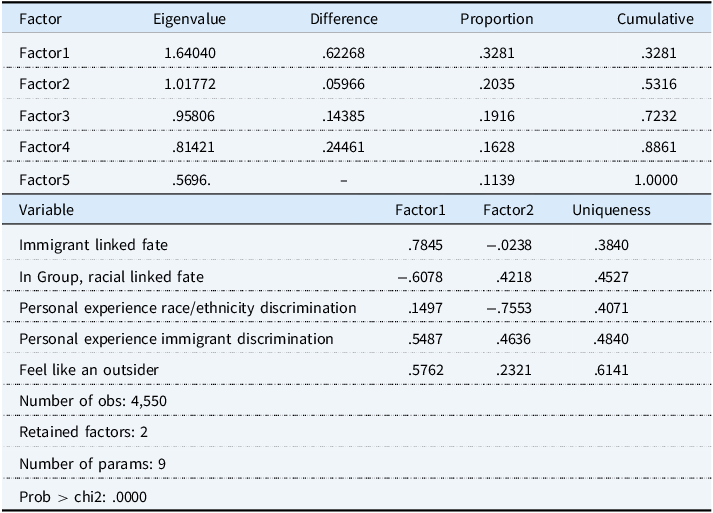
Next, we offer the results of a principal components factor analysis (PCF) to further illustrate that immigrant linked fate and racial linked fate are distinct concepts. That is, they denote different aspects of social reality. We believe that immigrant linked fate captures the outcome of social exclusion from American society. While race is a component of immigration policy, it is experiences with exclusion that creates group cohesion across groups of diverse countries of origin, regardless of nativity status. Racial linked fate has a weak tie to outright exclusion from American society and is related to the unequal treatment from American society (racial discrimination) that forms the basis for racial linked fate. In other words, it is due to racial inequity and racial animus. To explore the relationship between these concepts, we performed PCF analysis that includes immigrant linked fate, racial linked fate, personal experience of immigrant discrimination, discrimination based on racial and ethnic background, and feelings of outsider status.
Table 2 presents the results of this factor analysis. Following the Kaiser criterion, the solution retains two factors with eigenvalues of 1.64 and 1.02. Approximately 32.81% of the total variance is explained by factor 1, and 20.35% of the variance is explained by factor 2. The factor loadings confirm that immigrant linked fate and racial linked fate load onto different factors. Immigrant linked fate has a strong loading of .7845 on factor 1 with a uniqueness score of 38%. Racial linked fate has a negative loading, suggesting an inverse relationship with factor 1, which is strongly explained by immigrant linked fate. Discrimination based on immigrant status has a moderate loading on factor 1 of .5487. Likewise, feeling like an outsider also has a moderate loading on factor 1 of .5762. Racial discrimination has a weak factor 1 loading of .1497. Racial linked fate has a positive and moderate (.4218) loading on factor 2. These results illustrate that immigrant linked fate and racial linked fate represent distinct dimensions of interdependence and support hypothesis one. These results suggest that conceptions of linked fate may extend beyond racial linked fate to multicultural coalitions that share experiences with exclusion that yield solidarity.
Factor analysis to disaggregate immigrant linked fate from racial linked fate

Table 2. Long description
The table presents the results of a factor analysis to disaggregate immigrant linked fate from racial linked fate. It has 11 rows and 7 columns. The columns are labeled Factor, Eigenvalue, Difference, Proportion, Cumulative, Variable, and Factor1, Factor2, Uniqueness. The table shows eigenvalues, differences, proportions, and cumulative values for five factors. It also lists factor loadings for variables such as immigrant linked fate, in-group racial linked fate, personal experience of race/ethnicity discrimination, personal experience of immigrant discrimination, and feeling like an outsider. The table indicates that immigrant linked fate and racial linked fate load onto different factors, with immigrant linked fate having a strong loading on factor 1 and racial linked fate having a moderate loading on factor 2.
Source: Collaborative Multiracial Post-Election Survey (CMPS) 2016.
Note: Principal component factor analysis, unrotated, using sample weights.
Multivariate Analysis of Predictive Factors of Immigrant Linked Fate
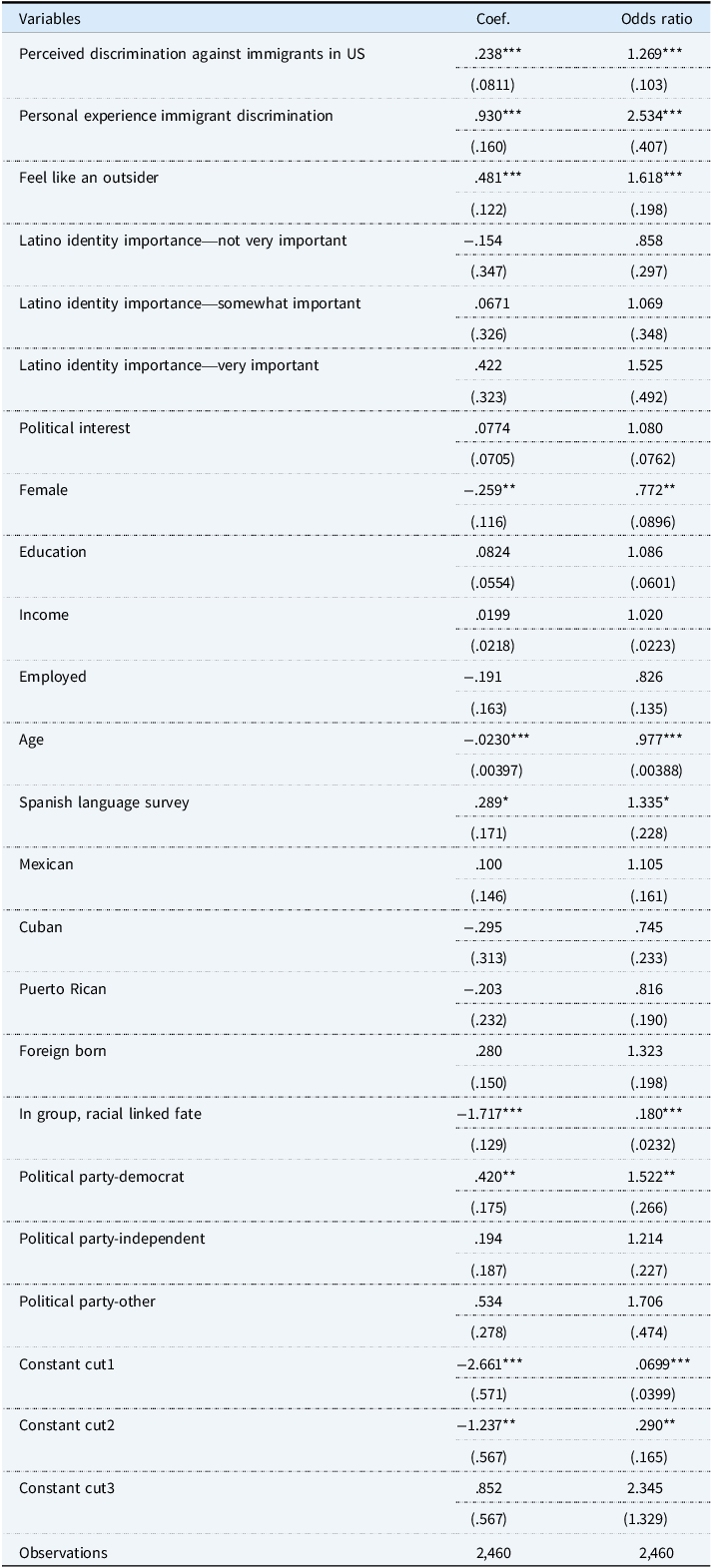
To test our hypotheses regarding the influence of discrimination and exclusion on levels of immigrant linked fate, we provide the multivariate results for Latinos presented in Table 3. We find support for our hypotheses regarding the predictive role of perceived and experienced immigrant discrimination and social exclusion with regard to immigrant linked fate among Latinos. Latinos who perceive there is immigrant discrimination, experience immigrant discrimination, and have feelings of being an outsider are strongly correlated with higher levels of immigrant linked fate. Latinos who perceive a high amount (“a lot”) of immigrant discrimination have 26.9% increased odds of expressing immigrant linked fate than those who perceive low levels of immigrant discrimination. As for experienced immigrant discrimination, Latinos who have experienced immigrant discrimination have about 2.5 times the odds of reporting high levels of immigrant linked fate compared to those Latinos who have not experienced immigrant discrimination. Latinos who report they feel like an outsider have an associated 61.8% increase in the odds of expressing high levels of immigrant linked fate when compared to Latinos who do not feel like an outsider. Together, these results support our hypotheses regarding feelings of exclusion and their role in fostering a sense of immigrant solidarity among Latinos regardless of immigrant status. The foregoing statement is strengthened by the statistically insignificant (at the less than .05 level) finding among foreign-born Latinos.
Ordered logit predicting immigrant linked fate among Latinos

Table 3. Long description
A table with 25 rows and 4 columns. The columns are labeled ‘Variables’, ‘Coef.’, ‘Odds ratio’, and ‘standard errors are in parentheses’. The table presents data on various factors influencing immigrant linked fate among Latinos. Row 1: Perceived discrimination against immigrants in US, 0.238, 1.269, 0.08111. Row 2: Personal experience immigrant discrimination, 0.939, 2.558, 0.160. Row 3: Feel like an outsider, 0.481, 1.618, 0.122. Row 4: Latino identity importance—not very important, -0.154, 0.858, 0.347. Row 5: Latino identity importance—somewhat important, 0.0671, 1.069, 0.326. Row 6: Latino identity importance—very important, 0.422, 1.525, 0.323. Row 7: Political interest, 0.0774, 1.080, 0.0705. Row 8: Female, -0.259, 0.772, 0.116. Row 9: Education, 0.0824, 1.086, 0.0554. Row 10: Income, 0.0199, 1.020, 0.0218. Row 11: Employed, -0.191, 0.826, 0.163. Row 12: Age, -0.0230, 0.977, 0.00397. Row 13: Spanish language survey, 0.289, 1.335, 0.171. Row 14: Mexican, 0.100, 1.105, 0.146. Row 15: Cuban, -0.295, 0.745, 0.313. Row 16: Puerto Rican, -0.203, 0.816, 0.232. Row 17: Foreign born, 0.280, 1.323, 0.150. Row 18: In group, racial linked fate, -1.717, 0.180, 0.129. Row 19: Political party-democrat, 0.420, 1.522, 0.175. Row 20: Political party-independent, 0.194, 1.214, 0.187. Row 21: Political party-other, 0.534, 1.706, 0.278. Row 22: Constant cut1, -2.661, 0.0699, 0.571. Row 23: Constant cut2, -1.237, 0.290, 0.567. Row 24: Constant cut3, 0.852, 2.345, 0.567. Row 25: Observations, 2,460, 2,460, N/A.
LR chi2 = 514.62 Prob > chi2 = .000 Pseudo R2 = .1608.
***p < .01, **p < .05, *p <.1, Standard errors in parentheses, weighted.
There are several controls in the Latino immigrant linked fate model that are statistically significant. Partisanship is positive and statistically significant. Latino Democrats have 52% greater odds of expressing higher levels of immigrant linked fate than Latino Republicans. This is quite notable in an ethnoracial group that has historically higher levels of partisan heterogeneity. Racial linked fate, age, and female are negatively correlated with immigrant linked fate. Notably, among Latinos, there is a decrease of 82% in the odds of expressing high levels of immigrant linked fate among Latino respondents who express racial linked fate with other Latinos than Latinos who do not express racial linked fate. This provides further evidence that immigrant linked fate and racial linked fate are different concepts. In this case, it suggests that Latinos are likely to find belonging with either Latinos or with immigrants, but much less frequently with both groups simultaneously. Also, with each one-year increase in age, there is a 2.3% decrease in the odds of espousing high levels of immigrant linked fate, suggesting that immigrant linked fate may be associated more strongly with younger generations. This is in line with the research on predictors of immigrant linked fate among Latino youth (Macías Mejía Reference Macías Mejía2025). Being Latina (female) decreases the odds of expressing immigrant linked fate by about 22.8% compared to Latinos (male). While the result for gender is interesting, we make no specific claims as to why gender may change the likelihood of espousing immigrant linked fate.
We expected that the importance a respondent places on their own racial or ethnic identity would moderate the level of immigrant linked fate. However, among Latinos we do not find a statistically significant relationship between Latino identity and immigrant linked fate. After further consideration, this is in line with our theoretical assumptions, because immigrant linked fate is about solidarity and not individual racial identity. Taken together, the Latino model of immigrant linked fate provides evidence that racial linked fate is distinct from immigrant linked fate and that experiences with exclusion and with experienced and perceived immigrant discrimination foster immigrant linked fate.
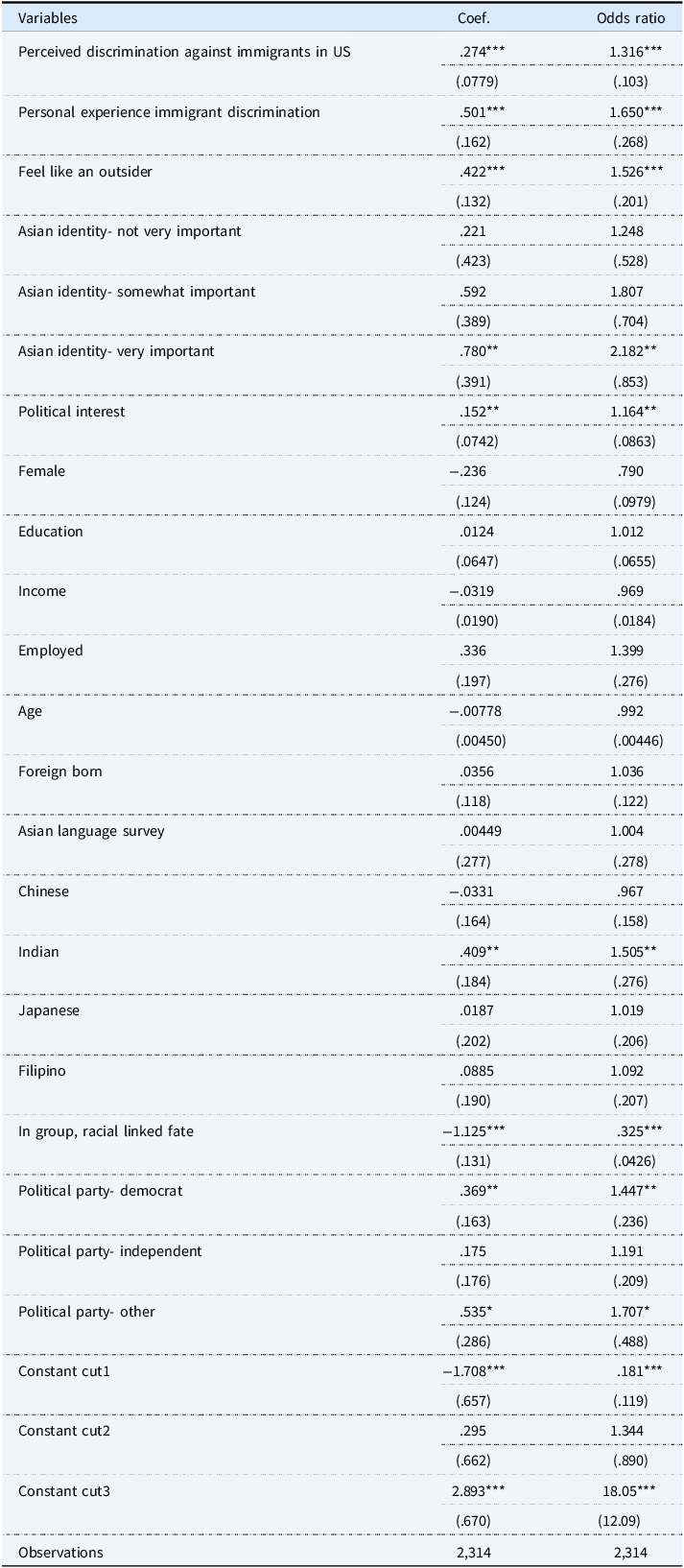
Table 4 displays the results of our Asian model of immigrant linked fate, which supports our hypotheses. We find that among Asian respondents, perceived immigrant discrimination is a statistically significant predictor of immigrant linked fate and is associated with a 31.6% increase in the odds of an Asian respondent having high levels of immigrant linked fate (p < .01). Experiences of immigrant discrimination are also a strong predictor of immigrant linked fate among Asians. Asian respondents who have experienced immigrant discrimination have a 65% increase in the odds of expressing high levels of immigrant linked fate when compared with those who have not experienced immigrant discrimination. Our third key independent variable, feels like an outsider, is also statistically significant. Asian respondents who report that they feel like an outsider in the United States have a 52.6% increase in the odds of feeling high levels of immigrant linked fate versus Asian respondents who do not feel like an outsider.
Ordered logit predicting immigrant linked fate among asians

Table 4. Long description
The table presents the results of an ordered logit model predicting immigrant linked fate among Asians. It includes 2,314 observations and features various variables with their coefficients and odds ratios. Key variables include perceived discrimination against immigrants in the US, personal experience of immigrant discrimination, feeling like an outsider, and the importance of Asian identity. Other variables include political interest, gender, education, income, employment status, age, foreign birth status, Asian language survey, and specific Asian ethnicities. The table also includes political party affiliation and constants. Each row lists the coefficient and odds ratio for each variable, with some variables marked as statistically significant.
LR Chi2 = 201.69 Prob > chi2 =.000 Pseudo R2 = .0819.
***p < .01, **p < .05, *p <.1, Standard errors in parentheses, weighted.
Unlike the results of our model of Latino immigrant linked fate, Asian respondents who feel that their racial identity is very important to them have 2.18 times the odds of reporting strong immigrant linked fate than Asians whose racial identity is not important to them. From these results, it follows that Asian identity itself may be one predicated on outsider status, providing evidence that the “forever foreigner” stereotype may be internalized among this group (Kim Reference Kim1999b; Masuoka and Junn Reference Masuoka and Junn2013).
With regard to our control measures, Asians with racial linked fate are less likely to express high levels of immigrant linked fate than Asians who do not express racial linked fate. Asians with racial linked fate experience a 67.5% decrease in the odds of reporting high levels of immigrant linked fate versus Asian respondents who do not report racial (Asian) linked fate. Partisanship also has an important relationship to immigrant linked fate among Asians. Asian Democrats have a 44.7% increase in the odds of reporting high immigrant linked fate when compared to Asian Republicans. Notably, Indian ancestry/country of origin was associated with a 50.5% increase in the odds of expressing immigrant linked fate when compared to Asians without Indian ancestry/country of origin.
Several important control variables were statistically insignificant in our Asian model of immigrant linked fate. SES and demographic variables such as education, income, age, employment status, gender, and language were all statistically insignificant. Perhaps most important is the insignificant finding for foreign-born status. When it comes to immigrant linked fate, it appears immaterial among our Asian sample, whether the respondent is foreign-born. This supports our supposition that immigrant linked fate is based on discriminatory and exclusionary experiences that form immigrant solidarity. In all, Asian respondents, like Latino respondents, have greater odds of reporting high levels of immigrant linked fate when they experience discrimination resulting from immigrant status, perceive discrimination directed at immigrants in the United States, and feel excluded from American society.
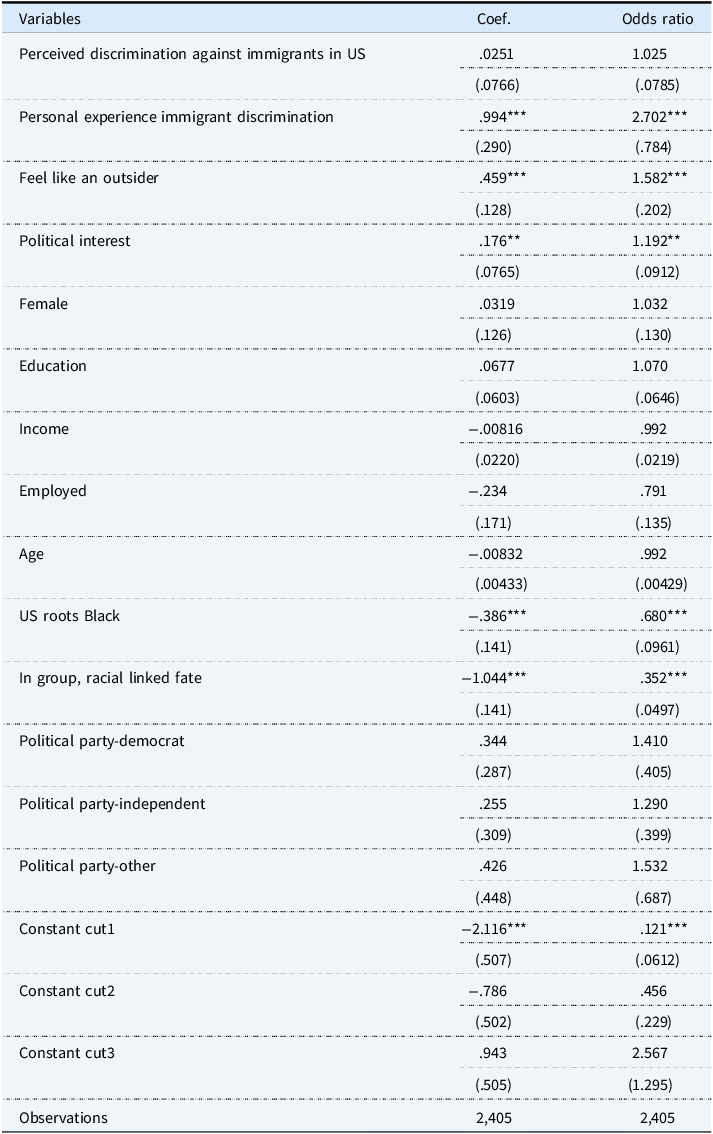
By far, Black respondents in our sample had the lowest percentage of foreign-born respondents (6.36%) compared to Latinos (24%) and Asians (45.6%), and yet, they express immigrant linked fate due to similar factors as Latinos and Asians. Table 5 displays the ordered logistic regression models for Black respondents. While perceptions of discrimination against immigrants are not statistically associated with higher levels of immigrant linked fate, experienced immigrant discrimination and feelings of outsider status are both statistically significant to immigrant linked fate among Blacks (p < .01). Black respondents who have experienced immigrant discrimination have 2.7 times the odds of reporting higher levels of immigrant linked fate when compared with Black respondents who have not personally experienced immigrant discrimination. Here it is important to note that while the effect is quite large, the percentage of Black respondents who experience immigrant discrimination is a small percentage (7.56%) of the total Black sample. This suggests that the effect is potent among a small portion of the Black population and is not a common experience. Likewise, Black respondents who report feeling like an outsider have a 58.2% increase in the odds of having high levels of immigrant linked fate than those who feel included in US society. We also find that Black respondents who have racial linked fate have a 64.8% decrease in their odds of expressing high levels of immigrant linked fate. Black respondents with long roots in the United States have a 32% reduction in the odds of expressing high levels of immigrant linked fate. Recall that the variable US Roots Black is our proxy for foreign-born status for Black Americans. Interestingly, it appears that for Black respondents, true immigrant status is an important factor predicting immigrant linked fate, but by no means the only one. This runs contrary to our expectations and our findings in the Latino and Asian models.
Ordered logit predicting immigrant linked fate among Blacks

Table 5. Long description
The table presents ordered logistic regression models for Black respondents, focusing on factors influencing immigrant linked fate. It includes variables such as perceived discrimination against immigrants, personal experience of immigrant discrimination, feeling like an outsider, political interest, gender, education, income, employment status, age, US roots, racial linked fate, and political party affiliation. Each variable is associated with a coefficient and odds ratio, indicating its impact on immigrant linked fate. Notable findings include the significant impact of personal experience of immigrant discrimination and feeling like an outsider on immigrant linked fate among Black respondents. The table also highlights that Black respondents with long roots in the US or those with racial linked fate have reduced odds of expressing high levels of immigrant linked fate.
LR chi2 = 130.82 Prob > chi2 = .000 Pseudo R2 = .0537.
***p < .01, **p < .05, Standard errors in parentheses, weighted.
Only one control variable is statistically significant in the Black model: political interest (p < .05). As Black respondents’ interest in politics increases, their odds of reporting high levels of immigrant linked fate rise by 19.2%. Like our Latino and Asian models, SES variables (age, income, education, and employment status) are statistically insignificant. This is one of the few political phenomena that is so consistently unmoved by SES. Interestingly, Democratic partisanship is not statistically related to expressions of immigrant linked fate. This may be because of the low partisan variability among Blacks in the United States.
In all, the model seems to fit Latino and Asian respondents better than Black respondents, but two of our key independent variables are statistically significant predictors of strong immigrant linked fate among Blacks and support two of our hypotheses. This suggests immigrant solidarity can emerge among Blacks despite their low rates of foreign-born individuals.
Immigrant Linked Fate and Immigration Policy Preferences
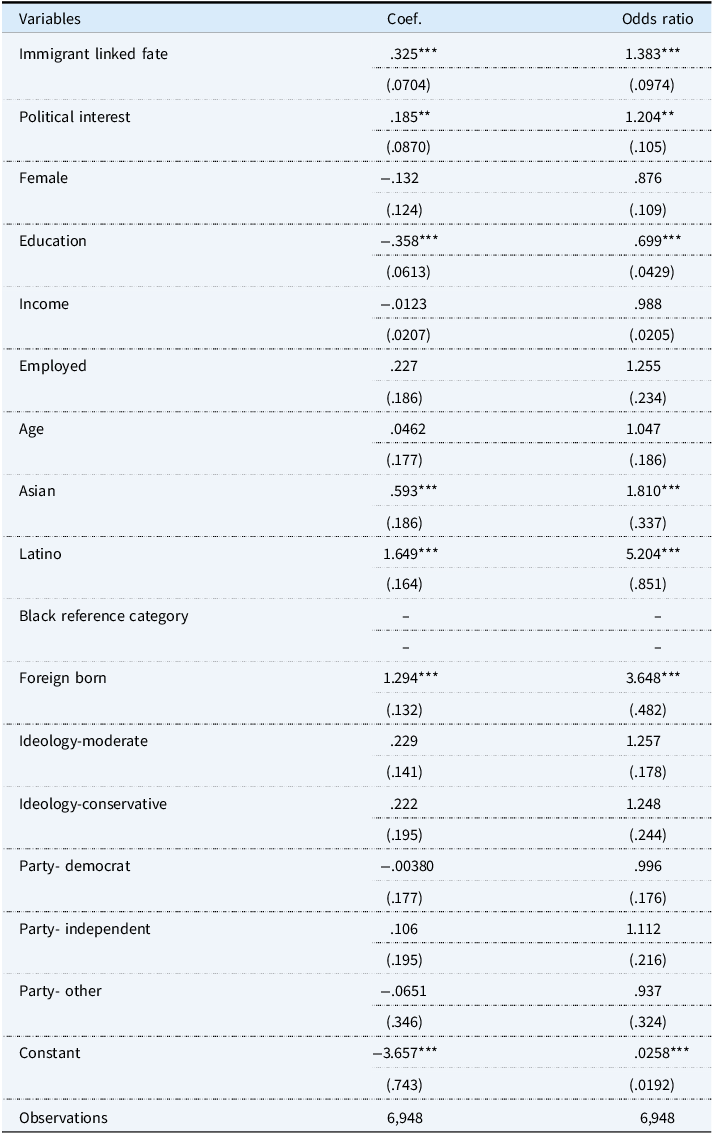
While the propensity of minority groups who express feelings of immigrant linked fate adds to our understanding of this new concept, what may be of greater importance are the outcomes associated with political behavior and attitudes. Thus, in Table 6, we present the multivariate results examining predictors associated with the likelihood of expressing immigration policy as a top issue facing the nation based on expressions of immigrant linked fate.
Pooled logistic regression predicting immigration reform as top issue facing nation

Table 6. Long description
The table presents the results of a pooled logistic regression predicting immigration reform as a top issue facing the nation. It includes two main columns: Coefficient (Coef.) and Odds ratio, each with corresponding standard errors in parentheses. The table has 16 rows, each representing a different variable such as immigrant linked fate, Political interest, Female, Education, Income, Employed, Age, Asian, Latino, Black reference category, Foreign born, Ideology-moderate, Ideology-conservative, Party-democrat, Party-independent, Party-other, and Constant. Each row lists the coefficient, odds ratio, and standard error for the respective variable. Notable variables include immigrant linked fate with a coefficient of 325 and an odds ratio of 1.383, Political interest with a coefficient of 185 and an odds ratio of 1.204, and Education with a coefficient of -358 and an odds ratio of 0.699. The table also includes the number of observations, which is 6,948.
***p < .01, **p < .05, Standard errors in parentheses, weighted.
Note: Models include only Black, Asian, and Latino (BLA) respondents from CMPS 2016.
Among our combined sample of Latino, Black, and Asian respondents included in Table 6, immigrant linked fate appears to increase the likelihood a respondent will mention immigration reform as the top issue facing the United States. The result is statistically significant and increases the odds of choosing immigration policy reform as a top issue by 38.3%. At first glance, this finding seems rather obvious, but some contextualization is necessary to help clarify the importance of such a finding. First, placing immigration reform at the top of the political agenda is not the norm. For most Americans, and in the CMPS 2016, the top issue facing the nation is economic in nature. In the CMPS 2016, immigration reform is by no means the modal category, ranking 7th in terms of response frequency. Second, while our model (and common sense) suggests a strong relationship between foreign-born status and likelihood of placing immigration reform as a top issue, when the model sample is reduced to include only respondents who are not foreign-born, we still find a strong positive relationship between the two variables.
The model also finds political interest and education predict immigration as a top policy issue among our combined sample. Respondents with high rates of interest in politics are 20.4% more likely to choose immigration as the top issue facing America (p < .05). By contrast, as education levels increase among respondents, the likelihood of choosing immigrant policy as a top issue falls by 30.1%.
Regardless of immigrant linked fate levels, Latinos have 5.2 times the odds of picking immigration policy as a top issue versus non-Latinos. Asians have an 81% increase in the likelihood of choosing immigration policy as their top issue, compared to Black respondents (who are the comparison category). By itself, foreign-born status is a strong predictor of choosing immigration as a top policy issue. Among Latinos, Asians, and Blacks, being foreign-born is associated with a 3.6 times increase in the odds of picking immigration as a top policy priority. It is interesting that neither ideology nor partisanship are statistically related to immigration policy priorities, but rather immigrant linked fate appears strongly predictive of policy preferences.
Discussion and Conclusion
We began our study by disentangling immigrant linked fate from racial linked fate through factor analysis, and our findings suggest that these are distinct, inverse constructs. Those who express high levels of immigrant linked fate tend to report lower levels of racial linked fate. This suggests that, despite strong racial solidarity ties, there may be conditions under which racial and ethnic minorities may step outside of their distinct racial groups and form solidarity with immigrants based on exclusion. In a period where federal policies seem to be deeply rooted in exclusion, we may be likely to see coalition building across racial and ethnic groups in solidarity with those feeling the strongest messages of exclusion: immigrants. The inverse relationship between racial linked fate and immigrant linked fate can be best understood through the two societal hierarchies, the US racial hierarchy and the US citizenship and legality hierarchy.
Racial hierarchy facilitates exclusion and subordination of racial and ethnic minority groups by limiting access to social, civil, and political rights (Masuoka and Junn Reference Masuoka and Junn2013; Molina Reference Molina2014). Racial and legal status interact to create a unique hierarchy in US society. Racial hierarchy is difficult to dismantle, and the ordering of groups from dominant to less deserving is often unmovable (Masuoka and Junn Reference Masuoka and Junn2013; Omi and Winant Reference Omi and Winant1986; Pérez Reference Pérez2021). In other words, depending on what racial or ethnic group an individual belongs to, they will find that they will be placed higher or lower on the racial hierarchy. No matter how favorably positioned a racial or ethnic group is within the US racial hierarchy, its members cannot join the White in-group unless they are White (Masuoka and Junn Reference Masuoka and Junn2013).
Citizenship and legality follow a similar (and related) hierarchical structure (Barreto and Lozano Reference Barreto and Lozano2017; Franko Reference Franko, Bosworth, Franko, Lee and Mehta2024). Based on national origin and political context, immigrant groups are placed in a hierarchy related to how much or little they are perceived to deserve legality and citizenship. Native-born citizens sit at the top of the status hierarchy, followed by naturalized citizens, then those with permanent residency status, then visa holders, followed by those granted asylum or refugee status, with undocumented immigrants at the bottom of the hierarchy (Barreto and Lozano Reference Barreto and Lozano2017; Franko Reference Franko, Bosworth, Franko, Lee and Mehta2024). It is important to note that legality is closely correlated with both phenotypical racial attributes and economic status. Though it may shift through history, the current immigrant stereotype centers around low-income Latinos with dark phenotypical attributes like brown eyes, hair, and skin (Chavez Reference Chavez2013). Immigrants who do not present as “immigrant” or “undocumented” based on current immigrant stereotypes may not experience the same level of exclusion as those who match current immigrant stereotypes. This could be considered a variation of “street race,” but in the sense of immigrant street perception. This process will be more relevant to Latinos and Asians, two groups who experience ethnoracial exclusion and forever foreigner tropes. Thus, for some individuals, their closeness to immigrant groups might be weaker than their closeness to a specific racial group, which can influence the inverse relationship between racial and immigrant linked fate.
Our research adds to the literature on linked fate and solidarity politics. The results imply that immigrant linked fate is rooted in shared experiences of discrimination and exclusion rather than in nativity status (foreign-born). For instance, among Latinos and Asians, foreign-born status was statistically unrelated to immigrant linked fate, suggesting that immigrant solidarity emerges from shared experiences with discrimination. These findings align with and extend research on solidarity and linked fate grounded in social exclusion (Chan and Jasso Reference Chan and Jasso2023; Macías Mejía Reference Macías Mejía2024).
While both racial linked fate and immigrant linked fate materialize as a result of marginalization and exclusion, they intersect in interesting ways. Latinos and Asians are more likely to have first or secondhand knowledge of the immigrant experience, but Blacks, who might not have direct experience with being an immigrant, may still have solidarity with immigrants based on similar experiences of exclusion and othering. These marginalization experiences may make it easier for Blacks to vicariously experience immigrant discrimination and oppression, which can translate into solidarity with immigrant groups in the United States. By the same logic, we argue that nonimmigrant Latinos and Asians will similarly espouse immigrant solidarity due to society’s tendency to “paint them with the same brush” as immigrants. Perceived immigrant status based on phenotypical ascription may cause similar exclusionary and discriminatory experiences among nonimmigrant Latinos and Asians that are commonly applied to immigrants. In addition to phenotypical ascription of immigrant status, surnames could also act as cues for discriminatory behaviors toward nonimmigrant Latinos and Asians (Hadah Reference Hadah2025; Oreopoulos Reference Oreopoulos2011). Thus, several mechanisms exist that perpetuate the forever foreigner trope.
Masuoka and Junn (Reference Masuoka and Junn2013) mention in their book that even though Blacks do not have a large number of immigrants, they are also “othered” because of their race and non-White racial classification. Black exclusion has been driven by White supremacist ideology, rooted in their descent from slavery and the intergenerational transmission of the slave narrative. This group has faced Jim Crow laws, segregation, engaged in the fight for equality during the Civil Rights Movement, and recently fought for social equity through the Black Lives Matter movement (White and Laird Reference White and Laird2020). The Reconstruction era granted citizenship to Black men and gave them the opportunity to vote, yet this opportunity was short-lived once Jim Crow policies and practices were instated, with most Black men facing several barriers to vote (White and Laird Reference White and Laird2020). Persistent oppression faced by Blacks during Jim Crow served as a mobilizing factor for this group.
Among Latinos and Asians, the most notable mechanism of racializationFootnote 5 has been nativism and racial discrimination, but they also faced Jim Crow segregation (in Texas and California) and were denied the right to vote alongside Blacks (Alcoff Reference Alcoff2003; Molina Reference Molina2014; Sanchez Reference Sanchez1997). Racism and nativism toward Latinos and Asians have manifested in several ways, with Mexicans and Mexican Americans (US citizens) facing deportation as a result of the Repatriation era in the late 1920s continuing in the 1930s and Operation Wetback in the 1950s (Molina Reference Molina2014). These anti-Mexican and anti-Latino experiences continue today and have cemented the image of Latinos, specifically Mexicans (irrespective of legal status), as “illegal” (Chavez Reference Chavez2013). Moreover, Asian Americans were seen as taking occupational opportunities from White Americans, as was the case during the 1800s when the Chinese Exclusion Act was passed in 1882 to prohibit immigration from China and lead to increased discrimination toward Chinese in the United States (US Office of the Historian n.d.). During World War II, after the attack on Pearl Harbor, Japanese and Japanese Americans were racially profiled and were revoked of their living quarters, businesses, material possessions, and so forth and placed in what would be known as Japanese internment camps (Nagata et al. Reference Nagata, Kim and Wu2019). Unfortunately, these examples of historical exclusion and oppression only scratch the surface.
Commonly, acts of oppression are justified by citing the incompatibility of the groups with the “American way of life” (Chavez Reference Chavez2013; Molina Reference Molina2014). Both institutions and individuals have historically dehumanized Latino and Asian citizens through the use of “wetback” and “slant-eyes,” just to name a few (Alcoff Reference Alcoff2003; Sanchez Reference Sanchez1997). Whether this is because of their use of non-English languages or fear of multiculturalism, the “forever foreigner” frame is persistent (Sanchez Reference Sanchez1997). These nativist and racist attacks are not new and are ways by which Latinos and Asians experience persistent discrimination in modern-day United States.
The historical patterns of exclusion are likely to persist for decades to come. For example, during Trump’s second administration, he attempted to end birthright citizenship through an executive order, but also members of his administration share similar beliefs and views that can transcend into future administrations. Similarly, the continued presence and violence from Immigration, Customs, and Enforcement (ICE) agents is unlikely to decrease as long as Trump remains president. Also, discussions concerning national security, such as 9/11, make abolishing ICE unlikely. As it pertains to immigration policy preferences, our findings suggest we can expect that immigrant linked fate can serve as a motivating factor driving the expression of immigrant solidarity among Latinos, Blacks, and Asians. Even when Latinos, Asians, and Blacks are removed from the immigrant experience, these groups are still plagued by persistent exclusion, which serves as the backdrop for activating immigrant solidarity in the form of immigrant linked fate that yields support for immigration policies. The results from this study suggest that exclusion is embedded in American democracy and will most likely persist for decades to come. This study is foundational for our understanding of solidarity building among Latinos, Asians, and Blacks toward immigrant groups and will serve as an important piece of reference for research on solidarity politics.
Most importantly, these results are imperative to advancing research on solidarity politics and can be a starting point for understanding ways to develop coalitions among members of US society to defend and continue to support immigrants’ rights, especially during an ominous political administration that is consistently infringing on the rights of immigrants as well as US citizens and perpetuating violence against immigrant communities. Decades of research have optimistically suggested that rainbow coalitions are possible and even inevitable; our research suggests that a social agenda that highlights exclusion could open the door for rainbow coalitions in a way that other political frames may not. Our study complements Macías Mejía’s (Reference Macías Mejía2024) study by showing that immigrant linked fate can predict policy preferences in addition to political participation. It is possible that when politics is framed around the exclusion of immigrants, it may have downstream effects on individuals’ beliefs in other policy domains. This is a task for future research.
A key extension would replicate this study for White Americans. This would help us understand whether exclusion interacts with political identity among White Americans. While the study leverages data from a highly anti-immigrant climate during the 2016 presidential election, this study would benefit from replication using more recent data to assess whether immigrant linked fate has intensified under the punitive immigration policies and anti-immigrant political climate of the second Trump presidency. Finally, we see great value in applying experimental survey methods to tease out the causal mechanisms driving the acquisition of immigrant linked fate and the politics of exclusion.
Supplementary material
The supplementary material for this article can be found at https://doi.org/10.1017/rep.2026.10107.
Acknowledgments
We thank the editor and anonymous reviewers at the Journal of Race, Ethnicity, and Politics for their constructive feedback on earlier drafts of this manuscript. We also thank Dr. Rubén Martinez for his feedback on earlier drafts.
Funding statement
This research did not receive any specific financial support.
Competing interests
The authors declare no competing interest.


 Open access

