Introduction
Carinata, also known as Ethiopian mustard, is an oilseed crop primarily cultivated for biofuel production (Bouaid et al. Reference Bouaid, Martinez and Aracil2009; Cardone et al. Reference Cardone, Mazzoncini, Menini, Rocco, Senatore, Seggiani and Vitolo2003). Oil-derived biodiesel from carinata behaves similarly to commercial biodiesel for engine performance and lowered emission levels of particulate matter (Cardone et al. Reference Cardone, Mazzoncini, Menini, Rocco, Senatore, Seggiani and Vitolo2003). Carinata is high in erucic and linoleic acids, which are desirable characteristics in industrial biofuel production because they simplify the refining process into high-energy fuels (i.e., long-chain hydrocarbons) such as jet fuel (Seepaul et al. Reference Seepaul, Small, Mulvaney, George, Leon, Paula-Moraes, Geller, Marois and Wright2019; Taylor et al. Reference Taylor, Falk, Plamer, Hammerlindl, Babic, Mietkiewska, Jadhav, Marillia, Francis, Hoffman, Giblin, Katavic and Keller2010). Agronomically, carinata is better adapted and produces greater seed yields in hotter, drier regions (Taylor et al. Reference Taylor, Falk, Plamer, Hammerlindl, Babic, Mietkiewska, Jadhav, Marillia, Francis, Hoffman, Giblin, Katavic and Keller2010), and low input cropping systems compared to rapeseed {Brassica napus [(L.) var. napus]; Bouaid et al. Reference Bouaid, Martinez and Aracil2009}. Carinata is also resistant to seed shattering (Rakow and Getinet Reference Rakow and Getinet1998), is highly disease resistant (Taylor et al. Reference Taylor, Falk, Plamer, Hammerlindl, Babic, Mietkiewska, Jadhav, Marillia, Francis, Hoffman, Giblin, Katavic and Keller2010), and has a relatively high (>40%) oil content compared to other Brassicaceae species (Seepaul et al. Reference Seepaul, Small, Mulvaney, George, Leon, Paula-Moraes, Geller, Marois and Wright2019). In addition to its desirable crop characteristics, carinata can also be planted and harvested using agricultural equipment already owned by many growers, including grain drills and small-grain combines (Leon et al. Reference Leon, Ferrell and Mulvaney2017; Mulvaney et al. Reference Mulvaney, Leon, Seepaul, Wright and Hoffman2019), which makes this species a promising winter crop for the southeastern United States (Kumar et al. Reference Kumar, Seepaul, Mulvaney, Colvin, George, Marois, Bennett, Leon and Wright2020).
In the southeastern United States, crop rotations include summer crops such as cotton (Gossypium hirsutum L.), soybean [Glycine max (L.) Merr.], corn (Zea mays L.), peanut (Arachis hypogaea L.), and sorghum [Sorghum bicolor (L.) Moench ssp. bicolor], which might be followed by wheat (Triticum aestivum L.) or fallow in the winter (Salassi et al. Reference Salassi, Deliberto and Guidry2013). Due to increased industry demand for biofuels, southeastern U.S. growers have been interested in growing carinata during the winter to diversify their crop rotations. This increase in interest has led to the necessity to identify effective and safe weed management tools for carinata, because it has been shown that an effective herbicide program can prevent seed and oil yield losses (Hossain et al. Reference Hossain, Johnson, Blackshaw, Liu, Kapiniak, Gampe, Molnar, Luan, Poppy and Gan2018). In addition to the need for in-season herbicide weed control, it has been noted that carinata seed shattered during harvest can germinate in the following summer crop (Seepaul et al. Reference Seepaul, Small, Mulvaney, George, Leon, Paula-Moraes, Geller, Marois and Wright2019); therefore, it is also important to identify herbicides that will control volunteer plants. Some studies have been conducted on herbicide tolerance in carinata, but only a few herbicides have been identified with potential use on this crop, such as pendimethalin and S-metolachlor (for preemergence control), clopyralid (postemergence broadleaf control), and clethodim (postemergence grass control; Leon et al. Reference Leon, Ferrell and Mulvaney2017). Therefore, research is needed to identify herbicides that can facilitate the inclusion of carinata into existing crop rotations. The objective of this research was to assess the tolerance of carinata establishment and crop yield with select preemergence and postemergence using dose-response field studies.
Materials and Methods
Preliminary Screening
A preliminary screening was conducted to characterize carinata tolerance to several herbicides and identify herbicides with potential for safe use on this crop. The screening was conducted at the Williamsdale Biofuel Field Laboratory in Wallace, NC (34.76°N, 78.10°W) in 2017–2018 and the Piedmont Research Station in Salisbury, NC (35.69°N, 80.64°W) in 2018–2019. The soil at Wallace was a Noboco loamy fine sand (fine-loamy, siliceous, subactive, thermic Oxyaquic Paleudult) with an organic matter content of 1.5%, pH 4.2. The soil at the Salisbury, NC, location was a Lloyd clay loam (fine, kaolinitic, thermic Rhodic Kanhapludult) with an organic matter content of 1.25%, pH 6.4. Carinata variety ‘Avanza’ was planted at both locations with a small-grain planter on 36-cm rows at 6.7 kg ha−1 seeding rate, and agronomic management was carried out following recommendations by Seepaul et al. (Reference Seepaul, Small, Mulvaney, George, Leon, Paula-Moraes, Geller, Marois and Wright2019). The field was prepared with conventional tillage, and 20 kg N ha−1 were applied at planting and 40 kg N ha−1 at the bolting stage. The experiments were arranged as a randomized complete block design with four replications at each location. At the Wallace location, the plot size was 6.1 m by 2.4 m, and at the Salisbury location, the plot size was 7.6 m by 1.5 m. The Wallace location had 21 herbicide treatments and the Salisbury location had 24 treatments (see Table 1). Each location included a nontreated control for comparison. Right after planting, the entire experimental area was treated with S-metolachlor at 1.4 kg ai ha−1 (Leon et al. Reference Leon, Ferrell and Mulvaney2017) and hand-weeding occurred as needed to ensure weed-free conditions. Herbicides were applied using a CO2-pressurized backpack sprayer with four AIXR 11002 nozzles (TeeJet Technologies, Spraying Systems Co., Springfield, IL) calibrated to deliver 187 L ha−1 at 206 kPa. Preemergence herbicide treatments were sprayed within 2 d of planting and postemergence herbicides were sprayed when the crop reached the 6- to 8-leaf stage (Table 2). The 6- to 8-leaf stage was chosen as an early postemergence application considering target dates for effective weed control and for carinata to have enough leaves for herbicide uptake and characterization of injury symptoms.
PRE and POST herbicide, doses, and application timings for preliminary screening experiments on carinata at two North Carolina locations.a

a Abbreviations: NIS, nonionic surfactant; POST, postemergence; PRE, preemergence; S, Salisbury; W, Wallace.
b POST herbicides were applied on 6- to 8-leaf stage carinata.
c NIS applied at 0.25% vol/vol.
Application timings for PRE and POST herbicides evaluated on carinata for preliminary screening and the dose-response studies at each experiment location. a

a Abbreviations: POST, postemergence; PRE, preemergence.
b PRE herbicides were applied at 1 to 2 d after carinata planting, while POST herbicides were applied at 6- to 8-leaf stage of carinata.
Dose-Response Study
The dose-response study was conducted using herbicides that caused low injury to carinata from the preliminary screening. The preemergence herbicides for this study included diuron, clomazone, and napropamide, whereas the postemergence herbicides included simazine and clopyralid. The study was designed to evaluate the tolerance of carinata to varying rates of the selected preemergence and postemergence herbicides. Thus, field experiments were conducted in the 2019–2020 field season at three locations: 1) Piedmont Research Station in Salisbury, NC; 2) Lower Coastal Plain Tobacco Research Station in Hookerton, NC (35.38°N, 77.56°W); and 3) West Florida Research and Education Center in Jay, FL (30.77°N, 87.14°W). Carinata planting and management were carried out as indicated for the preliminary screening. The soil at the Salisbury, NC, location was a Lloyd clay loam (fine, kaolinitic, thermic Rhodic Kanhapludult) with an organic matter content of 1.25%, pH 6.4. The soil at the Hookerton, NC, location was a Goldsboro loamy sand (fine-loamy, siliceous, subactive, thermic Aquic Paleudult) with an organic matter content of 1.5%, pH 4.7. The soil at the Jay, FL, location was Red Bay sandy loam (fine-loamy, kaolinitic, thermic Rhodic Kandiudult) with an organic matter content of 2.1%, pH 5.8.
The experiment was arranged as a randomized complete block design with four replications at each location and plots were 7.6 m by 1.5 m. The Salisbury and Hookerton experiments consisted of 31 herbicide treatments, whereas the Jay location consisted of 26 herbicide treatments by removing the highest rate for each herbicide (Table 3). Each location included nontreated control plots. Right after planting, the entire experimental area was treated with S-metolachlor at 1.4 kg ai ha−1 (Leon et al. Reference Leon, Ferrell and Mulvaney2017), and hand-weeded and kept weed-free until canopy closure. Rates below label recommendations were used to characterize the symptomology associated with herbicide injury and low carinata tolerance. Label or above-label rates were chosen to identify those that can provide effective weed control without reducing carinata yield, thus confirming high carinata tolerance. Herbicides were sprayed using a CO2-pressurized backpack sprayer with four 11002 nozzles (TeeJet Technologies) calibrated to deliver 187 L ha−1 at 206 kPa. Each preemergence herbicide was sprayed within 2 d after planting and each postemergence herbicide was sprayed when the crop reached the 6- to 8-leaf stage (Table 2).
Doses of PRE and POST herbicides applied for the dose-response field experiment on carinata. a

a Abbreviations: NIS, nonionic surfactant; POST, postemergence; PRE, preemergence.
b PRE herbicides were applied at 1 to 2 d after carinata planting, while POST herbicides were applied at 6- to 8-leaf stage of carinata.
c NIS applied at 0.25% vol/vol.
Data Collection and Statistical Analysis
Carinata injury was evaluated at 4 and 8 wk after treatment (WAT), and in the preliminary screening population density was evaluated 8 wk after postemergence treatments. Due to similarity in injury ratings, only 4 WAT data are presented in figures, but 8 WAT data are included in tables. Injury was visually estimated on a scale from 0% (no injury) to 100% (plant death). Injury symptoms included chlorosis, stunting, necrosis, and epinasty, depending on the mechanism of action of the herbicide. For the dose-response study, seed yield was determined by harvesting the center five rows of each plot with a small-plot combine. Seed yield was adjusted to 8% moisture content. Data analysis was performed using SAS software version 9.4 (SAS Institute, Cary, NC). Herbicide injury and yield were analyzed with ANOVA using the GLIMMIX procedure. For the preliminary screening, treatments were considered fixed effects and blocks random, and the analysis was performed by location. In the dose-response study, each herbicide was analyzed separately by location due to interactions between herbicide, dose, and location (P < 0.05). Means were determined using the LSMEAN statement, and means separation was conducted using Tukey’s honestly significant difference with a significance level of α = 0.05. Data were subject to linear and nonlinear regression (linear and quadratic plateau) analysis using SigmaPlot software version 14.0 (Systat Software Inc., San Jose, CA) with herbicide rate as the independent variable and carinata injury and seed yield as the dependent variables.
Results and Discussion
Preliminary Screening
In the preliminary screening, several herbicides caused high levels of carinata mortality (>90% injury 4 WAT; Tables 4 and 5). However, some herbicides also caused minor injury and did not reduce population density, suggesting that for these herbicides there was potential for selectivity that was worth exploring further. For example, at a rate of 560 g ai ha−1, diuron applied preemergence caused less than 5% injury (Table 5) and no population density reductions compared to the nontreated control. Similarly, clomazone applied preemergence at a rate of 90 g ai ha−1 caused less than 34% injury at 8 WAT (Table 5) and while maintaining similar population densities compared to the control. With napropamide, carinata treated with 2,240 g ai ha−1 exhibited low injury (<5% in Wallace, Table 4); however, injury levels reached up to 45% in Salisbury (Table 5). Simazine injury ratings were less than 40% (Tables 4 and 5) without affecting population density. Clopyralid at 420 and 840 ae ha−1caused minor injury (0% to 15%) and no density reductions (Tables 4 and 5).
Carinata population density and injury in response to herbicide applications for preliminary screening in Wallace, NC.a,b

a All applications were conducted as POST.
b Abbreviations: POST, postemergence; PRE, preemergence; WAT, weeks after treatment.
Carinata population density and injury in response to herbicide applications for preliminary screening in Salisbury, NC. a

a Abbreviations: POST, postemergence; PRE, preemergence; WAT, weeks after treatment.
Fluazifop-P-butyl caused no visible injury symptoms (Tables 5), and yield was not reduced compared to the nontreated control (data not shown) at either 210 or 420 g ai ha−1, which was equivalent to 1× and 2× the recommended label rate, respectively. Therefore, as previously reported for clethodim, fluazifop-P-butyl was safe on carinata and can be used to control grass weeds (Leon et al. Reference Leon, Ferrell and Mulvaney2017).
Herbicides such as 2,4-DB, oxyfluorfen, and ethofumesate were highly injurious to carinata (30% to 95%). Likewise, metribuzin, imazethapyr, and chlorimuron caused injury of 90% or higher and high levels of mortality (Tables 4 and 5) compared to the nontreated control. Due to their consistent high injury on carinata, oxyfluorfen, ethofumesate, metribuzin, imazethapyr, and chlorimuron herbicides were not chosen for the dose-response study. However, these herbicides have potential for volunteer carinata control. Conversely, diuron, napropamide, clomazone, simazine, and clopyralid were chosen for the dose-response study because of their potential selectivity in carinata.
Dose-Response Study
Preemergence Herbicides
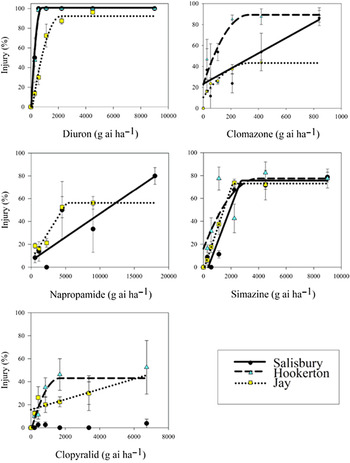
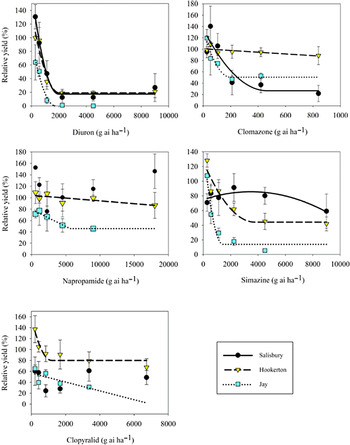
For preemergence herbicides diuron, clomazone, and napropamide, there were differences in the injury they caused to carinata depending on location. Herbicide injury ranged from 8% to 100% (Figure 1) and yield losses varied from 1% to 100% (Figure 2). Some treatments (preemergence and postemergence) exhibited higher yields than the nontreated control (i.e., >100% yield). Although hand weeding was conducted until canopy closure, it is possible that weeds escaping that control interfered with carinata, thereby influencing yield in the nontreated control. Another possibility is that at the lowest rates several herbicides triggered a hormetic response (Cedergreen Reference Cedergreen2008).
Carinata injury in response to increasing doses of preemergence (diuron, napropamide, and clomazone) and postemergence (simazine and clopyralid) herbicides at 4 wk after treatment in field experiments at the Hookerton and Salisbury, NC, and Jay, FL, locations.

Carinata yield relative to the nontreated control in response to increasing doses of preemergence (diuron, napropamide, and clomazone) and postemergence (simazine and clopyralid) herbicides in field experiments at the Hookerton and Salisbury, NC, and Jay, FL, locations. No significant regression models were obtained napropamide and clopyralid at the Salisbury location and therefore were not included in the figure.

In contrast with the preliminary screening, diuron applications at all rates were highly injurious to carinata in the dose-response study (Figure 1). This highlights the potential variability that can be seen in response to this herbicide based on soil and climatic differences in carinata. However, when considering the three locations of the dose-response study, it was evident that this herbicide represents a high risk to carinata. For example, diuron doses above 280 g ai ha−1 injured carinata by 54% up to 84% (Figure 1 and Table 6). Carinata injury ratings exhibited a logarithmic response until 100% injury was reached at the label rate of 1,120 g ai ha−1. These high injury rates were reflected in significant yield losses. The relative yield for carinata corresponded to the injury response where the yield was reduced as the herbicide rate was increased until 2,240 g ai ha−1 (Figure 2). The dose response analysis illustrated that 50% yield reduction of carinata occurred from 482 to 1,051 g ai ha−1 depending on location (Table 7). Due to these high levels of injury and yield reductions, diuron could be a tool in rotational crops to control volunteer carinata.

a Injury ratings for 4 and 8 WAT were similar so only 4 WAT data is presented in this table. Estimates are based on the most parsimonious model averaging results across experimental locations.
b Means are ± standard error.
c n.d., no data due to the absence of injury at that level.
d Abbreviations: ID, injury dose; POST, postemergence; PRE, preemergence; WAT, weeks after treatment.

a Estimates are based on the most parsimonious model averaging results across experimental locations.
b Means ± standard error.
c n.d., no data due to the absence of yield loss at that level.
d Abbreviations: ID, injury; POST, postemergence; PRE, preemergence; WAT, weeks after treatment; YD, yield loss.
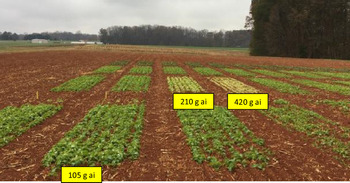
Clomazone caused high levels of carinata injury at higher application rates (i.e., above 105 g ai ha−1; Figure 1). Fifty percent injury was observed at 77 and 366 g ai ha−1 at the Hookerton and Salisbury locations, respectively (Table 6). With the assumption that yield reductions of less than 10% were acceptable, application rates should not be higher than 61 g ai ha−1 of clomazone under Jay conditions, which is lower than the current label rate of 105 g ai ha−1 (Anonymous 2017; Table 7). Conversely, carinata at the Hookerton location had only 10% yield loss compared to the nontreated control at a rate of 711 g ai ha−1, which is more than six times the label rate for carinata (Table 7). So at the label rate of 105 g ai ha−1, clomazone could provide an acceptable level of safety and only higher rates could have a high risk of injury and yield loss for this location. The Jay location had injury levels below 50%; however, yield reductions above 25% occurred at 90 g ai ha−1 or above (Table 6 and 7). These differences in locations could be due to the fact that clomazone is a nonionic herbicide, with high adsorption in clay soils, as was observed at the Salisbury location and in high organic matter, as was observed in Jay (Loux et al. Reference Loux, Liebl and Slife1989). If clomazone was to be used for preemergence weed control in carinata, this will require that growers understand the risk, but transient nature, of the pigment loss that plants could exhibit (Figure 3). Otherwise, these symptoms could be a major concern for growers and even hinder clomazone manufacturers from pursuing registration despite the fact that yield reductions were minor or null. In any case, more testing is needed with clomazone to find rates that minimize crop injury and at the same time ensure winter weed control in carinata.
Chlorosis and bleaching from preemergence clomazone applications at 105, 210, and 420 g ai ha−1 on carinata at 8 wk after treatment at the Salisbury, NC, location.

Injury ratings at the Hookerton location were not included in the napropamide analysis due to frost damage, which prevented the detection of herbicide injury symptoms. Napropamide injury to carinata was positively related to herbicide rate (Figure 1). Rates of 1,906 to 4,692 g ai ha−1 or higher caused at least 25% injury to carinata (Table 6). Although injury symptoms were detected, the damage caused by napropamide was not high enough to reduce yields (Figure 2). A yield loss of 25% in Jay, FL, required a dose of 716 g ai ha−1 (Table 7). Greater yield reduction was not observed at the Salisbury location. Results suggested that napropamide, which is currently being used in the southeastern United States in certain Brassicaceae vegetables, including broccoli (Brassica oleracea L. var. italica), brussels sprouts (Brassica oleracea L. var. gemmifera DC.), cabbage (Brassica oleracea L.), and cauliflower (Brassica oleracea L. var. botrytis; Anonymous, 2012), could be a safe preemergence option for winter broadleaf weed and grass control in carinata. However, napropamide has a 180-d and 365-d plant-back interval for cereal grains and crops not listed on the label, respectively (Anonymous 2012). This could be problematic for rotations commonly used in the southern United States, because the only major row crop included in the napropamide label is tobacco.
Postemergence Herbicides
Among the postemergence herbicides evaluated, carinata treated with simazine or clopyralid exhibited large differences in injury depending on the location and rate ranging from 0% to 82% and yield losses from 5% to 100%.
As rates of simazine increased, there was a rapid increase in carinata injury (Figure 1). Injury of 50% or more was observed with rates above 1,308 g ai ha−1 (at present, the label rate is 1,120 g ai ha−1; Figure 1 and Table 6). Carinata was not able to recover from the high levels of injury caused by simazine, resulting in relative yield losses ranging from 20% in Salisbury and Hookerton to 95% in Jay (Figure 2). Simazine application resulted in a 25% reduction in relative yield compared to the nontreated control at 475, 1,466, and 6,892 g ai ha−1, in Jay, Hookerton, and Salisbury, respectively (Table 7). Simazine and atrazine, both photosystem II (PS II) inhibitors, control many broadleaf weeds, such as wild mustards. Thus, these herbicides are likely candidates to be used for controlling volunteer carinata (when smaller than 3.8 cm) in rotational crops (Anonymous 2007, 2015).
Clopyralid caused low injury to carinata plants, even at the highest rate (Figure 1). At low rates, injury increased rapidly, but quickly stabilized. The observed injury was 25% at rates ranging from 630 g ai ha−1 in Hookerton up to 2,112 g ai ha−1 in Jay (Table 6). Yield reductions of 50% occurred at a rate of 322 g ai ha−1 in Jay only, whereas all other locations did not reach 25% yield reductions (Table 7). Although this herbicide caused low injury, its efficacy for winter weed control may be limited if used alone. Johnson et. al. (Reference Johnson, Webster, Grey and Luo2018) reported that clopyralid applied postemergence at 110 g ae ha−1 controlled cutleaf evening-primrose (Oenothera laciniata Hill) by less than 50%, henbit (Lamium amplexicaule L.) by 59%, corn spurry (Spergula arvensis L.) by 63%, and wild radish (Raphanus raphanistrum L.) by 61% on sugarbeet (Beta vulgaris L.).
Weed Control Solutions for Carinata Cropping Systems
The present study identified two preemergence herbicides (clomazone and napropamide) and one postemergence herbicide (clopyralid) as potential weed control options for carinata production due to its crop tolerance and minimal yield loss risk. However, depending on the rate, phytotoxicity symptoms caused by clomazone might not be acceptable for some growers and weed managers.
The research also identified three PS II-inhibiting herbicides: diuron (categorized as a Group 7 herbicide by the Weed Science Society of America), metribuzin (Group 5), and simazine (Group 5), with high herbicidal activity on carinata. This is not surprising considering that Brassicaceae species are highly susceptible to PS II inhibitors, as multiple efforts have been made to transfer alleles that confer resistance to those herbicides from wild species to crops such as canola (Brassica napus L.; Beversdorf and Kott Reference Beversdorf and Kott1987; McGuire and Thurling Reference McGuire and Thurling1992). Diuron and metribuzin could be used to control volunteer carinata in cotton and soybean, respectively, which are typical summer crops in the southeastern United States.
Imazethapyr and chlorimuron (both Group 2 herbicides), which are acetolactate synthase (ALS)-inhibiting herbicides, can also be used for effective postemergence control of volunteer carinata in rotational crops. Susceptibility to ALS-inhibiting herbicides was anecdotally reported with reference to poor carinata establishment and yield loss in areas where imazapic was applied in the previous season (Seepaul et al. Reference Seepaul, Small, Mulvaney, George, Leon, Paula-Moraes, Geller, Marois and Wright2019). The results of the present study clearly confirmed the high susceptibility of carinata to ALS inhibitors with injury and high levels of plant mortality when treated with imazethapyr or chlorimuron.
The susceptibility of carinata to residual herbicides from Groups 2, 5, and 7 is an important factor that will determine the potential for carinata to be grown in rotation with crops such as corn, cotton, soybean, and peanuts. For example, corn is the only crop that should be planted following simazine applications, up to 1 yr, or injury could occur to crops (Anonymous 2020). Metribuzin has a plant-back restriction of 4 mo between application and planting of corn, soybeans, and wheat (Anonymous 2011). The rotation interval after applying chlorimuron is 8 mo for peanuts, 10 mo for cotton or field corn, and 12 mo for sorghum (Anonymous 2003). Rotational intervals for carinata for the aforementioned herbicides will likely influence their use preceding carinata, as well as the frequency and sequence of carinata within the rotation (Grey et al. Reference Grey, Braxton and Richburg2012). To facilitate compatibility with different crop rotation sequences, it might be necessary to develop carinata lines with tolerance to Group 2 herbicides, which are the most soil persistent herbicides, since peanut-cotton rotations are common in the southeastern United States. Additionally, it is important to consider Groups 12 and 14 herbicides, such as fluridone and fomesafen, which are used in cotton and provide control of Amaranthus spp. (Anonymous 2016).
The consistently greater injury and yield losses observed in Jay, FL, compared with the other locations suggests that environmental factors such as temperature or soil type might be critical for safety. For example, temperatures in North Carolina were 3 C and 8 C lower on average than in Jay, FL, at the time of the preemergence and postemergence herbicide applications, respectively. Warmer temperatures tend to increase herbicide absorption, translocation, and phytotoxicity (Varanasi et al. Reference Varanasi, Prasad and Jugulam2016). Therefore, additional research should be conducted across various soil types and environmental conditions to further investigate interactions that might influence herbicide safety. Although herbicides are an important control tool, other weed management practices, such as mechanical or cultural approaches, should be investigated to offer alternative weed control options for carinata production, and to ensure proper stewardship of the herbicides used in the crop rotations. In this way, growing carinata for the diversification of cropping systems could generate a more robust integrated weed management system that benefits not only the management of winter but also summer annual weeds (Tiwari et al. Reference Tiwari, Reinhardt Piskackova, Devkota, Mulvaney, Ferrell and Leon2021a, 2021b).
Acknowledgments
We thank members of the Southeast Partnership for the Advancement of Renewables from Carinata (SPARC). This research was funded by U.S. Department of Agriculture–National Institute of Food and Agriculture grants 2017-6505-26807, 2018-70006-28933, 2019-68012-29818, Hatch Project NC02653, and Hatch Project FLA-WFC-005843. The authors declare no conflict of interests.