INTRODUCTION
The L2 motivational self system (L2MSS; Dörnyei, Reference Dörnyei2005, Reference Dörnyei, Dörnyei and Ushioda2009) has expanded the horizons of language learning motivation research from an Anglocentric perspective into the global realm of self and imagination. As a response to the criticisms (see Crooks & Schmidt, Reference Crooks and Schmidt1991; Norton, Reference Norton1995; Oxford & Shearin, Reference Oxford and Shearin1994) raised against Gardner’s theory of motivation (1985; Gardner & Lambert, Reference Gardner and Lambert1972), Dörnyei reframed the concept of L2 motivation as an outcome of how a learner perceives the relationship between his or her current and future concepts of self. Many motivation studies have examined the model in different contexts around the globe. These studies have often found largely consistent but asymmetric empirical support for the individual components of the model. Whereas ideal L2 self and L2 learning experience have been shown to strongly predict motivation (e.g., Csizér & Kormos, Reference Csizér, Kormos, Dörnyei and Ushioda2009; Kormos & Csizér, Reference Kormos and Csizér2014; Papi, Reference Papi2010; Papi & Teimouri, Reference Papi and Teimouri2012, Reference Papi and Teimouri2014; Ryan, Reference Ryan, Dörnyei and Ushioda2009; Taguchi, Magid, & Papi, Reference Taguchi, Magid, Papi, Dörnyei and Ushioda2009; Teimouri, Reference Teimouri2017; You & Dörnyei, Reference You and Dörnyei2014), achievement (Dörnyei & Chan, Reference Dörnyei and Chan2013), and proficiency (Lamb, Reference Lamb2012), ought-to L2 self has remained a questionable construct with little motivational significance. This construct has resulted either in a statistically nonsignificant (e.g., Csizér & Kormos, Reference Csizér, Kormos, Dörnyei and Ushioda2009; Papi & Teimouri, Reference Papi and Teimouri2012) or a statistically significant but small amount of variance in motivation (e.g., Moskovsky, Assulaimani, Racheva, & Harkins, Reference Moskovsky, Assulaimani, Racheva and Harkins2016; Papi, Reference Papi2010; Papi & Teimouri, Reference Papi and Teimouri2012, Reference Papi and Teimouri2014; Ryan, Reference Ryan, Dörnyei and Ushioda2009; Taguchi et al., Reference Taguchi, Magid, Papi, Dörnyei and Ushioda2009; Teimouri, Reference Teimouri2017; You & Dörnyei, Reference You and Dörnyei2014). In fact, in a meta-analysis of 32 research studies involving 39 unique samples and a total of 32,078 language learners, Al-Hoorie (in press) found that ideal L2 self explained nearly three times more variance (37%) in intended effort than ought-to L2 self did (14%). More interestingly, whereas ideal L2 self positively correlated with L2 achievement (r = .20), there was no correlation between ought-to L2 self and L2 achievement (r = -.05). Researchers who found weak relationships between ought-to L2 self and motivational measures mostly seem to have accepted the assumption that ought-to L2 selves “lack the energizing force to make a difference in actual motivated learner behaviors by themselves” (Dörnyei & Chan, Reference Dörnyei and Chan2013, p. 454).
In some other studies, ought-to L2 self has not even emerged as a valid construct (e.g., Csizér & Lukács, Reference Csizér and Lukács2010; Kormos & Csizér, Reference Kormos and Csizér2008; Lamb, Reference Lamb2012; Ryan, Reference Ryan, Dörnyei and Ushioda2009). Csizér and Lukács (Reference Csizér and Lukács2010) attributed the problem to the age of their participants. They argued that the construct did not emerge in their study because “the secondary school participants are still relatively young to internalise the pressure the environment might put on them” (p. 6). Kormos and Csizér (Reference Kormos and Csizér2008), who also failed to identify an ought-to L2 self, suggested that ought-to L2 self might emerge as a factor in rural contexts where “students experience little contact with English speakers and their cultural products” (p. 350). Some motivation researchers, consequently, have chosen to completely leave out the construct in their studies and exclusively focus on ideal L2 self (e.g., Al-Hoorie, Reference Al-Hoorie2016; Henry & Cliffordson, Reference Henry and Cliffordson2015). The exclusion of ought-to L2 self and its lack of motivational potency, however, do not make theoretical or practical sense as the construct is considered one of the two major self-guides regulating human behavior (Higgins, Reference Higgins1987, Reference Higgins1997). According to Higgins (Reference Higgins1987), not everyone is motivated by ideal selves: “[S]ome may possess only ought self-guides, whereas others may possess only ideal self-guides” (p. 321). For many L2 learners, ought-to L2 self can, therefore, be the only guide for self-regulation (see also Dörnyei, Reference Dörnyei2005, Reference Dörnyei, Dörnyei and Ushioda2009). In addition, in more collectivist cultures, ought-related constructs have been found to be more prevalent than ideal-related motives (Apple & Da Silva, Reference Apple and Da Silva2016; Lee, Aaker, & Gardner, 2000).
In a recent attempt to resolve the issues surrounding the construct of ought-to L2 self, Teimouri (Reference Teimouri2017) drew on Higgins’s self-discrepancy theory (1987) and regulatory focus theory (1997) to test a revision of the model in which ideal L2 self and ought-to L2 self were each bifurcated into two constructs with different standpoints: own and other. Teimouri (Reference Teimouri2017) used principal component analysis to analyze data he collected in the English as a foreign language (EFL) context of Iran. The analysis, however, yielded a three-component model: ought-to L2 self/own, ought-to L2 self/other, and a unitary ideal L2 self. In terms of the predictive validity of the proposed model, nonetheless, multiple regression results only replicated the findings of the previous studies: Ideal L2 self accounted for a large amount of variance in intended effort (B = .46, p < .001), whereas both ought-to L2 self/own (B = .15, p < .001) and ought-to L2 self/other (B = .10, p < .05) explained much smaller amounts of variance.
Despite the promising development in the revision proposed by Teimouri (Reference Teimouri2017), the model did not provide any stronger evidence for the validity and relevance of ought-to L2 selves than the previous studies. It is our speculation that the failure in bifurcating ideal L2 self and finding adequate predictive validity for the ought constructs were due to the lack of sufficient attention to the standpoints and regulatory distinctions in the operationalization of ideal and ought-to selves, and ignoring qualitative differences in learners’ motivated behaviors, points that were rightly raised but not fully addressed by Teimouri (Reference Teimouri2017).
As a response to researchers’ call for the reformulation of ought-to L2 self (e.g., Dörnyei & Chan, Reference Dörnyei and Chan2013; Kormos & Csizér, Reference Kormos and Csizér2008; Papi & Teimouri, Reference Papi and Teimouri2012; Thompson & Vásquez, Reference Thompson and Vásquez2015), the present study proposes a 2 × 2 model of L2 self-guides based on Higgins’s (Reference Higgins1987) self-discrepancy theory. This study, however, goes beyond identifying the self-guides and extends into the realm of regulatory focus theory (Higgins, Reference Higgins1997), according to which, individuals who are motivated by different self-guides representing different regulatory orientations show qualitative differences in the strategic means they employ in their goal pursuits. Therefore, the predictive validity of the proposed model is tested not only in terms of learners’ quantity of motivated learning behavior but also with reference to qualitative differences in the strategic inclinations they employ in their L2 learning and use, with the latter being one of the key premises in regulatory focus theory. In the following sections, the issues with the previous formulations will be addressed one by one. Then, a description of the proposed 2 × 2 revision will be presented, followed by a report on a survey study of ESL learners in the context of the United States, which provides empirical support for the proposed model.
THE L2 MOTIVATIONAL SELF SYSTEM
Inspired by growing dissatisfaction with the previous theories of L2 motivation, Dörnyei (Reference Dörnyei2005, Reference Dörnyei, Dörnyei and Ushioda2009) drew on two theories from the field of social psychology with the concept of the self at their core to propose the L2MSS. In doing so, Dörnyei combined the self-dimensions in Higgins’s (Reference Higgins1987) self-discrepancy theory with the conceptual content of Markus and Nurius’s (Reference Markus and Nurius1986) possible selves theory. The proposed framework included ideal L2 self and ought-to L2 self as self-guides. Ideal L2 self was described as the kind of L2 speaker one would ideally desire to be, representing one’s hopes and aspirations. Ought-to L2 self represented “attributes that one believes one ought to possess (i.e., various duties, obligations, or responsibilities) in order to avoid possible negative outcomes” (Dörnyei, Reference Dörnyei2005, p. 106). The third component, L2 learning experience, encompassed “situation specific motives related to the immediate learning environment and experience” (ibid., p. 106).
Higgins’s (Reference Higgins1987) self-discrepancy theory included two domains and two standpoints. Ideal self and ought self were the domains, which could be perceived from own and other standpoints. According to Higgins (Reference Higgins1987, Reference Higgins1997), ideal self has a promotion focus, whereas ought self has a prevention focus. Promotion and prevention are two chronic motivational systems outlined in Higgins’s regulatory focus theory (1997). Individuals with a promotion regulatory focus are concerned with the need for advancement, growth, and accomplishments, and sensitive to the presence or absence of positive outcomes. By contrast, prevention-focused individuals are concerned with the need for security, safety, and calmness, and sensitive to the presence or absence of negative outcomes. Dörnyei adopted the ideal and ought domains to represent the promotion and prevention focus, respectively.
However, as discussed in more detail in the following text, the formulation paid insufficient attention to the regulatory distinction between ideal L2 self and ought-to L2 self and included asymmetric standpoints. This is understandable as the regulatory distinction has not been the central argument in Dörnyei’s (Reference Dörnyei2005, Reference Dörnyei, Dörnyei and Ushioda2009) conceptualization of the self-guides. Rather, the intuitive appeal of images and senses in possible selves theory, which “goes beyond logical, intellectual arguments when justifying the validity of the various future-oriented self types” (Dörnyei, Reference Dörnyei, Dörnyei and Ushioda2009, p. 15), seems to have been the foundation of this model. In addition, the difference between the ideal and ought-to L2 selves was not viewed in regulatory focus terms because, as Dörnyei and Ushioda (Reference Dörnyei, Ushioda, Dörnyei and Ushioda2009) posited, “at the heart of the issue lies the question of the internalisation of external influences, which is a key concern in Deci and Ryan’s (1985) self-determination theory” (p. 352). However, in contrast to self-determination theory and possible selves theory, the regulatory distinction between ideal self and ought self is the foundation of Higgins’s self-discrepancy theory (1987), and even more so of his regulatory focus theory (1997). The present study is based on the argument that insufficient attention to the regulatory differences as well as own-versus-other standpoints in the original conceptualization and operationalization of the L2MSS have led to the findings that have cast doubt on the validity of ought-to L2 self in previous studies.
Four questionnaires have been used in the major quantitative studies on the L2MSS. The majority of the studies used the questionnaire developed by Taguchi and colleagues (2009). Other studies (e.g., Csizér & Kormos, Reference Csizér, Kormos, Dörnyei and Ushioda2009; Csizér & Lukács, Reference Csizér and Lukács2010; Kormos & Csizér, Reference Kormos and Csizér2008) used an earlier version of a questionnaire developed by Ryan (Reference Ryan2008) (commonly cited as Ryan, 2005). Finally, Lamb (Reference Lamb2012) and Teimouri (Reference Teimouri2017) developed their own versions of these scales. In this section, we discuss issues concerning the measurement of ought-to L2 self, ideal L2 self, and intended effort, which might have been the primary reason for the problematic findings in previous studies. We will then make a case for the bifurcation of both ideal L2 self and ought-to L2 self and the use of an improved measure of motivated behavior.
OUGHT-TO L2 SELF AND IDEAL L2 SELF: CONCEPTUAL AND OPERATIONAL ISSUES
Taguchi et al. (Reference Taguchi, Magid, Papi, Dörnyei and Ushioda2009) developed the first scales to measure the components of the L2MSS, which have been used in many other studies (e.g., Al-Hoorie, Reference Al-Hoorie2016; Dörnyei & Chan, Reference Dörnyei and Chan2013; Islam, Lamb, & Chambers, Reference Islam, Lamb and Chambers2013; Papi, Reference Papi2010; Papi & Teimouri, Reference Papi and Teimouri2012, Reference Papi and Teimouri2014; Teimouri, Reference Teimouri2017; You & Dörnyei, Reference You and Dörnyei2014). Nonetheless, the scales have both standpoint and regulatory focus issues. Whereas all of the items measuring ideal L2 self are from the own standpoint (e.g., “I can imagine a day when I speak English as if I’m a native speaker of English”), ought-to L2 self includes items from both the own (e.g., “It will have a negative impact on my life if I don’t learn English”) and other standpoints (e.g., “My parents believe that I must study English to be an educated person”). Given the own standpoint is more internalized than the other standpoint (Higgins, Reference Higgins1987), this asymmetricity might have led to stronger results for ideal L2 self.
Having asymmetric standpoints is not the only concern with these scales. Taguchi and his colleagues (2009) included items in ought-to L2 self that did not have a prevention regulatory focus. Items such as “Studying English is important to me in order to gain the approval of my peers/teachers/family/boss” represent motives to approach positive outcomes such as gaining the approval and respect of others rather than avoiding negative outcomes (e.g., losing the respect). Indeed, out of the 10 items used in the three versions of the scale (i.e., Chinese, Japanese, and Iranian), only three represent a tendency to avoid negative outcomes (e.g., “It will have a negative impact on my life if I don’t learn English”); the rest of the items either have a promotion focus or are neutral. The researchers collected questionnaire data from more than 5,000 participants and used structural equation modeling (SEM) to test how the components of the model resulted in intended effort. Correlation results showed that whereas ideal L2 self explained 7% (r = .27, p < .001), 19% (r = .44, p < .001), and 10% (r = .31, p < .001) of the variance in intended effort in Japan, China, and Iran, respectively, ought-to L2 self accounted only for 3% (r = .17, p < .001), 4% (r = .20, p < .001), and 1% (r = .12, p < .001) of the variance.
Similar results were found in other studies. Papi (Reference Papi2010) used the scales to test an SEM model subsuming the components of the L2MSS, English anxiety, and intended effort in a study involving 1,011 Iranian high school students. The results showed that ideal L2 self accounted for 12% and ought-to L2 self for 1% of the variance in intended effort. In the same EFL context, Papi and Teimouri (Reference Papi and Teimouri2012) found that ideal L2 self significantly predicted intended effort among secondary (B = .30, p < .001), high school (B = .30, p < .001), and university students (B = .31, p < .001), while ought-to L2 self did not emerge as a significant predictor in any of the subsamples. In another publication, Papi and Teimouri (Reference Papi and Teimouri2014) divided their sample into two groups of promotion- and prevention-oriented learners based on their mean scores on ideal L2 self (promotion) and ought-to L2 self (prevention). The results indicated that for promotion-oriented learners, ideal L2 self (r = .47, p < .001) explained 22% of the variance in intended effort, but ought-to self was not a significant predictor. For the prevention-oriented group, intended effort correlated weakly with both ideal L2 self (r = .16, p < .05) and ought-to L2 self (r = .13, p < .05). In Hong Kong, Dörnyei and Chan (Reference Dörnyei and Chan2013) found that ideal L2 self accounted for 46% (r = .68, p < .001) and 45% (r = .67, p < .001) of the variance in intended effort to learn English and Mandarin, respectively, whereas ought-to L2 self explained 22% (r = .47, p < .001) and 35% (r = .59, p < .001) of the variance. In addition, ideal L2 self was found to result in 6% (r = .24, p < .01) and 18% (r = .42, p < .001) of the variance in the students’ English and Mandarin grades, respectively, while ought-to L2 self was not a significant predictor of their grades. In a large-scale study of 10,413 Chinese EFL learners, You and Dörnyei (Reference You and Dörnyei2014) found that ideal L2 self explained 26% (r = .51, p < .05) of the variance in intended effort but ought-to L2 self accounted only for 14% (r = .38, p < .05). In the context of Pakistan, Islam et al. (Reference Islam, Lamb and Chambers2013) showed that ideal L2 self was a much stronger predictor (B = .20, p < .05) of intended effort than ought-to L2 self (B = .07, p < .05). Similar results were found in Saudi Arabia by Moskovsky et al. (Reference Moskovsky, Assulaimani, Racheva and Harkins2016): Ideal L2 self and intended effort strongly correlated (r = .63, p < .01) explaining 40% of the variance, whereas the figure for ought-to L2 self and intended effort was only 7% (r = .26, p < .01).
A few other studies have used an earlier version of Ryan’s (Reference Ryan2008) scales, which have similar issues as Taguchi et al.’s (Reference Taguchi, Magid, Papi, Dörnyei and Ushioda2009) scales. Whereas ideal L2 self items are formulated exclusively from the own standpoint, ought-to L2 self includes items from both own (e.g., “It is necessary to learn English because it is an international language”) and other (e.g., “Others will be disappointed, if I failed to learn German”) standpoints. Ought-to L2 self includes items with a promotion (e.g., “In order to become more knowledgeable, I have to know English/German”) or no regulatory focus (e.g., “For people living around me it is important to learn German”). Kormos and Csizér (Reference Kormos and Csizér2008) used Ryan’s scales to examine age-related motivational differences among 623 Hungarian secondary school, university, and adult learners of English. In their principal component analysis, the items that were expected to load on ought-to L2 self, loaded onto or overlapped two different factors. Also, the Cronbach’s alpha values of the scale for the three subsamples were very low (.31, .33, and .33). For ideal L2 self, however, Cronbach’s alpha ranged from .75 to .85. Furthermore, ideal L2 self emerged as a strong predictor of intended effort for secondary school (β = .32, p = < .01), university (β = .29, p = < .01), and adult participants (β = .37, p = < .01). Csizér and Kormos (Reference Csizér, Kormos, Dörnyei and Ushioda2009) used the same scales to test an SEM model of EFL students’ motivation in Budapest. Results showed that whereas ideal L2 self predicted 14% and 24% of the variance in intended effort for secondary school and university students, respectively, ought-to L2 self was not a significant predictor for secondary school students and explained only 2% of the variance for university students. Csizér and Lukács (Reference Csizér and Lukács2010) adapted the same scales to study 237 Hungarian students’ motivation to learn English and German simultaneously and found that whereas ideal English self (β = .56 and .58, p = < .001) and ideal German self (β = .69 and .71, p = < .001) emerged as strong predictors of intended effort, ought-to L2 self was dropped from the analyses due to lack of reliability.
The ought-to L2 self scale developed by Lamb (Reference Lamb2012) also has similar issues. Some items are promotion rather than prevention focused (e.g., “Do you feel you have to study English well to be a good pupil?”), whereas some other items do not have a clear regulatory focus (e.g., “Learning English is necessary because people surrounding me expect me to do so”). Certain items in the ought-to L2 self scale reflect the own standpoint (e.g., “I need English to avoid failing my exams”), others represent the other standpoint (e.g., “If I fail to learn English I’ll be letting other people down”). Not surprisingly, in the data that Lamb (Reference Lamb2012) collected from 527 English learners in Indonesia, the ought-to L2 self scale did not show sufficient reliability and was dropped in data analysis, while ideal L2 self was found to be a significant predictor of intended effort for metropolitan participants (β = .25, p = < .01).
Arguing that the future L2 selves, as conceptualized in the L2MSS, do not reflect regulatory distinctions (promotion vs. prevention) theorized in Higgins’s regulatory focus theory (1997), Teimouri (Reference Teimouri2017) tested a 2 × 2 model of L2 selves in the EFL context of Iran. The hypothesized model included ideal self/own, ideal self/other, ought-to self/own, and ought-to self/other, reflecting the original proposal outlined in self-discrepancy theory (Higgins, Reference Higgins1987). Data were collected from 524 high school students. Principal component analysis, however, confirmed the existence of three future self-guides (i.e., ought-to L2 self/own, ought-to L2 self/other, and ideal L2 self), and multiple regression only replicated the asymmetric findings of the previous studies. Ideal L2 self was the strongest predictor (β = .46, p = < .001), whereas ought-to L2 self/own (β = .15, p = < .001) and ought-to L2 self/other (β = .10, p = < .05) predicted much smaller amounts of the variance in intended effort.
Ideal L2 self was not bifurcated in Teimouri’s (Reference Teimouri2017) results probably because his questionnaire did not include items that unequivocally measured ideal L2 self from the other standpoint. The scale measuring ideal L2 self/other included items such as “I can imagine a day that all my friends admire my high English proficiency,” repeated in different forms. Whereas such items reflect how much an individual values the recognition he or she receives for speaking English fluently, they do not necessarily represent the hopes and aspirations that the learner’s significant others have for him or her. This is because ideal L2 self can include both social (e.g., popularity, respect) and professional (e.g., academic success) aspects (Dörnyei, Reference Dörnyei, Dörnyei and Ushioda2009). Ought-to L2 self/own and other did not appear to have a standpoint issue. Furthermore, except for one of the items in ought-to L2 self/own that seemed to have a promotion focus (i.e., “I must learn English; otherwise I will have difficulties finding a job in the future”), the rest of the items were prevention focused. Not unlike the previous studies, however, both the ought selves resulted in notably smaller amounts of variance in intended effort than ideal L2 self did. We speculate that these results could be mainly attributed to issues related to intended effort, the motivation measure used in Teimouri (Reference Teimouri2017) as well as the overwhelming majority of the L2MSS studies, a topic to which we turn to now.
INTENDED EFFORT: CONCEPTUAL AND OPERATIONAL ISSUES
Another possible reason for the strong asymmetricity of the results of the previous L2MSS studies in favor of ideal L2 self could have been the biased regulatory focus of intended effort, the most commonly used motivated behavior measure in L2 motivation research over the last decade. Regulatory focus theory (Higgins, Reference Higgins1997) outlines two general strategic inclinations in goal pursuits: eager and vigilant strategies. An eager strategy, associated with a promotion focus, is used to maximize gains and minimize nongains through taking advantage of every opportunity that may result in positive outcomes. A vigilant strategy, associated with a prevention focus, is utilized to minimize losses and maximize nonlosses through avoiding choices that may result in negative outcomes. A closer look at the intended effort measures used in the previous studies shows a clear promotion bias in the operationalization of the scale, as reflected in the wording of some of the items such as “If an English course was offered in the future, I would like to take it” (Csizér & Kormos, Reference Csizér, Kormos, Dörnyei and Ushioda2009; Taguchi et al., Reference Taguchi, Magid, Papi, Dörnyei and Ushioda2009), and “I would like to study English even if I were not required” (Taguchi et al., Reference Taguchi, Magid, Papi, Dörnyei and Ushioda2009). Implicated in these items is an eager strategic inclination, which ensures that learners take advantage of potential opportunities (e.g., extra English courses and doing assignments voluntarily) to maximize their gains (i.e., learning and performance). These strategies represent an eager strategic inclination, and are, thus, biased in favor of learners with a promotion focus and against prevention-focused individuals, who are more motivated when they are required to meet an obligation and avoid negative consequences. Making a similar argument, Teimouri (Reference Teimouri2017) included both intended effort and willingness to communicate (WTC) to represent qualitatively different motivated behavior measures. The study found partial evidence for the qualitative difference resulting from the two L2 selves, with ideal L2 self being the only significant predictor of WTC. However, ideal L2 self accounted for the major portion of the variance in intended effort as well, undermining the author’s claim that the measure was qualitatively different from WTC.
A second concern with intended effort is its largely hypothetical nature and, thereby, lack of direct relevance to the present time. Whereas some items in this scale are related to the actual motivated behavior (i.e., “I am working hard at learning English,” Taguchi et al., Reference Taguchi, Magid, Papi, Dörnyei and Ushioda2009), some other items (“I would like to spend lots of time studying English,” Taguchi et al., Reference Taguchi, Magid, Papi, Dörnyei and Ushioda2009; Teimouri, Reference Teimouri2017) measure the amount of time and effort that learners report they intend to invest in language learning, which may not necessarily match their actual behavior (Sheppard, Hartwick, & Warshaw, Reference Sheppard, Hartwick and Warshaw1988). Using hypothetical statements is not the best practice in survey development because “questions about future behavior cannot reproduce the behaviorally relevant issues very well” (Fowler, Reference Fowler1995, p. 80). Learners’ success can be better predicted by the behavior they display in real time than their estimation of their efforts in the future, which could be inaccurate due to the general unpredictability of the future and regulatory bias in its estimation due to respondents’ optimism, which is also a characteristic of promotion-focused individuals (e.g., Hazlett, Molden, & Sackett, Reference Hazlett, Molden and Sackett2011).
These two issues have possibly contributed to the emergence of ideal L2 self as the major predictor and ought-to L2 selves as weak predictors of intended effort in previous studies. To avoid the pitfalls of using intended effort as the measure of motivated behavior, a purely quantitative measure of learners’ current motivated learning behavior with no regulatory bias is used in the present study. In addition, two sets of L2 use strategies with eager (promotion-focused) versus vigilant (prevention-focused) regulatory inclinations are used to examine the discussed qualitative differences in the way learners with different regulatory orientations approach L2 learning. This dimension moves the scope of this study beyond self-discrepancy theory and into the realm of regulatory focus theory, according to which “there is a natural fit between promotion focus concerns and the use of eagerness means” and “between prevention focus concerns and the use of vigilance means” (Higgins et al., Reference Higgins, Friedman, Harlow, Idson, Ayduk and Taylor2001, p. 5).
RESEARCH QUESTIONS
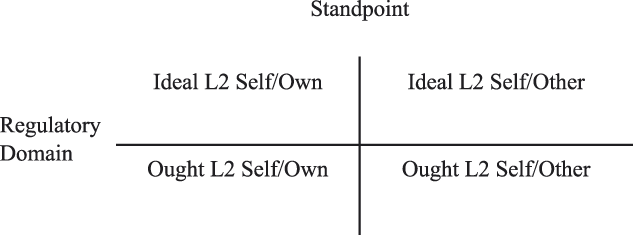
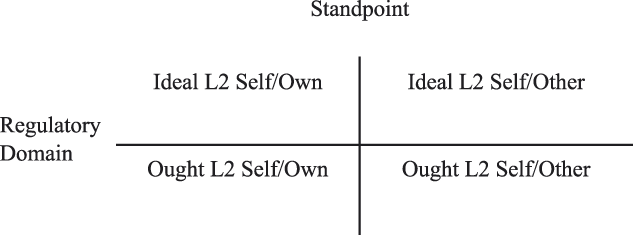
In this study, a revision of the L2MSS, which addresses the theoretical and operational concerns discussed previously, is proposed. Drawing on Higgins’s self-discrepancy theory (1987) and regulatory focus theory (1997), a 2 × 2 model, illustrated in Figure 1, with two self-guides (ideal L2 self and ought L2 self) formulated from two standpoints (own and other) is tested. It is anticipated that the ought L2 self scales would predict comparable amounts of motivated behavior as the ideal L2 self scales. Furthermore, the promotion self-guides (ideal L2 self/own and ideal L2 self/other) are expected to predict an eager strategic inclination, whereas the prevention self-guides (ought L2 self/own and ought L2 self/other) are anticipated to predict a vigilant strategic inclination. Therefore, the following research questions are formulated:
1. Is the 2 × 2 model of L2 self-guides better represented by data collected from L2 learners (ideal L2 self own/other and ought L2 self own/other) than the models with two (Dörnyei, Reference Dörnyei, Dörnyei and Ushioda2009) or three (Teimouri, Reference Teimouri2017) self-guides?
2. Do the ought L2 self scales (own and other) predict a comparable amount of variance in motivated learning behavior as the ideal L2 self scales (own and other)?
3. Do the self-guides with a promotion (ideal L2 self own and other) versus prevention regulatory focus (ought L2 self own and other) predict eager versus vigilant strategic inclinations, respectively?
The 2 × 2 model of L2 self-guides.
METHODS
PARTICIPANTS
Two-hundred fifty-seven international university students (109 male, 145 female, and 3 missing gender) studying and learning ESL at a major university in the United States participated in this study. The participants were from a wide variety of disciplines including but not limited to engineering (14%), music (7.8%), education (7%), business (5.8%), and computer science (5.8%), at both graduate (71.0%) and undergraduate levels (25.7%). The students’ age ranged from 17 to 45 with a mean of 26.65 (SD = 5.31) and a median of 26. The participants were from 50 different nationalities including China (32.7%), South Korea (10.1%), Panama (8.6%), Columbia (4.3%), Turkey (4.3%), and Iran (4.3%). They spoke 27 different native languages including Chinese (36.7%), Spanish (24.9%), and Korean (10%) as their first language. On a five-point scale ranging from beginner to upper-intermediate and over, most of the participants (67.7%) reported their English proficiency to be at the upper-intermediate and over level, and many others rated themselves at the intermediate level (27.2%). More than half of the participants (52.9%) were in the first or second year of their studies, the rest were in their third, fourth, fifth, or sixth year. The participants had lived in the United States for 29 months on average at the time of data collection.
INSTRUMENTS
A questionnaire was developed based on the proposed 2 × 2 model and in response to the discussed concerns with the scales used in previous studies. The questionnaire consisted of three parts. The first part included items measuring the four self-guides. The responses to the questions were collected on a six-point Likert scale with 1 showing strongly disagree and 6 showing strongly agree. The second part consisted of items measuring eager and vigilant strategic inclinations, and learners’ motivated learning behavior. A five-point Likert scale was used to respond to these items with 1 showing never true of me and 5 showing always true of me. The third part collected participants’ background information including their gender, age, nationality, L1, length of residence in the United States, and self-reported English proficiency. The following list includes the motivational scales that are the focus of this study:
1. Ideal L2 self/own: representing the L2 attributes that the learner (own standpoint) would ideally hope (promotion focus) to possess in future.
2. Ideal L2 self/other: representing the L2 attributes that the learner’s significant others such as his or her family (other standpoint) would ideally hope (promotion focus) the learner will possess in future.
3. Ought L2 self/own: representing the L2 attributes that the learner (own standpoint) believes he or she ought to possess (e.g., obligations, duties, and requirements) to avoid negative consequences (prevention focus).
4. Ought L2 self/other: representing the L2 attributes that the learner believes other people (other standpoint) expect him or her to possess (e.g., obligations, duties, and requirements). The learner foresees negative consequences in failure to meet those expectations (prevention focus).
5. L2 motivated learning behavior: representing the learner’s level of time, effort, and cognitive investment in the L2 learning pursuit.
6. Eager L2 use: representing L2 learning/use strategies that the learner employs to maximize the presence and minimize the absence of positive outcomes (e.g., learning and performance).
7. Vigilant L2 use: representing L2 learning/use strategies that the learner uses to minimize the presence and maximize the absence of negative outcomes (e.g., looking incompetent).
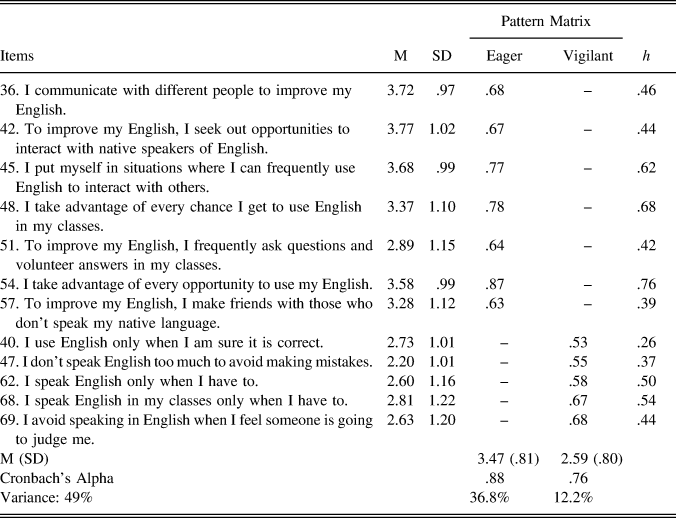
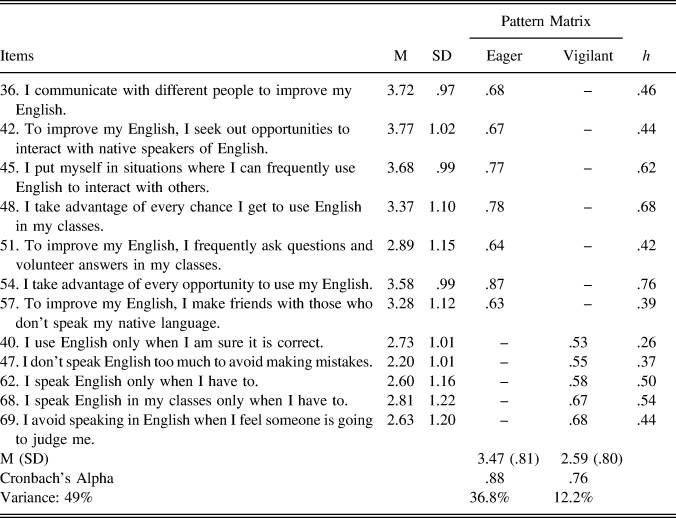
Items measuring the scales along with their reliability coefficients and means and standard deviations are presented in Table 1.
Cronbach’s alpha values and descriptives for the scales used

PROCEDURES
Data collection took place in January 2017. As the participants came from different proficiency levels, the questionnaire was piloted in English on 25 international students. Based on the feedback received, the wording of the items that the students found confusing or hard to understand was adjusted for better comprehensibility. An online version of the questionnaire was then created using Qualtrics. A link to the questionnaire was distributed to the international students, asking for their voluntary participation in exchange for a chance to win one of ten $50 gift cards. The collected data were submitted to SPSS 23 for analysis. Following data cleaning procedures (Dörnyei, Reference Dörnyei, Dörnyei and Ushioda2009), responses submitted by 55 out of 313 participants were eliminated because they were incomplete, completed in an unusually short time, or completed by native English speakers.
RESULTS
CONFIRMATORY FACTOR ANALYSIS OF L2 SELF-GUIDES
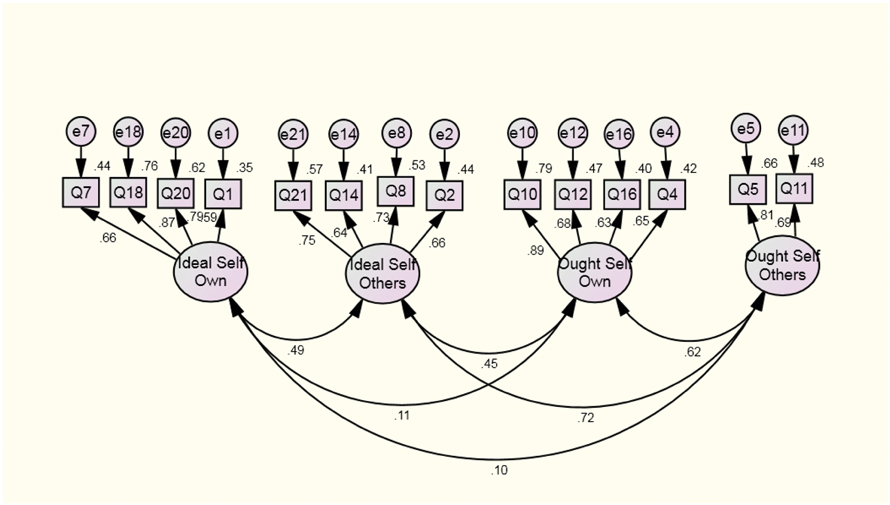
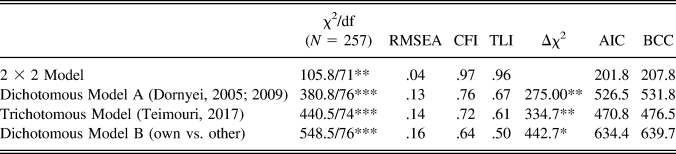
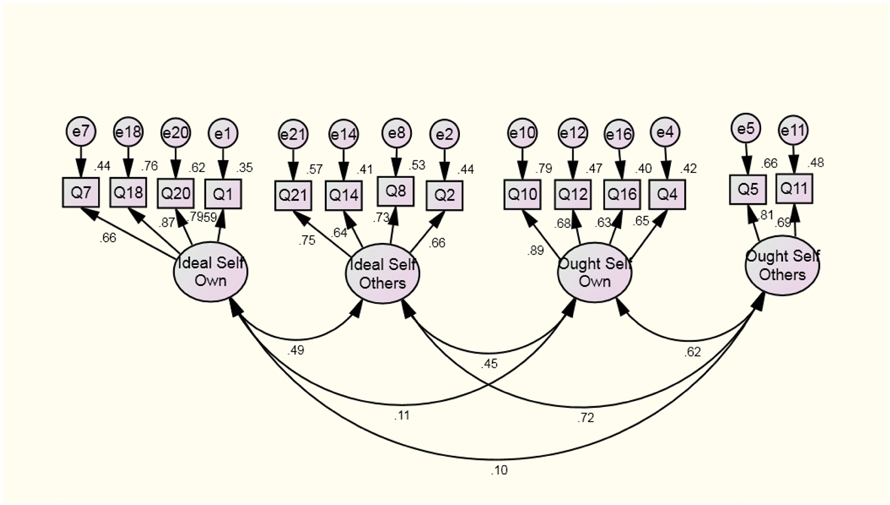
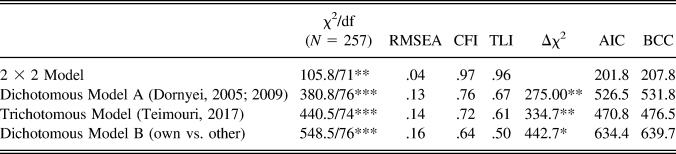
To examine whether the data represented the proposed 2 × 2 model of L2 self-guides better than Dörnyei’s (Reference Dörnyei, Dörnyei and Ushioda2009) model with two self-guides, and Teimouri’s (Reference Teimouri2017) model with three self-guides (research question 1), confirmatory factor analyses were run using AMOS 18.00 (IBM) with the solution generated based on maximum likelihood estimation.Footnote 1 The initial model included 16 observed variables (questionnaire items) that loaded on four latent variables (four items for each self-guide). Two items that did not load properly on ought self/other were deleted. The final model, presented in Figure 2, included 14 observed variables that strongly loaded onto the four self-guides. Table 1 includes the items with their reliability coefficients and descriptive statistics. Chi-square to degrees of freedom was significant, indicating inadequate fit. However, this measure is commonly considered problematic for sample sizes larger than 250. Therefore, other measures of goodness of fit such as the Root Mean Square Error of Approximation (RMSEA) (acceptable value < .05), the Comparative Fit Index (CFI) (acceptable value > .90), and the Tucker-Lewis Index (TLI) (acceptable value > .90) were used instead. As shown in Table 2, these values all strongly confirmed an excellent fit for the proposed model.
Confirmatory factor analysis results for the 2 × 2 model.
Comparison of tested models
* p < .05; **p < .01; ***p < .001.
Three alternative models were also tested and compared using the chi-square difference test, Akaike information criterion (AIC), and Browne-Cudeck criterion (BCC). A dichotomous model (dichotomous model A) was tested based on Dörnyei’s (Reference Dörnyei2005, Reference Dörnyei, Dörnyei and Ushioda2009) original L2MSS with one ideal L2 self and one ought-to L2 self. The items adopted/developed for ideal L2 self/own and other were loaded on a unitary ideal L2 self, and the items adopted/developed for ought L2 self/own and other were loaded on a unitary ought L2 self. A trichotomous model was tested based on Teimouri’s (Reference Teimouri2017) revision; this model included ought-to L2 self/own, ought-to L2 self/other, and a unitary ideal L2 self composed of all the items adopted/developed for ideal L2 self/own and other. Finally, dichotomous model B was tested based on the standpoints: Own-based self-guides, which included all the items from ideal L2 self/own and ought L2 self/own, and other-based self-guides, comprised of all the items from ideal L2 self/other and ought-to L2 self/other. The goodness of fit indices related to the three alternative models and the results of the chi-square difference test are displayed in Table 2. As shown, compared against the three alternative models, the model proposed in the present study is the only one with acceptable fit. The chi-square difference test and the AIC and BCC values also confirmed that the proposed model showed significantly better fit than the alternative models. Cronbach’s alpha reliability coefficients of all the scales were acceptable (Table 1), and composite reliability values were larger than 0.7 (ideal L2 self/own = .82, ideal L2 self/other = .79, ought L2 self/own = .81, and ought L2 self/other = .82), suggesting the internal consistency of the scales. The average variance extracted (AVE) was .54 for ideal L2 self/own, .49 for ideal L2 self/other, .52 for ought L2 self/own, .57 for ought L2 self/other, supporting the convergent validity of the constructs. All the squared inter-construct correlations (Table 3) were smaller than their respective AVEs, indicating the discriminant validity of the constructs.
Intercorrelations

* p < .05; ***p < .001.
MULTIPLE REGRESSIONS ANALYSIS: PREDICTORS OF MOTIVATED LEARNING BEHAVIOR
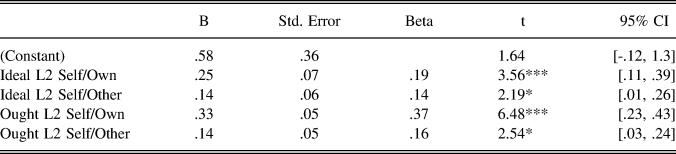
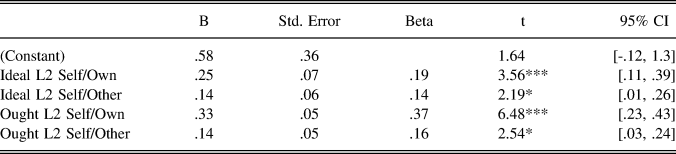
To examine whether the amounts of variance in motivated learning behavior explained by the ought L2 self/own and other are comparable to those of ideal L2 self/own and other (research question 2), a regression analysis was conducted using the entry method with the four self-guides (using the raw mean scores), included as predictor variables and motivated learning behavior as the outcome variable (for intercorrelations, see Table 3). Results showed that the regression model was significant (F (4, 252) = 38.08, p = < .001, R 2 = .38), predicting 38% of the variance in motivated learning behavior. As presented in Table 4, all the four future self-guides emerged as significant predictors. More importantly, ought L2 self/own (β =.37, p = <.001) emerged as the strongest predictor of motivated learning behavior, explaining nearly twice as much variance as ideal L2 self/own (β = .19, p = < .001). Ought L2 self/other (β = .16, p = .01) and ideal L2 self/other (β = .14, p = .03) were also significant but weaker predictors of the outcome measure.
Multiple regression results with motivated behavior as outcome variable
Note: R 2 = .38.
* p < .05; ***p < .001.
PREDICTORS OF EAGER AND VIGILANT STRATEGIC INCLINATIONS
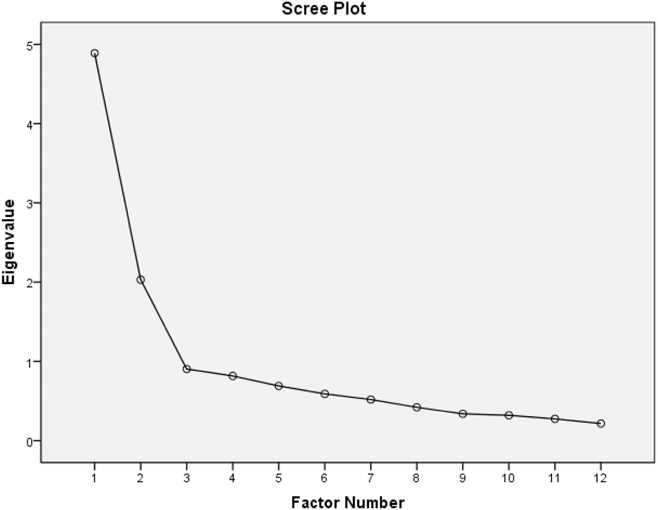
To examine whether the L2 self-guides would predict qualitatively different (eager vs. vigilant) strategic inclinations in participants’ use of English (research question 3), related items were submitted to exploratory factor analysis with maximum likelihood as method of extraction. Direct oblimin with Kaiser normalization was used as method of rotation, and the number of factors were determined using eigenvalues larger than 1 (Kaiser’s criterion) and the scree plot.
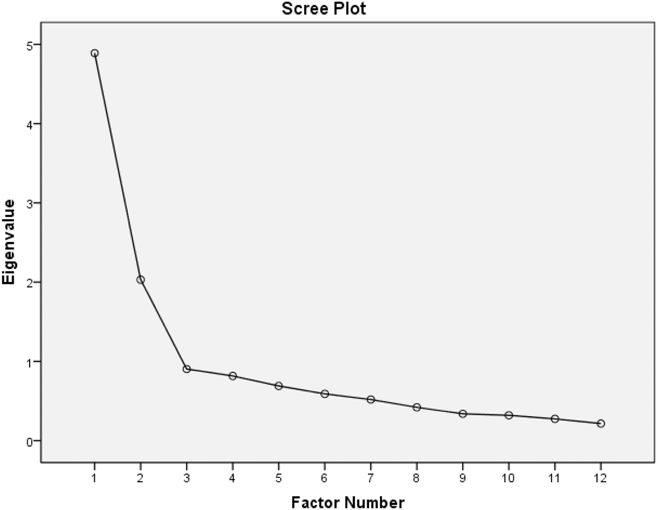
The results showed that Kaiser-Meyer-Olkin measure of sampling adequacy (.86) was much larger than the minimum acceptable value of .05, and Bartlett’s test of sphericity was also statistically significant, χ2(66) = 1381.9, p < .001, indicating an acceptable goodness of fit for the dataset. The analysis neatly resulted in two factors, which together explained 49% of the variance (Table 5). The scree plot also supported the two-factor solution (Figure 3). The first factor, which explained 36.8% of the variance (eigenvalue = 4.89), included seven questionnaire items, highlighting learners’ eager strategic inclination in their use of English, hence labeled eager L2 use. The second factor, which explained 12.2% of the variance (eigenvalue = 2.03), included five items measuring learners’ vigilant strategic inclination in using English, hence labeled vigilant L2 use. Cronbach’s alpha reliability coefficient was .88 for eager L2 use and .76 for vigilant L2 use, suggesting the internal consistency of the scales.
Results of exploratory factor analysis and descriptive statistics
Scree plot for the emerged factors relating to strategic inclinations.
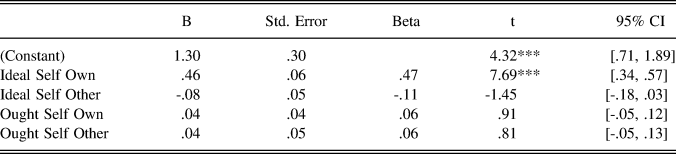
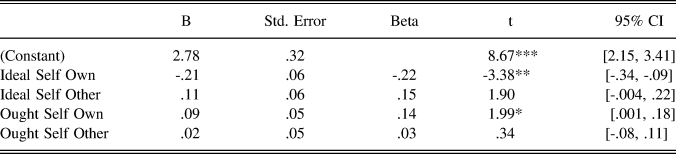
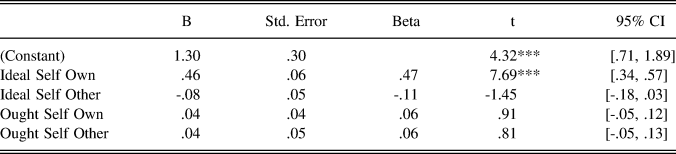
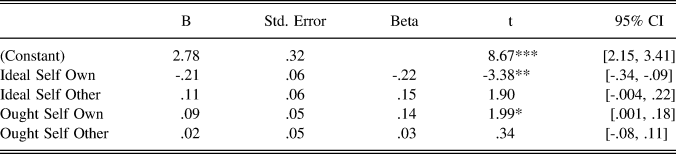
Two multiple regression analyses with ideal L2 self/own, ideal L2 self/other, ought L2 self/own, and ought L2 self/other as predictor variables, and eager L2 use and vigilant L2 use as outcome variables were performed (see Table 6 for intercorrelations). When eager L2 use was entered as the dependent variable (Table 7), the model was significant (F (4, 252) = 16.22, p < .001, R 2 = .21), and ideal L2 self/own (β = .47, p <.001) emerged as the only significant predictor of learner eager L2 use. In the second regression analysis with vigilant L2 use as the outcome variable (Table 8), which was also significant (F (4, 252) = 5.63, p < .001, R 2 = .08), ought L2 self/own (β = .14, p = .05) emerged as the only significant positive predictor of vigilant L2 use and ideal L2 self/own (β = -.22, p = .001) negatively predicted vigilant L2 use.
Intercorrelations between L2 self-guides and strategic inclinations

* p < .05; **p < .01; ***p < .001.
Multiple regression results with eager L2 use as outcome variable
Note: R 2 = .21.
*** p < .001.
Multiple regression results with vigilant L2 use as outcome variable
Note: R 2 = .08.
DISCUSSION
The purpose of this study was to test a model of L2 self-guides that addressed the two major limitations of Dörnyei’s (Reference Dörnyei2005, Reference Dörnyei, Dörnyei and Ushioda2009) theory of motivation: asymmetricity in standpoints and lack of clear regulatory distinctions. In the original formulation of their first measures (Taguchi et al., Reference Taguchi, Magid, Papi, Dörnyei and Ushioda2009), ideal L2 self was constructed solely from the own standpoint whereas ought-to L2 self included items from both own and other standpoints, creating asymmetric standpoints that could have resulted in the higher predictive power of ideal L2 self in the previous studies. Ideal L2 self and ought-to L2 self were, thus, bifurcated to reflect both own and other standpoints. In addition, it was argued that the regulatory distinction has not been considered in the operationalization of ought-to L2 self. In other words, ought-to L2 self included both promotion and prevention items. Therefore, in developing the new ought self-guides, items with an exclusively prevention regulatory focus, representing sensitivity to the presence or absence of negative outcomes, were used. The results of confirmatory factor analysis supported the effectiveness of our procedures and reconceptualization. The 2 × 2 model demonstrated better fit than Dörnyei’s original model (2005, 2009), which included only ideal L2 self and ought-to L2 self, and Teimouri’s (Reference Teimouri2017) tripartite model with ideal L2 self, ought-to L2 self/own, and ought-to L2 self/other.
In addition, intended effort was criticized for its promotion bias and hypothetical nature. A new scale with no regulatory bias, and pertinent to the current time, effort, and cognitive investment of L2 learners was developed to measure motivated learning behavior and test the predictive validity of the new model. Multiple regression results confirmed our expectations. Every one of the four future self-guides emerged as a significant predictor of motivated learning behavior. In contrast to the previous L2MSS studies, which uniformly found ideal L2 self (own) to be the strongest self-guide (e.g., Csizér & Kormos, Reference Csizér, Kormos, Dörnyei and Ushioda2009; Kormos & Csizér, Reference Kormos and Csizér2008; Lamb, Reference Lamb2012; Moskovsky et al., Reference Moskovsky, Assulaimani, Racheva and Harkins2016; Papi, Reference Papi2010; Papi & Teimouri, Reference Papi and Teimouri2012, Reference Papi and Teimouri2014; Ryan, Reference Ryan, Dörnyei and Ushioda2009; Taguchi et al., Reference Taguchi, Magid, Papi, Dörnyei and Ushioda2009; Teimouri, Reference Teimouri2017), in this study, ought L2 self/own emerged as the strongest predictor of motivated learning behavior. These results further support the validity of our main assumption that if conceptualized and operationalized accurately, the ought self-guides can also be major motivators (Higgins, Reference Higgins1987, Reference Higgins1997). These results, nonetheless, do not suggest that ought L2 self/own is the strongest predictor of L2 motivation in every context. The emergence of this variable as the strongest predictor of motivated behavior could be explained with reference to the ESL setting of this study, wherein learners find themselves facing potentially serious negative academic, professional, and social consequences for failure to effectively learn and use English. The more immediate possibility of these negative consequences, represented in the questionnaire items measuring ought L2 self/own (e.g., “If I don’t work on my English, I will fail in school/university”), seems to have outweighed the luxury of approaching more positive consequences such as speaking “like a native speaker of English,” as captured with the questionnaire items measuring ideal L2 self/own. Therefore, in addition to ideal L2 self/own, which the learners can still use to regulate their behavior toward more desirable end states, ought L2 self/own emerged as a strong self-guide to regulate their behavior away from potential undesirable end states. These findings support the importance of both ideal and ought self-guides in the study of L2 motivation. Ideal L2 self/other and ought L2 self/other, however, emerged as weaker predictors of motivated behavior, results that support the general assumption in motivation research and specifically in the self-determination theory (Deci & Ryan, 1985) that the more-internalized motives result in higher levels of motivation than the less-internalized ones.
The inclusion of strategic inclinations in the present study was in line with the developments in Higgins’s theory of motivation, in which self-discrepancy theory (Higgins, Reference Higgins1987) has evolved into regulatory focus theory (Higgins, Reference Higgins1997). According to Higgins and Cornwell (Reference Higgins and Cornwell2016), research on self-discrepancy theory had two major limitations that restricted its applicability. It did not pay sufficient attention to the strategic means used to achieve desired end states and the situational induction of motivational states. Regulatory focus theory addresses these limitations as it “emphasizes the strategic means used to approach these two desired end-states rather than simply the psychological distance between one’s current state and these two desired end-states” (Higgins & Cornwell, Reference Higgins and Cornwell2016, p. 57). It can also be used for creating situational regulatory focus and fit through regulatory induction techniques (see Motyka et al., Reference Motyka, Grewal, Puccinelli, Roggeveen, Avnet, Daryanto, de Ruytor and Wetzels2014). In the present study, these strategic tendencies were tested in the form of eager versus vigilant L2 use. The results showed that ideal L2 self/own predicted eager L2 use positively and vigilant L2 use negatively. By contrast, ought L2 self/own, which was the strongest predictor of motivated learning behavior in this study, did not predict eager L2 use and was the only positive predictor of vigilant L2 use. These results support the key assumption in the present study that examining the quantity of motivated behavior does not do justice to the complexity of motivation, and qualitative differences in learners’ behavior also need to be examined to better understand how motivation works in language learning (Papi, Reference Papi2018). More specifically, the findings support the central principle in regulatory focus theory (Higgins, Reference Higgins1997) that individuals with different regulatory foci employ qualitatively distinct strategic means in their goal pursuits. Promotion-focused learners pursue their goals in an eager manner, which sustains their feeling of advancement and accomplishment through maximizing gains and approaching matches to their desired end states, with minimal consideration for the risks or negative consequences of their behavior (e.g., 54. I take advantage of every opportunity to use my English). Prevention-focused individuals, by contrast, follow a vigilant strategic tendency, which sustains their feeling of safety and security through minimizing losses and avoiding mismatches to their desired end states. They are prudent and precautionary and avoid what they perceive as risky behavior that may result in those mismatches (e.g., 47. I don’t speak English too much to avoid making mistakes).
These results align with the findings of the previous studies by Higgins and his associates. A study by Freitas and Higgins (Reference Freitas and Higgins2002), for instance, showed that learners with stronger ideals favored eager study strategies (e.g., “Spend more time at the library”), while those with stronger oughts preferred vigilant strategies (e.g., “Stop procrastinating”). Higgins, Roney, Crow, and Hymes (1994) also found that the ideal-driven individuals anticipated more enjoyment in using eager friendship strategies (e.g., “Be loving and attentive”), whereas the ought-driven participants anticipated more enjoyment in using vigilant ones (e.g., “Stay in touch. Don’t lose contact with friends”). In a signal detection study, Crowe and Higgins (Reference Crowe and Higgins1997) found that a promotion focus led to an eager state with a risky bias to ensure “correct hits” and ensure against “errors of omission” (i.e., missing a hit opportunity), but a prevention focus resulted in a vigilant state with a conservative bias to ensure “correct rejections” and ensure against “errors of commission” (i.e., making a mistake). These findings are also supported by the results of the previous L2 motivation studies that showed that ideal L2 self was associated with eager tendencies such as WTC (e.g., Khajavy & Ghonsooly, Reference Khajavy and Ghonsooly2017; Rajabpour, Ghanizadeh, & Ghonsooly, Reference Rajabpour, Ghanizadeh and Ghonsooly2015; Teimouri, Reference Teimouri2017) and promotion-related emotions such as joy (Teimouri, Reference Teimouri2017), whereas ought-to L2 self was related to vigilant strategic tendencies such as lower classroom participation (Papi & Abdollahzadeh, Reference Papi and Abdollahzadeh2012) and prevention-related emotions such as L2 anxiety (e.g., Papi, Reference Papi2010; Papi & Teimouri, Reference Papi and Teimouri2014; Teimouri, Reference Teimouri2017). Ideal L2 self/other and ought L2 self/other, however, did not predict the eager and vigilant strategic tendencies, respectively. It seems that the ESL learners’ strategic inclinations to use the language tend to be associated with L2 self-guides from their own rather than others’ standpoints. Maximizing gains through eager L2 use strategies and minimizing the feeling of failure through vigilant L2 use strategies, therefore, appear to have more internalized sources of self-regulation.
Intended effort’s strong relationship with promotion-focused variables such as ideal L2 self, and its weak relationship with the prevention-oriented constructs such as ought-to L2 self in the previous studies (e.g., Ryan, Reference Ryan2008, Reference Ryan, Dörnyei and Ushioda2009; Taguchi et al., Reference Taguchi, Magid, Papi, Dörnyei and Ushioda2009; Teimouri, Reference Teimouri2017; You & Dörnyei, Reference You and Dörnyei2014) could have only been an artifact of the regulatory match between ideal L2 self and the eager inclination of intended effort rather than real indicators of the motivational superiority of ideal L2 self. The regulatory bias of intended effort, however, is not limited to the L2MSS studies; this construct has also been used in relation to other motivational frameworks. Csizér and Dörnyei (Reference Csizér and Dörnyei2005), for example, found strong correlations between this measure and Gardner’s (Reference Gardner1985) construct of integrativeness, which Dörnyei (Reference Dörnyei, Dörnyei and Ushioda2009) rightly argues to be conceptually similar to ideal L2 self. According to Masgoret and Gardner (Reference Masgoret and Gardner2003), “[T]he integratively motivated student is one who is motivated to learn the second language, has an openness to identification with the other language community, and has favorable attitudes toward the learning situation” (p. 128). Whereas being motivated and having favorable attitudes toward the learning environment suggest no regulatory bias, identification with the target language community requires high levels of openness to new experiences, which has been shown to be an eager strategic tendency, matching a promotion focus (e.g., Trawalter & Richeson, Reference Trawalter and Richeson2006; Vaughn, Baumann, & Klemann, Reference Vaughn, Baumann and Klemann2008). In addition, instrumental orientation, the second major construct in Gardner’s (Reference Gardner1985) theory of motivation also seems to have a promotion bias. All the items composing this scale in Gardner’s attitude/motivation test battery (1985) concern the achievement of positive outcomes (e.g., Studying French can be important for me only because I’ll need it for my future career). If both integrativeness and instrumental orientation have a promotion focus, the findings of the studies that have used Gardner’s theory of motivation would need to be reinterpreted with reference to the same regulatory asymmetricity that has biased the L2MSS. In other words, the studies that have used Gardner’s theory of motivation could be said to have been limited only to the promotion-focused variables affecting L2 motivation.
CONCLUSIONS
The L2MSS has been the most commonly used theoretical framework for the study of L2 motivation over the last decade. Not only has it provided an alternative to the Gardnerian research tradition (e.g., Gardner, Reference Gardner1985; Gardner & Lambert, Reference Gardner and Lambert1972), it has also opened our eyes to the potentials of looking at the self as the core of learners’ motivational thinking. It was time, however, for the original conceptualization to undergo modifications to better capture how motivation works for language learning. The previous model resulted in asymmetric relationships between L2 self-guides and motivational measures, with ideal L2 self emerging as the holy grail of student motivation and ought-to L2 self being a motive with negligible motivational significance. The present study reconceptualized the L2 self-guides based on Higgins’s self-discrepancy theory (1987) and regulatory focus theory (1997) in the form of the 2 × 2 model (Figure 1), with ideal L2 self and ought-to L2 self bifurcated into own and other standpoints, and formulated based on promotion and prevention regulatory foci, respectively. The results of the study provided preliminary evidence for the validity of the proposed model and supported the central assumption in Higgins’s (Reference Higgins1987, Reference Higgins1997) motivation theory that both promotion and prevention self-guides can result in motivation, an important principle that has not been sufficiently examined in the past research on L2 motivation. From a regulatory focus perspective, learners with a prevention focus are motivated by different desired and undesired end states than learners with a promotion focus. Therefore, lack of adequate attention to regulatory distinctions and prevention-related motives has resulted in the dominance of promotion-focused constructs in L2 motivation research. This has been the case in major theories of L2 motivation ranging from Gardner’s theory (1985; Gardner & Lambert, Reference Gardner and Lambert1972) to more recent ones such as Dörnyei’s L2MSS (2005, 2009). Research on L2 motivation, therefore, needs to adopt a broader scope to include a wider range of motives with different regulatory orientations.
Following Higgins’s theoretical developments, in the present study we employed self-guides not only to measure how they result in motivated learning behavior, but also to examine how learners with different regulatory orientations adopt different strategic means and pursue L2 learning in qualitatively different manners, as outlined in regulatory focus theory. The results supported the key regulatory focus principle: Learners driven by ideal L2 self/own (promotion-focused) utilized eager strategies in their L2 behavior; those driven by ought L2 self/own (prevention-focused) employed vigilant strategies. Although these results using the self-guide measures sound promising and in line with research on regulatory focus theory, it remains to be shown whether the use of self-guides, as is common in this field, is the best way to examine motivated learning strategies. This is mainly because even though self-guides as regulatory mechanisms are structurally the same across different contexts (in terms of regulatory focus and standpoints), the content of these constructs could vary across individuals and contexts. The same goal could be seen an ought by one learner and an ideal by another (Shah, Higgins, & Friedman, Reference Shah, Higgins and Friedman1998). Therefore, it would be more scientifically sound if more open-ended and “ideographic” measures are used in future studies, following the research tradition established by Higgins and his associates (see Higgins, Reference Higgins1987).
Higgins et al. (1986), for instance, developed the selves questionnaire to assess the degree of congruency among an individual’s actual self and his or her desired (ideal and ought) selves. In this questionnaire, participants list their actual selves, ideal selves, and ought selves. The greater the number of mismatches between one’s actual and ideal/ought selves, the larger is the magnitude of the ideal/ought self-discrepancy. Higgins, Shah, and Friedman (Reference Higgins, Shah and Friedman1997) employed the extent-rating method to measure regulatory focus strength. In this method, the actual-self extent rating is subtracted from the ideal/ought extent rating for each ideal/ought attribute the participants list. The differences between the two ratings are used as measures of regulatory focus strength. Shah et al. (Reference Shah, Higgins and Friedman1998) have developed the self-guides strength measure. In this technique, the latencies of participants’ responses in the selves questionnaire are used as measures of their self-guide strength. In addition to these open-ended procedures, the most common measure of chronic regulatory focus has been the Regulatory Focus Questionnaire, developed by Higgins et al. (Reference Higgins, Friedman, Harlow, Idson, Ayduk and Taylor2001). The questionnaire includes 11 items (five measuring a prevention focus and six measuring a promotion focus) and has been shown to be the most robust measure of chronic regulatory focus (e.g., Higgins & Cornwell, Reference Higgins and Cornwell2016). Employing these procedures to explore general and L2-specific regulatory focus strength, self-discrepancies, self-guides strength, and the interaction between these could push the boundaries of L2 motivation research in the coming years and create a meaningful relationship between motivation research in the fields of second language acquisition and social psychology.
LIMITATIONS AND FUTURE DIRECTIONS
The present study was based on data collected from international students studying at a university in the United States. Hence, the results could not be generalized to other contexts. Whereas the ideal and ought L2 selves from the standpoint of “others” significantly predicted motivated learning behavior, they did not predict eager versus vigilant strategies, failing to support regulatory focus predictions. This might have been due to the limited range of eager and vigilant strategies captured in this study, which was because the participants were not learning English in an instructional setting (e.g., an ESL center). Investigating the issue in instructional settings is likely to result in a different range of strategies predicted by selves from the standpoint of “others” as well. In this study, strategic inclinations were documented as outcome variables. Future research needs to examine how these strategic inclinations influence different learning outcomes (e.g., accuracy vs. fluency). Only two items loaded on ought L2 self/other and the two other items did not probably because of the exaggerated nature of item 35 and lack of specific references (i.e., “others”) in item 30. The scale can be further improved by drawing on other specific negative consequences or agitation-related emotions such as fear and threat (Higgins, Reference Higgins1987). Two examples of such items could be: If I fail to learn English, my family/teachers/advisor will lose confidence in me and If I fail to learn English I will have to face my family’s disapproval and blames. The questionnaire was administered in English, which was not the native language of the participants. This could be problematic as many of the participants self-reported intermediate proficiency levels. Even though the self-rating of the L2 proficiency may not exactly reflect the actual proficiency of the participants, administering the questionnaire in the participants’ first language can help avoid this issue in future studies. Alternatively, it would be interesting to see how learners at different proficiency levels may vary in terms of the target motivational characteristics.
The findings of this study can have profound implications for research on motivational strategies, self-regulation, and learning styles and strategies. If learners are motivated by motives that match their regulatory focus, prescribing one-size-fits-all strategies (e.g., Guilloteaux & Dörnyei, Reference Guilloteaux and Dörnyei2008; Moskovsky, Alarabi, Paolini, & Ratcheva, Reference Moskovsky, Alrabai, Paolini and Ratcheva2013; Papi & Abdollahzadeh, Reference Papi and Abdollahzadeh2012) to motivate everyone should be reevaluated. In addition, if learners with different regulatory orientations pursue goals in qualitatively different manners and use different strategic means, research on self-regulation, learning styles, and strategies might benefit from considering these differences.
The self-guides are not only end states that language learners approach or avoid; they can also be used in experimental priming studies and classroom contexts to create regulatory fit (for a meta-analytic review of 215 studies, see Motyka et al., Reference Motyka, Grewal, Puccinelli, Roggeveen, Avnet, Daryanto, de Ruytor and Wetzels2014). According to regulatory fit theory (Higgins, Reference Higgins2000), if the chronic or situationally induced regulatory focus of an individual matches the manner in which he or she completes a task, the individual will experience regulatory fit, which results in higher engagement, motivational strength, and persistence (e.g., Cesario, Higgins, & Scholer, Reference Cesario, Higgins and Scholer2008; Crowe & Higgins, Reference Crowe and Higgins1997), task enjoyment (e.g., Freitas & Higgins, Reference Freitas and Higgins2002), and learning and performance (e.g., Maddox & Markman, Reference Maddox and Markman2010; Worthy, Maddox, & Markman, Reference Worthy, Maddox and Markman2007). Creating situational regulatory focus in the classroom context can also lead learners to use certain strategic tendencies. Promotion induction can result in the use of eager strategic behaviors such as more participation, creativity, and risk taking; prevention priming can increase vigilant strategic behaviors such as attention to form, accuracy, and structure. In addition to its pedagogical utility, the perspective outlined in this article can provide a theoretical tool for L2 motivation researchers to move beyond descriptive studies of L2 motivation and toward employing rigorous motivational interventions to understand and promote cognitive and learning processes and outcomes, thereby creating a meaningful link between research on motivation and second language acquisition (Han & McDonough, Reference Han and McDonough2017; see Papi, Reference Papi2018).