The Centers for Disease Control and Prevention (CDC) “Antibiotic Resistance Threats in the United States,” published in 2013 and 2019, categorize vancomycin-resistant Enterococcus spp (VRE) as a serious public health threat requiring prompt action. 1,2 VRE is an endemic pathogen across healthcare settings; it is associated with increased patient mortality, increased hospital length of stay and healthcare costs. Reference Chiang, Perencevich and Nair3–Reference Cetinkaya, Falk and Mayhall5 The estimated attributable cost to VRE among hospitalized patients in 2017 was US$539 million. 1 To contain this antibiotic-resistant organism, high-quality surveillance efforts are required to ensure accurate monitoring of VRE incidence and to assess the impact of various infection prevention and control efforts.
The CDC National Healthcare Safety Network (NHSN) multidrug-resistant organism and Clostridioides difficile (MDRO/CDI) reporting module (data reporting platform) enables surveillance of 6 laboratory-identified (LabID) antibiotic-resistant organisms, including VRE. Federal and state reporting mandates exist for some organisms in the MDRO/CDI module. Although VRE is not included in any federal reporting mandate, the state of California does require submission of VRE LabID event data to the NHSN. Currently, we do not understand the hospital-level factors associated with differential incidence of VRE. Also, no national benchmarks have been established to monitor trends that could inform infection prevention, and our understanding about the extent of spread of this antibiotic-resistant organism is limited. The primary objective of this analysis was to identify predictors of healthcare facility-onset (HO) VRE bacteremia LabID events that are suitable for use in a risk-adjusted infection benchmark at the national level.
In addition, in this report, we introduce risk-adjusted, summarized, HO-VRE bacteremia incidence at hospital, state, and national levels in the form of standardized infection ratios (SIRs), which provide a means of comparing HO-VRE bacteremia LabID event incidence data to a national baseline. These SIRs can be used to track and measure HO-VRE bacteremia LabID event incidence and prevention progress.
Methods
Data cleaning
VRE bacteremia LabID event data included in this analysis were reported voluntarily (except by hospitals in California that reported due to a state reporting mandate) into the patient safety component, MDRO/CDI module of NHSN by ACHs. Every month each ACH indicates their intention to conduct surveillance through a standard NHSN form known as the Monthly Reporting Plan. The ACHs that entered VRE LabID into their Monthly Reporting Plan for their entire inpatient population (specifically facility-wide inpatient reporting) and submitted data for calendar year 2017 by April 1, 2019 were included. Due to insufficient reporting by specialized ACHs (eg, children’s, psychiatry, surgical) our analysis was limited to general hospitals. Data were analyzed using SAS version 9.3 software (SAS Institute, Cary, NC).
Selection of variables
VRE bacteremia LabID events were categorized as either community-onset (CO) or healthcare facility-onset (HO). We defined CO-VRE events as a VRE-positive specimen collected ≤3 days after hospital admission, or a specimen collected from an emergency department or 24-hour observation unit. We defined HO-VRE events as a VRE-positive specimen collected >3 days after hospital admission. To avoid duplicate counting of the same event, only VRE bacteremia events that occur at least 14 days apart can be reported. Additional details regarding the surveillance protocols for these events have been described elsewhere. 6 To limit the data entry burden on hospitals, the MDRO/CDI LabID surveillance protocol calls for denominator data submissions at the hospital level; thus, patient-level factors are only collected for those patients with a VRE bacteremia LabID event; therefore, they are not available for the CDC to include in the development of a risk-adjusted benchmark.
VRE bacteremia monthly inpatient denominator data (facility-wide inpatient days and admissions) were reported from ACHs each month. In addition, monthly counts of total outpatient encounters from emergency departments and 24-hour observation units, if applicable, were collected. ACHs with zero annual facility-wide inpatient days or admissions were excluded from further analysis. We also imposed a conservative rule to identify facilities with highly imprecise VRE rates and excluded those with unadjusted VRE incidence greater than the 50th percentile plus 8 times the 50th percentile VRE incidence value.
Variable parametrization
Annual nonduplicate HO-VRE bacteremia incidence rates per 100,000 patient days were calculated to evaluate potential risk adjustment variables. Negative binomial regression was used for all univariate and multivariable modeling. Potential risk factors identified for this analysis included hospital-level covariates such as VRE CO prevalence, as well as ACH characteristics that were self-reported on the NHSN annual hospital survey. The variables were assessed on the univariate level for significant association with HO-VRE bacteremia: hospital inpatient bed size, intensive care unit bed size, average length of patient stay (calculated as total annual patient days divided by the total annual admissions), inpatient and outpatient VRE CO prevalence rates, presence of an oncology unit, medical school affiliation, and CO CDI prevalence rate. The inpatient CO VRE prevalence rate was calculated as the total number of CO VRE bacteremia LabID events divided by the total admissions and is presented as per 10,000 patient admissions. Outpatient CO VRE prevalence rate was calculated as the number of CO VRE bacteremia LabID events reported from emergency departments and/or 24-hour observation units, divided by the number of outpatient encounters and multiplied by 10,000. Stratified HO-VRE bacteremia LabID incidence rates were calculated for categorical facility variables, and single variable models were constructed to determine whether a statistically significant relationship exists between each potential risk factor and HO-VRE bacteremia incidence. Distinct levels of categorical variables, such as hospital bed size, ICU bed size, CO-VRE, and CO-CDI prevalence rate, were combined when appropriate. For example, the inpatient and outpatient CO-VRE prevalence rates were assessed using tertile and quartile stratification, but a best-fit model was ultimately achieved when these were each categorized into 3 levels based on statistically significant difference in VRE incidence for each category. The inpatient CO-VRE prevalence rate was categorized into 3 levels based on statistically significant difference in the CO-VRE incidence in each group: high (>95th percentile), medium (75th–95th percentile), and low (<75th percentile). The outpatient CO VRE prevalence rate was categorized into 2 levels: high (>90th percentile) and low (≤ 90th percentile). Similarly, using tertile and quartile stratification, average length of patient stay was categorized into 2 levels: high (>75th percentile) and low (≤75th percentile). An assessment of outliers was performed on all continuous variables to identify any influential data points, and various stratification levels were evaluated for significant association and best fit in a single-variable model. P < .05 was considered to indicate significance for all statistical testing.
Calculation of SIR
A multivariable negative binomial regression model was developed using a forward stage-wise selection process in which statistically significant variables from the univariate analyses were considered for inclusion. Goodness-of-fit at each stage of the model-building process was assessed using the likelihood-ratio test and the Akaike information criterion (AIC) statistic. Variable parameterization was performed to ensure that there was significant difference in HO incidence for each category. A best-fit model was developed and confirmed by likelihood ratio tests and AIC. The final best-fit model included all variables for which the parameter estimate’s 95% confidence interval excluded zero. The final multivariate model was validated using bootstrap validation.
The resulting model, applied to 2018 VRE bacteremia data reported to the NHSN, was used to predict the number of HO-VRE bacteremia events that occurred in each hospital and state. The number of predicted events was then used to produce HO-VRE bacteremia SIRs, which were calculated as the number of observed HO-VRE bacteremia events divided by the number of predicted HO-VRE bacteremia events. SIRs were calculated for each ACH, state, and nationally, for all levels in which at least 1 HO-VRE bacteremia event was predicted. State-level SIRs were calculated for states that had at least 5 ACHs reporting 2018 VRE bacteremia LabID event data to NHSN. A mid-P exact test was used on all SIRs to determine whether the number of observed events was significantly different than the number predicted (ie, if the SIR was statistically significantly different from 1). An SIR >1 indicates that more LabID events were reported than predicted, and an SIR <1 indicates that fewer LabID events were reported than predicted. More information about the CDC methodology for calculating and interpreting SIRs is described elsewhere. 7
Results
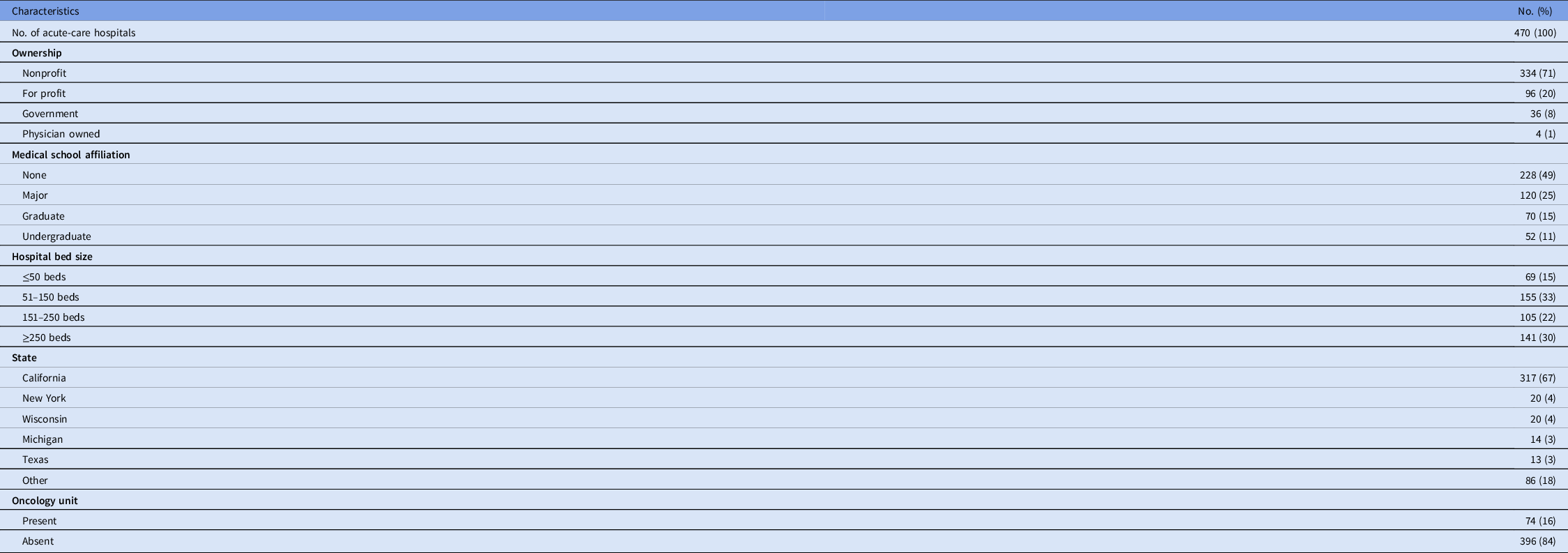
After applying exclusion criteria, 470 ACHs from 35 states had submitted sufficient data to the NHSN for inclusion in the 2017 baseline analysis for HO-VRE bacteremia LabID event incidence. A large proportion of ACHs were in California (67%). Most hospitals in our analysis were nonprofit (71%), were affiliated with a medical school (51%), and did not have an oncology unit (84%). More than 50% of hospitals in our analysis had >150 beds (Table 1). Overall, 536 HO-VRE bacteremia LabID events and 19,419,271 patient days were reported in 2017, resulting in an unadjusted HO-VRE bacteremia national incidence rate of 2.76 per 100,000 patient days.
Characteristics of Hospitals Contributing to the 2017 VRE Bacteremia SIR Baseline

Note. VRE, vancomycin-resistant enterococci.
The incidence rate varied by hospital characteristic. For example, ACHs with a higher inpatient CO-VRE prevalence rate (ie, >2.95 per 10,000 admissions) had an unadjusted HO-VRE bacteremia incidence rate of 6.91 per 100,000 patient days compared to 1.88 in hospitals with a low inpatient CO-VRE prevalence rate (ie, <0.63 per 10,000 admissions). ACHs with a high length of patient stay (>4.9 days), high outpatient VRE community prevalence rate (>0.93 per 10,000 encounters), and the presence of an oncology unit had national HO incidence rates of 4.78, 7.51, and 4.32 per 100,000 patient days, respectively.
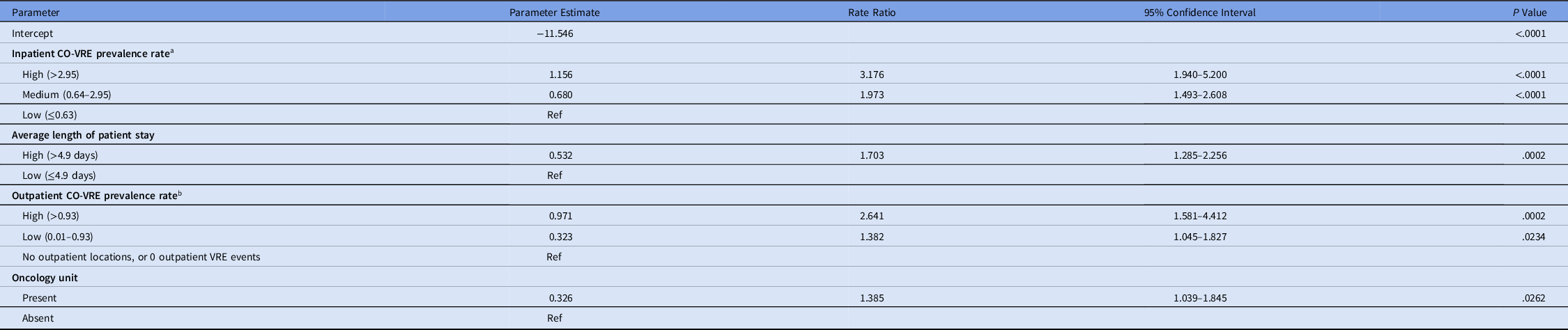
The final best-fit multivariate model included inpatient and outpatient CO-VRE prevalence rates, average length of patient stay, and presence of an oncology unit (Table 2). These 4 variables were significantly associated with HO-VRE bacteremia, with the inpatient CO VRE prevalence rate having the strongest association. Hospitals in the highest category of inpatient CO-VRE prevalence rate had a HO-VRE bacteremia incidence rate that was >3 times greater than that of hospitals with a low CO-VRE prevalence rate (adjusted RR, 3.2).
Model to Predict Healthcare Facility-Onset VRE Bacteremia, 2017

Note. CO, community onset; VRE, vancomycin-resistant enterococci.
a Inpatient prevalence rate = CO-VRE events/admissions × 10,000.
b Outpatient prevalence rate = CO-VRE events/encounters × 10,000.
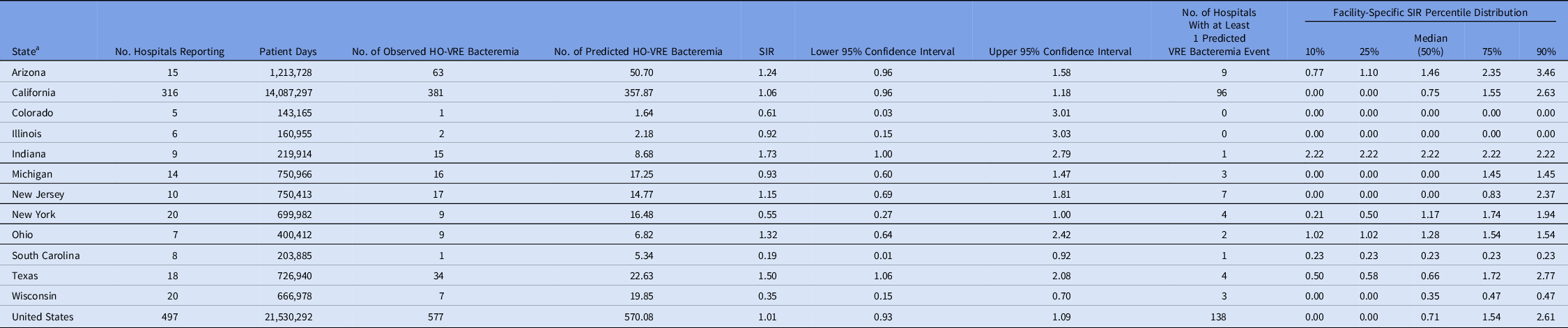
In 2018, 497 hospitals reported 577 HO-VRE bacteremia events and 21,530,292 patient days. The 2018 national SIR was 1.01 (95% CI, 0.93–1.09), with state-level SIRs ranging from 0.19 to 1.73. South Carolina had the lowest SIR of 0.19 (95% CI, 0.01–0.92), with 8 facilities reporting to the NHSN, and Indiana had the highest SIR of 1.73 (95% CI, 1.00–2.79), with 9 facilities reporting to the NHSN (Table 3). California’s state SIR was 1.06 (95% CI, 0.96–1.18), and the pooled SIR from states with no reporting mandate for VRE was 0.93 (95% CI, 0.80–1.06). There were 138 facilities (26%) that had at least 1 predicted HO-VRE bacteremia event and thus an SIR could be generated. Of these, 12 hospitals had an SIR >1, whereas 5 hospitals had an SIR <1, and both were statistically significant.
2018 VRE Bacteremia Standardized Infection Ratios, by State

Note. HO, healthcare facility–onset; VRE, vancomycin-resistant enterococci.
a This table includes states in which at least 5 hospitals reported VRE LabID event data to NHSN in 2018
Discussion
This analysis represents the first national estimate of HO-VRE bacteremia using data that hospitals submit to the NHSN. Our findings indicate that hospital-level factors, specifically CO-VRE prevalence rates, average length of patient stay, and presence of an oncology unit are associated with HO-VRE bacteremia incidence. These findings were used to develop a validated predictive model for SIR calculations, which in turn enable ACHs to monitor infection prevention progress compared to national-, state-, and hospital-level benchmarks.
The SIR offers an alternative method of monitoring HO-VRE bacteremia incidence compared to pooled mean rates, which were previously published annually by the NHSN for various healthcare-associated infections (HAIs). 8 Pooled mean rates do not account for factors differentially impacting incidence at the healthcare facility and patient population levels. Therefore, the value of pooled mean rates in making comparisons is limited to a cross section in time for the population or facility being measured. Also, a pooled mean rate is difficult to interpret as a standalone value to measure progress without a reasonable baseline. In contrast, the SIR incorporates a statistical model used to determine the predicted number of infection events adjusting for differences in infection incidence, based on national, aggregate NHSN data. As such, the calculated SIR offers an immediate comparison to a national baseline (SIR >1 indicates more events were reported than predicted, and an SIR <1 indicates fewer events were reported than predicted) and is adjusted for factors that contribute to HAI risk within a facility. SIRs can be used to monitor not only changes between 2 distinct periods but also to compare HO-VRE bacteremia rates between hospitals or hospital systems and a national benchmark.
The various hospital-level factors included in the final best-fit model for risk adjustment used to generate SIRs corroborate the findings of previous studies. Other researchers have found that patients who are immunocompromised or have a hospital length of stay ≥3.5 days are at higher risk for HO-VRE infection. 9–Reference DiazGranados and Jernigan11 Although the CDC is not able to include patient-level clinical characteristics in this analysis, the similarity in study findings provides confidence that certain facility factors can serve as proxies for patient characteristics. Other studies identified additional risk factors for VRE infection and colonization, including increased incidence of CDI infection and use of IV vancomycin or metronidazole. 9,Reference Fujitani, George, Morgan, Nichols and Murthy12–Reference Stevens, Khader and Echevarria15 However, CO-CDI prevalence rate was not a statistically significant predictor for HO-VRE bacteremia in this study.
Although SIRs are useful for monitoring infection prevention progress using a national baseline, there are some limitations. The hospital data used to calculate SIRs are self-reported to the NHSN, and the validity of the risk-adjustment model is dependent on the quality of those data. Individual patient-level characteristics could not be considered in this analysis because the NHSN MDRO/CDI module does not collect patient-level risk factors for all patients in the hospital; therefore, the presence of an oncology unit was considered a proxy for providing care to immunocompromised patients. In addition, the baseline model was created using data largely reported by California hospitals, where VRE reporting is mandated. As additional hospitals choose to report VRE bacteremia data to NHSN, or if additional legislative mandates are enacted, a future analysis could be performed with greater representation of all hospitals in the United States, which can help to scale up the monitoring and prevention of HO-VRE bacteremia. Lastly, the SIR can provide an indication of prevention progress, but it does not indicate which prevention strategies need evaluation.
Conducting surveillance of public health threats, like HO-VRE bacteremia, is in alignment with the CDC’s mission to promote healthcare safety and quality. Data captured by surveillance systems can help establish the baseline incidence rate by which significant deviations and infection prevention progress can be measured. However, specialized analytic methods may be required to assist with data interpretation and comparability. The HO-VRE bacteremia SIR is a summary measure that enables the NHSN to develop national estimates and to make comparisons at various levels, including healthcare facility, state, region, and healthcare quality group. Additional healthcare facilities across the nation are encouraged to report HO-VRE bacteremia events to the NHSN to help elucidate the nationwide burden of this pathogen.
Acknowledgments
The findings and conclusions in this report are those of the authors and do not necessarily represent the official position of the Centers for Disease Control and Prevention or the Agency for Toxic Substances and Diseases Registry.
Financial support
No financial support was provided relevant to this article.
Conflicts of interest
All authors report no conflicts of interest relevant to this article.