I. Introduction
The Severan Miaphysites were (and are) a Christian confession who rejected the Christology of the council of Chalcedon in 451. The Christological ideas of Severus of Antioch were briefly promoted as an imperial orthodoxy by the emperor Anastasius (d. 518). But for much of the 6th century, the Severan Miaphysite clergy constituted an orthodoxy in waiting: they continued to appeal to Roman emperors for arbitration and received occasional patronage, but also suffered periodic persecution (such as coerced communion or the confiscation of property). In this era, the heroes of the movement were itinerant missionaries such as Jacob Baradeus (d. 568), who worked to consecrate a hierarchy of priests and bishops who were independent of the Chalcedonians.Footnote 2 Most Miaphysite bishops at this time were, in practice, unable to hold the urban sees of their Chalcedonian rivals and operated from rural monasteries.Footnote 3 This was the context for the greater use of Syriac by the Miaphysites, in a rural environment where Greek was less familiar, though we should remember that both Chalcedonians and the Church of the East also employed Syriac in various settings.
The Arab conquests of the 7th century brought an end to the imperial patronage of the Chalcedonians, and the Severan Miaphysites were able to establish themselves as one of the three accepted Christian confessions of the caliphate. Though their institutional centers remained in monasteries, and monks dominated the Severan episcopate, the movement was able to generate patronage from their new Muslim rulers and receive official support for the gathering of tithes, the suppression of dissidents, and the foundation of new churches. The church under Muslim rule was often known as “Jacobite,” after Jacob Baradeus, at least in public settings.Footnote 4
Contemporary sources for the Miaphysites in the 6th century are relatively rich: dossiers of letters, hagiographies, and the ecclesiastical history of John of Ephesus (d. 586). But the coverage for subsequent centuries is much more patchy. A substantial ecclesiastical history, written by the patriarch Dionysius of Tel-Mahre (d. 842), covered the period c. 580–842, but this is not extant and we are reliant on later medieval chronicles that used Dionysius, of which the Chronicle of Michael the Syrian (d. 1199), his successor as patriarch, is the most significant.
The history describes the struggles of Dionysius and his predecessor Cyriacus with schismatics; Dionysius’ close relationship to the caliph al-Ma’mun (d. 833); Dionysius’s visits to Egypt and the events of the fourth fitna. Footnote 5 We also have a detailed narrative for the very different period described by the historian Ignatius of Melitene (d. 1058), who also survives in quotation by later medieval historians. Ignatius wrote in the aftermath of the Byzantine reconquest of eastern Anatolia and parts of northern Syria, in which the Miaphysites had been invited to resettle lands that had been depopulated after the expulsion of Muslims who refused to convert. He reflects on how this relationship had turned bitter when the Byzantines attempted to convert the Miaphysites to Chalcedonianism a generation later.Footnote 6
This article considers a further source for the history of the Severan Miaphysites in the 9th and 10th centuries. This is the substantial appendix that is included in the final pages of Michael’s Chronicle. Footnote 7 It lists the Severan Miaphysite patriarchs of Antioch between c. 580–1199 and gives their home monasteries, their place of consecration, and their place of death, as well as the bishop who consecrated them.Footnote 8 It also gives the bishops that they consecrated, and notes the monasteries they came from. Historians have not given these lists much attention: they have been mined to describe when episcopal sees appeared or disappeared, but with little interest in which monasteries supplied candidates for different bishoprics. But the data is very rich: for the period 800–1050, which I have focused on here, there are some 600 different monasteries and bishoprics.
While church historians have been concerned with Christians under Muslim rule, attention is often focused on theology and/or on the immediate aftermath of the conquests in the 7th century. Though the material from the episcopal lists is undoubtedly ambiguous, it offers the possibility of treating a period and a region that is very little studied, but where a Christian presence has existed until the present day. In particular, it allows us to reflect on how political changes affected the church, including how it was affected by the restoration of Roman authority after several centuries of Muslim rule.Footnote 9
The lists themselves do not give the impression of having been heavily edited. They refer to the same monasteries by different names. And occasionally, there are groups of bishops who are only named and are not connected to a monastery. I hypothesize that we are dealing with a single official list, which was updated by different scribes, some of whom followed slightly different conventions in what information they chose to record.Footnote 10 The existence of this list implies a continuous culture of archival record-keeping in the patriarchate. In part, this record confirms that bishops were who they claimed to be and prevented those who had already been consecrated from seeking to be reconsecrated to a more prestigious see. But it also emphasized the dependence of bishops on the consecrating patriarch: if a patriarch was excommunicated, then all of the bishops he had consecrated would also need to be excommunicated or reconfirmed.Footnote 11 The custom of keeping consecration lists may have helped to preserve this state of affairs and encouraged loyalty to an incumbent patriarch.
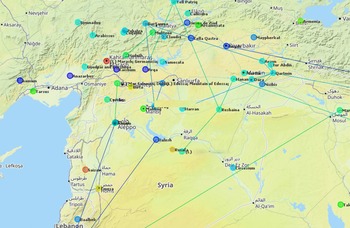
I wanted to capture the differences over time in the relations between bishoprics and monasteries, so I used the list of patriarchs to divide the consecration lists into four time slices. These were selected to match the geographical clustering of the patriarchs themselves: Phase I: Raqqa (800–876), Phase II: Tur Abdin (876–910), Phase III: Antiocheia (910–965), and Phase IV: Melitene (965–1030) (further details in the Table 1 below and network maps immediately before the conclusion). Note that the list allocates each consecration to a patriarch, but gives no further chronological details, so we cannot determine whether consecrations were made at the start of a patriarch’s reign or distributed more evenly. For each time slice, I identified the most dominant monasteries, typically those with the largest numbers of bishops, and the sees that were most strongly tied to these dominant monasteries (the most desirable prizes).Footnote 12
Patriarchs of the Syriac Orthodox Church

The lists can be used in three ways analytically. The first is to complement the narrative of the West Syriac ecclesiastical histories. This body of narrative leaves several holes. Its coverage between 842 and c. 1000 is limited to occasional anecdotes preserved in Bar Hebraeus’ Ecclesiastical History.Footnote 13 But the development of the network of monasteries and sees offers an alternative means of writing this period of history, where we can see the emergence of new dominant monasteries, and the disappearance of others, as a way of telling the institutional church history of the period.
A second way in which we can draw on the lists is to test the assertions of the narrative histories. Where are the anecdotes that they describe as exceptional, and where are they typical? Do the reforms that Dionysius orchestrated as patriarch lead to enduring change, or were they ephemeral? And do the network position of actors identified in the histories provide alternative or complementary explanations for their behaviors?
Third, the lists provide new questions. Why do sees diminish in their importance or disappear? Why are there geographical gaps in the coverage, and can we explain the clustering of monasteries with specific sees? Why do monasteries become more or less significant? What is the relationship between the patriarch’s monastery and the other monasteries? And where do these specific historical networks differ from abstract networks? Many of these questions cannot be answered definitively; indeed, I am often forced to speculate on the basis of patterns known from earlier periods of history that are better known, but the analysis of the lists does render them “known unknowns.”
I employ a number of hypotheses on how to interpret the data from the richest part of Dionysius’ history, namely the link between the election of patriarchs depended primarily on access to the political patronage of (Muslim) elite figures. For instance, monks with strong links to Harran in northern Mesopotamia, which briefly served as the Marwanid capital in the final years of the regime, dominated the patriarchate in the period 740–760.Footnote 14 Likewise, the city of Raqqa was not only a major center of government in the early 9th century, but was also the site used by the Abbasid governor Abdallah ibn Tahir to choose between patriarchal candidates by listening to the acclamations of the crowd.Footnote 15 Here too, monks with links to Raqqa and to Abdallah were able to secure the patriarchate and use the powers of the state to defeat their rivals.Footnote 16 I explain the patterning of the patriarchal elections partly through changing patterns of patronage, from the Abbasids to the Hamdanids and Byzantines, though these operate with different degrees of intensity and with interruptions.
It seems unlikely to me that different visions of orthodoxy played a major role in determining how patronage was dispensed, in part because none of these powers were Miaphysite Christians and in part because I would expect later sources to at least mention moments of theological redefinition in passing. Dionysius himself sees the big issues of his time as schism rather than heresy.Footnote 17 On the other hand, it may well be that family connections or lower order forms of patronage did affect episcopal elections, as they certainly did in the Church of the East in the 6th century, but we cannot determine how this influence worked in individual cases.Footnote 18
II. The Patriarch
The Miaphysite church in the 7th, 8th, and 9th centuries had been dominated by a small number of monasteries that monopolized the office of the patriarch.Footnote 19 Here, I examine what can be gleaned from the sparse list of patriarchal succession until 800 (phase 0), before turning to the richer evidence after 800, for which we have episcopal consecration lists (phases I–IV).
Qenneshre was the most important of these monasteries. It provided five patriarchs in the period 591–846, and they ruled for a total of 136 years in this period. Among them were Athanasius Gamala (603–631), who played a prominent role in the restructuring of the Miaphysite church after the victory of Heraclius over the Persians, and the prominent historian Dionysius of Tel-Mahre (d. 845).Footnote 20 Qenneshre was famous as an educational center and a site of the translation of Greek philosophy.Footnote 21 After Dionysius, it produced no further patriarchs, but it continued to produce bishops until the reign of John V in the first decades of the 10th century.
The second of these monasteries was Gubba Barraya, near Cyrrhus and Mabbug in northern Syria. Gubba Barraya was the alma mater of four patriarchs in the period 591–846, but its influence came to a very abrupt end when the Gubbite monks supported a schismatic movement that opposed Cyriacus of Takrit (793–817) and Dionysius of Tel-Mahre (818–845). This schism was partly triggered by concerns over liturgical reform, but it was also linked to the Gubbites’ expectation that they would be able to control Cyrrhus as a pocket see, which they seemed to have done until the reign of Cyriacus.Footnote 22 Following Dionysius’ reign, Gubba Barraya failed to produce any more bishops.
The third of the great monasteries is Qartmin (modern Mor Gabriel), near Midyat in the Tur Abdin, which is still a major monastery today. It was associated with a series of significant holy men from the 5th to 8th century, who were celebrated in later hagiographies. These celebrated the foundation of smaller monasteries subordinate to Qartmin, as well as extensive and lucrative landholdings.Footnote 23 Nevertheless, the monastery’s significant political influence as a producer of patriarchs did not occur until the mid-8th century, when the caliph Marwan II briefly moved his base to the nearby city of Harran. The years c. 740–760 coincided with the reigns of three Qartminian patriarchs (Ishaq [755–756], Athanasius Sandalaya [756–758] and David of Dara [762–774]). Athanasius (while still only bishop of Maypherkat) was also able to use his influence to defy his predecessor Iwannis (739–754), engage in a substantial building program, and reorganize the church hierarchy for his own benefit.Footnote 24 Qartmin continued to provide numerous bishops throughout this period, as well as two further patriarchs, Theodosius (887–896) and Dionysius III (958–961).
The fourth and fifth of the monasteries that need to be highlighted as nurseries of the patriarchs are Bizona (“the monastery of the pillars”) and Mar Zakkai in the city of Callinicum. While Harran was a center of power relatively briefly (it lost its status as a seat of the caliph in 750 and as a mint by the 760s), Callinicum became a major center of industry and agriculture. It became the site of an army camp (Rafiqa) in the 770s and then a substantial urban foundation in the 780s (Raqqa), when it was one of a number of capitals for al-Rashid (786–809).Footnote 25 Mar Zakkai and Bizona had been founded in the old Roman settlement in the 6th century, but now found themselves in the immediate vicinity of a major center of government, which became the seat of Abdallah ibn Tahir (d. 844/845), the Abbasid governor of Egypt and the Levant (824–828).Footnote 26 Cyriacus (793–817) and Yohannan (846–873) were both monks in Raqqa, at Bizona, and Mar Zakkai, respectively.
After 800, we can begin to ask more complex questions of the data. In particular, how do the most “central” monasteries of each phase relate to the place of origin of the patriarchs and/or to the political authorities? The period c. 800–873 (phase I) is dominated by a small number of monasteries: Hananaia (near Mardin, modern Dair ez-Zaferan), Qartmin, Qenneshre, Mar Zakkai, the Mountain of Edessa, and the monastery of the easterners (in Amida), even though not all of these produced patriarchs.Footnote 27 Of these, Qartmin and Mar Zakkai, though they had been founded in the late Roman period, owed their importance to their proximity to new Muslim centers of government. This kind of proximity seems to have been especially important in the period c. 740–873 and coincided with the apogee of the caliphate during the first Abbasid century. In this era, Edessa and Callinicum stand out as the most significant sees and were the most likely to receive bishops from the most dominant monasteries. This situation likely arose because they hosted powerful urban monasteries and because Callinicum-Raqqa was also a political center.
Phase II, in the late 9th and early 10th centuries, sees a greater variety in the monasteries that produce a bishop: there is not the kind of domination that had been seen before, and few monasteries produced two incumbents for the same see. The three interregna that followed the reigns of Yohannan (846–873), Ignatius (878–883), and Theodosius (887–896) may hint at a difficulty in reaching consensus in a church that had become accustomed (or been obliged to accept) to a degree of political “guidance” from the caliph’s governors, which was no longer forthcoming. The three patriarchs of the late 9th century (878–909) were all drawn from Mesopotamian monasteries, and they were also consecrated and died in Mesopotamia, which seems to indicate a retreat to the centers of Miaphysite settlement in the absence of the incentives of political patronage from a powerful sponsor. In this era, the Mountain of Edessa, and to a lesser extent Mar Hanania, are the only dominant monasteries of the previous era to retain their importance, and the Mountain of Edessa has the highest number of bishops. Qartmin in this era seems to have retained its influence over a small group of sees that it never lost control over, such as Harran and the Tur Abdin, and slightly increased its portfolio to a wider variety of sees, for whom it was the only major monastery to provide bishops.Footnote 28 The relative demotion of the Raqqan monasteries of Bizona and Mar Zakkai during phase II is likely linked to the Abbasids’ loss of control in the Levant, and the wider effects of political strife in Iraq in this period, such as the Zanj revolt (869–883).
We can detect a slightly different pattern in the mid-10th century (phase III). After the reign of Dionysius II (896–909), patriarchs were increasingly drawn from northern Syria, especially three monasteries in the vicinity of Antioch: Qourzahiel, the monastery of the Black Mountain, and Tarel. And four of the patriarchs of this era were consecrated at Tell ‘Ada, a fortified village between Antioch and Aleppo that is adjacent to a monastery of the same name. This new importance for northern Syria did not exclude Mesopotamia, however: Basil (923–935) and Dionysius III (958–961) came from Mesopotamian monasteries and died in Mesopotamia as well, so this shift in geographical center toward Antiocheia was not total.Footnote 29 The dominant monasteries were those that had been important in phase I: Bizona, Mar Zakkai, the Mountain of Edessa, Qartmin, and Mar Hanania have the highest number of bishops, and the monasteries that actually generated patriarchs are only ranked ninth or tenth for their ability to provide bishops. The cities of Aleppo, Damascus, and Edessa are the most significant sees and are most likely to receive bishops from the dominant monasteries.
We might tentatively associate the geographical pattern of the elections of patriarchs in phase III with the creation of political centers at Antioch and Aleppo under the Hamdanid ruler Sayf al-Dawla (r. 945–967). The Life of Christopher of Antioch, a Melkite (Chalcedonian) hagiography dedicated to a patriarch of Antioch, looks back at the period of Hamdanid rule after the Byzantine annexation and confirms the significance of Antioch and Aleppo as twin centers.Footnote 30 It also credits a Miaphysite administrator, Kulayb, with influence at Antioch under Sayf al-Dawla (§12).Footnote 31 To the hagiographer, Kulayb is responsible for the excessive taxation of the Antiochenes, but, if we read between the lines of the text, it also suggests that both Miaphysites and Melkites enjoyed influence in this period, which is so badly served by Miaphysite narrative sources.
III. The Shift to Melitene
The consecration lists also provide further details to an event that has long been known from Ignatius of Melitene, namely the Miaphysite colonization of Melitene. The shift to Melitene is made more comprehensible by looking at the fate of monasteries in Antiocheia immediately before the transfer of the patriarchate, and the consecration lists emphasize that newly founded institutions near Melitene became significant very quickly. Because the consecration lists can be analyzed alongside the narrative sources, it is possible to analyze phase IV in greater detail than was possible for phases II and III.
The middle decades of the 10th century were an important moment for the creation of new monasteries and bishoprics in the region of Melitene. Melitene itself had been a metropolitanate since before the 8th century, but it was joined by new sees, including a new metropolitanate at Simandu (Gr. Tzamandos).Footnote 32 The region also saw a number of new monastic foundations: Qlawdia just before 953 and Gubbos in c. 954, Nahra de Qarire, Sergisyeh, and Bar Gagi in 958, and Barid in 969, the last of which was built as the patriarch Yohannan Sarigta’s own residence.Footnote 33
Bar Hebraeus describes how a Persian Christian from Azerbaijan “desired to live in a Christian district” and built a monastery in the village of Tursha on the east side of the Euphrates. He then built a second monastery in Qlawdia, where he was joined by three monks from Mar Hananaia near Mardin. This party of monks then went on to the village of Gubbos, where they were encouraged to build a third monastery with the assistance of the protospatharios John Gumaya in c. 958. This monastery attracted learned monks from the Mountain of Edessa. It also received donations from one Emmanuel of Harran, a disciple of the bishop of Takrit, which were used to pay for schools and xenodocheia in c. 970, and from the merchant, Marutha of Takrit, who paid for an irrigation system in c. 1000. A further monastery, Bar Gagi, was built by another Takritian monk in 958, after whom the monastery was named, with the assistance of one of the monks of Gubbos. In 987 Bar Gagi was later patronized by a local patrician, Eutychius, also known as Kulayb, who may be identified with the same Kulayb who had served Sayf al-Dawla.Footnote 34 Monks from the vicinity of Melitene were consecrated to major sees soon after these foundations.
Thus, the foundations in Melitene were facilitated by men from all over the Miaphysite world: from the well-established monasteries near Edessa and Mardin and from lay aristocrats whose lineage went back to Edessa but who had achieved recognition from the Byzantine rulers of Melitene, who had captured the city in 934. They may have also taken relics of Sergius and Bacchus from older sites such as Rusafa (Sergiopolis). But monks and merchants from the Miaphysite east, especially Takrit, which was undergoing persecution from local Muslims, also played a key role in founding these monasteries, whose libraries, scriptoria, and seminaries were very productive by the last decades of the 10th century.Footnote 35 This emigration may also have been stimulated by the economic possibilities for elites under Byzantine rule, such as the right to bear arms and construct churches, both of which were restricted under Muslim rule.Footnote 36
We can distinguish a final trend in the election of the patriarch from c. 985, phase IV, when a series of patriarchs had links to the city of Melitene. We can witness this new importance of Melitene in the works of Ignatius himself, who uses the reigns of the bishops of Melitene as a chronological marker alongside the sees of Antioch and Takrit (this is clearly visible in the early parts of Book XIII of Michael the Syrian).
Gilbert Dagron’s much-quoted article on the immigration of Syriac speakers to Byzantine territory emphasized the account by Ignatius, who described an official invitation by the emperor Nikephoros Phokas (r. 963–969). Dagron envisaged the emperors employing a markedly different policy in Antioch from Melitene, and he argued that persecution in the former was accompanied by (initial) toleration in the latter, and that this helps to explain the migration of Syriac-speakers to the Melitene monasteries. But David Gyllenhaal has recently pointed to a number of problems with this interpretation: if Nikephoros did make such a promise, he actually broke his word almost immediately. The story of a treaty is likely to be Ignatius’ invention. Likewise, the impression of a consistent imperial policy regarding Antioch does not hold up: the activities of the Chalcedonian patriarch Agapius II (976–996) against the Miaphysites are products of opportunism in the anarchic circumstances of the revolts of Bardas Skleros (d. 991). Following Bernd Andreas Vest, Gyllenhaal stresses that there were actually three waves of immigration into Melitene: in the 960s, in the 980s under Yohannan Sarigta (965–985), when the patriarch himself moved to near Melitene, and in the 990s, with the arrival of wealthy refugees from Takrit.Footnote 37
The episcopal lists may allow us to go further in understanding Yohannan Sarigta’s willingness to relocate the patriarchate. This relocation falls close to the disappearance of Yohannan’s home monastery of Tarel, which lay near Aleppo. Tarel had produced two patriarchs in quick succession (Abraham [962–963] and Yohannan). Of the seven bishops consecrated by Abraham, three were monks of Tarel, and the six bishops whose monasteries are known were all from near Antioch (XXVIII). Yet Yohannan only consecrated a single monk from Tarel (XXIX, 27), and the monastery is never mentioned after this point in the consecration lists.
We can only speculate about the reasons for this disappearance, given how little we know about the monastery. But since it had been very significant under Abraham and then suddenly produced no further bishops during a period of anarchy that surrounded the fall of the Hamdanids, it may be that the monastery was abandoned, perhaps during the chaos that surrounded the end of the dynasty. The district of Melitene had indeed been a major site of patronage in the 960s, but this did not lead inexorably to the transfer of the patriarchate 20 years later, and there had also been a significant promotion of Tarel and other sites in Antiocheia. Therefore, the dissolution of Sarigta’s own monastery of Tarel may have precipitated the move to Melitene as much as the pull factors.
At first sight, an apparent exception to the pattern of the drift of authority toward Melitene and its environs is the election of Yohannan IX Bar ‘Abdun (1004–1030), but he was a Melitenian who was also a monk of the Black mountain. His selection might indicate the enduring importance of the Black mountain monastery near Antioch, which, like Melitene, had been reconquered by the Byzantines. Furthermore, the Black mountain was also an early site of contact between Chalcedonians and Miaphysites, and the scholarly output of this earlier contact at the start of the 10th century may have seemed very relevant to a Miaphysite leadership that was now centered on Melitene, where the issues of Chalcedonian-Miaphysite relations had become much more salient.Footnote 38
For this fourth phase, the monasteries around Melitene are the most dominant: Barid, Bar Gagi, Mar Aaron, Abu l’Houri, Sergisyeh, and the monastery of Barsauma are most important. The one exception here to the domination of the Melitenian monasteries is Qartmin, which is the only one of the prominent monasteries of the previous generation to retain its position.
Finally, we should not forget that the political border between Byzantium and the caliphate was moving throughout the 10th century. As the Byzantine frontier moved east, the network map also straddled the frontier between Byzantium and Muslim ruled states to its east. In other words, there seems to have been little to prevent monks from the environs of Melitene from being appointed as bishops in Mesopotamia or Palestine. Historians in several subdisciplines have stressed the porosity of the Anatolian frontier. It has been seen as the site of shared martial and architectural cultures,Footnote 39 where there was migration for employment and trade as well as warfare.Footnote 40 Note, however, that to say the frontier was porous is not the same as claiming it was unregulated, and I suggest that state authorities on both sides permitted this form of cross-border engagement, perhaps to keep channels of communication open even in times of conflict, or simply because the Miaphysites were seen as relatively neutral. The Miaphysite church then emerges as an interstitial organization in the 10th century, an entity that was increasingly based in the region of Byzantine control but retained strong links to older centers in Mesopotamia and elsewhere.
IV. Bishoprics under the Patriarchate of Antioch
Michael’s lists allow us to locate the episcopal network of the Miaphysite world with much more precision than for other Christian communities.Footnote 41 Irrespective of the links between bishoprics and monasteries, the consecration lists give us very rich evidence for the geographical distribution of Miaphysite institutions. Though one cannot immediately extrapolate from this to demography, this distribution does show that most Miaphysite sees continued to be located in ancient cities that hosted bishops in the Roman period. On the other hand, the lists illustrate several areas where the Miaphysites failed to maintain a presence and some areas where the Miaphysites placed bishops in more minor settlements. I attempt to link these patterns to the social and cultural makeup of the Miaphysite church in this period. Furthermore, the distribution of sees is another area where we can test the accuracy of the narrative sources against the data provided by the consecration lists.
There were c. 60 Miaphysite bishoprics in the province of Antioch in c. 900, compared to the 130 at Chalcedon in 451.Footnote 42 In several areas, the Miaphysites only retain one or two of the sees of a metropolitanate. Likewise in Palestine and Phoenicia Libanensis, which had had a stronger attachment to Chalcedonianism since the 6th century, the Miaphysites only retained the most prestigious metropolitanates like Jerusalem, Tiberias, and Damascus. And in Sinai and the towns and villages of the Transjordan they had no representation at all: here the Chalcedonians seemed to enjoy a monopoly.
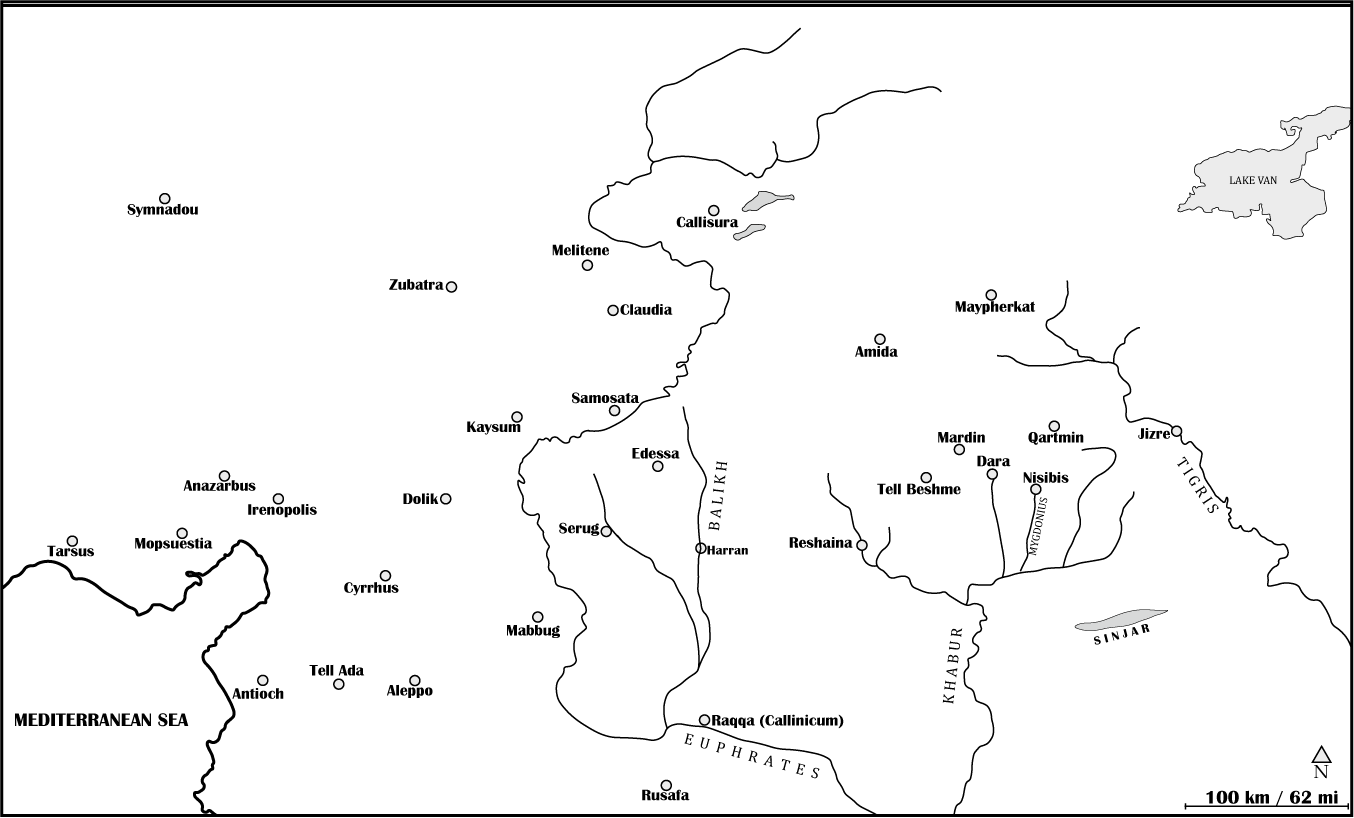
We can make a similar point about eastern Anatolia as the southern Levant: here too, the Miaphysites only retained a small number of prestigious sees such as Irenopolis, Tarsus, Anazarbus, and Melitene in districts such as Isauria, Cilicia, and Cappadocia, at least until the colonization of the Melitene region under John Sarigta by Miaphysites from further east.Footnote 43 The absence of Miaphysites in Isauria and Cilicia is worth stressing because this region had produced a major intra-Miaphysite schismatic group, the Tritheists, in the late 6th century, which was led by two figures from this region, Conon of Tarsus and Eugenius of Seleucia.Footnote 44 Exactly how Miaphysitism disappeared from much of this region is obscure: did internal Miaphysite divisions make conversion to Chalcedonianism more likely? Or was this an area where Chalcedonians persecuted Miaphysites, as is implied by a seventh narrative preserved in Michael the Syrian?Footnote 45 Or was settlement in this area particularly devastated because it lay directly on or near the Arab-Byzantine frontier?Footnote 46
However, we explain this decline, it is still worth noting that elements of a Miaphysite hierarchy did survive in eastern Anatolia and probably had a continuous history going back to the 6th century. In spite of the well-attested development of Syriac as a language of theology and liturgy in Miaphysite circles in the 6th and 7th centuries,Footnote 47 I would still assume that Christian populations in Melitene (for instance) would have been mostly Greek-speaking into the 9th century.Footnote 48 On the other hand, the Miaphysite presence in western Anatolia, Constantinople, and the Aegean, which is attested in John of Ephesus’ writings in the late 6th century, was entirely eliminated. The one partial exception is a Miaphysite see in Bithynia, whose last incumbent was elected 910–922.Footnote 49 The origins of this population in Bithynia are unclear: its existence corresponds to a lacuna in the historical narrative. Perhaps they were a merchant community that was established in the late 9th century but eventually assimilated into the Chalcedonian population? Or perhaps they were the descendants of earlier deportees, who were periodically sent bishops from monasteries in Mesopotamia?Footnote 50
If Anatolia or Palestine sees a retreat to a small number of prestigious sees, we see the reverse pattern for the formerly Roman parts of Mesopotamia. Here, Miaphysite bishops are attested for places that had only been large villages or towns in the fifth century: Tur Abdin, Tell Beshme, Serug, Jizre, Dolik, Mardin, Kaysum, and Zubatra are all good examples. And if the places where the patriarchs died are a proxy for their itineraries, the patriarchs spent a great deal of time traveling between the villages of Mesopotamia, even if their official residences were in cities.
We cannot determine the changes in settlement size with precision. It may be that Zubatra in particular grew in prestige, and possibly in size as well, when it was used as a fortified muster point for the Byzantine-Arab wars by the caliph Harun al-Rashid. Having a bishop here might have been a canny political decision, which gave the patriarch access to high-ranking figures as they passed through Mesopotamia en route to the summer raids, which were an important part of the caliph’s display of authority. Kaysum was not explicitly re-founded by a caliph, but it seems to have played a similar role as a muster point: it was here that Dionysius of Tel-Mahre had his second audience with al-Ma’mun, when the caliph was preparing to go on campaign.Footnote 51
In other cases, such as Mardin and Tur Abdin, the creation of a see may be a consequence of the flight of Miaphysite monks during the Chalcedonian persecutions of the 6th century: these were highland zones where Miaphysites had been relatively shielded and where Miaphysite monasticism had an especially long history.Footnote 52 Mardin had not been a see in the fifth century, and it seems to owe its elevation to the proximity of large numbers of Miaphysite-aligned villages. And the see of Tur Abdin had no urban center at all, and its bishop was resident in the monastery of Qartmin until the see was transferred to the village of Hah in the 12th century.Footnote 53
The case of Tell Beshme, some 35 km southwest of Mardin, illustrates a third phenomenon, where a particularly influential individual, in this case the notorious patriarch Athanasius Sandalaya, was responsible for the creation of new institutions. These are not necessarily created in response to need or demand. Several bishops of Tell Beshme came from the monastery founded by Athanasius Sandalaya near Maypherkat.Footnote 54 But the narrative gives us no indication that his foundation was also an episcopal see that endured for over a century, a detail that Dionysius may have deliberately glossed over to avoid presenting Athanasius as a success. For Dionysius, Athanasius was an anti-patriarch and a key villain of his narrative. Yet under Dionysius himself, the bishop of Tell-Beshme was recruited from the monastery of Sandalaya, and the see endured until the early 10th century.Footnote 55
The elevation of smaller villages to sites of importance, as the hosts of synods or the seats of bishops, is especially visible in smaller schismatic groups. The Gubbite monks who opposed Cyriacus of Takrit (793–817) and Dionysius of Tel-Mahre (817–845) had short-lived sees at Goulia and Kumit, which are small settlements that have not been located.Footnote 56 When schism led to persecution, the result was often retreat from urban centers into the highlands and we see this pattern for the Chalcedonian persecutions of the 6th century and for the Gubbite schism of the early 9th.Footnote 57 It was only quite gradually that the Miaphysites were able to develop churches and monasteries in the vicinity of Antioch, which was a major Chalcedonian stronghold. So, although the Miaphysite west was led by a patriarch of Antioch, it was only in 723 that a Miaphysite church was built in Antioch itself,Footnote 58 and only in the early 10th century that monasteries like Tell Ada and Qourzahiel in the vicinity of Antioch regularly produced patriarchs or were the sites for their consecration.
The only major sees that were associated with the Gubbite schism were Mopsuestia in Cilicia and Bostra in the former Roman province of Arabia.Footnote 59 Both had been metropolitanates in the 6th century. But Mopsuestia is omitted from the episcopal lists, even though it continued to be a significant settlement in the Arab-Byzantine border region (al-Massisa).Footnote 60 It may be that being on the losing side of the schism caused congregations to change their affiliation by converting to other Christian confessions or Islam. Alternatively, Mopsuestia may have been punished by the removal of their representation, and the district transferred to another see.
V. Clusters of Influence and Their Geographical Distribution
Historical Network software (ORA) allows us to ask more targeted questions of our data that emerge from the narrative sources, as well as a tool for visualization. For instance, network analysis allows us to test for the degree to which individual monasteries were consistently appointed to local bishoprics.Footnote 61 This issue of the “pocket see” had been central to the dispute between Cyriacus of Takrit and Gubba Barraya in Dionysius’ narrative. There was an expectation that the metropolitan of Cyrrhus in northern Syria should be a Gubbite monk, but Gubba Barraya was heavily punished after its involvement in the schism against Cyriacus and Dionysius of Tel-Mahre. No more bishops were appointed from here after Dionysius’ reign, in spite of its earlier prestigious history.Footnote 62 Qartmin seems to have enjoyed a similar position to Gubba Barraya, and the Syriac chronicles associated with Qartmin celebrate its ability to control the nearby sees of Dara and Harran.Footnote 63
ORA allows us to determine that the situation that had occurred at Gubba Barraya, and which was celebrated at Qartmin, was not the norm. How far this might be the result of a deliberate policy decision is unclear, but even monasteries with a very large number of appointees, such as the monastery of the easterners or the mountain of Edessa, do not consistently control the same bishoprics. Qartmin continued to control a number of pocket sees in Tur Abdin, Dara, Harran, and Nisibis, but it is an exception to the general pattern in the Miaphysite west.Footnote 64 If Qartmin had a particularly powerful network of support, this might help to explain why it did not meet the same fate as Gubba Barraya, even though the anti-patriarch Abraham, the final leader of the Gubbite schism, was actually a monk of Qartmin (a fact that Dionysius tends to gloss over in his narrative). Certainly, Qartmin has the highest number of appointees across the period of 800–1042 as a whole.
ORA also allows users to identify clusters within the network, by progressively removing peripheral links from the network (the Girvan-Newman method, which generates Newman clusters).Footnote 65 A surprising result of this analysis is that the clusters of bishops and monasteries are not geographically discrete. I had expected to see clusters around topography, or grouped around important monasteries or cities, but for each of the phases, the Newman clusters are overlaid on top of one another.Footnote 66 In other words, there are not obvious candidates for secession from the network, where a major see attempted to declare independence along with a local cluster of smaller sees and monasteries. Such declarations would occur in the future, when independent patriarchs established themselves in the late medieval and early modern periods in Amida (Church of the East) and Melitene, Mardin, and Salah (Miaphysites). The relative resilience of the patriarchate to this kind of secession might be explained by the absence of geographically segregated clusters: powerful monasteries had links to cities across the patriarchate as a whole, and significant cities recruited their bishops from a range of important monasteries. It is hard to tell whether this was a deliberate decision by the patriarch and his advisors to diversify the election to a given see between monasteries, or whether this was an organic effect, where numerous monasteries were capable of recruiting or educating candidates who were desirable as bishops and were all given a role.
In abstract models, networks that are expanding tend to recruit new nodes that are attached to nodes that already have large numbers of links. In other words, nodes that are already central become extremely central over time.Footnote 67 But it is noteworthy that we do not see this pattern in the consecration lists. Partly, this may be the result of changing patterns of patronage. But while political patronage does seem to determine the choice of patriarch, and the existence of a small group of dominant monasteries, a large number of minor monasteries are present in the lists at every phase. Collectively, they produce many more bishops than famous examples like Qartmin or Mar Zakkai. In a similar vein, we do not see the patriarch’s own monastery dominate consecrations (with the short-lived exception of Tarel, mentioned above). Again, it is hard to determine if this shows deliberate restraint by the patriarch and powerful monasteries, in order to share opportunities more widely, or a meritocratic recognition that talent or influence was indeed widely distributed.
Phase I: 800-876

Phase II: 876-910.

Phase III: 910-965.

Phase IV: 965-1030.

Syriac Orthodox Sees in the 9th and 10th Centuries (figure by Greg Fisher).

VI. Conclusions
The network relationships between bishoprics and monasteries in the Miaphysite episcopal lists have provided a number of significant findings. It has suggested the existence of a moment of Hamdanid patronage of the Miaphysite patriarch, but it also showed that the church had a “natural” center of gravity in Mesopotamia in spite of the changing origins of the patriarch. I have also argued that the move to Melitene in the 10th century was neither an inevitability generated by earlier investment, nor the result of Byzantine policy, but partly the result of push factors of persecution in Takrit and warfare in Antioch. At several points, we have been able to set the historians’ narrative against the patterns shown in the lists, to observe, for instance, that Qartmin’s control of a group of pocket sees was exceptional, and that most monasteries were not permitted to develop this kind of portfolio.
Both the methods and the data used in this article have much more potential than I have been able to explore here. The consecration lists in Michael the Syrian’s appendix extend up to the 12th century, and medieval Syriac narratives of Michael, Bar Hebraeus, and the Chronicle to 1234 could be usefully compared to the information contained there. Similarly, historians familiar with the political events of the Seljuk invasions and the Crusades could usefully examine the changing distribution of bishoprics and their changing relationships to monasteries to see how patronage and/or persecution affected the Miaphysite community, and how many of the patterns charted here continued into a later period. The onomastic patterns of the bishops might also benefit from closer study.
Network analysis offers many possibilities, whether using ORA or other software such Pajek or R. In church history, there have already been interesting studies of the epistolary networks of Theodoret of CyrrhusFootnote 68 and other late antique bishops,Footnote 69 though these “ego-networks” require different forms of analysis to that employed here. But ORA can also be usefully employed to visualize itineraries, or the different kinds of links enjoyed by actors in a narrative history. Much of the strength of these methods is to identify patterns that are hard to spot in review, such as clustering, but they must always supplement a close reading of the available sources.
Network analysis identifies a raw pattern, but this still demands interpretation and explanation. The challenge for the lists examined here has often been that they lack an immediate context, and this can mean that the data generates more questions than answers. Nevertheless, turning points emerge in the chronology from the shifts in the monasteries able to elect a patriarch and from the monasteries able to dominate episcopal elections, and these shifts are often, but not always, correlated with changes in political geography. These correlations underscore the need to integrate church history into the political history of the caliphate and its successor states. Just as historians have increasingly recognized that for Jewish history, the study of “(power) minorities” requires the juxtaposition of two sets of sources, those of the minority itself and those of their political context.Footnote 70 Doing so will enrich the historiography of both.