1. Introduction
Surface sculpture (sensu Whittington & Wilmot, Reference Whittington, Wilmot and Kaessler1997) on the cuticle of adult trilobites may be composed of a great variety of structures (e.g. tubercles, spines, pits, ridges). Pustules alone may be of various sizes, ranging from tiny tubercles to long spines. They can vary in internal structure (e.g. Fortey & Clarkson, Reference Fortey and Clarkson1976; Størmer, Reference Størmer1980), be randomly dispersed or have a well-organized distribution. This diversity in size, shape, structure or distribution, along with their common occurrence, encouraged authors to consider pustules as fundamental features in long-lasting debates concerning such topics as the segmentation of the trilobite body (e.g. Whittington, Reference Whittington1956a, p. 182), the sensory organ apparatus (Fortey & Clarkson, Reference Fortey and Clarkson1976; Wilmot, Reference Wilmot1991) or the mode of life of spiny trilobites (e.g. Whittington & Evitt, Reference Whittington and Evitt1954; Whittington, Reference Whittington1956b; Hammann & Rabano, Reference Hammann and Rabano1987). However, the occurrence and distribution of dorsal tubercles/spines in adults has proved to be inconstant within many trilobite clades, which led to their usefulness being questioned in systematics.
The adults of most Devonian otarionines display rather simple surface sculpture, composed of more or less heterogeneously disposed tubercles. In addition, some species possess spines on the glabella and on the cephalic border. Whether or not these features should be regarded as diagnostic at the generic or subgeneric level remains a matter of debate. With the exception of Přibyl & Vaněk (Reference Přibyl and Vaněk1981, p. 173) and Basse (1997, p. 199), who did not consider cephalic border spines to have a high taxonomic value, most authors (e.g. Přibyl, Reference Přibyl1947; Prantl & Přibyl, Reference Prantl and Přibyl1950; Erben, Reference Erben1952; Lütke, Reference Lütke1961, Reference Lütke1965; Alberti, Reference Alberti1967, Reference Alberti1969, Reference Alberti1970, Reference Alberti1983; Chatterton, Johnson & Campbell, Reference Chatterton, Johnson and Campbell1979; Ellermann, Reference Ellermann1992; Schraut, Reference Schraut2000) accepted the concept of Otarionella Weyer, Reference Weyer1965, as including all aulacopleurid species with border spines in holaspides, regardless of other morphological features. However, it soon became evident that in characters other than spinosity, Otarionella comprises some species close to Otarion Zenker, Reference Zenker1833, such as Cyphaspis coronatum Barrande, Reference Barrande1872, Otarion (Coignouina) stephanum Lütke, Reference Lütke1961, Otarion (Otarionella) tafilaltense Alberti, Reference Alberti1967, and many others that are nearer to Cyphaspis Burmeister, Reference Burmeister1843, including Otarion (Otarionella) magnificum Alberti, Reference Alberti1967, Otarion (Otarionella?) sidiarounium Alberti, Reference Alberti1969, Otarion (Otarionella) proavus Alberti, Reference Alberti1970, and Otarion (Otarionella) longispinosus Ellermann, Reference Ellermann1992. Notwithstanding Otarionella being admittedly polyphyletic (Alberti, Reference Alberti1969, p. 378; Thomas & Owens, Reference Thomas and Owens1978; Lütke, Reference Lütke1980, p. 115), it has been used as a convenient ‘basket taxon’ for aulacopleurids with cephalic border spines.
The early appearance during ontogeny of a sculptural feature is considered to be a major criterion to suspect its potential utility for discriminating high taxonomic levels. If a feature occurs in a constant and precise location (or in the same relative positions, if several structures are involved), this precocious appearance suggests that the structure develops under a strong genetic control and thus is prone to evolve under natural selection. In the case of major cephalic dorsal spines/tubercles, this assumption is reinforced by the fact that their distribution likely reflects, at least to some extent, the segmentation of the head (e.g. Whittington, Reference Whittington1956a). Adrain & Chatterton (Reference Adrain and Chatterton1994) were the first to recognize the potential usefulness of juvenile cranidial spines in the systematics of the Otarioninae. Using variations in number and/or distribution of fixigenal, glabellar, and palpebral spines in early meraspides, they identified three cephalic spine patterns in the Otarioninae. One of these appeared to be restricted to Otarion and Cyphaspis, thus enabling Adrain & Chatterton (Reference Adrain and Chatterton1994) to define a new tribe, the Otarionini. These authors also showed that early meraspides of otarionines usually display cephalic border spines. These progressively reduce during ontogeny until they can no longer be discriminated in adult individuals of most species. Accordingly, they regarded the persistence of such spines in holaspides as a simple paedomorphic trait, probably acquired independently in several lineages. This led them to consider Otarionella a subjective junior synonym of Otarion.
However, no early development of an otarionine with a spinose adult morphology was hitherto known. One such growth sequence is described here for the first time, belonging to a new taxon, Otarionella rastrum sp. nov., which belongs to a group of species centred on the type of Otarionella, O. davidsoni (Barrande, Reference Barrande1852). As such, it is regarded as representative of the ontogenetic development of this group. In the light of the new information provided by this ontogenetic sequence, and by adult specimens of O. rastrum sp. nov. and O. lkomalii sp. nov., the putative synonymy of Otarionella and Otarion is reconsidered.
2. Localities, environment and age
This contribution is the fourth describing silicified trilobites from the early to late Emsian Bissounel Formation, Montagne Noire, Southern France (Feist, Reference Feist1970a; R. Feist, unpub. Ph.D. thesis, Univ. Montpellier II, 1977; Lerosey-Aubril, Reference Lerosey-Aubril2007). The new material comprises silicified early growth stages (metaprotaspides to early holaspides) from this formation and calcareous holaspides from the overlying late Emsian Mont Peyroux Formation. Associated early growth stages of Cyphaspis are figured and discussed for comparison.
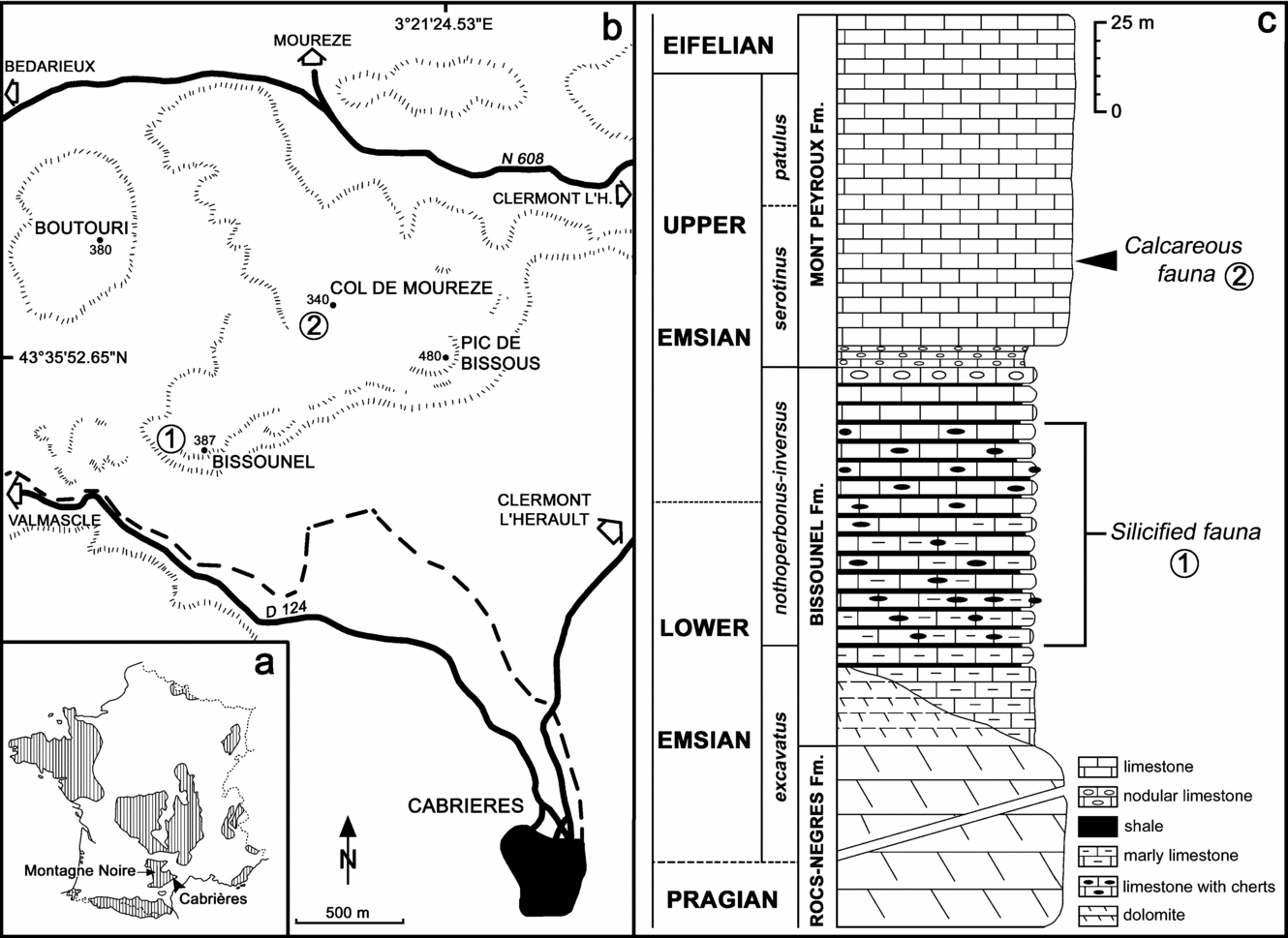
The silicified growth stages of O. rastrum sp. nov. were recovered from the type locality of the Bissounel Formation (Feist, Reference Feist1985) situated on the northwestern slope of Bissounel Hill (‘Vissounel’ on topographical maps), 2.8 km NW of Cabrières, Montagne Noire, southern France (Fig. 1). At this locality, the lowest of the three members of the 100 m thick Bissounel Formation is characterized by well-bedded, grey marly limestones. Faunas comprising Anetoceras, asteropygine and phacopine trilobites and the conodonts Polygnathus dehiscens and P. gronbergi indicate an early Emsian age (Feist, Reference Feist1970b). The middle member comprises ochre-brown marls and grey or grey-brown limestone beds which are sometimes marly and more often microsparitic. They contain numerous chert lenses and ribbons as well as large silicified cup-shaped tabulate or stromatoporoid colonies (‘calcaires à polypiers siliceux’, auct.). Environmental conditions are interpreted to have been rather clear and shallow waters, subject to tidal and wave action, rich in oxygen and nourishment. Among organisms present, reef-builders form extended biostromal lenses within dense growths of crinoids and bryozoans. A few brachiopods, and rugose corals such as Calceola sandalina, occur. Siliceous diagenetic processes not only affected macrofaunas but also thin-shelled dacryoconarids, ostracods (Feist & Groos-Uffenorde, Reference Feist and Groos-Uffenorde1979) and bryozoans (Bigey & Feist, Reference Bigey and Feist1976), as well as growth stages of chonetid brachiopods, bivalves, and trilobites. The prevalence of spinose and sculptured shells is striking. Conodonts are absent and the age of this interval can be assigned only approximately to an undifferentiated nothoperbonus–inversus interval (passage from early to late Emsian). The upper member consists of grey-brown crinoidal chert-less limestones. Index conodonts, such as Polygnathus laticostatus, indicate the inversus Biozone, basal late Emsian.
Location of silicified and calcareous trilobite beds. (a) Location of Cabrières area in the southeastern Montagne Noire, southern France (vertical hatch lines indicate pre-Mesozoic massifs). (b) Location of sites in the Devonian Pic de Bissous mountain range north of Cabrières village, 8 km SW of Clermont-l'Hérault township. Site 1, western slope of Bissounel peak. Site 2, southwestern vicinity of hill 340 at Col de Mourèze, WNW of Bissous peak. (c) Vertical section through the Bissounel and Mont Peyroux formations showing silicified faunas (site 1) and calcareous faunas (site 2).

The Bissounel Formation is overlain by the lower member of the Mont Peyroux Formation, which consists of massive, micritic, light-grey and red-speckled limestone forming the top of Bissounel Hill, Pic de Bissous and Hill 340 at Col de Mourèze (Fig. 1). Rich accumulations of trilobites of Bohemian type occur in places. Rare conodonts indicate a serotinus Zone age, early late Emsian (Feist, Schönlaub & Bultynck, Reference Feist, Schönlaub and Bultynck1985).
The silicified growth stages of Otarionella that were recovered from the middle member of the Bissounel Formation are uppermost early Emsian through lowermost late Emsian in age, and as such they are slightly older than the limestone material of O. rastrum sp. nov. from the overlying Mont Peyroux Formation (early late Emsian). The comparison of early holaspides from both levels revealed no diagnostically significant differences. Accordingly, both sets of material are attributed to the same species.
No articulated specimens have been found in the Montagne Noire. The first complete carapaces of an otarionine with anterior border spines were figured by Basse (1997, plate 11, figs 10, 11), who assigned them to Cyphaspis chamaeleo Basse, Reference Basse1997; these are refigured here for comparison. They come from the higher part of Ohle Formation (middle Eifelian) of Endorf, western Sauerland region, eastern Rhenish Slate Mountains, Germany.
The Moroccan species Otarionella lkomalii sp. nov. is a rare component of the trilobite fauna in a bed known locally as the ‘Ceratarges Couche’, which crops out near the base of a section located close to Jbel Zireg at the south end of the Maider Basin. It has been mined commercially for some distance along strike for its trilobite fauna, which includes species of Ceratarges, Cornuproetus, Cyphaspis, Gerastos, Otarionella, Phacops, Radiaspis (very rare), Thysanopeltis and a large styginid. The trilobites from this bed and those from another also mined for trilobites lying 27 m above in the same section, the ‘Thysanopeltis Couche’ which contains Cornuproetus, Gerastos, Leonaspis, Phacops and Thysanopeltis, suggest an Eifelian age. The strata that form the part of the section at this locality consist of fairly pure limestone. They are largely micritic, and contain a fauna suggestive of deposition on an open marine shelf. Other fossils include crinoids and the trace fossil Chondrites. Kaufmann (1998, fig. 5) showed that the Jbel Zireg region was located in a region of platformal or basin margin neritic facies (fossiliferous limestones) on the south side of the Maider Basin during the Eifelian costatus Zone.
Hollard (1974, fig. 4) presented a stratigraphic column through some of the Devonian strata of Jbel Zireg. His section is located on the other limb of the same anticline as the locality that yielded the species described herein. There is a problem in applying formation names to the limestone and shale rock units of Middle Devonian age in this part of Morocco. Many were defined rather loosely by Hollard (Reference Hollard1974) and vary so much lithologically that they seem to have been as much based on age as on lithology. In more recent publications, these names have been applied to stratigraphic sections in a rather inconsistent fashion, with formational boundaries sometimes drawn in the middle of comparatively uniform sequences of strata. The boundary between the El Otfal Formation and the Taboumakhloûf Formation (Hollard, Reference Hollard1974, pp. 46, 49, fig. 4) is particularly problematic. These are the two formational names most likely to have been applied to the strata of Eifelian age in Jbel Zireg that contain O. lkomalii sp. nov. Some authors seem to have placed the boundary between these formations on the basis of age or fossil zone (the change from dm1 to dm2: e.g. Hollard, Reference Hollard1974; Kaufmann, Reference Kaufmann1998, fig. 31) rather than at a distinct, mappable change in lithology. Because of these problems of correct application of formation names in this region, some authors illustrating stratigraphic columns of Lower and Middle Devonian strata from the Maider basin have chosen to ignore formation names altogether in favour of labelling their stratigraphic columns with ages and biostratigraphic zones (usually conodont or ammonoid zones). The most likely name to be applied to the strata bearing O. lkomalii sp. nov. near Jbel Zireg is the El Otfal Formation (see Hollard, Reference Hollard1974, fig. 4; Hollard, Reference Hollard1981, table 3).
Silicified and calcareous specimens of O. rastrum sp. nov., as well as latex casts of the original material of O. chamaeleo, are housed in the Collections of Invertebrate Palaeontology of the University Montpellier II (UMC- IP490–543). The single specimen of O. lkomalii sp. nov. is deposited in the type collection of the University of Alberta (UA11821).
3. Systematic palaeontology
Terminology
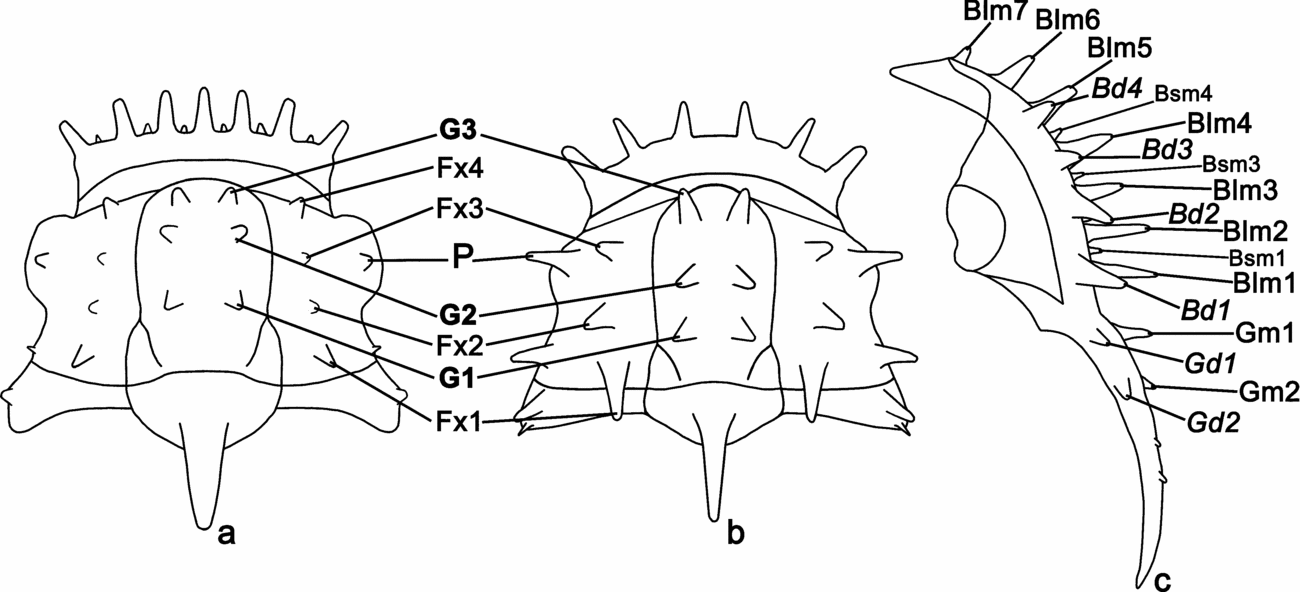
Morphological terms and abbreviations used herein follow those defined by Whittington et al. (Reference Whittington, Chatterton, Speyer, Fortey, Owens, Chang, Dean, Fortey, Jell, Laurie, Palmer, Repina, Rushton, Shergold, Clarkson, Wilmot, Kelly and Kaessler1997). Fixigenal, glabellar and palpebral spines in early growth stages have been abbreviated by respectively Fx, G and P, as introduced by Adrain & Chatterton (Reference Adrain and Chatterton1994). Additional abbreviations are: Bd – dorsal spine of the librigenal lateral border; Blm – long marginal spine of the librigenal lateral border; Bsm – short marginal spine of the librigenal lateral border; Gd – dorsal spine on the genal spine; Gm – marginal spine on the genal spine. These are summarized in Figure 5.
Order PROETIDA Fortey & Owens, Reference Fortey and Owens1975
Family aulacopleuridae Angelin, Reference Angelin1854
Subfamily otarioninae Richter & Richter, Reference Richter and Richter1926
Genus Otarionella Weyer, Reference Weyer1965
Type species
Cyphaspis davidsoni Barrande, Reference Barrande1852, Suchomasty Limestone (early late Emsian), Prague district, Czech Republic.
Diagnosis (emend.)
Cephalon like in Cyphaspis, but with two or three evenly spaced pairs of spines on median glabellar lobe, prominent and large glabellar basal lobes (L1), three fixigenal spines (Fx1–3) present in early meraspides that become reduced in holaspides, where only the posterior one usually remains; single transverse row of tubercles across the preglabellar field; anterior border of the cranidium carrying six evenly spaced spines on prominent crest, prolonged on the librigenal border by four spines, second row of spines displayed on the lower part of outer margin. Occipital spine always present. Thorax with ten segments, axial spines consistently developed on fourth and sixth segments, sometimes on second segment; pygidium small, axis at least as large as pleural field, merging with postaxial field, three to five axial rings.
Assigned species
Cyphaspis davidsoni Barrande, Reference Barrande1852, early late Emsian, Czech Republic; Otarion spinafrons Williams in Cooper & Williams, Reference Cooper and Williams1935, Givetian, USA; Otarion (Otarionella) greifensteinensis Schraut, Reference Schraut2000, basal Eifelian, Germany; Cyphaspis chamaeleo Basse, Reference Basse1997, middle Eifelian, Germany; Otarionella lkomalii sp. nov., early Eifelian, Morocco; Otarionella rastrum sp. nov., early late Emsian, France. Tentatively assigned: ?Cyphaspis stephanophora Hall in Hall & Clarke, Reference Hall and Clarke1888, Eifelian, USA; ?Otarion (Otarionella) bensaidi Alberti, Reference Alberti1983, basal Eifelian, Morocco.
Otarionella rastrum sp. nov.
Figures 2a–y, 3a–cc
Remarks
This taxon was informally introduced in the unpublished thesis of R. Feist (Univ. Montpellier II, 1977) and incorrectly cited in Basse (1997, p. 122) as ‘C. rastra t.sp.’ (nom. nud., sic!).
Material
Nine cranidia, 2 librigenae, 1 pygidium in limestone preservation; 3 metaprotaspides and about 50 cranidia, 6 hypostomes, 20 librigenae, 20 transitory pygidia and pygidia silicified.
Etymology
From latin rastrum, rake, referring to the spiny margin of the cephalon.
Type locality and horizon
Hill 340 of Col de Mourèze, 2.6 km NNW of Cabrières village, Hérault, France. Lower member of the Mont Peyroux Formation (Feist, Reference Feist1985). Unbedded pink-white speckled biomicrites. Early late Emsian (Polygnathus serotinus Biozone).
Holotype
Large holaspid cranidium, UMC-IP504, Figure 2q.
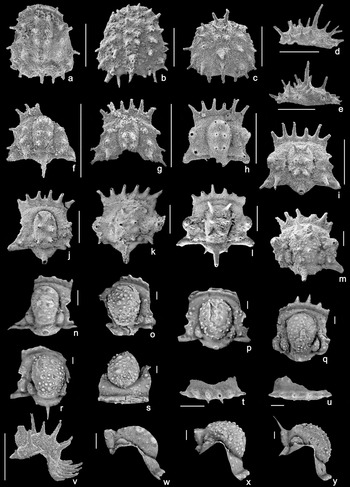
Otarionella rastrum sp. nov. (a–m, t–v) Scanning electron micrographs of silicified specimens from the middle member of the Bissounel Formation (early to late Emsian), Bissounel Peak, Montagne Noire, France. (n–s, w–y) Digital photographs of calcareous specimens from the Mont Peyroux Formation (late Emsian), Montagne Noire, France. Scale bars 0.25 mm (a–e) and 0.5 mm (f–y). (a–e) Metaprotaspides; (a) dorsal view, UMC-IP490; (b) dorsal view, UMC-IP491; (c–e) specimen with anterior border broken, UMC-IP492; (c) dorsal view; (d) left lateral view; (e) postero-lateral view. (f–r) Cranidia, dorsal views; (f) smallest meraspid specimen, UMC-IP493; (g) meraspis, UMC-IP494; (h) meraspis, UMC-IP495; (i) meraspis, UMC-IP496; (j) meraspis, UMC-IP497; (k) meraspis (?), UMC-IP498; (l) meraspis (?), UMC-IP499; (m) meraspis (?), UMC-IP500; (n) holaspis (?), UMC-IP501; (o) holaspis, UMC-IP502; (p) holaspis, UMC-IP503; (q) holotype, holaspis, UMC-IP504; (r) holaspis, UMC-IP505; (s) holaspis, anterior view, UMC-IP506. (t, u) Fragments of the anterior region, anterior views; (t) small specimen, UMC-IP507; (u) large specimen, UMC-IP508. (v–x) Right lateral views; (v) meraspis, UMC-IP496; (w) holaspis (?), UMC-501; (x) holaspis, UMC-IP502; (y) mirrored left lateral view, holaspis, UMC-IP505.

Diagnosis
Glabella short ovoidal, strongly inflated; posterior pair of glabellar spines lost in late holaspis; large, inflated L1 lobes; anterior margin transversely furrowed, two pairs of secondary marginal spinules connected to major spines by low ridges; short (sag. and exs.) occipital ring with strong spine; posterior cranidial margin spinose; anterior facial sutures parallel to axis; long and slender librigena with seven long spines (Blm1–7) on border margin and inwardly curved genal spine. Pygidium convex with high axis carrying 5+1 well-defined axial rings.
Description
Glabellar middle lobe egg-shaped (length/ width ratio = 1.31, tending to increase with age); widest (tr.) opposite γ, steadily converging behind, broadly rounded at base, highly convex in lateral view culminating shortly behind δ, strongly declining both towards the front and to the rear, overhanging preglabellar field in lateral view when occipital ring held in vertical position, provided with three equidistant and adaxially situated pairs of strong tubercles (G1–3), with G2 and G3 more prominent than G1, the latter tending to be lost in late holaspides (Fig. 2o–s, x, y); S1 very deep in anterior, shallowing towards posterior, as wide (tr.) as adjacent portion of axial furrow; S2 not discernible; L1 rather prominent, protruding laterally, strongly inflated, pear-shaped with pointed anterior ends extending as far forward as the posterior part of the palpebral lobe; axial furrows broad and deep, slightly divergent rearwards; preglabellar furrow shallow and overhung by anterior half of glabella, with a tiny axial pit on some specimens (not visible on fig. 2s); preglabellar field narrow (sag.), no longer than occipital ring, vaulted sagittally, convex adjacent to preglabellar furrow, merging with broad, steep-sided border furrow of transversely even breadth, provided with a row of coarse tubercles that runs transversely in parallel with the preglabellar furrow (e.g. fig. 2o); anterior border modestly curved transversely, evenly arched in frontal view, carrying prominent crest, semicylindrical in section, sharply raised against border furrow, provided with strong, evenly spaced spines of moderate length, horizontally outstretched when occipital ring in vertical position, separated from outer, anterior part of border by transverse furrow (fig. 2s, u); anterior outer part of anterior border below border furrow forming sharp, slightly protruding edge provided with two pairs of small spines, the medial pair being thicker than the external one, all situated opposite and below main spines on the crest, adaxial ones being connected to the latter by a shallow ridge that interrupts the transverse furrow; occipital furrow forming a shallow transverse depression that remains of constant length (sag., exs.) between basal glabellar lobes, behind which it narrows and deepens considerably before merging with both axial and posterior border furrows; occipital ring as long (sag.) as occipital furrow, modestly narrowing laterally, transversely narrower than basal glabella, moderately vaulted (sag., exs.), carrying a median spine of length equal (sag.) to L1 (exs.), and a prominent tubercle on each side at half distance between medial spine and distal end of occipital ring; fixigenae between glabella and palpebral lobe moderately inclined towards axial furrow and as large (tr.) as L1, arched both transversely and from front to rear, sloping less posteriorly than anteriorly, carrying a strong tubercle (Fx1) in middle of posterior fixigenal field (e.g. fig. 2y); anterior branches of facial sutures straight, parallel to axis; posterior branches subparallel in their anterior halves, turning gently outwards posteriorly; palpebral lobe small, upraised, carrying a single tubercle; posterior border semicylindrical in section, slightly flexed backwards and broadening externally, provided with nodes on its inner third and near to the suture.
Librigena with base of genal spine inwardly curved at genal angle, longer (exsag.) than cranidium (fig. 3h, i); genal field modestly vaulted carrying strong widely spaced tubercles; eye ovoid, upraised, sitting on swollen, unornamented platform that extends forwards and backwards; lateral border furrow wide, concave, merging with librigenal field, more sharply delimited against upturned lateral border, interrupted before reaching genal angle by bridge-like swelling that links the librigenal field with border; posterior border furrow enlarged, without defined groove or pit; lateral border robust, cylindrical, as wide as abaxial part of posterior border and base of genal spine, carrying four thick upraised dorsal spines (Bd1–4) and, below them, seven downwards directed, long marginal spines (Blm1–7).
No adult thoracic segment known. Pygidium with narrow parabolic posterior outline (length/width ratio: 0.5, excluding articulating half-ring); axis high, slightly flat-topped, evenly arched from front to rear in side view, 1.2 times wider (tr.) than pleural field, with 5+1 rings, the three anterior ones inflated and clearly separated by straight inter-ring furrows that become shallower from front to rear, remnant articulating half-ring developed on second ring (fig. 3z, cc); axial furrows straight, moderately converging, very deep at second and third ring but shallowing behind to merge with inflated postaxial field; fulcrum at one-third of way out from axial furrow; inner, horizontal inner part of pleural field separated from deeply inclined outer part by sudden break in slope that corresponds to the fulcral line; three pleurae, flexed at fulcral line, differentiated into narrower anterior bands and slightly broader and higher posterior ones, both separated by deep pleural furrows that suddenly terminate towards edge of pleural field; interpleural furrows weaker and narrower than pleural furrows but extending to margin where they are slightly backwardly-curving; postero-lateral margin without border. Sculpture: besides spines and prominent tubercles, smaller drop-like granules are present on glabellar and occipital lobes, fixigenae, axial rings and pleural bands (where they are coarser on fulcral line); cephalic borders with finer granules; anterior preglabellar field, external part of librigenal field and border furrows densely pitted.
Comparisons
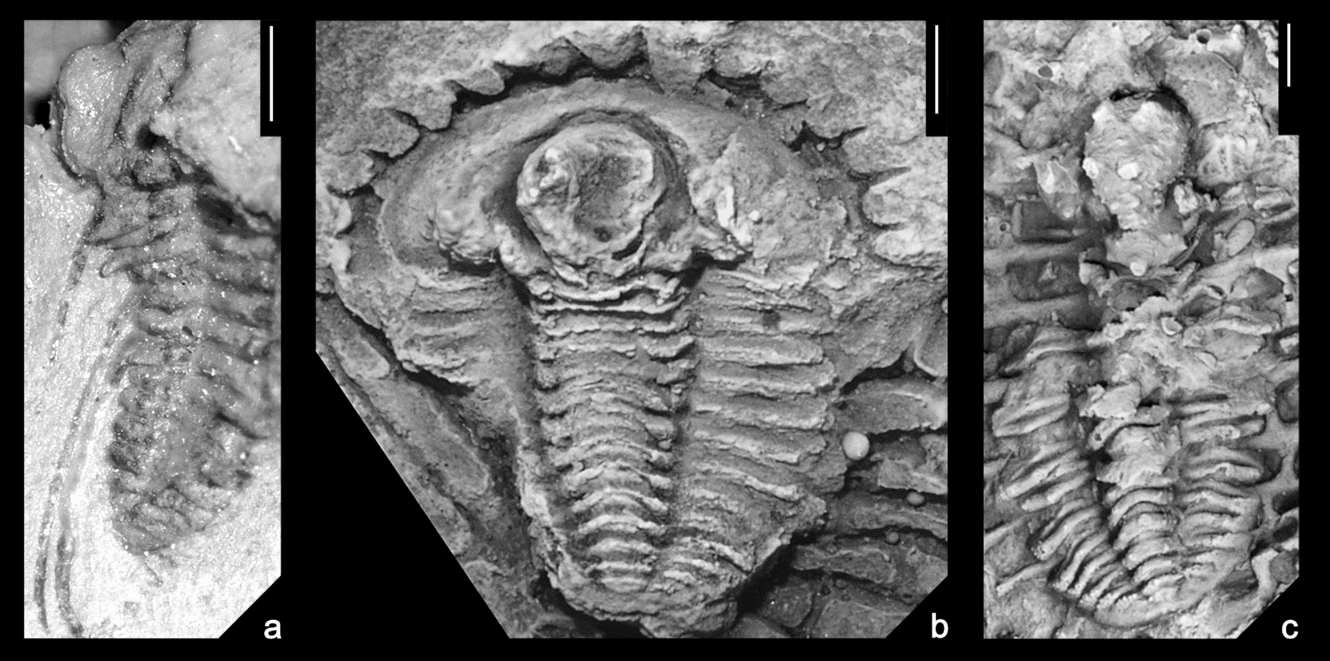
The new species shares with the approximately contemporaneous O. davidsoni the general outline and convexity of the cephalon and the glabella but differs from it in the larger and more inflated L1 that are closer to each other, the shorter (sag.) occipital lobe and the much longer librigenal spines. It is more closely related to the slightly younger O. greifensteinensis. However, the latter has a more elongated glabella with a greater length/width ratio, a steeper frontal slope and the culmination of longitudinal convexity situated further forwards. O. rastrum sp. nov. resembles O. spinafrons from the late Middle Devonian from the Tully Limestone, especially in the distribution of spines on the glabella and the margins; however, the latter has a less convex glabella, denser tuberculation and larger, triangular, more forwardly extended L1. Unfortunately no pygidia are known from these species. Two entire exoskeletons of O. chamaeleo (Basse, Reference Basse1997 and refigured herein, Fig. 4a–c) are known. Whereas the cephalic features of this species and O. rastrum sp. nov. are largely identical (excepting the shorter occipital ring and preglabellar field, the parallel anterior facial sutures and the longer librigenal spine in the latter), the pygidia are distinct, mainly in the longer axis with more differentiated rings, the narrower pleural field and the longer interpleural furrows that characterize O. rastrum sp. nov.
O. rastrum sp. nov. differs from the early Eifelian O. lkomalii sp. nov (Fig. 6a–f), also known from an entire exoskeleton, in the following characteristics: the L1 lobes are smaller and more triangular (anteriorly pointed) in shape; the frontal lobe does not overhang the preglabellar furrow and preglabellar field to such an extent; the occipital furrow is shorter (sag. and exs.) and does not widen as much adjacent to the adaxial side of L1; the occipital spine is relatively finer and perhaps longer; there is a distinct pair of spines on the posterior margin of the occipital ring, about half-way between the occipital spine and the axial furrows; the preglabellar field is longer (sag.); the cephalic border is narrower (sag.); the palpebral lobe lacks a medial pit, distal to a distinct palpebral tubercle; Fx1 is distinct; the genal spines are longer and more curved; the pygidium is more elongate (sag.).
Ontogeny
Anaprotaspis unknown. Three metaprotaspid specimens (Fig. 2a–e) are confidently assigned to Otarionella rastrum sp. nov. because of the great similarity of their protocranidia to the smallest cranidia of this species, in particular regarding the cephalic spine pattern. These three specimens may represent a single metaprotaspid stage. It is slightly elongate, 0.418–0.441 mm in sagittal length and 0.378–0.411 mm in maximum width (tr.); glabella rounded antero-medially, and reaching anterior border furrow; axial furrows rather deep except adjacent to the posterior preoccipital glabella where they shallow; preglabellar furrow faint; no glabellar furrows discernible; occipital furrow broad and shallow; occipital ring narrow (tr.); anterior border furrow faint and backwardly curved abaxially; anterior border moderately inflated; facial suture slightly diverging backwards; palpebral lobes poorly differentiated; no eye ridges and posterior border furrow discernible at this stage; junction between the protocranidium and the protopygidium marked by a shallow and broad furrow that strongly curves backwards abaxially. Protopygidium short (sag. and exs.) with a medially re-entrant posterior margin; axial furrows rather deep; axis almost reaching posterior margin and comprising two rings, well separated by a rather deep inter-ring furrow; no pleural or interpleural furrows visible. In lateral view, larvae slightly and almost symmetrically vaulted; axial lobe moderately inflated (fig. 2d). Sculpture: G1–G3 sharp and evenly spaced, decreasing in length from front to rear (fig. 2d); median occipital spine robust and long (fig. 2d, e); Fx1–3 projecting dorsally, with Fx1, Fx2 and Fx3 located roughly opposite to middle distance between occipital spine/G1, G1/G2 and G2/G3 respectively; P1 and another spine are present near lateral margins, with P1 located opposite Fx3 and the other spine roughly opposite to G1; two additional spines located in postero-lateral corner of protocranidium; six aligned and evenly spaced anterior border spines that project dorsally and slightly forwards. The first protopygidial segment bears a short axial spine and is probably represented laterally by a pair of pleural spines; the second protopygidal segment displays a larger and longer axial spine but it likely bears a single pleural spine only. Librigena and hypostome unknown.
The smallest cranidium (fig. 2f) is only slightly larger than protocranidia and accordingly may represent the first meraspid stage. Although the two stages are very similar, a few shape changes can be described: relative overall width (tr.) slightly increases; axial, occipital and anterior border furrows deepen and narrow; palpebral lobes widen (tr.); appearance of faint and backwardly curved S1, faint eye ridges, and posterior border furrows that are straight adaxially, but strongly curved forwards abaxially; convexity of posterior occipital margin increases; posterior branch of facial suture becomes outwardly curved and more divergent backwards; the more posterior of the two postero-lateral corner spines shortens significantly while the other becomes more robust and appears to be located on the posterior border of the cranidium (fig. 5b).
From this early meraspid stage to the more advanced holaspides, the following shape changes can be observed (Fig. 2g–r): glabella significantly widens (tr.), in particular posteriorly, where L1 greatly widens (tr.) at the expense of the posterior fixigenal field; axial furrows remain rather wide throughout ontogeny but they deepen strongly and increasingly diverge backwards; preglabellar furrow slightly deepens, with a tiny axial pit appearing in some holaspid specimens; S1 significantly deepens in late meraspides, especially in its anterior two-thirds; occipital furrow remains rather large but deepens strongly throughout ontogeny; occipital ring widens (tr.) and shortens (sag.); preglabellar field rapidly appears and broadens (sag.), only moderately narrowing in late ontogeny; anterior border furrow deepens moderately and rapidly straightens along with the anterior border in earliest meraspides; backward convergence of anterior sutures first increases then decreases; ε–ω (posterior suture) initially straightens until the appearance of ζ, then ε–ζ and ζ–ω respectively decreasingly and increasingly diverge backwards; palpebral lobes widen (tr.) in early ontogeny; eye ridges rapidly vanish; posterior border furrow deepens slightly and narrows. In lateral view (Fig. 2v–y), glabella significantly inflates dorsally and towards anterior, becoming bulbous and overhanging the preglabellar field in late holaspid stages; occipital ring decreases in height while palpebral lobes elevate. Sculpture evolves as follows: G1–3 initially increasing (Fig. 2g–l) then decreasing in length (Fig. 2m–r) until G2 and G3 represented by no more than strong tubercles while G1 almost completely vanish (Fig. 2r); occipital spine decreases in relative diameter and length; a sharp but tiny marginal spine appears on either side of the occipital spine in late meraspid stages (Fig. 2l), at about middle distance between occipital spine and axial furrows, then it decreases in length to become no more than a prominent tubercle (e.g. Fig. 2m, p, r); Fx2 and Fx3 rapidly vanish during early meraspid period (Fig. 2g–j) while Fx1, though decreasing in length, persists in holaspid stages in the form of a strong tubercle (e.g. Fig. 2r); likewise, P1 shortens, representing no more than a tubercle in the adults; the second lateral marginal spine visible on smallest specimens rapidly vanishes; posterior border spine decreases in length but persists in the form of a tubercle in largest holaspides, and an additional small tubercle appears on the inner third (tr.) of the posterior border in late ontogeny; the six anterior border spines shorten and become more forwardly directed; two small marginal spines appear below the median pair of major border spines in late meraspid stages (Fig. 2t), then they shorten while another tiny marginal spine appears on both sides in largest holaspides (Fig. 2s, u); numerous coarse tubercles appear on the glabella in late ontogeny while some rare ones appear on the fixigena near γ and along the preglabellar furrow.
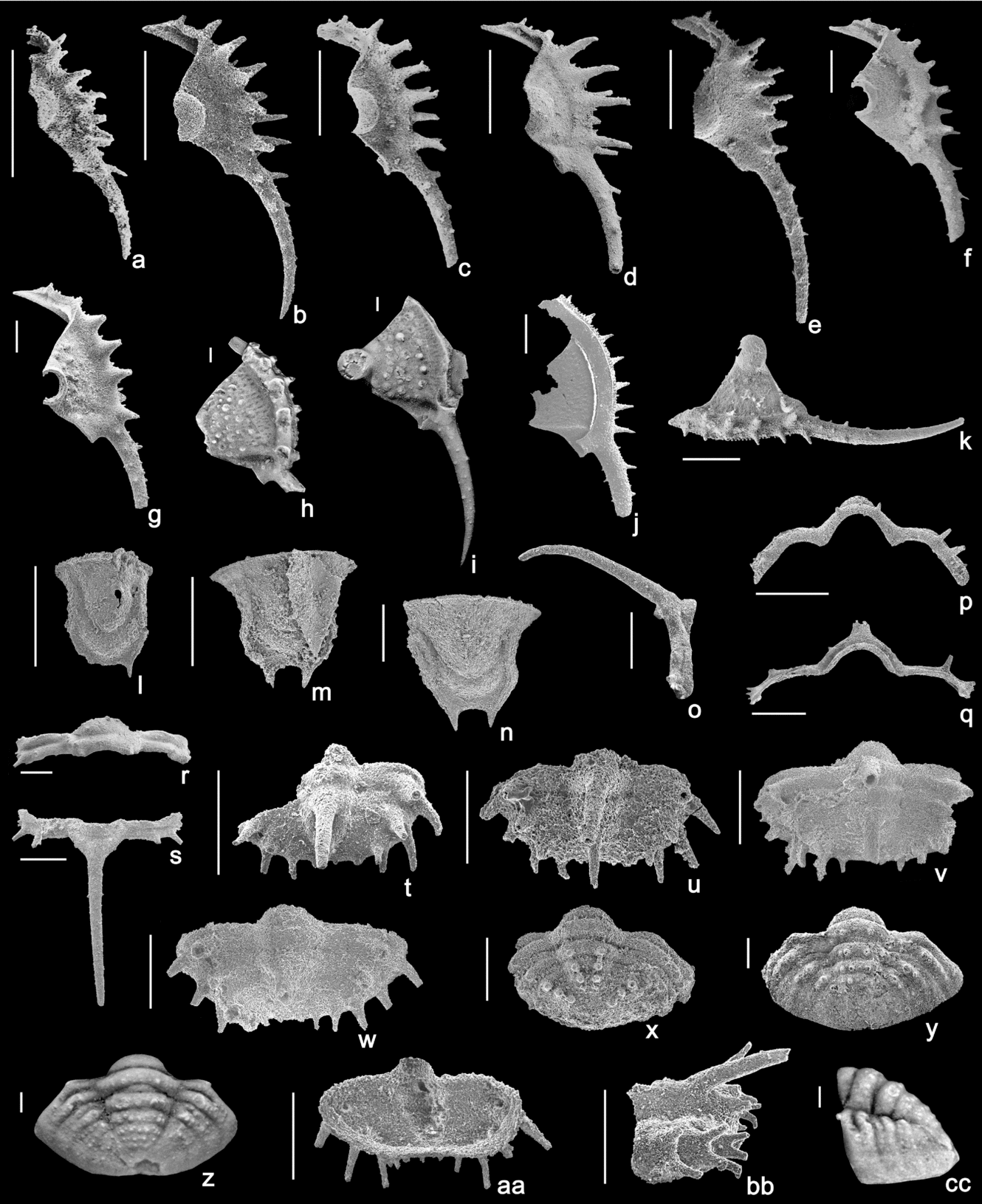
The smallest librigena found (Fig. 3a) exhibits the following features: large kidney-shaped eye; librigenal field especially narrow (tr.) and poorly separated from a lateral border of equal width (tr.) by a break in slope; genal spine robust, rather long, and curved inwards and backwards; posterior border short (tr.) but wide (exs.), poorly separated from genal field by faint and shallow posterior border furrow. Doublure bearing a single terrace ridge that separates horizontal abaxial third from almost vertical, adaxial two-thirds. In lateral view, eye high and lateral border slightly inflated representing respectively about 50% and 40% of the maximum height of the librigena. Sculpture: two rows of spines occur on the lateral border. First row composed of four robust and long spines (numbered Bd 1–4 forwards), projecting dorsally and laterally. Second row composed of seven long (numbered Blm1–7 forwards) and four short (numbered Bsm1–4 forwards) marginal spines, projecting ventrally and laterally; Blm1 and Blm2 located between respectively genal spine/Bd1 and Bd1/Bd2 in dorsal view; Blm3, Blm4, and Blm5 located opposite respectively Bd2, Bd3 and Bd4 ventrally; Bsm1, Bsm2, Bsm3 and Bsm4 intercalated between respectively Blm1/Blm2, Blm2/Blm3, Blm3/Blm4 and Blm4/Blm5; Blm6 and slightly shorter Blm7 located near respectively β and α turning points of the facial suture. First and second rows are prolonged on the genal spine by respectively two dorsal (numbered Gd1–2 backwards) and one marginal (Gm1) spines.
Otarionella rastrum sp. nov. (a–g, j–y, aa, bb) Scanning electron micrographs of silicified specimens from the middle member of the Bissounel Formation (early to late Emsian), Bissounel Peak, Montagne Noire, France. (h, i, z, cc) Digital photographs of calcareous specimens from the Mont Peyroux Formation (late Emsian), Montagne Noire, France. Scale bars 0.5 mm (a–s) and 0.25 mm (t–cc). (a–g) Librigenae, dorsal views; (a) smallest meraspid specimen, UMC-IP509; (b) meraspis, UMC-IP510; (c) meraspis (mirrored), UMC-IP511; (d) meraspis, UMC-IP512; (e) meraspis (?), UMC-IP513; (f) meraspis (?) (mirrored), UMC-IP514; (g) holaspis (?) (mirrored), UMC-IP515. (h, i) Librigenae, dorso-lateral views; (h) holaspis with genal spine broken, UMC-IP516; (i) holaspis with lateral border broken (mirrored), UMC-IP517. (j) Right librigena, ventral view (mirrored), UMC-IP518. (k) Left librigena (note the three rows of lateral border spines), lateral view, UMC-IP519. (l–n) Hypostomes, ventral views; (l) UMC-IP520; (m) UMC-IP521; (n) UMC-IP522. (o–s) Thoracic segments with (o, q, s) or without (p, r) an axial spine; (o) right lateral view, UMC-IP523; (p) posterior view, UMC-IP524; (q) anterior view, UMC-IP525; (r) dorsal view (front to the top), UMC-IP526; (s) dorsal view (front to the top), UMC-IP527. (t–z) Transitory pygidia and pygidia, dorsal views; (t) meraspid degree 2, UMC-IP528; (u) meraspid degree 3, UMC-IP529; (v) large meraspid degree 3, UMC-IP530; (w) meraspid degree 4, UMC-IP531; (x) meraspis, UMC-IP532; (y) small holaspis (?), UMC-IP533; (z) large holaspis, UMC-IP534. (aa) Small meraspis, ventral view, UMC-IP535; (bb) meraspid degree 2, lateral view (mirrored), UMC-IP528; (cc) large holaspis, lateral view, UMC-IP534.

The following ontogenetic changes can be described in subsequent stages (Fig. 3b–k): eye widens (tr.), becoming hemi-discoid in dorsal view (Fig. 3e); librigenal field significantly broadens, representing about 50% of the maximum width (tr.) of the librigena in adults; lateral border furrow rapidly differentiates, then deepens, remaining large throughout ontogeny; genal spine significantly increases in length until early holaspid period (Fig. 3b, e), somewhat shortens thereafter (Fig. 3i); posterior border furrow deepens moderately and widens; posterior border slightly widens (exs.). In lateral view (Fig. 3k), eye becomes higher than wide; librigenal field strongly elevates, reaching about 40% of the maximum height of the librigena in holaspides; lateral border moderately inflates. Changes affecting sculpture are: Bd1 migrates backwards (e.g. Figs 3b, c, 5c), thus being located opposite Blm1 dorsally and separated from Bd2 by a distance almost equal to twice the distance between Bd2/Bd3 or Bd3/Bd4 (Figs 3g, 5c); Blm2 located opposite middle distance between Bd1/Bd2, having no corresponding spine on the dorsal side of the border (e.g. Figs 3c, 5c); Bd1–4 and Blm1–7 initially lengthen in early ontogeny (Figs 3b–d, 5c) and shorten thereafter (Fig. 3e–g); Bsm1–4 shorten in late ontogeny; a third row composed of numerous tiny spines appears in late growth stages below the second row (Fig. 3j, k); Gd1 and Gd2 rapidly shorten, representing no more than large tubercles when two additional tubercles (Gd3–4) appear behind Gd2, then Gd1–4 regress until they cannot be distinguished from the numerous small tubercles that appear on the genal spine in late ontogeny; likewise, Gm2 rapidly appears behind Gm1 (Fig. 5c), both shorten in late growth stages until they can no more be differentiated from the newly formed tubercles, which cover the holaspid genal spine; coarse tubercles appear on the librigenal field in late ontogeny, initially around the eye only, subsequently spreading more and more outwards until covering the entire librigenal field, with the exception of a narrow area along the lateral border furrow where diverticulae appear.
Otarionine hypostomes closely resemble each other in our sample. However, some of them seem to display relatively longer posterior spines for a given size-class (Fig. 3l–n). This morphotype is tentatively assigned to Otarionella rastrum sp. nov. because its relative abundance corresponds to that of other sclerites of this species. Shape changes affecting this hypostome during ontogeny are: anterior part significantly widens (tr.), narrow lateral notches and shoulders differentiate, posterior spines approach each other, and posterior border broadens (sag. and exs.) at the expense of the posterior lobe of the middle body.
Our sample also contains many juvenile thoracic segments of otarionines. Some of them consistently bear a pair of short spines near the posterior margin of the axial ring and a pair of longer spines on the pleurae (Fig. 3o–s), whereas others never display such structures. A similar spine/tubercle pattern can be observed both on the occipital segment and on segments of late meraspid to holaspid pygidia of O. rastrum sp. nov. (e.g. Fig. 3y). Consequently, we consider that the spiny thoracic segments belong to this species, whereas the others probably belong to an undetermined species of Cyphaspis. This assignment is also supported by the fact that these spines are retained in the form of small tubercles on the holaspid thorax of O. chamaeleo (see Fig. 4c). As the size of thoracic segments varies along the antero-posterior axis of a single individual, it is difficult to determine whether a size difference between two isolated segments results from a different position within the transitory thorax or from the fact that they represent two distinct growth stages. In all cases, shape changes affecting thoracic segments seem to be minor.
Otarionella chamaeleo (Basse, Reference Basse1997), middle Eifelian, Ohle Formation, Sauerland, Germany. All figures are digital photographs. Scale bars 1 mm. (a, b) Holotype; (a) latex cast of the external moult, right lateral view, UMC-IP536; (b) latex reproduction of the internal moult, dorsal view, UMC-IP537; (c) latex reproduction of an external moult, dorsal view, UMC-IP538.

No transitory pygidium corresponding to meraspid degrees 0 and 1 can be identified in our sample. However, meraspid degrees 2, 3 and 4 are represented by specimens that we confidently assign to Otarionella rastrum sp. nov., with regards to spine patterns. These meraspid degrees are identified using axial spines on the second, fourth and sixth future thoracic segments as markers. No transitory pygidium corresponding to meraspid degree 5 (a specimen with a single axial spine on the anteriormost segment) has been found in our sample. Larger specimens, lacking axial spines, cannot be attributed to particular meraspid degrees and, as a consequence, are not described individually. The transitory pygidium of meraspid degree 2 is slightly larger than the protopygidium (Fig. 3t). It can be identified by the fact that the first axial ring is smooth while the second and the fourth bear axial spines. Accordingly, its four axial rings may represent future thoracic segments 3 to 6. Four pairs of pleural spines, corresponding to these segments, occur on both sides, followed by a single pleural spine that probably represents a fifth segment undifferentiated on the axis. The transitory pygidium of meraspid degree 3 is slightly larger but displays only three axial rings (Fig. 3u). The two axial spines are located on the first and the third segments, indicating that one segment has been released into the thorax. Consequently, the axial rings may represent future thoracic segments 4 to 6. Three pairs of spines are present on the corresponding pleurae. These are followed rearwards by an additional pair of pleural spines, and further by a single spine, which indicates that two additional segments are present at this stage, though undifferentiated on the axis. A similar spine pattern can be observed in slightly larger specimens with more developed pleural spines (Fig. 3v), which indicates that a certain variation already exists among the transitory pygidia representing meraspid degree 3. The transitory pygidium of meraspid degree 4 (Fig. 3w) is characterized by a single axial spine located on the second of five axial rings (future thoracic segments 5 to 9). Five corresponding pairs of pleural spines occur on both sides, followed by a single additional spine.
From meraspid degree 4 transitory pygidia to holaspid pygidia (Fig. 3w–z), the axis shortens (sag.) and significantly widens (tr.). The outer two-thirds of the pleural field flex strongly downwards, which leads to an important heightening of the pleural field and consequently of the entire pygidium in lateral view (Fig. 3cc). Sculpture: axial rings of newly formed segments bear a pair of tubercles that progressively reduce in late ontogeny; likewise, paired pleural spines are progressively replaced by paired tubercles that regress in latest stages; small tubercles appear along the posterior margin of the posteriormost axial rings and on the outer pleural fields of the largest specimens.
Otarionella lkomalii sp. nov.
Material
A single complete articulated specimen. Other specimens of this rare species from the same locality have been seen by one of the authors (BDEC) in the hands of commercial dealers in Morocco, but were unavailable for study.
Etymology
This species is named for Adi Lkomali, a Berber trilobite collector of southern Morocco.
Type locality and horizon
The type locality is located near Jbel Zireg (N 30° 36′ 41.6; W 04° 32′ 22.7) at the southern end of the Maider Basin, in the Anti-Atlas of southeastern Morocco. The trilobite was collected from a bed that is 28 cm thick, composed of limestone (moderately resistant micritic mudstone to wackestone). This bed is early Eifelian in age, and should probably be assigned to the El Otfal Formation of Hollard (Reference Hollard1974).
Holotype
Complete, articulated specimen UA11821, Figure 6a–f.
Diagnosis
Glabella short, ovoid, moderately inflated, with two pairs of prominent spinose tubercles in anterior half of median lobe (G2–3); occipital spine comparatively stout and prominent, very slightly curved back distally; preglabellar field short, only about as long (sag.) as anterior border; L1 lobes are comparatively large, strongly inflated and rounded anteriorly so as to be bluntly ovoid or rounded orthogonal in outline; eyes are small and slightly stalked dorsolaterally so as to overhang upper parts of genal fields; librigenae with genal spines only very slightly curved, and distinctly shorter than genal fields, and with four prominent distally directed marginal spines (Bd1–4), several secondary spines (number not certain but two most posterior ones are most prominent; Blm); pygidium moderately convex, with axis with four to five rings plus terminal piece; sculpture on thorax and pygidium of comparatively low, suppressed tubercles, mainly on axis; sculpture on cephalon of numerous small- to medium-sized tubercles, and fine caeca-related pits on genal regions; prominent slightly backward curved axial spines present on fourth and sixth thoracic segments, with more posterior spine being 50% longer than more anterior form, which in turn is distinctly longer than occipital spine.
Description
Glabella middle lobe egg-shaped (length/width ratio of holotype: 1.17 in dorsal view); widest opposite or just behind γ, steadily converging behind, broadly rounded at back, moderately convex dorsally in lateral view, with maximum height slightly behind δ, curving down forward and backward, overhanging preglabellar field when back of occipital ring in vertical orientation, provided with two pairs of prominent tubercles (G2–3), G2 located near maximum height of lobe (opposite or in front of δ, depending on orientation of specimen) and G3 some distance further forward on anterior slope of lobe; front part of S1 very deep, back half firmly impressed, but shallower and wider (tr.); S2 not discernible; axial furrows broad and deep, slightly divergent rearwards, overhung by glabella in most regions except for opposite anterior ends of S1 and opposite occipital ring; preglabellar field narrow (sag.), about same width as anterior border, and slightly shorter than occipital ring, appears convex in lateral profile, with broadly anteriorly convex row of tubercles; border furrow distinct but not deep, width appears altered adjacent to some of large marginal spines on anterior border of cranidium; anterior border of cranidium subhorizontal in profile, moderately convex forward, with six large marginal spines projecting forward, evenly arched in anterior view, sharply raised against border furrow medially but not laterally; lower part of anterior border with small ridge and some subdued ventrodistally directed tubercles; occipital furrow comparatively wide (sag., exs.), wider distally (adjacent to inner margin of L1) than medially, narrower and deeper behind L1, and merging with axial and equally deep, transverse posterior border furrows; occipital ring about as wide (sag.) as occipital furrow medially but narrowing slightly laterally, extending laterally out to behind about half width (tr.) of L1 lobes, moderately vaulted (sag., exs.), carrying a stout posterodorsally and very slightly backward curved occipital spine that is shorter (sag.) than L1, and sculpture of variable sized tubercles on rest of ring; fixigenae between glabella and palpebral lobe curve down toward axial furrow, and slightly wider (tr.) than L1 lobes, arched both transversely and front to back, with sculpture of variable sized tubercles, and without any of tubercles being particularly prominent (no Fx1 discernible); anterior portions of facial suture straight and run approximately exsagittally; posterior branches of facial suture subparallel to slightly posteriorly divergent in anterior half and more posterolaterally directed further back; palpebral lobe small, upraised with a proximal tubercle and more distal pit; posterior border semicylindrical in section, slightly flexed backward and slightly wider (exs.) distally.
Librigena with only very slightly inward curved genal spine that is distinctly shorter (exs.) than the rest of the cheek; librigenal field only slightly convex, and steeply inclined, carrying variable sized tubercles on raised areas, with small, shallow pits between, subtle caecal pattern may be discerned among pits and tubercles, tubercles not arranged in rows parallel with border; eye ovoid, upraised, extends forwards and outwards relative to librigenal field; moderately impressed lateral border furrow at angular junction between librigenal field and border, more impressed in anterior half of cheek than near anterior portion of facial suture, only very slightly shallower across bridge-like swelling in front of genal field; posterior border furrow distinctly shallower across sutural ridge near genal angle, moderately to firmly impressed elsewhere; lateral border robust, carrying four prominent outward directed major spines (Bd1–4), and below them several more ventrally directed spines (Blm), with the more posterior of these spines being distinctly larger than those further forward.
Thorax with ten segments. Prominent axial spines occur on fourth and sixth thoracic segments, with that on the fourth segment being about same diameter and twice the length of occipital spine, and two-thirds length and diameter of that on sixth segment, with both spines posterodorsally directed and slightly curved backward distally; in dorsal view, thorax is slightly barrel shaped, with maximum width across fourth or fifth segments, and posteriormost segments distinctly narrower (tr.) than anteriormost segments; sculpture of subdued tubercles on axial rings and posterior pleural ribs; distinct, firmly impressed pleural furrows run outward near middle length of pleural regions of each segment to die out a short distance from the distal tips of the segments; axial rings form about 0.41–0.43 of width of thorax.
Pygidium with broad, parabolic posterior outline, and length width ratio of about 0.435 (articulating half-ring not included), and width of pygidial axis over width of pygidium about 0.42; pygidial axis is high, slightly flat-topped, evenly arched from front to rear in side view, with 5+1 axial rings, with the anterior two to three rings being distinctly more inflated and clearly separated by transverse, complete inter-ring furrows that become distinctly shallower from front to rear, remnant of articulating half ring developed on second ring (in back of first ring); axial furrows curve inward slightly backward and are distinctly deeper near front of pygidium than where they become inconspicuous at back of axis; fulcrum along anterior margin appears to be almost half distance from axial furrow to lateral margin of pygidium; but sharp change in slope, corresponding to fulcral line only about one-third way across pleurae; three pleurae are differentiated into narrower anterior bands and broader and higher posterior bands by distinct pleural furrows that disappear about two-thirds way across pleurae; interpleural furrows are weaker and narrower than pleural furrows, and anterior ones may be discernible slightly more distally than pleural furrows; border only apparent through absence of distinct furrows; sculpture is not preserved on holotype (perhaps because of abrasive mode of preparation?).
Comparisons
This species is contrasted with Otarionella rastrum sp. nov. above, under that species. None of the three species from Morocco assigned to Otarionella by Alberti (1967, 1969), Otarion (Otarionella) magnificum Alberti, Reference Alberti1967, O. (Otarionella) sidiarounium Alberti, Reference Alberti1969, and O. (Otarionella) tafilaltense Alberti, Reference Alberti1967, are assigned to this genus herein. All of these species, known only from cephalic material (largely cranidia), can be readily distinguished from Otarionella lkomalii sp. nov. on the basis of numerous characteristics, involving the sculpture, size and shape of the glabellar lobes; details of the fixigenae, patterns and numbers of coarse tubercles, size and shape of the occipital spine, and size and orientation of the preglabellar field. Otarionella bensaidi Alberti, Reference Alberti1983, from beds containing Nowakia sulcata at Hamar Laghdad in southeastern Morocco, is only assigned with question to Otarionella herein. This species is known only from its cranidium. However, even with so little material available, O.? bensaidi can be distinguished from O. lkomalii by numerous features, including: a much less inflated frontal glabellar lobe, less distinct G2, smaller, more ovate L1, greater number of tubercles along the anterior margin, and a narrower (sag.) occipital furrow. Thus, these two species do not appear to be closely related.
4. Discussion
According to Adrain & Chatterton (Reference Adrain and Chatterton1994), two lines of arguments suggest that Otarionella should be regarded as a subjective junior synonym of Otarion: (1) the original concept of Otarionella Weyer, Reference Weyer1965, including any otarionines with prominent cephalic border spines, cannot be regarded as a monophyletic unit, and (2) the spinose adult morphology, diagnostic of the genus Otarionella, represents no more than a paedomorphic variant of the typical morphology of Otarion. While we agree with those authors concerning the polyphyletic status of the original concept of Otarionella, we reject their assumption that most species formerly grouped within this genus, especially the type species Otarionella davidsoni (Barrande, Reference Barrande1852), are simple paedomorphic forms of Otarion. By contrast, we believe that not only Otarionella (as redefined in Section 3) is distinct from Otarion but also that it has probably not evolved from this latter genus. This view is supported by both juvenile and adult characteristics that are discussed separately below.
4.a. Cranidial spine patterns in the early growth stages
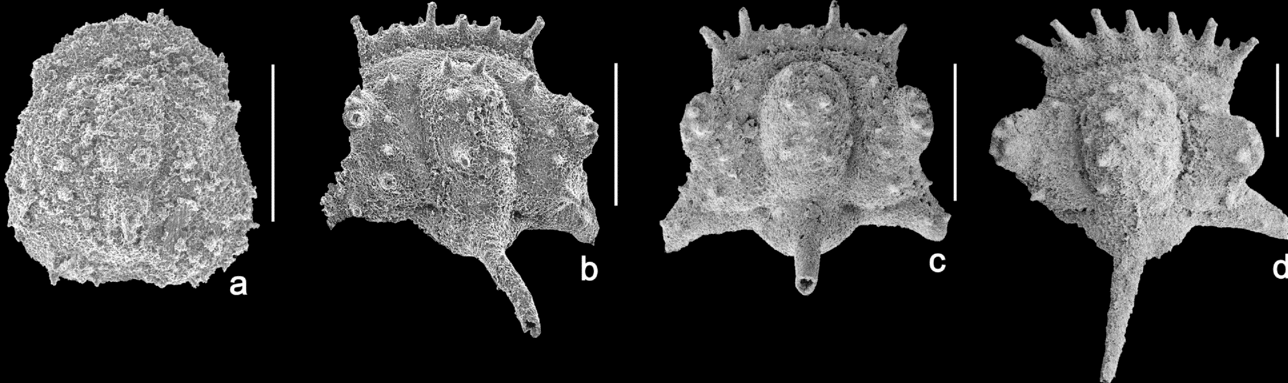
The pattern of cranidial spine distribution in meraspides of Otarion comprises a single pair of palpebral spines (P1), predominant fixigenal spines Fx1 and Fx4 (Fx2 and Fx3, when present, are smaller and rapidly vanish during early meraspid period), crowded and anteriorly placed glabellar pairs of spines G2 and G3, and two rows of cephalic border spines (Adrain & Chatterton, Reference Adrain and Chatterton1994). A virtually identical cephalic spine pattern can be observed in meraspides of Cyphaspis (Adrain & Chatterton, Reference Adrain and Chatterton1994, Reference Adrain and Chatterton1995; see Figs 5a and 7b, herein), which led Adrain & Chatterton (Reference Adrain and Chatterton1994) to group Cyphaspis, Otarion and two younger genera (Namuropyge Richter & Richter, Reference Richter and Richter1939 and ?Dixiphopyge Brezinski, Reference Brezinski1988) within the tribe Otarionini Richter & Richter, Reference Richter and Richter1926. The distribution of cephalic spines in early growth stages of Otarionella, as exemplified by Otarionella rastrum sp. nov., differs in several major aspects from that of Otarion (Figs 2f, g, 5b). Although three pairs of spines occur on the juvenile glabella, they are evenly spaced and G1 is positioned far posterior to glabellar middle length (sag.). Moreover, Fx2 and Fx3, though shorter than Fx1, are strong in early meraspid stages, whereas Fx4 never develops during ontogeny (Fig. 5b). On the other hand, cephalic spine patterns in Otarionella and Otarion have two features in common: a single prominent palpebral spine (P1) and two rows of cephalic border spines. This latter similarity, however, proves to be somewhat superficial when examined in detail. In Otarion and Cyphaspis, the dorsal row is probably composed of six spines in the earliest growth stages (Fig. 7b), but a seventh spine rapidly appears sagittally (e.g. Fig. 7c, herein; figs 1.3, 7.1 in Adrain & Chatterton, Reference Adrain and Chatterton1994; fig. 2.1–3 in Adrain & Chatterton, Reference Adrain and Chatterton1996), sometimes leading to a rapprochement of the two most abaxially located spines (e.g. figs 1.40, 1.47, 2.1, 2.11 in Adrain & Chatterton, Reference Adrain and Chatterton1996). In Otarionella, a seventh spine never develops and the dorsal row is comprised of six strong and evenly spaced spines throughout ontogeny. Moreover, the second row is composed of only two small spines in early meraspides of Otarionella (Fig. 2t), and it is only later that an additional small spine develops on both sides (Fig. 2s). Each of these four small spines corresponds anteriorly to one of the four adaxial spines of the first row. In Otarion and Cyphaspis, this second row comprises more spines (up to seven on our specimens; Fig. 7d), with some of them corresponding to spines of the first row and others being somewhat intercalated between them (Fig. 6b–d; see also figs 7.1, 9.3, 9.4 in Adrain & Chatterton, Reference Adrain and Chatterton1994). In addition, this organization into two rows tends to disappear in Otarion (e.g. figs 9.1, 9.2, 9.5 in Adrain & Chatterton, Reference Adrain and Chatterton1994) and Cyphaspis (e.g. figs 1.40, 2.9, 2.10 or 5.8 in Adrain & Chatterton, Reference Adrain and Chatterton1996), while border spines shorten during ontogeny, whereas it remains unchanged probably as late as the holaspid period in Otarionella (e.g. Fig. 2s).
Spine distribution in early meraspid cranidium of Cyphaspis (a), and in early meraspid cranidium (b) and librigena (c) of Otarionella. Bd – dorsal spine of the librigenal lateral border; Blm – long marginal spine of the librigenal lateral border; Bsm – short marginal spine of the librigenal lateral border; Fx – fixigenal spine; G – glabellar spine; Gd – dorsal spine on the genal spine; Gm – marginal spine on the genal spine; P – palpebral spine.

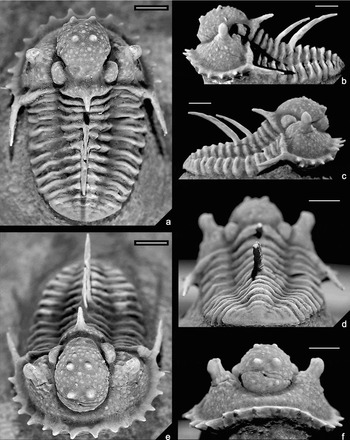
Otarionella lkomalii sp. nov., early Eifelian, El Otfal Formation, Jbel Zireg region, south side of Ma'der basin, Anti-Atlas, Morocco. All figures are digital photographs. Scale bars 2.5 mm. (a–f) holotype, UA11821; (a) dorsal view; (b) left lateral view; (c) right lateral view; (d) posterior view; (e) antero-dorsal view; (f) anterior view.

Cyphaspis sp., early to late Emsian, middle member of the Bissounel Formation, Bissounel Peak, Montagne Noire, France. All figures are scanning electron micrographs of silicified specimens in dorsal views. Scale bars 0.25 mm. (a) Metaprotaspis (note the four fixigenal tubercles), UMC-IP539. (b–d) Meraspid cranidia; (b) small specimen with six major border spines, strong Fx4, and grouped G2/G3, UMC-IP540; (c) small specimen with seven major border spines, UMC-IP541; (d) large specimen with Fx2 and Fx3 lost and numerous glabellar tubercles, UMC-IP542.

To summarize, Otarionella and Otarion–Cyphaspis show significant differences in patterns of juvenile cranidial spine distribution. These dissimilarities are so important that Otarionella fails to display three of the five diagnostic characters of the tribe Otarionini (Fx2 and Fx3 suppressed, G2 and G3 crowded and toward anterior glabella, and G1 positioned just posterior to glabellar sagittal middle length in early meraspides). In addition, the two rows of cephalic border spines differ in the two groups (number of spines involved, spine distributions, ontogenetic changes) and accordingly their occurrence cannot reasonably be considered as a shared character. Thus, it seems difficult to consider Otarionella a simple paedomorphic form of Otarion, since it implies that three, possibly four, of the five juvenile features, so far considered sufficiently constant to be diagnostic of the tribe Otarionini, have evolved to such a degree that they can no more be observed in this taxon. Moreover, even if a spinose morphology in adults may be generally regarded as a paedomorphic trait in the Otarioninae, the differences between cephalic spine patterns suggest that an origin of Otarionella from Otarion would have implied complex evolutionary processes rather than simple paedomorphosis. This is also indicated by the differences between the metaprotaspides of Otarionella and Cyphaspis. In Otarionella rastrum sp. nov., the protocranidium displays a complex pattern of strong spines, which is already very similar to that of the subsequent meraspid stages (Fig. 2a–e). By contrast, the metaprotaspis of Cyphaspis possesses low tubercles that, however, seem to already display an organized distribution (Fig. 7a). The occurrence of four fixigenal tubercles (Fx1–4) and the absence of cephalic border spines in this latter metaprotaspis demonstrate that the cephalic spine patterns of Cyphaspis and Otarionella differ as early as the protaspid period. If Cyphaspis is considered as having had a paedomorphic origin from Otarion, it seems unlikely that this latter would display stronger and differently distributed cephalic tubercles in metaprotaspid stages.
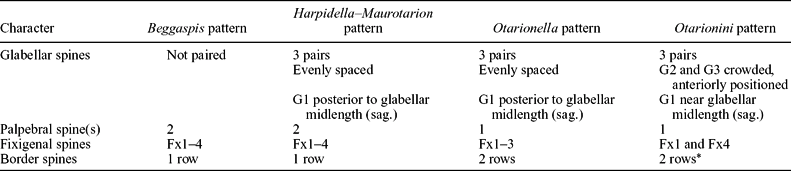
Lastly, considering patterns of meraspid cranidial spine distribution alone, there are no indications of Otarionella being phylogenetically closer to Otarion, and more generally to the tribe Otarionini, than to other otarionines such as Harpidella M'Coy, Reference M'Coy1849 and Maurotarion Alberti, Reference Alberti1969. Indeed, Adrain & Chatterton (Reference Adrain and Chatterton1994) pointed out that these latter genera show a similar cephalic spine pattern in early meraspides that can be described as follows: two palpebral spines (P1–2), four major fixigenal spines (Fx1–4), three evenly spaced pairs of glabellar spines (G1–3) and a single row of cephalic border spines. To facilitate comparisons, the characteristics of the juvenile cephalic spine pattern of Otarionella rastrum sp. nov. and those of the three patterns identified by Adrain & Chatterton (Reference Adrain and Chatterton1994) are summarized in Table 1. Features such as three pairs of evenly spaced glabellar spines, with G1 far posterior to middle length (sag.) of the glabella, are shared by Otarionella, Harpidella and Maurotarion. On the other hand, Otarionella and the Otarionini possess a single palpebral spine and two rows of cephalic border spines, whereas Harpidella and Maurotarion have two palpebral spines and a single row of cephalic border spines. As shown above, the two rows of cephalic border spines in Otarionella and the Otarionini differ significantly in terms of number of spines, organization and ontogenetic evolution, and accordingly, they cannot reasonably be considered as homologous in the two groups. At this stage of comparison, it could be stated that the Otarionella pattern is somewhat intermediate between the Harpidella–Maurotarion and the Otarionini patterns. The absence of Fx4, however, demonstrates that the Otarionella pattern also possesses its own characteristics, suggesting that it might have undergone, to some extent, independent evolution.
Characteristics of cranidial spine patterns in otarionine meraspides

Abbreviations used: Fx – major fixigenal spine; G – glabellar spine; sag. – sagittally.
* Number of spines composing these two rows and their location, however, differ from that of Otarionella (see text).
It follows from these comparisons that it is very unlikely that the cephalic spine pattern observed in Otarionella is derived from that of the Otarionini and, all the more, that representatives of Otarionella represent simple paedomorphic forms of Otarion. Indeed, this would imply complex, unparsimonious evolution, involving the secondary loss of the peculiar organization of glabellar spines of the Otarionini, the reappearance of well-developed Fx2 and Fx3, and the disappearance of the fourth fixigenal spine (Fx4), which is steadily predominant in meraspid cranidia of Otarionini. In our opinion, it seems more parsimonious to infer that the shared characters of the cephalic spine patterns of Otarionella and the Otarionini result from a common origin of the two clades (that is, they are plesiomorphic). Indeed, it can be speculated that both groups differentiated from an unknown ancestor with four fixigenal spines and three pairs of evenly spaced glabellar spines as in Harpidella and Maurotarion, but with one palpebral spine already lost and possibly a second row of border spines already acquired. Later, Fx4 might have been lost in the Otarionella lineage, while the primitive Otarionini acquired a different distribution of the glabellar spines, and lost Fx2 and Fx3, the two rows of cephalic border spines evolving independently in the two lineages.
4.b. Evidence from adult morphology
Besides its particular pattern of cranidial spine distribution in meraspides, Otarionella is characterized by a unique association of adult features that clearly differentiates this taxon from both Otarion and Cyphaspis. This unique combination of adult characters comprises two, sometimes three, evenly spaced pairs of glabellar spines, an occipital median spine, a strong posterior fixigenal tubercle (Fx4) (which is not visible on the unique specimen of Otarionella lkomalii sp. nov.), a single row of tubercles around the front of the glabella, and six strong and evenly spaced cranidial border spines on a prominent crest. In addition, four strong spines (Bd) are initially inserted dorsally on the librigenal border. As exemplified by O. chamaeleo (Basse, Reference Basse1997; Fig. 4a–c) and Otarionella lkomalii sp. nov. (Fig. 6a–f), Otarionella also differs from all other otarionines by a restricted number (10) of thoracic segments, among which the fourth and the sixth bear a sharp and long axial spine (a shorter spine also occurs on the second thoracic segment in O. chamaeleo). Lastly, the pygidium of Otarionella is small, with an axis composed of three to five axial rings, at least as large (tr.) as the pleural fields, and merging with the postaxial field. Many of these characteristic traits concern sculptural features. However, most of them develop as early as the metaprotaspid period in O. rastrum sp. nov. (see Section 3) and accordingly, they may represent genetically fixed characters. Also, we consider that their persistence in the adults of several species justifies their use as diagnostic characters.
Besides adult spinosity, the morphology of Otarionella differs significantly from that of Otarion. This is particularly obvious when the type species of the two genera, Otarionella davidsoni (Barrande, Reference Barrande1852) and Otarion diffractum Zenker, Reference Zenker1833, are compared. In many aspects, Otarionella and particularly Otarionella davidsoni is morphologically much closer to Cyphaspis and its type species Cyphaspis ceratophthalma (Goldfuss, Reference Goldfuss1843) than to Otarion diffractum. Unlike this latter, it indeed displays a strongly inflated glabellar middle lobe overhanging the short preglabellar field in life position, strongly protruding and somewhat stalked eyes, a reduced number of thoracic segments, and a relatively narrow (tr.) pygidium with few axial rings. This gross similarity could be attributed to the fact that both genera are supposed to have a paedomorphic origin (Adrain & Chatterton, Reference Adrain and Chatterton1994, Reference Adrain and Chatterton1996). However, the inflated glabella, overhanging the preglabellar field, is a typical peramorphic trait not only in the Otarioninae but also in the Proetida as a whole. This suggests that if similar heterochronic processes have been involved in the origin of these two genera, they were not restricted to paedomorphosis. In all cases, differences between patterns of juvenile cranidial spine distribution (see Section 4.a) demonstrate that the similarities between Otarionella and Cyphaspis are more likely the result of a parallel evolution than that of a common origin of the two taxa from Otarion. Thus, the adult morphology, like ontogenetic data, is not consistent with a close relationship between Otarionella and Otarion and a fortiori, with a proposed synonymy between the two genera.
5. Conclusion
A precocious development, a well-organized distribution, and a relative scarcity within clades are all criteria indicating that a sculptural feature may be worth considering for systematic purposes. These criteria, to which we can add visibility for practical reasons, represent no more than the criteria typically used to test the potential utility of any morphological character in systematics. Thus, there are no convincing reasons to preclude the use of sculptural features in systematics, especially when they represent abundant discrete characters like the cephalic tubercles of Otarioninae.
Data currently available on the ontogeny of the Otarioninae are still too scarce to depict, even grossly, the evolution of cephalic spine patterns in the clade as a whole. However, they appear already sufficient to definitively reject a synonymy of Otarionella and Otarion.
Acknowledgements
The authors are indebted to Martin Basse, Bochum, who sent latex casts of the original material of O. chamaeleo (Basse, Reference Basse1997), including the so-far undescribed external mould of the holotype that shows thoracic axial spines. R. M. Owens and an anonymous referee are thanked for their helpful suggestions. Chatterton acknowledges financial support from a Natural Sciences and Engineering Research Council of Canada discovery grant. This is a contribution of the Institut des Sciences de l'Evolution, UMR 5554 CNRS (ISEM 2006–071) and of the Laboratoire Magmas et Volcans, UMR 6524 CNRS.