INTRODUCTION
Over the course of a serious illness, individuals and their families face a number of critical and often difficult decisions that greatly impact their care and quality of life (Bakitas et al., Reference Bakitas, Kryworuchko and Matlock2011). For example, as the cancer progresses, patients often must decide whether to continue chemotherapy, to embark on an investigational trial, or to focus on supportive treatments alone. Palliative care and decision scientists have noted that there are few decision-making support tools to aid seriously ill persons with such important decisions as choosing life-sustaining treatments, deciding on when to shift from disease-oriented to supportive care, etc., and those that do exist have not been widely disseminated or evaluated (Butler et al., Reference Butler, Ratner and McCreedy2014; Hanson & Winzelberg, Reference Hanson and Winzelberg2013). Patient decision aids (PtDAs) are promising decision-support tools that have demonstrated positive patient outcomes in a variety of healthcare decisions. One metaanalysis concluded that PtDAs yielded such positive patient outcomes as enhancing patients' knowledge of treatment options and of the risks involved; increasing the rates of participation in shared decision making; reducing decisional conflict; and improving communication with healthcare providers (Butler et al., Reference Butler, Ratner and McCreedy2014; Stacey et al., Reference Stacey, Legare and Col2011). However, few PtDAs have been developed and evaluated for use in the early stages of advanced illness, when persons are actively receiving disease-focused (e.g., chemotherapy/radiation) treatments.
Looking Ahead: Choices for Medical Care When You're Seriously Ill®, developed by Health Dialog Inc., is one of just a few PtDAs that assist patient to understand the kinds of choices they may face during the course of a serious illness (Bakitas et al., Reference Bakitas, Kryworuchko and Matlock2011). Unlike other video PtDAs that focus on specific choices—for example, which breast cancer treatment to choose (Waljee et al., Reference Waljee, Rogers and Alderman2007) or what specific level of care to choose during a serious illness (Volandes et al., Reference Volandes, Paasche-Orlow and Mitchell2013)—Looking Ahead provides a more general overview of the types of decisions that individuals may face in the future and what steps and resources they may want to leverage to make the most informed decisions possible. Looking Ahead was developed through a rigorous process and tested for feasibility, acceptability, and impact on knowledge and decisional conflict by Matlock and colleagues (Reference Matlock, Keech and McKenzie2011) in a small randomized controlled trial (RCT) with patients on a palliative care unit. These patients generally found it acceptable but thought it would have been more helpful if they had had it earlier on in the course of their disease—at the time of diagnosis. Therefore, we evaluated Looking Ahead in a target audience of patients who were newly facing a serious illness and their family caregivers by incorporating it into the ENABLE III (Educate, Nurture, Advise, Before Life Ends) (Bakitas et al., Reference Bakitas, Tosteson and Li2015; Dionne-Odom et al., Reference Dionne-Odom, Azuero and Lyons2015) early palliative care telehealth RCT.
ENABLE (Bakitas et al., Reference Bakitas, Ahles and Skalla2008; Reference Bakitas, Lyons and Hegel2009b ; Reference Bakitas, Tosteson and Li2015) was designed to provide skills and coaching in problem solving, symptom and self-care management, communication, and decision support, thus empowering patients and family caregivers to take an active role in their healthcare (Wagner et al., Reference Wagner, Bennett and Austin2005; Reference Wagner, Austin and Davis2001; Wasson et al., Reference Wasson, Splaine and Bazos1998). The purpose of the present nested mixed-methods evaluation was to elicit patient and caregiver participants' feedback on the clarity and overall usefulness of the commercially available Looking Ahead PtDA when introduced soon after a new diagnosis of advanced cancer.
METHODS
Design
This was a mixed-methods summative evaluation (Creswell & Plano Clark, Reference Creswell and Plano Clark2007; Elwyn et al., Reference Elwyn, O'Connor and Bennett2009; Tashakkori & Teddlie, Reference Tashakkori and Teddlie1998) of the commercially available Looking Ahead PtDA nested within the ENABLE III RCT. Our study was approved by the Dartmouth College Committee for the Protection of Human Subjects as an amendment to the parent trial.
The ENABLE III RCT
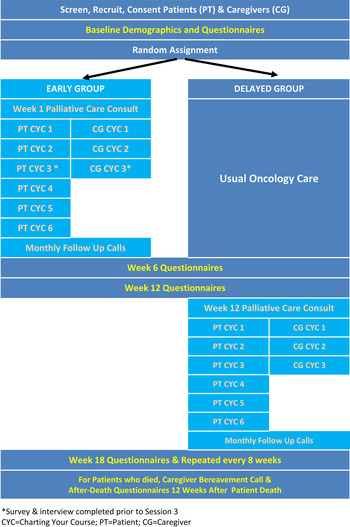
The ENABLE III parent RCT is the third in a series of studies examining the impact of an early palliative care telehealth intervention (Bakitas et al., Reference Bakitas, Ahles and Skalla2008; Reference Bakitas, Lyons and Hegel2009b ; Reference Bakitas, Tosteson and Li2015). The primary aims of ENABLE III were to examine: (1) the effects of intervention timing (early [within 60 days of diagnosis] vs. delayed [12 weeks after randomization]); (2) the impact of a parallel family caregiver intervention; and (3) the mediators/moderators of intervention effects. The ENABLE III intervention consisted of: (1) an in-person standardized palliative care assessment, and (2) weekly phone sessions with an advanced practice palliative care nurse coach instituting the Charting Your Course (CYC) curriculum followed by monthly telephone follow-up (see Figure 1). Additional details of the ENABLE intervention are extensively described elsewhere (Bakitas et al., Reference Bakitas, Lyons and Hegel2009a ; Reference Bakitas, Tosteson and Li2015; Dionne-Odom et al., Reference Dionne-Odom, Azuero and Lyons2015).
Parent study schema.

The Looking Ahead PtDA was introduced and discussed in session 3 of CYC (“Communication, Decision Making, and Advance Care Planning”). This session reviewed effective family and healthcare team communication skills, building a support network, medical decision making, and advance care planning. In the week prior to this session, the nurse coach asked participants to review the Looking Ahead PtDA (comprised of a DVD and booklet, mailed to participants after randomization in the parent trial). At the beginning of the session, the nurse coach digitally recorded participants' feedback about the PtDA using a semistructured interview with both closed and open-ended questions.
Sample
The parent trial included patients over the age of 18 with an advanced solid tumor or hematological malignancy (prognosis between 6 and 24 months) without dementia or active Axis I psychiatric disorders (e.g., schizophrenia, bipolar disorder) or a substance abuse disorder. Patients were asked to identify a caregiver, defined as “someone who knows you well and is involved in your medical care.” Consecutive ENABLE III patient participants who used Looking Ahead were asked to participate in the summative evaluation substudy until the target number of 50 patients with digitally recorded interview data was reached (April 2011–October 2012) (Figure 2). Due to withdrawal from the parent study or death, not all participants completed the PtDA program. Some watched the program but did not complete the semistructured interview due to time constraints or patient preference. The participants who did not have a DVD player were offered the opportunity to view it when they attended the clinic.
Patient entry and analysis flow diagram.

Procedures
All interviews were conducted by telephone, and patient and caregiver interviews were completed separately. The patient semistructured interview had 20 forced-choice and 13 open-ended questions, and the caregiver semistructured interview had 11 forced-choice and 5 open-ended questions. The semistructured interview contained acceptability questions developed by Barry et al. (Reference Barry, Fowler and Mulley1995) and Matlock et al. (Reference Matlock, Keech and McKenzie2011) and additional investigator-developed questions specific to the purpose and topics of the PtDA. The semistructured interview contained questions about how much of the program/booklet they had viewed; the length of time engaged in the program; the clarity of its language; the narrator's use/explanation of medical terms; satisfaction with the program; helpfulness in clarifying values and decisions; usefulness in interactions with family, friends, and healthcare providers; and whether they would recommend it to others. Responses to forced-choice questions were provided on a Likert-type scale (strongly agree, agree, neutral, disagree, strongly disagree). Open-ended questions expanded on the topics, allowing participants to provide greater depth to their responses, elicited their reaction to the patient interviews, and requested feedback about content that was missing or could be improved. Participants were also asked about how the information in the PtDA compared to the information they had received from their healthcare team, whether it changed their approach to decision making, and their overall reaction to the program.
Forced-choice question responses were entered into a SurveyMonkey form, and the nurse coach summarized brief fieldnotes for the open-ended questions. The median time to complete an interview was 17 minutes (range = 11–35 minutes). All interviews were digitally recorded, and responses to open-ended questions were transcribed verbatim by a professional transcriptionist, checked for accuracy by a research assistant, and uploaded into ATLAS.ti (v. 6.3, Berlin, Germany) qualitative software. Some 7 of 57 patients and 3 of 20 caregiver interviews were unable to be recorded due to recorder technical issues, so that only nurse coach fieldnotes were utilized to capture these open-ended responses.
Looking Ahead: Choices for Medical Care When You are Seriously Ill® Shared Decision Program
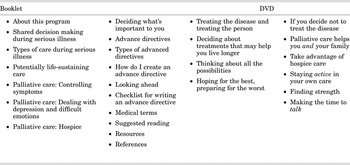
Published by the Informed Medical Decisions Foundation (formerly the Foundation for Informed Medical Decision Making) and distributed by Health Dialog, Looking Ahead is a PtDA tool for individuals living with serious illness and their families. The purpose of the program is to provide education about options and to prepare individuals and their family caregivers for future medical choices. It describes palliative and hospice approaches, outlines various forms of advance care planning, and emphasizes how values and preferences can shape medical decisions. The two-part PtDA consists of a 35-minute DVD video and a 52-page booklet, described further in Table 1. A social work narrator guides the viewer through 10 theme-based mini-sections. The DVD features brief interviews with palliative care physicians describing key concepts and issues in laypersons language interspersed with live conversations between clinicians and actual patients. The patient–physician conversations illustrate a spectrum of values and preferences for medical care. The booklet contains information about different types of medical care during a serious illness (curative, palliative, and hospice): advance directives (including a checklist); and how patients' values should influence medical decision making. The development of the Looking Ahead PtDA is described elsewhere (Matlock et al., Reference Matlock, Keech and McKenzie2011).
Section and topical content of the Looking Ahead booklet and DVD

Analysis
Responses to closed and open-ended questions were first analyzed separately (Creswell & Plano Clark, Reference Creswell and Plano Clark2007; Tashakkori & Teddlie, Reference Tashakkori and Teddlie1998). Frequency distributions were calculated for all questions with Likert-type responses. Aided by ATLAS.ti software (v. 6.0, Berlin, Germany), a research assistant (LJ), supervised by the PI (MB), performed in-vivo coding of transcripts. The research assistant and PI each coded the first five interviews and compared coding and specified code definitions to ensure clarity and interrater reliability. Thereafter, an additional 10% of randomly selected interviews were independently coded by the PI and compared to the research assistant's codes. The PI and research assistant met regularly throughout the process until all transcripts were completed. Audit trails and memo writing about coding decisions were ongoing throughout the analysis. The PI, co-PI (JND-O), and research assistant then reviewed all codes and collapsed them into categories and themes (Fossey et al., Reference Fossey, Harvey and McDermott2002; Glaser & Strauss, Reference Glaser and Strauss1967; Graneheim & Lundman, Reference Graneheim and Lundman2004; Sandelowski, Reference Sandelowski2000) through an iterative process of classifying, comparing, grouping, refining, and data reduction. The themes were then compared to the relevant close-ended responses in order to confirm (triangulate) or expand upon the responses.
RESULTS
Participant Demographics
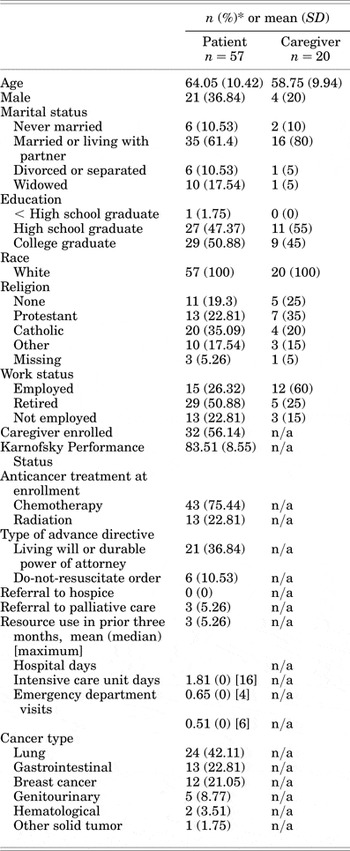
The substudy patient and caregiver demographic characteristics are listed in Table 2. Patients' mean age was 64 (SD = 10.42), 37% were male, most (61%) were married or living with a partner, just over half (51%) were retired, and nearly 50% had a high school education or less. The most common diagnoses were lung (42%), gastrointestinal (23%), and breast (21%) cancer, with 75% receiving chemotherapy and 23% undergoing radiation. Just over a third (37%) had already completed an advance directive, and 11% had a do-not-resuscitate (DNR) order. Patients were highly functional at baseline as measured by a Karnofsky Performance Status score >80% (range 0 [dead] to 100% [no problems with function or activities of daily living]). Caregivers' mean age was 59 (SD = 9.94), 80% were female and married, and 60% were employed.
Participant demographics

* Values are expressed as numbers (percentage) unless otherwise indicated. Overall percentages may not add up to 100% due to rounding.
n/a = not applicable, SD = standard deviation.
There were no statistically significant demographic differences between those patients who did (n = 57) and did not (n = 136) complete the semistructured interview except for female gender (63 vs. 43%, p = 0.01). Caregiver participants who completed the semistructured interview (n = 20) were not statistically different demographically from those who did not (n = 97) (data not shown).
“Looking Ahead” Usability, Acceptability, and Satisfaction
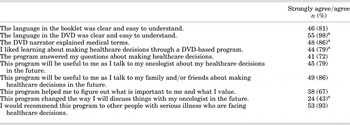
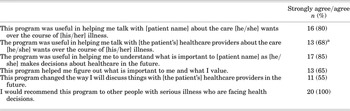
Tables 3 and 4 describe patient and caregiver participants' responses to the close-ended questions. Explanatory themes and exemplar quotes from the open-ended questions are presented below and in ×Tables 5–7. Most patient participants (77%) viewed the program (booklet and/or DVD) just once, and the remainder viewed it twice or more. Participants spent an average of 57 minutes (median = 45 min; range = 30–180 min) engaged with the program. Some 93% of patients and 100% of caregivers stated that they would recommend the program to another person experiencing serious illness, 5% of patients were neutral, and only 1 patient disagreed with this statement. Another patient commented that it was applicable in diseases other than cancer:
I think anybody that's facing any type of disease should see that. (ID 174, male, lung cancer, age 53)
Patient (n = 57) responses to forced-choice questions

a n = 56.
Caregiver (n = 20) responses to forced-choice questions

a n = 19
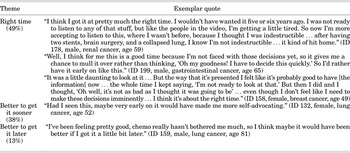
How was receiving the program timed?

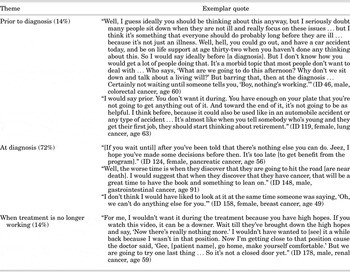
When should people receive the program?

Participant-reported impact of the looking ahead program

Booklet Evaluation
Some 46% of patients read all or most of the booklet, 33% read some, and 21% read none of the booklet. A quarter of patients indicated that they had shared the booklet with someone else (data not shown). Most (81%) felt that the booklet was clear, understandable, and helpful:
The back of the booklet has some information that's good to have about publications and information if I do have question. (ID 152, female, lung cancer, age 61)
DVD Evaluation
Almost twice as many patients (93%) and three times as many caregivers (95%) watched the DVD compared to reading the booklet. Most patients (98%) found the DVD language to be clear, easy to understand, and engaging:
One of the things I liked about the DVD is that it was very warm and welcoming … It drew me in. (ID 76, female, lung cancer, age 68)
According to one caregiver,
It was very easy to listen to and watch … very informative … The language was very easy to understand. (CGID 45)
A third (33%) of patients watched the DVD with someone and commented on how the program stimulated conversation:
My wife and I talked about it quite a lot—for another half an hour at least. (ID 175, male, multiple myeloma, age 71)
Some 80% believed that the length of the DVD was just right, while none felt it was too short. One patient felt it was too basic:
See, I'm like at the Ph.D. level of cancer … The DVD is designed for someone just entering high school. (ID 174, male, lung cancer, age 54)
Few patients and caregivers (10%) had concrete suggestions for improvement. Some wished there were “more specifics” about completing advance directives (e.g., witnessing, what next?):
What should be in it, if you're making up a living will, a DNR … What should actually be in it? (ID 114, female, breast cancer, age 67)
One patient suggested a closing summary:
Have a little narrative at the end [of the DVD] saying, “Each person's decision is his own, and the provider should go along with him.” … Let the patient make the final decisions … Explain that you have more rights than you think you do. (ID 101, male, prostate cancer, age 70)
Some (25%) patients were initially hesitant to watch the DVD:
I thought it would be depressing, but it was very well done—uplifting, actually. It didn't talk down to you and gave just the right feeling from the language and people. (ID 29, female, gastrointestinal cancer, age 49)
Another patient explained it this way:
I didn't really want to watch it … It took me a while, … I pulled it out a couple times and thinking, “How come I keep forgetting to watch this?” There must be a reason [why I'm] “hiding the head in the sand.” (ID 125, female, endocrine cancer, age 74)
One patient attributed their hesitancy to being “alone”:
I was really hesitant to put it on because of being alone … I said, “I don't want to deal with this.” (ID 69, female, lung cancer, age 71)
Reactions to Patient Interviews: “Valuable” and “Validating”
Respondents described the patient interviews as “genuine,” “validating.” and “valuable”:
I really liked the patient interviews. It was very powerful to have the patients themselves explain things. (ID 124, female, pancreatic cancer, age 56)
One caregiver stated,
It was positive, helpful … showed me how different people dealt with situations. (CGID 77)
Some patients found it validating to see others who had experiences similar to their own:
I was hesitant … but then I saw the patients talking, and I felt the same way as some of them … So it helped. (ID 48, female, breast cancer, age 46)
Some participants were able to relate even though the DVD patient was a different gender or age. A 65-year-old male with gastrointestinal cancer (ID 199) identified with a young woman with breast cancer:
Well, it really brought home the point that, you know, the quality of life is the important aspect. I think the one woman who was stopping her treatment because she was spending 20 hours a day in bed and missing out on everything. She decided to stop the treatment so that she could spend quality time with her family … It reinforced a key point of what I think.
Some participants saw the DVD patients as role models:
I think one of the things [I learned] was the chance to talk openly and candidly with the care team as this guy was doing in the DVD. (ID 175, male, multiple myeloma, age 71)
Best Time to Receive the Program: “Earlier the Better”
About half of our participants (49%) preferred to receive the program at the time of diagnosis. Table 5 presents participant quotes about how the program was timed. Some 49% of patients and caregivers felt they got the program at “just about the right time”; however, 38 and 37% of patients and caregivers thought it would have been better to get it sooner. Even though some participants were at first hesitant to watch it, they felt that having this information before they had to make decisions was important.
Table 6 provides exemplar quotes expanding upon the question of when Looking Ahead should be provided. Most (72%) thought that patients should receive the program shortly after a diagnosis of advanced cancer. Small but equal proportions of patients thought it should be provided prior to diagnosis of a serious illness (14%) or “when the treatment is no longer working” (14%). Some patients emphasized that “waiting until the treatment is no longer working” put patients at risk for potential harm. The first quote in Table 6 is from a 60-year-old man with colorectal cancer (ID 46), who eloquently explains why early on it might be difficult to get patients to focus on such topics as advance care planning.
Program Impact
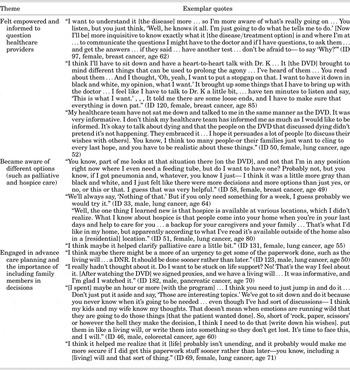
Table 7 presents the key themes and supporting quotes related to program impact. The three themes that emerged were empowerment, awareness, and engagement in advance care planning. Regarding empowerment, the DVD provided new information for some and for others prompted an increased sense of self-efficacy toward having conversations and asking questions of their clinicians. Patients expressed feeling “informed,” “in charge,” and able to be more “forthcoming … [about] speak[ing] up” and “[speaking] my mind a little bit more.”
Some 40% of participants reported an enhanced awareness of healthcare options, realizing that decisions about life-sustaining treatments were not “all or nothing” and that there were “more decisions and more options than just yes or no” (Table 7). Patients also expressed that they learned more about palliative care and hospice:
If I get there [hospice care], I'll know what to expect. (ID 97, female, breast cancer, age 62)
Another participant commented,
[It] made me more aware of when the time comes to stop treatment. Previously, I had tended to look at making those decisions when there was no hope left. (ID 33, male, lung cancer, age 64)
Another recognized that decisions aren't necessarily final and that they can change over time, as stated by a 69-year-old man with pancreatic cancer (ID 153):
It certainly clarified things and raised the level of importance in making a lot of these decisions early on rather than waiting … It clarified those things that I've got to review and make sure— and probably review periodically. That's one thing it pointed out, is that, you know, these decisions aren't final. You have the option of looking at them again because things do change over time.
Some 25% of patients felt that, while they may not have learned anything new, watching the DVD reaffirmed their choices and values:
I think I already know what my values are, but it did help to make me think about them. (ID 132, female, lung cancer, age 53)
Others voiced the importance of taking prompt action in advance care planning:
I really haven't thought about it much. I mean, I know in the back of my mind I need to do something, but this [watching the DVD] made it come to my attention where I need to do it now. (ID 82, female, breast cancer, age 49)
They identified the need to discuss their wishes with others and to put their wishes in writing:
I've been meaning to talk to my healthcare proxy if I can't make decisions. So I finally had a chance to talk to her to make sure she's up to the task. (ID 175, male, multiple myeloma, age 71)
A 65-year-old man with a gastrointestinal cancer (ID 199) stated,
Well, I think it was in this one line that struck me—I'm pretty sure it was in the DVD—is that the diagnosis affects the individual, but the treatment and illness affects the entire family! … everyone is affected by the decisions I make.
DISCUSSION
The purpose of this mixed-method summative evaluation study, conducted within the ENABLE III early palliative care telehealth RCT, was to determine participants' acceptability and impressions of the Looking Ahead PtDA program. Unlike traditional decision aids, which are geared to a single crossroads decision (e.g., mastectomy vs. lumpectomy), this program presented key messages and information to consider when facing myriad healthcare decisions during a serious illness. The Looking Ahead PtDA program features clinician and patient interviews, communicates the definition of palliative care and how beliefs and values can impact healthcare choices, and underscores the importance of choosing a healthcare proxy.
Participants' responses about usability and acceptability were very favorable. Nearly all patients (93%) and family caregivers (100%) stated that they would recommend Looking Ahead to others with a serious illness. The major themes included: a preference for the DVD over the booklet, valuing patient interviews, and a preference for receiving the program at or soon after an advanced cancer diagnosis. Additionally, participants believed that exposure to this program empowered them to question healthcare providers, increased their awareness of such different healthcare options as palliative and hospice care, prompted engagement in advance care planning, and emphasized the importance of including family members in the planning process.
Our findings are consistent with Matlock et al.'s (Reference Matlock, Keech and McKenzie2011) previous pilot trial evaluating Looking Ahead in an acute inpatient palliative care unit. However, our study builds on those findings and empirically confirms their belief that introducing advance care planning PtDAs for patients with advanced cancer and their families even earlier in the process is equally acceptable.
The American Society of Clinical Oncology's provisional consensus statement recommends that palliative care be integrated early on in the course of advanced cancer care (Smith et al., Reference Smith, Temin and Alesi2012). However, exactly when and how to introduce palliative care and advance care planning continues to be a topic of intense interest and study. Based on our results, we believe that outpatient integration of advance care planning PtDAs facilitated by a health coach early on in the serious illness trajectory is a promising and viable option for early integration of advance care planning specifically and palliative care approaches in general.
The ENABLE III parent trial (Bakitas et al., Reference Bakitas, Tosteson and Li2015) and other early palliative care intervention trials have demonstrated a survival advantage over usual cancer care (Bakitas et al., Reference Bakitas, Lyons and Hegel2009b ; Temel et al., Reference Temel, Greer and Muzikansky2010). One proposed explanation is that prospective decision making may influence patients' choices, resulting in reduced iatrogenic treatments (Bakitas et al., Reference Bakitas, Tosteson and Li2015). Individuals with serious illness who postpone healthcare planning and decision making until serious health events transpire (e.g., cardiac event, respiratory distress) may incur additional decisional anxiety, and they (or their proxy decisionmakers) may opt for burdensome medical treatments that ultimately shorten their survival.
Our results provide multiple instances in which participants were stimulated to take action after viewing the program. For example, participants recognized the importance of advance care planning and took steps to complete an advance directive, to discuss important treatment decisions with a healthcare provider, etc. Such actions are more likely to be successful if taken during a time of relatively good health and low distress. This finding will need to be confirmed, as we relied solely on self-report rather than objective data to catalogue actions triggered by the Looking Ahead PtDA (e.g., review documentation of actual conversations with healthcare providers about these topics).
Several participants described a hesitancy about reading and watching a PtDA about advance care planning. However, after watching the DVD, their apprehensions eased, and many found the patient interviews in particular positive and engaging. In contrast to the reports of others (Lenert et al., Reference Lenert, Ziegler and Lee2000), this appeared to hold even in cases where the patient's gender, age, and disease differed from the participant's.
LIMITATIONS OF THE STUDY
There are a number of study limitations to note. First, our study lacked racial and ethnic diversity, reflecting the homogeneity of the New England demographic area. Future research is needed to test the acceptability and user impressions of this and other PtDAs in minority and underserved populations. Second, the especially high approval of the Looking Ahead PtDA may have been due to a selection bias. All of the participants participated in an early palliative care intervention and may have already had accepting attitudes toward early palliative care and advance care planning. Third, not all patients had family caregivers, and there were far fewer caregiver perspectives recorded. Hence, we recommend further evaluation of such a PtDA with family caregivers. Finally, since all participants had a nurse coach and received other content, we cannot determine whether we would see the same impact if the PtDA was used by itself. Pairing coaching and guidance with PtDAs has been reported in a recent systematic review to positively enhance decision support (Stacey et al., Reference Stacey, Kryworuchko and Belkora2013).
CONCLUSIONS
In conclusion, our summative evaluation study, nested in an early palliative care randomized controlled trial, demonstrated a high degree of acceptability of a PtDA in a Caucasian sample. The participants reported that patient role models led them to feel more relaxed about the topic of advanced care planning, and some felt an increased urgency to act.
SIGNIFICANCE OF RESULTS
Despite professional recommendations, many healthcare providers are hesitant to broach advance care planning and early palliative care referral for fear of upsetting patients (Dionne-Odom et al., Reference Dionne-Odom, Kono and Frost2014; Von Roenn et al., Reference Von Roenn, Voltz and Serrie2013). We hope that our findings will soften those concerns. Delivering this type of PtDA late in the trajectory of an advanced illness (i.e., at the very end of life), when patients have already made many key medical decisions (Matlock et al., Reference Matlock, Keech and McKenzie2011), may not be helpful and might even lead to regret about acceptance of treatments that were not consistent with their values. We recommend that future work concentrate on determining reliable ways to incorporate PtDAs into standard practice.
ACKNOWLEDGMENTS
This study was funded in part by a grant from the Informed Medical Decision Making Foundation and by National Institutes of Health grant R0-1 NR011871-01. The funding agencies had no role in the design of the study nor in the analysis or interpretation of results. Over the course of this study, Dr. Dionne-Odom has received support from the NIH/NINR (1K99NR015903), the National Cancer Institute (2R25CA047888-24), the National Palliative Care Research Center, and the American Cancer Society (RSG PCSM – 124668). The authors wish to acknowledge all of the members of the ENABLE III project team.