1 Introduction
The purpose of this article is to prove some
 $L^p(\mathbb {R})\times L^q(\mathbb {R}) \rightarrow L^r(\mathbb {R})$
estimates for bilinear operators of fractional integral type. The classical example of these operators is the bilinear fractional integral
 $$ \begin{align} H_{\alpha}(f,g)(x):=\int_{\mathbb{R}^n}f(x-t)g(x+t)\,\frac{\textrm{d}t}{|t|^{n-\alpha}} \end{align} $$
with
 $0<\alpha <n$
, and the
 $L^p(\mathbb {R}^n)\times L^q(\mathbb {R}^n) \rightarrow L^r(\mathbb {R}^n)$
boundedness of
 $H_{\alpha }$
can be found in Kenig and Stein [Reference Kenig and Stein21], Grafakos and Kalton [Reference Grafakos and Kalton14], and also Grafakos [Reference Grafakos12], where
 $(\frac {1}{p},\frac {1}{q},\frac {1}{r})$
lies in the open convex hull of the pentagon with vertices
 $(\frac {\alpha }{n}, 0, 0)$
,
 $(1, 0, 1-\frac {\alpha }{n})$
,
 $(0, \frac {\alpha }{n}, 0)$
,
 $(0, 1, 1-\frac {\alpha }{n})$
and
 $(1, 1, \frac {2n-\alpha }{n})$
. Furthermore, they also showed that a restricted weak type estimate holds at each vertex of the pentagon. On the other hand, by homogeneity, we note that
 $H_{\alpha }(f,g)$
maps
 $L^p(\mathbb {R}^n)\times L^q(\mathbb {R}^n)$
to
 $ L^r(\mathbb {R}^n)$
only when
 $$ \begin{align*}\frac{1}{r}=\frac{1}{p}+\frac{1}{q}-\frac{\alpha}{n}.\end{align*} $$
More precisely, in the present article, we focus our attention on the bilinear fractional integral
 $H_{\alpha ,\gamma }$
along a curve
 $(t,\gamma (t))$
, which has the form
 $$ \begin{align} H_{\alpha,\gamma}(f,g)(x):=\int_{0}^{\infty}f(x-t)g(x-\gamma(t))\,\frac{\textrm{d}t}{t^{1-\alpha}}, \end{align} $$
where
 $0<\alpha <1$
. The first author of this article and Liu considered the
 $L^p(\mathbb {R})\times L^q(\mathbb {R}) \rightarrow L^r(\mathbb {R})$
estimates for
 $H_{\alpha ,\gamma }$
under the case of
 $\gamma (t):=t^\beta $
in [Reference Li and Liu26]. Then, it is natural to characterize the indices
 $(\frac {1}{p}, \frac {1}{q}, \frac {1}{r})$
for which
 $H_{\alpha ,\gamma }$
maps
 $L^p(\mathbb {R})\times L^q(\mathbb {R})$
to
 $L^r(\mathbb {R})$
for more general curves. We now state the needed conditions on the curve
 $(t,\gamma (t))$
and some related definitions.
Hypothesis on curves (H.). We assume that
 $\gamma \in C^2(\mathbb {R}^+)$
is monotonic on
 $\mathbb {R}^+$
,
 $\lim \limits _{t\rightarrow 0^+}\gamma (t)=\lim \limits _{t\rightarrow 0^+}\gamma '(0)=0$
, and satisfy
 $\omega _{\infty ,1}\geq \omega _{0,2}$
,
 $\omega _{0,1}>1$
. Furthermore, there exist positive constants
 $C^{(1)}_{1}$
,
 $C^{(2)}_{1}$
and
 $C^{(1)}_2$
such that
 $$ \begin{align} \left|\frac{t\gamma'(t)}{\gamma(t)}\right|\leq C^{(1)}_2\quad\textrm{and}\quad\left|\frac{t^j\gamma^{(j)}(t)}{\gamma(t)}\right|\geq C^{(j)}_{1}~~\textrm{with}~~j=1,2. \end{align} $$
In particular, we note that (H.) is essentially applicable to a polynomial with no linear term and constant term. Here and hereafter, we define
 $$ \begin{align*} \omega_{0,1}:=\liminf\limits_{t\rightarrow0^{+}}{\frac{\ln{|\gamma(t)|}}{\ln t}},\quad &\omega_{0,2}:=\limsup\limits_{t\rightarrow0^{+}}{\frac{\ln{|\gamma(t)|}}{\ln t}},\\ \omega_{\infty,1}:=\liminf\limits_{t\rightarrow{\infty}}{\frac{\ln{|\gamma(t)|}}{\ln t}},\quad &\omega_{\infty,2}:=\limsup\limits_{t\rightarrow{\infty}}{\frac{\ln{|\gamma(t)|}}{\ln t}}. \end{align*} $$
Next, we will state two main results of this article. The first one is as follows.
Theorem 1.1 Assume that
 $\gamma $
satisfies (H.) and
 $\frac {\omega _{\infty ,2}-\omega _{\infty ,1}}{\omega _{\infty ,2}-1}<\frac {\alpha }{1-\alpha }<\frac {\omega _{\infty ,2}}{\omega _{\infty ,2}-\omega _{\infty ,1}+1}$
. Then, there exists a positive constant C, such that
 $$ \begin{align*}\left\|H_{\alpha,\gamma}(f,g)\right\|_{L^{r}(\mathbb{R})}\leq C \|f\|_{L^{p}(\mathbb{R})}\|g\|_{L^{q}(\mathbb{R})}\end{align*} $$
holds for all
 $f\in L^{p}(\mathbb {R})$
and
 $g\in L^{q}(\mathbb {R})$
, where
 $(\frac {1}{p},\frac {1}{q},\frac {1}{r})$
lies in the open convex hull of the following points:
 $$ \begin{align*} &A\left(\alpha,0,0\right),&&B\left(1,0,1-\alpha\right),\\ &C_1\left(0,\frac{\alpha}{\omega_{\infty,1}},0\right),&&C_2\left(0,\frac{\alpha}{\omega_{0,2}},0\right),\\ &D_1\left(0,1,1-\frac{\alpha}{\omega_{\infty,1}}\right),&&D_2\left(0,1,1-\frac{\alpha}{\omega_{0,2}}\right),\\ &E\left(1, \frac{\omega_{\infty,2}-\alpha}{2\omega_{\infty,2}-\omega_{\infty,1} }, \frac{2(\omega_{\infty,2}-\alpha)}{2\omega_{\infty,2}-\omega_{\infty,1} }\right),&&F\left(\frac{\omega_{\infty,2}-\alpha}{2\omega_{\infty,2}-\omega_{\infty,1} }, 1, \frac{2(\omega_{\infty,2}-\alpha)}{2\omega_{\infty,2}-\omega_{\infty,1} }\right). \end{align*} $$
The second main result of this article, Theorem 1.2, will study the analog of Theorem 1.1 for the case of
 $\frac {\alpha }{1-\alpha }\geq \omega _{\infty ,1}$
. We note that Theorem 1.2 may also be viewed as a necessary supplement corresponding to Theorem 1.1, since the condition
 $\frac {\omega _{\infty ,2}-\omega _{\infty ,1}}{\omega _{\infty ,2}-1}<\frac {\alpha }{1-\alpha }<\frac {\omega _{\infty ,2}}{\omega _{\infty ,2}-\omega _{\infty ,1}+1}$
in Theorem 1.1 is equivalent to
 $\frac {\alpha }{1-\alpha }<\omega _{\infty ,1}$
when
 $\omega _{\infty ,1}=\omega _{\infty ,2}$
.
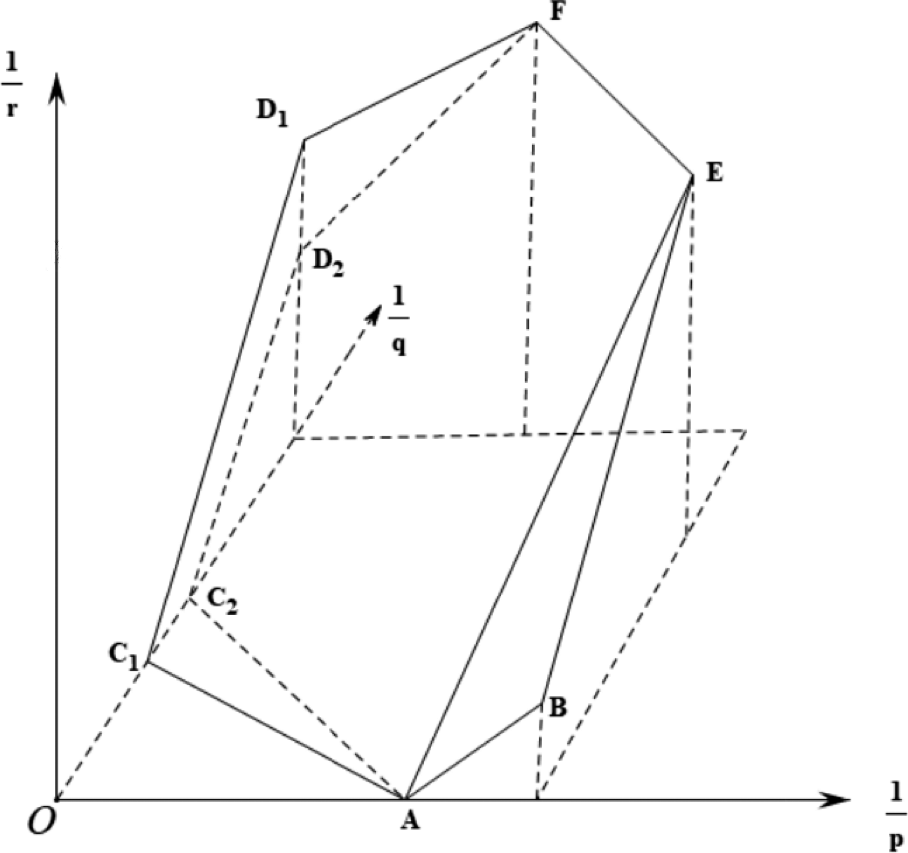
Regions of
 $(\frac {1}{p}, \frac {1}{q}, \frac {1}{r})$
in Theorem 1.1.

Theorem 1.2 Assume that
 $\gamma $
satisfies (H.) and
 $\frac {\alpha }{1-\alpha }\geq \omega _{\infty ,1}$
. Then, there exists a positive constant C, such that
 $$ \begin{align*}\left\|H_{\alpha,\gamma}(f,g)\right\|_{L^{r}(\mathbb{R})}\leq C \|f\|_{L^{p}(\mathbb{R})}\|g\|_{L^{q}(\mathbb{R})}\end{align*} $$
holds for all
 $f\in L^{p}(\mathbb {R})$
and
 $g\in L^{q}(\mathbb {R})$
, where
 $(\frac {1}{p},\frac {1}{q},\frac {1}{r})$
lies in the open convex hull of the following points:
 $$ \begin{align*} &A\left(\alpha,0,0\right),&&B\left(1,0,1-\alpha\right),\\ &C_1\left(0,\frac{\alpha}{\omega_{\infty,1}},0\right),&&C_2\left(0,\frac{\alpha}{\omega_{0,2}},0\right),\\ &D_1\left(0,1,1-\frac{\alpha}{\omega_{\infty,1}}\right),&&D_2\left(0,1,1-\frac{\alpha}{\omega_{0,2}}\right),\\ &\begin{cases} G_1\left(1, \frac{1-\alpha}{2-\omega_{\infty,1}}, \frac{2(1-\alpha)}{2-\omega_{\infty,1}}\right),&\omega_{\infty,1}\leq2\alpha;\\ G^1_2\left(1, \frac{\alpha}{\omega_{\infty,1}}, 1\right),~G^2_2\left(1, \frac{1}{2}, 1\right),&2\alpha<\omega_{\infty,1}, \end{cases},&&H\left(\frac{\omega_{\infty,1}-\alpha}{\omega_{\infty,1}}, 1, \frac{2(\omega_{\infty,1}-\alpha)}{\omega_{\infty,1}}\right). \end{align*} $$
Remark 1.3 Let us express the regions of
 $(\frac {1}{p}, \frac {1}{q}, \frac {1}{r})$
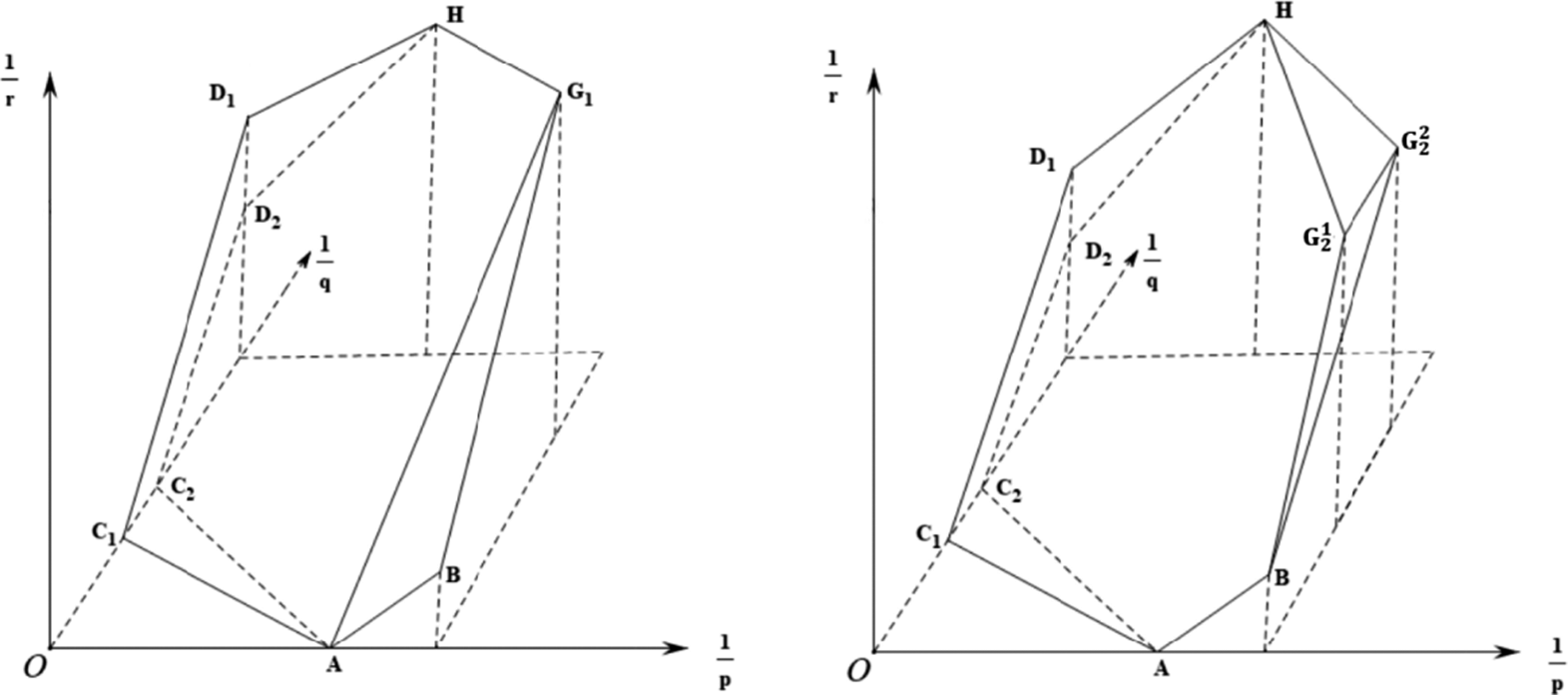
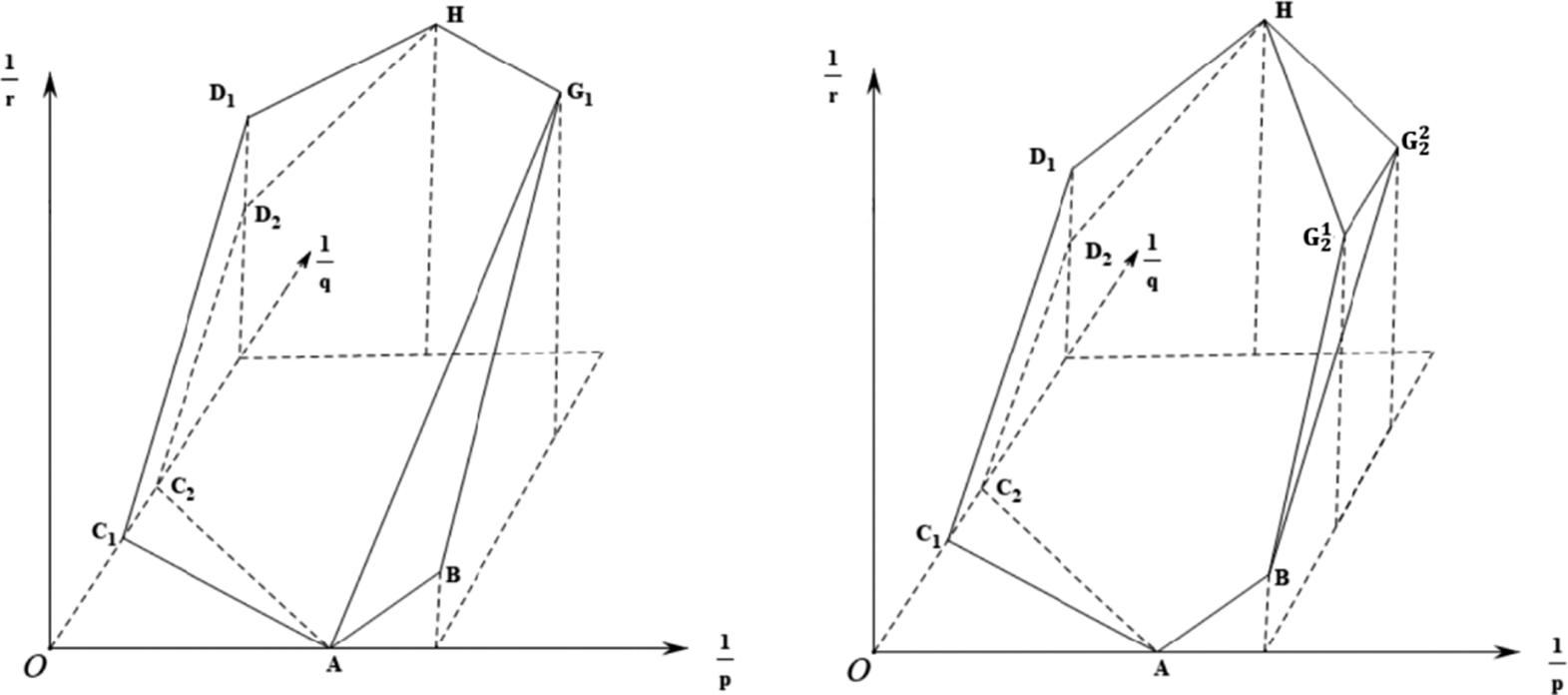
in Theorems 1.1 and 1.2 as in Figures 1 and 2, respectively.
Regions of
 $(\frac {1}{p}, \frac {1}{q}, \frac {1}{r})$
in Theorem 1.2 with
 $\omega _{\infty ,1}\leq 2\alpha $
and
 $2\alpha <\omega _{\infty ,1}$
, respectively.
Example 1.4 Let us list some examples of curves.
-
(1)
 $\gamma _1(t):=t^\beta $
with
$\beta \in (1,\infty )$
. Then the regions of
$(\frac {1}{p}, \frac {1}{q}, \frac {1}{r})$
in the
$L^p(\mathbb {R})\times L^q(\mathbb {R}) \rightarrow L^r(\mathbb {R})$
estimates for the corresponding
$H_{\alpha ,\gamma _1}$
lies in the open convex hull of the following points:
$$ \begin{align*} &~~~A\left(\alpha,0,0\right),~~~~~~~~~~~~~~~~~~~~~~~~~~~~~B\left(1,0,1-\alpha\right),\\ &~~~C\left(0,\frac{\alpha}{\beta},0\right),~~~~~~~~~~~~~~~~~~~~~~~~~~~D\left(0,1,1-\frac{\alpha}{\beta}\right),\\ &\begin{cases} E\left(1, 1-\frac{\alpha}{\beta}, 2(1-\frac{\alpha}{\beta})\right),~~~~~~~~~~F\left(1-\frac{\alpha}{\beta}, 1, 2(1-\frac{\alpha}{\beta})\right),& if~ \frac{\alpha}{1-\alpha}<\beta;\\ G_1\left(1, \frac{1-\alpha}{2-\beta}, \frac{2(1-\alpha)}{2-\beta}\right),~~~~~~~~~~~~~~~H\left(1-\frac{\alpha}{\beta}, 1, 2(1-\frac{\alpha}{\beta})\right),& if~ \frac{\alpha}{1-\alpha} \geq \beta~and~\beta \leq 2\alpha;\\ G^1_2\left(1, \frac{\alpha}{\beta}, 1\right),~~G^2_2\left(1, \frac{1}{2}, 1\right),~~~H\left(1-\frac{\alpha}{\beta}, 1, 2(1-\frac{\alpha}{\beta})\right),& if~ \frac{\alpha}{1-\alpha} \geq \beta ~and~2\alpha<\beta. \end{cases} \end{align*} $$
-
(2)
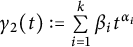
$\gamma _2(t):=\sum \limits _{i=1}^{k} \beta _i t^{\alpha _i}$
, where
$\beta _i\in \mathbb {R}\backslash \{0\} $
for all
$i=1,2,\ldots ,k$
and
$1<\alpha _1<\alpha _2<\cdots <\alpha _k$
with
$k\in \mathbb {N}$
. Then the regions of
$(\frac {1}{p}, \frac {1}{q}, \frac {1}{r})$
in the
$L^p(\mathbb {R})\times L^q(\mathbb {R}) \rightarrow L^r(\mathbb {R})$
estimates for the corresponding
$H_{\alpha ,\gamma _2}$
lies in the open convex hull of the following points:
$$ \begin{align*} &~~~A\left(\alpha,0,0\right),~~~~~~~~~~~~~~~~~~~~~~~~~~~~~~~B\left(1,0,1-\alpha\right),\\ &~~~C_1\left(0,\frac{\alpha}{\alpha_k},0\right),~~~~~~~~~~~~~~~~~~~~~~~~~~C_2\left(0,\frac{\alpha}{\alpha_1},0\right),\\ &~~~D_1\left(0,1,1-\frac{\alpha}{\alpha_k}\right),~~~~~~~~~~~~~~~~~~~D_2\left(0,1,1-\frac{\alpha}{\alpha_1}\right),\\ &\begin{cases} E\left(1, 1-\frac{\alpha}{\alpha_k}, 2(1-\frac{\alpha}{\alpha_k})\right),~~~~~~~~~F\left(1-\frac{\alpha}{\alpha_k}, 1, 2(1-\frac{\alpha}{\alpha_k})\right),& if~ \frac{\alpha}{1-\alpha}<\alpha_k;\\ G_1\left(1, \frac{1-\alpha}{2-\alpha_k}, \frac{2(1-\alpha)}{2-\alpha_k}\right),~~~~~~~~~~~~~~~H\left(1-\frac{\alpha}{\alpha_k}, 1, 2(1-\frac{\alpha}{\alpha_k})\right),& if~ \frac{\alpha}{1-\alpha} \geq \alpha_k~and~\alpha_k \leq 2\alpha;\\ G^1_2\left(1, \frac{\alpha}{\alpha_k}, 1\right),~~G^2_2\left(1, \frac{1}{2}, 1\right),~~~ H\left(1-\frac{\alpha}{\alpha_k}, 1, 2(1-\frac{\alpha}{\alpha_k})\right),& if~ \frac{\alpha}{1-\alpha} \geq \alpha_k ~and~2\alpha<\alpha_k. \end{cases} \end{align*} $$
-
(3)
$\gamma _3(t):=t^\beta \log (1+t)$
, or
$t^\beta \arctan t$
, or
$e^{\beta t}-\beta t-1$
, where
$\beta>0$
. We note that all of these
$\gamma _3$
satisfy
$\gamma _3(0)=\gamma ^{\prime }_3(0)=\cdots =\gamma ^{(d-1)}_3(0)=0$
and
$\gamma ^{(d)}_3(0)\neq 0$
, where
${d\geq 2}$
and
$d\in \mathbb {N}$
, which is called as finite type d at
$0$
in Iosevich [Reference Iosevich19]. The regions of
$(\frac {1}{p}, \frac {1}{q}, \frac {1}{r})$
in the
$L^p(\mathbb {R})\times L^q(\mathbb {R}) \rightarrow L^r(\mathbb {R})$
estimates for the corresponding
$H_{\alpha ,\gamma _3}$
can be obtained as in above, we omit the details.





















The first motivation of our problem is the bilinear Hilbert transform
 $H_{\gamma }(f,g)$
along a curve
 $(t,\gamma (t))$
, which is defined by
 $$ \begin{align*}H_{\gamma}(f,g)(x):=\mathrm{p.\,v.}\int_{-\infty}^{\infty}f(x-t)g(x-\gamma(t))\,\frac{\textrm{d}t}{t}.\end{align*} $$
If
 $\gamma (t):=-t$
, then this operator turns to be the standard bilinear Hilbert transform. As a landmark work, Lacey and Thiele [Reference Lacey and Thiele22, Reference Lacey and Thiele23] set up its
 $L^p(\mathbb {R})\times L^q(\mathbb {R})\rightarrow L^r(\mathbb {R})$
boundedness for all
 $\frac {1}{p}+\frac {1}{q}=\frac {1}{r}$
,
 $p, q>1$
, and
 $r>\frac {2}{3}$
. This boundedness confirms a conjecture raised by Calderon. The restriction
 $r>\frac {2}{3}$
follows from the boundedness of a model operator they used. So far, to extend the region to
 $\frac {1}{2} < r \leq \frac {2}{3}$
is still a challenging question. Related works can be found in [Reference Grafakos and Li15, Reference Li and Li24, Reference Li31] and references therein.
On the other hand, the
 $L^p(\mathbb {R})\times L^q(\mathbb {R})\rightarrow L^r(\mathbb {R})$
boundedness of
 $H_{\gamma }(f,g)$
with some general curves
 $\gamma $
are of great interest to us. We start with a special case
 $\gamma (t):=t^d$
, where
 $d\in \mathbb {N}$
and
 $d>1$
, Li [Reference Li30] obtained the
 $L^2(\mathbb {R})\times L^2(\mathbb {R})\rightarrow L^1(\mathbb {R})$
boundedness for this operator. For
 $\gamma (t):=\textrm {P}(t)$
, a polynomial with no linear term and constant term. Li and Xiao [Reference Li and Xiao32] set up the
 $L^p(\mathbb {R})\times L^q(\mathbb {R})\rightarrow L^r(\mathbb {R})$
boundedness of
 $H_{\gamma }(f,g)$
with
 $\frac {1}{p}+\frac {1}{q}=\frac {1}{r}$
,
 $p>1$
,
 $q>1$
and
 $r>\frac {d-1}{d}$
. At the same time, they showed that
 $r>\frac {d-1}{d}$
is sharp up to the end point. Moreover, by replacing
 $\gamma $
with a homogeneous curve
 $t^d$
, where
 $d\in \mathbb {N}$
and
 $d>1$
, they also showed that the range of r can be extended to
 $r>\frac {1}{2}$
. Lie [Reference Lie33] considered a curve class
 $\mathcal {NF}^C$
and obtained the
 $L^2(\mathbb {R})\times L^2(\mathbb {R})\rightarrow L^1(\mathbb {R})$
boundedness of
 $H_{\gamma }(f,g)$
for
 $\gamma \in \mathcal {NF}^C$
, and it was extended to the
 $L^p(\mathbb {R})\times L^q(\mathbb {R})\rightarrow L^r(\mathbb {R})$
boundedness with
 $r\geq 1$
in [Reference Lie34]. More recently, Guo and Xiao [Reference Guo and Xiao17] also introduced a set
 $\textbf {F}(-1,1)$
and obtained the
 $L^2(\mathbb {R})\times L^2(\mathbb {R})\rightarrow L^1(\mathbb {R})$
boundedness of
 $H_{\gamma }(f,g)$
for
 $\gamma \in \textbf {F}(-1,1)$
. Li and Yu [Reference Li and Yu27] obtained the
 $L^p(\mathbb {R})\times L^q(\mathbb {R})\rightarrow L^r(\mathbb {R})$
boundedness of
 $H_{\gamma }(f,g)$
with
 $r>\frac {1}{2}$
for some curves that are much easier to be verified than
 $\mathcal {NF}^C$
and
 $\textbf {F}(-1,1)$
. For some other related works, we refer the reader to [Reference Chen and Guo6, Reference Christ, Durcik and Roos7, Reference Li and Li25].
The second motivation of our problem comes from the Hilbert transform
 $T_{\gamma }$
along a curve
 $(t,\gamma (t))$
, where
 $$ \begin{align*}T_{\gamma}f(x_1,x_2):=\mathrm{p.\,v.}\int_{-\infty}^{\infty}f(x_1-t,x_2-\gamma(t)) \,\frac{\textrm{d}t}{t}.\end{align*} $$
This and related families have been extensively studied. The
 $L^p(\mathbb {R}^2)$
boundedness of
 $T_{\gamma }$
with
 $\gamma (t):=t^2$
arisen naturally within the study of the constant coefficient parabolic differential operators initiated by Jones [Reference Jones20]. Later, it was extended to more general classes of curves; see for instance [Reference Carbery, Christ, Vance, Wainger and Watson2, Reference Carbery, Vance, Wainger and Watson3, Reference Carlsson, Christ, Córdoba, Duoandikoetxea, de Francia, Vance, Wainger and Weinberg5, Reference Córdoba, Nagel, Vance, Wainger and Weinberg8, Reference Nagel, Vance, Wainger and Weinberg37, Reference Stein and Wainger44] and the references therein. There are some results which extend the aforementioned results to variable coefficient settings; see, for example, [Reference Bennett1, Reference Carbery, Wainger and Wright4, Reference Di Plinio, Guo, Thiele and Zorin-Kranich9, Reference Guo, Hickman, Lie and Roos18, Reference Li and Yu28, Reference Li and Yu29, Reference Liu and Yu36].
On the other hand, we can define the fractional integral
 $ T_{\alpha ,\gamma }$
along a curve
 $(t,\gamma (t))$
as
 $$ \begin{align*} T_{\alpha,\gamma}f(x_1,x_2):=\int_{0}^{\infty}f(x_1-t,x_2-\gamma(t))\,\frac{\textrm{d}t}{t^{1-\alpha}}, \end{align*} $$
where
 $0<\alpha <1$
. The study of the boundedness properties of
 $T_{\alpha ,\gamma }$
first appeared in the work of Ricci and Stein [Reference Ricci and Stein39]. The discrete operator modeled on the fractional integral was proved by Stein and Wainger [Reference Stein and Wainger43]. Moreover, Pierce [Reference Pierce38] considered the discrete analog of a fractional integral operator on the Heisenberg group. For higher dimensional case, we refer the reader to Secco [Reference Secco40] and Gressman [Reference Gressman16]. For more related works, see [Reference Grafakos13, Reference Seeger and Wainger41].
We now want to mention several ingredients in the proofs of our Theorems 1.1 and 1.2. The basic idea in our proofs is the interpolation argument. To treat the case when
 $p=\infty $
or
 $q=\infty $
, i.e., the points:
 $A, B, C_1, C_2, D_1$
, and
 $D_2$
, we will obtain some restricted weak type estimates for
 $H_{\alpha ,\gamma }$
. The main difficulty is to prove the Hardy–Littlewood–Sobolev inequality, i.e., the
 $L^p(\mathbb {R})\rightarrow L^q(\mathbb {R})$
estimate for the corresponding fractional integral operator
 $I_{\alpha ,\gamma }$
. We here use a property of
 $\gamma $
and find the desired estimates depend on the indices
 $\omega _{0,1}, \omega _{0,2}, \omega _{\infty ,1},$
and
 $\omega _{\infty ,2}$
in (H.), see Lemma 2.2. For the case when
 $p=1$
or
 $q=1$
, i.e., the points:
 $E, F, G_1, G_2^1, G_2^2$
, and H, we shall consider the non-critical case and critical case in establishing a uniform estimate for
 $H_{\alpha ,\gamma ,j}$
, which comes from a decomposition of
 $H_{\alpha ,\gamma }$
. Moreover, to make
 $\frac {1}{r}$
or
 $\frac {1}{q}$
tends to maximal value when
 $p=1$
, we need some complicated calculations by considering all possibilities. Argue similarly when
 $q=1$
, but we here need to establish (5.2) by (5.3) and (5.11) respectively, which is the most technical parts of the proofs with
 $q=1$
, and the whole purpose of considering (5.3) or (5.11) is to find a certain balance between the following two cases
 $|E_\lambda |\geq 2^{j_0}|\gamma '(2^{j_{0}-1})|$
and
 $|E_\lambda |<2^{j_0}|\gamma '(2^{j_{0}-1})|$
. It is also worth noticing that the stationary point of
 $H_{\alpha ,\gamma }$
will leads to a few technical difficulties, which does not occur in considering
 $H_{\alpha }$
defined in (1.1), see [Reference Grafakos12, Reference Grafakos and Kalton14, Reference Kenig and Stein21].
The structure of the article is as follows:
-
* In Section 2, we get some restricted weak type estimates for
$H_{\alpha ,\gamma }$
at
$p=\infty $
or
$q=\infty $
based on an estimate for the fractional integral operator
$I_{\alpha ,\gamma }$
. -
* In Section 3, we devote to establish a uniform estimate for
$H_{\alpha ,\gamma ,j}$
by considering two cases: non-critical case and critical case, see Propositions 3.1 and 3.2 respectively. -
* In Section 4, we obtain some
$L^p(\mathbb {R})\times L^q(\mathbb {R}) \rightarrow L^{r,\infty }(\mathbb {R})$
estimates for
$H_{\alpha ,\gamma }$
with
$p=1$
. The estimate near the point E in Theorem 1.1 can be found in Proposition 4.1 and the estimate near the points
$G_1$
,
$G_2^1$
, and
$G_2^2$
in Theorem 1.2 can be found in Proposition 4.3, where
$\frac {1}{q}$
or
$\frac {1}{r}$
tends to maximal value in our proofs. -
* In Sections 5, we obtain some
$L^p(\mathbb {R})\times L^q(\mathbb {R}) \rightarrow L^{r,\infty }(\mathbb {R})$
estimates for
$H_{\alpha ,\gamma }$
with
$q=1$
. Proposition 5.1 shows the estimate near the point F in Theorem 1.1 and Proposition 5.3 is devote to the estimate near the point H in Theorem 1.2. We note that
$\frac {1}{p}$
or
$\frac {1}{r}$
also tends to maximal value in our proofs.








Throughout this article, we always use C to denote a positive constant, which is independent of the main parameters, but it may vary from line to line. Moreover, we use
 $C_{\varepsilon }$
to denote a positive constant depending on the indicated parameter
 $\varepsilon $
. Furthermore, we will use the standard notation
 $a\lesssim b$
(or
 $a\gtrsim b$
) to mean that there exist a positive constant C such that
 $a\le Cb$
(or
 $a\ge Cb$
). The expression
 $a\approx b$
means
 $a\lesssim b$
and
 $b\lesssim a$
.
 $\hat {f}$
means the Fourier transform of f. For any set E, we use
 $\chi _E$
to denote the characteristic function of E, and
 $|E|$
shall denote the measure of E. Let
 $\mathbb {R}^+:=(0,\infty )$
, and we use
 $\infty $
to denote
 $+\infty $
. For any
 $s\in \mathbb {R}$
, we denote by
 $\lceil s\rceil $
the smallest integer greater than s.
2 Some restricted weak type estimates for
$H_{\alpha ,\gamma }$
at
$p=\infty $
or
$q=\infty $


In this section, the aim is to prove some restricted weak type estimates for
 $H_{\alpha ,\gamma }$
at particular endpoints
 $p=\infty $
or
 $q=\infty $
. We commence by considering the fractional integral operator
 $I_{\alpha ,\gamma }$
along the curve
 $(t,\gamma (t))$
, where
 $$ \begin{align} I_{\alpha,\gamma}f(x):=\int_{0}^{\infty}\left|f(x-\gamma(t))\right|\,\frac{\textrm{d}t}{t^{1-\alpha}} \end{align} $$
with
 $0<\alpha <1$
, which is a convolution type operator.
2.1 An estimate for the fractional integral operator
$I_{\alpha ,\gamma }$

Let us begin by introducing the following lemma.
Lemma 2.1 Assume that
 $\gamma \in C^{1}(\mathbb {R}^+)$
is monotonic on
 $\mathbb {R}^+$
,
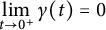 $\lim \limits _{t\rightarrow 0^+}\gamma (t)=0$
and satisfies that
 $$ \begin{align} \textit{there~ exist~ positive ~constants}~ C^{(1)}_1~ and~ C^{(1)}_2 ~\textit{such~ that}~ C^{(1)}_1\leq\left|\frac{t\gamma'(t)}{\gamma(t)}\right|\leq C^{(1)}_2~ \textit{on}~ \mathbb{R}^+. \end{align} $$
Then, for any
 $\varepsilon>0$
, there exist positive constants
 $t_{1,\varepsilon }\in (0,1)$
and
 $t_{2,\varepsilon }\in (1,\infty )$
, such that
 $$ \begin{align*}\begin{cases} |\gamma(t)|\in(t^{\omega_{0,2}+\varepsilon},t^{\omega_{0,1}-\varepsilon})~ &\textrm{for}~ \textrm{all} ~t\in(0,t_{1,\varepsilon}); \\ |\gamma(t)|\in(t^{\omega_{\infty,1}-\varepsilon},t^{\omega_{\infty,2}+\varepsilon})~ &\textrm{for}~ \textrm{all} ~t\in(t_{2,\varepsilon},\infty), \end{cases}\end{align*} $$
where the definitions of
 $\omega _{0,1}$
,
 $\omega _{0,2}$
,
 $\omega _{\infty ,1}$
and
 $\omega _{\infty ,2}$
can be found in (H.).
Proof We first show
 $\omega _{0,1}, \omega _{0,2}, \omega _{\infty ,1}, \omega _{\infty ,2}\in (0,\infty )$
. Indeed, it follows from Liu, Song, and Yu [Reference Liu, Song and Yu35, Remark 1.4] that
 $$ \begin{align} e^{\frac{C^{(1)}_{1}}{2}}\leq \frac{|\gamma(2t)|}{|\gamma(t)|}\leq e^{C^{(1)}_{2}} \end{align} $$
for all
 $t\in \mathbb {R}^+$
, we then have
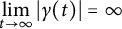 $\lim \limits _{t\rightarrow \infty }|\gamma (t)|=\infty $
. This, combined with
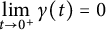 $\lim \limits _{t\rightarrow 0^+}\gamma (t)=0$
, by l’Hôpital’s Rule and (2.2), leads to
 $$ \begin{align*} \frac{C^{(1)}_1}{2}\leq{\frac{\ln{|\gamma(t)|}}{\ln t}}\leq 2C^{(1)}_2 \end{align*} $$
holds for all
 $t\in (0, A)\cup (A^{-1}, \infty )$
, where A is a positive constant. Furthermore, from the supremum and infimum principle, we can find that
 $\omega _{0,1}, \omega _{0,2}, \omega _{\infty ,1}, \omega _{\infty ,2}\in [\frac {C^{(1)}_1}{2}, 2C^{(1)}_2] \subset (0,\infty )$
.
From the definitions of
 $\omega _{0,1}$
and
 $\omega _{0,2}$
, we see that
 $$ \begin{align*}\omega_{0,1}=\sup\limits_{\tau\in (0, 1)}\inf\limits_{t\in (0, \tau)}\frac{\ln|\gamma(t)|}{\ln t} ~~\textrm{and} ~~\omega_{0,2}=\inf\limits_{\tau\in (0,1)}\sup\limits_{t\in (0,\tau)}\frac{\ln|\gamma(t)|}{\ln t}.\end{align*} $$
Then, for any
 $\varepsilon>0$
, there exists a positive constant
 $t_{1,\varepsilon }\in (0,1)$
such that
 $$ \begin{align*}\inf\limits_{t\in (0, t_{1,\varepsilon})}\frac{\ln|\gamma(t)|}{\ln t}\in(\omega_{0,1}-\varepsilon, \omega_{0,1}]~~ \textrm{and} ~~\sup_{t\in (0, t_{1,\varepsilon})}\frac{\ln|\gamma(t)|}{\ln t}\in [\omega_{0,2}, \omega_{0,2}+\varepsilon),\end{align*} $$
which implies that
 $$ \begin{align*}\omega_{0,1}-\varepsilon<\frac{\ln|\gamma(t)|}{\ln t}<\omega_{0,2}+\varepsilon\end{align*} $$
for all
 $t\in (0, t_{1,\varepsilon })$
. Therefore,
 $$ \begin{align*} |\gamma(t)|=t^{\log_t {|\gamma(t)|}}=t^{\frac{\ln |\gamma(t)|}{\ln t}}\in(t^{\omega_{0,2}+\varepsilon},t^{\omega_{0,1}-\varepsilon}) \end{align*} $$
for all
 $t\in (0, t_{1,\varepsilon })$
. Similarly, for the same
 $\varepsilon $
, there exists a positive constant
 $t_{2,\varepsilon }\in (1,\infty )$
such that
 $$ \begin{align*}\omega_{\infty,1}-\varepsilon<\frac{\ln|\gamma(t)|}{\ln t}<\omega_{\infty,2}+\varepsilon\end{align*} $$
for all
 $t\in (t_{2,\varepsilon }, \infty )$
, which leads to
 $$ \begin{align*} |\gamma(t)|\in(t^{\omega_{\infty,1}-\varepsilon},t^{\omega_{\infty,2}+\varepsilon}) \end{align*} $$
for all
 $t\in (t_{2,\varepsilon }, \infty )$
. Therefore, we finish the proof of Lemma 2.1.
Based on this Lemma 2.1, we now turn to the study of an almost sharp
 $L^p(\mathbb {R})\rightarrow L^q(\mathbb {R})$
estimate for
 $I_{\alpha ,\gamma }$
defined in (2.1).
Lemma 2.2 Let
 $\gamma $
be the same as in Lemma 2.1 with
 $\omega _{0,2}\leq \omega _{\infty ,1}$
, and
 $1<p<q<\infty $
satisfy
 $$ \begin{align*} \frac{1}{p}-\frac{1}{q}=\frac{\alpha}{M} ~~~~~~with~ M\in (\omega_{0,2}, \omega_{\infty,1}). \end{align*} $$
Then,Footnote
1
there exists a positive constant C, such that for all
 $f\in L^p(\mathbb {R})$
,
 $$ \begin{align} \left\|I_{\alpha,\gamma}f\right\|_{L^{q}(\mathbb{R})} \leq C \|f\|_{L^{p}(\mathbb{R})}. \end{align} $$
On the other hand, suppose that the estimate (2.4) holds. Then p and q satisfy
 $$ \begin{align*} \frac{1}{p}-\frac{1}{q}=\frac{\alpha}{N}~~~~~~with~N\in [\omega_{0,1}, \omega_{\infty,2}]. \end{align*} $$
Proof For any
 $\varepsilon>0$
, using the positive constants
 $t_{1,\varepsilon }\in (0,1)$
and
 $t_{2,\varepsilon }\in (1,\infty )$
in Lemma 2.1, we decompose
 $$ \begin{align*} I_{\alpha,\gamma}f(x)=\left(\int_{0}^{t_{1,\varepsilon}} + \int_{t_{1,\varepsilon}}^{t_{2,\varepsilon}} + \int_{t_{2,\varepsilon}}^{\infty} \right)\left|f(x-\gamma(t))\right|\,\frac{\textrm{d}t}{t^{1-\alpha}}=:I^{(1)}f(x)+I^{(2)}f(x)+I^{(3)}f(x). \end{align*} $$
Without loss of generality, we can assume that
 $\gamma $
is increasing on
 $\mathbb {R}^+$
. For
 $I^{(2)}f$
, by a change of variables and Young’s inequality, it is easy to see that there exists a positive constant
 $C_{\varepsilon }$
such that
 $$ \begin{align*}\left\|I^{(2)}f\right\|_{L^{q}(\mathbb{R})} \leq C_{\varepsilon} \|f\|_{L^{p}(\mathbb{R})}\end{align*} $$
holds for all
 $1\leq p\leq q\leq \infty $
. Let
 $M_{\varepsilon }\in [\omega _{0,2}+\varepsilon , \omega _{\infty ,1}-\varepsilon ]$
. For
 $I^{(1)}f$
, by a changes of variables and Lemma 2.1, noticing the trivial fact that
 $(\gamma ^{-1})'(t)\cdot \gamma '(\gamma ^{-1}(t))=1$
and (2.2), we get the following estimate
 $$ \begin{align*} I^{(1)}f(x)\leq \frac{1}{C^{(1)}_1} \int_{0}^{\gamma(t_{1,\varepsilon})}|f(x-\omega)|\cdot(\gamma^{-1}(\omega))^{\alpha}\,\frac{\textrm{d}\omega}{\omega} \leq \frac{1}{C^{(1)}_1} \int_{0}^{\gamma(t_{1,\varepsilon})}|f(x-\omega)|\,\frac{\textrm{d}\omega}{\omega^{1-{\frac{\alpha}{M_{\varepsilon}}}}}. \end{align*} $$
Moreover, by the Hardy–Littlewood–Sobolev inequality in Stein [Reference Stein42], we can obtain that
 $$ \begin{align*}\left\|I^{(1)}f\right\|_{L^{q}(\mathbb{R})} \lesssim \|f\|_{L^{p}(\mathbb{R})}\end{align*} $$
for all
 $1<p<q<\infty $
satisfying
 $\frac {1}{p}-\frac {1}{q}=\frac {\alpha }{M_{\varepsilon }}$
. Similarly, we can obtain the same estimate for
 $I^{(3)}f$
. Since
 $\varepsilon $
was arbitrary, we deduce that (2.4) holds for all
 $1<p<q<\infty $
satisfying
 $\frac {1}{p}-\frac {1}{q}=\frac {\alpha }{M}$
.
On the other hand, suppose that the estimate (2.4) holds, then
 ${\frac {1}{p}}-{\frac {1}{q}}={\frac {\alpha }{N}}$
with
 $N\in [{\omega _{0,1}},{\omega _{\infty ,2}}]$
. Actually, let the dilation
 $f_{\delta }(x):=f(\delta x)$
with
 $\delta>0$
, we see that
 $\|f_{\delta }\|_{L^{p}(\mathbb {R})}={\delta }^{-{\frac {1}{p}}}\|f\|_{L^{p}(\mathbb {R})}$
. Moreover, by a change of variables and Lemma 2.1, it is clear that
 $$ \begin{align*} I_{\alpha,\gamma}(f_{\delta})(x)&\gtrsim \left(\int_{0}^{\delta t_{1,\varepsilon}}+ \int_{\delta t_{1,\varepsilon}}^{\delta t_{2,\varepsilon}}+ \int_{\delta t_{2,\varepsilon}}^{\infty}\right) |f(\delta x-\omega)|\left(\gamma^{-1}\left(\frac{\omega}{\delta}\right)\right)^{\alpha}\,\frac{\textrm{d}\omega}{\omega} \\ &\gtrsim \int_{0}^{\delta t_{1,\varepsilon}}|f(\delta x-\omega)|\left({{\frac{\omega}{\delta}}}\right)^{\frac{\alpha}{\omega_{0,1}-\varepsilon}}\,\frac{\textrm{d}\omega}{\omega} +\int_{\delta t_{2,\varepsilon}}^{+\infty}|f(\delta x-\omega)|\left({{\frac{\omega}{\delta}}}\right)^{\frac{\alpha}{\omega_{\infty,2}+\varepsilon}}\,\frac{\textrm{d}\omega}{\omega}. \end{align*} $$
We then have
 $$ \begin{align*}I_{\alpha,\gamma}(f_{\delta})(x)\gtrsim\delta^{-\frac{\alpha}{\omega_{0,1}-\varepsilon}}\int_{0}^{\delta t_{1,\varepsilon}}|f(\delta x-\omega)|\,\frac{\textrm{d}\omega}{\omega^{1-{\frac{\alpha}{\omega_{0,1}-\varepsilon}}}},\end{align*} $$
which leads to
 $$ \begin{align*}\left\|\int_{0}^{\delta t_{1,\varepsilon}}|f(\delta x-\omega)|\,\frac{\textrm{d}\omega}{\omega^{1-{\frac{\alpha}{\omega_{0,1}-\varepsilon}}}}\right\|_{L^{q}(\mathbb{R})} \lesssim\delta^{\frac{\alpha}{\omega_{0,1}-\varepsilon}}\|I_{\alpha,\gamma}(f_{\delta})\|_{L^{q}(\mathbb{R})} \lesssim\delta^{\frac{\alpha}{\omega_{0,1}-\varepsilon}}{\delta}^{-{\frac{1}{p}}}\|f\|_{L^{p}(\mathbb{R})}.\end{align*} $$
Furthermore, we claim that the following holds:
 $$ \begin{align*}\left\|\int_{0}^{\delta t_{1,\varepsilon}}|f(x-\omega)|\,\frac{\textrm{d}\omega}{\omega^{1-{\frac{\alpha}{\omega_{0,1}-\varepsilon}}}}\right\|_{L^{q}(\mathbb{R})} \lesssim\delta^{\frac{\alpha}{\omega_{0,1}-\varepsilon}-\frac{1}{p}+ \frac{1}{q}}\|f\|_{L^{p}(\mathbb{R})}.\end{align*} $$
Let
 $\delta \rightarrow \infty $
, then one has
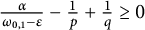 ${\frac {\alpha }{\omega _{0,1}-\varepsilon }}-{\frac {1}{p}}+{\frac {1}{q}}\geq 0$
. Otherwise, the right side is
 $0$
, this yields a contradiction. Therefore,
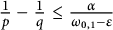 ${\frac {1}{p}}-{\frac {1}{q}}\leq {\frac {\alpha }{\omega _{0,1}-\varepsilon }}$
. Since
 $\varepsilon $
was arbitrary, we conclude that
 $\frac {1}{p}-\frac {1}{q}\leq \frac {\alpha }{\omega _{0,1}}$
. Similarly, we also have
 $$ \begin{align*}I_{\alpha,\gamma}(f_{\delta})(x)\geq\delta^{-\frac{\alpha}{\omega_{\infty,2}+\varepsilon}}\int_{\delta t_{2,\varepsilon}}^{+\infty}|f(\delta x-\omega)|\,\frac{\textrm{d}\omega}{\omega^{1-{\frac{\alpha}{\omega_{\infty,2}+\varepsilon}}}},\end{align*} $$
the above implies that p and q satisfying
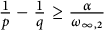 ${\frac {1}{p}-\frac {1}{q}\geq \frac {\alpha }{\omega _{\infty ,2}}}$
. Therefore, p and q satisfy
 $\frac {1}{p}-\frac {1}{q}=\frac {\alpha }{N}$
with
 $N\in [\omega _{0,1}, \omega _{\infty ,2}]$
, this concludes the proof of Lemma 2.2.
From the proof of Lemma 2.2, we have the following remark to show the equivalent condition of Lemma 2.2 for a class of new curves.
Remark 2.3 Assume that
 $\gamma \in C^{1}(\mathbb {R}^+)$
,
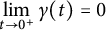 $\lim \limits _{t\rightarrow 0^+}\gamma (t)=0$
, and there exist positive constants
 $0<A\leq B<\infty $
and
 $0<a\leq b<\infty $
such that
 $\gamma (t)\approx t^{a}$
,
 $t\in (0,A)$
and
 $\gamma (t)\approx t^{b}$
,
 $t\in (B,\infty )$
, whichFootnote
2
implies that
 $\omega _{0,1}=\omega _{0,2}=a$
and
 $\omega _{\infty ,1}=\omega _{\infty ,2}=b$
. Then, there exists a positive constant C such that for all
 $f\in L^{p}(\mathbb {R})$
, the estimate
 $$ \begin{align*} \left\|I_{\alpha,\gamma}f\right\|_{L^{q}(\mathbb{R})}\leq C\|f\|_{L^{p}(\mathbb{R})} \end{align*} $$
holds, if and only if p and q satisfy
 $$ \begin{align*}{\frac{1}{p}}-{\frac{1}{q}}\in \left[{\frac{\alpha}{b}},{\frac{\alpha}{a}}\right].\end{align*} $$
In addition, if
 $a>b$
, then
 $I_{\alpha ,\gamma }$
has no the corresponding
 $L^{p}(\mathbb {R})\rightarrow L^{q}(\mathbb {R})$
boundedness.
2.2 Some restricted weak type estimates for
$H_{\alpha ,\gamma }$

We now establish some restricted weak type estimates for
 $H_{\alpha ,\gamma }$
in the following Proposition 2.4. The definition of the restricted weak type estimate can be found in Grafakos [Reference Grafakos11]. More clearly, let
 $0<p_1,\ldots ,p_m,p\leq \infty $
, we say that an m-linear operator T is of restricted weak type
 $(p_1,\ldots ,p_m,p)$
if there is a constant
 $C=C(p_1,\ldots ,p_m,p)$
such that for all measurable subsets
 $A_1,\ldots ,A_m$
of finite measure we have
 $$ \begin{align*} \sup\limits_{\lambda>0}\left|\{x\in \mathbb{R}^n :\ |T(\chi_{A_1},\ldots,\chi_{A_m})(x) |>\lambda \}\right|{}^{\frac{1}{p}}\leq C |A_1|^{\frac{1}{p_1}}\cdots |A_m|^{\frac{1}{p_m}} \end{align*} $$
when
 $0<p<\infty $
and
 $$ \begin{align*} \left\|T(\chi_{A_1},\ldots,\chi_{A_m})\right\|_{L^{\infty}(\mathbb{R}^n)}\leq C |A_1|^{\frac{1}{p_1}}\cdots |A_m|^{\frac{1}{p_m}} \end{align*} $$
when
 $p=\infty $
. A operator is of restricted weak type
 $(p,q,r)$
at some points, by [Reference Grafakos11, Theorem 7.2.2] or [Reference Li and Liu26, Theorem 2.1], which in fact implies the
 $L^p(\mathbb {R})\times L^q(\mathbb {R}) \rightarrow L^{r}(\mathbb {R})$
boundedness of this operator on the corresponding open convex hull of these points.
Proposition 2.4 Let
 $\gamma $
be the same as in Lemma 2.1 with
 $\alpha \leq \omega _{0,2}\leq \omega _{\infty ,1}$
. Then
 $H_{\alpha ,\gamma }(f,g)$
is of restricted weak types
 $({\frac {1}{\alpha }},\infty ,\infty )$
,
 $(1,\infty ,{\frac {1}{1-\alpha }})$
,
 $(\infty ,{\frac {M}{\alpha }},\infty )$
, and
 $(\infty ,1,{\frac {M}{M-\alpha }})$
with
 $M\in (\omega _{0,2}, \omega _{\infty ,1})$
.
Proof We split the following four parts to finish our proofs:
-
⋆ Consider the restricted weak type
$({\frac {1}{\alpha }},\infty ,\infty )$
. Take
$f=\chi _{A}$
and
$g=\chi _{B}$
, where
${A, B\subset \mathbb {R}}$
are measurable sets of finite measure, by the Exercises 1.4.1 in Grafakos [Reference Grafakos10], it implies (2.5)
$$ \begin{align} \left\|H_{\alpha,\gamma}(\chi_{A},\chi_{B})\right\|_{L^{\infty}(\mathbb{R})} \lesssim \sup\limits_{x\in{\mathbb{R}}} \int_{x-A} |t|^{\alpha-1}\,\textrm{d}t \lesssim \int_{ |t|\lesssim |A| } |t|^{\alpha-1}\,\textrm{d}t \lesssim|A|^{\alpha}. \end{align} $$
We then have that
$H_{\alpha ,\gamma }(f,g)$
is restricted weak type
$({\frac {1}{\alpha }},\infty ,\infty )$
. -
⋆ Consider the restricted weak type
$(1,\infty ,{\frac {1}{1-\alpha }})$
. From Lemma 2.2 and Remark 2.3, let us set
$\gamma (t):=t$
in (2.1), we may obtain that holds, if and only if p and q satisfy
$$ \begin{align*} \left\|I_{\alpha,t}f\right\|_{L^{q}(\mathbb{R})} \lesssim \|f\|_{L^{p}(\mathbb{R})} \end{align*} $$
where
$$ \begin{align*}{\frac{1}{p}}-{\frac{1}{q}}=\alpha,\end{align*} $$
$$ \begin{align*} I_{\alpha,t}f(x):=\int_{0}^{\infty}\left|f(x-t)\right|\,\frac{\textrm{d}t}{t^{1-\alpha}}. \end{align*} $$
Therefore,
which implies that
$$ \begin{align*} \left\|H_{\alpha,\gamma}(\chi_{A},\chi_{B})\right\|_{L^{\frac{1}{1-\alpha}}(\mathbb{R})} \lesssim \left\|I_{\alpha,t}\chi_{A}\right\|_{L^{\frac{1}{1-\alpha}}(\mathbb{R})}\lesssim \left\|\chi_{A}\right\|_{L^{1}(\mathbb{R})} \lesssim|A|, \end{align*} $$
$H_{\alpha ,\gamma }(f,g)$
is restricted weak type
$(1,\infty ,{\frac {1}{1-\alpha }})$
.
-
⋆ Consider the restricted weak type
$(\infty ,{\frac {M}{\alpha }},\infty )$
. It is easy to see that (2.6)
$$ \begin{align} \left\|H_{\alpha,\gamma}(\chi_{A},\chi_{B})\right\|_{L^{\infty}(\mathbb{R})} \lesssim \left\|I_{\alpha,\gamma}\chi_{B}\right\|_{L^{\infty}(\mathbb{R})}. \end{align} $$
For any
$\varepsilon>0$
, as in Lemma 2.2, we can conclude that (2.7)where the definition of
$$ \begin{align} I_{\alpha,\gamma}\chi_{B}(x) \lesssim I_{\frac{\alpha}{M_{\varepsilon}},t}\chi_{B}(x) +I^{(2)}\chi_{B}(x), \end{align} $$
$I^{(2)}$
can be found in Lemma 2.2. Moreover, by (2.5), we obtain that
$\|I_{\frac {\alpha }{M_{\varepsilon }},t}\chi _{B}\|_{L^{\infty }(\mathbb {R})}$
can be bounded from above by
$|B|^{\frac {\alpha }{M_{\varepsilon }}}$
, and the same estimate also holds for
$I^{(2)}\chi _{B}$
since
$\omega _{0,2}\geq \alpha $
. Therefore, from (2.6) and (2.7), it follows that
$$ \begin{align*} \left\|H_{\alpha,\gamma}(\chi_{A},\chi_{B})\right\|_{L^{\infty}(\mathbb{R})} \lesssim |B|^{\frac{\alpha}{M_{\varepsilon}}}. \end{align*} $$
Since
$\varepsilon $
was arbitrary, we deduce that
$H_{\alpha ,\gamma }(f,g)$
is restricted weak type
$(\infty ,{\frac {M}{\alpha }},\infty )$
. -
⋆ Consider the restricted weak type
$(\infty ,1,{\frac {M}{M-\alpha }})$
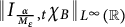
. By Lemma 2.2, we can see that which further implies that
$$ \begin{align*} \left \|H_{\alpha,\gamma}(\chi_{A},\chi_{B})\right\|_{L^{\frac{M}{M-\alpha}}(\mathbb{R})} \lesssim \left \|I_{\alpha,\gamma}\chi_{B}\right\|_{L^{\frac{M}{M-\alpha}}(\mathbb{R})}\lesssim \left \|\chi_{B}\right\|_{L^1(\mathbb{R})}\lesssim |B|, \end{align*} $$
$H_{\alpha ,\gamma }(f,g)$
is restricted weak type
$(\infty ,1,{\frac {M}{M-\alpha }})$
.




Therefore, putting things together we finish the proof of Proposition 2.4.
As in Remark 2.3, we also have the following remark.
Remark 2.5 Let
 $\gamma $
be the same as in Remark 2.3. Then
 $H_{\alpha ,\gamma }(f,g)$
is of restricted weak types
 $({\frac {1}{\alpha }},\infty ,\infty )$
,
 $(1,\infty ,{\frac {1}{1-\alpha }})$
,
 $(\infty ,{\frac {M}{\alpha }},\infty )$
and
 $(\infty ,1,{\frac {M}{M-\alpha }})$
with
 $M\in [a, b]$
.
3 A uniform estimate for
$H_{\alpha ,\gamma ,j}$

In this section, we devote to establish a uniform estimate for
 $H_{\alpha ,\gamma ,j}$
, which comes from a decomposition of
 $H_{\alpha ,\gamma }$
. Indeed, without loss of generality, we can assume
 $f, g\geq 0$
and decompose
 $$ \begin{align*} H_{\alpha,\gamma}(f,g)(x)=\sum_{j \in \mathbb{Z}}\int_{2^{j-1}}^{2^j}f(x-t)g(x-\gamma(t))\,\frac{\textrm{d}t}{t^{1-\alpha}}\lesssim \sum_{j \in \mathbb{Z}}2^{(\alpha-1)j}H_{\alpha,\gamma,j}(f,g)(x), \end{align*} $$
where
 $$ \begin{align} H_{\alpha,\gamma,j}(f,g)(x):=\int_{2^{j-1}}^{2^j}f(x-t)g(x-\gamma(t))\,\textrm{d}t. \end{align} $$
For estimating
 $H_{\alpha ,\gamma ,j}$
, it is natural to use the theory of oscillatory integrals and stationary phase estimates. From
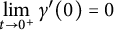 $\lim \limits _{t\rightarrow 0^+}\gamma '(0)=0$
and (1.3), it implies that
 $|\gamma '(t)|$
is strictly increasing on
 $t\in \mathbb {R}^+$
. As in Liu, Song, and Yu [Reference Liu, Song and Yu35, Remark 1.4], by letting
 $G(t):=\ln |\gamma '(t)|$
, we claim that
 $$ \begin{align} \frac{|\gamma'(2t)|}{|\gamma'(t)|}\geq e^{C_0 } \end{align} $$
holds for all
 $t\in \mathbb {R}^+$
with
 $C_0:=\frac {C^{(2)}_{1}}{2C^{(1)}_{2}}$
, which further implies that
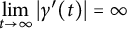 $\lim \limits _{t\rightarrow \infty }|\gamma '(t)|=\infty $
. Therefore, we may assume that
 $|\gamma '(1)|>1 $
by the dilation
 $f_{\delta }(x):=f(\delta x)$
and (1.3). Furthermore, the change of variables
 $u=x-t$
and
 $v=x-\gamma (t)$
yields that the Jocobian
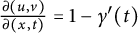 ${\frac {\partial (u,v)}{\partial (x,t)}}=1-\gamma '(t)$
, and then there exists at most one stationary point
 $t_0$
satisfying
 $\gamma '(t_0)=1$
and
 $t_0\in (2^{j_0},2^{j_{0}+1}]$
for some negative integer
 $j_0$
small enough. We shall consider two cases: non-critical case and critical caseFootnote
3
in the following Propositions 3.1 and 3.2, respectively.
Proposition 3.1 (Non-critical case
 $j\neq j_0, j_0+1, j_0+2$
) Assume that
 $\gamma \in C^2(\mathbb {R}^+)$
is monotonic on
 $\mathbb {R}^+$
,
 $\lim \limits _{t\rightarrow 0^+}\gamma (t)=\lim \limits _{t\rightarrow 0^+}\gamma '(0)=0$
,
 $\omega _{0,1}, \omega _{\infty ,1}> 1$
, and satisfy (1.3). Then, there exists a positive constant C, such that
 $$ \begin{align*}\left\|H_{\alpha,\gamma,j}(f,g)\right\|_{L^{r}(\mathbb{R})}\leq C 2^j\|f\|_{L^{p}(\mathbb{R})}\|g\|_{L^{q}(\mathbb{R})}\end{align*} $$
for all
 $f\in L^{p}(\mathbb {R})$
and
 $g\in L^{q}(\mathbb {R})$
, where
 $p,q,r$
satisfy
 $\frac {1}{p}+\frac {1}{q}=\frac {1}{r}$
and
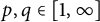
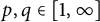 $p, q \in [1, \infty ]$
.
Proof We first consider the
 $L^1(\mathbb {R})\times L^1(\mathbb {R}) \rightarrow L^{\frac {1}{2}}(\mathbb {R})$
estimate for
 $H_{\alpha ,\gamma ,j}$
. If
 $j<j_0$
, then
 $$ \begin{align*}\left|{\frac{\partial(u,v)}{\partial(x,t)}}\right|=|1-\gamma'(t)|\geq 1-|\gamma'(t)|>1-|\gamma'(2^{j_0})|\gtrsim 1,\end{align*} $$
and furthermore, the change of variables
 $u=x-t$
and
 $v=x-\gamma (t)$
yields that
 $$ \begin{align} \left\|H_{\alpha,\gamma,j}(f,g)\right\|_{L^{1}(\mathbb{R})}\lesssim \int_{\mathbb{R}}\int_{\mathbb{R}} f(u)g(v){\frac{1}{|1-\gamma'(t)|}}\,\textrm{d}u\textrm{d}v\lesssim \|f\|_{L^{1}(\mathbb{R})}\|g\|_{L^{1}(\mathbb{R})}. \end{align} $$
On the other hand, for any measurable set E with finite measure, apply Hölder’s inequality and (3.3) to deduce that
 $$ \begin{align} \left\|H_{\alpha,\gamma,j}(f,g)\chi_{E}\right\|_{L^{\frac{1}{2}}(\mathbb{R})}\leq |E|\left\|H_{\alpha,\gamma,j}(f,g)\right\|_{L^{1}(\mathbb{R})}\lesssim |E|\|f\|_{L^{1}(\mathbb{R})}\|g\|_{L^{1}(\mathbb{R})}. \end{align} $$
Let the interval
 $I_k:=((k-1)2^j,k2^j]$
with
 $k\in \mathbb {Z}$
. It is easy to check that
 $H_{\alpha ,\gamma ,j}(f \chi _{I_{k}},g\chi _{I_{k+d}})(x)$
is supported in a finitely many terms of these intervals and
 $H_{\alpha ,\gamma ,j}(f \chi _{I_{k}},g\chi _{I_{k+d}})(x)=0$
when
 $|d|>3$
for every fixed
 $k\in \mathbb {Z}$
. Therefore, by (3.4), we conclude that
 $$ \begin{align*} \left\|H_{\alpha,\gamma,j}(f \chi_{I_{k}},g\chi_{I_{k+d}})\right\|_{L^{\frac{1}{2}}(\mathbb{R})}\lesssim 2^j\left\|f \chi_{I_{k}}\right\|_{L^{1}(\mathbb{R})}\left\|g\chi_{I_{k+d}}\right\|_{L^{1}(\mathbb{R})}, \end{align*} $$
which, together with the triangle inequality and the Cauchy–Schwarz inequality, shows that
 $$ \begin{align} &\left\|H_{\alpha,\gamma,j}(f,g)\right\|_{L^{\frac{1}{2}}(\mathbb{R})} =\left\|\sum\limits_{d\in\mathbb{Z},~|d|\leq 3}\sum\limits_{k\in\mathbb{Z}}H_{\alpha,\gamma,j}(f \chi_{I_{k}},g\chi_{I_{k+d}})\right\|_{L^{\frac{1}{2}}(\mathbb{R})} \\ &\quad\leq \sum\limits_{d\in\mathbb{Z},~|d|\leq 3} \left[\sum\limits_{k\in\mathbb{Z}} \left\|H_{\alpha,\gamma,j}(f \chi_{I_{k}},g\chi_{I_{k+d}})\right\|^{\frac{1}{2}}_{L^{\frac{1}{2}}(\mathbb{R})} \right]^2\nonumber\\ &\quad\lesssim 2^j \sum\limits_{d\in\mathbb{Z},~|d|\leq 3} \left[\sum\limits_{k\in\mathbb{Z}} \left(\left\|f \chi_{I_{k}}\right\|_{L^{1}(\mathbb{R})}\left\|g\chi_{I_{k+d}}\right\|_{L^{1}(\mathbb{R})} \right)^{\frac{1}{2}} \right]^2\lesssim 2^j\|f\|_{L^{1}(\mathbb{R})}\|g\|_{L^{1}(\mathbb{R})}.\nonumber \end{align} $$
This is the desired
 $L^1(\mathbb {R})\times L^1(\mathbb {R}) \rightarrow L^{\frac {1}{2}}(\mathbb {R})$
estimate for
 $H_{\alpha ,\gamma ,j}$
in the case of
 $j<j_0$
.
We now turn to the case of
 $j>j_{0}+2$
. An easy calculation gives
 $$ \begin{align*}\left|{\frac{\partial(u,v)}{\partial(x,t)}}\right|\geq|\gamma'(t)|-1\geq|\gamma'(2^{j-1})|-1\geq|\gamma'(2^{j_0+2})|-|\gamma'(2^{j_0+1})|\gtrsim 1.\end{align*} $$
Taking this into account one can see that
 $$ \begin{align*} \left\|H_{\alpha,\gamma,j}(f,g)\right\|_{L^{1}(\mathbb{R})}\lesssim \frac{1}{|\gamma'(2^{j-1})|-1}\|f\|_{L^{1}(\mathbb{R})}\|g\|_{L^{1}(\mathbb{R})}. \end{align*} $$
As in (3.4), noticing that
 $|\gamma '(2^{j-1})|-1 \gtrsim |\gamma '(2^{j-1})|$
for
 $j>j_{0}+2$
, thus we have an estimate
 $$ \begin{align} \left\|H_{\alpha,\gamma,j}(f,g)\chi_{E}\right\|_{L^{\frac{1}{2}}(\mathbb{R})}\lesssim \frac{|E|}{|\gamma'(2^{j-1})|}\|f\|_{L^{1}(\mathbb{R})}\|g\|_{L^{1}(\mathbb{R})}. \end{align} $$
From
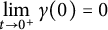 $\lim \limits _{t\rightarrow 0^+}\gamma (0)=0$
and (1.3), it shows that
 $|\gamma (t)|$
is strictly increasing on
 ${t\in \mathbb {R}^+}$
. We also from (2.3) have
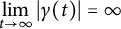 $\lim \limits _{t\rightarrow \infty }|\gamma (t)|=\infty $
. Then, we can split
 $\mathbb {R}$
as a union of intervals
 $J_k:=((k-1)|\gamma (2^j)|,k|\gamma (2^j)|]$
with
 $k\in \mathbb {Z}$
. Furthermore, one sees that
 $H_{\alpha ,\gamma ,j}(f \chi _{J_{k}},g\chi _{J_{k+d}})(x)$
is supported in a finitely many terms of these intervals, and there exists a universal constant C such that
 $H_{\alpha ,\gamma ,j}(f \chi _{J_{k}},g\chi _{J_{k+d}})(x)=0$
when
 $|d|>C$
for every fixed
 $k\in \mathbb {Z}$
. Indeed, we may take
 $C:=\max \{-2+\frac {C^{(1)}_2}{2},1+2^{{j_0}+2}\}$
. Therefore, by (3.6), (2.3) and (1.3), we obtain
 $$ \begin{align*} &\left\|H_{\alpha,\gamma,j}(f \chi_{J_{k}},g\chi_{J_{k+d}})\right\|_{L^{\frac{1}{2}}(\mathbb{R})}\\&\quad\lesssim \frac{|\gamma(2^j)|}{|\gamma'(2^{j-1})|} \left\|f \chi_{J_{k}}\right\|_{L^{1}(\mathbb{R})}\left\|g\chi_{J_{k+d}}\right\|_{L^{1}(\mathbb{R})}\lesssim 2^j\left\|f \chi_{J_{k}}\right\|_{L^{1}(\mathbb{R})}\left\|g\chi_{J_{k+d}}\right\|_{L^{1}(\mathbb{R})}. \end{align*} $$
Furthermore, as in (3.5), we also assert that
 $$ \begin{align} \left\|H_{\alpha,\gamma,j}(f,g)\right\|_{L^{\frac{1}{2}}(\mathbb{R})}\lesssim2^j\|f\|_{L^{1}(\mathbb{R})}\|g\|_{L^{1}(\mathbb{R})} \end{align} $$
holds for all
 $j>j_{0}+2$
.
Putting things together, for the non-critical case
 $j\neq j_0, j_0+1, j_0+2$
, we have established the
 $L^1(\mathbb {R})\times L^1(\mathbb {R}) \rightarrow L^{\frac {1}{2}}(\mathbb {R})$
estimate for
 $H_{\alpha ,\gamma ,j}$
. The remaining
 $L^p(\mathbb {R})\times L^q(\mathbb {R}) \rightarrow L^r(\mathbb {R})$
estimates follow by interpolation with the following three trivial estimates:
 $L^\infty (\mathbb {R})\times L^\infty (\mathbb {R}) \rightarrow L^\infty (\mathbb {R})$
,
 $L^\infty (\mathbb {R})\times L^1(\mathbb {R}) \rightarrow L^1(\mathbb {R})$
and
 $L^1(\mathbb {R})\times L^\infty (\mathbb {R}) \rightarrow L^1(\mathbb {R})$
. Therefore, we finish the proof of Proposition 3.1.
Proposition 3.2 (Critical cases
 $j= j_0, j_0+1, j_0+2$
) Let
 $\gamma $
be the same as in Proposition 3.1. Then, there exists a positive constant C, such that
 $$ \begin{align*}\left\|H_{\alpha,\gamma,j}(f,g)\right\|_{L^{r}(\mathbb{R})}\leq C \|f\|_{L^{p}(\mathbb{R})}\|g\|_{L^{q}(\mathbb{R})}\end{align*} $$
for all
 $f\in L^{p}(\mathbb {R})$
and
 $g\in L^{q}(\mathbb {R})$
, where
 $p,q,r$
satisfy
 $\frac {1}{p}+\frac {1}{q}=\frac {1}{r}$
,
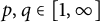
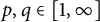 $p, q \in [1, \infty ]$
and
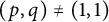 $(p,q)\neq (1,1)$
.
Proof We only consider the case
 $j= j_0$
, the proofs of the cases
 $j=j_0+1, j_0+2$
are similar to the case
 $j= j_0$
and we omit the details. Since
 $j_0$
is a negative integer, we can bound
 $H_{\alpha ,\gamma ,j_0}(f,g)(x)$
by
 $$ \begin{align*}\int_{0}^{1}f(x-t)g(x-\gamma(t))\,\textrm{d}t.\end{align*} $$
Moreover, we can restrict x into the interval
 $[0,1]$
. Indeed, let
 $f_N(x):=f(x+N)$
and
 $g_N(x):=g(x+N)$
if we have the restriction of x, then
 $\|H_{\alpha ,\gamma ,j_0}(f,g)\|^r_{L^{r}(\mathbb {R})}$
can be dominated by a constant times
 $$ \begin{align*} &\sum\limits_{N\in\mathbb{Z}}\int_{0}^{1}\left(\int_{0}^{1}f_N(x-t)g_N(x-\gamma(t))\,\textrm{d}t\right)^r\,\textrm{d}x \\&\quad\lesssim \sum_{N\in\mathbb{Z}}\left\|f_{N}\right\|_{L^{p}(\mathbb{R})}^{r}\left\|g_{N}\right\|_{L^{q}(\mathbb{R})}^{r} \lesssim \|f\|_{L^{p}(\mathbb{R})}^{r}\|g\|_{L^{q}(\mathbb{R})}^{r}, \end{align*} $$
where the last inequality follows from Hölder’s inequality.
Therefore, it suffices to show that
 $$ \begin{align} \int_{0}^{1}\left(\int_{0}^{1}f(x-t)g(x-\gamma(t))\,\textrm{d}t\right)^r\,\textrm{d}x\lesssim \|f\|_{L^{p}(\mathbb{R})}^{r}\|g\|_{L^{q}(\mathbb{R})}^{r} \end{align} $$
for all
 $p,q,r$
satisfying
 $\frac {1}{p}+\frac {1}{q}=\frac {1}{r}$
,
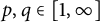 $p, q \in [1, \infty ]$
and
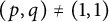 $(p,q)\neq (1,1)$
.
When
 $r\geq 1$
, it is easy to see that (3.8) follows from Minkowski’s integral inequality and Hölder’s inequality. When
 $\frac {1}{2}<r<1$
, we need some more complicated calculations. Indeed, let
 $\psi $
be a smooth function supported on
 $\{t\in \mathbb {R}:\ \frac {1}{2}\leq |t|\leq 2\}$
with the property that
 $0\leq \psi (t)\leq 1$
and
 $\Sigma _{k\in \mathbb {Z}} \psi _k(t)=1$
, where
 $\psi _k(t):=\psi (2^{-k}t)$
. In order to obtain (3.8) with
 $\frac {1}{2}<r<1$
, it suffices to establish the following estimate: there exists a positive constant
 $\varepsilon $
such that
 $$ \begin{align} \int_{0}^{1}\left[\int_{0}^{1}f(x-t)g(x-\gamma(t))\psi\left(2^{k}(t-t_{0})\right)\,\textrm{d}t\right]^r\,\textrm{d}x\lesssim 2^{-\varepsilon k}\|f\|_{L^{p}(\mathbb{R})}^{r}\|g\|_{L^{q}(\mathbb{R})}^{r} \end{align} $$
for all
 $k>0$
, where
 $p,q,r$
satisfy
 $\frac {1}{p}+\frac {1}{q}=\frac {1}{r}$
,
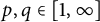 $p, q \in [1, \infty ]$
and
 $\frac {1}{2}<r<1$
.
We establish (3.9) by considering the following two cases:
-
• The case of
$2^{-k+2}\leq t_0$
. Notice that
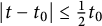
${\frac {1}{2}}\cdot 2^{-k}\leq |t-t_0|\leq 2\cdot 2^{-k}$
, it implies
$|t-t_0|\leq {\frac {1}{2}}t_0$
and we can then rewrite the left hand side of (3.9) as (3.10)where
$$ \begin{align} \int_{0}^{1}\left[\int_{-\frac{t_0}{2}}^{\frac{t_0}{2}}f_{t_0}(x-t)g_{t_0}\left(x-\Upsilon_{t_0}(t)\right)\psi\left(2^{k}t\right)\,\textrm{d}t\right]^r\,\textrm{d}x, \end{align} $$
$$ \begin{align*}f_{t_0}(x):=f(x-t_0), ~~g_{t_0}(x):=g(x-\gamma(t_0))~~ \textrm{and} ~~\Upsilon_{t_0}(t):=\gamma(t+t_{0})-\gamma(t_{0}).\end{align*} $$
On the other hand, we obviously have
$|t|\leq 2^{-k+1}$
. Moreover, by Lagrange’s mean value theorem,
$|\Upsilon _{t_0}(t)|\leq |\gamma '(\zeta )||t|\leq 2|\gamma '(2)|2^{-k}$
, where
$\zeta \in ({\frac {t_0}{2}},{\frac {3}{2}}t_0)\subset (0,2)$
. Then, if we set with
$$ \begin{align*} \Omega_{N}:=\left(2N|\gamma'(2)|2^{-k}, 2(N+1)|\gamma'(2)|2^{-k}\right] \end{align*} $$
$N=0,1,\ldots ,\lceil \frac {2^k}{2|\gamma '(2)|}\rceil $
, which trivially leads to
$x-t, x-\Upsilon _{t_0}(t)\in \Omega _{N-1}\cup \Omega _{N} \cup \Omega _{N+1}$
for all
$x\in \Omega _{N}$
.
Therefore, to obtain (3.9), it is enough to show that, there exists a positive constant
$\varepsilon $
such that (3.11)for all
$$ \begin{align} \left\|\Lambda_N(f_{t_0, N}, g_{t_0, N})\right\|_{L^{r}(\mathbb{R})}^{r}\lesssim 2^{-\varepsilon k}\|f_{t_0, N}\|_{L^{p}(\mathbb{R})}^{r}\|g_{t_0, N}\|_{L^{q}(\mathbb{R})}^{r} \end{align} $$
$k>0$
, where
$f_{t_0, N}:=f_{t_0}\chi _{\Omega _{N}}$
,
$g_{t_0, N}:=g_{t_0}\chi _{\Omega _{N}}$
and
$$ \begin{align*} \Lambda_N(f_{t_0, N}, g_{t_0, N})(x):=\chi_{\Omega_{N}}(x)\int_{-\frac{t_0}{2}}^{\frac{t_0}{2}}f_{t_0, N}(x-t)g_{t_0, N}\left(x-\Upsilon_{t_0}(t)\right)\psi\left(2^{k}t\right)\,\textrm{d}t. \end{align*} $$
Indeed, notice that
$\frac {1}{2}<r<1$
, from (3.10), by the triangle inequality, we can bound the left hand side of (3.9) by essentially. This, in combination with (3.11) and Hölder’s inequality, leads to the desired estimate (3.9).
$$ \begin{align*}\sum_{N\in [0, \lceil\frac{2^k}{2|\gamma'(2)|}\rceil]} \left\|\Lambda_N(f_{t_0, N}, g_{t_0, N})\right\|_{L^{r}(\mathbb{R})}^{r}\end{align*} $$
We now turn to the proof of (3.11) by establishing the following estimates:
-
∘ The
$L^1(\mathbb {R})\times L^\infty (\mathbb {R}) \rightarrow L^1(\mathbb {R})$
boundedness of
$\Lambda _N(f_{t_0, N}, g_{t_0, N})$
. A calculation gives
$$ \begin{align*} \left\|\Lambda_N(f_{t_0, N}, g_{t_0, N})\right\|_{L^{1}(\mathbb{R})}&\leq \|g_{t_0, N}\|_{L^{\infty}(\mathbb{R})}\int_{0}^{1}\chi_{\Omega_{N}}(x)\int_{-\frac{t_0}{2}}^{\frac{t_0}{2}}f_{t_0, N}(x-t)\psi\left(2^{k}t\right)\,\textrm{d}t\,\textrm{d}x\\ & \lesssim 2^{- k}\|f_{t_0, N}\|_{L^{1}(\mathbb{R})}\|g_{t_0, N}\|_{L^{\infty}(\mathbb{R})}. \end{align*} $$
-
∘ The
$L^{\infty }(\mathbb {R})\times L^1(\mathbb {R}) \rightarrow L^1(\mathbb {R})$
boundedness of
$\Lambda _N(f_{t_0, N}, g_{t_0, N})$
. One easily sees that
$$ \begin{align*} \left\|\Lambda_N(f_{t_0, N}, g_{t_0, N})\right\|_{L^{1}(\mathbb{R})}&\leq \|f_{t_0, N}\|_{L^{\infty}(\mathbb{R})}\kern-1.5pt\int_{-\frac{t_0}{2}}^{\frac{t_0}{2}}\kern-1.5pt\int_{0}^{1}\chi_{\Omega_{N}}(x)g_{t_0, N}\left(x-\Upsilon_{t_0}(t)\right)\,\textrm{d}x ~\psi\left(2^{k}t\right) \,\textrm{d}t\\ & \lesssim 2^{- k}\|f_{t_0, N}\|_{L^{\infty}(\mathbb{R})}\|g_{t_0, N}\|_{L^{1}(\mathbb{R})}. \end{align*} $$
-
∘ The
$L^1(\mathbb {R})\times L^1(\mathbb {R}) \rightarrow L^{\frac {1}{2}}(\mathbb {R})$
boundedness of
$\Lambda _N(f_{t_0, N}, g_{t_0, N})$
. As in Proposition 3.1, we need a
$L^1(\mathbb {R})\times L^1(\mathbb {R}) \rightarrow L^{1}(\mathbb {R})$
estimate for
$\Lambda _N(f_{t_0, N}, g_{t_0, N})$
. By Lagrange’s mean value theorem, it follows from the change of variables
$u=x-t$
and
$v=x-\Upsilon _{t_0}(t)$
that where
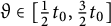
$$ \begin{align*}\left|{\frac{\partial(u,v)}{\partial(x,t)}}\right|=|1-\Upsilon_{t_0}'(t)|=|\gamma'(t+t_{0})-\gamma'(t_{0})|=|\gamma"(\vartheta)||t|\gtrsim 2^{-k},\end{align*} $$
$\vartheta \in [{\frac {1}{2}}t_0, {\frac {3}{2}}t_0]$
. Then,
$$ \begin{align*} \left\|\Lambda_N(f_{t_0, N}, g_{t_0, N})\right\|_{L^{1}(\mathbb{R})}&\lesssim \int_{\mathbb{R}}\int_{\mathbb{R}} f_{t_0, N}(u)g_{t_0, N}(v)\left|{\frac{\partial(x,t)}{\partial(u,v)}}\right|\,\textrm{d}u\textrm{d}v\\ &\lesssim 2^{k} \|f_{t_0, N}\|_{L^{1}(\mathbb{R})}\|g_{t_0, N}\|_{L^{1}(\mathbb{R})}. \end{align*} $$
Moreover, one may use the Cauchy–Schwartz inequality to deduce that
$$ \begin{align*} \left\|\Lambda_N(f_{t_0, N}, g_{t_0, N})\right\|_{L^{\frac{1}{2}}(\mathbb{R})}\lesssim |\Omega_{N}|\left\|\Lambda_N(f_{t_0, N}, g_{t_0, N})\right\|_{L^{1}(\mathbb{R})} \lesssim \|f_{t_0, N}\|_{L^{1}(\mathbb{R})}\|g_{t_0, N}\|_{L^{1}(\mathbb{R})}. \end{align*} $$
Putting things together, it follows from an interpolation that (3.11) holds for all
$p,q,r$
satisfying
$\frac {1}{p}+\frac {1}{q}=\frac {1}{r}$
,
$p, q \in [1, \infty ]$
and
$\frac {1}{2}<r<1$
. -
-
• The case of
$2^{-k+2}> t_0$
. Let it follows from
$$ \begin{align*}\Pi_k(f,g)(x):=\int_{0}^{1}f(x-t)g(x-\gamma(t))\psi\left(2^{k}(t-t_{0})\right)\,\textrm{d}t,\end{align*} $$
$2^{-k+2}> t_0$
that
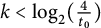
$k< \log _2 (\frac {4}{t_0})$
, therefore to prove (3.9) it will suffice to prove for all
$$ \begin{align*} \left\|\Pi_k(f,g)\right\|_{L^{r}([0, 1])}\lesssim \|f\|_{L^{p}(\mathbb{R})}\|g\|_{L^{q}(\mathbb{R})} \end{align*} $$
$p,q,r$
satisfying
$\frac {1}{p}+\frac {1}{q}=\frac {1}{r}$
,
$p, q \in [1, \infty ]$
and
$\frac {1}{2}<r<1$
. This can be proved by an interpolation with the following estimates:
-
∘ The
$L^1(\mathbb {R})\times L^\infty (\mathbb {R}) \rightarrow L^1([0, 1])$
boundedness of
$\Pi _k(f,g)$
. It is easy to get
$$ \begin{align*} &\left\|\Pi_k(f,g)\right\|_{L^{1}([0, 1])}\\&\quad\leq \|g\|_{L^{\infty}(\mathbb{R})}\int_{0}^{1}\int_{0}^{1} f(x-t)\psi\left(2^{k}(t-t_{0})\right)\,\textrm{d}t\,\textrm{d}x \lesssim \|f\|_{L^{1}(\mathbb{R})}\|g\|_{L^{\infty}(\mathbb{R})}. \end{align*} $$
-
∘ The
$L^{\infty }(\mathbb {R})\times L^1(\mathbb {R}) \rightarrow L^1([0, 1])$
boundedness of
$\Pi _k(f,g)$
. One obtains
$$ \begin{align*} &\left\|\Pi_k(f,g)\right\|_{L^{1}([0, 1])}\\&\quad\leq \|f\|_{L^{\infty}(\mathbb{R})}\int_{0}^{1}\int_{0}^{1}g(x-\gamma(t))\psi\left(2^{k}(t-t_{0})\right)\,\textrm{d}t\,\textrm{d}x \lesssim \|f\|_{L^{\infty}(\mathbb{R})}\|g\|_{L^{1}(\mathbb{R})}. \end{align*} $$
-
∘ The
$L^1(\mathbb {R})\times L^1(\mathbb {R}) \rightarrow L^{\frac {1}{2}}([0, 1])$
boundedness of
$\Pi _k(f,g)$
. From
${\frac {1}{2}}\cdot 2^{-k}\leq |t-t_0|\leq 2\cdot 2^{-k}$
,
$2^{-k+2}> t_0$
and
$0<t<1$
, which means that
$0<t\leq \frac {7}{8}t_0$
or
$ \frac {9}{8}t_0\leq t<1$
. Furthermore, by the facts that
$\gamma '(t_0)=1$
and
$|\gamma '(t)|$
is strictly increasing on
${t\in \mathbb {R}^+}$
, the change of variables
$u=x-t$
and
$v=x-\gamma (t)$
implies that Hence, we have
$$ \begin{align*} \left|{\frac{\partial(u,v)}{\partial(x,t)}}\right|&=|1-\gamma'(t)|=|\gamma'(t)-\gamma'(t_{0})|\\ &\geq \begin{cases}|\gamma'(t)|-|\gamma'(t_{0})|\geq \left|\gamma'\left(\frac{9}{8}t_0\right)\right|-\left|\gamma'(t_{0})\right|\gtrsim 1, ~~~\textrm{if} ~\frac{9}{8}t_0\leq t<1;\\ |\gamma'(t_{0})|-|\gamma'(t)|\geq \left|\gamma'(t_{0})\right|-\left|\gamma'\left(\frac{7}{8}t_0\right)\right|\gtrsim 1, ~~~\textrm{if} ~0<t\leq \frac{7}{8}t_0. \end{cases} \end{align*} $$
This, together with the Cauchy–Schwartz inequality, leads to
$$ \begin{align*} \left\|\Pi_k(f,g)\right\|_{L^{1}([0, 1])}&\lesssim \int_{\mathbb{R}}\int_{\mathbb{R}} f(u)g(v)\left|{\frac{\partial(x,t)}{\partial(u,v)}}\right|\,\textrm{d}u\textrm{d}v\lesssim \|f\|_{L^{1}(\mathbb{R})}\|g\|_{L^{1}(\mathbb{R})}. \end{align*} $$
$$ \begin{align*} \left\|\Pi_k(f,g)\right\|_{L^{\frac{1}{2}}([0, 1])}\lesssim\left\|\Pi_k(f,g)\right\|_{L^{1}([0, 1])}\lesssim \|f\|_{L^{1}(\mathbb{R})}\|g\|_{L^{1}(\mathbb{R})}. \end{align*} $$
-














































Therefore, we finish the proof of the Proposition 3.2.
4 Estimates for
$H_{\alpha ,\gamma }$
with
$f\in L^1(\mathbb {R})$


Recall that
 $$ \begin{align} H_{\alpha,\gamma}(f,g)(x)\lesssim \sum_{j \in \mathbb{Z}}2^{(\alpha-1)j}H_{\alpha,\gamma,j}(f,g)(x). \end{align} $$
Our goal in this section is to establish some
 $L^p(\mathbb {R})\times L^q(\mathbb {R}) \rightarrow L^{r,\infty }(\mathbb {R})$
estimates for
 $H_{\alpha ,\gamma }$
with
 $p=1$
by considering the corresponding estimates for
 $H_{\alpha ,\gamma ,j}$
.
Proposition 4.1 Let
 $\gamma $
be the same as in Theorem 1.1. Then, there exists a positive constant C, such that
 $$ \begin{align*}\left\|H_{\alpha,\gamma}(f,g)\right\|_{L^{r(\varepsilon),\infty}(\mathbb{R})}\leq C \|f\|_{L^{1}(\mathbb{R})}\left\|g\right\|_{L^{2r(\varepsilon)}(\mathbb{R})},\end{align*} $$
where
 $\frac {1}{r( \varepsilon ) }:=\frac {2(\omega _{\infty ,2}-\alpha )}{2\omega _{\infty ,2}-\omega _{\infty ,1}}-\varepsilon $
with
 $\varepsilon>0$
small enough.
Proof For
 $H_{\alpha ,\gamma ,j}$
defined in (3.1), let E be a measurable set with finite measure, a calculation gives
 $$ \begin{align*} \left \|H_{\alpha,\gamma,j}(f,g)\chi_{E}\right\|_{L^{1}(\mathbb{R})} \leq\|g\|_{L^{\infty}(\mathbb{R})}\int_{E}\int_{2^{j-1}}^{2^j}f(x-t)\,\textrm{d}t\,\textrm{d}x \leq|E|\|f\|_{L^{1}(\mathbb{R})}\|g\|_{L^{\infty}(\mathbb{R})} \end{align*} $$
for all
 $j\in \mathbb {Z}$
. This, combined with Propositions 3.1 and 3.2, shows that
 $$ \begin{align} \left\|H_{\alpha,\gamma,j}(f,g)\chi_{E}\right\|_{L^{1}(\mathbb{R})}\lesssim \min\left\{2^j,|E|\right\}\|f\|_{L^{1}(\mathbb{R})}\|g\|_{L^{\infty}(\mathbb{R})} \end{align} $$
for all
 $j\in \mathbb {Z}$
. From (3.4) and (3.5), we can write
 $$ \begin{align} \left\|H_{\alpha,\gamma,j}(f,g)\chi_{E}\right\|_{L^{\frac{1}{2}}(\mathbb{R})}\lesssim \min\left\{2^j,|E|\right\}\|f\|_{L^{1}(\mathbb{R})}\|g\|_{L^{1}(\mathbb{R})} \end{align} $$
for all
 $j<j_0$
, and by (3.6) and (3.7), it follows that
 $$ \begin{align} \left\|H_{\alpha,\gamma,j}(f,g)\chi_{E}\right\|_{L^{\frac{1}{2}}(\mathbb{R})}\lesssim \min\left\{2^j,\frac{|E|}{|\gamma'(2^{j-1})|}\right\}\|f\|_{L^{1}(\mathbb{R})}\|g\|_{L^{1}(\mathbb{R})} \end{align} $$
for all
 $j>j_0+2$
.
Now, for any fixed
 $f\in L^1(\mathbb {R})$
, the operator
 $H_{\alpha ,\gamma ,j}(f,g)\chi _{E}$
may be viewed as a linear operator about g. Interpolation (4.2) with (4.3) implies that
 $$ \begin{align} \left\|H_{\alpha,\gamma,j}(f,g)\chi_{E}\right\|_{L^{\frac{1}{1+\theta_1}}(\mathbb{R})}\lesssim \min\left\{2^j,|E|\right\}\|f\|_{L^{1}(\mathbb{R})}\|g\|_{L^{\frac{1}{\theta_1}}(\mathbb{R})} \end{align} $$
for all
 $j<j_0$
with
 $\theta _1\in (0,1)$
. From Proposition 3.2, reiterating this interpolation process, we also have
 $$ \begin{align} \left\|H_{\alpha,\gamma,j}(f,g)\chi_{E}\right\|_{L^{\frac{1}{1+\theta_1}}(\mathbb{R})}\lesssim \min\left\{2^{j_0},2^{{j_0}\theta_{1}}|E|^{1-\theta_{1}}\right\}\|f\|_{L^{1}(\mathbb{R})}\|g\|_{L^{\frac{1}{\theta_1}}(\mathbb{R})} \end{align} $$
for all
 $j=j_0, j_0+1, j_0+2$
. Using the interpolation argument on (4.2) with (4.4), we claim that
 $$ \begin{align} &\left\|H_{\alpha,\gamma,j}(f,g)\chi_{E}\right\|_{L^{\frac{1}{1+\theta_1}}(\mathbb{R})}\\&\quad\lesssim \min\left\{2^j,\frac{2^{j(1-\theta_{1})}|E|^{\theta_1}}{|\gamma'(2^{j-1})|^{\theta_{1}}},2^{j\theta_1} |E|^{1-\theta_1},\frac{|E|}{|\gamma'(2^{j-1})|^{\theta_1}}\right\}\|f\|_{L^{1}(\mathbb{R})}\|g\|_{L^{\frac{1}{\theta_1}}(\mathbb{R})} \nonumber\end{align} $$
for all
 $j>j_0+2$
.
Now pick
 $E_{\lambda }:=\{x\in {\mathbb {R}}:\ |H_{\alpha ,\gamma }(f,g)(x)|>\lambda \}$
with nonnegative functions
 $f, g \in L^1(\mathbb {R}) \cap L^{\infty }(\mathbb {R})$
. One may use Chebyshev’s inequality and (4.1), (4.5)–(4.7) to deduce that
 $$ \begin{align} \lambda^{\frac{1}{1+\theta_{1}}}|E_{\lambda}|&\lesssim \int_{E_{\lambda}}\left(\sum\limits_{j\in\mathbb{Z}}2^{(\alpha-1)j}H_{\alpha,\gamma,j}(f,g)(x)\right)^{\frac{1}{1+\theta_{1}}}\,\textrm{d}x \lesssim\sum\limits_{j\in\mathbb{Z}}2^{{\frac{\alpha-1}{1+\theta_{1}}}j}\int_{E_{\lambda}}H_{\alpha,\gamma,j}(f,g)(x))^{\frac{1}{1+\theta_{1}}}\,\textrm{d}x\\ \nonumber &\lesssim \Delta_{1}+\Delta_{2}+\Delta_{3}, \end{align} $$
where
 $$ \begin{align*}\begin{cases} \Delta_{1}:=\sum\limits_{j<j_{0}}2^{{\frac{\alpha-1}{1+\theta_{1}}j}}\min\left\{2^j,|E_\lambda|\right\}^{\frac{1}{1+\theta_{1}}} \|f\|_{L^{1}(\mathbb{R})}^{\frac{1}{1+\theta_{1}}}\|g\|_{L^{\frac{1}{\theta_1}}(\mathbb{R})}^{\frac{1}{1+\theta_{1}}}; \\ \Delta_{2}:=2^{{\frac{\alpha-1}{1+\theta_{1}}}j_{0}}\min\left\{2^{j_0},2^{{j_0}\theta_{1}}|E_\lambda|^{1-\theta_{1}}\right\}^{\frac{1}{1+\theta_{1}}}\|f\|_{L^{1}(\mathbb{R})}^{\frac{1}{1+\theta_{1}}}\|g\|_{L^{\frac{1}{\theta_1}}(\mathbb{R})}^{\frac{1}{1+\theta_{1}}};\\ \Delta_{3}:=\sum\limits_{j>j_{0}+2}2^{{\frac{\alpha-1}{1+\theta_{1}}}j}\min\left\{2^j,\frac{2^{j(1-\theta_{1})}|E_\lambda|^{\theta_1}}{|\gamma'(2^{j-1})|^{\theta_{1}}},2^{j\theta_1} |E_\lambda|^{1-\theta_1},\frac{|E_\lambda|}{|\gamma'(2^{j-1})|^{\theta_1}}\right\}^{\frac{1}{1+\theta_{1}}}\|f\|_{L^{1}(\mathbb{R})}^{\frac{1}{1+\theta_{1}}}\|g\|_{L^{\frac{1}{\theta_1}}(\mathbb{R})}^{\frac{1}{1+\theta_{1}}}. \end{cases}\end{align*} $$
These three terms are treated separately in the following section. We are ready to calculate
 $\Delta _{1}$
, which can be written as
 $$ \begin{align*} \left[\sum\limits_{j<j_{0},~{|E_{\lambda}|\geq2^j}}2^{{\frac{\alpha}{1+\theta_{1}}}j}+ \sum\limits_{j<j_{0},~{|E_{\lambda}|<2^j}}2^{{\frac{\alpha-1}{1+\theta_{1}}}j}|E_\lambda|^{\frac{1}{1+\theta_{1}}}\right] \|f\|_{L^{1}(\mathbb{R})}^{\frac{1}{1+\theta_{1}}}\|g\|_{L^{\frac{1}{\theta_1}}(\mathbb{R})}^{\frac{1}{1+\theta_{1}}}. \end{align*} $$
Notice that
 $$ \begin{align*}\sum\limits_{j<j_{0},~{E_{\lambda}\geq2^j}}2^{{\frac{\alpha}{1+\theta_{1}}}j}\lesssim \begin{cases} 2^{{\frac{\alpha}{1+\theta_{1}}}{j_0}} , & |E_\lambda|\geq2^{j_0}; \\ |E_\lambda|^{\frac{\alpha}{1+\theta_{1}}}, & |E_\lambda|<2^{j_0}, \end{cases}\end{align*} $$
and
 $$ \begin{align*}\sum\limits_{j<j_{0},~{|E_{\lambda}|<2^j}}2^{{\frac{\alpha-1}{1+\theta_{1}}}j}|E_\lambda|^{\frac{1}{1+\theta_{1}}}\lesssim \begin{cases} 0, & |E_\lambda|\geq2^{j_0}; \\ |E_\lambda|^{\frac{\alpha}{1+\theta_{1}}}, & |E_\lambda|<2^{j_0}. \end{cases}\end{align*} $$
Hence we have the estimate
 $$ \begin{align} \Delta_{1}\lesssim \begin{cases} \|f\|_{L^{1}(\mathbb{R})}^{\frac{1}{1+\theta_{1}}}\|g\|_{L^{\frac{1}{\theta_1}}(\mathbb{R})}^{\frac{1}{1+\theta_{1}}}, & |E_\lambda|\geq2^{j_0}; \\ |E_\lambda|^{\frac{\alpha}{1+\theta_{1}}}\|f\|_{L^{1}(\mathbb{R})}^{\frac{1}{1+\theta_{1}}}\|g\|_{L^{\frac{1}{\theta_1}}(\mathbb{R})}^{\frac{1}{1+\theta_{1}}}, & |E_\lambda|<2^{j_0}. \end{cases} \end{align} $$
Now we turn to the second term
 $\Delta _{2}$
, it is easy to see that
 $$ \begin{align} \Delta_{2}\lesssim \begin{cases} \|f\|_{L^{1}(\mathbb{R})}^{\frac{1}{1+\theta_{1}}}\|g\|_{L^{\frac{1}{\theta_1}}(\mathbb{R})}^{\frac{1}{1+\theta_{1}}}, & |E_\lambda|\geq2^{j_0}; \\ |E_\lambda|^{\frac{1-\theta_{1}}{1+\theta_{1}}}\|f\|_{L^{1}(\mathbb{R})}^{\frac{1}{1+\theta_{1}}}\|g\|_{L^{\frac{1}{\theta_1}}(\mathbb{R})}^{\frac{1}{1+\theta_{1}}}, & |E_\lambda|<2^{j_0}. \end{cases} \end{align} $$
Our next goal is to consider
 $\Delta _{3}$
, a calculation gives
 $$ \begin{align*} \min\left\{2^j,\frac{2^{j(1-\theta_{1})}|E_\lambda|^{\theta_1}}{|\gamma'(2^{j-1})|^{\theta_{1}}},2^{j\theta_1} |E_\lambda|^{1-\theta_1},\frac{|E_\lambda|}{|\gamma'(2^{j-1})|^{\theta_1}}\right\}= \begin{cases} 2^j, & |E_\lambda|\geq2^j|\gamma'(2^{j-1})|; \\ \frac{2^{j(1-\theta_{1})}|E_\lambda|^{\theta_1}}{|\gamma'(2^{j-1})|^{\theta_{1}}},&2^j\leq|E_\lambda|<2^j|\gamma'(2^{j-1})|;\\ \frac{|E_\lambda|}{|\gamma'(2^{j-1})|^{\theta_1}} , & |E_\lambda|<2^j. \end{cases} \end{align*} $$
We can then write
 $\Delta _{3}=\Delta _{3,1}+\Delta _{3,2}+\Delta _{3,3}$
, where
 $$ \begin{align*}\begin{cases} \Delta_{3,1}:= \sum\limits_{ \substack{j>j_{0}+2 \\|E_\lambda|\geq2^j|\gamma'(2^{j-1})| }} 2^{{\frac{\alpha}{1+\theta_{1}}}j} \|f\|_{L^{1}(\mathbb{R})}^{\frac{1}{1+\theta_{1}}}\|g\|_{L^{\frac{1}{\theta_1}}(\mathbb{R})}^{\frac{1}{1+\theta_{1}}}; \\ \Delta_{3,2}:=\sum\limits_{ \substack{j>j_{0}+2 \\2^j\leq|E_\lambda|<2^j|\gamma'(2^{j-1})| }} {\frac{2^{{\frac{\alpha-\theta_{1}}{1+\theta_{1}}}j}|E_\lambda|^{\frac{\theta_{1}}{1+\theta_{1}}}}{|\gamma'(2^{j-1})|^{\frac{\theta_{1}}{1+\theta_{1}}}}} \|f\|_{L^{1}(\mathbb{R})}^{\frac{1}{1+\theta_{1}}}\|g\|_{L^{\frac{1}{\theta_1}}(\mathbb{R})}^{\frac{1}{1+\theta_{1}}};\\ \Delta_{3,3}:=\sum\limits_{ \substack{j>j_{0}+2 \\|E_\lambda|<2^j}} {\frac{2^{{\frac{\alpha-1}{1+\theta_{1}}}j}|E_\lambda|^{\frac{1}{1+\theta_{1}}}}{|\gamma'(2^{j-1})|^{\frac{\theta_{1}}{1+\theta_{1}}}}} \|f\|_{L^{1}(\mathbb{R})}^{\frac{1}{1+\theta_{1}}}\|g\|_{L^{\frac{1}{\theta_1}}(\mathbb{R})}^{\frac{1}{1+\theta_{1}}}. \end{cases}\end{align*} $$
Corresponding to
 $\Delta _{3,1}$
, for any
 $\varepsilon>0$
, it follows from Lemma 2.1 that
 $$ \begin{align*}\sum\limits_{ \substack{j>j_{0}+2 \\|E_\lambda|\geq2^j|\gamma'(2^{j-1})| }} 2^{{\frac{\alpha}{1+\theta_{1}}}j}\lesssim \begin{cases} |E_\lambda|^{\frac{\alpha}{(\omega_{\infty,1}-\varepsilon)(1+\theta_{1})}}, & |E_\lambda|\geq2^{j_0+2}|\gamma'(2^{j_0+1})|; \\ 0, & 2^{j_0+2}\leq|E_{\lambda}|<2^{j_0+2}|\gamma'(2^{j_{0}+1})|;\\ 0, &|E_{\lambda}|<2^{j_0+2}. \end{cases}\end{align*} $$
On the other hand, let us set
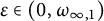 $\varepsilon \in (0,\omega _{\infty ,1})$
, and we take that
 $\alpha <\theta _{1}(\omega _{\infty ,1}-\varepsilon )$
, then by Lemma 2.1 one has
 $$ \begin{align*}\sum\limits_{ \substack{j>j_{0}+2 \\2^j\leq|E_\lambda|<2^j|\gamma'(2^{j-1})| }} {\frac{2^{{\frac{\alpha-\theta_{1}}{1+\theta_{1}}}j}|E_\lambda|^{\frac{\theta_{1}}{1+\theta_{1}}}}{|\gamma'(2^{j-1})|^{\frac{\theta_{1}}{1+\theta_{1}}}}} \lesssim \begin{cases} |E_\lambda|^{{\frac{\alpha+\theta_1(\omega_{\infty,2}-\omega_{\infty,1}+2\varepsilon)}{(\omega_{\infty,2}+\varepsilon)(1+\theta_{1})}}}, & |E_\lambda|\geq2^{j_0+2}|\gamma'(2^{j_{0}+1})|;\\ |E_\lambda|^{{\frac{\alpha+\theta_1(\omega_{\infty,2}-\omega_{\infty,1}+2\varepsilon)}{(\omega_{\infty,2}+\varepsilon)(1+\theta_{1})}}}, & 2^{j_0+2}\leq|E_{\lambda}|<2^{j_0+2}|\gamma'(2^{j_{0}+1})|;\\ 0, &|E_{\lambda}|<2^{j_0+2}. \end{cases}\end{align*} $$
This is the estimate about
 $\Delta _{3,2}$
. Furthermore, for estimating
 $\Delta _{3,3}$
, we need to take
 $\alpha -1+\theta _{1}>0$
. It follows from
 $\omega _{\infty ,1}>1$
that
 $\alpha -1+\theta _{1}-\theta _{1}(\omega _{\infty ,1}-\varepsilon )<0$
for all
 ${\varepsilon \in (0,\omega _{\infty ,1}-1]}$
. From Lemma 2.1, we then have
 $$ \begin{align*}\sum\limits_{ \substack{j>j_{0}+2 \\|E_\lambda|<2^j}} {\frac{2^{{\frac{\alpha-1}{1+\theta_{1}}}j}|E_\lambda|^{\frac{1}{1+\theta_{1}}}}{|\gamma'(2^{j-1})|^{\frac{\theta_{1}}{1+\theta_{1}}}}}\lesssim \begin{cases} |E_\lambda|^{{\frac{\alpha-\theta_1(\omega_{\infty,1}-1-\varepsilon)}{1+\theta_{1}}}}, & |E_\lambda|\geq2^{j_0+2}|\gamma'(2^{j_{0}+1})|; \\ |E_\lambda|^{{\frac{\alpha-\theta_1(\omega_{\infty,1}-1-\varepsilon)}{1+\theta_{1}}}}, & 2^{j_0+2}\leq|E_{\lambda}|<2^{j_0+2}|\gamma'(2^{j_{0}+1})|;\\ |E_\lambda|^{{\frac{1}{1+\theta_1}}}, &|E_{\lambda}|<2^{j_0+2}. \end{cases}\end{align*} $$
Notice that
 $$ \begin{align*}|E_\lambda|^{{\frac{\alpha-\theta_1(\omega_{\infty,1}-1-\varepsilon)}{1+\theta_{1}}}}\leq|E_\lambda|^{\frac{\alpha}{(\omega_{\infty,1}-\varepsilon)(1+\theta_{1})}} \leq |E_\lambda|^{{\frac{\alpha+\theta_1(\omega_{\infty,2}-\omega_{\infty,1}+2\varepsilon)}{(\omega_{\infty,2}+\varepsilon)(1+\theta_{1})}}}\end{align*} $$
holds for
 $|E_\lambda |\geq 2^{j_0+2}$
if
 $\varepsilon \in (0,\min \{\omega _{\infty ,1}, \omega _{\infty ,1}-1\})$
. Consequently,
 $$ \begin{align} \Delta_{3}\lesssim \begin{cases} |E_\lambda|^{{\frac{\alpha+\theta_1(\omega_{\infty,2}-\omega_{\infty,1}+2\varepsilon)}{(\omega_{\infty,2}+\varepsilon)(1+\theta_{1})}}} \|f\|_{L^{1}(\mathbb{R})}^{\frac{1}{1+\theta_{1}}}\|g\|_{L^{\frac{1}{\theta_1}}(\mathbb{R})}^{\frac{1}{1+\theta_{1}}}, & |E_\lambda|\geq2^{j_0+2};\\ |E_\lambda|^{{\frac{1}{1+\theta_{1}}}} \|f\|_{L^{1}(\mathbb{R})}^{\frac{1}{1+\theta_{1}}}\|g\|_{L^{\frac{1}{\theta_1}}(\mathbb{R})}^{\frac{1}{1+\theta_{1}}}, &|E_{\lambda}|<2^{j_0+2}. \end{cases} \end{align} $$
It follows from
 $\alpha -1+\theta _{1}>0$
and
 $\theta _1\in (0,1)$
that
 $ |E_\lambda |^{{\frac {1}{1+\theta _{1}}}}\leq |E_\lambda |^{\frac {\alpha }{1+\theta _{1}}}\leq |E_\lambda |^{\frac {1-\theta _{1}}{1+\theta _{1}}}$
holds for
 $|E_{\lambda }|<2^{j_0+2}$
. This, combined with (4.8)–(4.11), we conclude that
 $$ \begin{align} \lambda^{\frac{1}{1+\theta_{1}}}|E_{\lambda}|\lesssim \begin{cases} |E_\lambda|^{\frac{\alpha+\theta_1(\omega_{\infty,2}-\omega_{\infty,1}+2\varepsilon)}{(\omega_{\infty,2}+\varepsilon)(1+\theta_{1})}} \|f\|_{L^{1}(\mathbb{R})}^{\frac{1}{1+\theta_{1}}}\|g\|_{L^{\frac{1}{\theta_1}}(\mathbb{R})}^{\frac{1}{1+\theta_{1}}}, & |E_\lambda|\geq2^{j_0+2}; \\ |E_\lambda|^{\frac{1-\theta_{1}}{1+\theta_{1}}} \|f\|_{L^{1}(\mathbb{R})}^{\frac{1}{1+\theta_{1}}}\|g\|_{L^{\frac{1}{\theta_1}}(\mathbb{R})}^{\frac{1}{1+\theta_{1}}}, &|E_{\lambda}|<2^{j_0+2}. \end{cases} \end{align} $$
By a calculation, for
 $\varepsilon $
small enough, we have that
 $\frac {\omega _{\infty ,2}-\omega _{\infty ,1}}{\omega _{\infty ,2}-1}<\frac {\alpha }{1-\alpha }<\frac {\omega _{\infty ,2}}{\omega _{\infty ,2}-\omega _{\infty ,1}+1}$
implies
 $$ \begin{align} \max\left\{1-\alpha, \alpha, \frac{\alpha}{\omega_{\infty,1}-\varepsilon}\right\}<\frac{\omega_{\infty,2}-\alpha+\varepsilon}{2\omega_{\infty,2}-\omega_{\infty,1}+3\varepsilon}. \end{align} $$
Then, we can take
 $$ \begin{align} \theta_1\leq \frac{\omega_{\infty,2}-\alpha+\varepsilon}{2\omega_{\infty,2}-\omega_{\infty,1}+3\varepsilon} \end{align} $$
with
 $\varepsilon $
small enough, which further implies that
 $$ \begin{align*}\frac{\alpha+\theta_1(\omega_{\infty,2}-\omega_{\infty,1}+2\varepsilon)}{(\omega_{\infty,2}+\varepsilon)(1+\theta_{1})}\leq \frac{1-\theta_{1}}{1+\theta_{1}},\end{align*} $$
This, together with (4.12), gives
 $$ \begin{align} \lambda|E_{\lambda}|^{\frac{\omega_{\infty,2}+ \theta_1(\omega_{\infty,1}-\varepsilon)-\alpha+\varepsilon}{\omega_{\infty,2}+\varepsilon}}\lesssim \|f\|_{L^{1}(\mathbb{R})}\|g\|_{L^{\frac{1}{\theta_1}}(\mathbb{R})} \end{align} $$
for all
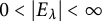 $0<|E_\lambda |<\infty $
, where
 $\varepsilon $
small enough and
 $\theta _1$
satisfies (4.14). Therefore, we have established the
 $L^{1}(\mathbb {R})\times L^{\frac {1}{\theta _{1}}}(\mathbb {R})\rightarrow L^{\frac {\omega _{\infty ,2}+\varepsilon }{\omega _{\infty ,2}+ \theta _1(\omega _{\infty ,1}-\varepsilon )-\alpha +\varepsilon }, \infty }(\mathbb {R})$
boundedness for
 $H_{\alpha ,\gamma }$
.
It is easy to see that
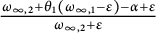 $\frac {\omega _{\infty ,2}+ \theta _1(\omega _{\infty ,1}-\varepsilon )-\alpha +\varepsilon }{\omega _{\infty ,2}+\varepsilon }$
takes the maximal value
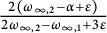 $\frac {2(\omega _{\infty ,2}-\alpha +\varepsilon )}{2\omega _{\infty ,2}-\omega _{\infty ,1}+3\varepsilon }$
when
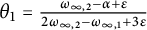 $\theta _1= \frac {\omega _{\infty ,2}-\alpha +\varepsilon }{2\omega _{\infty ,2}-\omega _{\infty ,1}+3\varepsilon }$
. On the other hand, from (4.13), it follows
 $\frac {\alpha }{\omega _{\infty ,1}-\varepsilon }<\frac {\omega _{\infty ,2}-\alpha +\varepsilon }{2\omega _{\infty ,2}-\omega _{\infty ,1}+3\varepsilon }$
, which equals to
 $2\alpha +\varepsilon <\omega _{\infty ,1}$
, we then have
 $2\alpha <\omega _{\infty ,1}$
. This, together with
 $\alpha <1<\omega _{\infty ,1}\leq \omega _{\infty ,2}$
, shows
 $3\alpha <\omega _{\infty ,1}+\omega _{\infty ,2}$
. Therefore,
 $$ \begin{align*}\frac{\omega_{\infty,2}-\alpha+\varepsilon}{2\omega_{\infty,2}-\omega_{\infty,1}+3\varepsilon}< \frac{\omega_{\infty,2}-\alpha}{2\omega_{\infty,2}-\omega_{\infty,1}}\end{align*} $$
holds for all
 $\varepsilon $
small enough. Putting things together, we conclude that
 $H_{\alpha ,\gamma }$
maps
 $L^{1}(\mathbb {R})\times L^{2r( \varepsilon ) }(\mathbb {R})$
to
 $L^{r(\varepsilon ), \infty }(\mathbb {R})$
, where
 $\frac {1}{r( \varepsilon ) }:=\frac {2(\omega _{\infty ,2}-\alpha )}{2\omega _{\infty ,2}-\omega _{\infty ,1}}-\varepsilon $
with
 $\varepsilon $
small enough. Therefore, we finish the proof of Proposition 4.1.
Remark 4.2 In fact, (4.13) is also used to prove the following Proposition 5.1. In the proof of Proposition 4.1, it suffices to replace (4.13) by
 $$ \begin{align*} \max\left\{1-\alpha, \frac{\alpha}{\omega_{\infty,1}-\varepsilon}\right\}<\frac{\omega_{\infty,2}-\alpha+\varepsilon}{2\omega_{\infty,2}-\omega_{\infty,1}+3\varepsilon}, \end{align*} $$
which leads to the condition
 $\frac {\alpha }{1-\alpha }<\frac {\omega _{\infty ,2}}{\omega _{\infty ,2}-\omega _{\infty ,1}+1}$
in Theorem 1.1 can be replaced as
 ${2\alpha <\omega _{\infty ,1}}$
.
Proposition 4.3 Let
 $\gamma $
be the same as in Theorem 1.2. Then, there exists a positive constant C, such that
 $$ \begin{align*}\left\|H_{\alpha,\gamma}(f,g)\right\|_{L^{\bar{r}(\varepsilon),\infty}(\mathbb{R})}\leq C \|f\|_{L^{1}(\mathbb{R})}\left\|g\right\|_{L^{\bar{q}(\varepsilon)}(\mathbb{R})},\end{align*} $$
where
 $$ \begin{align*} \begin{cases} \frac{1}{\bar{r}(\varepsilon )}:= \frac{2(1-\alpha)}{2-\omega_{\infty,1}}-\varepsilon ~~\textrm{and}~~\frac{1}{\bar{q}(\varepsilon )}:=\frac{1}{2\bar{r}(\varepsilon )} ,&\omega_{\infty,1}\leq2\alpha;\\[6pt] \frac{1}{\bar{r}(\varepsilon )}:= 1-\varepsilon ~~\textrm{and}~~\frac{1}{\bar{q}(\varepsilon )}\in \left[\frac{\alpha}{\omega_{\infty,1}}-\varepsilon, \frac{1}{2}-\varepsilon\right] ,& 2\alpha<\omega_{\infty,1}, \end{cases} \end{align*} $$
with
 $\varepsilon>0$
small enough.
Proof The main difference here lies in the establishing of
 $\Delta _{3,2}$
. In fact, let
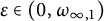 ${\varepsilon \in (0,\omega _{\infty ,1})}$
, and we take
 $\alpha>\theta _{1}(\omega _{\infty ,1}-\varepsilon )$
. By Lemma 2.1, one immediately has
 $$ \begin{align*}\sum\limits_{ \substack{j>j_{0}+2 \\2^j\leq|E_\lambda|<2^j|\gamma'(2^{j-1})| }} {\frac{2^{{\frac{\alpha-\theta_{1}}{1+\theta_{1}}}j}|E_\lambda|^{\frac{\theta_{1}}{1+\theta_{1}}}}{|\gamma'(2^{j-1})|^{\frac{\theta_{1}}{1+\theta_{1}}}}} \lesssim \begin{cases} |E_\lambda|^{{\frac{\alpha-\theta_1(\omega_{\infty,1}-1-\varepsilon)}{1+\theta_1}}}, & |E_\lambda|\geq2^{j_0+2}|\gamma'(2^{j_{0}+1})|;\\ |E_\lambda|^{{\frac{\alpha-\theta_1(\omega_{\infty,1}-1-\varepsilon)}{1+\theta_1}}}, & 2^{j_0+2}\leq|E_{\lambda}|<2^{j_0+2}|\gamma'(2^{j_{0}+1})|;\\ 0, &|E_{\lambda}|<2^{j_0+2}. \end{cases}\end{align*} $$
The estimation of
 $\Delta _{3,3}$
is the same as in Proposition 4.1, and we also need to take
 ${\alpha -1+\theta _{1}>0}$
, which can be realized by the condition that
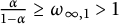 $\frac {\alpha }{1-\alpha }\geq \omega _{\infty ,1}>1$
. Notice that
 $\alpha>\theta _{1}(\omega _{\infty ,1}-\varepsilon )$
, which implies
 $|E_\lambda |^{\frac {\alpha }{(\omega _{\infty ,1}-\varepsilon )(1+\theta _{1})}}\leq |E_\lambda |^{{\frac {\alpha -\theta _1(\omega _{\infty ,1}-1-\varepsilon )}{1+\theta _1}}}$
for
 $|E_\lambda |\geq 2^{j_0+2}$
. Thus one can write
 $$ \begin{align*} \Delta_{3}\lesssim \begin{cases} |E_\lambda|^{{\frac{\alpha-\theta_1(\omega_{\infty,1}-1-\varepsilon)}{1+\theta_1}}} \|f\|_{L^{1}(\mathbb{R})}^{\frac{1}{1+\theta_{1}}}\|g\|_{L^{\frac{1}{\theta_1}}(\mathbb{R})}^{\frac{1}{1+\theta_{1}}}, & |E_\lambda|\geq2^{j_0+2}; \\ |E_\lambda|^{{\frac{1}{1+\theta_{1}}}} \|f\|_{L^{1}(\mathbb{R})}^{\frac{1}{1+\theta_{1}}}\|g\|_{L^{\frac{1}{\theta_1}}(\mathbb{R})}^{\frac{1}{1+\theta_{1}}}, &|E_{\lambda}|<2^{j_0+2}. \end{cases} \end{align*} $$
As in Proposition 4.1, we have an estimate
 $$ \begin{align} \lambda^{\frac{1}{1+\theta_{1}}}|E_{\lambda}|\lesssim \begin{cases} |E_\lambda|^{{\frac{\alpha-\theta_1(\omega_{\infty,1}-1-\varepsilon)}{1+\theta_1}}} \|f\|_{L^{1}(\mathbb{R})}^{\frac{1}{1+\theta_{1}}}\|g\|_{L^{\frac{1}{\theta_1}}(\mathbb{R})}^{\frac{1}{1+\theta_{1}}}, & |E_\lambda|\geq2^{j_0+2}; \\ |E_\lambda|^{\frac{1-\theta_{1}}{1+\theta_{1}}} \|f\|_{L^{1}(\mathbb{R})}^{\frac{1}{1+\theta_{1}}}\|g\|_{L^{\frac{1}{\theta_1}}(\mathbb{R})}^{\frac{1}{1+\theta_{1}}}, &|E_{\lambda}|<2^{j_0+2}. \end{cases} \end{align} $$
We now want to obtain that
 $$ \begin{align} \frac{\alpha-\theta_1(\omega_{\infty,1}-1-\varepsilon)}{1+\theta_1}\leq \frac{1-\theta_{1}}{1+\theta_{1}}, \end{align} $$
which equals to
 $\theta _1(2-\omega _{\infty ,1}+\varepsilon )\leq 1-\alpha $
. If
 $2-\omega _{\infty ,1}+\varepsilon \leq 0$
, (4.17) is obvious. If
 $2-\omega _{\infty ,1}+\varepsilon>0$
, (4.17) equals to
 $$ \begin{align} \theta_1\leq\frac{1-\alpha}{2-\omega_{\infty,1}+\varepsilon}. \end{align} $$
Clearly
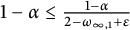 $1-\alpha \leq \frac {1-\alpha }{2-\omega _{\infty ,1}+\varepsilon }$
holds for all
 $\varepsilon \in (0,\omega _{\infty ,1}-1]$
, which shows (4.18) can be realized. This, combined with (4.16) and (4.17), means that
 $$ \begin{align*} \lambda|E_{\lambda}|^{1-\alpha+\theta_1(\omega_{\infty,1}-\varepsilon)}\lesssim\|f\|_{L^{1}(\mathbb{R})}\|g\|_{L^{\frac{1}{\theta_1}}(\mathbb{R})} \end{align*} $$
for all
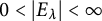 $0<|E_\lambda |<\infty $
, where
 $$ \begin{align} \begin{cases} \theta_1\leq\frac{1-\alpha}{2-\omega_{\infty,1}+\varepsilon}, &\omega_{\infty,1}<2\alpha+\varepsilon;\\ \theta_1< \frac{\alpha}{\omega_{\infty,1}-\varepsilon}, & 2\alpha+\varepsilon\leq\omega_{\infty,1}, \end{cases} \end{align} $$
and
 $\varepsilon>0$
small enough. Therefore, we have established the
 $L^{1}(\mathbb {R})\times L^{\frac {1}{\theta _{1}}}(\mathbb {R})\rightarrow L^{\frac {1}{1-\alpha +\theta _1(\omega _{\infty ,1}-\varepsilon )}, \infty }(\mathbb {R})$
boundedness for
 $H_{\alpha ,\gamma }$
.
On the other hand, by (4.19), for
 $\varepsilon>0$
small enough, one easily sees that
 $$ \begin{align*} \begin{cases} 1-\alpha+\theta_1(\omega_{\infty,1}-\varepsilon)\leq\frac{2(1-\alpha)}{2-\omega_{\infty,1}+\varepsilon}<\frac{2(1-\alpha)}{2-\omega_{\infty,1}}, &\omega_{\infty,1}<2\alpha+\varepsilon;\\ 1-\alpha+\theta_1(\omega_{\infty,1}-\varepsilon)< 1, & 2\alpha+\varepsilon\leq\omega_{\infty,1}. \end{cases} \end{align*} $$
Therefore, we conclude that
 $H_{\alpha ,\gamma }$
maps
 $L^{1}(\mathbb {R})\times L^{\bar {q}( \varepsilon ) }(\mathbb {R})$
to
 $L^{\bar {r}(\varepsilon ), \infty }(\mathbb {R})$
with
 $\varepsilon>0$
small enough. Here,
 $\frac {1}{\bar {r}( \varepsilon )}$
tends to maximal value as
 $\varepsilon \rightarrow 0$
.
Notice that
 $\frac {\alpha }{\omega _{\infty ,1}-\varepsilon }$
increases as
 $\varepsilon $
increases when
 $2\alpha +\varepsilon \leq \omega _{\infty ,1}$
, then
 $\frac {1}{\bar {q}( \varepsilon )}$
doesn’t tend to maximal value as
 $\varepsilon \rightarrow 0$
. We now want
 $\frac {1}{\bar {q}( \varepsilon )}$
to take maximal value. In fact, from the process of our proofs, we can find that
 $\varepsilon $
need only satisfies
 $\varepsilon \leq \omega _{\infty ,1}-2\alpha $
and
 $\varepsilon \leq \omega _{\infty ,1}-1$
when
 $\omega _{\infty ,1}>2\alpha $
. Moreover, using
 $2\alpha <\omega _{\infty ,1}\leq \frac {\alpha }{1-\alpha }$
, we have
 $\frac {1}{2}<\alpha $
. Therefore, we should only to take
 $\varepsilon \leq \omega _{\infty ,1}-2\alpha $
. It is easy to check that
 $\frac {1}{\bar {q}( \varepsilon )}$
tends to the maximal value
 $\frac {1}{2}$
when
 $\varepsilon =\omega _{\infty ,1}-2\alpha $
, and
 $\frac {1}{\bar {r}(\varepsilon )}$
tends to
 $1$
. Then,
 $H_{\alpha ,\gamma }$
maps
 $L^{1}(\mathbb {R})\times L^{\frac {2}{1-\varepsilon }}(\mathbb {R})$
to
 $L^{\frac {1}{1-\varepsilon }, \infty }(\mathbb {R})$
with
 $\varepsilon>0$
small enough when
 $\omega _{\infty ,1}>2\alpha $
.
Putting things together, we finish the proof of Proposition 4.3.
5 Estimates for
$H_{\alpha ,\gamma }$
with
$g\in L^1(\mathbb {R})$


In this section, we will establish some
 $L^p(\mathbb {R})\times L^q(\mathbb {R}) \rightarrow L^{r,\infty }(\mathbb {R})$
estimates for
 $H_{\alpha ,\gamma }$
with
 $q=1$
by considering the corresponding estimates for
 $H_{\alpha ,\gamma ,j}$
.
Proposition 5.1 Let
 $\gamma $
be the same as in Theorem 1.1. Then, there exists a positive constant C, such that
 $$ \begin{align*}\left\|H_{\alpha,\gamma}(f,g)\right\|_{L^{r(\varepsilon),\infty}(\mathbb{R})}\leq C \|f\|_{L^{2r(\varepsilon)}(\mathbb{R})}\left\|g\right\|_{L^{1}(\mathbb{R})},\end{align*} $$
where
 $\frac {1}{r( \varepsilon ) }=\frac {2(\omega _{\infty ,2}-\alpha )}{2\omega _{\infty ,2}-\omega _{\infty ,1}}-\varepsilon $
with
 $\varepsilon>0$
small enough as in Proposition 4.1.
Proof Let E be a measurable set with finite measure, and recall that
 $H_{\alpha ,\gamma ,j}$
defined in (3.1) with
 $j\in \mathbb {Z}$
, by the fact that
 $|\gamma '(t)|$
is strictly increasing on
 $t\in \mathbb {R}^+$
, a routine calculation gives
 $$ \begin{align*} &\left\|H_{\alpha,\gamma,j}(f,g)\chi_{E}\right\|_{L^{1}(\mathbb{R})} \\&\quad\leq\|f\|_{L^{\infty}(\mathbb{R})}\int_E\int_{2^{j-1}}^{2^j}g(x-\gamma(t))\,\textrm{d}t\,\textrm{d}x\leq \frac{|E|}{|\gamma'(2^{j-1})|} \|f\|_{L^{\infty}(\mathbb{R})}\|g\|_{L^{1}(\mathbb{R})}. \end{align*} $$
Combining Propositions 3.1 and 3.2, for any
 $j\in \mathbb {Z}$
, we immediately have
 $$ \begin{align} \left\|H_{\alpha,\gamma,j}(f,g)\chi_{E}\right\|_{L^{1}(\mathbb{R})} \leq \min\left\{2^j, \frac{|E|}{|\gamma'(2^{j-1})|} \right\} \|f\|_{L^{\infty}(\mathbb{R})}\|g\|_{L^{1}(\mathbb{R})}. \end{align} $$
Notice that
 $H_{\alpha ,\gamma ,j}(f,g)\chi _{E}$
can be viewed as a linear operator about f for any fixed
 $g\in L^1(\mathbb {R})$
, by interpolation between (5.1) with (4.3), we conclude that
 $$ \begin{align*} &\left\|H_{\alpha,\gamma,j}(f,g)\chi_{E}\right\|_{L^{\frac{1}{1+\theta_2}}(\mathbb{R})} \\&\quad\lesssim \min\left\{2^j,2^{j(1-\theta_{2})}|E|^{\theta_{2}},{\frac{2^{j\theta_2}|E|^{1-\theta_{2}}}{|\gamma'(2^{j-1})|^{1-\theta_{2}}}} ,{\frac{|E|}{|\gamma'(2^{j-1})|^{1-\theta_{2}}}}\right\}\|f\|_{L^{\frac{1}{\theta_2}}(\mathbb{R})}\|g\|_{L^{1}(\mathbb{R})} \end{align*} $$
for all
 $j<j_0$
with
 $\theta _2\in (0,1)$
. From Proposition 3.2, reiterating this interpolation process, then the following estimate is valid:
 $$ \begin{align*} \left\|H_{\alpha,\gamma,j}(f,g)\chi_{E}\right\|_{L^{\frac{1}{1+\theta_1}}(\mathbb{R})}\lesssim \min\left\{2^{j_0},\frac{2^{{j_0}\theta_{2}}|E|^{1-\theta_{2}}}{ |\gamma'(2^{j_0-1})|^{1-\theta_{2}} }\right\}\|f\|_{L^{\frac{1}{\theta_2}}(\mathbb{R})}\|g\|_{L^{1}(\mathbb{R})} \end{align*} $$
for all
 $j=j_0, j_0+1, j_0+2$
. A further interpolation between (5.1) with (4.4) gives
 $$ \begin{align} \left\|H_{\alpha,\gamma,j}(f,g)\chi_{E}\right\|_{L^{\frac{1}{1+\theta_2}}(\mathbb{R})} \leq \min\left\{2^j, \frac{|E|}{|\gamma'(2^{j-1})|} \right\} \|f\|_{L^{\frac{1}{\theta_2}}(\mathbb{R})}\|g\|_{L^{1}(\mathbb{R})} \end{align} $$
for all
 $j>j_0+2$
. Moreover, in order to establish the desired estimate, we bound
 $$ \begin{align} \left\|H_{\alpha,\gamma,j}(f,g)\chi_{E}\right\|_{L^{\frac{1}{1+\theta_2}}(\mathbb{R})} \leq \min\left\{2^j, \frac{2^{j(1-\theta_2)}|E|^{\theta_2}}{|\gamma'(2^{j-1})|^{\theta_2}} \right\} \|f\|_{L^{\frac{1}{\theta_2}}(\mathbb{R})}\|g\|_{L^{1}(\mathbb{R})} \end{align} $$
for all
 $j>j_0+2$
.
Recall that
 $E_{\lambda }=\{x\in {\mathbb {R}}:\ |H_{\alpha ,\gamma }(f,g)(x)|>\lambda \}$
. Then, by a similar argument as in (4.8), we conclude that
 $$ \begin{align} \lambda^{\frac{1}{1+\theta_2}}|E_{\lambda}|\lesssim \Upsilon_{1}+\Upsilon_{2}+\Upsilon_{3}, \end{align} $$
where
 $$ \begin{align*}\begin{cases} \Upsilon_{1}:=\sum\limits_{j<j_{0}}2^{{\frac{\alpha-1}{1+\theta_{2}}j}}\min\left\{2^j,2^{j(1-\theta_{2})}|E_{\lambda}|^{\theta_{2}},{\frac{2^{j\theta_2}|E_{\lambda}|^{1-\theta_{2}}}{|\gamma'(2^{j-1})|^{1-\theta_{2}}}} ,{\frac{|E_{\lambda}|}{|\gamma'(2^{j-1})|^{1-\theta_{2}}}}\right\}^{\frac{1}{1+\theta_2}}\|f\|^{\frac{1}{1+\theta_2}}_{L^{\frac{1}{\theta_2}}(\mathbb{R})}\|g\|^{\frac{1}{1+\theta_2}}_{L^{1}(\mathbb{R})}; \\ \Upsilon_{2}:=2^{{\frac{\alpha-1}{1+\theta_{2}}}j_{0}}\min\left\{2^{j_0},\frac{2^{{j_0}\theta_{2}}|E_{\lambda}|^{1-\theta_{2}}}{ |\gamma'(2^{j_0-1})|^{1-\theta_{2}} }\right\}^{\frac{1}{1+\theta_2}}\|f\|^{\frac{1}{1+\theta_2}}_{L^{\frac{1}{\theta_2}}(\mathbb{R})}\|g\|^{\frac{1}{1+\theta_2}}_{L^{1}(\mathbb{R})};\\ \Upsilon_{3}:=\sum\limits_{j>j_{0}+2}2^{{\frac{\alpha-1}{1+\theta_{2}}}j}\min\left\{2^j, \frac{2^{j(1-\theta_2)}|E_{\lambda}|^{\theta_2}}{|\gamma'(2^{j-1})|^{\theta_2}} \right\}^{\frac{1}{1+\theta_2}} \|f\|^{\frac{1}{1+\theta_2}}_{L^{\frac{1}{\theta_2}}(\mathbb{R})}\|g\|^{\frac{1}{1+\theta_2}}_{L^{1}(\mathbb{R})}. \end{cases}\end{align*} $$
Consider
 $\Upsilon _1$
, in analogy to the calculation in
 $\Delta _{3}$
, and observe that
 $$ \begin{align*} &\min\left\{2^j,2^{j(1-\theta_{2})}|E_{\lambda}|^{\theta_{2}},{\frac{2^{j\theta_2}|E_{\lambda}|^{1-\theta_{2}}}{|\gamma'(2^{j-1})|^{1-\theta_{2}}}} ,{\frac{|E_{\lambda}|}{|\gamma'(2^{j-1})|^{1-\theta_{2}}}}\right\}\\&\quad\leq \begin{cases} 2^j, & |E_{\lambda}|\geq 2^j; \\ 2^{j(1-\theta_{2})}|E_{\lambda}|^{\theta_{2}}, & 2^j{|\gamma'(2^{j-1})|}\leq|E_{\lambda}|< 2^j; \\ {\frac{|E_{\lambda}|}{|\gamma'(2^{j-1})|^{1-\theta_{2}}}}, & |E_{\lambda}|<2^j|\gamma'(2^{j-1})|. \end{cases} \end{align*} $$
Hence we can write
 $$ \begin{align*} \Upsilon_{1}=\Upsilon_{1,1}+\Upsilon_{1,2}+\Upsilon_{1,3} \end{align*} $$
with
 $$ \begin{align*}\begin{cases} \Upsilon_{1,1}:=\sum\limits_{ \substack{j<j_{0} \\ |E_{\lambda}|\geq2^j }} 2^{{\frac{\alpha}{1+\theta_{2}}j}}\|f\|^{\frac{1}{1+\theta_2}}_{L^{\frac{1}{\theta_2}}(\mathbb{R})}\|g\|^{\frac{1}{1+\theta_2}}_{L^{1}(\mathbb{R})}; \\ \Upsilon_{1,2}:=\sum\limits_{ \substack{j<j_{0} \\ 2^j{|\gamma'(2^{j-1})|}\leq|E_{\lambda}|<2^j }} 2^{{\frac{\alpha-\theta_{2}}{1+\theta_{2}}}j}|E_\lambda|^{\frac{\theta_{2}}{1+\theta_{2}}}\|f\|^{\frac{1}{1+\theta_2}}_{L^{\frac{1}{\theta_2}}(\mathbb{R})}\|g\|^{\frac{1}{1+\theta_2}}_{L^{1}(\mathbb{R})}; \\ \Upsilon_{1,3}:=\sum\limits_{ \substack{j<j_{0} \\ |E_{\lambda}|<2^j|\gamma'(2^{j-1})| }} \frac{2^{{\frac{\alpha-1}{1+\theta_{2}}j}}|E_\lambda|^{\frac{1}{1+\theta_{2}}}}{|\gamma'(2^{j-1})|^{\frac{1-\theta_{2}}{1+\theta_{2}}}}\|f\|^{\frac{1}{1+\theta_2}}_{L^{\frac{1}{\theta_2}}(\mathbb{R})}\|g\|^{\frac{1}{1+\theta_2}}_{L^{1}(\mathbb{R})}. \end{cases}\end{align*} $$
Let’s now consider
 $\Upsilon _{1,1}$
. For any
 $\varepsilon>0$
, it follows from Lemma 2.1 that
 $$ \begin{align*}\sum\limits_{ \substack{j<j_{0} \\ |E_{\lambda}|\geq2^j }} 2^{{\frac{\alpha}{1+\theta_{2}}j}}\lesssim \begin{cases} 2^{\frac{\alpha}{1+\theta_{2}}j_0}, & |E_\lambda|\geq2^{j_0}; \\ |E_\lambda|^{\frac{\alpha}{1+\theta_{2}}}, & 2^{j_0}|\gamma'(2^{j_{0}-1})|\leq|E_{\lambda}|<2^{j_0};\\ |E_\lambda|^{\frac{\alpha}{1+\theta_{2}}}, &|E_{\lambda}|<2^{j_0}|\gamma'(2^{j_{0}-1})|. \end{cases}\end{align*} $$
To see what happens corresponding to
 $\Upsilon _{1,2}$
and
 $\Upsilon _{1,3}$
, due to a minor technical issue we will assume that
 $\alpha <\theta _2$
. For any
 $\varepsilon>0$
, by Lemma 2.1, it is easy to see that
 $$ \begin{align*}\sum\limits_{ \substack{j<j_{0} \\ 2^j{|\gamma'(2^{j-1})|}\leq|E_{\lambda}|<2^j }} 2^{{\frac{\alpha-\theta_{2}}{1+\theta_{2}}}j}|E_\lambda|^{\frac{\theta_{2}}{1+\theta_{2}}}\lesssim \begin{cases} 0, & |E_\lambda|\geq2^{j_0}; \\ |E_\lambda|^{\frac{\alpha}{1+\theta_{2}}}, & 2^{j_0}|\gamma'(2^{j_{0}-1})|\leq|E_{\lambda}|<2^{j_0};\\ |E_\lambda|^{\frac{\alpha}{1+\theta_{2}}}, &|E_{\lambda}|<2^{j_0}|\gamma'(2^{j_{0}-1})|, \end{cases}\end{align*} $$
and
 $$ \begin{align*}\sum\limits_{ \substack{j<j_{0} \\ |E_{\lambda}|<2^j|\gamma'(2^{j-1})| }} \frac{2^{{\frac{\alpha-1}{1+\theta_{2}}j}}|E_\lambda|^{\frac{1}{1+\theta_{2}}}}{|\gamma'(2^{j-1})|^{\frac{1-\theta_{2}}{1+\theta_{2}}}}\lesssim \begin{cases} 0, & |E_\lambda|\geq2^{j_0}; \\ 0, & 2^{j_0}|\gamma'(2^{j_{0}-1})|\leq|E_{\lambda}|<2^{j_0};\\ |E_\lambda|^{{\frac{\alpha-\theta_{2}}{(\omega_{0,1}-\varepsilon)(1+\theta_{2})}}+{\frac{\theta_{2}}{1+\theta_{2}}}}, &|E_{\lambda}|<2^{j_0}|\gamma'(2^{j_{0}-1})|. \end{cases}\end{align*} $$
The above implies
 $$ \begin{align} \Upsilon_1\lesssim \begin{cases} \|f\|^{\frac{1}{1+\theta_2}}_{L^{\frac{1}{\theta_2}}(\mathbb{R})}\|g\|^{\frac{1}{1+\theta_2}}_{L^{1}(\mathbb{R})}, & |E_\lambda|\geq2^{j_0}|\gamma'(2^{j_{0}-1})|; \\ \left(|E_\lambda|^{\frac{\alpha}{1+\theta_{2}}}+|E_\lambda|^{{\frac{\alpha-\theta_{2}}{(\omega_{0,1}-\varepsilon)(1+\theta_{2})}}+{\frac{\theta_{2}}{1+\theta_{2}}}}\right) \|f\|^{\frac{1}{1+\theta_2}}_{L^{\frac{1}{\theta_2}}(\mathbb{R})}\|g\|^{\frac{1}{1+\theta_2}}_{L^{1}(\mathbb{R})}, &|E_{\lambda}|<2^{j_0}|\gamma'(2^{j_{0}-1})|. \end{cases} \end{align} $$
For
 $\Upsilon _2$
, we obviously have the estimate
 $$ \begin{align} \Upsilon_{2}\lesssim \begin{cases} \|f\|^{\frac{1}{1+\theta_2}}_{L^{\frac{1}{\theta_2}}(\mathbb{R})}\|g\|^{\frac{1}{1+\theta_2}}_{L^{1}(\mathbb{R})}, & |E_{\lambda}|\geq2^{j_0}|\gamma'(2^{j_{0}-1})|; \\ |E_\lambda|^{\frac{1-\theta_{2}}{1+\theta_{2}}}\|f\|^{\frac{1}{1+\theta_2}}_{L^{\frac{1}{\theta_2}}(\mathbb{R})}\|g\|^{\frac{1}{1+\theta_2}}_{L^{1}(\mathbb{R})}, & |E_{\lambda}|<2^{j_0}|\gamma'(2^{j_{0}-1})|. \end{cases} \end{align} $$
For
 $\Upsilon _3$
, which can be written as
 $$ \begin{align*}\left[\sum\limits_{ \substack{j>j_{0}+2 \\ |E_{\lambda}|\geq2^j{|\gamma'(2^{j-1})|} }} 2^{{\frac{\alpha}{1+\theta_{2}}}j}+ \sum\limits_{ \substack{j>j_{0}+2 \\ |E_{\lambda}|<2^j{|\gamma'(2^{j-1})|} }} \frac{2^{{\frac{\alpha-\theta_{2}}{1+\theta_{2}}}j} |E_\lambda|^{\frac{\theta_{2}}{1+\theta_{2}}}}{|\gamma'(2^{j-1})|^{\frac{\theta_{2}}{1+\theta_{2}}}}\right] \|f\|^{\frac{1}{1+\theta_2}}_{L^{\frac{1}{\theta_2}}(\mathbb{R})}\|g\|^{\frac{1}{1+\theta_2}}_{L^{1}(\mathbb{R})}.\end{align*} $$
For any
 $\varepsilon>0$
, by Lemma 2.1, we can find
 $$ \begin{align*}\sum\limits_{ \substack{j>j_{0}+2 \\ |E_{\lambda}|\geq2^j{|\gamma'(2^{j-1})|} }} 2^{{\frac{\alpha}{1+\theta_{2}}}j}\lesssim \begin{cases} |E_\lambda|^{\frac{\alpha}{(1+\theta_{2})(\omega_{\infty,1}-\varepsilon)}}, & |E_\lambda|\geq2^{j_0}|\gamma'(2^{j_{0}-1})|;\\ 0, & |E_\lambda|<2^{j_0}|\gamma'(2^{j_{0}-1})|. \end{cases}\end{align*} $$
Moreover, for
 $\varepsilon \in (0, \omega _{\infty ,1}-1]$
, by Lemma 2.1, then the following estimate is valid:
 $$ \begin{align*}\sum\limits_{ \substack{j>j_{0}+2 \\ |E_{\lambda}|<2^j{|\gamma'(2^{j-1})|} }} \frac{2^{{\frac{\alpha-\theta_{2}}{1+\theta_{2}}}j} |E_\lambda|^{\frac{\theta_{2}}{1+\theta_{2}}}}{|\gamma'(2^{j-1})|^{\frac{\theta_{2}}{1+\theta_{2}}}}\lesssim \begin{cases} |E_\lambda|^{\frac{\alpha+\theta_2(\omega_{\infty,2}-\omega_{\infty,1}+2\varepsilon)}{(1+\theta_{2})(\omega_{\infty,2}+\varepsilon)}}, & |E_\lambda|\geq2^{j_0}|\gamma'(2^{j_{0}-1})|; \\ |E_\lambda|^{\frac{\theta_{2}}{1+\theta_{2}}}, & |E_\lambda|<2^{j_0}|\gamma'(2^{j_{0}-1})|. \end{cases}\end{align*} $$
Because of
 $|E_\lambda |^{\frac {\alpha }{(1+\theta _{2})(\omega _{\infty ,1}-\varepsilon )}}< |E_\lambda |^{\frac {\alpha +\theta _{2}(\omega _{\infty ,2}-\omega _{\infty ,1}+2\varepsilon )}{(1+\theta _{2})(\omega _{\infty ,2}+\varepsilon )}}$
holding for
 $|E_\lambda |\geq 2^{j_0}|\gamma '(2^{j_{0}-1})|$
, which comes from the fact that
 $\alpha <\theta _2(\omega _{\infty ,1}-\varepsilon )$
with
 $\varepsilon \in (0, \omega _{\infty ,1}-1]$
, we then arrive at
 $$ \begin{align} \Upsilon_{3}\lesssim \begin{cases} |E_\lambda|^{\frac{\alpha+\theta_{2}(\omega_{\infty,2}-\omega_{\infty,1}+2\varepsilon)}{(1+\theta_{2})(\omega_{\infty,2}+\varepsilon)}}\|f\|^{\frac{1}{1+\theta_2}}_{L^{\frac{1}{\theta_2}}(\mathbb{R})}\|g\|^{\frac{1}{1+\theta_2}}_{L^{1}(\mathbb{R})}, & |E_\lambda|\geq2^{j_0}|\gamma'(2^{j_{0}-1})|; \\ |E_\lambda|^{\frac{\theta_{2}}{1+\theta_{2}}}\|f\|^{\frac{1}{1+\theta_2}}_{L^{\frac{1}{\theta_2}}(\mathbb{R})}\|g\|^{\frac{1}{1+\theta_2}}_{L^{1}(\mathbb{R})}, & |E_\lambda|<2^{j_0}|\gamma'(2^{j_{0}-1})|. \end{cases} \end{align} $$
Notice that
 $\omega _{0,1}>1$
, we can set
 $\varepsilon \in (0, \omega _{0,1}-1]$
, and it follows from
 $\alpha <\theta _2$
that
 $$ \begin{align*}|E_\lambda|^{{\frac{\alpha-\theta_{2}}{(\omega_{0,1}-\varepsilon)(1+\theta_{2})}}+{\frac{\theta_{2}}{1+\theta_{2}}}}\leq|E_\lambda|^{\frac{\alpha}{1+\theta_{2}}} ~~\textrm{and} ~~|E_\lambda|^{\frac{\theta_2}{1+\theta_{2}}}<|E_\lambda|^{\frac{\alpha}{1+\theta_{2}}}\end{align*} $$
for
 $|E_{\lambda }|<2^{j_0}|\gamma '(2^{j_{0}-1})|$
. Furthermore, since
 $\alpha>1-\theta _2$
, one can check that
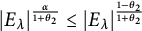 $|E_\lambda |^{\frac {\alpha }{1+\theta _{2}}}\leq |E_\lambda |^{\frac {1-\theta _{2}}{1+\theta _{2}}}$
holds for
 $|E_{\lambda }|<2^{j_0}|\gamma '(2^{j_{0}-1})|$
directly. These estimates, combined with the estimates (5.4)–(5.7) and the fact that
 $ |E_\lambda |^{\frac {\alpha +\theta _{2}(\omega _{\infty ,2}-\omega _{\infty ,1}+2\varepsilon )}{(1+\theta _{2})(\omega _{\infty ,2}+\varepsilon )}}\geq 1$
for
 $|E_\lambda |\geq 2^{j_0}|\gamma '(2^{j_{0}-1})|$
, lead to
 $$ \begin{align} \lambda^{\frac{1}{1+\theta_2}}|E_{\lambda}|\lesssim \begin{cases} |E_\lambda|^{\frac{\alpha+\theta_{2}(\omega_{\infty,2}-\omega_{\infty,1}+2\varepsilon)}{(1+\theta_{2})(\omega_{\infty,2}+\varepsilon)}}\|f\|^{\frac{1}{1+\theta_2}}_{L^{\frac{1}{\theta_2}}(\mathbb{R})}\|g\|^{\frac{1}{1+\theta_2}}_{L^{1}(\mathbb{R})}, & |E_\lambda|\geq2^{j_0}|\gamma'(2^{j_{0}-1})|; \\ |E_\lambda|^{\frac{1-\theta_{2}}{1+\theta_{2}}} \|f\|^{\frac{1}{1+\theta_2}}_{L^{\frac{1}{\theta_2}}(\mathbb{R})}\|g\|^{\frac{1}{1+\theta_2}}_{L^{1}(\mathbb{R})}, &|E_{\lambda}|<2^{j_0}|\gamma'(2^{j_{0}-1})|. \end{cases} \end{align} $$
Therefore, we obtain a similar estimate with (4.12). Here, we used (4.13). As in Proposition 4.1, we conclude that
 $H_{\alpha ,\gamma }$
maps
 $L^{2r( \varepsilon )}(\mathbb {R})\times L^{1 }(\mathbb {R})$
to
 $L^{r(\varepsilon ), \infty }(\mathbb {R})$
, where
 $\frac {1}{r( \varepsilon ) }=\frac {2(\omega _{\infty ,2}-\alpha )}{2\omega _{\infty ,2}-\omega _{\infty ,1}}-\varepsilon $
with
 $\varepsilon $
small enough. Therefore, we finish the proof of Proposition 5.1.
Remark 5.2 Let
 $\alpha \in (0, \frac {1}{2})$
, from the process of the proof of Proposition 5.1, we have
 $$ \begin{align} \left\|H_{\alpha,\gamma}(f,g)\right\|_{L^{\frac{\omega_{\infty,2}}{\omega_{\infty,2}+ (1-\alpha)\omega_{\infty,1}-\alpha}+\varepsilon, \infty}(\mathbb{R})}\lesssim \|f\|_{L^{\frac{1}{1-\alpha}}(\mathbb{R})}\left\|g\right\|_{L^{1}(\mathbb{R})} \end{align} $$
for
 $\varepsilon>0$
small enough.
Indeed, we should only repeat the previous process to prove Proposition 5.1 except for establishing (5.8). Here, we assume that
 $\alpha \leq 1-\theta _2$
, this can be realized when
 $\alpha \in (0, \frac {1}{2})$
. We then have that
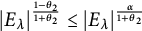 $|E_\lambda |^{\frac {1-\theta _{2}}{1+\theta _{2}}}\leq |E_\lambda |^{\frac {\alpha }{1+\theta _{2}}}$
holds for
 $|E_{\lambda }|<2^{j_0}|\gamma '(2^{j_{0}-1})|$
, which further implies
 $$ \begin{align*} \lambda^{\frac{1}{1+\theta_2}}|E_{\lambda}|\lesssim \begin{cases} |E_\lambda|^{\frac{\alpha+\theta_{2}(\omega_{\infty,2}-\omega_{\infty,1}+2\varepsilon)}{(1+\theta_{2})(\omega_{\infty,2}+\varepsilon)}}\|f\|^{\frac{1}{1+\theta_2}}_{L^{\frac{1}{\theta_2}}(\mathbb{R})}\|g\|^{\frac{1}{1+\theta_2}}_{L^{1}(\mathbb{R})}, & |E_\lambda|\geq2^{j_0}|\gamma'(2^{j_{0}-1})|; \\ |E_\lambda|^{\frac{\alpha}{1+\theta_{2}}} \|f\|^{\frac{1}{1+\theta_2}}_{L^{\frac{1}{\theta_2}}(\mathbb{R})}\|g\|^{\frac{1}{1+\theta_2}}_{L^{1}(\mathbb{R})}, &|E_{\lambda}|<2^{j_0}|\gamma'(2^{j_{0}-1})|. \end{cases} \end{align*} $$
Notice that
 $\frac {\alpha +\theta _{2}(\omega _{\infty ,2}-\omega _{\infty ,1}+2\varepsilon )}{(1+\theta _{2})(\omega _{\infty ,2}+\varepsilon )}\leq \frac {\alpha }{1+\theta _{2}}$
is equivalent to
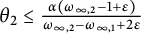 $\theta _2\leq \frac {\alpha (\omega _{\infty ,2}-1+\varepsilon )}{\omega _{\infty ,2}-\omega _{\infty ,1}+2\varepsilon }$
. This can be established by the fact that
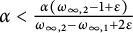 $\alpha <\frac {\alpha (\omega _{\infty ,2}-1+\varepsilon )}{\omega _{\infty ,2}-\omega _{\infty ,1}+2\varepsilon } $
with
 $\varepsilon \in (0, \omega _{\infty ,1}-1)$
. Thus
 $$ \begin{align*} \lambda|E_{\lambda}|^{\frac{\omega_{\infty,2}+ \theta_2(\omega_{\infty,1}-\varepsilon)-\alpha+\varepsilon}{\omega_{\infty,2}+\varepsilon}}\lesssim \|f\|_{L^{\frac{1}{\theta_2}}(\mathbb{R})}\|g\|_{L^{1}(\mathbb{R})} \end{align*} $$
holds for all
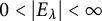 $0<|E_\lambda |<\infty $
. On the other hand, since
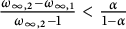 $\frac {\omega _{\infty ,2}-\omega _{\infty ,1}}{\omega _{\infty ,2}-1}<\frac {\alpha }{1-\alpha }$
, we have
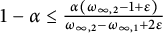 $1-\alpha \leq \frac {\alpha (\omega _{\infty ,2}-1+\varepsilon )}{\omega _{\infty ,2}-\omega _{\infty ,1}+2\varepsilon }$
for
 $\varepsilon>0$
small enough.Footnote
4
Therefore, we can take
 $\theta _2=1-\alpha $
. Observe that
 $$ \begin{align*}\frac{\omega_{\infty,2}+ (1-\alpha)(\omega_{\infty,1}-\varepsilon)-\alpha+\varepsilon}{\omega_{\infty,2}+\varepsilon}<\frac{\omega_{\infty,2}+ (1-\alpha)\omega_{\infty,1}-\alpha} {\omega_{\infty,2}}\end{align*} $$
for
 $\varepsilon>0$
small enough, this gives the assertion (5.9).
Proposition 5.3 Let
 $\gamma $
be the same as in Theorem 1.2. Then, for
 $\varepsilon>0$
small enough, there exists a positive constant C, such that
 $$ \begin{align*}\left\|H_{\alpha,\gamma}(f,g)\right\|_{L^{\tilde{r}(\varepsilon),\infty}(\mathbb{R})}\leq C \|f\|_{L^{2\tilde{r}(\varepsilon)}(\mathbb{R})}\left\|g\right\|_{L^{1}(\mathbb{R})},\end{align*} $$
where
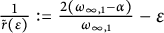 $\frac {1}{\tilde {r}( \varepsilon ) }:=\frac {2(\omega _{\infty ,1}-\alpha )}{\omega _{\infty ,1}}-\varepsilon $
with
 $\varepsilon $
small enough.
Proof Repeating the proof of Proposition 5.1, we then arrive at (5.4). Consider
 $\Upsilon _{1}$
, we now assume that
 $\alpha>\theta _2$
. For any
 $\varepsilon>0$
, by Lemma 2.1, one sees
 $$ \begin{align*}\sum\limits_{ \substack{j<j_{0} \\ 2^j{|\gamma'(2^{j-1})|}\leq|E_{\lambda}|<2^j }} 2^{{\frac{\alpha-\theta_{2}}{1+\theta_{2}}}j}|E_\lambda|^{\frac{\theta_{2}}{1+\theta_{2}}}\lesssim \begin{cases} 0, & |E_\lambda|\geq2^{j_0}; \\ |E_\lambda|^{\frac{\alpha+\theta_2(\omega_{0,2}-1+\varepsilon)}{(\omega_{0,2}+\varepsilon)(1+\theta_{2})}}, & 2^{j_0}|\gamma'(2^{j_{0}-1})|\leq|E_{\lambda}|<2^{j_0};\\ |E_\lambda|^{\frac{\alpha+\theta_2(\omega_{0,2}-1+\varepsilon)}{(\omega_{0,2}+\varepsilon)(1+\theta_{2})}}, &|E_{\lambda}|<2^{j_0}|\gamma'(2^{j_{0}-1})|. \end{cases}\end{align*} $$
Notice that
 $\alpha -\omega _{0,2}-\varepsilon +\theta _2(\omega _{0,2}-1+\varepsilon )<0$
, this along with Lemma 2.1 yields
 $$ \begin{align*}\sum\limits_{ \substack{j<j_{0} \\ |E_{\lambda}|<2^j|\gamma'(2^{j-1})| }} \frac{2^{{\frac{\alpha-1}{1+\theta_{2}}j}}|E_\lambda|^{\frac{1}{1+\theta_{2}}}}{|\gamma'(2^{j-1})|^{\frac{1-\theta_{2}}{1+\theta_{2}}}}\lesssim \begin{cases} 0, & |E_\lambda|\geq2^{j_0}; \\ 0, & 2^{j_0}|\gamma'(2^{j_{0}-1})|\leq|E_{\lambda}|<2^{j_0};\\ |E_\lambda|^{\frac{\alpha+\omega_{0,1}-\omega_{0,2}-2\varepsilon+\theta_{2}(\omega_{0,2}-1+\varepsilon)}{(\omega_{0,1}-\varepsilon)(1+\theta_{2})}}, &|E_{\lambda}|<2^{j_0}|\gamma'(2^{j_{0}-1})|. \end{cases}\end{align*} $$
It is easy to check that
 $$ \begin{align*}|E_\lambda|^{{\frac{\alpha}{1+\theta_{2}}}}\leq|E_\lambda|^{\frac{\alpha+\theta_2(\omega_{0,2}-1+\varepsilon)}{(\omega_{0,2}+\varepsilon)(1+\theta_{2})}}\leq |E_\lambda|^{\frac{\alpha+\omega_{0,1}-\omega_{0,2}-2\varepsilon+\theta_{2}(\omega_{0,2}-1+\varepsilon)}{(\omega_{0,1}-\varepsilon)(1+\theta_{2})}}\end{align*} $$
holds for
 $|E_{\lambda }|<2^{j_0}|\gamma '(2^{j_{0}-1})|$
. We then have
 $$ \begin{align} \Upsilon_1\lesssim \begin{cases} \|f\|^{\frac{1}{1+\theta_2}}_{L^{\frac{1}{\theta_2}}(\mathbb{R})}\|g\|^{\frac{1}{1+\theta_2}}_{L^{1}(\mathbb{R})}, & |E_\lambda|\geq2^{j_0}|\gamma'(2^{j_{0}-1})|;\\ |E_\lambda|^{\frac{\alpha+\omega_{0,1}-\omega_{0,2}-2\varepsilon+\theta_{2}(\omega_{0,2}-1+\varepsilon)}{(\omega_{0,1}-\varepsilon)(1+\theta_{2})}} \|f\|^{\frac{1}{1+\theta_2}}_{L^{\frac{1}{\theta_2}}(\mathbb{R})}\|g\|^{\frac{1}{1+\theta_2}}_{L^{1}(\mathbb{R})}, &|E_{\lambda}|<2^{j_0}|\gamma'(2^{j_{0}-1})|. \end{cases} \end{align} $$
 $\Upsilon _2$
has the same estimate as in Proposition 5.1, and we turn to
 $\Upsilon _3$
. It is different from (5.3), we here need to bound (5.2) as
 $$ \begin{align} \left\|H_{\alpha,\gamma,j}(f,g)\chi_{E}\right\|_{L^{\frac{1}{1+\theta_2}}(\mathbb{R})} \leq \min\left\{2^j, \frac{2^{j\theta_2}|E|^{1-\theta_2}}{|\gamma'(2^{j-1})|^{1-\theta_2}} \right\} \|f\|_{L^{\frac{1}{\theta_2}}(\mathbb{R})}\|g\|_{L^{1}(\mathbb{R})}. \end{align} $$
Then, we can write
 $$ \begin{align*} \Upsilon_{3}=\sum\limits_{j>j_{0}+2}2^{{\frac{\alpha-1}{1+\theta_{2}}}j}\min\left\{2^j, \frac{2^{j\theta_2}|E_{\lambda}|^{1-\theta_2}}{|\gamma'(2^{j-1})|^{1-\theta_2}} \right\}^{\frac{1}{1+\theta_2}} \|f\|^{\frac{1}{1+\theta_2}}_{L^{\frac{1}{\theta_2}}(\mathbb{R})}\|g\|^{\frac{1}{1+\theta_2}}_{L^{1}(\mathbb{R})}, \end{align*} $$
which can be rewritten as
 $$ \begin{align*}\left[\sum\limits_{ \substack{j>j_{0}+2 \\ |E_{\lambda}|\geq2^j{|\gamma'(2^{j-1})|} }} 2^{{\frac{\alpha}{1+\theta_{2}}}j}+ \sum\limits_{ \substack{j>j_{0}+2 \\ |E_{\lambda}|<2^j{|\gamma'(2^{j-1})|} }} \frac{2^{{\frac{\alpha-1+\theta_{2}}{1+\theta_{2}}}j} |E_\lambda|^{\frac{1-\theta_{2}}{1+\theta_{2}}}}{|\gamma'(2^{j-1})|^{\frac{1-\theta_{2}}{1+\theta_{2}}}}\right] \|f\|^{\frac{1}{1+\theta_2}}_{L^{\frac{1}{\theta_2}}(\mathbb{R})}\|g\|^{\frac{1}{1+\theta_2}}_{L^{1}(\mathbb{R})}.\end{align*} $$
For any
 $\varepsilon>0$
, by Lemma 2.1, we also have
 $$ \begin{align*}\sum\limits_{ \substack{j>j_{0}+2 \\ |E_{\lambda}|\geq2^j{|\gamma'(2^{j-1})|} }} 2^{{\frac{\alpha}{1+\theta_{2}}}j}\lesssim \begin{cases} |E_\lambda|^{\frac{\alpha}{(1+\theta_{2})(\omega_{\infty,1}-\varepsilon)}}, & |E_\lambda|\geq2^{j_0}|\gamma'(2^{j_{0}-1})|;\\ 0, & |E_\lambda|<2^{j_0}|\gamma'(2^{j_{0}-1})|. \end{cases}\end{align*} $$
We assume that
 $\alpha <(1-\theta _2)(\omega _{\infty ,1}-\varepsilon )$
with
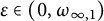 $\varepsilon \in (0, \omega _{\infty ,1})$
, it follows from Lemma 2.1 that
 $$ \begin{align*}\sum\limits_{ \substack{j>j_{0}+2 \\ |E_{\lambda}|<2^j{|\gamma'(2^{j-1})|} }} \frac{2^{{\frac{\alpha-1+\theta_{2}}{1+\theta_{2}}}j} |E_\lambda|^{\frac{1-\theta_{2}}{1+\theta_{2}}}}{|\gamma'(2^{j-1})|^{\frac{1-\theta_{2}}{1+\theta_{2}}}}\lesssim \begin{cases} |E_\lambda|^{\frac{\alpha+(1-\theta_2)(\omega_{\infty,2}-\omega_{\infty,1}+2\varepsilon)}{(1+\theta_{2})(\omega_{\infty,2}+\varepsilon)}}, & |E_\lambda|\geq2^{j_0}|\gamma'(2^{j_{0}-1})|; \\ |E_\lambda|^{\frac{1-\theta_{2}}{1+\theta_{2}}}, & |E_\lambda|<2^{j_0}|\gamma'(2^{j_{0}-1})|. \end{cases}\end{align*} $$
Based on the fact
 $|E_\lambda |^{\frac {\alpha }{(1+\theta _{2})(\omega _{\infty ,1}-\varepsilon )}}< |E_\lambda |^{\frac {\alpha +(1-\theta _{2})(\omega _{\infty ,2}-\omega _{\infty ,1}+2\varepsilon )}{(1+\theta _{2})(\omega _{\infty ,2}+\varepsilon )}}$
holds for
 $|E_\lambda |\geq 2^{j_0}|\gamma '(2^{j_{0}-1})|$
, we deduce that
 $$ \begin{align} \Upsilon_{3}\lesssim \begin{cases} |E_\lambda|^{\frac{\alpha+(1-\theta_{2})(\omega_{\infty,2}-\omega_{\infty,1}+2\varepsilon)}{(1+\theta_{2})(\omega_{\infty,2}+\varepsilon)}}\|f\|^{\frac{1}{1+\theta_2}}_{L^{\frac{1}{\theta_2}}(\mathbb{R})}\|g\|^{\frac{1}{1+\theta_2}}_{L^{1}(\mathbb{R})}, & |E_\lambda|\geq2^{j_0}|\gamma'(2^{j_{0}-1})|; \\ |E_\lambda|^{\frac{1-\theta_{2}}{1+\theta_{2}}}\|f\|^{\frac{1}{1+\theta_2}}_{L^{\frac{1}{\theta_2}}(\mathbb{R})}\|g\|^{\frac{1}{1+\theta_2}}_{L^{1}(\mathbb{R})}, & |E_\lambda|<2^{j_0}|\gamma'(2^{j_{0}-1})|. \end{cases} \end{align} $$
Combining (5.10), (5.6), and (5.12), then the following estimate is valid:
 $$ \begin{align*} \lambda^{\frac{1}{1+\theta_2}}|E_{\lambda}|\lesssim \begin{cases} |E_\lambda|^{\frac{\alpha+(1-\theta_{2})(\omega_{\infty,2}-\omega_{\infty,1}+2\varepsilon)}{(1+\theta_{2})(\omega_{\infty,2}+\varepsilon)}}\|f\|^{\frac{1}{1+\theta_2}}_{L^{\frac{1}{\theta_2}}(\mathbb{R})}\|g\|^{\frac{1}{1+\theta_2}}_{L^{1}(\mathbb{R})}, & |E_\lambda|\geq2^{j_0}|\gamma'(2^{j_{0}-1})|;\\ \left(|E_\lambda|^{\frac{\alpha+\omega_{0,1}-\omega_{0,2}-2\varepsilon+\theta_{2}(\omega_{0,2}-1+\varepsilon)}{(\omega_{0,1}-\varepsilon)(1+\theta_{2})}}+|E_\lambda|^{\frac{1-\theta_2}{1+\theta_2}}\right) \|f\|^{\frac{1}{1+\theta_2}}_{L^{\frac{1}{\theta_2}}(\mathbb{R})}\|g\|^{\frac{1}{1+\theta_2}}_{L^{1}(\mathbb{R})}, &|E_{\lambda}|<2^{j_0}|\gamma'(2^{j_{0}-1})|. \end{cases} \end{align*} $$
If we have
 $$ \begin{align*}\frac{\alpha+(1-\theta_{2})(\omega_{\infty,2}-\omega_{\infty,1}+2\varepsilon)}{(1+\theta_{2})(\omega_{\infty,2}+\varepsilon)}< \frac{1-\theta_2}{1+\theta_2}\leq \frac{\alpha+\omega_{0,1}-\omega_{0,2}-2\varepsilon+\theta_{2}(\omega_{0,2}-1+\varepsilon)}{(\omega_{0,1}-\varepsilon)(1+\theta_{2})},\end{align*} $$
which equals to
 $\frac {\omega _{0,2}-\alpha +\varepsilon }{\omega _{0,2}+\omega _{0,1}-1}\leq \theta _2<\frac {\omega _{\infty ,1}-\alpha -\varepsilon }{\omega _{\infty ,1}-\varepsilon }$
for
 $\varepsilon>0$
small enough, we then obtain that
 $$ \begin{align} \lambda|E_{\lambda}|^{\frac{\omega_{\infty,1}-\alpha-\varepsilon+ \theta_2(2\omega_{\infty,2}- \omega_{\infty,1} +3\varepsilon)}{\omega_{\infty,2}+\varepsilon}}\lesssim \|f\|_{L^{\frac{1}{\theta_2}}(\mathbb{R})}\|g\|_{L^{1}(\mathbb{R})} \end{align} $$
holds for all
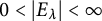 $0<|E_\lambda |<\infty $
. Indeed,
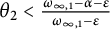 $\theta _2<\frac {\omega _{\infty ,1}-\alpha -\varepsilon }{\omega _{\infty ,1}-\varepsilon }$
comes from the assumption in estimating
 $\Upsilon _{3}$
. In order to show that we can take
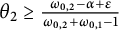 $\theta _2\geq \frac {\omega _{0,2}-\alpha +\varepsilon }{\omega _{0,2}+\omega _{0,1}-1}$
, it suffices to show that
 $$ \begin{align*}\frac{\omega_{0,2}-\alpha+\varepsilon}{\omega_{0,2}+\omega_{0,1}-1}<\frac{\omega_{\infty,1}-\alpha-\varepsilon}{\omega_{\infty,1}-\varepsilon}\leq \alpha\end{align*} $$
holds for
 $\varepsilon>0$
small enough, which is trivially verified by the condition that
 $\frac {\alpha }{1-\alpha }\geq \omega _{\infty ,1}\geq \omega _{0,2}$
and
 $\omega _{0,1}>1$
. Thus, we obtain (5.13) for
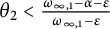 $\theta _2<\frac {\omega _{\infty ,1}-\alpha -\varepsilon }{\omega _{\infty ,1}-\varepsilon }$
with
 $\varepsilon>0$
small enough.
Notice that
 $$ \begin{align*}\frac{\omega_{\infty,1}-\alpha-\varepsilon+ \theta_2(2\omega_{\infty,2}- \omega_{\infty,1} +3\varepsilon)}{\omega_{\infty,2}+\varepsilon}<\frac{2(\omega_{\infty,1}-\alpha-\varepsilon)}{\omega_{\infty,1}-\varepsilon}\end{align*} $$
when
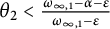 $\theta _2<\frac {\omega _{\infty ,1}-\alpha -\varepsilon }{\omega _{\infty ,1}-\varepsilon }$
with
 $\varepsilon>0$
small enough, and
 $\frac {2(\omega _{\infty ,1}-\alpha -\varepsilon )}{\omega _{\infty ,1}-\varepsilon }<\frac {2(\omega _{\infty ,1}-\alpha )}{\omega _{\infty ,1}}$
, we conclude that
 $H_{\alpha ,\gamma }$
maps
 $L^{2\tilde {r}( \varepsilon )}(\mathbb {R})\times L^{1 }(\mathbb {R})$
to
 $L^{\tilde {r}(\varepsilon ), \infty }(\mathbb {R})$
, where
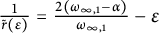 $\frac {1}{\tilde {r}( \varepsilon ) }=\frac {2(\omega _{\infty ,1}-\alpha )}{\omega _{\infty ,1}}-\varepsilon $
with
 $\varepsilon $
small enough. Therefore, we finish the proof of Proposition 5.3.
Acknowledgments
The authors would like to thank the referee for carefully reading the manuscript and for offering valuable suggestions, which made the paper complete, accurate and more readable.