INTRODUCTION
In Pakistan, mixed crop-livestock farming systems constitute the majority of agricultural production, of which smallholder farmers contribute most. This is particularly so in the Punjab region, where the average smallholder mixed farm is 2–3 ha, with three quarters being used for growing cash crops and one quarter for growing forage (Cain et al., Reference Cain, Anwar and Rowlinson2007; Dost et al., Reference Dost, Misri, El-Nahrawy, Khan and Serkan2014). Livestock are an integral part of the farming system and contribute about 40% of the average annual income of smallholder farms. Animals are also essential to the nutrition/sustenance of the household for milk, meat and for the provision of work, such as draught power to pull ploughs (Anwar et al., Reference Anwar, Khan, Ikram, Akhtar, Shafique and Abdul2012). Forage crops occupy 16–19% of the total cultivated area in Pakistan as a whole (Saeed et al., Reference Saeed, Gul, Wahab, Durrani, Haleema, Ayub, Muhammad, Said and Ahmad2011); with berseem clover leading winter forage crop in the country, being cultivated on 710,000 ha and producing about 22.61 million tonnes of green forage (dry matter basis) annually (Government of Pakistan, Reference Farooq2015). Berseem clover is grown both as a monoculture and in combination with oats (Avena sativa) and brassica species, such as rapeseed (Brassica juncea), mustard (Brassica nigra) and canola (Brassica napus). It is also mixed into feed rations with wheat (Triticum aestivum) and rice (Oryza sativa) straws for livestock feeding (Ud-Din et al., Reference Ud-Din, Ullah, Khan, Ramzan, Ahmad and Hameed2014). It is quite common practice to grow berseem clover as a dual purpose crop for both forage and seed, with the seed often retained for future plantings (Dost et al., Reference Dost, Misri, El-Nahrawy, Khan and Serkan2014).
There is a significant difference in forage and seed yields of improved varieties of berseem clover achieved at research stations compared to those of smallholder farmers using locally available, unimproved landraces (Government of Punjab, 2014). This difference is possibly attributable to lack of awareness by farmers of the appropriate agronomic practices needed for growing improved forage varieties and/or lack of availability of seed of these varieties, and the required inputs (such as fertiliser and inoculant) needed to achieve yield potential (Anwar et al., Reference Anwar, Khan, Ikram, Akhtar, Shafique and Abdul2012). These issues might be addressed by creating awareness of the reasons for low forage production, and then knowledge transfer of improved practices to farmers. Indeed, knowledge building of farmers about methods for increasing forage production can lead to the adoption of technologies that reduce yield gaps as well as promoting sustainable forage production and seed yields (Satyapriya et al., Reference Satyapriya, Agrawal, Sharma, Singh and Kumar2013).
Livestock production in mixed farming systems is often limited by inadequate supply of green forage due to lack of availability of quality seed. In Pakistan, the demand for berseem clover seed cannot be fulfilled through the formal seed supply system which is defined as, ‘the vertically organised seed production and distribution system of the verified seed of approved varieties using strict quality standards’, as in many situations, formal seed supply has been unable to meet farmers’ complex needs such as time, place and quantity of seed with minimum cost, and dependence on external sources (David, Reference David2004). Thus, there is a need for an alternative supply system, which supplies quality seed to farmers and leads to increased forage production at the farm level. Phaikaew and Stur (Reference Phaikaew and Stur1998) proposed that the establishment of village-based forage seed enterprises (VBFSEs) can create an alternative and secure seed supply system at the local level. This could also increase seed supply of improved varieties at the village level, resulting in increased forage and seed production. Further, the VBFSE model would be a mean of educating and increasing awareness of farmers on improved varieties and agronomic production technology (Nakamanee et al., Reference Nakamanee, Srisomporn, Phengsavanh, Samson and Stur2008).
There have been no detailed studies undertaken in the Punjab region of Pakistan on the level of technical awareness or farmers’ understanding of growing berseem clover for forage and seed production. Nor has the appropriateness of the VBFSE model been tested with local farmers. Therefore, the objectives of the present study were to understand and quantify the following issues at the farm level: (1) Farmers’ understanding of growing berseem clover for forage and seed production and factors affecting crop productivity; (2) berseem clover seed sourcing and availability; and (3) farmers’ attitudes towards adoption of improved berseem clover varieties, and the potential for the establishment of VBFSEs in their locality. The information generated from the survey would provide baseline information to streamline the future research and development in forage and seed production at the smallholder farmer level.
MATERIALS AND METHODS
A survey was designed to profile smallholder farmers in the North-Eastern region of the province of Punjab, Pakistan.
Survey design
The survey focused on three primary sections: (1) General farmer and farm characteristics: data on age, level of education, use of male and female labour, nature of land tenure, extent of land leasing and leased rate, berseem clover production area and credit loans with interest rates; (2) farmer knowledge and understanding in terms of: sourcing berseem clover varieties, growing the crop, production technologies for the crop both for forage and seed; and factors associated with berseem clover forage and seed production; and (3) constraints to berseem clover seed production at the farm level: availability of basic seed, knowledge and awareness of seed sources, distance from market, characteristics desired in an improved variety, and critical success factors for enhancing berseem clover seed production.
The questions were predominantly close-ended and designed with the specific objective of obtaining a response in the most efficient and easily understood manner. However, there were some open-ended questions to obtain greater insight into the farm and the farmers’ views on varietal selection and adoption. The survey was carried out solely by the lead author and the collected data was non-identifiable. When necessary, survey questions were explained to respondents in a way that responses were not influenced.
Sample population
The stratified random sampling technique was used to randomly select the survey participants, proportional to the population in each locality within each village. A total of 43 berseem clover growers from 21 villages (Supplementary Figure S1), were randomly selected as respondents from a list of 203 Australian Sector Linkage Programme (ASLP) registered dairy farmers in the districts of Kasur and Okara of Punjab, Pakistan. It was anticipated that selection of participants from registered growers would generate a greater response rate than that achievable through a new selection of farmers. Their ongoing involvement in the ASLP research and development program was likely to suggest a more positive attitude towards involvement in other research activities.
The survey was translated into the local Urdu language and piloted with 10 smallholder farmers to validate it for comprehensiveness and ability to produce unbiased (true to type) responses (Satyapriya et al., Reference Satyapriya, Agrawal, Sharma, Singh and Kumar2013). As only minor modifications from the original survey occurred during these 10 pilot surveys, the data generated was incorporated into the main body of data collected. Each survey participant was provided with an information sheet, consent form and briefed about the research and the survey's voluntary nature before beginning. The survey was completed as a face-to-face interview and took approximately 30–40 min to complete.
Statistical analyses
Both quantitative and qualitative data were collected and analysed using descriptive and inferential statistics as described by Singh et al. (Reference Singh, Dubey, Ali, Nigam, Srivastava, Saxena, Yadav and Kumar2013) and Anwar et al. (Reference Anwar, Khan, Ikram, Akhtar, Shafique and Abdul2012). The quantitatively collected data contained two types of response variables, continuous and categorical (predicted) variables, and therefore a two-way analysis of variance (ANOVA) was used. The model can be symbolised as follows: Response ~ District + Locality. The predicted values were assigned a rank based on the Tukey's family of pairwise differences with a family confidence level of 5%. The model assumptions for the two-way ANOVA were that the residuals are normally distributed because they have a constant variance and are independent. In addition, the factor level variances are equal for the district + locality (Singh et al., Reference Singh, Dubey, Ali, Nigam, Srivastava, Saxena, Yadav and Kumar2013). This was tested using the Brown–Forsythe test. The Shapiro–Wilk test of normality was used to determine if the residuals were normally distributed, unless otherwise stated in the results, the model assumptions were checked and met. When analysing the categorical response variables, a Fisher's exact test of independence was used to determine whether a relationship existed between the responses to the questions, as response was categorical and the predictor was a continuous variable. In both cases the hypotheses being tested were: H 0 – The two variables are independent; H 1 – The two variables are dependent. The data were analysed in R using asreml-R package (R Core Team, 2015). An overall 5% significance level was deemed to provide statistical significance.
RESULTS
Demographic profile of the survey population
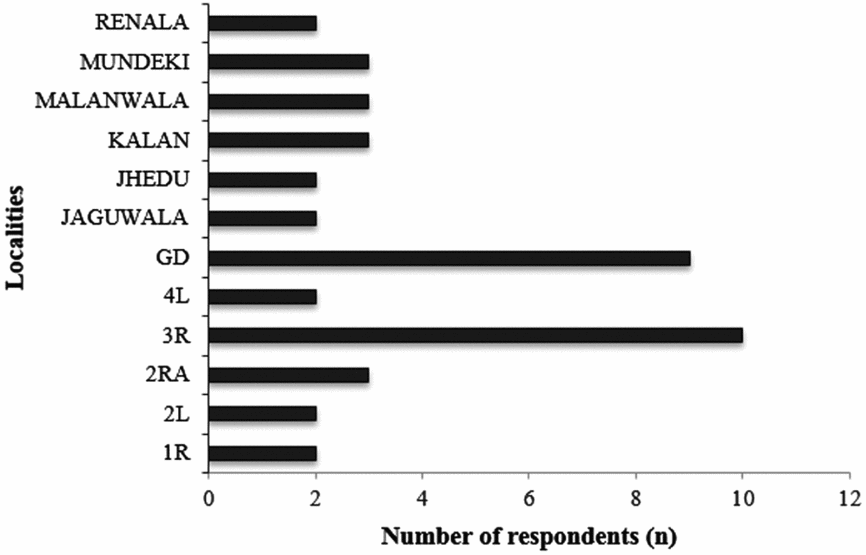
All the respondents (n = 43) were from 21 villages within 12 localities in the districts of Kasur and Okara. The localities of Mundeki, Malanwala, Kalan, Jhedu and Jaguwala are situated in district Kasur, while Renala, GD, 4L, 3R, 2RA, 2L and 1R are located in district Okara. Typically, two to three farmers per village were interviewed. The number of respondents within each of the localities is shown in Figure 1. All of the respondents surveyed were male with an average age of 42.5 ± 2.2 years and with a range of both young (18 years) and experienced (90 years) farmers. The age distribution of the respondents was 16% young age (between 18 and 30 years), 49% middle aged (between 31 and 45 years), and 35% experienced farmers (between 46 and 90 years of age). The response variable of age varied significantly (p < 0.05), both between districts and localities. Of the respondents, 88% had obtained some level of education, with the remaining 12% illiterate and with no formal education. Among the educated farmers, 7% had primary education (up to 5th standard), 44% had matriculated (up to 10th standard), and 37% were graduated from colleges and universities. None of the respondents had studied any kind of agricultural science or had any formal training in agricultural methods/operations undertaken at their farms.
The number of randomly chosen survey respondents proportionate to the size of population at each locality in the districts of Kasur and Okara, Punjab, Pakistan.

All of the respondents who owned small (<3 ha) and medium sized (3–5 ha) farms worked on their own farm whilst those who owned large farms (>5 ha) hired labour to carry out farm operations. All of the respondents used male labour on their farm and 70% of the respondents also used female labour. The average total farm labour was 3.1 ± 0.2 labour units with a range of one to eight labour units per farm (including farmers themselves). This comprised 2.2 ± 0.2 male labour units farm−1 (range 1–6 labour units) and 1.3 ± 0.1 female labour units farm−1 (range of 1–3 labour units). The response variable (both male and females) of labour did not vary (p > 0.05) either between districts or localities.
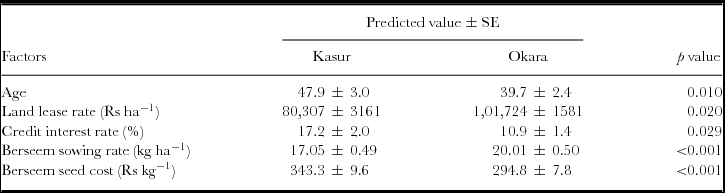
Of the respondents, 9% had tractors that they had purchased using a machinery loan from either agricultural or commercial banks (agricultural loans), with an interest rate of up to 18% as compared to other business loans having up to 29% interest rate. In addition, 16% also obtained credit loans on a seasonal basis from different agricultural and commercial banks to buy crop inputs such as seed, fertiliser and pesticides. The average credit loan amount was 160,000 ± 48,429 Rupees (Rs) equivalent to 1637 US$, with a range of 25,000 to 400,000 Rs annually. The average interest rate on credit loans at the time was 12.4 ± 1.2%, ranging from a minimum rate of 9% from the agricultural bank (Zarai Taraqiati Bank Ltd.) to a maximum rate of 18% from commercial banks. The credit loan amount did not vary (p > 0.05) between districts; however, interest rates were significantly higher (p < 0.05) in Kasur district (17%) than in Okara district (11%) farmers.
Farm size and characteristics
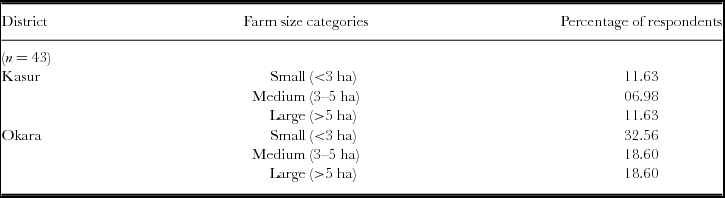
The average farm size of the survey respondents was 6.84 ± 1.42 ha, ranging from a minimum of 0.40 ha to a maximum of 48 ha. Whilst farm size varied significantly (p < 0.001) between localities, it did not vary (p > 0.05) between districts (Table 1). Of the respondents, 70% also leased land in order to make their land unit profitable. The average leased land area was 5.71 ± 1.54 ha, with a range of 0.40 to 32.37 ha. The area of leased land did not vary (p > 0.05) between localities or districts. The highest variable cost in berseem clover production was the cost of leasing land, with an average cost of 97,439 ± 3783 Rs ha−1 (equates to 33% of the average total variable costs), and ranging from 61,775 to 1,35,905 Rs ha−1. The cost of leasing land was significantly higher (p < 0.05) in Okara district (1,01,724 Rs ha−1) than in Kasur district (80,308 Rs ha−1) but did not vary (p > 0.05) between localities. The surveyed farms were grouped into three farm size categories; small (< 3 ha), medium (3–5 ha) and large (>5 ha) (Table 1). Of the total respondents, 70% had small to medium sized farms of <5 ha of cultivated land, and within these respondents, 63% had small farms of <3 ha.
The percentage of respondents (n = 43) farming small (<3 ha), medium (3–5 ha) and large (>5 ha) farm sizes in the surveyed villages of the Kasur and Okara districts of Punjab, Pakistan.

Farmers’ practices of growing berseem clover
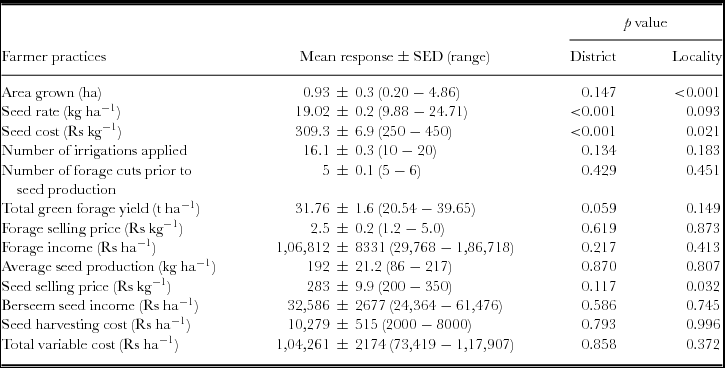
Farmers’ practices when growing berseem clover are summarised in Table 2. The average area grown varied significantly (p < 0.001) between localities (average 1.07 ha) but did not differ (p > 0.05) between districts (average 2.15 ha). To grow their crops, respondents either retained their own seed or sourced the seed from fellow farmers (74%), used improved seed varieties obtained from the research stations (3%) or purchased their seeds from their local agricultural markets (23%). Both resourcing of seed varied (p < 0.05) between districts as did the seeding rates used (19 kg ha−1); however, the average seeding rate was 19 kg ha−1 and did not vary (p > 0.05) between localities (villages of the district). In Kasur district, the average sowing rate was 17 kg ha−1 (below the recommended level of 20 kg ha−1), while in Okara district the average sowing rate was 20 kg ha−1. The average cost of berseem clover seed was 309 Rs kg−1 but this varied depending on the seed source, on an average of 319 Rs kg−1 at district (p < 0.05) and 307 Rs kg−1 at locality (p < 0.05) level. The most expensive seed came from the market (450 Rs kg−1), followed by research-station seed (350 Rs kg−1). The least expensive seed was traded between farmers (250 Rs kg−1). The average cost of seed varied (p < 0.001) between both districts (p < 0.001) and localities (p < 0.05). In Kasur, the average cost of seed was 342 Rs kg−1, while in Okara district the cost was 295 Rs kg−1.
Average (±SED) and range of responses regarding farmers’ practices in growing berseem clover on their farms in the survey villages of districts Kasur and Okara, Punjab, Pakistan. p values indicate significant differences at the level of either district or locality.

Of the respondents, 79% sowed berseem clover in mid-October, with the remaining 21% sowing in late September. There were no differences (p > 0.05) between districts or localities in the timing of sowing. In terms of fertiliser use, 79% of respondents used both organic (farmyard manure) as well as inorganic with the remaining 21% only using inorganic fertilisers. Inorganic fertiliser used were urea (46% N), diammonium phosphate (DAP; 18% N and 46% P2O5), nitrophos (NP; 22% N and 20% P2O5), sulphate of potash (SOP; 50% K2O) and muriate of potash (MOP; 60% K2O) for K fertilisers depending on availability. None of the respondents performed soil tests and neither did they use Rhizobium inoculant with the seed at sowing. Of the farmers using inorganic fertilisers, 95% used urea, 91% DAP and 5% used SOP/MOP as sources of N, P and K fertilisers. The average application rate of farmyard manure (wet weight basis) over the whole growing season was 18.75 t ha−1; with 7% of the farmers applying it at the rate of 7.5 t ha−1, 14% at 15 t ha−1, 11% at 22.5 t ha−1 and 47% at the rate of 30 t ha−1. Where inorganic fertiliser was used, the average application rates were 86 kg N ha−1 for urea, 74 kg P ha−1 for DAP and 31 kg K ha−1 for SOP. Where the respondents used urea, 69% applied it at the rate of 58 kg of N ha−1, and the remaining 31% applied 115 kg N ha−1 through the growing season as split applications. The respondents irrigated their berseem clover crop on an average of 16 times (each irrigation of about one acre-inch = 102 m3 of water), with the same number of irrigations (p > 0.05) across both districts and localities.
The average number of forage cuts taken prior to closing up the crop for seed production was five, the same across (p > 0.05) both districts and localities within districts. There was considerable variation in forage harvesting time and plant height at harvest; but overall this did not vary (p > 0.05) between districts or localities. The majority (79%) of respondents reported that herbage production was low at the start of the winter season due to poor germination and initial growth. Similarly, growth was low in midwinter due to frost. As berseem clover is an annual cool-season legume, forage production declined as the summer progressed, it being the end of the growing season as the crop was being left for seed production. None of the respondents had the forage assessed for nutritive value due to lack of awareness and knowledge as well as the lack of availability of a forage testing service. As a consequence of the variability in the time of the last forage cut, there was a wide range of harvesting times for the seed crop. Of the respondents who produced seed, 28% harvested their seed crop in early June, 32% in mid-June, 28% in late June and 12% in the early July. About 40% of the respondents either prolonged forage cuttings or increased the number of cuts, which caused late seed harvesting. Hence, flowering and seed set occurred during the warm June (with reduction in honeybee activity due to high temperature) resulting in low average seed yields of 192 kg ha−1.
The average green forage and seed yields with their respective selling prices and incomes are presented in Table 2. The average green forage yield (31.8 ± 1.6 t ha−1 wet weight basis) and forage selling price (2.5 Rs kg−1) did not vary (p > 0.05) between districts or localities and consequently the average forage income (1,06,812 ± 8331 Rs ha−1) also did not vary (p > 0.05) between districts or localities. The average seed yield (192 kg ha−1) and average selling price of the farmer-produced seed (283 Rs kg−1) did not vary (p > 0.05) between districts; however, seed price did vary (p < 0.05) between localities, with the price at Okara ranging from 267 to 300 Rs kg−1, compared to 225 to 350 Rs kg−1 at Kasur. The average value of the seed income (32,600 Rs ha−1) did not vary (p > 0.05) between districts or localities. The total variable costs (1,04,250 Rs ha−1) and seed harvesting cost (10,300 Rs ha−1) of berseem clover did not vary (p > 0.05) between districts or localities.
Berseem clover seed production at the village level
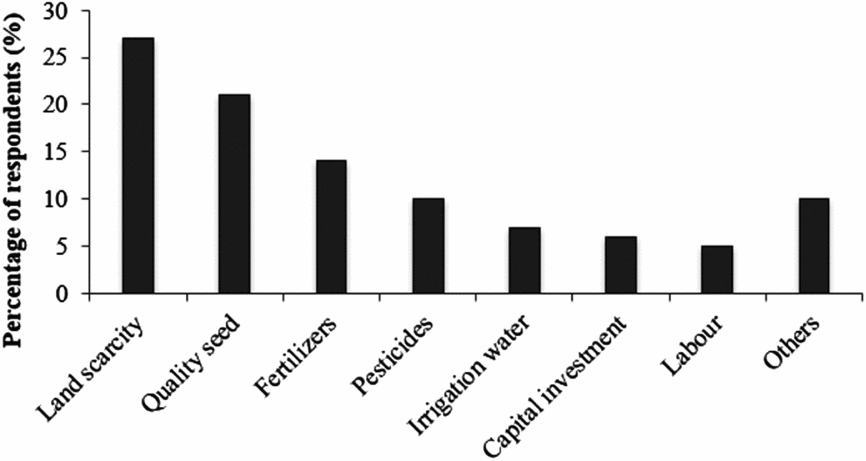
Farmer seed, both own-saved and purchased from other farmers, was used by 74% of the respondents for growing forage. Approximately one-third of these respondents retained seed they had, and thus were considered seed producers, and the remaining two-thirds purchased seed directly from other farmers in the village. The majority of the seed producers (56%) had no technical support, and also had little or no knowledge of improved practices required for growing berseem clover for forage and seed production. Only 14% of the respondents used technical guidance from their local Agricultural Department extension services. Of the respondents, 30% obtained information and technical support for growing maize and sorghum forages (which they could apply somewhat to berseem clover production) from farmer meetings and field days conducted by private seed and Agro-chemical companies. The respondents who produced berseem clover seed faced constraints during the seed production process. When asked to rank these, all identified the poor availability of land, scarcity of crop inputs such as quality seed and fertilisers, rains at the time of seed setting, insects, pests and disease attack, damage from birds and the need for multiple spray applications (Figure 2). Of the seed producers, 63% considered they could manage most of these constraints through expanding their operation via leased land and improving awareness of crop protection as they were well equipped with farm equipment and experience; however, the remaining 37% felt they could not manage these constraints, resulting in significant forage and seed yield losses.
Major constraints in berseem clover seed production at village level experienced by the surveyed farmers (n = 43) in the villages of districts of Kasur and Okara, Punjab, Pakistan during 2012–2013.

Potential role of village-based forage seed enterprises
The survey participants were questioned regarding the introduction of VBFSEs and perceptions of associated benefits such as access to improved variety seed and improved production technologies as a way to increase forage and seed production. The major varietal selection characteristics identified by 92% of the respondents were increased number of forage cuts, longer growing season and increased forage yields. In addition, 64% of the respondents preferred varieties with low irrigation water requirements; 54% wanted low weed seed contamination, lower fertiliser requirements and resistance against pests and diseases; and 47% preferred to have varieties that fitted well in their crop rotation, grew well under frost (very low temperature) conditions and would not lodge. Of the respondents, 35% preferred to select varieties with greater plant height and a higher number of forage cuts, had greener colour and high yield of green forage. Twenty-eight percent of respondents preferred to select varieties that had good germination rates, with more stemming, more flowers and higher forage and seed yields. Thirty-seven percent of the respondents had preferences for selecting varieties with quick growth with broader leaves and lustrous green colour, greater stem width and with disease resistance. Farmer responses varied (p < 0.05) both between districts and locality.
The respondents suggested there were some specific requirements and critical success factors to consider in establishing VBFSEs at their villages. Every respondent (100%) agreed that the availability of improved varieties of berseem clover was a pre-requisite to start a VBFSE. Of the respondents, 33% also considered the availability of land as an important requirement and 35% suggested that the availability of seed production technologies and technical supervision by researchers were also important requirements. For 33% of the respondents, fertiliser and irrigation water availability were the important requirements. Availability of land and crop inputs such as improved variety seed, fertilisers and pesticides, credit loans as well as availability of information were considered by 74% of the respondents as the most important critical success factors. Farmers’ willingness and commitment to seed production, and of the building of trust with farmers were considered by 14% of the respondents as important critical success factors. For 9% of the respondents, the factors critical in development of a VBFSE must include knowledge of the improved practices of crop production, technical support in seed production, farmer training in seed marketing, demonstration plots in villages, and availability of machinery such as seed graders. Only 3% of the respondents could not identify any critical success factors for the successful establishment of VBFSEs in their villages.
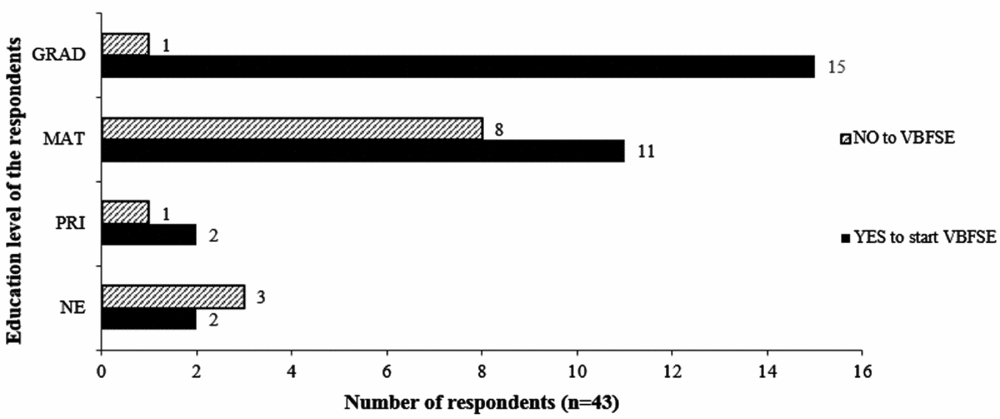
The main factors affecting the farmer's attitude towards using VBFSE intervention and willingness to start VBFSE are presented in Table 3. Overall, 67% of the respondents thought that this idea could be workable in their villages and wanted to start the VBFSE activity on their farms. They also thought it could be a profitable and successful small-scale seed business in their localities. Across the Kasur and Okara districts, 77% (n = 10) and 63% (n = 19) of the respondents were willing to start VBFSE in their village. The education level of the respondents had a significant effect (p < 0.05) on the decision to start a VBFSE, as shown in Figure 3. Of the educated respondents (n = 38), 74% were willing to start VBFSE, and of the non-educated respondents (n = 5), only 40% would consider starting a VBFSE. Those with a graduate level of education were the most willing, with 15 out of 16 graduates wishing to participate in such a program. Lower lease rate also encouraged farmers to start VBFSE on their farms and thus Kasur farmers were more interested in VBFSE than Okara farmers.
Differences in socio-economic factors affecting berseem clover seed production such as farmer age, land lease rates, credit interest rates, berseem clover sowing rates and associated cost to start village-based forage seed enterprises in the districts of Kasur and Okara, Punjab, Pakistan.

*Predicted values from raw data for the main effect of district ± SE.
Relationship between education levels of non-educated (NE), primary (PRI), matriculant (MAT) and college-graduated (GRAD) farmers and willingness to start village-based forage seed enterprises in villages of districts of Kasur and Okara, Punjab, Pakistan.

To start a VBFSE business requires both the willingness of the farmers as well as some initial capital investment. Of the farmers who agreed to start VBFSEs (n = 29), 67% were willing to invest an average of 159,900 Rs ha−1 in order to start the business. The major expense identified within this investment was land rent (ranging from 61,000 to 95,000 Rs ha−1). Other major expenses identified were in the form of crop inputs such as improved seed, fertilisers, irrigation water and pesticides. Of the respondents that agreed to start VBFSEs, 41% were willing to invest an average of 36,000 Rs for seed cleaning, grading, packing and marketing of the berseem clover seed produced as a result of village-based seed production. The majority of this investment would come from credit loans from banks, with predicted interest rate values a significant (p < 0.05) factor influencing agreement to start a VBFSE.
DISCUSSION
Demographic profile of the survey population
The majority (88%) of the respondents were literate, having obtained some level of education. This is much higher than the national average of 58% literacy rate (Government of Pakistan, Reference Farooq2015). Literacy is an important factor in improving smallholder incomes as education plays an important role in decision making and the adoption of agricultural interventions (Ul-Allah et al., Reference Ul-Allah, Khan, Burkert and Wachendorf2014a). All of the respondents were male. In Pakistan, the household decision making and responsibility goes with the senior male member of the family; however, women carry out a considerable amount of the farm work in caring for crops and livestock. It is therefore acknowledged that the inclusion of women in activities to improve their agricultural knowledge and skills is very important and has a key role in increasing whole farm productivity. Involvement of women in training and economic activities has been shown to result in enhancement of both forage and livestock production (Anwar et al., Reference Anwar, Khan, Ikram, Akhtar, Shafique and Abdul2012). In reality, the level of involvement women have in the making of farming decisions is likely to vary considerably between households.
Sowing rate
Agronomic practices have a major impact on forage and seed yields. The average sowing rate of 19 kg ha−1 was just below the recommended 20 kg ha−1 to maximise forage and seed yields (Gul et al., Reference Gul, Saeed, Khan, Anwar, Nasrullah, Robina and Hussain2013). The cost of seed was a factor affecting sowing rate and also the choice of seed as the majority (74%) of the respondents used low cost farmer seed. Despite market seed being the most expensive (450 Rs kg−1), more respondents used this seed (23%) than research-station seed (3% of respondents), which on an average cost 100 Rs kg−1 less. This was most likely due to its greater availability in the market and lack of farmer awareness of the performance characteristics of research station sourced seed. In addition, market seed is much more readily available to farmers to purchase on credit compared to research-station seed, making ease of access a more significant factor in their decision making than seed price. Overall, there was a general lack of awareness amongst farmers about available improved varieties and that the research stations were working to improve berseem varieties in the province. Assuming the demand shifts in favour of research station seed, even though the demand cannot be met by the research stations through their current seed production and distribution system. This is because of the research stations only produced 10% of the total seed demand (Anwar et al., Reference Anwar, Khan, Ikram, Akhtar, Shafique and Abdul2012). Therefore, a potential option of VBFSE was discussed in detail in this paper as an alternative seed production and distribution system. It runs informally through participatory research, parallel to the current formal seed production and distribution system and thus complimenting the formal system in order to fulfil the seed demand.
Time of sowing
Gul et al. (Reference Gul, Saeed, Khan, Anwar, Nasrullah, Robina and Hussain2013) identified that time of sowing was an important factor in maximising forage and seed yields in Pakistan. For Kasur and Okara districts climate, the recommended time of sowing is the middle of October (Gul et al., Reference Gul, Saeed, Khan, Anwar, Nasrullah, Robina and Hussain2013; Sardana and Narwal, Reference Sardana and Narwal2000). Whilst most (79%) abided by this recommendation, 21% of the respondents planted in late September, which would expose seedlings to high temperatures, potentially damaging seedlings at the early growth stages and negatively impacting on plant growth. The advantage of an earlier sowing may be a longer period for forage production. Increasing sowing rates by 15–20% could compensate for the loss of seedlings; however, this could also increase the cost of production to smallholder farmers.
Fertilisation
Ul-Allah et al. (Reference Ul-Allah, Khan, Fricke, Buerkert and Wachendorf2014b) found the use of balanced fertilisers was the most important factor influencing the growth and productivity of forage crops in the irrigated mixed farming systems of Punjab, Pakistan. Berseem clover requires N initially in its life cycle for root and shoot growth; however, as the plant grows it starts fixing atmospheric N, thus reducing N fertiliser needs (Anwar et al., Reference Anwar, Khan, Ikram, Akhtar, Shafique and Abdul2012). The N fixation resulting from the symbiotic relationship between the plant and Rhizobia and its efficacy is greatly dependent on the Rhizobium inoculant activity (Naveed et al., Reference Naveed, Mehboob, Shaker, Hussain and Farooq2015). However, results of this survey revealed that none of the farmers were inoculating their crops, which leads to a reduction in nutrient use efficiency and hence increases costs of production. The recommended fertiliser rates are 20 kg N ha−1, 60 kg P ha−1 and 30 kg K ha−1, all applied through broadcast onto the soil surface at the time of sowing (Saeed et al., Reference Saeed, Gul, Wahab, Durrani, Haleema, Ayub, Muhammad, Said and Ahmad2011). However, Oushy (Reference Oushy2008) reported a starting rate of 42 kg N ha−1 at the time of land preparation (fertiliser placement apart from seed) significantly increased forage yield. This can be achieved by applying urea (46% N) at 50 kg ha−1, DAP (18% N and 46% P2O5) at 150 kg ha−1, and sulphate of potash (SOP; 50% K2O) or muriate of potash (MOP; 60% K2O) at 72 kg ha−1 and 60 kg ha−1, respectively (only through inorganic fertiliser application). However, the survey identified that farmers were also using farmyard manure, which reduces both fertiliser application rates and fertiliser costs.
Farmyard manure is a mixture of solid and liquid excreta from animals and contains varying amounts of litter and left over roughages/forage. Due to its availability within the farm system, the majority (79%) of the respondents used this source of fertiliser, applying it at rates varying between 7.5 and 30 t ha−1 (wet weight basis, average 18.75 t ha−1). Although it is likely to vary significantly, on a dry weight basis, farmyard manure has been reported to contain 1.8% N, 0.6% P and 2% K (Roy et al., Reference Roy, Sharma and Trehan2001). Therefore, application rates for N ranged from 32 to 135 kg ha−1 (average 84 kg ha−1) and for K from 35 to 150 kg ha−1 (average 94 kg ha−1), while those for P ranged from 10 to 42 kg ha−1 (average 26 kg ha−1). Thus, N and K were being applied in excess of plant requirements by 95% and 72% of respondents, respectively, whilst applications of P by 79% of respondents were below the recommended levels. Moreover, P is more likely to be deficient in Pakistani soils as P can be fixed by Ca present in the many soils with high pH (Jan et al., Reference Jan, Ali, Wahid, Shah, Khan and Khan2014). The majority of the farmers (>90%) used urea (between 124 to 247 kg urea ha−1) and DAP fertilisers to provide additional nutrients to their berseem crops further exacerbating the nutrient imbalance. Indeed, use of recommended levels of P and K fertilisers has been identified as being critical in increasing berseem clover seed yields when grown on the commonly occurring calcareous alkaline soils of Pakistan (Jan et al., Reference Jan, Ali, Wahid, Shah, Khan and Khan2014; Ul-Allah et al., Reference Ul-Allah, Khan, Burkert and Wachendorf2014a). The rate of nutrient release in high pH soils like those of Pakistan is very important and the release of P and K nutrients was found to be greater by 308% and 229%, respectively, as compared to inorganic fertilisers with the addition of an organic fertiliser, such as farmyard manure (Jan et al., Reference Jan, Ali, Wahid, Shah, Khan and Khan2014). Use of farmyard manure can enhance nutrient release into the soil, making them available for plant growth over a longer period and also having better cumulative effects in maintaining long term soil fertility compared to inorganic fertilisers (Roy et al., Reference Roy, Sharma and Trehan2001).
Inorganic fertilisers such as urea, NP and DAP are high N products that exacerbate N levels when used in combination with farmyard manure, potentially losing N from the system and contaminating groundwater. This excessive use of N fertiliser also increases the cost of production, as fertilisers are the most costly crop input in Pakistan (Ul-Allah et al., Reference Ul-Allah, Khan, Burkert and Wachendorf2014a). More importantly, however, the addition of excessive N decreases potential atmospheric-N fixation by berseem clover – a key factor likely to reduce the cost of production in Pakistan and affecting the productive levels of subsequent crop plantings (Naveed et al., Reference Naveed, Mehboob, Shaker, Hussain and Farooq2015). Given both the non-use of artificial inoculants among farmers and the long use of N fertiliser in berseem production the question must arise as to whether the populations of native rhizobia present in berseem growing soils are both sufficiently dense and effective. It would appear that research to address this important question is necessary although it can be said that the lack of inoculant use indicates a clear lack of awareness and understanding amongst farmers of the potential for berseem clover to fix N and thus reduce their costs while also enriching the soil. The commonly used combination of DAP and farmyard manure applied at sufficient rates to maximise production (250 kg DAP ha−1, 7 t manure ha−1) is very costly (23,650 Rs ha−1); whereas a combination of farmyard manure (7 t ha−1) and single super phosphate at a rate of 350 kg ha−1 (cost of 11,650 Rs ha−1) or nitrophos at a rate of 250 kg ha−1 (cost of 17,500 Rs ha−1) may provide more economical options depending on the availability of these fertilisers. In addition, use of single super phosphate stimulates the growth of berseem clover through increasing nitrogen content in the soil. Moreover, the sulphur (S) addition results in an increase of soil organic matter, which can be helpful in the reclamation process as Pakistani soils are deficient in S (Jan et al., Reference Jan, Ali, Wahid, Shah, Khan and Khan2014). The continued use of farmyard manure is important for its contribution of organic matter and micronutrients such as Zn, Mg, Mn and Cu to the soil and thus potentially addresses other soil fertility constraints such as improved soil organic carbon and increased soil P availability (Roy et al., Reference Roy, Sharma and Trehan2001).
Irrigation management
Irrigation scheduling in many areas may have been excessive to requirements needed to maximise forage and seed production. The respondents irrigated an average of 16 times. In comparison, Ud-Din et al. (Reference Ud-Din, Ullah, Khan, Ramzan, Ahmad and Hameed2014) maximised berseem clover green forage and seed yields in the Peshawar district of Pakistan with 10 irrigations. This may be due to more rainfall and cooler climate of the location. Kassab et al. (Reference Kassab, El-Saiad and Ibraim2013) found that one irrigation per cut of berseem produced the highest crop water use efficiency (23.8 kg m−3) compared to two irrigations per cut (16.8 kg m−3). Therefore, reducing number of irrigations can produce optimum forage yield with high water use efficiency as suggested by Ud-Din et al. (Reference Ud-Din, Ullah, Khan, Ramzan, Ahmad and Hameed2014) and Kassab et al. (Reference Kassab, El-Saiad and Ibraim2013). The respondents’ irrigation scheduling is unlikely to have had major adverse effects on production as berseem clover has been shown to be highly productive on waterlogged soils (Nichols et al., Reference Nichols, Craig, Rogers, Albertsen, Miller, Mcclements, Hughes, D'antuono and Dear2008); however, it is an inefficient use of resources especially in a nation that is already short of water. When determining the optimum number of irrigations, the brackish (saline) nature of underground water and availability of quality canal irrigation water in the irrigated areas of Punjab need to be taken into consideration. Why farmers practice this excessive use of saline irrigation water should be further investigated. It is possible that irrigation is being carried out to maintain the soil properties, flushing salt out away from the root zone and preventing the immediate toxicity problems; however, the number of irrigations may be exacerbating the problem in the longer term because salts accumulate below the root zone causing capillary rise as water is evaporated (Mehboob et al., Reference Mehboob, Shakir and Mehboob2011; Nichols et al., Reference Nichols, Craig, Rogers, Albertsen, Miller, Mcclements, Hughes, D'antuono and Dear2008).
Harvest management
Forage harvest management in berseem clover is very important, and the cutting frequency, stage of crop and plant height at harvest have been shown to impact on forage and seed yields (Iannucci, Reference Iannucci2001). The recommended forage harvesting regimen is that it should be first cut after 50–60 days after sowing (DAS), with subsequent cuttings at 30–40 days intervals in order to maximise forage production (Oushy, Reference Oushy2008). However, the surveyed farmers took more forage cuts (five cuts) with more frequent cuttings than recommended prior to seed production. There are two well recognised forage deficient periods, December–January due to low temperatures, and May–June when the spring (March–April) planted summer forage crops such as maize, sorghum, sorghum-sudan grass hybrids and millet are not yet ready. This is probably one of the reasons for longer than optimal harvesting of berseem clover forage until the late April and early May (Dost et al., Reference Dost, Misri, El-Nahrawy, Khan and Serkan2014). These shorter cutting intervals are likely to cause a reduction in forage and seed yields (Iannucci, Reference Iannucci2001). If five forage cuts are taken, flowering would be delayed until the warm May and June, which would further reduce seed yields because of limited honeybee activity due to high air temperature and low air relative humidity (Iannucci and Annicchiarico, Reference Iannucci and Annicchiarico2011). Iannucci and Annicchiarico (Reference Iannucci and Annicchiarico2011) and Oushy (Reference Oushy2008) reported that the optimum number of harvests to maximise both forage and seed yields was 3–4 forage cuts at early flowering before seed production. Reductions in seed yield of between 21% (Iannucci and Annicchiarico, Reference Iannucci and Annicchiarico2011) and 51% (Sardana and Narwal, Reference Sardana and Narwal2000) were reported if berseem was cut five times as opposed to four. It also delayed the last forage cut prior to seed production with the late harvesting further reducing seed yields as the high temperatures at seed setting in May caused pollen sterility as well as seed shrivelling (Dost et al., Reference Dost, Misri, El-Nahrawy, Khan and Serkan2014).
The average green forage yield was 32 t ha−1 which is typical of the average on-farm yield reported for Kasur and Okara districts (Government of Punjab, 2014). None of the respondents had the forage assessed for its nutritive value. However, berseem clover is widely known to be of higher nutritive value than most other forages and grasses (Roy et al., Reference Roy, Sharma and Trehan2001), and any limitations to animal production would more likely be due to inadequate supply rather than quality (Dost et al., Reference Dost, Misri, El-Nahrawy, Khan and Serkan2014). The survey did not ask the farmers whether they knew the nutritional benefits of berseem or how much to supply to livestock to meet their nutritional requirements. The major limitations to berseem clover seed production include imbalanced use of fertilisers, shortage of canal irrigation water (supplemented with saline tube well water), lack of pollination and poor harvesting management (Saeed et al., Reference Saeed, Gul, Wahab, Durrani, Haleema, Ayub, Muhammad, Said and Ahmad2011). The majority of the seed growers (56%) in the present study had no technical support, and therefore likely have limited knowledge of improved practices for growing berseem clover. The average seed yield reported by respondents was 192 kg ha−1, which is four times less than the potential maximum yields reported by Oushy (Reference Oushy2008) and Iannucci (Reference Iannucci2001). The major differences in berseem clover management used in these two studies included improved varieties, proper harvesting management (last cut at end of March), provision of honeybee hives for maximum pollination (2–3 hives ha−1) and prevention of water stress at the flowering stage.
Farmer's willingness in establishing village-based forage seed enterprises
The notion of establishing VBFSEs in farming communities originated from Africa (David, Reference David2004) as a sustainable approach to seed delivery. Many researchers evaluated this concept in their studies across Africa and Asia (Setimela et al., Reference Setimela, Monyo and Banziger2004; Singh et al., Reference Singh, Dubey, Ali, Nigam, Srivastava, Saxena, Yadav and Kumar2013; Srinivas et al., Reference Srinivas, Bishaw, Rizvi, Niane, Manan and Amegbeto2010). It has been found to be very effective in developing a seed production and informal distribution systems in many situations. However, this concept is used for the first for seed production (berseem clover) in the Punjab region of Pakistan. The merit of the concept was tested on the farmers surveyed, and most responded favourably with 68% of respondents considering it could be a profitable and successful small-scale business. The idea did not originate from the farmers themselves but most were amenable to the idea of adoption and long-term commitment to this activity (Srinivas et al., Reference Srinivas, Bishaw, Rizvi, Niane, Manan and Amegbeto2010). However, the participatory research approach could provide a sense of ownership to farmers and encourage them to make the idea their own thus ensuring better long-term success (Singh et al., Reference Singh, Dubey, Ali, Nigam, Srivastava, Saxena, Yadav and Kumar2013).
In order for such an intervention to work, farmers must be able to make the project financially and managerially sustainable and therefore adapt the idea to their circumstances. Almost all farmers (>97%) could identify critical factors that they would need to consider or manage for a better chance of success and thus were already adapting the idea conceptually to their circumstances. To adopt and apply new technologies such as the use of improved varieties, farmers require their own capital which may be needed for 6–12 months depending upon the crop grown (Cain et al., Reference Cain, Anwar and Rowlinson2007). It has also been suggested that the minimum rate of return acceptable by farmers in adopting any intervention is 40–100% in the majority of the situations, which is largely dependent on market prices. The requirement for higher returns probably relates to the cost of capital, risk involved in adoption, inflation rate and price fluctuations in both crop inputs (seed, fertiliser, pesticides and diesel oil) and of agricultural commodities produced (Cain et al., Reference Cain, Anwar and Rowlinson2007). The availability of capital (through loans) could be crucial in encouraging the establishment of VBFSE as it may facilitate the adoption of improved technology by enabling the use of improved variety seed. In addition, farmers can also buy seed graders, increasing the quality of the seed, thus leading potentially to greater profitability, so enhancing the impact of VBFSE establishment at farm level. Therefore, greater return to investment can be generated by buying and using machinery even at a higher interest rate and banks have more chance of loan recovery due to sustainable VBFSE business.
The majority of farmers in this survey (74%) were using farmer sourced seed and therefore were relying on the informal seed production system and market. In contrast, adoption of improved varieties was very low (<3% of respondents used research-station seed) and this was likely due to either physical or financial; lack of availability of quality seed, lack of production technology at the farm level (Anwar et al., Reference Anwar, Khan, Ikram, Akhtar, Shafique and Abdul2012; Cain et al., Reference Cain, Anwar and Rowlinson2007), and/or lack of knowledge of the benefits of using improved varieties. The preparedness of farmers to adopt improved agronomic technologies, including use of improved varieties, is a function of different constraints in adoption, such as ignorance, high inputs cost, lack of availability in the market and level of risk (Cain et al., Reference Cain, Anwar and Rowlinson2007; Ul-Allah et al., Reference Ul-Allah, Khan, Burkert and Wachendorf2014a). According to Phaikaew and Stur (Reference Phaikaew and Stur1998), the development of VBFSEs would provide an alternative and secure seed supply system at the local level. Establishment of VBFSEs, using improved berseem clover varieties and accompanied by technical support, would increase both supply and availability of quality seed resulting potentially in increased forage and seed production for surrounding farmers. Further, VBFSEs have the potential to act as a vehicle to educate and build the awareness of farmers on improved varieties and agronomic practices (David, Reference David2004; Nakamanee et al., Reference Nakamanee, Srisomporn, Phengsavanh, Samson and Stur2008). As mentioned, the respondents had clear ideas on what specific requirements and critical success factors would need to be considered in establishing VBFSEs within their villages. Almost all agreed the availability of improved variety seed was a pre-requisite to start a VBFSE. Provided farmers have access to the superior research station bred varieties it could be assumed that many of their current concerns about variety shortfalls will be answered. Farmer willingness/agreement to participate in a VBFSE was influenced by their level of education, with only 7% of the non-educated respondents willing to start a VBFSE. In addition to education, survey results also showed that the age of farmer, crop income and the level of risk associated with this agricultural intervention (Cain et al., Reference Cain, Anwar and Rowlinson2007), would impact on a farmer's decision to start a VBFSE on their farms. However, the participatory approach can be helpful and a handy tool to build farmers’ trust and build their confidence about the benefits of this intervention to improve their livelihoods (Singh et al., Reference Singh, Dubey, Ali, Nigam, Srivastava, Saxena, Yadav and Kumar2013).
CONCLUSION
There is willingness by smallholder farmers in the Kasur and Okara districts to establish VBFSEs, with specific recommendations as to the characteristics of the improved varieties of berseem clover to be used in these enterprises. The smallholder farmers could identify preferred traits for an improved variety. Seed production and marketing through VBFSEs was considered a potential small-scale business both for quality forage and seed production at the village level. It would also complement the formal seed supply system. However, improved quality, production technology and skills of seed procurement techniques were found to be the major constraints in seed production and marketing.
Acknowledgements
We thank the Australian Centre for International Agricultural Research (ACIAR) for providing the financial support to undertake this research. We are also grateful to the School of Animal and Veterinary Sciences, Charles Sturt University for supporting this research project by awarding a Faculty of Science Scholarship to the senior author.
SUPPLEMENTARY MATERIAL
To view supplementary material for this article, please visit https://doi.org/10.1017/S0014479717000540