1. Introduction
Over the course of the last 150 years, the organization of information production has undergone a deep transformation. For more than a century, due to the specific investments necessary for the creation of long-distance mass distribution systems and low marginal costs of production, the corporation has been the predominant institution of information production. The latter has been characterized by a combination of exclusive intellectual property rights, on the one hand, and vast capital investments as well as highly hierarchical managerial structures, on the other hand. Classic examples are Hollywood, the broadcast networks and the recording industry. Today, the move to a communication environment dominated by the Internet is changing all of that. Alongside corporations, radically decentralized systems of information production have emerged, where loosely connected communities of volunteers openly share information on the basis of non-exclusive property rights claims. These systems have been generally referred to as peer production (Benkler, Reference Benkler2002a, Reference Benkler2006) and include communities of free software developers (e.g. GNU/Linux), open-content on-line wikis (e.g. Wikipedia), collective blogs (e.g. Global Voices), multi-player online games (e.g. EverQuest) and distributed platforms for resource sharing (e.g. Flickr). In some niches of the information industryFootnote 1 (e.g. software, online encyclopaedia), peer production systems have proven capable of generating impressive intellectual outcomes and have started to represent a serious threat to the survival of corporations.
The growing evidence on the importance of peer production raises some important questions for those concerned with the emergence and evolution of economic institutions. What are the factors that have actually favoured the emergence of peer production in the last ten to twenty years? Is the latter a purely technology-driven phenomenon caused by the Internet, or other factors did play a similarly important role? Does the emergence of peer production mean that corporations will inevitably be displaced as conventional forms of information production? These are the main questions addressed in this paper.
Several works have recently addressed similar issues (Baldwin and von Hippel, Reference Baldwin and von Hippel2011; Benkler, Reference Benkler2002a, Reference Benkler2006; von Hippel, Reference von Hippel2005). This literature, which mainly relies on the so-called New Institutional approach, see for instance Coase (Reference Coase1937) and Williamson (Reference Williamson1985), tends to explain the emergence of peer production as a purely technology-driven phenomenon. The main argument is that digital technologies have created an environment where organizations based on non-exclusive property rights regimes have become relatively more effective than the ones based on exclusive property rights regimes in reducing the transaction costs associated with information production. This trend, at least for certain types of information goods, has in turn generated an efficiency advantage for peer production, leading to its proliferation in the economy. Obviously, if this interpretation is correct, its implications for the future of information production are remarkable. According to the New Institutional approach, in fact, if in the present technological environment peer production platforms are more efficient than corporations, i.e. the same output can be produced at a lower cost per unit of transaction, the former are inevitably going to displace the latter as the predominant institutions of information production.
The adoption of the New Institutional approach in studying peer production, however, suffers one important limitation. One of the key assumptions of this approach is that technology is an exogenous variable in the process of organizational design (e.g. property rights allocation). Although this view has been largely predominant in the economic literature, several authors see it as inadequate when we address digital productions (see Lessig, Reference Lessig2006; Reidenberg, Reference Reidenberg1998). The reason, as argued by Elkin-Loren and Salzberger (Reference Elkin-Loren and Salzberger1999, p. 578), is simply that:
The Cyberian world is very different from Coase's example of straying cattle [. . .]. In the latter, technological change as a result of change in legal rules is, indeed, a remote option. In Cyberspace, [in contrast] technologies are constantly changing the substance of legal rules that may indeed affect technological development and vice versa. The apparent shortcomings of the [standard] economic approach are that it takes technological development as static and overlooks the correlation and reciprocity between technological development and legal rules. [. . .] [In Cyberspace] technology should become endogenous to the analysis, and the economic discourse should be expanded to address it.
Obviously, the fact that such an ‘expansion of the economic discourse’ is effectively undertaken is not at all neutral with respect to the meaning of the theory. A growing literature on organizational equilibria has indeed shown that, when a two-way causality between technology and property rights exists, multiple organizational equilibria may exist, and competition is not any more sufficient to ensure that efficient organizations are effectively selected (see Earle et al., Reference Earle, Pagano and Lesi2006; Pagano, Reference Pagano, Bowles, Gintis and Gustafsson1993, Reference Pagano2011; Pagano and Rossi, Reference Pagano and Rossi2004; Pagano and Rowthorn, Reference Pagano and Rowthorn1994). In these cases, other factors, not efficiency alone, need to be identified if one wants to explain how new institutions emerge.
By relying on the notion of organizational equilibrium, the present paper will argue that the emergence of peer production can be ascribed to two main factors. The first one, in line with previous literature, is the diffusion of digital technologies in the form of cheap processors, computer networks and highly modular software architectures. Such devices have substantially increased the extent to which technology can be modularized, making peer production an increasingly viable mode of organization. Increased viability, however, does not by itself imply the actual emergence of peer production. Any process of institutional change requires some time before new optimal modes of organization can be adopted. On this note, the second important factor identified by this paper arises from the argument that in the case of peer production a crucial role has been played by the culture of free software (in particular the GNU/Linux community). By sustaining the adoption of free software packages on moral grounds rather than actual performance, this culture has reduced the competitive pressure generated by proprietary packages and has in turn allowed the new communities of developers to learn how to optimize their internal organization. Because peer production could emerge within this ‘protected environment’, it then extended to other sectors of the information industry (e.g. online encyclopaedias and video sharing) and eventually became an effective institution of information production.
This paper contributes to the previous literature in two ways. First, it presents a critique of the arguments that explain the emergence of peer production on the sole basis of technology. In doing so, this paper also reinforces the idea that, in the future, the landscape of information production will most likely be characterized by the co-existence of different organizational forms, rather than by the simple predominance of just one of them. Second, this paper suggests that, in addition to digital technologies, a crucial role in the emergence of peer production has been played by the ethics of free software. The latter, in particular, not only motivated programmers but also provided a ‘cultural subsidy’ that helped peer production to effectively emerge. In this sense, peer production is seen more as the result of a political choice rather than as the outcome of pure technological change.
This paper is organized as follows. Section 2 introduces the notion of organizational equilibrium and surveys the related literature on this topic. Section 3 applies the notion of organizational equilibrium to the case of information production. This is done through a simplified version of a model originally developed in Landini (Reference Landini2012). This section aims to make the reader familiar with a possible way of modelling the interaction between technology and property rights in information production. In addition, it clarifies the role that digital technologies played in enlarging the set of organizational equilibria in the economy. Section 4 focuses on the issue of dynamic change in institutional designs and discusses the role of subsidies in institutional evolution. Section 5 draws on the historical record to provide some evidence supporting the argument that the ethics of free software operated as a ‘cultural subsidy’. Section 6 concludes the paper.
2. Organizational equilibria
The relationship between technology (i.e. the technological characteristics of the resources used in production) and property rights (i.e. the set of rights on the resources employed in the organization and on the organization itself) has always been a controversial issue in social science. ‘If causation exists, it can go both ways. On the one hand property rights can be seen as factors shaping the nature and the characteristics of the resources used in production. On the other hand, the technological characteristics of resources employed in production can be considered to be the cause of changes in the system of property rights’ (Pagano, Reference Pagano2011, p. 379).
Authors adopting the standard New Institutional approach, first originated by Coase (Reference Coase1937, Reference Coase1960) and then extended in the transaction costs (Williamson, Reference Williamson1985) and property rights literature (Hart, Reference Hart1995), tend to support the second view. In a world of positive transaction costs and contract incompleteness, they argue that the characteristics of the resources and assets used in production (i.e. the nature of technology) inevitably affect the allocation of property rights. Under the force of competition, in particular, property rights are generally designed to minimize the sum of transaction and production costs. By doing so, organizations can improve efficiency and enjoy a competitive advantage in the market. This in turn makes efficiency-enhancing property rights predominant in the economy.
The standard New Institutional way of reasoning, however, can be inverted. In contexts characterized by contractual incompleteness, it could be the initial allocation of property rights that affects the nature of technology and not the reverse.Footnote 2 In fact, when given a certain allocation of property rights, agents may have an incentive to design technology to minimize the transaction costs associated with the initial rights. As a result, according to this view, we should expect technology and property rights to optimally adjust to each other, with the exception that this time the direction of causation is reversed. Whereas the standard New Institutional approach views causality as running from technology to property rights, in this approach causality runs from property rights to technology.
Although these two views have often been considered antithetical in the literature (Williamson, Reference Williamson1985), they are not mutually exclusive. On the contrary, as suggested by Pagano (Reference Pagano, Bowles, Gintis and Gustafsson1993), it is possible that both causalities hold at the same time. When this is the case, economic organizations qualify as self-sustaining institutions, in which for any given technology there exists an optimal allocation of property rights, and for any given allocation of property rights there exists an optimal technology. When these conditions obtain, a situation of ‘organizational equilibrium’ arises, where property rights self-reinforce via technology and vice versa. By relying on Aoki (Reference Aoki2001), this self-reinforcing relation can be viewed as the source of institutional complementarities between technology and property rights, with the obvious consequence that, when such complementarities obtain, multiple organizational equilibria may exist.
The notion of organizational equilibria has been employed in several contexts to study the evolution of organizational forms. Pagano and Rowthorn (Reference Pagano and Rowthorn1994), for instance, use this notion to study the competitive selection of democratic and capitalist firms. Pagano and Rossi (Reference Pagano and Rossi2004) rely on a similar approach to model the complementarity between skills development and intellectual property rights (IPRs) protection, and use this model to suggest the existence of divergent trajectories of knowledge accumulation across countries. Earle et al. (Reference Earle, Pagano and Lesi2006), similarly, use the framework of organizational equilibria to investigate the relationship between ownership dispersion and the adoption of information technologies in a sample of Eastern European firms.
Landini (Reference Landini2012) presents one of the first attempts to apply the notion of organizational equilibria to the study of information production. This paper develops a formal model on the co-existence of open- and closed-source productions in the software industry. In the model, a group of software developers need to design a new system of production, i.e. they need to set a specific combination of property rights and technology. The model shows that, if the cost of modularizing technology is sufficiently small, both open- and closed-source productions are viable systems. Moreover, if the expected rents on the software are sufficiently large, closed-source production can still be selected, even if it is relatively inefficient. Altogether, these results can shed some light on the existence of organizational diversity in the software industry.
Although the model developed in Landini (Reference Landini2012) provides some useful insights, it presents some limitations too. In particular, the paper is silent regarding the methods for actually identifying optimal combinations of technology and property rights. The model assumes that only two types of technology exist in the economy (modular and non-modular) and then analyses the decision-making dynamics leading to the adoption of one optimal combination as opposed to the other. No reference is made to the process through which organizations learn about the optimal design of technology and property rights. From an evolutionary perspective, however, this point is relevant because depending on how such learning proceeds, different paths of institutional innovation may emerge.
Starting from this consideration, the following three sections integrate the model presented in Landini (Reference Landini2012) by taking into explicit account the learning process that led to the emergence of peer production. After presenting a simplified version of the model, this paper discusses the role of digital technologies in sustaining the viability of peer production. Then, the importance of subsidies in favouring the transformation of viable institutional change into an emerging institution is studied and the role of the free software culture as one such subsidy is evaluated.
3. A simple model of organizational design
Basic setting and assumptions
A simple way of modelling the process of organizational design in information production follows. Consider an economy in which two different (sets of) agents r and t are involved in the production of a composite information good (say an encyclopaedia). To do so, and before production can actually take place, they need to design the system of production, i.e. they need to make a choice along two different domains:
1. The property rights domain (R); and
2. The technology domain (T).
In domain R, two main alternatives are available: an open property rights regime (RO∈R) and a closed property rights regime (RC∈R). An open property rights regime combines marginal (or absent) use of employment contracts with non-exclusive intellectual property claims and decentralized ownership of physical capital. A closed property rights regime, in contrast, combines wide use of employment contracts with exclusive intellectual property claims and centralized ownership of physical capital. Both of these regimes are widely used in the field of information production and tend to be associated with fairly different organizational structures: flat communities of self-selected volunteers in the case of RO (e.g. free software, Wikipedia, YouTube) and managerial hierarchies based on hired labour in the case of RC (e.g. proprietary software, Encarta, broadcast networks).
In domain T, the features of technology are captured by the combination of two distinct variables: the modularity of the production system (M) and the employment of cognitive labour (L). A comprehensive characterization of the alternative resources employed in information production would obviously require a wider array of variables to be considered, ranging from publicly available information to physical equipment. However, given that the main aim of this analysis is to model the two-way causality between technology and property rights, I choose to focus on these two variables only. Much of the literature on software development has indeed shown that both modularity and cognitive labour are technological factors that have strict interconnections with property rights (Benkler, Reference Benkler2002a, Reference Benkler2002b; Mac Cormack et al., Reference Mac Cormack, Rusnak and Baldwin2006).
With respect to M, I follow Baldwin and Clark (Reference Baldwin and Clark2000) in defining the degree of modularity as the extent to which the system of production can be decomposed into small and independent modules (i.e. collections of interdependent tasks). In this specific case, M reflects the number of dependences that may exist among the different tasks necessary to produce information.Footnote 3 When M is high, many tasks are independent and modules are on average small; in contrast, when M is low, many tasks are interdependent, and modules tend to be large.
L reflects the units of cognitive work (e.g. hours) assigned to the development of each production module per unit of time (e.g. a day). When L is high it means that, on average, each production module requires a large amount of cognitive work. In contrast, when L is low, the amount of cognitive work required is small. For the sake of brevity and to avoid excess formalism, I do not report detailed formal definitions of M and L (and of their relationship) here. I refer the reader to Landini (Reference Landini2012).
These definitions of M and L allow one to treat such variables as two factors of production in the standard economic sense. Both M and L positively contribute to production, and can to a certain extent be considered to substitute each other. For any given information good, an increase (decrease) in M tends to decrease (increases) the average size of the production modules and therefore reduces (augments) the amount of L necessary to develop each module. Obviously, the extent to which M and L can be effectively substituted depends also on some external exogenous component, such as the physical equipment necessary to produce information or the intrinsic complexity of the information good. Under this interpretation, the nature of a generic technology i can be defined by the factors proportion (or technical intensity): Ti=Mi/Li. Such a technology can be then defined as relatively M-intensive (L-intensive) with respect to benchmark j as long as Ti>Tj (Ti<Tj).
Given this characterization of domains R and T, the decision-making process is modelled as follows. Agents r and t make independent choices in the property rights domain and the technology domain, respectively. In both domains, choices are made to maximize individual payoff, i.e. r will choose the property rights regime (RC vs. RO) that maximizes πr for a given technology, while t will choose the technology (i.e. set the factors proportion T=M/L) that maximizes πt for a given property rights regime. Notice that abstracting from the problem at hand, r stands as a representative of the causality mechanism that runs from technology to property rights (i.e. the New Institutional view), while t stands as a representative of the causality mechanism that runs from property rights to technology (i.e. the ‘reversed’ view).
Agent payoffs depend on the costs and benefits that are associated with distinct design options. In terms of costs, I consider both design costs and transaction costs. I call d the design cost of modularity, i.e. the cost of modularizing the production system; l the transaction cost of labour, i.e. the cost of inducing actual effort from labour;Footnote 4 and m the transaction cost of modularity, i.e. the information cost associated with the allocation of cognitive skills across production modules. m, in particular, can be interpreted as the computational cost that is incurred in screening the skills of individual workers first, and then in assigning workers to the development of specific modules within the system. To account for asymmetric relations within the organization, I also assume that, while transaction costs m and l enter the payoffs of both agents r and t, design costs d are paid only by the agent involved in the modularization of technology, i.e. agent t.
Given these definitions, I assume that each property rights regime RO and RC is characterized by a different transaction cost advantage. For RO, I follow Benkler (Reference Benkler2002a) in assuming that there exists a cost advantage in terms of m compared with RC. The reason is that under RO the allocation of cognitive skills is not hierarchically determined, but rather relies on the self-identification of community members into the modules to which they wish to contribute (e.g. a professor of particle physics who chooses to write an entry on solar neutrinos), thus allowing for positive computational saving. I will call this a cost advantage x (< m). At the same time, as partly suggested by David and Rullani (Reference David and Rullani2008), the fact that in organizations based on RC most of the subjects are hired rather volunteer, makes it easier for such organizations to mobilize labour (i.e. to induce effort) compared with organizations based on RO. For this reason, I assume that under RC there is a cost advantage in terms of l, which I call y (< l). On this basis, I write the transaction costs function as follows:
 \begin{equation}
C(M,L,R) = \left\{ {\begin{array}{ccc}
{(m - x)M + lL,} & {{\rm if}} & {R = R^O ,} \\[5pt]
{mM + (l - y)L,} & {{\rm if}} & {R = R^C ,} \\
\end{array}} \right.\end{equation}
In terms of benefits, I assume that the information good gives rise to two main types of return. The first is the expected rents on the sale of the information good (e.g. the sale of proprietary copies of the encyclopaedia), which is appropriated by the agent who owns the organization, i.e. agent r. I will call this rent z(L,R). Because such rents exist only under RC, I assume it to take the following form:
 \begin{equation}
z(L,R) = \left\{ {\begin{array}{ccc}
{0,} & {{\rm if}} & {R = R^O ,} \\[5pt]
{zL,} & {{\rm if}} & {R = R^C ,} \\
\end{array}} \right.\end{equation}
Under these assumptions, the payoffs of agents r and t can be, respectively, written as follows:
 \begin{equation}
\pi _r (R,T(M,L)) = z(L,R) + \frac{{\left[ {Q(M,L) - C(M,L,R)} \right]}}{2},\end{equation}
 \begin{equation}
\pi _t (R,T(M,L)) = \frac{{\left[ {Q(M,L) - C(M,L,R)} \right]}}{2} - dM.\end{equation}
The model is solved by studying the maximization problem associated with equations (3) and (4). An organizational equilibrium (OE) is defined as a combination of R and T such that both r and t maximize their individual payoffs. Agents are assumed to be risk neutral, and the price of the information good is equal to 1.
Results
A set of results that relate the existence of an organizational equilibrium to the specific features of the technological regime in which production takes place can be derived. Obviously, the features of the technological regime can be expressed along several dimensions. In the following propositions, I focus primarily on the comparison between regimes characterized by different degrees of technical malleability (i.e. the elasticity of substitution between M and L). In particular, I study what happens when moving from a regime with a low technical malleability to one with a high technical malleability. Such a move can indeed reflect part of the technological change associated with the advent of digital technologies. To avoid excess formalism, I report here only the most relevant propositions. For a complete solution of the model, refer to the Appendix.
Let TM and TL (where TM≥TL) be the technical intensities that maximize profit under RO and RC, respectively. Then, the following can be proved:
Proposition 1.If technical malleability is null (i.e. elasticity of substitution between M and L is zero), then there exists a threshold T = (y + 2z)/x) such that if TM and TL are lower than T, then pair {RC,TL} is the only OE, i.e. only firm production is viable; otherwise, pair {RC, TL} is the only OE, i.e. only peer production is viable.
The intuition behind Proposition 1 follows. When technical malleability is null, M and L cannot be modified to adjust to different property rights regimes. It follows that only one OE can exist in the economy. Its features depend on the property rights regime that is most convenient for the given technology. If such technology is L-intensive, i.e. both TM and TL are low, then the equilibrium is firm production. In this case, the system of production consists of a few modules of a large size, which require a large amount of cognitive labour to be developed. The possibility to hire labour and exploit managerial command makes the adoption of a closed property rights regime relatively convenient as opposed to an open property rights regime, which (mainly) relies on voluntary work. This makes firm production the only viable solution in the economy. In contrast, if the technology is M-intensive, advantages come primarily from the possibility of economizing on the allocation of cognitive resources and incentives to provide effort play a relatively unimportant role. In this case, an open property rights regime enjoys an advantage over a closed property rights regime, in that it relies on the self-selection of cognitive skills into modules. As a result, peer production turns out to be the only viable organizational equilibrium.
The result is different, however, if we consider a technological regime characterized by high technical malleability. In this case, the combination of M and L can be easily adjusted to the specific features of different property rights. The design of the optimal technology in domain T will thus depend on the choice that is made in domain R, and vice versa. As a result, multiple organizational equilibria can exist. In particular, the following can be proved:
Proposition 2. (a) If technical malleability is maximal (i.e. the elasticity of substitution between M and L is ∞), then there always exist two OEs in the economy, namely the pairs {RC, TL} and {RO, TM} , i.e. both firm production and peer production are viable; (b) any increase in technical malleability enlarges the set of parameters for which both combinations {RC, TL} and {RO, TM} are OEs.
When the elasticity of substitution between M and L is high, technology and property rights are institutional complements. If an open property rights regime is selected in domain R, the organization finds it profitable to design a relatively M-intensive technology. Such technology, in fact, substitutes the employment of many units of cognitive work with the design of finely grained production modules, which can be easily developed by relying on voluntary work and self-selection. Obviously, the reverse is true when a closed property rights regime is selected in domain R. In this case, the design of a relatively L-intensive technology is convenient, where cognitive labour remains the predominant factor of production. By doing so, the organization can in fact exploit the advantages that derive from managerial command over hired labour as a means to induce work effort. The result is that the adoption of a modular versus non-modular technology essentially depends on the type of property rights regime that is adopted in production and multiple organizational equilibria exist. In each of these equilibria, the design of technology is optimal with respect to property rights, and property rights are optimal for the given technology. In this sense, institutional complementarities exist.
Propositions 1 and 2 suggest the existence of a strict relationship between technical malleability and the viability of organizational equilibria. In particular, they show that the result of moving from a relatively inelastic technological regime to a relatively elastic regime is institutional complementarities between technology and property rights and thus the existence of multiple organizational equilibria. At a very abstract level, the content of these propositions can be useful in making sense of the effects that the advent of digital technologies had on the organization of information production. Unlike what is generally assumed, digital technologies did not simply make the design of flat systems of production possible; rather, they have radically modified the techniques for information production. This has resulted in a significant impact on the type and number of viable organizational equilibria.
The relevance of this impact is clear if we take a closer look at how the techniques employed in information production have evolved, starting from the analogue environment, i.e. the world as it was prior to the development of digital technologies. In this environment, the production and distribution of information required large physical equipment such as high-volume mechanical presses, radio and television relay stations. Technology was extremely rigid and costly to modularize. The high cost of physical capital resulted in the concentrated ownership of communication equipment, which in turn constrained the possibility to decompose the production process into finer and independent modules. Most of the tasks were interdependent (low M), and most modules were likely to require a high involvement of cognitive labour (high L). The production environment was therefore characterized by a fairly rigid (i.e. low malleability) and relatively L-intensive production technology. This, as suggested by Proposition 1 above, made firm production (i.e. the corporation) the only viable organizational equilibrium.
Staring from this condition, the diffusion of digital technologies in the late 1980s and especially in the 1990s had a dramatic impact on the features of the production environment. Following developments in data transmission, computer networks based on cheap processors gradually replaced capital-intensive equipment as the predominant communication device. This suddenly increased the flexibility and adaptability of technology. The fragmented ownership of computers, together with the huge improvements in computational capabilities and sophistication of software architectures, enabled the design of increasingly modular production platforms (high M). At the same time, the rising number of online users created a pool of human resources that could be easily involved in the execution of short tasks (low L). The combination of these two effects radically increased the degree of substitutability between cognitive labour and modularity (i.e. high malleability), and in turn made peer production increasingly viable. As a result (in line with Proposition 2), two organizational equilibria started to exist in the economy, namely firm production and peer production.
Altogether, the model shows that the role played by digital technologies in the emergence of peer production cannot be limited to a simple change in the efficiency of distinct property right options. Rather, digital technologies have seriously altered the technique of information production, making technology modules extremely malleable. This has, in turn, made open and non-hierarchical modes of organization increasingly viable as design options. What remains to be investigated is how such an increased viability actually translated into the effective emergence of peer production. As the next section will show, the existence of institutional complementarities and multiple organizational equilibria make such a passage far from obvious. In these cases, the learning process through which new optimal organizational designs were discovered is of crucial importance.
4. Institutional complementarities, learning and the role of subsidies
In evolutionary theory, ‘learning’ and organizational change are often seen as strictly interlinked processes. In complex and rapidly changing environments, the identification and adoption of new modes of organization requires strong cognitive abilities on the side of organizations and is often achievable only where skills and routines can be acquired and perfected through practice. As posited by Nelson (Reference Nelson1991, p. 71):
New modes of organisation aren't simply chosen when circumstances make them appropriate. They, like technologies, evolve in a manner that is foreseen only dimly. And even when firm makes a conscious decision to change organisation, it may take a long time before it is comfortable and effective in its new suit of clothes.
Often, new modes of organization are implemented following processes of cumulative learning, during which potentially viable designs are tried out and tested against the environment. If the feedbacks are positive, the changes are implemented and the organization adopts new ways of operating. Otherwise, the changes are discarded and the organization returns to its original design. This trial-and-error procedure is indeed the crucial process that actually marks the passage from the potential viability of new modes of organization to their actual emergence.
The speed at which learning progresses is seriously affected by the existence of institutional complementarities. The latter increase the complexity of an organization's internal design and enlarge the set of modifications that are necessary for a new organizational form to emerge. Notably, Pagano (Reference Pagano2011) suggests an analogy between the role of institutional complementarities and that of epistasis in biological speciation. Similar to the way in which epistatic interactions among the genes of complex organisms constrain the emergence of new species, institutional complementarities can limit the process of institutional evolution. When institutional complementarities exist, new modes of organizations cannot be approached by gradual one-by-one adjustments and necessarily require simultaneous and complementary modifications. The latter, however, are very difficult to accomplish, and they often lead to inferior hybrids (i.e. non-optimal combinations of technology and property rights). Due to their lower performance, hybrids may fail to overcome the selection barrier created by incumbent organizations, which have already adapted to the surrounding environment. As a result, the dynamics turn out to be overly persistent, with institutional innovation becoming a rare and occasional phenomenon.
With respect to information production, the stabilizing effect of institutional complementarities is highly relevant. Because the corporation has been for a long time the status quo institution in many sectors of the economy, the effective emergence of peer production required two key conditions to be met: first, that the new productive solution be effectively viable; and, second, that the initial barrier against institutional speciation be overcome. While the first condition, as discussed in Section 3, can be reasonably explained by the advent of digital technologies, the second condition cannot. In fact, if the selection barrier was sufficiently strong, no hybrid organization would have ever had the time to make the overall path to new optimal designs and peer production most likely would have not emerged.
Obviously, the fact that peer production currently exists reveals that, somehow, the convergence towards the new equilibrium condition was accomplished. The crucial point, however, is to understand what made such a convergence possible. Pagano (Reference Pagano2011) suggests that, in general, two types of mechanisms help to override institutional bias: the first mechanism is the economic equivalent of protectionism, that is, barriers that allow organizations to experiment with different combinations of technology and property rights in a ‘safe’ and protected environment; the second is the economic equivalent of a subsidy, that is, special incentives that help to shift the selection pressure away from production efficiency alone. In both cases, external support gives time to a newly born organization to learn how to optimize its internal structure and thus to complete the process of institutional speciation. Pagano (Reference Pagano2011) argues that similar factors have indeed played a major role in several processes of institutional innovation, such as the emergence of managerial capitalism in the United States and Germany at the end of the 19th century and the evolution of distinct corporate governance models in Japan and Italy after the Second World War.
In the case of information production, the role played by these different types of protection mechanisms can be represented as follows. Consider as a reference the model developed in Section 3 and suppose we are in a situation in which two organizational equilibria exist in the economy, namely pairs {RC, TL} and {RO, TM}. At time t, however, only equilibrium {RC, TL} has emerged as an effective productive solution, whereas {RO, TM} is just viable. This could be a reasonable representation of the information economy as of the late 1980s. Assume also that for any organization that chooses to adopt RO the probability to survive at time t+1 is very low for any π(RO, Ti)<Π(RC, TL), where π(.) is the organization's fitness function (Kauffman, Reference Kauffman1993) that depends positively on both πr and πt defined above, and Ti is a generic technology. In contrast, this probability is one for any π(RO, Ti)≥Π(RC, TL). This condition, although very simple, establishes a meaningful link between performance (i.e. production efficiency) and survival. To be consistent with previous works, assume also that in equilibrium, peer production is more efficient than firm-based production, or in other words that π(RO, TM)>Π(RC, TL).
Consider an organization that, starting from point {RC, TL}, is to explore the space of possibilities in search of a new mode of organization. This could be a company, or more generally a community of information producers, which is informed on the potential viability of some alternative system of production based on open property rights. The organization, however, does not know what the alternative optimal design is. The organization chooses technology on the basis of one very simple routine, which says: ‘at time t, pick one technology such that T≥TL. If you survive, at time t + 1 climb the fitness function until a peak is found’. In this sense, the passage from t to t + 1 represents the time threshold after which cumulative learning begins.
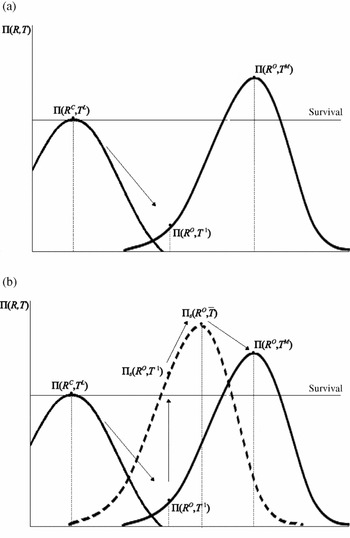
Figure 1(a) offers a graphical representation of the overall searching dynamics. The two continuous bell-shaped curves π(RC, T) and π(RO, T) represent the fitness function under distinct property rights regimes. The shortest one is for R=RC, and the tallest one is for R=RO. Under this very simplified setting, the fitness landscape presents two peaks {RC, TL} and{RO, TM}, with firm-based production, i.e.{RC, TL} being a local peak. The horizontal axis reports the technical intensity of production technology, with the degree of modularity that increases moving from left to right. Each point on the two curves represents a different mode of organization. The continuous horizontal line at π(R, T)=Π(RC, TL) defines the survival threshold.
Searching dynamics. The two bell-shaped curves represent the fitness functions under RO (tallest) and RC (smallest). Without a subsidy (panel a), survival is difficult in that it requires a significant change with respect to the status quo in terms of technical design. Under the subsidy (panel b), survival is easier to be achieved and the organization can converge to the new organizational equilibrium.

Suppose that, at time t, the organization selects the pair {RO, T1}. In the absence of any subsidy, this choice implies a significant reduction in overall fitness, with the organization falling from point π(RC, TL) to π (RO, T1). In the presence of institutional complementarities, any mismatch between technology and property rights is likely to generate substantial losses in terms of total net revenue and it thus reduces the probability of the organization to survive. The resulting organizational hybrid performs badly against incumbent organizations that have already adopted an optimal institutional design, and faces the risk of failing before even having had the chance to learn how to improve performance.
Obviously, this does not mean that, in this framework, organizational change can never occur. In fact, the possibility that the organization selects from the very beginning a technology such that the condition for survival is met cannot be a priori excluded. Such an event, however, is very unlikely in that it requires the organization to make a significant change with respect to the status quo in terms of technical design. Most likely, the organization starts by selecting a technology in the neighbourhood of TL and then it proceeds from there to explore the fitness landscape. The farther this starting point is from the survival threshold, however, the fewer the chances that the organization will complete the overall path towards the new optimal design and the lower the probability that institutional innovation eventually occurs.
Now suppose that a subsidy in favour of the organization is temporarily introduced (the same reasoning holds for protectionism). This subsidy can be anything that helps to reduce the selection pressure operating against organizational hybrids. It can include a change in the transaction cost disadvantage associated with open property rights (e.g. an improved ability to mobilize labour, for instance through intrinsic motivation), as well as an incentive that helps to move the selection criteria away from efficiency alone (e.g. a broadened set of features according to which the quality of an information good is evaluated). In the former case, the effect would be a leftward shift of the fitness function, with the new optimum being associated with T < TM; in the latter case, the shift would instead be upwards, with an average increase in the organization's fitness. The dotted curve πs(RO, T) reported in Figure 1(b) considers both effects jointly. Notice that the increase in fitness after the subsidy does not imply an associated increase in productive efficiency, in that for each pair {RO, T}, the isolated contribution of efficiency to fitness is captured only by curve π(RO, T).
Operating under the subsidy, the organization substantially increases its probability of survival. In this case, the existence of institutional complementarities may also cause a reduction in fitness when a mismatch between technology and property rights arises. However, the minimum degree of technical modularity that is necessary for the organization to survive is much smaller than when there is no subsidy. In particular, the selection of technology T1 at time t would now imply a shift from point π(RO, T1) to πs(RO, T1) in the picture, which is far beyond the survival threshold. From that point onwards, the organization could then start to climb the fitness function achieving the peak Πs (RO, T). Obviously, this does not exclude the possibility that the organization fails. In fact, there always exists some degree of technical modularity for which the survival threshold is not crossed. What the subsidy does is just reduce the level of change in technical design that the organization needs to implement to survive.
Once the peak Πs (RO, T) is achieved, the organization can gradually converge towards equilibrium{RO, TM}. As the beneficial effect of the subsidy fades away, in fact, the organization is forced to adapt to the features of the surrounding environment and must increase the degree of technical modularity. Such an adaptation, however, can occur while being already above the survival threshold. The reduced exposure to selection pressure gives time to the organization to learn what the new optimal design is, and pair {RO, TM} can finally emerge as a new equilibrium condition in the economy. Graphically, this can be represented as a gradual shift of the subsidized fitness function πs(RO, T) back to its original position, with the organization moving from point Πs (RO, T) toπ(RO, TM).
Altogether, the searching dynamics depicted in Figure 1 offer an intuitive representation of the speciation process that led to the emergence of peer production. In particular, it shows that, even in the presence of an efficiency gap between firm production and peer production, the emergence of the latter would have been difficult to achieve without explicit protection. On this basis, the last question that needs to be addressed is whether such a protection mechanism effectively existed in the case of peer production and the nature of the mechanism. As the next section will show, a qualitative reconstruction of the historical context in which peer production emerged reveals that an important form of protection was indeed available and it is associated with the ethics of free software. Ethical convictions tended to motivate individual decisions on software adoption more on moral grounds than on actual software performance, thus shifting the selective pressure away from production efficiency alone. This generated a cultural subsidy that gave time to newly born organizations to optimize their internal design and eventually expand to other sectors of the economy.
5. GNU/Linux and the emergence of a new organizational species
According to Moody (Reference Moody2001), the origin of free software development can be associated with a precise moment in history, namely the launch of the GNU project in September 1984. Founded by former MIT Artificial Intelligence Lab programmer Richard M. Stallman (RMS), the GNU project aimed at reproducing a non-proprietary version of many components of UNIX, one of the leading operating systems (OS) of the time. Although the project started as a single-person endeavour, it soon attracted the attention of a large community of programmers. As of 2010, it is estimated that more than 200 people have contributed software to the GNU system.
The reasons that RMS chose to start the GNU project were rooted in the evolution of the U.S. software industry in the early 1980s. This period, as suggested by Nuvolari (Reference Nuvolari2005), saw an increased commercialization of software production, which started with the AT&T's decision to begin to sell licenses of UNIX. After that, a growing number of companies began to sell copies of software packages without granting full access to the underlying source code. These companies bound the work of hired programmers on these software packages through non-disclosure agreements. This way of doing business represented a substantial departure from the sharing-based culture that had characterized the world of computer programming since the 1970s. In those early days, the users of mainframe computers were primarily universities and corporate research laboratories, which saw computer programs primarily as research tools. For this reason, it was common practice among programmers to share the source code of their works and to develop new programs by improving upon the code written by others. From this perspective, the source code of programs represented a sort of public good that was freely available to anyone in the programming community to read, study and hack.
In this cultural background, RMS and other programmers like him perceived the growing commercialization of software programs as a direct attack on their individual freedom. As members of the worldwide community of hackers, they rebelled against the idea that the underlying source code of programs could be in any way enclosed. For them, as suggested by Moody (Reference Moody2001, p. 4), these special texts represented ‘a new kind of literature that forms part of the common heritage of humanity: to be published, read, studied and even added to, not chained to desks in inaccessible monastic libraries for a few authorised adepts to handle reverently’. Consequently, this community started to look at the GNU project as something that went far beyond tinkering with the simple technicalities of code programming and that instead was strictly related to the defence of individual freedom. Commenting on the origins of GNU, for instance, RMS observed the following:
[T]he overall purpose [of GNU] is to give the users freedom by giving them free software they can use and to extend the boundaries of what you can do with entirely free software as far as possible. Because the idea of GNU is to make it possible for people to do things with their computers without accepting domination by somebody else. Without letting some owner of software say, ‘I won't let you understand how this works; I'm going to keep you helplessly dependent on me and if you share with your friends, I'll call you a pirate and put you in jail.’ [. . .] I consider that immoral, and I'm working to put an end to that way of life. [. . .] That's what GNU is for, it's to give people the alternative of living in freedom. (Moody, Reference Moody2001, p. 38)
To strengthen the efficacy and sustainability of the GNU project, RMS extended his own range of activities beyond programming. In 1985, he founded the Free Software Foundation and introduced a new licensing procedure for software called the General Public License (GPL). Thanks to a clever interpretation of the standard copyrights legislation, a GPL permits free redistribution of GPL programs, free modification of GPL programs, and free redistribution of the modified versions of GPL programs, without depriving programmers of their own individual authorship of GPL code (see McGowan, Reference McGowan2001). As reported by Moody (Reference Moody2001, pp. 27–28), RMS ‘created in the GPL a kind of written constitution for the hacker world that enshrined basic assumptions about how their community should function. In doing so, he enabled that world to progress far more efficiently than it had in the past when all these “laws” were unwritten. [. . .] [And] yet for Stallman, this emphasis on inherent efficiency misses the point about the GNU project and the GPL. His essential concern is freedom, and the GNU project a means to an end rather than an end in itself’. From this perspective, ‘Stallman's work is significant not only because it engendered many of the key elements [. . .] that made the success of what came to be the combined GNU/Linux operating system possible but also because it provided an ethical backdrop against which the entire free software and open source story is unfolding’ (p. 30).
The existence of this ethical backdrop turned out to be of crucial importance for the success of free software and for peer production generally. The characterization of free software (as the ‘GPLed’ software came to be known) as a means to an end rather than as an end in itself had a powerful impact on the way in which software programs started to be consumed. For a large portion of users, the ‘free’ nature of source code became a condition that was often more important than the degree of the technical performance of a program in determining which particular program to adopt. By direct admission of RMS, in fact, the early applications of the GNU system
had no technical advantage over Unix. [. . .] [Yet, they had] a social advantage, allowing users to cooperate, and an ethical advantage, respecting the user's freedom. (Stallman, Reference Stallman2002, p. 24)
The combination of these ‘non-technical’ features created an environment where ‘source code freedom’ rather than ‘technical performance’ became the principal domain in which competing applications were compared. This, at least for programs that attracted the attention of hackers, generated a kind of ‘cultural subsidy’ in favour of free software production (and as a consequence peer production) because it reduced the selective pressure that the latter had to face from competing proprietary products.
The reasons behind the initially sluggish performance of the GNU project as well as other early attempts to develop free software are numerous. One in particular, however, has attracted the attention of several authors, namely, the low modularity of system architectures. Raymond (Reference Raymond1999), for instance, notes the relatively low modularity of some GNU tools (e.g. Emacs C) as one of the key reasons for their slow development. Similar views have also been expressed by Narduzzo and Rossi (Reference Narduzzo, Rossi and Koch2005) and Benkler (Reference Benkler2002a). In line with the model discussed in Sections 4 and 5, the low degree of modularity is seen as a constraint on the ability to mobilize a sufficiently large community of contributors, resulting in negative consequences on the quality of the final software. It follows that, in addition to the ‘cultural subsidy’, the effective success of free software required important changes to be implemented at the organizational level, with modularity becoming a major design component.
The combined effect of increased modularity and the ‘cultural subsidy’ indeed played a major role when the history of free software had its second important twist. On 25 August 1991, a Finnish undergraduate student named Linus Torvalds posted a message on the comp.os.minix newsgroup about his work on a free UNIX kernel called Linux. Although the development of a UNIX kernel (eventually called Hurd) had always been on the waiting list of the GNU project, it was still non-existent in 1991 and indeed represented the missing step towards the realization of a complete free system. For this reason, the degree of excitement that welcomed the first news about Linux comes as no surprise. As reported by Moody (Reference Moody2001, p. 42), less than four hours after Torvalds's original message there were already positive reactions in the newsgroup:
[A] fellow Finn wrote: ‘Tell us more!’ and asked: ‘what difficulties will there be in porting?’ [Similarly,] a Minix user from Australia said: ‘I am very interested in this OS. I have already thoughts of writing my own OS, but decided I wouldn't never have the time to write everything from scratch. But I guess I could find the time to help raising a baby OS:-).’
As noted by Moody, this was just ‘a portent of the huge wave of hacker talent that Linux would soon ride’ (ibid.).
Although from a technical point of view, Linux was characterized by an enhanced degree of modularity in respect to its predecessors (Raymond, Reference Raymond1999), it still did not exhibit excellent technical properties at its inception. In the comments attached to version 0.01 of the code (released in October 1991), for instance, Torvalds himself admits:
[T]his isn't yet the ‘mother of all operating system’, and anyone who hoped for that will have to wait for the first real release (1.0), and even then you might not want to change for Minix. (Moody, Reference Moody2001, p. 45)
However, the appeal for programmers to start using and studying Linux was not primarily a matter of the operating system performance. In the same posting accompanying the release of the 0.01 version, Torvalds in fact writes:
I can (well, almost) hear you asking yourselves ‘Why?’ Hurd will be out in a year (or two, or next month, who knows), and I've already got Minix. This is a program for hackers by a hacker. I've enjoyed doing it, and somebody might enjoy looking at it and even modifying it for their own needs. It is still small enough to understand, use and modify, and I'm looking forward to any comments you might have. (Moody, Reference Moody2001, p. 45)
The strength of the appeal of free code modification was indeed sufficient to result in extraordinary success. As argued by Nuvolari (Reference Nuvolari2005), when Torvalds released version 1.0 of Linux in 1994, the OS could compete successfully in stability and reliability with most commercial versions of UNIX. After that release, Linux was further refined, incorporating a number of new features. The community of developers grew exponentially, outnumbering the thousands. In 1999, the effective potential of Linux also received its ‘official recognition’ in the so-called ‘Halloween document’, an unofficial document leaked out from Microsoft that mentioned Linux (and, generally, the diffusion of open-source production) as a major competitive threat to the company.
If we look at the overall period that began with the launch of the GNU project and resulted in the success of Linux, it is possible to observe a clear pattern of organizational speciation. Starting from the idea of a small group of programmers that had deep roots in the hacker culture of the early 1970s, the GNU project served as an example for an alternative non-proprietary way of developing software. The use of exclusive copyrights terms was substituted by GPL-like licenses, and the employment of paid programmers was replaced by the voluntary participation of communities of peer developers. At the beginning, this way of producing software encountered some difficulties, and the quality of ‘free’ programs could not compete with that of their proprietary counterparts. Indeed, the low degree of modularity that characterized the early system architecture limited the possibility to attract large communities of contributors. Nevertheless, the attachment of strong social and ethical values to these works compensated (at least partly) for their inferior quality and supported their diffusion in spite of their technical deficiencies. With the passage of time, and in virtue of this ‘cultural subsidy’, the communities of free software developers were able to improve their internal organization and define the rules that could sustain their performance in a clearer way; see, for instance, Raymond (Reference Raymond1999). The result was the impressive success that free software enjoyed in the second half of the 1990s, with programs such as Linux (OS), Apache (web server), MySQL (relational database) and Sendmail (mail transport agent) becoming widely popular even outside of the hacker world (see Moody, Reference Moody2001). It is indeed with the success of these programs that peer production made its first appearance on the ‘stage’ of information production.
This brief history of free software, however, raises some important questions. The most relevant, for the sake of the argument developed here, is whether other sectors of the economy exist, aside from software, in which peer production could have possibly emerged within the same period of time. If this is not the case, then the role played by the specific culture of free software would be significantly undermined because it would be indistinguishable from the effect of pure technological change. In this respect, although a more robust empirical analysis is required, some supporting evidence can be gained by looking at the status of information technology at the beginning of the 1990s. Such an analysis reveals that beyond the specific domain of software production, many of the technologies generally associated with peer production were already available. The first proposal for the WWW system, i.e. the easy-to-use system of interlinked hypertexts that facilitates the transmission of information over the Internet, for instance, was written by Tim Berners-Lee in 1989 (Berners-Lee, Reference Berners-Lee1999). Even earlier, in 1978, Ward Christensen developed the first Bulletin Board System, which can be considered one of the technological antecedents of Internet forums and blogs (Stone, Reference Stone2004). Similarly, as early as 1972, a group of researchers at Carnegie Mellon University developed a system called the ZOG multi-user database, which is, in many respects, an indirect predecessor of the wiki-style web page (e.g. WikiWikiWeb) created by Ward Cunningam in 1994. Finally, with specific reference to the design of a peer-to-peer (P2P) network, Usenet, developed by Tom Truscott and Jim Ellis in 1980, can be viewed as one of the first client-server architectures in which the principle of P2P server interactions was directly employed (Fristrup, Reference Fristrup1994). In spite of this technological substratum, however, highly successful and non-software-related examples of peer production such as Napster (a P2P network), Wikipedia (an online encyclopaedia), and a myriad of individual and collective blog, did not emerge until the early 2000s. But, in most of these cases (for instance, Wikipedia; Reagle, Reference Reagle2010), the evolution of GNU and Linux was indeed considered to be the main example to follow in the design of digital platforms. This observation, although only at an intuitive level, tends to support the view that peer production first emerged in the particular niche of software production and only afterwards did it extend to other sectors of the economy.
6. Conclusion
Commenting on the relationship between information and institutions in modern economies, Arrow (Reference Arrow and Chirchilnisky1999, p. 25) once observed the following:
Information, one of the fundamental economic determinants, leaps over from one firm to another, yet the firm has so far seemed reasonably defined in terms of legal ownership. It seems to me that there must be an increasing tension between legal relations and fundamental economic determinants. [. . .] We are just beginning to face the contradictions between the system of private property and of information acquisition and dissemination.
Although Arrow was not directly referring to peer production in this statement, he still captured the essence of the institutional change that the information economy is facing. In the decade that followed Arrow's observation, there has been a dramatic diffusion of non-proprietary forms of production that have spawned different types of information goods. As suggested by Benkler (Reference Benkler2006, p. 5), instead of treating the latter as mere curiosities, ‘we should see them for what they are, namely a new mode of production emerging in the middle of the most advanced economies in the world’.
Based on this evidence, this paper investigated the factors that favoured the emergence of this new mode of information production. Unlike most of the previous literature, this paper did so by modelling technology as an endogenous variable in the process of organizational design. In this way, this paper integrated the intuition derived from a portion of the cyberlaw literature, according to which the endogeneity of technology is indeed one of the crucial features that characterize the move to a digital production environment.
On the basis of a simple model, this paper suggested that the diffusion of digital technologies is a necessary but not a sufficient condition to explain the emergence of peer production. The reason is that when technology is endogenous, multiple organizational equilibria may exist in the economy. In such a case, the emergence of a new organizational form necessarily requires some form of protection, which reduces the selection pressure against hybrid organizations, allowing a new equilibrium condition to be identified. With respect to peer production, this paper suggested that such a protection mechanism arose from the cultural backdrop that characterized the early adherents to the free software movement. By promoting the adoption of free software programs on moral grounds rather than on the merits of the actual performance of these programs, this culture created a somewhat protected environment where peer production could first emerge and then proliferate.
If this interpretation is correct, then interesting implications exist for the future of peer production. The existence of multiple organizational equilibria limits the possibility of establishing any direct link between production efficiency and institutional change. This implies that, even if in the present technological environment peer production can be more efficient than standard firm-based production, it does not necessarily mean that the former will replace the latter as the predominant institution of information production. Whether replacement would occur depends on several factors, including the frequency of the two institutions and the speed of the selection process. Moreover, depending on the type of institution that we believe is more valuable for society as a whole, see on this Benkler and Nissenbaum (Reference Benkler and Nissenbaum2006) and Benkler (Reference Benkler2002b), public policy such as the reform of IPRs legislation can also affect what information production institution becomes predominant.
Appendix: Model solution
In domain R, given a generic technology Tj, r will choose to adopt an open property rights regime as long as πr(RO, Tj)≥πr(RC, Tj), which is the case if and only if
 \begin{equation}
T^j = \frac{{M^j }}{{L^j }} \ge \frac{{y + 2z}}{x}.\end{equation}
Similarly, r will choose to adopt a closed property rights regime as long as πr(RC, Tj)≥πr(RO, Tj), which is the case if and only if
 \begin{equation}
T^j = \frac{{M^j }}{{L^j }} \le \frac{{y + 2z}}{x}.\end{equation}
From equations (A.1) and (A.2), the following holds.
Proposition A1.In domain R, the incremental benefit from choosing RO (instead of RC ) is greater when an M-intensive technology is selected in domain T, i.e. when TM is selected instead of TL.
Proof. For a given value of x, y and z, consider two technologies TM and TL such that conditions (A.1) and (A.2) are simultaneously satisfied, i.e. TM≥(y+2z)/x≥TL. Then, it follows directly from (A.1) and (A.2) that
 \begin{equation}
\pi _r (R^O ,T^M ) \ge \pi _r (R^C ,T^M ),\end{equation}
 \begin{equation}
\pi _r (R^C ,T^L ) \ge \pi _r (R^O ,T^L ).\end{equation}
Adding equations (A.3) and (A.4) side by side and rearranging, we obtain the following relation:
 \begin{equation}
\pi _r (R^O ,T^M ) - \pi _r (R^C ,T^M ) \ge \pi _r (R^O ,T^L ) - \pi _r (R^C ,T^L ),\end{equation}
which proves the proposition.
Let us now consider domain T. Under the above decision-making process described in Section 3, t will set M and L so as to maximize πt(RC, T(M, L)) and πt(RO, T(M, L)). Let
 \begin{equation}
(M^C ,L^C ) = \arg \max \pi _t (R^C ,T(M,L)),\end{equation}
 \begin{equation}
(M^O ,L^O ) = \arg \max \pi _t (R^O ,T(M,L)).\end{equation}
Then, from equations (3) and (4) in the main text and under standard assumption about the shape of the marginal product, i.e. ∂2Q/∂M2>0 and ∂2Q/∂L2>0, it follows that MC≤MO and LC≥LO. From the latter conditions, it is straightforward to derive the following relation:
 \begin{equation}
T^O = \frac{{M^O }}{{L^O }} \ge \frac{{M^C }}{{L^C }} = T^C .\end{equation}
Relation (A.8) in turn implies that:
Proposition A2.In domain T, the incremental benefit from choosing an M-intensive technology TM (instead of an L-intensive technology TL ) is greater when an open property rights regime is selected in domain R, i.e. when RO is selected instead of RC.
Proof. Consider two technologies TM and TL such that condition (A.8) is satisfied, i.e. TM≥TL. Then, it follows directly from (A.8) that
 \begin{equation}
\pi _t (R^O ,T^M ) \ge \pi _t (R^O ,T^L ),\end{equation}
 \begin{equation}
\pi _t (R^C ,T^L ) \ge \pi _t (R^C ,T^M ).\end{equation}
Adding equations (A.9) and (A.10) side by side and rearranging, we obtain the following relation:
 \begin{equation}
\pi _t (R^O ,T^M ) - \pi _t (R^O ,T^L ) \ge \pi _t (R^C ,T^M ) - \pi _t (R^C ,T^L ),\end{equation}
which proves the proposition.
Under some continuity conditions of function π(·) and assuming that strategy sets Sr={RO, RC} and St={TM, TL} have a partial order ≥ (see Milgrom and Roberts, Reference Milgrom and Roberts1990), Propositions (A1) and (A2) imply that the game G={2, (Si, πi, i=r, t), ≥ } is supermodular. Furthermore, it can be provedFootnote 5 that in G there exist two pure strategy Nash equilibria (NE), namely {RO, TM} and {RC, TL}. Each of them is an organizational equilibrium (OE). The first, {RO, TM}, is characterized by an open property rights regime and a relatively modular technology, namely peer production. The second, {RC, TL}, is characterized by a closed property rights regime and a relatively non-modular technology, namely firm production.
The technological conditions supporting the existence of distinct OEs in information production can be summarized in the following proposition:
Proposition A3. (a) Suppose TO=TM≥(y+2z)/x≥TL=TC. Then in G there exist two OEs, namely {RO, TM} and {RC, TL}. (b) Suppose TO=TM≥TL=TC≥(y+2z)/x . Then {RO, TM} is the only OE in G. (c) Suppose (y+2z)/x≥TO=TM≥TL=TC. Then {RC, TL} is the only OE in G. (d) For any ratio (y+2z)/x there always exists at least one OE in G.
Proof. Points (a), (b) and (c) follow directly from conditions (A.1), (A.2) and (A.8) above. Point (d) is a direct consequence of points (a), (b) and (c).
Proposition A3 suggests that if the ratio (y+2z)/x falls into the closed intervals defined by the factors proportions that optimize under the different property rights regimes, two distinct ways of organizing information production exist. The question, then, becomes to understand how likely it is that such condition obtains. Intuition suggests that the ‘malleability’ of technology plays an important role because it ensures that, for any given property rights regime, factors proportion can be adjusted so as to minimize production costs. Under the standard assumption of decreasing marginal product, in particular, it can be proved that:
Proposition A4. (a) For any Q(M,L) and any costs (m, l, d), there exists at least one triple (x, y, z) such that multiple OEs exist. (b) If the elasticity of substitution between M and L is zero, then there exists only one triple (x, y, z) such that multiple OEs exist. (c) If the elasticity of substitution between M and L is ∞, then any positive triple (x, y, z) implies that multiple OEs exist. (d) Any increase in the elasticity of substitution between M and L enlarges the set of the triple (x, y, z) for which multiple OEs exist.
Proof. See proofs of Propositions 2–5 in Pagano and Rowthorn (Reference Pagano and Rowthorn1994).
Propositions 1 and 2 in the text follow directly from Propositions A3 and A4.