Introduction
Antipsychotic agents constitute the mainstay of treatment of a wide variety of psychiatric disorders; however, their use, tolerability and compliance are compromised by several adverse effects. Those related to the occurrence of metabolic disturbances are the most significant ones considering their long-term impact (Barton, Segger, Fischer, Obermeier, & Musil, Reference Barton, Segger, Fischer, Obermeier and Musil2020; Pozzi et al., Reference Pozzi, Pisano, Marano, Carnovale, Bravaccio, Rafaniello and Radice2019; Rafaniello et al., Reference Rafaniello, Pozzi, Pisano, Ferrajolo, Bertella, Sportiello and Capuano2016). Meta-analyses of studies including mixed patient populations have shown that changes in anthropometric parameters including weight, body-mass index (BMI) and waist size are caused by almost all antipsychotics, in some cases to a clinically relevant extent (Bak, Fransen, Janssen, van Os, & Drukker, Reference Bak, Fransen, Janssen, van Os and Drukker2014; Barton et al., Reference Barton, Segger, Fischer, Obermeier and Musil2020; Huhn et al., Reference Huhn, Nikolakopoulou, Schneider-Thoma, Krause, Samara, Peter and Leucht2019; Tek et al., Reference Tek, Kucukgoncu, Guloksuz, Woods, Srihari and Annamalai2016). This meta-analytic evidence, together with results from basic science, also shows that specific antipsychotics induce more sizeable weight gain than others (Musil, Obermeier, Russ, & Hamerle, Reference Musil, Obermeier, Russ and Hamerle2015), suggesting a molecule-specific risk rather than a ‘generation’-based risk for antipsychotics (Ballon, Pajvani, Freyberg, Leibel, & Lieberman, Reference Ballon, Pajvani, Freyberg, Leibel and Lieberman2014). The increase in weight gain is accompanied by alterations of glyco-metabolic parameters like glucose, triglycerides and cholesterol plasma levels. It is currently not clarified whether physical and glyco-metabolic parameters alterations develop simultaneously or whether one may precede or cause the other. Likewise, unclear is the magnitude of lipid and glucose dysregulations in patients treated with various antipsychotics, as glyco-metabolic parameters are accessory outcomes in clinical trials. In addition, antipsychotics are used off-label for many psychiatric disorders of adults and children (Lindström, Lindström, Nilsson, & Höistad, Reference Lindström, Lindström, Nilsson and Höistad2017; Maher et al., Reference Maher, Maglione, Bagley, Suttorp, Hu, Ewing and Shekelle2011; Zhou et al., Reference Zhou, Keitner, Qin, Ravindran, Bauer, Del Giovane and Xie2015), whereas data on antipsychotic-induced glyco-metabolic alterations are available predominantly from studies on schizophrenic adults (Rummel-Kluge et al., Reference Rummel-Kluge, Komossa, Schwarz, Hunger, Schmid, Lobos and Leucht2010). To date, two meta-analyses assessed specifically the association between the second v. first-generation antipsychotics and dyslipidemia, including data from a small number of studies (N = 18) and being circumscribed to adults with severe schizophrenia-spectrum disorders or bipolar disorder. In the first study clozapine use was found associated with increased triglycerides (standardized mean difference, SMD = 0.51), but not cholesterol; as compared with haloperidol, neither olanzapine nor risperidone was associated with differences in cholesterol or triglycerides changes; a high heterogeneity was found between studies (all I 2 > 50%, p < 0.05). A more recent network meta-analysis, including randomized controlled trials of antipsychotics used for the labeled treatment of acute schizophrenic exacerbations, found different glyco-metabolic effects between antipsychotics, with olanzapine and clozapine showing the worst changes and aripiprazole, brexpiprazole, cariprazine, lurasidone, and ziprasidone showing the best changes (Pillinger et al., Reference Pillinger, McCutcheon, Vano, Mizuno, Arumuham, Hindley and Howes2020). The extent to which different antipsychotics cause glyco-metabolic alterations and the mechanisms behind antipsychotic-induced glyco-metabolic alterations, therefore, still need to be better understood (Buhagiar & Jabbar, Reference Buhagiar and Jabbar2019; Zhang et al., Reference Zhang, Liu, Su, You, Ma, Yang and Kou2017). In particular, no study has yet explored the relationship between glyco-metabolic changes and the pharmacological profile of antipsychotics. This is an important issue as antipsychotics act by interfering with several neurotransmitter receptors, including D2 dopaminergic, 5-HT1A, 5-HT2A, 5-HT2C serotonergic, H1 histaminergic, M1 cholinergic and alpha-1 and alpha-2 noradrenergic receptors, and debate is open on whether actions on neurotransmitter receptors are only responsible for the antipsychotic-specific glyco-metabolic change profile. Higher antagonism of H1 histaminergic, 5-HT2C serotoninergic, alpha-1 noradrenergic, M1 and M3 cholinergic receptors has been implicated as a risk factor (Casey & Zorn, Reference Casey and Zorn2001; Olten & Bloch, Reference Olten and Bloch2018; Roerig, Steffen, & Mitchell, Reference Roerig, Steffen and Mitchell2011). In parallel, studies conducted in vitro and in vivo have produced a considerable amount of evidence suggesting that chemical properties and modes of action of antipsychotics, other than receptor binding, can be relevant for glyco-metabolic alterations. Specifically, these may be the result of metabolic disruptions happening at the cellular level, due to the amphiphilic weak base nature of antipsychotics. Antipsychotics may indeed interfere directly with sterol and lipid trafficking and metabolism, triggering a cascade of para-physiological events that may lead to clinically evident glyco-metabolic alterations (Vantaggiato, Panzeri, Citterio, Orso, & Pozzi, Reference Vantaggiato, Panzeri, Citterio, Orso and Pozzi2019).
We have thus performed a network meta-analysis of glyco-metabolic effects of antipsychotic drugs and applied regression models to examine the association between changes and neurotransmitter receptor occupancy and key chemical properties of antipsychotics.
Methods
Searches
We followed the PRISMA extension statement for network meta-analysis (eMethods 1 in the Appendix) (Hutton et al., Reference Hutton, Salanti, Caldwell, Chaimani, Schmid, Cameron and Moher2015).
We submitted our Protocol at the International Prospective Register of Ongoing Systematic Reviews (ID:166663). We searched PubMed (MEDLINE), Embase, and Psycinfo up to 10 September 2020. We hand-searched the references of previous network meta-analyses for additional records. Our search strategy for one of the above-mentioned databases (Pubmed) is described fully in the eMethods 2 in the Appendix; in brief, we used three terms: antipsychotics, glyco-metabolic parameters, and trials. We combined these terms with the boolean operator ‘AND’. The search strategy was adapted to other databases. We did not contact authors for unpublished data.
We used the following inclusion criteria: studies enrolling human subjects; subjects affected by any psychiatric conditions or/and healthy volunteers treated with any oral antipsychotic drugs or placebo; studies reporting the values of changes in glyco-metabolic outcomes.
We used two sets of exclusion criteria; one for the qualitative analysis and one for the quantitative analysis i.e. network meta-analysis. Qualitative exclusion criteria were: papers not in English; literature reviews; observational studies, case reports, case series; studies enrolling patients with addiction or substance use disorders; patients with eating, nutritional and/or metabolic disorders (e.g. obesity, anorexia); patients who received antipsychotic drugs as an add-on therapy; patients who received pharmacological treatment aimed at controlling, or preventing, metabolic disorders. Exclusion criteria for the quantitative analysis were: studies having a non-randomized design; studies including pediatric patients; studies including healthy volunteers; studies with administration schemes other than parallel arms treatment administration; studies not reporting a pre- and post-treatment value (or its change) for the glycometabolic outcomes reported.
Primary outcomes were the changes in the following glyco-metabolic parameters: glucose (mg/dL), glycosylated hemoglobin (HbA1c) (%), Insulin (μU/mL), Homeostatic Model Assessment for Insulin Resistance (HOMA-IR) (mmol × mU/L), triglycerides (mg/dL), total cholesterol (mg/dL), HDL cholesterol (mg/dL), LDL cholesterol (mg/dL). When available, we collected data on additional outcomes including body weight (Kg), waist circumference (cm), BMI (Kg/m2), C-peptide (ng/mL), and leptin (ng/mL).
Data extraction and processing
For all records identified by the search strategy, full-texts were retrieved and independently evaluated following stated criteria for potential inclusion by two authors (VB and EI), with discrepancies adjudicated by CC. Data were independently extracted by two authors (VB and EI) and disagreements resolved by consensus and consultation with CC and MP.
The following information was extracted from included studies: first author; publication year; study duration; study type (blinding/design); the number of subjects; patients' diagnoses; the number of naïve patients; sex distribution; age of subjects; the number of patients exposed to antipsychotic(s) or in control/comparator/placebo groups: generic name of antipsychotics, antipsychotic dose; generic name of concomitant drugs used; changes of outcomes at the end of the study with respect to baseline.
Risk of bias (quality) assessment
Two authors (VB and EI) assessed the risk of bias of randomized trials by using the Cochrane risk-of-bias tool for randomized trials (RoB 2) (RoB 2: A revised Cochrane risk-of-bias tool for randomized trials, 2020) and of non-randomized clinical trials by using the risk of bias tool to assess non-randomized studies of interventions (ROBINS-I tool) (Sterne et al., Reference Sterne, Hernán, Reeves, Savović, Berkman, Viswanathan and Higgins2016). The disagreement was resolved by consensus and consultation with the expert group (CC and FM). We used a modified version of RoB 2 tool for the quality assessment of single-arm trials, switch studies, and studies on different formulation or doses of antipsychotics.
Strategy for data synthesis
We performed a network meta-analysis for each outcome using the graph-theoretical method that has been found to be equivalent to the frequentist approach to network meta-analysis (Rücker, Reference Rücker2012). For each outcome and each study, we considered the mean at the end of the treatment minus the mean at baseline (MD) and their corresponding standard deviations (s.d.) if reported in the primary study. If MD was not reported, we calculated it using the mean at baseline and at the end of treatment and the corresponding s.d. using the formula proposed by the Cochrane handbook (Higgins et al., Reference Higgins, Thomas, Chandler, Cumpston, Li, Page and Welch2020) using a correlation of 0.6. We chose this value because available correlations ranged between 0.48 and 1. To assess the sensitivity of results on the choice of the correlation value, we also considered values of 0.5, 0.8 and 0.95. The results of sensitivity analyses comprised only minor deviations from the results of the main analysis, thus they were not shown. If one of the s.d.s was not reported in the primary study, we used the only one reported. If both s.d.s were not reported, we estimated them from the average of studies included in the meta-analysis, reporting on the same outcome and same drugs. We then transformed data in the contrast-based format and meta-analyzed mean differences (MDs) using random-effects models.
We tested local inconsistency by splitting network estimates into the contribution of direct and indirect evidence. We drew the network map with the width of the line between two nodes proportional to the number of studies comparing the two connected treatments. We also presented league tables with MDs and corresponding 95% confidence intervals (CIs) of direct comparisons in the upper triangular half and of mixed comparisons in the lower triangular half, and p values from Cochrane Q test, when lower than 0.05, as an indicator of global heterogeneity (within designs) and global inconsistency (between designs). Finally, we showed forest plots with placebo or no treatment as the reference group. We used the netmeta R package (Rücker, Krahn, König, Efthimiou, & Schwarzer, Reference Rücker, Krahn, König, Efthimiou and Schwarzer2020). In particular, the pairwise function for transformation in contrast-based format and calculation of MDs and standard errors (s.e.s), the netgraph for maps, the netleague for tables, the forest for plots, the netsplit to test local consistency.
Pharmacodynamic and chemical data sources for antipsychotics and methods for estimating neurotransmitter receptor occupancy
For each drug included in the network meta-analysis, we estimated the relative occupancy for receptors: D2 dopaminergic, H1 histaminergic, alpha-1 and alpha-2 noradrenergic, M1, M3, and M4 cholinergic, and 5-HT1A, 5-HT2A and 5-HT2C serotoninergic, by using an equation of the pharmacological receptor theory (Kenakin, Reference Kenakin2004).
The equation used was Relative receptor occupancy (%) = [Cr] / (Ki + [Cr]) × 100, where [Cr] represents the concentration of unbound AP and Ki is the equilibrium dissociation constant determined in inhibition studies for the specific drug-receptor pair.
[Cr] values at the average of therapeutic reference ranges and data on plasma protein binding were taken from the ‘AGNP Consensus Guidelines for Therapeutic Drug Monitoring in Psychiatry’ (Hiemke et al., Reference Hiemke, Bergemann, Clement, Conca, Deckert, Domschke and Baumann2018).
Ki values were retrieved from the International Union of Basic and Clinical Pharmacology (IUPHAR) database (IUPHAR - International Union of Basic & Clinical Pharmacology, 2020) and the National Institute of Mental Health Psychoactive Drug Screening Program (PDSP) (PDSP - NIMH Psychoactive Drug Screening Program, 2020). We used the median of all Ki values from competitive binding assays on human receptors.
Chemical properties including pKa values, hydrophilicity and polarizability were retrieved from the Drugbank database (Wishart et al., Reference Wishart, Feunang, Guo, Lo, Marcu, Grant and Wilson2018). Most antipsychotics have two pKa values (strongest basic; strongest acidic) as they have two atoms, attackable at different pH values, of which one is usually acidic, while the other can be neutral or basic. The polarizability of a molecule depends on how much its electron cloud can be distorted by the presence of a nearby charge, causing the induction of a dipole. Practically, a highly polarizable molecule reacts to the presence of a nearby charge by sliding its electron cloud towards it or away from it, becoming positively charged at one side and negatively charged at the other side (i.e. a dipole), while still being neutrally charged. A table containing drug-specific pharmacological and chemical parameters is available in eTable 13, in the Appendix.
Regression analysis
We used fixed-effects linear regression to examine the association between the relative receptor occupancy (%) and chemical properties of various antipsychotic agents, and the MD of the eight glyco-metabolic outcomes v. placebo/no treatment arms. Individual antipsychotics were weighted by the inverse of standard error squared reported in the forest plots, i.e. estimates of each drug compared to placebo or no-treatment. We showed one table for each outcome with coefficients and 95% CIs of all investigated variables and selected regression plots.
Differences between the protocol and the review
In addition to MEDLINE search, we considered also EMBASE and PsycINFO databases to avoid missing relevant studies. To reduce methodological and clinical heterogeneity, we decided to exclude also studies having a non-randomized design, studies including pediatric patients or healthy volunteers, studies with administration schemes other than parallel arms treatment one, and studies not reporting a pre- and post-treatment value (or its change) for the reported outcomes. We evaluated the quality of observational studies using ROBINS tool as suggested by Cochrane handbook. We reported MD instead of SMD to improve clinical interpretability.
Finally, we did not perform subgroup analyses because of the low number of studies in strata.
Results
Literature search results
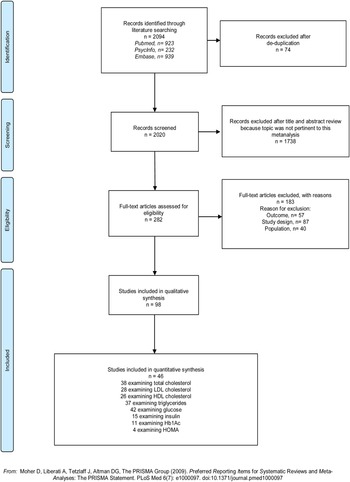
Of the 2094 articles retrieved, 98 contained studies that met the inclusion criteria (Fig. 1). As two randomized, double-blind controlled trials enrolled the same cohort of patients, we considered these two studies as a single trial (eResults in the Supplement). Of included studies, 68 (69.38%) were randomized trials; of these, 49 (72.05%) were double-blind (of these, 47 were parallel studies; one was of a crossover type and one a single-arm trial), three single-blind, parallel, and 16 (23.52%) were randomized, open-label, parallel trials. Thirty (30.30%) were not-randomized trials; of these, 28 were open-label, single-arm trials and two open-label, parallel trials.
Study flow diagram, retrieved on 10 September 2020. The final search was launched on 10 September 2020.

Seventy-three (74.48%) studies enrolled patients with schizophrenia or psychotic disorders; in 11 (11.22%) studies patients had mania or bipolar disorders; five (5.10%) studies involved patients with mixed psychiatric disorders; three (3.06%) studies enrolled healthy volunteers; three (3.06%) studies enrolled patients affected by autism spectrum disorders; and three (3.06%) studies involved patients with anxiety or major depression.
The overall sample included 21 136 participants, [17 633 patients had been treated with antipsychotic drugs, 3503 with placebo or not treated; (eTable 1 in the Supplement)]. The mean age range was 4–87 years. Thirteen studies (13.26%) studies enrolled pediatric patients (under 18 years). The mean percentage of male patients was 59.14. The mean study duration was 18.2 weeks (range 2–100 weeks).
The quality of 68 randomized trials was evaluated by using the Rob tool; of these, 23 (33.82%) were at high risk of bias, 26 (38.23%) with some concerns, and 19 (27.94%) at low risk (eFigure1 in the Supplement). We carried out also the quality assessment for 30 non-randomized studies (not included in the network metanalysis) by using the ROBINS-I tool (eTable 3 in the Supplement); the overall risk of bias was ‘critical’ for seven studies (23.33%), ‘serious’ for 10 studies (30.30%) and moderate for six studies (20.00%). As no data on the risk of bias post-intervention were available for seven studies (23.33%), we were unable to determine the related overall assessment.
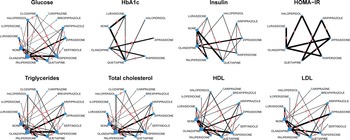
Forty-six studies evaluating changes in main glyco-metabolic outcomes were eligible for inclusion in the network meta-analysis (sample size: 11 464). We examined the following 13 antipsychotic drugs: aripiprazole, brexpiprazole, cariprazine, clozapine, haloperidol, iloperidone, lurasidone, olanzapine, paliperidone, placebo/no treatment, quetiapine, risperidone, sertindole, ziprasidone. Among the selected studies, the main outcomes of interest were reported by the following number of studies: 38 = total cholesterol, 28 = LDL cholesterol, 26 = HDL cholesterol, 37 = triglycerides, 42 = glucose, 15 = insulin, 11 = HbA1c and 4 = HOMA-IR. Some studies reported on several outcomes and thus were included in more than one network meta-analysis. The networks generated for each outcome are shown in Fig. 2, forest plots of all antipsychotics v. placebo/no treatment are shown in Fig. 3. Table 1 reported the highest and lowest pooled values of MD for each main glyco-metabolic outcome, for the 13 antipsychotic drugs included in the network.
Direct comparisons of interventions among included studies evaluating primary outcomes. The number of studies evaluating each outcome was glucose (n = 42), HbA1c (11), insulin (15), HOMA-IR (4), triglycerides (37), total cholesterol (38), HDL cholesterol (26), and LDL cholesterol (28). Node size is proportional to the number of studies including the corresponding treatment; line thickness is proportional to the number of studies comparing the connected treatments, as shown by numbers over the lines.

Forest plots of active principles compared with placebo/no treatment or on primary outcomes. The fixed-effects regression was used to examine the association between the relative receptor occupancy (%) and chemical properties of various antipsychotic agents, and the MD of the eight glyco-metabolic outcomes v. placebo/no treatment arms.

Lowest and highest changes found in studies included in the network meta-analysis

Values refer to minimum and maximum changes between before-treatment and after-treatment, for each pair outcome-drug.
Fifty-two studies were included in the systematic review only; changes in main glyco-metabolic outcome reported in the articles excluded from the network meta-analysis are nevertheless reported, in the supplementary materials (e Table 2 in the Supplement).
Glucose
As compared with placebo/no treatment, glucose levels change after AP treatment ranged from a mean reduction of −5.91 mg/dL with aripiprazole, up to a mean increase of 7.90 mg/dL with cariprazine (Fig. 3). The rank order of the drugs in terms of changes in glucose means (largest reduction to largest increase) was: aripiprazole, iloperidone, ziprasidone, quetiapine, lurasidone, risperidone, placebo/no treatment, brexpiprazole, clozapine, paliperidone, sertindole, olanzapine, haloperidol, cariprazine (Table 2). The mixed comparisons (eTable 4 in the Supplement) showed a smaller increase of glucose means after aripiprazole as compared with risperidone, paliperidone, haloperidol, cariprazine and no treatment, and a greater increase after olanzapine as compared with aripiprazole, ziprasidone, quetiapine and placebo/no treatment. There was significant global heterogeneity (Q = 100.14, p < 0.0001) and inconsistency (Q = 86.09, p < 0.0001) but no evidence of local inconsistency.
Ranking of treatments, from the best to the worst, for all outcomes

ARI, aripiprazole; BRE, brexpiprazole; CAR, cariprazine; CLO, clozapine; HAL, haloperidol; ILO, iloperidone; LUR, lurasidone; OLA, olanzapine; PAL, paliperidone; QUE, quetiapine; RIS, risperidone; SER, sertindole; ZIP, ziprasidone; p/n, placebo/no treatment.
In defining best and worst treatments, we assumed that better results implied increases in HDL and decreases in all other parameters. Data are reported as p score of treatment i. p score is defined as the mean of all 1 - p[j] where p[j] denotes the one-sided p value of accepting the alternative hypothesis that treatment i is better than one of the competing treatments j. Thus, if treatment i is better than many other treatments, many of these p values will be small and the p score will be large. Vice-versa, if treatment i is worse than most other treatments, the p score is small. The p score of treatment i can be interpreted as the mean extent of certainty that treatment i is better than another treatment.
Hba1c
As compared with placebo/no treatment, HbA1c levels changes after AP treatment ranged from a mean reduction of −1.20% with haloperidol, up to a mean increase of 0.02% with lurasidone (Fig. 3). Drugs ranking from the largest reduction to largest increase of HbA1c was found to be haloperidol, ziprasidone, risperidone, placebo/no treatment, olanzapine, quetiapine, lurasidone (Table 2).
The mixed comparisons (eTable 5 in the Supplement) showed a smaller increase of HbA1c means after haloperidol or ziprasidone as compared with risperidone, olanzapine, quetiapine, lurasidone and placebo/no treatment. No evidence of global heterogeneity or inconsistency was found. The regression analysis showed no significant factors.
Insulin
As compared with placebo/no treatment, insulin levels change after AP treatment ranged from a mean reduction of −0.84 μU/mL with ziprasidone, up to a mean increase of 1.49 μU/mL with olanzapine (Fig. 3). Drugs ranking from most negative to the most positive on increases of insulin means was found to be: ziprasidone, aripiprazole, risperidone placebo/no treatment, paliperidone, quetiapine, lurasidone, haloperidol, olanzapine (Table 2).
The mixed comparisons (eTable 6 in the Supplement) showed a smaller increase of insulin means after ziprasidone as compared with olanzapine. There was significant global inconsistency (Q = 15, p = 0.0103) but no evidence of global heterogeneity. As regards local inconsistency, four direct comparisons differed significantly from their mixed counterparts; in direct comparisons, the differences between aripiprazole and ziprasidone, between aripiprazole and risperidone, and between olanzapine and risperidone changed direction, still being non-significant; the difference between olanzapine and ziprasidone was significantly greater in direct comparison.
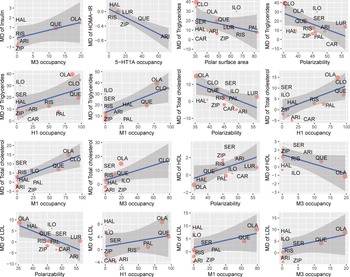
The regression analysis (Fig. 4) showed that a higher occupancy of M3 [β = 0.96 (0.07, 1.85)] cholinergic receptors was an increasing factor.
Regression lines of the MD for each outcome v. selected properties of antipsychotic medications. Dots represent single antipsychotics, with size proportional to the number of analyzed studies. Lines represent the regression equations and the grey zones show 95% confidence intervals. ARI, aripiprazole; BRE, brexpiprazole; CAR, cariprazine; CLO, clozapine; HAL, haloperidol; LUR, lurasidone; OLA, olanzapine; PAL, paliperidone; QUE, quetiapine; RIS, risperidone; SER, sertindole; ZIP, ziprasidone.

HOMA-IR
As compared with olanzapine, HOMA-IR levels change after AP treatment ranged down to a mean reduction of −0.8 mmol × mU/L with aripiprazole and up to 0.2 mmol × mU/L with haloperidol (Fig. 3). Drugs, when ranked from the most negative to the most positive on HOMA-IR means were aripiprazole, quetiapine, ziprasidone, risperidone, lurasidone, olanzapine, haloperidol (Table 2). The mixed comparisons (eTable 7 in the Supplement) showed that HOMA-IR means with aripiprazole were reduced as compared with quetiapine, ziprasidone, lurasidone, haloperidol, and olanzapine. No evidence of global heterogeneity or inconsistency was found and there was no local inconsistency. The regression analysis (Fig. 4) showed that a higher occupancy of 5-HT1A serotoninergic [−0.12 (−0.2, −0.04)] receptors was a reducing factor.
Triglycerides
As compared with placebo/no treatment, triglycerides levels change after AP treatment ranged from a mean reduction of −0.71 mg/dL with brexpiprazole, up to a mean increase of 39.50 mg/dL with olanzapine (Fig. 3). Drugs ranking from the smallest negative to the largest increase of triglyceride means was found to be: brexpiprazole, placebo/no treatment, cariprazine, ziprasidone, paliperidone, aripiprazole, haloperidol, risperidone, lurasidone, sertindole, quetiapine, iloperidone, clozapine, olanzapine (Table 2).
The mixed comparisons (eTable 8 in the Supplement) showed a larger increase of triglyceride means after olanzapine as compared with brexpiprazole, cariprazine, ziprasidone, paliperidone, aripiprazole, haloperidol, risperidone, lurasidone, quetiapine and placebo/no treatment; and a larger increase after clozapine as compared with ziprasidone, paliperidone, aripiprazole, risperidone, and placebo/no treatment. There was significant global inconsistency (Q = 162.99, p < 0.0001); local inconsistency was found in the comparison between olanzapine and risperidone, resulting in a larger difference in favor of risperidone.
The regression analysis (Fig. 4) showed as reducing factors a higher polar surface area [β = −0.501 (−0.922, −0.08)] and a higher polarizability [β = −1.356 (−2.34, −0.372)] of antipsychotics, while H1 histaminergic [β = 2.16 (0.16, 4.16)], M1 cholinergic [β = 2.84 (1.49, 4.19)] receptors occupancies were increasing factors.
Total cholesterol
As compared with placebo/no treatment, total cholesterol levels change after AP treatment ranged from a mean reduction of −4.90 mg/dL with aripiprazole, up to a mean increase of 14.87 mg/dL with olanzapine (Fig. 3). The rank order of the drugs in terms of changes in total cholesterol means (largest reduction to largest increase) was: aripiprazole, ziprasidone, cariprazine, placebo/no treatment, haloperidol, lurasidone, paliperidone, risperidone, iloperidone, brexpiprazole, sertindole, quetiapine, clozapine, olanzapine (Table 2).
The mixed comparisons (eTable 9 in the Supplement) showed a smaller increase of total cholesterol means after aripiprazole as compared with risperidone, quetiapine and clozapine, and after ziprasidone as compared with quetiapine and clozapine; mixed comparisons showed a larger increase after olanzapine as compared with aripiprazole, cariprazine, ziprasidone, haloperidol, paliperidone, lurasidone, risperidone and quetiapine; quetiapine, clozapine and olanzapine increased cholesterol means more than placebo/no treatment.
Evidence of global heterogeneity was absent, but global inconsistency was found (Q = 46.12, p = 0.0003). Regarding local inconsistency, four direct comparisons differed significantly from the respective mixed ones: aripiprazole was significantly different from risperidone while not from olanzapine; haloperidol was significantly different from clozapine; the magnitude of difference between risperidone and olanzapine was larger.
The regression analysis (Fig. 4) showed as reducing factor a higher polarizability of antipsychotics [β = −0.681 (−1.141, −0.221)], while H1 histaminergic [β = 1.43 (0.56, 2.3)] and M1 [β = 1.55 (0.89, 2.2)] and M3 cholinergic [β = 3.45 (0.36, 6.55)] receptors occupancies were increasing factors.
HDL cholesterol
As compared with placebo/no treatment, HDL cholesterol levels change after AP treatment ranged from a mean increase of 2.77 mg/dL with brexpiprazole, up to a mean decrease of −1.12 mg/dL with olanzapine (Fig. 3). Drugs ranking from the most positive to the most negative HDL cholesterol change was found to be: brexpiprazole, sertindole, aripiprazole, ziprasidone, risperidone, iloperidone, lurasidone, quetiapine, cariprazine, placebo/no treatment, paliperidone, haloperidol, olanzapine (Table 2).
The mixed comparisons (eTable 10 in the Supplement) showed a decrease of HDL cholesterol means after olanzapine as compared with ziprasidone.
There was significant global heterogeneity (Q = 37.89, p < 0.0001) and global inconsistency (Q = 48.55, p < 0.0001); in direct comparison, olanzapine resulted to decrease HDL cholesterol means as compared with aripiprazole.
The regression analysis (Fig. 4) showed as increasing factor higher polarizability of antipsychotics [β = 0.119 (0.025, 0.213)], while M3 cholinergic [β = −1.17 (−1.95, −0.39)] receptors occupancy was a reducing factor.
LDL cholesterol
As compared with placebo/no treatment, LDL cholesterol levels change after AP treatment ranged from a mean reduction of −3.90 mg/dL with aripiprazole, up to a mean increase of 8.68 mg/dL with olanzapine (Fig. 3). Drugs ranked from the most negative to the most positive LDL cholesterol change were aripiprazole, cariprazine, ziprasidone, placebo/no treatment, risperidone, lurasidone, paliperidone, sertindole, brexpiprazole, quetiapine, iloperidone, haloperidol, olanzapine (Table 2).
The mixed comparisons (eTable 11 in the Supplement) showed a smaller increase of LDL cholesterol means after aripiprazole and ziprasidone as compared with quetiapine, and a larger increase of LDL means after olanzapine as compared with aripiprazole, cariprazine, ziprasidone, risperidone, lurasidone, paliperidone, quetiapine, and placebo/no treatment.
Global inconsistency (Q = 33.99, p = 0.0012) was significant. Considering local inconsistency, three direct comparisons differed significantly from the respective mixed ones: aripiprazole reduced significantly LDL levels as compared with risperidone; the magnitude of effect increased in the comparison between ziprasidone and olanzapine; the direction of difference between aripiprazole and ziprasidone changed, although significance was not reached.
The regression analysis (Fig. 4) showed as reducing factor a higher polarizability of antipsychotics [β = −0.455 (−0.772, −0.137)] and as increasing factors higher H1 histaminergic [β = 0.76 (0.03, 1.49)], M1 [β = 0.93 (0.35, 1.51)], and M3 [β = 4.34 (1.59, 7.1)] cholinergic receptors occupancies.
Additional outcomes
We obtained network meta-analysis results also for weight and BMI, which were consistent with previous publications and were thus not shown. However, regression analyses regarding weight and BMI (eTable 12 in the Supplement) showed as increasing factors a higher H1 histaminergic receptor occupancy [significant for both: respectively, β = 0.32 (0.11, 0.53) and β = 0.12 (0.02, 0.22)], a higher M1 cholinergic receptors occupancy for weight [β = 0.28 (0.04, 0.53)] and a higher M3 cholinergic receptors occupancy for BMI [β = 0.46 (0.14, 0.79)].
Discussion
Regarding the outcomes investigated in previous network meta-analyses, we found discrepancies that need to be properly appraised. Aripiprazole was the metabolically safest or almost safest AP, in all analyses except for triglycerides. The peculiar serotoninergic activity of aripiprazole may explain the consistent results on parameters comprising the glycemic regulation. Pancreatic islets indeed use serotonin as an autocrine and paracrine signal to stimulate hypoglycemic mechanisms (Almaça et al., Reference Almaça, Molina, Menegaz, Pronin, Tamayo, Slepak and Caicedo2016). Serotonin can suppress the activity of pancreatic alpha cells while also increasing insulin levels. Our results suggest the usefulness of a deeper investigation of whether aripiprazole or any other AP can bind to serotonin receptors expressed in pancreatic islets, issues uninvestigated presently. No insulin measurements are available for brexpiprazole and brexpiprazole was ranked in the neutral risk zone for glucose in our dataset. Information on this parameter would be important to clarify whether aripiprazole and brexpiprazole may have different glycemic effects.
Surprisingly, we found that aripiprazole had an increasing effect on triglycerides, very different from that seen for brexpiprazole, suggesting a possible role for the pharmacological differences between the two molecules in determining this discrepancy: in particular, as discussed here below, a different involvement of 5-HT1A agonism by aripiprazole (weak) v. brexpiprazole (strong) may be relevant.
Ziprasidone, an AP that has been defined ‘weight-neutral’ (Krause et al., Reference Krause, Zhu, Huhn, Schneider-Thoma, Bighelli, Chaimani and Leucht2018; Leucht et al., Reference Leucht, Cipriani, Spineli, Mavridis, Orey, Richter and Davis2013), maintained in our network meta-analysis a neatly favorable glycemic and lipid/cholesterol profile, being associated with a relatively large increase in HDL and a weak increase in triglycerides.
In our work, haloperidol resulted to have a higher risk profile as compared with that published previously, in particular regarding glucose and insulin increases. This effect may be due to the activity of haloperidol and its metabolite on sigma receptors, which are widely expressed in the liver and can interfere with glycemic homeostasis (Hellewell et al., Reference Hellewell, Bruce, Feinstein, Orringer, Williams and Bowen1994). In parallel, we confirmed the high-risk profile of haloperidol for triglycerides and thus LDL cholesterol, possibly as a direct consequence of dysregulated glycemic control, while observing a moderate risk profile for other outcomes.
Regarding less represented antipsychotics, brexpiprazole resulted to have a low risk regarding glycemic control outcomes, while it increased all forms of cholesterols, showing a mixed risk profile. Cariprazine showed the highest increase in glucose levels while showing no risk for lipid/cholesterol increases. Sertindole had moderate/high risks. Cariprazine, brexpiprazole, and sertindole resulted to have a quite different profile in our network meta-analysis as compared to the previous ones (Huhn et al., Reference Huhn, Nikolakopoulou, Schneider-Thoma, Krause, Samara, Peter and Leucht2019; Pillinger et al., Reference Pillinger, McCutcheon, Vano, Mizuno, Arumuham, Hindley and Howes2020; Zhou et al., Reference Zhou, Keitner, Qin, Ravindran, Bauer, Del Giovane and Xie2015), possibly due to the low number of available studies on such molecules that are seldom used (sertindole) or have been newly introduced. With limited study numbers, even a change of one study in the dataset, due to different inclusion/exclusion criteria, can lead to a considerable change in detected AP effects.
The results concerning other antipsychotics were in fact aligned with the network meta-analyses published previously. Lurasidone resulted in an overall low/medium risk profile.
Quetiapine showed a neutral risk for glycemic outcomes, while the risk was higher for triglycerides and cholesterols, consistent with previous network meta-analyses. Risperidone and paliperidone were overall at neutral/moderate risk, and olanzapine and clozapine were usually the worst among examined antipsychotics, as previously shown (Huhn et al., Reference Huhn, Nikolakopoulou, Schneider-Thoma, Krause, Samara, Peter and Leucht2019; Pillinger et al., Reference Pillinger, McCutcheon, Vano, Mizuno, Arumuham, Hindley and Howes2020; Zhou et al., Reference Zhou, Keitner, Qin, Ravindran, Bauer, Del Giovane and Xie2015), except for glucose levels. Regarding glucose, haloperidol and cariprazine obtained the worst risk scores.
As compared with previous network meta-analyses, ours expanded significantly the number of analyzed glyco-metabolic outcomes, including also HbA1c, insulin and HOMA-IR. It is important to consider that, by including in our work several outcomes related to glycemic control, we were able to provide results more reliable than those from previous publications. Glucose changes were coupled with almost parallel changes in HOMA-IR and opposite changes in insulin, more clearly indicating effects on glycemic control mechanisms. Changes in HbA1c were not strictly aligned with the other glycemic outcomes, possibly due to a more subtle regulation that may manifest changes only over longer time frames.
A pattern of consistency across outcomes was found also regarding LDL and total cholesterol, again increasing the internal reliability of our results.
Besides a more comprehensive network meta-analysis, in the present work, we have provided an investigation of the putative mechanisms of the adverse metabolic effects of antipsychotics, by performing regression analyses on the results of network meta-analyses. We have found that changes in several outcomes were associated, not only with neurotransmitter receptor binding properties but also with chemical properties of antipsychotics. This finding provides support to an innovative interpretation of the mechanisms of adverse metabolic action of antipsychotics, currently demonstrated only in vitro and in vivo (Canfrán-Duque et al., Reference Canfrán-Duque, Casado, Pastor, Sánchez-Wandelmer, de la Peña, Lerma and Busto2013; Kristiana, Sharpe, Catts, Lutze-Mann, & Brown, Reference Kristiana, Sharpe, Catts, Lutze-Mann and Brown2010; Lauressergues et al., Reference Lauressergues, Staels, Valeille, Majd, Hum, Duriez and Cussac2010).
The traditional interpretation of the adverse metabolic effects of antipsychotics is based on psychopharmacological mechanisms, by which antipsychotics are supposed to alter the hypothalamic regulations of appetite and hormone production. This limited view has been recently completed by the clarification of neurotransmitter receptor-mediated effects happening also in peripheral tissues, like pancreas, liver, muscles, and adipocytes that express dopamine, serotonin and histamine receptors, and are innervated by muscarinic cholinergic and noradrenergic fibers (Ballon et al., Reference Ballon, Pajvani, Freyberg, Leibel and Lieberman2014).
We observed that several occupancy values were indeed important to determine the metabolic risk profile of antipsychotics. Occupancies of H1 histaminergic and M1/M3cholinergic receptors were, always jointly, risk factors for the increase of total and LDL cholesterols; M1/M3 cholinergic receptors occupancies were risk factors for the increase of insulin levels and H1 histaminergic and M1 cholinergic receptors occupancies were risk factors for the increase of triglyceride levels. M3 cholinergic receptors occupancy was also connected with a decrease in HDL cholesterol levels. These parameters taken together support the hypothesis that antihistaminergic and muscarinic cholinergic activities of antipsychotics may be responsible for part of their adverse metabolic effects.
H1, M1, and M3 receptors occupancies were also connected with increases in weight and BMI. This finding strengthens and expands what was found in a previous regression study (Olten & Bloch, Reference Olten and Bloch2018) that linked the M1 and H1 Kis with weight gain. H1 histaminergic receptors have a crucial psychopharmacological role in determining appetite, through the regulation of hypothalamic AMPK. Moreover, by activating AMPK, histamine H1 receptors might also induce the suppression of antipsychotic-SREBP-driven increases in triglycerides and sterol production, as debated in recent reviews (Vantaggiato et al., Reference Vantaggiato, Castelli, Giovarelli, Orso, Bassi, Clementi and De Palma2019). Interestingly, the 5-HT1A serotoninergic receptors occupancy resulted to reduce glucose levels increases, while 5-HT2C receptors occupancy was a risk factor for triglyceride increase. This result may be interpreted in conjunction with the effects we observed for aripiprazole and brexpiprazole, to support the hypothesis that several serotoninergic receptors can regulate the activities of pancreas (Almaça et al., Reference Almaça, Molina, Menegaz, Pronin, Tamayo, Slepak and Caicedo2016), liver (Gershon, Reference Gershon2013), and muscles (Hajduch et al., Reference Hajduch, Rencurel, Balendran, Batty, Downes and Hundal1999). The role of serotoninergic receptors in modulating metabolic adverse effects should be investigated further in preclinical and clinical studies.
Mechanistic interpretations comprising these ‘psycho-metabolic’ mechanisms based on neurotransmitter receptors could explain quite well the changes in body parameters, i.e. weight and BMI, yet not for all antipsychotics. For instance, the ‘weight-neutral’ nature of ziprasidone and, debatably, of aripiprazole, has been used to put this interpretation under question, highlighting the need to identify the mechanisms not based on neurotransmitter receptors. An increasing number of studies in vitro and in vivo has suggested a role for the amphiphilic cationic nature of antipsychotics, which renders them capable of partitioning across aqueous and lipid compartments alike, depending on their chemical characteristics and on the pH of the cellular compartment in which they diffuse. A pathogenetic model has been recently described, assembling the available preclinical evidence around some concepts including ‘lysosomal trapping’ (Canfrán-Duque et al., Reference Canfrán-Duque, Barrio, Lerma, de la Peña, Serna, Pastor and Busto2016) and ‘activation through inhibition’ (Skrede, Steen, & Fernø, Reference Skrede, Steen and Fernø2013). By these mechanisms, antipsychotics alter lysosomal function and thus the uptake of plasmatic LDL cholesterol, starting a cascade of metabolic impairments in the management of sterols and lipids, which ultimately leads to a waste of energy for the production of excessive sterol precursors and triglycerides that become accumulated.
Considering the potential relevance of this broader interpretation, we chose to analyze the relationship between the glyco-metabolic adverse effects of antipsychotics and some of their chemical properties that could influence ionic and amphiphilic behaviors. We chose to focus on pKa, and on polarizability and polar surface area. In the context of lysosomes, the importance of pKa values of antipsychotics would not seem important, as lysosomal pH is around 5 and every attackable atom gets charged in lysosomes. However, different values of the basic pKa represent the fact that some antipsychotics may lose an electron and become cations even in neutral compartments, like the cytosol or endosomes, while other antipsychotics may remain uncharged until they reach the lysosomes. Regarding polarizability and polar surface area, a highly polarizable AP will be more subject to being in a dipolar state, mimicking actual ionic charge. In the context of the distribution of amphiphilic molecules across cellular compartments, we must consider that antipsychotics can be distributed to cellular membranes or to aqueous compartments solely depending on their ionic charge. Antipsychotics that are not ionized nor dipole-induced will remain in membranes (hydrophobic), while antipsychotics that are ionized (by virtue of pKa) will remain in aqueous compartments and antipsychotics that are dipole-induced (by virtue of polarizability) will be likely expelled from membranes into aqueous compartments. In the present network meta-analysis, we observed how the chemical parameters above matter in determining the adverse potential of antipsychotics to cause glyco-metabolic alterations.
We found that antipsychotics that are more polarizable or with a higher polar surface area, i.e. distributed predominantly in aqueous compartments, cause less increases of triglycerides, total cholesterol, and LDL cholesterol, while they can increase HDL cholesterol more. The fact that polarizability is very relevant across multiple outcomes and the consistency across cholesterol/HDL outcomes support the hypothesis that antipsychotics may exert their adverse metabolic effect through mechanisms of interference at the level of membranes and/or hydrophobic compartments.
n case of the basic pKa value we could not find a significant role in influencing our outcomes, although a trend towards significance appeared for triglycerides, total and LDL cholesterol.
Beyond the scope of this work, there are two aspects of APs and metabolism that may be worth investigating in future research, to have a clearer understanding of metabolic disorders induced by APs.
The first is the role of lipid disturbances existing prior to the onset of psychosis. Reductions in cholesterol and increases in triglycerides plasma levels have been consistently described in drug-naïve psychotic and schizophrenic patients (Dickens et al., Reference Dickens, Sen, Kempton, Barrantes-Vidal, Iyegbe, Nordentoft and McGuire2020; Misiak, Stańczykiewicz, Łaczmański, & Frydecka, Reference Misiak, Stańczykiewicz, Łaczmański and Frydecka2017; Pillinger, Beck, Stubbs, & Howes, Reference Pillinger, Beck, Stubbs and Howes2017; Wedervang-Resell et al., Reference Wedervang-Resell, Friis, Lonning, Smelror, Johannessen, Agartz and Myhre2020). It is not yet clear whether these alterations may be etiopathogenic or just associated features, but it is plausible that altered sterol/lipid ratios lead to a change in the composition of cellular membranes and thus to a different functioning of neurotransmitter receptors. Following this interesting theory, the cholesterol and lipid alterations caused by antipsychotics may be a required part of their therapeutic action, meaning that antipsychotics can shift a ‘psychogenic’ lipidomic pattern towards a psychiatrically neutral one.
Another area of interest regards the role of mitochondria in lipid metabolism. Mitochondria may be etiopathological mediators in psychosis or schizophrenia as well as be involved with the response to APs. APs were found to impair the respiratory chain and alter levels of Drp1 (Scaini et al., Reference Scaini, Quevedo, Velligan, Roberts, Raventos and Walss-Bass2018), protein that regulates mitochondrial fission/fusion and impairs their metabolic function (Del Campo et al., Reference Del Campo, Bustos, Mascayano, Acuña-Castillo, Troncoso and Rojo2018). APs also reduce the relative amount of mitochondrial DNA, suggesting an AP-induced damage (Kumar et al., Reference Kumar, Efstathopoulos, Millischer, Olsson, Wei, Brüstle and Lavebratt2018). Interestingly, blocking Drp1 impedes neuronal differentiation and promotes death (Vantaggiato et al., Reference Vantaggiato, Castelli, Giovarelli, Orso, Bassi, Clementi and De Palma2019), and the loss of oxidative metabolism due to APs was suggested to be causative for the cognitive decay seen in long-term users of Aps (Turkheimer et al., Reference Turkheimer, Selvaggi, Mehta, Veronese, Zelaya, Dazzan and Vernon2020). In addition, muscarinic agonism (functionally analogous to D2 dopaminergic blockade) impairs mitochondrial trafficking and function (Sabbir, Calcutt, & Fernyhough, Reference Sabbir, Calcutt and Fernyhough2018), which further connects APs with mitochondrial interference.
Limitations
From a methodological point of view, though our network meta-analysis was based on the assumption that baseline clinical characteristics were largely similar among different studies comparing different medications, we chose to focus on antipsychotics use not only in acute schizophrenic patients (78.20% of our total cohort included in the network), a choice that likely inflected assumption of similarity and homogeneity between studies. In this regard, it must be considered that metabolic alterations occurring in a short time frame, such as that of a clinical trial, may not be fully indicative of the medium or long-term metabolic status imposed by continued AP use. Observational studies reporting long-term changes in metabolic parameters are thus needed. As some antipsychotics are quicker than others in promoting excessive weight gain, but ultimately reach similar weight gain plateaus, the same self-limiting phenomenon might occur with changes in metabolic indices.
For our exploration of correlations between metabolic effects and the neurotransmitter receptor occupancy of antipsychotics, we chose to rely on occupancy values as they represent Kis corrected based on the trough plasma concentrations that are required for therapeutic efficacy, thus being more relevant to the clinic than just Kis.
Another limitation regards the calculation of s.d. of MD: if not reported in the primary study, we used baseline and endpoint values and considered a correlation of 0.6. However, we performed sensitivity analyses setting the correlation to 0.5, 0.8, and 0.95 and found no substantial differences in results. Again, to avoid the exclusion of studies because of missing data, we chose to estimate s.d. of MD, if not reported in the primary study and if baseline and endpoint values were missing, by using the average of included studies. However, we imputed data for less than 5% of the studies. Another technical limitation concerns the use of studies in English only, which may have led to a minor loss of data. Considering the quality of studies included in the quantitative analysis, we acknowledge that the majority presented with concerning or high levels of risk of bias, an unsolvable issue that might limit the interpretability of results.
Conclusion
On the clinical side, we provided a ranking of drugs that may be useful to guide antipsychotic switching. We showed that olanzapine and clozapine, and in some cases haloperidol and quetiapine, were associated with variations of unfavorable clinical significance. Conversely, aripiprazole and ziprasidone may be valid options to manage patients with metabolic imbalances, because these APs caused less deteriorations or even promoted improvement of the examined metabolic indices. More data are required to evaluate newer antipsychotics properly, although brexpiprazole seems promising, lurasidone appears to have moderate risk and cariprazine presents with a low lipidic risk but a high glycemic risk. This network meta-analysis is the first providing high-quality clinical data in support of mechanistic interpretations of the glyco-metabolic adverse effects of antipsychotics that have been so far studied essentially in vitro. Our study supports that the partitioning of antipsychotics across cellular membranes and aqueous compartments is crucial to determine their adverse metabolic potential. Antipsychotics with a marked tendency to remain in hydrophobic compartments might be mitigated in their glyco-metabolic adverse effects by using compounds that stimulate H1 and/or M1/M3 and/or 5-HT1A receptors, or by specific inhibitors of the molecular mechanisms involved. Moreover, drug developers should seek for future antipsychotics that are highly polarizable and ionizable, to have safer metabolic profiles, and should expand the understanding of serotoninergic mechanisms involved in both psychopharmacology and metabolism.
Supplementary material
The supplementary material for this article can be found at https://doi.org/10.1017/S0033291721000180.
Acknowledgements
This work was supported by the Regional Center of Pharmacovigilance of Lombardy (to EC), the Italian Medicines Agency, Agenzia Italiana del Farmaco (AIFA, to EC) and by the Italian Ministry of Health (Ricerca Corrente 2019–2020, to MP and MN; and Progetto Finalizzata RF-2016-02363761 to EC and AC) which are gratefully acknowledged. The funding public institutions had no role in any part of the work.
Conflict of interest
All authors declare that they have no conflicts of interest concerning the topic of this work.