Introduction
Ordovician rocks in Mexico are mostly restricted to the southern part of the country, in the state of Oaxaca (Robison and Pantoja-Alor, Reference Robison and Pantoja-Alor1968; Yochelson, Reference Yochelson1968), and to the north in the states of Chihuahua (Bridges, Reference Bridges1965; Barboza-Gudiño et al., Reference Barboza-Gudiño, Torres-Hernández and Villasuso-Martínez2016) and Sonora (Dumble, Reference Dumble1900; King, Reference King1939; Vega-Granillo and Araux-Sánchez, Reference Vega-Granillo and Araux-Sánchez1987; Poole et al., Reference Poole, Stewart, Berry, Harris, Repetski, Madrid, Ketner, Carter and Morales-Ramirez1995; Page et al., Reference Page, Harris, Poole and Repetski2003; Almazán-Vázquez et al., Reference Almazán-Vázquez, Buitrón-Sánchez and Franco-Vega2006; Cuen-Romero et al., Reference Cuen-Romero, Reyes-Montoya and Noriega-Ruiz2020). These rocks contain a diverse fossil biota consisting of sponges, bryozoans, corals, brachiopods, mollusks, trilobites, echinoderms, graptolites, and conodonts. Among the mollusks, Ordovician gastropods are the poorest-known group due to their scarcity in Mexico. The fossil record of lower Paleozoic gastropods of Mexico is scarce and poorly documented; among these, a species from the Lower Ordovician (Tremadocian) Tiñú Formation in the state of Oaxaca, identified as Eobucania mexicana Yochelson, Reference Yochelson1968, is associated with fragments of bellerophontiform gastropods (Yochelson, Reference Yochelson1968).
In Chihuahua, the lower Paleozoic Sierra Plomosas sedimentary sequence consists of carbonate and siliciclastic rocks that belong to the southwestern Laurentian platform (Barboza-Gudiño et al., Reference Barboza-Gudiño, Torres-Hernández and Villasuso-Martínez2016). The oldest rocks that crop out in this area correspond to the Ordovician Sóstenes Formation, which is made up of limestone, shale, and sandstone (Bridges, Reference Bridges1964). The unit has an abundant gastropod fauna consisting of Palliseria and Maclurites, as well as brachiopods and conodonts (Bridges, Reference Bridges1965; Barboza-Gudiño et al., Reference Barboza-Gudiño, Torres-Hernández and Villasuso-Martínez2016).
In Sonora, a sequence of dolomite, sandy limestone, conglomerate, and siltstone that is exposed in Sierra Martínez with a thickness of ~100 m is considered to be Early Ordovician in age (Montijo-González and Terán-Ortega, Reference Montijo-González and Terán-Ortega1988). In this sedimentary sequence, Poole et al. (Reference Poole, Stewart, Berry, Harris, Repetski, Madrid, Ketner, Carter and Morales-Ramirez1995) identified a diverse fauna represented by brachiopods, gastropods (Lecanospira, Maclurites, Helicotoma, Lophospira), trilobites, and conodonts, included in the Macerodus dianae–Histiodella sinuosa zones and considered as Early–Middle Ordovician (Ibexian–Whiterockian) in age.
There are a few reports of Lower Ordovician gastropods in central Sonora, in the areas of Rancho Pozo Nuevo and Rancho Las Norias, in which only the genera Maclurites, Lecanospira, and ?Palliseria were reported and have not been the focus of systematic and taxonomic studies (Vega-Granillo and Araux-Sánchez, Reference Vega-Granillo and Araux-Sánchez1987; Page et al., Reference Page, Harris, Poole and Repetski2003; Almazán-Vázquez et al., Reference Almazán-Vázquez, Buitrón-Sánchez and Franco-Vega2006; Beresi et al., Reference Beresi, Cabaleri, Buitrón-Sánchez, Rodríguez, Heredia and Tortello2012). The study presented herein constitutes the first systematic work of Ordovician gastropods from the Las Norias formation (informally named, according to the NACSN, 2005) in central Sonora. Six taxa—Maclurites acuminatus (Billings, Reference Billings1865), ?Monitorella sp., Lecanospira sp., Malayaspira aff. M. rugosa Kobayashi, Reference Kobayashi1958, Lophospira perangulata (Hall, Reference Hall1847), and Hormotoma? sp.—are illustrated and described for the first time in Mexico.
The occurrence of this fauna allows inference of a direct biocorrelation of Lower–Middle Ordovician faunas of Sonora with fauna from Laurentia (USA, Canada, and Greenland), South America (Argentine Precordillera), Europe (United Kingdom, Norway, Sweden, Estonia), and Asia (China and Malaysia).
Geological setting
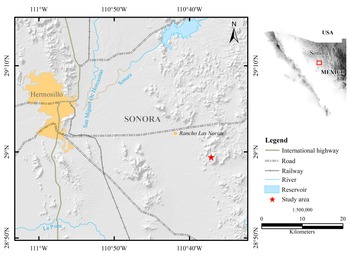
The Rancho Las Norias is located 30 km east of Hermosillo, the capital of the state of Sonora. The main access to the study area is through state highway 104, which connects the city of Hermosillo with the town of Mazatán (Fig. 1). The Ordovician outcrops are located 5 km south of Rancho Las Norias via a dirt road. The area is delimited by the coordinates 29°1.064′N, 110°39.052′W and 28°58.347′N and 110°35.982′W.
Location of the study area in central Sonora, Mexico.

Few studies have been carried out in the area, mainly for stratigraphic and paleontological purposes, although none of the fossil groups mentioned in these investigations has been studied systematically; therefore, the biota is limited only to partial mentions. Vega-Granillo and Araux-Sánchez (Reference Vega-Granillo and Araux-Sánchez1987) defined the Las Norias formation (an informal name according to the NACSN, 2005) as a succession of limestone with intraclasts, shale, highly fossiliferous limestone, cherty dolomite, and quartzite, containing brachiopods identified as Hesperonomia sp., gastropods such as Lecanospira sp., and trilobites such as Cybelopsis sp. This assemblage was assigned to the Early–Middle Ordovician.
Page et al. (Reference Page, Harris, Poole and Repetski2003) also used the name Las Norias formation and carried out a more detailed biostratigraphic study in which they documented an abundant fauna of brachiopods, gastropods, cephalopods, trilobites, and conodonts, which they assigned to a stratigraphic position that varies from the Histiodella donnae Zone in the lower part of the unit (Floian, Ibexian) to the Histiodella holodentata Zone in the upper part (Darriwilian, Whiterockian). Page et al. (Reference Page, Harris, Poole and Repetski2003) also mentioned the presence of the gastropod genus Maclurites. Almazán-Vázquez et al. (Reference Almazán-Vázquez, Buitrón-Sánchez and Franco-Vega2006) used the informal name Pozo Nuevo formation to refer to the same sequence. In this work, following the principle of nomenclatural priority, we will refer to this sequence as Las Norias formation sensu stricto of Page et al. (Reference Page, Harris, Poole and Repetski2003).
A detailed facies/microfacies and paleoenvironmental analysis of the Pozo Nuevo formation (= Las Norias formation) cropping out at Cerro Salazar, located in central Sonora near Rancho Las Norias, was carried out by Beresi et al. (Reference Beresi, Cabaleri, Buitrón-Sánchez, Rodríguez, Heredia and Tortello2012). In this work, the gastropods present are of two types: one with a high spire identified in the Family Lophospiridae (Lophospira) and the other with flattened spires (Maclurites and Lecanospira) of the Family Macluritidae. Hormotoma and possibly Donaldiella are also present among the gastropods. Conodonts described from these units at Cerro Salazar were assigned to the Oepikodus communis Zone (late Floian) and to the Tripodus laevis Zone (early Dapingian); both zones are typical of the North American Midcontinent Province (Beresi et al., Reference Beresi, Cabaleri, Buitrón-Sánchez, Rodríguez, Heredia and Tortello2012).
Ordovician stratigraphy of Rancho Las Norias
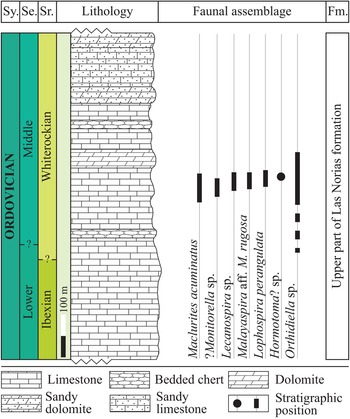
The Ordovician Las Norias formation (Vega-Granillo and Araux-Sanchez, Reference Vega-Granillo and Araux-Sánchez1987; Page et al., Reference Page, Harris, Poole and Repetski2003), which lies on top of a sandstone and quartzite unit that probably is Cambrian in age (Page et al., Reference Page, Harris, Poole and Repetski2003), consists from the base to the top of: (1) a sequence of intraclastic limestone intercalated with calcareous shale and massive-bedded limestone with silicified annelid tubes and gastropods; followed by (2) a highly fossiliferous sequence of intraclastic limestone, banded white chert, massive-bedded limestone, and some shale; and (3) sandy limestone and sandy dolomite with cross-bedded quartz sandstone lenses at the top of the formation (Figure 2). The Las Norias formation is very fossiliferous, containing orthid brachiopods, gastropods, trilobites, and conodonts (Page et al., Reference Page, Harris, Poole and Repetski2003). A unit of Devonian limestone, sandy limestone, dolomite, and sandstone is unconformably on top of the Las Norias formation. Figure 2 shows the upper part of the Las Norias formation, from which the fauna studied were collected for this study.
Stratigraphic column and faunal assemblage of the studied section (modified after Page et al., Reference Page, Harris, Poole and Repetski2003).

Poole et al. (Reference Poole, Stewart, Berry, Harris, Repetski, Madrid, Ketner, Carter and Morales-Ramirez1995) carried out a comparative analysis of the complete stratigraphic sections of the Ordovician in the state of Sonora, suggesting that the Ordovician strata of Sierra Agua Verde were deposited on an internal marine platform and maintained a paleogeographic position close to Laurentia, while the Ordovician deposits of Rancho Las Norias, Sierra Martínez, Cerro Cobachi, and Sierra López were deposited to the west and south of the Sierra Agua Verde. Likewise, the Ordovician strata of central Sonora may be correlated with other deposits in the United States that crop out in Utah, southern and eastern Nevada, south-west and south-central New Mexico, west Texas, and in Mexico in the state of Chihuahua (Poole et al., Reference Poole, Stewart, Berry, Harris, Repetski, Madrid, Ketner, Carter and Morales-Ramirez1995; Stewart et al., Reference Stewart, Poole, Harris, Repetski, Wardlaw, Mamet and Morales-Ramírez1999; Page et al., Reference Page, Harris and Repetski2012).
Material and methods
Specimen surfaces were coated with colloidal graphite and then ammonium chloride sublimate before photography. Cross-sections were prepared for some specimens. The material was prepared in the Laboratorio de Paleontología, Departamento de Geología, Universidad de Sonora.
Repository and institutional abbreviation
The studied material is deposited at the Colección de Paleontología, Departamento de Geología de la Universidad de Sonora with the numbering initials USDG.
Systematic paleontology
The classification used here is based on Bouchet et al. (Reference Bouchet, Rocroi, Hausdorf, Kaim, Kano, Nützel, Parkhaev, Schrödl and Strong2017).
Class Gastropoda Cuvier, Reference Cuvier1795
Superfamily Macluritoidea Carpenter, Reference Carpenter1861
Family Macluritidae Carpenter, Reference Carpenter1861
Genus Maclurites Le Sueur, Reference Le Sueur1818
Type species
Maclurites magna Le Sueur, Reference Le Sueur1818 (p. 310–311), Lenoir Limestone, Middle Ordovician, Tennessee.
Maclurites acuminatus (Billings, Reference Billings1865)
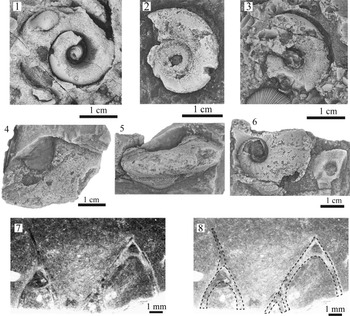
Figure 3.1–3.3
- Reference Billings1865
Maclurea acuminata Billings, p. 240, fig. 215.
- Reference Whitfield1890
Maclurea acuminata; Whitfield, p. 32, pl. 3, figs. 1, 2.
- Reference Seely1910
Maclurea acuminata; Seely, pl. 57, figs. 9, 10.
- Reference Banks and Johnson1957
Maclurites florentinensis; Banks and Johnson, p. 635, pl. 74, figs. 4, 5, 10.
- Reference Yü1961
Maclurites acuminatus; Yü, p. 34, pl.1, figs. 1, 2.
- Reference Rohr and Measures2001
Maclurites? acuminatus; Rohr and Measures, p. 289, fig. 5.19–5.21.
- Reference Rohr, Harper, Stouge and Christiansen2015
Maclurites acuminatus; Rohr et al., p. 798, fig. 3A–C.
Maclurites acuminatus (Billings, Reference Billings1865) and ?Monitorella sp. from the Las Norias formation. (1–3) Maclurites acuminatus, (1) USDG 390, (2) USDG 391, (3) USDG 392. (4–7) ?Monitorella sp., (4, 5) USDG 393, apical and lateral views, (6) USDG 394, apical view, (7) cross section through USDG 395, with accompanying outline, shown as dashed lines.

Holotype
Maclurea accuminata Billings, Reference Billings1865, Table Point Formation, Middle Ordovician, Newfoundland, Canada.
Occurrence
Las Norias formation, Lower–Middle Ordovician, Sonora, Mexico.
Description
Description is based primarily on specimen USDG 390, a small discoidal shell, as well as incomplete fragmentary and poorly preserved specimens. Shell has a planar base and a convex upper surface. The apical cavity is fragmented, narrow and steep-sided; outer edge of the whorl acute, ~10°, smooth outer surface, without ornamentation.
Materials
Three poorly preserved and fragmented specimens from the Las Norias formation; illustrated specimens (USDG 390, USDG 391, USDG 392).
Measurements
Specimen USDG 390 is 2.5 cm in diameter, USDG 391 is 1.8 cm in diameter, and USDG 392 is 2.2 cm in diameter.
Remarks
Rohr et al. (Reference Rohr, Harper, Stouge and Christiansen2015) established that the main characteristics that identify Maclurites acuminatus are its base, narrow apical cavity, and absence of previous whorls visible within the apical cavity. The Mexican species is similar to Maclurites acuminatus from the Narwhale Sound Formation of the Hudson Land of the Ordovician (Ibexian) from Greenland, in terms of the base and the narrow apical cavity, but differs in size, since the Mexican specimen has a larger diameter (2.5 cm, USDG 390) compared to the Greenland specimen (1.5 cm) (Rohr et al., Reference Rohr, Harper, Stouge and Christiansen2015). The Mexican specimen is comparable with Maclurites sp. 1 from the Catoche Formation from Labrador and Newfoundland, Canada (Rohr and Measures, Reference Rohr and Measures2001), but the Mexican specimen has a shorter shell.
Genus Monitorella Rohr, Reference Rohr1994
Type species
Monitorella auricula Rohr, Reference Rohr1994 (p. 478), Antelope Valley Formation, Middle Ordovician, Whiterockian, Nevada, USA.
?Monitorella sp.
Figure 3.4–3.8
Occurrence
Las Norias formation, Lower–Middle Ordovician, Sonora, Mexico.
Description
Description is based on specimen USDG 394. Incomplete, discoidal shell, rounded whorl profile, sharp top, flat base. Smooth surface, wide apical depression, each whorl about twice as wide as the previous.
Materials
Two poorly preserved specimens and one cross section in a slab from the Las Norias formation. Illustrated specimens (USDG 393, USDG 394, USDG 395).
Measurements
USDG 393, 1.5 cm in width of the whorl; USDG 394, 3.5 cm in diameter.
Remarks
The partial cross section (Fig. 3.7) resembles the cross section of Palliseria (see Knight, Reference Knight1941, pl. 67, fig 2a) and Monitorella (see Rohr and Measures, Reference Rohr and Measures2001, fig. 3.30). Although the base of the shell is missing, the bedding plane likely broke along a flat base rather than through a round base (Palliseria), so it is tentatively assigned to Monitorella until additional complete specimens are found. Monitorella Rohr, Reference Rohr1994, is similar to the genus Maclurites Le Sueur, Reference Le Sueur1818, but differs in a more rounded whorl profile. Similarly, the apical depression is wider than in the genus Maclurina Ulrich and Scofield, Reference Ulrich and Scofield1897; however, Monitorella does not have ornamentation on the spire (Rohr, Reference Rohr1994). Palliseria Wilson, Reference Wilson1924, has a strongly convex base. This specimen is assigned to the genus Monitorella due to the roundness of the whorl, the wider apical depression, and because the shell does not have ornamentation. Opercula of the shell occur in Nevada (Rohr, Reference Rohr1994), but have not been observed in Sonora.
Genus Lecanospira Butts, Reference Butts1926
Type species
Ophileta compacta Salter, Reference Salter1859 (p. 10), from the Beauharnois Formation, Lower–Middle Ordovician, Quebec, Canada.
Lecanospira sp.
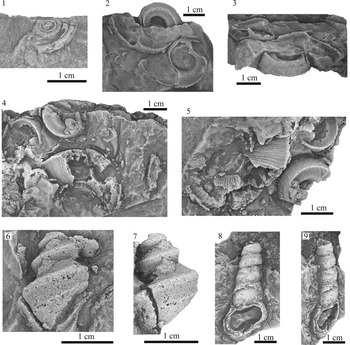
Figure 4.1
Occurrence
Las Norias formation, Lower–Middle Ordovician, Sonora, Mexico.
Lecanospira sp., Malayaspira aff. M. rugosa Kobayashi, Reference Kobayashi1958, Lophospira perangulata (Hall, Reference Hall1847), and Hormotoma? sp. from the Las Norias formation. (1) Lecanospira sp. USDG 396; (2, 3) Malayaspira aff. M. rugosa, USDG 397, apical and lateral views; (4, 5) Malayaspira aff. M. rugosa, USDG 398; (6, 7) Lophospira perangulata, USDG 399, side views; (8, 9) Hormotoma? sp., USDG 400, side views.

Description
Small, slowly expanding discoidal shell, ~1 cm in diameter. Slightly concave base, concave top. Whorl crest, base of the whorl rounded. The poorly preserved internal mold has a conspicuous umbilical area.
Material
One poorly preserved specimen from the Las Norias formation. Illustrated specimen (USDG 396). Hypotype USDG 396, ~1 cm in diameter.
Remarks
Lecanospira is widely distributed in the Lower Ordovician of North America (Rohr et al., Reference Rohr, Boyce and Knight2003). The Mexican specimen has a slightly depressed spire, which suggests a possible relationship to Lecanospira nerine (Billings, Reference Billings1865). However, preservation of the specimen does not allow observation of details, including the apical area, therefore, it is not possible to make a specific determination.
Family Ophiletidae Knight, Reference Knight1956
Genus Malayaspira Kobayashi, Reference Kobayashi1958
Type species
Malayaspira rugosa Kobayashi, Reference Kobayashi1958 (p. 227). Lower Setul Formation of Malaysia, Middle Ordovician.
Malayaspira aff. M. rugosa Kobayashi, Reference Kobayashi1958
Figure 4.2–4.5
Occurrence
Las Norias formation, Sonora, Mexico.
Description
Discoidal, whorl cross section subquadrate. Base flat, growth lines straight from upper suture to crestal angulation where a shallow, V-shaped sinus is present, slightly opisthocyrt growth lines on base of shell.
Materials
Two poorly preserved specimens (USDG 397, 398) from the Las Norias formation.
Remarks
The four-sided whorl profile distinguishes Malayaspira from Lecanospira Butts, Reference Butts1926. The shell is similar to Malayaspira hintzei Rohr, Reference Rohr1994, which has a sharper lower-outer angulation. Malayaspira speciosa (Billings, Reference Billings1865) was established on only the base of the shell, but later-illustrated complete shells (Rohr and Measures, Reference Rohr and Measures2001) have a more angular whorl profile at the base. Better material may clarify the assignment of the Sonora species.
Order Murchisoniina Cox and Knight, Reference Cox and Knight1960
Family Lophospiridae Wenz, Reference Wenz1938
Genus Lophospira Whitfield, Reference Whitfield1886
Type species
Murchisonia bicincta Hall, Reference Hall1847 (p. 177), Trenton Limestone, New York, USA, Upper Ordovician.
Lophospira perangulata (Hall, Reference Hall1847)
Figure 4.6, 4.7
- Reference Hall1847
Murchisonia perangulata Hall, p. 41, pl. 40, fig. 4.
- Reference Salter1859
Murchisonia bicincta var. perangulata Salter, pl. 4, fig. 7.
- Reference Ulrich and Scofield1897
Lophospira perangulata; Ulrich and Scofield, p. 972, pl. 72, figs. 1–7.
- Reference Ruedemann1901
Lophospira perangulata; Ruedemann, p. 31.
- Reference Raymond1908
Lophospira perangulata; Raymond, p. 188, pl. 49, figs. 7, 8.
- Reference Twenhofel1938
Lophospira perangulata; Twenhofel, p. 61, pl. 8, fig. 20.
- Reference Wilson1951
Lophospira perangulata; Wilson, p. 37, pl. 4, fig. 15.
- Reference Vostokova1962
Lophospira perangulata; Vostokova, p. 17, pl. 3, fig. 7.
- Reference Vostokova1964
Lophospira perangulata; Vostokova, p. 62, pl. 1, fig. 7.
- Reference Steele and Sinclair1971
Lophospira perangulata; Steele and Sinclair, p. 15.
- Reference Rohr1980
Lophospira perangulata; Rohr, p. 174, pl. 8, figs. 11–14.
- Reference Rohr and Blodgett1985
Lophospira perangulata; Rohr and Blodgett, p. 673.
- Reference Tofel and Bretsky1987
Lophospira perangulata; Tofel and Bretsky, p. 705, fig. 4.7, 4.8, 4.10, 4.13.
- Reference Rohr1996
Lophospira perangulata; Rohr, p. 59, fig. 2.19–2.22.
Holotype
Hall (Reference Hall1847) did not designate a type specimen, but, according to Tofel and Bretsky (Reference Tofel and Bretsky1987), four of his specimens (AMNH, 578, 29448, 29572, and 29573) are in the collections of the American Museum of Natural History. Hall's specimens are from the Lowville Limestone (= “Birdseye limestone”), New York, USA, Middle Ordovician.
Occurrence
Las Norias formation, Lower–Middle Ordovician, Sonora, Mexico.
Description
Moderate size (1.85 cm high), narrowly phaneromphalous, sample poorly preserved with almost three whorl angulations, a well-developed carina bearing the selenizone is present on the upper shoulder. Suture flush in early whorls. Whorl surface concave above and below upper angulation; thread above and below selenizone. Growth lines not preserved due to silicification. Apex and last whorl not preserved. Apical angle: 50–55°. Maximum width of the last whorl 1.30 cm.
Material
One specimen, USDG specimen 399.
Remarks
Lophospira perangulata is a very abundant and widespread species (Ulrich and Scofield, Reference Ulrich and Scofield1897; Rohr, Reference Rohr1980) in the Middle and Upper Ordovician.
Superfamily Murchisonioidea Koken, Reference Koken1896
Family Murchisoniidae Koken, Reference Koken1896
Subfamily Murchisoniinae Koken, Reference Koken1896 (=Hormotomidae Wenz, Reference Wenz1938)
Genus Hormotoma Salter, Reference Salter1859
Type species
Murchisonia gracilis Hall, Reference Hall1847 (p. 181), Trenton Limestone, Ordovician, New York, USA.
Hormotoma? sp.
Figure 4.8, 4.9
Occurrence
Las Norias formation, Lower–Middle Ordovician, Sonora, Mexico.
Description
High-spired, slowly expanding, with rounded whorls; umbilicus and surface ornament unknown, apical angle ~15°, fragmentary specimen 4.8 cm high.
Material
One specimen, USDG 400.
Remarks
This is a common genus in the Ordovician and includes many unrelated taxa with this general smooth, high-spired shape. It is present in the Middle Ordovician limestone beds of the Precordillera of San Juan Province, western Argentina.
Age and distribution of the gastropod fauna
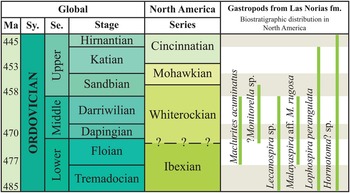
The gastropod fauna documented in this study suggests an Early–Middle Ordovician age (Figure 5). Although Hormotoma spp. is widely distributed through the Ordovician (Cullison, Reference Cullison1938; Wilson, Reference Wilson1951; Rohr et al., Reference Rohr, Harper, Stouge and Christiansen2015), the rest of the taxa are indicative of the Lower–Middle Ordovician: Lophospira perangulata is a common Lower–Middle Ordovician species in North America (Rohr, Reference Rohr1996), ranging from Darriwilian to Sandbian (Whiterockian, Mohawkian); Monitorella extends from the Dapingian to the lower Sandbian (Whiterockian) in Nevada (Rohr, Reference Rohr1996); and Maclurites acuminatus and Malayaspira rugosa are distributed from the Floian to the Darriwilian (Ibexian, Whiterockian) in North America, Argentina, and Indonesia (Kobayashi, Reference Kobayashi1959; Ross and Longwell, Reference Ross and Longwell1964; Rohr, Reference Rohr1994; Rohr et al., Reference Rohr, Beresi and Yochelson2001 Rohr and Measures, Reference Rohr and Measures2001; Bertero, Reference Bertero2009; Rohr et al., Reference Rohr, Harper, Stouge and Christiansen2015). Finally, Lecanospira is mainly distributed from the Lower–Middle Ordovician (Tremadocian, Darriwilian).
Chronostratigraphic range of the gastropods from the upper part of Las Norias formation.

According to Page et al. (Reference Page, Harris, Poole and Repetski2003), based on the presence of conodonts, the stratigraphic section of Rancho Las Norias varies in age from Ibexian to Whiterockian. This is confirmed by the presence of gastropod species Maclurites acuminatus, Malayaspira aff. M. rugosa, and ?Monitorella sp. Abundant specimens of Orthidiella sp., which is a widespread genus at the boundary between the Lower and Middle Ordovician (Whiterockian) of Nevada, California, and Newfoundland (Ross and James, Reference Ross and James1987; Rohr and Measures, Reference Rohr and Measures2001), were collected in the study area.
The occurrences of the Las Norias formation in central Sonora and surrounding areas denotes closeness to the paleoequator on the western side of Laurentia. In addition, these sections are also near the western extent of the transcontinental arch (Lam and Stigall, Reference Lam and Stigall2015; Husinec and Harvey, Reference Husinec and Harvey2021). The Ordovician gastropod faunas studied in this work have a wide geographic distribution in North America. Maclurites acuminatus has been described from the Ordovician Norwhale Sound Formation of Greenland (Rohr et al., Reference Rohr, Harper, Stouge and Christiansen2015), the Ordovician Table Point Formation of Newfoundland, Canada (Boyce and Knight, Reference Boyce and Knight2009), and the Ordovician Fort Cassin Formation in Vermont, USA (Whitfield, Reference Whitfield1890).
Abundant Lecanospira species, including Lecanospira sp., Lecanospira compacta (Salter, Reference Salter1859), Lecanospira nerine (Billings, Reference Billings1865), and Lecanospira lecanospiroides (Bridge and Cloud, Reference Bridge and Cloud1947), are known from the Ordovician of Quebec, Newfoundland, Labrador, and Alberta in Canada (Boyce, Reference Boyce1983; Rohr et al., Reference Rohr, Norford and Yochelson1995, Reference Rohr, Measures, Boyce and Knight2000, Reference Rohr, Boyce and Knight2003; Desbiens et al., Reference Desbiens, Bolton and McCracken1996; Knight et al., Reference Knight, Azmy, Boyce and Lavoie2008). In the USA, abundant Lecanospira species (Lecanospira sp., Lecanospira compacta, Lecanospira soluta Heller, Reference Heller1954, Lecanospira perplana Heller, Reference Heller1954, Lecanospira lecanospiroides, Lecanospira sanctisabae [Roemer, Reference Roemer1849], Lecanospira transvercordatus [Stauffer, Reference Stauffer1937]) are known in the Ordovician of the states of Alaska, Georgia, Maryland, Minnesota, New York, North Dakota, Pennsylvania, Texas, and Utah (Whitfield, Reference Whitfield1889; Stauffer, Reference Stauffer1937; Bridge and Cloud, Reference Bridge and Cloud1947; Hintze, Reference Hintze1951; Allen and Lester, Reference Allen and Lester1957; Lochman, Reference Lochman1966; Bartlett and Webb, Reference Bartlett and Webb1971; Peters, Reference Peters2004). Malayaspira rugosa has been documented in North America for the Ordovician of the Skoki Formation in Alberta and the Kechika Formation in British Columbia (Rohr et al., Reference Rohr, Norford and Yochelson1995). Also, Malayaspira aff. M. rugosa was described from the Ordovician Precordilleran carbonates (Bertero, Reference Bertero2009). Malayaspira rugosa has been described from the Ordovician of the Table Point Formation in Newfoundland and Labrador, Canada (Rohr and Measures, Reference Rohr and Measures2001). Maclurites species were illustrated and described from Ordovician carbonates of the Precordillera of San Juan Province, western Argentina (Kayser, Reference Kayser1876; Beresi, Reference Beresi1986).
Of the species described in this work, Lophospira perangulata, which is known from the Ordovician of the Narwhale Sound Formation and Cape Calhoun of Greenland (Troedsson, Reference Troedsson1928; Rohr et al., Reference Rohr, Harper, Stouge and Christiansen2015), has the widest geographic distribution in North America. In Canada, the species has been documented in the province of Ontario in the Gull River, Bobcaygeon, Verulam, Lindsay, Lowville, and Watertown formations (Wilson, Reference Wilson1951; Liberty, Reference Liberty1969; Steele and Sinclair, Reference Steele and Sinclair1971; Rohr et al., Reference Rohr, Measures and Boyce2004), and in the province of Quebec from the Ordovician Mingan, Chaumont, and Aylmer formations, among others (Okulitch, Reference Okulitch1935; Twenhofel, Reference Twenhofel1938; Wilson, Reference Wilson1951). The Ordovician species Lophospira perangulata from the Table Point Formation is known in Newfoundland and Labrador (Rohr et al., Reference Rohr, Measures and Boyce2004). In the USA, the species has a wide distribution in the Ordovician of the states of Alaska, California, Colorado, Illinois, Iowa, Indiana, Kentucky, Minnesota, Missouri, Nevada, New York, Ohio, Pennsylvania, Tennessee, and Virginia (Ulrich and Scofield, Reference Ulrich and Scofield1897; Butts, Reference Butts1926; Wilson, Reference Wilson1949; Rohr, Reference Rohr1980, Reference Rohr1994; Rohr and Blodgett, Reference Rohr and Blodgett1985; Sloan and Webers, Reference Sloan and Webers1987; Rohr et al., Reference Rohr, Measures and Boyce2004).
Hormotoma has a wide geographic distribution in North America and abundant species are known in the Ordovician of Ontario, Quebec, Manitoba, Nunavut, and Northwest Territories, among others (Whiteaves, Reference Whiteaves1897; Foerste, Reference Foerste1924; Twenhofel, Reference Twenhofel1928; Okulitch, Reference Okulitch1935; Wilson, Reference Wilson1938, Reference Wilson1951; Stearn, Reference Stearn1956; Bolton, Reference Bolton1977; Barnes et al., Reference Barnes, Norford and Skevington1981; Desbiens et al., Reference Desbiens, Bolton and McCracken1996; Jin and Zhan, Reference Jin and Zhan2000; Peters, Reference Peters2004). In the USA, it is known from the Ordovician in the states of Alaska, Arkansas, California, Georgia, Illinois, Iowa, Indiana, Kentucky, Maryland, Michigan, Minnesota, Missouri, Montana, New York, Ohio, Oklahoma, Texas, Vermont, Virginia, Wisconsin, and Wyoming (Hall, Reference Hall1847; Whitfield, Reference Whitfield1886; Ulrich and Scofield, Reference Ulrich and Scofield1897; Hussey, Reference Hussey1926; Cooper and Prouty, Reference Cooper and Prouty1943; Dalve, Reference Dalve1948; Wilson, Reference Wilson1949; Hintze, Reference Hintze1952; Allen and Lester, Reference Allen and Lester1957; Titus, Reference Titus1982; Sloan and Webers, Reference Sloan and Webers1987).
In the San Juan Formation of the Precordillera of Argentina, gastropod genera representing bellerophontoids, euomphaloids, pleurotomaroids, and an onychochiloid from the Lower–Middle Ordovician (Dapingian–lower Darriwillian) were summarized by Rohr et al. (Reference Rohr, Beresi and Yochelson2001) and Rohr and Measures (Reference Rohr and Measures2001).
The discovery of Ordovician gastropod faunas extends our knowledge of the Ordovician biotic content in the warm marine platform of Sonora. The gastropod occurrence provides new important elements for paleoenvironmental interpretations and paleobiogeographic affinities among the platforms of Sonora, Laurentia, and the Precordillera, with an age range from Early–Middle Ordovician.
Acknowledgments
The authors thank the Departamento de Geología, Universidad de Sonora for financial support to carry out this research. We are indebted to M.A. Flores-Castro for the support provided during fieldwork. We are grateful to J.O.R. Ebbestad (Uppsala University, Sweden) and an anonymous reviewer for kindly reviewing this manuscript. We are also thankful for the support provided by the editorial and production team of JP, including J. Kastigar and J. Musha.