INTRODUCTION
The distress elicited by a cancer diagnosis at any stage is well documented. The negative consequences of receiving a palliative cancer diagnosis can be even more severe (Zabora et al., Reference Zabora, BrintzenhofeSzoc and Curbow2001). Cancer, especially when untreatable, is demonstrated to have a deleterious effect on patient quality of life (Axelsson & Sjoden, Reference Axelsson and Sjoden1998; Hwang et al., Reference Hwang, Chang and Fairclough2003), psychological health (Zabora et al., Reference Zabora, Blanchard and Smith1997), and marital satisfaction (Fang et al., Reference Fang, Manne and Pape2001). In addition, patients are often confronted with end-of-life considerations and existential issues (Griffiths, Norton, Wagstaff, & Brunas-Wagstaff, Reference Griffiths, Norton and Wagstaff2002). The partners of these patients also report negative life effects and worries for the future that can meet or exceed those of the patient (Blanchard et al., Reference Blanchard, Albrecht and Ruckdeschel1997; Axelsson & Sjoden, Reference Axelsson and Sjoden1998; Carlson et al., Reference Carlson, Ottenbreit and Pierre2001; Kornblith et al., Reference Kornblith, Herndon and Zuckerman2001; Northouse et al., Reference Northouse, Mood and Kershaw2002; Chen et al., Reference Chen, Chu and Chen2004; Fleming et al., Reference Fleming, Sheppard and Mangan2006). In recognition of these needs, interventions to address the psychosocial needs of both cancer patients and their families are increasingly being utilized.
Despite the expansion of programs and services for cancer patients, their partners, and families in general, there has not been a corresponding growth of interventions during palliative care (Hudson, Reference Hudson2004). In fact, only 15% of 329 studies included in a systematic review of psychological therapies were designed for advanced-stage cancer patients (Newell et al., Reference Newell, Sanson-Fisher and Savolainen2002). A recent review of interventions for couples facing end-of-life cancer revealed only five studies (McLean & Jones, Reference McLean and Jones2007). They identified several gaps in the literature, including the lack of theory in intervention development, and recommended future research use longitudinal designs with validated outcome measures.
Retreats as interventions are becoming more popular as a means by which to offer psychosocial services because they offer a relatively intensive intervention in a shorter period of time. Unfortunately, many of the popular retreat interventions have not yet been systematically evaluated and, therefore, outcome literature is sparse. This limits understanding of participation outcome and hinders further development. Despite this, the research available to date suggests that retreat interventions may positively impact quality-of-life domains (Rutledge & Raymon, Reference Rutledge and Raymon2001; Angen et al., Reference Angen, MacRae and Simpson2002, Reference Angen, Simpson and MacRae2003). Until now, no retreat interventions have addressed the specific needs of palliative cancer patients and their partners.
The lack of specific interventions and supportive research with palliative populations can be partially attributed to logistical difficulties encountered by researchers. Rinck et al. (Reference Rinck, van den Bos and Kleijnen1997) summarized the extent of the issues often encountered while conducting research with patients at the end of life in his review of 11 studies. Problems with participant recruitment and attrition, sample homogeneity, and outcome selection were predominant. Serious issues actually prevented the publishing of results in 2 of the 11 studies. Hence, there has been a prevailing view of many in the research community that palliative research is not possible. Despite the difficulties inherent in this work, the importance of the information obtained from research with palliative patients cannot be overlooked. Fortunately, opinions among practitioners and researchers are changing to suggest that ethically and methodologically sound research with palliative populations is feasible and should be encouraged (Casarett & Karlawish, Reference Casarett and Karlawish2000).
Objectives
This pilot study assessed the feasibility of offering a novel intensive psychosocial retreat program to palliative cancer patients and their partners. Evaluation of the Tapestry program and tracking of outcomes, such as quality of life, was part of a larger study which will be reported in a subsequent paper. This study had the following objectives: (1) Estimate feasibility of the recruitment strategy for the retreat program for use in subsequent research designs. (2) Collect pilot data on the acceptability of the research project and completion rates of a battery of outcome measures that have been selected to reflect the likely outcomes from an intensive psychosocial intervention for couples (with documentation of missed data due to death and drop-outs).
METHODS
Participants
Participants were identified as eligible if they had histopathologically confirmed metastatic cancer of the breast, prostate, or colon, were legally married to a person of the opposite sex, resided within 40 km of the Calgary region, and attend the Tom Baker Cancer Center. After being identified as eligible, the patient charts were further reviewed by a research nurse, psychiatrist, palliative physician, and the attending oncologist. Exclusion criteria were extensive and included the inability to speak or read English; the presence of a psychiatric condition, cognitive impairment, delirium, severe depression, or intense anxiety; a prognosis of survival less than 6 months at initial file review as determined by the palliative physician; a performance status of 60% or less on the Palliative Performance Scale (PPS) or unstable medical conditions; a partner with a significant illness or mental health issue; and the initiation of new medical, psychological, or psychiatric treatment within 4 weeks prior to baseline assessment that may have affected the results of outcome measures or made the patient too unstable to leave the proximity of the cancer center to attend retreat.
Intervention
The Tapestry retreat format and content have previously been described (Angen et al., Reference Angen, MacRae and Simpson2002, Reference Angen, Simpson and MacRae2003) and is based on the Commonweal Cancer Help Program (Remen, Reference Remen1995).
Procedure
Patients were identified by a file review of then current outpatient breast, colon, and prostate cancer clinics at the Tom Baker Cancer Center in Calgary, Alberta, and considered for eligibility. A research assistant flagged potentially eligible patients and attached a letter of introduction to the study to their file. The attending oncologist reviewed the patient eligibility and gave the letter of introduction to the patient if eligible. All eligible patients who were given the introductory letter were contacted by the research assistant in person, who explained the study in more detail and obtained informed consent. Patients were initially offered the opportunity to enter the natural history cohort. Subsequently, patients were offered the opportunity to attend the Tapestry retreat with their partners. There was no cost to the couple to attend the retreat, as the program was funded by the Canadian Institutes of Health Research. For practical reasons related to the rate of recruitment, some couples in the natural history cohort were later offered the chance to attend the retreat program. If they chose not to attend the retreat, they were asked if they would remain in the study as part of the natural history group.
After obtaining consent for file review, a palliative physician and psychiatrist further reviewed the patient's eligibility to participate in the study. After eligibility was confirmed, a meeting was scheduled with the nurse researcher to complete the baseline questionnaires. Assessments were performed by the same nurse researcher in the patient's home or another location of the patient's choice. Baseline assessment of couples attending the Tapestry retreat was completed approximately 1 week prior to retreat attendance. Follow-up assessments were then performed 1 month after baseline (or retreat), and at 3-month intervals up to the time the patient refused contact due to worsening illness, the patient died, or 1 year (whichever came first). Ethical approval for this study was obtained from the Conjoint Health Research Ethics Board of the University of Calgary/Tom Baker Cancer Centre.
Sample Size
Sample size was determined based on considerations of the patient population concerned and the exploratory nature of the study. Originally three retreats were scheduled to accommodate study participants (18 couples). The natural history cohort was intended to recruit 30 couples, but the study was truncated after 18 months as the recruitment rate was lower than expected. Recruitment continued until the potential participant resource had been exhausted and no new cases could be identified. A major limitation in the recruitment is that the retreat center availability is a fixed and limited resource, that is, it must be booked months in advance, and thus only couples recruited prior to these fixed dates could be offered the opportunity to attend the program. Detailed recruitment data (number screened, number eligible from chart review, number approached, number consented) and reasons for refusal or ineligibility were compiled. The final sample consisted of 15 couples in the Tapestry group and 20 couples in the natural history group.
Data Analysis
Data analysis was performed using the Statistical Package for Social Sciences, version 15. Due to the exploratory nature of this research, significance values at or below the p < .10 probability level are reported. Because this research is primarily hypothesis generating, no corrections were made for multiple comparisons. Data analysis preceded in accordance with the study objectives:
1. Feasibility of recruitment: The feasibility of conducting a longitudinal study with palliative patients and their partners was assessed on two levels: (1) the number of patients eligible as identified in the clinics and (2) the number who consent and complete the baseline assessment battery. Reasons for patient ineligibility and participation refusal are reported.
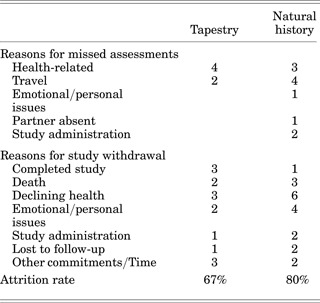
2. Suitability of the research project: The couples who consented to the study and completed baseline assessments were included in the final sample. Completion rates were assessed by the proportion of couples who completed the questionnaire package at each time point. Reasons for missed assessments and study withdrawal were tabulated. Mortality during the 12 month follow-up was determined, and dates of patient death were confirmed from medical charts.
RESULTS
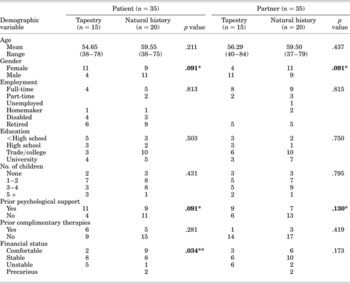
Patient and partner demographics for the Tapestry and natural history group are presented in Table 1. T tests and Pearson's or Fisher's exact chi-square analyses were performed in order to determine whether significant differences between patients and partners were present on any of the demographic variables. Patients in the Tapestry group were significantly more likely to be women, χ 2(1) = 2.81, p = .091, had received prior psychological support, χ 2(1) = 2.81, p = .091, and were less comfortable with their finances, χ 2 = 7.89, p = .034. Partners attending the Tapestry retreat were also more likely to have received prior psychological support, χ 2(1) = 2.16, p = .130.
Comparison of patient and partner demographics using t tests or chi-square analyses

Significan results in bold.
* p < .10; **p < .05; ***p < .0156.
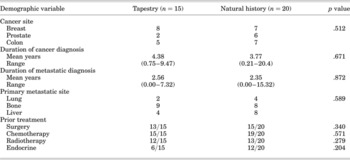
Patient disease demographics are presented in Table 2. The primary tumor site was breast (53%) in the Tapestry group, compared to an equal number of individuals with breast (35%) and colon (35%) cancer in the natural history group. The patients in the Tapestry group had an average cancer duration of 4.38 years and were diagnosed with metastatic sites 2.56 years previously. Patients in the natural history group were diagnosed with cancer an average of 3.77 years previously and had metastatic cancer for 2.35 years. These differences were not statistically significant, t(33) = −.429, p = .671; t(33) = −.162, p = .872. The primary metastatic tumor site in the Tapestry group was bone (60%) whereas in the natural history group there were an equal number of individuals with bone (40%) and liver (40%) metastases. The majority of the patients in both groups had received prior surgical, chemotherapy, and radiotherapy treatments.
Comparison of patient disease demographics using t tests or chi-square analyses

* p < .10; **p < .05; ***p < .01.
Objective 1: Feasibility of Recruitment
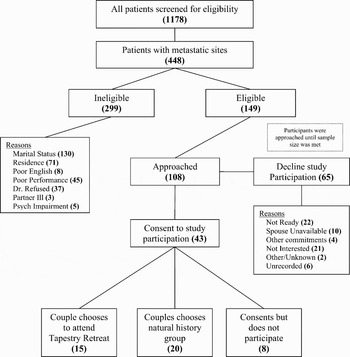
The primary area of investigation in this pilot project was the extent to which a suitable sample of patients with advanced disease could be recruited for study participation. Patient screening began in the summer of 2005 and continued for 18 months until no new patients could be identified in clinic. These results are summarized in Figure 1. A total of 1178 patients visiting the breast (685), prostate (326), and colon (167) clinics were screened for eligibility. Of these patients, 448 had metastatic cancer, effectively excluding 62% of the total patient population. Of those patients with a confirmed metastatic cancer diagnosis (448), 12% were not recommended for the study by their physician. The remaining patients were then assessed for the remaining study eligibility criteria. Marital status was the primary reason for exclusion in nearly half of the sample (43%), followed by geographical location of residence preventing retreat attendance or follow-up (24%).
Patient recruitment flowchart.

This left 149 patients as eligible for study participation. We were able to successfully approach 72% of those patients identified as eligible for study participation (the remainder were not approached due to logistical difficulties, such as patients missing appointments and new or ongoing treatments making patients medically unable to safely leave the proximity of the cancer center to attend the retreat). Of the patients approached, 60% declined program participation. The primary reason for study refusal was the patient not being ready to discuss his or her disease and its effects (34%), followed by not being interested in the focus of the intervention or the study (32%). The reason for study refusal was unknown or unrecorded in 12% of the sample. This resulted in a final sample of 43 couples consenting to study participation. Eight couples consented but did not participate because they changed their mind or became ineligible before the baseline assessment. Fifteen couples chose to participate in the Tapestry program and 20 couples formed the natural history group. In total, this study was able to successfully recruit 32% (35/108) of those patients eligible and approached for study participation.
Objective 2: Suitability of Research Project
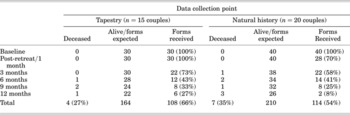
Secondary to the primary objective, we sought to determine whether patients and their partners would be able to complete the study protocol. Adherence was calculated by comparing the number of forms expected to the number of forms received. Mortality rate was calculated, and assessments scheduled for deceased individuals were not included in the expected total. The mortality rate for the Tapestry group was 27% over the year following the baseline assessment. In the Tapestry group, a total of 164 assessments were expected over the year of the follow-up, and 108 were actually received, resulting in a total response rate of 66% over the full duration of the study period. There was a downward trend noted in the number of assessments completed over the 12 month follow-up. At baseline and after the retreat, 100% of assessments were completed, followed by 73% at 3 months, 43% at 6 months, 33% at 9 months, and 27% at 12 months (these percentages do not include missing assessments from those who had died). The mortality rate for the natural history group was 35%. In the natural history group, a total of 210 assessments were expected and 114 were actually received, resulting in a lower total response rate (54%) than the Tapestry group. The negative trend in assessment completion was also observed for the natural history group. At 1 month follow-up, adherence fell to 70%, followed by 58% at 3 months, 41% at 6 months, 25% at 9 months, and 8% at 12 months. The adherence and mortality rates for both groups are presented in Table 3.
Completion rates for couples and mortality of patients

Attrition was defined as withdrawal from the study for reasons other than death. Attrition rate, reasons for missed assessments, and study withdrawal are presented in Table 4. Attrition rates were 67% and 80% in the Tapestry and natural history groups, respectively. Three couples in the Tapestry group and one couple in the natural history group completed the entire study protocol. Declining health and planned travel were the primary reasons for missing assessments in both groups. In the Tapestry group, declining health and time commitments were the reasons most often given for study withdrawal. Other couples mentioned that the study made them think about their negative future when they wanted to be positively focused on the present. In the natural history group, declining health was also the main reason for study withdrawal. Many couples also reported that they were not ready to think about the issues dealt with in the study and withdrew for this reason.
Attrition rate, reasons for participant missed assessments, and study withdrawal

DISCUSSION
Research on the feasibility of offering psychosocial treatment programs to patients with palliative cancer and their partners is an important area of clinical interest. The results of the current recruitment strategy were similar to that reported by Steinhauser et al. (Reference Steinhauser, Clipp and Hays2006) in their large longitudinal study with palliative cancer patients. They approached patients for a longitudinal descriptive study of the transition from serious illness to death. The comparative percentages for the Steinhauser et al. (Reference Steinhauser, Clipp and Hays2006) paper and the current work are 9% versus 13% for overall eligibility, 74% versus 72% for the number of eligible patients contacted, and 32% versus 40% for those patients consenting to participate. Given that the Steinhauser et al. (Reference Steinhauser, Clipp and Hays2006) study did not involve a psychosocial intervention, our numbers compare favorably. Although the recruitment rate may be acceptable and comparable, there are some suggested techniques for improving participant recruitment. For example, part of our recruitment strategy relied on physician approval, an approach that has been criticized as being overly restrictive. Steinhauser et al. (Reference Steinhauser, Clipp and Hays2006) suggest that physicians may negatively affect recruitment as a result of inaccuracies in predicting time to death, protecting patients by acting as study gatekeepers, inaccurately gauging the patient's receptiveness to the research, or allowing their personal opinions about the study's worth to affect referral.
Initially recruiting palliative patients may be less of a problem than keeping participants in the study. It is understandable that as the patient's health decreases, completing a battery of forms becomes laborious. We observed a decrease in the number of forms returned over the 12 month follow-up period for both groups. Specifically, there was an overall response rate of 66% in the Tapestry group and 54% in the natural history group. This is comparable to, but higher than, the response rate of 51% reported by Sherman et al. (Reference Sherman, McSherry and Parkas2005) in their quality of life study with 38 palliative cancer patients. This suggests that offering an intervention acts as an incentive for patients to remain involved in the study.
The primary reasons for missing assessments were related to health or travel. Many of the patients and spouses were using their remaining time to visit with family and friends or vacation. We saw more people in the natural history group withdraw from the study for reasons other than death. Declining health and emotional or personal reasons were once more the primary reason for study withdrawal. It may also be the case that participants in the natural history group felt less compelled to “give back,” because they did not receive an intervention as part of the study. Sherman et al. (Reference Sherman, McSherry and Parkas2005) reported similar results, with many patients not wanting to talk about their cancer or finding that completing the questionnaires caused them too much stress. At times it was the caregiver who instigated study withdrawal, as they felt the questionnaires were too much of a burden because they were already overwhelmed with the care of their dying partner. Making the assessments easier for the patients and spouses to complete may improve the likelihood that they remain in the study and provide more balanced results. The study battery in this case was extensive and took 0.5–2 h to complete each assessment. Easing participant burden can be accomplished by allowing participants to complete assessments by phone or during interviews, being flexible on assessment timing, and ensuring the measurements are clear and easily understood (Sherman et al., Reference Sherman, McSherry and Parkas2005).
In summary, this research demonstrates that, although recruitment and retention may be challenging, research with palliative patients is feasible. Specifically, we offered couples an intensive psychosocial intervention—something that has not been attempted or evaluated in the past—and found the intervention to be not only possible, but welcomed by participants. The results demonstrate that retreat participation was easily tolerated and successfully completed by palliative patients within the last 6 months of life. This may enable recruiting from a larger number of patients, including those who may be sicker and have a shorter prognosis than our current exclusion criteria allowed and would make declining availability of data with time in follow-up less of an issue. This being said, we also discovered that having patients choose whether or not to attend the retreat allowed those patients who wished to benefit from the program most access to the assistance. This design may pose problems for establishing efficacy, but it strengthens real-life applicability and effectiveness. This research has important implications for future studies with palliative patients. Subsequent research should ensure that measurement instruments are brief and specific in order to minimize associated burden. In addition, we found that a 12-month follow-up may have been unreasonable and suggest that researchers may want to distinguish between conducting research with patients in the early palliative phase of their disease and with those at the time of imminent death (Steinhauser et al., Reference Steinhauser, Clipp and Hays2006). These periods are very different and can determine health-related withdrawal, change the research location from home to hospital or hospice, and impact outcomes. Specifying the period of most interest and relevance to the research objectives may minimize patient attrition and increase the relevance of results. Lastly, these results emphasize the importance of including the partner as an integral and important component of palliative research, both as an independent focus of investigation and in combination with the patient.
ACKNOWLEDGMENTS
This research was supported by a Canadian Institutes of Health Research operating grant awarded to Drs. Simpson and Carlson. Dr. Linda E. Carlson holds the Enbridge Research Chair in Psychosocial Oncology co-funded by the Canadian Cancer Society Alberta/NWT Division and the Alberta Cancer Foundation. The research team thanks Dr. Helen MacRae and the other Tapestry facilitators for their dedication to the patients we serve. Most importantly, we acknowledge and appreciate the participants in this study for contributing their time and experiences so that we can better assist them and others in the future.