

Two prominent financial economists began a special issue of the Journal of Financial Economics
The biggest financial crisis since the Great Depression took place exactly fifty years after the publication of the Modigliani and Miller (MM) irrelevance propositions. The timing is ironic because the 2008 financial crisis shows decisively that capital structure matters and that the frictions assumed away by MM are of first order importance. This is not to minimize MM's seminal contribution, but rather to reject its pervasive misuse in finance and economics.Footnote 1
Others noted that comparative and international political economists had also over-simplified the ways that financial actors behaved, which left those disciplines with less to say about the crisis and ongoing economic weakness than would have been desired. Layna Mosley and David Andrew Singer noted that “very few empirical analyses occur at the firm-level” at all.Footnote 2 More have emerged since,Footnote 3 but the genre remains obscure in the “large-n” political economy of finance literature, and I am unaware of any new theories of financial firm behavior that have emerged in the post-crisis comparative and international political economy literatures. Others argued that more attention needed to be paid to the ways in which complex global structures condition the playing field for individual actors, who are then forced to make investment choices under uncertainty.Footnote 4 And, of course, political systems further complicate firms' decision-making processes by presenting them with diverse sets of regulatory and other policies, which firms seek to influence.Footnote 5 Thus, a post-crisis research agenda should include an analysis of comparative and inter- national financial markets as complex structures comprised of heterogenous agents operating in diverse environments.
This paper argues that political economists have relied on false assumptions following from the MM tradition in a similar manner as financial economists. The failure to generate a robust quantitative post-crisis research agenda in the political economy of finance literature follows from this problem. In order to construct a more realistic framework for understanding financial actor behavior that incorporates the political, economic, and financial environments within which they operate, we should examine both sides of firms' balance sheets. On the liabilities side, we should begin by moving away from the representative-agent models that expect firms to behave homogenously, especially by enjoying leverage.Footnote 6 Indeed, researchers in the burgeoning social science of finance program have already done so, noting in a “small-n” context that representative-agent models in financial economics were not “performative,” in that they did not influence behavior after being proposed nearly as much as later models, such as the capital asset pricing model.Footnote 7 This paper shows that representative-agent models do not hold up well to empirical testing in a larger sample either: Financial firms do not behave homogenously.
On the assets side we should generalize the literature on preferences over the term structure of interest rates to include a wider set of factors than simple time preference. We need not go far afield to find an alternative: Contemporaneous to MM, Culberton proposed a model in which investors have a “preferred habitat” in the market, which was extended in the following years.Footnote 8 This model suggests that heterogenous agents have heterogenous preferences over the sorts of investments they make and demand a premium to invest outside of their preferred niche. Financial actors, in other words, wish to occupy different positions within the market ecology, make different sorts of investments, take on different types (and amounts) of risk, and have different time horizons. These preferences are reflected in heterogenous prices.Footnote 9
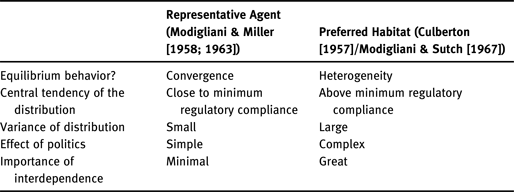
The preferred habitat (PH) approach proposed below generates different empirical expectations than those that emerge from more traditional representative-agent models (RA) that assume actor preferences as fixed and identically distributed. Under RA, market competition forces individual agent behaviors to converge to an equilibrium point, perhaps with some variation due to noise-traders or other opaque signals; under PH financial actors differentiate their behaviors according to their niche, location, experience, or subjectivities. Under RA, political factors influence firm behaviors in relatively straightforward, linear ways; a PH approach would draw from theoretical traditions that emphasize the need for variegated governance systems that are tailored to particular circumstances, such as the Ostrom (or Bloomington) School of political economy. RA models actors as independent and drawn from a common distribution; PH allows actors to vary in their type and degree of interdependence. RA treats markets as equilibrium seeking and stable absent unpredictable exogenous shocks; PH understands markets to be dynamic, evolving, and characterized by multiplexity.
This paper shows that descriptive reality is closer to the view presented by preferred habitat models. That is, Cochrane is empirically correct: Preferences over discount rates, as well as other subjective processes, vary a lot more than foundational financial economic models typically allow. Political economists frequently rely on the intuition from these models to form the baseline logic for theories of the politics of finance, although they nearly never cite the models from which that intuition is taken, so as financial economists revise their views of financial market behavior political economists should follow. I extend intuitions from the “preferred habitat” theoretical tradition to include other factors that condition the financial system, in particular political factors that can present governance challenges for market and non-market actors. Interdependencies within the broad financial ecology also generate structural power inequalities; as such, this paper links the preferred habitat approach to recently developed models of financial networks. Together, this is a first step towards the development of a realistic microfoundational theoretical account of agent behaviors that aggregates into an observable macro structure. Throughout I refer to financial market actors in a variety of ways: as actors, firms, institutions, companies, or particular types (such as banks) depending on the context. I intend the framework I propose to be generalizable across types of financial units, and indeed to sectors other than finance (although extensions beyond finance must wait for future exploration). The different literatures with which I hope to engage— minimally including comparative politics, financial economics, international political economy, regulation and governance, and social studies of finance—use these terms differently, and I understand that a category like “firm” will invoke different associations in the minds of comparative political economists and financial economists. To some extent this is unavoidable, but I have attempted to unite several strands of the literature and hope the paper will be read in that spirit.
The orthodox view of financial behavior
Whether descending from the welfare economics or public choice tradition, standard political economy accounts of financial actor behaviors are seemingly inferred from MM's capital structure irrelevance principle of representative agent models in financial economics: Given certain assumptions—efficient markets, zero transaction costs or taxes, symmetrical information—the value of a firm is unaffected by whether it is financed by equity or debt.Footnote 10 In terms of basic accounting a firm's assets less its liabilities equals its equity. Absent frictions, in other words, whether asset accumulation is funded by increasing equity or liabilities, is trivial: The capital structure is irrelevant. In this world all actors should behave similarly, and thus they can be modeled with a single representative agent.
In its simplest form, a so-called “vanilla” bank that accepts deposits and makes loans, institutions can increase profits in two ways: they can lend more at any given rate of profit or they can lend the same amount at a higher rate of profit. The rate of profit is determined by the difference between the cost of a firm's liabilities (i.e., the interest paid to its depositors) and the return on its assets (the interest received from the loans it extends). When banks channel funds from savers to borrowers, profits are earned by exploiting an interest rate differential that represents the bank's management of risk inherent in maturity mismatch: Borrowers wish to borrow long term, while creditors prefer to lend for shorter durations. Deposits are paid an interest rate, while loans are charged an interest rate. The bank's profit is the difference between the quantity of funds deposited and the quantity of funds lent, adjusted by their respective interest rates.Footnote 11 The interest rates are determined by risk. Banks charge higher interest rates to riskier borrowers or for longer-term loans. Banks pay little interest on demand deposits, as they are of short duration and involve very little risk. Restating the above in a more general way that includes non-vanilla institutions, financial firms can increase profits either by earning more from their assets or by paying less for their liabilities.
However, under common real-world conditions, such as the deduction from taxes of interest payments, equity financing becomes relatively more expensive and debt financing becomes more attractive.Footnote 12 Funding asset accumulation with equity capital is costly because it represents foregone earning potential. But acquiring assets via debt financing can also be costly: It increases the sensitivity that a bank has to the risk in its asset portfolio. If banks increase leverage too greatly their counterparties' investments will be less secure, which may cause them to demand a higher interest rate (i.e., higher financing costs) as compensation. As such, a profit-maximizing firm must consider two variables pertaining to the opposite sides of their balance sheet: the amount of risk in their asset portfolio and the cost of their financing operations. Enough income must be earned from assets to pay off liabilities. Higher leverage requires higher returns in order to be profitable; lower leverage requires lower returns. To generate higher returns, firms will be more likely to accept larger risks.
The same incentive exists under normal market circumstances besides the interest tax deductions, including market opacity and the presence of transaction costs. Thus, in real-world political economies firms often have an incentive to leverage their equity capital, multiplying gains (or losses) from their asset portfolios via debt financing. In the typical RA account, this incentive is only diminished by the willingness of lenders to continue extending debt finance at an acceptable price (“market discipline”) or by regulatory requirements that force firms to finance their operations with a minimum level of equity capital to mitigate against the risk of insolvency.Footnote 13 In this framework, even with symmetrical information and no transaction costs, firms are risk-neutral absent taxation but risk-acceptant conditional on taxation.
In fact, taxation is not even necessary to generate this result. A recent extension of the MM model noted:
The right baseline for banks is high leverage, not anything goes, when we take MM's idealized model and include a market segment of agents who value liquidity per se because they have imperfect access to capital markets. … High bank leverage is privately optimal and generates no systemic risk under our model's idealized conditions.Footnote 14
The political economy literature puts it even more bluntly: “In an interdependent financial community in which every state wants to enhance or maintain the competitiveness of its banking sector, deregulation by one state must be countered by that of others. This competitive spiral forces regulation toward its lowest common denominator”.Footnote 15 While a variety of forces can help prevent this race from dominating all aspects of regulatory politics, these are treated as variables that mitigate the “natural” tendency towards competition-driven insecurity.Footnote 16
Thus, it is not an exaggeration to say that in the MM tradition there is an expectation that under normal circumstances firms will “race to the bottom”—meaning that they become more acceptant of risk-taking activities—by progressively increasing leverage, which increase systemic risk.Footnote 17 Even vanilla banking markets could contain race to the bottom dynamics.Footnote 18 As banks compete for profits, the differential between income earned from assets and fees paid to liabilities will shrink. Banks will seek to capture market share by charging less on assets or by paying more for their liabilities. The cumulative result is that banks lend more at lower margins, leaving them susceptible to illiquidity or insolvency should their investments under-perform. Such behaviors are generally present in the run-up to banking crises.Footnote 19
Continuing this logic, the more competitive a market is the greater the temptation for banks to lend more and/or lend more riskily. In this way, banking markets resemble a prisoner's dilemma: If banks could make credible commitments to not undercut their competitors they could all lend a reasonable amount at a reasonable interest rate, guaranteeing a reasonable profit at low risk in perpetuity. But banks cannot make such a commitment, since each firm benefits from capturing more market share. The result is that competitive pressures drive risk accumulation, which may eventually culminate in a crash. A third-party intervener, usually a government, is needed to change the structure of the strategic interaction by making a commitment to prudent behavior credible. This is done through regulation, by setting a floor under which risk-taking activities cannot fall.
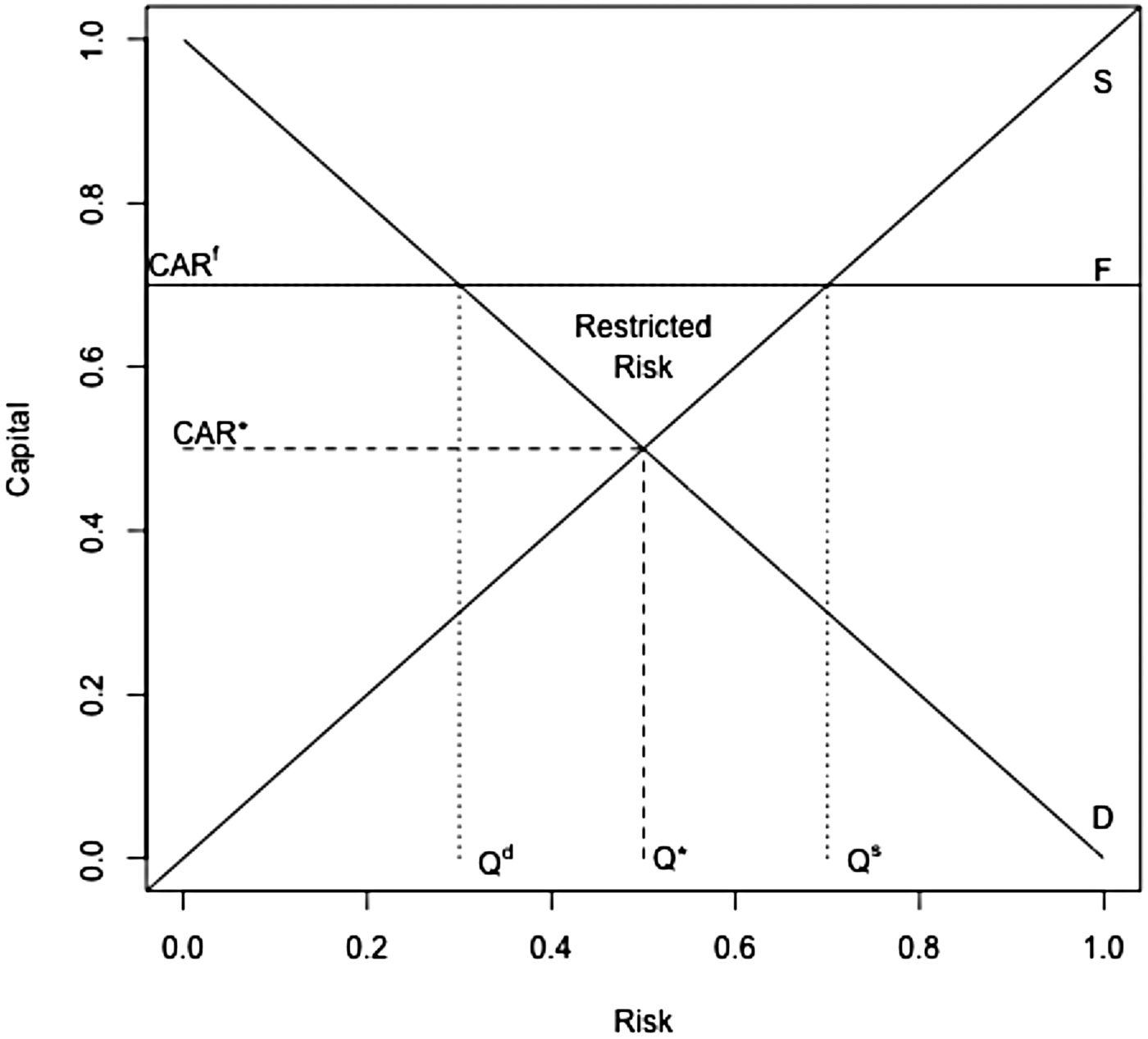
This sets up the “states vs. markets” approach that is common in much political economy scholarship. This approach supposes that markets and governments are in opposition, and outcomes depend on which has the upper hand. Figure 1 illustrates this scenario.
In this state of the world a financial regulation reduces market activity, so the quantity of risk in the market decreases from Q∗ to Qd. This view of the relationship between governments and financial markets is common in the political economy literature.

The market equilibrium quantity of risk—Q∗ — is restricted by capital adequacy regulation CARf so that the market settles at a new quantity of risk (Qd ), while the triangle labeled “Restricted Risk” is the “market surplus” of risk-taking that is prevented by the regulation.
This process is mirrored in the global political economy. Each state benefits when their firms possess a competitive advantage over their foreign rivals. But the pursuit of that advantage can lead to a situation where each state allows its firms to accumulate assets via debt finance rather than equity finance. If all states participate—and competition forces them to do so—financial markets may generate quite a lot of instability while profits are competed away.Footnote 20 As states become more tightly integrated and international markets more competitive, so the thinking goes, instability can spread from jurisdiction to jurisdiction in ways which are unpredictable ex ante.Footnote 21 A credible international regulatory standard is necessary to alter the structure of the interaction so that defection is no longer rewarded, thus preventing the origination and spread of crises. Such regulatory requirements have typically involved mandating a minimum level of equity capital, which banks must maintain against the risk of default in their asset portfolios. The global capital standard—the Basel Accords negotiated under the auspices of the Bank for International Settlements— was originated for this purpose.Footnote 22 Thus, the baseline positive political theories of regulatory politics also have the “race to the bottom” assumption at their core.Footnote 23
Interestingly, this basic conclusion holds whether the theoretical framework employed comes from either of the two primary positive theoretical frameworks in the literatures on the politics of regulation and governance: the welfare economics or public choice traditions. The welfare economics “classics” descend from the notion of negative externalities promoted by Arthur Pigou, with the understanding that excessive financial risk-taking creates costs borne by society (rather than the individual financial actors who accept the risks).Footnote 24 This literature explores the ways in which a benevolent social planner could maximize societal welfare by using tax and statutory regulations to force economic agents to internalize the costs of their actions, which, in this case, would be excessive risk-taking.
The public choice approach pioneered by Stigler and Peltzman argued that no such benevolent social planner is likely to exist, but powerful firms (especially incumbents) may use policy to entrench their position and secure their private interest at society's expense.Footnote 25 At the core of both of these traditions, which have generated vast academic and policy literatures, is the belief that competitive pressures financial actors to engage in actions that generate negative social externalities. The tension between the approach focused on societal welfare, and that which warns of regulatory capture has been at the core of a much political economy scholarship.Footnote 26
So the basic premise that flows from the MM tradition has been imported into the core of the political economy of finance literature. At the same time, very few of the primary texts in this literature have critically examined the empirical feasibility of its assumptions.Footnote 27 Such an examination should be able to perform two functions: first, erect a micro-level framework that is empirically viable, meaning that it well-describes the actual activities of financial actors; second, aggregate these individual actions into a macro-structure that can be studied empirically and theoretically (ideally within the same framework). The social studies of finance approach began undertaking the first step even before the global financial crisis and has since made some real gains. These could be accepted, broadened, and extended into a “preferred habitat” macro-structural context that, as I describe below, is flexible enough to incorporate insights from all of these literatures.
The social studies of finance alternative
The financial economics tradition has been questioned by practitioners of the “social studies of finance” (SSF), which empirically studies financial markets from the perspective of economic sociology, anthropology, human geography, and other disciplines. A primary consideration in this literature is performativity: the tendency for some models of social systems to become truer descriptions of phenomena in social systems after being proposed.Footnote 28 In this conception theories are tools as well as descriptive simplifications, engines as well as cameras.Footnote 29 For example, the Black-Scholes options pricing formula did not explain financial market behavior very well until its proposition led traders to use it. After broad adoption, the model performed quite well until the 1987 stock market crash. Through its use the model came closer to reality. This, in turn, led to the accumulation of particular types of risk which were exposed during the 1987 crash, at which point the model became counterperformative: The unwinding of prior investment positions contradicted the model.Footnote 30
Performativity and counterperformativity are dynamic processes that occur in complex social environments,Footnote 31 so this literature is concerned with the ways in which people cognitively assess valuation across time, and prioritizes “opening up black boxes” such as the internal ecology of firms.Footnote 32 Recent work has been concerned with viewpoints' effects: “the issues across which an actor allocates her attention will shape the properties that are selected as salient and worthy of consideration when assessing the focal situation.”Footnote 33 When financial actors make investment decisions they do so based on criteria including models of markets, but also the broader environments within which they operate.Footnote 34 The approach is fundamentally Polanyian—it seeks to embed economic agents within broader social contexts—and part of an anti-essentialist “pragmatic turn” in the social science of finance.Footnote 35 This literature complicates financial actors in important ways. Unlike classical finance theory, it is empirically-driven. Unlike behavioral finance, it situates actors within realistic contexts.
As such, SSF analyses are not ideational despite a common focus on cognitive processes and models.Footnote 36 The research design for these studies is typically ethnographic: a close analysis of individual firms or trading desks over short periods of time to uncover the processes by which investors make decisions. But because political economists who study finance typically build from models based on actor homogeneity (via, e.g., a representative agent) key insights from SSF have not yet been significantly integrated into the comparative or international political economy literatures, much less financial economics.Footnote 37
But while useful in many ways there are two important limitations to the SSF approach. The first is that these studies are of a limited scope. The benefit of detailed microfoundational research—a more realistic account of behavior than that based on ex ante principles—comes at a cost in terms of generalizability. While some black boxes are opened others are closed; in particular, macro structures are often abstracted away in this research. The second limitation in some way follows from the first: Almost all of this research is qualitative and case-based; little of it grasps with bigger data sets that include more financial actors. Therefore, inference about the overall performance of markets is limited.
The descriptive graphs below show that such analyses are needed. I contend that the SSF orientation can be complemented by a large-n quantitative analysis that considers the ways in which financial market behaviors may vary. Such an analysis may consider how firms' viewpoints are conditioned by their position within broader systems and could link the actor-oriented approach of SSF with higher levels, which retain the behavioral insights that have come from SSF. The best opportunity for doing this comes from the preferred habitat tradition in financial economics, which is flexible enough to extend into political economy.
The preferred habitat approach
In his 2011 presidential address to the American Finance Association, John Cochrane concluded with the following:
Discount rates vary a lot more than we thought. Most of the puzzles and anomalies that we face amount to discount-rate variation we do not understand. Our theoretical controversies are about how discount rates are formed. We need to recognize and incorporate discount-rate variation in applied procedures.Footnote 38
Cochrane's complaint was that financial economists had not paid sufficient attention to the diversity of preferences among financial actors in the run-up to the global financial crisis, and he pointed to the few modern applications of PH models as possible alternatives. PH models in financial economics combine insights from pure expectations and market segmentation theories, and were created to explain mismatches between theoretical expectations of bond yields and empirical realities. Pure expectations theory expected yields at longer durations of bonds (e.g., thirty-year bonds) to correspond perfectly with yields compounded from shorter duration bonds (e.g., thirty successive one-year bonds). In reality, as market segmentation theorists noted, the market for thirty-year bonds is very different from the market for one-year bonds: The yield curve is upwardly sloped across the range of maturity lengths, at least in normal times. This indicates that investors attach a higher risk to bonds with longer maturity durations and some are more willing to participate in some markets than others. However, market segmentation theory cannot explain why bond rates tend to move in tandem.Footnote 39
The PH model synthesizes the two in a framework that is flexible enough to accommodate studies of corporate finance, banking, and investments generally. Investors subjectively prefer to be engaged in a certain segment of the market but, if compensated sufficiently well, they will move outside of their niche. While the bulk of financial economics work has focused on habitats in the term structure of interest rates there is no ex ante reason to limit the approach to this area.Footnote 40 One important area to consider the applicability of the preferred habitat approach is in the riskiness of firms' asset portfolios. The MM capital structure irrelevance principle suggests that under many real-world conditions banks should prefer to increase leverage, meaning that they acquire assets using debt rather than equity. Thus, a common way of examining the risk of portfolios is through capital-to-assets ratios, which are often weighted according to the perceived ex ante riskiness of each asset. These risk-weights impact the amount of equity capital that banks must maintain to protect against a decline in value of their assets. For example, under the simple rules of the first Basel Accord, U.S. Treasury bills were perceived to be riskless and thus given a risk-weight of zero, while unsecuritized mortgages involved a 50 percent risk-weight. These capital ratios are the bedrock of the post-crisis global Basel Accords as well as most domestic regulatory regimes.
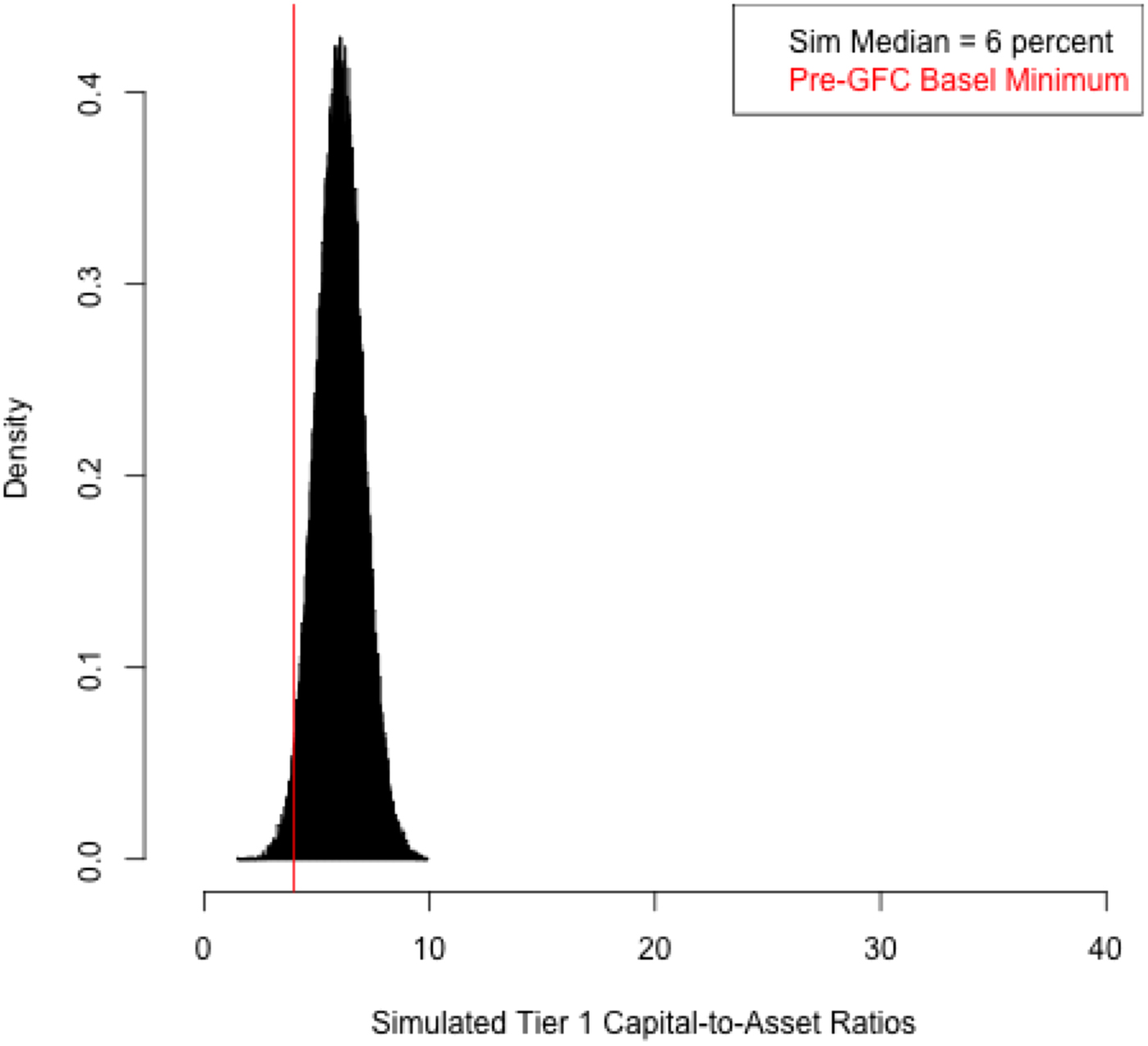
As discussed above, RA models following from MM would lead to two expectations: first, that competitive pressures would force the central tendency of firms' capital ratios to be quite close to the regulatory minima; second, that the pressures should force the variance of capital ratios to be very narrow. Such a story expects banks in aggregate to behave as in figure 2, which represents the portion of banks' asset accumulation which is funded by equity (i.e., “tier 1”) capital: competition should force homogeneity—variance in bank capital-to-assets ratios should be low—and the central tendency should be to match the regulatory minima, plus a small buffer to protect against idiosyncratic risk. To behave in any other way would be uncompetitive, and uncompetitive firms will not last long in a market as dynamic as global banking. To keep their domestic banking sectors competitive in increasingly integrated global financial markets, governments will tend not to regulate more strictly than the international regulatory standards. So, from the standard models we should expect convergence in bank behaviors, with a high degree of clustering around minimum regulatory requirements.
The view of bank behavior fundamental to prevalent theories of regulation: Due to competitive pressures, banks behave similarly and minimally comply with statutory regulations such as the pre-crisis international Basel Capital Accords (represented by the red line).
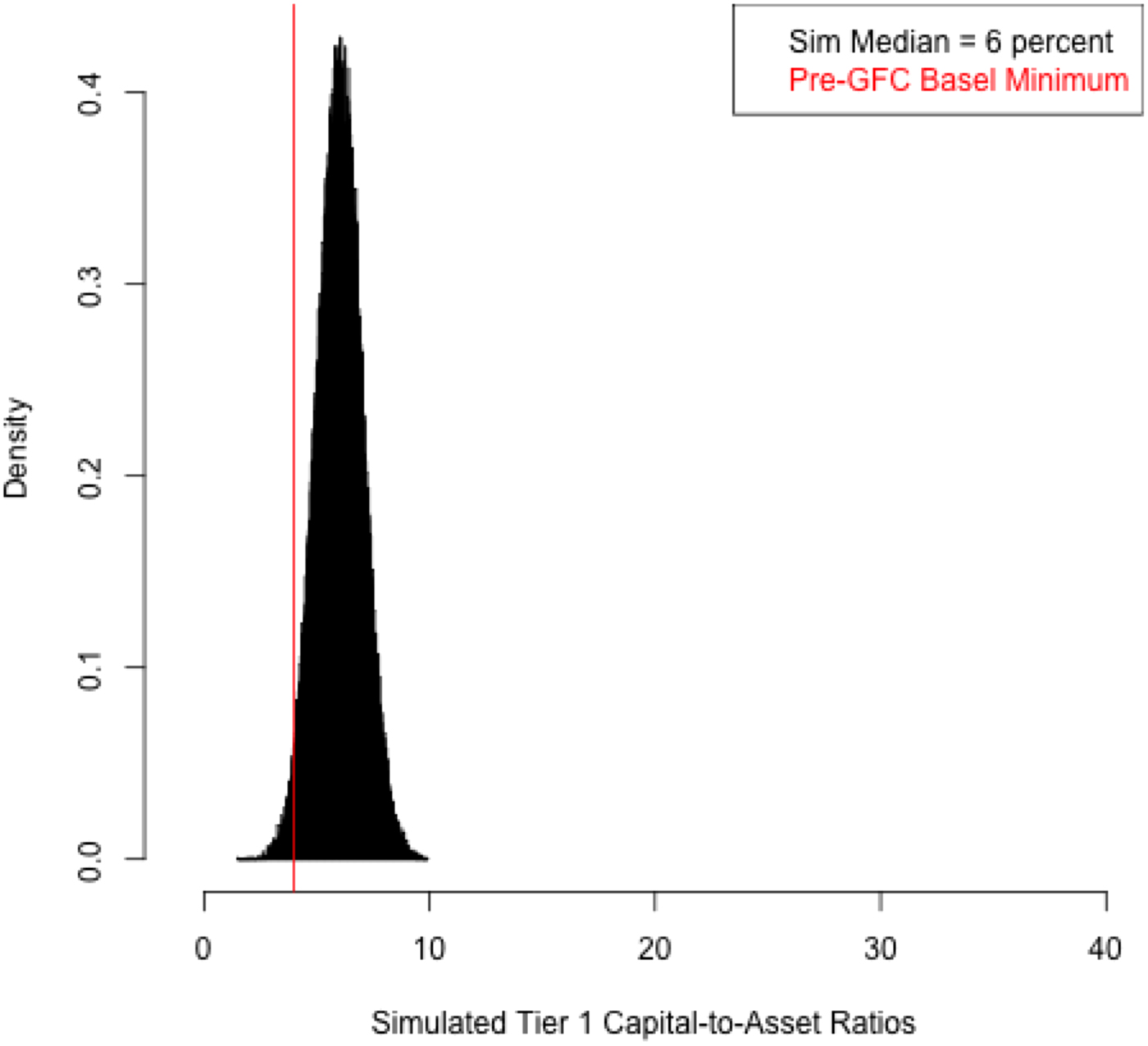
I do not exaggerate the implications of the standard models with the simulation portrayed in figure 2. Even the complication allowing a small capital buffer is relatively recent to the financial economics literature: “Virtually all models of bank decision making…tended to assume that capital requirements are binding constraints on bank behavior”.Footnote 41 Absent those constraints banks would increase leverage, which implies increased risk. The capital buffer, represented by the distance between the regulatory standard (red vertical line) and the majority of the density in figure 2, was modeled as nothing more than insurance against an accidental erosion of capital that would lead to closure of the firm by regulators (or some other penalty).
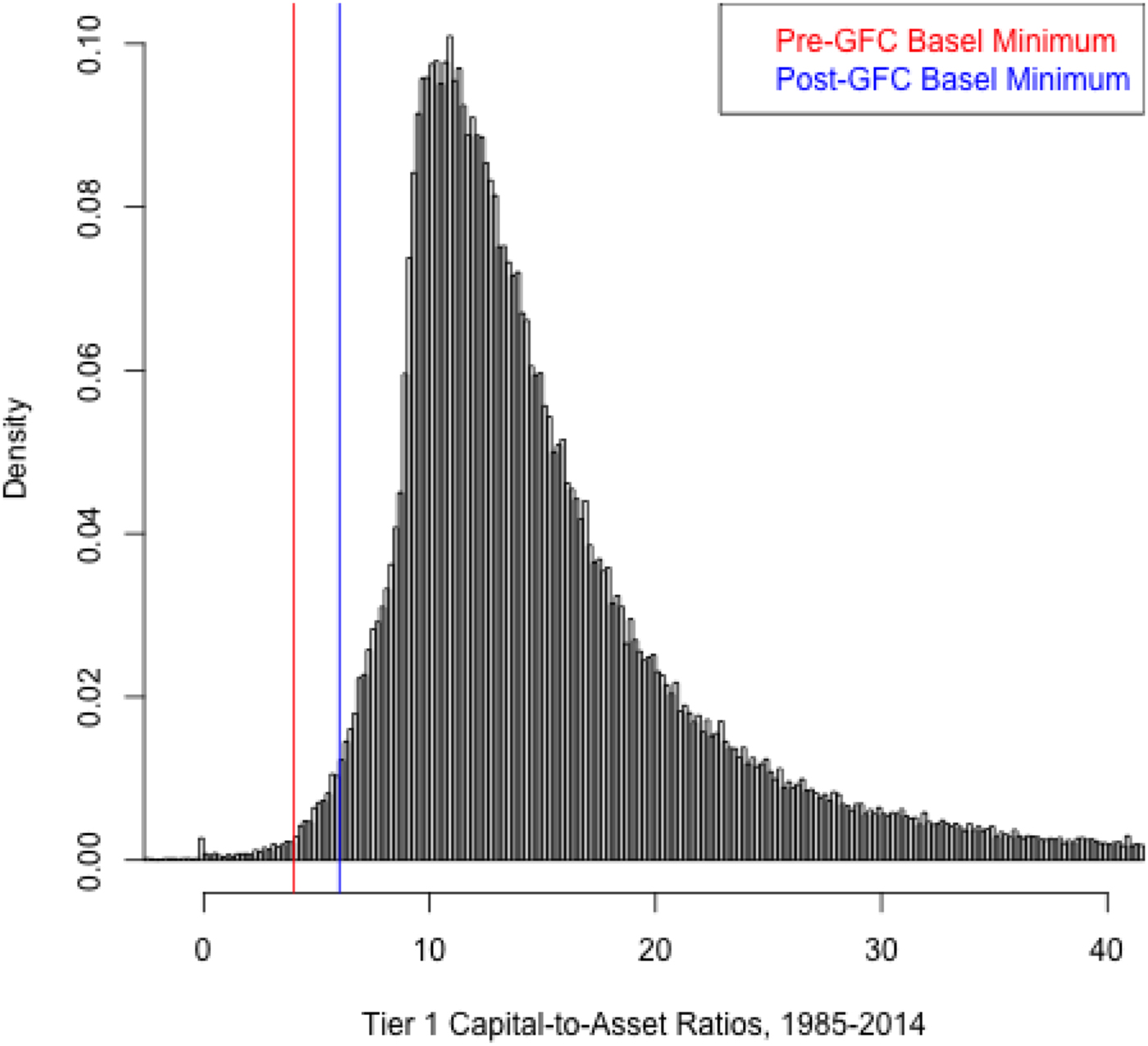
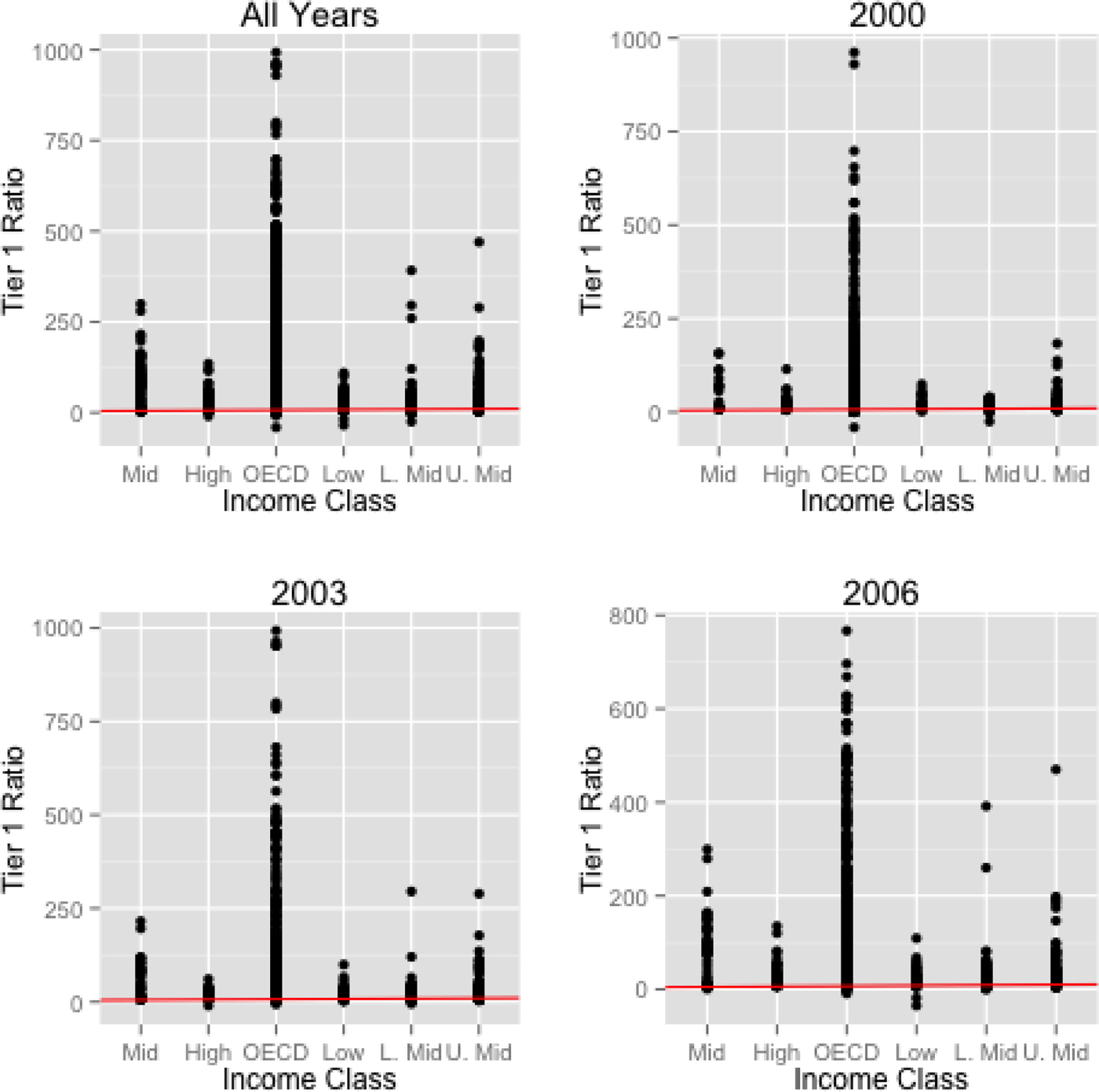
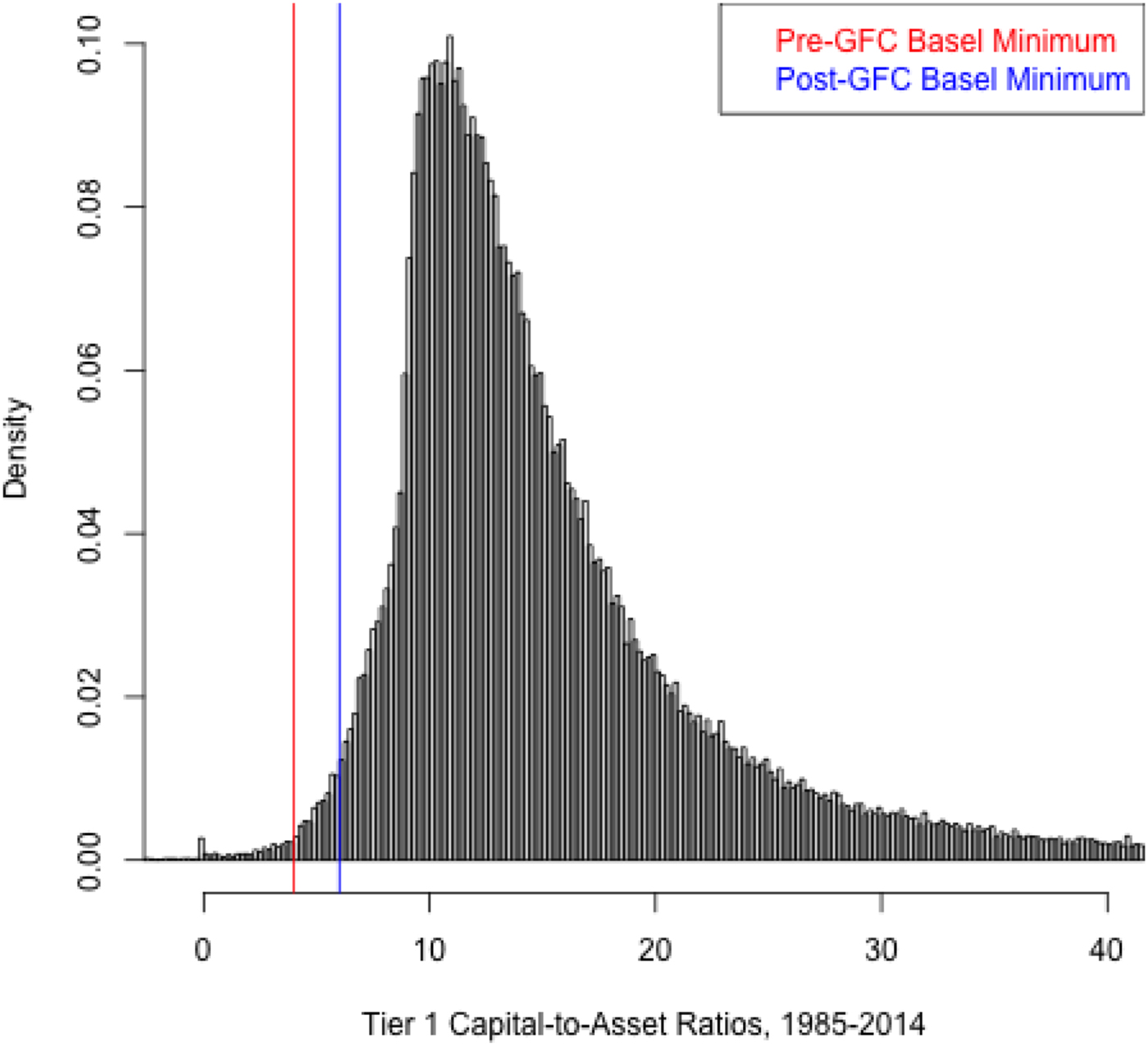
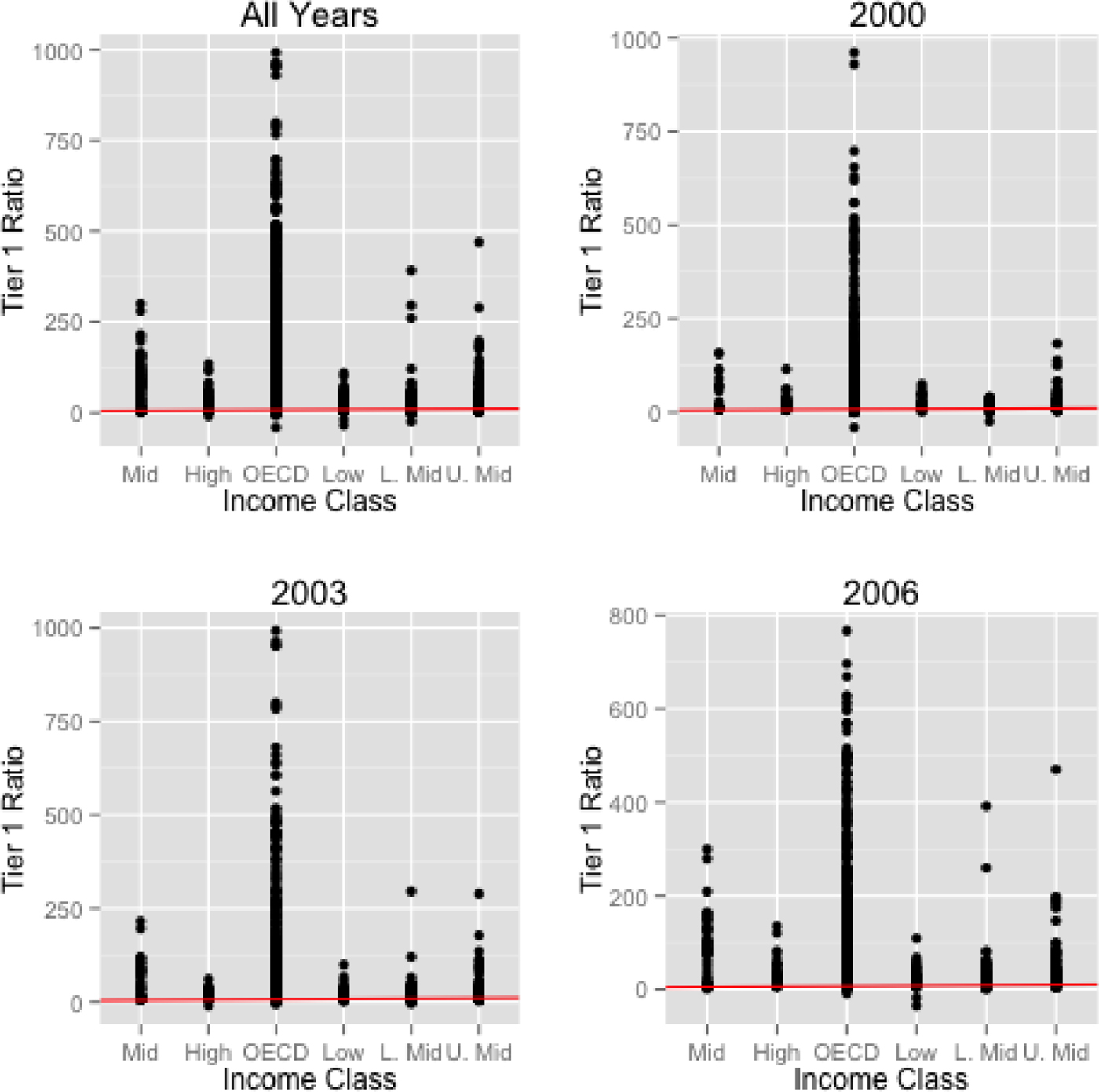
Banks do not behave in this way, however.Footnote 42 As figure 3 demonstrates, the central tendency of bank behavior is well above the regulatory minimum—the median was more than triple the pre-crisis international standard set by the Basel Committee for Banking Supervision, and even double the post-crisis—and the variance is quite large.Footnote 43 There does not appear to be a race to the bottom or a climb to the top. Instead, banks differentiate themselves, just as the preferred habitat approach expects. We observe this diversification within and across countries and time, as the pre-global financial crisis sample in figure 4 shows.
Risk-weighted tier 1 capital adequacy ratios, 1985–2014. The central tendency is higher and the variance is wider than standard theories would expect, indicating no homogenous race to the bottom.
Risk-weighted tier 1 capital adequacy ratios, 2000–6, by World Bank income class. The horizontal red line is the minimum tier 1 ratio under the pre-crisis Basel Accords. There is a quite a lot of variation both within and across these groups, and within and across time periods. Underlying data from the Bureau van Dijk's BankScope.
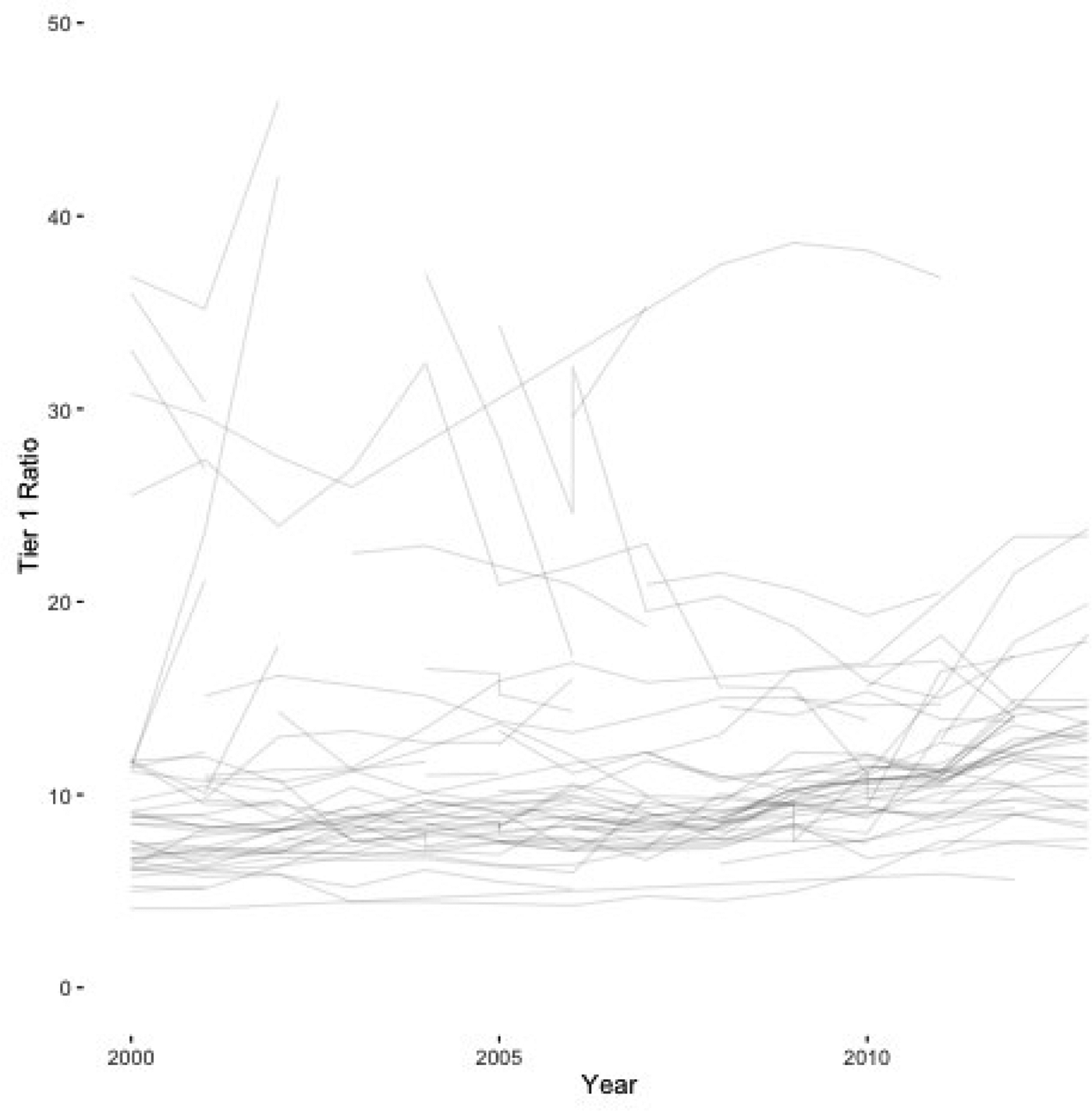
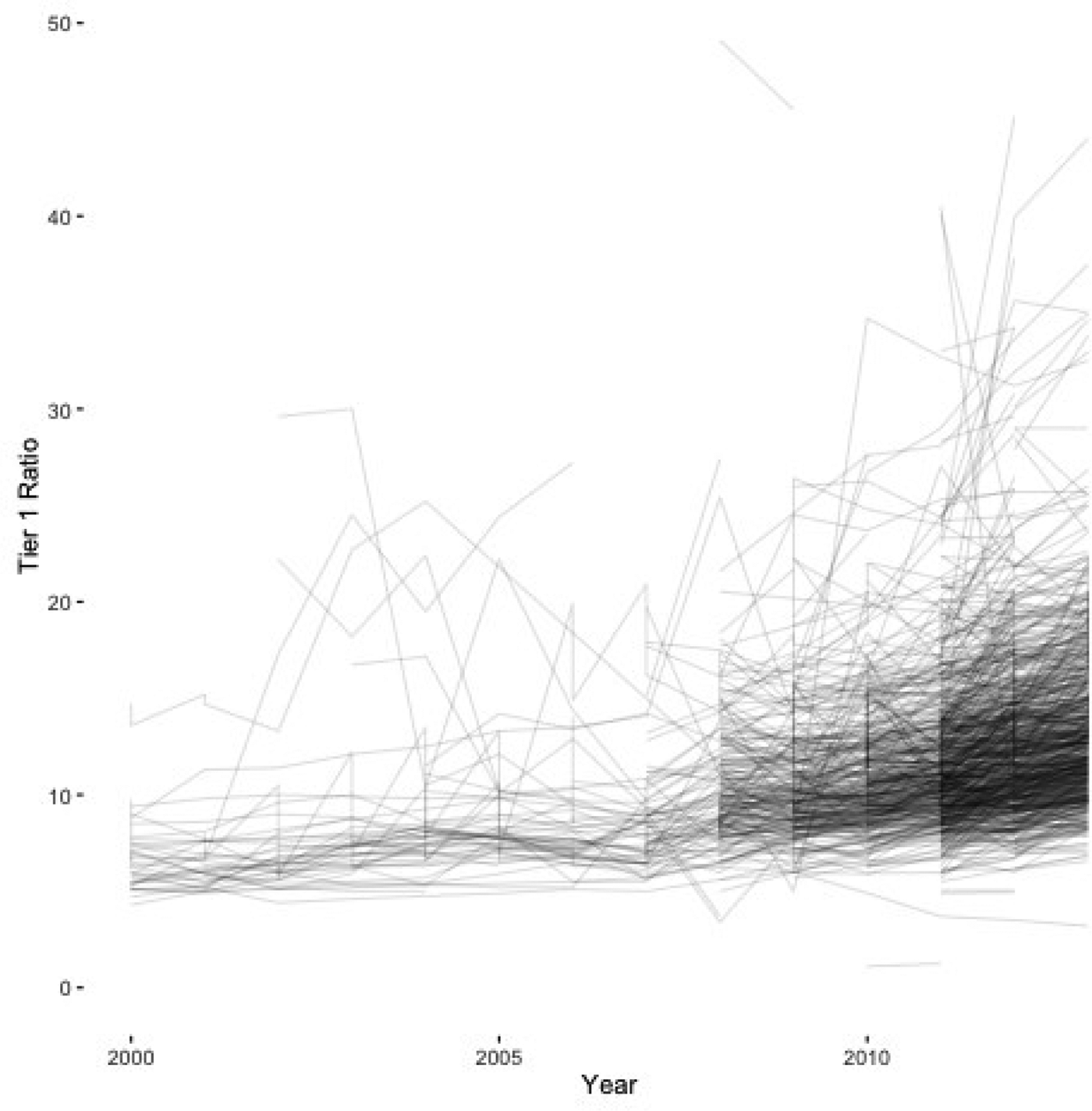
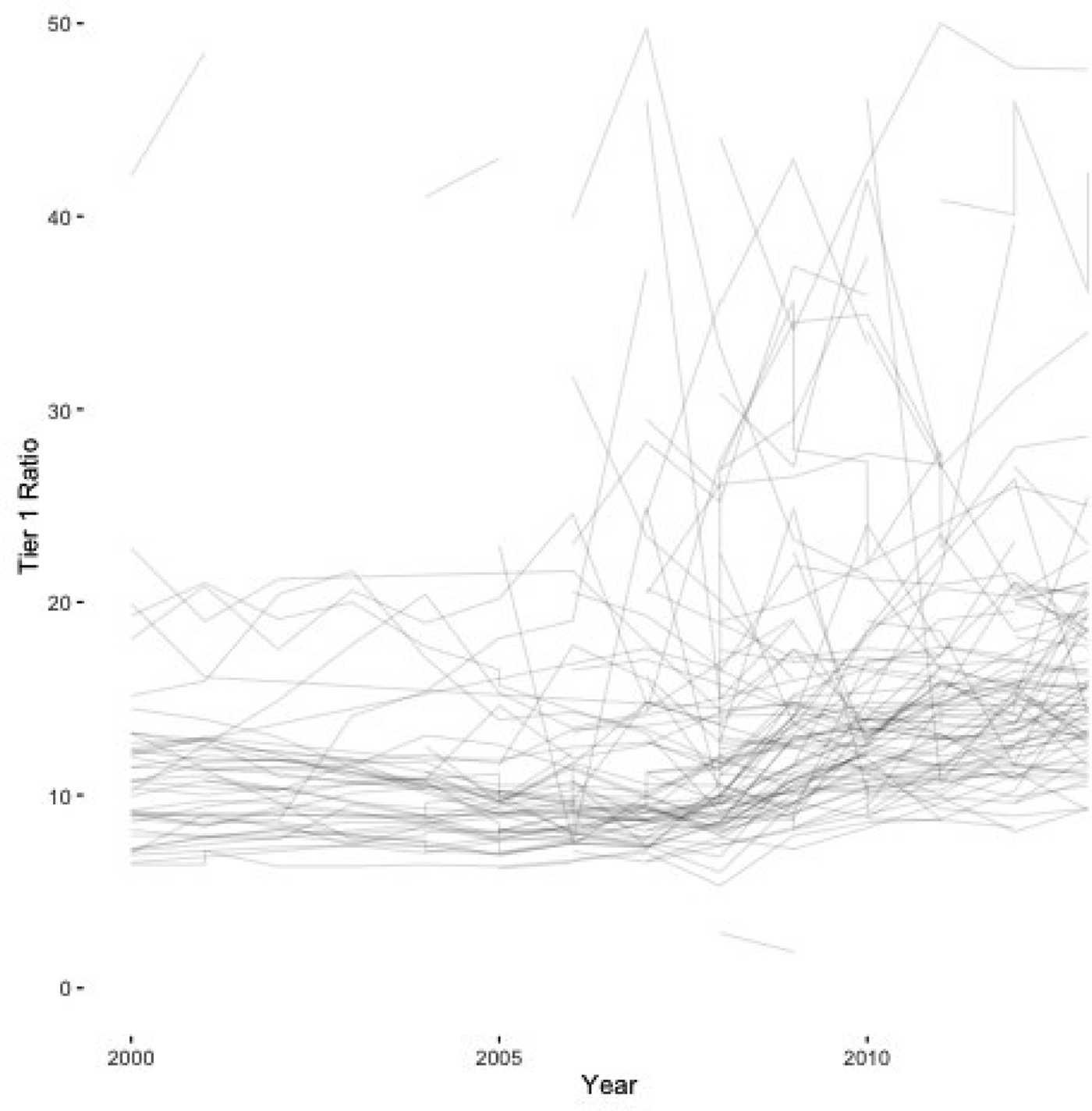
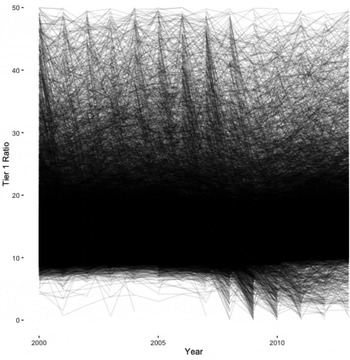
This has major implications for the ways in which political economists understand the relationship between firms and governments. For one thing, the habitat varies significantly across countries. Figures 5–8 reports risk-weighted tier 1 capital-to-assets ratios (CAR) for banks in four advanced economies that remain archetypical in the “varieties of capitalism” literature.Footnote 44 All four represent very distinct national systems: France has relatively few institutions overall and most are modestly-well capitalized; Germany has both more financial firms than France and a more diverse range in CAR; the United Kingdom does not have many firms, and their behaviors are even more diffuse; while the United States has an enormous number of financial institutions, which vary significantly in their levels of capitalization.
Tier 1 capital as a proportion of risk-weighted assets in France, 2000–13. Lines represent firms across time. Data taken from the Bureau van Dijk's Bankscope set.

Tier 1 capital as a proportion of risk-weighted assets in Germany, 2000–13. Lines represent firms across time. Data taken from the Bureau van Dijk's Bankscope set.

Tier 1 capital as a proportion of risk-weighted assets in the United Kingdom, 2000–13. Lines represent firms across time. Data taken from the Bureau van Dijk's Bankscope set.

Tier 1 capital as a proportion of risk-weighted assets in the United States, 2000–13. Lines represent firms across time. Data taken from the Bureau van Dijk's Bankscope set.

Each of these market structures, and the political and institutional environments within which they have developed, represents a distinct habitat, which should condition how actors in these jurisdictions behave. In all of them firms' capital relative to the risk in their asset portfolios displays quite a lot of variance, most of which is well-above the regulatory minima. But the national systems are quite diverse, as well. There are many more “niches” in the American market, but perhaps greater competition within each niche. The relatively small number of firms in a market as competitive as Britain's might provide opportunities for savvy financiers to enter into new niches even if it would be difficult to challenge incumbent firms on their own turf. France's financial sector in general is less disintermediated than its peers—an image supported by the Z/Yen rankings of global financial centersFootnote 45 —while Germany still retains its “three pillar banking system” legacy of small credit cooperatives, large commercial banks, and Landesbanks.Footnote 46 Interestingly, these national systems have mostly retained their unique characteristics—and comparative differences—over the hyper-globalized and hyper-financialized era from 2000–14. Even in the era of relatively open capital markets it does not appear that differences in national financial systems has been substantially eroded. Moreover, despite some substantial efforts towards regulatory harmonization,Footnote 47 there still remains substantial variation in cross-national regulatory and institutional practices.
The PH approach would not find this descriptive picture difficult to assimilate. After all, financial actors may have all sorts of preferences over where they exist in the market. A range of political economy variables could influence the habitat, including regulatory regime, government type, partisan control of the government, macroeconomic choices regarding the “trilemma,” the tax and redistribution scheme, historical legacy of market institutions, and much else besides. As Charles Calomiris and Stephen Haber write, “modern banking is best thought of as a partnership between the government and a group of bankers, a partnership that is shaped by the institutions that govern the distribution of power in the political system”.Footnote 48
The shape of the habitat impacts where within the market structure particular financial actors prefer to exist. While a full analysis of the determinants of the habitat and firms' locations within it is beyond the scope of this paper, the above descriptive mappings of capital ratios around the world indicates that moving beyond a simplistic RA account, such as that proffered in the MM tradition, is much needed. Moreover, while these national habitats have distinct characteristics—as do sub-habitats at the sectoral or even firm-levels—they are also interlinked into a global system.
Thus, the PH framework is capable of contextualizing the global environment within which varieties of financial capitalism develop, persist, and change. This flexibility provides an opportunity to link micro-level empirics—whether in the SSF or large-n traditions—to national-level systems that are situated within a global structure of financial interdependence. The key is to not treat units as if they are undifferentiated: some types of financial actors or firms will have different preferences from others. Some types of political systems will relate to finance in different ways from other types. Prominent firms operating within prominent financial systems will have more interconnections, and thus more influence, throughout the global macrofinancial system. As the system develops and changes the habitat develops and changes; as the habitat develops and changes the actions of financial agents may also evolve.
The habitat as an interdependent network
The financial economics literature on habitats have assumed that a market structure arises when independent agents have heterogenous preferences over the term structure of interest rates. Thus, the shape of the habitat—e.g., the yield curve—is a simple function of the aggregated preferences of bond investors. But a political economy approach to the habitat should not only increase the types of actors involved in the market to include other types of investors, it would also consider the ways in which the habitat emerges through the creation of interdependencies among these actors who operate in a politicized context. The broader environment in which interdependencies are formed is social, political, and economic in addition to financial. And, once created, the structure of interdependencies then conditions where within the habitat's structure an actor may seek to be located.
Perhaps the most progress in exploring financial markets in this way has been made by economic sociologists, not financial or political economists. The “architecture of markets” approach explicitly links to financial networks as the culmination of processes of aggregation by heterogenous agents.Footnote 49 Some political economists have engaged with theories of the ecology of social organization. An application to the study of financial governance, in which regulators pass through “revolving doors” between the connecting the public and private sectors, was provided by Seabrooke and Tsingou.Footnote 50 Others have discussed how organizational ecology provides insights for the study of global governance, specifically highlighting the utility of ecological “niches” as a metaphor.Footnote 51
Using network analysis to link these literatures is a logical step. The networked nature of the financial habitat was salient during the global financial crisis that began in 2007—indeed, it is perhaps the most salient fact of all financial crises—and has remained important since. For example, during the crisis German pensioners became exposed to American subprime mortgages through the ties Landesbanks had with American investment banks, thus necessitating bailouts from the public sector. The second-largest publicly-owned German financial institution, Bayerische Landesbank (or BayernLB), was one of the first major institutions to post major losses from assets backed by subprime mortgages, prompting the resignation of CEO Werner Schmidt in March 2008. BayernLB was the first financial institution to accept funds from the German government's €500bn bailout fund in September 2008, and the state of Bavaria—BayernLB's supermajority owner—also injected public funds into the bank. Retrenchment from subprime losses then exacerbated the eurozone sovereign debt crisis.Footnote 52 Similar malinvestments exposed the Chinese government to potentially-significant losses from U.S. agency-backed bonds, fretted Chinese Premier Wen Jiabao in March, 2009: “We have lent a huge amount of money to the U.S. Of course we are concerned about the safety of our assets. To be honest, I am definitely a little worried.”Footnote 53 So Chinese savers, Bavarian pensioners, American homeowners, and taxpayers in these and other jurisdictions, were directly linked together through the bridges built by the American financial sector. The indirect linkages extended far further.
Thus, the financial habitat is networked and it is global. It is also characterized by multiplexity, meaning that it operates in multiple dimensions. Finance is inherently relational, as each transaction involves a buyer and a seller, and financial contracts connect creditors and borrowers as counterparties. Finance is also relational at a social level.Footnote 54 As we begin to aggregate financial actors and the linkages between them, we can begin to understand how financial risk can take on various goods types— private, club, common pool, public—depending on the structure of the habitat's network.Footnote 55 The resulting market structures are frequently hierarchical as well as being interdependent. Thus, one's view of the “habitat” depends on one's place within it—a shark sees her place in the sea differently from a minnow.
A number of scholars have recently portrayed aspects of the global finance system as a hierarchical network.Footnote 56 These early models have rendered the macro structure in one dimension and have proposed the “fitness plus preferential attachment” (FPA) endogenous growth mechanism of network development, but they have not yet integrated micro-level data into the overarching structure. According to FPA, an initial quality advantage is reproduced over time through endogeneous structural processes that persist even after the quality gap is eroded.Footnote 57 The PH framework is one pathway towards linking a behavioral model of actor behavior to these structural theories in a way that seems to comport well with empirical reality. In this framework one's preferred “niche” within the habitat would be related to one's position within the network structure in addition to the institutional environment and one's internal attributes. The structural position of Goldman Sachs as a key node in the broad network surely influences its activities. At the same time, First Bank of Duluth would surely be destroyed if it attempted to compete with Goldman Sachs directly; to survive it must find another niche. In this way structural positions can be reified through repeated interaction.
Once generalized from preferences over the term structure of interest rates to include financial activities more generally, the preferred habitat approach can help us build tractable models linking micro agents to macro structures. They could also incorporate incentives for policymakers: A government of a market-leading financial sector may seek to impose regulations, both domestically and internationally, that preserve its pride of place at the core of the structure.Footnote 58 Similarly, the diversity of regulatory regimes around the world—which is not easily explainable from competitive models of regulatory politics derived from representative agent models in economics—might make more sense in a PH context.Footnote 59 Policy activities by central banks could also be sensitive to the financial habitat in their jurisdictions.Footnote 60 Indeed, even the distribution of political power is shaped by the market habitat.Footnote 61
Scholars have examined the American interbank payments system conducted through Fedwire, the Fed Funds market, the Italian overnight lending market, and the global banking system itself as networks.Footnote 62 Others have focused on how financial crises diffuse through network structures, focusing on processes of contagion.Footnote 63 As more and more data on corporate and financial networks is released to the public these issues will become even more critical to study in the future.Footnote 64
All of these structural analyses lack a micro-level theoretical apparatus that can accommodate actor-level preferences. The preferred habitat tradition offers such a framework. From it we can develop models whereby financial (and other economic) agents create a structure through interactions that produce an interdependent network structure. Within this structure we might explore dyadic processes such as assortative mixing (via homophily or some other process), hyper-dyadic processes such as transitivity (the tendency for friends of friends to become friends themselves), or systemic processes such as preferential attachment (the tendency for well-connected actors in networks to attract new links at a great rate). As the network develops over time actors can struggle for preferred positions within it: Not all will race towards risk, but some will; not all will seek stability, but others will. As these systems develop and evolve over time the very nature of risk itself might be transformed, from a private good to a club good, or a common pool. Or even, if the interdependencies permeate society, to a public “bad.”Footnote 65
Political economy approaches to the financial habitat would allow actor preferences to vary according to risk-tolerance at multiple levels: Micro-variation occurs at the level of the firm, meso-variation occurs at the level of the national political economy, while macro-variation occurs in response to developments within the broad structure of the global political economy. Each of these levels condition banks' attitudes towards risk, and firms must respond to all of them simultaneously. Local, national, and global institutions—public and private, formal and informal—further influence the habitat. Recent developments with exponential random graph models (ERGM) allow specification of inferential statistical models on networks that can accommodate monadic, dyadic, and systemic covariates. Footnote 66
Governing the habitat: A conclusion
Representative agent models of financial actor behavior derived from the MM capital structure irrelevance principle generate a simple conclusion about financial governance: Prudential regulation is needed to prevent firms from over-loading on debt relative to their asset portfolio. Thus, tightening statutory prudential regulations should prevent firms from “racing to the bottom” as a result of competition. In line with this thinking, governments responded to the subprime crisis by tightening regulatory structures at the domestic and international levels. At the domestic level, many countries have made drastic revisions to their regulatory codes. In the United States, for example, the Dodd-Frank Wall Street Reform and Consumer Protection Act is “arguably the most significant financial legislation in modern history” according to Kathleen Casey, then a Commissioner of the Securities and Exchange Commission.Footnote 67 At the international level, the Basel Committee on Banking Supervision, housed at the Bank for International Settlements, agreed on a new global standard—its third in three decades—regulating banking activities. The ostensible purpose of these regulatory reforms is to counteract race to the bottom dynamics in financial markets: absent regulation, firms utilize progressively riskier lending strategies in order to capture greater market share.Footnote 68 Absent regulation, eventually, this “mania” will culminate in instability and crisis.Footnote 69
But the empirical record shows that no such race to the bottom is occurring, at least not at the level of the market. Instead, firms differentiate themselves along a number of dimensions. There are differences across firms, across national financial economies, and enormous diversity within the global financial network as a whole. The PH framework provides a more realistic way to understand this descriptive picture, and is capable of linking micro-level theories of actor behavior with macro-theories of complex system structures.
Differences between representative agent models following from MM's capital structure irrelevence principle and those following from Culberton's preferred habitat framework.

Thus, financial markets are complex networks that locate actors within structures that can be conceptualized as a habitat.Footnote 70 Within this habitat actors have heterogenous preferences. They have different tolerances of risk. They have preferences over the length of exposures. The financial habitat is also conditioned by the institutional, political, and regulatory contexts governing it; the interdependencies will also produce a structure whereby some actors occupy a more privileged position than others. These firms will be able to use their market position to economic benefit.Footnote 71
Conceptualizing finance as a complex system involves acknowledging that financial markets contain hierarchies and interdependencies that together constitute an interdependent network. That is, contra Walter Powell's famous idealization, networks are not distinct organizational forms from markets and hierarchies, distinguished by level of centralization and familiarity.Footnote 72 Rather, markets are networks: They bind buyers and sellers through exchange, borrowers and lenders through temporal intermediation. These networks become hierarchical if there is an initial quality advantage that privileges some over others. Just as within the market some may produce a better product for a lower cost, within the financial system some more offer more attractive services at compelling costs. As these “fit” firms or actors attract counterparties they move into a core position within the market structure, with others organized around them.
The PH model suggests that a variety of forms of behavior are reasonable in a structural context, even though only one form is feasible in a equilibrium-seeking RA model. There is “room to move” for firms, governments, and, indeed, entire markets even though the choice set will be constrained by one's position within this structure, the shape of the system as a whole, and one's own subjective preferences.Footnote 73 At the same time, there remains the possibility that some actors may degrade the entire market—thus threatening their direct counterparties through contagion and indirect counterparties through the imposition of negative externalities. Thus, as others in this issue have noted, financial risk may represent a “common pool”.Footnote 74
An alternative conception of financial markets (and financial market risk) implies the need for alternative forms of governance. The PH approach is compatible with one tradition in particular: the polycentric governance approach to social-ecological systems (SES) developed by the Ostrom School of political economy.Footnote 75 In this context, the goods type that financial risk takes on is likely to be a partial function of the habitat's shape. A dense, highly-concentrated market structure must prioritize risks taken at the core of the network (including among the so-called “systemically-important financial institutions”) because they impact the rest of the system disproportionately. A more diffuse network may need stricter rules across the board, and rely on private institutions or club structures to monitor compliance.
At the same time global finance is an intensely political playing field, both within- and across-countries. The Ostrom School has typically emphasized the ways in which actors can coordinate to achieve viable governance. But the politics of finance is frequently competitive, and outcomes depend upon the distribution of political and economic power. Thus, insights from the Ostrom School must be combined with those from comparative and international political economy to create a societal approach to the political of financial markets.