Catheter-associated urinary tract infections (CAUTIs) and central-line–associated bloodstream infections (CLABSIs) are linked to increased morbidity and mortality and are considered reasonably preventable events in the hospital setting.Reference Umscheid, Mitchell, Doshi, Agarwal, Williams and Brennan 1 Both conditions, captured using the Centers for Disease Control and Prevention (CDC) National Healthcare Safety Network (NHSN) surveillance definitions, are also considered hospital-acquired conditions, with financial penalties applying to institutions that “underperform.” 2 The CDC NHSN CAUTI definition was revised in January 2015 to exclude funguria and lower bacteriuria levels. 3 The change in the definition may affect the classification of healthcare-associated fungemia with the exclusion of CAUTI as a possible source. On the other hand, CLABSI attribution often relies on the exclusion of other sources; ie, if no other source is identified for bacteremia based on the NHSN categories, then the bacteremia is considered central-line associated. We evaluated the effect of the CAUTI definition change on NHSN-defined CLABSI outcomes in a large health system.
METHODS
We compared CAUTI and CLABSI NHSN outcomes for calendar years 2014 and 2015 at 65 hospitals that are part of a large, nonprofit health system in 24 states. We included the adult intensive care units (ICUs) for our evaluation. The data are submitted by all hospitals into the NHSN for both CAUTI and CLABSI. The infection preventionists at each of the hospitals, based on the CDC NHSN algorithms for CAUTI and CLABSI, 3 , 4 identify the events and report them to the NHSN. Starting January 2015, all CAUTIs were reported based on the new definition. 3 The 2015 CAUTI definition excludes urine analysis findings, nonbacterial organisms (eg, Candida spp.), and any quantitated urine cultures with <100,000 colony-forming units per milliliter (CFU/mL).Reference Fakih, Gould and Trautner 5 , 6
We compared changes in the event rates, the associated organisms, and the standardized infection ratio (SIR). We also examined changes in outcomes based on hospital size. We evaluated whether CLABSI rates have been affected by the CAUTI definition change, with attention to the impact of candidemia on CLABSI in the 2015 period compared with the 2014 period. For 2014, we reviewed all the organisms associated with CAUTI and evaluated any association with levels of bacteriuria. For CLABSI, we evaluated any changes in Enterococcus species CLABSI rates, as enterococci commonly colonize the urine and may be isolated at lower levels of bacteriuria. For this analysis, only organisms listed as the first pathogen submitted per NHSN CAUTI and CLABSI events were included in the results. We used the Z test to calculate the P values and 95% confidence intervals for the comparison of the incidence density rates for 2014 versus 2015. The study was evaluated by St. John Hospital Institutional Review Board and was deemed exempt from further review.
RESULTS
The study involved 137 adult ICUs from 65 hospitals. Of the ICUs, 18 (13.1%) were in 17 smaller hospitals (≤100 beds), 28 (20.4%) were in 21 medium-size hospitals (101–300 beds), and 91 (66.4%) were in 27 large hospitals (>300 beds). Urinary catheter and central-line utilization ratios were 0.62 and 0.52 in 2014, and 0.59 and 0.51 in 2015, respectively. In 2015, large hospitals ICUs accounted for 78.7% of urinary catheter days (n=198,152), compared to 18.6% for medium hospitals ICUs (n=46,733) and 2.8% for small hospital ICUs (n=6,991). Similarly, large hospitals accounted for the vast majority of central-line use in 2015 (n=168,179; 77.4%), compared to 20.6% for medium (n=44,732) and 2.1% for small (n=4,465).
The Effect of the 2015 CAUTI Definition Change Based on Hospital Size
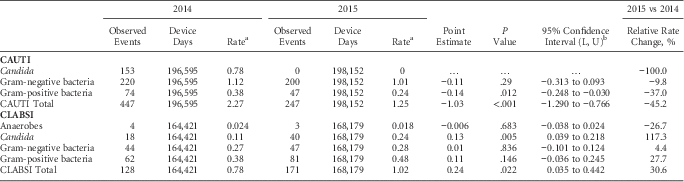
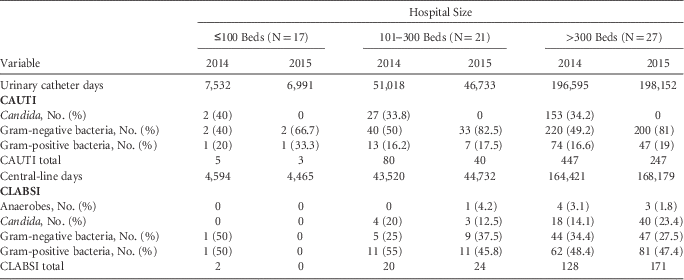
The SIR for CAUTI dropped from 1.04 in 2014 to 0.58 in 2015 (−44.2%), while the CLABSI SIR increased from 0.36 in 2014 to 0.47 in 2015 (+30.6%). CAUTI rates dropped 44.8% from 2.09 to 1.15 events per 1,000 device days (P<.001). The drop was significant for large hospitals (−45.2%; P<.001), medium hospitals (−45.4%; P=.002), but not for small hospitals (−35.4%; P=.8). CLABSI rates increased 27.1% from 0.71 to 0.90 per 1,000 device days (P=.027). The increase was significant for large hospitals (+30.6%; P=.022; Table 1) but not for small and medium-size hospitals. Small and medium size hospitals had similar proportions of Candida and gram-positive microbiology for CAUTI as large hospitals in 2014 (Table 2), but they did not experience the increases in CLABSI that occurred in large hospitals.
Organisms Reported Associated With CAUTI and CLABSI Events for 91 Adult ICUs for 2014–2015 for 27 Hospitals With >300 Beds

NOTE. CLABSI, central-line–associated bloodstream infection; CAUTI, catheter-associated urinary tract infection; ICU, intensive care unit.
a The rates are per 1,000 device days.
b The upper and lower limits in the 95% confidence interval for the rate difference.
The Proportion (%) of Different Organisms Associated With CAUTI and CLABSI Events Based on Hospital Size for 2014 and 2015

NOTE. CLABSI, central-line–associated bloodstream infection; CAUTI, catheter-associated urinary tract infection.
The Effect of the 2015 CAUTI Definition Change Based on Organism
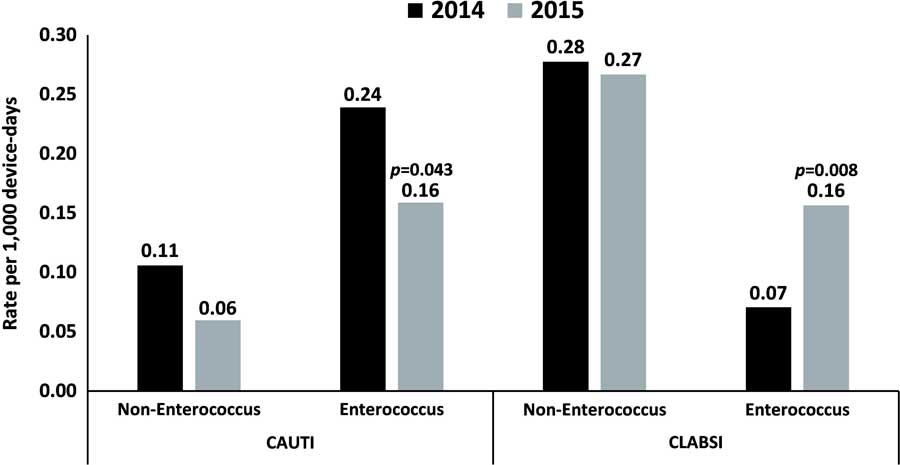
With the new definitional change, no Candida species were associated with CAUTI in 2015. On the other hand, Candida species associated CLABSI increased 91.1% from 0.104 to 0.198 per 1,000 device days (P=.012). Candidemia associated CLABSI increased for 22 of 150 (14.7%) events in 2014 to 43 of 195 (22%) in 2015. We also evaluated the effect of the change in definition on events associated with gram-positive organisms and Enterococcus species (Figure 1). Gram-positive–associated CAUTI rates dropped 36.7% from 88 events over 255,145 device days (0.34 per 1,000) in 2014 to 55 events per 251,876 device days (0.22 per 1,000) in 2015 (P=.007). The enterococcal CAUTI rate dropped from 61 events (0.24 per 1,000) in 2014 to 40 (0.16 per 1,000) in 2015, a reduction of 33.6% (P=.043). On the other hand, CLABSI associated with Enterococcus increased by 121.6% from 0.071 (15 of 212,535) to 0.16 (34 of 217,376) per 1,000 device days (P=.008). Enterococcemia-associated CLABSI increased from 15 of 150 (10%) events in 2014 to 34 of 195 (17.4%) in 2015. This effect was not found for gram-negative bacteria. In 2014, the gram-negative CAUTIs were associated with cultures yielding ≥105 CFU/mL in 238 cases compared to 24 with <105 CFU/mL (ratio, 9.9). Conversely, gram-positive CAUTIs in 2014 were associated with positive cultures ≥105 CFU/mL in 71 cases compared to 17 with <105 CFU/mL (ratio, 4.2).
The effect of the definitional change on Enterococcus and Non-Enterococcus gram-positive organisms associated with catheter-associated urinary tract infection (CAUTI) and central-line–associated bloodstream infection (CLABSI).

DISCUSSION
The NHSN-defined CAUTI and CLABSI data are publicly reported and used by hospitals, health systems, and state and governmental organizations to evaluate improvements in preventing infection related to urinary catheters and central lines. The 2015 definitional change for NHSN surveillance definition of CAUTI was an attempt to improve its clinical relevance by excluding candiduria and lower-grade bacteriuria. The change has led to a reduction in CAUTI by more than 40%, coupled by an increase in CLABSI of 30% in our system ICUs. A sizable proportion of the increase in CLABSI may be attributed to candidemia and enterococcemia cases, which doubled in 2015 compared to 2014. Candida and Enterococcus spp. accounted for 40% of CLABSI events in 2015 compared to a 25% of the cases in 2014. The significant increase in the association of Enterococcus spp. with CLABSI may be explained by reclassification of cases with lower-level bacteriuria. Other potential possibilities include any changes related to urine culturing practices (ie, fewer urine cultures performed in 2015 compared with 2014).Reference Mullin, Kovacs and Fatica 7 , Reference Trautner, Grigoryan and Petersen 8 Interestingly, we found no increase in gram-negative bacteria–associated CLABSI, which makes it less likely that large changes in urine culturing practices occurred in 2015 in our intensive care units.
The effect of the definitional change was noted in large hospitals. Units from large teaching hospitals have historically shown higher NHSN CAUTI rates compared to smaller hospitals.Reference Dudeck, Edwards and Allen-Bridson 9 The proportion of Candida species associated with CAUTI varies based on hospital size, and its exclusion may benefit tertiary-care centers, where up to half of the events may be attributed to yeast.Reference Tedja, Wentink, O’Horo, Thompson and Sampathkumar 10 Small and medium-size hospitals, although they had similar microbiology for CAUTI in 2014 to that of larger hospitals, did not exhibit increases in CLABSI. Not identifying increases in smaller and medium-size hospitals may be either related to differences in colonization with yeast and Enterococcus species in the urine in 2015, or their small sample size representing ~3% and 19% of our device population respectively. Starting 2017, the baseline comparison for both CLABSI and CAUTI SIRs would be reset to 2015 data. This ensures that changes for hospital and national performance over time are compared using the same definitions. However, the adjusted baseline will not adjust for the definitional changes, and we may see notable changes in SIR, especially in larger hospitals.
Currently, the rates of both NHSN CAUTI and CLABSI are approximately 1 event per 1,000 device days. With the large reductions in CAUTI based on changes in definition and not true improvements, we caution that the message may be misconstrued. Patients with urinary catheters often develop bacteriuria,Reference Cope, Cevallos, Cadle, Darouiche, Musher and Trautner 11 – Reference Tambyah and Maki 13 symptomatic CAUTI, and bacteremia even with associated lower levels of bacteriuria,Reference Greene, Ratz, Meddings, Fakih and Saint 14 making it a very common hospital-acquired infection. Patients are often inappropriately given antimicrobials for asymptomatic bacteriuria,Reference Cope, Cevallos, Cadle, Darouiche, Musher and Trautner 11 leading to colonization with multidrug-resistant gram-negative organisms 15 , Reference Sievert, Ricks and Edwards 16 and Clostridium difficile infection.Reference Drekonja, Rector, Cutting and Johnson 17 Conversely, we will be mistakenly looking at our national CLABSI improvement efforts suffering a setback. We will always need to be reminded that the NHSN definitions are surveillance based and not clinical. Specifically, NHSN CAUTI underestimates how often physicians may use antibiotics to treat suspected CAUTI.Reference Fakih, Gould and Trautner 5 , Reference Al-Qas Hanna, Sambirska, Iyer, Szpunar and Fakih 18
The Centers for Medicare and Medicaid Services (CMS) includes the National Healthcare Safety Network (NHSN) CAUTI and CLABSI standardized infection ratios as part of its hospital acquired condition (HAC) reduction and its hospital value-based purchasing reimbursement programs for hospitals that are paid through the inpatient prospective payment system. 19 CAUTI and CLABSI each constitute 17% of the HAC score weight; combined, they account for more than a third of the score. 20 Such changes will likely affect hospitals and their risk for the 1% reduction in reimbursement related to the HAC reduction program, with substantial financial implications. In addition, both CAUTI and CLABSI SIRs are publicly reported, are accessible to patients and payers, and are considered a reflection of the hospital’s quality and safety performance. It is time to consider other objective measures that provide a global assessment of device safety and infectious harm. For example, the CDC is working on a device-associated standardized utilization ratio (SUR),Reference Halpin, Sinkowitz-Cochran and Allen-Bridson 21 a measure that will help benchmark device utilization based on the different types of inpatient units. The device SUR may be used as a performance measure for urinary catheter harm, whether infectious or noninfectious.Reference Fakih, Gould and Trautner 5 Moreover, hospital-onset bacteremia is another measure that reflects hospital infection prevention practices, whether from a vascular catheter, urinary catheter, surgical, abdominal, or pulmonary source. These data can be electronically captured and represent more than 15 times NHSN CLABSI events.Reference Rock, Thom and Harris 22
Our study has several limitations. We relied on submitted data by hospital infection prevention teams into the NHSN database. We have not evaluated for any variations in surveillance methods or interpretation of the surveillance definitions at the participating facilities. In addition, we did not directly assess and reapply the 2014 definition on the 2015 reported events. Notwithstanding the limitations mentioned, the strength of our findings is bolstered by the large number of hospitals included, from small to large tertiary-care centers and representing many states.
Our findings provide an important addition to the literature addressing the CAUTI definition and its impact on quality improvement efforts nationally. The revised 2015 definition has led to a significant reduction in CAUTI rates and, in turn, an increase in candidemia and enterococcemia cases classified as CLABSI events. These observations have important implications on the perceived successes or failures to eliminate both infections, and may impact outcomes related to the Hospital-Acquired Condition Reduction Program.
ACKNOWLEDGMENTS
Financial support: No financial support was provided relevant to this article.
Potential conflicts of interest: All authors report no conflicts of interest relevant to this article.