Introduction
International debates about the comparative institutional structures of welfare states have focused on social expenditure and the inclusiveness of social policy. In these debates Australia is often characterised as a variant of Esping-Andersen's (Reference Esping-Andersen1990) liberal welfare regime, with relatively low spending when compared to other OECD countries and an emphasis on means-tested social provision. Yet Australia has also been acknowledged as a unique case in which industrial protections and relatively generous taper rates have created a more inclusive and progressive welfare state, sometimes called the wage-earners’ model.
In recent decades, the Australian model has been transformed.Footnote 1 Common to many English-speaking democracies, labour market deregulation has wound back industrial protections since the 1980s. Simultaneously, social expenditure has increased, particularly for families with children, mostly following a traditional model of means-tested payments with taper rates that include most low- and middle-income earners. Many now claim Australia is the most targeted and progressive welfare state in the OECD (Whiteford, Reference Whiteford2008; Whiteford and Angenent, Reference Whiteford and Angenent2002; Korpi and Palme, Reference Korpi and Palme1998). While we largely accept this characterisation for social expenditure, it does not take account of parallel developments in fiscal welfare, particularly the growth of social tax expenditures (STEs). STEs – which denote social spending delivered as tax breaks – have increased alongside labour market deregulation and increased spending on families, suggesting these developments may be linked.
We seek to incorporate the rapid growth of STEs into our understanding of the Australian welfare state, although similar developments are likely to have unfolded elsewhere – particularly in liberal welfare states. We confine our discussion to Australia since STEs are even more difficult to compare across countries than social expenditure. Presenting the most comprehensive study of STEs across OECD countries, Adema and Ladaique (Reference Adema and Ladaique2005) offer a rare contribution to comparative study. However, deep-rooted data limitations stemming from national variations in defining and measuring tax expenditures remain.Footnote 2 Moreover, Australia publishes relatively reliable data on STEs and, despite their significant scale, they have received little recent attention.
In liberal welfare states such as Australia, STEs extend welfare to almost all citizens by offering benefits to higher-income groups. However, unlike social-democratic universalism, STEs contribute to what we call a dual welfare state in which higher-income earners access benefits through the tax system and private welfare providers. Drawing on Peter Baldwin's (Reference Baldwin1990) analysis, we argue that STEs may facilitate a middle-income – high-income class coalition by addressing social risks faced by the middle class that are not addressed by targeted payments. The result is a more expansive, but less equitable, conception of the Australian welfare state.
The article proceeds in four sections. First we explain the conventional understanding of the Australian welfare state and substantial changes since the 1970s. We then discuss the rising significance of STEs to the Australian welfare state in more detail. Thereafter, we examine the drivers behind the growth in STEs. We identify three interrelated factors: fiscal austerity, the privatisation agenda of neo-liberalism and the rise of ‘aspirational’ politics. In conclusion, we explore how these changes have led to a dual welfare state, and consider implications for understanding the Australian and other welfare regimes.
Australia as a welfare laggard? The wage-earners’ welfare state and beyond
Classifying Australia as a liberal welfare regime overlooks the system of social protection ‘by other means’ pioneered in the early twentieth century. Unlike European welfare states, Australia's system of social protection primarily consisted of ‘economic’ policy instruments. The early strength of the Australian union movement and Labor Party established an arbitrated minimum ‘living’ wage, alongside industry and migration controls. The ‘living’ wage directed wages policy towards social policy ends by ensuring male wages were adequate to meet basic family needs, partially de-linking wages from productivity (Castles, Reference Castles1994), while a residual welfare state provided targeted assistance, reducing the need for high taxes. Castles (Reference Castles1985) argues this created a wage-earners’ welfare state model in which wage regulation addressed the same goals as social policy, and thus reduced political pressure for a more elaborate welfare state. The wage-earners’ model received bipartisan support for most of the twentieth century, because it tied the interests of labour to capital by providing workers with higher wages in return for industry protection (Castles, Reference Castles1985).
Since the 1970s, the constitutive elements of the wage-earners’ model have been dismantled. While the most important element – the minimum wage – remains high by international standards, a series of reforms enacted by the Hawke-Keating Labor and Howard Coalition governments have deregulated the industrial relations system and decoupled it from social imperatives (see Mendes, Reference Mendes2009). The winding back of the wage-earners’ model has renewed the significance of conventional social policy instruments: income transfers and social services.
The transformation of Australia's welfare state was driven, at least in part, by the rising influence of neo-liberalism (see Pusey, Reference Pusey1990; Rees et al., Reference Rees, Rodley and Stilwell1993). However, governments responded differently. The Hawke-Keating government's major social policy reforms expanded social expenditure and targeted social support towards the poor. Labor governments increased social expenditure by 4 per cent of GDP between 1983 and 1996, which was considerably higher than the OECD average of 2.5 per cent (Castles, Reference Castles2001: 5). But, Labor governments also targeted universalist welfare benefits, such as the aged pension and family allowances, by tightening the eligibility criteria and/or increasing the benefit, reflecting the neo-liberal approach of confining state action to assisting those most in need (Mendes, Reference Mendes2008: 33).
The Coalition's embrace of neo-liberalism was more pronounced. While it was unable to reduce social expenditure (Mendes, Reference Mendes2009: 108), the Howard government increased work activity tests for the unemployed, single parents, individuals with disabilities and recent migrants (Wilson and Meagher, Reference Wilson, Meagher, Denemark, Meagher, Wilson, Western and Phillips2007).Footnote 3 Subsidies to private welfare services and savings also increased.
Other social policy changes can also be seen as compensation for the impact of broader economic reform. The Hawke government justified Medicare, the universal health scheme, as a bargaining chip in wage negotiations with the unions. Similarly, the Howard government expanded assistance to low- and middle-income families as part of its compensation for the Goods and Services Tax. The increase in family benefits by both CoalitionFootnote 4 and Labor governments, serves an equivalent purpose to the minimum ‘living’ wage of the wage-earners’ model and may be thought of as a functional equivalent. Family assistance in Australia amounts to 3.3 per cent of GDP, which is among the highest in the OECD, compared to 3.4 per cent in Norway and 3.5 per cent in Sweden.Footnote 5
Reforms since the 1980s have transformed Australian social expenditure into the most targeted and redistributive among OECD countries (Whiteford, Reference Whiteford2008).Footnote 6 And, despite recent tax reforms, progressive income taxes are a higher proportion of total taxation in Australia than the OECD average (Warburton and Hendy, Reference Warburton and Hendy2006).Footnote 7 This meant that by the early twenty-first century, considerable assistance to families with children is combined with increasingly targeted and conditional support for (other) low-income groups (see Mendes, Reference Mendes2009: 108).Footnote 8
The rise and rise of social tax expenditures
The rapid expansion of tax expenditures has coincided with the transformation of social expenditure since the 1980s. We focus on the subcategory of STEs, those tax expenditures that qualify as fiscal welfare. Despite measurement problems, the evidence indicates that tax expenditures – and STEs – have grown considerably since the early 1980s in number and budgetary scale. We argue that STEs need to be incorporated into our understanding of the Australian welfare state if we are to comprehend the full extent of welfare provision.
Social tax expenditures
We adapt the term ‘STEs’ used by Toder (Reference Toder1999) to refer to tax expenditures that qualify as what Titmuss (Reference Titmuss1958) called fiscal welfare. In his essay ‘The Social Division of Welfare’, Titmuss’ major insight was that the ‘definition, for most purposes, of what is a “social service” should take its stand on its aims; not on the administrative methods and institutional devices employed to achieve them’ (1958: 42). According to Titmuss (Reference Titmuss1958), welfare programmes share the common aim of enhancing the wellbeing of their recipients. He conceived of a social division of welfare (SDW) comprising three welfare systems delivered through different policy instruments: social welfare distributed by the social expenditure of the state, occupational welfare delivered to workers as benefits obtained through employment and fiscal welfare received through tax expenditures and other elements of the tax code (Titmuss, Reference Titmuss1958: 42). We classify tax expenditures as fiscal welfare, and thus STEs, if they allocate resources in the key areas of welfare provision, including: social security, health, education, housing and family and community assistance.
Titmuss (Reference Titmuss1958) developed his SDW thesis in response to right-wing commentators who framed the post-war welfare state as ‘expensive for the middle classes, unnecessary for many of the working classes and potentially debilitating for all social classes’ (Mann, Reference Mann2008: 2). He claimed that these assertions relied on a narrow and misleading conception of the welfare state as only social welfare, which was mainly received by lower-income earners. He was concerned that this partial understanding of welfare reinforced negative stereotypes of the ‘dependent’ recipients of social welfare, while ignoring similar benefits higher-income earners receive through ‘other means’. Addressing these concerns, the SDW thesis drew attention to how individuals receive welfare through their social relationships with the state, the tax system and employment – showing how all members of contemporary capitalist democracies are interdependent (Titmuss, Reference Titmuss1958: 53; Mann, Reference Mann2008: 3). We consider our dual welfare state concept a vindication of Titmuss’ classic thesis.
Accounting for tax expenditures
Broadly understood, tax expenditures provide selective tax breaks to taxpayers who undertake certain actions or belong to particular social groups. Distinct from general tax cuts, tax expenditures provide individuals with incentives to change their behaviour or compensate for social risks. The major types of tax expenditures include: tax exemptions, tax deductions, tax rebates or offsets, tax concessions, allowances, rate relief, provisions for tax deferral and income tax averaging (Smith, Reference Smith2003: 3). The selectivity of tax expenditures means that they are deviations from the tax benchmark, the normative structure of the taxation system that treats similar taxpayers equally (Ingles et al., Reference Ingles, Jackson, Podger and Raymond1982: 6).Footnote 9
The resource allocation of tax expenditures is conceptually equivalent to that carried out by social expenditures because of their similar effects on state revenue and resource allocation. Surrey and McDaniel (Reference Surrey and McDaniel1985: 25) conceive of tax expenditures as instantaneous cash transfers involving taxpayers, who pay their full tax liability according to the tax benchmark, and the state which reimburses taxpayers through lower taxes. They contend that the revenue reimbursed by the state through tax expenditures is conceptually equivalent to the revenue expended on social expenditures (Surrey and McDaniel, Reference Surrey and McDaniel1985: 25). Moreover, tax expenditures and social expenditures are both financed by reallocating resources from other programmes, running deficits or increasing taxation (Hacker, Reference Hacker2002: 34), and both increase the resources available to their recipients.
But despite wide agreement over definition, precise estimates of tax expenditures in Australia are difficult to calculate for three main reasons: broader disputes over the composition of the tax benchmark (Smith, Reference Smith2003: 3), the inability of conventional accounting systems to capture them (Auditor-General, 2008: 13) and the range of rebates and concessions not included in the Treasury's Tax Expenditure Statement (TES), particularly hybrid policies that combine elements of tax expenditures and social expenditures. While these measurement issues highlight the importance of identifying data sources (Bradford, Reference Bradford and Bruce1988: 431), they are not dissimilar from those associated with other policy instruments, meaning the tax expenditure concept remains a useful tool to shed light on an effectively invisible form of redistribution. We draw on statistical data from the Treasury, the Economic Planning Advisory Council (EPAC) and the Australian Tax Office (ATO), which measure tax expenditures using the revenue-forgone approach.
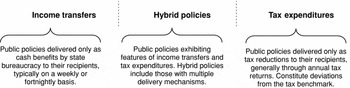
The most pressing quandary in using the tax expenditure concept, however, stems from the existence of hybrid policies, such as the private health insurance and childcare rebates. These policies allow recipients to either claim assistance through the tax system or as a subsidy when purchasing services. The structure of assistance also varies. Rebates often refund a proportion of the cost of the service, rather than a proportion of tax paid, and usually have a cap. As there is no definitive method to classify hybrid policies, the distinction between tax expenditures and income transfers remains partially arbitrary. Our approach is to conceive of hybrid policies as fitting along a continuum with policies delivered as tax expenditures at one extreme and income transfers at the other (see Figure 1). We classify public policies as tax expenditures if they meet the criteria of the tax expenditure concept outlined above. We also treat hybrid policies as tax expenditures for analytical purposes if they are framed as such in public discourse, as they are subjected to similar political processes as tax expenditures. Hybrid policies provide further rationale for incorporating STEs within the welfare state by demonstrating their substitutability with social expenditures.
The continuum of income transfers and tax expenditures

The tax expenditure–social expenditure continuum highlights the importance of examining the detail of policy. Although a detailed account of this diversity is not possible here, caution should be taken when applying this broad account to particular policy domains. We acknowledge that reforms that move a policy along the continuum have important implications for equity and transparency, and can change income distribution (see Spies-Butcher and Stebbing, Reference Spies-Butcher and Stebbing2009). Nonetheless, this conception aids understanding of how the frame of tax expenditures impacts on the structure of the welfare state beyond ‘pure’ tax expenditures.
The rise of tax expenditures
Tax expenditures, along with social welfare programmes, are the ‘two oldest forms of financial assistance provided by the Commonwealth’ (Auditor-General, 2008: 27). In Australia, STEs have a long history in policy domains such as health and retirement incomes. The Fisher Labor government enacted superannuation tax concessions in 1915 (Nielsen and Harris, Reference Nielson and Harris2008: 2). The Menzies Coalition government established tax deductions for private health insurance premiums in 1953 (Kewley, Reference Kewley1973: 361). However, despite the longer history of tax expenditures, we focus on trends from the 1970s because of data limitations. The same measurement issues are even more pronounced at state level, where reliable data are unavailable. Hence, the figures here only refer to federal expenditure.
With the aforementioned measurement issues in mind, analysis undertaken by the Economic Planning and Advisory Council (1986) suggests that tax expenditures declined compared to direct expenditure and as a proportion of Gross Domestic Product (GDP) during the 1970s. As a proportion of public spending, tax expenditures fell from 13.1 per cent of public spending in 1970–71 to 6.4 per cent in 1982–83 (EPAC: 1986: 9). Similarly, tax expenditures dropped from 3.1 per cent of GDP in 1970–71 to 1.9 per cent of GDP in 1982–83 (EPAC, 1986: 9). Because EPAC only collected tax expenditure estimates listed in the Budget, its figures are significantly lower than those appearing in the Treasury's Tax Expenditure Statements (TES) that are compiled annually from the Budget and in-house estimates since 1986.
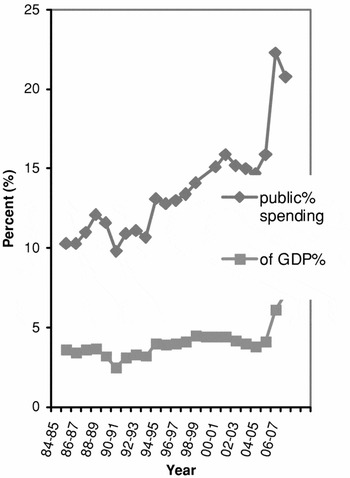
Subsequently, the TES data indicate that tax expenditures have increased substantially in number and scale since the mid-1980s. The number of tax expenditures reported in the TES has increased by around 75 per cent: from 170 in the 1984–85 financial year to over 320 in 2007–08 (Treasury, 1986, 2009). The budgetary scale of tax expenditures has grown in both monetary and proportional terms. The reported cost of tax expenditures listed in the TES swelled from AUS $7 billion in 1984–85 to more than AUS $73 billion in 2007–08, or from 3.6 per cent to 7.1 per cent as a share of GDP; tax expenditures also rose, as a proportion of public spending, from 11 per cent to 21 per cent (see Figure 2). Although the data are not fully comparable, the apparent decline of tax expenditures in the 1970s and subsequent rise from the 1980s onwards suggest that this represents a novel development.
Tax expenditures as a proportion of GDP and public spending 1984–2008
Source: Australian Yearbook, ABS (various years) National Accounts and Treasury (various years) Tax Expenditure Statement.

The rise of social tax expenditures
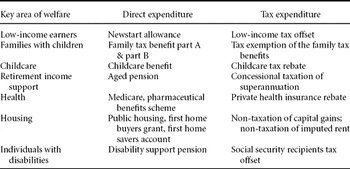
Reflective of the overall trend, the STE subset of total tax expenditures appears to have grown in number and budgetary scale since the mid-1980s. Table 1 displays STEs that have been introduced by Labor and Coalition governments for: low-income earners, families with children, childcare, retirement incomes, health, housing and individuals with disabilities. The number of STEs reported in the TES has risen by more than 85 per cent from 36 in 1985–86 to 67 in 2007–08 (Treasury, 1986, 2009).Footnote 10 The cost of STEs surged over eight-fold from around $5 billion in 1985–86 to $43 billion in 2007–08, amounting to an increase in GDP from 2.4 per cent to 4.2 per cent.Footnote 11 As a proportion of total public spending, STEs rose from around 7 per cent in 1985–86 to 12 per cent in 2007–08 (Treasury, 1986, 2009). Growth was particularly rapid under the Coalition government during the mining boom years at the beginning of the century. Much of this growth is attributable to the rising costs of superannuation tax concessions from 1.3 per cent of GDP in 1985–86 to 1.9 per cent of GDP in 2007–08 (Treasury, 1986, 2009). Currently the largest category of STEs, superannuation tax concessions amount to $26 billion of revenue forgone (Treasury, 2009: 10). Both the growing number and budgetary impact of STEs highlight their increasing relevance to the Australian welfare state.
Direct expenditures and tax expenditures in key areas of Australian welfare

However, as noted before, the TES underestimates the budgetary impact of tax expenditures. In particular, three large housing STEs appear in an appendix of the TES, but not in its total estimates. The Senate estimated the capital gains tax exemption for owner-occupier housing to account for $20 billion, the tax exemption of imputed rent at $15 billion and the land tax exemption for owner-occupier housing at $10 billion in 2007–08 (Senate Select Committee on Housing Affordability in Australia, 2008: 40). If these tax expenditures were accounted for in the TES, STEs would account for $88 billion, which is equivalent to around 21 per cent of direct expenditure or 5.8 per cent of GDP. But this is still likely to understate the value of STEs, as other programmes not costed in the TES have been estimated to exceed several billion dollars (Smith, Reference Smith2003: 9).
The drivers of social tax expenditures
The rise of STEs represents a response to the same political and social forces that eroded the wage-earners’ welfare state and constrained the development of a social democratic welfare regime in Australia. In a context of fiscal austerity, tax expenditures provide a route to extend welfare with low political resistance. Tax expenditures promote markets and private firms in social provision, thus appealing to the reformist spirit of neo-liberalism. Finally, tax expenditures allow resources to be directed to the non-poor, an important electoral constituency, without appearing to contradict the ethos of a liberal welfare state.
The progeny of austerity?
The rapid expansion of STEs is partly a consequence of fiscal austerity, which builds on Pierson's (Reference Pierson2001) concept of permanent austerity without implying inherent stability. By permanent austerity, Pierson (Reference Pierson2001: 411) refers to the political context of capitalist democracies from around the late 1970s in which real or perceived fiscal constraints on the state restricted the growth of social expenditure. Fiscal austerity has increased the appeal of STEs as they allow legislators to extend social provisions while minimising political resistance by reducing the visibility of spending.
Fiscal austerity has presented barriers to expanding or retrenching the welfare state. Economic factors – such as slowing economic growth, the ageing of the population and economic globalisation – limited revenues. The hegemony of neo-liberalism constituted a further ideological constraint (see Harvey, Reference Harvey2005). At the same time, the electoral popularity of existing social programmes among their recipients limited retrenchment (Pierson, Reference Pierson2001: 412).
In Australia, the constraints of fiscal austerity were more pronounced during the 1980s and 1990s when public concern focused on the expanding current account deficit (see Kelly, Reference Kelly1992), but were less evident in the mining boom of the early 2000s. This did not prevent the growth of social expenditure, which increased from 11.3 per cent of GDP in 1980 to 17.8 per cent in 1998 (Castles, Reference Castles2004: 25); rather, it limited this growth to social programmes that could be linked to broader economic reforms (alongside social justice considerations). At the same time, the electoral popularity of welfare programmes prevented widespread welfare state retrenchment (see Mendes, Reference Mendes2009). This reflected the growth in the proportion of the population that relied on welfare for their primary source of income, from less than 5 per cent of the working-age population in the 1960s to more than 16 per cent in 2004 (Saunders, Reference Saunders2007).
Although limiting the growth of social expenditure, fiscal austerity provides a reason for the popularity of STEs among legislators since the mid-1980s, as they have provided a policy back door to incrementally increase social provisions. As Toder argues:
Tax incentives are popular because they represent a way of increasing Federal support for social policy, while seeming to be tax cuts rather than increases in spending. Compared to direct outlay programmes with similar goals, they better meet the need of politicians to appear to favour spending restraint and in some circumstances can be financed at a lower political cost. (1999: 5)
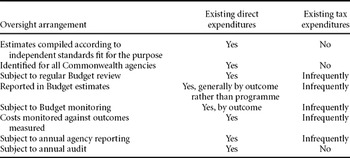
STEs also lower political resistance by reducing public accountability. Tax expenditures circumvent many of the oversight arrangements that social expenditure programmes are routinely subjected to in the legislative process, as displayed in Table 2. Unlike social expenditure programmes, tax expenditures are not identified by all Commonwealth agencies, not estimated according to independent standards or subjected to annual audits. Tax expenditures are also infrequently accounted for in the Budget, with many escaping regular review. Moreover, the TES, the principal data source, does not amount to a comprehensive review and requires no vote when tabled in parliament (Wanna, Reference Wanna2003: 3).
Oversight arrangements for direct expenditures and tax expenditures

Source: Auditor General (2008: 15).
Tax expenditures also receive little attention in Australian public discourse. The TES has partially enhanced the visibility of tax expenditures, but it receives little media coverage – particularly compared to the Budget. The Treasury maintains that the TES is released near the beginning of the calendar year to inform the Budget (Senate Select Committee on Housing Affordability in Australia, 2008: 32). But its release during this period contributes to its low visibility: in each of the past six years, it was released within a week of Christmas or Australia Day. The lower visibility of tax expenditures in the media means that they often do not receive the public response accompanying new social expenditures, reinforcing STEs as a policy ‘back door’.
Further, STEs have low visibility by design as they do not involve direct transactions and appear to give taxpayers ‘their own money’ back and reduce the size of government. On the one hand, recipients may not understand tax expenditures as state transfers, as they reduce their tax burdens rather than provide cash or a service. On the other hand, tax expenditures allocate resources by reducing revenue rather than increasing outlays, which extend state regulation but reduce the state's Budget. The combined effect of their low visibility in the legislative process, media and their design has reduced the political costs of STEs to legislators.
Neo-liberalism, privatisation and institutional layering
A second explanation for the rapid growth of STEs is their compatibility with neo-liberalism. The widespread influence of neo-liberalism not only contributed to fiscal austerity but also increased the appeal of reforms that privatised public services (Kelly, Reference Kelly1992: 15). STEs appealed to the reformist spirit of neo-liberalism because they provided legislators with instruments to privatise welfare services while leaving popular social welfare programmes intact. We contend that the legislators of the Hawke-Keating and Howard governments used STEs to build additional institutional layers of private social provision on top of existing social welfare programmes.
Many STEs extend consumer choice and shift resources to private service providers. Examples include the Private Health Insurance Tax Rebate (PHITR) and the concessional taxation of superannuation. By requiring consumers to choose between private welfare services to access the benefit, these STEs are framed as encouraging rational economic behaviour while also directly benefiting private enterprises. And, although STEs constitute market intervention, they minimise state bureaucracy.
STEs shift resources to the private sector without dismantling popular public services through a process that Thelen (Reference Thelen, Mahoney and Rueschemeyer2002) calls institutional layering. Institutional layering entails the building of new institutions or policies on top of existing policies and institutions (Thelen, Reference Thelen, Mahoney and Rueschemeyer2002: 225). It is an incremental approach to reform often used by legislators when radical reforms to existing programmes are not politically feasible. Thelen (Reference Thelen, Mahoney and Rueschemeyer2002: 227) contends that layering new policies or institutions on pre-existing institutional arrangements alters the interests of political actors and the trajectory of institutional development. Although Thelen applies this concept to explain the development of individual policies, the same logic is at work here on a larger scale.
The Howard government's introduction of the PHITR in 1999 provides an example of institutional layering. Despite opposing Medicare for over ten years in opposition, the Coalition promised to maintain Medicare in 1996 in recognition of its electoral support (Elliot, Reference Elliot2005). Rather than reforming Medicare, the government enacted the PHITR, a tax rebate for private health insurance premiums, as part of a package of reforms to boost private health insurance coverage. In 2006–07, the PHITR shifted $3.4 billion to the private health sector (AIHW, 2008a: 34) and (alongside other reforms) has increased private health insurance coverage. This example shows how STEs can subsidise private services and facilitate private provision by building an additional layer on existing institutions without alienating constituencies that support public services.
However, most STEs enacted by Australian governments typically place few restrictions on resource allocation. For example, the superannuation tax concessions form part of the second layer that superannuation adds to Australia's retirement income system. These STEs provided $26 billion of subsidies in 2007–08 to the superannuation industry, but did not require individuals to invest in funds that met certain policy objectives or provided specified benefits. The lack of restrictions placed on how the subsidies allocated through STEs are spent effectively reduces both the transparency and accountability of public expenditure.
The new politics of class coalition: appealing to the aspirationals
A further influence on the rapid growth of STEs has been influenced by the ability of political actors to develop alliances in support of expansion. Social policy scholarship has focused mostly on the influence of the working class, the group perceived to benefit most from welfare programmes. However, the middle class, broadly conceived of as non-poor social groups, has also played important roles in social policy development as welfare recipients and self-interested agents (Goodin and Le Grand, Reference Goodin, Le Grand, Goodin and Grand1987: 203). Baldwin's (Reference Baldwin1990) comparative analysis of welfare state development shows that the establishment of cross-class coalitions helps explain the structure of social policy. In countries where the working class developed coalitions with farmers or small business owners, this allowed progressive dominance of the state. These coalitions facilitated solidaristic welfare policies, but also often required alliances to be built, with farmers and business people demanding access to benefits offered to workers, and these demands being met through universal provision.
In Australia, STEs represent an alternative strategy for building political support that decouples the interests of middle- and low-income earners by linking middle-class interests with higher-income earners, who gain most from STEs. Higher-income earners pay higher income tax rates and tend to spend more on private welfare. As STEs often return money to taxpayers in proportion to their marginal tax rate and subsidise private welfare spending, higher-income earners tend to benefit most from these policies. Unsurprisingly, STEs are predominately a strategy of the conservative parties, but the changing political context discussed earlier may help explain the more modest, but still important, support for many of these policies by Labor governments.
The largest STEs in Australia involve housing and retirement costs. Here the benefits are largely uncapped and require private spending to gain access to benefits. For example, superannuation contributions and investment earnings are taxed at the concessional rate of 15 per cent. Most employers are obliged to contribute 9 per cent of wages towards these funds on a worker's behalf. For those earning over $180,000 per annum this concession is equivalent to a 30 per cent rebate for investments and earnings, as the top marginal tax rate for these income earners is 45 cents in the dollar. But for low-income earners on under $30,000 per annum, the scheme provides no benefit. Richard Denniss (Reference Denniss2007) estimates that over their life a person consistently earning over $72,000 per annum who relies on compulsory employer contributions would accrue more from STEs than they would have received from a full public pension.Footnote 12 This should cause us to reassess the size of Australia's welfare state. Superannuation tax benefits are comparable to pensions in their budgetary impact, but are not included in OECD comparisons that show Australia to be a low spender on the aged. Including superannuation also changes our assessment of the distributional effects of Australia's welfare spending.
Even for STEs with hybrid schemes that provide benefits proportional to private spending – rather than tax rates – similar distributional effects emerge. For instance, Denniss (Reference Denniss2005) shows that the PHITR is highly regressive: while 69 per cent of households earning over $100,000 per annum held private insurance and received the rebate, only 24 per cent of households earning less than $25,000 per annum held such insurance. STEs for childcare, health, pensions and housing are structured to provide rebates or concessions to those purchasing private welfare services. As a result, the dual effects – of reversing the tax scale and restricting benefits to those who purchase private services – mean that STEs have radically different distributional effects than the core of Australia's targeted welfare state. A more complete picture of Australia's welfare state must therefore take account of social expenditure and STEs.
The greatest benefits of these STEs flow to higher-income earners, but moderate-income earners benefit too: over 40 per cent of Australians hold private health insurance (PHIAC, 2008), roughly 70 per cent benefit from the concessional taxation of owner-occupied housing (ABS, 2006) and over 54 per cent of wage earners receive concessional treatment on their private retirement savings (ATO, 2009). STEs can thus potentially unite the interests of higher- and middle-income earners.
By uniting these interests, STEs have a potential to gain political support and limit redistribution. Korpi and Palme (Reference Korpi and Palme1998) identified a paradox between targeting and redistribution: targeted welfare states redistribute more proportionately but tend to be smaller and redistribute less overall. Korpi and Palme (Reference Korpi and Palme1998) contend that the apparent restriction on the growth of targeted welfare states may reflect the lack of middle-class support for targeted schemes, as they receive few benefits. However, rather than simply restricting welfare state growth, an analysis of STEs allows us to conceptualise welfare state development as a battle between competing welfare models that offer alternative strategies for incorporating middle-class voters.
Iversen and Soskice (Reference Iversen and Soskice2006) contend that majoritarian systems consolidate around two large parties that usually represent worker and business interests, which must then secure middle-class support to gain an electoral majority. On this reading, Australia's generously targeted system stems from attempts by the Labor Party to incorporate middle-class voters into a system of social support that delivers most to low-income earners but still benefits many middle-income earners.Footnote 13 Alternatively, STEs largely represent a Coalition alternative to tax cuts that deliver social protection in a manner that maximises support for high-income groups while extending considerable benefits to some middle-income earners. Middle-class voters are unlikely to accept the absence of social support, especially considering growing new social risks, so business parties are required to offer some form of social policy. Also, the low transparency of STEs helps subvert the legitimacy constraint that prevents redistribution from poor to rich (Iversen and Soskice, Reference Iversen and Soskice2006). As a result, STEs are likely to be advocated by business parties as a mechanism to build class alliances while advancing the interests of high-income earners and, we would expect, are more likely to appear in majoritarian electoral systems and liberal welfare regimes.
This largely reflects the Australian experience, as most STEs were initiated and/or extended during Coalition governments, with two significant exceptions: the introduction of compulsory superannuation and the child care rebate. Labor with the unions extended superannuation to most workers; however, they used private schemes that largely retained existing tax concessions, significantly increasing STEs. The choice of a private scheme over a state or union-run scheme is probably explained by the political constraints of fiscal austerity and neo-liberalism discussed earlier. In the second, Labor's position partly reflects the preferences of professional women who are a growing Labor constituency.
There is evidence that support for STE-type policies among middle-income earners helps explain their growth. The wage-earners’ model provided middle-income earners with stable and well-paid jobs. However, middle-income earners have faced increasing uncertainty over recent decades because of the winding back of the wage-earners’ model, the collapse of full employment, and the emergence of new social risks. Many of the new social risks connected with issues such as maternity leave, housing affordability and income stability (see Taylor-Gooby, Reference Taylor-Gooby and Taylor-Gooby2004) are greater issues for middle-income Australians than in previous decades. At the same time, young middle-income families living in outer-suburban electorates play an increasingly significant role in Australian elections. Australian commentators have dubbed this group of voters ‘aspirationals’ (Manning, Reference Manning2005), arguing they support policies that encourage private provision and the neo-liberal message of social mobility. There is some empirical support for these claims, with social attitudes research suggesting this group is more likely to support social policies linked to STEs (Wilson et al., Reference Wilson, Meagher and Hermes2008).
STEs, then, provide a political framework for uniting the interests of middle- and higher-income earners. Their low visibility reduces political resistance to these policies, making them less subject to the legitimacy constraints that typically prevent regressive social spending. Their low visibility may also reduce awareness by middle-income earners of the larger assistance directed to higher-income groups. In a political context where middle-income voters are key to electoral success, face growing social risks and receive relatively little from a targeted welfare state, STEs are likely to enjoy greater political support.
The institutional renovation of the Australian welfare state
The factors driving the rapid growth of STEs are interrelated and have implications for how we understand the political and institutional development of the Australian welfare state since the 1980s. The low visibility of STEs provided legislators with tools to increase social spending in the context of fiscal austerity and to forward the neo-liberal agenda of privatisation. At the same time, the low levels of transparency and accountability of STEs allowed legislators to shift resources to electorally significant middle-income constituencies that did not benefit from the increasingly targeted and conditional system of social expenditures. The use of the taxation system to divert social spending to middle-income earners partly explains the inequitable distributive effects of many STEs, as these policies often invert the progressive income tax scales and/or subsidise private services that most lower-income earners still cannot afford.
Although these developments have not led to the wholesale retrenchment of social programmes, it is difficult to locate STEs within the targeted and redistributive Australian welfare state model because of their inequitable, and often regressive, distributional impacts. Segal (Reference Segal2004: 14) argues that the PHITR supports the second tier of the Australian health system; Warren (Reference Warren2008) considers the superannuation tax concessions to be a second tier of retirement incomes policy; and Jamrozik (Reference Jamrozik2005: 299–300) frames STEs for housing as middle-class welfare, and social housing as residual welfare. These studies frame individual STEs as a second tier of welfare provision in particular policy domains. In light of our discussion of institutional layering, we can also note that these STEs were built without dismantling existing welfare programmes. But, despite the recognition of second tiers, there has been little account of the broader implications that STEs have for the Australian welfare state (although see Bryson, Reference Bryson1992).
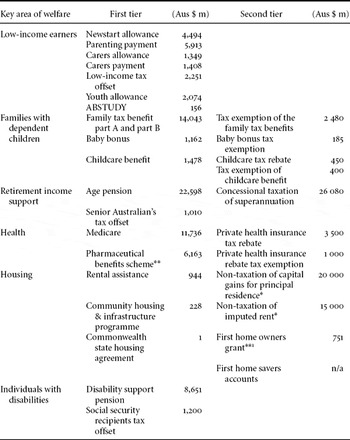
We conceive of STEs as a second tier of an ideal typical understanding of the Australian welfare state, which we call the dual welfare state. The programmes comprising the dual welfare state's two tiers are outlined in Table 3. The first tier entails the residual welfare model that has been outlined in recent literature (see Whiteford and Angenent, Reference Whiteford and Angenent2002; Whiteford, Reference Whiteford2008); it consists primarily of social welfare targeted mainly at lower-income households. The core of the first tier includes Medicare, the age pension and the Family Tax Benefits Part A and Part B. Other programmes of the first tier, such as the Newstart Allowance (the unemployment benefit) and the Disability Support Pension, have become increasingly conditional, either imposing mutual obligation or quarantines. The second tier entails programmes effectively targeted at the middle and upper class, which account for considerable expenditure, but much less than the first tier. It is mainly comprised of fiscal welfare, particularly STEs, and disproportionately benefits higher-income earners. The second tier typically places minimal constraints on the behaviour of its recipients and it subsidises private service providers.
The Australian dual welfare state 2006–07

Notes: 1We conceive of the First Home Owners grant as a subsidy for the purchase of a private good, which makes it essentially a rebate – albeit one that is fairer than most others because it has a flat benefit of $7,000. In fact, it is actually a good example of a hybrid policy.
*Figures from 2007–08 financial year.
**Figures from 2005–06 financial year.
Two qualifications, however, are required. We acknowledge that the dual welfare state model is an heuristic. As our hybrid conception of STEs suggests, there is fuzziness at the edges. Policies often combine elements of tax expenditure and social expenditure, and even these combinations evolve over time. However, the dual welfare state model allows us to use the hybrid conception of STEs to better appreciate the implications of policy change, and the framing of policy debates, for the structure of the welfare state, as policy-makers gradually shift policy along the continuum. These shifts, we contend, are best understood as a (sometimes subtle) battle to reorientate the Australian welfare state between its dual goals through a process akin to institutional layering.
Moreover, the three factors that we contend have driven the growth of STEs are not equally important in each case. This is particularly true for hybrid policies that are framed as STEs to reduce both the magnitude of social expenditure and the stigma of receiving welfare by supporting individual initiative. In Australia, the Family Tax Benefits are framed as hybrid policies but function as social expenditure programmes. It is also reflective of the rise of working tax credits in Australia, such as the Low Income Tax Offset, and more broadly in liberal welfare states, including the Earned Income Tax Credit in the US and Working Families Tax Credit in the UK. While reflecting the influence of fiscal austerity and the reformist spirit of neo-liberalism, these developments clearly do not represent examples of the middle-class mobilisation we have discussed above.
Implications of Australia's dual welfare state for other liberal welfare regimes
The Australian welfare state has been transformed over the past three decades. The wage earners’ model has given way to a more conventional welfare regime based on a highly targeted model of social security, but one more inclusive than that traditionally associated with liberal welfare states. Accompanying this has been a pronounced increase in the role of STEs in social provision. This transformation was largely facilitated by fiscal austerity, the rise of neo-liberalism and a middle/upper-class coalition. The result is a dual welfare state that provides social support to different groups using different instruments. In this sense, STEs allow us to understand how even apparently minimal welfare states cater to diverse social interests, albeit in ways distinct from social-democratic ‘universalism’.
Our analysis is confined to Australia, but similar pressures are likely in other, particularly liberal, welfare states. Adema and Ladaique's (Reference Adema and Ladaique2005: 32) research suggests that STEs play a considerable redistributive role in other OECD countries, such as the United States, Japan, Germany and France. In particular, research in the United States suggests that STEs are particularly important in this archetypal liberal regime. Consistent with our account, Howard (Reference Howard1999) and Hacker (Reference Hacker2002) argue this reflects the mobilisation of middle- and upper-income interests, with predictable consequences for income distribution.
Of course, the Australian context is to some extent unique. Australian social democrats, largely through the Labor Party, have embraced targeting in a distinct way that extends beyond the poor, creating a less stigmatised ‘liberal’ model. Yet building on Korpi and Palme's (Reference Korpi and Palme1998) discussion of the ‘paradox of redistribution’, we suggest that targeting may create space for alternative class coalitions to form in support of less progressive social programmes, such as STEs. Building on the literature on retrenchment, this approach may allow us better to understand how neo-liberalism influenced welfare state development through the expansion of STEs, rather than simply conceiving of neo-liberalism as a constraint on social policy expansion.
Acknowledgement
The authors thank Shaun Wilson, Michael Fine, Francis G. Castles and anonymous referees for very helpful comments on drafts of this article. We remain responsible for the claims made.