“Not all changes are highly structured, and no change takes place in a social vacuum.” (Labov 1963:274).
Although Joos (1942) is widely credited for first reporting the phenomenon of Canadian raising, it was Chambers' (1973) article that started the flurry of research on this topic. From south of the Canadian border came reports, occasionally controversial, about similar behavior in the United States (Allen, 1989; Dailey-O'Cain, 1997; Vance, 1987). These proved to be variations on the theme, however, in that the raising patterns noted by Joos and Chambers were never quite replicated but shown to be somewhat different, often more complex, and certainly more variable. Later, Chambers and colleagues (Chambers, 1989; Chambers & Hardwick, 1986) weighed in again with an update from Canada detailing a change in the raising of /au/ and a reinterpretation of some of the exceptions to /ai/ raising, which seemed to be growing more complex by the minute. Finally, there were reanalyses and a replication of Labov's (1963) work on Martha's Vineyard (Blake & Josey, 2003; Eckert, 2000; Milroy, 2003). It was all enough to make one nostalgic for the good old days when things were simpler, and Canadian raising was predictable and, well, Canadian. Chambers himself noted that a better description of the phenomenon might be “a dialectogical term for the coexistence of the two very similar allophonic reflexes in the same accent” (1989:77) rather than a single process. It is, therefore, with some trepidation that I report that there is, or has been, what may, or may not, be raising in Vermont as well.
RAISING OF /ai/ AND /au/ IN THE UNITED STATES
It is no surprise that there has been such interest in, and even controversy about, these vowels. In 1925, Krapp noted the difficulty that prior linguists had had with long /ai/ and stated, “The same difficulty confronts phoneticians today, and it arises from the uncertainty of the character of the first element of the diphthong” (1925:189). In the eighteenth and early nineteenth centuries, five pronunciations were reported, all of which Krapp described as still present in the United States in 1925:

,

,

,

, and

. In fact, only the first (

) was not present in “cultivated” as well as vernacular speech. Furthermore, the pronunciation of the diphthong nucleus by the mid seventeenth century in England was converging on

, although the situation was more complex in 1925 and most likely was in the 1600s, as well (Krapp, 1925).
/au/ also has a complex history. Krapp noted that for most of America the first element was

, but both

and

were common in Eastern Virginia, and

was frequent in New England. He also found evidence of diphthongs beginning with both

and

reported as “errors” to be avoided in the mid 1800s in New England (Krapp, 1925:196; Russell, 1843).
Kurath and McDavid (1961) argued that a centralized /ai/, found in much of England, was likely to be the source of the similar production they found in New England “rustic” speech in all positions in words. At the time of their study, it appeared to be giving way to a lowered initial segment. Raised /au/ was also found in British English folk speech in all positions in words, much as Kurath and McDavid found it in New England. This variant was also noted to be dying out, with a lowered variant becoming more common.
Labov (1963) described the social factors present in Martha's Vineyard that influenced the raising of /ai/ and /au/. There are similarities between Martha's Vineyard and rural Vermont beyond those related to vowels. For example, both places, after a number of years of isolation and rural life including farming in both places and fishing in Martha's Vineyard, experienced changes leading to decreased isolation brought on, in part, by an increasing service economy: “summer people” in Martha's Vineyard and skiers and “leaf-peepers” in Vermont. In addition, Labov called Martha's Vineyard “an island of r-pronouncers in a sea of r-lessness” (1963:276). A similar, if less extreme, claim can be made of Vermont, in that the state forms a western border of r-production, contrasting with the r-lessness to the east in New Hampshire. In addition, like Martha's Vineyard, Vermont has seen the disappearance of the New England short /o/ (Avis, 1961) and the merger of the low back vowels. Boberg (2001) noted that the low back merger found in many areas of the U.S. and Canada appears to be of recent origin in Vermont.
Labov reported that /ai/ and /au/ were fronted and sometimes centralized, becoming

or

and

or

. He hypothesized that the mid-central /ai/ was brought from England to the first settlement of Martha's Vineyard in 1642 and that this vowel most likely survived to become scattered in New England and upper New York as described in the Linguistic Atlas of New England (LANE) (Kurath, 1939b). Labov noted that the Canadian raising pattern, discussed later, favoring voiceless environments is only suggested in the New England data.
Centralized /au/ was not likely to have been imported by the early English settlers to Martha's Vineyard. Although Krapp (1925) described both

and

as the “rural New England” forms (1925:192–196), Martha's Vineyard did not have this feature at the time of LANE (Labov, 1963). Furthermore, Labov found that vowel centralization was highest among, not the oldest speakers, but the 31- to 45-year-olds, who most identified with Martha's Vineyard's rural tradition and were most resistant to the summer people. Labov interpreted his results as a new trend in /au/ centralization, due, possibly, to parallelism with /ai/, an older feature.
Blake and Josey (2003) visited Martha's Vineyard forty years after Labov to add real-time information about the variable /ai/. One of the demographic changes noted was the tendency for more “mainlanders” to reside on Martha's Vineyard all year long, effectively changing their previous identity as “summer people.” Furthermore, the fishing industry had continued to decline, and young people did not appear to consider that vocation an option for them. Although there had been a trend away from /ai/ raising since Labov's study, the raised /ai/ continued to be found in all environments on Martha's Vineyard, but it was more prominent in the environments predicted by Canadian raising. Following L. Milroy (1996 in Blake & Josey, 2003),1
Blake and Josey cited Milroy (1996) as an unpublished manuscript. It was later published as Milroy (2003); hence, the seeming contradiction of Blake and Josey citing a publication that had not yet been published at the time of their work.
L. Milroy (2003) discussed several studies, including those of Labov (1963) and Blake and Josey, and proposed an account of phonological change that contrasts ideology-free and ideological change. She noted that ideology-free change, such as leveling, is sometimes, but not always, internally motivated, appears in areas not necessarily connected by time and/or space, and can be constrained by local, ideological change. In the case of Martha's Vineyard, she argued that the early relevant distinction between fishermen and others on the island disappeared with changing economic and social conditions. With these changes, the more global, ideology-free changes, such as Canadian raising, were no longer constrained and appeared on the island, as reflected in the data collected by Blake and Josey for /ai/.
Dailey-O'Cain (1997) found that both /au/ and /ai/ raising occurred in Ann Arbor with /ai/ raising being the more frequent. In addition, /ai/ raising was found in more environments than were predicted by earlier Canadian raising studies, specifically before voiceless-final clusters (e.g., pint) and before /r/ (e.g., tire). She also found syllable stress to be a significant factor in raising behavior. Furthermore, there was occasional /ai/ raising in even the most unlikely environments, such as before voiced consonants (e.g., ride). /au/ raising was much more restricted, occurring only before voiceless consonants and voiceless flapped consonants, except for very rare exceptions. There was no social variation in the more established /ai/ raising, although young women were leading in the newer change, /au/ raising.
RAISING OF /ai/ AND /au/ IN CANADA
As noted earlier, Joos (1942) is credited as the first to associate /au/ and /ai/ raising with Canada and to define it: a raised variant of /ai/ and /au/ in the prevoiceless environments and a low variant elsewhere. He suggested further that this phenomenon had its beginning in the shortening of English vowels before voiced consonants.
Chambers (1973) found the Canadian raising label appropriate for raising of /ai/ and /au/ because of the feature's prominent role in the Canadian dialect. However, Chambers did not intend to imply anything about the distribution of the feature, and he found great similarity between these vowels in Canada and those in eastern Virginia and Martha's Vineyard. He argued that the greater variability represented by the speech of Vinyarders was indicative of a less stable speech behavior that may have been a result of the change being an early one at the time of Labov's study. Canada, on the other hand, is, or was at the time, an example of “linguistic stability” of the type that occurs at a later point in language change.
Gregg (1973), with later support from Picard (1977), presented a historical account of Canadian raising that appears to be quite relevant to the findings on Vermont speech. He noted that centralization of /ai/ was common in both English and Irish speech circa 1600 in all phonetic environments. The raised vowel was likely later produced in a more restricted set than even that found in Canadian raising due to contact with seventeenth century Jacobean planters from southwest Scotland. He concluded that the centralized form may, in fact, have been the more basic and older form and the Canadian pattern a simplification of the early, complex Scots-Irish pattern.
Thomas (1991) cited atlas data to substantiate his claim that Canadian raising is older than previously thought—dating back to at least 1880. Furthermore, he argued that it is likely to be much more widespread than detected in the past and cited examples of areas where it has gone unnoticed in other parts of the English-speaking world. With these points in mind, Thomas looked to the northern U.S., where he said Canadian raising is a newer phenomenon, for clues as to its origin. He disagreed with earlier researchers' claims of a phonological explanation with raised onsets as the base form, but argued instead that a phonetic account in which onsets follow raised offglides and which supports the argument for lowered onsets as the base form, as claimed by Gregg (1973).
J. Milroy's (1996) study of raising and the Scottish Vowel Length Rule (SVLR) in Newcastle upon Tyne in northern England demonstrated differences between Canadian raising and that found in Scots and Tyneside speech. In fact, the SVLR would predict raising in the prevoiceless environments, as well as in prevoiced environments, except voiced fricatives and [r]. Milroy further reported on a single speaker from Michigan, whose speech (including raised /ai/ in knives, cider, and fire) indicates that exceptions, which are also found in varieties influenced by the SVLR, may be prevalent in Canadian raising, as it appears in the U.S., as well.
Paradoxically speaking, even stability as suggested by Chambers (1973) is impermanent at times. The traditional pattern of Canadian raising appears to be changing. Chambers and Hardwick (1986) found a new change in Canadian English consisting of fronting of /au/, particularly in nonvoiced environments, led by younger speakers and females in both Vancouver and Toronto. They noted that the fronting approximates the norm in the adjacent United States, rendering the change a “standardizing” one, but to the United States, rather than the standard Canadian, norm. Woods (1993) found similar results in Ottawa. He also reported that both Canadian /au/ and /ai/ appeared to be receding, with younger women leading this change.
Chambers (1989) noted that Vance's (1987) earlier finding that raised /ai/ can be found in the northern U.S. helped to explain Chambers' observation that people often comment on the raised /au/ as a feature of Canadian speech but not the raised /ai/. Furthermore, he discovered that the raised /au/ was undergoing change in several Canadian cities such that younger speakers were showing much more variability in vowel onsets than older speakers, a result of a fronting change led by women and younger speakers. A continuation of this change could effectively eliminate the /au/ raising from the Canadian dialect. Chambers posited that one explanation for this change could be a change toward “North American standard pronunciation” (1989:83). The fact that raised /au/, but not /ai/, is undergoing change could then be explained by the fact that raised /ai/ is already a feature of some dialects of U.S. English, thus removing the impetus for that particular change.
Later work by Chambers (1999), however, argued that the trend can better be explained as a homogenization on both sides of the border. He highlighted a change in Canadian raising as part of the formation of a larger, leveled “supernational standard” (1999:117). As noted by Dailey-O'Cain earlier, Canadian raising, as well as fronting, has been found in the U.S., and Chambers argued that this feature is but one of several that have traveled from Canada to the U.S. and vice versa in the formation of a converging standard variety.
Hung, Davison, and Chambers (1993) explored raising in Victoria (near Vancouver) and Montreal. (Montreal is of specific interest in the current study, as it is the closest Canadian city to Vermont.) Although findings for Victoria were generally compatible with those in Vancouver and Toronto, Montreal was found to be outside the speech community characterized by the other three cities. Specifically, /au/ fronting, although changing in the other cities, was stable but variable in Montreal, and the authors proposed that the back variant may never have been the standard there. Those who did front /au/ in Montreal, all under 50 years of age, also rarely failed to raise /au/ in the contexts predicted by Canadian raising. Their interpretation of these findings, that there did not appear to be a set of shared norms among the Anglophone Montreal community at all, is supported by evidence of other forms of cultural variation there (Hung et al., 1993:265–266).
Finally, Boberg (2004) provided additional detail about Montreal English. The ethnic and linguistic diversity he described supports the Hung et al. suggestion of heterogeneity in that city. He also found the fronting of /au/ to be present there but not in all speakers. In fact, speaker ethnicity appeared to be a significant factor. For example, the /au/ productions of some of his speakers of Italian descent are low and back.
SETTLEMENT OF VERMONT
Vermont was originally inhabited by the Abenaki indigenous group and later by French and some Dutch settlers. Beginning in the 1760s, after the end of the French and Indian War, Vermont settlement by British-descended groups began. From this point forward, settlement by these British groups was dominant due to both the large number of these immigrants and the permanence of their settlements (Meeks, 1986).
Although the early settlers were primarily British, they can also be subdivided into more specific language and cultural varieties: English, Scottish, and Scots-Irish (Ford, 1941; Klyza & Trombulak, 1999). Tracing the origins of these settlers has been difficult due to the fact that Vermont was populated mostly as a secondary settlement from other parts of New England. English settlers came primarily via Connecticut and New Hampshire out of the Massachusetts Bay Colony, and the Scots-Irish in the mid to late 1700s from Worcester and western Massachusetts (Ford, 1941; Kurath, 1939a). It is important to consider all of these groups as potential influences on early Vermont speech as there are considerable linguistic differences between them. Once in Vermont, settlers' movement was restricted by both the scarcity of good roads and the fact that the roads that did exist were expensive toll roads. However, the completion of the Champlain Canal in New York in 1832 and the Erie Canal in 1825 provided an escape route for those who desired one (Meeks, 1986). There is some evidence, though, that although some settlers did move west at that point, other Vermonters stayed where they were. Of those who had arrived in Vermont by 1775, 70% remained in the same town in 1791 and 95% remained in the state (Klyza & Trombulak, 1999). Of greater importance to the formation of a distinct rural dialect was that, with the completion of the Erie Canal in 1825, the settlement of Vermont slowed drastically, as many who were looking for frontier land went west, rather than north, leaving Vermont in a state of isolation that lasted until the twentieth century.
METHOD
Research participants
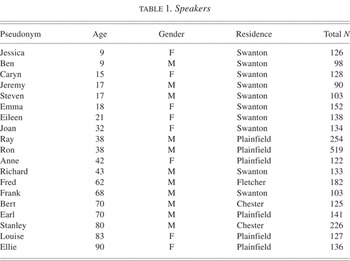
There were 19 participants in the current study, all from central and northern Vermont. As can be seen in Table 1, eight of the speakers are female, and eleven are male. The speakers range in age from 9 to 90 years, with both men and women in each general age group (9 to 18; 21 to 43; and 62 to 90). All of the speakers were recruited by convenience sampling. The youngest speakers were recruited by and interviewed in their local public schools. Some speakers of the middle group are the parents of the younger speakers; others were approached on the referral of other community members. All participants from the older group were referred by other community members.2
As discussed in detail in a study of glottalization in northern Vermont (Roberts, 2006), some of the speakers identified themselves as Abenaki, a Native American group indigenous to northern Vermont. Because of the history of forced assimilation and oppression faced by the Abenaki people (Gallagher, 1999; Haviland & Power, 1994) identification of speakers by ethnicity was a complex and politically charged process. Furthermore, those who did self-identify as Abenaki as a group, did not appear to share norms of speech behavior, although they did demonstrate the features that have thus far been identified as typifying Vermont speech. The effects of affiliation and other social factors on Vermont speech characteristics will be the focus of a different study, but for the present, ethnicity will not be specifically examined.
Speakers

Procedure
All of the adult speakers were interviewed once in their homes for approximately one hour. Younger subjects were interviewed twice for approximately 20 to 30 minutes each, due to class schedules in their schools. Interviews were free-flowing conversations but included demographic information, interests, and daily activities. The high school students and adults were also asked their impressions of Vermonters and their speech. Interviews were recorded using a Sony DAT Corder and a Sony ECM T145 lavaliere microphone.
There were approximately 100 to 200 vowels per speaker, which were digitized using the Computerized Speech Lab 4400 (Kay Elemetrics) at a sampling rate of 11,025 Hz. Analysis was accomplished using the Praat (Boersma, 2003) and Akustyk (Plichta, 2004) programs, then normalized and charted with Plotnik (Labov, 2003). The first two formants of the vowels (F1 and F2) were measured at the first formant steady state of the vowel nucleus, when possible, utilizing the procedures outlined in Labov, Yaeger, and Steiner (1972) and Labov (1994). Vowels with no discernible F1 steady state were measured at 25 ms from the onset. Particular attention was paid to the distance between the nuclei of the target vowels, /ai/ and /au/, and that of at least ten tokens each of

and

, which did not differ significantly from each other, and were also taken from the interviews. As previously noted, Boberg (2001) found that these vowels were merged in Vermont and suggested that this merger was of recent origin. The low back merger was present in the speech of the current speakers, positioned in the low back area of the vowel space, and included

as in ‘father’, as well as the

in ‘cot’ and the

in ‘caught’. The only exception to this pattern was found in some of the oldest speakers, who produced a more front

or [a] before [r], as in ‘barn’. This variant was, therefore, excluded from the calculation of the merged vowel. The means of normalized F1 and F2 frequencies of target vowels (

and

) were subtracted from that of the normalized frequencies of the merged anchor vowel

. The resulting difference scores were graphed for interspeaker comparison, as will be demonstrated later. F1 difference scores, then, indicated degree of raising of /ai/ and /au/; F2 differences indicated degree of fronting of these same variables. Difference scores were used for these comparisons, rather than comparing the normalized measurements directly, because the wide age range (in addition to sex difference) present in the participant pool made the application of an additional check on the analysis seem advisable. Finally, simple regression analyses were performed on both vowels with age and gender as independent variables.
RESULTS
The first point to be made in discussing these results, particularly given the large body of previous work on raising processes for /au/ and /ai/ discussed earlier, is that in Vermont, as found in some of the other studies on this topic (cf. Labov, 1963; Dailey-O'Cain, 1997), they appear to be separate phenomena. Although it will be seen that there are similarities between these vowels in Vermont and Canadian raising, and there are obvious historic parallels as well, at this point in time the patterns represented by the two vowels are quite distinct from each other and will be summarized separately.
Raising and fronting of /au/
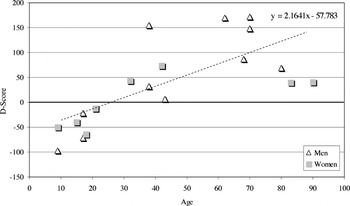
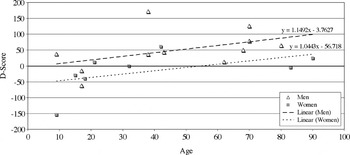
In Vermont, /au/ in a raised position is a salient sociolinguistic feature. It is commented on frequently by those who are asked about speech in Vermont. The results of this study support its saliency as well as its obsolescence. As can be seen in Figure 1, age stratification is present for this feature in that raising increases with age across all of the speakers. Results of the regression reveal these findings to be significant at the p < .001 level. Furthermore, those who raise /au/ do so in all phonological environments. The trademark of Canadian raising—that it occurs only, or even primarily, in prevoiceless contexts—is not applicable to Vermont /au/. These findings also differ from those of Dailey-O'Cain (1997) in Ann Arbor, who also found /au/ raising virtually restricted to the prevoiceless environments. Results of the regression analysis for gender approached, but did not achieve, significance (p = .06). However, only one woman has an F1 difference score over 50, whereas six of the eleven men have a score this high, and four of them have scores over 100. On the other hand, with the exception of a 38-year-old man and a 42-year-old woman, none of the younger speakers has a difference score over 50.

Raising of /au/ using a comparison of difference scores by age and gender.
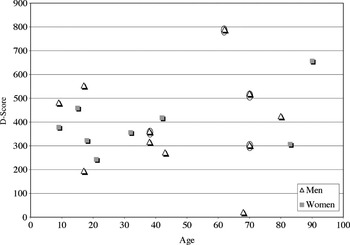
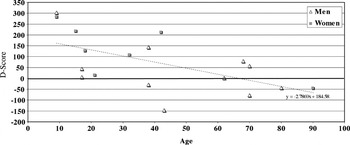
Fronting (F1) difference scores paint a different picture altogether as shown in Figure 2. In this case, there is no stratification at all! Neither age nor gender results reached significant levels. To underscore this point, the symbols of the four most extreme “/au/ raisers” have been circled on the graph. They, too, are scattered from the higher to lower regions of the chart. However, it is crucial to note that all of the F1 difference scores but one are over 100. That is, for all of the speakers, these tokens of /au/ overlap strongly with the front, nonperipheral vowel at the height of the F2. For example, for Caryn, who has a low /au/, /au/ overlaps with

. Fred's /au/ tokens are high; they overlap with

, or even

. Dailey-O'Cain (1997) found front /au/ as well, but the history of fronted /au/ is contradictory in New England. Krapp noted the presence of

as the nucleus for /au/ in 1925, but Kurath and McDavid (1961) noted that front onsets of /au/ were common in the midland north including New York state, but not in New England. Current findings suggest that Vermont may be more like neighboring New York and the midland than it is like the rest of New England in this regard, or that possibly there was more /au/ fronting in New England than found by Kurath and McDavid. Furthermore, the absence of back tokens raises the possibility that, as is the case for the speakers in Montreal (Hung et al., 1993), a back nucleus is not a target for /au/.

Fronting of /au/ using a comparison of difference scores by age and gender.
Centralization of /ai/
The well-documented Canadian raising pattern, although not as simple as originally formulated by Joos, can still be generally characterized as raising of /ai/ and /au/ in prevoiceless contexts. We have already noted that this pattern is not apparent with /au/ in Vermont. However, as the results for /ai/ are not as clear-cut, we will begin by looking at the most likely environment for raising:

followed by voiceless consonants or /ai/ [-vce].
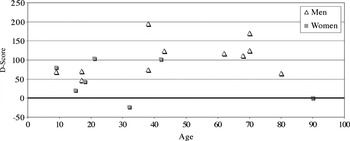
Unlike the results for /au/ raising, there is no evidence of age correlation or gender difference for /ai/ [-vce] as shown in Figure 3. Gender is implicated in both extremes in that those who raise most are men, and those who raise least are women. However, there are also several men and women in the mid-range area. It is the case that all speakers raise /ai/ preceding a voiceless consonant occasionally, but some do it very inconsistently, making the Canadian raising pattern, in this case, as in Labov (1963), more of a tendency than a rule. This generalization is borne out more strongly when individual vowel charts are examined. All speakers demonstrate raising of /ai/ [-vce] for some tokens, which the lower tokens in the voiceless context balance out when the mean is calculated. For example, Ellie, the oldest speaker, has a raising score of zero. Examination of her tokens reveals that, although some /ai/ [-vce] tokens are, in fact raised, others are quite low, resulting in a mean near

. There is, however, evidence of an influence of a voiced-voiceless pattern in that all but the lower two tokens that are raised and back are /ai/ [-vce]. In summary, Ellie does not raise /ai/ [-vce] consistently. However, when she does demonstrate /ai/ raising and backing, it is more likely to be in the prevoiceless environment.

Raising of /ai/_ -V using a comparison of difference scores by age and gender. The 80-year-old woman did not have enough tokens to be included in the analysis.
A pattern that is atypical of Canadian raising is revealed when these results are contrasted with those of /ai/ [+vce], or

followed by voiced segments or pause. As shown in Figure 4, although there are those who never raise /ai/ [+vce] in all age groups, older speakers and men were significantly more likely to raise /ai/ [+vce] than younger speakers and women (p < .045 for age and p < .050 for gender). In fact, for the most extreme speakers (i.e., Fred, Bert, Earl, and Stanley, the older males) the norm is raised /ai/ in all contexts. That is, they have very few instances of lowered nuclei for

in either the prevoiceless or other environments. The rest are well above the mean for

. For example, all of Fred's

tokens are raised except for three instances of the pronoun ‘I’. It appears, then, that the older male speakers demonstrate a pattern of general /ai/ raising with occasional exceptions. They contrast with the younger speakers, who, for the most part raise /ai/ primarily in the prevoiceless condition, although, even for this group, there is occasional raising in the prevoiced condition. In the mid-range are a few of the middle age group male speakers, such as Ray and Richard. They demonstrated a mixed pattern that comprised raising before voiceless final consonants and frequent but variable raising elsewhere.

Raising of /ai/_ + V using a comparison of difference scores by age and gender.
As previously mentioned, Dailey-O'Cain (1997) found in Ann Arbor, Michigan, some deviations from the typical Canadian raising pattern. She reported frequent raising before /r/ and before clusters ending in a voiceless consonant (e.g., pint). The latter were too infrequent in the current sample to examine. However, of the speakers who did not raise in all environments, five produced tokens of /ai/ before [r]. Of these, only one produced any raised tokens in this environment. The others treated /ai/ before [r] similarly to /ai/ before any other voiced segment.
Fronting/backing of /ai/
The examination of possible fronting of /ai/ in both the prevoiceless and elsewhere conditions presents a challenge, in that, in addition to the centralization demonstrated by the speakers, which results in a slight increase in the frequency of their F2 means, there is also, for some of the speakers, vowel backing. In the earlier discussion of /au/, it was noted that all of the speakers fronted /au/, whether or not raising is present. On the other hand, Figure 5, a graph of the difference between the F2 levels for /ai/ [-vce] and

, demonstrates that for most speakers, the mean of F2 in both environments is at or to the front of that of the F2 of

. There are ten speakers, however, for whom the mean of /ai/ [-vce] is lower than (and therefore behind) the mean of

. In fact, the older speakers' mean differences were significantly lower than those of the younger speakers (p < .011). Although these small differences would not, in themselves, indicate a perceivable difference in onsets, they do appear to indicate the presence of back tokens of /ai/ [-vce]. For these speakers, the

of ‘tight’ sounds like

as in ‘toy’. Not surprisingly, given the previous results, this feature shows up most of all in the older speakers. In addition, no speaker under the age of 35 has a negative difference score. Above this age, only four speakers have positive scores, and in the entire group only one of the women has a negative score: Ellie, who at 90, is the oldest speaker.

Fronting/backing of /ai/_ -V using a comparison of difference scores by age and gender. The 80-year-old woman did not have enough tokens to be included in the analysis.
In point of fact, there does not seem to be any appreciable fronting of /ai/ going on in Vermont. There is centralizing and raising, and there is raising and backing, as well as, of course, more standard low productions. The centralized tokens are in many cases to the front of

, but in no case are they comparable to the front vowels or to /au/. Both centralization (as indicated primarily by raising) and backing can be seen as features of Vermont speech, but the backing, like the centralization before voiced phonemes, appears to be primarily, although not unexceptionably, the trait of the more extreme speakers: the older speakers and, in the case of /ai /[+vce] raising, males.
In summary, /au/ raising shows consistent age grading, whereas all speakers show fronting of /au/. As has been found in other studies of these vowels, /ai/ is more complicated, with most speakers raising /ai/ in the prevoiceless environment. In the prevoiced condition, raising is confined, for the most part, to the older males, who raise /ai/ in all environments with few exceptions. Finally, there is no tendency toward fronting of /ai/ in any environment, although the more extreme speakers, the older speakers, back some tokens of /ai/ in both prevoiced and prevoiceless environments.
DISCUSSION
The results suggest that the original pattern for the vowels studied in Vermont was not Canadian raising, but an across-the-board raised and fronted /au/ and a central and back /ai/. The oldest male speakers retain much of this pattern. These findings are more consistent with those of Krapp (1925) and Kurath and McDavid (1961) in New England generally, and Labov (1963) in Martha's Vineyard, than of reports of Canadian raising, with the exception of that of Gregg (1973), who, as previously noted, argued that the raised form is older and at the origin of Canadian Raising. Even Gregg's report, however, suggested that it was the more complex raising pattern that first appeared outside of Great Britain.
Vermont speech also appears to differ from that in Michigan (Dailey-O'Cain, 1997). Although both studies found /ai/ and /au/ raising to be separate processes, Dailey-O'Cain noted that /au/ raising is quite similar to Canadian raising in environmental patterning and appears to be the newer feature of the two, with young women in the lead. On the contrary, in Vermont, although the relative age of the features is not clear, /au/ raising is most entrenched in the oldest speakers and is disappearing from, not entering, the speech community. In Ann Arbor, /ai/ raising was found to be more variable: frequent before /r/ and some clusters and not completely absent even from other prevoiced environments. This finding is similar to the younger speakers in Vermont, who do show a more typical Canadian raising pattern. However, although data are limited in this environment, /ai/ before /r/ appears to be treated like other voiced contexts, and, as with /au/, raising in the older speakers tends to be present in all phonological environments.
These differences between the two areas of the United States, both of which are close to the Canadian border, suggest some implications for the formation of a “superstandard” North American dialect put forward by Chambers (1999). As previously noted, Vermont speech, like that of other rural areas, seems to be a leveling variety, and it may well end up sounding similar to a superstandard dialect. However, the process appears to be a different one. Raising is present in Vermont speech but does not appear, given historical and linguistic evidence, to be a result of contact with Canada. Rather, raising in Vermont presents, like Canadian raising, as an older behavior that may be disappearing due to contact with speakers from other parts of the U.S.
Chambers (1989:83–86) cautioned that a historical explanation of the origin of Canadian raising as a continuum harkening back to the Great Vowel Shift lacks concrete evidence of origin. He proposed that Canadian raising may have originated spontaneously in the twentieth century in several areas, under the influence of vowel shortening before voiceless consonants. However, he also supported the possibility of a more general historical account of Trudgill (1984), who said a raised variant of both /ai/ and /au/ present in northern England and Scotland and lowered variants in southern England and in parts of the U.S. predated Canadian raising. A combination of these models and natural phonetic tendencies may have resulted in the unified, but complex, Canadian raising.
What records there are of early Vermont speech (Kurath, 1939b) indicate that raising has been a part of Vermont speech for considerably longer than is usually assumed in Canada. In addition, Scottish and Scots-Irish settlement in Vermont is well documented, as is the presence of raised /au/ and /ai/ in these varieties (Gregg, 1973; Klyza & Trombulak, 1999; Kurath, 1939a; Trudgill, 1984). The presence of the most extreme tokens of these features in the oldest, male speakers, further suggests that the raised character of the vowels in Vermont harkens back to the earliest European settlement in the late 1700s.
Although it is certainly possible that raising in Vermont (as well as in other areas of the United States) is a different phenomenon altogether than that in Canada, Thomas (1991), as previously discussed, brought alternative evidence on the age of raising in Canada. The claim that Canadian raising is an older feature allies well with the linguistic evidence in Vermont, both that in LANE and in the older speakers in the current study. Although we still suffer from the lack of historic evidence, as pointed out by Chambers (1989), synchronic results suggest that in Vermont raised onsets are the older form, and the dominant forms in the older speakers.
The present findings, then, lead to the following question: Is Canadian raising present in the younger speakers in Vermont? Other accounts of raising in the United States do make the assumption that there is a connection between the raising of /ai/ and /au/ there and that in Canada (Blake & Josey, 2003; Dailey-O'Cain, 1997; Vance, 1987). However, it is not always clear whether that claimed connection is a historical one or one of similarity in a more-or-less natural process, as in the definition proposed by Chambers (1989:77) and quoted earlier. In Vermont, first of all, there is no evidence of Canadian raising in the younger speakers for /au/, as they do not raise it at all. In some fashion, the results for /ai/ resemble those of Blake and Josey (2003) in that the newer behavior appears to be resembling Canadian raising more than the earlier, more general, raising patterns. Although this has been reasonably interpreted as a new change toward Canadian raising superimposed on an older pattern of consistent raising, I would like to suggest a different interpretation for the current findings in Vermont. As has been argued by several others (cf. Chambers, 1973; Gregg, 1973; Joos, 1942; Thomas, 1991), the original reported pattern of Canadian raising, that in which /ai/ and /au/ are raised before voiceless consonants and not elsewhere, is a relatively natural phenomenon, whether linked to the common shortening of vowels before fortis phonemes or the onsets following raised offglides. As such, it is not inconceivable that an obsolescing dialect would, as leveling occurs, be influenced by natural, nonlocal, ideology-free (Milroy, 2003) phonetic processes. That is, those environments in which raising is most phonetically motivated are less vulnerable to leveling (or, in this case, lowering) than those that are not. Rather than a raising innovation, such as that reported by Dailey-O'Cain, Thomas, Vance, and Blake and Josey, in this case, it appears more likely the original raised vowels are lowering as a function of leveling.
In conclusion, Kurath and McDavid (1961) found both the raised /au/ and /ai/ to be disappearing in Vermont in favor of a more “standard” lowered nucleus. The current study echoes this finding in that these features are found primarily in the older speakers. However, this disappearance appears to be quite slow in that some of the current older, most extreme, speakers were not alive when the LANE data were collected, yet they show strong evidence of the regressive pattern. The nonlocal lowered variant is the favored one for younger speakers and, in some cases, women, although it is important to note that for /au/, it is a fronted lowered variant that is replacing the raised form. As previously discussed, and as found in Montreal by Hung et al. (1993), the back vowel does not appear to be a target for Vermont speakers at any age. Although /ai/ and /au/ do not share a common nucleus even in their leveled variety, they do share a common process. Both vowel nuclei have dropped without changing their horizontal position, resulting in /ai/ with a low back or central nucleus, when it is not raised, and /au/ with a low front nucleus.
The findings of the current study suggest that the leveling process most affects the feature, raised and fronted /au/, that is most local and most locally salient. Even this feature, however, retains some of its relic character in that it lowers, but does not back. Vermont, like Martha's Vineyard and many other rural areas, has been affected by a reduction in the isolation of its early history. With this more general socioeconomic and cultural change, comes a more specific sociolinguistic one. Dialect leveling is a common phenomenon with increasing contact with the outside world. It is not surprising to note its presence in Vermont. Futhermore, it is not unusual for leveling processes to take on their own characteristic speed and patterning with some features eroding faster than others. It is in the uniqueness of local dialect erosion that we can look for clues as to its inception as well as to the social factors that affect it. Vermont /au/ and /ai/ leveling is mitigated and facilitated by the naturalness of the vowel patterns as well as the social salience of the features themselves. The result is leveling that has been slower than perhaps predicted by researchers in the 1930s and more erratic than wished for by researchers on the lookout for systematicity today. This study of the lowering of /ai/ and /au/ in Vermont demonstrates that different social and historical characteristics can result in contrasts in the same linguistic variables located a mere national border away.