Knots represent one of the principal and most recognizable components of Andean khipus (or quipus)—knotted-cord recordkeeping devices, best known for their use by the Inka empire (ca. AD 1400–1532). For more than a century, scholars have confidently recorded and directly interpreted the knots on many Inka-style khipus as numerical values, making them some of the few “deciphered” khipu signs (see Locke Reference Locke1912, Reference Locke1923).Footnote 1 Yet, despite constituting what many consider the best understood components of khipus, the direct study of khipu knots continues to yield meaningful insights (e.g., Hamilton Reference Hamilton2016–2017; Hyland Reference Hyland2024). Even so, new findings often stand in isolation, lacking a unifying framework for understanding the relationships and properties of different khipu knots, particularly those beyond simply ascribing a numerical value.
Early khipu scholarship focused almost exclusively on determining a cord’s “Lockean value”—that is, its numerical value—recording only the knot information deemed relevant for such a calculation: the number, type, and position of knots. Scholars in the last few decades, however, have become increasingly aware of different knot variations. These small changes to the canonical khipu knot types—overhand, figure-eight, and long knots—can be varied without seemingly affecting a knot’s numerical value (e.g., Conklin Reference Conklin, Quilter and Urton2002; Hamilton Reference Hamilton2016–2017; Urton Reference Urton1994). In effect, knot variations appear to enable multiple ways of representing the same numerical value on a khipu cord.
Until now, the identification and classification of khipu knot variations have primarily relied on inductive research. In contrast, this article takes a deductive approach to offer a more rigorous, standardized foundation for understanding khipu knots—and those of other knotted objects. Rather than simply relying on observations alone, it deploys the mathematical subdiscipline of knot theory, thereby building on a wealth of preexisting knowledge on knots. It asks how mathematical knot theory can help identify overlooked knot variations and the implications these variations may have for understanding the khipu code. In simpler terms, What more can we learn from the khipu’s most familiar sign, the knot itself?
Specifically, this article focuses on (1) common khipu knot variations that lead to misidentifications, (2) potential insights into khipu construction and data-encoding processes, and (3) the functional properties that certain knot variations offered khipukamayuqs (khipu specialists). It highlights the importance of recognizing topologically equivalent knots—those that are visually distinct yet are structurally identical—and explores how variations of the same knot type could be used to encode or modify meaning in khipus. Through basic mathematical knot theory, this article reveals that common khipu knot forms can be transformed into visually distinct variations or other common forms without untying them, offering new perspectives on khipu versatility and complexity.
The Canonical Khipu Knots
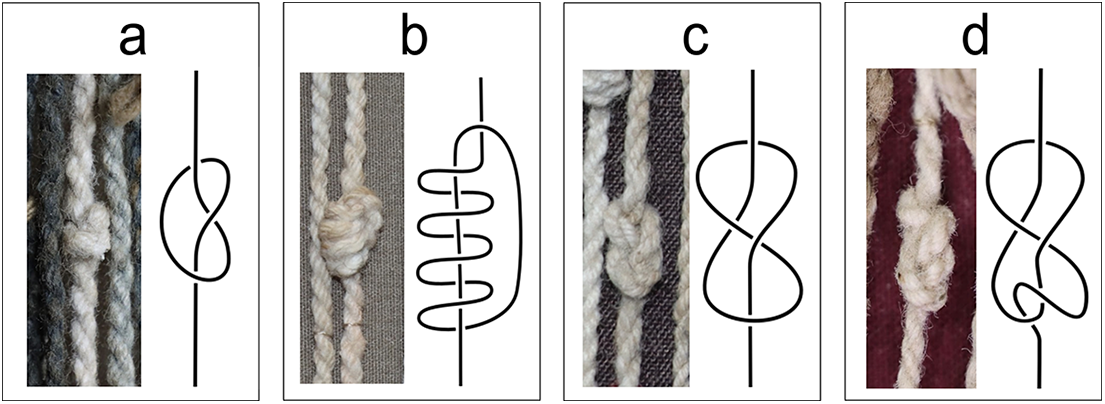
Let us first familiarize ourselves with the three most prolific khipu knot varieties: the overhand knot, the long knot, and the figure-eight knot (Figure 1a–c). While recognizing the importance of also exploring “anomalous” knot types (see Quave Reference Quave and Victòria Solanilla2009), the prevalence of overhand, figure-eight, and long knots—both in khipus and the khipu literature—establishes them as a solid foundation.
(a) Overhand knot; (b) long knot with four turns; (c) figure-eight knot; (d) pseudo figure-eight knot. (Color online)

It was not until L. Leland Locke’s (Reference Locke1912) breakthrough paper—in which he outlined the base-10 positional number system encoded by knots on most Inka-style khipus—that khipu knots began formally being identified and introduced into academic scholarship. Although he would settle on common names for the “overhand knot” and the “figure-eight knot,” Locke (Reference Locke1912) favored the term “long knot” to describe the set of knots used to signify the values 2–9 in a cord’s unit position, which are determined by the number of turns added to the knot. Eventually, Locke (Reference Locke1912:330–331) concluded that there were “but ten variations in all” of khipu knots: the overhand knot, the figure-eight knot, and eight long knot variations, which “differ from each other and from the [overhand] knot only in the number of turns taken in tying.” That is to say, the construction of an overhand knot is equivalent to a long knot of one turn. Although the simplicity of Locke’s (Reference Locke1912, Reference Locke1923) decipherment and knot typology made it a cornerstone of khipu literature, it placed an enormous emphasis on recording and calculating khipu cord values. It would also become evident that khipus contained more than just Locke’s 10 knot varieties.
The Pseudo Figure-Eight Knot
Although not considered one of Locke’s canonical khipu knot types, the pseudo figure-eight knot is notable because of its visual similarity to the conventional figure-eight knot (Figure 1d).Footnote 2 Day (Reference Day1967:16,18) appears to be the first to report this knot on an Inka-style khipu,Footnote 3 and Ascher and Ascher (Reference Ascher and Ascher1978:17) would later note that the pseudo figure-eight knot is only differentiated from the conventional figure-eight by “an extra turn.” The striking similarity between the two knot types means the potential for their misidentification is high, particularly when they are tied tightly on a khipu cord. Thus, these two knot types are exemplars of why a more rigorous understanding of khipu knots is needed. Because figure-eight knots dominate the khipu literature, misidentifications likely result in underreporting of pseudo figure-eight knots, although the extent is unclear.
In fact, misidentifications have already happened. For example, khipu 41-70-30/3110 in Harvard University’s Peabody Museum of Archaeology and Ethnology has two pseudo figure-eight knots—one on pendant 12 and another on pendant 20. Despite knowing of pseudo figure-eight knots, the Aschers’ datasheet for khipu 41-70-30/3110 records both as normal figure-eight knots (Ascher and Ascher Reference Ascher and Ascher1978:115–117). Although a successive study recorded in the Open Khipu Repository (OKR Team 2022) rectified the misidentification on pendant 12, the knot on pendant 20 remained misrecorded until I recently restudied it. At Museo Leymebamba in Peru, khipu CMA-480.1 was recorded in the early 2000s with three pseudo figure-eight knots; my subsequent study increased this count to seven. Similarly, khipu SA4029 in the Penn Museum was recorded by Ascher and Ascher (Reference Ascher and Ascher1978:56–58) as having 13 figure-eight knots, but I found that at least 11 of those are actually pseudo figure-eight knots.
These misidentifications are highlighted not to discredit any specific scholar but rather, as Thompson (Reference Thompson2024:2) remarked, to offer “an empathetic recognition of our shared humanity and of a fragility inherent in the process.” Mistakes are inevitable, especially when examining hundreds—or even thousands—of individual khipu cords. Nevertheless, these case studies raise an important question: How many other pseudo figure-eight knots, or khipu knots in general, have been misidentified?
In addition to knot conflation, we must remain alert to other common errors: misreading the number of turns in a long knot, miscounting the number of tightly bunched overhand knots, or incorrectly identifying a knot’s twist direction. Such examples underscore the urgent need for systematic documentation and cross-referencing in khipu studies—for knots and beyond. Misidentifications may obscure patterns essential to understanding khipu encoding. Moreover, given how consistently scholars attempt to “read” khipu knots, the need for an underlying systematic framework is particularly acute.
To mitigate misidentifications, scholars must familiarize themselves with the structure and relationships of knots and be equipped with the correct nomenclature to discuss them. For these reasons, we turn to the mathematical subdiscipline of knot theory—a branch of topology, the foundations of which offer us powerful tools for understanding khipu knots and archaeological knots more broadly.
Applying Mathematical Knot Theory to Khipu Knots
It is first necessary to summarize some basic principles used by mathematicians when discussing knots before applying them to khipu knot analysis and discussing their implications for decipherment. First, we must understand how knots tied in the “real world” (e.g., khipu knots) relate to their mathematical counterparts. We will then observe how certain knots serve as fundamental building blocks that can be combined to create more complex knots. From there, we will investigate the properties of knots and their mirror images, after which we will move on to understanding how we can tell mathematically whether two knots are the same (or different). Along the way, we will see how each step meshes with the study of khipu knots; with these basic ideas established, we will be well equipped to discuss the ramifications of the elucidated khipu knots’ properties and relations.
What Is a Mathematical Knot?
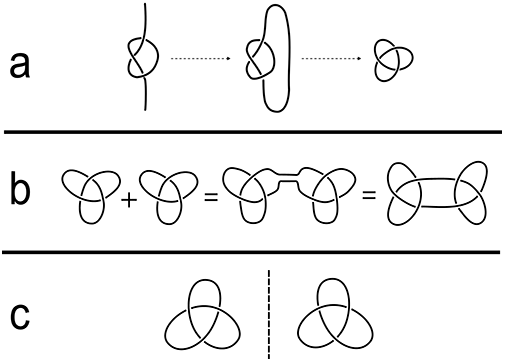
Unlike a knot tied in the “real world,” a mathematical knot is defined by a closed loop that has no beginning or end and does not intersect with itself at any point. Once tied, a knot from the real world can easily be converted to its mathematical counterpart by connecting its two free ends (Figure 2a).Footnote 4 In addition to being made of a closed loop, Adams (Reference Adams1994:2; emphasis added) writes that we should “think of the [mathematical] knot as if it were made of easily deformable rubber,” and therefore, “we will not distinguish between the original closed knotted curve and the deformations of that curve through space that do not allow the curve to pass through itself. All of these deformed curves will be considered to be the same knot.” In other words, once a knot has been created (i.e., tied), any deformations or changes made to it will not alter the specific knot type it is classified as, so long as the deformations do not cut or cause any part of the knot to pass through any other part of itself. Thus, after a knot is tied, an infinite number of variations of it exist.
(a) Converting a “real-world” overhand knot to its mathematical counterpart, the trefoil; (b) the composite granny knot formed from two identical trefoils; (c) the trefoil’s two distinct mirror images.

To better understand this, think of your favorite sweater. No matter how much you fold it, bunch it up, or turn its sleeves inside out, as long as you avoid any physical damage, you should always be able to return the sweater to its original state when you decide to wear it. Even though your sweater can technically be arranged in an infinite number of ways, we would not consider these variations to be different sweaters or articles of clothing. This same principle applies to knots.
Prime and Composite Knots
Within knot theory, all knots can be categorized into one of three basic classes: the unknot (i.e., a simple circle), prime knots, and composite knots. The category of prime knots encompasses the most fundamental and irreducible knot types, which can be combined or “summed” to form composite knots (Lickorish Reference Lickorish1997:6). For instance, a simple composite knot, often called the granny knot, can be made by joining two identical trefoil knots (Figure 2b). You can imagine the joining process as if each knot were cut at a given point, producing two “free” ends for each knot. These free ends are then connected to the other free ends from the other cut knot to once again form a continuous closed loop. In this way, one is not making a knot deformation but rather a new composite knot. Returning to our sweater analogy, such an operation would be akin to sewing multiple sweaters together. The resulting fashion conglomeration could no longer be called a sweater, yet it should be clear that the resulting piece is the composite of several separate sweaters—that is, its prime components—no matter how much you bunched, twisted, and deformed it.
The Standard Knot Table
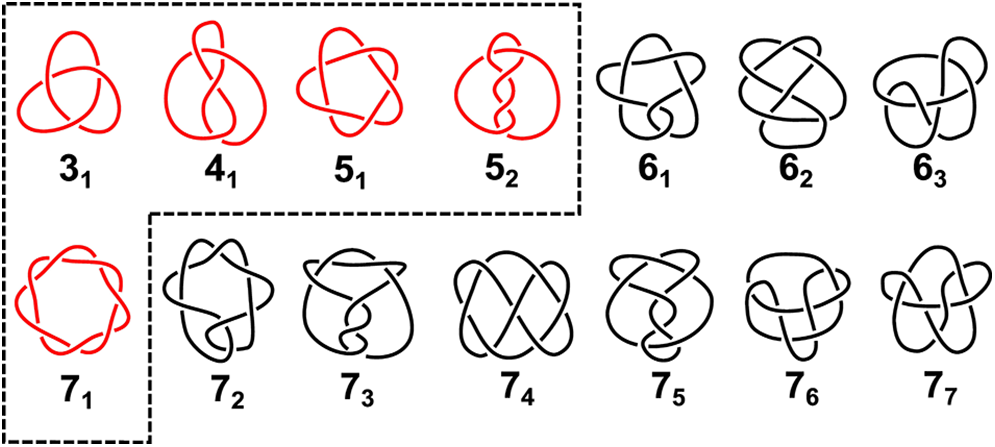
The standard knot table lists prime knots based on the minimum number of crossings a given knot has: a “crossing” simply refers to when one part of a knot crosses over or under another (Figure 3).Footnote 5 As we have seen, one can deform a knot in various ways and thus add more crossings, but the standard knot table shows each prime knot in a state where it has the minimum number of crossings possible.Footnote 6 Each knot on the standard knot table is given an identifier: the first number signifies the number of crossings a knot has, whereas the subscript serves as an index for that specific knot within the group of knots with the same number of crossings. In other words, the minimum crossing number for any given knot does not always uniquely define it—except for cases such as the trefoil (the only knot with a minimum crossing number of three) and the figure-eight knot (the only knot with a minimum crossing number of four).
A subset of Rolfsen’s (Reference Rolfsen2003:391–415) prime knot table (up to seven crossings); the dashed line outlines mathematical khipu knot counterparts.

We can think of the standard knot table as a sort of periodic table of knots. Just like atoms on the periodic table can be grouped into the alkali metals, alkaline earth metals, transition metals, post-transition metals, metalloids, reactive non-metals, noble gasses, and so on, knots can be grouped by their minimum number of crossings. Just as specific atoms may have different isotopes, such as carbon-12, carbon-13, and carbon-14, so too can a knot have different deformations or variations. Carbon-12 and carbon-14—although not exactly the same—are both still carbon, just as a trefoil that has been stretched, twisted, and turned (but not cut or passed through itself) is still a trefoil.
Continuing the chemistry analogy, you can think of composite knots like molecules that can be built out of atoms (prime knots) from the periodic table (standard knot table). Similar to how atoms can have different isotopes, molecules may be built of the same set of elements but have many distinct variations; in chemistry, these are called isomers. Although the exactness of the chemistry analogy starts to break down here, the important thing to know is that all knot types—whether they fall into the category of prime knots, composite knots, or even the unknot— can have many different deformations or variations.
Interestingly, the mathematical counterparts to the basic khipu knots mentioned thus far—the overhand knot, figure-eight knot, each type of long knot, and the pseudo figure-eight knot—are all prime knots and can be identified on the standard knot table. The overhand knot, as we saw in Figure 2a, corresponds to the mathematical trefoil knot, or 31 on Rolfsen’s table. Phillips (Reference Phillips2014) notes that, for khipus, the figure-eight knot is equivalent to 41 and that long knots can be identified on the standard knot table following the regular pattern of (2n+1)1, where “n” represents the number of turns a long knot has. Thus, a long knot of two turns is equivalent to 51, a long knot of three turns to 71, a long knot of four turns to 91, and so on.
In addition to being a curiosity, the fact that knots most used by khipukamayuqs are all prime may tell us something about khipu production: it may possibly reflect a desire to simplify khipu encoding and make knotting as efficient as possible. Could the prevalent use of prime knots hint that khipukamayuqs sought to use the most “elemental” knots possible? It is likely no coincidence that the overhand knot, the most frequently occurring knot in Inka-style khipus, has the fewest number of crossings possible for any knot: it is mathematically the simplest possible knot that one can tie.
Chiral (and Amphichiral) Knots
Although all knots have a mirror image, only some have mirror images that are topologically distinct, meaning that the knot and its mirror image are considered different knots. Some knots are like pairs of shoes, which have both a left shoe and a right shoe. No matter how you orient them, each remains identifiable as distinctly left or right, yet they clearly form a closely related pair. To illustrate further, imagine holding up a left shoe to a mirror. The reflection would show a right shoe. If you could magically reach into the mirror and grab the reflected shoe, you would now have the original left shoe and its paired right shoe. The same concept applies if you start with the right shoe.
By contrast, some knots are more like an unlabeled wine bottle. When held up to a mirror, its reflection looks identical to the original. If you could similarly reach into the mirror and pull out the reflected object, you would have an exact duplicate of the original wine bottle.
Knots with distinct mirror images, like the shoes, are called chiral. In contrast, knots that are indistinguishable from their mirror image—like the wine bottle—are called amphichiral. Mathematically, amphichiral knots can be shown to be topologically equivalent to their mirror image, whereas chiral knots cannot (Adams Reference Adams1994:15; Crowell and Fox Reference Crowell and Fox1977:9). We will look at how to prove knot equivalency (or lack thereof) in the next section. For now, simply know that, unlike chiral knots, amphichiral knots can be deformed into their mirror image without the need to cut them or pass through themselves.
The two mirror images of a chiral knot type are sometimes called enantiomers. Note that enantiomers are like the shoe example; no single shoe (left or right) or enantiomer is the one true shoe, but rather they both constitute a given mirror image for a type of shoe more generally. In the same way, if a knot type is chiral, mathematicians consider its enantiomers to be related but distinct knots (again, just like how a pair of shoes “match” but are distinct). The simplest chiral knot is the trefoil (Figure 2c), whereas the simplest amphichiral example is the figure-eight knot.
Urton (Reference Urton1994) introduced the notion of knot “directionality” to khipu studies—although he attributes the first meaningful recognition of this kind of knot property to Bill Conklin (see Urton Reference Urton1994:n9).Footnote 7 The knot directionality that Urton described can be understood as an observation of the two visually distinct mirror images by which many khipu knot types can be tied.Footnote 8 Thus, Urton’s directionality loosely corresponds to knot chirality; however, as noted earlier, some khipu knots—like the figure-eight knot—are amphichiral. To distinguish and record knot mirror images, Urton (Reference Urton1994) devised a naming scheme, labeling one mirror image “S” and the other “Z.” Khipus showing systematic use of these forms have since been identified—for example, V A 42527 in the Ethnologisches Museum, Berlin, Germany (see Urton Reference Urton2003:83–87) and 41.0/7305A in the American Museum of Natural History, New York (see Ascher Reference Ascher2005:106–108).
Knot Equivalency
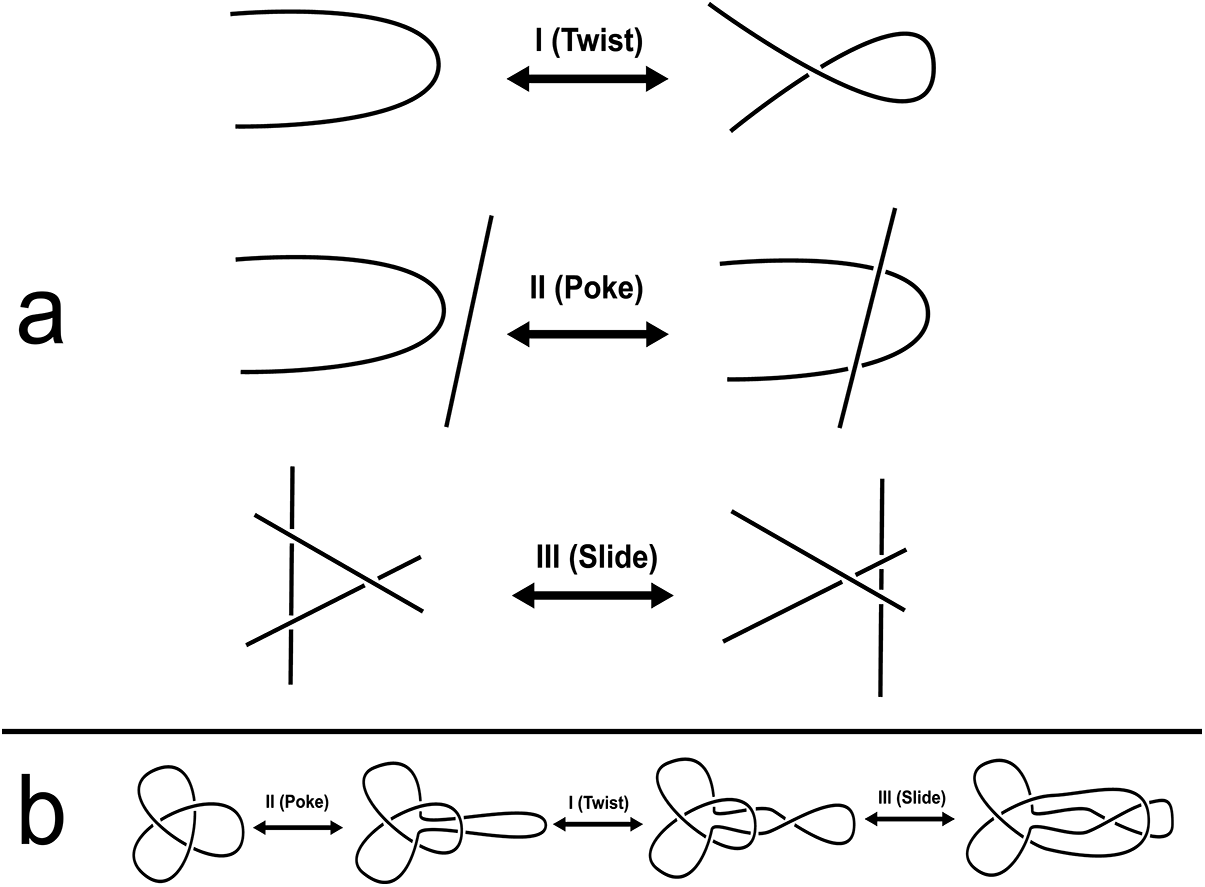
As we have seen, topologically we can deform a knot as much as we want, yet as long as we do not cut or untie it, we will never be able to change the type of knot we started with to any other type. In essence there exists an infinite number of variations for each knot, meaning knots that appear visually distinct can share identical constructions, and the same is true for physical khipu knots. So how, then, can we know whether two knots—which may visually appear different— are actually the same knot (or, conversely, whether they are different knots)? To answer these questions, we turn to the Reidemeister moves (Figure 4).
(a) The three Reidemeister moves; (b) each move shown altering a trefoil.

Think of the Reidemeister moves as different ways one can manipulate something like a rubber band—representative of the mathematical unknot—without breaking or cutting it. If you are able to convert one knot to another through a series of Reidemeister moves, then you have proven that those two knots are topologically equivalent (Lickorish Reference Lickorish1997:3). In other words, the two knots are said to belong to the same isotopy type (Crowell and Fox Reference Crowell and Fox1977:8) or what I simply refer to as knot type in this article. We can think of a knot type as a superclass to which an infinite number of deformations of said knot type belong: we can refer to these different deformations as knot variations. Again, it is important to reiterate that all knot types can be placed into one of three larger categories—unknot, prime, or composite—and that each category contains many different knot types (except for the unknot, which only contains the unknot itself).
Given the infinite number of possible knot variations, how can we begin to make sense of them? Consider a figure-eight knot whose top loop has been stretched one micrometer to the left. Although a topologist would classify this as a distinct variation, such minute differences are nearly impossible to detect or interpret in practice. Moreover, micro-variations like this are far more likely the result of chance—stemming from how a knot was tied, burial conditions, handling during conservation, and so on—than of intentional design. Thus, a good starting point may be variations that are notably visually distinctive, which can be easily recognized, reproduced, and clearly differentiated from other knots of the same knot type. Although there is some subjectivity in what counts as distinctive, this approach allows us to reduce a theoretically infinite number of variations to a more practical finite set. Still, we should always remain cautious. The study of signs often involves subtle distinctions that may only become clear with practice, enculturation, or both. Until further research is done, we can only presume which variations are truly distinctive and which are not.
Introducing the concept of knot equivalency to khipus reveals, most notably, that khipu knots that appear distinct can actually be variations of the same knot type. Moreover, knots can be transformed via the Reidemeister moves, morphing them into visually distinct variations without needing to be untied. As we will see, these insights have major ramifications for khipus and for knotted records more broadly. They open new possibilities for scholars to consider, particularly the potential for active knot (and thus data) manipulation without untying.
The following sections outline these implications, focusing on figure-eight and long knots. Although overhand knots can also be deformed, they appear to offer only a single visually distinct form and therefore are not discussed in detail.
The Topology of Figure-Eight Knots
Unlike other common khipu knots that are chiral, the figure-eight knot is amphichiral, which affords this knot type a curious property. As noted earlier, amphichiral refers to a knot with equivalent mirror images—recall the wine bottle analogy. Unlike chiral knots that are fixed to either their “S” or “Z” enantiomer form, no matter how they are manipulated, a figure-eight knot can easily be “flipped” between its two mirror images: this can be achieved via a continuous manipulation and inversion of the knot through itself (Phillips Reference Phillips2014). Note that, although topologically figure-eight knots are amphichiral, real-world figure-eight knots can appear to have two visually distinct mirror images when the knot is “oriented relative to its wend” (see Chisnall Reference Chisnall2016:297). In other words, a figure-eight knot tied on a cord with a clearly defined “top” and “bottom” can appear to have two visually distinct mirror images. However, the orientation of the cord determines which mirror image the figure-eight knot will exhibit, which is not the case with chiral knots.
You can observe this phenomenon yourself by first tying either an S or Z figure-eight knot onto a cord. Then, holding the cord vertically, flip the cord so that what was once the “top” of the cord now faces down and vice versa. You will see that the figure-eight knot appears as the mirror image of either the S or Z version you originally tied. Still, because one can distinguish between “oriented” figure-eight knot mirror images, Urton (Reference Urton1994) differentiates between these orientations using the same labeling scheme he employed for chiral knots (S and Z). However, it is important to point out once again that, unlike truly chiral knots, such as overhand and long knots whose S- or Z-ness is fixed, a figure-eight knot can be changed between Urton’s (Reference Urton1994) S to Z without being untied (Figure 5), which is what makes it amphichiral.
S to Z transformation of a figure-eight knot (adapted from Phillips Reference Phillips2014).

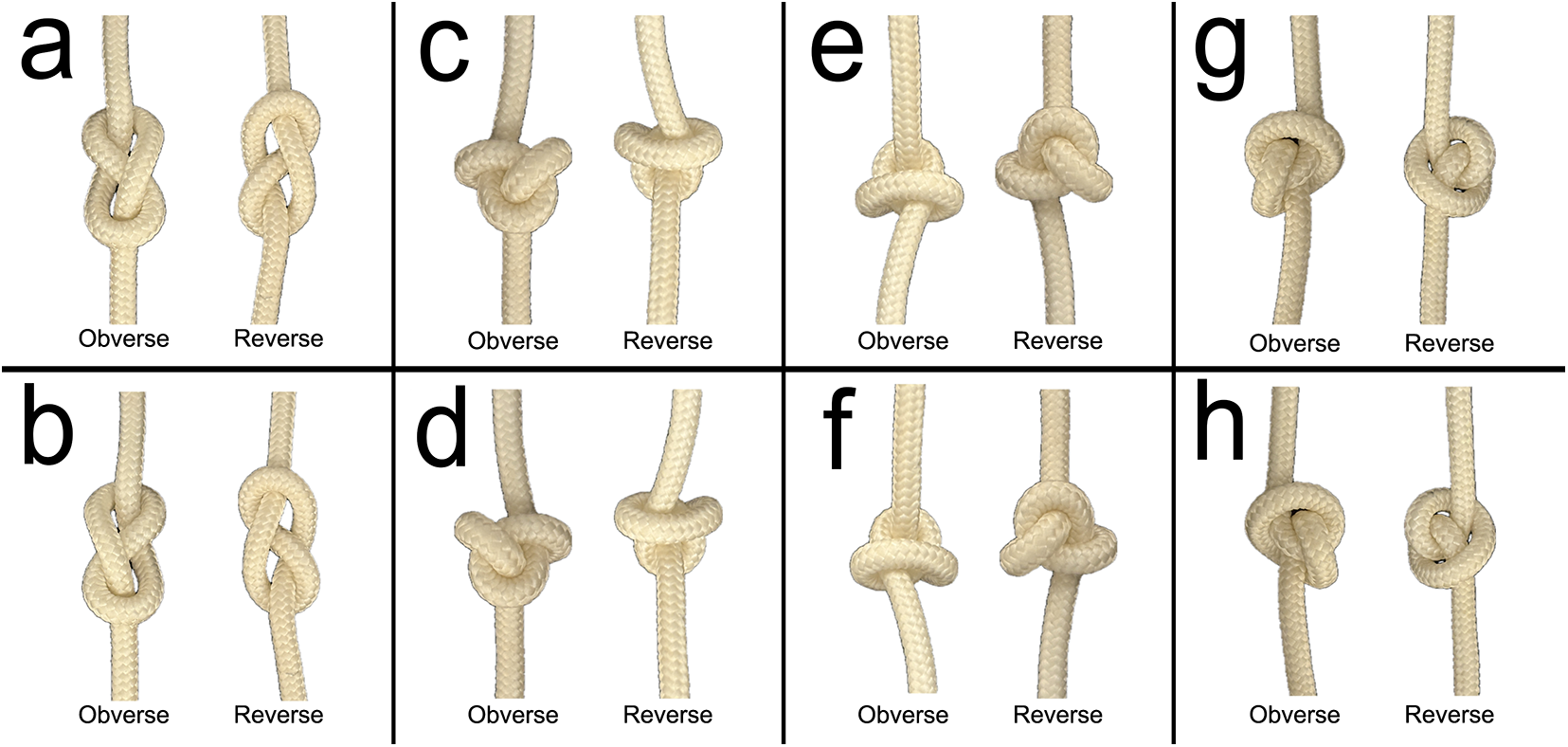
The deformation of one knot variation into another variation of the same type—like that seen in Figure 5—is referred to by various terms (for example, flyping, ambient isotopy, and distortion) but are referred to here as capsizing. There appear to be two main ways to capsize a figure-eight knot: by pushing either (1) “down” the top of the knot or (2) “up” the bottom of the knot. As a figure-eight knot is capsized from one orientation to another, several visually distinct variations are formed as intermediaries. In total, there appears to be at least eight visually distinct figure-eight knot variations that scholars should be looking to identify and record (Figure 6a–h): (a) the normal figure-eight S,  $E_S^{}$; (b) normal figure-eight Z,
 $E_Z^{}$; (c) top-side capsized figure-eight S,
 $E_S^T$; (d) top-side capsized figure-eight Z,
 $E_Z^T$; (e) bottom-side capsized figure-eight S,
 $E_S^B$; (f) bottom-side capsized figure-eight Z,
 $E_Z^B$; (g) pretzel knot S,
 $E_S^P$; and (h) pretzel knot Z,
 $E_Z^P$. Note that these eight variations all form part of a continuous chain, in which capsizing the knot into a given variation is one step toward another subsequent variation.
Figure-eight knot variations: (a) normal S; (b) normal Z; (c) top-side capsized S; (d) top-side capsized Z; (e) bottom-side capsized S; (f) fottom-side capsized Z; (g) pretzel S; (h) pretzel Z.

Yet, given the apparent ease by which figure-eight knots can be capsized and their directionality reversed, one must ask, Is recording these variations at all meaningful for figure-eight knots? The answer is yes, for at least two reasons.
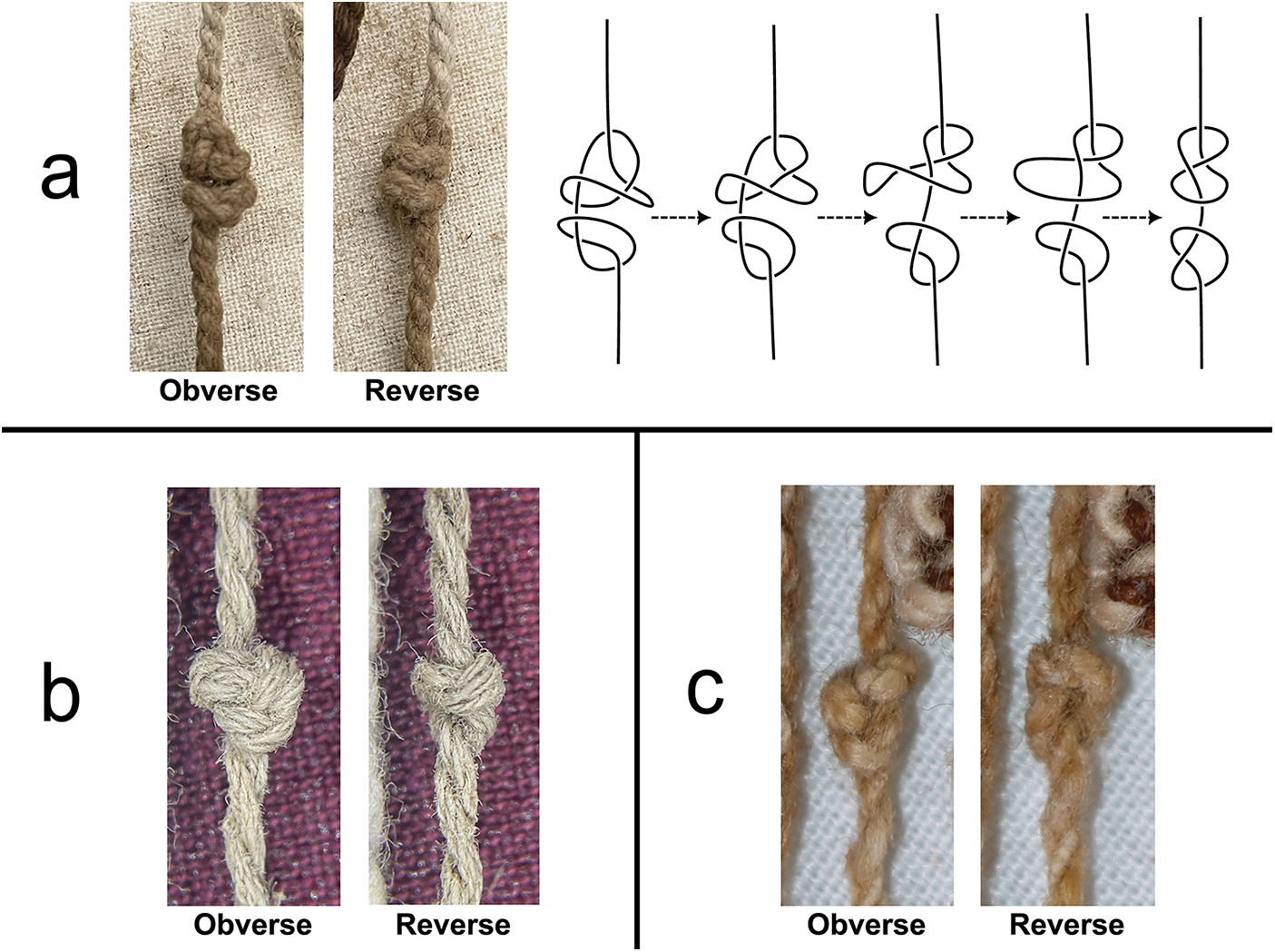
First, anyone looking to analyze and record knotted objects like khipus should be cautious and be aware of these kinds of knot variations: they can be very tricky to identify and are easily confused with other knot forms. For instance, a capsized figure-eight knot—particularly the top-side and bottom-side varieties—may appear visually similar to an overhand knot, especially on small tight cords, like those on khipus. An example can be found on khipu 41-70-30/3110 in the second knot register of pendant cord 12 (Figure 7a). At first glance, the knots tied onto this register give the appearance of two overhand knots, and this is indeed what was recorded by Ascher and Ascher (Reference Ascher and Ascher1978:115–117) and by a successive study recorded in the Open Khipu Repository (OKR Team 2022). However, the knot registry is actually composed of one bottom-side capsized figure-eight knot Z tied closely above a normal Z-twisted overhand knot.Footnote 9
(a) Obverse/reverse views of pendant 12 on khipu 41-70-30/3110, with line drawing showing the figure-eight knot via Reidemeister moves; (b) topside capsized S figure-eight knot on CMA-480(A) pendant 41; (c) topside capsized Z figure-eight knot on CMA-583 subsidiary 1 of pendant 136. (Color online)

Other examples of this type of misidentification occurred in previous recordings of khipus CMA-480(A) and CMA-583 in Museo Leymebamba (Figure 7b–c). For CMA-480(A), the sole knot found on pendant 41 was recorded as an overhand knot, but my restudy of this khipu revealed the knot to be a topside capsized figure-eight knot S.Footnote 10 On CMA-583, the sole knot on subsidiary 1 of pendant 136 was also misidentified as an overhand knot, but I later observed it to be a topside capsized figure-eight knot Z.
Note that the deformed figure-eight knots that I discovered on 41-70-30/3110, CMA-480(A), and CMA-583 are variations that sit as intermediaries between the “normal” figure-eight knot and the pretzel knot. Although I have only observed one pretzel knot on an Inka-style khipu cord, the top-side and bottom-side capsized varieties appear more frequently.Footnote 11 Therefore, it is crucial for scholars to identify, recognize, and accurately record topologically equivalent but visually distinct knots, such as those described here. Doing so not only helps prevent misidentifications but may also be significant if these variations carry distinct semantic meanings.
Second, although figure-eight knots can be readily capsized between their mirror-image forms, a complete flip from S to Z (or vice versa) is unlikely to occur by accident—from jostling or rough handling—given how tightly khipu knots are often tied. Instead, top-side and bottom-side capsizing are more likely candidates as evidence of handling or use. In fact, even if these figure-eight knot variations carry no distinct semantic value, they may offer insight into the khipu chaîne opératoire: the sequence of actions involved in khipu construction and use.
We can imagine several scenarios in which a standard figure-eight knot becomes capsized during the construction, handling, or use of a khipu. One possibility is that the figure-eight knot gets caught as it is pulled through the doubled end of a cord to form a cow-hitch attachment knot, resulting in a bottom-side capsized figure-eight knot. If so, such a variation might indicate that some knots were tied before, not after, the cord was attached to the primary cord or to another pendant or subsidiary cord.
Alternatively, a top-side capsized figure-eight knot could result from “expanding” a loosely formed cow hitch, where the hitch pushes back against the top of the figure-eight knot, altering its shape. Another possibility is that a top-side deformation comes from use rather than construction; for instance, from a khipukamayuq running their hand down the cord to feel and interpret its contents. If this were the cause, the deformation might reveal both the physical technique and the directional pattern by which khipu cords were read in practice.
Of course, these are not the only possible scenarios. Figure-eight knot variations may well have been intentionally made to convey specific semantic meanings. However, to examine the scenarios described earlier, as well as others, we must first identify and record figure-eight knot variations before looking for meaningful patterns.
The Topology of Long Knots
Although khipu scholarship often refers to all long knots as if they constitute a single knot type, the term “long knot” more accurately describes several related knots that share similar properties but not the same topological knot type. Despite their similarities to the overhand knot, which is technically a long knot of one turn, long knots have an additional trait that overhand knots do not appear to have. Similar to figure-eight knots, long knots can be easily capsized into several visually distinct variations. Again, because each of these new knot variations shares the same knot type as the original long knot they are made from, long knots can be manipulated into these different forms without needing to be untied. Yet, because long knots are chiral, unlike the figure-eight knot, they maintain their S or Z enantiomer form, regardless of how they are deformed.
Hamilton (Reference Hamilton2016–Reference Hamilton2017) makes a valuable contribution by formally introducing the concept of long knot orientation or axis directionality to long knots, labeling the two orientations as “angle-end-up” and “angle-end-down.” He astutely points out that long knots “are not symmetrical on both ends. At the top, the cord passes into the knot along its axis—and actually forms the axle around which the rounds of cord were made. At the bottom of the knot, the cord exits at a distinct right angle” (Hamilton Reference Hamilton2016–2017:95). Although this distinction highlights key variations, it ultimately represents two variations of the same knot type; that is, if the angle-end-up and angle-end-down long knot variations are both tied S or both tied Z and both have the same number of “turns.” Hamilton goes on to argue that the orientation by which a long knot is tied might inform us about the processes by which khipus are made: “Previous scholarship has generally asserted that blank quipus were first made and then inscribed with knots. For the angle end of the [long] knot to face upward toward the primary cord, however, the cord could not have been attached to the quipu when the knot was tied. This suggests most cords were knotted before they were appended to a quipu” (Hamilton Reference Hamilton2016–2017:95).
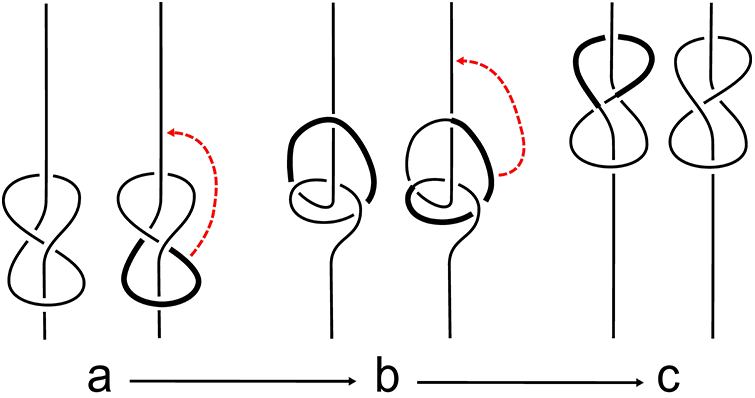
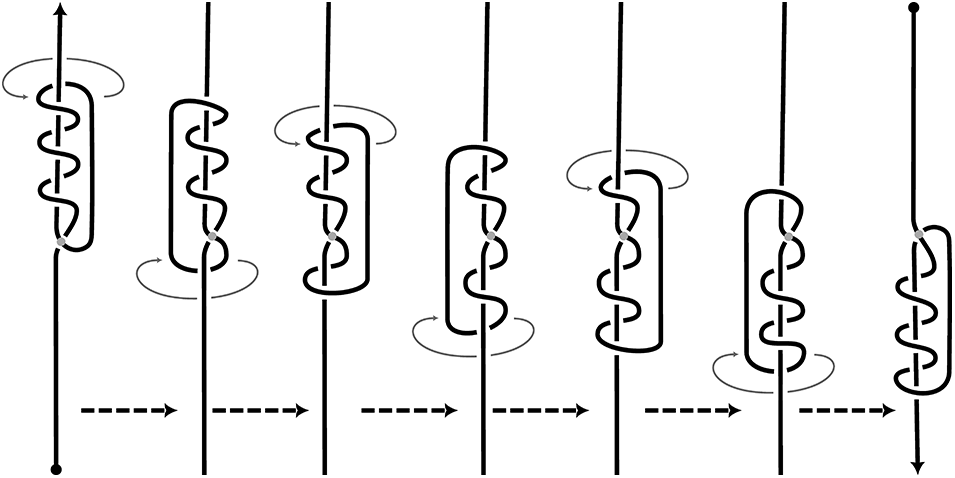
However, Hamilton’s strong claims about how long knot orientation can inform us about khipu construction processes require reevaluation, because both the angle-end-up and angle-end-down variations of a long knot belong to the same knot type. This knot equivalence implies that a long knot can be capsized from one orientation to another, meaning that either orientation can be tied before or after a cord is attached to a khipu. Figure 8 depicts a method by which one can simply twist a long knot, either up or down a cord, to change its orientation.Footnote 12 It should again be emphasized that, in contrast to the amphichiral figure-eight knot, long knots maintain their S or Z chirality throughout the transformation. In addition, although long knots can be readily capsized between their angle-end-up and angle-end-down forms (or vice versa), a complete transformation is extremely unlikely to occur by accident given how tightly khipu knots are often tied.
Capsizing of 3-turn S-twist long knot from “angle-end-down” (left) to “angle-end-up” (right). The “angle” ends of the first and last knot are notated with a circle, and “axis” ends with an arrow. A gray dot marks the central axis around which the knot is twisted.

As with the capsizing of a figure-eight knot, there are many intermediaries between angle-end-down and angle-end-up long knots. These could be described as “under” or “over” twisted, although such distinctions are less clear-cut than those of the figure-eight knot. Still, being aware of such intermediaries is critical because they do appear on khipus (Figure 9) and, yet, before this publication, have gone all but unrecorded. These intermediary twisted long knots can often be identified via their lack of “angle” end and instead appear to have two “axis” ends. Like figure-eight knot variations, long knot variations may or may not have held specific meanings. Regardless, recording such variations and understanding how and why they occur on khipus will no doubt further our understanding of khipu construction methods and pave the way for valuable future research.
“Over-” or “under-twisted” long knots: (a) CMA-480.2(A) pendant 1; (b) CMA-665 pendant 12; and (c) CMA-665 pendant 14. (Color online)

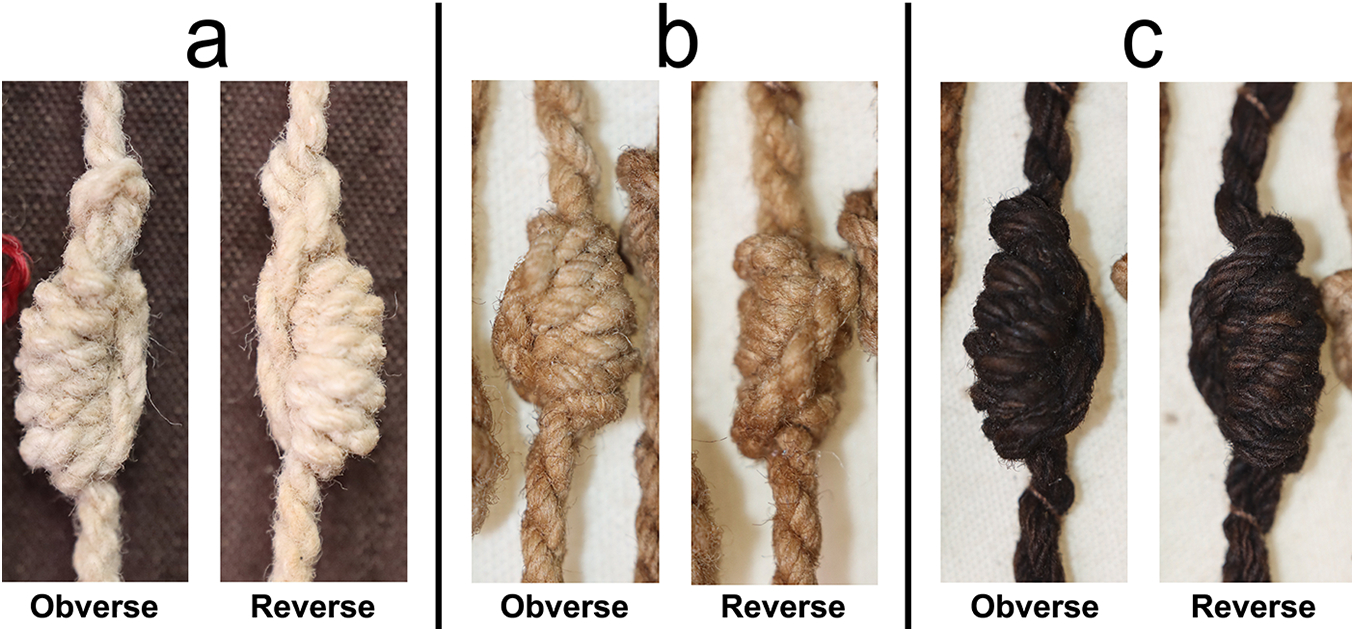
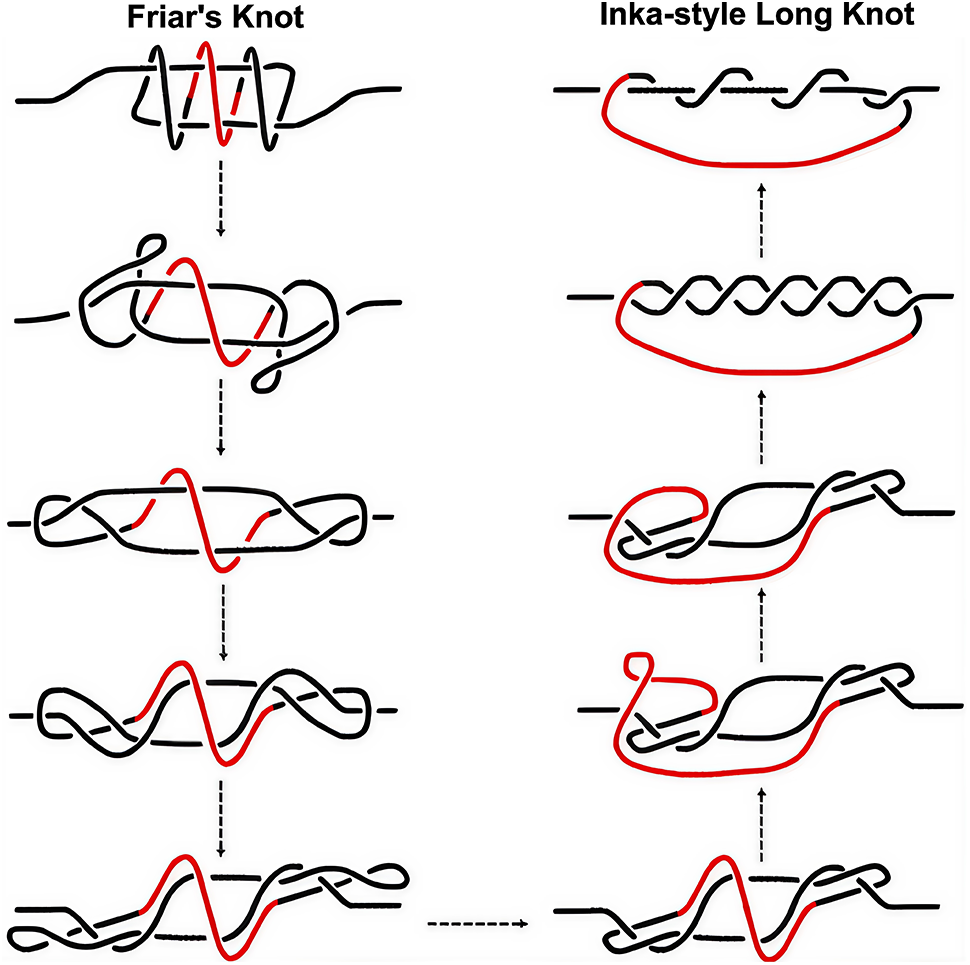
In addition to angle-end-down and angle-end-up variations. there is at least one more long knot variation scholars should look to identify and record: the Friar’s knot. Phillips (Reference Phillips2014) claims that Inka-style long knots and Friar’s knots are topologically equivalent, belonging to the same knot type. Although the Friar’s knot does not appear among the intermediate forms shown in Figure 8, it can be shown through a series of Reidemeister moves that Inka-style long knots belong to the same knot type as the Friar’s knot (Figure 10), a knot commonly tied onto the Franciscan Cincture (Phillips Reference Phillips2014).
Friar’s knot (top left) transforming into an Inka-style long knot (top right; adapted from Phillips Reference Phillips2014). (Color online)

This variation on the traditional Inka-style long knot is of particular interest. For more than 100 years, many khipu catalogers have considered the Friar’s knot to be completely separate from the traditional long knot, often treating it as anomalous. Yet this knot surfaces frequently across the khipu literature. Locke (Reference Locke1923:24) describes finding this type of knot on the so-called Cajamarquilla khipus; Salomon (Reference Salomon2004:162) refers to this variation as the “Tupicocha knot, or T-knot” and the conventional long knot as the “I-knot” (Inka long knot); Quave (Reference Quave and Victòria Solanilla2009:244) calls them “inverted long knots”; and Strauss (Reference Strauss2019:42) dubbed them “spiral knots” in her Harvard undergraduate thesis.
Unlike the broader khipu scholarship that, time and time again, classed the Friar’s knot as its own knot type, Locke, Salomon, Day (Reference Day1967:16–18),Footnote 13 and Quave seem among the few who understood the topological relation between the Friar’s knot and the typical Inka-style long knot. Salomon (Reference Salomon2004:164), for instance, describes a practical process for carrying out a topological transformation like that shown in Figure 10 (except in reverse):
One must slacken its exposed or ascending vertical axis [of a typical Inka-style long knot], and, by winding it around the already existing turns in a contrary direction, exhaust them. The effect of this surprising “rope trick: is to replace the turns with a series of oppositely spiraled turns lacking an exposed axis (Ashley 1944:94, illustration 566). Such a transformation might have expressed a transvaluation of the long knot’s value (such as, postulating a speculative example, negative to positive).
Yet, Salomon (Reference Salomon2004:164) later writes that he never observed anyone in Tupicocha making a Friar’s knot in this way. Rather, the most common way to tie a Friar’s knot appears to be outlined by Locke (Reference Locke1923:39–40), who reports that it is “formed as in the other cases [i.e. normal Inka-style long knots], with the exception that both ends of the cord are pulled, causing the peculiar wrapped condition.” In other words, one begins by simply tying a normal Inka-style long knot but pulls both ends taut when finishing, as opposed to pulling just one end (as one would for a typical Inka-style long knot).
I have observed that when I teach others to tie Inka-style long knots, beginners often produce a Friar’s knot by mistake. Unlike a typical Inka-style long knot, which must be clinched at one end only, the Friar’s knot results when both ends of the cord are pulled tight—a motion that seems to be the most intuitive for the majority of beginners. This is not to say that Friar’s knots found on khipus are evidence of unskilled khipukamayuqs. Such knots could certainly be intentionally made, like those found on the Tupicocha khipus, to distinguish them from typical Inka-style long knots.
Still, if the Friar’s knot is indeed easier—or at least more intuitive—to produce, then why did the Inka favor their long knot variation? One likely reason is legibility. With the Friar’s knot it is much harder to count the number of turns used and thus determine its value, because its two sides appear to have different numbers of turns.Footnote 14 In contrast, the iconic external slash visible on the typical Inka long knot helps ensure that the knot’s value is always clear to the readers, no matter what side of the knot they look at.
As a brief aside, two other “long knots” merit mention for completeness, though they are only related to Inka-style long knots in name: Urton’s so-called belted long knot or “BL” for short, and the Aschers’ “double long knot” or “LL” for short.Footnote 15 Despite both knots having “long knot” in their names, these two knot types are distinct and are not part of the typical long knot family. In other words, they do not fall within the same knot type of any typical Inka-style long knots nor of each other. Furthermore, both of these knot types are exceedingly rare, only appearing on the Dauelsberg khipus: belted long knots are only reported by Urton on khipu AS70 (see OKR Team 2022:KH0083 Notes), and double long knots are only reported by the Aschers on khipus AS69 and AS70 (Ascher and Ascher Reference Ascher and Ascher1978:399–525).
Discussion
Having examined the structure and characteristics of khipu knots through the lens of mathematical knot theory, we now turn to the broader implications of these findings. Specifically, the following discussion explores how the ability to manipulate and transform knots may change our understanding of the khipu code and the potential significance of rare khipu signs.
The Malleability of the Units Position
As we have now seen, the conventional Inka-style long knot and the figure-eight knot—typically used to signify unit values on a khipu cord following Locke’s standard base-10 logic—can both be altered into various visually distinct forms without being untied. Yet, the overhand knot—typically used on Inka-style khipu cords for tens, hundreds, thousands, and so on—cannot seemingly be deformed in any visually distinct or meaningful way. This implies that the information encoded in the unit position of a khipu cord may be uniquely “malleable,” flexible, or subject to adjustment when compared to the more fixed overhand knots found in the tens, hundreds, thousands, and higher positions.
The idea that khipu data may have been updated or altered might seem far-fetched, but Salomon (Reference Salomon, Piquette and Whitehouse2013) has convincingly argued that khipus can serve as functional, operational devices rather than simply as fixed texts. Even the earliest Spanish account of Inka khipu use—from a 1533 letter by Hernando Pizarro (Reference Pizarro1872 [1533]:122)—supports this idea, referencing the active updating of storehouse khipu data. Similarly, Hyland (Reference Hyland2016) describes late nineteenth- and early twentieth-century tributary khipus from the town of Anchucaya that were used as dynamic records through the deliberate unknotting of cords. Together, these brief examples underscore the potential for khipus to function as working documents, rather than static records.
This article identifies at least eight visually distinct figure-eight knot variations (four for each mirror image) and at least six visually distinct knot variations for each type of long knot (three for each mirror image). Despite the many possible variations, figure-eight knots are typically tied in one of two standard variations—normal S or normal Z—that can be flipped between without untying the knot. Similarly, the two mirror images of each long knot are typically tied in one of the two standard variations—angle-end-up or angle-end-down—that can also be flipped between without untying the knot. It bears repeating that these specific transformations for figure-eight knots and long knots are highly unlikely to occur accidentally on a khipu cord: they require intentional manipulation. In essence, the unit positions and the types of knots typically tied there by khipukamayuqs make them a unique case warranting scholarly attention.
The ability to “update” or “alter” a knot after it has been tied, whether it is a long knot or a figure-eight knot, may have been a useful function for khipukamayuqs. Until now, discussions of data “updating” on khipus have focused almost exclusively on acts of undoing: untying knots, removing or reattaching pendant cords, or otherwise erasing prior inputs. However, the possibilities explored here suggest a parallel, yet distinct, form of intervention: transforming. Rather than simply being untied, some knots could have been reshaped or repurposed through capsizing. This opens the door to a broader conception of khipu data manipulation—one that includes not only removal but also reconfiguration.
Imagine, for a moment, a hypothetical khipu for tracking debts. Unpaid debts could be marked in the unit position by one of the standard knot variations, with these knots then being “updated” to another variation once a debt has been paid. For instance, a figure-eight knot may be flipped from S to Z or a long knot from angle-end-up to angle-end-down (or vice versa in either case). Thus, in a hypothetical case of tribute collections, one variation could mark payments received versus those still owed. Although a cord’s numerical value might remain stable during these knot alterations, the context or meaning surrounding that value could have been changed “on the fly,” even after a knot was securely tied. The inherent possibility of such a system highlights the flexibility that knot transformations afford. Accounting for the additional variations outlined for each knot type would only allow for even more complexity of this kind of malleable system.
Still, the transient nature of an on-the-fly knot change presents challenges for demonstrating their use, particularly because some genres of khipus might be better candidates for this type of operation than others; for example, local tribute “working” khipus versus historical census khipus. Future research focused on systematically recording knot variations and identifying khipu genres may help address these difficulties. In any event, bringing awareness to the possibility of such use cases is essential as scholars continue to explore the full range of meanings and applications of khipus, as well as of other knotted records.
How Might Rare or Anomalous Knots Contribute to the Khipu Code?
A question that arises is how should we think about the use of seemingly rare knot types? Perhaps knot variations, like those shown in this article, were made by accident or are symptoms of certain khipu construction methods. Still, we should heed Quave’s (Reference Quave and Victòria Solanilla2009:243) argument that “khipukamayuq were aware of changes in the construction sequence and that in spite of state guidance in the construction of record-keeping devices, khipukamayuq were agents of their recorded knowledge and their execution of state standards.” Thus, knot variations may represent signs specific to a region or a certain khipukamayuq (e.g., see Thompson Reference Thompson2024), serving as mnemonic signs within a more standardized system of meaning (or among other standardized signs). Testing such hypotheses will require researchers to collect and examine spatial and temporal distributions of knot variations across khipu collections in an attempt to correlate them with known regional practices or administrative structures. Although many extant khipus lack context, the ones that have known provenance—for example, khipus from Inkawasi, Pachacamac, and Laguna de los Cóndores—are a good starting point.
Another possibility is that some knot variations serve as extremely niche signs, used only within specific khipu genres. Imagine future researchers examining a fantasy book a century from now; in said book, you would be very unlikely to find the “@” symbol. Yet, if these researchers were to look at a list of email addresses on an old hard drive from the same time period, this symbol would be much more prevalent. Therefore, as always, we must keep in mind that khipu genre may play a significant role in how certain khipu signs are meant to be interpreted. Although progress toward understanding khipu genres is being made—with scholars examining the potential significance of khipu genre through the use of kaytes, or end bundles (Hyland Reference Hyland2020), and through primary cords (FitzPatrick Reference FitzPatrick, Quave, Quilter, Splitstoser and Vail2026)—for the time being, it is difficult to know which khipu signs, if any, are genre-specific.
Conclusions
Quave (Reference Quave and Victòria Solanilla2009:248) urges scholars to “continue to collaborate to come up with a khipu typology and a universal comparison of anomalous attributes,” and by viewing khipu knots and their many variations through the lens of knot theory, this article has aimed to do just that. Since the time of Locke and especially in recent years, researchers have increasingly challenged his purely numerical interpretation of khipus, whether it be through color (Hyland Reference Hyland2016), knot and ply variations (Hyland et al. Reference Hyland, Ware and Clark2014; Urton Reference Urton1994), attachment knot orientations (FitzPatrick Reference FitzPatrick2024; Medrano and Urton Reference Medrano and Urton2018), or primary cord components (FitzPatrick Reference FitzPatrick, Quave, Quilter, Splitstoser and Vail2026; Hyland Reference Hyland2020). And now, this revelation—that knots can be altered into visually distinct forms without untying them—invites scholars to reconsider khipus, and archaeological knotted objects more broadly, in fundamentally new ways.
An emphasis on knot form and malleability allows for a further theory of the khipu derived not from European models and understandings of two-dimensional, often static, recordkeeping, but one grounded in the khipu’s materiality itself. The distinctive tactical and three-dimensional nature of khipus necessitates the application of a branch of mathematics—knot theory—that is not typically used in the study of systems of communication.
Accordingly, although numerical approaches to the khipu continue to yield useful results (e.g., Medrano and Khosla Reference Medrano and Khosla2024), there is growing evidence that these results alone cannot account for holistic khipu interpretations. Future research should continue to collect data related to the inherent materiality and multidimensionality of khipus and the unique affordances provided by each.
Many material-based questions remain. Does the fiber type—camelid or human hair, for example—affect how easily knots deform? Did khipukamayuqs prioritize tactile over visual distinction in their knotting, and is there even a meaningful difference between the two? Questions like these, including whether knot variations carry semantic meaning, will remain unanswered unless we first call attention to these alternate forms and begin to systematically record their existence. Although some may view this as a call for needlessly “hyper-differentiated” knot categories, this article argues the opposite: the more instances of knot variation we record, the more we can glean whether there exist patterns (and therefore intentionality or process) behind them. It is always easier to split now and lump later; the reverse is far more difficult, if not impossible. Future research might test correlations between knot variations and regional, administrative, or genre-specific contexts. Despite constraints of funding, logistics, and time, it is essential that we allow ourselves the patience and freedom to thoroughly explore and investigate khipu knot variations and, by extension, the broader materiality of khipus and other archaeological artifacts.
Furthermore, whether these alternate knot forms carry or do not carry semantic meaning, scholars must recognize their variability to avoid misidentification. Close examination of knot variation may also elucidate the process of khipu production and, by extension, the very process of khipu data encoding itself. More precisely, it pushes us to articulate how gesture and material interaction shaped ancient Andean recordkeeping and media practices. By increasing our understanding of the processes used to encode khipus, scholars will be better equipped to interpret khipu signs that, in turn, will bring us closer to the ephemeral actions and mental operations of the Inka’s long-anonymous recordkeepers.
Finally, this article’s relevance extends beyond the realm of khipus. The principles drawn from mathematical knot theory apply to a wide range of other knotted objects and communication systems worldwide in regions such as Costa Rica (Splitstoser Reference Splitstoser2022), Venezuela (Sánchez P. Reference Sánchez P.2012), British Columbia (Leechman and Harrington Reference Leechman and Harrington1921), Latvia (Nastevičs Reference Nastevičs2016), and Japan (Kurita Reference Kurita2005). A mathematically grounded knot classification system therefore holds significance for knotted traditions well beyond the Andes.
Acknowledgments
I thank Idabelle Paterson for reviewing many drafts; Manuel Medrano, Karen M. Thompson, Jack Bishop, and Albert Zhang for their insights; and Jeffrey C. Splitstoser for his encouragement and thoughtful discussions. Additional thanks go to the staff of Museo Leymebamba—especially Sonia Guillén—as well as to Emily Pierce Rose at Harvard’s Peabody Museum and Anne Tiballi at the Penn Museum.
Funding Statement
This research was supported by the David Rockefeller Center for Latin American Studies and Department of Anthropology, Harvard University, Cambridge, Massachusetts.
Data Availability Statement
The physical khipus examined are housed in Museo Leymebamba (Peru), Harvard’s Peabody Museum, and the Penn Museum. Digitized data were sourced from the Open Khipu Repository: https://doi.org/10.5281/zenodo.6908343.
Competing Interests
The author declares none.