INTRODUCTION
Archaeological materials recovered from the ancient city of Tollan-Xicocotitlan suggest it was a cosmopolitan center with many languages and cultures, including perhaps Otomí, Nahua, and Chichimeca. Aspects of commerce, war, and religion are revealed through local and nonlocal pottery, lithics, shell, and architecture and sculpture, among other materials, but it is particularly in sculpture that we come to appreciate the cultural and ideological complexity that served to differentiate Tula's ruling class from the larger population, as well as distinguishing individuals within Tula's ruling class.
The so-called “Warrior Pillars”—that is, basalt pillars carved in relief—constitute some of Tula's most notable archaeological remains. They were located in the heart of the ancient city, in the monumental precinct known as Tula Grande, apparently inside a temple atop one of the two largest pyramids in the city's sacred precinct. The carved reliefs, the subject of this article, are fundamental to understanding the ruling class of the ancient Toltecs of Tula because they portray warriors linked to power and nobility. These images, along with various iconographic elements associated with them, are a continuation of prior and contemporaneous concepts seen at Teotihuacan and Chichén Itzá, and subsequently Mexico-Tenochtitlan. That these concepts persisted throughout all this time indicates that their sacred character was preserved, although perhaps with varied meaning and application, as they were shared by ethnically distinct and linguistically diverse populations over a long period of time.
The present article presents new data and new interpretations pertaining to these well-known objects that further illuminates the history of Tula, its rulers, and its populace. To this end, I reconsider previous studies by various scholars of the iconography of Tula and elsewhere, including comparisons to sculpture from other times and places, including Teotihuacan, Chichén Itzá, and other sites. These are relevant points of comparison given their shared architectural, sculptural, and iconographic elements, aided further by the knowledge and insights of chroniclers of sixteenth-century central Mexico. I propose that the carved images on the pillars of Pyramid B represent past and present rulers of Tula at the time of construction of the pillars, which I believe were completed in the final years of the apogee of Tula's Tollan phase, approximately a.d. 900–1150.
THE PYRAMID B PILLARS AS ARCHITECTURAL AND SCULPTURAL ELEMENTS
In the monumental center of Tula Grande, composite masonry columns and pillars were commonly used as roof supports inside buildings and porticos. There were, in addition, supports constructed of massive pieces of basalt, including the four Pyramid B pillars. Each of these pillars measures approximately 0.62 meters in width, and the two whole specimens are approximately 4.6 meters tall. All four faces of each pillar contain relief carvings that are the focus of this publication.
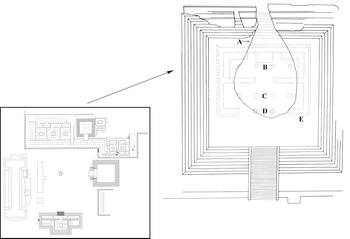
The Pyramid B pillars came to light during Acosta's 1941 field season when he explored a trench that had been cut into the rear (north face) of Pyramid B in prehispanic times (Figure 1a). The trench contained numerous segments of large basalt pieces, including 13 of the 16 sections that would make up the four existing pillars; in 1985, one of the three missing sections was found in excavations along the northern part of Pyramid B (Jiménez Garcia Reference Jiménez García1998:95). Also recovered from the trench were the four famous caryatides or Atlanteans, and portions of two feathered-serpent columns, all of carved basalt. These various objects shared characteristics of style and construction, including the use of tenon and mortise construction, which suggest that all were created in the same time period, with the purpose of expressing a unique iconographic discourse.
Pyramid B, Tula Grande (inset), Tula, Hidalgo. (a) Outline of trench through rear of pyramid; (b) “warrior pillars”; (c) Atlantean columns; (d) serpent columns; (e) plan of temple as suggested by Acosta (Archivo Jorge R. Acosta, Instituto Nacional de Antropología e Historia; Mastache et al. Reference Mastache, Cobean and Healan2002; architectural plan courtesy of Fernando Báez Urincho).

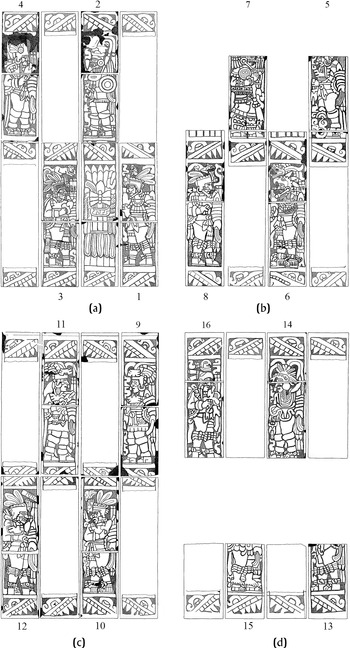
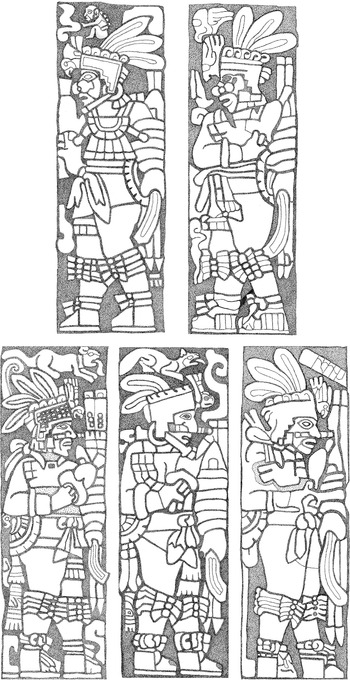
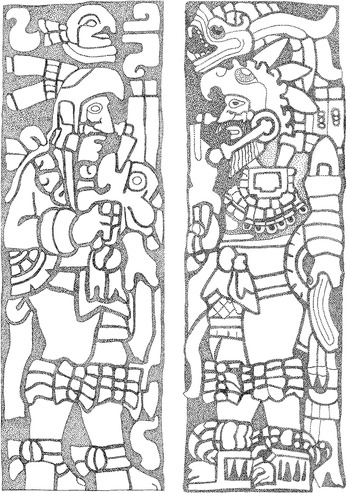
Each whole pillar is composed of four sections; when assembled, these exhibited carved representations of 16 individuals and weaponry, arranged vertically on each face, along with several smaller representations that collectively divide it into two (upper and lower) registers (Figure 2). Each section contains a continuation of the representation from the preceding section, providing a unique and hence unambiguous match when reassembling the four pillars.
(a–d) Individuals (1–16) and other representations on pillars a–d, Pyramid B, Tula, Hidalgo. Drawings by author and Daniel Correa, digitalization by Aarón Arboleyda.

Fragments of charred beams were found inside the trench as well that, according to Acosta, “seguramente provienen del techo que sostenían las pilastras” (Reference Acosta1941:244). Thus, following its consolidation, the reassembled pillars were placed atop Pyramid B, along with the Atlanteans and feathered-serpent column sections, where they were presumed to have supported the roof of the surmounting temple (Figures 1b–1d). Since they were all the same height, the warrior pillars and Atlanteans were presumed to have been inside the temple itself, while the two feathered-serpent columns were presumed to flank its entranceway, a common arrangement for similar feathered-serpent columns and temples atop pyramids at Chichén Itzá. Although no traces of the temple itself were encountered, Acosta provided a tentative reconstruction drawing (Figure 1e), apparently based on the plan of the Temple of the Warriors at Chichén Itzá (Morris et al. Reference Morris, Charlot and Morris1931:125).
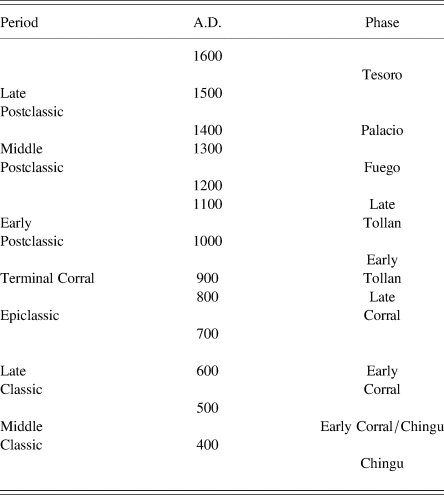
I believe the order of the three kinds of supports as seen in Figure 1 is correct, however, their order (left to right) and the orientation of the faces of the pillars appear to be entirely arbitrary. In the course of this paper I will present a reconstruction of both the order and orientation of pillars a–d, based on evidence and arguments presented below. For the present, however, I will employ a system of nomenclature that follows their current order and orientation, in which the 16 individuals are numbered consecutively, beginning with the rightmost pillar (Figure 2a) in the current placement and proceeding to the leftmost (Figure 2d). Cynthia Kristan-Graham (Reference Kristan-Graham1986:3) dated the columns and pillars atop Pyramid B to the Tollan phase (around a.d. 900–1150; Table 1), when Tula reached its apogee as a major center, and I agree with this dating. In terms of iconography, I propose that the pillars, along with the Atlanteans and the serpentine columns, correspond to period 2-B, the second of two construction phases proposed by Cobean et al. (Reference Cobean, García and Mastache2012:153–158) for Tula Grande (c. A.D. 1000–1150).
Revised chronology for Tula and the Tula region (after Healan et al. Reference Healan, Cobean and Bowsher2021).

The reliefs had been covered entirely with red pigment (Acosta Reference Acosta1956–1957:79), and certain parts apparently contained inlays that possibly included obsidian and/or shell in the eyes and nails of the individuals, and these or other materials in some of the objects that they held. Unfortunately, we do not know if the red pigment was then covered with stucco and if the figures, as well as the objects they carried, had been painted, as was the case for Atlanteans and the carved tablets that adorn the facade of Pyramid B.
Each pillar contains three kinds of representations: individuals, isolated glyphs, and ensembles of weapons (only one of the ensembles, the one between individuals 1 and 3, is shown in Figure 2). These various representations, which alternate between the upper and lower registers across the faces of each pillar, should be regarded collectively as an integrated whole. All of the individuals are depicted as walking, and each possesses certain unique features that distinguish them. On each individual, the body is shown in three-quarter view and the face is shown in profile. The feet face in the same direction, one in front of the other. The arms invariably hold weaponry, and in some cases are bent, while in other cases they are extended alongside the body (Jiménez García Reference Jiménez García1998:96). At least seven individuals (Figure 2:1, 3, 6, 8, 10, 12, and 16) have signs or name glyphs above their heads, but none of these is accompanied by numerals or appears to correspond to Mesoamerican calendrical signs (Kristan-Graham Reference Kristan-Graham1986:3).
The ensembles of weapons and other objects that alternate among the four individuals on each pillar are a prominent feature since they are depicted at the same scale as the humans. All appear to involve essentially the same arrangement of five feathered lances or atlatl darts, over which are placed an arma curva, atlatl (spearthrower), knife, a scepter tied with paper ribbons and bows, a decorated cup, and arrangements of feathers or large plumes or strips of hide (Jiménez Garcia Reference Cobean and Mastache2007:55). The 1:1 ratio of ensembles to individuals and the virtually identical appearance of the former suggest there was an intent to portray the individuals as equals, each of them presumably associated with one of the adjacent ensembles. Such arrangements of arms and ritual objects recall a scene from the Codex Borbonicus, folio 34, involving the ritual burning of bundles of rods tied with rope and decorated with paper (Cobean et al. Reference Cobean, García and Mastache2012:174).
THE HOMBRE-JAGUAR-PÁJARO-SERPIENTE (H-J-P-S) FIGURE
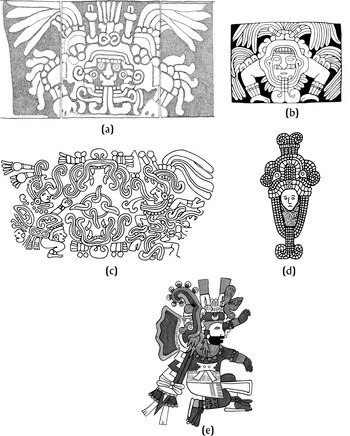
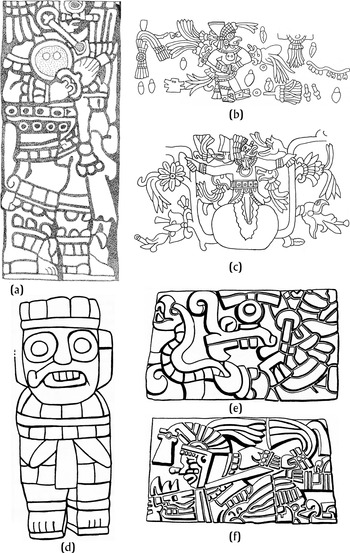
To understand the message contained in the Pyramid B pillars, it is essential to consider other iconographic elements from the structure where they were found. Pyramid B is composed of five talud/tablero tiers, whose facade was faced with carved reliefs displaying quadrupedal animals, birds, and a composite figure that I call hombre-jaguar-pájaro-serpiente, or “h-j-p-s” (Jiménez Garcia Reference Jiménez García1998). This figure is also reproduced in the iconography and architecture of at least two construction stages of Pyramid B, although it is only partially preserved on the north and east facades today (Figure 3a). The h-j-p-s figure has two antenna-like objects above the head that are very similar to nose and ear ornaments worn by many representations of individuals at Tula, and to objects that adorn the nose, head, or tail of various Maya deities of the Classic and Postclassic periods. Cobean et al. (Reference Cobean, García and Mastache2012:156) suggest that the h-j-p-s reliefs were carved during Iconographic period 2-A, dating to the beginning of Tula's apogee and prior to the Pyramid B pillars that belong to the final stages of Toltec splendor.
Hombre-jaguar-pájaro-serpiente (h-j-p-s) and related representations. (a) Pyramid B, Tula (Cobean et al. Reference Cobean, García and Mastache2012:Figure VII.8); (b) Chichén Itzá, Yucatán (Miller and Taube Reference Miller and Taube1993:105); (c) Vasija de Escuintla (Taube Reference Taube1992:Figure 21-b), with individual on right side wearing War Serpent headdress with antennae similar to those on (a) and (b); (d) War Serpent headdress worn by Ruler 1, Piedras Negras (Taube Reference Taube1992:Figure 6-c); (e) Aztec deity Xiuhtecuhtli (Codex Borbonicus, pl. 20, from Mateos Higuera Reference Mateos Higuera1992:Figure 12/1), exhibiting attributes of h-j-p-s figure at Tula: fire serpent and “antenna-like” paired shafts or arrows, beside the descending bird on headdress and stylized butterfly pectoral worn by some individuals on Tula's pillars.

To interpret the h-j-p-s figure that appears repeatedly on the Pyramid B tableros, we turn to a representation that appears repeatedly on the facade of the Pyramid of Quetzalcóatl at Teotihuacan (Figure 4b), noting their similarity and placement on the same type of architectural feature, the talud-tablero façade. Miller and Taube called the Pyramid of Quetzalcóatl figure a jaguar-serpent-bird, described as a serpentine creature from which a human head projects, which they considered a frontal depiction of the War Serpent (Miller and Taube Reference Miller and Taube1993:104; Taube Reference Taube1992:59). While rare in Teotihuacan, frontal views of the War Serpent are more common at Tula and sites in the Maya area, including Piedras Negras and Chichén Itzá (Figures 3c and 3d). According to Miller and Taube, the primary association of this composite image is war.
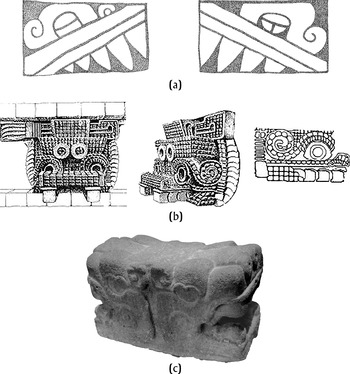
Jaguar-pájaro-serpiente (j-p-s) glyph (formerly “glyph H”) and related representations. (a) j-p-s glyph, pillar b, Tula, Hidalgo (drawings by the author and Daniel Correa); (b) War Serpent, Temple of Quetzalcoatl, Teotihuacan, reconstruction drawing by A. Caso and I. Bernal (Taube Reference Taube1992:Figure 5); (c) seat or throne, Tula, Hidalgo, Museo Nacional de Antropología (photograph by the author).

The h-j-p-s figure depicted on the Pyramid B tableros is a feathered feline in frontal view in which only the body and front paws are seen. It could be a jaguar, but more likely a puma, from whose jaws appear or emerge a human face and a forked tongue that could belong to either the feline or the human. This compound figure appears to be an adaptation at Tula of the War Serpent seen on the facade of the Pyramid of Quetzalcóatl at Teotihuacan. In the late Postclassic period, the War Serpent was transformed into an icon of power and nobility, as seen in the attire of the god Xiuhtecuhtli (Jiménez García Reference Jiménez García1998). In the Codex Borbonicus this deity and his attire are similar in appearance to the h-j-p-s representation on the facade of Pyramid B, including the two “antennae,” as well as the panache worn by the Atlanteans atop Pyramid B (Figure 3e).
Reminiscences of Teotihuacan and Symbols of Nobility at Pyramid B
The Pyramid B pillars include a figure (Figure 4a) that I initially named glyph H (Jiménez García Reference Jiménez García1998). This glyph, which appears on the bottom, middle, and top portions of each face, was previously identified by Kristan-Graham (Reference Kristan-Graham1987:2) as a cipactli glyph. It does resemble a caiman head lacking a lower jaw, and also exhibits a stylized plumed brow over the eye, below which is a band containing a row of pointed teeth and fangs forming an upper jaw. There are some differences in its various renderings on the pillars—that is, the eyebrow can terminate with a curl at one or both ends, the pupils exhibit various shapes, and the teeth and fangs vary in number. The glyph is in fact a composite of three salient elements: the eye of a reptile, the feathered brow of a bird, and the teeth and fangs of a feline (Jiménez García Reference Jiménez García1998:132), and for this reason I now prefer to call it the “jaguar-pájaro-serpiente (j-p-s)” glyph.
The j-p-s glyph, which Kristan-Graham interpreted as a caiman or cipactli, was the first day in some 260-day Mexican calendars, including those of the Aztec, Zapotec, and Mixtec. Kristan-Graham (Reference Kristan-Graham1987:2) thought it therefore might refer to the beginning of time, thus indicating that the individuals on the pillars were ancestors. Similar signs are found in the southeast colonnade of the Temple of the Warriors complex at Chichén Itzá. Kristan-Graham believes that the representations at Tula and Chichén Itzá are more or less contemporaneous, dating from around a.d. 900 (Kristan-Graham Reference Kristan-Graham1987:2–3), although, stylistically speaking, in my opinion the Pyramid B pillars correspond to the final episode of construction at Tula Grande near the end of the twelfth century.
If we compare the h-j-p-s glyph of Pyramid B to the figure on the Temple of Quetzalcóatl at Teotihuacan that Taube identified as the “War Serpent,” in both cases we are dealing with recurring images that appear on the facades of both structures and alternate with other figures. Moreover, both creatures lack a lower jaw.
Taube (Reference Taube1992:82) believes that there was continuity between the War Serpent and the mythological serpent Xiuhcóatl of the late Postclassic in terms of form as well as meaning. As examples, he cites the Ixtapaluca plaque, the ballcourt marker of Arcelia, and other terminal Classic representations of the War Serpent that exhibit clear morphological similarities to Xiuhcóatl. If, as it appears, among the Classic period Maya, the War Serpent was directly associated with the institution of government and was directly identified with the supreme war leader, its importance at Teotihuacan must have been particularly great (Taube Reference Taube1992:82). According to Taube, the Teotihuacan War Serpent was part of the war/fire complex and was the ancestral form of Xiuhcóatl (Taube Reference Taube1992:78). At Tula, the War Serpent would likely also have been a symbol of nobility.
I consider the j-p-s glyph on the Pyramid B pillars to be a synthesis of the h-j-p-s figure that adorned the facades of the pyramid. While the latter figure appears in many contexts at Tula (e.g., Gamboa Cabezas and Healan Reference Gamboa Cabezas and Healan2021), at Tula Grande the j-p-s glyph appears only on the Pyramid B pillars and two other basalt monoliths that appear to have functioned as seats or thrones. One of these, seen in Figure 4c, provides an excellent illustration of its abstract and eclectic nature. What at first appear to be two opposing serpent heads are actually the heads of two felines with bifurcated serpent tongues, and eyes over which a curved element represents the bird's feathered brow. Thus, while both h-j-p-s and j-p-s representations are adaptations of the War Serpent seen on the Quetzalcóatl Pyramid at Teotihuacan, the occurrence of the latter as supporting both seated and standing individuals of prominence in all of its occurrences suggests that it functioned as an emblem of power for the rulers of Tollan-Xicocotitlan.
THE INDIVIDUALS ON THE PILLARS
The sculptural style and iconography of the individuals displayed on the pillars follow the same general canons observed in other representations of warrior figures in Tula. At the same time, each of the 16 individuals on the Pyramid B pillars exhibits notable differences in attire, trappings, and even posture, indicating a conscious attempt to give them individuality, which I believe means that they represent real individuals. All carry weapons and are richly attired, and some have a glyph by their head.
Dress, Accessories, and Arms
Some individuals wear a kilt tied in front that covers the hips, while others wear a loincloth. All wear sandals, some with designs involving stripes or triangles. Accessories include plumes, nose bars, ear spools, dorsal disks, necklaces, breastplates, chest ornaments, bracelets, unusual kilts, such as one shaped like a conch shell interior, kneepads, leggings, and bangles.
Each individual bears the following arms: atlatl, two darts, arma curva, a knife, and cotton padding on the arm. The atlatl is always held in the right hand, usually close to the body in front or to one side, pointed up or down, although one individual rests his arm so that the atlatl hangs next to his legs. Those with padding on the left arm also carry a knife in the top of the padding. The hand holding the atlatl is positioned in various angles, perhaps to show freedom of movement, unlike what Kristan-Graham (Reference Kristan-Graham1986:43) suggests for the individuals on the pillars at Chichén Itzá, where, in some cases, the hand is placed on the opposite shoulder, which could indicate submission. Only one of the individuals on the Pyramid B pillars has his hand on his shoulder, and this does not resemble the pose seen at Chichén Itzá.
Six of the individuals are depicted with speech scrolls, eight are not, and the other two are indeterminate, since they lack the head and upper torso portions of the pillar. Some individuals have volutes around the legs or feet; it is not known what these volutes represent, but it might be copal smoke, the fragrance of flowers, or movement. Kristan-Graham (Reference Kristan-Graham1986:11) noted that the volutes depicted on pillars at Chichén Itzá exhibited certain artistic characteristics seen at El Tajín, Veracruz; but those on the Pyramid B pillars are rather simple and more modest in form.
WHO WERE THE LORDS REPRESENTED ON THE PILLARS?
Names, Titles, and Responsibilities
I have noted that the glyphs on the Pyramid B pillars lack a numeral, hence I do not believe that these are calendrical names, although we know that at Tula there are indeed glyphs with a numerical coefficient (Jiménez García and Love Reference Jiménez García and Love2020). Moreover, those on the Pyramid B pillars are isolated glyphs—that is, they do not occur with other glyphs to form texts.
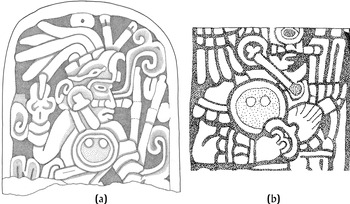
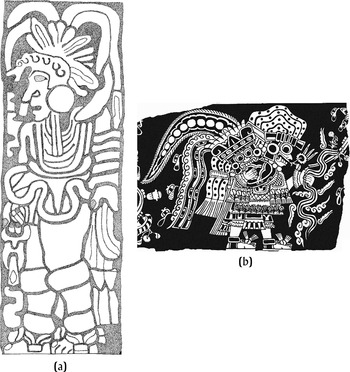
There is a representation of a Toltec-style warrior at the site of Tetmilican (García Payón Reference García Payón1941) in the mountainous region of Guerrero that is very similar to the individuals on the Pyramid B pillars (Figure 5). The warrior wears a headdress that has two “antennae” like those of the h-j-p-s figure on the facade of Pyramid B (Figure 3a), suggesting that the individuals are related in some way (Jiménez Garcia Reference Jiménez García2019). However, the Tetmilican warrior appears to bear a numeral with the glyph, “one eagle,” which would be a calendrical name, unlike those on the Pyramid B pillars.
(a) Human representation from Tetmilican, Guerrero; (b) individual 7, pillar b, Pyramid B, Tula, Hidalgo (Jiménez García Reference Jiménez García2019, http://www.famsi.org/reports/07027/index.html).

While Acosta (Reference Acosta1956–1957:97–100) believed the Pyramid B pillar glyphs indicated the military rank of the individuals, specifically the hieroglyph of totemic animals of various military castes, Kristan-Graham (Reference Kristan-Graham1989:215) proposed that they were personal names or titles, based on her analysis of the Terminal Classic/Early Postclassic sculpture of Chichén Itzá, where she detected two different writing systems: Maya hieroglyphs of the classic style, and name glyphs. The latter, according to Kristan-Graham, are logograms for Yucatec patronyms like those seen in the Temple of the Warriors, and unlike the inscriptions of the classic style that record elite dynastic histories, they identify individuals or historic lineages outside the group, as well as some persons within it (Kristan-Graham Reference Kristan-Graham1986:1, 39).
Kristan-Graham (Reference Kristan-Graham1986:40; Reference Kristan-Graham1987:4–5) believes that the glyphs on the Pyramid B pillars are evidence of a relationship between Tula and the Maya. Noting their similarity to glyphs carved on the pillars of the Temple of the Warriors, she proposes that at both places the glyphs could indicate lineage names, and that in fact some of them at Tula refer to Yucatec lineages, where the names of flora and fauna are most commonly used. Taube (Reference Taube2000:17) also believes that the Pyramid B pillar glyphs are personal names.
At Chichén Itzá, Kristan-Graham (Reference Kristan-Graham1987) found that name glyphs appear on pilasters and pillars in ten different buildings, but are most numerous in the Temple of the Warriors complex, where 27 percent of the 348 individuals on 87 pillars have name glyphs. The majority of the signs represent fauna or flora, such as serpents’ rattles or ears of maize; some depict physical objects, such as a knife, and others refer to an action, such as a mano grinding on a metate. These motifs are very closely related to the Yucatec surnames that Roys (after Kristan-Graham Reference Kristan-Graham1987:5) compiled from early colonial documents. This discovery is of considerable interest, although we cannot be sure that the glyphs at Tula and Chichén Itzá represent the same thing.
Besides referring to their lineage, an individual's personal glyph could imply their priestly, military, administrative, or political function. Dehouve notes that many of the Aztec dignitary names readily reveal the religious function of their charge, including some individuals of high status that function as god impersonators or teohuaque and carry the name of their gods, and in some cases the name of a specific temple (Dehouve Reference Dehouve2013:41–42). It might also refer to their title or function, or link them to a specific place or region, since, as Dehouve has demonstrated, the vast majority of Aztec titles are formed around a toponym, and Nahuatl rules of grammar are sufficiently precise to permit the reconstruction of the phoneme from which is formed the names of the individuals, as in the case of the word mexícatl or mexíhcatl (pl. mexica or mexicah), “he who is the inhabitant of Mexico” (Dehouve Reference Dehouve2013:42). According to Dehouve, other investigators have often misunderstood the meanings of the titles of prominent individuals because they do not realize that they are formed around a place name. The title huitznáhuatl or huitznahuácatl (“He of Huitznáhuac”) is formed on the toponym “near the thorns”—huitz-tli “thorns,” náhuac “near.” She explains that through the use of a rebus or a play on words, the title glyph consists of a thorn (huitz-tli) and a speech scroll that is read “náhuatl” (word or language), which gives us huitz-náhuatl. This play on words mixes náhuac (near) with náhuatl (word). Other titles formed on toponyms include coatécatl (He of Coatlán, “place of the serpents”), huecamécatl (He of Huehuecan, “old place”), tocuiltécatl (He of Tocuillan, or Ocuillan, “place of the worm”), and so on (Dehouve Reference Dehouve2013:42–43, Table 1).
Not only did personal glyphs refer to places, but also to roles. Brigida von Mentz (Reference von Mentz2008:277) notes that in central Mexico and the area of Cuauhnáhuac in the sixteenth century, those who held political and military positions received some of the following names: tlatoani (He that talks), tlacochcálcatl (He of the house of darts), and administrative functions: tepixqui (the guardian) and calpixqui (the mayordomo), among others (von Mentz Reference von Mentz2008:277). In mid-sixteenth-century documents from Cuauhnáhuac studied by von Mentz (Reference von Mentz2008:124, 481), the glyph for thorn represents the title huitznáhuatl, a judgeship. Until the end of the sixteenth century in this region, the positions of huitznahuácatl (judge and warrior), tlilancálqui (he of the black house, a supreme military rank, also title of provincial governor), and tlacochcálcatl (warrior of high rank in charge of the arsenal) were still used to allude to the prestige of their lineages through the use of the old titles in their names (von Mentz Reference von Mentz2008:286).
In her study of the Chichén Itzá pillars, Kristan-Graham likewise refers to place, noting that “the name signs identify the lineages, and implicitly the territories reclaimed by Chichén Itzá” (1986:47). For Mastache et al. (2002:98), the personal glyphs on the Pyramid B pillars could refer to name, position, or rank, and the individuals on the Pyramid B pillars could well represent historical individuals, perhaps rulers of Tula or high-ranking nobility who were members of Toltec dynasties (Acosta Reference Acosta1956–1957; Jiménez Garcia Reference Jiménez García1998; Kristan-Graham Reference Kristan-Graham1989; Mastache and Cobean Reference Mastache and Cobean2000).
Mastache et al. (Reference Mastache, Cobean and Healan2002:104–105) suggested that the individuals on the Pyramid B pillars represent two different hierarchies—specifically, kings or rulers identified by glyphs above the head versus those lacking glyphs who represent secondary elites of high rank, perhaps equivalent to the cihuacoátl of the Mexica or the Toltec high priest to whom Kirchhoff (Reference Kirchhoff1955) referred. If this were the case, then the kings or sovereigns of Tula are represented in the lower register of the pillars, while those in the upper register (except for individual 16, who bears a personal glyph) represent a secondary rank. According to Mastache et al., the figures in each of the registers on a given face walk in opposite directions, so they suggested that individuals walking in the same direction were contemporaries, one representing a king and the other a secondary ruler (as noted below, however, this perception of direction is a distortion of the two-dimensional representation of three-dimensional objects). On the other hand, Kristan-Graham (Reference Kristan-Graham1989:315–317) proposed that all of the individuals portrayed on the Pyramid B pillars were kings, and that the two individuals on a single face represented a newly enthroned and previous king, respectively.
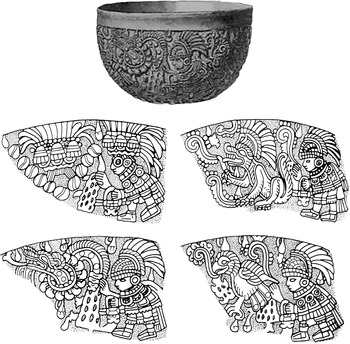
The images on a ceramic vessel of the Teotihuacan tradition from Las Colinas, Tlaxcala (Figure 6) provide a useful comparison to the individuals on the Pyramid B pillars. Taube (Reference Taube2000) suggests that the glyphs that accompany the four individuals on this vessel are their titles. Like the latter individuals, the four on this vessel are very similar to each other in size and dress, each bears a distinct glyph, and two have a speech scroll, while two do not. The Pyramid B individuals are likewise very similar to each other in size and dress and all are armed, while only half bear distinguishing glyphs.
Ceramic vessel from Colinas, Tlaxcala, with representations of individuals bearing personal or titular glyphs (TaubeReference Taube2000:Figure 8).

After reviewing the above suggested identifications and interpretations by other investigators, I believe that the individuals carved on the Pyramid B pillars were real people—that is, historical warriors that were all carved at the same time during the last renovation of the Pyramid B temple. Whoever ordered the representations assigned the same importance to all of them, for groups of arms were carved for each person, as well as being marked by the j-p-s glyph, the emblem of the War Serpent, in order to indicate that they had held power. Some were with speech scrolls, some without, but all were probably ruler-warriors (lords or kings) of Tollan-Xicocotitlan.
The Warrior Elites
The iconography of Tula's sculpture indicates the existence of elite warriors, of whom we see two hierarchically organized groups in the Pyramid B pillars: Xiuhtótotl Warriors and Eagle Warriors.
Nine of the individuals have in common the use of loincloths, kneepads, and anklets fitted with bows of tied paper. Of these, five (individuals 1, 3, 8, 10, and 12) wear a panache with a descending bird on the front, two (6 and 16) wear an avian helmet, and two (13 and 15) are unknown, since they lack the section that would show the upper body. I have assigned the term “Xiuhtótotl Warrior” to those that have the descending bird, although one must note that each exhibits minor differences that may identify a distinct type of bird for each individual. Similarly, the two warriors with bird helmets can be considered “Eagle Warriors,” although their helmets differ. These warriors occupy all eight positions in the lower register of the pillars and one position (individual 16) in the upper register. The paper kneepads they wear are linked to both Tláloc and the Tlaloque, and are also worn by the central figure on the altar in the anteroom of Edificio 4 (Acosta Reference Acosta1956, Reference Acosta1956–1957; Báez Urincho Reference Báez Urincho2021; Jiménez Garcia Reference Jiménez García1998:Figure 52). Kristan-Graham (Reference Kristan-Graham1989:161, 258) notes that the tied knots are similar to elements of dress that Classic period Maya kings wore during autosacrificial rites, one of their key obligations as rulers, and suggested that the kneepads of the Tula personages are tied cloth, stained with their blood following rites of autosacrifice.
I believe that this type of kneepad was a distinctive part of the Tula rulers’ attire. It must be noted that each of the weapon ensembles depicted on the Pyramid B pillars includes a scepter, with ties or paper bows in the center of each. Similarly, the largest stela from Tula shows a richly attired individual wearing these same kneepads and bearing the same weapons carried by the individuals on the Pyramid B pillars, also holding a scepter and wearing a beard that links him to the god king Topiltzin Quetzalcóatl.
Xiuhtótotl Warriors (panache with descending bird)
In his investigations of the iconography of Chichén Itzá, Alfred Tozzer (cited in Mastache et al. Reference Mastache, Cobean and Healan2002) noted that the panache with descending birds was a key diagnostic item for representations of Toltec warriors, and for almost a century scholars have associated the descending bird motif with the royal lineages of Chichén Itzá. According to Kristan-Graham (Reference Kristan-Graham1989:132–134), this motif, which at Chichén Itzá was normally painted blue, can be identified with a lineage that still existed in northern Yucatan during the late Postclassic, the famous Tutul Xiu, which had partial Mexican origins. Given that the term Xiututul in Nahuatl means “turquoise bird,” the descending blue bird motif has been identified with the royal Xiu lineage (Mastache et al. Reference Mastache, Cobean and Healan2002:105).
If this motif at Chichén Itzá is associated with elites of Mexican origin, it would not be surprising that the helmets with a descending bird at Tula (Figure 7) are one of the attributes of kings at Tula (Mastache et al. Reference Mastache, Cobean and Healan2002:105–106). The importance of this icon should be obvious, since it was later incorporated into the attire of the god Xiuhtecuhtli in the late Postclassic (Jiménez Garcia Reference Jiménez García1998:Figure 183), as well as that of Aztec rulers, as seen in the codices of central Mexico.
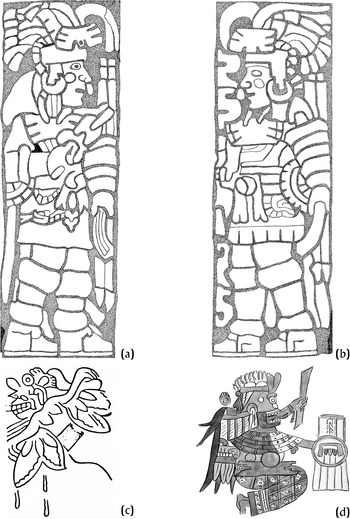
Individuals 1, 10, 3, 8, and 12, pillars a, b, and c, Pyramid B, Tula, Hidalgo. Drawings by the author and Daniel Correa, digitalization by Aarón Arboleyda.

Cobean et al. (Reference Cobean, García and Mastache2012) tentatively assigned Nahuatl names to the Pyramid B pillar glyphs to distinguish them, although their names could have been Otomí or some other language. Individual 1 was named Huehuentzin, “Elder Lord of Maintenance,” given his glyph: an old man in a seated position, whose hands emit a double scroll. Individual 3, whose glyph is a crouching feline with an extended tongue, was named Miztli or Cuitlamiztli (Lord Puma). Individual 8, whose glyph is a crouching animal with pointed ears and extended tongue, was named Oztohua, “Lord Gray Fox.” Individual 10, whose glyph is a downward-facing macaw, was named Alo, “Lord Guacamaya.” Individual 12, whose glyph is a caterpillar or worm with transverse body sections, was named Meocuilin or Cinocuilin, “Maguey Worm” or “Corn Worm.”
Eagle Warriors (helmet)
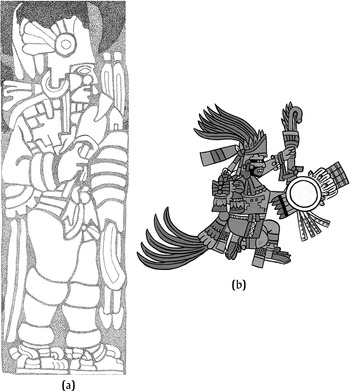
Individuals 6 and 16 (Figure 8) may be predecessors of the Mexica Eagle Warrior. Individual 6 was named Quetzalcóatl since his glyph is a feathered serpent with open jaws and long fangs (Cobean et al. Reference Cobean, García and Mastache2012:166). Kristan-Graham (Reference Kristan-Graham1989:326) notes that Henry Nicholson proposed that individual 6 was a priest dedicated to the cult of Quetzalcóatl. Individual 16 was named Toztli or Toznene (Lord Papagayo) because his glyph is the head of a papagayo with two “canes,” or antennae, and a double frontal volute and a single volute at the back (Cobean et al. Reference Cobean, García and Mastache2012:167). This is the only warrior with a name glyph and kneepads with knotted bows who is situated in the upper register of the pillars, and I believe he is the individual who ordered the construction of the four pillars and the last renovation of the Pyramid B temple.
Individuals 16 and 6, pillars d and b, Pyramid B, Tula, Hidalgo. Drawings by the author and Daniel Correa, digitalization by Aarón Arboleyda.

IDENTIFYING PATRON OR GUARDIAN DEITIES
Seven of the 16 individuals on the Pyramid B pillars exhibit various attributes of deities found at Tula, Chichén Itzá, and Teotihuacan and other sites in central Mexico. All of them—that is, individuals 2, 4, 5, 7, 9, 11, and 14 (Figure 2)—are situated in the upper register of the pillars and wear clothing, panaches, or other paraphernalia that make each appear unique, although two are rather similar to each other. These seven have been previously identified as deified rulers (Cobean et al. Reference Cobean, García and Mastache2012).
It is likely that the attributes of the deities represented by these seven individuals were shared by many pre-Columbian societies. We do not know what language or languages were spoken in Tollan-Xicocotitlan, but its inhabitants probably spoke some variant of Nahuatl, proto-Nahuatl, Otomí, or perhaps some other language that existed in the Tula region. The deities named below share many of the attributes associated with the individuals involved, although it is helpful to remember, as Dehouve (Reference Dehouve2017:11) noted, that each Mexican god generally had ten or more names.
Xipe Totec, Huehuecóyotl, and Ixtlilton (individual 2)
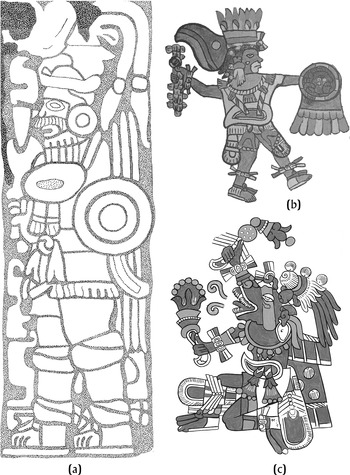
Individual 2 (Figure 9a) wears an ornament on the chest and holds a round shield. Such ornaments, called anáhuatl, were pendants made of pearly conch shell from the Pacific Coast (Vesque Reference Vesque2017:n9). For Postclassic communities in central Mexico, Xipe Totec, “Our lord the flayed one,” was a warrior god (Dehouve Reference Dehouve2017:34), a god of renewed vegetation, patron of metalsmiths, and who identified with Mixcoatl under his various titles (Tena Reference Tena2002:78). In the Codex Tudela, Ixtlilton (Figure 9b) likewise bears a chest ornament and round shield, while in the Codex Borbonicus we see Huehuécoyotl, “Old Coyote” (Figure 9c), the god of the Otomí, also wearing the jewel on his chest (Mateos Higuera Reference Mateos Higuera1992:55). Also known as the “god of dance” (Tena Reference Tena2002:78), in Figure 9c we also see that Huehuecóyotl wears ear ornaments of shell and that the ends of his kilt are rounded—that is, related to movement, round things, water, and fertility. Ixtlilton means “young black individual” or “carinegrillo,” god of recovered health and domestic festivities (Sahagún Reference Sahagún1985:43; Tena Reference Tena2002:75).
(a) Individual 2, pillar a, Pyramid B (drawing by the author and Daniel Correa, digitalization by Aarón Arboleyda); (b) Ixtlilton, Codex Tudela, pl. 44r (Vesque Reference Vesque2017:Figure 10/A); (c) Huehuecóyotl, Codex Borbonicus, pl. 4 (Mateos Higuera Reference Mateos Higuera1992:Figure 5/1).

Xiuhtecuhtli, Ixcozauhqui (individual 4)
Individual 4 (Figure 10a) wears a xiuhuitzolli (diadem) and butterfly pectoral. Xiuhtecuhtli was the “Lord of Turquoise,” god of fire (Dehouve Reference Dehouve2013:34), and Ixcozauhqui was “He of the Yellow Face” (Mateos Higuera Reference Mateos Higuera1992:65). The image of Ixcozauhqui in the Codex Telleriano Remensis has these same two attributes (Figure 10b). In the late Postclassic period and among the Mexica in particular, sovereigns used the xiuhuitzolli diadem as a symbol of power, as having the right to govern. The diadem worn by individual 4 also has a chalchihuitl, which emphasizes the importance and the precious nature of the headgear and its wearer.
(a) Individual 4, pillar a, Pyramid B, Tula, Hidalgo (drawing by the author and Daniel Correa, digitalization by Aarón Arboleyda); (b) Ixcozauhqui, Codex Telleriano Remensis, pl. 6v (Mateos Higuera Reference Mateos Higuera1992:Figure 6/2).

Tezcatlipoca (individual 5)
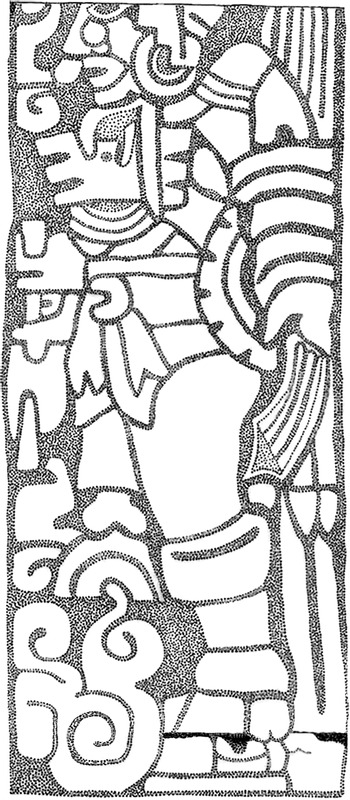
Individual 5 has his right leg cut off and a defleshed lower femur, below which is a disc or half-disk emitting volutes (Figure 11). This is the only representation of this type found at Tula to date. At Chichén Itzá, five of the warriors on pillars in the Temple of the Warriors and the colonnade adjacent to the Temple of the Chacmool have this same mutilation at the knee. For Thompson (Reference Thompson1942:48–50), there could be no doubt that these five figures represented warriors who bear the signature feature of the deity Tezcatlipoca, “He of the smoking mirror,” who, among the Aztecs, was the god of royalty who had multiple functions (Dehouve Reference Dehouve2017:34). In central Mexico, Tezcatlipoca is generally represented with a foot cut off at the ankle or with both feet intact, but Thompson noted that there did not appear to have been any representations of this god with the leg cut off at the knee.
Individual 5, pillar b, Tula, Hidalgo. Drawing by the author and Daniel Correa, digitalization by Aarón Arboleyda.

Tláloc, God of Water, Ehécatl, God of Wind (individual 7)
Individual 7 (Figure 12a) bears all of the principal attributes of this god at Tula, including eye goggles, type Q earspools (round earspools with a tubular bead in the center (Jiménez García Reference Jiménez García1998:Figures 165 and 180), and a fringed top (Cobean et al. Reference Cobean, García and Mastache2012:170). On his chest is a disk with two small perforations, very similar in form to the pyrite mirrors that were found in the offerings in sala 2, Edificio 3 (“Palacio Quemado”) at Tula Grande (Cobean et al. Reference Cobean, García and Mastache2012:Lámina 20). The sandstone bases of these mirrors have the same perforations, suggesting they were suspended as pectorals (Mastache et al. Reference Mastache, Cobean and Healan2002:103). Besides these particular features, a god of wind from the Maya area (Figures 12b and 12c) also wore a round plaque with perforations, a mosaic belt, and fringed tunic like the Tula warriors. The Maya figure also wears an avian beak.
(a) Individual 7, pillar b, Pyramid B, Tula, Hidalgo (drawing by the author and Daniel Correa, digitalization by Aarón Arboleyda); (b–c) individuals wearing pectoral, breastplate, kilt, and belt like those of 12A, Chichén Itzá (Taube Reference Taube2011:Figures 13-e and 14-a); (d–f) images of Tlaloc and Tlaloques, Tula, Hidalgo (Jiménez García Reference Jiménez García1998:Figure 35; Acosta Reference Acosta1960:Láminas XV and XVI).

Tláloc, “He who is made of earthly substance,” was god of the celestial waters and probably god of the earth in more ancient times (Tena Reference Tena2002:76). Ehécatl, god of the wind that precedes rain and identified with Quetzalcóatl (Tena Reference Tena2002:77), wore a mask of a duck's beak. At Chichén Itzá, excavations directed by Peter Schmidt encountered numerous examples in early Postclassic contexts of Ehécatl-Quetzalcóatl wearing a mask of a duck's beak (Taube Reference Taube2011:24).
At Tula, individuals depicted with goggles and a mouth rim with fangs also wear a hair ornament of several tied paper ribbons (Figure 12d). They are associated with other aquatic elements, namely serpents (Figure 12e), and with Tlaloques (Figure 12f), reclining individuals holding a baton decorated with shells and paper bows. However, the latter individuals are also associated with war, since warriors and rulers also bear their insignia. In earlier times, Tláloc was he who “tended over the earth,” and was god of rain, and his assistants were the Tlaloque (Dehouve Reference Dehouve2013:34). Tláloc, with his many names and duties, was the omnipresent deity of Mesoamerican cultures of the Classic and Postclassic periods.
Itzpapálotl, “Obsidian Butterfly,” Cihuacóatl, “Snake Woman” (individuals 9, 11)
Individuals 9 and 11, face to face on the same pillar, share many attributes, including a stylized butterfly worn both in the headdress and as a pectoral, a circle over the cheek, and a kilt decorated with a rattlesnake (Figures 13a and 13b). The emphasis on the butterfly suggests it represents the principal insignia of these two warriors. Indeed, the stylized butterfly was an insignia that many of the representations of warriors of Tula wore on their chest. It was associated with war and warriors killed in battle. It is likely that the headdress corresponds to some warrior hierarchy since it is present on other representations of warriors at Tula.
(a–b) Individuals 11 and 9, pillar c, Pyramid B, Tula, Hidalgo (drawings by the author and Daniel Correa, digitalization by Aarón Arboleyda); (c) panel with image of Itzpapálotl, Edificio 1, El Corral, Tula, Hidalgo (Acosta Reference Acosta1956–1957); (d) Cihuacóatl, Códice Ixtlilxóchitl (Mateos Higuera Reference Mateos Higuera1992:Figure 16/3).

The butterfly wings associate these individuals with Itzpapálotl, “Obsidian Butterfly,” who, to the people of central Mexico, was mother-goddess of nomadic or Chichimeca hunters to the north (Tena Reference Tena2002:79), while the pectoral, the snake, and the circle on the cheek are seen in representations of the late Postclassic goddess Cihuacóatl, “Snake Woman” (Figure 13d). One of the best-known representations of Itzpapálotl in fact comes from Acosta's excavations of El Corral, a circular pyramid dating to the Tollan phase, located approximately 1 kilometer north of Tula Grande (Acosta Reference Acosta and Moctezuma1974:47; Jiménez García Reference Jiménez García1998:322). The representation is a carved stone tablet containing the image of a woman with a fleshless face and butterfly wings (Figure 13c).
Given their strong similarity, individuals 9 and 11 may represent twin gods. Their main differences are that individual 9 has speech scrolls; there are some differences in the kilts worn; and the serpent belt is more evident on individual 11, exhibiting a forked tongue and rattles.
Quetzalcóatl, God of Storms (individual 14)
Individual 14 appears to represent Quetzalcóatl, the “plumed serpent,” by his headdress decorated with small shells and his kilt that represents a transverse section of a large shell (Figure 14a; Cobean et al. Reference Cobean, García and Mastache2012:172; Jiménez García Reference Cobean and Mastache2007:57). The attributes of this deity, which we encounter among various gods in late Postclassic central Mexico, seemingly go back to Teotihuacan times. Wrem Anderson and Helmke (Reference Wrem Anderson and Helmke2012:10) list the traits shared by various representations of this deity, as well as their facial characteristics, noting a continuity that extends from Teotihuacan to the Mexica deity Tláloc, and they prefer to call him the storm god, referring to the deity with goggles at Teotihuacan (Figure 14b). The Teotihuacan storm god had a headdress of bows and round earspools with pendants. In Mexica times, Quetzalcóatl was the god of royalty who served many functions (Dehouve Reference Dehouve2013:34). At Tula, representations of Tláloc have a hairpiece of strips of paper that form a bow and type Q earspools, but the individuals on the pillars with round earspools have those with a band-like pendant instead. These individuals also have other objects on their body that are related to the later Mexica solar and fire deities, like the xiuhuitzolli headdress or a panache decorated with butterflies. One such individual wears a panache decorated with shells, which infers a solar connection.
(a) Individual 14, pillar d, Pyramid B, Tula, Hidalgo (drawing by the author and Daniel Correa, digitalization by Aarón Arboleyda); (b) Storm God, Techinantitla, Teotihuacan (Wrem Anderson and Helmke Reference Wrem Anderson and Helmke2012:Figure 13).

SUMMARY
In the preceding sections I have made the following observations:
• The individuals on the Pyramid B pillars are not simply warriors, but rulers dressed to give them a bellicose appearance, wearing elite attire while bearing weapons (atlatl, two darts, arma curva, knife, and arm padding).
• All of these 16 individuals were rulers, because all are presented at an equal scale in fine attire and in association with the j-p-s glyph that I consider a symbol of power. The weapon ensembles that accompanied each of them could be the offerings they gave to their gods or the ones they received when they assumed power.
• All eight individuals in the lower register and one (individual 16) in the upper register share two elements of clothing—loincloth and kneepads with knotted bows—and at least seven have glyphs next to the head, which indicates that they were real people. Among these individuals, two subgroups can be distinguished: ones that wear headgear with a descending bird and ones that wear an avian helmet, which I believe represent two military orders: Xiuhtótotl and Eagle Warriors. The kneepads and paper anklets associate them with Tláloc, and some wear a butterfly breastplate that links them to Xiuhtecuhtli or Itzpapálotl deities. The glyphs appear to represent personal names in Nahuatl, Otomí, or another language of the region, but they may also refer to other things at the same time—their title, function or position, military rank, or provenance.
• The other seven individuals, all of whom are located in the upper register, are represented as warriors associated with various guardian deities, given that each manifests one or more distinctive elements of a particular deity.
• Individual 16, “Lord Papagayo,” the only individual in the upper register with a glyph and other attributes shared with the rulers in the lower register, is believed to be the last to have ruled and the one who ordered the construction of the pillars as part of the last renovation of Pyramid B and its temple.
I propose that all the individuals portrayed on the pillars were real people, because they each have features that make them different. They are not static representations, but rather dynamic individuals, each appearing to have been posed in a manner that the artists and sculptors chose or were compelled to depict. In addition to the more obvious differences seen in their clothing, each individual exhibits subtle differences in body size and facial characteristics that further differentiate them and tell us that they were real people. Although they do share certain features of clothing and other objects that group them into various warrior societies, each remains a unique individual.
TENTATIVE RECONSTRUCTION OF THE ORDER AND ORIENTATION OF THE PILLARS
It must be remembered that there is no conclusive evidence that the columns and pillars that adorn the top of Pyramid B were in either the arrangement or the order that is seen today or that they had even been placed atop Pyramid B to begin with. No traces of a temple remained atop Pyramid B, and the columns and pillars were found dismantled in a trench that had been dug through the middle of the pyramid. Despite these uncertainties, I believe the basic configuration seen today is accurate. Although there are many other pillars and columns in Tula Grande, all others were built of masonry, and it is reasonable to assume that the massive basalt columns and pillars had been placed atop the pyramid in which they were found rather than in the adjacent vestibules and buildings that have their own columns and pillars of masonry. Moreover, I agree with Acosta that the fragments of charred beams that were also encountered in the trench would almost certainly have come from the roof of the building they had supported.
Acosta provided a tentative reconstruction of the temple that shows the Atlanteans and pillars in separate rooms (Figure 1e), a reconstruction that appears to have been based on the plan of the Temple of the Warriors at Chichén Itzá (Morris et al. Reference Morris, Charlot and Morris1931:125), including the hypothetical placement of benches in the back room. It is almost certain that the two feathered-serpent columns would have been at the front, flanking the entrance to the temple at the top of the stairs, as seen in several structures at Chichén Itzá. Like the serpents, the Atlanteans are sculpture “in the round,” designed to have been seen from the plaza. Acosta reconstructed the entrance to the temple as very wide, which would have facilitated this view. It could have been even wider, perhaps a portico open on the side facing the plaza. On the other hand, the carved pillars, with their rich details and iconographic elements that could not be seen from the plaza, were not intended to be seen by the public and would have occupied the private space inside the temple.
Unlike the Atlanteans, each of the pillars is distinct, each face is unique, raising the question of how the pillars were ordered and how their faces were oriented. I believe that it may be possible to determine both with a reasonable level of confidence. In attempting to achieve these goals, one must appreciate that each pillar is a three-dimensional representation. Presentation of the faces in two dimensions, such as the “rollout” seen in Figure 2, is a convenient method of perceiving them in the whole, but it is a distortion that introduces errors of interpretation. For example, in Figure 2 the individuals on opposite faces appear to be walking towards each other, but in reality they are walking side by side in the same direction.
I propose that the representations on the pillars form a narrative according to the wishes of Lord Papagayo (individual 16), which might be revealed if we could reconstruct the original order and orientation. As the king who commanded its creation, I propose that his representation would have occupied a position of prominence, seemingly one facing the entrance. If pillar D is oriented in this manner, then individuals 13 and 15 in the lower register are oriented so that they appear to proceed into the interior of the temple. This makes sense because the two processions of individuals on the benches in the vestibule in front of Pyramid B meet at the foot of its stairs (Jiménez García and Cobean Reference Jiménez García, Cobean and Evans2016), hence individuals 13 and 15 could be considered a continuation of this same procession. By arranging the other three pillars in the same way, the rulers in the lower registers become the heads of the processions that originated in the vestibule and continued up the stairs and into the temple atop Pyramid B. Interpreted in this way, the original orientation of each pillar becomes unambiguous.
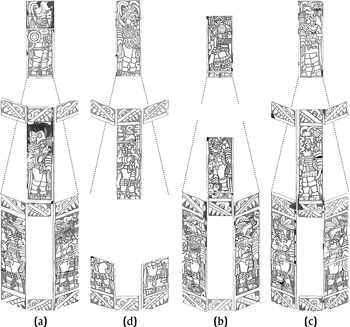
If the above is correct, those facing the entrance would have been individuals 4, 5, 9, and 16. As seen in Figure 2, individuals 16 and 9 proceed towards the right, while 4 and 5 proceed towards the left. Assuming that the pillars would have been arranged so that these four individuals were converging on the axis of entry to the temple, there are only four possible sequences of these four individuals (16-9-4-5, 16-9-5-4, 9-16-4-5, and 9-16-5-4). Figure 15 presents what I consider to be the most likely of the four, namely 9-16-5-4, for the following reasons. I believe the most prominent positions would be the two that frame the axis of entry to the temple. One of these would have been occupied by “Lord Papagayo,” who approaches the axis of entry from the left, and hence would have occupied the position on the left side of the axis. The position on the right side of the axis would have been occupied by one of the two individuals who approach the axis from the right: individual 9, one of two individuals, possibly twins, who personify the deities Itzpapálotl and Cihuacóatl, and individual 5, the personifier of Tezcatlipoca, whom I believe would more likely have occupied the other position of prominence.
(a–d) Suggested order and orientation of Pyramid B pillars based on arguments presented in text. Individuals on back face (top row) are pictured in reverse to show their orientation as would be seen by the viewer. Drawings by the author and Daniel Correa, digitalization by Aarón Arboleyda.

Figure 15 depicts the resulting order of the four pillars (a-d-b-c) and the orientation of their faces based on the above discussion, presented in a way that retains their relationship from three-dimensional space. The individuals on the back faces are therefore oriented as they would be seen by the viewer—that is, the reverse of how they appear in Figure 2—thus correctly showing that the individual on the back of each pillar is proceeding is the same direction as his counterpart on the front.
FINAL COMMENTS
In summary, I suggest that the rulers who occupy the lower register are portrayed as a continuation of the processions of individuals that originate in the vestibule and converge at the stairway of Pyramid B. In fact, they appear to be leading these processions, a function worthy of rulers. With one exception (Lord Papagayo), the rulers in the upper register may well have fulfilled the function of teohuaque, representing the deities of the temples or the guardian deities of barrios, and, by fulfilling that function, were given their identity. It is interesting to note that the Atlanteans wear the same smooth kneepads as the individuals in the upper register and both support (i.e., are in direct contact with) the temple roof—hence they were probably equivalent to the holders of the universe among the Maya.
The presence of Lord Papagayo as the only named ruler in the upper register indicates his exceptional status as the last king in the sequence who ordered the creation of the pillars to record his royal lineage and to establish his legitimacy as a ruler. Therefore, it is likely that the sequence of individuals constitutes a narrative of the succession of rulers, but not one that is readily apparent, for a number of reasons. A specific order is not obvious due to the representation of individuals in three dimensions that makes it possible to view the sequence from more than one perspective. The rulers that personify gods have no name glyphs, and hence cannot currently be identified. While the order of the pillars and the orientation of their faces as seen in Figure 15 represent what I believe to be the most logical arrangement, other, equally logical arrangements may exist, hence there is no guarantee that this is the correct one. However, I believe I have provided the conceptual and methodological groundwork for further research.
With a more detailed study of the complete corpus, including fragmentary specimens, of human sculpture from Tula, one that would include a consideration of provenance, context, and chronology, it may be possible not only to gain greater knowledge of the specialized clothing, weaponry, and other regalia associated with the warriors and dignitaries of ancient Tula, but also to shed light on how the warrior elites and their societies came into being and how they evolved over time.
Finally, it must be noted that a major part of this new interpretation of the individuals on the Pyramid B pillars was made possible by the discovery, in 1985, of one of the missing upper sections of pillar B. Kristan-Graham's studies were made without knowledge of this discovery, and Mastache et al. (Reference Mastache, Cobean and Healan2002) provide a discussion and an illustration of the section, but not in relation to the rest of the pillar. Most important, the find now places Quetzalcóatl and Tezcatlipoca in the lower and upper registers, respectively, of the same pillar, which appears to support the indigenous chronicles that speak of the succession between the two kings, and offers a possible clue to the reading order of the sequence of individuals. It also raises the intriguing possibility that the conflict between the two described in the chronicles might actually have occurred.
RESUMEN
La pirámide B de Tula es uno de los edificios más importantes del recinto sagrado de la ciudad. De su iconografía destacan los relieves plasmados en los pilares porque muestran una narrativa sobre personajes que vivieron antes del año 1200.
Después de analizar sus atributos y compararlos con otras imágenes plasmadas en piezas arqueológicas y códices del centro de México, puedo decir que los individuos en los pilares no son simplemente guerreros, sino reyes que visten trajes sagrados y armas propias de la élite de Tollan-Xicocotitlan: lanzadardos, dos dardos, arma curva, cuchillo, y banda acolchada.
Los 16 individuos de los pilares debieron ser reyes, porque a la cabeza y a los pies de cada uno de ellos hay un glifo de poder que conjunta al jaguar, al pájaro, y a la serpiente (j-p-s). Este glifo y el que incluye la figura humana (h-j-p-s) son adaptaciones en Tula de la Serpiente de Guerra que se ve en la Pirámide de Quetzalcóatl en Teotihuacán. Su existencia en Tula como un asiento, además de acompañar a los individuos en los pilares de la Pirámide B, apuntan a que funcionó como emblema o ícono de poder de los gobernantes de Tollan-Xicocotitlan.
Los individuos fueron dispuestos en dos hileras, inferior y superior. Los ubicados en el nivel inferior y uno en el superior se caracterizan por vestir taparrabos y rodilleras con moños. Siete llevan glifos junto a la cabeza, lo que indica que tuvieron nombre, función, cargo, título, rango militar o procedencia, es decir, fueron personas reales. De ellos, se distinguen dos subgrupos—uno que usa tocado o penacho con pájaro descendente, y otro con yelmo de ave—los cuales parecen equipararse a órdenes militares de Xiuh-tótotl y Águila. Quienes visten rodilleras y ajorcas con moños, posiblemente de papel, se relacionan con Tláloc, y los que llevan pectoral de mariposa, a las deidades Xiuhtecuhtli o Itzpapálotl. En cambio, los otros individuos que se ubican en la parte superior, se ostentan como guerreros asociados a determinadas deidades.
Sugiero que los reyes que tienen su nombre, cargo o distinción, es decir, los que ocupan el registro inferior, sean retratos de quienes encabezaban las procesiones de individuos que se concentraban en los vestíbulos para acceder a la escalinata de la Pirámide B. Como reyes, lideraban esas procesiones. Por otra parte, los reyes en el registro superior—con una sola excepción—bien pudieron ser teohuaque, es decir, representantes de las deidades de los templos o de las deidades tutelares de los barrios o señoríos y que, por cumplir esa función, no se les puso su nombre.
El señor “Papagayo” es el único rey nombrado en el registro superior e indica su estatus excepcional; por ello, propongo que fue el último rey en la secuencia, quien ordenó la elaboración de los pilares para dejar constancia de su linaje real y el consecuente derecho a gobernar. Es probable que la disposición de los individuos constituya una narrativa en la sucesión de reyes, donde el orden no es obvio debido a su representación en tres dimensiones o de bulto—el espectador puede verlos desde distintos ángulos—y los reyes que personifican dioses no tienen glifos de nombre, lo que hace que no podamos identificarlos actualmente.
Aquí discuto sobre la distribución y orientación que debieron tener los pilares originalmente, así como la relación que guardaban unos señores con respecto a otros. El hallazgo de los pilares dentro de la Pirámide B por parte de Jorge R. Acosta le dio la pauta para plantear que se encontraban en lo alto de la misma construcción, formando una hilera al fondo del templo. Esta investigación concluye que los personajes de los pilares encabezaban las procesiones y sólo los reyes entraban al templo de la Pirámide B. En Tula, los hombres deificados y la serpiente emplumada no sólo sostenían el techo del templo, sino que eran las principales deidades de la última etapa de apogeo de la ciudad.
ACKNOWLEDGMENTS
I am grateful to Robert H. Cobean, Dan M. Healan, Luís Gamboa Cabezas, Aarón Arboleyda Castro, and Daniel Correa Baltazar for their collaboration during the different stages this work went through towards its completion. To Cobean and Healan for the exchange of information and scholarly discussions that we had, from which my approach to the problem has greatly benefited. To Healan I am also grateful for the review, supervision, and editing of the manuscript, and for asking me questions that I should have asked of the archaeological materials. To Gamboa for giving me complete freedom of access to the pillars for drawing and study. To Arboleyda for revision of the text, digitalization of the drawings, and for his company throughout the investigation. To Correa for his patience in deciding how the drawings should be done, the successful outcome of which is clear to see. And again to Healan for his English translation of the manuscript. I am also grateful for the willingness and support of William Fowler for publishing these interpretations that I have made of the images on the pillars, which were part of one of the most sacred spaces of Tula.