Introduction
The extent of opportunities for full participation and citizenship for older people who are frail or have high care needs has long been criticised (van Hees et al. Reference van Hees, Horstman, Jansen and Ruwaard2015). The aged-care environment in particular has traditionally been characterised by control, risk management and a focus on pathology; as a result, client autonomy and participation has been compromised (DeForge et al. Reference DeForge, van Wyk, Hall and Salmoni2011; Huby et al. Reference Huby, Stewart, Tierney and Rogers2004; Mitchell and Glendinning Reference Mitchell and Glendinning2007). This is emphasised for those who are seen as ‘impaired’, particularly when the focus is placed on ‘managing’ those individuals, rather than managing the situations in which risk exists (Bailey et al. Reference Bailey, Clarke, Gibb, Haining, Wilkinson and Tiplady2013). Ageist constructions of older service users as dependent and incapable have also resulted in restriction of participation (Wikstrom and Emilsson Reference Wikstrom and Emilsson2014). Further, a policy focus on ‘active’ or ‘successful’ ageing has been criticised for ignoring the lived reality of those who have extensive care needs (Timonen Reference Timonen2016). It is these older people, who may be considered outside the realm of ‘successful’ ageing and who have traditionally been seen as too frail to participate, who are most at risk of being excluded from opportunities to have their voices heard. Even those who are able to retain a greater degree of control over their daily lives may have their freedom and autonomy limited because their lives, and physical personal spaces, need to be rearranged around others (van Hees et al. Reference van Hees, Horstman, Jansen and Ruwaard2015).
Client engagement is, however, increasingly seen as central to aged-care service development and provision, with growing calls for older people, regardless of their level of frailty, to have a voice – and control – in the services they receive as well as the policy that guides these. As well as being a prerequisite for the provision of person-centred care, engagement at its simplest level is an important part of service design and evaluation, and is used to facilitate the development of policies that are informed, appropriate and responsive, and that are delivered efficiently (Gregory Reference Gregory2007). Emerging discourses about power and citizenship that have highlighted the centrality of clients’ rights and responsibilities in care services have also driven a more fundamental philosophical shift in the way care is conceptualised and services are provided.
This is being translated into practice in various ways. For example, in many Organisation for Economic Co-operation and Development countries an increasing focus has been placed on the client's role through the introduction of personalised or consumer-directed care schemes. Client involvement in decisions that affect them has also long been required under service accreditation standards and service regulations (e.g. in Australia, the Aged Care Accreditation Standards). More recently, increasing initiatives towards co-design and co-production are appearing in the care space, as well as initiatives to promote collective action among service users, albeit largely restricted to individual projects (e.g. Baur et al. Reference Baur, Abma, Boelsma and Woelders2013; van Malderen et al. Reference van Malderen, Vriendt, Mets and Gorus2016). This shift towards client voice, choice and control has highlighted the fundamental importance of effective engagement practice to support the implementation of these philosophical ideals.
The enactment of these increasing opportunities for participation and empowerment, however, varies considerably. Critiques of broader engagement processes in aged care have identified a reliance on formal consultative or consumerist approaches that reinforce existing agendas (Baur et al. Reference Baur, Abma, Boelsma and Woelders2013). Initiatives or processes that involve greater degrees of power and control for clients in areas other than individual-level care decision making are more rare, and can be challenging to facilitate (Abma and Baur Reference Abma and Baur2014; Baur and Abma 2011Reference Baur and Abmaa; Baur et al. Reference Baur, Abma, Boelsma and Woelders2013). It is for this reason that considering the range and complexity of the forms engagement can take is vital in exploring power relationships in the care context.
Understanding engagement
Terms such as engagement, participation, involvement and consultation are often used interchangeably. The notion of engagement incorporates a broad range of activities, including those designed to inform or educate, gather information or consult, discuss or involve, collaborate on a more equal footing, or empower clients (Health Canada 2000). Whilst different types of engagement call for greater or less involvement on the part of clients, no type is considered to be inherently better than another; rather, they fulfil different purposes and provide for different depth of involvement (Queensland Health 2010). Seen as a continuum, however, they involve incremental increases in power sharing by the organisation, and in responsibility and control by the client. Further, engagement may occur at different levels of decision-making focus or proximity to the individual client, from the individual through to the service, organisation and broader system level, affording broader or narrower scope of influence to clients. It may also be more reactive or more proactive (Department of Health and Human Services Tasmania 2009), representing different degrees of commitment to client influence beyond their own interests.
The approaches to engagement that are used within an organisation are therefore vital in understanding clients’ autonomy, control and influence in this context of aged care. The practice of engagement by aged-care providers gives important insights into the extent to which older people have influence both inside and outside their own immediate sphere of care and the opportunities this presents for empowerment. It is therefore important to understand how engagement is conceptualised and practised by those who facilitate and participate in engagement processes. Interrogating practice in this way allows exploration of the power relationships inherent in this context in order to understand service user engagement in aged care and how it can be supported. However, while power relationships in care have been given some attention, including in regard to personalisation schemes and person-centred care, rarely are organisational practices interrogated in depth.
This paper explores understandings and practices of engagement within one large aged-care organisation, considering the perspective of both staff and clients. In other papers, we have explored the roles and positions that clients and staff take up or are given in the way they talk about engagement in aged care (Petriwskyj, Gibson and Webby Reference Petriwskyj, Gibson and Webby2014, Reference Petriwskyj, Gibson and Webby2015a, Reference Petriwskyj, Gibson and Webby2015b). In this paper, we explore how those positions are enacted in the opportunities for engagement that are offered or created within the organisation, and what this means for the extent of client power. The focus of this research was on exploring the practice of client engagement in depth within one large aged-care organisation, to consider what forms of client engagement were being implemented, how they were being implemented, and to what extent older people could effectively participate in service provision at the level of the individual, service, local community and organisation.
Research approach
This research was conducted across 17 service locations of Blue Care, which is a large Australian aged-care service. This organisation operates across metropolitan, coastal and rural/regional areas, and consists of residential and community care services, as well as retirement living services. Ethical approval was gained from the Human Research Ethics Committee governing research conducted in Blue Care (reference number Petriwskyj 11712).
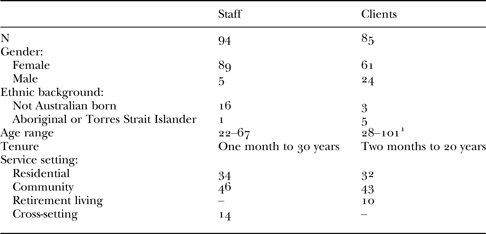
Invitation letters were distributed directly to participants accessed through the organisation, or distributed by service managers. Ninety-four staff participated from residential and community services. Their roles included assistants in nursing, personal carers, administrative staff, service managers, activities, hospitality, clinical nursing and allied health staff, chaplains, upper management, and managers of special programmes and initiatives. Staff members at both operational and strategic levels within the organisation participated. Eighty-five clients across residential, community and retirement living settings took part. Participant characteristics are presented in Table 1. All participants received an information sheet as well as verbal explanation and signed a consent form.
Participant characteristics

Note: 1. Since this organisation provides services to clients of a very broad age range, and because focus groups took place in the care setting with established groups, the age range of the sample is broad and includes those who would not be considered ‘older people’; 88 per cent of clients who participated gave their age as over 65, with only one client aged under 50. As all the clients who were younger in age participated in focus groups rather than individual interviews, it was not possible to separate their responses.
Interviews and focus groups were conducted by the first and second authors on location at each service, during 2012. The involvement of these university researchers, who were independent of the organisation under study, was an important strategy for ensuring rigour. Thirteen focus groups and nine semi-structured individual interviews were held with staff and two interviews and 12 focus groups were conducted with clients. Use of a semi-structured interview schedule allowed for flexibility while promoting consistency. The questions explored the forms of engagement and opportunities for client participation that were, or had previously been, in use in the organisation, their frequency, their effectiveness, their importance in the context of care, roles and responsibilities for engagement among staff, barriers and facilitators to effective engagement, and client preferences for engagement.
Throughout the research process, the researchers paid reflexive attention to their own positions as younger Caucasian women conducting and analysing interviews with older people, Indigenous people, and people from culturally and linguistically diverse backgrounds about their care experiences. Interviews and focus group discussions were recorded and transcribed verbatim. All quotations were also reported verbatim to retain participants’ voices.
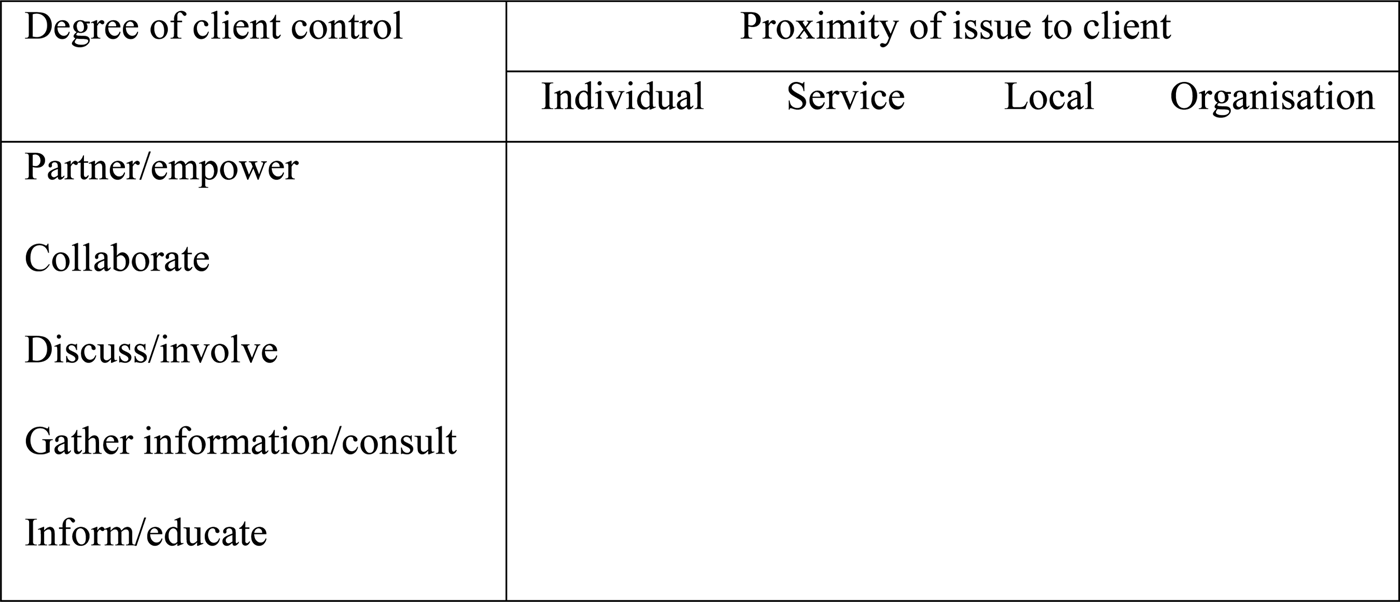
The transcripts were analysed using QSR International's (2012) NVivo 10 qualitative data management software. Analysis involved multiple stages of coding, including a combination of open and axial coding, to identify concepts, which were distilled and organised within themes (Strauss and Corbin Reference Strauss and Corbin1998). For the purpose of this paper, the data were analysed for themes relating to client engagement and to identify the different forms of engagement that participants discussed. Data were analysed using a framework that reflected the broadly accepted understandings of service user engagement in health and social care and adopted a matrix which is shown in Figure 1.
Engagement matrix.

Findings
What is engagement?
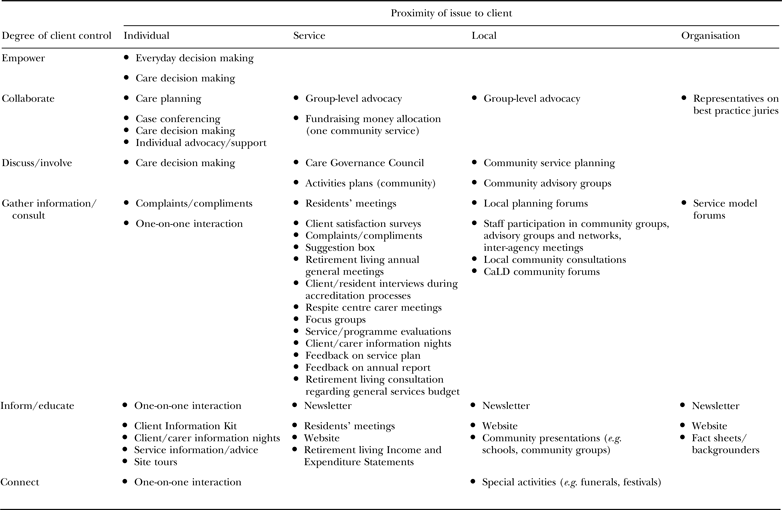
Findings across the sources of data highlighted diverse conceptualisations of engagement within Blue Care, ranging from a very broad perspective on the client's role as having input into every aspect of their care experience, through to specific types of situations in which engagement can take place. The areas in which engagement occurred varied in their objective and purpose. Interactions were both formal and informal, although mostly formal across individual, service, local and organisational levels. Some were purely interpersonal interactions or referred to relationships between staff or the organisation and clients; others were focused more broadly at the service and organisational levels. The engagement strategies and activities identified in interviews and focus groups are summarised in Table 2.
Engagement activities identified

Note: CaLD: culturally and linguistically diverse.
In analysing the engagement strategies discussed, three main points were identified. The first related to patterns in the level of control and power sharing involved in engagement strategies in different decision-making domains. The second related to issues around organisational control of processes, and the impact this had on the effectiveness of engagement. Finally, an additional category of engagement was identified that is particularly relevant to the aged-care context, and which is added to our model here: that of connection.
Relationship between depth and scope of influence
Patterns can be identified in the engagement mechanisms and strategies discussed by staff and clients with regard to the scope of client influence at different levels of decision making. While the more controlled and less collaborative forms of engagement were seen at all levels, including that of the organisation as a whole, collaborative and empowered roles for clients were largely restricted to the individual and, to a smaller extent, service level. One staff member reflected on the various approaches in the organisation:
I think the individual engagement is much easier because that is our business … it's more at the group and community level that we have struggled but in saying that when the organisation does make a business decision to engage … it's done on a grand scale and it's done well. (Community staff)
Initiatives designed to inform clients (and potential clients) or as educational opportunities occurred across the individual, service, local and organisational levels. For the most part, traditional information-sharing mechanisms were used. However, activities at this level of engagement occurred both as an end in themselves (e.g. newsletters) and as a facilitator or supplement to more participative mechanisms (e.g. information nights to support collaborative care decisions) and both active and passive forms of information sharing and education were evident. This suggests an approach to information sharing that is not simply as a passive fulfilment of requirements, but as an intentional form of engagement.
Consultation processes were common; however, these occurred most frequently at the service and local levels. Some strategies crossed domains; for example, compliments and complaints procedures, while focused on the individual, were used in aggregated form at a service and organisational level as broader information about issues across the service. This was an organisation-driven process that was designed to offer clients an opportunity to have some input into the direction taken at the service and organisational levels.
At the service level, consultation was both formal, e.g. client experience surveys and residents’ meetings, and informal, e.g. dialogue between staff and clients:
There's a box down near the office and they've got papers sitting up behind it, and you can take a paper, you don't have to write your name, and then they've got a box and you just poke it into. That's how come they've got two letters from me because that's what it's there for. Whether the residents can get down there and do it for themselves is another thing because some of them have got walkers and some are in wheelchairs. (Residential client)
Other consultation activities occasionally provided opportunities for client input into organisational-level decisions and planning. These included, for example, consultation forums to contribute to designing the organisation's service model, to which some clients were invited. Such activities were a relatively rare occurrence; however, one respondent had been a participant in one such forum, and was a client who was regularly called on, as a community leader, for advice:
I know [executive member] well, she keeps in touch with me … I've had a session with them here too. Which is good because you're able to voice … well I wouldn't go somewhere where you were gagged. I just said that things were pretty good, and just things that we needed. (Community client)
At the local level, consultation mechanisms were both specific and targeted, such as local community consultations and community forums, and local service planning processes, and opportunities that occurred through participation in other activities, such as community groups, advisory groups and networks, and inter-agency meetings. This activity was seen by managers as vital in building and maintaining relationships with clients, their families and other community stakeholders. Apart from acting as a presence at the local level, strategies such as community consultations offered ways for the service to gather clients’ opinions about its operation and to make suggestions about the future direction of the service.
Strategies involving greater collaboration were seen as a vital part of care. Some of these occurred at the service and local levels, and client representation had, at different times, been sought on advisory groups such as best practice juries and the care governance council at the organisational level. However, collaborative decision making was most often demonstrated by clients participating in individual care decisions and care planning. Both clients and staff saw this collaboration at an individual level as an important part of engagement and of client autonomy. These discussions happened in both formal and informal ways on an ongoing basis; discussion with clients, and involving them in decision making at the individual level, required an on-going process of negotiation amongst staff, clients and relatives. At times, this collaborative relationship became more advisory when clients chose to defer to professional opinions; however, clients recognised the efforts of staff to engage them in decision making.
Opportunities for client empowerment and client control were similarly largely confined to the individual level, and particularly to ‘everyday’ autonomy. Everyday individual-level decision making (e.g. related to dressing, eating, activities, etc.) was an important and frequent engagement scenario in both community and residential services. Client control and autonomy in everyday issues and decisions was seen as helping older people to retain their dignity:
…we give them the options that if they're safe to eat in their rooms unattended, then they can eat in their rooms unattended. If they want to eat in their room and they're not safe then a staff member will negotiate a time that is suitable for both to eat in their room … It's still their decision. (Residential staff)
The decisions in which clients were involved also varied in terms of their needs or wishes:
Some of them as basic as what they wear each day and others it comes down to managing their health. (Residential staff)
Indeed, the findings suggested that collaborative and empowered approaches to engagement at the individual level were expected. More traditional forms of control over individual decisions that positioned the client as passive, while identified in practice, were frowned upon. Promoting client autonomy was expressed as central, although in practice it was not without challenges, including both attitudinal and systemic challenges (Petriwskyj, Gibson and Webby Reference Petriwskyj, Gibson and Webby2014).
Despite this commitment to individual empowerment, the scope of involvement in decision making was somewhat restricted as the level of control for the client increased. For example, while client input at the service level ranged from decisions about food, activities, interior decoration, maintenance and landscaping, through to issues around care quality and appropriateness of the service, or the accrual or expenditure of fundraising money, greater involvement in decision making was most commonly regarding ‘everyday’ lifestyle and maintenance issues. Care and health-related decisions were most often collaborative, while everyday lifestyle decisions were more likely to be left to the client's control. Opportunities for participation in decision making about service-level management, service development and planning issues were much less common, and were restricted to controlled consultative processes such as evaluation and client experience surveys. Therefore, as the domain of decision making moved away from the individual, and the ramifications of the decision for the organisation increased, the degree of power sharing in the types of engagement strategies adopted decreased. This is not unusual in the care context; however, it begins to highlight the limits placed around client power as decision making moves away from the individual.
The findings highlighted the lack of meaningful opportunities for participation at an organisational level. While few clients expressed a preference for how much involvement they would like at this level, some were already involved, and others preferred not to be involved at all. Nevertheless, both interviews with managers and organisational documents indicated an intention to increase opportunities for participation at the organisation level as well as in the community:
I think things like the consultation process that happened around [Blue Care's service model] Tailor Made need to be a regular occurrence … I think that I would expect that we should be having regular conversations with clients about big picture issues that will affect them in the coming years, and what we should be doing as an organisation. (Management staff)
This could enable clients to be involved in consultation processes regarding service planning. The suggestion highlights the importance at this management level of ensuring higher-level input from clients on more than a one-off or ad hoc basis. Further, while the Tailor Made consultation process was extensive and involved a large number of clients and carers, some management staff felt that even greater client involvement would have been desirable. It was seen as an effective and valuable exercise to inform the development of the service model:
We probably could have had more, there weren't … You know in terms of the balance of input, we could have had more. But the actual input itself was very valuable. (Management staff)
It is notable that the notion of a fully empowered client who takes initiative and proactively engages with the organisation to create new spaces for participation was largely absent in these descriptions of engagement in the organisation. Clients were empowered to act autonomously within the confines of organisational processes, particularly in relation to individual-level decision making. However, while opportunities for client control were provided, no client-driven initiatives were identified, nor were spaces for these to occur described. Such a reliance on organisationally driven, and often consumerist approaches is common in aged care, and certainly not unique to this organisation, or even to the Australian context (Baur et al. Reference Baur, Abma, Boelsma and Woelders2013). They do not, however, promote a process of relational empowerment or collective action, a process which can foster greater partnership in the care setting (Baur and Abma Reference Baur and Abma2011a). They also fail to provide space in the organisation for collective action or active citizenship by clients beyond responding to organisational priorities or self-interest (Barnes Reference Barnes2008; Baur et al. Reference Baur, Abma, Boelsma and Woelders2013). Indeed, the positions of client as ‘activist’ or ‘citizen’ were absent in discussions with clients and staff (Petriwskyj, Gibson and Webby Reference Petriwskyj, Gibson and Webby2014). This highlights an opportunity for the development of engagement practice that creates space for active and empowered clients.
Indeed, often when staff discussed empowerment for clients, they did so in relation to individual and group-level advocacy, which was seen by staff as an important part of their role:
…I mean it's just the clientele we deal with, it's elderly and younger disabled who don't have the means or resources to be able to access things that we can so, yeah. Being an advocate and helping them get what they need is a huge part of the role as well. (Community staff)
These staff members identified certain groups of clients as lacking access to particular resources, which then positioned staff as responsible for advocating for clients’ needs. Analysis addressing the positioning of staff in relation to clients indicated that staff frequently occupied positions of power in relation to clients, but discussed these in terms of acting in benevolent, caring ways towards, or on behalf of, clients (Petriwskyj, Gibson and Webby Reference Petriwskyj, Gibson and Webby2015a). This also reflects a central aim of person-centred care, in terms of providing services to meet clients’ needs, and can empower clients (e.g. providing access to resources). Nevertheless, it does risk minimising opportunities for client engagement beyond the level of the individual, unless explicit opportunities are initiated for clients and staff to collaborate, and for staff to advocate with rather than for clients in terms of implementing change at the service, local or organisational level. Further, while staff worked with clients to identify their needs, power rested with the staff to act on these and ensure a response on the client's behalf. Therefore, while this was seen by staff as empowering for clients, it did not represent an empowered and proactive position for clients beyond their own individual needs, or outside staff-initiated action.
Organisational control and effectiveness of strategies
The findings highlighted the issue of the extent to which these strategies facilitate effective participation, and the extent to which they represent power sharing by the organisation. A relationship could be identified between the effectiveness of engagement and the retention of control by the organisation or its staff. In particular, one of the key reasons identified for ineffectiveness was a lack of responsiveness on the part of the staff or organisation. This highlights the issue of organisational control over engagement.
For example, the complaints process was one strategy that often worked quite effectively:
Well I've done it once, I was really annoyed about it, it wasn't serious or anything, but by the same token that girl [staff member] changed, so I wrote and thanked them, and let them know that I was quite happy with what had gone on. (Residential client)
The process, however, was also criticised by some clients as ineffective, as they did not feel heard and did not know what happened to their feedback. Whilst this was intended to empower clients to contribute to service improvement, the power to choose whether to respond to issues was nevertheless retained by the staff.
Collaborative decision making was most often demonstrated in individual care decisions and care planning. Staff illustrated the multi-directional discussion which needed to occur in the process of decision making, in order to allow all interested parties (resident, family and staff member/s) to voice their needs and opinions, but with power ultimately lying with the client.
There are things like, what sort of care, like especially for the family, ‘What sort of care do you think mum or dad needs? … and then also the client, ‘Would you like someone to help you?’, because even if the family wants you to shower their mum, if their mum says, ‘No, I'm not having anyone come in to shower me’, then it won't happen. (Community staff)
This aspect of engagement was a useful way of demonstrating respect for clients’ wishes, as well as a way of encouraging a sense of dignity and autonomy in a situation which had the potential to be disempowering. This was seen as a natural part of care, not one necessarily guided by formal processes. However, some instances were reported in which clients were not adequately involved:
I don't think that they are all positive, I think they are variable. I've seen respite centres where you'd have to say that people are treated like children, and patronised and I've seen ones where it's genuine person-, genuinely person-centred care and people are a partner. (Management staff)
Both instances of being empowered and being disempowered regarding care and health decisions were recounted by staff and clients, examples which highlighted the key role of staff in fostering, or limiting, client control even over their own individual decisions. Thus, even individual-level, organisation-mandated forms of engagement could be ineffective, if staff did not foster power sharing.
Residents’ meetings were another example of a standard and required form of engagement in residential services that varied in the depth of involvement of breadth of influence they allowed. Both clients and staff mentioned positive aspects of residents’ meetings, e.g. the openness of staff to a range of issues and ideas. Residents’ meetings could be productive and satisfying processes for clients when they had opportunities to raise concerns and queries, and to have these genuinely acknowledged by staff, for instance through feedback reports or changes being made. Staff also discussed the way such consultation processes helped clients to feel heard and have their opinions acknowledged. Although these were generally seen as positive experiences, there were some frustrations with the responsiveness of the process:
…residential services are required to have resident meetings on an ongoing basis … but … I have fairly recently been involved in an audit of a residential facility where we were told by residents that there is no point in taking issues to the residents’ meeting because nothing gets done about them. (Community staff)
This highlights the risk that further attempts at engagement could be undermined if issues are not followed through sufficiently, for example, by initiating suggestions made by clients, or by discussing with them why certain ideas could not be implemented. It is vital that the organisation makes it clear how client feedback will be implemented in making changes to the service (Dialogue by Design 2012).
It is notable that in each of these examples residents’ meetings were largely controlled by staff, and that the power to engage with and respond to client contributions lay with staff. These forums were not used in the residential setting as opportunities for empowered and proactive client participation. Common mechanisms such as complaints and residents’ meetings sometimes resulted in little action, restricting the power clients had to create change. This highlights a key feature of such mechanisms – that control is almost entirely retained by the organisation – and the risks inherent in retaining this control without also providing adequate feedback regarding action that may or may not result. Initiatives such as residents’ councils have long been criticised for failure to promote adequate participation and achieve their objectives, including questions of inclusiveness, representation, staff and client skills, and broader systemic constraints of decision making (O'Dwyer and Timonen Reference O'Dwyer and Timonen2010).
It would be easy to attribute this to traditional power relations in care in which staff have often been criticised for dominating relationships with clients. However, other findings from this study (e.g. Petriwskyj, Gibson and Webby Reference Petriwskyj, Gibson and Webby2015a) have highlighted the relational and fluid nature of power among these respondents. Further, we have highlighted the importance of organisational supports for staff in their practice (Petriwskyj, Gibson and Webby Reference Petriwskyj, Gibson and Webby2015b). It would therefore be overly simplistic to argue that individual staff attitudes and beliefs, rather than an interaction with structural and processual constraints, limits engagement in this context.
On the other hand, when input was seen as having a real impact on decision making, engagement strategies continued to gain participation and were seen as successful. For example, in broader community consultation and engagement:
We find that that's a really effective means to get to things locally and because we have been at it for a while and we've achieved quite a bit, well we've got quite a bit of, basically you know integrity in the health system and people will be quite forthright and say ‘Look we feel that we need this’ or ‘This is not working’ or what have you. We find them a good way to get to the local people. (Management staff)
Client representation had, at different times, been sought on advisory groups such as best practice juries and the care governance council at the organisational level. There were mixed views from both staff and clients about the extent to which they were useful and desirable. In particular, older people's participation in these higher-level organisational processes were seen as challenging, especially in relation to issues such as representation:
Whilst I think it's really important to have representative positions in certain spaces, I struggle a bit with the tokenistic thing of having one client on a particular group. I actually believe that people can only really go there from their own experience. And so you put a lot of responsibility sometimes on people to do that. (Management staff)
Such initiatives, for example the inclusion of a client as an advisor on a committee, do indeed run the risk of tokenism (Baur, Abma and Baart Reference Baur, Abma and Baart2012). Representation and representativeness have long been challenging concepts in regard to participation, and are tied to questions about legitimacy of processes and, ultimately, issues of inclusion (Young Reference Young2000). It is notable, however, that concerns about representation were presented in discussions as a roadblock that had stalled creation of opportunities at this level of the organisation. Deeper discussion about innovation to promote inclusion was not evident.
Connection building as the foundation of engagement
An important finding from the discussions was that the activities and spaces for engagement described by staff and clients incorporated a broader concept of engagement than is generally referred to in the engagement literature or practice documents. These activities – such as client–staff interaction or staff participation in community rituals and festivals – represented a form of ‘connection’, an informal, interactional form of engagement that did not aim to inform decision making, planning or service delivery, but functioned to build and establish relationships, or demonstrate respect or esteem.
Staff saw everyday (verbal and non-verbal) interactions – or ‘connecting’ – with clients as an important part of engagement, despite not being a part of formal processes. This is exemplified in one staff member's description of visiting another facility:
When I looked at a lot of their residents either sitting in their rooms or sitting downstairs and just sitting in a chair, and staff are just walking past … And we're always communicating and talking with our residents and I noticed … the residents didn't look happy and the staff didn't look happy … And I think you see that it was quite a cold place, whereas this is quite a warm place. (Residential staff)
As another staff member described, it was an intangible part of care work:
…there's this other sort of aspect to it that you can't, you couldn't write it down, you can't describe it, it just happens. (Residential staff)
These everyday interactions were seen by staff as powerful sources of relationship and trust building, which reflect a person-centred philosophy of building positive relationships within the care environment. They additionally helped to foster a warmer and more caring environment. Further, staff viewed these interactions as a precursor to more effective consultation and decision making between clients and themselves, building the rapport and relationships that were central to effective engagement around larger issues.
Staff and clients also described the support staff provided for individuals and families through transitions and crises. These transitions included movement to residential care, deterioration of a client's health or a client's death. For example, one client described her transition, assisted by staff, when her deteriorating health required that she stop a long-term voluntary role:
…it was very hard to take because I'd been there for so long, but they made me realise my age and my physicalities, and I have got it now and that's how it is. I'm happy … The ladies truly have made me realise it'll go on. (Community client)
This support was an important role for staff who interfaced with clients on a daily basis. On the other hand, when interactions were perceived as negative, this had important implications for staff–client relationships:
I had to have my meals, my breakfast anyway, in my room and I have certain members of the staff that will pull the trolley up outside the door, bring the tray in, put it on the table and walk out and not even give you the time of day … But as I say it's only just those few of them, others they couldn't be nicer to you. (Residential client)
Interactions between staff and clients such as those described here were central in giving clients a sense of respect, dignity and feeling acknowledged. As a result, they can lay the foundation for higher levels of engagement and positive relationships, or can be a hindrance when these informal interactions are absent or perceived as negative.
This connection making occurred at the local community level also. Staff described participation in special activities and rituals including funerals and community festivals as part of their role in engagement. This was seen as important both in relation to specific culturally and linguistically diverse communities and more generally.
When I was out at [town] they used to have a big carnival once a year and they used to have worm races and we used to go in the worm races, we always had a worm, and you used to have to get dressed up … And you had so much feedback from the general populace. (Community staff)
As discussed by this staff member, community participation can be an effective way of connecting with different groups within the community, as well as opening opportunities to gain feedback from clients about the organisation. Similarly, staff viewed engagement with the broader community, including networking with community stakeholders, being seen as active participants in the community, as well as the marketing and sharing of news, as part of their role.
…all our staff being reminded about ‘they're Blue Care’, and that's important I think … Certainly it's amazing the part a personal carer can play in developing relationships with the community or a client just by what they do, that speaks volumes, and people probably don't realise the part they play. (Community staff)
This staff member highlighted the importance of staff acting as representatives for the service provider in the community and, in doing so, developing rapport and relationships with clients. While this was vital for connecting with the community, it was seen as sometimes necessary for staff to be reminded of the role they played.
Discussion
The findings highlight two key, related messages regarding the practice of engagement in aged-care organisations, and the broader understanding of engagement that guides research and practice in the aged-care environment.
Creating spaces for empowerment
There is opportunity for a more empowered, activist or citizen client in the context of aged care. In this study, however, there appeared to be no existing space for this. Collaborative activities occurred more at the individual level, such as care planning; at higher levels of decision making, interactions were largely consultative, such as through residents’ meetings and client surveys. Indeed, strategies for facilitating increased participation and authority for clients at the level of a particular service were few, with mechanisms operating more often as consultation rather than partnership exercises. This is a finding that resonates with much international work that has criticised the dominant approaches to older people's participation for reliance on consultative approaches that focus on, and reinforce, existing organisational agendas rather than creating spaces for client agenda setting and identification of issues important to them (Baur et al. Reference Baur, Abma, Boelsma and Woelders2013). This is reflected in calls for new approaches to participation and deliberation that can transform, rather than simply reinforce and reproduce, power relationships (Barnes Reference Barnes2005).
In this study, the greatest autonomy was evident in residents’ councils in retirement living; however, these remained most akin to consultative forums in that the range of issues they addressed was limited to areas such as maintenance and lifestyle, and the actions taken on these decisions remained the domain of the service manager. Existing mechanisms such as residents’ meetings could be used as, or supplemented with, discussion, collaboration or partnership strategies. Mechanisms such as residents’ councils face challenges in the intersection between clients’ lifeworlds and the system (Baur and Abma Reference Baur and Abma2011b), but can be supported to promote empowered decision making by clients (Baur and Abma Reference Baur and Abma2011b; Baur et al. Reference Baur, Abma, Boelsma and Woelders2013).
Overall, the level at which the interaction took place ranged from the individual to the broader organisational level. The most widespread and effective strategies were at individual and service levels, although a range of examples of engagement with the broader community, such as community consultation exercises, were reported. More limited strategies for client contributions at the broader organisational level, and to some extent the local level, appeared to exist, and a lack of communication channels between the organisation and clients was identified. Further, involvement at the organisational level tended to be isolated, rather than regular, activities such as forums to contribute to the design of the service model. Service and individual-level activities, such as care planning and decision making, residents’ meetings and complaints, compliments and suggestions processes, were more often ongoing. Recommendations in interviews and focus groups included making consultation more specific and targeted around issues, and making engagement activities more planned and regular, rather than reactive or ad hoc. It was also seen as important to ensure that opportunities for clients to have real influence on decisions are afforded.
It was therefore recognised that there is room for greater client input at the organisational level. Older people's influence was largely restricted to their immediate sphere, e.g. their own care, everyday or lifestyle issues, with limited impact on service or organisational processes. However, concentrating client empowerment around such issues, while more easily implemented and certainly important domains, may serve to simply reinforce the existing power relationship that places parameters around older people's influence over issues that affect them. In the changing care environment, characterised by person-centred and consumer-directed care, service providers are expected to engage with clients around their needs, preferences and expectations. It is argued that increased client power is an inherent and natural consequence of this. Such models, however, do not serve to extend client influence beyond their immediate sphere – whether physical or conceptual – but simply increase the influence clients are expected to have within existing organisational controls.
One example of the ways in which both client and staff influence at an organisational level was limited was through the communication processes and structures that were used. The majority of opportunities for communication between the executive or strategic level of the organisation and clients were one-way or otherwise restricted and opportunities for client influence were therefore also restricted to the individual or service level. This also limits accountability; when clients talk to the staff they are in effect only talking to that staff member or, at best, their own service, rather than more broadly to the organisation, even though their concerns may have broader implications. These existing channels could also be used for two-way communication and consultation on a less formal basis. This is particularly important for those clients who are not comfortable with formal processes, lack the capacity to engage with traditional formal processes or need additional assistance to communicate. Staff may also be disempowered by the limitations in communication, as they are – albeit inadvertently – restricted in their ability and authority to identify and advance broader issues of relevance to the organisation. In this way, both clients and staff are restrained by organisational processes, and their power is curtailed (Petriwskyj, Gibson and Webby Reference Petriwskyj, Gibson and Webby2015b). Strengthened communication channels between clients and staff at the service level, and the higher-level management structures of the organisation, would go some way to contributing to opportunities for broader influence.
Supporting and facilitating client empowerment within broader structures – and particularly around issues outside the client's immediate everyday sphere, or that impact the broader organisation – is not without implications for governance and management of the organisation as a whole. This serves to highlight the issue of how an organisation that must operate effectively in an increasingly competitive market and maintain effective management processes and accountability can, and should, balance this business management with inclusive governance processes that facilitate client empowerment.
It should be noted that in a competitive market, in which the client is expected to have greater control over their own care and in which they are assumed to adopt the role of active consumer, increased client influence in broader decision making carries inherent risks but also carries advantages. The role of consumer carries assumptions about the various preferences in the market that need to be accommodated, and the informed and discerning mobility of the consumer among different products and services in order to meet their needs and preferences (McLaughlin Reference McLaughlin2009). The ability of a service provider to identify and respond to the needs and preferences of their target market is vital to ensuring survival in a competitive environment. While the role of consumer in aged care has been criticised for the assumptions it makes about clients’ willingness and capacity to engage in this way (McLaughlin Reference McLaughlin2009), involvement of the client as consumer in the design and development of products and services may be seen as an essential part of this response to the market.
The role for the client proposed here, however, also moves beyond that of consumer to that of an active citizen who acts beyond their own interests and predetermined organisational agendas (Barnes Reference Barnes2008; Baur et al. Reference Baur, Abma, Boelsma and Woelders2013). What benefits this may have for organisations has not been well explored, including in the Australian context in which care environments remain spaces in which older people's roles are controlled and delineated. Approaches such as care-ethics and relational empowerment have been suggested as ways to foster collective action in partnership between clients and services (Abma and Baur Reference Abma and Baur2015). Such emerging explorations suggest the potential for development of new forms of partnership in aged care beyond partnership centred on individual care needs and service delivery; that is, beyond the approaches to partnership promoted, and even required, in contemporary aged-care policies.
How stronger, and broader, influence can be supported is a key practice challenge. Collective action in care, particularly the residential setting, clearly needs to be supported by the decision-making structures and processes, and the practice of the organisation and its staff, to be effective. This means that engagement strategies should not be undertaken only on the organisation's terms; opportunities for participation that are respectful of clients’ preferences and capacities, and promote partnership, rather than competition, between clients and staff, are needed. Attention to inclusion within participation processes is additionally important; that is, ensuring that diverse ways of participating are accepted and facilitated within these processes, and that the voices of all participants carry equal weight (Young Reference Young2000). Indeed, respecting the diversity of clients and their experiences is a fundamental principle of engagement (Tritter and McCallum Reference Tritter and McCallum2006).
An expanded model of engagement
Finding opportunities for, or encouraging, connections between staff and clients could help to build trust and serve to diminish some of the power imbalances that continue to exist in aged-care provision. As we identified, efforts to create connections between staff and clients are a vital contribution in terms of building the foundations for on-going or future engagement. Such connections promote relational, and collaborative, approaches to care and decision making (Petriwskyj, Gibson and Webby Reference Petriwskyj, Gibson and Webby2014, Reference Petriwskyj, Gibson and Webby2015a). To this end, we have proposed an expanded model of engagement that recognises and makes explicit activities that promote connections and relationships beyond decision-making transactions.
As discussed earlier in this paper, engagement is generally understood on a continuum from information sharing to empowerment, with each category of participation representing a shift in power from the organisation to the client (e.g. Health Canada 2000; Queensland Health 2010). This approach to engagement is primarily concerned with consultation or specific decision-making activities. This is an approach that has grown from models of political participation, which assume limited, and usually static, relationships between those who have, and do not have, decision-making power. Most, for example, draw on Arnstein's (Reference Arnstein1969) ladder of participation. The application of these models to traditional health contexts has attempted to challenge ‘expert’ power and emphasised patient expertise and authority.
What these findings suggest, however, is that in the aged-care context, engagement is a broader concept that extends beyond functional decision making or even market research activities. In this context, the dynamics and relationships are closer and more intimate than in many of the traditional health contexts in which models of consumer engagement are often used. This is particularly, but not uniquely, the case in residential aged care in which the interactions are frequent but not necessarily related to decision making or even care itself, and in which care needs are high. Further, the decision making that takes place in the context of aged care is frequent, complex and ongoing. This is a unique context in which the transactions taking place rely heavily on the quality of the relationships between the actors.
‘Connection’ is therefore a category of activities that links broader concepts of person-centred care more directly to the practice of engagement, with the recognition of an engagement framework that allows for the role of participation, empowerment and citizenship in the care context. This is also a model that resonates with conceptualisations of care as relational and interdependent, rather than a series of uni-directional transactions in a static dependent relationship – most notably, an ethic of care (Tronto Reference Tronto1993). It resonates with the concept of ‘relational autonomy’ (MacKenzie and Stoljar Reference MacKenzie and Stoljar2000), which understands autonomy as being developed in relationships with others, through supports that facilitate decision making and planning. This has been identified as important in understanding and development of participation (Abma and Widdershoven Reference Abma and Widershoven2014).
Fostering active pursuit of these connections is, in our model, a central dimension of engagement practice in the aged-care context that fosters and promotes opportunities for deeper engagement. Indeed, mentorship and support from staff can be useful, or even necessary for empowerment to flourish (Bonifas, Hedgpeth and Kramer Reference Bonifas, Hedgpeth and Kramer2013); to facilitate this mentorship, strong relationships grounded in trust are necessary. In turn, some research has suggested that involvement in empowered collective decision making, at the most empowered end of the engagement continuum, can promote a shared social identity with staff and other clients, and could change clients’ behaviour towards others, including connecting with each other through shared spaces (Knight, Haslam and Haslam Reference Knight, Haslam and Haslam2010). In this way, these ends of the engagement continuum support each other.
While these connections appeared not to contribute directly to organisational or individual goals, it is clear that they were not power-neutral. Indeed, the way this connection was enacted by staff could actively disempower clients or could form the building block for meaningful relationships. Thus, while this informal ‘connection’ did not involve power sharing or client control, its implications for power relations in the aged-care context were significant.
It is therefore central in how empowerment in the ‘fourth age’ is understood. If engagement is seen as a range of initiatives or activities undertaken by the organisation, and to some extent by individual staff, then it is seen as something through which power is retained by the organisation and given to clients at the organisation's discretion. Recognising connection forming as fundamental within a model of engagement broadens this understanding to everyday practice and, importantly, to how everyday practice is conducted. This makes engagement an embedded, dynamic process that centres on the relational and interdependent nature of care. A focus on relationship building promotes an understanding of engagement that allows power to be shared and used, rather than given.
Limitations of this research
As with all research, the findings of this study should be considered in the context of its particular sample. For example, the sample was necessarily limited to those who volunteered to participate. In the case of clients, these are likely those who are more engaged generally in activities relating to the organisation. In the case of staff, they are likely to be staff with an interest in engagement practice. The sample of staff was also limited in that no staff from a retirement living setting were able to be recruited. This limits the ability to broaden conclusions to the retirement living setting. Future research should explore the potential differences in the different contexts of community, residential and retirement living with a more representative group of staff.
Further, while diversity is always of importance in considering engagement, the sample for this study included only a small number of clients or staff of Aboriginal and Torres Strait Islander descent. Some important aspects of socio-demographic diversity, such as sexual orientation for example, were not specifically identified as part of the study, but can affect experiences of care. Future studies aiming to interrogate the practice of engagement could focus more specifically on diversity among both clients and staff, including issues of cognitive capacity and other forms of impairment and frailty.
On a related note, the inclusion of a small number of clients in younger age groups means that the data are not restricted to ‘older people’. It was not possible to exclude the contributions of these clients from the analysis. This needs to be considered in relation to the conclusions, as it cannot be argued that these findings uniquely relate to older clients. However, only one client was aged under 50 and close to 90 per cent were aged over 65, the age at which clients traditionally have access to ‘aged care’-specific services in Australia. It is also worth noting that since these clients belonged to services catering to adults of all age groups, they therefore may age within the service. The perspectives of these clients are therefore also of value in understanding the experience of engaging with services as one ages.
This is an in-depth study in one organisation, a large faith-based not-for-profit care service; however, different types of organisations engage differently, based on different service models. Future studies should address the diversity of forms of engagement, and innovations in engagement, being undertaken in different organisational environments.
Conclusion
In all, this paper has served to highlight the importance for aged-care services of expanding the understanding about engagement, and more particularly how it is practised. In this context, the older person was both a service user, with the organisation managed separately from the client and services are delivered to the client, and a customer, choosing and to some extent helping to shape services within the confines dictated by the organisation, but with their power largely limited to their more immediate sphere. These roles are based on inherent assumptions about the relative positions of clients and the organisation and, within them, the power of older people even as informed and discerning consumers is bounded by governance structures and decision-making processes of the organisation that limit either the depth or scope of their influence. Opening up spaces for empowered clients outside this immediate sphere challenges existing governance structures and decision-making processes. Important questions must be addressed for organisations regarding the extent to which clients are, and should be, part of the governance structures of the organisation.
If these spaces are not created, however, this needs to be understood in the context of what this means for empowerment in the ‘fourth age’. Those who are very frail or have high care needs are, by necessity, dependent on their involvement with services. For some, particularly those in residential care, this involvement includes not just the provision of direct physical care, but many, even all, aspects of their spiritual, social, political and personal life. If participation is restricted, it limits these older people's influence over their own world and the organisational context that shapes their life. It is not just the individual sphere that impacts on the lives of older people, but their roles in and interactions with the service, their community and the broader policy environment.
The findings have further highlighted the limitations in the commonly accepted understandings about engagement. The unique nature of the aged-care environment necessitates a rethinking of the scope of engagement and, by extension, the roles of staff in enacting it. With recognition of the centrality of connection and relationship building to other forms of engagement comes the potential to build strong, dynamic, mutually respectful collaborations. The significance of this level of engagement emphasises that engagement in the context of aged care is not simply about what an organisation does, in the sense of specific techniques or strategies for engagement, but about how staff approach care work, and how they are while they do this work. This approach to engagement is not only an end in itself, but also underlies the openness that is needed to create spaces for empowerment in what has traditionally been a disempowering context for older people. This expanded understanding presents opportunities for aged-care organisations to work in greater partnership with increasingly empowered clients, beyond policy-driven requirements for individual client control.
Acknowledgements
The contributions to this project of the Blue Care staff and clients who participated and assisted with recruitment are gratefully acknowledged. Thanks go to Associate Professor Deborah Parker for her practical and methodological advice and to Robyn Batten for her comments on an earlier version of the manuscript. This research was funded by Blue Care as part of the Blue Care Tailor Made Model. The first and second authors contributed to the design and implementation of the study including data collection and data analysis. All authors contributed to interpretation and development of conclusions, and the writing of this paper.