INTRODUCTION
There is a long history of using otoliths to describe the age and growth characteristics of marine and freshwater fishes (Jackson Reference Jackson2007). These non-skeletal structures are fortuitous in their utility by being mostly inorganic carbonate and can provide not only a conserved record of environmental chemistry (Campana Reference Campana1999), but incremental growth that can be used as an annual marker in estimating age. Age estimation of fishes (lifespan or ontogenetic age) using growth zones in otoliths (a.k.a., ear stones) can be analogous to counting growth rings in a tree (Black et al. Reference Black, Boehlert and Yoklavich2005), but even tree ring counting requires some form of validation to be certain about the timing of the growth structure being quantified (Stokes and Smiley Reference Stokes and Smiley1996). For fishes, there are numerous avenues to apply some level of temporal specificity to growth using otoliths (Campana Reference Campana2001). In some cases, direct observations of fish growth will suffice but for most fishes that live and grow out of sight it can be a challenging endeavor—annual variation in seasonal growth patterns are often not well-defined in the otolith and can lead to greater uncertainty in estimates of age.
Geochemical methods can provide valid estimates of age and have been successful at determining great longevity where traditional visual methods of counting growth zones were considerably lower. Lead-radium dating of yelloweye rockfish (Sebastes ruberrimus) and orange roughy (Hoplostethus atlanticus) provided conclusive evidence that the potential longevity of these deep-sea fishes exceeds 100 years (Andrews et al. Reference Andrews, Cailliet, Coale, Munk, Mahoney and O’Connell2002, Reference Andrews, Tracey and Dunn2009). In other circumstances, use of both lead-radium dating and oxygen-18 fractionation (used as a proxy for seasonal changes in habitat temperature) for otoliths of Pacific cod (Gadus macrocephalus) revealed a short-lived life history on the order of 10 years (Andrews Reference Andrews2016; Kastelle et al. Reference Kastelle, Helser, McKay, Johnston, Anderl, Matta and Nichol2017). Nonetheless, of the age validation methods utilizing otolith chemistry, the most successful to date uses bomb-produced radiocarbon (14C)—a 14C signal that was created by atmospheric testing of thermonuclear devices in the 1950s and 1960s that has diffused into the aquatic environments of the world (Spiker Reference Spiker1980; Broecker and Peng Reference Broecker and Peng1982; Schuur et al. Reference Schuur, Druffel and Trumbore2016). This environmental 14C signal as dissolved 14C (dissolved inorganic carbon, DIC) is consequently sequestered by the fish and into the otolith as part of the largely calcium carbonate matrix that is metabolically inert (Campana and Neilson Reference Campana and Neilson1985), as opposed to skeletal structures or fish scales that may be resorbed (Ichii and Mugiya Reference Ichii and Mugiya1983)—otoliths are conserved through time and can function as a valid environmental proxy for the lifespan of the fish (Campana Reference Campana1999).
Bomb 14C dating is a modern form of 14C dating where the contamination of nuclear testing has provided a marker in time that is useful in determining the year of formation and age of various organisms living in the atmosphere, like trees and humans (Fichtler et al. Reference Fichtler, Clark and Worbes2003; Calcagnile et al. Reference Calcagnile, Quarta, Cattaneo and D’Elia2013), and marine and freshwater environments, like trout, clams, sharks, and turtles (Campana et al. Reference Campana, Casselman and Jones2008; Kilada et al. Reference Kilada, Campana and Roddick2009; Passerotti et al. Reference Passerotti, Andrews, Carlson, Wintner, Goldman and Natanson2014; Van Houtan et al. Reference Van Houtan, Andrews, Jones, Murakawa and Hagemann2016). Over the last 25 years, bomb-produced 14C has been used to make valid estimates of age, growth, and longevity for various marine fishes by validating purported annual growth zones in otoliths (Kalish Reference Kalish1995). This long history of successes has often revealed growth characteristics with confidence for fishes where age was typically underestimated (e.g., Kastelle et al. Reference Kastelle, Kimura and Goetz2008; Andrews et al. Reference Andrews, DeMartini, Brodziak, Nichols and Humphreys2012; Campana et al. Reference Campana, Valentine, Maclellan and Groot2016), but the time specificity of this 14C marker can be complicated by the influences of 14C-depleted sources to the system. In some cases where no other 14C records exist, the well-defined otolith growth zone structure is interpreted as the best available information on the timing and strength of the bomb-produced 14C signal in the affected environment (Grammer et al. Reference Grammer, Fallon, Izzoa, Wood and Gillanders2015; Campana et al. Reference Campana, Valentine, Maclellan and Groot2016; Andrews et al. Reference Andrews, Smale, Cowley and Chang2018). In these circumstances, an observed offset—a bomb 14C signal attenuation or phase lag or both as observed from the otolith age reading (birth year) record—is qualified with other observations of oceanography and 14C measurements from the regional marine environment (i.e., assays of 14C in DIC from water column profiles, like GEOSECS).
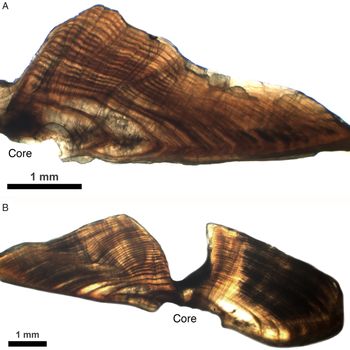
Gray snapper (Lutjanus griseus) from the Gulf of Mexico have otoliths that are easy to read for estimates of age because the annual growth zone structure is typically well defined (Figure 1), even to the extent that multidecadal growth histories have been established using a dendrochronological approach (Black et al. Reference Black, Allman, Schroder and Schirripa2011). A previous study using bomb 14C dating provided support for a maximum estimated age of ~28 years from the alignment of measured 14C values from the core (within the first year of growth) of the otolith (Fischer et al. Reference Fischer, Baker, Wilson and Nieland2005). The gray snapper used in the study provided birth years that were generally in agreement with regional marine bomb 14C references available at the time, like 14C records from other aged fish otoliths (Baker and Wilson Reference Baker and Wilson2001). Recent advances in establishing coral and otolith 14C reference records for the Gulf of Mexico have provided an opportunity to not only reevaluate the findings of Fischer et al. (Reference Fischer, Baker, Wilson and Nieland2005), but to process a series of additional otolith samples to further test the validity of gray snapper age estimates and potentially expand estimates of maximum age. However, there were early indications that the levels of 14C taken up by the otoliths of gray snapper were complicated by as yet undescribed circumstances associated with the early life history of this species. Because bomb 14C dating is a well-established tool in providing valid birth years and ages for fishes of tropical waters—as is the case within the Gulf of Mexico (Baker and Wilson Reference Baker and Wilson2001; Cook et al. Reference Cook, Fitzhugh and Franks2009; Andrews et al. Reference Andrews, Barnett, Allman, Moyer and Trowbridge2013a; Barnett et al. Reference Barnett, Thornton, Allman, Chanton and Patterson2018; Andrews et al. Reference Andrews, Pacicco, Allman, Falterman, Lang and Golet2020)—the objective of this study is to look more closely at some observed 14C anomalies from gray snapper otoliths relative to the early life history habitat, such as the nearshore seagrass beds and mangroves (Starck and Schroeder Reference Starck and Schroeder1971), with consideration for variation in environmental 14C due to geological substrates and other catchment factors associated with the delivery of terrestrial carbon sources (Plummer and Sprinkle Reference Plummer and Sprinkle2001; Keaveney et al. Reference Keaveney, Reimer and Foy2015). Because δ13C can be linked to the salinity of estuarine habitats (Chanton and Lewis Reference Chanton and Lewis1999), use of the observed 14C depletion relative to δ13C in the otolith was investigated as a tool for verifying the link to a freshwater carbon source. Furthermore, longevity estimates of gray snapper were evaluated on the basis of some 14C findings from gray snapper otoliths and the regional marine environment.
Gray snapper (Lutjanus griseus) otolith sections viewed with transmitted light for specimens GS-01 (panel A) and GS-08 (panel B). Growth zone structure is well defined for this species and can be age validated using bomb 14C dating (extraction of the core region with micromill in each section image), but the measured 14C values can be complicated by estuarine waters during the early life history of some gray snapper. GS-01 was consistently aged to 18 ± 1 years and was well supported from core 14C values. GS-08 was consistently aged to 31 ± 1 years but was not well supported from the initial core 14C value (14C-depleted). A second extraction at year-2 (a partial ring that is not visible in the section image) provided a 14C value near expected bomb 14C levels (Figure 2), indicating a habitat change during the first 2 years of life (estuary to marine).

Materials and Methods
Gray snapper otoliths were from sampling programs in the U.S. Gulf of Mexico and had been housed at the NOAA Fisheries, SEFSC, Panama City Laboratory. Specimens were chosen as (1) a series of older archived otolith specimens from the 1980s, and (2) a series of more recently collected juvenile specimens that would assist with delineating the bomb 14C decline period (Tables 1 and 2). The former was to provide more refined bomb 14C ages from the 14C rise period because the greatest estimated ages for gray snapper were on the order of 20–30 years (birth years that would align with the 1950s to 1960s 14C rise period). The latter was to reinforce the use of otolith core material as a temporal reference for adult gray snapper—agreement of these known-date specimens (age is not in question because fish size at recruitment is known) with the coral 14C reference is an indication that otolith 14C levels are consistent with regional marine 14C levels and would be accurately reflected in adult otolith cores over time. The findings from these initial sample sets were posited to provide information that could lead to adults collected in years more recent than 2000 that may be aged using the decline period (e.g., Andrews et al. Reference Andrews, Barnett, Allman, Moyer and Trowbridge2013a; Barnett et al. Reference Barnett, Thornton, Allman, Chanton and Patterson2018; Andrews et al. Reference Andrews, Pacicco, Allman, Falterman, Lang and Golet2020).
Fish and otolith information with corresponding radiocarbon data for gray snapper (Lutjanus griseus) juveniles used as reference material. The formation scenario was either in agreement with the bomb 14C decline period reference or depleted from what was expected (italics). The data reported here were obtained from a portion of the whole otolith (rostrum tip or half of smallest otoliths).

n.a. = Data not available.
Area 21 = Naples, FL.
Area 23 = Dauphin Island, AL, to St Andrews Bay, FL.
Fish and otolith information with corresponding 14C data for gray snapper (Lutjanus griseus) adults used in this study. Samples were within the first year of growth (core; A) and in some cases at growth year-2 (B). The formation scenario is the bomb 14C period that is the temporal reference for the estimated year of formation. Specimen extractions that were from fish of the marine environment provide support for ages 18–25 years (bold). Those not in agreement with the coral-otolith reference are noted as depleted relative to the formation scenario (italics). All specimens listed here were collected from Treasure Island, Florida, with the exception of GS-15 (Madiera Beach).

† Age validated based on an early life history that is consistent with the marine environment.
‡ Minimum age validated by last known year of pre-bomb 14C levels (~1958).
The selected otoliths were prepared for age reading in transverse sections in a standard manner that is described elsewhere (e.g., Andrews et al. Reference Andrews, Cailliet, Coale, Munk, Mahoney and O’Connell2002). Age was estimated by counting well-defined opaque zones (Figure 1). While Fischer et al. (Reference Fischer, Baker, Wilson and Nieland2005) provided some support for the age reading method with bomb 14C dating, the goal was to reinforce the findings with fish that had birth years during the more diagnostic bomb 14C rise period (~1958–1970), along with more recently collected fish that would have birth years during the decline period (>1985).
Sample extractions and 14C measurements were conducted in a commonly practiced manner associated with otolith research (i.e., Andrews et al. Reference Andrews, Barnett, Allman, Moyer and Trowbridge2013a; Barnett et al. Reference Barnett, Thornton, Allman, Chanton and Patterson2018). Reference material from the otoliths of juvenile gray snapper (known date of formation because age is not in question) was a manually broken portion of the whole otolith that was either the tip of the rostrum for larger juveniles or nearly half the otolith for the smallest fish—these samples were used to measure 14C in the most recently formed carbonate. Core extractions (within the first year of growth) on adult gray snapper were made with a micromill (Elemental Scientific Lasers, LLC, Bozeman, MT) using a 500 µm Brasseler® (Savannah, GA) bur in two passes at 0.2 mm deep. The extracted material came from within the first otolith growth zone using a roughly ellipsoid pattern of 2.0 × 3.0 × 0.4 mm and a targeted extraction mass of 3–4 mg of CaCO3 powder. A second-year extraction was made at the clearly visible second growth zone for some otoliths with a path length of ~3 mm at 0.2 mm depth along the zone with a targeted extraction mass near 1 mg.
The extracted otolith samples were submitted as carbonate to the National Ocean Sciences Accelerator Mass Spectrometry Facility (NOSAMS), Woods Hole Oceanographic Institution in Woods Hole, Massachusetts, for standard hydrolysis analyses to determine sample 14C levels. Radiocarbon measurements were reported by NOSAMS as Fraction Modern—the measured deviation of the 14C/12C ratio from Modern. Modern is defined as 95% of the 14C concentration of the National Bureau of Standards Oxalic Acid I standard (SRM 4990B) normalized to δ13C VPDB (–19‰) in 1950 AD (VPDB = Vienna Pee Dee Belemnite geological standard; Coplen Reference Coplen1996). Radiocarbon results were corrected for isotopic fractionation using δ13C measured concurrently during AMS analysis and values are reported here as F14C (Reimer et al. Reference Reimer, Brown and Reimer2004). Stable isotope δ13C measurements were made on a split of CO2 taken from the CO2 generated from acid hydrolysis.
Radiocarbon data from the juvenile otoliths and the extracted adult otolith cores of gray snapper were compared to regional bomb radiocarbon records from the Gulf of Mexico for temporal alignment and age validation. The 14C reference record for the Gulf of Mexico was compiled from previous studies of coral and otoliths of either known or calibrated age (Baker and Wilson Reference Baker and Wilson2001; Cook et al. Reference Cook, Fitzhugh and Franks2009; Andrews et al. Reference Andrews, Barnett, Allman, Moyer and Trowbridge2013a; Barnett et al. Reference Barnett, Thornton, Allman, Chanton and Patterson2018). The pattern traced by the changes in marine 14C through time was described using a Loess curve fit (spline interpolation smoothing parameter = 0.2, two-parameter polynomial; SigmaPlot 11.2), which provided a central tendency that could be used to determine the accuracy of age estimates from gray snapper that started life in the marine environment. The central tendency was also used to differentiate measurements that were attenuated by 14C-depleted water sources—these depleted values provided information on settlement to an estuarine environment and were compared with 14C measurements from other studies of 14C in the carbonates of marine invertebrates from the region (Hadden and Cherkinsky Reference Hadden and Cherkinsky2015; Hadden et al. Reference Hadden, Loftis and Cherkinsky2018). In addition, the regional geology and movement of freshwater in the Upper Floridan Aquifer (UFA) was considered relative to the potential impact of 14C-depleted freshwater on the DIC available to otolith formation in the early life history of gray snapper.
Estimates of age were either validated by direct comparison with the regional marine 14C reference or the estimated birth year was deemed to represent a 14C-depleted uptake (freshwater-influenced) and was accurately placed in time from the well-defined growth zone counting (Figure 2). For the freshwater-influenced gray snapper, the age and birth year were assumed to be accurate based on growth zone counts to provide a measure of the offset or dilution from the marine 14C reference. For the gray snapper with a 14C offset, a second extraction was made at the second year of growth. This was undertaken because of initial observations that core 14C values could be depleted and it was posited that settlement to the nearshore environment was the reason. Hence, because gray snapper typically move into deeper water as adults it was conceivable that the second measurement might return to the marine reference curve.
Radiocarbon data from otolith material of gray snapper (Lutjanus griseus) with reference records from coral and otoliths fit with a Loess curve (Andrews et al. Reference Andrews, Barnett, Allman, Moyer and Trowbridge2013a; Barnett et al. Reference Barnett, Thornton, Allman, Chanton and Patterson2018). Juvenile gray snapper represent known-date material and indicate 14C-depleted DIC was taken up by the otolith for three fish (grey circle with hash) that fall below the expected 14C decline. Projected 14C values from the collection date to the estimated birth year for adult gray snapper reflect the juvenile fish pattern in that some are 14C-depleted and some are in close agreement with the expected trend. The most plausible explanation is that some gray snapper recruit to estuary waters as part of their early life history. Successive otolith extractions (open circles connected with a dashed line)—one sample at the core and the other at year-2—reveal that some fish spend part or all of their first 2 years in estuary waters (GS-02, 06, 08, 09, 15), while some were strictly marine (specimens aligned with the prebomb and 14C rise in 1950s and 1960s). Empirical evidence for 14C-depleted waters in similar estuarine habitats of juvenile gray snapper can be had from regional marine mollusks studies—two gastropod (Busycon sinistrum and Strombus alatus) and an oyster (Crassostrea virginica) show both in-synch and depleted 14C levels (Hadden and Cherkinsky Reference Hadden and Cherkinsky2015; Hadden et al. Reference Hadden, Loftis and Cherkinsky2018). Gulf of Mexico oceanic and river input DIC measurements of 2011–2012 were from open water assays in northeastern waters (Chanton et al. Reference Chanton, Cherrier, Wilson, Sarkodd-Adoo, Bosman, Mickle and Graham2015) and from various rivers (both non-Upper Floridan Aquifer (UFA) and within UFA from around the Gulf of Mexico (Table 3)—note specifically the greatly 14C-depleted value of F14C = 0.564 (adjusted upward for visibility in year 2012) from Suwannee River within the UFA (Figure 3).

The time of formation was adjusted for the juvenile and adult samples to account for a period of formation removed by the micromilled extraction (Tables 1 and 2). The F14C values for the juvenile references were from ~1 year of otolith growth taken from the otolith rostrum (typically a long growth axis on the posterior end) or half of the smallest otoliths (young of the year). As a result, the date of formation for the F14C value was adjusted by +0.5 years to reflect the mean date of formation. The year of formation for adult fish plotted relative to the 14C reference was adjusted by +0.25 years for the core or second ring extraction period, and +0.5 years to account for mid-year hatch date (1 July, Fischer et al. Reference Fischer, Baker, Wilson and Nieland2005), for a total adjustment of +0.75 years to the final date of formation.
To further investigate the idea that freshwater sources were influencing 14C levels in the otoliths of some fish, changes in δ13C were correlated to the depleted F14C measurements (Tables 1 and 2). To do this, the percent difference between the F14C values expected (determined from the date of formation on the reference Loess curve) and the measured F14C values from otolith material was calculated and correlated with δ13C. From this relation it is possible to estimate environmental salinity during the time of otolith formation for individuals with depleted 14C levels using an estuary mixing model for the marine and freshwater sources of Apalachicola Bay, Florida (Chanton and Lewis Reference Chanton and Lewis1999). Because tropical marine fishes may incorporate metabolic carbon to the otolith, an adjustment was also investigated to account for trophic level depletion (typically from approximately –3‰ to –5‰ for tropical marine fishes; e.g., Andrews et al. Reference Andrews, Barnett, Allman, Moyer and Trowbridge2013a; Barnett et al. Reference Barnett, Thornton, Allman, Chanton and Patterson2018). These salinity estimates were compared with empirical evidence from the settlement habitat of juvenile gray snapper (Starck and Schroeder Reference Starck and Schroeder1971; Wuenschel et al. Reference Wuenschel, Jugovich and Hare2004; Serrano et al. Reference Serrano, Grosell and Serafy2010) to verify the applicability of the freshwater 14C dilution concept.
Six USA rivers along the northern Gulf Coast from the Suwannee River of Florida in the East to the Trinity River of Texas in the West were sampled above the influence of salinity at a depth of 0.5 m. Water was collected by peristaltic pump into a 60 mL syringe, filtered through a combusted GFF glass fiber filter, and 20 mL was injected into 30 mL evacuated serum vials capped with butyl rubber stoppers. Samples were injected with 1 mL of degassed 20% phosphoric acid, stored on ice and returned to the lab, and brought to gauge pressure with Helium (He) through an open split. The δ13CO2 was determined on 200 µL injections of vial headspace onto a Hewlett Packard gas chromatograph coupled to a Thermo-Finnegan Delta V isotope ratio mass spectrometer relative to NBS standards and reported relative to VPDB. Following the 13C determination, vials were stripped with He at a flow rate of 50 mL per minute, the CO2 trapped cryogenically, purified and sealed into 6 mm glass tubes. These CO2 aliquots were sent to Lawrence Livermore National Laboratory and run on an accelerator mass spectrometer.
RESULTS
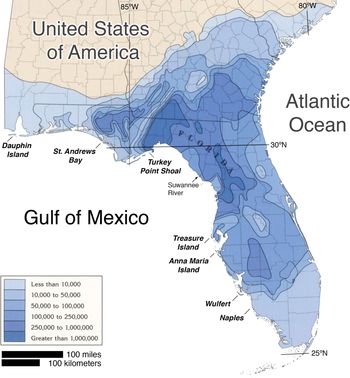
The series of juvenile gray snapper otoliths selected as known-date reference material revealed a wider range of 14C values than anticipated from fish that would have resided in the marine environment. From the range of dates selected (1982–2005) it was expected that the F14C values would cover the associated 14C decline range of F14C = ~1.14–1.06, but several otoliths were depleted by 3–6% from the central tendency of the 14C decline reference (Table 1). Other known-date reference values from this data set were considered similar to the relationship because the F14C value was within a ~2% tolerance (natural variability of the decline record) and within the range of measured values represented in the existing coral and otolith reference data set. These 14C-depleted measurements (GS R09, R11, and R13; Figure 2) may represent a freshwater-influenced environment (estuary) during the time of formation as a result of groundwater fluxes from the UFA (Figure 3).
Map of the southeastern USA bordering the northeastern portion of the Gulf of Mexico where the gray snapper (Lutjanus griseus) used in this study were collected with Upper Floridan Aquifer transmissivity (the ease with which water moves through the aquifer in square feet per day) as a proxy for potential flux of 14C-depleted waters to the marine environment. Locations where the juvenile fish were collected are noted with no pattern that can be discerned among the depleted fish otolith samples—Wulfert (GS-R11), Anna Maria Island (GS-R13), and St. Andrews Bay (GS-R09) were depleted and cover nearly the full southwestern edge of the aquifer. Hence, small-scale differences in fish settlement patterns, relative to freshwater sources and regional mixing patterns, are likely reasons for variable 14C levels in juvenile gray snapper otoliths from across this region. Noted is the location of the Suwannee River where unique DIC measurements were taken in 2012 revealing greatly 14C-depleted waters entering the ocean (F14C = 0.564, Δ14C = –440‰; Table 3). Map was rendered from USGS public domain figure of Miller (Reference Miller2000).

The series of adult gray snapper otoliths that were cored for 14C measurements revealed that five of the 12 otoliths had at least one 14C-depleted value (core or second-year-ring or both; Table 2, Figure 2). Two fish exhibited both in-synch and depleted 14C values relative to the existing coral and otolith reference data set: (1) GS-02 began life in the marine environment and then moved to a freshwater-influenced environment between the first and second year; (2) GS-8 exhibited the opposite relationship and began life in a freshwater-influenced environment, and then moved to marine waters between the first and second year. The other three fish with depleted 14C values were either greatly depleted by 10–24% and remained low (GS-06, 09), or began as greatly depleted and then closely approached an alignment with the 14C reference in the second year (GS-15).
A relationship between the depletion of F14C and changes in δ13C provided an opportunity to verify environmental conditions with a rough calculation of the habitat salinity during early life history. Otolith measurements that were 14C-depleted (lower than expected by 3–24% relative to the 14C reference curve) revealed corresponding decreases in δ13C values (δ13C = –0.26·(% depletion F14C) – 3.4; R2 = 0.74; Figure 4). Because the linear relation intercepted an expected F14C value of δ13C = –3.4‰ (marine environment), a corresponding adjustment was made to the depleted δ13C values to account for uptake of metabolic carbon sources to the otolith carbonate (Nelson et al. Reference Nelson, Hanson, Koenig and Chanton2011). This normalized δ13C is used for comparisons with regional DIC records for marine and freshwater sources of Florida (Chanton and Lewis Reference Chanton and Lewis1999). Freshwater DIC is 13C-depleted relative to marine DIC and follows a linear trend with salinity during mixing in an estuary (Chanton and Lewis Reference Chanton and Lewis1999). Hence, the lowest δ13C values of –9.0‰ to –9.9‰ for GS-09 were adjusted by +3.4‰ to –5.6 to –6.5‰ with a corresponding environmental salinity estimate of ~10–12, versus ~1–3 without an adjustment—the latter values are lower than the salinity preferred by juvenile gray snapper (~9–23, Serrano et al. Reference Serrano, Grosell and Serafy2010; Figure 4).
Decrease in gray snapper (Lutjanus griseus) otolith δ13C relative to the percent F14C depletion from expected F14C levels plotted as marine measurements (in-synch) with estuary values (depleted) that were >2% lower than expected. Mean δ13C levels for the marine environment indicated a minor metabolic carbon component (mean δ13C = –2.8‰). The regression intercept of the 14C-depleted values (δ13C = –3.4‰) also provided a measure of mean metabolic carbon in the otolith based on the offset from marine DIC (δ13C = ~0.0). By increasing the elevation of the regression by this amount (+3.4‰) the otolith δ13C levels are normalized to what would be expected from DIC for the estuarine environment experienced by the juvenile fish. The adjusted δ13C values for the most depleted measurements (GS-09) lead to an estimated salinity of 10–12 from an estuary δ13C-to-salinity model (Chanton and Lewis Reference Chanton and Lewis1999), as opposed to a nearly freshwater salinity of 1–3 when not normalized for metabolic carbon—these findings are consistent with studies of gray snapper early life history because the species is well-adapted to low salinity (Wuenschel et al. Reference Wuenschel, Jugovich and Hare2004) with an affinity for salinity near 9–23 for juvenile fish (Serrano et al. 2001). Specimen GS-07A with a modern F14C signal and depleted δ13C (–7.7 ‰) is likely from a river away from UFA influence (See Table 3 and otolith measurements by Daugherty et al. (Reference Daugherty, Andrews and Smith2019)).

The rivers sampled are listed with the precise sampling locations (Table 3). The δ13C of riverine DIC varied from –6‰ to –16‰ due to the mixture of CO2 derived from the respiration of organic matter with CO2 derived from the atmosphere and carbonate dissolution (Chanton and Lewis Reference Chanton and Lewis1999). Radiocarbon content, expressed as fraction modern, varied from 98% modern in the westernmost Sabine River to a low of 56% modern in the Suwannee River of north Florida. The Suwannee River drains karst topography and is influenced by a number of springs along its course leading to a significant ground water-surface water interaction (e.g., Katz et al. Reference Katz, DeHan, Hirten and Catches1997; Crandall et al. Reference Crandall, Katz and Hirten1999). Interaction with carbonate reservoirs, including the Floridan Aquifer, results in significant 14C depletion. However, all of the rivers were depleted in 14C relative to the value observed in coastal waters at that time (Figure 2), which was fraction modern 1.05% (Chanton et al. Reference Chanton, Cherrier, Wilson, Sarkodd-Adoo, Bosman, Mickle and Graham2015).
Series of freshwater DIC and 14C measurements from various rivers inputs around the Gulf of Mexico. These unique measurements provide a strong indication of how depleted a riverine input can be from the UFA relative to non-UFA inputs to nearshore habitats. Only the Suwannee River of Florida had greatly 14C-depleted waters. Note that the Western-UFA (D188) input from the Pascagoula River is at the extreme western margin of the Upper Floridan Aquifer where transmissivity is low.

DISCUSSION
The study plan to provide validated estimates of age for gray snapper revealed unanticipated results that are important for studies of 14C in otoliths that are formed in the nearshore and estuarine environments. While the otoliths of this species can be well-defined for age reading (Figure 1), 14C results were complicated. The initial series of juvenile gray snapper otoliths—material of known dates of formation that are used to provide a baseline in age validation studies (e.g., Andrews et al. Reference Andrews, Barnett, Allman, Moyer and Trowbridge2013a; Barnet et al. Reference Barnett, Thornton, Allman, Chanton and Patterson2018)—were the first observations of complicated bomb 14C results for gray snapper. Three of the 13 samples were depleted by 3–6% relative to the central tendency of the bomb 14C decline reference (Figure 2). Age could be ruled out as a factor because alignment of the measured F14C value with the Gulf of Mexico coral-otolith 14C reference would lead to birth years more recent than collection dates. The remaining 10 juvenile samples were considered similar and in agreement with the bomb 14C decline by being within ~2% (natural variability) of the expected decline 14C value for a given formation date. The trend for the 10 specimens was also similar to what Fischer et al. (Reference Fischer, Baker, Wilson and Nieland2005) found for six cored otoliths of adult gray snapper from off Louisiana—no otolith core material from those fish was greatly depleted relative to the 14C reference curve. Consequently, the developing premise of the current study is that gray snapper otoliths of Florida were influenced by 14C-depleted waters issuing from karst topography (ancient limestones and other soluble rock formations) where the UFA plays a role in the chemistry of the nearshore marine environment. Consistent with this idea, the coastal waters of Louisiana were not expected to be greatly 14C-depleted because the hydrogeology of the region is different from the nearshore waters of the UFA, assuming the fish used by Fischer et al. (Reference Fischer, Baker, Wilson and Nieland2005) were local through their lives. It was the measurement of both depleted and in-synch 14C levels in adult gray snapper otoliths from Florida, coupled with easy-to-read otolith sections, that indicated variable 14C uptake was due to the environmental conditions of gray snapper recruitment habitat. Once again, discrepancies in the age reading of otolith sections were eliminated as a factor because calculated birth years from some of the measured F14C values were intangible (>1000 years).
The observed differences in 14C uptake to the otoliths of gray snapper can be attributed to mixing of 14C-depleted groundwater from the UFA to the coastal marine environment of Florida (Figure 3). Empirical evidence from 14C dated waters that pass through the UFA—dated as tens of thousands of years old as attributed to the dissolution of ancient substrates—would ultimately reach the sea via riverine base-flow and direct groundwater inputs (Plummer and Sprinkle Reference Plummer and Sprinkle2001; Burnett et al. Reference Burnett, Bokuniewicz, Huettel, Moore and Taniguchi2003). A combination of 14C decay due to water age, dissolution of ancient carbonates, and remineralization processes can lead to reduced 14C levels in freshwater sources (Pearson and Hanshaw Reference Pearson and Hanshaw1970; Glynn and Plummer Reference Glynn and Plummer2005; Moore Reference Moore2010; Keaveney et al. Reference Keaveney, Reimer and Foy2015). Groundwater inputs to the marine environment were historically strong before well pumping began but many remain positive in terms of the flux of freshwater to the marine environment of the Gulf of Mexico (Burnett et al. Reference Burnett, Bokuniewicz, Huettel, Moore and Taniguchi2003; Kroeger et al. Reference Kroeger, Swarenski, Greenwood and Reich2007). Hence, it follows that the otoliths of fish growing in these highly variable environments would sequester 14C via DIC that is a combination of marine and freshwater sources.
Observations made with other marine and estuarine organisms provide support for the uptake of 14C-depleted DIC across this region of the Gulf of Mexico. Shell specimens from two marine gastropod species with collection dates during the pre-bomb period were used to examine 14C levels in the nearshore environment of Florida (Hadden and Cherkinsky Reference Hadden and Cherkinsky2015). While a more marine species (Busycon sinistrum) had carbonate 14C levels that agreed with pre-bomb 14C levels (known year of formation), Strombus alatus shells were found to be either in agreement or 14C-depleted (Figure 2). Differences like this could be attributed to metabolic carbon because not all shell carbonate is formed from DIC, but this factor is unlikely because δ13C values for all 14C measurements were near zero (McConnaughey and Gillikin Reference McConnaughey and Gillikin2008), similar to typical δ13C levels recorded in marine carbonates and sea water. One within-shell sample series for S. alatus demonstrated variable uptake over the life of the gastropod—known to live less than 10 years and arbitrarily estimated here to have lived a 5-year span for demonstration purposes—and exhibited evidence for either (1) movement in and out of the marine and estuarine environments or (2) localized changes in regional water sources, like dilution of the marine 14C signal by 14C-depleted river or UFA waters, or a combination of both factors (Figure 2). Similar evidence was provided by recently collected marine and estuarine oyster (Crassostrea virginica) shells from Apalachicola Bay, Florida (Hadden et al. Reference Hadden, Loftis and Cherkinsky2018). Oyster shell carbonate of river-influenced specimens provided significantly lower 14C levels than the marine specimens (Figure 2), which can be attributed at least in part to 14C-depleted UFA waters.
Similar 14C depletions can occur for the uptake of bomb-produced 14C to the otoliths of fishes in other marine environments. Regions where upwelling can be seasonally strong often lead to depleted 14C values in DIC and marine carbonates. For example, levels of bomb-produced 14C in DIC can vary by two orders of magnitude for the coastal environment of the northeastern Pacific Ocean due to upwelling of old deep-waters (e.g., Andrews et al. Reference Andrews, Leaf, Rogers-Bennett, Neuman, Hawk and Cailliet2013b; Haltuch et al. Reference Haltuch, Hamel, Piner, McDonald, Kastelle and Field2013). While the bomb 14C rise in upwelling regions can remain contemporaneous (~1958), post peak 14C levels can be highly variable and regionally specific (see figure 3 of Andrews et al. Reference Andrews, Leaf, Rogers-Bennett, Neuman, Hawk and Cailliet2013b). There are also indications that the seasonal flux of deeper waters on the Agulhas Bank of South Africa can influence 14C in nearshore DIC as evidenced by the otoliths of red steenbras (Petrus rupestris; Andrews et al. Reference Andrews, Smale, Cowley and Chang2018). Other studies of deep-water fishes reveal similar circumstances for fishes that reside below the thermocline and it is the otolith record that is deemed a reliable indicator of when bomb-produced 14C reached these environments (Filer and Sedberry Reference Filer and Sedberry2008; Horn et al. Reference Horn, Neil, Paul and McMillan2012; Grammer et al. Reference Grammer, Fallon, Izzoa, Wood and Gillanders2015; Campana et al. Reference Campana, Valentine, Maclellan and Groot2016). But for the Gulf of Mexico waters off of Florida these circumstances do not exist in the well-stratified mixed layer where there is near uniformity in temperature and salinity year-round (Baranova et al. Reference Baranova, Biddle, Boyer, Garcia, Hamilton, Paver and Seidov2014). Hence, the most tangible source for 14C-depleted DIC to the otoliths of nearshore marine fishes of Florida is freshwater inputs from the karst topography of the UFA. This perspective is well-supported by the unique measurements of 14C in the DIC of the Suwannee River of Florida relative to other river inputs of the northern Gulf of Mexico (Table 3). The Suwannee River is a centrally located river of the UFA and the lower reach waters were greatly 14C-depleted from other marine (reduced from expected by ~50%) and freshwater sources (reduced from expected by ~5–10%) at the time (Figures 2, 3).
Contrary to the observed 14C depletions recorded here, bomb 14C-enriched waters of the nearshore environment have been observed where there are strong freshwater influences, like life history studies of fishes that recruit to the Chesapeake Bay and Bering Sea environments of North America. Bomb-produced 14C records from otoliths of black drum (Pogonias cromis) of Chesapeake Bay were greatly fortified relative to the marine environment and approached 40% of the maximum observed atmospheric levels at that time (Campana and Jones Reference Campana and Jones1998). A more recent study of ΔR values (14C reservoir corrections for the marine environment) from Chesapeake Bay revealed elevated 14C levels that may explain the observations of Campana and Jones (1998), but also indicated that the complex regional hydrogeology, coupled with various biological and environmental factors, were responsible for regionally specific 14C-depletions, as well (Rick et al. Reference Rick, Henkes, Lowery, Colman and Culleton2012). The Bering Sea is a low salinity basin of the North Pacific Ocean due to freshwater input from precipitation (Schmitt Reference Schmitt2008). It follows that a rapid bomb 14C response was recorded for this environment in the otoliths of yellowfin sole (Limanda aspera)—the elevated bomb 14C levels were more representative of tropical waters and Δ14C values approach 200‰ in 1966 (F14C≈1.2), significantly faster than mid-North Pacific coral records (AH Andrews, personal observation; Andrews et al. Reference Andrews, Asami, Iryu, Kobayashi and Camacho2016; Kastelle et al. Reference Kastelle, Helser, Wischniowski, Loher, Goetz and Kautzi2016). In addition, more elevated 14C than expected in some otoliths of Greenland cod (Gadus ogac)—a species known to inhabit nearshore waters as a juvenile (Nielsen and Andersen Reference Nielsen and Andersen2001)—with known dates of formation in the 1950s also may be attributed to freshwater influences on the Davis Strait marine system (AH Andrews, personal observation; Campana et al. Reference Campana, Casselman and Jones2008).
In freshwater environments, the uptake of 14C to otoliths is typically associated with the stronger atmospheric bomb 14C signal due to a timelier mixture from the atmosphere (Peng and Broecker Reference Peng and Broecker1980; Spiker Reference Spiker1980). Rainwater provides a direct deposition of atmospheric 14CO2 (dissolved in water vapor) and as a result, the bomb 14C levels of DIC in rivers and lakes can be considerably greater than the marine environment. This was demonstrated for North American rivers and lakes using otolith 14C measurements from freshwater fishes, like various salmonids, sturgeon, freshwater drum, buffalo fish, and alligator gar (Campana et al. Reference Campana, Casselman and Jones2008; Davis-Foust et al. Reference Davis-Foust, Bruch, Campana, Olynyk and Janssen2009; Bruch et al. Reference Bruch, Campana, Davis-Foust, Hansen and Janssen2009; Braaten et al. Reference Braaten, Campana, Fuller, Lott, Bruch and Jordan2015; Casselman et al. Reference Casselman, Jones and Campana2019; Daugherty et al. Reference Daugherty, Andrews and Smith2019; Lackmann et al. Reference Lackmann, Andrews, Butler, Bielak-Lackmann and Clark2019). While this process of enrichment has occurred for the source waters of the UFA (Plummer and Sprinkle Reference Plummer and Sprinkle2001), the modern 14C signal is greatly exceeded by dissolution-depleted waters of ancient limestone substrates by the time it reaches base-flow sources.
For about half of the adult gray snapper in this study, the originally expected alignment of estimated birth year—calculated from growth zone counting in the otolith sections—agreed with the bomb 14C reference series, many of which were diagnostic by alignment with the rapid 14C rise in the 1960s (Figure 2). It can be surmised that these fish did not reside in a strongly freshwater-influenced habitat during their first 2 years of life. Hence, it follows that these marine specimens support the age reading at 18 to 28 years for this study, with a minimum age of 25 years from pre-bomb levels (Table 2), which is similar to what was reported by Fischer et al. (Reference Fischer, Baker, Wilson and Nieland2005). In both studies, the growth zone counting is annual and a lifespan of ~30 years is well supported for gray snapper.
Because the adult gray snapper with depleted core values are well placed in time, these freshwater-influenced specimens can be used as a proxy for other environmental variables. Some of these otoliths were 14C-depleted by up to 24% (Figure 2). Hence, the estuarine mixing of freshwater with the marine system was linked to the depleted 14C levels with a correlation to otolith δ13C levels (Figure 4). With a minor adjustment for metabolic carbon to the otolith (δ13C depleted by –3.4‰ for marine environment), the estimated salinity for the estuarine environment from δ13C indicated the most 14C depleted fish (GS-09) resided in salinities of 10–12 using a regional δ13C modeling reference (Chanton and Lewis Reference Chanton and Lewis1999). This estimate is consistent with observations of environmental salinity for juvenile gray snapper (Starck and Schroeder Reference Starck and Schroeder1971), as well as the early life history settlement habitat that is typically associated with estuarine waters (Chester and Thayer Reference Chester and Thayer1990; Allman and Grimes Reference Allman and Grimes2002). Gray snapper is well-adapted to low salinity in their early life history (Wuenschel et al. Reference Wuenschel, Jugovich and Hare2004) with an affinity for salinity near 9–23 for juvenile fish (Serrano et al. Reference Serrano, Grosell and Serafy2010). Hence, it is important to consider the life history and regional hydrogeology for otoliths of fishes for not only bomb 14C age validation studies, but for archaeological work on midden otoliths when determining true radiocarbon age and potential dates of site occupation (e.g., Disspain et al. Reference Disspain, Wallis, Fallon, Sumner, St George, Wilson, Wright, Gillanders and Ulm2017).
CONCLUSIONS
The origin of this study was to reinvestigate estimates of age, growth, and lifespan of gray snapper as was determined in a previous study (Fischer et al. Reference Fischer, Baker, Wilson and Nieland2005). Initially, the findings of the current study were considered compromised by depleted F14C levels in the otolith that could not be aligned with the bomb-produced 14C signal of the marine environment; however, some fish aligned well with the temporal reference. Because the otoliths were easy to read for age (growth zone counting) and some fish could be age validated with bomb 14C dating, the goal of this study shifted to understanding why some otolith measurements were greatly 14C-depleted. Investigation of the early life history of gray snapper (settlement to estuarine waters) and the hydrogeology (inputs of freshwater from the Upper Floridan Aquifer) led to the conclusion that the karst topography of Florida influenced otolith 14C levels and measurable depletions in both F14C and δ13C were related to environmental salinity.
ACKNOWLEDGMENTS
Thank you to W. Scott McBride (U.S. Geological Survey) and EM Keaveney (Queen’s University Belfast) for insight on the UFA, freshwater 14C, and a technical review. Infrastructural support on micromilling was provided by the Pacific Islands Fisheries Science Center. Thank you to two anonymous reviewers for constructive comments. This research was made possible by grants from the NMFS Marine Fisheries Initiative and The Gulf of Mexico Research Initiative/C-IMAGE II. Data are publicly available through the Gulf of Mexico Research Initiative Information and Data Cooperative (GRIIDC) at https://data.gulfresearchinitiative.org (doi:<10.7266/N7FN14RW>). The scientific results and conclusions, as well as any views or opinions expressed herein, are those of the authors and do not necessarily reflect those of NOAA or the Department of Commerce.