

The Garboldisham macehead is an unusual decorated macehead carved from red deer (Cervus elaphus) antler. The macehead was found in the mid-1960s deposited in a tributary of the river Little Ouse, Norfolk (Edwardson Reference Edwardson1965), and is decorated with three spirals, making it especially significant. This paper reports on the analysis of the decoration using digital imaging, discuss a new radiocarbon date recently obtained for the artefact, and discusses its significance alongside other dated antler maceheads. Finally we report on the local archaeological context of the macehead, and discuss its wider archaeological significance.
MANUFACTURE AND REWORKING
The macehead was examined using digital imaging techniques as part of the Leverhulme funded Making a Mark project, investigating the manufacture and context of decorated artefacts from across Neolithic Britain and Ireland. We will not discuss the methodology here (see Jones et al. Reference Jones, Cochrane, Carter, Dawson, Díaz-Guardamino, Kotoula and Minkin2015). Reflectance Transformation Imaging (RTI) is a non-contact, affordable and easy imaging technique. RTI is especially useful for recording archaeological artefacts because of its ability to acquire and represent the 3D reflectance properties of objects. In addition, certain details of the macehead were recorded with a handheld USB digital microscope Firefly GT200 providing up to 230× native optical magnification. Finally, close-range photogrammetry using Structure from Motion was used to construct a 3D model of the macehead. RTI, close-range photogrammetry, and digital microscopy were used to record the macehead in order to examine the sequences of manufacture.
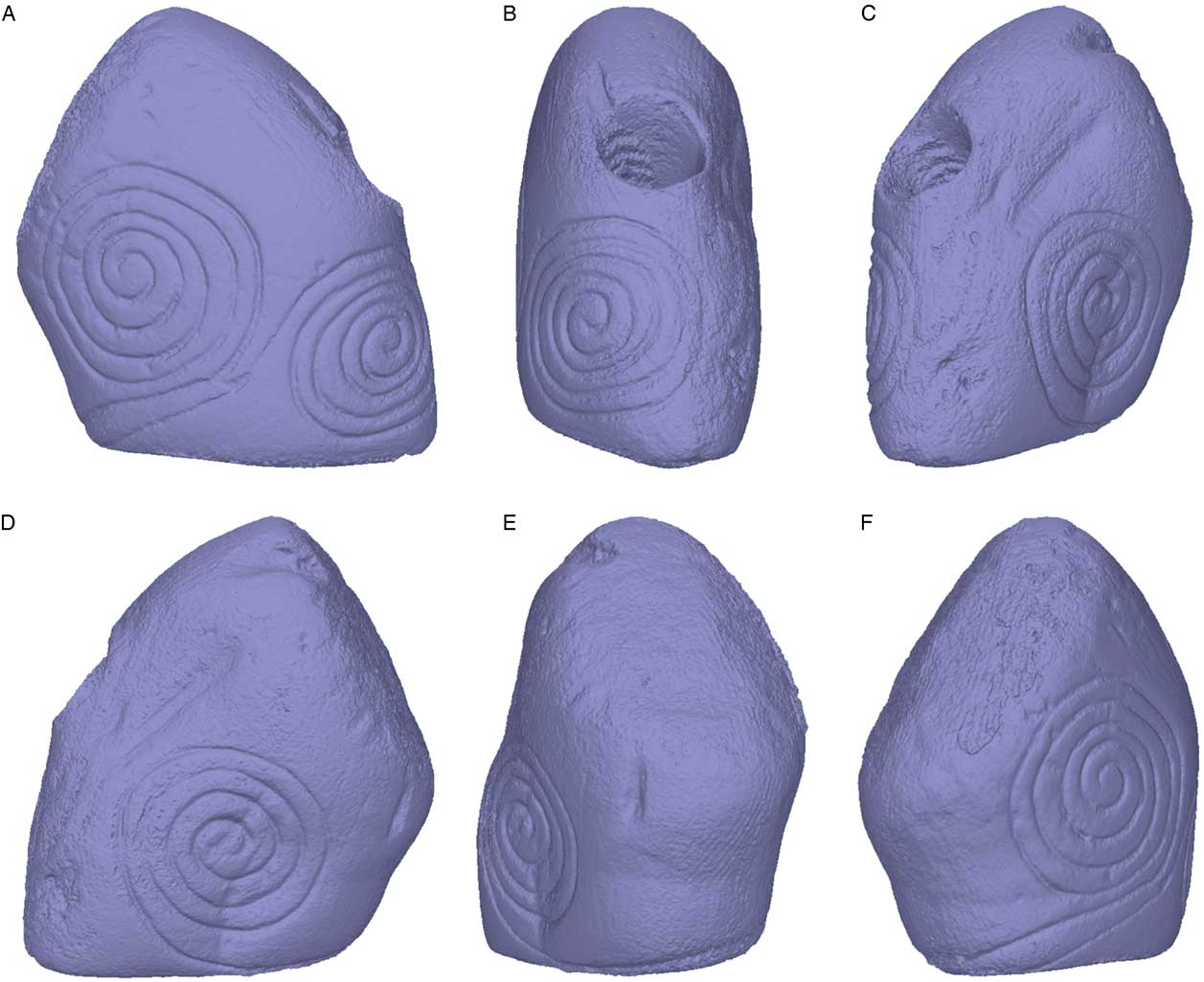
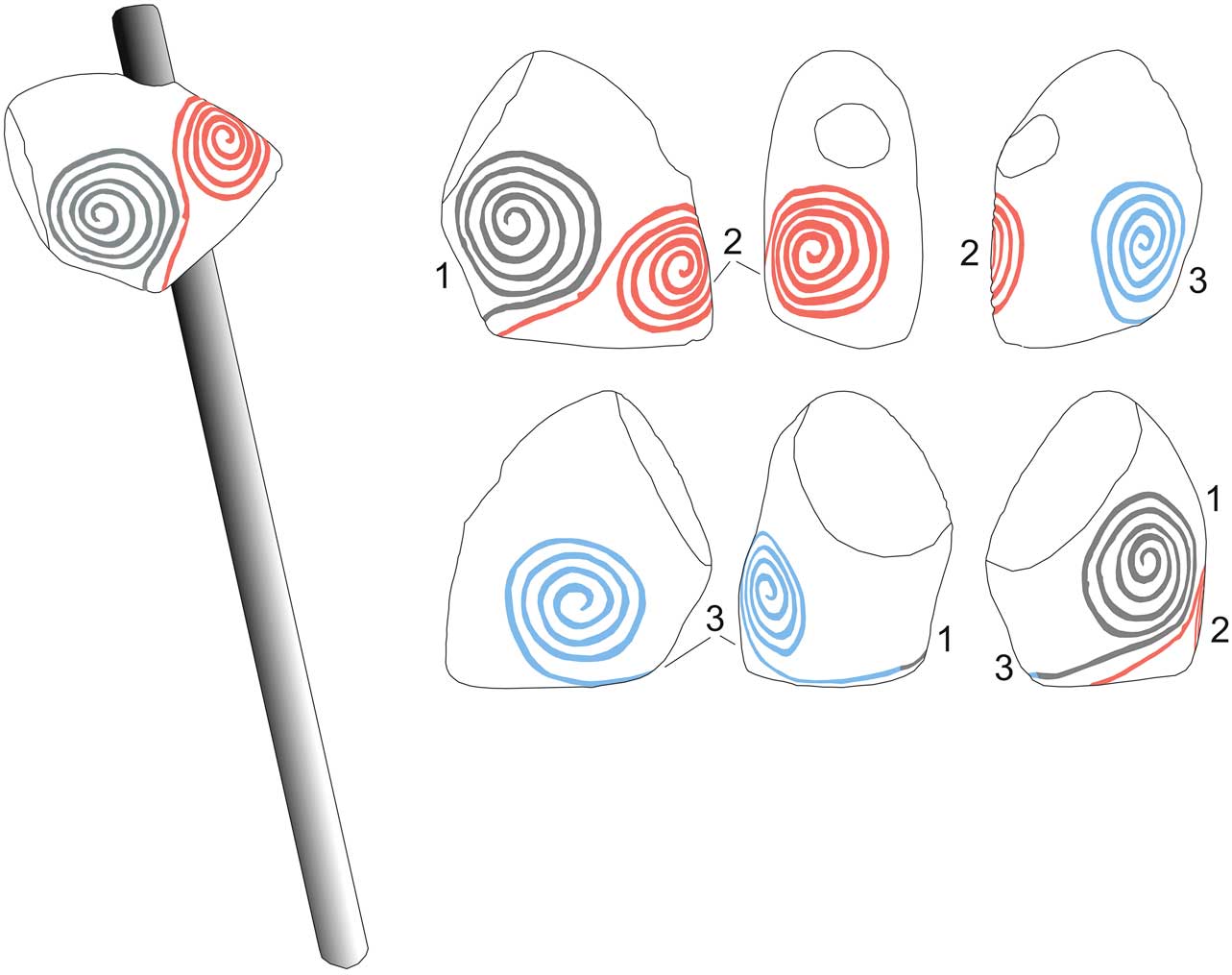
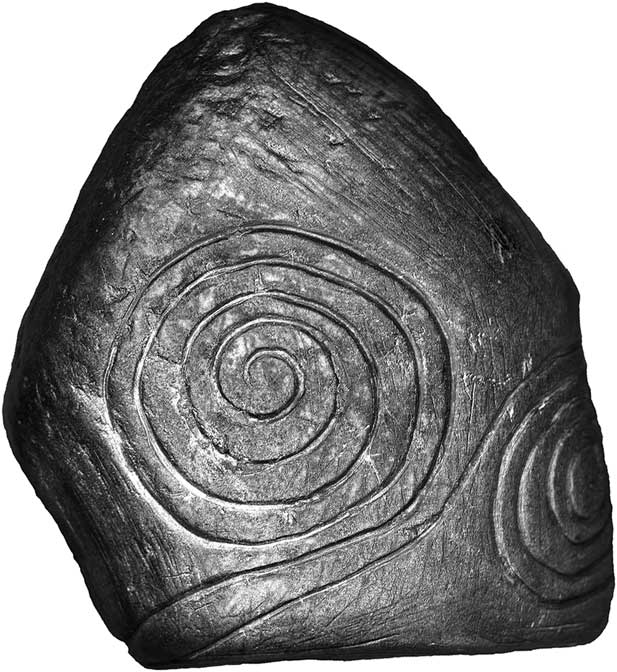
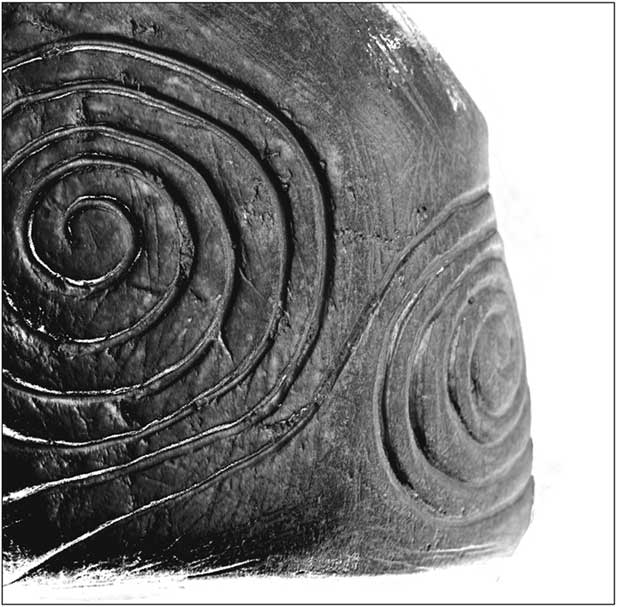
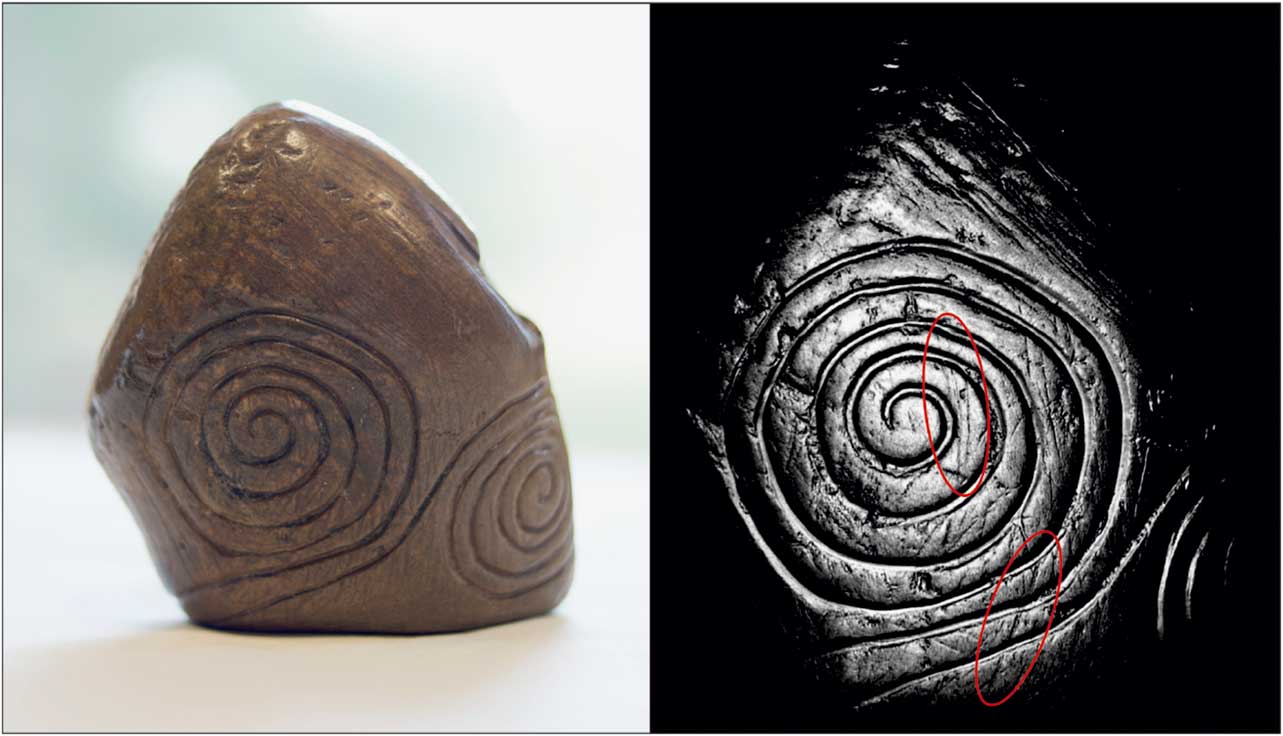
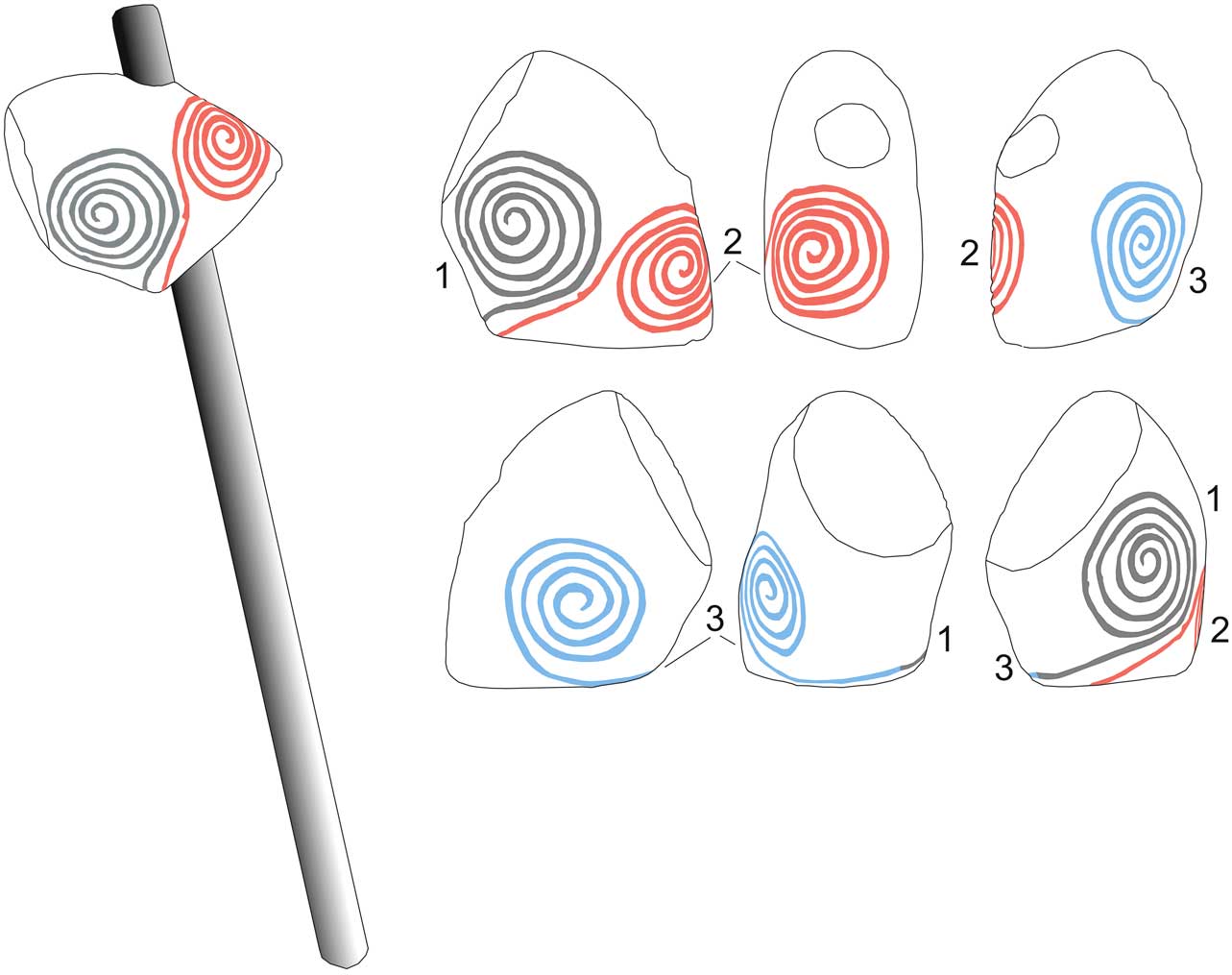
The macehead has been manufactured from the basal region and burr of a red deer antler (see Simpson Reference Simpson1996, 294). The antler has been trimmed substantially and polished. It is possible, using digital imaging and the naked eye, to discern the ‘grain’ of the antler, not completely erased by polishing (Fig. 1). Polishing striations are also visible on the surface of the macehead (Fig. 3). The macehead is decorated with three spirals cut into the polished surface. There is a complexity to their arrangement (Fig. 2). One spiral is carved on one surface this is then ‘carried over the shoulder of the implement to be repeated twice on the other side’ (Edwardson Reference Edwardson1965, 145). The difficulty of being able to comprehend the decoration visually at a single glance is an attribute that the Garboldisham macehead shares with a number of other decorated artefacts from the British and Irish Neolithic, including various carved stone balls and the Knowth macehead.
Views of the 3D model of the macehead where the ‘grain’ of the antler can be observed

Our analysis focused in particular on the surface with the two spirals. Careful analysis indicates that the larger of the two was carved with the grain of the antler. The larger spiral (marked in grey in Fig. 2) flattens on one edge running parallel to the side of the antler implement. Notably this conforms to a substantial grain in the antler (Figs 1 & 4). The smaller of the two spirals (marked in pink in Fig. 2) notably respects the larger of the spirals and its carver kinked the second smaller spiral away from the larger.
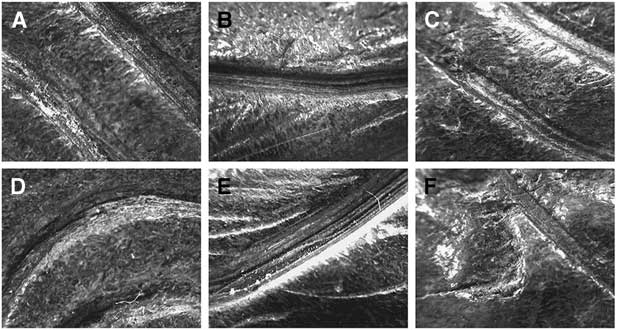
Using RTI it is possible to discern a stratigraphic sequence of carving and striation. This is clearest for the larger of the two conjoined spirals. At the outer edge of this spiral a polishing striation can clearly be seen butting up against the carved edge. This is then cut by the outer whorl of the spiral and the exterior meandering line (Fig. 5). This sequence of activity is suggestive of more than one episode of carving and is confirmed by digital microscopy of the carved grooves which exhibit two episodes of carving: the spiral was carved and then recarved at a later date (Fig. 6). We cannot know whether this sequence followed rapidly, in the manner of a master craftsperson correcting the work of an amateur or apprentice, or whether these should be regarded as distinct episodes indicative of a long use-life.
Superficially, the Garboldisham macehead resembles the decorated macehead from Knowth (Eogan & Richardson Reference Eogan and Richardson1982) as both possess spiral decoration, though it diverges from the Knowth macehead in a number of ways. The decoration of both include spirals, but the Knowth examples are positioned on either side of the drilled hole of the macehead; the Garboldisham spirals meander across the surface and are not organised by the central axis of the drilled hole. Notably, the Knowth macehead is one of the few decorated artefacts in the British and Irish Neolithic repertoire on which decoration is executed in relief (the other example being Drum 1, Folkton), whereas the Garboldisham spirals are incised into the surface of the antler. One clear point that stands out from the decoration of the Garboldisham macehead is the way in which the decoration works with the grain and morphology of the antler. Arguably, it is this that lends the macehead its unique character and unusual orientation when (or if) hafted (see Fig. 2). Both decoration, and orientation mark this example out as distinctive when compared with the corpus of known antler maceheads.
DATING
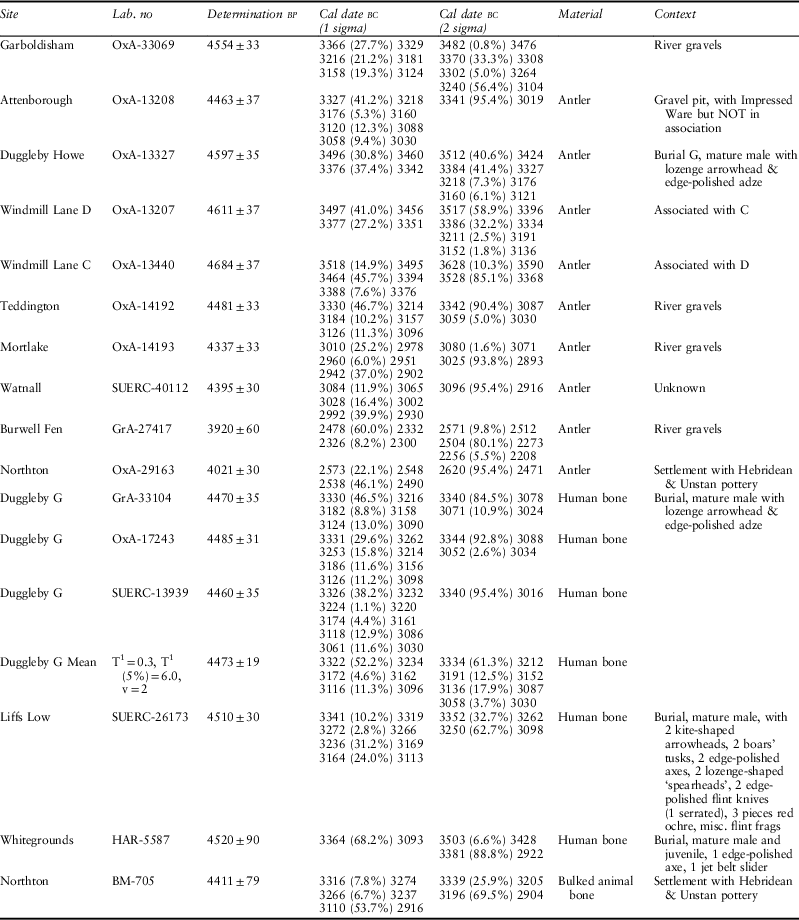
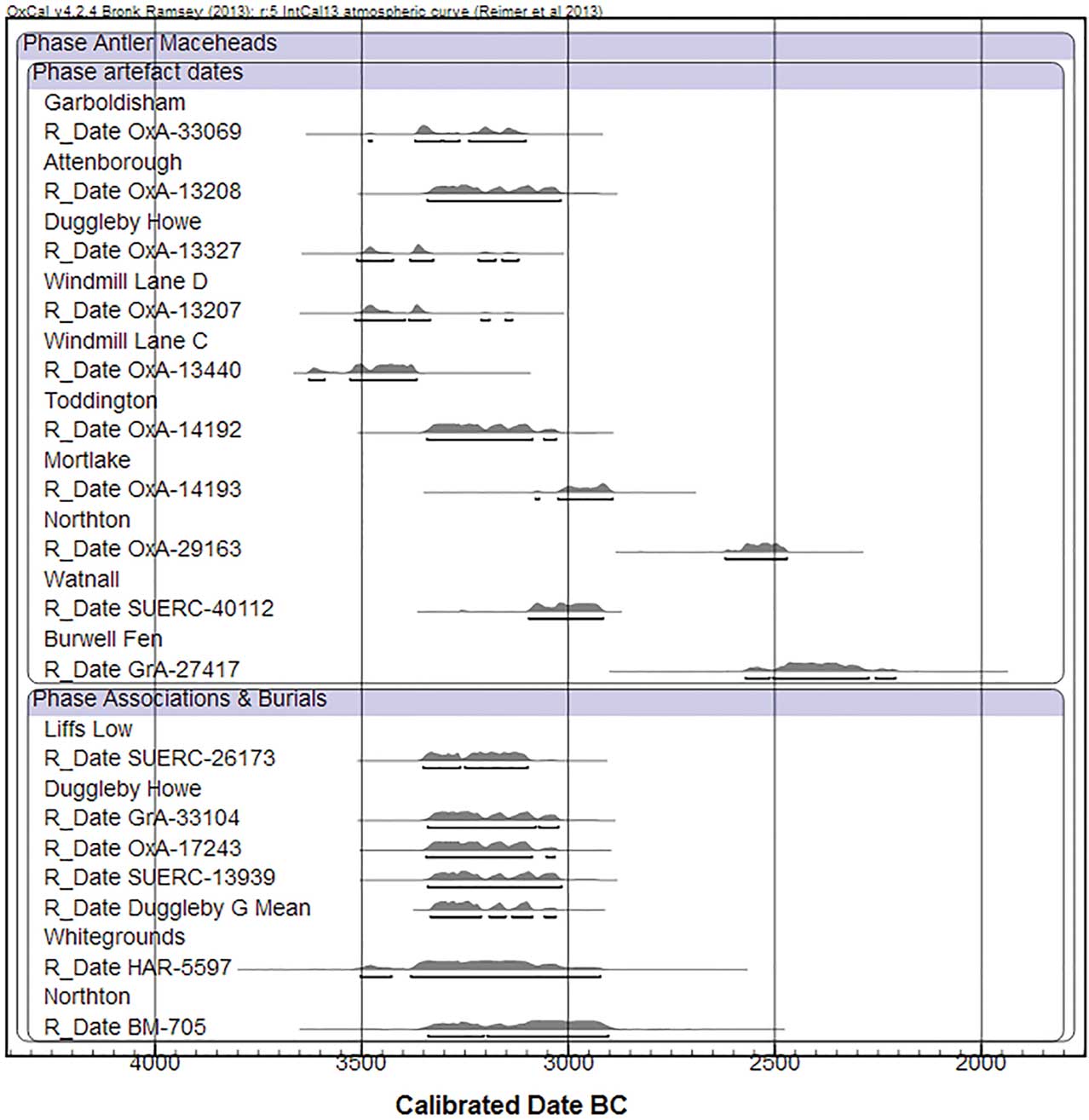
Garboldisham was on the original list of those maceheads chosen for radiocarbon dating by the Antler Macehead Dating Project (hereafter AMDP) mainly because of its unusual decoration and polishing, but it was not made available for sampling at that time. This new date is therefore extremely welcome. The date of 4554±33bp (OxA-33069) is in keeping with other dates obtained as part of AMDP (Loveday et al. Reference Loveday, Gibson, Marshall, Bayliss, Bronk Ramsay and Plicht2007) but consequently falls on the Middle Neolithic plateau in the calibration curve and, as a result, has several date ranges within the 2 sigma bracket though slightly weighted towards 3240–3104 cal bc (56.4%) (Table 1).
Dates for antler maceheads from the british neolithic calibrated using oxcal 4.2

Since the results of the AMDP were published more associated radiocarbon dates have become available for antler maceheads (eg, Northton, Harris & Watnall, Nottinghamshire, discussed below; Table 1). Indirect dates by association may also now be considered. For example, the macehead from Liffs Low, Derbyshire, failed to produce sufficient collagen when sampled as part of the AMDP but a date has since been obtained from the associated burial of an adult male (Loveday & Barclay Reference Loveday and Barclay2010 with thanks to Mandy Jay and the Beaker People Project). Being associated with edge-polished axes, Liffs Low bears close comparison with Burial G (also a mature male) at Duggleby Howe, North Yorkshire, which was likewise associated with an antler macehead (originally dated as part of AMDP) as well as an edge-polished adze. Three further dates have been obtained from this skeleton (Gibson & Bayliss Reference Gibson and Bayliss2010).
This dating by association can possibly be extended to include the secondary burial of a mature male and juvenile at Whitegrounds, North Yorkshire, also associated with an edge-polished axe and jet belt-slider but in this case without a macehead (Brewster Reference Brewster1984).
Regarding new direct dates, that from Watnall (National Museums Scotland) produced a result of 4395±30bp (SUERC-40112) (Sheridan et al. Reference Sheridan, Goldberg, Blackwell, Mahler, Richards, Duffy, Gibson, Macniven and Caldwell2012; Gibson Reference Gibson2013). The macehead has some polishing and is No. 2 in Simpson’s (Reference Simpson1996) corpus but, unfortunately, details of its discovery are lacking. The previous date for the Northton macehead (Loveday et al. Reference Loveday, Gibson, Marshall, Bayliss, Bronk Ramsay and Plicht2007) was obtained from bulked associated animal bone and therefore lacks strict integrity, however, the artefact has been dated directly as part of the Stepping Stones project (Garrow et al. Reference Garrow, Griffiths, Anderson-Whymark and Sturt2017, appx S1) and has produced a date of 4021±30 bp (OxA-29163) which is probably too young (Sheridan et al. Reference Sheridan, Garrow, Mason, Schulting, Snoeck, Bradley, Waddington, Cook and Naysmith2014 and see below).
The data have been calibrated using OxCal 4.2.4 (Bronk Ramsay Reference Bronk Ramsey2009) and IntCal13 (Reimer et al. Reference Reimer, Bard, Bayliss, Beck, Blackwell, Bronk Ramsey, Grootes, Guilderson, Haflidason, Hajdas, Hatté, Heaton, Hoffmann, Hogg, Hughen, Kaiser, Kromer, Manning, Niu, Reimer, Richards, Scott, Southon, Staff, Turney and Plicht2013). The plotted results (Fig. 7) show that the majority of these maceheads, including that from Garboldisham, date to the second half of the 4th millennium including those dated by association. They clearly date to the Middle Neolithic when Impressed Ware was in currency. The Duggleby Howe macehead was associated with Burial G which, using Bayesian modelling of the burial sequence, was dated to 3335–3275 cal bc (65% probability). The macehead itself, however, was also dated and provided a slightly older date range of 3370–3345 cal bc (65% probability) suggesting that it may have been a curated object, already some decades old when buried (Gibson & Bayliss Reference Gibson and Bayliss2010, 68). This does not, however, preclude the object being a personal possession: it need not have been inherited but may have been obtained when new whilst the deceased was still a young man. He was identified as an hexagenarian by Mortimer (Reference Mortimer1905, 28) and his maturity was confirmed by Ogden (in Gibson & Bayliss Reference Gibson and Bayliss2010). This possible curation of a prestigious artefact may also be pertinent to Liffs Low. Notwithstanding that the date ranges for the maceheads from Mortlake and Watnall extend into the 3rd millennium, the major currency of these artefacts appears to pre-date the appearance of Grooved Ware.
The date from Burwell Fen and the new date for the Northton macehead suggest, on face value, that the chronology of these artefacts can be extended to the mid-3rd millennium but there are potential problems with these dates. The Northton macehead was found in the upper Neolithic (as opposed to Beaker) midden at Northton (Simpson Reference Simpson1996; Simpson et al. Reference Simpson, Murphy and Gregory2006) and was associated with multi-carinated Hebridean bowls, the currency of which, like Impressed Ware, cannot on present dating be pushed much later than 3000 bc. Indeed, it may have been the lack of collagen contained in the small size of the sample submitted that was responsible for the young date (Sheridan et al. Reference Sheridan, Garrow, Mason, Schulting, Snoeck, Bradley, Waddington, Cook and Naysmith2014). With this in mind, the date from the bulked sample of animal bone (BM-705) may be the more reliable. The late date for the Burwell Fen macehead is less easy to explain. It may demonstrate the survival of the type into the later Neolithic but, being substantially later than the other maceheads, including those dated by association, it is suggested here that the date must be regarded with caution.
Those maceheads with well-defined archaeological contexts, namely Liffs Low and Duggleby Howe Burial G, belong to a group of richly furnished Middle Neolithic inhumation burials (Loveday & Barclay Reference Loveday and Barclay2010) associated with a suite of artefacts including polished rectangular flint knives, lozenge and chisel arrowheads, boars’ tusks, edge-polished axes and adzes, and jet belt-sliders. The increasing number of radiocarbon dates for such grave groups suggest that they very much belong to the second half of the 4th millennium and are therefore middle rather than later Neolithic. These burials represent an important change in the burial record from the generally multiple disarticulated inhumations of the earlier Neolithic (notwithstanding the individuals from causewayed enclosures) towards a more personal, individual burial rite with accompanying artefacts. These Middle Neolithic burials in turn give way to the general practice of cremation in the later Neolithic (Healey Reference Healy2011), which practice may, of course, have a detrimental effect on any associated organic artefacts.
Given the Middle Neolithic credentials of these antler crown maceheads, the spiral decoration on the Garboldsham macehead is therefore important given its frequent comparison with the spiral motifs on rock art and some Grooved Ware ceramics. The elongated lozenge faceting on some antler and stone Maesmore type maceheads has also drawn parallel with the plastic lattice motifs on Grooved Ware. This was taken as suggesting a later Neolithic date for these items, especially the stone maceheads (Piggott Reference Piggott1954; Roe Reference Roe1968) that also have acknowledged Late Neolithic Orcadian parallels. Carved stone balls with spiral motifs, such as that from Towie, Aberdeenshire (Clarke et al. Reference Clarke, Cowie and Foxon1985, 54), have been similarly dated by analogy (Marshall Reference Marshall1977, 61–3) and both Roe (Reference Roe1968) and Simpson (Reference Simpson1996) accept that the antler forms, even those with elongated lattice decoration, pre-date the stone Maesmore type.
Ian Kinnes (Reference Kinnes1995) discussed the spiral motif and cited instances of spirals and/or curvilinear designs in media, other than rock art, that can be dated to the Early–Middle Neolithic. He furthermore suggested that the durability of rock art (both on outcrops and in monuments) and ceramics might skew the chronological and geographical distribution of this motif. Loveday suggested that the spiral in a British and Irish context may derive from the early copper double ‘spectacle’ spirals of Europe and, in support of this, he makes interesting observations on the similarities of architecture between the later Neolithic Orcadian settlements and broadly contemporary structures on mainland Europe. He also notes that, on the continent, the spiral has been present as a motif since LBK times (Loveday Reference Loveday2004) and globally since the Palaeolithic. Alison Sheridan, however, clearly demonstrated that passage grave rock art, particularly in Ireland, pre-dated the appearance of Grooved Ware on both sides of the Irish Sea (Reference Sheridan2004). She similarly pointed out that, while the presence of the spiral motif on Grooved Ware ceramics themselves (and within Grooved Ware-associated contexts generally) cannot be denied, the motif itself was already established well before the appearance of this ceramic type. The spiral clearly appears in the Impressed Ware-associated Middle Neolithic (if not earlier – Kinnes Reference Kinnes1995) and its presence on Grooved Ware pottery simply demonstrates the persistence (and perhaps potency) of the design into the 3rd millennium.
Based on the available radiocarbon dates for passage graves, Bayliss & O’Sullivan (Reference Bayliss and O’Sullivan2013) suggested that they were first constructed 3910–3120 cal bc (68% probability), with the end of use in 3090–2905 cal bc (95% probability) or 3025–2935 cal bc (51% probability). As with the antler crown maceheads, it appears that the passage grave tradition met its demise just as Grooved Ware was starting to spread southwards and westwards from Orkney. Hensey, however, details the development of Irish passage graves and points out that rock art only appears with Type II passage graves in Ireland around 3600 bc culminating in the highly visible art of the Type III passage graves around 3200–3000 bc (Hensey Reference Hensey2015, 45). It is worth remembering, however, that many of the carved stones at Knowth and Newgrange (Type III tombs) also appear to have been reused from earlier monuments (Shee Twohig Reference Shee Twohig2012). It is also with type II passage graves that solar observation becomes firmly demonstrable in the archaeological record and this phenomenon persists into and increases with the development of the Type III monuments.
In fact the best parallels for the Garboldisham spirals are derived from motifs in rock art and passage graves/tombs. Paul Frodsham (Reference Frodsham1996) surveys the known examples of the spiral motif in the British Neolithic and discusses a suite of evidence, including open-air rock art, passage graves, standing stones, pottery, and portable artefacts like carved stone balls. He notes key examples of spiral motifs in 11 open-air rock art sites in northern England and Scotland with key sites being Morwick Mill, Northumberland, Achnabreck, Argyll, and Ballochmyle, Ayrshire. He also notes carved spirals on several Cumbrian stone circles, the most well known being Long Meg and her Daughters. Spiral decoration is also a feature of the art of passage graves in Orkney and Anglesey with examples at Pierowall and Eday Manse, Orkney, and Barclodiad Y Gawres and Bryn Celli Ddu, Anglesey. Many of the examples discussed by Frodsham are difficult to pin down chronologically. The new date from Garboldisham, complimented by the Bayesian dates from Irish passage tombs, allows us to begin to discuss spiral decoration as part of this horizon of change associated with the demise of antler crown maceheads and passage graves and the arrival of Grooved Ware.
ARCHAEOLOGICAL CONTEXT
The archaeological context of the Garboldisham macehead, deposited c. 1.5 m below the river Little Ouse amongst ‘animal bones’ (Edwardson Reference Edwardson1965, 145) is consonant with the depositional context of a number of other antler maceheads, deposited in the river Thames in the London region (Simpson Reference Simpson1996). Since the discovery of the macehead in the mid-1960s another artefact has been discovered from the same context: a partly polished flint axe. The report on this simply states that it was found at Hopton in ‘spoil at the Bridge site’ (Owles & Smedley Reference Owles and Smedley1967, 78) near the find spot of the Garboldisham macehead. We cannot be sure that the polished flint axe and macehead were certainly associated and, given the nature of the depositional context (a river), this is impossible to confirm. Given the numbers of flint and stone axes from riverine contexts (Bradley Reference Bradley1990; Lamdin-Whymark Reference Lamdin-Whymark2008) there is a strong possibility that the two artefacts were associated. We could, therefore, either consider this location of the Little Ouse as a site of repeated depositions of the kind described for the Thames (Lamdin-Whymark Reference Lamdin-Whymark2008, 35) or of this being a complex single episode deposit consisting of numerous separate components; in either case it seems certain that both the Garboldisham macehead itself and its find location should be considered as special or unusual.
SIGNIFICANCE
Some years ago Ian Kinnes (Reference Kinnes1995) raised doubts about the attribution and association of spiral decorated artefacts. The new date obtained from Garboldisham goes some way to redressing those doubts and enables wider discussion. The radiocarbon date places this artefact firmly within the spread of Middle Neolithic dates for antler maceheads (Loveday et al. Reference Loveday, Gibson, Marshall, Bayliss, Bronk Ramsay and Plicht2007). More significantly it provides a date for spiral decoration and situates the macehead alongside the dates for primary activity and use associated with Irish passage tombs. This is important as the clearest iconographic parallels for the Garboldisham macehead include the spiral decorated flint mace from Knowth (Eogan Reference Eogan1986) and the triple spiral motif from Newgrange (O’Kelly Reference O’Kelly1982), though, as noted above, the Knowth macehead is carved with a different technique. The comparability in dates for Irish passage tombs and the Garboldisham macehead suggest interaction between eastern Ireland and East Anglia at an early stage of the Middle Neolithic. Interaction with eastern Ireland is a recurrent theme for numerous contexts across southern and eastern England, and Wales and will be discussed in more detail elsewhere (Jones & Díaz-Guardamino in prep.).
Importantly the date for the Garboldisham macehead firmly locates it within the established date range of Peterborough/Impressed Ware (Ard & Darvill Reference Ard and Darvill2015) of c. 3400–2800 cal bc. In this case Gibson’s arguments for spiral decoration being associated with winding cord in whipped cord decoration in Peterborough Ware contexts is especially apposite (Gibson Reference Gibson2002, 59). Meanwhile recent re-evaluations of the dates for Orcadian Neolithic settlements, classically associated with spirally decorated artefacts, are now beginning to suggest comparable dates between the 31st and 28th centuries cal bc for Pool (MacSween et al. Reference MacSween, Hunter, Sheridan, Bond, Bronk Ramsey, Reimer, Bayliss, Griffiths and Whittle2015), and later 32nd–29th centuries for Barnhouse (Richards et al. Reference Richards, Jones, MacSween, Sheridan, Dubar, Reimer, Bayliss, Griffiths and Whittle2016). This is critical as it complicates oft-noted stylistic associations between the spiral decoration of Garboldisham and a Grooved Ware sherd from Skara Brae. We cannot make too much of a radiocarbon date from a single artefact, but potential implications include a comparable phase of spiral decorative motifs in southern England, associated with Irish passage tombs and Peterborough/Impressed Ware, to those associated with the Grooved Ware of Orcadian Neolithic settlements.
Annotated diagram showing the changing appearance of the three spirals (in differing colours) as the macehead is manipulated by the viewer. Also included is an interpretation of the maceheads appearance and orientation if hafted
RTI snapshot of the other decorated side of the macehead. The application of the filter Coefficient Unsharp Masking enhances the visualisation of the polishing striations

View of the larger spiral where it flattens. RTI snapshot generated with the filter Diffuse Gain

View of striations cut by spiral. RTI snapshot generated with the filter Specular Enhancement

Details of the carved grooves: A, B, D, & E show deep grooves produced by recarving; C & F show grooves produced by a single carving episode, most probably with a flint tool. Snapshots taken with the digital microscope

Comparison of dates from antler maceheads from Neolithic Britain

Acknowledgements: Alex Gibson would like to thank Duncan Garrow and Alison Sheridan for information regarding the Northton macehead. Andrew Meirion Jones and Marta Díaz Guardamino would like to thank the staff at the Oxford Radiocarbon Laboratory for their helpfulness.