The main reason for studying early modern public finance lies in its presumed function as foundation for modern economic growth. Proposed first by Peter Dickson in 1967, this idea emphasizes the importance of the switch from haphazard and expensive short-term borrowing by monarchs to a consolidated long-term debt under parliamentary control, more secure, traded on liquid secondary markets, and thus cheaper.Footnote 1 Following Dickson, Douglass C. North and Barry R. Weingast wrote a celebrated article highlighting the institutional aspect of this switch, the constitutional reforms following the Glorious Revolution (1688/89) which raised property rights protection. They argued that the reforms enabled a decline in interest rates which stimulated British economic growth and subsequent ascendancy.Footnote 2 Their article inspired a vigorous debate on the causal nexus between political regime change and economic performance, but, curiously enough for a finance debate, nobody appears to have wondered where the money for rising investments in public and private securities came from.Footnote 3 To our mind, investors will lend freely to the state only if the latter is credibly committed to its obligations and if the investors have money to spare for the purpose. The hallmark financial revolutions, from Italy via the Dutch Republic to Britain, the United States, and Japan, happened in expanding economies because here the tax base and the supply of loanable funds grew hand in hand.Footnote 4 In order to tap into these resources, governments had to signal their commitment to secure property rights, but investors always weighed the benefits of lending money to the state against likely returns from other opportunities.
To explore the relationship between economic growth and public debt management in early modern Europe, we analyze public finance in Holland, the biggest and richest province of the Dutch Republic during its long seventeenth century (1579–1713). By the latter date, Holland had built up a huge debt at issuing rates among the lowest in Europe. Curiously enough, this debt was composed of many different loans rarely secured on specific revenue flows. We argue that this peculiar debt structure resulted from investors' preferences, themselves driven by voluminous savings and declining private investment opportunities. Those preferences were articulated in two connected bargaining processes driving the evolution of Holland's public debt. The first negotiation involved the political question of whether or not to wage war; it played out in the Estates of Holland among the 18 cities represented there. Over time, the cities moved from supporting offensive warfare to retreat from interstate competition. The financial requirements resulting from the Estates' military agenda drove the second bargaining process about funding military expenses by raising tax and/or by issuing loans. We show that this was a dynamic process, its outcome initially determined by the country's economic growth boosting both fiscal resources and the scope for public borrowing. When economic growth slowed after 1650, Holland's issuing policy changed because investments in the public debt were now more attractive than private projects.
Others before us have suggested that Holland's widening tax base and growing savings determined the size and issuing rates of the provincial debt.Footnote 5 However, with our new estimates of the size and composition of loans between 1590 and 1720, we document more precisely the interaction between the government and its creditors over the terms of debt issues. Exploring differences between public and private interest rates, we gauge investors' preferences and document the late emergence of a secondary market for government bills. Finally, we use surviving accounts of negotiations within the Estates of Holland to show how these investors' preferences influenced the Estates' decisions about the funding of warfare in general, and their choice for certain kinds of loans in particular.
We start by outlining the main features of Holland's public debt system in the sixteenth century. We then relate how the revolt against Spain interrupted the reforms pioneered during the Habsburg period. Once the Spanish threat had receded, Holland gradually restored its credit. Even so the province still had to rely on a mix of wealth levies and forced loans, supplemented by increasing amounts of short-term bills, because the abundance of lucrative business openings after 1590 raised the opportunity cost of funding the state. During the Dutch economy's slowdown in the second half of the seventeenth century, issuing rates of public debt dropped to record low levels, not because of better property rights, but because the available savings dwarfed demand for capital from private opportunities and from the state.
THE ORIGINS OF THE PUBLIC FINANCE FRAMEWORK
The secret of Holland's seventeenth-century fiscal system lay in its mediated structure. Urban public finance facilities dating back to the Middle Ages were made to serve provincial needs through careful grafting which, because the cities held power in the Estates, helped to inspire confidence that financial demands remained reasonable, the money well spent, and payments met promptly.Footnote 6 The literature interprets this arrangement as a static equilibrium resulting from taxpayers doubling as debt holders and political decision makers, and motivated by considerations of citizenship.Footnote 7 However, we emphasize that the arrangement was really dynamic, a continuous bargaining process between local and central levels, between taxpayers, investors, and political representatives, and between urban and provincial officials, over fiscal policy.
The grafting started in 1482, when the six biggest cities jointly floated a loan on their account, but on behalf of the province.Footnote 8 The provincial loans issued during the 1540s were also controlled by the local tax receivers, members of the central administration but part of the local elite.Footnote 9 They doubled as debt managers, selling annuities and paying interest and redemptions from their tax receipts. At this stage, voluntary buyers were found only in Amsterdam; elsewhere office holders or wealthy citizens were forced to buy in proportion to their census contribution.Footnote 10
For the loans issued during the 1550s, Holland could do without forced purchases.Footnote 11 The issues consisted of a mix of life annuities, more expensive but self-extinguishing, and losrenten, annuities redeemable at the debtor's wish. Redeemable annuities appear to have served a specific segment, investors seeking a secure store of wealth for long-term holding; transfers were rare.Footnote 12 To supplement the annuities loans the Estates occasionally raised money by selling obligaties or promissory notes issued on the credit of a corporation or one of its officials pledging particular revenues to redeem a specified debt.Footnote 13 Being basically unfunded, they carried a higher interest rate than annuities.
During the 1560s Philip II tried to centralize and increase taxation. The effort, combined with rising religious tensions and an economic slump, sparked the Dutch Revolt. The military emergency pushed Holland into a serious fiscal crisis.Footnote 14 Interest payments were suspended from 1572 and forced the Estates to borrow from army commanders and suppliers at very high interest rates. Confiscated émigré and church property compensated the most demanding creditors.Footnote 15 The emergency also shifted the balance between cities and province. To ease the pressure, the Estates seized control over local excises from the cities in 1574. Initially conceived as an emergency measure, this administrative change transformed the patchwork of local excises into a uniform tax system of common means (gemeene middelen) across the whole province, a tax revolution which necessarily complemented the earlier shift upwards of borrowing power.Footnote 16 The rebel provinces which signed the Union of Utrecht (1579) accepted to introduce a similar system.
However, the new fiscal regime's full potential remained as yet unrealized because mobilizing private savings proved difficult. A forced loan was contemplated in 1581 but not carried through. In 1585 Holland's towns and villages had to borrow on their own credit to anticipate the revenues of a wealth tax.Footnote 17 A loan from the English Crown helped to make ends meet.Footnote 18 The province also continued to rely on expensive stopgaps such as short-term loans at punitive rates from merchants and army suppliers.Footnote 19 Loans raised by the cities supplied the rest. During the years 1584–1604 Amsterdam borrowed about 1 million guilders for the province, and Delft probably did likewise.Footnote 20
LEARNING TO MANAGE THE MARKET, 1588–1621
During 1588 Holland's prospects changed dramatically. The Great Armada was defeated and the Spanish army's advance stalled, enabling the republic to secure its frontiers during the subsequent decade. After the immediate danger had subsided, Holland reorganized its public finance. Rising tax receipts gradually restored Holland's credit, enabling the Estates to cut issuing rates from 12 percent in 1590 to 8.3 percent in 1597. Though still above its own previous low, and high compared to some states, this was the same rate Holland had paid during the late 1550s and on a par with Geneva, so it probably reflects the market price for small, fledgling Protestant regimes.Footnote 21 The Estates also converted bills issued during the 1580s into annuities issued in the name of the gemeene land, i.e., the province.Footnote 22
By 1594 Holland resumed sales of annuities through its 18 local tax receivers.Footnote 23 These officials had considerable leeway.Footnote 24 Provincial officers preferred to issue redeemable annuities or life annuities, but they allowed receivers to sell obligaties or bills if needed. This article was formally short-term, up to twelve months, akin to treasury bills in Anglo-Saxon parlance but, being habitually rolled over, tended to become long-term, as will become clear below. During 1594–1598 the receivers raised 850,000 guilders in annuities plus nearly 640,000 guilders in bills, but booming private business then raised the stakes, so Holland switched to forced loans supplemented by bills.Footnote 25 Between 1599 and 1603 Holland borrowed 900,000 guilders through voluntary sales of annuities, 3.2 million in forced loans, plus 2.4 million in bills.Footnote 26 Between 1604 and 1609 Holland primarily sold life and redeemable annuities, with bills occasionally mixed in. When the 1609 Truce with Spain took effect, Holland's debt had reached 14.4 million guilders, of which 5.2 million guilders in bills.Footnote 27
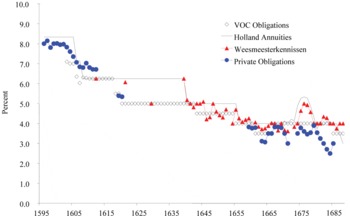
The public credit recovery was highlighted by declining interest rates. The issuing rate for redeemable annuities dropped from 8.3 percent in 1597 to 7 in 1605 and to 6.25 in 1608, only slightly trailing the rates paid by Amsterdam merchants and the Dutch East India Company (VOC) for short-term loans (Figure 1).Footnote 28 The Estates succeeded cutting interest costs further several times with a withholding tax on redeemable annuities of 0.5 percent in 1596, and 1 percent in 1601, 1604, and 1607.Footnote 29 With maximum rates of 9 percent, bills paid slightly more than annuities (Figure 1), a consequence of the bills being sold on the receivers' personal credit.Footnote 30 The rating difference gradually disappeared, however. From 1597 buyers could ask the Estates to guarantee the bills; in 1605 the Estates reduced the receivers' commission for selling bills from 1 to 0.5 percent, and from 1607 redeemable annuities and bills had identical issuing rates.Footnote 31 From 1608 these stood at 6.25 percent, a rate last obtained in 1556, putting Holland in the European middle band, above Genoa, Venice, Castile, and France, but below Naples, Rome, Bologna, and fellow Protestant Britain and Geneva.Footnote 32
INTEREST PAID ON VOC BONDS, PRIVATE BONDS IN AMSTERDAM, AND HOLLAND'S REDEEMABLE ANNUITIES, 1595–1688

Economic growth boosted the recovery of Holland's credit. Between 1590 and 1609 fiscal revenues doubled.Footnote 33 Moreover, the expanding economy boosted the supply of savings; the average annual increase of the wealth of Amsterdam merchants, for instance, may have been as high as 12.5 percent in this period.Footnote 34 Potential public debt buyers had plenty of alternative investment opportunities, however. Both the booming European trade and the first intercontinental expeditions yielded much higher returns.Footnote 35 Hence to accept the large loans of 1599–1603, investors needed prodding by forced issues for about half of the total. As before, such loans were based on a census of the entire population. Commissioners assessed every household in detail, after which those possessing 2,000 guilders or more had to accept a loan for 0.5 percent of their wealth in redeemable or life annuities.Footnote 36 To sweeten the pill, the loans were exempt from the withholding tax, but the receivers still needed the threat of suspending interest payments on existing loans for investors to swallow their allotted portion.Footnote 37
Both provincial and local authorities had resorted to such census-based levies before, first during the 1540s and again during the 1570s and 1580s emergency.Footnote 38 This time, however, the Estates clearly intended to create a regular fiscal resource. Revised and updated in 1599 and 1602, the census ledgers enabled the receivers to subdue investors holding out for better conditions, offering them the option between a rinse (voluntary loan) and a shave (forced loan), with the potential third option, a haircut (levy), remaining unused until the 1620s. The ledgers harnessed the market so well that officials hailed them as the foundation of Holland's finances.Footnote 39 However, as static appraisals of real assets, the ledgers were quickly obsolete, expensive to update, and unable to capture the fast growing liquid wealth from commerce.
To tap this commercial wealth, Holland raised substantial amounts in bills between 1588 and 1609. With a maturity of up to 12 months, bills offered investors the advantages of a slightly higher interest rate plus greater control over their money than annuities. Redemption of annuities was at the authorities' discretion. Transfer of ownership passed through an official register, for which a fee plus a 3.3 percent duty for transferring annuities was charged.Footnote 40 With bills, the boot was on the other foot. Billholders could demand repayment at the end of term and effect transfers without formalities or extra cost, because bills were, in effect bearer paper, transferable by endorsement, really liquid equivalents of time deposits.Footnote 41 As such they were ideally suited to merchants with their constantly shifting liquidity needs, so the receivers in Amsterdam, Rotterdam, or Delft found it easier to sell bills than annuities. For their part, the Estates constantly urged receivers to sell bills only if no takers could be found for annuities, probably because they realized that its creditors could cause a public finance crisis at any moment by demanding their money back.Footnote 42 Presumably, the receivers countered that danger by staggering interest payments to match the flow of revenues coming in.
The loans raised between 1588 and 1609 were puny by later standards but the forces shaping issuing policy were the same. The Estates tailored amounts to be raised, the instruments, and their price to perceived market conditions. By letting the receivers mediate the preference mismatch between the province and its creditors, the Estates could raise loans as quickly, as cheaply, and as close to its funding needs as local markets allowed. Moreover, by setting maximum loan issuing rates, the Estates gave officials an incentive for bargaining with investors.Footnote 43 The 1609 Truce with Spain altered the stakes of both parties. Funding pressure eased and debt issues remained comparatively small, creating room for the province to convert all bills and redeemable annuities into 6.25 percent redeemable annuities. The conversion proceeded slowly because investors bridled at the interest rate cut.Footnote 44 It nevertheless succeeded because investors disliked the alternative, repayment, and because the Estates exempted the new annuities from transfer tax, a typical mix of threats and incentives made possible by the temporary financial breather.Footnote 45 In similar circumstances, the attempted conversion of the Estates General's debt failed for a lack of money.
THE FREE MARKET'S STRETCH, 1621–1648
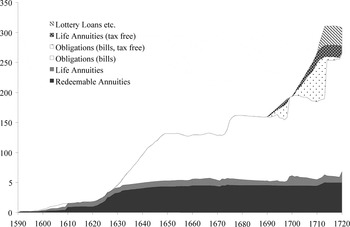
What policy choice the Estates of Holland may have had in the 1610s disappeared during the much shorter but massively more expensive second phase of the Eighty Years' War. Between 1621 and the Peace of Westphalia in 1648, Holland's debt rose more than fivefold to 125.5 million guilders, not counting a floating debt of 7.2 million.Footnote 46 Letting the debt rise so quickly required a firm confidence in the country's fiscal resilience, which the economic boom clearly inspired. As before, the Estates preferred issuing annuities, but tweaked financial policy in two respects: they used wealth levies rather than forced loans to supplement voluntary purchases of annuities, and from the late 1620s they increasingly relied on bills rather than annuities. By 1648 bills amounted to 73 million guilders, or 60 percent of Holland's debt (Figure 2).
THE ESTIMATED SIZE AND COMPOSITION OF HOLLAND'S DEBT, 1590–1720 (million guilders)

Presumably, there were three reasons for using wealth levies rather than forced loans. First, despite new taxes military expenditure outpaced revenues, so any measure slowing the growth of interest charges was welcome.Footnote 47 Second, forced loans enabled taxpayers who needed liquidity to sell their paper, but rising wealth had lessened their need to do so. Third, the Estates feared pushing issuing rates upward by floating too much debt. The alternatives were first debated in 1622, when a proposed forced loan was dropped in favor of a wealth levy.Footnote 48 The following year Delft objected to a free loan because local investors would demand higher interest rates, suggesting wealth taxes or forced loans instead.Footnote 49 The yield from wealth levies began to drop, however, because the 1602 ledgers were too old, shifting the burden away from merchants with their liquid wealth to property owners in less dynamic sectors.Footnote 50 The ensuing debate shows the Estates unable to find the lesser evil among the growing interest burden, wealth levies, and forced loans.Footnote 51 When in 1625 the Estates finally did issue a forced loan of 0.5 percent on wealth assessed, they drafted a careful compromise between conflicting interests. The annuities issued in return carried 3 percent interest during the first six years, rising to the going rate of 6.25 percent after that; they were also free from the 3.3 percent transfer duty during the first three years. To ensure a fair balance between wealth owners, the Estates also had the 1602 ledgers updated, so the loan was clearly intended as a one-off.Footnote 52 So it remained. Though the Estates debated the option of a forced loan again in 1626, 1627, 1628, 1630, and in 1633–1635, each time they decided to levy a wealth tax instead, sometimes made more attractive by letting the taxpayers have annuities for their contribution if they paid before a set date.Footnote 53 By 1635 the tax yield had started to decline again, but now the Estates ensured a light touch for mercantile wealth by not updating the 1625 ledgers.Footnote 54 Taxing wealth remained a last resort, occurring on average once every three years until 1650.Footnote 55
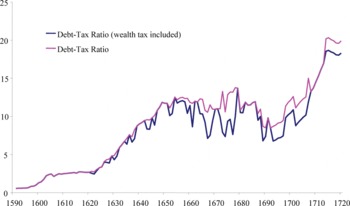
By the mid-1630s the Estates could afford the policy change from forced loans to wealth levies and bills because the market absorbed bill issues with remarkable ease. The administrative groundwork for the transition was done in 1628, when the province substituted its own credit for that of the receivers. Henceforth, new bill issues were backed by a certificate of indemnity for the receiver pledging all provincial revenues for servicing the debt.Footnote 56 The administrative tightening up made little difference for bill buyers, since receivers had provided such a guarantee on demand since 1597, but it did signal the Estates' commitment to the new issuing policy. Using bills on such a scale meant building up a perpetual debt with short-term instruments. Before the Truce of 1609 the debt-tax ratio had barely touched three, that is to say, the debt could have been redeemed with three years' revenues. Now the rate shot up to 12 by 1650 (Figure 3), rendering debt retirement unlikely given the frequency of European wars. Consequently, the bills turned from short-term paper into de facto perpetuals. This quasi-consolidation took place gradually and without any change to status or price of the bills, creating a remarkable anomaly in the history of public finance: a rapidly growing debt financed largely with short-term instruments at issuing rates that were amongst the lowest in Europe.
THE RATIO OF DEBT TO TAX REVENUES IN HOLLAND, 1600–1720

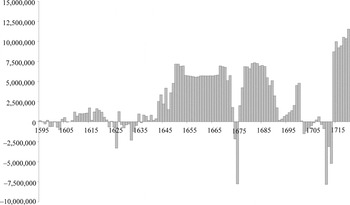
How to explain this anomaly? By 1630 Holland combined a strong credit record with a booming economy and savings outpaced the rise in public debt. Historians agree that the period up to the 1650s was the most dynamic phase of the republic's economic growth.Footnote 57 Moreover, the net debt increase between 1621 and 1648 more or less equaled the interest paid out during that period, with net annual transfers from investors to the province seldom exceeding 1 million guilders (Figure 4). The ballooning debt could thus be financed entirely by reinvesting interests paid out.Footnote 58 Investors obliged because the bills were always redeemable at par and at short notice but as their savings accrued, few billholders exercised the option. In 1621, 1622, and 1623 redemptions amounted to only 56,000, 84,000, and 148,000 guilders.Footnote 59 By 1635 the roll-over of bills was so common that the provincial receivers lost their small fee for it.Footnote 60 Declining market rates in the 1630s led to plans for a conversion of redeemable annuities and bills from 6.25 percent to 5. When preparing this conversion in 1640, the Estates deemed 800,000 guilders enough to cover expected redemptions on an estimated total debt of 94 million.Footnote 61
ESTIMATED NET ANNUAL TRANSFERS FROM THE PROVINCE OF HOLLAND TO ITS CREDITORS, 1600–1720 (interest paid out minus new debt issues)

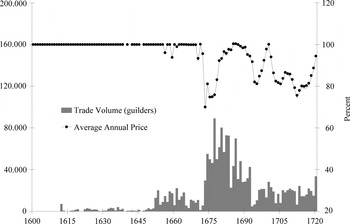
Investors had little to gain from a formal consolidation and a lot to lose (in particular the liquidity from the option to redeem at the tax receivers' offices), as the fate of redeemable annuities showed. With a transfer tax and related formalities, Holland effectively locked its annuities into a relatively small segment. Data from Gouda demonstrate this phenomenon to good effect (Figure 5). The annuities transfers recorded by the city secretary show little activity until the 1650s. In 16 years between 1613 and 1650 there were no transfers; in 12 more years, only one or two annuities changed hands. The nine remaining years saw three or four transfers, exceptionally five or seven, for amounts in the hundreds of guilders rather than in the thousands. Moreover, the few recorded prices were invariably at par. The annuities clearly catered for a specific market segment, i.e., investors holding the paper long enough to cancel the penalty on transfers. This segment absorbed no more than the 50 million guilders reached by the early 1640s, anchoring prices at par until the 1672 emergency forced a fire sale.
TRANSFERS AND PRICES OF HOLLAND'S REDEEMABLE ANNUITIES RECORDED BY GOUDA'S TOWN SECRETARIES, 1600–1720

If investors could only lose from consolidation, the Estates did not stand to gain. Their debt management depended entirely on continuously rolling over short-term paper at interest rates that could hardly be lower and by now they probably knew that the likelihood of a roll-over crisis was minimal.Footnote 62 Consequently, we must see Holland's anomaly as an equilibrium of interests achieved on one side by rapid economic growth and wealth accumulation and on the other by the soaring expenditures needed to defend that prosperity. The equilibrium depended on the receivers' dual-action safety valve, which gave investors an exit option while buffering roll-over crises.
TRAPPED IN EQUILIBRIUM, 1648–1672
The 1648 peace with Spain did not bring an end to fiscal concerns. Indeed, at 7 million guilders annually, interest payments absorbed 60 percent of revenue.Footnote 63 Moreover, the debt's short-term character sat uneasy after an incident in 1653. When the first Anglo-Dutch War (1652–1654) appeared to go against the republic, billholders giving notice squeezed several receivers, notably the one in The Hague. The bottlenecks were solved by transferring funds between offices and by having receivers persuade creditors to leave their money untouched.Footnote 64
Though the roll-over crisis did not pose a serious threat and passed quickly, the experience added impetus to formulating three financial policy priorities during the 1650s and 1660s: conversion, redemption, and consolidation. The Estates tackled the first two issues in tandem and started exploring the options for reducing the interest burden through cutting the debt. In August 1652 Johan de Witt, on his way to Holland's most powerful office of grand pensionary, presented radical plans. The interest on redeemable annuities and bills would be reduced from 5 to 4 percent for at least one year, with the savings going into a redemption fund. This proposal caused such uproar that the subject had to be shelved. The ongoing war with Britain prevented debt reduction anyway, but to avoid a further increase the Estates raised the land tax by 50 percent and reintroduced a 0.5 percent wealth tax, revising the ledgers in 1654 to boost the yield.Footnote 65
The war with England taught some harsh realities: Holland's financial position required further billholders' sacrifices. Wealth levies became a regular tax, raised in all but nine years until 1722. There was room for an interest rate cut, too, because the savings which had earlier absorbed the fast growing debt pushed interest rates down now that debt creation had stopped. Between 1650 and 1653 net annual transfers from Holland to investors amounted to 7 million guilders, subsequently dropping to around 6 million (Figure 4), money which, with the Dutch economic spurt slowing down, could not easily find alternative employment. Consequently private interest rates started to fall: to 4.5 percent by 1655, and less than 4 percent five years later (Figure 1). By 1660 Amsterdam's orphans' trustees (weesmeesters) lent at 3.5 to 4 percent, while the city's leading merchants borrowed at 3 to 3.5 percent.Footnote 66 The VOC lowered its bond rates from 4 to 3.5 percent between 1662 and 1665.Footnote 67
Falling interest rates combined with the war lessons to muster the political will for a billholders' sacrifice. In March 1655 bills were said to trade at 105–107 percent of par, the first instance we have of bill prices.Footnote 68 The Estates used these high prices to force through an interest rate reduction to 4 percent in August, earmarking the saved expense for a redemption fund that would extinguish the debt in 40 years.Footnote 69 Foreigners would be repaid first, then holders who had given notice in 1653, followed by investors living outside Holland, and in the last resort inhabitants proper.Footnote 70 The profoundly unpopular redemption would thus hit the delegates and their constituents somewhat later but investors need not have worried. To achieve its goal of repaying the debt in 40 years, the province should have redeemed over 3 million guilders annually. The debt, however, declined by just that amount between 1655 and 1670, partly due to the fact that in 1664, with the clouds gathering for the Second Anglo-Dutch War (1665–1667) redemption funds were diverted into war spending.Footnote 71
After conversion and redemption, the Estates turned their attention to consolidation. During 1657 and 1658 they repeatedly discussed the wholesale repackaging of bills into annuities.Footnote 72 No decision was taken, presumably because delegates realized that, with nothing to attract investors and little to gain for the government, consolidation made no sense. Nor was it viable. In Gouda, the number of annuities transferred rose markedly during the 1650s and 1660s, reaching double figures for amounts totaling 6,000 to 20,000 guilders annually (Figure 5). After 1655 prices dipped under par on a few occasions: 98 percent, 96 percent, 93 even, rendering a conversion at par impossible. As a second best, the Estates reintroduced its old policy of selling annuities rather than bills, with marginal success.Footnote 73
Thus Holland, though at the peak of its power, was trapped in a public finance system of its own making. By the 1650s the Estates depended on the market to realize its policies; consequently, the interest rate conversion succeeded, the redemption made as much headway as the international situation allowed, and the consolidation failed. Though the Estates managed to reduce debt, public finance had reached clear limits. Larger conflicts than those with Britain would require higher contributions from wealth owners. In effect, the high-level equilibrium between Holland and its creditors was really a trap for both, the sheer size of the debt tying both parties to each other hand and foot.Footnote 74 Moreover, the Estates did not embrace the emerging secondary market as a means to lower interest costs, but actively disliked it, as their strenuous consolidation efforts show. For their part, the billholders were trapped, too, in their own savings. Interest payments boosted surplus savings, pushing down interest rates. We see here the origins of Holland as Europe's lender of first resort, offering such low interest rates that, from the late 1650s, foreign monarchs rushed in.Footnote 75
COMING TO TERMS WITH THE MARKET, 1672–1678
The three-pronged attack by Britain, France, and two German princes in 1672 created entirely new financial parameters. Holland had begun preparing for an imminent conflict with France as early as 1670, raising troops, taxes, and loans.Footnote 76 In October 1671 the Estates introduced a small roll-over charge on bills.Footnote 77 Over the next four months, they boosted reserves with 9 million guilders worth of loans.Footnote 78 By early April the Gecommitteerde Raden warned against further borrowing for fear of ruining credit, so the Estates chose to levy a 1 percent wealth tax instead.Footnote 79 Then war broke out in earnest. Needing funds instantly, Holland resorted to forced loans. Revenues were disappointing and the Estates widened the assessment terms.Footnote 80 Between 1672 and 1675 Holland raised 10 million guilders in free loans plus nearly 25 million guilders in forced loans, 7 percent of the estimated wealth in real estate and public securities.Footnote 81 Getting hold of any money at all proved difficult because the invasion triggered a scramble for cash.Footnote 82 After some deliberation, the Estates allowed receivers to accept bullion and gold and silver objects in payment, hoping to avoid investors pressing for cash through redemption.Footnote 83 This happened anyway; by June the receivers were in trouble from billholders giving notice. On 2 June provincial officials intervened and raised the terms for giving notice.Footnote 84 This failed to stop the run, so on June 13 the Estates declared a moratorium on redemptions, though not on interest payments.Footnote 85 Even so all receivers fell in arrears.Footnote 86 In 1675 interest payments on the forced loans of 1672 were still overdue, the Estates were also concerned about servicing the 1674 forced loans. As a result, they briefly entertained the notion of cancelling the 1672 arrears outright.Footnote 87 Holland also paid interest due in bills rather than money and persuaded the VOC to pay dividends in public bills rather than cash.Footnote 88
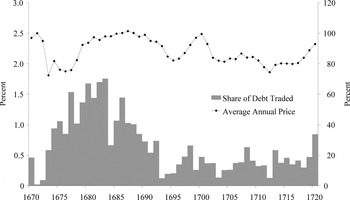
The war thus threw Holland in its deepest financial crisis since the late sixteenth century. The Estates proposed drastic measures such as renewing the existing wealth tax ledgers and widening the assessment to include all financial assets. After intense negotiations they adopted a blanket 16.6 percent increase of the estimated wealth for tax payers worth more than 3,000 guilders using updated ledgers. The Estates also decided to levy two wealth taxes of 0.5 percent each specifically applied to financial assets, thus effectively reducing nominal interest rates on Holland bills to 3 percent in 1673. The impact of this latter measure was softened somewhat by introducing a dual taxation rule. Sums due in the financial assets levy could be subtracted from sums due in personal wealth tax.Footnote 89 This benefitted big investors to the detriment of small ones, people below the tax threshold with a redeemable or life annuity as a pension provision. The sharp drop in Gouda prices from 1673 followed by marked fluctuations and increasingly high annual turnovers shows that this caused a rush to sell redeemable annuities (Figures 5 and 6). The liquidity squeeze thus breathed life into the rudimentary local secondary markets that had begun in the 1650s and 1660s.
Why did a secondary market not emerge earlier? After all, with 130 million guilders of debt there will always be investors who need some liquidity. The receivers probably served this market, redeeming bills for later resale.Footnote 90 In 1666 and 1668 the Amsterdam merchant Louys Trip purchased such bills.Footnote 91 Billholders could also obtain liquidity by offering their securities as loan collateral (lombarding).Footnote 92 The 1672 squeeze upset the balance between supply and demand, though the Gouda data do not tell us how active that market was. All the same it bears emphasis that the secondary market did not emerge on purpose, or as a consequence of diverging investors' expectations, but as a consequence of the friction between aggregate supply and demand, just as the secondary market in VOC shares had originated in sustained demand after the closure of the company's subscription books.Footnote 93
The Gouda data also show that investors discounted the securities tax in prices, leading private and public rates to diverge. At the start of the war, private interest rates in Amsterdam shot up, but once the immediate danger had disappeared, they declined again (Figure 1). A small portfolio of 67 loans extended by one Amsterdam merchant banker on collateral of VOC shares between 1673 and 1683 shows a sharply declining interest rate, the lowest one dropping from 3.5 percent in 1677 to as little as 2.5 percent in 1683.Footnote 94 Public rates followed a quite different trajectory. During the summer of 1672 the yield on Holland's securities also peaked as sellers could find no buyers. The available bill data for 1672 suggest that prices plummeted to 30 percent, recovering to the 70–85 range during the second half of the year, then dropping again to 50–55 in late December before returning to 76 early in 1673.Footnote 95 Low securities prices directly translated into higher borrowing costs. In 1673 the cities had to borrow their usual advance on the forced loans at 6 percent per year.Footnote 96 The market situation then eased somewhat, but with bill prices below 80 Holland had to offer at least 5 percent for free loans. Considering this too high, the Estates continued issuing forced loans at 4 percent. That proved difficult and in 1674 receivers were once again warned not to sell bills below par, which they obviously were doing.Footnote 97As late as 1678 the Rotterdam receiver could raise money only by offering 5 percent.Footnote 98 By now players in the secondary market held the whip hand. During the mid-1650s bill prices had performed no more than a signaling function for delegates to the Estates, helping them to decide whether or not to lower interest rates; from the 1670s, however, the Estates had to follow the market rate, whether they wanted to or not.
THE DOUBLE-EDGED SCALPEL, 1678–1713
The 1678 Peace of Nijmegen enabled Holland to restore its finances. With a debt-to-tax rate of fourteen, the situation was worse than before De Witt's efforts of the 1650s and 1660s (Figure 3). The circumstances of the 1650s returned, but with a difference. The province could not redeem large sums, so instead it raised the rate of both the excises and the real estate tax. The extra revenues helped to push the debt-to-tax rate to 8.5 by 1690, its lowest level for more than 40 years (Figure 3). Holland also reduced expenses by forcing an interest rate cut in the form of a withholding tax. In 1680 the Estates imposed a 0.5 percent wealth levy. Public securities were taxed at 0.5 percent of the face value, deducted from interest payments by the receivers.Footnote 99 A similar withholding tax on interest payments had been used between 1596 and 1607, but opposition had prevented subsequent attempts to levy it. In 1634, for instance, the Estates had rejected a proposal for taxing interest payments on bills and on other loans because credit would collapse if private administrations were opened for inspection.Footnote 100 The Estates considered a withholding tax in 1655, but abandoned it in favor of an interest rate cut. In December 1671, only months before Louis XIV's invasion, De Witt had great difficulty in persuading the Estates to enact a temporary 5 percent levy on interest payments.Footnote 101
The 1680 withholding tax was also discontinued, presumably because of its immediate impact on credit. After a steady recovery during the late 1670s, Gouda and Leiden annuities prices halted in 1681, drifted for a year or two as if testing the Estates' intentions, then resumed their rise back to par (Figure 6). Clearly investors wanted compensation for their sacrifices during the war before being amenable to an interest rate cut. With the swell of interest payments not absorbed by new debt issues running at some 7 million guilders a year, that moment would come more or less automatically (Figure 4). Modest redemptions helped to prepare the ground; fiscal reforms succeeded in generating the surplus needed for about 2.6 million guilders of redemptions during the 1680s.Footnote 102 In 1687 the Estates reintroduced the 0.5 percent withholding tax on public debt interest payments. The rate was doubled to 1 percent the following year; again the dual taxation rule cushioned big investors. Compared to the blunt knife of the ledger-based wealth levies with their built-in obsolescence, the withholding tax was a scalpel, easier to impose, more efficient, and cheaper to apply. Moreover, the Estates could use the withholding tax rate to test the market's readiness for new issues, lowering or raising the interest differential between existing bills and new issues as required. The adoption of this tax also signaled that the Estates considered bills a fair proxy for overall wealth, i.e., ownership was spread sufficiently wide over wealth owners for the tax to result in an equitable assessment. The moment proved well chosen; Gouda-Leiden prices hardly moved, so the market accepted the interest rate cut (Figure 6).
THE ANNUAL AVERAGE PRICE OF HOLLAND'S LOSRENTEN IN GOUDA AND LEIDEN AND THE VALUE OF LOSRENTEN SOLD AS A PERCENTAGE OF THE TOTAL DEBT OUTSTANDING THERE, 1670–1720

The withholding tax was also instrumental in funding the quarter century of almost continuous warfare which followed William of Orange's ascension of the English throne in 1689. During this period, Holland's debt nearly doubled from 160 million guilders in 1690 to almost 300 million at the Peace of Utrecht in 1713, pushing the debt-to-tax ratio back to over fourteen. To fund the wars, the Estates resorted to their customary round of substantial tax raises, including the real estate tax, the excises, and a doubling of the withholding tax on interest payments to 2 percent. Consequently, from 1690 investors suffered an annual haircut of a similar magnitude to the forced loans of the 1670s. Billholders are said to have borne this stoically because countering the French threat required sacrifices, but they did not have much of an option. Home alternatives such as buying real estate suffered a similar tax pressure on yields and foreign alternatives like British securities were slow to materialize.Footnote 103
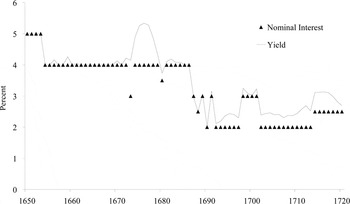
Moreover, the annuity prices from Gouda and Leiden show an immediate impact of taxation on the price of public debt (Figure 7). The market accepted the initial reductions of 1687–1690, but prices then dropped to 80 percent in 1695. The Estates responded by halving the withholding tax to 1 percent following the end of the Nine Years' War in 1698, causing annuities prices to veer back. The reimposition of a 2 percent levy at the start of the War of the Spanish Succession in 1702 clearly disappointed investors and prices fell gradually to reach 75 percent in 1712, giving a 3 percent yield. By that time, even a 0.5 percent tax cut failed to restore prices.
THE NOMINAL INTEREST RATE AND THE YIELD ON HOLLAND'S LOSRENTEN, 1650–1720

The price drop shows Holland caught in a vicious circle of its own making. Its scalpel cut both ways; to raise the very large loans needed, the Estates had to offer incentives which drove down the price of old debt to the same degree and then necessitated new incentives. For example, at first Holland sold new issues at a tax-exempt 4 percent for the duration of the war. This period had to be extended to ten years after the war for later issues.Footnote 104 When the market for 4 percent bills appeared exhausted, the Estates adopted a successful British public debt innovation, lottery loans, issuing lottery bills totaling 34 million guilders in 1711, 1712, and 1713.Footnote 105 During 1710 and 1711 Holland also issued twenty-year bills at 9 percent, of which 4 percent interest and 5 percent amortization.Footnote 106 The entire volume issued during 1690–1712 consisted of loans incentivized in one way or another (Figure 2). In 1709 sluggish home demand even led the Estates to take a 1.5 million 4 percent loan from the Swiss canton of Bern.Footnote 107
Under these circumstances, the receivers needed all their skills to coax local markets into accepting new issues while holding on to old, lower-yielding bills. They probably did this by pretending to make exclusive offers to selected customers, which they could because the primary market remained opaque. The Estates published no financial information whatsoever; only the receivers knew how much money was to be raised or still needed to be subscribed, so they could play investors against each other. Moreover, despite negative transfers during the early 1700s (Figure 4), the mismatch between investment opportunities and surplus savings continued. Though old bills sold under par on the secondary market, there was no rush to redeem them at par with the receivers because investors feared being excluding from new issues at higher rates that could raise the overall yield of their portfolios. This gave the receivers considerable leverage. New loans were probably fed to investors according to their status with the receiver, favorites being able to buy new, untaxed issues, perhaps even be allowed to swap old, taxed bills for new. Less privileged investors would have needed to bargain, guarded threats of reimbursement serving to coax them into accepting whatever it pleased the receiver to offer them. In 1706 the French diplomat Adrianus Helvétius reported admiringly from The Hague on the skills with which the Receiver-General Receiver of the United Provinces, Cornelis de Jonge van Ellemeet, exploited his market to get new issues subscribed.Footnote 108
Consequently, by the Peace of Utrecht in 1713 Holland's bill debt, homogeneous in 1687, had become a patchwork of different issues. Rather than preventing the rise of a secondary market, as Larry Neal surmised, this was actually the consequence of pressure from the secondary market.Footnote 109 At this moment in time, Britain struggled for a secondary market to absorb its short-term debt overhang and ended up creating liquidity by way of securitization, with the 1720 boom and bust as a direct consequence.Footnote 110 By contrast, Holland had no such need and thus avoided the worst of the 1720 excesses.Footnote 111 The key difference between the two countries would seem to have resided in Holland's fiscal decentralization, the system of feeding debt directly to local markets in proportion to their tax yield, rather than issuing everything from the center.Footnote 112 In this way, investors could be targeted, tax receipts matched with interest payments, debt issues tailored to available savings, and trust maintained by leaving local people in charge. Britain's public finance trajectory was a particular one, determined by its particular circumstances, and not by any general law of public finance development. This particularity explains why public finance best practices could not easily be transplanted, why the “Dutch Finance” imported by William III into Britain did not really work there, and why so few European countries adopted British fiscal practices even during the nineteenth century.Footnote 113 In public finance, each country needed to develop its own wheel, no doubt inspired by foreign examples, but always adapted to local circulation.
CONCLUSION
At first sight, the evolution of Holland's public debt appears a curious anomaly. There was no distinctive North-Weingast moment of fundamental constitutional change. The Estates' credible commitment to debt service evolved gradually, grafted on that of the cities and sustained, as and when needed, by fiscal reforms to make revenue meet increased debt service levels. The predominantly short-term character of Holland's debt in the seventeenth century defies ordinary logic, which emphasizes the desirability of consolidation to create a liquid market for government debt and attain lower interest rates. In Holland, a secondary market for public debt appeared very late in the day, long after the start of such a market for private securities such as VOC shares. Until the French invasion of 1672, the liquidity on call at the tax receivers' offices combined with the lombarding of public bills sufficed for investors, and a fully fledged market only sprang up following a general liquidity squeeze. Finally, from 1687 the composition of Holland's debt changed dramatically from the traditional mix of bills and annuities into a patchwork of issues with different terms and conditions, each individual one tailored to the market conditions and managed by the withholding tax.
Yet on reflection, Holland's case reveals that the long-running debate about the causes of the modernization of public finance in early modern Europe has overlooked a vital ingredient: private savings. For debt to grow and interest rates to fall, credible commitment and efficient fiscal institutions were necessary, but not sufficient. Unless such institutions coincided with growing riches, unless they enabled the authorities to tap private wealth efficiently and timely, they achieved little or nothing. Economic growth and rising wealth generate the tax flows needed for debt service; the importance of good fiscal institutions lies in the need for capturing these revenues in a timely and proper manner. Then as now, fiscal institutions needed constant readjustment to changed circumstances, and the evolution of public borrowing was always a dynamic process of bargaining over the application of growing savings for state purposes, the course of which depended on local circumstances. Unless we start looking at early modern public finance from the perspective of such processes, we will not fully understand how they evolved. In Holland's case, the accumulation of private wealth widened the Estates' options, at the price of giving in to investors' preferences, which changed as wealth increased and private alternatives declined. Thus a growing debt at falling interest rates was not due to any institutional changes, but to a combination of abundant savings with a weakening economy.
The importance of a savings surplus for public finance is underlined to best effect by changes in the size, composition, and price of Holland's debt. Rising savings changed investors' preferences from long-term to short-term, forcing the government to respond. The province's initial debt instruments, annuities, combined full governmental control over repayments with investors' demand for a secure store of wealth. This demand was fairly static, tied as it was to a limited number of uses, but as economies grew and savings accumulated, investors in public securities wanted liquidity so they could switch their resources as and when required. Holland's solution of short-term bills with a return option was unusual only in being remarkably successful. This finding highlights another aspect neglected in the credible commitment debate: there existed no direct link between credible commitment, secondary bill markets, liquidity, and low costs of capital. In Holland, a liquid market seems to have appeared some 70 years after the emergence of the Amsterdam market for VOC shares. Liquid markets for public debt were clearly more difficult to create than we like to think, so we need to reconsider what it takes.
Finally, surplus savings also explains why, as Larry Epstein has demonstrated, issuing rates for public debt fell across the European board, in countries with limited government and absolutist rule alike. The economic success of the Italian city states, Holland, and Britain tended to weaken the need for commitment and institutional change elsewhere, because once growing wealth had pushed down home interest rates, investors started looking abroad for higher returns. Genoese loans sustained the Spanish Crown in the sixteenth and seventeenth centuries, Amsterdam debt absolute regimes in Denmark, Austria, and Russia in the eighteenth century, British bonds various South American regimes in the nineteenth century, all loans bridging the often wide interest rate gap due to the difference in commitment and in institutions between lender and borrower. Thus one key driver of the declining interest rates noted by Epstein would appear to have been growing savings, spread through arbitrage between wealthy centers and a poorer periphery. Aspects of credible commitment diffused in this way as well, the Danish and Russian monarchs learning the importance of a prompt debt service from their Dutch bankers, for instance. If the Spanish and Austrian Crowns proved slower to pick up that lesson, this underlines that money will flow to where it is wanted, but its lessons do not necessarily follow.
Appendix: The Size and Composition of Holland's Debt, 1590–1720
Our reconstruction of the size and composition of Holland's debt at the end of each year between 1590 and 1720 (reported in Figure 2) differs from earlier calculations by E. H. H. Dormans (Tekort) and Ruud Liesker and Wantje Fritschy (Gewestelijke). This appendix details the amendments and changes we made to their estimates.
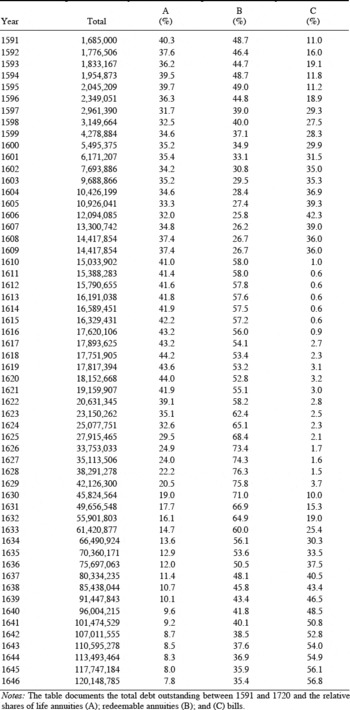
Appendix Table 1A details the size and composition of Holland's debt between 1591 and 1646. We estimate Holland's debt at the end of 1591 at 1.5 million guilders, the amount for which Holland's towns, since 1588, issued annuities to replace bills outstanding.Footnote 114 For the years 1591–1607 we took the Estates resolutions concerning sales of life annuities, redeemable annuities, and bills as basis for our estimates and assumed that all loans were placed in accordance with those instructions.Footnote 115 This seemingly strong assumption is warranted by both the reported value of Holland's interest payments in 1604 and the conversion of these bills recorded by the Noorderkwartier in 1618 (see below). One exception is 1594, when annuities worth 250,048 guilders were sold to replace a similar amount in bills issued by the tax receivers; we deduct this amount from the estimated value of bills outstanding in 1594.Footnote 116
THE SIZE AND COMPOSITION OF HOLLAND'S DEBT (1591–1646)

Notes:
The table documents the total debt outstanding between 1591 and 1720 and the relative shares of life annuities (A); redeemable annuities (B); and (C) bills.
Though preferring annuities, the Estates also approved bill issues worth 5.2 million guilders between 1591 and 1607, with a term of one year but rolled over upon expiry.Footnote 117 The Estates also used forced sales of life- and redeemable annuities in 1599, 1600, 1602, and 1603. A 1618 report put the total revenues for these four years for the northern part of Holland (Noorderkwartier) at 660,611 guilders. Based on this area's share in fiscal revenue (20.5 percent), we estimate the total of forced loans for Holland at 3.2 million guilders.Footnote 118 To arrive at annual estimates, we have attributed equal shares to 1599, 1600, 1602, and 1603.
In 1609 the Estates ordered the conversion of all bills into annuities; the 1618 Noorderkwartier report confirmed the conversion of 1,131,119 guilders worth of bills.Footnote 119 This amount is very close to the area's 20.5 percent share in the 5.2 million guilders bill debt of 1609, i.e., 1,069,546 guilders. We therefore assume the receivers in the Zuiderkwartier to have successfully converted all their bills in 1609 as well. In the Noorderkwartier, 90 percent of bills were converted into redeemable annuities and 10 percent into life annuities.Footnote 120 We assume this ratio was the same for the Zuiderkwartier and we distribute the 5.2 million guilders worth of bills in 1609 between the two types of annuities in 1610. Subsequently, the Noorderkwartier receivers repaid 34.4 percent of the redeemable annuities; we assume the Zuiderkwartier receivers to have done the same and we take these redemptions to have been distributed equally over time between 1610 and 1618.
The 1618 report also allows estimates of the relative share of life annuities and redeemable annuities between 1591 and 1609.Footnote 121 The 495,300 guilders of annuities issued until 1598 in the Noorderkwartier consisted of 45.3 percent life annuities and 54.7 percent redeemable annuities; the 660,612 guilders of forced loans of 1599–1603 consisted of 58.9 percent life annuities and 41.1 percent redeemable annuities; and the 490,804 guilders of annuities issued between 1601 and 1608 consisted of 69.1 percent life annuities and 30.9 percent redeemable annuities. We estimate the composition of Holland's debt by applying these ratios to the various issues of annuities between 1591 and 1607, while at the same time adjusting the value of life annuities outstanding to their average annual extinction rate between 1591 and 1609 (1.25 percent). The accuracy of this procedure is confirmed by a government report from 8 March 1604 stating that Holland paid about 1 million guilders in interest.Footnote 122 Our estimates for 1603—bills worth 3,448,802 guilders at 8.5 percent; life annuities worth 3,506,533 guilders at 14.3 percent and redeemable annuities worth 2,976,223 guilders at 8.33 percent—yields interest payments of 1,005,347 guilders.Footnote 123
In 1609 the estates general asked all provinces to contribute to the redemption of 4,356,101 guilders worth of bills issued by the Union and to take over a debt of 1,303,245 guilders.Footnote 124 If Holland contributed according to its share in the Union's budget (58 percent), it should have issued about 3.3 million guilders of debt to pay for that. According to a 1616 report, the receiver general of Holland paid 309,201 guilders interest on renten sold between 1610 and 1614 to redeem loans which not previously charged to the province.Footnote 125 We assume this statement relates to the operations for the Union and estimate that, by 1614, Holland had fulfilled its obligations. Consequently, we estimate the share of life annuities (at 14.3 percent) and redeemable annuities (at 6.25 percent) at 40 and 60 percent of the replacement loans, respectively.
In 1616 the Noorderkwartier issued 300,000 guilders of life annuities as its share in a 2.8 million guilders loan of the estates general to redeem the cities of Flushing and Brielle from the English Crown.Footnote 126 Based on the Noorderkwartier's 20.5 percent share, we estimate Holland's total issue of annuities at 1.5 million guilders in 1616, but we assume that the Zuiderkwartier issued 40 percent life annuities and 60 percent redeemable annuities. In 1617 the Noorderkwartier sold 73,800 guilders of bills to fund a 360,000 guilders loan from Holland to Sweden. The Estates' resolutions reveal several other bill issues between 1610 and 1620, mostly in support of allies.Footnote 127 These loans were small and mostly short-term, but not all of them were redeemed and we estimate the bill debt rose to 573,000 guilders in 1620. In 1617 and 1618 the Noorderkwartier also sold life annuities worth 41,000 guilders as part of two 200,000 guilders loans to pay for French troops. We estimate that the Zuiderkwartier exclusively sold life annuities as well in these two instances, but we assume that in a new 400,000 guilders issue of annuities in 1620 redeemable annuities made up one quarter.
Taking into account a 1 percent annual extinction rate of life annuities between 1610 and 1620, we estimate the size of Holland's debt at the end of 1620 at 18.2 million guilders, with 6.25 percent redeemable annuities totaling 9.6 million guilders, 11.1 percent life annuities of 8.0 million guilders, and 6.25 percent bills of 570,000 guilders. The estimated interest due on these loans was 1,522,294 guilders, a 1634 report of Holland's finance office putting the total interest paid in 1620 at 1,550,621 guilders.
The Opreeckeninge, an internal report describing the size and composition of Holland's debt in 1632, 1647, 1652, and 1667, put the total at 55.9 million guilders by the end of 1632.Footnote 128 In combination with our estimate for 1620, this would imply an increase of 37.5 million guilders, i.e., 3 million less than the 34.4 million of new loans in the 1634 report.Footnote 129 We cannot explain this difference satisfactorily and surmise that loans initially issued by individual cities, or by the Union, were later added to Holland's total.Footnote 130 We follow the 1634 report to reconstruct the annual debt increase between 1620 and 1632, spreading the excess 3 million guilders over these years according to relative size of the known issues. Given the Estates' strong preference for annuities, and the fact that they only discussed the issue of bills instead of annuities in 1629, we assume that between 1620 and 1628 all new issues consisted entirely of life and redeemable annuities.Footnote 131
The Opreeckeninge also shows the debt increased with 70 million guilders between 1632 and 1647. To reconstruct the growth pattern, we can use a document from 1694 which reports the annual value of loans issued between 1599 and 1694.Footnote 132 We discard the actual amounts of new loans reported in 1694 because they do not add up to the amounts given in the 1634 report and the Opreeckeninge of 1667, but we use the implied distribution of loans over the years 1632–1647 to approximate the annual growth of the debt.
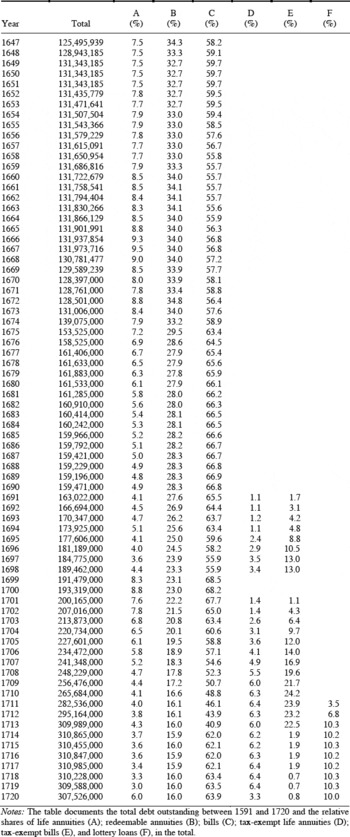
Appendix Table 1B details the size and composition of Holland's debt between 1647 and 1720. For the years from 1647 to 1720, we follow Dormans' estimates with only minor adjustments.Footnote 133 We estimate that 6 million guilders of war debts were consolidated during 1648–1649. The relative shares of life annuities, redeemable annuities, and bills between 1632 and 1652 are interpolated from Dormans' estimates of their share in the first and last year of this period.Footnote 134 We follow Liesker and Fritschy's estimates of the redemption of 4.4 million guilders' worth of bills between 1655 and 1660 (assuming life and redeemable annuities were issued in equal amounts to replace them) as well as their estimate for the issue of new bills worth 3 million guilders between 1664 and 1666. Data for 1668 and 1669 are lacking and therefore we interpolate the size and composition of Holland's debt from the figures for 1667 and 1670. The value of tax-exempt loans between 1691 and 1720 is calculated from detailed reports drafted by Holland's finance office.Footnote 135
THE SIZE AND COMPOSITION OF HOLLAND'S DEBT (1647–1720)

Notes:
The table documents the total debt outstanding between 1591 and 1720 and the relative shares of life annuities (A); redeemable annuities (B); bills (C); tax-exempt life annuities (D); tax-exempt bills (E), and lottery loans (F), in the total.