Introduction
The respiratory tract is protected from airborne infection and debris by a mucociliary layer that lines the sinonasal cavity.Reference Papsin and McTavish1 This layer is made up of columnar, ciliated epithelial cells and goblet cells embedded in mucus. Foreign particles trapped in the sticky mucus layer are propelled towards the nasopharynx, along with the entire mucus layer.Reference Papsin and McTavish1 Nasal mucociliary clearance is the first stage of the host defence mechanism, and plays a critical role in protection against infection and external stimuli.Reference Kim, Song, Young, Lee and Yoon2 Mucociliary clearance is primarily regulated by the amount and rheological properties of secreted mucin and by ciliary activity. Dysfunction of mucociliary clearance aggravates or enhances the development of various nasal diseases.Reference Kim, Song, Young, Lee and Yoon2
Nasal diseases such as allergic rhinitis and acute and chronic rhinosinusitis are frequent sources of morbidity, leading to increased healthcare costs and loss of productivity.Reference Tomooka, Murphy and Davidson3 Inflammation of the paranasal sinuses interferes with the transfer of particles towards the pharynx and delays mucociliary transport time.Reference Tomooka, Murphy and Davidson3–Reference Hauptman and Ryan5
Nasal irrigation is a simple and inexpensive treatment which relieves the symptoms of a variety of sinus and nasal conditions (including infectious and allergic entities), reduces the use of medical resources and helps minimise antibiotic resistance.Reference Garavello, Romagnoli, Sordo, Gaini, Di Berardino and Angrisano6 Nasal irrigation has been used for centuries to treat various sinonasal diseases, including sinusitis and allergic rhinitis.Reference Kim, Song, Young, Lee and Yoon2–Reference Talbot, Herr and Parsons4 Isotonic saline was first introduced for nasal irrigation, while hypertonic saline has recently been popularised as it has been found to decrease oedema and improve mucociliary clearance.Reference Rabago, Zgierska, Mundt, Barrett, Bobula and Maberry7
Hypotheses regarding the benefits of irrigation are: (1) improvement of mucociliary clearance, (2) decrease in mucosal oedema, (3) decrease in inflammatory mediators, and (4) mechanical cleaning of inspissated mucus.Reference Tomooka, Murphy and Davidson3 Mucosal stasis, infection and thickening of secretions are all reported to hinder mucociliary activity. Removal of inspissated mucus and debris may cause mucociliary clearance to normalise.Reference Rossmann, Lee, Forrest and Newhouse8 Irrigation with isotonic or hypertonic saline solutions may help clear crusts and debris, as well as increase clearance of secretions and thin the mucus. Isotonic saline is reported to improve mucociliary clearance mostly through mechanical cleaning, while hypertonic saline solutions exert their effect by decreasing oedema and increasing mucociliary clearance through stimulation of ciliary beat frequency, thinning of mucus and suppression of inflammation. Some authors state that rhinitis results in delayed mucociliary transport time, whereas others report no such change.Reference Talbot, Herr and Parsons4, Reference Sakakura, Ukai, Majima, Murai, Harada and Miyoshi9, Reference Sakakura, Majima, Saida, Ukai and Miyoshi10 However, there is no standard protocol for nasal irrigation, and physicians' choice of nasal irrigation solution for different nasal pathologies usually depends on anecdotal evidence.Reference Tomooka, Murphy and Davidson3, Reference Rabago, Zgierska, Mundt, Barrett, Bobula and Maberry7
In this study, we aimed to investigate the effects of irrigation of nasal cavities with isotonic or hypertonic saline solutions on mucociliary transport time, in cases of allergic rhinitis, acute sinusitis and chronic sinusitis.
Patients and method
At a tertiary academic centre, 87 patients and 45 healthy volunteers were enrolled, after approval from the local ethical committee and obtaining informed consent from participants. Of the 87 patients, acute and chronic sinusitis was diagnosed in 24 and 42, respectively, via clinical history, physical examination and paranasal sinus computerised tomography scans. A diagnosis of perennial allergic rhinitis was confirmed in 21 patients via clinical history, physical examination and skin prick testing (Lincoln Diagnostic, Decatur, Illinois, USA). The 45 healthy volunteers had no health complaints and a normal rhinoscopic examination. We excluded from the study any patients with a history of sinonasal disease (other than allergic rhinitis or acute or chronic sinusitis), smoking, allergy or upper airway infection over the past three weeks, as well as patients using topical or systemic sympathomimetics, parasympathetic agents or antihistamines.
Mucociliary clearance time was measured using the saccharine clearance test method described by Prior et al. Reference Prior, Schofield, Boivin, Anderson and Drake-Lee11 This is a cheap, simple and effective method of assessing mucociliary clearance and its role is widely accepted. Saccharine clearance may be slow or absent in patients with normal mucociliary transport, due to technical errors. One of the most common mistakes is placing the saccharine onto squamous epithelium; this can be avoided with training.Reference Prior, Schofield, Boivin, Anderson and Drake-Lee11 In our study, all mucociliary clearance time measurements were performed by the same physician (who was experienced in saccharine clearance testing), in an attempt to overcome this problem. This physician was blinded to the type of irrigation solution used.
A quarter of a saccharine tablet was placed on the medial part of the inferior concha, 1.5 cm behind the anterior end of the inferior turbinate. The patient was asked to swallow every 30 seconds, and the interval between the application of saccharine and the detection of a sweet taste was recorded. Measurements were performed in the same room at a constant humidity and a temperature of 20–25°C. Subjects were instructed to breathe silently through the nose and not to sniff.
After the initial assessment, each subject was asked to use a solution of either isotonic saline or hypertonic saline (3 per cent, pH 7.6) for 10 days. This assignment was made randomly, and patients in different groups were matched by age. At the end of 10 days, a total of 160 ml of solution had been applied to each nasal cavity in two separate daily doses. Nasal irrigation was administered using a disposable syringe filled with 8 ml of solution (4 ml for each nostril). At the end of the 10-day irrigation period, the test was repeated by the same physician in the same room.
Mucociliary clearance times were found to have a normal distribution, using the Kolmogorov–Smirnov test. Analysis of variance was performed to assess difference in mucociliary clearance time between the four groups, and Dunnet's test was utilised to compare the means of the three clinical groups with that of controls. A p value of <0.05 was considered significant.
Results
No patients were lost to follow up, and no serious side effects or intolerance necessitating cessation of irrigation were reported by patients during the study.
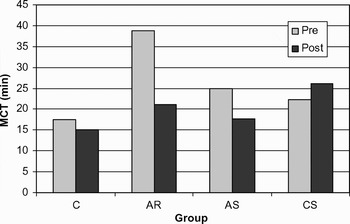
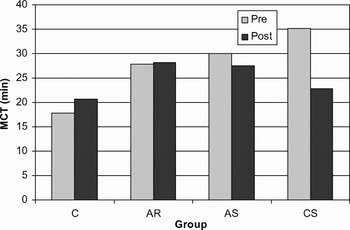
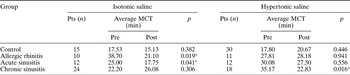
Before irrigation, the mucociliary clearance times of the acute sinusitis, chronic sinusitis and allergic rhinitis patients were found to be delayed compared with controls (p = 0.013, p = 0.007 and p = 0.019, respectively) (Table I, Figure 1). After irrigation with hypertonic saline, mucociliary clearance times improved in chronic sinusitis patients (p = 0.016), while isotonic saline improved mucociliary clearance times in acute sinusitis and allergic rhinitis patients (p = 0.044 and p = 0.047, respectively) (Table 1, Figure 2).
Effect of isotonic saline irrigation on mucociliary clearance time in the four groups. C = control; AR = allergic rhinitis; AS = acute sinusitis; CS = chronic sinusitis

Effect of hypertonic saline irrigation on mucociliary clearance time in the four groups. C = control; AR = allergic rhinitis; AS = acute sinusitis; CS = chronic sinusitis

Mucociliary clearance time before and after irrigation with isotonic or hypertonic saline solutions

* Significant as p < 0.05. Pts = patients; MCT = mucociliary clearance time; pre = pre-irrigation; post = post-irrigation
Isotonic saline irrigation did not cause any significant change in mucociliary clearance time in chronic sinusitis patients (p = 0.233). Similarly, irrigation with hypertonic saline did not significantly alter mucociliary clearance time in acute sinusitis or allergic rhinitis patients (p = 0.370 and p = 0.941, respectively) (Table I). In the control group, neither the isotonic nor the hypertonic saline solution resulted in any significant change in mucociliary clearance time (p = 0.328 and p = 0.244, respectively).
Discussion
Mucociliary clearance of airway epithelium can be affected by ciliary beat frequency and rheological changes in mucus. Efforts have been made to improve ciliary activity and restore mucociliary clearance in various diseases of the upper respiratory tract.
Nasal irrigation is commonly prescribed to patients with acute or chronic rhinosinusitis and after endoscopic sinus surgery, in order to improve mucociliary function, decrease mucosal oedema, decrease inflammatory mediators and mechanically clear inspissated mucus.Reference Rossmann, Lee, Forrest and Newhouse8 The use of irrigating solutions also improves the penetration and bioavailability of topical medications.Reference Papsin and McTavish1
In adults, irrigation with hypertonic saline has been advocated, since it has been found to improve mucociliary clearance time in both acute and chronic sinusitis patients.Reference Talbot, Herr and Parsons4 In children with chronic sinusitis, hypertonic saline provided better symptomatic and radiological outcomes than isotonic saline.Reference Shoseyov, Bibi, Shai, Shosayov, Shazberg and Hurvitz12 In our study, we did not detect any difference between the mucociliary clearance times of acute sinusitis and perennial allergic rhinitis patients before and after application of hypertonic saline solutions. Unlike chronic sinusitis, these two entities are less likely to cause permanent epithelial structural damage and ciliary loss, and therefore a change in ciliary beat frequency would not be expected. In acute sinusitis and allergic rhinitis, the amount and rheological properties of secretions are more likely to contribute to impairment of mucociliary clearance.Reference Georgitis13 In these circumstances, temporary dysfunction in mucociliary transport may occur, but immune system responses and other homeostatic mechanisms can enable recovery.Reference Prior, Schofield, Boivin, Anderson and Drake-Lee11 In a recent study, isotonic saline was found to be the most physiological irrigation solution in terms of nasal epithelial cell mucin secretion and cellular morphology.Reference Kim, Song, Young, Lee and Yoon2 On the other hand, chronic low-grade infections may give rise to permanent ciliary dysfunction and structural changes in the epithelium.Reference Prior, Schofield, Boivin, Anderson and Drake-Lee11, Reference Rutland and Cole14 Electron microscopy studies have demonstrated ciliary disorientation, loss of ciliated epithelial cells and an increase in nonciliated cells in chronic rhinosinusitis patients.Reference Tomooka, Murphy and Davidson3 The more severe the chronic sinusitis, the more delayed the nasal mucociliary clearance time.Reference Sakakura, Ukai, Majima, Murai, Harada and Miyoshi9, Reference Sakakura, Majima, Saida, Ukai and Miyoshi10
A randomised study of 143 patients investigated the symptom scores of common cold and rhinitis patients before and after using isotonic or hypertonic saline, and before and after observation only. No difference was found between the symptom scores of the various groups.Reference Adam, Stiffman and Blake15 The use of nasal irrigation for acute rhinosinusitis is under debate. Our findings indicate that irrigation with isotonic saline is more effective in improving mucociliary clearance time in this patient group.
Hypertonic saline has been found to improve the symptoms of allergic rhinitis and chronic rhinosinusitis.Reference Tomooka, Murphy and Davidson3 Our findings regarding the benefit of hypertonic saline irrigation in chronic rhinosinusitis confirm these results. We found that irrigation with isotonic saline (but not hypertonic saline) resulted in improved mucociliary clearance time in patients with perennial allergic rhinitis. In chronic sinusitis, the effect of hypertonic saline on mucociliary clearance time is more obvious, since it stimulates ciliary beat frequency and thus restores the main impaired mechanism causing mucociliary clearance delay.
A topical antibacterial effect of hypertonic saline has been documented in some studies.Reference Shoseyov, Bibi, Shai, Shosayov, Shazberg and Hurvitz12, Reference Mangete, West and Blankson16 However, our study found no effect of hypertonic saline on mucociliary clearance time in acute sinusitis patients, indicating that an antibacterial effect may not be the main mechanism by which hypertonic saline improves mucociliary clearance time. Once suppurative and chronic inflammation is established, the beneficial effect of hypertonic saline on mucociliary clearance time becomes more obvious.Reference Robinson, Hemming, Regnis, Wong, Bailey and Bautovich17 Majima et al. proposed that the retarded nasal mucociliary clearance seen in chronic sinusitis may be related to factors other than the rheological properties of mucus. Histological examination of chronic maxillary sinusitis has shown disorientation of mucosal epithelia cilia.Reference Majima, Sakakura, Matsubara, Murai and Miyoshi18 This raises the possibility that the main effect of hypertonic saline is achieved through stimulation of ciliary beat frequency.Reference Toskala, Nuutinen and Rautiainen19 Hyperosmolar fluid in the airway causes release of calcium and prostaglandin E2 from intracellular stores, increasing the availability of adenosine triphosphate to the cilia axoneme, resulting in increased ciliary beat frequency.Reference Shoseyov, Bibi, Shai, Shosayov, Shazberg and Hurvitz12, Reference Daviskas, Anderson, Gonda, Eberl, Meikle and Seale20
Since hypertonic saline has different effects in patients with allergic rhinitis compared with acute sinusitis, we believe that the rheological properties of mucus play an important role as determinants of mucociliary clearance time in these two conditions. Isotonic saline provides simple mechanical cleaning without any osmotic gradient, and decreases inflammatory mediators in the medium by simply flushing out irritants and mucus.Reference Papsin and McTavish1, Reference Georgitis13 Garavello et al. reported that hypertonic saline was useful in patients with seasonal allergic rhinitis through its effect of decreasing leukotriene C4 levels.Reference Garavello, Romagnoli, Sordo, Gaini, Di Berardino and Angrisano6 In our study, we enrolled patients with perennial allergic rhinitis, since the symptoms and mucociliary clearance status of seasonal allergic rhinitis patients could vary throughout the year.
Overall, we speculate that ciliary beat frequency is a more important determinant of mucociliary clearance time in chronic sinusitis patients. In contrast, mucociliary clearance time in allergic rhinitis and acute sinusitis patients is more likely to be influenced by the rheological properties of mucus. Hypertonic saline seems to act by affecting ciliary beat frequency, whereas isotonic saline is more likely to modify the rheological properties of mucus.
In allergic rhinitis patients, hypertonic saline irrigation has been reported to decrease leukotriene C4 levels.Reference Tomooka, Murphy and Davidson3 Garavello et al. have supported the use of hypertonic saline irrigation in seasonal allergic rhinitis patients.Reference Garavello, Romagnoli, Sordo, Gaini, Di Berardino and Angrisano6 Georgitis et al. found that irrigation with isotonic saline led to a decline in histamine and leukotriene C4 levels in patients with allergic rhinitis.Reference Georgitis13 In our study, we did not find any improvement in the mucociliary clearance time of perennial allergic rhinitis patients after hypertonic saline irrigation. We believe that, in patients with perennial allergic rhinitis and acute sinusitis, the rheological properties of mucus (affected by isotonic saline irrigation) are more important determinants of mucociliary clearance time.
In a recent study, both hypertonic and isotonic saline solutions were found to improve mucociliary transport and to provide symptomatic relief.Reference Hauptman and Ryan5 However, hypertonic saline was reported to be more irritating to the nasal mucosa. In our study, we did not encounter intolerance to the saline solutions sufficient to stop treatment; however, lack of a discrete symptomatic assessment scale would appear to be a limitation of the study.
• Nasal irrigation is a simple, cheap and effective treatment for sinonasal pathologies which reduces symptoms, reduces the need for other treatment options and helps decrease antibiotic resistance
• Isotonic and hypertonic saline solutions are commonly used for nasal irrigation
• This study investigated changes in mucociliary clearance in patients with allergic rhinitis, acute sinusitis and chronic sinusitis after irrigation with isotonic or hypertonic saline solutions
• Hypertonic saline appeared to improve mucociliary clearance in chronic sinusitis patients, while isotonic saline appeared to be more useful in allergic rhinitis and acute sinusitis
We are aware that improvement of mucociliary clearance is not the only indicator of benefit from saline solution irrigation in cases of nasal pathology. Symptomatic relief and clinical recovery do not always move in parallel with restoration of mucociliary clearance time. Clinical, radiological and pathological evaluation should be discretely documented in order to enable more accurate interpretations.
Conclusion
Nasal irrigation with isotonic and hypertonic saline solutions is an effective and safe method of improving mucociliary clearance. The potential of nasal irrigation for improving mucociliary clearance should be utilised according to agreed criteria. Further studies should be undertaken in order to develop standard protocols for selective use of saline solutions in various nasal pathologies.
Acknowledgement
We would like to thank Dr Oytun Emre Sakici, of the Department of Forestry Engineering, Black Sea Technical University, Trabzon, for his contribution to the statistical analysis of the data.