The tomb sculptures of the First Emperor of China, Qin Shi Huangdi 秦始皇帝 (r. 247–210 bc), have captured the imagination of the public and excited the interest of researchers since their discovery in 1974 (Figure 1). The thousands of warriors lined up in marching formation soon became the monumental symbol of the might of the emerging Chinese empire. When granting inscription to the list of World Heritage sites to the tomb in 1987 the UNESCO committee based its decision mainly on the extraordinary qualities of the sculptures.Footnote 1 Many exhibition catalogues and scholarly publications investigated their functions, their appearance as realistic figural representations or even portraits, their production technology, their colouring, weaponry, and their archaeological and historical context.Footnote 2
View of warrior pit no 1, tomb of the First Emperor of China (died 210 bc). Photograph by the author.(colour online)

However, the most surprising aspect of the terracotta warriors, along with the figures of officials, musicians, dancers and acrobats found in other pits around the tomb, has hardly been addressed previously: the question of how to explain their very existence. In the decades and centuries before the First Emperor chose to equip his tomb with thousands of sculptures, figures were rarely placed in tombs and never shown in public spaces. Naturalistic sculpture was entirely unknown. No long-standing sculptural tradition preceded the making of the First Emperor's famous terracotta warriors. No earlier or contemporary member of the Chinese elite had demonstrated any significant interest in sculpture at all.
Equally remarkable is the fact that even if the First Emperor initiated figurative art on such a grand scale, he did not establish an artistic tradition. Although in the following centuries many tombs contained figurines, these were generally smaller and showed summaric features. No sculptures comparable in their artistic accomplishment to the terracotta warriors have been found. To patrons and artisans the medium appears to have lost its attraction as soon as the Emperor had died. Only centuries later – with the emergence of Buddhism – was sculpture to become a focus of Chinese art again.
Since the sculptures cannot be assigned to an indigenous Chinese tradition, it is necessary to inquire into what initiated their sudden appearance and where the required skills came from. Why did the emperor decide to use a medium that was barely known in China? Was this dramatic artistic shift a result of contact with other cultural traditions?
When trying to identify a likely source, the modern observer has very few choices at hand. During the lifetime of the First Emperor, in the third century bc, only a few Asian societies employed sculpture. In northern Asia and Mongolia (apart from megaliths that occasionally show anthropomorphic features), the Korean peninsula and the Japanese islands, in Southeast Asia or the Indian subcontinent, sculpture appears not to have been part of everyday material culture. At this time, only one culturally connected group of states in Asia made large-scale realistic sculpture for public spaces and grave sites: The Hellenistic states in Western and Central Asia that emerged in the wake of the Alexandrian conquests, and areas under their influence. If any alien factor played a role in the creation of the terracotta figures, one has to search for it in the contemporary Hellenistic world. The present text, therefore, will examine the possibility of contact between Greek and Chinese culture in the third century bc and will determine whether there could be a connection between the figurative art prominently used in the Hellenistic world and the brief flowering of sculpture under the First Emperor of China.
Three arguments relevant to the question will be brought to bear. First, this study will investigate the sculptures in the context of Chinese art before and during the lifetime of the Emperor and identify features that indicate intimate knowledge of contemporary Hellenistic artistic practice. Second, it will demonstrate that, contrary to popular belief, it is conceivable and actually likely that the Chinese and the Hellenistic cultures came into contact in the third century bc. Finally, it will discuss the earliest examples of public sculpture in China, the twelve famous bronze statues of the First Emperor, and introduce historic epigraphic evidence to the discussion that for the first time provides contemporary literary support for the assumption that the sudden surge of interest in figurative art under the First Emperor was initiated from the outside.
The terracotta figures in art history
Sculpture without tradition?
Various attempts have been made to understand the terracotta warriors as part of China's long artistic tradition. Indeed, when looking at pre- and early historic archaeological finds from the vast area covered by modern China, one can identify a range of examples of sculpture. Several Neolithic and Bronze Age cultures occasionally featured humans and animals in sculptures or reliefs. The best-published examples are perhaps the “goddess” with inlaid blue eyes from the fourth millennium bc Hongshan culture site at Niuheliang 牛河梁, or the depictions of human faces on ceramics of the Yangshao Culture in Gansu Province of the third millennium bc. Also well known are the giant bronze statues and masks from Sanxingdui 三星堆, Sichuan Province, which belong to a culture contemporary with the Shang state and date to the second half of the second millennium bc.Footnote 3
The archaeological record clearly demonstrates that peoples occupying early East Asia were perfectly capable of making sculpture, even if the medium was employed rather infrequently. Most religious sites and tombs made do without any representations of humans or animals. The main paraphernalia of ritual practices were not sculptures, but jade objects, bronze vessels, and musical instruments, most of which were decorated with abstract designs of masks and animals, or geometric patterns. Furthermore, the sculptural objects mentioned above were created a thousand or more years before the period in question, and the First Emperor, his advisers and craftsmen in the late third century bc are unlikely to have known about them.Footnote 4
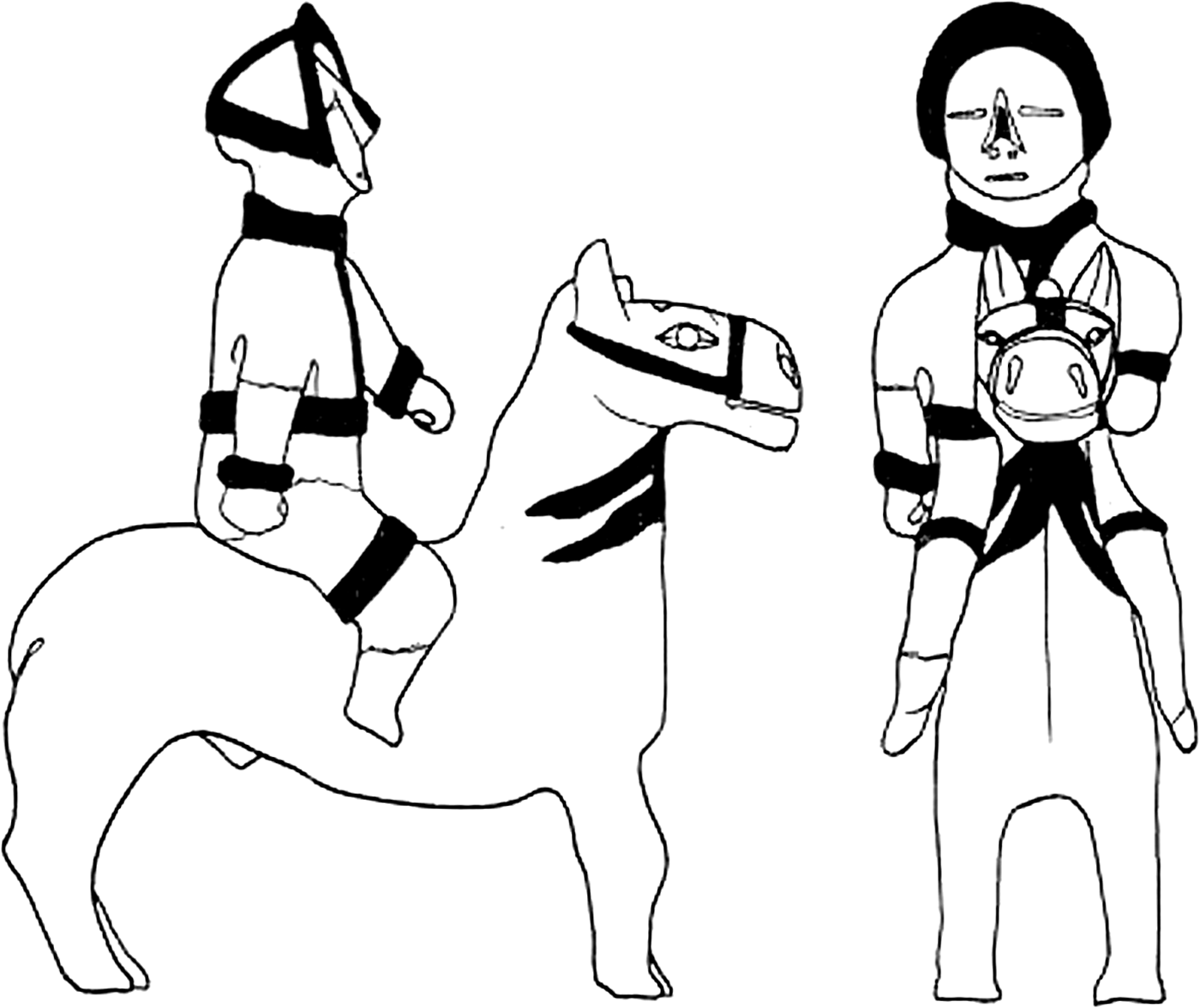
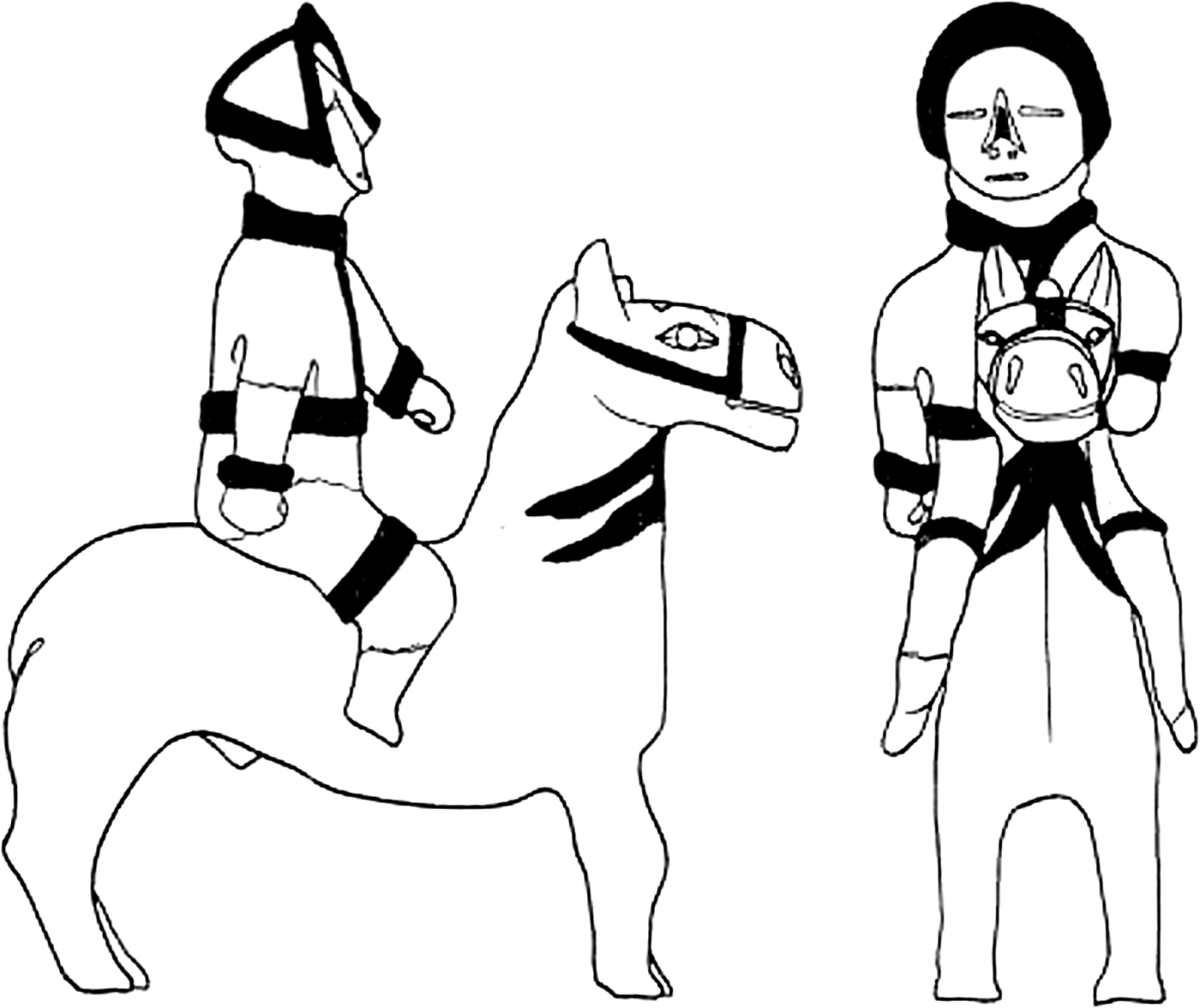
From the centuries immediately preceding the Qin Dynasty again we know of only a few depictions of the human figure. Four wooden figures were found in a tomb in Liangdaicun 梁帶村 in Hancheng 韓城, Shaanxi, tentatively dated to the late ninth century bc.Footnote 5 One further example are two wooden human figures meant to be sedan chair bearers placed in a Qin state tomb in Longxian 隴縣, Shaanxi, dating from about 700 bc. Both were 80 cm high, painted, and were reported to have had alien facial features.Footnote 6 Although it cannot be ruled out that, because of the perishable character of the material, other examples may have been lost, to current knowledge these figures stand isolated in the archaeological record of China. Only from about 300 years later do figures become more common. The examples include small bronze musicians in a miniature house from Shaoxing 紹興 in the southern province of Zhejiang, dated to the fifth century bc, a human-shaped lamp stand from the royal tomb no. 6 in Pingshan 平山 county, Hebei province, dated to the fourth century bc, as well as some simple wooden and clay figures of attendants found in other tombs.Footnote 7 In addition, there are the statuettes of two horse riders which came to light in a late fourth-century bc tomb in Taerpo 塔兒坡, Xianyang, Shaanxi, which are believed to be the earliest depiction of riders in China (Figure 2).Footnote 8 Lothar von Falkenhausen relates the appearance of such tomb figures to a new concept of the tomb chamber as a representation of the world of the living, which gradually emerged from the fifth century bc.Footnote 9
Tomb figure of horse rider, earthenware, from tomb in Taerpo, Xianyang, Shaanxi province, late fourth century bc, height 22 cm. Kaogu yu wenwu 1996/5, p. 8, fig. 9.
From the fourth century bc onwards tomb figurines become noticeable in the records, mainly of the peripheral principalities of Qin and Chu,Footnote 10 but also of other areas. Still, even if the few known finds are published disproportionately frequently, they should not obscure the fact that figures of people and animals were very rare exceptions to the conventional imagery of the Zhou period. A statistical comparison clarifies this. Between 1989 and 2003 in the area of modern-day Xi'an, right in the centre of the Qin Empire, three cemeteries with 317 tombs of the principality of Qin and the Qin Dynasty (sixth–third centuries bc) were excavated. These tombs belonged to the upper and middle social strata of the local population and were furnished with abundant ceramic, jade and bronze objects. However, only a single one of these graves contained some small statuettes (Figure 3), while the others had no representations of animals or humans.Footnote 11 The tomb of King Cuo, a ruler of the Zhongshan state during the late fourth century bc, which is often compared with the tomb of the First Emperor due to its geographical and temporal proximity, contained no sculptures among a large variety of furnishings. The only representation of a human included in the excavation report – a crouching figure of a foreigner that appears to have been a vessel foot – was a chance find by farmers in the vicinity and does not necessarily come from the Cuo tomb.Footnote 12
Tomb figure, earthenware, from tomb 123 in the southern suburb of Xian, Shaanxi province, third century bc, height 7.7 cm. Xi'an nanjiao Qin mu, colour plate 2–5.(colour online)
Depictions of the human figure were not a common part of the representational canon in China before the Qin Dynasty. Apparently a religious practice gradually began to take hold from the fourth century bc and led to the inclusion of figurines in some tombs, which might allow us to say that the function of the terracotta warriors as tomb figures has earlier local roots. The known examples of sculpture, though, were small earthenware, bronze or wood figures, mostly rather crudely fashioned. Indeed, not a single elite tomb appears to have included sculpture comparable to the warriors. In von Falkenhausen's words, “nothing in the archaeological record prepares one for the size, scale, and technically accomplished execution of the First Emperor's terracotta soldiers”.Footnote 13 For his contemporaries, the First Emperor's sculptures must have been something dramatically new.
It is also striking that the interest in sculpture was limited to the emperor himself. The sheer number of figures in the tomb often obscures the fact that they were exceptional even in the emperor's own time. No other Qin tomb – on the basis of what we currently know – contained anything comparable.
After the brief reign of the First Emperor, sculpture lost its prominence almost immediately. For some generations terracotta soldiers were still made for the graves of the Han ruling family, around the capital Chang'an and around Xuzhou, the ancestral homeland of the Han emperors in the modern-day province of Jiangsu (Figure 4). These warriors were only about 50–80 cm tall with simply modelled bodies and without individualized features, some of them nude and originally dressed in cloth uniforms.Footnote 14 From the first century bc onwards, craftsmen modelled mainly small statuettes which, in their doll-like execution, call to mind the tomb figures of the late Zhou period. Some examples of stone sculpture have been discovered too. Figures of animals and humans stood on the mound of a tomb traditionally ascribed to the Han general Huo Qubing (霍去病, 140–117 bc) (Figure 5). The famous general was well-acquainted with foreign traditions. He led several campaigns to the north and west into Xiongnu territory and has been credited with bringing back a metal sculpture 金人 from one of the expeditions.Footnote 15 Two crudely hewn giant stone statues were excavated from the Shanglin 上林 park of Han emperor Wu. In 168 ad a larger than life-size stone figure of the official Li Bing 李冰 was erected in Sichuan province.Footnote 16
Tomb figures, painted earthenware, from tomb no. 4 in Yangjiawan, Xianyang, Shaanxi province, height c. 48–50 cm, Xianyang Municipal Museum. Photograph by the author. (colour online)
Stone sculpture from the tomb of Huo Qubing (died 117 bc), Shaanxi province, height c. 180 cm. Photograph by the author.(colour online)
The examples of sculpture listed above show that a tradition of placing figurines in tombs gradually emerged in the fourth century bc. During the third century sculpture was still used only rarely, but became more established during the Han dynasty. The function of the terracotta warriors as tomb figures serving some purpose in a perceived afterlife does fit, one might say, into a local development: but nothing else about them does. In no other instance was sculpture granted such exceptional importance in the overall design of a tomb. The emperor in effect surrounded himself with figures of humans and animals. Furthermore, the execution of the warriors was unlike anything known at the time. Although statuettes in some earlier tombs symbolized servants or soldiers, no attempt was made actually to create a likeness of a human being, and no sculpture was made life size. The emphasis on the realistic appearance of the warriors as well as the sheer scale to which the medium was used place the terracotta warriors outside the local tradition and require us to consider an outside stimulus for their creation.
Alien features
We need to go one step further still. In traditional art historical terms, some of the sculptures in the tomb of the First Emperor display yet more surprising features. These are the so-called acrobats from pit K9901. To evaluate properly the extraordinary qualities of the acrobats, we first need to examine the warriors again.
The terracotta warriors were modelled very carefully and accurately depict – from belt buckles to neck clothes and nailed soles – every detail of the clothing and armour of soldiers of the time (Figure 6). Additional care was given to the faces that invoke (although shaped with the help of a few standard moulds) the impression of actual human faces, with all the variations one would expect to see (Figure 7). The faces and hands were in almost all cases painted in flesh tones, while the clothing and armour were covered with various colours and patterns. The craftsmen obviously tried to make the ceramic figures appear like real people. They were so successful that some modern researchers thought the terracotta warriors to be portraits.Footnote 17 These qualities lead modern observers to describe the sculptures as “masterpieces of realism”,Footnote 18 employing a terminology one would expect to find in descriptions of Classical Greek or Hellenistic statues.
Terracotta figures from warrior pit no. 1, tomb of the First Emperor, height c. 180 cm. Museum of Terracotta Warriors and Horses, Lintong. Photograph by the author. (colour online)
Head of terracotta figure from warrior pit no. 1, tomb of the First Emperor. Museum of Terracotta Warriors and Horses, Lintong. Photograph by the author. (colour online)
When looking at the warriors more closely a comparison with their Greek counterparts becomes less justified, despite the detailed depiction of surface features. Little care appears to have been given to the accuracy of proportions (Figure 8). Arms are often too short, while hands and heads are rather large and chests overstretched. Furthermore, limbs and torso do not add up to an organic whole. Instead, they appear to be stuck into each other from unrelated templates. Legs are stiff and arms curve fluidly with no articulation of joints. Thick layers of cloth and armour do not follow the anatomical structure but hide it to the extent that the body seems not to be present. It is quite obvious that the warriors were not made by experienced sculptors in the Greek sense but – as Lothar Ledderose has shown – by craftsmen from workshops usually employed in the production of ceramic drainage pipes.Footnote 19
Terracotta figure from warrior pit no. 1, tomb of the First Emperor, height c. 180 cm, Museum of Terracotta Warriors and Horses, Lintong. Photograph by the author. (colour online)
A much more advanced understanding of the human body is displayed in a group of sculptures discovered in pit K9901, south-east of the First Emperor's tomb mound. In the pit of about 800 m2, archaeologists excavated eleven badly damaged figures in 1999, only five of which could be restored well enough to give an impression of their original appearance. Currently a new excavation is bringing to light dozens more.Footnote 20 The sculptures are usually described as acrobats or dancers although their original function remains elusive. They are not mass produced in generic types as are the warriors, but each is fashioned in a distinctive stance or movement. They appear to be modelled individually.
The figures are wearing only loincloths, which leave visible the contours of their bodies. While one of the reconstructed bodies appears assembled and as lifeless as the soldiers,Footnote 21 others show that the sculptors tried to render the bones, joints and associated muscles visible. The figure of a lean man stands upright with arms crossed across the abdomen. The muscular upper body with all sinews and joints is clearly characterized (Figure 9). The sturdy body of a second figure has one arm raised in a walking stance, his ribs visible under the taut skin of his chest (Figure 10). The torso of another figure, perhaps representing a dancer, has a well-formed chest and abdomen, and anatomically correct legs with modelled knee joints and kneecaps (Figure 11). The right arm is bent, revealing a well-defined elbow and articulated muscles on the upper arm. An understanding of the body is even more perceptible in the figure of an acrobat, possibly a weightlifter (Figure 12). His burly and muscle-bound body shows many anatomical details, such as biceps and tendons, which had never been represented previously in China.
Terracotta figure from pit K9901, tomb of the First Emperor, height 152 cm. Museum of the Terracotta Warriors of the First Emperor, Lintong. Photograph by Xia Juxian and Guo Yan. (colour online)
Terracotta figure from pit K9901, tomb of the First Emperor, height 181 cm. Museum of the Terracotta Warriors of the First Emperor, Lintong. Photograph by Xia Juxian and Guo Yan. (colour online)
Terracotta figure from pit K9901, tomb of the First Emperor, height 152 cm. Museum of the Terracotta Warriors of the First Emperor, Lintong. Photograph by Xia Juxian and Guo Yan. (colour online)
Terracotta figure from pit K9901, tomb of the First Emperor, height 171 cm. Museum of the Terracotta Warriors of the First Emperor, Lintong. Photograph by Xia Juxian and Guo Yan. (colour online)
Observation of the sculptural qualities displayed in the acrobats is crucial for the current inquiry as it helps to narrow down the likely source from which the craftsmen adopted ideas. The limited degree of understanding of the human body makes the terracotta warriors to some extent comparable to the Kouros figures of the Greek Archaic period, sculpture in pre-Alexandrian Persia or Egypt or, for instance, megaliths in southern Siberia. There, although the human body had been shown in various ways, little attempt was made to transform it into a functioning whole. If we had only the warriors but not the acrobats, it might be valid to suggest loosely that Qin sculpture was initiated by contact with any ancient sculpture-using culture.
The acrobats, however, lead us to a more precise source. While life-sized sculptures were made in several Eurasian cultures, interest in the anatomic qualities of the human body is found only in the Greek context. The great contribution of the Greeks to this medium was, from about 500 bc, to develop the sculpted body into a functioning whole. It was they who learned to calculate proportions, who observed that the outer shape of a body is defined by its internal structure, and who realized that any movement would have to be supported by the interaction of all the organs under the skin, and who attempted to make their sculpture interact with the space around them. The creation of a believable human body preoccupied generations of Greek sculptors. It was a complex artistic and intellectual process that did not happen overnight but in a series of steps leading from late Archaic to Classical and finally to Hellenistic sculpture (Figure 13).Footnote 22
Statue of a young man, bronze, around 300 bc, height 128 cm, found in Rhodos. Staatliche Museen zu Berlin – Preußischer Kulturbesitz, Antikensammlung, Inv. Nr. SK 2. Photograph Johannes Laurentius. (colour online)
To be sure, the development of Greek art throughout the sixth to third centuries bc is too multi-layered to be captured in just a few lines. The work of sculptors was not just about achieving ever more naturalistic depictions of the human body but included experimentation with viewing angles and degrees of subjectivity, manipulation of proportion and perspective, as well as frequent fall-backs to earlier stylistic elements. The creation of the realistic and seemingly “living” human body, however, was an achievement that made Greek art different from that of neighbouring areas. It is difficult to name this crucial quality of Greek sculpture as the terms “realism” and “naturalism” both have ranges of connotations and have been called into question in modern discussions of art. In using realism in this article I follow John Boardman who, in his discussion of the reception of Greek art by peoples outside the Greek tradition, argued that it was this characteristic that sprang to the eye of any foreign viewer and that proved to be the most influential feature of Greek art.Footnote 23 It was the sheer realism (and not, for instance, the Greek preference for nude human bodies or the presentation of mythological narratives) that was copied and recreated in northern Africa, Hellenized Asia, and many areas of Europe, and that subsequently decisively informed the arts of the Roman empire. In Antiquity, the realistic presentation of the human body was an inherently Greek feature.
Artistically the warriors have little in common with Hellenistic art apart from their being life-sized sculptures which the artisans – by modelling in the round, meticulous attention to surface detail and life-like colouration – made to look like the “real thing”. The acrobats, on the other hand, suggest rather intimate knowledge of Hellenistic sculpture. The people who made them appear to have had some awareness of the features that mattered to Greek sculptors.
It is hard to imagine that Chinese craftsmen developed “overnight” abilities that required a long process of experimentation and discovery in other cultures. The sudden appearance of sculpture in the tomb already suggests external initiation. The acrobats now point further to the likely source being Hellenistic. The features that mirror contemporary Greek artistic ideas even require us to consider the direct involvement in their production of specialists who had first-hand knowledge of Hellenistic art.
After the death of the First Emperor, there was no new attempt for centuries to render the bone and muscle structure of the human figure visible. Only in the sixth century ad did Chinese artists again show a tentative interest in the representation of a living, realistic body, when the popularization of Buddhism led to a new engagement with the medium of sculpture.Footnote 24
The figures in the tomb of the First Emperor stand isolated in the development of Chinese art. Their creation does not fit into any visible local tradition. Instead, the sudden surge in sculpture making appears to be closely linked only to the emperor himself. Some of the figures excavated near his tomb even feature ideas of the representation of the body that were at the time limited to Hellenistic culture. In order to understand the existence of the First Emperor's sculptures, we need to look at the third-century bc map not of China, but of Eurasia in general.
A historic opportunity
Greeks and Greek art in Asia
The beginning of intra-Asian exchange is traditionally dated to 138 bc, the year that the imperial envoy Zhang Qian 張騫 (d. 114 bc) set out on a mission to Ferghana, Bactria and Transoxiana. However, this is only the earliest surviving written evidence of contact between the Greek-influenced Central Asian states and China. Before this first documented contact, there was already exchange between China and the rest of Asia, as recent studies of bronze and iron metallurgy, glass manufacture, and investigations of the spread of crops, herd animals and beads have shown.Footnote 25
Although archaeology reveals more and more evidence for early exchange across Asia, few attempts have been made to investigate transcontinental contacts during the period of the First Emperor. One reason for this lack of research could be that the First Emperor has been a highly politicized historic person even in modern times, and questions of a nationalistic approach on the one side or a Eurocentric or colonialist perspective on the other rapidly arise. Even Richard Barnard's innovative and provocative essay, “Alexander in China?”, in which he argues that some aspects of the tomb of the First Emperor and other tombs of the period may follow Western sources, especially the famous monumental tomb of King Mausolos in Halicarnassus (d. 353 bc), stirred little reaction.Footnote 26 We need to acknowledge, however, that it was precisely the third century bc that bore an exceptional historic opportunity for encounters between China and Greece. The violent transformation of the political map of Central and West Asia by Alexander the Great and his successors undoubtedly opened new channels of interaction between East and West. The developments will be outlined briefly.
In 334 bc, Alexander the Great (356–323 bc), king of Macedonia and Hegemon of the Hellenic League, began his offensive against the Persian Empire, which was then seen as the main rival to Western culture. He conquered the Persian satrapies on the Mediterranean (including Halicarnassus) and defeated the main army of the Persian king Darius III (r. 336–330 bc) at Issus in 333 bc. After taking over Persian possessions in Egypt and Libya, he crossed the Euphrates in 331 bc and pursued the remnants of the Persian army to the Caspian Sea. From there he went east. He took control of the eastern Persian satrapies in Bactria and crossed the Oxus and the Jaxartes (Amu Darya and Syr Darya), reaching what he considered the limit of the civilized world. Beyond these rivers there were only nomadic steppe peoples, whom the Greeks summarily designated Scythians. In 327 bc Alexander reached the easternmost extreme of his trip with an attempt to conquer Gandhara, an adventure that was cut short by the mutiny of his soldiers. He reached the Indus, then turned west again, leading his troops to Persepolis and Susa, the ancient Persian political centres. There he died in 323 bc.
Alexander's eleven-year campaign could be dismissed as a brief military adventure in Eurasian history, if it were not for the profound and lasting cultural impact it had on much of Asia and Europe. As leader of the Oikumene, or civilized world, Alexander attempted to merge the cultures under his rule. In this effort he brought Greek art, philosophy and language into areas as far away as present-day Afghanistan, Uzbekistan and Tajikistan, and introduced elements from these regions into Greek culture. Along the eastern border of the conquered territories, in the Sogdian and Bactrian satrapies of the former Achaemenid Empire, he founded numerous cities, where he settled Greek and Macedonian citizens, veterans drawn from the armies of conquered states, and members of the local population. Alexander's campaigns brought Asia, North Africa and Europe closer together and ushered in a period of long-distance cultural interaction unprecedented in its intensity.Footnote 27
Alexander's campaigns paved the way for a radical transformation in the culture of antiquity that is conventionally termed Hellenism. In this process, the arts became exceptionally important. Particularly in territories far from Greece, architecture, sculpture and painting were prominently used as symbols of power, cultivation, and as media of cultural identification and dominance.Footnote 28 Greek art changed, in Ernst Gombrich's words, “from being the concern of a few small cities into the pictorial language of almost half the world”.Footnote 29
Alexander himself was crucial in this transformation of Greek art, and brought into play an element that will be significant in the discussion below. He took sculptors and painters such as Lysippos (c. 370–310 bc) and Apelles (second half of the fourth century bc) on his expeditions and they glorified him in numerous portraits (Figure 14).Footnote 30 Alexander presented himself in various ways (such as youth, general or god) and had these images publicly displayed throughout the empire. Far more than any ruler before him he utilized the propagandistic value of art. He and his successors gave the arts a political function.
Head of Alexander the Great, marble, 2–1 century bc, height 37 cm, British Museum. © Trustees of the British Museum. (colour online)
Soon after Alexander's death in 323 bc, his empire, which stretched from Greece and Egypt to the Pamirs, was divided among some of his followers. Seleucus I (r. 312–280 bc) assumed control of conquered Achaemenid territories to the east, including Bactria, facilitating further the spread of Greek culture. Greek was the official language of the Seleucid Empire. Coins bore Greek inscriptions. More cities were founded, their elites largely composed of Greeks and Macedonians.Footnote 31
On the fertile plains of Bactria many Greek settlements flourished. In the mid-third century bc, a few years before the First Emperor assumed the throne of Qin in 246 bc, the satrap of Bactria, Diodotus (c. 255–235 bc), broke away from the Seleucid Empire and formed the Graeco-Bactrian kingdom,Footnote 32 which extended up to Sogdiana, including the Ferghana valley, and at times extended south to the Indus valley, thus expanding the boundaries of Alexander's Graeco-Macedonian sphere of influence further east. The Greek historian Apollodorus of Artemita (first century bc) reported in his history of the Parthian Empire that the Graeco-Bactrians had more peoples united under their rule than did Alexander, and that they had even encroached on the territories of the “Seres”, a people he locates in eastern Central Asia that is today often identified with the Chinese.Footnote 33
Ai Khanoum
While literary sources mention many cities founded by Alexander in Bactria and Sogdiana (Areia Alexandria, Alexandroupolis Arachosia, Alexandria in the Caucasus, Alexandria Eschate), and others established by Seleucus and Diodotos (Strabo claims that a successor to Diodotus ruled over “a thousand cities” in the second century bc),Footnote 34 we have only limited archaeological information on this topic. Only a few scientific excavations have taken place in the last hundred years in the area of present-day Afghanistan, and many of the Greek settlements have not been located. Archaeologically it is barely possible to reconstruct this brief period of Greek cultural flowering in Central Asia.
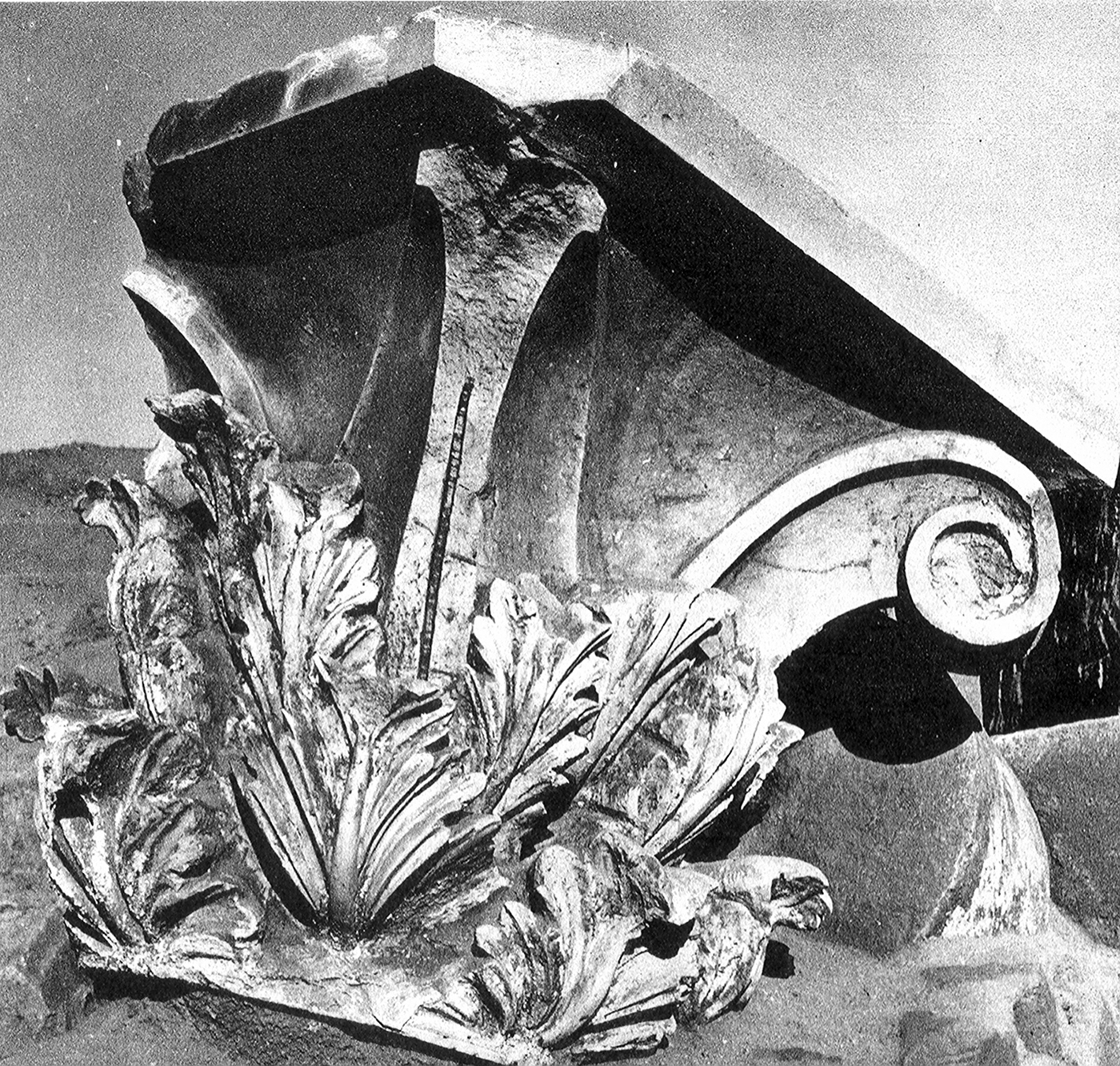
One site, however, is well researched: the easternmost city known among this group, a Greek border town located in Kunduz, in the north-east of modern Afghanistan. The city was discovered by chance in 1961 near the village of Ai Khanoum on the banks of the Oxus. Excavations by the French archaeologist Paul Bernard showed that it was probably established around 300 bc and abandoned 140 years later, when it was burned by nomadic raiders.Footnote 35 Although this was just a small town, the original name of which has not even been handed down, the excavations revealed its monumental Hellenistic conception. A theatre and a gymnasium, a huge palace with colonnades and Corinthian capitals (Figure 15), and private homes with mosaic floors in the Greek fashion came to light. The architecture of temples followed local building methods, while the architectural decoration and cult images venerated within them were clearly identified with Greece.Footnote 36 Found among the ruins were figures of stone, bronze and stucco, some of which represented gods and heroes of Greek mythology, such as Athena, Hermes and Heracles (Figures 16 and 17). Even images of Alexander himself may have existed as one tomb relief of a naked young man shows the Anastole, a motif borrowed from Alexander portraits.Footnote 37 The central cult figure in the main temple was apparently a sculpture of Zeus. The statue originally stood five to six metres high, though only the marble fragment of a foot remains.Footnote 38 Many figures were made of stucco and were preserved only in fragments.
Corinthian capital from Ai Khanoum, limestone, third century bc, height 74 cm. National Museum of Afghanistan.
Statuette of Heracles from Ai Khanoum, bronze, 250–150 bc, height 18 cm. Photograph Thierry Ollivier, National Museum of Afghanistan. (colour online)
Head of figure from Ai Khanoum, clay, 250–150 bc, height 21 cm. Photograph Thierry Ollivier, National Museum of Afghanistan. (colour online)
Archival labels on storage vessels indicate that the local elite had Greek names, and that the language of administration was Greek.Footnote 39 The text of a Greek stele inscription on the mausoleum of a certain Kineas, perhaps one of the rulers of the colony, relates a prophecy from the oracle in Delphi.Footnote 40 This find as well as recent work on ceramic typology confirms that, long after Alexander, close contacts continued to exist with the Mediterranean.Footnote 41
Of interest to this study are plaster casts of reliefs found in the ruins of Ai Khanoum. The casts have been related to ornaments on metal vessels produced in the Mediterranean. The casts may have served as templates for local silver- and goldsmiths.Footnote 42 Apparently, in addition to large sculpture, portable examples of sculpture and reliefs existed and motifs had a wide circulation.
As the example of Ai Khanoum shows, the elite within the colonies demonstrated their affiliation with Greek culture through architectural decoration, sculpture and use of the Greek language. The statues in temples and squares, at gravesites, and on the facades of public buildings must have made a significant impression on the indigenous population, who until then had no experience with large public sculpture.
Good evidence for the profound impact of Greek sculpture on local Central Asian cultures is provided by excavations in Takhti Sangin, the site about 100 km west of Ai Khanoum on the north bank of the Oxus river, in present-day Tajikistan. There, a citadel was equipped with a fire temple in the early third century bc. Even if the sanctuary served a local religion it was extensively decorated with sculpture, apparently executed by Greek-trained craftsmen (Figure 18).Footnote 43 The city of Khalchayan, a town on a northern tributary of the Oxus in modern-day Uzbekistan that came to some importance at the same time as Ai Khanoum and Takhti Sangin but continued to exist into the fourth century ad, contained a small palace built in the first century bc. Built long after the zenith of Greek influence on the area, the palace still included numerous sculptures with Hellenistic features (Figure 19).Footnote 44 The finds in Takhti Sangin and Khalchayan attest to the immediate and lasting influence of Greek sculpture on local culture, and they demonstrate that Greek sculptors put their skills in the service of non-Greek clients. Greek features often noted on Buddhist sculpture in Gandhara show that the appreciation remained powerful even in the early centuries ad.
Head of a male figure from Takhti Sangin, clay with pigments, third century bc, height 16 cm. Museum of National Antiquities, Dushanbe. Photograph Daniel Gerber, Zurich.(colour online)
Head of “Parthian ruler” from Khalchayan, clay with pigments, first century bc, height c. 30 cm. Khamza Institute Tashkent. Photograph by the author. (colour online)
The find of two bronze figures of kneeling warriors in the Ili valley appears to indicate that Greek sculpture had some impact even further east. The sculptures are hoard finds and are conventionally dated to the fifth to third centuries bc. One is bearded, about 20 cm high and dressed, while the other is 40 cm high and half naked (Figure 20). Both wear what appear to be helmets of the Macedonian or Phrygian type, helmets with a high, forward-bent spike and attached cheek pieces.Footnote 45 Such armour was widely used by Greek soldiers in the fourth and third centuries bc. On this basis Lin Meicun has argued that the bronzes are Hellenistic works.Footnote 46 Even if the precise background of the two figures still needs to be established the fine modelling of muscles, joints and even collarbones on the half-naked figure (alongside the fact that the sculpture is naked) indicates that its maker was at least familiar with Hellenistic art. The two bronzes confirm that the impact of Greek art was not confined to the areas conquered by Alexander but was carried east into what is now Chinese territory.
Figure of a kneeling warrior from Künäs river, Xinjiang, bronze, height 40 cm. Xinjiang Institute of Archaeology. Photograph by Qi Xiaoshan. (colour online)
In the late fourth and third centuries bc, both shortly before and during the reign of the First Emperor, products of Greek culture were carried east as far as the Pamirs, traditionally considered the western boundary of the Chinese sphere of influence. Nomadic peoples living north and west of Qin China certainly came into contact with both cultures and may have facilitated the transmission of information and artefacts. Recent finds of tombs of a nomadic people called Xirong 西戎 (Western Rong) in modern Chinese terminology show that they contained large numbers of objects of Central Asian and of Chinese origin.Footnote 47 Even if we currently lack proof that the Chinese ventured beyond the Pamir or the Greeks went the other way, we know that their next neighbours did.
In the third century bc Greek and Chinese cultures came geographically closest to each other. There was a brief historic opportunity for direct contact. Although the terracotta warriors and other archaeological finds suggest that Western objects and ideas crossed the Pamir into China, the transmitted Chinese literature of the period does not contain any record of this. Still, some historic epigraphic evidence survives that does provide contemporary written support for this thesis.
The twelve bronze statues of the First Emperor
Critics of this line of argument pointed out that sculpture in Hellenistic cities differed in one important respect from the terracotta warriors in the tomb of Qin Shi Huangdi. While the former were made for the gaze of the urban public, the terracotta warriors primarily served the emperor in the afterlife. Although the population of the Qin capital certainly knew of the clay figures' existence, the crucial aspect of communication with a living viewer and the – in many ways – political function of Hellenistic sculpture was absent. If the emperor learned about sculpture from the Hellenistic world, why would he choose to adopt the medium but not its uses?
It is often overlooked, however, that the terracotta warriors were not the only and certainly not the most important sculptures the emperor commissioned. Far more famous at the time and especially notable for their public function was a group of bronze figures which may represent the beginning of sculpture-making in the empire.
These crucial sculptures did not survive but are described in early literature. The passages are well known but if re-read carefully can provide significant insight into the question raised by this paper.
The figures were first mentioned in the Huainanzi 淮南子, a treatise originally written by Liu An 劉安 (c. 179–122 bc) before 139 bc.Footnote 48 The locus classicus can be found in the biography of the First Emperor in the Shiji by the historian Sima Qian 司馬遷 (c. 145–86 bc):
分天下以為三十六郡, 郡置守﹑尉﹑監. 更名民曰 「黔首」 . 大酺. 收天下兵, 聚之咸陽, 銷以為鍾鐻金人十二, 重各千石, 置廷宮中. 一法度衡石丈尺. 車同軌. 書同文字.
He divided the world into 36 commanderies, each with a governor, commanders and superintendents. He changed the name of the people to “The Black Haired Ones” and allowed a public feast. He collected the weapons of All-Under-Heaven in Xianyang, and cast them into twelve bronze figures of the type of bell stands,Footnote 49 each 1000 shi in weight, and displayed them in the palace. He unified the law, weights and measurements, standardized the axle width of carriages, and standardized the writing system.Footnote 50
In these few sentences Sima Qian outlines the crucial steps the First Emperor took to mark the pacification and to consolidate his new state in 221 bc. He extended the Qin institutional system to the conquered territories, abolishing the old hereditary feudal system and putting administration into the hands of appointed officials. He designed a common name for the peoples joined under his rule and gave a drinking amnesty for several days, as consumption of alcohol was strictly regulated. What has been insufficiently acknowledged up to now is that the text – next to the well-known legal, economic and administrative standardizations – mentions the erection of sculptures. This position in the transmission assigns them exceptional importance.
We do not know at precisely which palace the objects were displayed. Later commentaries quote the Sanfu jiushi 三輔舊事, an anonymous text that was compiled during or before the seventh century ad, claiming that it was the Epang palace 阿房宮,Footnote 51 but the construction of this monumental structure began only years later and has never been finished. Still, they were without question publicly presented. Being cast from the melted-down weapons of the conquered states and listed in the mantra of empire-consolidating measures, the bronzes gained propagandistic value. For the first time in Chinese history we find records of public sculpture with a distinctly political function. As work on the terracotta warrior pits may very well have begun only after the unification in 221 bc, it is possible that these twelve bronze statues mark the beginning of sculpture making in Qin China.Footnote 52
Some more information is known about the fate of these exceptional figures. During the Han period, they stood in the Changle Palace 長樂宮, according to Ban Gu 班固 (32–92 ad), the author of the Hanshu.Footnote 53 Then in the year 190 ad, the renegade general Dong Zhuo 董卓 (approximately 139–192 ad) had ten of them melted down for coinage. Several attempts were made to move the other two. In the fourth century ad, Fu Jian 苻堅 (338–385 ad), emperor of the short-lived Former Qin Dynasty, finally melted the last two of them down.Footnote 54 Later texts add that the figures were called Wengzhong 翁仲, “tomb guardians”, but it is unlikely that this term (or indeed an object of this function) was in use before Eastern Han.Footnote 55
The monumental sculptures appear to have been extant until the end of the Han dynasty. Two of them even survived for almost six centuries. The authors of the Huainanzi, Shiji and Hanshu and their later commentators may very well have seen the figures with their own eyes. Although no archaeological traces of the bronzes survive, there is no reason to doubt their existence.
The texts record some additional details. The Shiji mentions that the statues weighed 1,000 shi 石 (one shi weighed as much as one person could carry alone); other sources give 240,000 or 340,000 斤 jin, the equivalent of 61,000 or 87,000 kg. The bronze statues were, according to the text, five zhang 丈 (11.55 m) tall and had feet six chi 尺 (1.38 m) long. They stood on pedestals two or three zhang (4.62 or 6.93 m) high.Footnote 56 Although these measurements seem vague and exaggerated, we may assume the bronzes were giants.
For the present analysis, an incident involving Wang Mang 王莽 (r. 9–23 ad), the ruler of the short-lived Xin 新 dynasty, is interesting:
莽夢長樂宮銅人五枚起立, 莽惡之, 念銅人銘有 「皇帝初兼天下」 之文,即使尚方工鐫滅所夢銅人膺文.Footnote 57
(Wang) Mang dreamt that five of the bronze men in Changle palace stood up. He loathed this, considering that the bronze men bore the ”The [First] Emperor for the first time unified all-under-heaven” inscriptions. He right away ordered the Shangfang workshop to carve and deface the breast inscriptions of the [five] bronze men that had appeared in his dream.
In his 1936 study Harada Yoshito 原田淑人 (1885–1974) pointed out that this incident of the year 22 ad seems to suggest that we should imagine the sculptures not as standing, but seated. But the record of the frivolous act of Wang Mang reveals more. It tells us that the famous figures bore inscriptions. Yan Shigu 顏師古 (581–645 ad), quoting the Sanfu huangtu 三輔黃圖 (“Yellow Plans of the Metropolitan Area”, possibly third century ad) in his commentary to the Hanshu, provides us with the full text of the inscriptions. They ran:
皇帝二十六年, 初兼天下, 改諸侯為郡縣, 一 法律, 同度量。大人來見臨洮, 其長五丈, 足跡六尺。
In the 26th Year of the Emperor, when he first brought together all-under-heaven, divided the principalities into provinces and districts, and unified the weights and measures, [these] giants appeared in Lintao. They were five zhang high and had feet six chi long.Footnote 58
The inscriptions relate the bronzes to the fantastic appearance of “giants” in 221 bc that were of the same monumental size as the bronzes. Quite striking is the origin of the reports. Lintao 臨洮 was a town in the area of Min county 岷, in today's Gansu Province. In the Qin period the town was the westernmost outpost of China and lay in the territory of the Qiang 羌 people, the western neighbours of Qin. It was also the western terminus of the Great Wall.
If reports of the impressive Hellenistic sculptures reached China, they certainly went through Lintao. One should not necessarily assume, however, that it was the town of Lintao to which this text referred. In the Qin and Han conception of the world, the term Lintao gained additional significance. In Sima Qian's description of the empire's expanse, the name appears as one of the four cardinal points of China:
地東至海暨朝鮮, 西至臨洮、羌中, 南至北向戶, 北據河為塞, 並陰山至遼東。
In the east [the empire] stretched to the sea and Korea, in the west to Lintao in the territory of the Qiang tribe, in the south to Beixianghu, in the north it was bounded by the Yellow River and the mountains as far as Liaodong.Footnote 59
Comparable phases in the Huainanzi and the Hanshu list other place names for the north, east and south, but give Lintao for the west as well.Footnote 60 Lintao was thus not simply a place name, but a symbolic term, which meant “at the western end of civilization” or “in the Far West”. The First Emperor provided the twelve bronzes with inscriptions that made explicit reference to the western end of the known world.
Why did the emperor choose to place the reference to “giants” from Lintao in the inscriptions? Ban Gu provides an explanation:
史記秦始皇帝二十六年, 有大人長五丈, 足履六尺, 皆夷狄服,凡十二人, 見于臨洮. 天戒若曰, 勿大為夷狄之行, 將受其禍. 是歲始皇初并六國, 反喜以為瑞, 銷天下兵器, 作金人十二以象之.
In the 26th Year of the Emperor (221 bc) daren appeared that were 5 zhang tall and had feet of a size of 6 chi, all dressed in foreign (yidi 夷狄) robes. There were 12 of them and they appeared in Lintao. A heavenly taboo once said that he who recklessly follows foreign models will encounter disaster. In the same year, however, the Emperor succeeded in subjecting the six states, so he reinterpreted the appearance as an auspicious sign. Therefore, he melted down the weapons of all-under-heaven and cast the twelve bronze men to represent those [the daren from Lintao].Footnote 61
This text contains several crucial points. It states that the bronze sculptures in Qin were fashioned after prototypes. Gao You 高誘 (active 168–212), in his commentary to the Huainanzi, even went as far to say: 放寫其形, 鑄金人以象之. The emperor “imitated their shapes and cast bronze figures to represent those”.Footnote 62 The first sculptures made in Qin were not a brain child of the emperor or his advisers, but intentional copies.
The twelve auspicious and exotic-looking “giants” from Lintao mentioned in the inscriptions were the templates after which the bronzes were made. As used therein, the term daren 大人 (“big men”) does not clarify whether it describes tall visitors or the huge statues. However, since the twelve bronze sculptures are referred to in the same section as jinren 金人 (“metal men”), the first expression likewise should be understood as sculpture, perhaps made from a different material. Quite possibly there was no word in Qin Chinese that could adequately describe this new kind of object.Footnote 63
As well as their enormous size, the only characteristic reported of the daren is the unusual attire. Yi 夷 and Di 狄 were names for non-Chinese ethnic groups. Since in the Shiji and Hanshu the two characters are often used jointly as Yidi in contrast to “Chinese” Xia 夏, here it can be confidently translated as “foreign”. We learn that the templates for the bronze men were clad in outlandish robes. It is likely that the twelve bronze figures were equally dressed in non-Chinese fashion and represented foreigners.
That they were cast in bronze may again point to the Greek context. Even if today preserved only as later marble copies, high-ranking Greek sculptures of the fifth to third centuries bc were usually cast in bronze. Here one would wish for a study comparing the technology used for casting the bronze animals and wagons excavated from the First Emperor's tomb with the casting technologies employed in contemporary Greece.Footnote 64
One further point needs consideration. As the report on the dream of Wang Mang indicated, the inscriptions were the one crucial feature that sprang to mind when thinking of the sculptures even 200 years after their creation. The inscriptions were apparently prominent, perhaps placed on tablets in front of the chests or on the pedestals. This might explain why the bronzes were generally listed with the constantly repeated mantra of the steps the emperor took to consolidate his empire. The sculptures and their inscriptions may not have been just part of the story for Sima Qian and subsequent writers, but the source of it. The sculptures may have been the medium by which the emperor chose to proclaim his actions.
After an earlier version of this paper was published in German and ChineseFootnote 65 Lucas Christopoulos discussed the evidence of the twelve bronze sculptures of the First Emperor again, adding one important thought: the twelve daren that appeared in Lintao may have reflected the Greek practice of showing the twelve Olympian Gods as sculpture in human form.Footnote 66 One curious record may indeed link the twelve bronze figures and the “giants” they were meant to represent to the twelve Olympians. Diodorus Siculus, a Greek historian active in the first century bc, reports a story from the moment when Alexander the Great reached the easternmost point of his expedition and aborted his conquest of Gandhara:
Thinking how best to mark the limits of his campaign at this point, [Alexander] first erected altars of the twelve gods each fifty cubits high, and then traced the circuit of the camp three times the size of the existing one. Here he dug a ditch fifty feet wide and forty feet deep … he directed the infantry to construct huts each containing beds five cubits long, and the cavalry … to build two mangers twice the normal size. In the same way, everything else which would be left behind was exaggerated in size. His idea in this was to make a camp of heroic proportions and then leave to the natives evidence of men of huge stature, displaying the strength of giants.Footnote 67
This text provides evidence that Alexander consciously tried to impress the peoples to the east of his realm, spreading lore about giants. The number twelve occurs as well, although there is no indication that the altars of the twelve gods erected by Alexander were equipped with sculptures, though; other altars of the Olympians certainly displayed sculptures. It is conceivable that this event and the stories told about it provided a root for the tale about giants that became known in China roughly a century later.
Even if lost, the bronze sculptures provide a crucial piece in the jigsaw puzzle of the current inquiry. They were cast in bronze as was customary in Greece during the Classical and Hellenistic periods. They were public sculptures with a political function which again mirrors Alexandrian practice. Their appearance was outlandish and their inscriptions stated that they were made following a model from the “Far West”. The most important sculptures the emperor had commissioned can be clearly linked to the West.
Summary
To summarize, one can put forth the following points. The sculptures found in the tomb of the First Emperor of China stand isolated in the history of Chinese art. Both before and after the Qin Dynasty, as well as in contemporary tombs, there are no human or animal figures comparable to the terracotta warriors and horses, officials, dancers and acrobats.
While without parallel in Chinese art, the sculptures fit well in the wider Asian context of the third century bc, a time when Hellenistic art was at its height in Central and Western Asia. During the lifetime of the First Emperor, the Graeco-Bactrian kingdom of Diodotus encompassed all of Central Asia from the Jaxartes to the Indus, including the Ferghana Valley, and Hellenistic culture (and Hellenistic sculpture) flourished not only in distant Europe, but within reach of the growing Chinese empire. Knowledge of Hellenistic sculpture was accessible to the Chinese at the time, and may very well have been the stimulus for the sudden and temporary rise of sculpture in China.
The terracotta warriors were mass-produced sculptures made to look like humans. Even if they may have given a realistic impression in their original coloured state, they represent – in art historical terms – a rather undeveloped approach to the medium of sculpture. Significantly different is a series of figures of half-naked acrobats and dancers. Here the sculptors attempted to render a bone structure, muscles and sinews to depict a person in movement. This comes close to an understanding of the human body that was employed at the time only in Hellenistic Europe and Asia.
Beside the famous terracotta warriors (and possibly before them) the emperor had twelve monumental bronze statues made. Both their material and their function place these sculptures in line with contemporary Hellenistic art. The bronze sculptures bore inscriptions that indicate that they were cast following prototypes that were known to the Emperor from the “Far West”. The prototypes, and most likely the giant copies in the Chinese capital, were clad in foreign robes, i.e. visually exotic. From all the sculptures made under the emperor, the bronzes can be linked most clearly to the Hellenistic world and its art.
One can imagine different scenarios that explain the transmission of knowledge about Hellenistic sculpture. It is conceivable that nomadic peoples such as the Xirong, Xiongnu (匈奴) or Yuezhi (月氏 or 月支), whose territories were bordered by Bactria, Sogdiana and Qin China, carried east reports of Hellenistic statuary, which factored in the creation of the sculptures. It is equally possible that Chinese traders who crossed the Pamir brought back knowledge of Greek art. The warriors could very well have been made by local craftsmen following oral reports told by persons who may have seen or heard of Western prototypes. The acrobats display stylistic features that point towards an intimate knowledge of Hellenistic sculptural practice among their makers. This, as well as the various references to the West in the reports on the bronze sculptures, makes it conceivable that specialists from the West were involved in the production of the statues and there passed on their knowledge. DNA tests in a mass grave next to that of the First Emperor have shown, at least, that the workers employed at the site were of diverse genetic origin.Footnote 68 It is perfectly possible and actually likely that the sculptures of the First Emperor are the result of early contact between Greece and China.
The discussion the author of the present text aims to initiate needs, of course, to go much further. The medium of sculpture may be the most obvious element of material culture that suggests cross-cultural communication during this period, but it is not the only one. In an earlier paper I argued that the Emperor's craftsmen already imitated Persian silverware.Footnote 69 We need a renewed discussion not just of tangible excavated material but of all aspects of the dramatic change in China's cultural landscape during the time of the unification. The First Empire of the East can only be fully assessed if discussed in a pan-Eurasian context.