1. INTRODUCTION
Watch-keeping is an essential part of maritime life, whether aboard a small rowing boat or a large passenger liner. In the fishing industry, watch-keeping has always been different from commercial maritime vessels since few fishing vessels can afford to carry a specific Officer of the Watch (OOW) and so the skipper or a mate usually will undertake this role along with other duties. Thus, the ability of electronic aids to support watch-keeping becomes an important factor. A fishing vessel wheelhouse usually has a large array of electronic marine systems, including echo-sounders, sonars and other fishing aids as well as the navigational electronic systems such as an electronic chart, radar and global positioning system (GPS), together with backups of the key systems. The electronic chart, radar and GPS may well be integrated along with other information such as that from the fishing aids and echo-sounder so that all the information is displayed on one screen, in which case the system is referred to as an Integrated Electronic Marine System (IEMS). The concept of an IEMS for fishing has existed for over 20 years (Stoop, Reference Stoop1990) but its place as an aid to watch-keeping has not been investigated beyond a part of a cursory study in 2007 (Mills, Reference Mills2008). In addition to the systems already mentioned, most fishing vessels also carry an Automatic Identification System (AIS) and, if demersal (seabed) trawling, then a seabed viewing system may also be utilised.
This article explores the role of electronic marine systems in watch-keeping on fishing vessels and uses data from two sources; first, an analysis of secondary data gathered from the Marine Accident Investigation Branch (MAIB) Safety Digest for 2008 has been used to identify specific cases where electronic marine systems have been cited as a cause of incidents which included a fishing vessel. Only incidents relating to collisions and groundings have been included in this article since the avoidance of these are the two main reasons for keeping watch. Three of the eight cases considered in this article relate to incidents which do not involve fishing vessels but do involve the (mis)use of electronic aids such as are carried by fishing vessels and so they have been included for completeness. The second data set has been gathered as primary data and consists of short semi-structured interviews with fishing skippers about their perceptions of electronic marine systems in the context of keeping watch.
2. WATCH-KEEPING WITHIN THE UK FISHING INDUSTRY
Fishing vessels registered within the UK are required to keep a proper lookout at all times. The International Regulations for Preventing Collisions at Sea, 1972 state in Rule 5 that Every vessel shall at all times maintain a proper lookout by sight and hearing as well as by all available means appropriate in the prevailing circumstances and conditions so as to make a full appraisal of the situation and of the risk of collision. It is therefore against the law not to maintain a human lookout (‘by sight and hearing’), usually from the wheelhouse and also not to use electronic aids to support this lookout, as appropriate.
There is an established literature on human watch-keeping and its many facets from fatigue (for example, Phillips, Reference Phillips2000) to the effects of cold and wet on watch-keepers (for example, Poulton et al., Reference Poulton, Hitchings and Brooke1965). For the purposes of this article, it is sufficient to note that keeping a proper lookout has been an issue in collisions and groundings for many years although known prosecutions of fishermen for not keeping a proper lookout have been minimal. However, a case of prosecution of a fishing skipper and the owner of a vessel for not keeping a proper lookout is underway in Scotland (Fishing News, 2010).
It has long been maintained that IEMS can aid watch-keeping (Stoop, Reference Stoop1990) but no known studies, beyond those of the MAIB, have been undertaken which evaluate the usage of such systems in critical safety situations such as collisions and groundings. This is the main reason for using the MAIB Safety Digest since the MAIB is responsible for many evaluations of such incidents and takes an impartial and objective view of the causes of such incidents.
From time to time, Merchant Shipping Notices have been issued which have reiterated the need for a constant lookout with some, for example, advocating the full use of radar in addition to a human lookout (M.1190, 1986). A more recent notice (MGN 404 M+F, 2009) stipulates that ‘the [fishing vessel's] wheelhouse must not be left unattended at any time’ (MGN 404 M+F, 2009, Paragraph 3.1.3) and the same paragraph also advocates that the use and operational condition of navigation aids must also be taken into account. As we shall see, leaving the wheelhouse with the vessel on autopilot while keeping watch from the deck is often part of current fishing practices, in contrary to the requirements of MGM 404 M+F (2009) .
3. METHODOLOGY
It has been previously noted (for example, in Mills, Reference Mills2008) that fishing skippers dislike paperwork and have a healthy wariness of strangers asking questions, the answers to which can be traced back to themselves. For this reason, semi-structured interviews (Faulkner, Reference Faulkner2000) have been used which do not require any personal details about the respondents except that they are holders of a Class 1 Fishing Skipper's Certificate (or a ‘full ticket’ in fishing parlance). However, the vessel's registration number and name on which the fishing skipper is working and the type of fishing and examples of catch are all recorded but no questions are asked about the quantity of catch. This method has worked well in previous studies by this researcher since it gives sufficient data for the study but does not record any sensitive details connected with the interviewee. It does, however, require a full ethics proposal to be completed by the researcher for the purposes of her employer's Research Ethics Committee. Interestingly, this is because there are no signed statements by the interviewees that they are willing to participate in the study; such signatures would, of course, immediately identify the skippers by name and so reduce the number willing to take part.
Semi-structured interviews are a common way of gathering information through a series of ten or so questions which focus the required data but allow for flexibility in order to accommodate the thoughts of the interviewee which have resulted from the question. Indeed, semi-structured interviews allow the participant to express ideas which may not relate directly to the question being asked but are still interesting data for the researcher.
In this study, an extension of semi-structured interviews was also used which merges the single person interview with the group interview or focus group (Shneiderman, Reference Shneiderman1998). Normally, for the latter, four to eight persons are required but, in this study, some skippers were interviewed in pairs. To some extent, this shows the different working patterns of fishermen in that fully qualified skippers now work together on one vessel but, in terms of the data for this study, it was felt that ‘dual interviewing’ was useful in generating discussion and so giving more in-depth answers. One drawback to dual interviewing is that the two participants tended to agree on their answers while making individual points beyond the straight answer to the question. For quantitative analysis, this could pose problems of possibly skewed results but for qualitative analysis, utilised in this study, these additional points add richness which individual answers may lack.
The questions used built on previous work, in particular, that in Mills (Reference Mills2008) in that they focused on the safety enhancing aspects of electronic marine systems (EMS). However, previous work (Mills, Reference Mills2008 and Mills Reference Mills2007) only asked general questions about the perceptions of whether EMS enhanced safety, leaving the skippers to give examples to support their positive or negative answers. This study focuses specifically on keeping watch and avoiding collisions and groundings, both of which are serious consequences of poor watch-keeping. In addition, the questions extended the technology used to include that utilised beyond navigation and fishing such as AIS. In view of these important changes to the previously used questions, the present set of questions was piloted with two skippers, interviewed individually, and the consequent focus of some questions was slightly modified to sharpen the watch-keeping and collision avoidance aspects of the questions. However, the changes to the questions were not deemed large enough to exclude the two skippers' results from the study.
The questions focused on aspects of general safety of EMS and IEMS, rather than only on IEMS as in previous work (Mills, Reference Mills2008 and Mills, Reference Mills2007) but then diverged further from that previous work to focus on the usage of IEMS and other technologies for enhancing the safety aspects of watch-keeping. This included screen switching within a multi-functional navigation system as well as questions about other systems which could be used to enhance safety.
4. PROCEDURE
The secondary data published in the MAIB Safety Digest (2008) was analysed by considering all those cases listed which involved fishing vessels and watch-keeping. This was achieved by desktop research and the key results noted. Alongside this work, the fieldwork was completed which consisted of semi-structured interviews with ten fishing skippers.
It has been noted previously, for example, in Mills (Reference Mills2008), that the United Kingdom has only a small number of ports which accommodate large fishing vessels, most notably Newlyn in Cornwall, and Peterhead and Fraserburgh, both in North East Scotland. However, Lerwick, in the Shetland Isles, also is a large registering port for fishing vessels and can boast of being the home of a range of vessels of 70 metres or more LOA. Thus, it has a wide range of suitable vessels for this study while also being a landing port for fish caught by vessels registered elsewhere, such as Banff and Buckie. In addition, this port has recently expanded its fish market (together with associated industries) by building an additional fish quay and market at Gremista, just north of the main harbour, in order to accommodate the larger vessels (over 70 metres LOA) which are registered at Lerwick. However, a number of fishing vessels, while being registered at Lerwick, also moor at other towns and villages in the Shetland Isles, as is convenient to the skippers for their homes. Such ports as Scalloway and Collafirth consequently have vessels suitable for this study in port. Even so, some vessels may be moored in a port but their skippers may be away working elsewhere as a consequence of the Days at Sea Scheme run under the auspices of the European Union. In terms of large vessels, this was a pertinent problem as far as this study was concerned, since several large vessels of over 70 metres LOA were berthed in ports in the Shetland Isles but their skippers were not available for interview as they were working elsewhere.
In consequence of fishing in the UK now being essentially a part-time activity, with days at sea in some cases being limited to 120 days (Skipper, Reference Skipper2010), this study needed to focus on two ports in the Shetland Isles in order to collect sufficient data to be analysed alongside that from the MAIB Safety Digest. Unfortunately, no skippers of large fishing vessels were available for interview and the ten skippers involved in this study all worked on ‘single ticket’ (16·5 metres LOA to 24 metres LOA) or smaller vessels which did not have fully IEMS but did have multi-functional electronic chart systems with a varying number of data integrated on to the representation given by the chart. However, this need not detract from results about the use of electronic aids generally in the use of watch-keeping, which is the focus of this article.
5. RESULTS
The results are considered in two separate parts: first, we examine the data from the MAIB Safety Digest (2008) and then the data gathered from the fishing skippers will be considered.
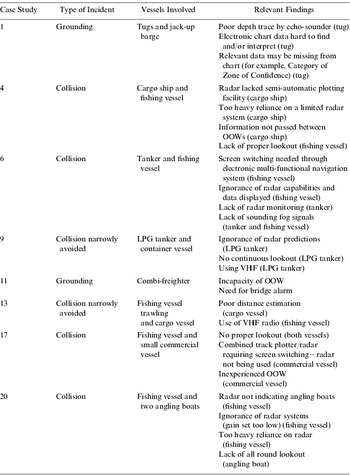
The MAIB Safety Digest (2008) contains 25 case studies which the MAIB had investigated. These case studies are not the full reports about each incident but they list the key factors involved and the implications for future working as summarised by the MAIB. The 25 studies are divided into three sections: Merchant Vessels containing 15 case studies, Fishing Vessels having six case studies, and Leisure Craft containing the remaining four case studies. This classification is somewhat arbitrary since if a merchant vessel is involved in an incident with a fishing vessel, it could be listed in the merchant vessels section rather than the fishing vessel category. Consequently, all 25 case studies were examined in turn to ascertain whether fishing vessels were involved and whether the incident had any bearing on either the use of electronic marine technology and/or watch-keeping. Of the 25 case studies, eight involved the use of electronic equipment or fishing vessels or problems of watch-keeping. Table 1 summarises the key findings from these case studies.
Key Findings from the MAIB Safety Digest (2008) .

From these results four key areas emerge for further discussion: problems associated with the use of radar (six entries), the lack of maintaining a proper lookout (five entries), too heavy reliance on electronic aids by the OOW (three entries) and problems associated with screen switching in order to obtain relevant data (two entries). In addition, the (incorrect) use of the VHF radio for collision avoidance was mentioned twice. Other issues raised only once included the lack of using a fog signal, the lack of use of alarms and the incapacity and ignorance of the OOW where information was withheld between watch officers. The four main issues listed above will be discussed later in this article but we now turn to the results from the fieldwork.
Of the ten fishing skippers interviewed, all but two worked on Scottish registered ‘single ticket’ vessels, (i.e. those which have a LOA between 16·5 metres and 24 metres); all these vessels caught white fish such as cod, ling and haddock by trawling. The two exceptions were both skippers of a Scottish registered 12 metres LOA vessel which was used mainly for training purposes and research associated with farming scallops. All the vessels used separate screens for the electronic information except for using an electronic chart to which the GPS and radar could be linked. In terms of safety, all the skippers preferred to use separate screens since these allowed more information to be visible simultaneously; the text was seen more clearly and separate screens allowed for backups in case of screen/system failure. Although it was accepted that these skippers had not used a fully functional IEMS, they were asked if they thought these systems may enhance watch-keeping. Seven replied negatively while the other three responded more positively. One skipper thought that the ergonomic advantage of having one screen in front of the OOW, rather than his having to look at separate screens with some inevitably being placed to the sides of the viewing area, was helpful in watch-keeping. Another skipper favoured the idea of having the plots of other vessels in the area clearly visible on the screen together with their predicted lines of progression. The third skipper could not give specific reasons as to why he felt an IEMS would be better. Generally, these results confirm earlier work (for example, Mills Reference Mills2007 and Mills Reference Mills2008) about the perceptions of fishing skippers; basically, those who have not used an IEMS do not acknowledge any advantage it may bring.
Three skippers confirmed that the AIS system was valuable for safety since it enabled the skipper to identify other vessels in the vicinity and so to call them on the VHF radio, if necessary. Again, systems giving information about the seabed were mentioned as being ‘essential’ (four skippers) for demersal (seabed) trawling. One system mentioned indicates the hazards of the seabed such as wrecks, oil pipelines and well heads, these being especially important data for fishing in the North Sea. One skipper already had a system which integrated a near vessel's details from the database associated with the AIS on to the object represented on the electronic chart through the radar; he stated that he found such information very helpful. Another skipper, who was in favour of IEMS, mentioned the cost of up-dating the electronic chart and admitted that his chart was ten years old and so may contain erroneous data as well as not having important current data.
In response to being asked about watch-keeping beyond using electronic aids for support, four skippers mentioned too much reliance on systems while another two stated that there was no substitution for keeping a good lookout. One skipper mentioned that having a too comfortable chair could lessen alertness while another suggested tiredness and complacency were problems in keeping watch. Interestingly, only one skipper mentioned alarms and this was in the context of his having had the main watch alarm repaired recently, thus suggesting that it had not been working previously.
Building on the secondary data gathered from the MAIB Safety Digest (2008), the skippers were asked if they experienced problems with screen switching. None of them had but nine of them pointed out that with separate screens there was little need to switch screens, except possibly with the electronic chart. Indeed, they felt that this was a good reason not to have an IEMS since they envisaged that screen switching would increase cognitive load both by having to remember the previously seen data and by having to recall where to find the required data. This perception is confirmed by Case Study 1 in Table 1.
Thus, the fishing skippers have independently confirmed the findings in Table 1 that the two main problems of keeping watch are relying too heavily on the electronic aids and characteristics associated with tiredness and complacency. They also emphasised that there was no substitute for keeping a proper lookout when watch-keeping. In addition, this particular group of skippers had no problems with screen switching since they did not use it very much, if at all. From Table 1, it is clear that the two problems of relying too heavily on electronic aids and keeping a proper lookout were also frequent issues in the MAIB Safety Digest (2008) . Tiredness and complacency are also problems regularly associated with poor watch-keeping and probably contribute to not keeping a proper lookout (Phillips, Reference Phillips2000). Thus, there is much commonality between the findings from the MAIB Safety Digest (2008) and the fishing skippers with a strong emphasis on a too heavy reliance of the electronic aids and the inability to keep a proper lookout.
These issues will now be discussed in more detail.
6. DISCUSSION
Keeping a proper lookout has long been paramount in watch-keeping and the literature about this issue is well established. It is well known that one of the problems with having a person on the bridge or in the wheelhouse whose sole duty is to lookout is that he may quickly become bored and lose alertness since for many hours there may be nothing to see except sea and birds. An associated problem with this task sequence is that no one person can have all round vision at any one moment in time and Case Study 20 in Table 1 is an example of this where the second angling boat's skipper was looking ahead (and no doubt to the sides) but did not look behind himself (astern) to see the fishing vessel travelling at a faster speed than his angling boat and so on a collision course (which resulted in a minor collision, fortunately, with no loss of life). It is also a fact of commercial fishing that often the wheelhouse is left unattended (with the vessel being steered by the auto-pilot) while fish are being gutted and stored with the lookout being kept from the deck (for example, as in Case Study 17, MAIB Safety Digest (2008), pp. 46–47). This task pattern prevents boredom and complacency since the OOW is preparing the fish for landing but it does mean that multi-tasking is taking place, thus increasing the cognitive load of the OOW. In addition, often gutting takes place on a foredeck (assuming it is not undertaken below deck) and this may well prevent all round vision of the vessel, even though, as we have seen, this is contrary to MGN 404 M+F (2009) . However, this task pattern may change if the skipper and owner of the vessel in the Scottish prosecution mentioned above are found guilty (Fishing News, 2010).
Existing electronic systems could be used to improve watch-keeping in terms of collision prevention and groundings. IEMS allow for the relevant information from the auto-pilot, the radar, the AIS and such legally required aids as the echo-sounder to be integrated into one system. Fishing information can be added too. A problem arises when the vessel is in danger of a collision or grounding and the readings from the relevant hardware and software are ignored by the OOW. In these situations, the system could monitor the various settings and readouts of the different equipments not being shown visibly on the screen (such as the information yielded by the different gain settings on the radar) and then the system could alert the OOW when any danger is likely. At least, the system should be alarmed so that the OOW knows there is a danger (M.1190, 1986). The system could easily highlight the data which have set off the alarm so that the OOW can make a decision about taking action to avoid the hazard. Here, it is relevant that only one fishing skipper interviewed mentioned alarms but anecdotal evidence suggests that many OOWs on fishing vessels either ignore or switch off alarms on the grounds of there being too many false alarms. With the current abilities of hardware and software, false alarms should be very infrequent.
Given that ships and aeroplanes can be directed remotely or automatically by software (Bell, Reference Bell2010), there is no technical reason why an autopilot could not be programmed to take evasive action when two vessels approach a defined distance between them. The data for this could come from the radar and the GPS and the vessel's log as well as the AIS and so evasive action could be taken automatically. The system could even be programmed to over-ride any manual intervention in such cases. However, it must be stated that in 2010 such a system would be illegal since maritime law still requires an OOW to make manual changes, as required. Even so, electronic aids could be used much more to support the OOW in watch-keeping but this requires knowledge of the systems and a regard for their limitations. Interestingly, ignorance of operating electronic aids, including the radar, is mentioned in five of the eight case studies of Table 1.
In Table 1, six out of the ten case studies specifically mentioned problems with the radar or other electronic systems as contributory factors to the recorded incident. In another case study (Case Study 13), poor distance estimation is blamed for a near miss suggesting possible misuse of the radar, assuming this was operating correctly. Exploration of the problems with the hardware and software as given in Table 1 suggests that three issues underlie these problems. The first is ignorance of operating the system correctly and knowing how to adjust the system to give the required information. For example, in Case Study 1, the echo-sounder of one of the tugs was showing a poor depth trace but it seemed that no-one adjusted the equipment or sought the reason why the trace was illegible. Perhaps not surprisingly, the tug grounded on a sandbank not shown on the paper chart being used. Here, we may use an example from everyday life: if a person is driving a car in an area where the speed limit is 30 miles per hour, that person trusts their speedometer to indicate their speed in that area. The accuracy of an individual speedometer can loosely be verified by the recognition that other vehicles are also travelling at a similar speed. In turn, this leads to justified trust in the speedometer by the driver of the vehicle. The technical principles of echo-sounders are well established and, in this case, a backup facility for verifying the main readings would have supported the OOW and perhaps prevented the grounding.
Similarly, in Case Study 20 (Table 1), ignorance of the setting-up of the radar in the fishing vessel caused the angling boats not to be displayed on the screen. With a higher gain level, the radar would have shown the angling boats and with a suitable alarm system, the collision may have been avoided. As we have noted, the system could monitor these readings and indicate to the OOW with an alert when a situation is likely to become critical. Again, in Case Study 4 (Table 1), ignorance of the technical limitations of the radar system was deemed a contributory factor to the collision. Thus knowledge of the systems' abilities and limitations are essential for making decisions in critical situations.
A second issue which occurs in Table 1 is that of ignorance of the meaning of the data being displayed. This is as critical a problem as the system not being set up correctly at the start of a voyage. The tug's OOW in Case Study 1 had problems of interpretation of data and finding the relevant data on the chart. Of course, missing data is always a hazard with any electronic chart and these can be expensive to maintain as one of the interviewed fishing skippers noted. However, an up-to-date chart should always be used. Few mountaineers, for example, would set out to climb in wilderness country without the most recent map and usually this would also be to a large scale. Given the seabed changes not only naturally but also as a result of human-made hazards such as wrecks and oil pipeline heads, the OOW needs to have current knowledge of these. Four fishing skippers mentioned a system which tracks the seabed and indicated hazards; all four believed that this system was essential for demersal trawling. Even without such a system, the fact in Case Study 1 that two systems (the echo-sounder and the chart) were giving conflicting information should have investigated.
Similarly, Case Study 6 suggested that the radar was not set properly since it only gave the skipper ‘one minute's worth of view ahead’ (MAIB Safety Digest, 2008, p. 21). Case Study 9 implied a lack of knowledge of the radar's limitations in a strong tidal stream. The system, apparently not set to include the results of the strong stream, indicated false information to the OOW who failed to allow for this on the vessel's Automatic Radar Plotting Aid (ARPA). Happily, the result was a narrow miss rather than a collision but better understanding of the radar and ARPA may have facilitated a safer outcome.
Perhaps with the problems of technology indicated in Table 1, it is not surprising that both the MAIB Safety Digest (2008) and the interviewed fishing skippers put emphasis on too heavy a reliance on the electronic aids. However, it must be remembered that the electronic aids are neutral and should hardly be blamed for misuse and ignorance of operation by the OOW. Indeed, the underlying trend in Table 1 is not that the systems themselves are at fault but that the operators did not use them correctly in the hazardous situation. Ignorance of operation is a common user problem; for example, few humans actually use software to its full functional potential. This can be easily seen in a word-processing package where users invariably have a favourite set of functions which are constantly used, together with a smaller set of lesser used functions. However, in most cases, there remains a set of functions which are never used by that user and of which the user is often unaware. Electronic marine aids need to be designed more specifically since they are to be used in safety critical situations such as collision avoidance and groundings; this probably requires a smaller set of functions which enables the user to have a clearer cognitive model of the whole system. Consistency of output would also help to generate trust in the system by the user.
The usual solution to technical software problems such as those in Table 1 is to train the users. However, fishing skippers, in particular, are busy people and, as already noted, not very enamoured by desk-work. Previous work (Mills, Reference Mills2008) noted that, when using IEMS, most skippers trained themselves by utilising the tutorials and user guides provided with the software, together with word of mouth discussions with other skippers. This can be adequate if the tutorials and associated training guides provided by the electronic systems' manufacturers have been written with the safety critical situations in mind.
Since none of the interviewed fishing skippers had a fully integrated electronic marine system, they did not have problems with screen switching. However, Table 1 reveals that in Case Studies 6 and 17 screen switching caused a problem. In Case Study 6, the skipper had an IEMS and was not monitoring the radar sufficiently frequently since this required switching from the electronic chart which was being used to view the position of the fishing pots. Case Study 17 relates a repetition of this with the radar again being subservient to the chart on a single screen IEMS. A solution to this problem could be automatic switching but this could become very frustrating for the OOW or fishing skipper since the screens could be changed at inconvenient times. A better solution would be to separate the radar information as a screen while allowing it to remain as an input of data into the integrated chart. This may seem a backward step in terms of IEMS but it would allow the radar data to be seen clearly by the OOW in a safety critical situation. However, if all the radar data were being monitored by the system and when a safety critical situation threatened, were to be incorporated into the electronic chart, together with alerts and alarms if the situation worsened (Stoop, Reference Stoop1990), then the separate radar output could be relegated to that of a backup.
Thus, it seems from these small data sets that the problems associated with watch-keeping remain; lack of a proper (human) lookout, user problems with the electronic aids, including the radar, resulting in too high a dependency on false data or a poorly set-up aid, and, to a lesser extent, the lack of switching screens frequently to include frequent viewing of the radar. Possible solutions have been suggested for the technical problems identified from the data.
As an aside to the main study, it is worth noting that Mills (Reference Mills2008) remarked on the lack of UK registered fishing vessels in the range of 30 metres LOA to 60 metres LOA in the study undertaken in 2007. The present study (2010) confirms this finding in that no fishing vessels were observed in the 30 metres LOA – 60 metres LOA category. Although at least four vessels were observed moored in the larger LOA range of over 70 metres, their skippers were away working elsewhere. Anecdotal evidence suggests they were working on other fishing boats which had not yet used all their allocated days at sea. With the fishing industry restricted to fishing only for a certain number of days, other fishermen are using the vessels for purposes other than fishing such as protecting oil pipelines and well heads, thus enabling the vessel to continue to earn the skipper a living (Skipper, Reference Skipper2010).
7. LIMITATIONS AND SUGGESTIONS FOR FURTHER WORK
As with all research, there are some limitations to this work. The first relates to the small data sets of both the primary and secondary data. However, ten interviews can yield useful qualitative information (Shneiderman, Reference Shneiderman1998) providing care is taken with generalising the results. In this study, the ten interviews have been supplemented by the secondary data which is based on UK government reports. This produced an interesting consensus of opinion with respect to the problems of watch-keeping and the lack of using electronic technology to support keeping watch. Using the two independent sets of data in this way, enables validation of the both sets of data and also allows replication of the findings of this work through the secondary data. It is admitted that it would be difficult to replicate exactly the primary data but further studies could be undertaken with other fishing skippers either within the Shetland Isles or further afield. Indeed, further work could extend the number of participants in the interviews as well as the number of case studies undertaken by the MAIB.
Much more importantly, this work has also raised a number of issues to do with the use of electronic aids in safety critical situations such as collision avoidance and groundings. The findings here suggest that technology could play a much more supportive role in watch-keeping beyond that found in this study. For example, OOWs should be able to rely heavily on electronic systems which should yield reliable and validated information in order to help the OOW make the correct decision for collision avoidance etc. Human error will always be present in what turn out to be poor decisions but the attributions made in Table 1 are much more to do with human ignorance of the electronic systems than actual decision-based errors made within a safety critical situation. This calls for a much more in-depth and independent study which investigates training in the use of systems and the use of IEMS in safety critical situations; the study could also include the problems associated with screen switching.
8. CONCLUSION
This study has revealed the part that IEMS and other electronic systems can play in watch-keeping while also indicating the need for more human support from the electronic aids in times of safety critical situations such as collision avoidance and groundings. The secondary data have indicated a need for electronic systems which are much more flexible to users' needs and which represent the object data in a clear and understandable way. In addition, screen switching has been revealed as a potential problem within an IEMS, particularly when switching between the radar and the chart is required.
The primary data have confirmed the secondary data findings in that ten fishing skippers agreed that the part played by electronic aids in watch-keeping must be very subservient to that of keeping a human watch. Since the skippers did not use IEMS, they felt that electronic aids with separate output screens were preferable to information displayed on one screen; these perceptions also confirm previous findings.