Introduction
Recent years have seen massive violence inflicted on Muslim Rohingya communities in Rakhine state and the subsequent displacement of more than 740,000 people into neighbouring Bangladesh.Footnote 1 The violence committed by the Myanmar army (the Tatmadaw) in Rakhine state in 2016 and 2017 has been described by an independent UN Fact-Finding Commission as crimes against humanity and potential genocide.Footnote 2 The issue has been discussed at the highest levels of international governance, including the UN General Assembly and Security Council.Footnote 3 These extreme acts of violence are underpinned by decades of discrimination against Rohingya people, enacted by both state and non-state actors. This article explores such ‘everyday discrimination’ experienced by Rohingya people and argues that it is attributable to the social boundary built through the construction of Muslims as ‘Other’ in the eyes of the country's majority non-Muslim population. In this article, I argue that the violence exacted on Rohingya Muslims in Myanmar is attributable to the construction of all Muslims with an appearance of South Indian descent as not only ‘fearsome’ but also as ‘disgusting others’.Footnote 4 In addition, in the aftermath of the communal violence in 2012, influential Buddhists monks have circulated the perception that in Myanmar, Buddhists are the hosts and all Muslims (not only Rohingya) are the guests.Footnote 5
Building on the work of border scholars such as Bouzas,Footnote 6 this article further argues that direct violence and social boundaries—constructed to exclude all Muslims in Myanmar from recognition, rights, and protection—work together to reinforce the political boundary of the state border, thus constituting ‘border governance’. This violent enactment of the border sheds light on the different ways in which the Myanmar border is constructed and enforced on the Rohingya people by powerful social and political actors. The article considers the construction of the border at multiple scales and through different registers: at the national level; at the township and village levels in Rakhine state (a sub-national unit in Myanmar); at the household level; as well as at the individual level. Social boundary making in Myanmar has occurred not only between Buddhists and Muslims, but also between Bamar and non-Bamar ethnics due to the national identity-building agenda of the Myanmar state at different times in history—from the first parliamentary government led by U Nu up until the present day. The state promotes the culture of the Bamar Buddhists, the largest ethnic group in the country, and expects minorities to assimilate, rather than develop an overarching shared identity.Footnote 7 According to Nick Cheesman, the ‘taingyintha (national race or ‘တိုင်းရင်းသား’ in Burmese) truth regime’ justifies the authoritarian state building of two military junta regimes—one led by General Ne Win, who seized power through a military coup in 1962, and another through the coup in 1988. This ideology contributes to instilling and naturalizing discriminatory concepts on which the primacy of the Bamar Buddhist identity is enforced.Footnote 8 The ‘taingyintha truth regime’ was utilized to build the new citizenship system of 1982, which limited the membership of Myanmar's political community to the recognized national races, thereby excluding the Rohingya people. During Ne Win's socialist era, the ‘taingyintha truth regime’ brought together in unity all national races who had been split during colonial rule. The regime was reinforced after the 1988 democratic mass revolution when the military state popularized the image of a country called ‘Myanmar’ as a single political community in which all national races were united in the struggle against the common external and internal enemy.Footnote 9 However, the apparent support for national races other than the Bamar was inconsistent in practice, as the two military authoritarian regimes violently acted—using military and state bureaucratic forces—against those members of national races who did not act in accordance with their constructed truth regime.
Consequently, institutionalized discrimination and state-sponsored persecutions, similar to those enacted against the Rohingya people, have been inflicted on non-Rohingya ethnic minorities too, especially those who pursued self-determination through armed revolutions. However, not all those ethnic minorities (or national races) experience citizenship and mobility problems in the way the Rohingya people do. While non-state sponsored media and civil society groups have strongly denounced the different forms of oppressions enacted by the Tatmadaw against ethnic minorities, this has not been the case for the Rohingya people who have been depicted as illegal Muslims immigrants threatening the existence of national races and Buddhism in Myanmar.
This article is based on fieldwork conducted in 2015 among residents of three villages in northern and central Rakhine state.Footnote 10 While discussing their Rohingya ethnicity and identity, interviewees shared their experiences of everyday forms of institutionalized discrimination up to the present day by what they called the ‘NaSaKa era’.Footnote 11 The research was carried out before the violence of 2017, but after several other periods of serious violence against Rohingya people and between Rohingya and Rakhine communities. The analysis in this article therefore helps to inform an understanding of the role of ‘everyday discrimination’, sustained over decades, in fostering a climate of violence against Rohingya people by enforcing social and political boundaries. Although this discrimination is characterized as ‘everyday’ on account of its normalization and routinization, such acts of everyday violence also contribute to the facilitation of mass violence such as occurred in 2017.
The first section provides an overview of the literature on bordering and violence which informs the conceptual framing of this article. The following section discusses the methods used to carry out this study. The third section thereafter provides a summary of historical, political, and social relations: first, between Muslim and non-Muslim people in Myanmar, particularly Bamar Buddhists, and second, between Rohingya Muslims and Bamar and Rakhine Buddhists. It demonstrates how the bordering practices observed today have deep-seated historical precedents. The fourth section develops the article's argument on how bordering practices and violence today are enacted at multiple scales, ranging from national laws to restrictions on townships and households, and on the bodies of the Rohingya people themselves. The conclusion reiterates the article's central argument about how bordering practices materialize in a multitude of ways to discriminate against and legitimize the expulsion of populations considered by the majority to be ‘out-of-place’ in the country.
Bordering and violent enactment
Within borderlands scholarship, several scholars such as Noel Parker and Rebecca Adler-NissenFootnote 12 and BouzasFootnote 13 have analysed borders and bordering practices through the lens of how social difference is operationalized by cognitive and material forms of boundary making. Bordering, as explained by Bouzas, is ‘about difference, about representing and making identity’.Footnote 14 In conflict situations, bordering involves more powerful social actors enforcing restrictive measures on populations that are targeted to be placed under political control, often through material practices. Such restrictive material practices contribute to the enactment of bordering, wherein the acts of being different or projecting difference can contribute to the materialization of borders. Enacting borders can be done by the state or ordinary people.Footnote 15
In conflict zones, the enactment of the border is often associated with violence. Scholars of feminist geopolitics, such as Pain and Staeheli,Footnote 16 have argued that geopolitics and intimacy are intertwined and need to be examined in multi-faceted, multi-level, and multi-sited ways. They contend that violence is ‘interpersonal and institutional, social, economic and political, physical, sexual, emotional and psychological’.Footnote 17 Alongside these observations, Fluri's study of civilian insecurity in war-ridden Afghanistan establishes that violence in the public sphere encroaches into the private sphere in multiple ways, for example, into civilian homes and by either policing or violating women's bodies.Footnote 18 In a later collection of edited essays, Fluri and Piedalue further explored the ways in which race and culture are imbricated in (gender-based) violence.Footnote 19 They argue for the importance of exposing how systemic vulnerabilities, such as those embodied in racial, gender, or sexual differences, can be manipulated to legitimize and perpetuate violence against vulnerable social groups.
This article examines how Muslim Rohingya residents, a doubly discriminated against ethnic minority group (that is, ‘double-minority’) residing in Myanmar's border area, Rakhine state, experience multiple forms of discrimination, which are institutionalized over time.Footnote 20 Bouzas argues that dispute contexts are shaped by ‘specific state practices of authority and control over time resulting in particular social orders in [the] borderland, distinct from those being formed in the mainland parts of the state’.Footnote 21 During fieldwork conducted in 2015, Rohingya interviewees in two townships in northern Rakhine state used the term ‘Dae Thandara U Pade’ (or ‘ေဒသ တရ ဥပေဒ’ in Burmese) to describe the form of order that they were subjected to through military and government interventions. This emic term can be translated to English as ‘local orders’. While similar understandings and experiences of ‘local orders’ may be observable in other border areas and among other ethnic minorities of Myanmar, this article investigates how it is understood in Rakhine state and how it is seen to operate in embodied and scalar ways. I therefore do not use it as an analytical, but as an emic or locally used term. Arguably, Muslim Rohingya face greater restrictions enforced by local orders compared to other ethnic minority groups, because of the visible phenotypical differences they embody as ‘Indians’ and ‘Muslims’ among the majority Buddhist Rakhine and Bamar populations. The mobility restrictions on Rohingya people are enforced particularly by Bamar and Rakhine communities, including children, because of hatred and fear caused by negative portrayals of Rohingya people as ‘fearsome’ and ‘disgusting’ illegal Muslim migrants from Bangladesh who intend to eradicate Buddhism and the other races.Footnote 22
In this article, I argue that the ‘local orders’ identified by Rohingya people play a similar role to the ‘social orders’ identified by Bouzas, namely, local laws, rules, and norms that target subjugated populations within particular spatial parameters and which are not applied to other populations within the said area (that is, Rakhine residents who are non-Rohingya people) or to other areas. Chris Lewa also wrote about ‘local orders’ that were introduced in Rakhine state in the late 1990s. According to Lewa, the Rohingya people are exclusively discriminated against by the Myanmar state using so-called ‘local orders’ (‘Dae Thandara U Pade’).Footnote 23
This article observes that local orders in Rakhine state enact violence to establish the boundaries of the Myanmar border. They are implemented at multiple scales, accentuating the effects on subjugated populations: at the national level, through the construction of citizenship in law and documentation; at the township and village levels in Rakhine state through the restriction of travel and mobility; at the household level, through household registrations and the control of births, marriages, and intimate family relationships; as well as at the individual level through arrests, detention, and acts of violence. To contextualize the above, I first provide an overview of the methods used in the study.
Methodology
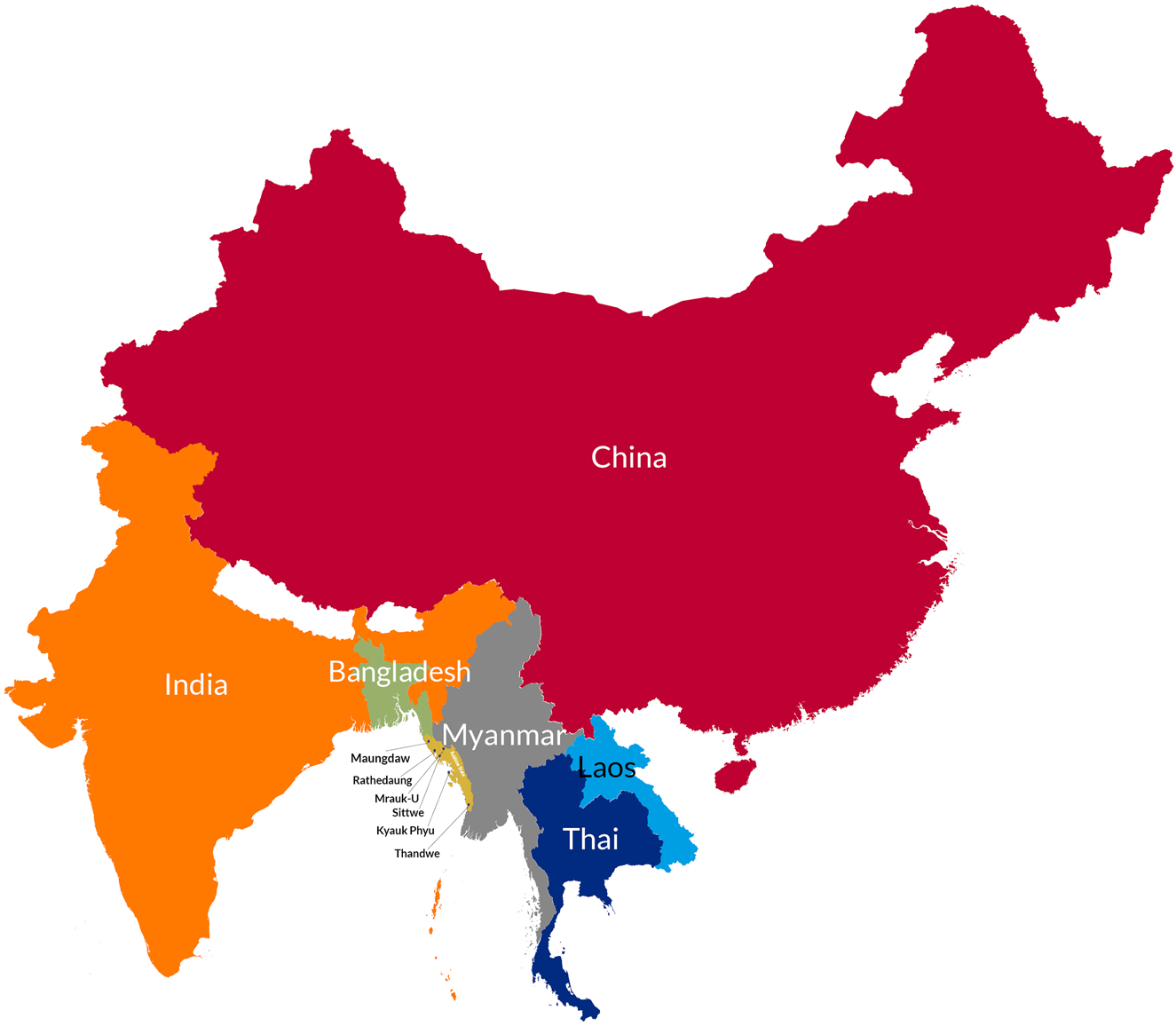
This article is based on qualitative data collection that was conducted from September to December 2015 in Rakhine state. The author led a research team of 16 people, which conducted both qualitative and quantitative field data collections, data processing, and preliminary data analysis. This research was part of a larger study mainly focused on access to justice and the informal justice system covering three states in Myanmar: Kachin, Rakhine, and Shan.Footnote 24 However, in this article I have chosen to focus on Rakhine state, in particular the areas inhabited by Muslim Rohingya. Data collection in Rakhine state covered 12 villages in six townships: Sittwe, Rathedaung, Maungdaw, Mrauk-U, Kyauk Phyu, and Thandwe. Sittwe and Mrauk-U are located in central Rakhine state, Rathedaung and Maungdaw are in northern Rakhine state, while Kyauk Phyu and Thandwe are in southern Rakhine state (see Map 1 below for the study sites). Given that Buddhists and Muslims are the two groups that constitute the majority in Rakhine state, the study selected one Buddhist and one Muslim village in each township studied in Rakhine state. Three of the 12 villages examined were populated entirely by people who self-identified as Rohingya. These villages are (or used to be) located in the Rathedaung, Maung Daw, and Mrauk-U townships.Footnote 25 One village that we studied in Kyauk Phyu previously had a mixed population of Rohingya people and other ethnic groups. After the 2012 violence between Buddhist Rakhine and Rohingya people, all Rohingya residents in that village were moved to IDP (internally displaced persons) camps.
Myanmar and neighbouring countries.

This article is mainly based on data gathered from key informant interviews (KIIs) with village administrators, religious leaders, and ordinary villagers. Focus group discussions (FGDs) were also conducted with a group of women, a group of men, and a group of village leaders such as village administrators, religious leaders, village elders, and respected persons. In terms of ethnicity, researchers conducted interviews with various groups residing in Rakhine state such as Rakhine, Rohingya, Kaman, Maramagyi, and Dynets. During the study, all the Rakhine, Maramagyi, and Dynet people interviewed are Buddhists, while all the Rohingya and Kaman people interviewed are Muslims. Both formal (including FGDs) and informal interviews were conducted in Burmese. For those interviewees who could not speak Burmese, we relied on interpreters hired in the village that we studied or in the town of Buthi Daung for the data collection in Maungdaw. Interpreters were village elders, youths who studied at a high school or university level, and those who used to work for international health NGOs.Footnote 26 Informal conversations with villagers and drivers were also useful in triangulating the collected information. General observations and experiences during the research field trip gave additional insight into exclusionary daily practices occurring in Rakhine state. The research team experienced considerable challenges in attempting to travel to Rohingya villages in northern Rakhine state, for example, Rakhine boatmen or drivers (with only one exception) were unable or unwilling to assist the research team to travel to there. It was impossible to recruit Rohingya interpreters in advance of the trip due to the restrictions imposed on Rohingya people for intra-state and even intra-township travel in the Rathedaung and Mrauk-U townships.Footnote 27
Historical exclusion of Rohingya people in Myanmar: ‘fearsome others’ at the Western Gate
Boundaries, according to Grahame Thompson, are ‘sites of difference and neighbourhoods of opposition’.Footnote 28 Many people in Myanmar (particularly Buddhists, not only Bamar Buddhists) create a social boundary against the Muslim world through the process of ‘Othering’ Muslims, constructing them not only as ‘fearsome others’ but also as ‘disgusting others’. Distorted narratives of Islam and Muslims have long been widespread in Myanmar and include such perceptions as ‘Islam is an ideology of violence’; a religion with ‘colonizing imperatives’; and of Muslims as a group that mistreats women.Footnote 29 Widespread and distorted narratives insist that Muslims are opposed to Buddhists in all respects, with common examples being the direction in which Muslims place their heads when they sleep and the practice of circumcision. Muslims position their heads westwards while most Myanmar Buddhists face the east when they sleep, so many people in Myanmar think that Muslims deliberately set out to do the opposite to them. The circumcision of Muslims is also misperceived as a Muslim way of transforming monkhood, and is criticized by Myanmar Buddhists as a ‘disgusting’ practice.Footnote 30
Myanmar shares borders with five countries—Bangladesh, India, China, Laos, and Thailand (see Map 1)—but the border with Bangladesh looms large in the national perception of boundaries and separation. Almost every citizen of Myanmar will instantly think of Rakhine state when they hear the term ‘Western Gate’ (‘အနောက်တံခါး’ ‘Anauk Tahkar’ in Burmese). There is a widespread belief and fear that if the ‘Western Gate’ of the country erodes, an immense demographic wave of Muslims from Bangladesh would enter the country and ‘wash away’ Buddhism in Myanmar and the rest of Southeast Asia. According to this belief, Rakhine Buddhists are owed gratitude for protecting the ‘Western Gate’, and Rakhine state (particularly northern Rakhine state) is not merely an international border but represents a boundary between the Buddhist and Muslim worlds.Footnote 31
To better understand the construction of Rohingya people as ‘fearsome others at the Western Gate’, we need to briefly reflect on the historical ‘politics of the line’.Footnote 32 The contemporary ethnocultural conflict between Muslims and Buddhist Rakhine in Rakhine state could not be predicted from its precolonial history (see the Appendix at the end of this article).Footnote 33 As the historical records indicate, the Arakanese kings adopted both Muslims and Buddhist titles from the fifteenth century onwards; the ancient Arakanese kingdom at that time had strong cultural interactions with Islamic culture.Footnote 34 Citing Wagoner, Michael Charney has argued that the Arakanese court's adoption of Muslim titles and coins was part of a process of cultural Islamification as opposed to religious Islamization. Cultural Islamification is a political strategy by which indigenous elites attempt to enhance their political status and authority through participation in the more ‘universal’ culture of Islam. The process thereby largely pertains to the broad sphere of secular culture rather than the narrower domain of formal religion.Footnote 35 In the sixteenth century, the Arakanese kingdom conquered Chittagong, Bengal's prosperous port which had been ruled by Muslim lords since the fourteenth century. Chittagong's Muslim, Hindu, and Buddhist populations were part of the Arakanese realm and a pillar of its economic power until 1666.Footnote 36 As Charney has further observed, Muslim populations in Arakan, particularly in Mrauk-U, increased significantly and formed a community, particularly during the seventeenth century, when Arakanese and Dutch slave raiders captured Bengalis from Banga and Chittagong for overseas as well as domestic agricultural labour markets and services for the Arakanese court.Footnote 37
In late 1784, the Burmese Konbaung dynasty conquered Arakan. Then in 1826, Arakan came under British colonial rule, during which time Muslims from Bengal migrated there after 1870.Footnote 38 Conflict between Muslims and Buddhists was accentuated during the Second World War, when Japan invaded Myanmar. At that time, the Burma Independent Army (BIA) and Arakanese Buddhists attacked Muslim villages, and Arakanese Buddhists in northern Rakhine state (where Muslim populations dominated) were attacked in retaliation.Footnote 39
During the negotiations for independence from the British, which was achieved in 1948, northern Arakan Muslim leaders from Maungdaw sought political autonomy on the basis that the Muslims of Arakan (or Arakan Muslims, now known as Rohingya) were an indigenous population. The local Buddhist population opposed this claim and it was also dismissed by both the Burmese and British authorities. In 1948, a council of religious teachers—the ‘Jam'iyyat ul-Ulama’—requested the Burmese government to demarcate an autonomous Muslim zone. In the same year, the Mujahid began an insurrection in the northern part of Rakhine state which can be attributed to the violent taxation practices of local militias, the dissatisfaction of local landlords, the unfair treatment of Muslims by Arakanese administrators, and murky business conflicts. However, because of its attacks on the local population, the Mujahid armed movement was not supported—even by Muslims in those areas. The insurrection ended in surrender in 1961 as a result of the Myanmar army's annual military campaigns. At the same time, Arakan Muslims pursued their political ambitions through parliamentary political pathways and gained political seats in the Constituent Assembly.Footnote 40
Arakanese Muslims’ ambitions for political autonomy were later taken advantage of by the state. When Arakanese nationalists (Buddhist Arakanese) in the Arakan National Union Organization (ANUO) called for the creation of an ethnic Arakan state, the then prime minister U Nu became allied with Sultan Mahmud, head of the Arakan Muslim Association (later to become minister of health in 1956). At the same time, a younger generation enhanced their efforts to claim political autonomy by adopting the common name ‘Rohingya’, thus creating points of contention.Footnote 41 After the surrender of the Mujahid in late 1961, Rohingya people were recognized as one of the ethnic groups (national races) of Myanmar.Footnote 42 In early May 1961, U Nu's government created the special Mayu Frontier Administration (MFA) to satisfy Muslims who had been concerned with his government's plan to grant Arakan statehood in the union. The MFA included areas of northern Rakhine state such as Maungdaw, Buthidaung, and Rathedaung townships where a majority of Muslims resided. The MFA, however, was essentially a modified version of the Frontier Area Administration (FAA) formed under General Ne Win's caretaker government (1958–1961) and was a means to extend the army's control over this border region, which was seen as a hideout for rebels and smugglers and an open gate for migrants from (what was then known as) East Pakistan (today Bangladesh).Footnote 43
General Ne Win's socialist government (1962–1988) did not officially remove Rohingya people from the list of recognized ethnic groups. However, his one-party dictatorship and the military junta enforced discreet, gradual steps towards withdrawing the citizenship status of Rohingya people. National Registration Cards (NRCs), which had been issued to people in the country since the 1950s, were not issued to Muslims in the northern part of Rakhine state starting from the 1970s. Authorities also seized existing cards owned by Rohingya people.Footnote 44 The 144 ethnicities which were listed as national races in the 1973 Census did not include Rohingya people.Footnote 45 The 1982 Citizenship Law stipulated that only those who had settled in Myanmar prior to 1823 (that is, before the British colonization in Arakan) are considered citizens by birth. The ‘144 list’ of national races included Rakhine Kaman, Rakhine-Chittagong, and Myedu who were considered as Muslims in Rakhine state.Footnote 46 It is widely assumed that the lists of the national races in the 1973 Census informed the 1982 Citizenship Law, although there are no official references to it. In the 1990s, the NRCs of the majority of people in the country, except for the Rohingya, were replaced with pink, coded Citizenship Scrutiny Cards (CSCs).Footnote 47
During Ne Win's rule, the Rohingya people were continuously persecuted, especially through Operation Dragon King (Naga Min), the so-called process of citizenship verification in the border regions.Footnote 48 Their political and social organizations were systematically dissolved by the government. Around the time that Bangladesh seceded from Pakistan in 1971, nearly half a million Bengalis trespassed into Arakan.Footnote 49 Operation Dragon King, which began in 1978 and was implemented particularly in Sittwe, Buthidaung, and Maungdaw, forced over 200,000 people to flee to Bangladesh.Footnote 50 Many of those who fled in 1978 were returned to Myanmar and, under international pressure, reluctantly accepted by the Myanmar government. Later many had to flee again as a result of security operations against Rohingya people in 1989, 1991–92, and in 2002. After the 1991–92 campaign, as many as 250,000 people sought refuge in Bangladesh.Footnote 51 Also, in 1991–1992, the State Law and Order Restoration Council (SLORC) settled Buddhist Rakhine and Bamar people in areas occupied by Rohingya people, with the intention of replacing them. The SLORC also introduced the NaSaKa to Rakhine state.Footnote 52 The NaSaKa, which was particularly active along the border between Rakhine state and Bangladesh, was a notorious border security force under which Rohingya people suffered terribly through different kinds of everyday suppression.Footnote 53 In 1995, White Cards, formally called Temporary Registration Cards (TRCs), were issued by the military junta to Rohingya people at the behest of the UNHCR. Given that the White Cards do not include details of the bearer's birth, they cannot be used in claims to citizenship.Footnote 54 In the 2010 general elections, 150,000 Rohingya people voted, most of whom held White Cards. Five Rohingya people were elected: three to the union parliaments and two to the state parliament (Rakhine State Parliament).Footnote 55 The three candidates elected to union parliaments were from the Union Solidarity and Development Party (USDP), which is the party backed by the Myanmar military. It was widely surmised that Rohingya voters chose Rohingya candidates from the USDP because the party lured them with promises of citizenship.Footnote 56
In June 2012, communal violence in Ramri township located in the southern part of Rakhine state was followed by a series of violent clashes between Muslims and Buddhists in other parts of the country, like Meiktila. The communal violence in June 2012 was sparked by the rape and murder of a 28-year-old Arakanese woman by three Muslim men in Ramri township in May.Footnote 57 On 3 June, a large group of Arakanese villagers in Toungop town, southeast of Ramri, stopped a bus and proceeded to beat and kill ten Muslims who were on board. The violence that started in June 2012 was followed by other violent clashes in October of the same year, resulting in the killing of hundreds of people, mostly Muslims. Over 125,000 people were displaced to the IDP camps in Rakhine state.Footnote 58 In 2015 Rohingya candidates were banned from running in general elections and Rohingya people were disenfranchised by the election law, which revoked the voting rights of White Card holders.
This disenfranchisement is the culmination of years of suppression and exclusion of the Rohingya people by the state. In this context, it is also important to note the influence of the relationship between Rakhine Buddhists and Rohingya people. While the majority of the population of Rakhine state are Buddhist Rakhine, estimated at over two million, they have felt threatened by the perceived large number of Rohingya people, estimated at around one million.Footnote 59 When Rohingya people became members of both the union and state parliaments after the 2010 elections, this heightened the concerns of the Rakhine about sharing political power with Rohingya people (see the Appendix). The changes in political power dynamics can be seen to have significantly attributed to the communal violence in 2012.
The historical context of conflict, politics, and the creation of a social boundary against Muslims indicates the deep-seated legacy of violent bordering practices performed against Rohingya people. The following section discusses Rohingya experiences of the NaSaKa era based on the accounts of Rohingya key informants in three villages: Rathedaung, Maungdaw, and Mrauk-U.
Purging the ‘fearsome other’: violent border enactments in national law and policy
The ‘taingyintha truth regime’ embedded in the 1982 Citizenship Law became the foundation for the discrimination against many people who are not considered to belong to a national race, particularly Rohingya people, as well as those with Indian and Chinese appearances. According to Article 3 of Section 2 of Myanmar's 1982 Citizenship Laws, only specified national races or native races (‘တိုင်းရင်းသား’ or ‘taingyintha’ in Burmese) that resided in Myanmar before 1823 are considered as ‘citizens at birth’ of the country. In fact, the 1982 Citizenship Law did not explicitly exclude Rohingya people from the national races of Myanmar as it did not refer to any of the national races except the eight ethnic groups: Kachin, Kayah, Karen, Chin, Bamar, Rakhine, and Shan. There is currently no enacted official list of native races. However, the authoritarian governments of Myanmar had previously prepared lists of native races during the national census, most notably the list of 144 native ethnicities for the 1973 Census under Ne Win's regime which did not include the Rohingya. It is widely assumed that the 1982 Citizenship Law referred to this list. However, the law is not objectively applied on the ground, and it lacks the logic and practicality that would mean it could be applied in an objective manner.
Many people in Myanmar become citizens without providing watertight documentation to prove their families settled in the country prior to 1823; they only need to obtain the endorsement of the village/ward administrator to be formally recognized as one of the native races of the country. In particular, there are three examples that illustrate the arbitrariness of determining eligibility for the CSC. First, there are cases where people cannot acquire CSCs because they look Indian or Chinese (races considered ‘foreign’ even if they have been in Myanmar for generations). Second, those who actually are Indian or Chinese can be issued CSCs as long as they do not resemble those races in their appearance.Footnote 60 Third, the situation is even more different for Rohingya; they were excluded when the NRCs issued in the mid-1950s were replaced with CSCs in the 1990s under the military junta (SLORC) and instead were given TRCs. Non-Rohingya Muslims and Hindus residing in other parts of Myanmar, even in the areas populated by the majority Bamar and other ethnic groups considered national races, also face profound difficulties in acquiring CSCs, even with citizenship documents and records of their ancestors. Even Kaman and Bamar Muslims, who are considered national races of Myanmar, experience significant difficulties in acquiring ID (identity) cards on account of their religious beliefs.Footnote 61
This law in fact allows non-national ethnic groups to apply to become ‘naturalized’ and/or ‘associate’ citizens of Myanmar. However, without much explanation, the government rarely processes the applications for naturalized citizenship properly or invites applicants for interviews.Footnote 62 In fact, it is highly doubtful that Rohingya people would be given citizenship status even if they did apply to be naturalized citizens, since they are considered ‘illegal immigrants from Bangladesh’. In 1998, Lieutenant-General Khin Nyunt, Secretary No. 1 of the State Peace and Development Council (SPDC), mentioned in his letter to the then UNHCR High Commissioner that ‘these people are not originally from Myanmar but have illegally migrated to Myanmar because of population pressures in their own country’.Footnote 63 Considering this statement, many discriminatory restrictions can be legally justified, including restriction of mobility, access to education, and confiscation of property.Footnote 64
In this context, it was unsurprising that three forms of national identity cards were observed and photographed by the research team in the three different Rohingya villages we studied, attesting to the variegated and partial political statuses of Rohingya people. One was a two-fold Green Card from August 1955 that had been issued to a man, another was a two-fold Pink Card from September 1974 that had been issued to a woman, and the last was a three-fold Green Card from October 1986 that had been issued to a man.Footnote 65 Two of the cards were presented by family members of the ID card owners and only one card was presented by the owner himself. The informants who presented the ID cards said that these documents were supposed to have been returned to the government in the late 1980s, but they had kept the cards as evidence of the legal status that they had once held. ‘We have automatically lost what we possessed,’ expressed one of our Rohingya informants who resided in a village of the Rathedaung township. This informant was referring to how families in the community had been gradually deprived of citizenship. To prove that they had once had citizenship status, some interviewees showed us the ID cards of their grandparents. One of them said that the ID cards held by many other people in his community had been confiscated by the authorities in the 1990s:
When NaSaKa came, they checked our household registration lists and ID cards. They returned household registration lists but not the ID cards […] They also seized the IDs during our travels.
Another respondent said:
My mother purchased the boat tickets and she was checked by intelligence and [they] took her ID saying you guys don't need to hold this card.
Due to their lack of ID cards, Rohingya people faced problems in accessing services, particularly those to do with education and travel. When the government was asked to provide ID cards to address these problems, it issued White Cards to Rohingya people.Footnote 66 Similar ID cards held by other people in the country had been recalled by the government around the mid-1980s. The majority of people in the country who returned their former ID cards were issued CSCsFootnote 67—but this was not the case for Rohingya people. The Rohingya informants shared that they thought the authorities issued White Cards to them because it was very difficult for them to travel and for their children to receive education without any ID cards. Every year, the immigration authorities came to the village and would issue the White Cards to Rohingya people who had turned 18.
Some Rohingya people did not return their ID cards when they learned that they would not receive the CSCs given to other people in the country. In addition, they started collecting as much documentation as possible to provide evidence of the citizenship status that they once had. In one case an informant kept his grandfather's service cards as a primary school teacher, which described his ethnicity as ‘Rohingya’. Another respondent showed us a worn-out household registration document on which the immigration officer who checked the registration status had written ‘Rohingya’. A different respondent provided the research team with a photocopy of a land certificate issued during the colonial era. Nevertheless, the Rohingya people still depended on White Cards to access services; however, despite carrying these cards and other documents endorsed by the village authorities, they faced severe restrictions while travelling or even just commuting to neighbouring villages when the NaSaKa policy was enforced in the villages in northern Rakhine state.
The experiences of the Rohingya informants described above highlight that the social boundaries enforced by the majority of people in Myanmar (most of the non-Rohingya people in Myanmar, including non-Rohingya Muslims) are not only related to the social construction of Rohingya people as ‘fearsome illegal migrants’, but also to the political construction of citizenship and the boundaries of the Myanmar state. As Parker and Adler-Nissen have discussed, states specialize in formalizing the boundaries of personal space in order to make borders.Footnote 68 The following section, also based on the accounts of Rohingya informants, describes how discriminatory rules were implemented in practice by ‘local orders’ (‘ေဒသ တရ ဥပေဒ’ or ‘Dae- Than-Dra U-Padae’ in Burmese). The NaSaKa was the formal apparatus to enforce those bordering practices. In other words, social boundaries became formalized by the discriminatory 1982 Citizenship Law and controversial lists of national races prepared for censuses, which were realized by the NaSaKa through local orders in northern Rakhine state.
Bordering practices through local orders and everyday discrimination in Rakhine state
This section identifies the manifold ways in which Rohingya people in Rakhine state experienced discrimination in their everyday lives through laws and restrictions that applied only to them (known as ‘local orders’), such as restricted travel and administrative procedures that regulated marriages, births, and housing registrations. Such restrictions also resulted in extortion, arbitrary arrests, and more extreme acts of violence on the bodies of Rohingya people. These actions exemplify the types of bordering practices enacted on marginalized populations as well as culminating forms of border governance.
Of the three Rohingya villages studied in 2015, two were located in townships of northern Rakhine state: Rathedaung and Maungdaw respectively. The May Yu Mountains and Naff River represent the physical boundaries that demarcate these two villages in Myanmar from neighbouring Bangladesh. The other village is located in Mrauk-U township located in central Rakhine. During fieldwork, villagers from the two villages in northern Rakhine state reported to the researchers how they were brutally ruled during the NaSaKa era by ‘local orders’. According to the Rohingya informants, the orders are ‘local’ because they are only imposed on their township (locality). One village leader in Rathedaung insisted that ‘we were governed by local orders which were not applied anywhere in the country’. Under these so-called local orders, Rohingya people suffered severe restrictions on their freedom of movement; household, marriage, and birth certificate registrations; housing and even small-scale renovation; and raising cattle. Many of those restrictions were mainly imposed during the NaSaKa era. Restrictions such as household registration and mobility remained in place even when the NaSaKa was abolished in 2013 under President U Thein's government.
Even though the restrictions imposed by local orders were widely known among Rohingya communities, the Buddhist Rakhine we interviewed in the same townships did not refer to any ‘local orders’. This difference in experience suggests that the restrictions of the so-called ‘local orders’ were imposed only on the Rohingya communities of the two townships. Intriguingly, the Rohingya informants we interviewed in the township of Mrauk-U further south also did not report restrictive local orders or brutal treatment by the NaSaKa, even though they experienced more general restrictions on mobility and withdrawal of their CSCs. These findings suggest that the ‘local orders’ were used specifically to exclude Rohingya Muslims who were residing in northern Rakhine state. Hence, the ‘local orders’ are a specific bordering practice concentrated in the north, which is exactly the critical frontier between the Muslim and Buddhist worlds. This conclusion—that northern Rakhine is the key bordering territory—is further supported by the finding that the villages studied in northern Rakhine state had been placed under the control of Border Guard Forces (BGF) after NaSaKa was disbanded in 2013, while the Rohingya village studied in Mrauk-U in central Rakhine state was under the control of the Myanmar Police Force (MPF).
As Salter et al. have argued, the violent enactment of bordering practices is designed to exclude, abandon, and/or kill the ‘Other’.Footnote 69 The following sub-sections illustrate how local authorities and institutions carried out this role against Rohingya people in Rakhine state during the NaSaKa era.
Township- and village-level restrictions on travel and mobility in the NaSaKa era
Rohingya people in Rakhine state have experienced restrictions on travel, even for visits to neighbouring villages, since the NaSaKa era. They were at risk of arrest during their trips, under a charge of ‘suspicious behaviour’. One of the villagers in Rathedaung township shared that ‘we were arrested even for inter-village travels […] The NaSaKa authorities arrested 30–40 people on one occasion under the charges of suspicion (‘Ma Thingar Hmu’ in Burmese).Footnote 70 Only when we gave 200,000–300,000 Kyats to NaSaKa then they released us.’ One villager in Mrauk-U township recalled how badly he was treated by checkpoint officers who stopped him from going to the township capital:
Normally, they allowed us to go to Mrauk-U with White Cards.Footnote 71 Sometimes, however, some of the authorities at the checkpoint stopped us and yelled, son-of-a bitch Kalar,Footnote 72 don't you know that you could not go [to Mrauk-U town] with White Cards and have to acquire endorsement from the village administrator? But they allowed us to go after we gave them 1,000–2,000 Kyats.
Travel beyond the township for Rohingya people was termed ‘travel-beyond-the-territory’ (‘နယ်ကျော်မှု’ or ‘Nae-Kyaw-Mhu’ in Burmese) according to what Rohingya people understood as regulations of the local order. Despite the technical rule that travelling beyond their respective townships of residence would be allowed with permission from the local authorities, such permission was difficult to acquire because the relevant forms were only available at the township General Administration Department (GAD). Other than in Maungdaw district, Rohingya people were not allowed to go to the township by law, but instead had to rely on non-Rohingya Rakhine people to get the travel pass from their respective township for which they had to pay them 30,000–35,000 Kyat (approximately US$ 30).Footnote 73 Rohingya people who travelled beyond their own township without permission would be arrested, put on trial, and sentenced to two to three years of imprisonment. According to the informants in Rohingya villages, young Rohingya men often needed to migrate internally and externally to find jobs as they had limited livelihood opportunities in their villages.
According to Rohingya informants in Maungdaw and Mrauk-U, a lot of young men went to Yangon and other countries like Thailand, Malaysia, and Indonesia, either by boat or walking through the jungle. Some were arrested en route. Rohingya people who were detained within Myanmar's territorial jurisdiction (whether on land or at sea) would be arrested and imprisoned. Those detained in international waters were more likely to be safely returned to their villages by the authorities.Footnote 74 However, there are many Rohingya irregular migrants in prison in Malaysia and other countries. The following example, reported by a Rohingya villager in Mrauk-U Township, shows how Rohingya people who flouted the local order prohibiting ‘travel-beyond-territory’ were punished:
It was in 2007. My son went to Yangon unofficially to find a job.Footnote 75 My son went by boat and was arrested near Sittwe. The police gave us a call. The immigration office in Sittwe put him on trial at the state level courtFootnote 76 located in Sittwe. They said (my son) had been arrested for travelling without having a township endorsement.Footnote 77 I was not allowed to enter the courtroom when my son's case was heard. He had to stay in the jail for six months during the hearing [before the sentence]. We paid 300,000 Kyat [nearly US$ 250] to the lawyer. My son was sentenced to six months imprisonment which counted [retrospectively] the time he was in jail while the case was ongoing. As a result, he was freed after the court sentence. He was very lucky as most of those people arrested for similar cases would be sentenced to two years imprisonment. Some were sentenced for five years imprisonment, with more charges in addition to the charge called ‘travel-beyond-the-territory’.
Household-level bordering practices: household and individual restrictions
Rohingya people were not allowed to apply for different household registration lists for intergenerational households or for extended families even when they moved to different villages.Footnote 78 This regulation has been in place since the NaSaKa era and was still imposed during our field work in October 2015. Some Rohingya villagers in Rathedaung township shared their experiences of restrictions that have been enforced on household registration since the NaSaKa era:
In 1996 NaSaKa came in and they made household registration. They issued only one form (one list for one family) in which all related family members were to be listed. Some of the lists had as many as 60 members. No one has been issued new household list since then [since NaSaKa was in place] […] Every six months [during the NaSaKa era] they would come with only one to two weeks’ notice and check if everyone on the household registration list were present. If someone on the list was missing at the time of the inspection, the authorities would cancel that person's name from the household list […] when those who were delisted were found in the village they would be arrested. In order not to be delisted from the household registration, we had to give [those officers] money.
Another respondent shared that those people who were absent during checks by the NaSaKa authorities would not only be delisted from the household list, but would also be annotated in red with the phrase, ‘BD fled’ (‘ဘီဒီပြေး’ or ‘BD Pyay’ in Burmese), meaning ‘fled to Bangladesh’. In order not to be listed as ‘BD fled’, household members would have to give 200,000–300,000 Kyat to the authorities.
Rohingya people also faced various restrictions on marriage, birth certificates, housing, and raising draught cattle. Rohingya people who wanted to get married had to apply for permission to the NaSaKa with the endorsement of the village administrator. It could take between six months to three years to secure such permission, and this procedure might cost the couple 300,000–500,000 Kyat. Some marriage permissions were denied by the authorities. One man shared his experience as follows:
Couples had to obtain marriage certificates. The parents of the couple had to sign. Only those who were eighteen years of age were allowed to marry. Then the permitted application to marry had to be submitted to the immigration. You could marry only when they gave permission. If your marriage did not have such permission and you were found out during spot checks, you would be imprisoned [for] even [up to] seven years.
Rohingya people also experienced restrictions in housing; they had to seek permission from the NaSaKa even for changing the roof of their houses or for renovations. To secure such permission, they had to give 500,000–1,000,000 Kyats to the officers.Footnote 79 For example, one informant shared that:
Suppose your home costs 1,000,000 Kyats then you had to give the same amount to NaSaKa. If you did not pay, they would come and demand it. If you paid you would not be arrested. But if you could not pay you will be imprisoned and charged with breaching the local orders.
The number of children that Rohingya families can have were limited as well, but the respondents had different information about how many this was; some said the limit was three, while others said it was two. Despite these uncertainties, the level of control is illustrated quite starkly by one of the Rohingya informants: ‘During NaSaKa era, we had to report whenever we gave birth to a child, if the cattle gave birth, and if there was a death in the house.Footnote 80 Whenever we reported anything to the authorities, we had to pay 5,000 Kyat to NaSaKa authorities.’ Those who used Bangladeshi phones (SIM cards) to communicate with their children who worked in Bangladesh had to pay monthly bribes to the authorities (100,000–200,000 Kyat). The NaSaKa also created economic rents in order to extend the extortion. For example, the NaSaKa would issue a licence for collecting products, such as shrimps, to one sole collector. Then they stipulated that people could only sell their products to that designated collector and those who failed to do so were arrested. One of the respondents reported that the NaSaKa placed informers in the community. Additionally, people were arrested if the informer gave wrong information to the NaSaKa. All these instances, which led to arbitrary arrests and detention thereby inflicting violence on the bodies of Rohingya people, depict the violent enactment of bordering practices.
After NaSaKa: one step forward, many steps back
‘Who are you? Are you all Buddhists? Are you all our people?’ These words were uttered to our research team by a border guard at one of the several border guard police outposts along the road between Maungdaw and the Nga Khu Ya village tract, which is only minutes away from Bangladesh by foot. ‘Our people’ (‘ကိုယ့်လူေတွ’ in Burmese), the pronoun that the policeman used to form an ‘in-group’, refers to those who are constructed socially and administratively as the ‘ethnic’ people of Myanmar as opposed to those considered as ‘non-ethnic’, particularly Rohingya people living in the area. The policeman asked those questions while inspecting our car which had broken down when it was transporting the research team (including me) to one of the Rohingya villages in Maungdaw township. Among our researchers were four Rohingya interpreters who had been issued a travel pass by the township immigration office.
In response to the policeman's questions, we answered that we were from Yangon and had come to the area to conduct research with the permission of the township authority. The policeman responded by saying:
As you all are our people, it doesn't matter. We have to help you. I would advise you to stay inside the police station given that the surrounding areas are Kalar villages and you know little about them.
Having been urged to do so several times by the policeman, the research team decided to go to the police station, which was only five minutes away. On the way, the policeman said that there were Bengali (meaning Rohingya) among the group and that they could not enter the police station for security reasons. We replied that if the Rohingya interpreters were not permitted to enter the police station, we would not go either. The policeman insisted that only the non-Rohingya members should enter the police station, reiterating that ‘you [the researchers] are our people; we have to help our people’.
This incident reflects the institutionalized discrimination committed by those government officials who are supposed to protect the people in the area. It happened in 2015, two years after the notorious NaSaKa was disbanded by a Presidential Order. The BGF had replaced the NaSaka in northern Rakhine state, while villages in central Rakhine state remained under the jurisdiction of the Myanmar Police Force (MPF).Footnote 81
These experiences demonstrate that the Myanmar state's security forces continue to regard the Rohingya people as enemies. However, at the time of the research team's visit in 2015, Rohingya informants insisted that their lives were better than they were during the NaSaKa era. They felt relieved from the everyday oppressive rule of the NaSaKa, despite continuing to experience severe travel restrictions after the communal violence that had occurred between Rakhine Buddhists and Rohingya people in 2012. For them, the obvious change was that they no longer went through arbitrary arrests and extortion by the NaSaKa. Nonetheless, relief from oppressive conditions did not mean they were free from the other restrictions imposed on them by so-called ‘local orders’ introduced in the NaSaKa era. One Rohingya villager in Maungdaw compared the NaSaKa and the BGF by saying, ‘NaSaKa had followers [the informers] who tended to give wrong information, [leading to people being] arrested by NaSaKa. The BGF do not have that practice.’
Another obvious change after the NaSaKa era has to do with the procedures for acquiring different permissions, which became faster and cheaper. For example, the process to obtain permission to marry was easier, with a more consistent process and fewer steps, and with less money being extorted. The Rohingya informants said they could submit a request for marriage permission to the BGF stationed at the village tract, which would be granted for 50,000 Kyat—four to six times lower than the amount demanded by the NaSaKa. Still, the time taken to acquire the document varied from one week to one year. Birth limitations were also lifted after the NaSaKa era. One respondent said that, ‘you can have as many children as you wish now. What you need to do is submit the information letter to the village administrator.’ Some of the restrictions were automatically ineffective because of gradual noncompliance on the part of Rohingya communities as well as inaction on the part of the authorities. For example, Rohingya people no longer reported the births and deaths of their draught cattle or the death of a family member to any of the authorities (except the village administrative leader, which is the usual procedure in Myanmar). As one respondent put it: ‘We do not report the birth or death of our cattle even though they [the authorities] asked us to report as usual. But if we failed to do so in the NaSaKa era, we would surely be arrested.’ Even though restrictions on household registrations still remained in 2015, there were no longer six-monthly checks by the authorities, thus relieving the Rohingya residents from further extortion.
Despite the relaxation of rules compared to the NaSaKa era, there were areas that had worsened. Rohingya respondents in Maungdaw reported that housing permissions and registrations of births were rejected without clarification even when they gave money to the authorities. The most obvious sign of the worsening conditions was Rohingya disenfranchisement as a result of the Presidential Announcement made by President U Thein Sein on 11 February 2015, declaring that White Cards would expire on 31 March 2015. In this way, as noted above, the right of White Card holders (such as Rohingya people) to vote in the national general elections was automatically voided, even though the election laws allowed those who held Temporary Registration Cards to vote. This move reflects another significant step to systematically expel ‘fearsome others’ from the political sphere of the country.
At the same time, our research showed that the state was making efforts to categorize ‘Rohingya’ as ‘Bengali’. One of the Rohingya informants in Rathedaung reported that they were told by the government in 2015 that they would be issued ‘ICNV’ (Identity Card for Nationality Verification)—also known as the Green Card—on condition that they applied with the ethnonym ‘Bengali’. They were also told that their travel would be smoother with this Green Card.Footnote 82 The informant said that he did not apply using the ethnonym ‘Bengali’ since it refers to those who were born in Bangladesh, whereas he had been born in Myanmar. On another occasion, when one Rakhine elder in Maungdaw was asked if including Rohingya people in better education and health services would improve social cohesion, he nodded his head, but then a few moments later, he shook his head saying: ‘No, it is not good that they (Rohingya people) are educated. They will engage in politics when they are educated.’
In fact, the social order in Rakhine state has also discriminated against Rohingya people by constructing them not only as the ‘fearsome other’, but also as ‘lower others’ in social status. A Buddhist Rakhine car driver told us: ‘Kalar(s) have to call Rakhine “big brother” (Ahko) [no matter] how much older they are (than the Rakhine).’ This underlines the social order where Rohingya are regarded as subordinate—in fact considered as slaves of Rakhine people. One Rakhine female farmer stated that ‘Kalar will only be slaves of the Rakhine's home but Rakhine will never be a slave [that is, never work] in a Kalar's home.’ Under this unequal social order, Rohingya people are verbally and physically assaulted by Rakhine communities. A Rohingya women told us: ‘I am stoned by Rakhine kids when I go to the market located at the tract village where the majority population is Rakhine.’ The researchers also observed that Rohingya people were verbally assaulted even during friendly conversations with Rakhine people. In one incident, a Rakhine visited a Rohingya house located in one of the villages of Mrauk-U while the research team made the filed data collection. As his visit was around lunch time, the Rohingya offered him lunch. Then the Rakhine made a joke, saying that he would have lunch if they treated him with pork curry. The Rohingya kept quiet while trying their best to maintain a friendly demeanour.
Such ethnic and religious discrimination extends across different domains: livelihoods, education, health, justice, and everyday social relations. The most common discrimination against Rohingya people practised by Buddhist Rakhine is the significantly lower wages for Rohingya labour compared to Rakhine and other non-Rakhine Buddhists. One Rakhine farmer in Mrauk-U said: ‘We pay 3,000 Kyat (around US$ 3 per day) to Kalar while we pay 5,000 Kyats (US$ 5) to Rakhine and Dynet.Footnote 83 Kalar also accept if we pay 2,000 Kyat (US$ 2) as they do not have work.’ Cases of discrimination at schools were also reported by Rohingya informants in two villages. In one case, the Rakhine and Bamar Buddhist teachers verbally assaulted Rohingya students by saying the education is not for Muslims. In another case, the female school headteacher did not accept the enrolment of Rohingya students after the 2012 communal violence. The reason she gave was that she could not guarantee the safety of Rohingya students who attended school with Rakhine and other Buddhist students.
After the communal violence in 2012, all the public schools located in Rohingya villages studied by the researchers have not had teachers (who are Buddhists) officially appointed by the state. According to our informants, the teachers claim that they fear for their safety if they go to Rohingya villages; nevertheless, they continue to collect their monthly salary from the schools in Rohingya villages. In terms of healthcare, another Rohingya informant said that ‘the doctor at the clinic [public health centre at the tract village] is a Rakhine and he never serves Rohingya people. He does not even take a look at us. The nurse is also Rakhine and she will serve us if we pay money.’
Conclusion
The Rohingya people have faced a particularly devasting situation as a double minority—as both Muslims and an ethnic group different from the majority—who are considered by public authorities and many ordinary citizens as illegal migrants who are different from the other ‘national races’ in the country and are thus undeserving of citizenship. This level of discrimination is not new, as our research from 2015 showed, but it culminated in 2017 with the military attacks on the Rohingya communities and the subsequent fleeing of the majority of the Rohingya people to Bangladesh. Building on the work of border scholars such as Bouzas, this article first proposed that social boundary making reinforces the political boundary of the state border and constitutes ‘border governance’ by excluding Rohingya people in Myanmar from recognition, rights, and protection. A harsh social boundary has formed between the majority Buddhists and minority Muslims due to the prolonged social construction of the latter as ‘fearsome and disgusting others’, which has been reinforced by and contributed to the national identity-building agenda of the Myanmar state. From the one-party totalitarian government led by General Ne Win to the inception of the NLD government elected in 2015, the Bamar Buddhist majority have viewed and depicted Rohingya people as illegal immigrants from Bangladesh, undermining the history of the Arakanese (Rakhine's) Mrauk-U kingdom. By socially constructing the Rohingya people as ‘fearsome others’, the violent actions taken by authorities, both formally and informally, against the Rohingya people are justified in the eyes of the majority Bamar Buddhist people in the country.
The article further demonstrated how bordering processes against Rohingya people have been violently enacted at multiple scales and different registers through ‘local orders’ that are not applied to other populations within the areas (Rakhine residents and others who are not Rohingya people) or to other minority groups. Such bordering processes take place at the national level, through persecutions using heavy-handed citizenship verification processes called Naga Min Operations and the 1982 Citizenship Law; at the sub-national level, through travel and mobility restrictions for intra-state and intra-township travel in Rathedaung and Mrauk-U townships; at the household level, through household registrations and the control of births, marriages, and intimate family relationships; as well as at the individual level through arrests, detention, and acts of violence. Alongside social and political boundary making, enacting discrimination across these different scales thus jointly contributes to processes of border governance in Myanmar's Rakhine state.
What then do these insights tell us about the linkages between social and political boundary making in the border area shared by Myanmar and Bangladesh? And what can the everyday forms of discrimination discussed tell us about the future outlook for the Rohingya people in Myanmar? By constructing the Rohingya population as the significant ‘Other’ of the political community in Myanmar, and in Rakhine state in particular, these bordering practices sustain the idea of a particular national identity as well as provide a means to assert and maintain power that has been long vested in the military and the Bamar-dominated central government. Other than inhabiting the physical border area that is used to politically construct Myanmar as a separate nation-state from Bangladesh, the Rohingya people also embody a symbolic border delineating the inside of the majority Buddhist nation from the Muslim minority which is cast outside of the nation. Such dual border-making processes are construed by the Bamar Buddhist powerholders as essential for the existential survival of the Myanmar state and nation. Relatedly, this wider political and symbolic boundary making is manifested in and serves to justify everyday forms of discrimination against the Rohingya by local authorities. Improving the future conditions for Rohingya people in Myanmar would require fundamentally rethinking and transforming the ways in which the public authorities, security forces, and a large part of the population perceive and treat the Rohingya, such as dismantling the social and political boundaries that have construed the Rohingya as foreigners, illegal migrants, and the significant ‘Other’ cast outside of the nation, even if these ways of thinking and behaving—as this article has showed—have been integral thus far to informing how the majority Bamar Buddhists view the Myanmar nation and state.
Appendix: Timeline from the fifteenth century to 2015: Rohingya in Arakanese history and institutionalized discrimination in Myanmar