Introduction
Termite control by using insecticide baits has gained much attention around the world since the deregistration of organochlorine insecticides (Fertilizer and Pesticide Authority 2001; Lee Reference Lee2004). Baiting is designed to be more environmentally friendly than other forms of control, especially chemical soil barrier treatments, as it employs small amounts of toxicant that are insect specific with very low mammalian toxicity (as first suggested by Esenther and Beal Reference Esenther and Beal1974; Su Reference Su1994). Another benefit of baiting is the transfer of the toxicant between colony members, aiming for the death of all termites in the infesting colonies, usually termed “colony elimination” (Su Reference Su1994; Su and Scheffrahn Reference Su and Scheffrahn1996, Reference Su and Scheffrahn1998). The death of foraging termites leading to the absence of termites in bait stations has been observed frequently (Forschler Reference Forschler1998; Lax and Osbrink Reference Lax and Osbrink2003; Glenn et al. Reference Glenn, Austin and Gold2008), whereas unambiguous colony elimination has been observed only rarely, due to the difficulties of monitoring colony level effects (Peters and Fitzgerald Reference Peters and Fitzgerald1999, Reference Peters and Fitzgerald2003; Evans Reference Evans2010).
There are gaps in our knowledge of termite baiting. First, the majority of studies are on species in the lower termite family Rhinotermitidae (Isoptera), especially in the genera Coptotermes Holmgren and Reticulitermes Holmgren. Second, the main active ingredients investigated for termite baits are chitin synthesis inhibitors (CSI). The CSIs have proved effective against rhinotermitid pest species and now there are several commercial products with CSIs for this purpose (Evans and Iqbal Reference Evans and Iqbal2015). Third, most baiting studies have taken place in temperate locations, most especially in the United States of America (Evans and Iqbal Reference Evans and Iqbal2015).
Termite baiting has been a goal for decades with significant research done in this field since late 1980s all over the world particularly in the United States of America, Australia, and Japan (Esenther and Beal Reference Esenther and Beal1974, Reference Esenther and Beal1978; Jones Reference Jones1984; Su and Scheffrahn Reference Su and Scheffrahn1988a, Reference Su and Scheffrahn1988b; Su Reference Su1994; for review see Evans and Iqbal Reference Evans and Iqbal2015), which led to the development of many baiting systems using different chemicals. However, to the best of our knowledge, there have been no field baiting studies evaluating various chemicals in Pakistan.
Microtermes mycophagus (Desneux) (Blattodea: Termitidae) is a fungus growing desert termite (Akhtar and Sarwar Reference Akhtar and Sarwar1993), mainly found in Multan, Bahawalpur, Muzaffargarh in Punjab province, Pakistan (Iqbal and Saeed Reference Iqbal and Saeed2013). Previously, this species has been reported to cause serious damage to agriculture crops such as wheat, sugarcane, and maize (Ahmed et al. Reference Ahmed, Mustafa, Riaz and Hussain2006; Manzoor et al. Reference Manzoor, Chaudhary, Sheikh, Khan and Khan2011), and timber structures in buildings (Iqbal and Saeed Reference Iqbal and Saeed2013) in Pakistan. Recently, some studies have been conducted to explore its foraging behaviour for the development of potential control strategies (Iqbal et al. Reference Iqbal, Saeed, Evans and Kwon2015). This species forages more or less all the year round but highest foraging activity has been recorded during August-October months in Multan. The population of this species ranges between 16 000 and 40 000 individuals estimated by constant removal methods during these months (Iqbal et al. Reference Iqbal, Saeed, Evans and Kwon2015).
Among different insecticides used in termite baiting, CSIs are the most extensively used followed by metabolic inhibitors and neurotoxins. Unfortunately, CSIs are less effective against higher termites (Lee et al. Reference Lee, Vongkaluang and Lenz2007) possibly because of differences in the natural history of the two types of termites. This led to investigation of some alternative potential chemicals against such higher termites.
Fipronil, a phenylpyrazole, is an insecticide that interferes with normal functioning of the insect nervous system by inhibiting the chloride channels of insects’ gamma-aminobutyric acid receptors (Cole et al. Reference Cole, Nicholson and Casida1993; Alexander et al. Reference Alexander, Mathie and Peters2011). It is a broad-spectrum insecticide but at lower doses it exhibits the properties of slow and non-repellent action (Shelton and Grace Reference Shelton and Grace2003). This compound has also been evaluated against termites in various laboratory and field trials (Remmen and Su Reference Remmen and Su2005; Huang et al. Reference Huang, Lei and Xue2006; Mao et al. Reference Mao, Henderson and Scherer2011; Gautam et al. Reference Gautam, Henderson and Davis2012; Vargo and Parman Reference Vargo and Parman2012; Iqbal and Saeed Reference Iqbal and Saeed2013). This chemical can be transferred among the different colony members (Tsunoda Reference Tsunoda2006; Saran and Rust Reference Saran and Rust2007; Spomer et al. Reference Spomer, Kamble, Warriner and Davis2008; Bagnères et al. Reference Bagnères, Pichon, Hope, Davis and Clément2009; Gautam et al. Reference Gautam, Henderson and Davis2012) due to trophallaxis, cannibalism, and mutual grooming processes. There are some studies showing its potential to be used in baits for managing a termite population (Forschler and Jenkins Reference Forschler and Jenkins2000; Huang et al. Reference Huang, Lei and Xue2006).
Keeping in view the hazards associated with soil treatments, lack of baiting studies in Pakistan, and the potential of fipronil as an effective ingredient in baits against the higher termites, the current study was planned to evaluate the role of fipronil baits for colony elimination or population suppression of M. mycophagus. Based on our previous studies on foraging activity of M. mycophagus, fipronil baits were assessed by baiting four colonies of this termite species during July–November, the period of maximum activity. The results will be helpful for entomologists and those managing infestations of termites in houses and buildings, and crops.
Materials and methods
Survey stakes preparation
Bombax malabaricum Linnaeus (Malvaceae) wood was purchased from a commercial source and stakes (15×5×2.5 cm) were prepared for monitoring the activity of M. mycophagus. This wood species is one of the most susceptible wood species to M. mycophagus.
Repellency test
Repellency of fipronil (Agenda 10 SC, Bayer Environmental Sciences, Selangor, Malaysia) to M. mycophagus was tested at six doses 0, 5, 10, 15, 20, and 30 ppm for selection of the fipronil dose to be used in baits. The doses were prepared in distilled water and were based on the previous toxicity trials on this termite species (Iqbal and Saeed Reference Iqbal and Saeed2013). Filter paper pieces (4.5 cm2) were treated with 0.5 mL of a specific dose. All the doses were replicated three times and each filter paper was considered as a replicate. The filter papers treated with each dose separately were placed randomly in plastic boxes (14×8.5×6 cm). One hundred workers plus two soldiers from two colonies were separately placed in the middle of the box. Two control boxes containing similar numbers of filter papers treated with distilled water were used to compare workers’ (from third colony) movement in the control and treated boxes. All boxes were placed in the dark inside a plastic container having moist toilet papers at the bottom. The boxes were examined at 30-minute intervals for a total of 150 minutes continuously for worker settlement at each dose. The mean numbers of workers on each of the six doses in the same box were compared for repellency. To avoid disturbance, photos were taken with a digital camera (Model DMC-FX75, Panasonic, Kadoma Osaka, Japan) and then the number of workers on each dose was counted from the photograph.
Baiting of field colonies of Microtermes mycophagus
Field site selection
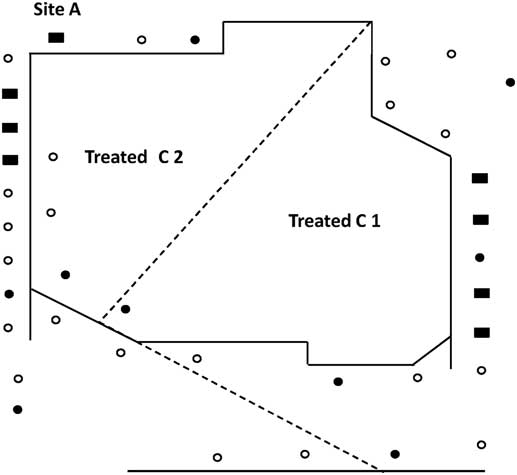
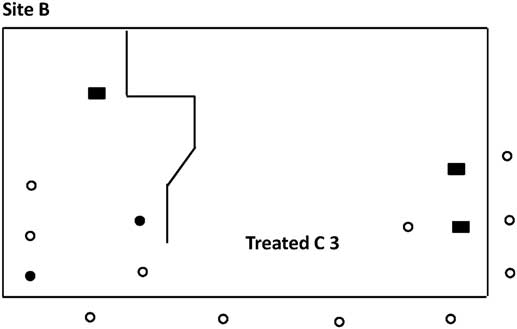
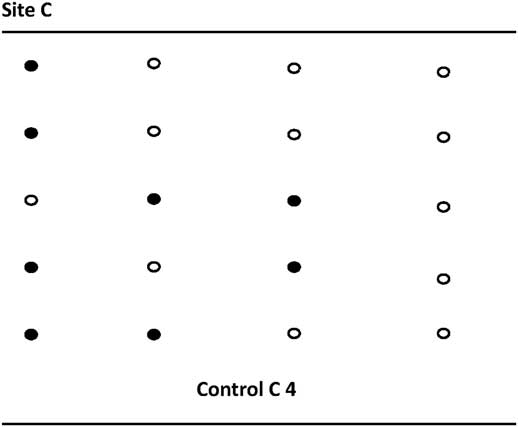
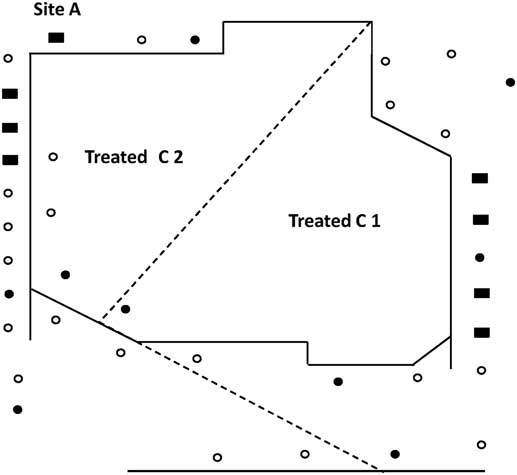
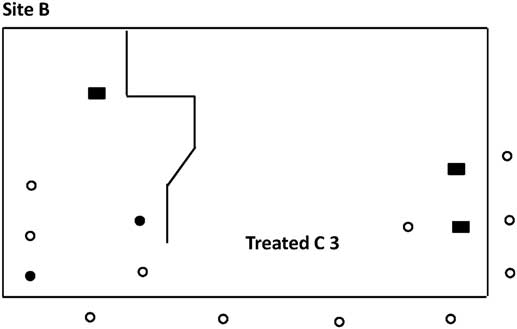
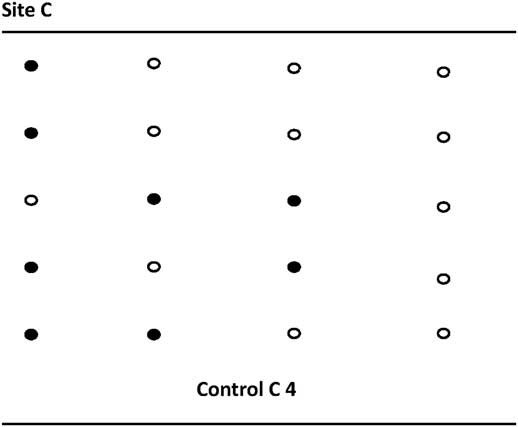
Three sites (designated A–C) with a history of M. mycophagus infestation were selected for this study. All these sites were located in the Multan, Pakistan. The site “A” was a house (Fig. 1). Soil treatment with conventional insecticide was applied five years before but termite infestation occurred several times over the years. The site “B” was also a house in a residential site, 7 km from the site A (Fig. 2). Site “C” was located near the Department of Entomology, Faculty of Agricultural Sciences and Technology, Bahauddin Zakariya University, Multan (Fig. 3).
Schematic drawing of site A showing location of monitoring stations initially installed. Each open circle (○) denotes an underground monitoring station without termite activity, and each solid circle (●) denotes a monitoring station with termite activity. Each rectangle (▬) denotes bait station.
Schematic drawing of site B showing location of monitoring stations initially installed. Each open circle (○) denotes an underground monitoring station without termite activity, and each solid circle (●) denotes a monitoring station with termite activity. Each rectangle (▬) denotes bait station.
Schematic drawing of site C showing location of monitoring stations initially installed. Each open circle (○) denotes an underground monitoring station without termite activity, and each solid circle (●) denotes a monitoring station with termite activity.
Foraging activity of Microtermes mycophagus
Survey stakes were driven into the soil around the perimeter of the building every 2–4 m at sites A and B, while they were buried in the soil in a grid at site C at an interval of 3–4 m. The stakes were examined weekly and after infestation, they were replaced with underground monitoring stations. A monitoring station consisted of a plastic container (23 cm in height by 20 cm diameter) filled with five pieces of B. malabaricum dried wood (each 16×7×3.5 cm each). Once stations were found infested on first inspection after seven days, the Nile blue treated filter papers (850 mg/L) were placed in one of the highly infested stations (>1000 workers) to map the foraging territory of each colony. The marked workers found in the interconnecting stations were considered from the same colony (Su and Scheffrahn Reference Su and Scheffrahn1998). The stations were examined biweekly for termite activity for a period of two months before the application of fipronil bait. At each site, termites were captured and counted directly from four stations on each inspection. Aggression test was also performed by following the methodology of Haverty et al. (Reference Haverty, Copren, Getty and Lewis1999) with some modification to identify the colonies at each site. Briefly, termites from each station were kept in separately in plastic boxes with moist toilet paper and wood pieces. Five workers and soldiers from one station were mixed with five workers and soldiers of other station for 10 minutes and observed for their aggressive behaviour with one another. If they showed aggressive behaviour, they were considered from separate colonies. The process was repeated for all the stations.
Baiting procedure
Based on our previous trials, baiting study was conducted during August–December 2013. The colonies were baited by following the methodologies of Huang et al. (Reference Huang, Lei and Xue2006) and Sajap et al. (Reference Sajap, Amit and Welker2000) with little modification. We used two doses of fipronil in baiting trials: 10 ppm and 30 ppm, which were prepared by dissolving 60 mg and 180 mg of fipronil formulation, respectively in 600 mL of distilled water. These two concentrations were selected on the basis of repellency test performed earlier. Toilet paper rolls were used to deliver the fipronil toxicant in the targeted colonies. The rolls were impregnated with 600 mL aqueous preparation of fipronil for each dose separately. The rolls (wet) treated with 30 ppm and 10 ppm dose were placed inside the station with lower dose at the bottom containing 240 mg of fipronil formulation in one baiting station. Three wood pieces (15×8×1.5 cm) were also placed along the sides of the station to keep the termites in the stations as suggested by Evans and Gleeson (Reference Evans and Gleeson2006). Sites A and B contained both stations that were baited, and stations that contained active termites but were not baited (monitoring stations) in order to monitor the decline (or not) of termite foraging. Termite activity was observed in both active monitoring and baited stations after one month and then biweekly after bait placement for a total of 120 days. After baiting, mean population estimates were obtained from four untreated monitoring stations in C1 and C2 while from two untreated and two treated stations in C3. At site C in the control colony (C4), four stations were inspected for termite activity and population estimation during the reported period. Once no termite or termite activity was observed in the monitoring and treated stations in the baited colonies, treated rolls were replaced with untreated colony for post treatment inspection. The per cent bait removed by the workers of M. mycophagus was estimated by visually observing the area removed. The baiting was considered successful if termite workers were found absent in the monitoring and bait stations, and wood structures in buildings (Su et al. Reference Su, Thoms, Ban and Scheffrahn1995; Thorne and Forschler Reference Thorne and Forschler2000).
Data analysis
The data of the number of workers on different doses in repellency test was subjected to non-parametric Friedman’s test using Statistix 8.1v (Analytical Software 2005). The number of workers in three treated colonies after bait placement was analysed using repeated measures analysis of variance (ANOVA) using SPSS software (Version 17.0 for windows, SPSS Inc., Chicago, Illinois, United States of America) and means were compared by Turkey’s honestly significant difference (HSD) test at 5% level of significance.
Results
Repellency test
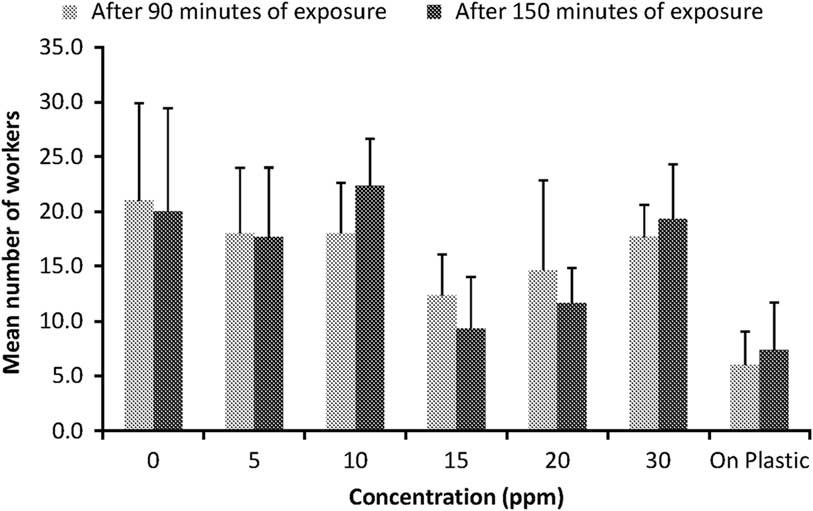
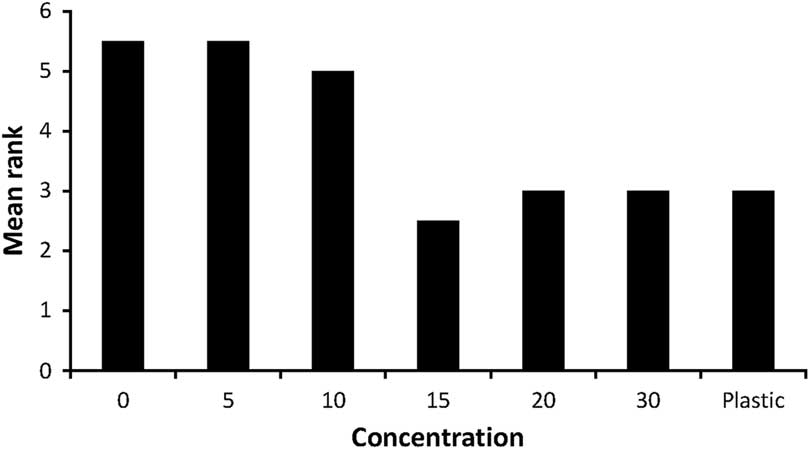
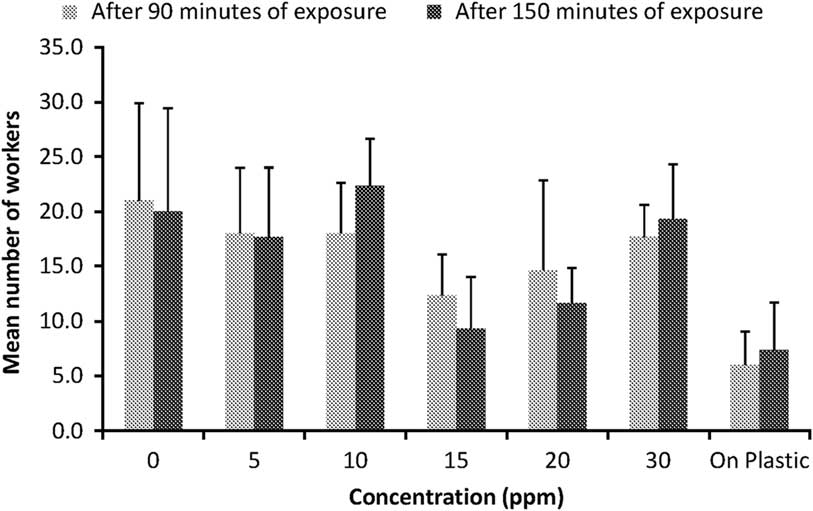
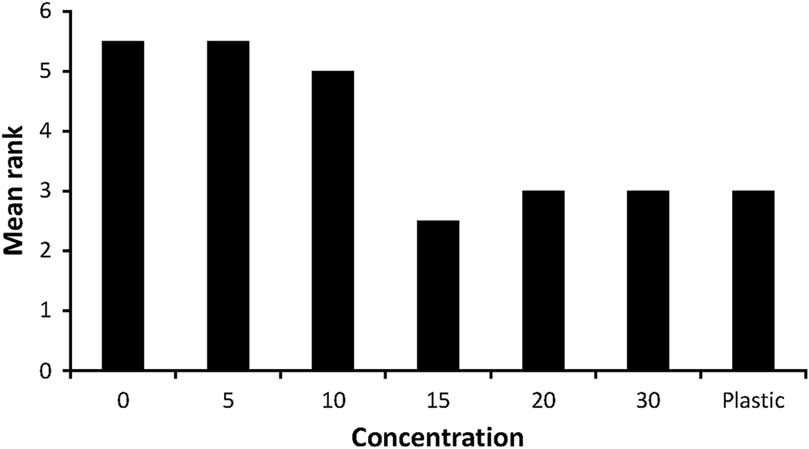
Workers did not settle down and moved fast in the boxes with fipronil-treated papers while only limited movement was observed in the control boxes after 30 minutes. They were almost stable after 90 minutes until 150 minutes after being placed in the boxes (Fig. 4). The numbers of workers settled on different doses after 90 and 150 minutes of exposure were statistically non significant (Friedman statistics=0.143; df=1; P-value, χ2 approximation =0.706) (Fig. 5). The results indicated that the tested doses were statistically at par in terms of their repellency to M. mycophagus.
Mean numbers of workers of Microtermes mycophagus on filter paper pieces treated with different concentrations of fipronil after 90 and 150 minutes of exposure in repellency test.
Friedman’s test indicating mean ranks of numbers of workers of Microtermes mycophagus on filter paper pieces treated with different concentrations of fipronil after 90 and 150 minutes of exposure in repellency test.
Foraging activity and baiting of Microtermes mycophagus
Site A
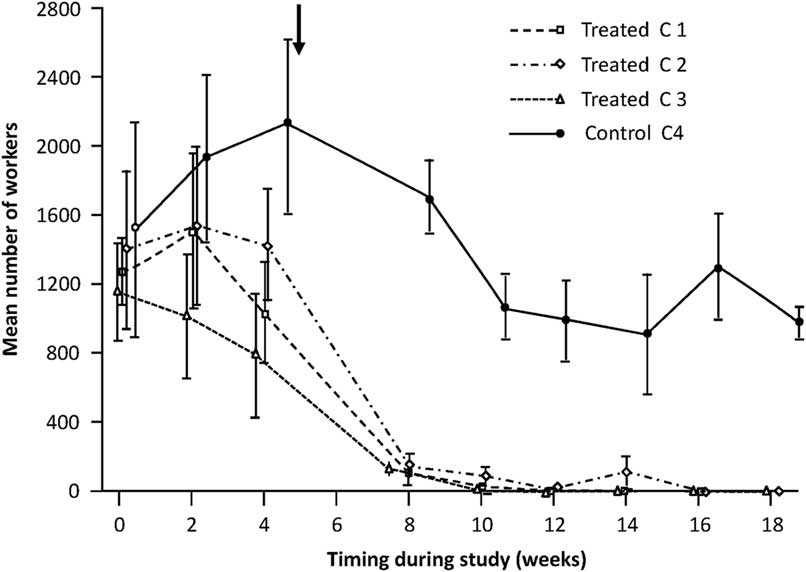
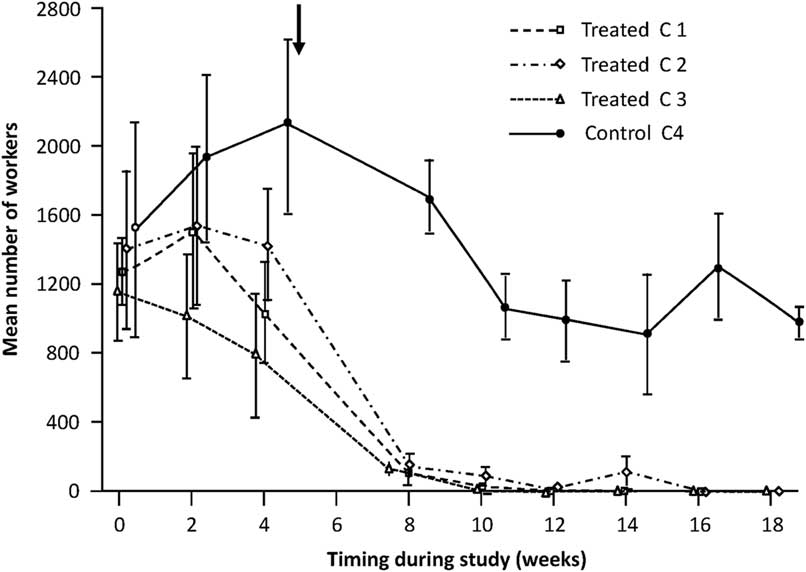
A total of 37 monitoring stations were installed at this site in July 2013 and 17 were contacted by M. mycophagus at the end of July. Nile blue treated filter papers were placed in one station in the first week of August. Two colonies were found to infest this site designated as treated colony 1 (treated C1) and treated colony 2 (treated C2) confirmed by the presence of dyed workers and aggression tests. There were a total of nine and eight stations contacted by the colony 1 and colony 2, respectively and four stations in the territory of each colony were baited while others were kept untreated as monitoring stations. The numbers of workers from four stations before baiting in the colonies ranged from 1030.6±289.09 to 1505.75±442.14 (mean±SE) per station in treated C1 and 1407.75±455.78 to 1544.75±457.05 (mean±SE) per station in treated C2 (Fig. 6). The fipronil baits were placed in the stations on 20 September 2013 in both colonies. After 30 days, no termites were found in seven of the nine stations in treated C1 while the rest of the stations showed a little termite activity. Termites ceased their activity after 56 days in all the stations after consuming an average of 5% of baits (Fig. 6). In treated C2, termite activity was observed in four of the eight stations on the first inspection and workers remained active until 30 November 2013. The termite ceased their activity within 86 days after consuming roughly 4% of the baits as no termites were observed in any of the stations on 15 December 2013 (Fig. 6).
Mean number of Microtermes mycophagus workers in colonies (C1–C4) recovered from four stations at all sites before baiting while after baiting, four untreated stations in C1 and C2, two untreated+two treated stations in C3 and four stations in control colony. Bars indicate SEM. Arrow indicates initiation of baiting to C1, C2, C3 colonies.
Site B
There were 15 stations installed at this site in July 2013 and on first inspection in the first week of August, five stations were found to contact by M. mycophagus. There was a single colony (treated C3) found to infest this building confirmed by aggression test and the presence of blue dyed termites. The mean numbers of workers per station before baiting at this site ranged from 781.8±352.9 to 1151.6±282.6 (mean±SE) (Fig. 6). Fipronil baits were placed in three stations on 19 September 2013 and two were left as unbaited monitoring stations. After 30 days, 130.8±41.25 workers were captured from four stations. By 3 November 2013, after 45 days of baiting, termite activity had ceased from all the stations after consuming 5% baits (Fig. 6).
Site C
At this site, a total of 20 monitoring stations were installed August 2013 and 12 were infested after seven days and Nile blue treated filter papers were placed in one of the monitoring stations. A separate colony occupying eight stations was identified by the presence of blue dyed termites and aggression test, and selected as a “control” colony (control C4). The mean numbers of workers on different inspection dates are shown in the Figure 6. The numbers of workers captured in four monitoring stations ranged from 1519.2±613.56 to 2123±504.31 (mean±SE) workers per station with peak catch during September 2013. There were 981.2±52.75 (mean±SE) workers captured on the last inspection in 3 January 2014 (Fig. 6).
The results of the repeated measures ANOVA indicated that after baiting the three treated colonies did not differ significantly (F=1.842; df=2, 9; P=0.214). Similarly, pair wise comparison of mean population of the treated colonies by Turkey’s HSD test showed non-significant difference in mean population after baiting (P>0.05).
In monthly post treatment inspections, no termite activity was recorded in the monitoring stations at site A and B. The mud tubes and wood damage were also not found until the last inspection in July 2014. These results indicated strong effect of fipronil baits on the foraging population of M. mycophagus at both the studied sites.
Discussion
Management of termites by using slow acting and non-repellent insecticides in cellulose baits is one of the recent strategies particularly in developed countries. A lot of research has been carried out in this field using CSIs against the most destructive lower termites in the United States of America, Australia, and Japan. However, these CSIs are less effective against the higher termites, particularly fungus growing termites (Lee et al. Reference Lee, Vongkaluang and Lenz2007). Microtermes mycophagus is the most common fungus-growing termite in southern Punjab, Pakistan. This species causes economic losses to agriculture crops, and wooden structures, mainly due to a lack of systematic management plans. Soil treatments with insecticides are being used for their management, however, environmental and public health concerns necessitate the need to explore alternative methods in Pakistan, like baiting. The current study reveals the findings of baiting trial against M. mycophagus using fipronil insecticide.
Our results indicated that fipronil baits have strong impacts on the field colonies of M. mycophagus. Two out of three baited colonies ceased their activity after 45–56 days of baiting while workers of the third colony stopped foraging after 86 days. These results suggested the suppression or possible elimination of the colonies of M. mycophagus due to baiting with fipronil. In another study, similar results were observed by Haung et al. (Reference Huang, Lei and Xue2006) who observed the elimination of two colonies of Odontotermes formosanus (Shiraki) (Isoptera: Termitidae) by using fipronil baits in China. In another study Forschler and Jenkins (Reference Forschler and Jenkins2000) reported the elimination of two out of four colonies of Reticulitermes species baited with fipronil. There was 960 mg (240 mg×4) fipronil formulated product (96 mg active ingredient) placed in the four stations in the foraging territory of each colony C1 and C2 and 720 mg (240 mg×3) formulation (72 mg active ingredient) in three stations of C3 colony but we could not measure the exact quantity of fipronil taken up by the foraging workers. But roughly, the amount of fipronil active ingredient taken up by the workers calculated on the basis of % bait eaten was 4.7 mg. This quantity of fipronil is almost equal to that used in Haung et al. (Reference Huang, Lei and Xue2006) study in which a mean of 4.2 mg fipronil was eaten before the elimination of field colonies of O. formosanus.
The cryptic nature of subterranean termites hinders the evaluation of the baiting system (Forschler Reference Forschler1996; Forschler and Jenkins Reference Forschler and Jenkins1999; Thorne and Forschler Reference Thorne and Forschler2000; Haverty et al. Reference Haverty, Tabuchi, Vargo, Cox, Nelson and Lewis2010). The post treatment inspection could be the only criteria for observing the bait efficiency. The continuous absence of termite infestation from the structures or above ground foraging tubes may be an indication of the elimination of the termite problem from the structure (Su Reference Su1994; Forschler and Ryder Reference Forschler and Ryder1996; Grace et al. Reference Grace, Tome, Shelton, Oshiro and Yates1996; Huang et al. Reference Huang, Lei and Xue2006; Ripa et al. Reference Ripa, Luppichini, Su and Rust2007; Wang et al. Reference Wang, Guo, Gong, Lu, Lei and Sun2007). According to Su and Scheffrahn (Reference Su and Scheffrahn1996) and Thorne and Forschler (Reference Thorne and Forschler2000), baiting is considered effective and successful if termite activity is reduced or eliminated at all the points being visited by the targeted termite species.
The absence of termites in the monitoring stations does not always mean the colony has been eliminated. There could be some probable reasons for the absence of termites in the installed stations. For example, seasonal variations or bait disturbance could result in shifting of the foraging territory during the monitoring processes (Thorne and Forschler Reference Thorne and Forschler2000; Evans and Gleeson Reference Evans and Gleeson2006; Gautam and Henderson Reference Gautam and Henderson2011). In the current study, we captured large numbers of workers from the control colony compared to treated colonies at different inspection dates. No capture of workers from the baited colonies following adequate bait consumption, and at the same time still high numbers of workers in bait stations of the control colony (control C4) further confirmed that fipronil baits had strongly affected the population of M. mycophagus.
Acknowledgements
The authors are thankful to Higher Education Commission (HEC), Pakistan for providing funds to perform this study.