Implications
In piglets, oral supplementation with polyamines before weaning increased the absorptive surface area of the gastrointestinal tract at weaning, and positively affected piglet growth pre- and post-weaning. Spermine and spermidine-supplemented piglets suckling first lactation sows gained significantly more weight during the first 4 days of supplementation. Spermine supplementation pre-weaning tended to increase piglet growth after weaning. These positive effects suggest that oral supplementation with polyamines, at low doses, can increase the capacity of piglets to cope with weaning, and thus reduce the negative impacts of weaning on piglet performance within commercial pig production systems.
Introduction
Piglet growth during the immediate post-weaning period is often compromised due to their failure to adapt to the abrupt change from milk to solid cereal-dominated diets (Lalles et al., Reference Lalles, Bosi, Smidt and Stokes2007). This period of reduced growth is associated with reduced voluntary feed intake, as well as structural and functional changes in the small intestine, which cause a decrease in the digestive and absorptive capacity of the weaned piglet (Lalles et al., Reference Lalles, Bosi, Smidt and Stokes2007). As a result, piglet welfare, performance and survival, as well as the efficiency of pig production, are all limited (Pluske et al., Reference Pluske, Hampson and Williams1997).
During the suckling period and weaning process the gastrointestinal tract of the neonate matures and undergoes substantial changes that facilitate the shift in diet composition experienced at weaning (Xu et al., Reference Xu, Wang and Zhang2000). The triggers for many of these changes are delivered via the maternal milk. In particular, milk-borne polyamines (putrescine, spermidine and spermine) play an important role in neonatal gut maturation, increasing in concentration in both maternal milk and the intestinal mucosa of rats during weaning (Peulen et al., Reference Peulen, Deloyer, Grandfils, Loret and Dandrifosse2000). In conventional production systems, piglets are normally weaned at 21 to 28 days of age, ~56 days earlier than would occur under natural conditions. It is, therefore, suggested that the milk consumed by piglets before commercial weaning lacks the required bioactives to facilitate the dietary transition that occurs at weaning. Spermidine concentrations in sow’s milk increase as lactation progresses peaking on day 49 of lactation (Kelly et al., Reference Kelly, King, Brown and McFadyen1991). Oral supplementation with spermine advanced intestinal maturation in piglets dosed from 2 to 15 days of age (Sabater-Molina et al., Reference Sabater-Molina, Larque, Torrella, Plaza, Lozana, Munoz and Zamora2009) and 11 to 14 days of age (Cheng et al., Reference Cheng, Li, Xing, Guo and Li2006). However, animal age appears to be a critical determinant of the intestinal response to spermine supplementation (Shimizu et al., 1993). It is, therefore, important to determine the impact of oral supplementation with spermine or spermidine before weaning on the intestinal development and performance of conventionally weaned 21 to 28-day-old piglets before and after weaning.
In light of this, two studies were conducted. Experiment One investigated the effect of oral spermine supplementation before weaning on the intestinal villus height and crypt depth of piglets weaned at 24 days of age. Experiment Two investigated whether oral supplementation with either spermine or spermidine before weaning would increase piglet growth before and after weaning at 24 days of age. In both studies, a comparison between the response of piglets suckling first and third lactation sows with the polyamine supplementation was included, based on evidence that suckled dam parity affects piglet performance pre- and post-weaning (Miller et al., Reference Miller, Collins, Emery, Begg, Smits and Holyoake2013).
Material and methods
All animal procedures were approved by the University of Adelaide’s Animal Ethics Committee and conducted in accordance with the Australian code of practice for the care and use of animals for scientific purposes, 7th edition (2004). Both experiments were conducted in South Australia, with Experiment One conducted at the University of Adelaide’s 300 sow herd research piggery, and Experiment Two conducted on a 7500 sow commercial facility. Spermine and spermidine were obtained from Sigma-Aldrich (Sigma Aldrich, Castle Hill, New South Wales, Australia). The doses of spermine and spermidine used were calculated to provide 20% more than normally received in sow’s milk. This figure was based on an estimated average intake of 950 ml/piglet per day, and sows milk containing 4.87 nmol/ml of spermine and 21.19 nmol/ml of spermidine (Sabater-Molina et al., Reference Sabater-Molina, Larque, Torrella, Plaza, Lozana, Munoz and Zamora2009).
Experiment One: effect of oral spermine supplementation pre-weaning on gastrointestinal morphology
The experimental design was a 2×2 factorial, incorporating two maternal parities (first v. third lactation sows; n=6 sows and litters/parity) and two levels of spermine supplementation (0 v. 926 nmol spermine). Within 24 h of birth, litter size was standardised to, and maintained throughout lactation at, 10 piglets. On day 14, male piglets were weighed, ranked according to liveweight (LW) and pair-matched according to LW. For each litter, the pair of piglets with the mean LW for the litter were selected, with only piglets born to that sow used. Within litter, one piglet from each pair was allocated to receive either 2 ml water (Control) or 463 nmol/ml spermine (Sp) solution. Doses of spermine and water were delivered in 2 ml of water using an oral drench gun, with piglets drenched every 2nd day from days 14 to 22 postpartum.
Individual piglet LW was recorded on days 14, 18 and 22 postnatal age. On day 23 postpartum, piglets were euthanised, dissected and the entire gastrointestinal tract removed via tubal ligation. The small intestine was divided into equal thirds, with the proximal third assumed to be the duodenum, followed by the jejunum. Segments (2 cm) were dissected from the beginning of the duodenum and the middle of jejunum, flushed with cold sterile saline solution, opened longitudinally and fixed in buffered formalin for 24 h. Fixed samples were dehydrated, cleared and embedded in paraffin wax. The embedded samples were then sectioned at 7 μm for staining. Sections were stained with haematoxylin–eosin for histological assessment of gastrointestinal morphology. Image analysis was used to measure villus height (distance from the opening of the crypt to the villus tip) and crypt depth (distance from the base to the opening of the crypt) of 10 villi in each section (VideoPro®, version 6.210; Leading Edge Pty Ltd, Australia).
Statistical analysis
Data are expressed as mean±SEM, unless otherwise stated. A general ANOVA was used to determine the effects of spermine supplementation and maternal parity on piglet weight and weight gain. Intestinal region was included in ANOVA to determine the effect of spermine supplementation and maternal parity on intestinal morphology. Between-treatment differences were examined using LSD. Significance was determined as P<0.05. Analysis was conducted using Genstat, 10th edition (Rothamsted Experimental Station, Harpenden, UK).
Experiment Two: effect of oral spermine or spermidine supplementation on piglet growth before and after weaning
Experimental design and measurements
The experimental design was a 2×3 factorial, incorporating two maternal parities (first v. third lactation sows; n=18 sows and litters/parity) and three polyamine supplements (0 v. 925 nmol of spermine solution v. 4026 nmol spermidine solution). Within 24 h of parturition (day 1), piglets were weighed and litter size was standardised to, and maintained throughout lactation at, 10 piglets. On day 14, piglets were weighed. Within litters, nine piglets were allocated to receive either 2 ml of water (Control), 463 nmol/ml spermine (Sp) or 2013 nmol/ml spermidine (Spd) solution. Piglet allocation was conducted to ensure that average LW for each treatment per litter was equal. Doses of spermine, spermidine and water were delivered using an oral drench gun, with piglets drenched every 2nd day from days 14 to 24 postpartum. Piglets were weighed individually on days 1, 14, 18 and 24 (weaning) of lactation and again on day 61 postpartum (day 37 post-weaning).
Statistical analysis
Data are expressed as mean±SEM, unless otherwise stated. A general ANOVA was used to determine the effects of spermine and spermidine supplementation and maternal parity on piglet growth. Between-treatment differences were examined using LSD. Significance was determined as P<0.05. Analysis was conducted using Genstat 10th Edition (Rothamsted Experimental Station, Harpenden, UK).
Results
Experiment One: effect of oral spermine supplementation pre-weaning on gastrointestinal morphology
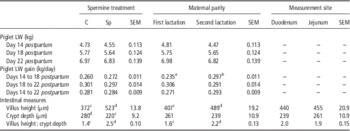
There was no effect of spermine supplementation on piglet LW or LW gain during the experimental period (Table 1). Piglets suckling third as compared with first lactation sows gained more weight between days 14 and 18 of lactation (P<0.05; Table 1). Oral spermine supplementation increased villus height, reduced crypt depth and increased the villus : crypt depth ratio compared with control piglets (P<0.05; Table 1). Villus height and villus height : crypt depth were greater for piglets suckling third compared with first lactation sows (P<0.05; Table 1).
Effect of oral spermine supplementation from days 14 to 22 postpartum and maternal parity on piglet liveweight (LW) and LW gain before weaning, as well as intestinal characteristics on day 23 postpartum (Experiment One)

C=control; Sp=Spermine.
a,bValues within a row, and main effect, with different superscript letters differ significantly at P<0.05.
c,dValues within a row, and main effect, with different superscript letters differ significantly at P<0.01.
Experiment Two: effect of oral spermine or spermidine supplementation on piglet growth before and after weaning
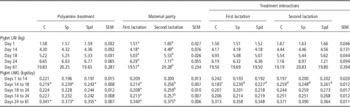
There were no main effects of spermine or spermidine treatment on piglet LW. Spermine and spermidine tended (P<0.1) to increase piglet LW gain between days 14 and 18. There was a significant interaction between treatment and parity for piglet LW gain from days 14 to 18. For piglets suckling first lactation sows, spermine and spermidine supplementation increased LW gain from days 14 to 18 (P<0.05; Table 2). Piglets that received spermine tended to gain more LW between weaning (day 24) and day 61 postpartum compared with control piglets (P=0.075; Table 2).
Effect of three oral supplementation treatments (Control (C) v. spermine (Sp) v. spermidine (Spd)) from days 14 to 24 postpartum and maternal parity (first lactation v. second lactation) on piglet liveweight (LW) and LW gain (LWG) (Experiment Two)

a,bValues within a row, and main effect, with different superscript letters differ significantly at P<0.01.
c,dValues within a row, and between individual treatments, with different superscript letters differ significantly at P<0.05.
* Values within a row, and main effect, with different superscript letters differ significantly at P<0.1.
Discussion
Taken together, the current data indicated a positive effect of polyamine supplementation on piglet growth and intestinal development. Spermine supplementation increased the surface area available for nutrient absorption at weaning. Both spermine and spermidine supplementation stimulated a positive, albeit, transient increase in the pre-weaning growth of piglets suckling first lactation sows. These data extend previous evidence that supplementary polyamines can alter intestinal development in early-weaned piglets, by demonstrating the positive effects of spermine and spermidine supplementation on conventional weaning age piglets. Importantly, these data provide preliminary evidence that spermine supplementation pre-weaning has the potential to increase piglet growth post-weaning.
Our finding that spermine supplementation altered morphology of the gastrointestinal tract is consistent with previous outcomes in 14-day-old suckling (Cheng et al., Reference Cheng, Li, Xing, Guo and Li2006; Sabater-Molina et al., Reference Sabater-Molina, Larque, Torrella, Plaza, Lozana, Munoz and Zamora2009) and 24-day-old weaned (Kang et al., Reference Kang, Wang, Hou, Yin, Ding, Zhu, Lio, Qiu, Yi, Wang and Gong2012) piglets. However, the currently observed increase in villus height and decrease in crypt depth contrasts with the reduced villus height and increased crypt depth observed in piglets receiving a spermine supplement before 2 weeks of age (Cheng et al., Reference Cheng, Li, Xing, Guo and Li2006; Sabater-Molina et al., Reference Sabater-Molina, Larque, Torrella, Plaza, Lozana, Munoz and Zamora2009). It is plausible that these differences reflect the ages of the piglets used, and animal age has been identified as a critical determinant of the intestinal response to spermine supplementation in rodent pups (Shimizu et al., 1993). In partial support of an age-dependent effect, Kang et al. (Reference Kang, Wang, Hou, Yin, Ding, Zhu, Lio, Qiu, Yi, Wang and Gong2012) reported increased villi height and decreased crypt depth in piglets receiving varying doses of spermine for 3 days following weaning at 21 days of age. The differing intestinal response to spermine supplementation in the present compared with previous studies may also be attributed to differences in the concentrations provided. Based on the mean spermine levels present in milk (Sabater-Molina et al., Reference Sabater-Molina, Larque, Torrella, Plaza, Lozana, Munoz and Zamora2009), the dose provided in the present study was designed to represent an approximate increase of 20% above the daily level consumed via the milk. The concentrations of spermine used in the previous studies were all substantially higher than those used in the present study: 10 times (Sabater-Molina et al., Reference Sabater-Molina, Larque, Torrella, Plaza, Lozana, Munoz and Zamora2009), 1891 times (Cheng et al., Reference Cheng, Li, Xing, Guo and Li2006) and between 324 and 1971 times (Kang et al., Reference Kang, Wang, Hou, Yin, Ding, Zhu, Lio, Qiu, Yi, Wang and Gong2012) the current dose. It is, therefore, suggested that timing of supplementation, rather than the dose provided, is responsible for the differences in intestinal alterations observed in the present compared with the previous studies of suckling piglets.
As supported by previous studies (Cheng et al., Reference Cheng, Li, Xing, Guo and Li2006; Kang et al., Reference Kang, Wang, Hou, Yin, Ding, Zhu, Lio, Qiu, Yi, Wang and Gong2012), spermine supplementation increased piglet LW gain in the present study. A positive effect of polyamines on intestinal glucose absorption has been proposed (Larque et al., Reference Larque, Sabater-Molina and Zamoroa2007), with enhanced maturation of the intestinal immune system also reported in spermine-supplemented neonatal mice (ter Steege et al., Reference ter Steege, Buurman and Forget1997). It is plausible that alterations in intestinal function in combination with the observed increase in the surface area available for nutrient absorption in spermine-supplemented piglets were responsible for their improved growth before weaning. The current data provided preliminary evidence that spermine supplementation pre-weaning can promote piglet growth following weaning. The impaired growth which occurs post-weaning is attributed to villus atrophy and crypt hyperplasia, and a resultant decrease in nutrient absorption. Villus atrophy and crypt hyperplasia occur as a result of increased villus cell loss and increased crypt cell production (Pluske et al., Reference Pluske, Hampson and Williams1997). It is suggested that polyamine supplementation may decrease the severity of post-weaning villus atrophy and crypt depth hyperplasia.
In summary, it is evident from the current data that spermine supplementation, at relatively low doses, can increase intestinal absorptive area at weaning and promote piglet growth following weaning. It also appears that piglets suckling first lactation sows benefit more from the provision of supplementary polyamines, suggestive of deficiencies in either maternal milk composition or deficits in intestinal development. Based on the current data, it is, therefore, suggested that supplementary spermine, even at low doses, is a potential strategy to alleviate the negative impacts of weaning on piglet performance.
Acknowledgement
This work was supported by a project grant from the Cooperative Research Centre for an Internationally Competitive Australian Pork Industry.