
Introduction
Conventionally dated to the late Eastern Zhou Dynasty (770–221 BC), the Rites of Zhou (Zhou Li, 周礼) has been a key but problematic text in the chemical study of ancient Chinese bronzes for more than a century (e.g. Chikashige Reference Chikashige1918, Reference Chikashige1936; Liang Reference Liang and Wang1925; Dono Reference Dono1932; Zhang Reference Zhang1958; Zhou Reference Zhou1978; Wu Reference Wu1986; Hua Reference Hua1990; Chen & Chase Reference Yunyun and Chase1991; Sun Reference Sun2011; Yang Reference Yang2015). The section Kaogong ji (Book of Diverse Crafts, also rendered as The Artificiers’ Record or Notes for Examining the Artisan) is generally thought to have been written between the fifth and third centuries BC and subsequently incorporated into Zhou Li (Jun Reference Wenren2012). This section provides a series of six recipes (or ‘receipts’, as sometimes translated in the non-Chinese literature) for the manufacture of specific types of bronze object. These recipes are specified in terms of sets of combinatorial ratios for two components: Jin (金) and Xi (锡). In modern Chinese, Jin (金) means gold, but in antiquity it is taken to mean copper (Cu) or copper alloy, or just ‘metal’. Xi (锡) is conventionally interpreted as tin (Sn) (see citations above). The true meaning of these characters, however, has been at the heart of a debate surrounding the six recipes for many decades.
The Rites of Zhou, in which the Kaogong ji and the six recipes are found, records the system of official bureaucratic positions in the Western Zhou administration, listing approximately 360 different offices. The book is said by the famous historian Liu Xin (c. 50 BC–AD 23) to have been incorporated into the Han Dynasty library in the middle of the second century BC. The earliest document that mentions the Rites of Zhou is the Shiji (Records of the Grand Historian), completed by Sima Qian c. 94 BC, in the Western Han Dynasty. Von Falkenhausen (Reference von Falkenhausen2014) suggests that Kaogong ji was inserted into the Zhou Li in the first century BC to replace a lost sixth section and is itself incomplete—of its original 31 chapters, six are lost. Chapter 5 of Kaogong ji (Gong jin zhi gong, Metal workers) enumerates the people responsible for foundry work (e.g. forging founders: zhushi, responsible for “low proportion alloy foundry”, and yeshi, who oversee “high proportion alloy foundry”; Jun Reference Wenren2012: 31), followed by the six recipes.
Not only is the date of the Kaogong ji unclear, being variously placed in the late Warring States (c. 450–221 BC), the Qin (221–206 BC) or even the Western Han (206–c. 50 BC) periods, but the veracity and purpose of the contents have also been called into question. Von Falkenhausen (Reference von Falkenhausen2014: 103) observes:
the Kaogong ji is not, as a text, a technical manual; instead, it was apparently written for use by administrative supervisors of court artisans, deliberately reducing technical information to simple formulae for their benefit. In other words, the text represents handy second-hand knowledge that did not come from the artisans themselves. This probably explains why the technical information contained in the text is often vague, and matches but very incompletely the data one can extract from the material record of Ancient China …
Nevertheless, the recipes have attracted considerable scholarly attention, though they are yet to be fully understood. In particular, there is a need to clarify the precise meaning of the terms ‘Jin’ and ‘Xi’, as linguistically, a better definition of these terms would contribute significantly to the study of Chinese historical texts. It would also offer an important insight into the practice of Chinese metal casting, and perhaps even to the perception of metals in ancient China. There is a significant difference between the use of pre-alloyed raw materials and pure metal ingots to produce leaded bronzes at the point of casting, with important implications for the study of metal extraction processes and the metal supply chain in Bronze Age China. In terms of the chaîne opératoire, it could indicate a previously unrecognised additional step between the extraction of pure metals and the supply of pre-formed alloys to the casting site, or suggest that production of primary metal was from mixed metal ores, thus producing natural alloys. Hence, a better understanding of the terms Jin and Xi is an important contribution to the study of the economy of Shang and Zhou China. Whether the stated combinations are actually reflected in the chemical data is a secondary consideration, since it has already been observed by von Falkenhausen (Reference von Falkenhausen2014) and others (e.g. Zhang Reference Zhang1958; Hua Reference Hua1990) that, for various reasons, they may not be.
Based on the translation by Chikashige (Reference Chikashige1936: 57–58), the original form of the text follows the formulae: The jin is divided into six, tin occupies one. This is the receipt for bells and tripod-vessels (钟鼑之齐: 六分其“金”而锡居其一). The jin is divided into five, tin occupies one. This is the receipt for axes and hatchets (斧斤之齐: 五分其“金”而锡居其一)… and so on (see Table 1). There are two ways to read these recipes. The first assumes that Jin is a generic term and refers to the total amount of metal present. In this case, the first formula translates as the final alloy being divided into six parts, five of which are pure copper and one is tin (copper:tin = 5:1, or copper = 5/6 (83.3 per cent) and tin = 1/6 (16.7 per cent)). The alternative reading is that Jin stands for copper alone, in which case the first recipe comprises six parts copper (6/7 = 85.7 per cent) and one part tin (1/7 = 14.3 per cent). Table 1 shows the recipes and the equivalent compositions based on a binary mixture of copper and tin, according to these two alternative readings (labelled I and II).
The six recipes, with traditional interpretations (Cu = copper; Sn = tin).

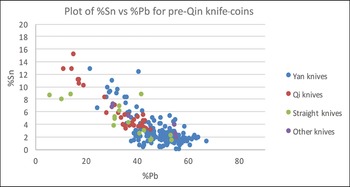
Under either interpretation, the predicted tin concentrations are uniformly higher than expected when compared with the analytical data from approximately contemporaneous bronze objects. The now extensive database of the chemical composition of Eastern Zhou bronzes shows them to be a diverse set of leaded bronzes, rather than alloys of only copper and tin (see Figure 1). The level of lead (Pb) in most objects is too high (approximately 10 wt% or more) to have entered the alloy as a contaminant in the copper. Obviously, it is impossible to create a ternary alloy by any combination of two pure ingredients. We must therefore assume either that Xi (锡) is not pure tin or that Jin (金) is not pure copper, or both.
Plot of %Sn (tin) vs %Pb (lead) for pre-Qin knife-coins (re-plotted by the authors based on data from Zhou (Reference Zhou2004)).

Earlier scholars had already come to this conclusion, but with differing opinions about the nature of the two components. Liang (Reference Liang and Wang1925) argued that Jin is copper with iron and various other impurities, and that Xi is tin and lead. We demonstrate below that although this is a logical and plausible suggestion, given the ambiguity between the nature of tin and lead in early Chinese culture (Chang Reference Chang1927; Liu & Pollard Reference Liu and Pollard2022) and the nature of the objects as ternary copper-tin-lead alloys, the assumption that Xi is an alloy of tin and lead is unlikely. Zhang (Reference Zhang1958) repeats this interpretation but focuses on the assumption that Jin is the final resulting alloy, with Xi being tin and lead. Chikashige (Reference Chikashige1936: 57) expresses a different opinion, arguing that Jin is either bronze or copper but stating that there is “no doubt about the tin” (i.e. that Xi is tin alone).
Zhou (Reference Zhou1978) reviews the two different combinatorial interpretations (Jin = pure copper, or Jin = final alloy) in the context of the chemical data for approximately 50 objects dated from the Shang to the Eastern Zhou. He argues that Jin should be pure copper but considers that the interpretation of the mirror recipe (which is the most incompatible with the actual analytical data) should be that the amount of added tin equates to half that of the pure copper (suggesting that there was a comma missing in the last recipe). Because of the relatively large dataset used, Zhou acknowledges the broad range and complexity of the archaeological data and argues that the six recipes might have been specific to the Qi state during the Warring States period. Wu (Reference Wu1986) also recognises the lack of correspondence between the six recipes and the results of chemical analyses of objects, arguing that the archaeological data are more complex than the recipes given in the Rites of Zhou.
Yang (Reference Yang2015) presents a different interpretation, arguing that the ratios given in the six recipes are by volume, not by weight. This argument is based on a Qing scholar's (Dai Zhen, AD 1724–1777) interpretation that before casting different metals, liquids need to be measured by volume. We have investigated this argument elsewhere (Liu & Pollard Reference Liu and Pollard2022). By using the densities of liquid copper and tin at their melting points, we have shown that combination by volume rather than weight makes some difference to the predicted compositions. If Jin is copper and Xi is tin, then, under Interpretation I in Table 1, for example, the predicted tin levels for the six recipes are reduced to 13, 15, 18, 23, 26 and 47 per cent, respectively. Although these levels of tin are somewhat more realistic than those in Table 1, this still does not address the main issue: how do you create a ternary alloy from two ingredients?
Determining alloying practices from chemical composition
The first attempt to understand alloying practices (i.e. the formulation of the copper alloy) from chemical composition was made by Caley (Reference Caley1939) using Greek bronze coinage. He based his argument on a set of analyses of 86 closely dated Greek coins (from the second half of the fourth century BC to the third century AD). He observed systematic variations in the proportions of copper, tin and lead over time and between issues—for example, the early coins (mid fourth to mid third century BC) had uniformly high copper (80–90 per cent), with varying proportions of lead and tin, while the level of copper was lower but more variable from the second half of the third to the second half of the second century BC. The highest proportion of tin occurred in the earliest period and the percentages of lead varied more erratically than either copper or tin (from <2 per cent to a maximum value of 36.76 per cent). Up to 2 per cent lead was considered as unintentional, but deliberate addition was dominant from the second century BC onwards. The overall trend identified by Caley was a gradual decline in average tin and a rapid rise in lead from the second century BC onwards.
The main purpose of Caley's analysis was to understand how this variation in lead and tin came about. In order to achieve this, Caley (Reference Caley1939: 111–35) discussed the composition of these coins in terms of three ratios:
 $$R = \displaystyle{{( {{\rm \% }Sn + {\rm \% }Pb} ) } \over {{\rm \% }Cu}}$$
 $$r1 = \displaystyle{{{\rm \% }Sn} \over {{\rm \% }Cu}}$$
 $$r2 = \displaystyle{{{\rm \% }Pb} \over {{\rm \% }Cu}}$$
Caley divided the observed variation into two types of change:
• Type I: change in tin percentage compensated by an equal change in lead (R remains constant but r1 and r2 change).
• Type II: change in tin percentage accompanied by much greater change in lead, resulting in an increase in R.
Type I change implies substitution of tin by lead in a controlled way and only occurs in early series of coins of the same type, issued within a short period. In general, however, the ratio of %Sn to %Pb is greater than 50 per cent (i.e. tin is the dominant alloying element). Caley postulated a series of recipes for replacing tin with lead, either by adding an amount of lead or replacing the tin with a tin/lead alloy, citing Pliny to support the second suggestion.
Type II coins are different and are conventionally seen as replacing copper with lead (e.g. Hammer Reference Hammer1908). Caley defined two patterns of alloying that could be employed in Type II change—‘addition’ (the addition of lead to an existing ternary bronze) and ‘replacement’ (the substitution of copper with lead)—and used the values of the three defined ratios to distinguish between them. In ‘addition’, r1 would remain constant (since both %Cu and %Sn are equally diluted), but r2 and R would increase. In ‘replacement’, both r1 and r2 would increase, as would R. Caley (Reference Caley1939: 133) concluded by stating:
it seems evident therefore that the second type of variation in the proportions of tin to lead in Greek coinage bronze must be ascribed to the addition of lead to earlier bronze and not to the use of new formulas in which part of the copper specified in earlier bronze formulas was replaced with an equal amount of lead.
This is an important and ingenious way of distinguishing between the different possible practices of the coin-casters at the point of manufacture—in the Greek case, it appears that the later alloys were made by diluting existing ternary bronze with additional lead, rather than making the alloys afresh from three components (copper, tin and lead), and gradually increasing the amount of lead at the expense of the copper.
Alloying of pre-Qin Chinese coinage
Caley's work demonstrates that a careful study of the ratios of copper, tin and lead can reveal important insights into bronze alloying practice. In a recent study of the chemical composition of pre-Qin (before 221 BC) Chinese copper coinage (Pollard & Liu Reference Pollard and Liu2021), rather than trying to produce representative averages for a particular coin type, we used a similar methodology to that of Caley (Reference Caley1939), considering ratios r1 and r2 and focusing on trend lines within the analytical data. Plotting the available data shows that the three main alloying elements (Cu, Sn and Pb) vary widely, even within a specific type of coinage, so that the recipe for the casting alloy is inadequately characterised by a set of averages of copper, lead and tin.
As an example, Figure 1 shows a plot of %Sn vs %Pb for the knife-coins (刀币) of the Warring States period (475–221 BC), divided typologically by Zhou (Reference Zhou2004) into four types: Yan knives (n = 178); Qi knives (n = 35); straight knives (n = 16); and other knives (n = 6). The Qi and Yan knives are linked to their use in the Qi and Yan States, perhaps indicating a more similar production procedure. The figure shows a strong negative correlation between tin and lead. An average composition for the Qi knives, for example, would be an inadequate description of their composition as a group, and suggests that it is best described by a trend line, reflecting the linear relationship between lead and tin. Moreover, it is apparent that the Qi knife-coins are very similar in composition (strictly, ranges of composition) to other contemporaneous coinage, despite slightly different trend lines for Yan knives, Qi knives and straight knives. This is potentially relevant in the context of the Kaogong ji, since some authors (e.g. Zhou Reference Zhou1978) have suggested that the six recipes only applied to the Qi state during the Warring States period. Although Figure 1 applies to coins and not to the categories of object defined in the Kaogong ji, it does suggest that the practice of metal casting in the Qi state was similar to that of other states during the Warring States period.
Across the entire dataset of pre-Qin coins produced by Zhou (Reference Zhou2004), the correlations calculated by Pollard and Liu (Reference Pollard and Liu2021) between the major elements are:
 $$\eqalign{& {\rm Cu}{\hbox-}{\rm Pb}\colon \;r = -0.965 \cr & {\rm Cu}{\hbox-}{\rm Sn}\colon \;r = 0.443 \cr & {\rm Sn}{\hbox-}{\rm Pb}\colon \;r = -0.597} $$
These correlations can be interpreted as follows: the strong negative correlation between copper and lead shows that as lead increases copper decreases, indicating that copper is replaced by lead in a dilution process. The weaker positive relationship between copper and tin shows that the coins with the highest copper also tend to have the highest tin. This weak positive association between tin and copper indicates that the alloying is not a simple dilution of copper with lead and tin (in which case tin would correlate negatively with copper, and tin and lead would correlate positively) but is more likely to be one of bronze (copper plus tin) diluted with lead, which would give the correlation trends observed in the data.
If we are correct in assuming that the process is a dilution of bronze with a lead alloy, then those coins with the highest values of tin and the lowest values of lead should be closest to the composition of the bronze component before the lead is added. Inspection of the entire dataset suggests that the highest tin values in the pre-Qin coinage are approximately 18 per cent, and the corresponding lead value is approximately 15 per cent. This composition is reasonably close to that of the Eastern Zhou ritual vessels that have the highest tin values—10 per cent lead, 18 per cent tin and 72 per cent copper (data from So Reference So1995). For the purposes of modelling the effect of mixing various combinations, we have therefore assumed that they might approximate the composition of the undiluted, raw ‘stock bronze’. This does not necessarily imply that coins were made from ‘recycled’ ritual vessels (although this could be true)—simply that the stock bronze alloy for coins was similar to that used for making ritual bronzes.
We have previously suggested that the simplest explanation for the alloy compositions of many of the pre-Qin coins is that they fit a mixing line between two starting components (Pollard & Liu Reference Pollard and Liu2021): one containing copper, lead and tin (i.e. a leaded bronze of approximately 80 per cent Cu, 15 per cent Sn and 5 per cent Pb), and one containing only copper and lead. For the latter, we used a 50/50 copper-lead alloy, which approximates the composition of ‘crude lumps’ of metal recovered archaeologically from hoards (Dai & Zhou Reference Dai, Weirong, Oddy and Cowell1988) and initially interpreted as primitive coinage. This suggestion that the composition of most of the pre-Qin coinage could be explained by a binary mixing model of two components was surprising, since the previous (and natural) assumption was that these ternary alloys were made from three independent starting components. The correlation structure within the major element data, however, indicates that this is unlikely.
Implications for the six recipes
The results summarised above focus on coinage, which are not the subject of the six recipes, and which are likely to have been produced in specialised mints, probably under centralised administrative control. Casting practices may therefore have been quite different in foundries producing bronze vessels and weapons. Nonetheless, the significance of casting leaded bronze (i.e. ternary metal) objects from a binary composition of pre-alloyed components is of great relevance to a reconsideration of the six recipes. If correct, it immediately solves the main question: how were ternary alloys produced from two components, Jin and Xi? Can we therefore make the leap and assume that Jin was a tin-bronze (or leaded tin-bronze), and that Xi was a predominantly lead alloy?
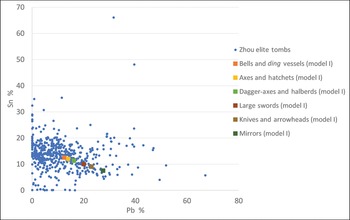
Table 2 shows a re-interpretation of the compositions in the six recipes, assuming that Jin is a bronze alloy with a composition of 80 per cent copper, 15 per cent tin and 5 per cent lead, and Xi is a binary 50/50 copper-lead alloy. As in Table 1, Model I assumes that Jin is the final resulting alloy, and Model II that Jin is a separate component. Figure 2 shows a plot of these data against an accumulated database of the chemical analyses of Eastern Zhou objects (data sources listed in the online supplementary material (OSM)).
Plot of %Pb (lead) vs %Sn (tin) for analysed metal objects from elite Eastern Zhou tombs, and predicted compositions for the six recipes from Table 2 (Model I) (summarised and plotted by the authors; for the background data, see the online supplementary material).

The six recipes reinterpreted assuming Jin = 80 per cent Cu (copper): 15 per cent Sn (tin): 5 per cent Pb (lead) and Xi = 50/50 Cu/Pb.

This shows that interpreting the two components in the six recipes as pre-prepared alloys is at least plausible—in all six cases, the modelled data fit within the distribution of the analytical data. If Jin and Xi were pure copper and tin, respectively, then the modelled points would lie on the tin axis, with no lead present. Granted, some objects have no lead and could have been produced from such a recipe, but the vast majority contain large quantities of lead. Figure 2 also demonstrates that the model proposed by Liang (Reference Liang and Wang1925) and subsequent researchers—that Jin is copper and that Xi is a tin-lead alloy—is unlikely for most cases, since this would give an overall positive correlation between lead and tin starting at the origin, as shown from the modelled data in Figure 3. The key feature here for any combination of copper with a binary tin-lead alloy is the positive correlation of the mixing lines, radiating from the origin (which, in this case, corresponds to 100 per cent Cu). Also shown in Figure 3 are two other models: one starting with a binary copper-tin alloy (80/20) diluted with pure lead, and also a binary copper-lead alloy (60/40) diluted with pure tin. The first of these shows a correlation that could be accommodated by the distribution in Figure 2, suggesting that this combination, or some variant of it, could also be involved in Eastern Zhou alloy production. Clearly, this does not define conclusively the nature of Jin and Xi—the hypothesis that Jin and Xi could represent a leaded bronze diluted by a binary copper-lead alloy, as identified in the study of pre-Qin coinage, is certainly plausible, in that it reflects the structure of the analytical data. This is not to say that it is the optimal model or even the only plausible one. It does, however, mitigate against the previous view that Jin and Xi are copper and tin, respectively, or even that Xi is a tin-lead alloy.
Model data for pure Cu (copper) diluted with increasing amounts of: 75 per cent Pb(lead)/25 per cent Sn (tin); 50 per cent Pb/50 per cent Sn; 75 per cent Sn/25 per cent Pb; binary Cu-Sn (80/20) diluted with pure Pb; and binary Cu-Pb (60/40) diluted with pure tin (summarised and plotted by the authors).

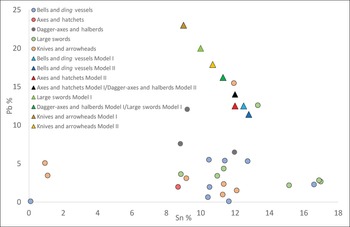
Another significant observation from Figure 3 is that most of the analysed objects from the Eastern Zhou do not conform well to any of these formulaic recipes, which calls into question the interpretation or applicability of the six recipes. If the data are broken down into object type and plotted against the appropriate formula, we see little correspondence. Figure 4, for example, shows a plot of the analysed Eastern Zhou objects from Shandong Province (approximating to the ancient Qi state, where the six recipes were assumed to have been recorded), with the two interpretations of the composition of objects from Table 2. It is evident that the lead content of either model appears unanimously higher than the chemical analyses of the excavated objects, regardless of object types. Meanwhile, a few objects show much lower levels of lead or tin, which cannot fit to any interpretation of the six recipes. This lack of correspondence should come as no surprise, as it has been observed since at least the 1970s (Zhou Reference Zhou1978; Wu Reference Wu1986) and has been eloquently summarised by von Falkenhausen (Reference von Falkenhausen2014), who, as noted above, suggests that the clarity of the ratios outlined in the six recipes are an administrative fiction, at best.
Plot of Eastern Zhou objects from Shandong Province (circles), together with calculated compositions from Table 2 (triangles) (summarised and plotted by the authors; for the background data, see the online supplementary material).

The identity of Jin and Xi
Even if the detail of the six recipes is not reflected in the analytical data, it remains important to understand what Jin and Xi were. The existence of these six formulae clearly indicates an administrative desire for a systematic and regulated approach to metal production during the Zhou Dynasty, although the scatter of the analytical data shows that this was not universally achieved. This could be related to the organisation of Eastern Zhou metal production, and no doubt discussion of this will continue. The idea that pre-prepared complex alloys were used as the raw materials for casting bronzes in pre-Qin China at a time when, from the archaeological evidence, relatively pure copper, tin and lead ingots were also available, requires a re-evaluation of the technological choices made by early Chinese bronze-casters. We have suggested, extrapolating from our study of pre-Qin coinage, that a bronze approximating to 80 per cent copper:15 per cent tin:5 per cent lead and a diluting component corresponding to an approximate 50/50 copper-lead alloy might have been suitable starting materials, and may therefore have corresponded to Jin and Xi, respectively. We are not suggesting that these are the precise compositions of Jin and Xi, merely that they are examples of what Jin and Xi might have been. If this is the case, then it would imply an additional step in the chaîne opératoire of metal casting—the production of prefabricated alloys for casting, to be supplied to the metal-casters. The obvious question is where did this prefabrication take place—the smelting site, the casting site, or elsewhere—and who performed this step, and why?
Conclusions
The recipes provided in the Rites of Zhou for the casting of objects from different types of bronze have been the subject of sustained scholarly analysis. Based on the argument presented here, we conclude that there is reasonable evidence to suggest that Jin and Xi could have been pre-prepared alloys supplied to ancient Chinese bronze-casters. This explains how ternary alloys can be made from a binary pair of raw materials, as indicated in the six recipes. We have suggested that a bronze comprising approximately 80 per cent copper:15 per cent tin:5 per cent lead and a diluting component of a 50/50 copper-lead alloy gives a reasonable reflection of the compositions seen in Eastern Zhou bronzes, but this is by no means the only possible combination. Simple modelling of various admixtures and comparison with the data distribution can, however, suggest that some combinations are unlikely, such as copper with a binary lead/tin diluent. Perhaps the best way of reading the recipes is as simplified formulae for producing bronze, very much as suggested in the Kaogong Ji, starting with Jin (金) or ‘metallic substance’ (meaning a copper-rich alloy) and Xi (锡), a ‘modifying material’, which might confer the desired properties onto the casting alloy. The nature of both Jin and Xi could, perhaps, change, depending on what was available or desired.
As noted by previous authors, there is very little correspondence between the scholarly interpretations of these recipes and the chemical data for compositions of Eastern Zhou objects, supporting von Falkenhausen's (Reference von Falkenhausen2014) assertion that, to some degree, the six recipes represent an administrative fiction. This in itself is interesting, but what matters is that we can be reasonably certain that Jin and Xi are unlikely to be pure metals, therefore implying an additional step in the chaîne opératoire and the wider organisation of ancient Chinese bronze production. More broadly, this reading of the six recipes enables us to better capture the invisible manufacturing steps embedded in the metallurgical and circulation process, and comprehend the enormous diversity of the alloying composition of artefacts dated to the Chinese Bronze Age. The combination of rich archaeological and chemical datasets with probable statistical analysis may enable further comprehension of the meaning of the key terminologies in early literature, leading to deeper understanding of their nature and social context.
Acknowledgements
This work carries a huge debt to the many scholars in China, and elsewhere, who have considered the archaeological and geochemical issues associated with metal production and use in the Chinese Bronze Age. We also thank the reviewers who made helpful comments on the text.
Funding statement
We acknowledge the support of the European Research Council Horizon 2020 (ERC advanced project FLAME, Flow of Ancient Metal Across Eurasia, 670010).
Supplementary materials
To view supplementary material for this article, please visit https://doi.org/10.15184/aqy.2022.81.