Introduction
With the development and popularisation of enhanced recovery after surgery, the possibility of rapid recovery of spontaneous breathing and early tracheal catheter removal after an operation for CHD in infants and toddlers (0 ∼ 3 years old) has attracted more attention. Ultra-fast-track cardiac anaesthesia is based on fast- track cardiac anaesthesia (extubation within 6 hours after operation), which further optimises surgical and anaesthesia procedures so as to allow for removal of the tracheal catheter immediately or within 1 hour after an operation. Ultra-fast-track cardiac anaesthesia not only improves the post-surgical recovery of patients but also reduces the hospitalisation time and costs for treating adult patients undergoing off-bypass cardiac surgery. Reference Hemmerling, Prieto and Choiniere1 The core concept of ultra-fast-track cardiac anaesthesiais to reduce the dosage of opioid narcotic drugs and select appropriate sedative and analgesic drugs that will allow for a rapid postoperative extubation and reduce the harmful stress response during the perioperative period. Dexmedetomidine is a highly selective alpha-2 (α2) agonist. Reference Mahmoud and Mason2 Several studies have found that dexmedetomidine is used as an anaesthetic adjuvant due its desirable properties (e.g., providing sedation without respiratory depression and its opioid-sparing effects Reference Kundra, Taneja and Choudhary3 ). The perioperative use of dexmedetomidine has also been confirmed to reduce the need for intraoperative and postoperative opioids. Reference Tobias, Gupta and Naguib4 Thus, dexmedetomidine is also reported to be used during the perioperative period of CHD surgery in young children. Reference Neema5 When used with a careful dosing strategy, dexmedetomidine results in low incidence and severity of adverse events in infants undergoing cardiac surgery involving cardiopulmonary bypass. Reference Zuppa, Nicolson and Wilder6 However, few studies have reported the effects of ultra-fast-track cardiac anaesthesia in infants and toddlers undergoing cardiac surgery with the use of dexmedetomidine.
We hypothesised that ultra-fast-track cardiac anaesthesia can be conducted in infants and toddlers with intraoperative administration of dexmedetomidine. Our primary goal was to observe whether the requirement for sufentanil in infants and toddlers undergoing cardiac surgery would be reduced under ultra-fast-track cardiac anaesthesia with the use of dexmedetomidine. Secondarily, we wanted to test whether the extubation time of very young children will be decreased by ultra-fast-track cardiac anaesthesia. Finally, we sought to assess whether ultra-fast-track cardiac anaesthesia might improve the postoperative recovery of infants and toddlers undergoing cardiac surgery.
Materials and methods
The current study enrolled patients who visited the Guangzhou Women and Children’s Hospital between July 2019 and January 2020. The ethical approval for this study (Ethical Committee Number 42501) was provided by the Medical Ethics Committee of Guangzhou Women and Children’s Medical Center, Guangzhou, China (Chairperson Professor Qingfeng-Li) on 27 March 2019, and signed informed consent was obtained from the guardian of each child who participated in this study. This trial was registered at chictr.org.cn (ChiCTR1900023887).
All of the children received open-heart atrial septal defect repair and/or ventricular septal defect repair under conditions of cardiopulmonary bypass. The preoperative cardiac function classifications were NYHA grades I and II, ASA grades I and II, and risk adjustment for congenital heart surgery grades 1 ∼ 2. The enrolled patients were randomly assigned to a dexmedetomidine ultra-fast-track cardiac anaesthesia group (Group D) or a conventional anaesthesia group (Group C) (allocation ratio, 1:1). The study exclusion criteria were severe pulmonary hypertension; children undergoing emergency surgery or secondary heart surgery; severe pneumonia prior to surgery; severe liver or kidney dysfunction; a severe central nervous system disease; and atrioventricular block.
Sample size
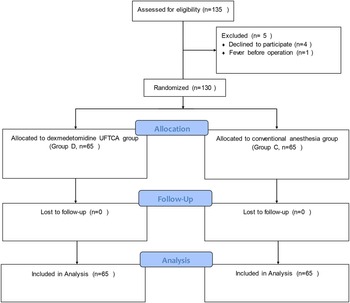
The study sample size was calculated using the G power software package. Based on a previous study conducted by Turgut, Reference Turgut, Turkmen and Gökkaya7 which used an α-level of p < 0.05 and a 10% chance of error when using a reduced anaesthetic requirement parameter, we determined that a sample size of 64 patients in each of two groups was required to achieve 80% power. At that point, 135 patients had been assessed for eligibility, and 5 were excluded before randomisation because of patient withdrawal or having a fever before operation. In total, 130 patients were randomised (allocation ratio, 1:1); 65 patients to Group D and 65 patients to Group C (Fig 1).
CONSORT flow diagram. A total of 130 children were randomised to two groups.

Perioperative management
All of the children received intravenous (I.V.) fluids upon arrival in the operation room. Next, they were given routine monitoring that included mask oxygen, electrocardiogram, percutaneous oxygen saturation (SPO2), temperature in the operation room. Preoperative IV penehyclidine hydrochloride was given at a dose of 0.01 mg/kg. Anaesthesia was induced by administration of propofol (2 ∼ 3 mg/kg), cis-atracurium (0.2 ∼ 0.3 mg/kg), and sufentanil (0.5 ∼ 1 µg/kg). After tracheal intubation, the invasive arterial pressure, central venous pressure, end-expiratory carbon dioxide, and urine volume monitoring were conducted for all of them.
Anaesthesia maintenance for Group D
After tracheal intubation, patients in Group D received continuous IV infusion of dexmedetomidine diluted with 0.9% saline (NS) (1 µg/kg/hour), combined with inhalation of sevoflurane (2 ∼ 3%). Cis-atracurium (0.2 ∼ 0.3 µg/kg) was added when the operation started. Sufentanil was added at the beginning of the operation and the depth of anaesthesia was monitored according to the Bispectral index. Sevoflurane (2 –3%) continued to be administered after the start of cardiopulmonary bypass. The rate of dexmedetomidine administration was adjusted to 0.3 µg/kg/hour after cross clamp released. When the superior and inferior caval vein were opened, mechanical ventilation was resumed, and sevoflurane (1 ∼ 2%) was inhaled to maintain anaesthesia until the end of the operation. The bispectral index index was maintained between 40 and 60 throughout the operation. After closure of the sternum, the patient was induced to breathe autonomously. When the operation was completed, the tracheal tube was removed when the tidal volume was >5 ml/kg, the respiratory rate was <40 times/minute, and SpO2 was ≥95% (FiO2 ≤ 0.6) under conditions of autonomous respiration. All of them received require hi-flow nasal cannula oxygenation in the cardiac intensive care unit. The patient-controlled intravenous analgesia used in Group D was dexmedetomidine 0.3 µg/kg/hour + sufentanil 0.03 µg/kg/hour, with the bolus of dexmedetomidine 0.03 µg/kg & sufentanil 0.003 µg/kg and a maximum dosage per hour of dexmedetomidine 0.15 µg/kg & sufentanil 0.015 µg/kg. The Patient-controlled intravenous analgesia could be administered up to 48 hours after surgery.
Anaesthesia maintenance for Group C
After tracheal intubation, the patients in Group C received continuous I.V. infusion of NS (the same volume as used for dexmedetomidine in Group D), and inhalation of sevoflurane (2 ∼ 3%) was performed; cis-atracurium (0.2 ∼ 0.3 µg/kg) was added when the operation started. Sufentanil was added at the beginning of the operation and CPB based on the BIS index. After beginning cardiopulmonary bypass, sevoflurane (2 ∼ 3%) was still administered. When the superior and inferior caval vein were opened, mechanical ventilation was resumed; after which, sevoflurane (1 ∼ 2%) was inhaled to maintain anaesthesia until the end of the operation. The BIS index between 40 and 60 was maintained throughout the operation. The patient-controlled intravenous analgesia in Group C was sufentanil (0.03 µg/kg/hour), with the bolus of sufentanil 0.003 µg/kg and a maximum dosage per hour of sufentanil 0.015 µg/kg, and it could be administered up to 48 hours after surgery.
Several intra-operative blood gas analyses were performed in both groups. Dopamine 5 ∼ 10 µg/kg/minute and milrinone 0.5 ∼ 1 µg/kg/minute were continuously infused after cross clamp releasing to maintain a stable circulation.
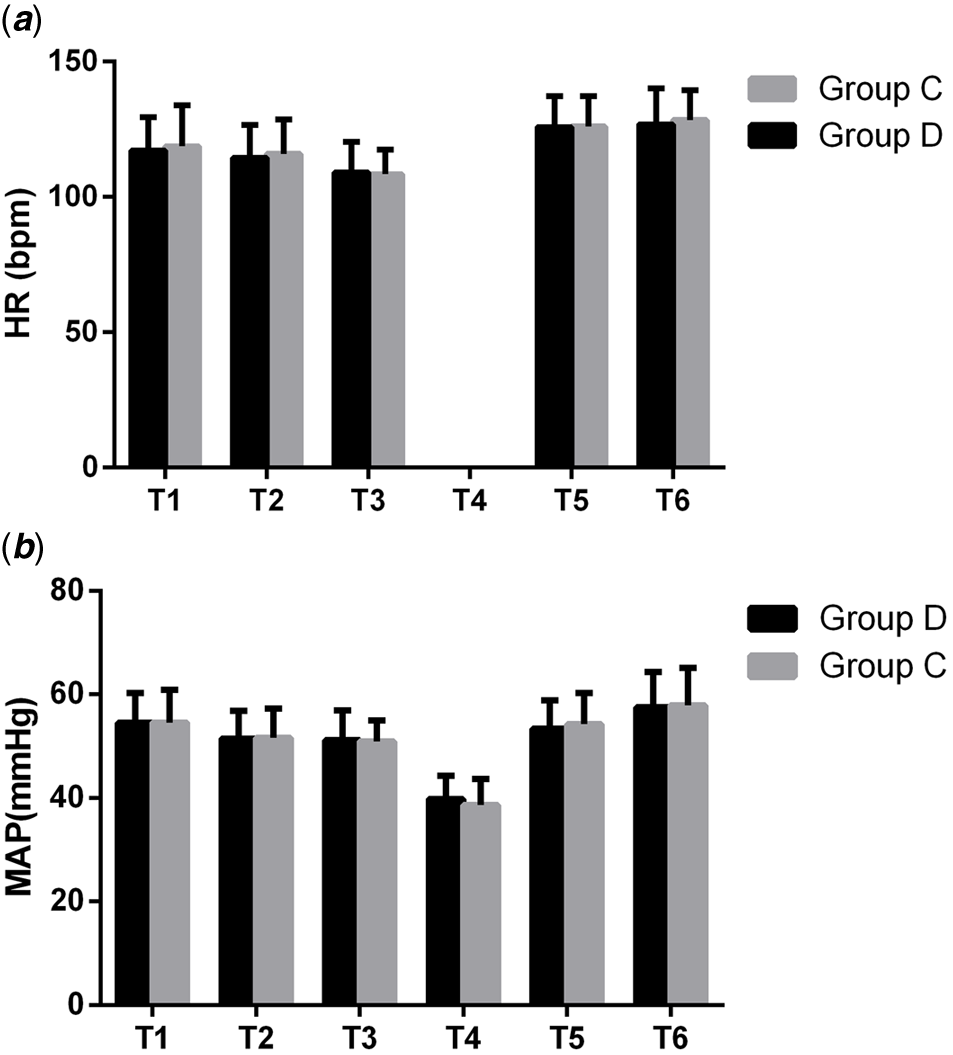
The heart rate and mean arterial pressure in the two groups were compared at the time before induction (T1), after induction (T2), time of skin incision (T3), during the CPB (T4), at the end of the cardiopulmonary bypass (T5), and at the end of the operation (T6). Data regarding intraoperative sufentanil dosage, extubation time (time from the end of operation to the removal of the tracheal tube), cardiac intensive care unit stay time, total hospital stay, and hospitalisation costs were also compared between the two groups. The FLACC pain scores and Ramsay sedation scores in the two groups were compared on the 1st and 2nd days after surgery by using the following scoring systems: (FLACC score: 0, comfort; 1 ∼ 3, mild pain; 4 ∼ 6, moderate pain; 7–10, severe pain. Ramsay score: 1, insufficient sedation; 2 ∼ 4, calm and satisfactory sedation; 5 ∼ 6, excessive sedation). A sample of arterial blood (1 mL) was collected at 2 hours after surgery for the analysis of blood gases and the lactate (Lac) level. The values for arterial partial pressure of oxygen (PaO2), arterial partial pressure of carbon dioxide (PaCO2), and the postoperative inotropic scores were also compared between the two groups.
Statistical analysis
All data were analysed using SPSS Statistics for Windows (Statistical Package for Social Sciences), and results are presented as mean ± standard deviation. The two-tailed Student’s unpaired t test, multiple comparisons, and repeated measures analysis of variance were used to analyse parametric data. All non-parametric data were analysed using the Chi-square (χ2) test. A p-value <0.05 was considered to be statistically significant.
Results
Preoperative variables
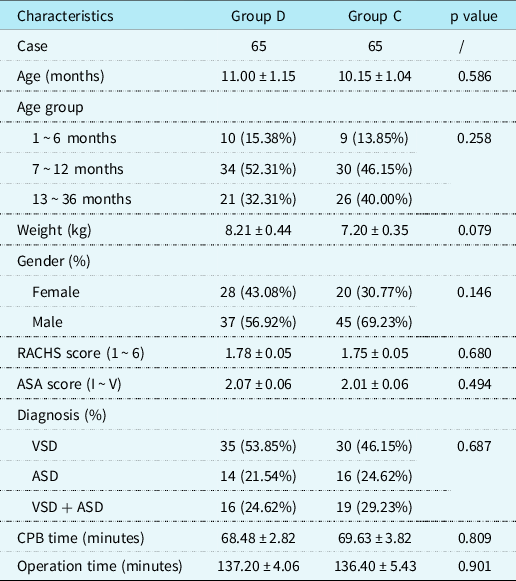
There were 65 cases of ventricular septal defect, 30 cases of atrial septal defect, and 35 cases of ventricular septal defect and atrial septal defect. Males accounted for 82 cases and females accounted for 48 cases. The patients ranged in age from 1 to 36 months and weighed 3.8 ∼ 22.5 kg. All patients in the two groups were similar in parameters of mean age, weight, gender, risk adjustment for congenital heart surgery score, American society of anesthesiologists score, and diagnosis. There were no differences in any of the preoperative variables of patients in the two groups (Table 1), and no patient in either group was lost to follow-up (Fig 1).
Comparison of general profiles between the two groups

No statistical significant differences between groups.
Reported as Mean ± SD. Categorical variables reported as: n (%).
ASA, American society of anesthesiologists; ASD, atrial septal defect; CPB, cardiopulmonary bypass; kg, kilogram; RACHS, risk adjustment for congenital heart surgery; VSD, ventricular septal defect.
Intraoperative variables
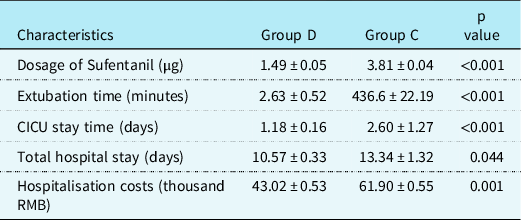
All cases underwent cardiopulmonary bypass, and there was no difference in the cardiopulmonary bypass time or total operation time in the two groups (Table 1). The intraoperative requirement of sufentanil in Group D was significantly lower than that in Group C (1.49 ± 0.05 vs. 3.81 ± 0.04 µg, p < 0.001, Table 2). The intraoperative haemodynamics in both groups were stable, and there were no significant differences in heart rate and mean arterial pressure between the two groups at any time of T1, T2, T3, T4, T5, or T6 (Fig 2a and b).
Comparison of the HR and MAP at different time points between the two groups. There was no statistically significant difference between groups. HR, heart rate; MAP, mean arterial pressure.

Comparisons of dosage of sufentanil and postoperative hospitalisations between the two groups

The dosage of sufentanil, extubation time, CICU stay time, total hospital stay, and hospitalisation costs in Group D were all significant lower.
CI, confidence interval; CICU, cardiac intensive care unit; RMB, ren-min-bi (Chinese currency).
Postoperative variables
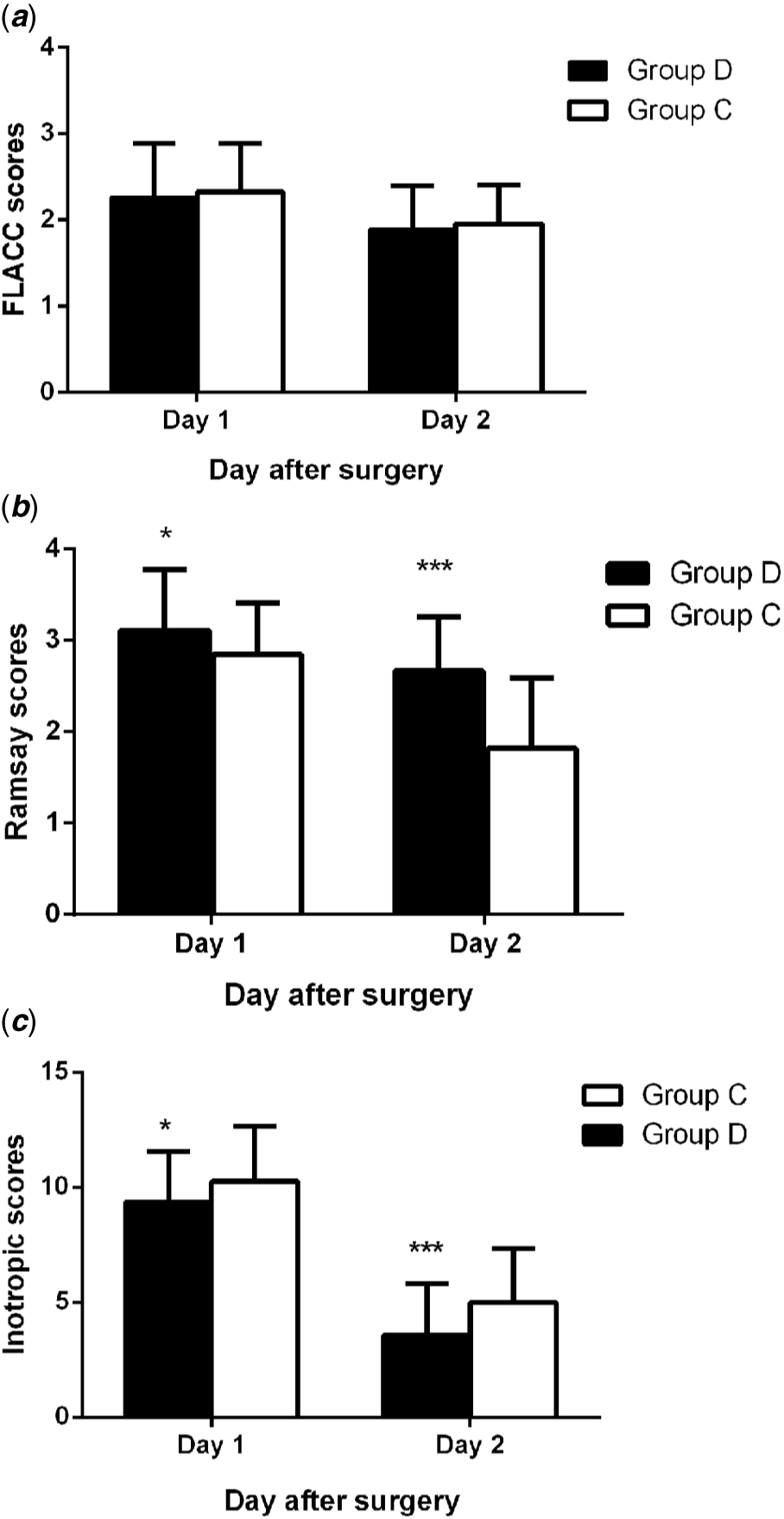
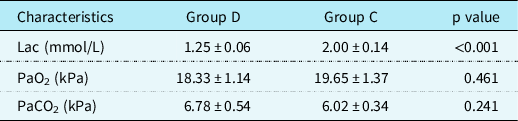
The extubation time (2.63 ± 0.52 vs. 436.60 ± 22.19 minute, p < 0.001, Table 2) in Group D was significantly lower than that in Group C. Moreover, the cardiac intensive care unit stay time, total hospital stay time, and hospitalisation costs of the children in Group D were all significantly lower than those of the children in Group C (Table 2). There was no significant difference in the FLACC scores in the two groups on the 1st and 2nd days after surgery (Fig 3a). The Ramsay scores of the children in Group D were significantly higher than those of the children in Group C on the 1st and 2nd days after surgery (3.10 ± 0.08 vs. 2.84 ± 0.07 on day 1, p = 0.017; 2.66 ± 0.07 vs. 1.81 ± 0.09 on day 2, p < 0.001; Fig 3b). The postoperative inotropic scores in Group D were significantly lower than those in Group C at each time point on the 1st and 2nd days after surgery (9.33 ± 0.27 vs. 10.25 ± 0.29 on day 1, p = 0.026; 3.58 ± 0.27 vs. 4.98 ± 0.29 on day 2, p < 0.001; Fig. 3c).The arterial Lac values in Group D were significantly lower than those in Group C at 2 hours after operation (1.25 ± 0.06 vs. 2.00 ± 0.14 mmol/L, p < 0.001, Table 3). There were no significant differences in the PaO2 and PaCO2 values in the two groups (Table 3).
Comparison of postoperative FLACC scores, Ramsay scores, and inotropic scores between the two groups. For FLACC scores, there was no statistically significant difference between groups. For Ramsay scores and inotropic scores, the differences were all statistically significant.

Comparison of arterial Lac, PaO2, and PaCO2 on the 2nd hour postoperatively between the two groups

The Lac value in Group D was significant lower.
CI, confidence interval; Lac, lactic acid; PaO2, arterial oxygen partial pressure; PaCO2, arterial partial pressure of carbon dioxide.
Discussion
In this single-centre, placebo-controlled randomised trial, when ultra-fast track cardiac anaesthesia was used in infants and toddlers with the administration of dexmedetomidine, both the perioperative requirement for sufentanil and extubation time after surgery were reduced significantly, and the inotrope requirement was also decreased. Furthermore, the extubation time was the shortest and the age of participants was the youngest in any similar studies. And none of the children required a re-intubation in the cardiac intensive care unit, and no significant respiratory or circulatory complications were observed.
Professor Verrier Reference Verrier, Wright and Cochran8 proposed the concept of fast-track cardiac anaesthesia in cardiac surgery that the tracheal catheter should be removed as soon as possible (within 6 hours) after operation. ultra-fast track cardiac anaesthesia has emerged that the tracheal catheter is removed immediately or within 1 hour after operation in adults, whether it can be performed in treating CHD in infants and toddlers depends on the children’s perioperative status. Davis believed that a gestational age >36 weeks and age >6 months were factors that favored the use of ultra-fast track cardiac anaesthesia. Reference Davis, Worley and Mee9 On that basis, this study reduced the age criterion and allowed the enrollment of patients who were >1-month old (less than 3 years), weighed >3.5 kg, were born at full term, and had no serious problems in other systems or organs.
Dexmedetomidine is widely used in perioperative anaesthesia. Studies showed that the sedative effect of dexmedetomidine was highly similar to human natural sleep. Reference Gonzalez-Gil, Villa and Millan10,Reference Bulow, Colpo and Pereira11 For young children, our knowledge concerning the use of dexmedetomidine in ultra-fast track cardiac anaesthesia is very limited. Dexmedetomidine has a good anesthetic effect on children who undergo CHD surgery, as it can stabilise haemodynamic parameters, shorten the respiratory recovery time, and reduce postoperative pain. Reference Pan, Wang and Lin12 And the safe dosage range of dexmedetomidine in infants is 0.2 ∼ 1.2 µg/kg/hour, and the dosage for postoperative sedation and analgesia is 0.25 ∼ 0.75 µg/kg/hour, Reference Su, Nicolson and Zuppa13 which can ensure a safe and effective sedative and analgesic effect without causing severe hypotension and bradycardia. So in this study, the intraoperative maintenance dosage of dexmedetomidine was 1 µg/kg/hour, and the postoperative sedative and analgesic dosage was 0.3 µg/kg/hour.
During open-heart CHD surgery requiring CPB, large doses of opioids are often used to suppress the strong stress response for CHD surgery in conventional anaesthesia procedures, such as fentanyl (50 ∼ 100 µg/kg). However, those opioids also produce a series of side effects, such as dose-dependent respiratory inhibition and intestinal motility inhibition. Reference Yuki, Matsunami and Tazawa14 Duncan Reference Duncan, Cloote and Weir15 found that a lower dose of opioids can effectively suppress the stress response, which suggested that further reductions in the dosages of opioids given to young children receiving ultra-fast-track cardiac anaesthesia may be possible. The ability to reduce the dosage of opioids may be the main advantage of UFTCA. Reference Reismann, von Kampen and Laupichler16 The results of this study showed that ultra-fast-track cardiac anaesthesia can significantly reduce the required intraoperative dosage of sufentanil with a proper dosage of dexmedetomidine (1.49 ± 0.05 vs. 3.81 ± 0.04 µg, p < 0.001, Table 2), which was similar to results reported by Dong. Reference Dong, Zhang and Lu17 Rong Reference Rong, Kamel and Rahouma18 also found that low-dose opioids were safe and effective for use in cardiac surgery, independent of the clinical characteristics of the patient and type of opioid used. In view of the current opioid epidemic, low-dose opioid anaesthesia should be considered for cardiac surgery patients. It was reported that the use of dexmedetomidine could reduce postoperative morphine and fentanyl consumption in children after CHD surgery, Reference Pan, Wang and Lin12 and our analysis provided further evidence that perioperative narcotic consumption could be decreased in infants and toddlers under ultra-fast-track cardiac anaesthesia with perioperative use of dexmedetomidine.
Another major advantage of ultra-fast-track cardiac anaesthesia is to reduce extubation time. In this study, not only the postoperative extubation times but also CICU stay times, total hospital stay times, and hospitalisation costs of the infants and toddlers in Group D were all significantly lower (Table 2). In particular, the mean postoperative extubation time was significantly reduced from ∼7 hours to ∼2.6 minutes (2.63 ± 0.52 vs. 436.60 ± 22.19 minutes, p < 0.001, Table 2), which was shorter than any time reported in similar studies. Reference Pan, Wang and Lin12,Reference Naguib, Tobias and Hall19 We believe that this reduction in extubation time was made possible because the dexmedetomidine inhibited respiration to a much lesser degree than the large dosages of sufentanil. Reference Gonzalez-Gil, Villa and Millan10 Prolonged tracheal intubation not only leads to an increased incidence of pulmonary infection but also results in discomfort in paediatric patients, which negatively impacts the stability of the circulatory system. Reference Bulow, Colpo and Pereira11 Therefore, early extubation is important for promoting recovery of the cardiac and lung functions of patients. Meissner Reference Meissner, Scharf and Dötsch20 concluded that fast-track cardiac anaesthesia in paediatric patients with CHD allows for early, safe extubation, which shortens the mechanical ventilation time and reduces pulmonary complications. Additionally, the intraoperative administration of dexmedetomidine was found to be independently associated with early extubation, Reference Amula, Vener and Pribble21 which was in exact agreement with our current findings.
During the surgery, we found that the heart rate and mean arterial pressure at different time point of patients in both groups were not significantly different (Fig 2a and b). Those findings indicated that dexmedetomidine combined with a small dosage of sufentanil could maintain the stability of haemodynamic parameters in young children undergoing CHD surgery. No adverse reactions, such as a decreased heart rate or blood pressure, were observed in Group D, which may have been due to the absence of a loading dose of dexmedetomidine and the routine use of dopamine after cross clamp release. Reference Chrysostomou, Komarlu and Lichtenstein22 There was also no significant increase in mean arterial pressure during the CPB procedure, which may be because dexmedetomidine reduced the plasma concentrations of epinephrine, norepinephrine, and catechol during the stress response. Reference Sarma, Narayana and Ganapathi23 Additionally, although the FLACC scores in the two groups were decreased on the two days after operation, there were no significant differences (Fig 3a), which may be related to the analgesic effect of dexmedetomidine in inhibiting the release of excitatory transmitters from the nucleus accumbens. Reference Kumar, Thepra and Bhagol24 The mean Ramsay score in Group D was significantly higher on the 2nd day after operation (Fig 3b), with satisfactory sedation in Group D and insufficient sedation in Group C, which was related to the fact that dexmedetomidine can reduce the incidence of postoperative agitation in children after general anaesthesia for a long time. Reference Bulow, Colpo and Pereira11 Another notable finding in this study was a less inotrope requirement in Group D. The inotrope scores at each time point on the 2 days after surgery were significantly lower in Group D (Fig 3c). That was the haemodynamics remained equivalent when less inotropic support was provided. This may be the potential physiological advantages of ultra-fast track cardiac anaesthesia, e.g., increases in venous return and cardiac output, intrinsic catecholamine release, and increased sympathetic stimulation and subsequent adequate vascular tone. Reference Hamilton, Honjo and Alghamdi25 The blood Lac value in Group D was significantly lower than that in group C (Table 3), but all the values were within a normal range. However, those data indicated a trend of rising blood Lac levels, and this needs further investigations in the future.
Our study has some limitations that should be mentioned. First, the sample size was relatively small, and the study was conducted at a single medical centre. Second, most of the patients had only mild illness without severe pulmonary artery hypertension before operation. Given the results, additional multi-centre prospective trials with a larger sample size and that include patients with more complicated CHD surgeries should be conducted.
In conclusion, the use of ultra-fast-track cardiac anaesthesia was safe and effective with the administration of dexmedetomidine and a low-dose sufentanil in infants and toddlers. Not only a less perioperative requirement for opioid drugs but also a shorter extubation time was achieved by ultra-fast-track cardiac anaesthesia. Moreover, ultra-fast-track cardiac anaesthesia could decrease the inotrope requirement, provide a satisfactory perioperative clinical conditions, and postoperative sedation and analgesia, especially in the young children with an atrial septal defect and/or ventricular septal defect.
Acknowledgements
The authors thank the anaesthetists, surgeons, and anaesthesia assistants at our hospital who participated in this study.
Financial support
This work was supported by the National Science Foundation of China (grant numbers 81671116, 81870823), Program of Guangzhou Municipal Science and Technology Bureau (201803010025).
Conflicts of interest
None.
Ethical standards
The authors assert that all procedures contributing to this work comply with the Helsinki Declaration of 1975, as revised in 2008, and has been approved by the regional ethics board in Guangzhou Women and Children’s Medical Center, Guangzhou, China.