Although literary sources paint a picture of a Continent awash with wandering Irishmen in the eighth and ninth centuries, we know little about individual persons and their beliefs and activities. The letters of Boniface, however, inform us generously of a certain Clemens active on the Continent in the middle of the eighth century. Described as an Irishman (Scottus genere), this cleric was, together with the Gaul Aldebert, the topic of synodal discussion in the early 740s. A relatively large number of letters (five in total) from the extant collection of Boniface's correspondences compiled by his successor Lul refer to the problems with the two heretics.Footnote 1 In addition, the men are also mentioned in two council reports (also preserved in Lul's collection) and one other letter surviving independently of Lul's collection (if we accept its genuineness). There are allusions to other correspondences, now lost, which also appear to have addressed the issue of Clemens and/or Aldebert. This relative richness of sources constitutes valuable and unique evidence on one protagonist in the wave of Irish peregrini in the eighth century. It offers a rare glimpse of the ways in which one Irishman's origin informed his teachings and the reception he received from the clerical elite on the Continent.
This article examines the sources to elucidate the context of Boniface's allegations and the role Clemens's Irish origin played. It begins with a fresh look at the evidence from the correspondence between Boniface and the papacy. In order to reach an accurate picture of Boniface's objections and the buildup of his argument, it is worthwhile to review the phrasing of the accusations individually and in chronological order. A list of rubrics from a Würzburg manuscript is then presented as new evidence for the events concerning Clemens and Aldebert. Following a note on the relationship between Clemens and Aldebert, this article then proceeds with a detailed examination of the four main themes in Boniface's accusations leveled at the Irishman Clemens in order to decide how these are related to our knowledge of Irish customs at the time, Continental representations of these customs, as well as attitudes toward wandering clerics originating from Ireland. Here the information gleaned from the Würzburg florilegium introduces new perspectives on the evidence from the letters and council acts.
At the outset, some words of caution are in order concerning the limitations of the extant primary sources. Every investigation into historical accounts of heresy is fraught with difficulties, since documents relating to deviant and nonconformist beliefs more often than not follow literary rules belonging to their genre and are riddled with well-established commonplaces and topoi about heretics. To be effective, the accusations to some degree had to reflect eighth-century Continental (and émigré Anglo-Saxon) expectations of heretical behavior (in the case of Clemens, possibly coupled with conceptions of particularly Irish heresies). In this context, the mention and the persecution of alleged heretics, moreover, may have served political, social, or literary purposes that transcended the simple rooting out of every heterodox thought. These considerations are not less relevant for our subject; the only extant sources for the life and teachings of Clemens are documents from Boniface himself or his sphere of influence. There is a distinct lack of texts from Clemens himself, resulting in an image that is one-sided at best. In addition, the attention devoted to the two alleged heretics seems excessive. It is not likely that the renegade clerics, Clemens and Aldebert, were the most pressing of Boniface's problems in the 740s. It appears that the persecution of Clemens and Aldebert was designed, not to remove the two heretics, but to illustrate to the ecclesiastical hierarchy (in particular the pope) the persistence of opposition to Boniface's important work. And despite Boniface's rhetoric of heresy, the two men appear to have been representative of the kind of heterodox or unorthodox preacher one would expect to find working in recently Christianized lands, not the leaders of a disciplined movement of heretical doctrine. At the same time, the accusations may be the culmination of the competition between three charismatic “holy men” vying for the patronage of princes and noblemen.Footnote 2 Such potential “hidden agendas” should warn us against taking the accounts at face value.
Yet, within the precisely framed accusations lies a kernel of truth (another requirement of a successful allegation). Therefore, we may still attempt to identify Irish elements in Clemens's alleged beliefs and teachings. We should, however, remain cautious; particularly when translating the accusations into Irish customs, we run the risk of “explaining away” any idiosyncratic, individual beliefs Clemens might have held.Footnote 3 Unless other evidence emerges, the extant primary sources will never be able to provide fully reliable information about Clemens's actual views and doctrines. They are, however, well-suited to shed light on Boniface's treatment of this particular Irishman.
I. The Letters of Boniface
In order to learn more about the context of Boniface's objections and how these were communicated over time, it is necessary to look more closely at the extant sources and the accusations leveled at Clemens. The first secure sourceFootnote 4 for the activities of Clemens is a letter from Pope Zacharias to Boniface, probably written in 743.Footnote 5 It first deals with the pope's conferral of the pallium upon the bishops Grimo of Rouen, Abel of Rheims, and Hartbert of Sens, on Boniface's recommendation. The pope then turns to the discovery by Boniface “in the same province of the Franks” (in eadem Francorum provintia) of two “pseudo-prophets,” whom Zacharias prefers to call “pseudo-Christians.” The letter catalogues the sins of the two men, without naming them, and the description mirrors the accounts in subsequent sources of the abuses of Aldebert and Clemens, respectively. The first of the pseudo-Christians, described as “a new Simon,” is probably Aldebert. He allegedly claimed to be a priest even though he did not refrain from carnal lust, led people astray, and preached foolishness. Seducing the people with falsehoods, he drew them away from the Church of God and set them against Christian law. He is said to have set up crosses and oratories in the fields, deceived the people with false miracles, claimed the title “Your Holiness,” and declared to know the names of the angels, which, the pope assures the reader, are the names of demons instead.Footnote 6
The description of the second man seems to fit the later reports about Clemens:
The other man [we discovered] was so truly given over to lust, that he kept a concubine and had two children by her. And yet he claimed the priesthood for himself, declaring that is was right according to the tradition of the Old Testament, and [declaring] that the surviving brother should take the wife of the deceased brother; also that when Christ came up from hell, he had left no one there, but carried all from there.Footnote 7
The brevity of this account is probably due to the letter's intended reader; because Boniface discovered the “pseudo-Christians,” the exposition is no doubt a recapitulation of a report sent to the pope by Boniface himself. The pope here probably summarizes the narrative for a clearly well-informed audience, omitting certain details, subtleties, and even the names and origins of the two men concerned. Zacharias concludes his letter by condemning the abuses of the two men and supporting Boniface's conviction of them and the fact that he put them in custody (in custodiam), agreeing that they can be called servants and forerunners of the Antichrist.Footnote 8 The pope enjoins Boniface to carry on his good work in order to increase the flock of Christ.
The next extant primary source relating to either of the two priests dates from the following year. The Neustrian Council of Soissons in 744, the third synod under Boniface's direction, discussed the heresy of Aldebert. The assembled bishops, priests, nobility, and populace unanimously condemned the heretic, lest “heresy rises any greater in the people” and “more people be destroyed, deceived by false priests.”Footnote 9 The acts of the council do not disclose concrete information about the teachings or beliefs of Aldebert, and Clemens is not mentioned at all.
Not much later, Boniface appears to have written to the pontiff again, detailing the acts and errors of both Aldebert and Clemens.Footnote 10 His letter, which has not survived independently, was brought before the Roman Council of 745 by the priest Denehard and is included in the council acts. It is the only piece of evidence on Clemens that is from the hand of Boniface himself, and the only one in which he is explicitly labeled an Irishman. In front of the assembled clergy, Denehard related how a synod held in the province of the Franks (of which we have no evidence otherwise) had decided to strip two heretical and schismatic priests named Aldebert and Clemens of their dignity and take them into custody. However, because the men were not doing penance according to their sentence and continued to lead people astray, Boniface turned to the Holy See. Boniface writes that since he had presided over a conference of priests and a synod in the province of the Franks, he had suffered many insults and persecutions from false priests, adulterous presbyters or deacons, and lustful clerics. His chief trouble was the two well-known heretics Aldebert, a Gaul, and Clemens, an Irishman, whose errors were different, though of equal sinfulness (specie erroris diversi, sed pondere peccatorum conpares).Footnote 11 Boniface requests help from the pope to lead the Franks and the Gauls back toward the right path so that they may no longer follow the fables and false miracles and prophecies of the precursor of the Antichrist. He encourages the pope to consign the two heretics to prison (in carcerem). It seems that, despite the decision of the Frankish synod to take them into custody, the two men were still roaming free. This may be the result of some degree of support for the two men, the existence of which Boniface acknowledges by stating that he is suffering persecution, enmity, and cursing from many people because of them. Aldebert, in particular, is said to be regarded by the people as a most holy apostle, a patron, an intercessor, a doer of righteousness, and a miracle worker.Footnote 12
Boniface goes on to describe in detail the respective heretical beliefs and abuses of the two clerics, which indeed differ greatly. Aldebert is described as a swindler, seducing people with false miracles. He was allegedly ordained after bribing unlearned bishops and declared himself equal to the apostles, later dedicating oratories to himself. He set up crosses and oratories in the fields and at springs and ordered public prayers invoking the merits of St. Aldebert. He, moreover, distributed his own fingernails and hair as sacred objects and declared, when people came to him to confess, to know all their hidden sins, maintaining that confession was not needed.Footnote 13
Clemens, like Aldebert, is here labeled not a priest but a bishop:
The other heretic, who is called Clemens, argues against the Catholic Church, denies and contradicts the canons of the churches of Christ, and rejects the writings and teachings of the holy Fathers Jerome, Augustine, and Gregory. Spurning synodal law, he declares that, according to his own interpretation, he can be bishop under Christian law even though he has two children born in adultery while [he was] under the name of bishop. Introducing Judaism, he declares that it is right for a Christian, if he so pleases, to accept the widow of his dead brother as wife. He contends contrary to the belief of the holy Fathers, saying that Christ Son of God, descending to the lower world, set free all whom the prison of hell held, believers and unbelievers, those who praised God as well as the worshippers of idols. And he declares many other horrible things concerning God's predestination contrary to the Catholic faith.Footnote 14
Boniface asked the pope to order (mandare) dux Carloman to take the heretic Clemens into custody lest he spread the seed of Satan and contaminate the whole flock.Footnote 15 The assembled clerics at the council declared themselves to be convinced that these men were servants of Satan and forerunners of the Antichrist, mentioning especially the distribution of Aldebert's hair and fingernails as relics, and Clemens's rejection of the sacred canons and the teachings of the Church Fathers (here, “Ambrose, Augustine, and others”), after which the council was adjourned.Footnote 16
During the second session, the council concerned itself with the supposed autobiography of Aldebert, also supplied by Denehard, in which he portrayed himself in true messianic style. A letter from heaven allegedly used by Aldebert was also read aloud, and the third session discussed a prayer put together by Aldebert, which included the purported names of the angels. There was no more discussion of the case of Clemens in these sessions before the sentencing, and there is no account of a similar autobiographical document from the Irishman or even an attempt to defend himself. At the end of the third session, the assembly condemned both Aldebert and Clemens. The first was to be deprived of all priestly functions and required to do penance for his sins lest he be anathematised, but Clemens was stripped of his priestly functions and punished by anathema immediately, without recourse to penance. He, the final paragraph states,
in his stupidity rejects the statutes of the holy Fathers and all synodal acts, imposing Judaism upon Christians, while preaching to take the wife of a dead brother, and also proclaiming that the Lord Jesus Christ, after he had descended into the lower world, brought everyone thence, righteous and unrighteous.Footnote 17
Those who had assented to his sacrilegious teachings were to undergo the same punishment.Footnote 18
The acts of the Roman Council were sent to Boniface by the Roman Cardinal-Deacon Gemmulus, who in an accompanying letter describes the sentencing of the heretics, or the convocation of the Roman Council—the text is inconclusive—as something Boniface “had not dared to hope for.”Footnote 19 Such a description suggests that Boniface's letter may not have been specifically written as a document to be read before the assembly, but rather as a general communication to the pope. Gemmulus succinctly summarizes the Irishman's abuses as the “insanity of Clemens” (Clementis dementia).Footnote 20 A letter from the pope also accompanied the account of the council. In that letter, he stated that the judgment should be read aloud in the whole “provincia Francorum” so that every schismatic who heard the judgment of the council might be converted from his evil ways. Boniface was enjoined to hold a council in the province of the Franks to spread the unity of the Church of God and ensure that the people were no longer involved in the errors of false priests.Footnote 21
The matter of Aldebert and Clemens recurs one final time in the correspondence between the pope and Boniface. In 747 Zacharias followed up on the earlier sentence and asked for a future synod to read the works of canon law sent by the pope to Pippin and also to sift out the cases of the “blasphemous and obstinate ex-bishops Aldebert, Godalsacius, and Clemens” in a final careful investigation.Footnote 22 If they were inclined to turn back toward the path of rectitude, Boniface, in conjunction with the prince of that province, was to dispose of the case according to his will. Otherwise, they were to be sent to the Apostolic See to receive their final sentence.Footnote 23 It is unclear if a subsequent synod discussed the matter of the three ex-bishops and what the outcome of the final careful investigation of their cases revealed. There is no further mention of Clemens in other narrative sources, and it is unknown what became of the Irishman.
II. The Würzburg Florilegium
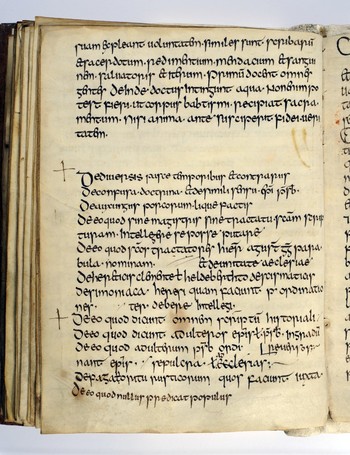
In addition to the correspondence of Boniface with the pope and the acts of the respective councils, there is another peculiar source for this episode: a list of rubrics in a late eighth- or early ninth-century manuscript at Würzburg's University Library.Footnote 24 This codex is a composite manuscript of three contemporary elements. The first element (fos. 1–41) contains an important florilegium of patristic excerpts from the great Irish canon law collection known as the Collectio canonum Hibernensis.Footnote 25 A contemporary element (fos. 42–51), which may only have been bound with the other elements sometime after the eleventh century, contains a fragment of another canon law collection, the Collectio Vetus Gallica.Footnote 26 The third element (fos. 52–59) is a compendium of sententiae of various patristic authors, papal decretals, and some excerpts which also appear to draw from the Hibernensis. Judging from the similar size and quality of the parchment and the correspondence of the handwriting, the first and the third elements must have belonged together. Together they comprise 49 folios, the greater part of which is written in a beautiful pointed Anglo-Saxon minuscule, but parts of folio 17r and 17v are written in a more cursive grade of Anglo-Saxon minuscule, and certain short passages are written in handwriting described by E. A. Lowe as crude Continental minuscule influenced by insular script or insular minuscule showing Continental influence (see fig. 1).Footnote 27 The manuscript is thought to originate from an Anglo-Saxon centre on the continent, probably Würzburg or the surrounding area.Footnote 28 The script can be dated to the late eighth or early ninth century.Footnote 29
Würzburg Universitätsbibliothek, MS Mp. th. q. 31, fo. 54v. For transcription, see appendix.

August Nürnberger studied the manuscript in detail and counted fifty-four capitula and chapter headings in the third element of the manuscript. He identified clear indications of influence from the circle of Boniface in this seemingly haphazard collection of synodal decrees, papal texts and patristic excerpts.Footnote 30 More recently, Michael Glatthaar further substantiated the connection with Boniface and proposed the title Sententiae Bonifatianae Wirceburgenses for the text.Footnote 31 Most importantly, the first capitulum (repeated as capitulum 46), concerning seven rules on laity or adulterous clergy presiding over a church, is also present in a manuscript at the Vatican under the heading “ex dictis s. Bonifacii.”Footnote 32 A passage at the end of this chapter, moreover, occurs almost verbatim in Boniface's letter to King Æthelbald of Mercia.Footnote 33 Furthermore, Nürnberger and Glatthaar found that many of the passages in this collection reflect the concerns and writings of Boniface and that excerpts from the Sententiae echo phrases in Boniface's letters, while certain themes under discussion were topics of particular interest to Boniface, such as (doubts about) correct baptism, exorcism, and insufflatio.Footnote 34 In addition, Nürnberger identified a citation of Iulianus Pomerus's De Vita Contemplativa, a text known to be used by Boniface.Footnote 35
Most crucial for our purpose, however, is the reference to Aldebert and Clemens in a short list of headings within the Sententiae that lack the relevant text. This set of capitula are numbered 16 to 27 in Nürnberger's list:
16. On different times of Easter and arguments against
17. On confused doctrine and on the similar interpretation of the bishop [and] priest
18. On the dissolved axunge of pigs
19. Concerning that they think/he thinks to be able to understand sacred scripture without teachers [and] without tracts
20. Concerning that the holy authors Jerome, Augustine, and Gregory are called by allegory
21. On the heretics Clemens or Aldebert, on schismatics, and on the unity of the Church
22. On the simoniac heresy which they perform through ordinations
23. Concerning that they say that the whole written work must be understood historically
24. Concerning that they say that adulterous bishops or priests are restored to their grades
25. Concerning that bishops ordain an adulterous priest
26. On a pagan rite of peasants which they perform next to graves or at churches
27. Concerning that no laity preachesFootnote 36
Item 21 can hardly refer to any other heretics than the Clemens and Aldebert of whom Boniface speaks in his letters to the pope. The topics of the capitula surrounding heading 21 (that is, nos. 16–20 and 22–27) suggest that they should also be read in the context of Boniface's problems with troublesome clergy: the capitula deal with abuses most likely to be perpetrated by unqualified clerics and false priests. It commences with an old-time favorite, namely the incorrect reckoning of the Easter date (no. 16), which may be a (belated) allusion to the controversy within the seventh-century Irish Church. Other items concern confused doctrine in priests and bishops (no. 17), reading the Bible without the aid of theological authorities (no. 19), incorrect reading or understanding (?) of patristic writings (no. 20), and interpreting written work only historically (no. 23). Other capitula cover matters such as simony (no. 22), adulterous priests and bishops (nos. 24–25), pagan rites (no. 26), and laymen preaching (no. 27). The remark about axunge (animal fat or grease, no. 18) is somewhat puzzling, but it is possible that it should be read in a medical or ritual context.
In fact, in addition to heading 21, a large number of these capitula can be directly associated with the abuses that Aldebert and Clemens were accused of in Boniface's letters.Footnote 37 Heading 22, alluding to an ordained simoniac heretic, reflects both the description of Aldebert as a “new Simon”Footnote 38 and his alleged bribing of uneducated bishops to ordain him.Footnote 39 The reference to “pagan rites” of simple folk (rusticorum) performed at graves and churches (no. 26) may be linked with the setting up of crosses and oratories by Aldebert,Footnote 40 as well as his preaching to a multitude of rustici.Footnote 41 Furthermore, the reference to “confused doctrine” of bishops and priests in capitulum 17 reflects Boniface's reference to the two men's “doctrine” in the letter read aloud before the Roman Council.Footnote 42 The headings concerned with adulterating bishops and priests (nos. 24–25) reflect on Clemens, who was accused of having two children out of adultery.Footnote 43 Of particular interest is also heading 19: De eo quod sine magistris sine tractatu sanctam scripturam intellegere se posse putare, “Concerning that they think/he thinks to be able to understand sacred Scripture without teachers [and] without tracts.” The grammar of this rubric (and other rubrics in this list, that is, nos. 22–24 and 26) is significant; rather than describing a general abuse, it accuses people in the third person plural (in this particular case maybe even a person in third person singular) of these offenses. The grammar suggests that the author had particular persons in mind, and since there is no other possible referents in the vicinity, it appears that these men were Aldebert and Clemens. Capitulum 19, in fact, accurately describes one of the principal accusations leveled at Clemens: arguing against the Catholic Church (contra catholicam contendit aecclesiam) and explaining Christian law according to his own interpretation (proprio sensu).Footnote 44 The latter phrase, from the Roman Council, is paralleled by the clause simili (that is, confusa) sensu in heading 17 in the Sententiae Bonifatianae.
The text of heading 20 is also striking: De eo quod sanctos tractatores Hieronimum, Augustinum, Gregorium parabula nominam [nominari?], “Concerning that the holy authors Jerome, Augustine, and Gregorius are named by allegory.” In this somewhat unclear sentence, the three Church Fathers appear in exactly the same combination and order as in Boniface's allegation against Clemens, who is said to refute the texts and wisdom of the Fathers: tractatus et intellectus sanctorum patrum Hieronimi, Augustini, Gregorii recussat.Footnote 45 The incorrect summary of this list by the clergy attending the Roman Council (patrum Ambrosii, Augustini et ceterorum)Footnote 46 demonstrates that the combination and sequence of Holy Fathers used by Boniface were not standard. They are, in fact, not found in any other contemporary text in this format. Although the exact meaning of the heading is not entirely clear, the use of the word parabula suggests that the purport intended in this remark is the loose interpretation of the Fathers’ writings, where more strict adherence is prescribed. This, again, closely parallels the allegation at the Roman Council.
The extensive familiarity with Boniface's writings displayed by the text, as well as the fact that the manuscript witness survives in Würzburg, suggests very strongly that the collection of folios 52–59 originated from the Boniface's circle and were copied somewhere around the area of Boniface's influence near Mainz, Würzburg, or Fulda. It appears to depend (to a large extent) on a collection composed in Boniface's lifetime, possibly written by Boniface himself.Footnote 47 The collection in the Würzburg manuscript should probably be regarded in the light of Boniface's proactive manner of gathering information about issues and problems vexing him. The letters in Lul's collection show the Anglo-Saxon requesting very specific texts from correspondents, including books from the Lateran archives through Cardinal-Deacon Gemmulus,Footnote 48 the Libellus responsionum from Archbishop Nothelm of Canterbury (for sentences on marriage),Footnote 49 and works of Bede from Abbot Huetbert of Wearmouth and Archbishop Egbert of York.Footnote 50 The Sententiae may represent a selection of authoritative passages relevant to Boniface's activities on the Continent, constituting a manual to facilitate his work. Capitula 16–27 (and similarly 48–54), lacking accompanying canons, appear to have served another purpose. As proposed by Schüling and Glatthaar, the headings seem to represent the outline or sketch of lost or extant letters,Footnote 51 or (Boniface's contributions to) the agenda of a synod or council.Footnote 52 Boniface used elements from nearly all of headings 16–27 (with the exception of nos. 16, 18, and 27) in his writings on the matter of Clemens and Aldebert. This block of text therefore seems to constitute preparatory notes for his pieces on the two men. It constitutes a valuable addition to our information of Boniface's case against Clemens, and, considering the difference in context and intended audience, it offers new perspective on the allegations.
III. Clemens's Independence from Aldebert
The primary sources compel us, firstly, to re-evaluate the relationship between Clemens and Aldebert. Clemens is often associated with Aldebert, suggesting that both were adherents to a similar heretical belief, perpetrators of the same abuses, or possibly working together.Footnote 53 The sources, however, offer evidence that the two clerics have nothing more in common than being accused by the same man, and having their cases discussed at the same time. At the Council of Soissons in 744—the first instance in which either of the men is mentioned by name—only Aldebert is discussed. In Boniface's letter read aloud to the Roman Council of 745 (the first time the two accused are named together), the Anglo-Saxon admits that their respective errors are different, though similar in sinful weight (specie erroris diversi, sed pondere peccatorum conpares).Footnote 54 To be sure, the detailed description of the respective heretical beliefs and abuses of the two clerics demonstrates their significant differences. There is, therefore, nothing in the evidence to suggest that Clemens and Aldebert were cooperating, or even that they shared the same doctrines. In fact, we have no reason to believe that they were in each other's vicinity or that the two knew each other. Aldebert is condemned as a heretic for the first time at a Neustrian council, where there is no mention of Clemens. At the Roman Council, Boniface asks the pope to order dux Carloman, who governed Austrasia, to take the heretic Clemens into custody.Footnote 55 This suggests that Aldebert was active in Neustria, whereas Clemens was located somewhere in Austrasia. When Pope Zacharias in his 743 letter refers to the two pseudo-prophets in eadem Francorum provintia, he therefore appears to use the word provintia for the whole of the Frankish realm, and not to distinguish between Neustria and Austrasia. The word “eadem” here refers to the previous topic in the letter, the confirmation of the pallium upon the bishop of Rouen (which, according to the division of the Frankish kingdom of 742, lay in Carloman's territory), and those of Rheims and Sens (Pippin's).Footnote 56
Clemens's independence from Aldebert, and vice versa, is also evident in the completely different characters of the two men. The latter is described as a messianic holy man who deems himself chosen and semi-sacred, whereas Clemens is the propagator of strange, erratic teachings who refuses to yield to ecclesiastical authority. The difference between the two is reflected in the dissimilar approach of the ecclesiastical authorities to Clemens and Aldebert respectively, resulting in two different sentences. The harsh penalty of anathema without the possibility of penance for Clemens may be due to the fact that Clemens's followers were made up almost exclusively of clerics, and of almost no lay people.Footnote 57 This may be significant, for it suggests that Clemens was not simply a charismatic vagrant preacher who deceived ignorant people into believing his heretical message (a description that seems to fit Aldebert much better), but rather that his appeal lay in a considered interpretation of ecclesiastical law, dogma, and authority.
Although Clemens and Aldebert seem to have been separated geographically, with different beliefs and activities, it is significant that in the documents they are almost always discussed conjointly. The combined accounts of the two men, covering a variety of respective abuses, give the impression that one of the aims was to present an all-inclusive narrative of the heretical opposition encountered by Boniface. The two men play the roles of the most important possible forms false priests might take, namely the messianic swindler, and the obstinate priest fiddling with dogma. As such, Clemens and Aldebert were “useful heretics,” incarnations of the abuses which Boniface, according to his accounts, was fighting in the Frankish lands. That both heretics were the most troublesome men known to Boniface is not very likely. It seems more probable that they were substitutes for clerics within Boniface's province whom he was unable to touch.Footnote 58 This is interesting because it indicates that Clemens was not patronized by nobility or local rulers who were powerful enough to protect him from Boniface's accusations (although it should be noted that Boniface's attempts to have the two men captured appear to have failed repeatedly).
In her excellent article on Boniface and the two heretics, Nicole Zeddies demonstrates how the accusations follow certain topoi about heresy and, especially, the signs of the antichrist. In Clemens's case the signs include his alleged lustfulness, as indicated by his concubine and two children, and his stultitia, which, as the personification of “false views,” was a sign of the antichrist.Footnote 59 Moreover, the dealing with heretics at synods and councils was distinctly modeled on the late antique councils, and helped to secure Zacharias's attention on the western part of the former Roman Empire, and Francia in particular.Footnote 60 It appears that Clemens and Aldebert were also employed as representatives, providing concrete examples for Boniface's more general critique, and it is important to keep this possible secondary motive in mind when reading the sources.Footnote 61
IV. The Heresy of Clemens
Notwithstanding possible stereotyping (possibly even owing to this), the accounts of Clemens reveal parallels with our knowledge of certain Irish idiosyncrasies. Interesting in this respect is the reference to the reckoning of the Easter date in the florilegium in the Würzburg manuscript (De diuersis pasce temporibus et contrariis—no. 16). While in the end this particular offense did not feature in the accusations leveled against Clemens (or Aldebert) in the extant sources, its inclusion in the list of abuses associated with the two heretics suggests a connection between the allegations and the typically Irish nonconformity regarding the date of Easter, at least in the formative stage of Boniface's indictment. The almost contemporary writings of Bede, expressly sought after and eventually received by Boniface, reinvigorated the interest in this particular historical peculiarity of the Irish.Footnote 62 Perhaps it had been considered as an additional charge against one of the two men (presumably Clemens) and featured in now lost correspondence on the subject or was rejected at a later stage. Its inclusion in this list may constitute a hint that Boniface's accusations were initially designed to include framing Clemens as an archetypical Irishman.
The remaining objections in the extant sources can be divided into four important elements of the Irishman's alleged beliefs and behaviors, namely Clemens's negation of the authority of councils and the Fathers, his own marital arrangements, his teachings regarding marrying the widow of one's deceased brother, and his thoughts about Christ's actions in hell and predestination. The remainder of this article is devoted to a detailed discussion of these four themes, their possible basis in Clemens's Irish heritage, and their representation in contemporary texts and recent history.
Clemens's alleged spurning of the ecclesiastical authorities was a grave concern for the attendants of the Roman Council. Boniface's letter describes him as “arguing against the Catholic Church,” “negating and refuting the Church's canons,” “rejecting the tracts and wisdom of the Church Fathers,” and, in relation to his marital behavior, “spurning synodal law,” while asserting that he “according to his own interpretation” lives in accordance with Christian law.Footnote 63 In their condemnation of the, offenses of Clemens the assembled bishops expressly repeat his faults regarding the Church's canons and the Fathers. Aside from Clemens's inappropriate use of religious authorities in the defense of his connubial choices, the objections appear to reflect a dispute about authority: Clemens is portrayed as the obstinate priest “arguing” with the Church. Rather than a sinner unconsciously going against the Church's canons, he is described as someone disputing them (abnegat et refutat).Footnote 64 Clemens's alleged arrogant independent interpretation of Christian law is evident from the phrase proprio sensu in the acts of the Roman Council,Footnote 65 and the clause simili (that is, confusa) sensu in heading 17 in the Sententiae Bonifatianae. It is also reflected by the fault described in heading 19 of the same text: thinking oneself capable of interpreting the scripture without teachers or authoritative tracts. These allegations in reality could have been based on anything from an outright dismissal by Clemens of the authority of canon law, patristics, and conciliar decrees to a dispute about the correct interpretation of the status of these texts. The latter seems to be the case here because it is noted that the Bible is not an authority Clemens is accused of rejecting, suggesting that this was the text which the Irishman preferred over the above-mentioned authorities.
The accounts of Clemens's alleged dismissal of ecclesiastical authorities shows some resemblance to an episode in the life of his compatriot Columbanus a century and a half earlier. The latter's trouble with the Gallic bishops initially centered on the bishops’ concern about Columbanus's adherence to the Irish rules governing the timing of Easter. Rather than the anxiety over the correct Easter date, the bishops’ unease appears to focus on the risk of “Judaizing.”Footnote 66 Such concerns were foreign to Columbanus, who wonders what relevance this has to reality (Quid ad rem pertinet?).Footnote 67 As far as he is concerned, the Passover rules were laid down in the Old Testament, which was the common property of Jews and Christians. Columbanus was frustrated that his opponents could not cite a single verse from scripture in their defense. As Clare Stancliffe recently demonstrated, the ensuing debate thus quickly brought to light the protagonists’ differing views as to where authority lay.Footnote 68 While for the bishops the legislative framework of the Church was foremost provided by canon law constituted by the rulings of earlier ecclesiastical synods together with papal decretals, for Columbanus the Bible (including the Old Testament) was primary, and alongside this lay the authority of earlier, widely revered Fathers, whose works often consisted of exegetical explications of the Bible. In his letter to the synod at Chalon-sur-Saône (603), Columbanus responded to the bishops’ accusation that he went against canon law by pointing out that the books of the New Testament are “our canons, the commands of the Lord and the apostles, in these our confidence is placed.”Footnote 69
The primacy of the Bible and biblical law has a strong Irish tradition. Mostly subject to a literal and normative interpretation, the Bible was seen as a source for not only theological and spiritual guidance but also practical issues of daily life. Especially the historical ordinances of the Old Testament seemed suitable, as is evinced by the large number of Old Testament quotations in non-biblical works, and in such texts as the Liber ex lege Moysi.Footnote 70 The early eighth-century Collectio canonum Hibernensis contains several hundreds of biblical citations.Footnote 71 Book 19 of this collection concerns the hierarchical order of canonical authorities and is used in some derivative texts as a preface.Footnote 72 It cites Pope Innocent and states that, when in need of authoritative writings, one should look first to the twenty-two books of the Old Testament, the four gospel books of the New Testament, and all works written by the apostles before turning to other authorities.Footnote 73 The citation makes it clear that only if one cannot find the answer in scripture (si non appareat) should one consult other texts. As a last resort clerics with a pressing question could organize a congregation of the province's seniors, effectively the provincial synods which the Gallic bishops regarded of prime importance.Footnote 74
The tendency of Irish churchmen to revert to the authority of the Bible, rather than those of conciliar and synodal jurisdiction, may have colored a number of disputes between Irishmen and Continental clergy. It may even have become part of the reputation the Irish had in other parts of Europe. The letter from Archbishop Lawrence of Canterbury (ob. 619) and his deputy bishops, Mellitus and Iustus, to the clergy of Ireland, partly cited by Bede in his eighth-century Historia ecclesiastica, demonstrates that the Continental experience with Columbanus certainly reflected back on the views of the Irish in general, both in Ireland and abroad:
we have learned from bishop Dagán who came to the above-mentioned island [Britannia] and from abbot Columbanus in Gaul, that the Irish do not differ from the Britons in their [wrong] way of life.Footnote 75
Boniface himself would have been familiar with the Irish views on the authorial status of canonical texts from his early years in Anglo-Saxon England, and the evidence from the Würzburg manuscript suggests that he had knowledge of a version of the Hibernensis.Footnote 76 The wording of Boniface's objections suggests that the conflict between Clemens and the Continental clergy may have had its roots in a difference of opinion about when decrees and synods supersede the authority of the Bible.
That a literal observance of biblical rules, evident in a number of Hiberno-Latin texts, played a role in the allegations against Clemens is suggested by allusions to this issue in the list of headings in the Würzburg manuscript. Capitulum 19 chides those who think they can understand the Bible without the aid of teachers or theological writings. Capitulum 23 addresses the literal understanding of the Bible in particular: De eo quod dicunt omnem scriptum historialiter debere intellegi, “Concerning that they say that the whole written work [perhaps the Bible] must be understood historically.” We find a reflection of the Irish custom of primacy of the Bible in Clemens's supposed rejection of “the statutes of the Holy Fathers and all decrees of councils,” notwithstanding the fact that the authority of the patristics and councils were highly regarded in Ireland, though in second place to the Bible. The context of this allegation suggests that it arose out of an argument. Could it be that Clemens did not so much deny these authoritative texts, but that he held that in a specific case the biblical precepts had a higher authority?
It is the literal observation of the Old Testament regulations that appears to have formed the basis for Clemens's abuses regarding marriage, and it may be that the dispute about authority ultimately centered on this issue. Boniface's accusation of Clemens's alleged belief that the Jewish law is suitable for Christians echoes the accusation leveled at Columbanus and the Irish high regard for the Old Testament, which falls within the tradition of the pre-eminence of the Bible. Clemens's errors concerning marriage were twofold: firstly, he had a concubine, according to Boniface, with whom he had two children, yet he maintained that it was still right for him to be a priest; and secondly, he held that it was permissible to marry the widow of his deceased brother, again referring to the Old Testament in support for this practice. The evidence suggests that Clemens put his thoughts on the matter into practice, his brother's widow probably being the concubine in question, but this is not entirely clear. It is perhaps unsurprising that this element caught Boniface's attention, who complained repeatedly about the sexual activities among the clergy and composed a new rule, which extended the forbidden degrees of consanguinity from four to seven, and also included in-laws and spiritual kin (godparents and godchildren).Footnote 77 The issue is also referred to in the list of headings in the Würzburg manuscripts, where cap. 24 and 25 concern adulterous clergy, or rather adulterers permitted to be clerics: similarly, Zacharias seems to be particularly exasperated by the fact that Clemens had a concubine and still remained a priest.Footnote 78
In most western European societies, a concubine was usually of a socially inferior status than her spouse, and their relationship was less formal than a proper marriage. Despite the writings of Augustine, Jerome, and others who condemned the Roman institution of concubinage, the first Council of Toledo (ca. 397–400) decided that men who kept only one concubine had the right to receive communion. Scholars such as Caesarius of Arles and Pope Leo the Great (who is cited at length in the Hibernensis) also conceded that it would be impractical to ban concubinage altogether.Footnote 79 In Irish society it appears that in the light of property rights and inheritance the practice of concubinage could not easily be eliminated. Instead, formal betrothal of concubines was introduced, probably propagated by the Church. As the term adaltrach for concubine (“adulteress,” from Latin adultera) implies, the Church disapproved of concubinage, but as a compromise they may have promoted the proper betrothal of the concubine to avoid illegitimate offspring, to favor proper marriages, and to force men to take the responsibility for the financial burden of a (secondary) wife. Although thus legally acceptable, the question of concubinage was the focus of discussion among Irish lawyers, and Christian virtues rejecting concubinage were promoted among the clergy and the poets. The Hibernensis, in fact, forbids the Irish to take concubines before or during marriage.Footnote 80 Here Clemens's alleged marital practices appear to be close to the limits of the legally permissible and the morally objectionable.
It is unlikely that Clemens's actions were typically Irish and wholly foreign to the Franks or even the Frankish lower clergy, but there may have been a general suspicion of Irish marital customs, in particular concerning polygamy. Famous are the eleventh-century complaints to Irish kings about the loose marriage customs in Ireland from Archbishop Lanfranc of Canterbury, as well as his successor Anselm.Footnote 81 These (not wholly unjustified) objections stood in a longer tradition. Jerome also reproved Irish marriage in his letter to Oceanus, in which he contrasts it with Christian marriage and notes with heavy irony that one should not enter upon honorable wedlock, but act like the Scots, the “Atacotti,” and the people of Plato's republic and have promiscuous wives and joint children.Footnote 82 The fact that this letter is cited in eighth-century canonical texts indicates that this topic, and this letter, was felt to be relevant in the eighth century.Footnote 83
The question whether or not a man should marry his brother's widow stems from a strict reading of the Bible. Deuteronomy 25:5–10 describes the practice of “levirate marriage,” known in Jewish law as yibbum, in which the brother of a man who died without children had an obligation to marry the latter's widow. These biblical precepts would have caused some discussion within the Irish Church as the inheritance of property and the consolidation of a family's land (the social motive behind levirate marriage) was as important in Irish kinship as in the tribal Hebrew society. The manner of approach of Irish lawyers to Old Testament rules that were at odds with the common doctrine of Western Christianity can be gleaned from their analysis of the topic of polygamy. In about the eighth century, polygamy was a matter of controversy in Ireland, as a well-known passage in the legal tract Bretha Crólige demonstrates:
Everyone is paid honorprice for his union according to the custom of the island of Ireland, whether it be manifold or single. For there is a dispute in Irish law as which is more proper, whether to have many sexual unions or a single one: for the chosen [people] of God lived in plurality of unions, so that it is not easier to condemn it than to praise it.Footnote 84
In the case of polygamy, the Irish lawyers appear to prefer a compromise over one particular ruling and to acknowledge the differences in opinion.
The extant Irish canonical material, however, explicitly forbids a man to marry his brother's widow. A canon in the so-called “Synodus II S. Patricii,” a seventh-century Irish collection of canons on several subjects, deals with this subject, under the heading, De thoro fratris defuncti, “On the marriage bed of a deceased brother,” in which the main sentence reads, Superstes frater thorum defuncti fratris non ascendat, “the surviving brother shall not enter the marriage bed of the deceased brother.”Footnote 85 The same canon, attributed to the Romani (that is, the party in the Irish Church advocating more conformity with Roman practices, in opposition to the Hibernenses), is repeated in book 46.35 of the Hibernensis, “De fratre non ascendente torum defuncti fratris.”Footnote 86 This canon is preceded by a decree of the Synod of ArlesFootnote 87 and followed by canons on the prohibition of a woman to marry two brothers, one from the Council of Neocaesarea and one attributed to Jerome. These synodal and patristic sources constitute exactly the authorities Clemens is alleged to have rejected. According to Zacharias's descriptions, Clemens used the Old Testament rulings on the marrying of a brother's widow to defend the fact that he had a concubine and remained a priest. Although the Irish Church had already voiced its disapproval of such customs, Clemens's defense appears to follow the Irish jurists’ approach of, and dialogue with, the legal material in the Old Testament, which we have also seen in Columbanus's explanation of Irish Easter customs.
It is important to note, though, that there is also mention of the custom of levirate marriage in eastern Francia. The passion of the seventh-century Irish missionary Kilian describes how the saint baptized the pagan dux Gozbert in Würzburg sometime after 686 or 687. Gozbert had married his brother's widow, Geila, which is described as an old custom (sicut antiquitus fuit consuetudinis). Kilian persuaded the dux to set aside his wife, only to incur the wrath of Geila and to meet his martyrdom on her instruction.Footnote 88 Like Kilian, Clemens was active in Austrasia (and possibly in the area of Würzburg) and it is possible that his thoughts on this matter struck a cord with the native population, who may have welcomed his defense of an old custom with scriptural authority.Footnote 89 It is equally possible that this “ancient custom” in his own province provided an important motive for Boniface to report about a heretic perpetrating this specific abuse.
The fourth element of the charges against Clemens concerns his supposed teaching that when Christ re-emerged from hell he left no one there, but took all with him.Footnote 90 In later correspondence, it is emphasized that the rescued souls included those of believers and unbelievers, those worshipping God and those worshipping idols (credulos et incredulos, laudatores Dei simul et cultores idulorum).Footnote 91 The theological tradition, instead, states that Christ released only the righteous men and women of Old Testament times, such as the prophets from the Old Testament and Adam and Eve. The heterodox belief of the entire emptying of hell, however, was not new: Philastrius of Brescia (ob. before 397) wrote about such heresy in his catalogue of heresies,Footnote 92 and Arnobius the Younger (fl. ca. 460) described it as his seventy-ninth heresy in his first book of the Praedestinatus.Footnote 93 Augustine himself also remarks on this heresy: alia, descendente ad inferos christo, credidisse incredulos et omnes inde existimat liberatos.Footnote 94 One can imagine how this teaching addressed a specific problem missionaries encountered in their attempts to convert pagans: how to preserve the people's ties with their pagan history as soon as they are converted to the new faith? This problem came to the fore in the well-known story of the Frisian king Radbod who, at the baptismal font, chose to remain pagan if Christianity meant that he would not be united with his ancestors in the afterlife.Footnote 95 Like many old cultures welcoming the new faith, the Irish made an effort to maintain their ties with the past and in particular with past (pagan) generations. We witness this sentiment in the Irish attempts to accord Christian law with the old vernacular legal tradition and the notion of ancestors who were “good” before the arrival of Christianity, such as the initially pagan “chief poet of the island of Ireland,” Dubthach maccu Lugair, who is described as “a vessel full of the Holy Spirit.”Footnote 96 An Old Irish gloss on the vernacular law tract Cáin Fuithirbe seems to refer to this particular notion, reading:
Let the judges bear in mind, since they are not pagans, that they did not transgress as long as they were in periods of unbelief [that is, before Patrick brought the faith] until ignorance of the baptism of salvations destroyed them if they deviated from the law of nature that God had given them.Footnote 97
This complicated passage demonstrates that it was God who granted the traditional Irish “law of nature” (recht aicnid) to Ireland's pre-Patrician inhabitants through their righteous judges.Footnote 98 More importantly, for our purpose, it states that ignorance of the baptism of salvation only destroyed man if they deviated from this pre-Patrician God-given law of nature. The pagan ancestors of the Irish Christians who adhered to the traditional law of the judges were by inference not destroyed for their blameless ignorance. This may have been the background of Clemens's purported belief that Christ set free from hell all who were imprisoned there, believers and unbelievers, “those who praised God and the worshippers of idols.”
The error of Clemens's teaching is put in a wider context by the added comment in the Roman Council of 745. Here, attached to the preceding accusation, we find the charge that Clemens holds many other “horrible” thoughts on pre-destination.Footnote 99 This seems a somewhat throwaway remark, coming at the end of a list of his sins and lacking details. It should probably be read in relation to his alleged teaching of Christ releasing all of hell's prisoners. Could it be that the combination of predestination and saved (and righteous) pagans is designed to allude to a specific heresy, which was generally believed to be widespread in Ireland, namely Pelagianism?
Pelagius was best known for his views on predestination and original sin. He asserted that children are born innocent, without the stain of original sin; that baptism is consequently not necessary for salvation, but that man's righteous acts and reason could lead him to God. This should be read as an opposition against the strict predestinarian thoughts in the later works of Augustine. Pelagians wanted to preserve a place for free will in the promise of grace; man's sinfulness was not the burden of original sin, so that Christ's Passion and the Resurrection were not the sole means of his redemption.Footnote 100 This meant there is the possibility of sinlessness, which is in fact ascribed to several Old Testament patriarchs and prophets. Following from the same thought, it is possible that even righteous pagans might be saved.Footnote 101
Pelagius's writings were condemned in 418, but his commentary on the letters of St. Paul was still widely read and highly regarded by Irish scholars. Pelagianism is often imagined—by medieval authors as well as modern historians—to have been widespread in the British Isles.Footnote 102 The first mention of the heresy in relation to the isles is the late fifth-century Life of St. Germanus, written by Constantius of Lyon, who writes that his protagonist successfully demolished the Pelagian party during his visit to Britain in 429 together with Lupus of Troyes.Footnote 103 In the same year, according to the Chronicle of Prosper of Aquitaine (an admirer of Augustine), a certain Pelagian named Agricola corrupted the churches of Britain by the proclamation of the Pelagian doctrine. He, however, was quickly dealt with by the deacon Palladius, sent by Pope Celestine, probably the same person who was later sent to “the Irish believing in Christ.”Footnote 104 According to Constantius of Lyon, there was a revival of British Pelagianism in 444–445.Footnote 105 Pelagius's possible British origin is often used to explain the support for his ideas in Britain and Ireland. Jerome explicitly provides a link with Ireland in the slightly obscure sentence habet progeniem Scoticae gentis, de Britannorum vicinia, “he has family from the Irish people, near the Britons,” and his more famous, and more colorful description of Pelagius as scottis pultibus praegravatus, “stuffed with Irish porridge.”Footnote 106 Closer to (Boniface's) home is the letter from Pope-elect John IV and the Roman curia of 640 addressed to the northern Irish churches, preserved by Bede, which accuses the Irish of espousing Pelagianism.Footnote 107 Bede, in fact, only reproduced part of John's letter, namely the part containing his accusation of Irish Pelagianism, apparently with the express aim of associating the Irish with this particular heresy.
It is impossible to determine if Clemens was indeed espousing Pelagian teachings. His alleged beliefs on the emptying of hell accord well with certain Pelagian tenets, in particular the claim that it is possible to live a perfect life without baptism, and similar themes were discussed within contemporary Irish society. Bede's citation of John's letter reflects and reinforced the association of Pelagianism and the Irish in the eighth century. It is possible that Boniface aimed to evoke the specter of a truly doctrinal heresy in his writings on Clemens's alleged teachings about saved pagans and his dubious thoughts on predestination. The allusion to Pelagianism would have added credibility and urgency to the accusations from Boniface, and to a Continental audience this heresy would probably fit well with the Irish origin of Clemens.
V. Conclusion
This closer examination of the description of Clemens and his alleged heretical beliefs has led to a number of observations. Firstly, it is crucial to divorce the purported actions and beliefs of the Irish Clemens from those of the Gaul Aldebert. In fact, there is no evidence to suggest that they knew each other or worked together. Yet, the fact that Boniface chose to accuse both men at the same time appears to have served a particular purpose, namely to present the pope with an all-inclusive image of the abuses that the Anglo-Saxon reformer was combating. Secondly, Boniface's description of Clemens's beliefs reveals a possible Irish background to them. They either reflect notions of the authorial status of canonical texts evident in Irish legal works, or themes under discussion within contemporary Irish society and church. At the same time, there is ample evidence that these topics were debated on the Continent and in Anglo-Saxon England, not seldom with an express mention of the Irish in this respect. The writings of Bede would have reinvigorated the interest in Irish peculiarities, historical or not, and at the same time we find comments by Jerome about the Irish reproduced in Continental texts. It is impossible to determine the extent to which Boniface's accusations were informed by his knowledge of Clemens's actions or by the contemporary interest in Irish peculiarities, but it is not unlikely that the allegations reflect a mix of these. This would have contributed to the portrayal of Clemens as the Irish sinner expected by a Continental audience, which had been fed a number of commonplaces about the Irish in the above-mentioned works. How well the undeniably one-sided sources describe Clemens's beliefs and teachings must always remain unknown, but Boniface's rendition of this affair does constitute a valuable witness to the Continental (and Anglo-Saxon) representation of Irish wandering preachers.
VI. Appendix: Transcription of the Headings on WÜrzburg UniversitÄtsbibliothek MS Mp.th.q.31, fo. 54v
(The twelve headings are numbered in accordance with Nürnberger's list in “Über die Würzburger Handschrift,” 80)
16. De diuersis pasce temporibus et contrariis
17. De confusa doctrina et de simili sensu episcopi presbyteri
18. De auxungiis Footnote 108porcorum liquefactis
19. De eo quod sine magistris sine tractatu sanctam scripturam intellegere se posse putare
20. De eo quod sanctos tractatores Hieronimum, Augustinum, Gregorium parabula nominam Footnote 109
21. De hereticis clemente uel heldeberthto, de scismaticis et de unitate aeclesiae
22. De simoniaca heresi quam faciunt per ordinationes
23. De eo quod dicunt omnem scriptum historialiter debere intellegi
24. De eo quod dicunt adulteros episcopos uel presbyteros in gradum reuersos
25. De eo quod adulterum presbyterum ordinant episcopi
26. De pagano Footnote 110ritu rusticorum quos faciunt iuxta sepulcra uel ad Footnote 111ecclesias
27. De eo quod nullus predicat populus