

The relationship between China and Mexico reflects a profound and abundant array of historic encounters and clashes and, in the modern era, a varied combination of commercial, cultural and political interactions as well as the effects of Chinese–Mexican immigration up to the first half of the 20th century. Intense political exchange has taken place at the highest level since the diplomatic recognition by Mexico of the People's Republic of China in 1972, and since the 1990s there have been multiple political and cultural exchanges as well as, despite diplomatic efforts, profound trade and economic difficulties.
Mexico's socioeconomic strategy, and since the late 1980s its export-oriented industrialization,Footnote 1 led it to opt for rapid integration within the United States market based on systems of temporary imports for their subsequent export (known as Importaciones Temporales para su Exportación programmes), with which other markets such as the European and Asian ones – and even some in which Mexico had occupied a privileged space, such as the Central American and Latin American markets – were relegated to secondary roles in real policy terms.
Within that context, this article focuses on the characteristics of the auto parts-automotive chain (AAC) in China and Mexico. There is significant justification for the study of the AAC in the two countries and its potential for concrete co-operation: as shown below, the AAC has transformed into a manufacturing and export sector in both countries with crucial effects in S&T, jobs and productivity, and in general has become a priority sector for the governments of both countries. Additionally, different policy sets of instruments have developed two different models of industrial organization in the AAC. Considering the degree of advancement and development of the AAC in both countries, this sector will be critical and to a large degree will define the Mexico–China relationship in the short and medium terms. The strategy of the respective companies established in both countries and the growing importance of international and even binational trade, as well as their competition in third markets, especially the United States, reinforce this conclusion and justification.
This study is divided into three sections. The first section provides a brief description of elements that are affecting the global industrial organization of the AAC. The second section analyses the recent development of the AAC established in Mexico and China and their primary characteristics, particularly for the original equipment manufacturing (OEM) companies and Chinese brands. The final section focuses on concrete options for co-operation between China and Mexico in the S&T sphere for the AAC, with the potential to overcome difficulties between the two countries and to foster dialogue in the short, medium and long terms.
It is important to situate this article and its main arguments in line with general, critical and detailed analysis on the Latin American–China relationship.Footnote 2 However, based on the work of the Centre of Chinese Mexican StudiesFootnote 3 in 2011, it attempts to go further. On the one hand, studies in Latin America should go beyond the discussion of China being a “threat or opportunity.” On the other hand, during the last six or so years Latin America has provided an extremely descriptive analysis of its relationship with China, particularly in terms of trade and investments. This is understandable since this relationship is fairly new; however, there is a need for a shift and deepening in the analysis. Since then, countries such as Argentina, Brazil, Chile, Peru and particularly Mexico have achieved interesting and increasingly complex results in their relationship with China.Footnote 4
Based on this and additional resultsFootnote 5 of more than ten years of work, Mexico is ideally suited to fit into a discussion of concrete options for co-operation. This allows for an analysis and proposals far beyond a “China-bashing” stance, but also beyond an apparent “positive” versus “negative” attitude regarding the Latin America–China relationship. From the perspective of our results, China is massively and qualitatively questioning Latin America and Mexico regarding its short, medium and long-term socioeconomic, technological, social and territorial development. However China is not the source of this Latin American structural problem, but rather a “mirror” reflecting the “nakedness”Footnote 6 of the region in terms of social and macroeconomic policies, as well as R&D, trade, competitiveness, industrial and innovation policies, and in many other specific segments. From this perspective, this article is a contribution to enrich the Latin American and particularly the Mexico–China relationship based on the detailed auto parts-automobile chain analysis and results. To enable such a dialogue and co-operation it is necessary to understand the concrete current industrial organization in both countries.
Antecedents of the International AAC Industrial and Trade Organization
This section broadly analyses two critical themes for understanding the effective potential for co-operation between Mexico and China: the main characteristics of the AAC at the global level and that of Mexico's trade with China, in order to review in the following section the characteristics of the AAC in Mexico and China, respectively. The general context compared is the structural change of the Chinese economy, especially in terms of its product and exports, and its increasing technological level. Unlike Mexico, in a relatively short period (since the 1990s) China has achieved an impressive rise in technological level and in expenditure in science and technology.Footnote 7
The primary trends of the AAC may be summarized as follows. First, the process of transferring segments of its value chains in the AAC began in the 1980sFootnote 8 and has significantly increased since the 1990s, and vehicle and auto parts manufacturing has regionalized, as a result both of consumer preferences and tariff considerations, and even public sector interventions such as providing incentives to local and national companies. In this process, Asia has played a critical role and has been able massively to increase its participation in AAC production and trade.Footnote 9
Second, and related, a growing trend towards the formation of “modules”Footnote 10 has stood out over at least the past 15 years in the AAC and its respective products, fostering an increase of its spatial transfer. Electric, transmission, brakes, tooling and other modules may be produced in different plants and locations, facilitating the final assembly process.
Third, particularly since 2000 and even more markedly since the international crisis of 2008, ecological, environmental and efficiency concerns have generated a dynamic of innovation and competition among new models – especially hybrids and electric vehicles – that will certainly modify automotive consumption patterns in the coming 50 years. The Japanese companies, such as Toyota and its Prius model, and to a lesser degree the European and American companies have massively invested in these technologies that will shape the market in the long term. In the meantime, however, the mature technologies based on petrol and diesel engines will continue to account for the majority of AAC share.
Fourth, the above-noted processes appear to have been exacerbated since the 2008 international crisis. There have been enormous differences in the regional growth dynamic (see below), important recovery particularly in the subcompact and energy-efficient automobile segments, as well as massive governmental policies to maintain the AAC in their respective countries and allow a reorganization process in the medium term.Footnote 11
Finally, it is particularly notable at the end of the first decade of the 21st century that many countries, both OECD members and others, are applying instruments to enhance the industrial sector in general and specifically to provide incentives to the AAC. While there is some scepticism regarding their effective reach,Footnote 12 large-scale measures, such as soft credits for US$25 billion offered by the United States Department of Energy for new “green” cars, will allow companies such as Nissan, Ford, Tesla Motors, Tenneco and Fisker Automotive, among others, to orient new technologies towards these sectors and to generate jobs within the United States.Footnote 13
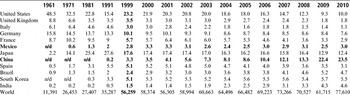
A profound readjustment in global territorial participation has occurred in the last decades (see Table 1). While the United States produced more than one-third of automobiles at the global level up until the mid-1970s, its participation fell to 9.3 per cent in 2009. The participation of European countries, especially the United Kingdom, France and Germany, also dropped. The case of Japan is particularly relevant: Japanese production increased significantly between 1971 and 1991, but fell to levels around 15 per cent by the early 21st century and to 12.9 per cent in 2009.
International Share of Automobile Production, 1961–2009 (Share over total)

Source: Own elaboration based on OICA (2011).
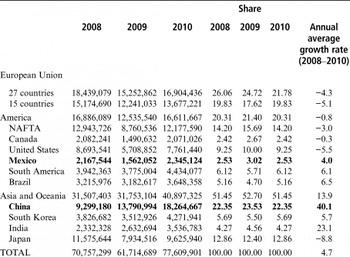
These trends reflect the increasing participation of Asian countries in the global production of automobiles, from barely 5 per cent in 1961 to more than 50 per cent in 2009. Looking at it from another angle, “emerging countries” such as Mexico, China, Brazil, India and South Korea substantially increased their participation. While China did not even figure in global production until the early 1990s, by 2010 it had transformed into the largest global producer, accounting for 23.5 per cent of automobiles manufactured throughout the world. Mexico has seen its participation fall since 2000, contributing only 2.5 per cent in 2009. Table 2 also reflects the differentiated effects of the 2008–09 crisis. While automobile production fell in 2009 in the European Union (with 27 and 15 countries) and the United States by 27.3, 19.3 and 34.3 per cent respectively, it increased 48.3 per cent in China. Mexico, highly dependent on the United States market (see below), also saw its production drop by 28 per cent.
Effects of the Global Crisis on Production of All Vehicles, 2008–2010

Source: Own elaboration based on OICA (2011).
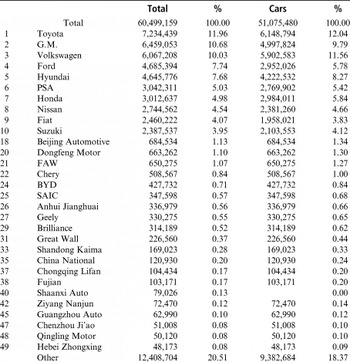
At the company level, the persisting predominance of the Japanese, North American and European companies also stands out: in 2009, Toyota, General Motors, Volkswagen, Ford and Hyundai headed total production. However, 21 Chinese companies now rank among the world's 50 primary automobile producers, including Chang An, BAICS, Dongfeng Motor, FAW, Chery, BYD, SAIC, Geely and Brilliance (see Table 3). This is significant given that less than a decade ago not one Chinese company existed in this category, and it is also significant that no Latin American manufacturer made the list in 2009.
Main Automobile Producers 2009

Source: Own elaboration based on OICA (2010).
Analysis of the AAC in Mexico and China
This section highlights a series of elements to understand the main characteristics of the AAC in Mexico and China. Without pretending an in-depth study of each case, the objective is to lay the foundations for a potential co-operation in S&T between the two countries in this chain, by focusing on the legal framework, market size, production, industrial organization, trade, primary strengths and respective debates.
In addition to the information outlined above, it is important to observe that in both countries, domestic vehicular “density” (cars per 1,000 inhabitants) is far below that of the European countries: 154 in Mexico and only 18 in China, compared with 499 in Germany. The potential for growth – while considering the serious ecological, environmental and energetic limitations – would appear to be very large in the two former countries.
The AAC in Mexico
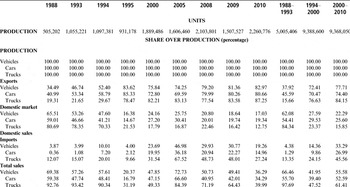
The automotive market in Mexico in its different segments represented 2.7 per cent of total GDP and 16.0 per cent of manufacturing GDP in 2009. There are currently 13 OEM company plants dedicated to passenger-vehicle production and another 11 for commercial vehicles.Footnote 14 The chain's intermediate consumption in 2009 was 984.175 billion pesos (or around US$78.734 billion) and production reached 1,566,842 vehicles, far below the historical high reached in 2008. Table 4 also illustrates that exports are the primary destination of AAC production in Mexico, accounting for 78 per cent of production for 2000–10, followed by automobiles and light and heavy trucks.Footnote 15 The 1994–95 crisis and the implementation of NAFTA, from this perspective, mark a turning point in the export orientation and an internal market that has still not recovered since that time. With around 1 million direct and indirect jobs in 10,742 companies, the AAC is one of the country's most relevant chains in terms of production, trade and employment.Footnote 16 Some 43 per cent of its employment is concentrated in the manufacture of automotive parts, 32 per cent in mechanic shops, 17 per cent in spare parts distributors, 8 per cent in the distribution and sales network, and 6 per cent in the finished product manufacturing industry.Footnote 17
Mexico: Total Production of Vehicles (production, sales and international trade) (1988–2010)

Source: Own elaboration based on INEGI and AMIA (several years).
It is important to remember that Mexico has a long history of incentives to the AAC, with five decrees between 1962 and 1993, the last of which aimed to achieve certain levels of added value in Mexico, as well as technological provisions and requirements related to the trade balance, among other purposes. With NAFTA, regional rules of origin govern Mexico's industrial organization: the regional content value (measured based on transaction and net cost value) established in NAFTA article 401 allows regional production to benefit from tariff reductions. Since 2002, the level of added value to benefit from the rules of origin is 62.5 per cent, with the objective of preventing foreign (especially Japanese) companies from using Mexico as an export “trampoline” to the United States.Footnote 18 On the other hand, Mexico has its own legislation to promote competitive advantages for the automotive industryFootnote 19 with several later decrees dating up to April 2010. In general, the Mexican legislation, evaluated up to August 2010, demands compliance with a series of provisions by new manufacturers of vehicles weighing up to 8,864 kilograms: the manufacture of at least 50,000 units; investment in Mexico of at least US$100 million in fixed assets for automotive production; and established agreements to distribute supply to consumers of the vehicles. A series of conditions also exists for new manufacturers without previous production in Mexico: in addition to the provisions above, exceptional permission is granted to import vehicles with zero ad-valorem tariff rates during the first three years of installation of a new manufacturer for 10 per cent of the production. This criterion continues even after the first three years of production.Footnote 20
There are several main current characteristics of the AAC in Mexico.Footnote 21 It is constituted by four large segments: assemblers, larger components and sub-assembly, parts and components, and raw materials. There are 17 assembly companies in the first segment, all of which are foreign. The automotive parts sector has around 1,500 national and foreign manufacturers.
The AAC is – along with the electronic and yarn-textiles-garments industries – one of the paradigmatic sectors of the Mexican economy (particularly the manufacturing sector) affected by the structural change oriented towards exports: unlike in the 1980s, it currently exports more than three-quarters of its production, predominantly to the United States. In other words, since the approval of NAFTA and its inauguration in January 1994, the AAC in Mexico is profoundly integrated with that of the United States, to such a degree that we could refer to a regional AAC (Canada, the United States and Mexico) with regional models, inputs, products and processes, in other words an industrial organization. Table 4 reflects how all the main segments of the AAC have experienced this export orientation, in both cars and trucks. In contrast, the internal market has suffered, and in 2008 and 2009 represented absolute levels below those of the early 1990s. From the perspective of the main business organizations,Footnote 22 this constitutes the primary structural problem of the AAC in Mexico: the lack of internal demand.
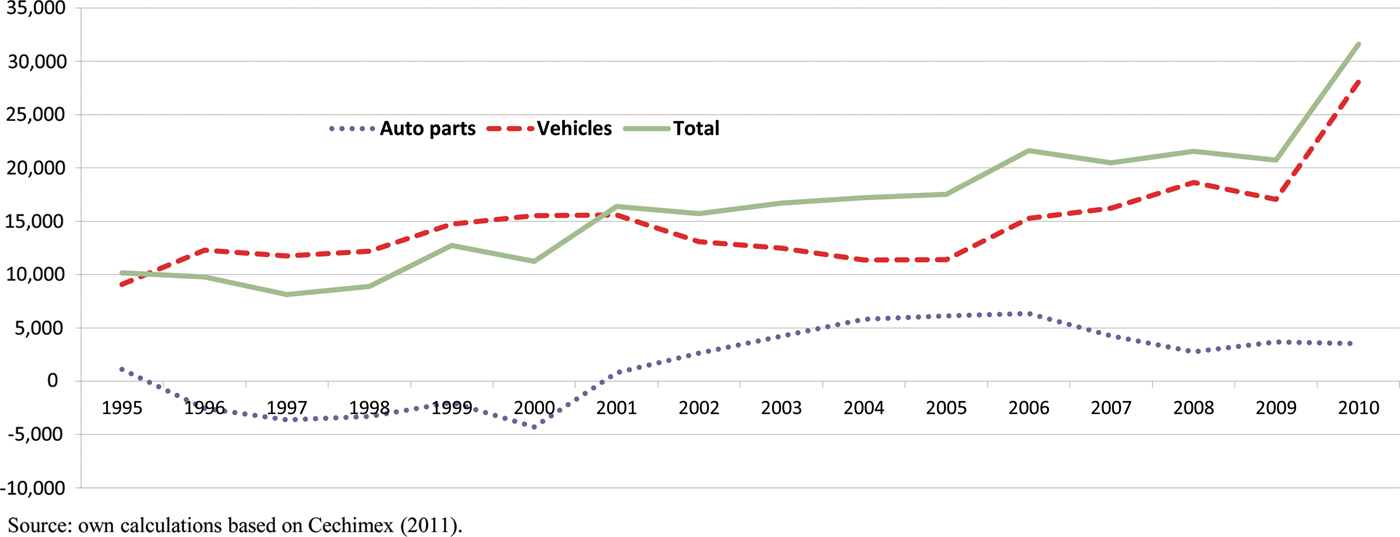
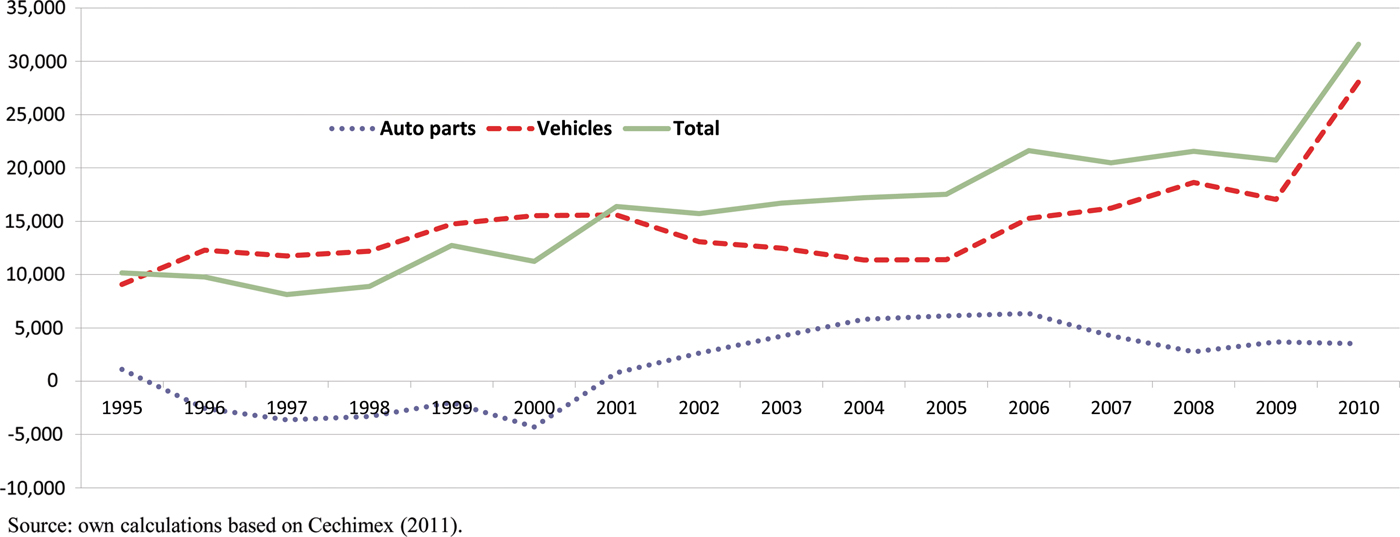
It is also important to note that Mexico's export orientation manifests more than 15 years of export experiences towards more than a dozen markets, with implications in transportation, logistics and intra- and inter-company relations. Furthermore, and considering the enormous importance for Mexico of the United States in the external trade of the AAC, the beginning of NAFTA in 2004 implied a deepening of regional industrial organization. Based on a detailed analysis of the trade of Mexico's AAC, various characteristics stand out.Footnote 23 The AAC has acquired more and more importance in Mexico's foreign trade, accounting in 2010 for 28 per cent and 17 per cent of total exports and imports respectively, with an annual trade surplus above US$20 billion since 2006, making it Mexico's most important trade surplus chain. The auto parts segment of the AAC has increased its participation in exports, contributing more than 60 per cent of the exports since 2004, while accounting for close to 80 per cent of AAC imports. However, more than 80 per cent of the AAC trade surplus is currently generated by the automotive segment (see Figure 1).
Mexico: Trade Balance of AAC, 1995–2010 (US$)
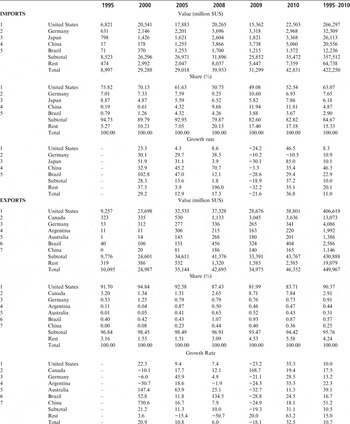
By countries, Mexico's AAC trade reflects the fact that more than 90 per cent of auto parts and automotive exports are directed towards the United States and Canada, while imports in both categories are significantly lower (less than 50 per cent of the total since 2008) from the NAFTA region. In auto parts, China has transformed into Mexico's second importer (with 11.81 per cent in 2010), followed by Germany and Japan, while in the automotive segment, Japan, Canada and Germany represented between 8 and 9 per cent of imported automobiles. In the last category, it is notable that in the mid-1990s the participation of the United States reached 88 per cent, dropping to 45 per cent in 2010. In auto parts as well, US participation in Mexico's total imports dropped from levels above 75 per cent in the 1990s to 53 per cent in 2010. Beyond the historic and current predominance of the United States in AAC trade, Table 5 reflects the important changes experienced by the AAC in trade, in particular China's very important growth in this category: exports to China and imports from China within the AAC grew with an average annual growth rate of 51.2 per cent and 46.3 per cent, respectively, between 1995 and 2009. As a result, Chinese participation in both categories was second in importance, outpaced only by the United States. However, the trade balance was very unequal for Mexico, with a trade deficit of almost US$5 billion in 2010.
Mexico: Trade of the AAC by Main Countries, 1995–2010

Source: Own elaboration based on Cechimex (2011).
At the subdivision level (6 digits of the Harmonized System), the primary Mexican automotive exports are concentrated in automobiles with cylinder capacities between 1,500 and 3,000 cm3 (over 60 per cent of the total in 2010), while auto parts imports are very diversified among more than 20 parts – including machinery, components, transmitter devices, motors, gearboxes, axles, steering boxes, gaskets and shock absorbers, among others – that represented 36 per cent of total parts imports in Mexico in 2009. A detailed tariff study of five subdivisions (and several dozen of respective fractions) of the AAC reveals that, in general, no import tariff exists, particularly with countries with which Mexico has a free trade agreement (currently numbering 42). Despite the above, a group of Latin American countries in particular (most importantly Brazil) and Asian countries (most notably China) receive no special tariff treatment, and in ten cases pay a 5 per cent tariff (for example, 87082901 and 87082910, among others). However, the case of subdivision 870323 (passenger vehicles with cylinder capacities above 1,500 cm3) stands out, in which the rest of the world – countries with which Mexico has not signed a FTA such as China – pay tariffs of between 30 and 50 per cent (for new and used cars with cylinder capacities between 1,500 and 3,000 cm3) respectively. As of 1 January 2012, the tariff for new cars from countries with which Mexico does not have a trade agreement will fall from 30 to 20 per cent. This disincentive to import automobiles is consistent with the previously noted policies for investing in Mexico and a consequence of the previously outlined NAFTA norms, although it generates a high “entry barrier” for new manufacturers, especially Chinese and Indian companies.
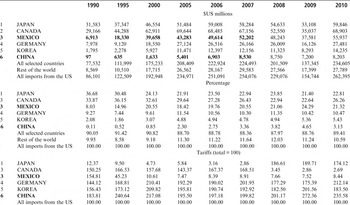
Considering the critical importance of the United States for the AAC trade,Footnote 24Table 6 illustrates the profound integration between Mexico and the United States in the AAC. For the United States as well, Mexico has consolidated itself since NAFTA as the primary importer: while Mexican AAC imports contributed barely 8 per cent in 1990, in 2009 Mexico converted into the primary exporter in the AAC to the United States, with 24.29 per cent, displacing even Japan, Canada and European Union countries. China, which in 1990 generated only 0.11 per cent of US AAC imports, presents the highest average annual growth rate of the primary exporters to the United States, calculated at 25.5 per cent during 1990–2009, with exports representing 5 per cent of the United States total (see Table 5).
United States: Imports in the AAC by Country, 1990–2010

Source: Own elaboration based on CECHIMEX (2011).
Table 6 also illustrates the enormous tariff benefits obtained by Mexico as a result of NAFTA and one of their primary objectives: for its respective AAC exports to the United States, only Canada is imposed lower tariffs than Mexico. In the case of China, for example, a 30-times higher tariff was levied in 2010. While the aggregated tariff is low – China pays 2.72 per cent on average – with small profit margins and at the specific product levels, these differences can play a critical role in decision-making. On the other hand, establishing plants to export from Mexico or Canada implies significant tariff incentives.
A further characteristic of the AAC in Mexico is that the AAC crisis since 2008 has had profound repercussions on North America and Mexico. In statistical terms, the AAC crisis during 2007–09 has been the most severe recorded for as long as comparative information has been compiled. With production of 1,566,842 units in Mexico,Footnote 25 it fell by 28.9 per cent from 2008 to 2009, with levels lower than in 2000. There has also been a profound impact on jobs: from August 2007, when the AAC registered its highest levels of production and employment, to January 2010, AAC sector employment dropped by 21.3 per cent. Table 6 also illustrates the 22 per cent collapse of AAC exports to the United States in 2009, although that of other countries was even higher (with average declines of 31 per cent). Chinese imports fell only 17.7 per cent, which also contributed to increase their participation in crisis periods.
It is also important to note that the auto parts industry – unlike the automotive, where manufacturers are all foreign – has significant Mexican participation and has increased its export value from levels approaching US$10 billion in the mid-1990s to over US$40 billion since then. This feature is one of the most relevant of the industrial organization of the AAC: Mexican capital only participates at the parts segment and none on the automobile segment; this is substantially different from China.
The auto parts segment in Mexico generates around US$30 billion in annual production,Footnote 26 although it dropped in 2009 in production, trade and employment terms (see above). In qualitative terms (on which much more specific work must be done) the auto parts segment is contradictory and full of paradoxes. On the one hand it presents a structure that fosters massive production and export to the United States in competitive conditions and prices. On the other, as discussed below, it is a segment in which the lack of greater development, particularly in the higher added-value segments, has hindered a “takeoff” of the AAC, as in many Asian countries.
In addition, the after sales sector represents an enormous market including much influence from informal and illegal sub-segments. There is a tendency in Mexico, often at the end of every six-year presidential period, to legalize millions of used cars that entered illegally from the United States, with very negative ecological effects (given that they are old cars, often with multiple mechanical or other problems) and economic repercussions (affecting the AAC and its socio-economic organization in Mexico).Footnote 27 Although innumerable studies and proposals have been drafted on the issue,Footnote 28 as of 2010 this important segment of the AAC has been unable to consolidate or regularize itself, and it is even increasingly addressed by imports of parts of dubious origin, constituting an additional public security problem.
Finally, the AAC exemplifies a large number of the contradictions of the export and “leading” sector in Mexico. It has increased its participation in GDP and employment, and has been constituted one of the most important groupings in terms of Foreign Direct Investment (FDI) and trade. However, parallel to its profound integration with the United States and other markets, it presents a “perverse” characteristic: the primary incentives (especially instruments for temporary import and subsequent re-export) to conduct its processes in MexicoFootnote 29 lead to the implementation of a minimal amount of innovation, science and technology, or development of new products and processes in Mexico. This contributes to the territorial polarization of the country because of its high concentration in a couple of states, and reproduces one of the main structural characteristics of FDI: its low research and development/gross domestic product ratio (R&D/GNP), particularly in the FDI-controlled segments.Footnote 30 In this way, the AAC presents R&D/GNP coefficient levels below manufacturing as a whole, at 2.03 per cent and 4.32 per cent, respectively.Footnote 31 Note that while the branches without FDI reach levels of 3.42 per cent, those with FDI levels above 50 per cent of their social capital are only 1.33 per cent. Nevertheless, 72 per cent of employment of the AAC is concentrated in the companies controlled by FDI.
In this way, the AAC in Mexico presents a series of important experiences and benefits: several decades of intra- and inter-company experiences; an important network of free trade agreements and effective tariff benefits with its primary trade partners (particularly the United States and Canada but also the European Union, several Latin American countries and Japan); and an industrial organization in operation for several decades, that with NAFTA reconverted into a regional export motor. It should not be underestimated that the AAC in Mexico has achieved a certain degree of diversification in both imports and exports, although the first are still extraordinarily concentrated in the NAFTA countries. Mexico today is the primary AAC exporter to the United States.
Nevertheless, the AAC in Mexico also reflects a series of industrial organization and development difficulties: high dependency on the United States and its three main automotive companies in the automobile segment; structural weakness of its auto parts and automotive industry inputs production sector, and the lack of science and technology processes, with the resulting lack of upgrading and higher added-value processes and products in the AAC. Public policies have explicitly to consider that Mexican firms only participate in the auto parts segment.
The AAC in ChinaFootnote 32
A recent group of analysesFootnote 33 have highlighted the impressive long-term effort by China to achieve an effective upgrading process in the AAC. While China remains far behind the S&T levels of industrialized countries, it has made enormous efforts to increase expenditures in S&T, which are well above respective coefficients in Latin American countries and Mexico. To what may we attribute this behaviour, specifically for the AAC established in Mexico?
A series of phases may be identified for the AAC in China: from the 1970s until the first five-year programmes indicating AAC support policies; from the mid-1980s until 2005/2007, a period in which the AAC in China massively fomented foreign investments in China through joint ventures; and since the final years of the 20th century, when the Chinese companies, now as OEMs and not as suppliers, begin to impose production and trade conditions. The automobile segment in China currently presents at least seven companies with their own brands – BAIC, SAIC, FAW, Geely, Chery, BYD and Foton – with effective potential to compete in global markets in the medium term.Footnote 34
It is important to remember that the AAC is a sector actively supported by the central and provincial governments since at least the 1980s. Even as far back as the 1950s, projects were presented to develop the AAC and companies such as China First Automobile Works (FAW) (currently one of the primary automobile manufacturers) and sites for passenger vehicle production in Shanghai and Dongfeng, among others.Footnote 35 Nevertheless, it was in 1994, with the “Industrial Policy on Development of the Automotive Industry,” that more aggressive strategies began, not only for supply but also to enhance consumption of this production. After joining the WTO, the central government implemented various new policies and notices on behalf of the National Commission on Development and Reform to make the existing measures compatible in respect of the limitations on the trade balance and added value coefficients, among other things, and especially to consolidate the existing AAC. This latter issue was also explicitly addressed in the 12th official Five-Year Plan (2011–15).Footnote 36 However, the measures established in the tenth Five-Year Plan (2001–05), those on joining the WTO and policies oriented towards FDI are the ones that fostered an increase in automotive production from less than 2 million units at the end of the 1990s to almost 14 million in 2009. In this period, more than 170 massive co-investments were fostered,Footnote 37 and the need was emphasized for the development of “independent technologies.” Several dozen decrees, notices and administrative measures relevant to the sector have been implemented since 2000.Footnote 38 Since 2006 the National Commission on Development and Reform has even explicitly sought to “consolidate” the automobile manufacturers and the auto parts companies, although with little success as of 2010.
In addition it is necessary to underline a couple of important structural elements of the Chinese AAC. With more than 160 OEMs and 4,600 auto parts manufacturers (China Council for the Promotion of International Trade [CCPIT] 2009), the levels of economics of scale are low and inefficient and also reflect a very high level of competition. The Chinese AAC stands out for its very high R&D investment levels, well above the rest of the economy, as well as a substantive increase in productivity (tripling between 2000 and 2007),Footnote 39 with relatively small increases in direct employment. Finally, as detailed by Yin, in the first decade of the present century the Chinese AAC is notable for the appearance of a group of provincial OEM companies actively supported by their respective provincial governments, such as Chery, Geely and BYD, which in 2009 already represented almost 30 per cent of total passenger car sales in an extremely competitive market. It must be emphasized that these local companies, including Great Wall and Anhui Jianghuai, do not have significant co-investments with foreign companies and are the result of regional production networks.Footnote 40
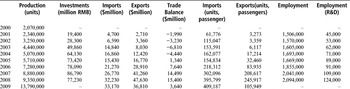
Table 7 presents some of the primary trends in production and trade. The information on production (see Table 1) illustrates the continuous growth of auto production, from fewer than two million units in the late 1990s to almost 14 million in 2009. It was not until 1999 that China first produced more automobiles than Mexico. Table 7 also illustrates that, for the moment and given the spectacular growth rates in AAC production, trade still plays a smaller role and falls below 5 per cent of total production. Exports are particularly strong in auto parts, but present a deficit in passenger vehicle trade. Finally, it indicates that both investments and productivity have substantially increased – employment far below production – while employment in R&D increased from 3 per cent to 6 per cent during 2001–08. Annual productivity increased by an average of 16.3 per cent during 2001–08.
China's AAC: Some Characteristics, 2000–2009

Source: Own elaboration based on several sources (2010).
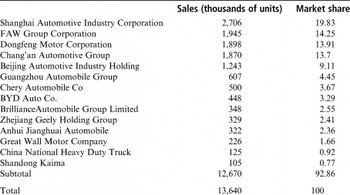
Probably one of the most relevant observations, from a Latin American perspective, is that in addition to the impressiveness of the Chinese companies in terms of their numbers in both the automobile and auto parts segments, their participation increased from under 5 per cent in 2000Footnote 41 to almost 30 per cent in 2009, and is projected to surpass 35 per cent by 2015.Footnote 42 This process reflects the success of various policies and instruments in terms not only of increased overall production, but in particular of production by Chinese brand companies such as SAIC, FAW, Dongfeng, Chang'an, BAIC, Guangzhou Automobile Group, Chery, BYD, Brilliance, Geely and Great Wall, among others. Unlike Latin America, which has no national or even regional brand, China currently boasts six or seven of its own brands with enormous potential.
Table 8 presents the important production capacity and installed capacity of the Chinese companies. Five of these companies are already producing more than 1 million units, and three more Chinese companies will soon join them. Around seven of this group, who have all achieved technological integration through FDI, have enormous potential and innovation capacity: BAIC, SAIC, Chery, Geely, BYD, FAW and Dongfeng. While all the public companies (except the regional companies such as Chery, Geely and BYD) have co-investments that date back more than a decade, several of the rest have achieved other arrangements: in 2010, Geely acquired Volvo, for example, while BYD has received much financial support from the central government and through FDI. It is also important to understand that several decades ago the AAC in China began with a relatively “primitive” and endogenous process of AAC creation. Since the 1980s and especially in the 1990s, the government fomented co-investments with FDI with the objective that the companies consolidate learning processes. However, these same companies are currently initiating massive processes of independence and autonomy from their co-investors in order to develop their own models, distribution centres and technology. The purchase of international companies and the huge productive capacity – several of those interviewed indicated that production could increase in 2015 to as high as 35 million units annuallyFootnote 43 – would appear to indicate that in the medium and long terms the AAC companies have initiated a process of international positioning through exports and investments in countries such as Iran, Russia, the Ukraine and Egypt, among others.
Sales by Firm (2009) and Market Share

Source: Own elaboration (2010).
Based on a detailed analysis of Chinese AAC trade, the following points stand out. First, Chinese AAC exports are distinguished by the 96 per cent preponderance of auto parts during 1995–2009. This structure is also reflected in the trade with the United States. In addition, in response to the growth of internal demand in 2009 and parallel to the international debacle, exports fell 12.5 per cent in 2009, although they are expected to recover in 2010–15. Second, imports are much more balanced between auto parts and the automotive sector, resulting in a positive trade balance of the AAC. Third, Chinese AAC demand through imports has expanded impressively, with an average annual growth rate of 20.3 per cent during 1995–2008, reaching more than US$45.7 billion in 2008, 66 per cent of that corresponding to auto parts. And finally, a relatively low level is observed in AAC trade between Mexico and China, with exports of US$690 million and imports of US$149 million in 2008, more than 90 per cent of which is concentrated in auto parts.
What are the possible spheres of strength of the Chinese AAC in innovation terms? A first tier of companies currently exists in China – formed in particular by Chang'an, Chery, Dongfeng, SAIC, FAW, Geely, Jianghua, Great Wall, Beiqi Foton and Shenyang – that lead both auto production and S&T efforts, most concretely visible in patents.Footnote 44 These companies (especially the individual brand names such as BYD, Chery, Geely and Great Wall) are also responsible for the greatest efforts in terms of exports and of acquisition of foreign companies and technologies.Footnote 45 A second strength is that the Chinese public sector, including at the city, provincial and central government levels, will continue to apply diverse policies to foment the AAC, as demonstrated by the 2009 “Plan to Adjust and Revitalize the Automotive Industry” and the tax reductions for auto purchases in 2010. The 12th Five-Year Plan (2011–15) also proposed to multiply measures to favour and stimulate the sector, in particular the private brand name companies. This is the most promising sector in the short, medium and long terms for the establishment of co-operation and exchanges. Third, automobiles that use new energy sources, especially electric cars and energy efficient models, will receive massive incentives through the 12th Five-Year Plan, and companies such as SAIC, FAW and BYD will obtain resources and conduct R&D to lead these new technologies even at the global level. Finally, as a result of the continuous increase of installed capacity and of programmes such as “going global,” it is anticipated that China may considerably increase its exports, in particular in auto parts but also in diverse automobiles. If China were to export 20 per cent of its production over the coming five years, perhaps some five million autos, it could generate massive adjustments and problems in the international AAC markets.
Co-operation Options
These two economies, Mexico and China, have achieved different trajectories of production and technology in the past 15 years. China was able to transform itself into the leading global producer with a growing domestic technological structure based on profound and widespread policy measures, in which public finance and industrial and trade policies have a critical role. Foreign trade, however, continues to play a limited part in China's AAC: while almost one in four cars are produced in China, from a qualitative perspective China has generated hundreds of domestic brands in the automobile and auto parts segments. In contrast, Mexican firms only participate in the auto parts segment in Mexico. Meanwhile, Mexico opted with NAFTA for an export-oriented structure with limited “territorial endogeneity” given that its export processes are based on temporary imports to be re-exported. As a result, Mexico has an extensive network of suppliers that has allowed it to transform into a substantive export base, both within NAFTA and beyond, in North America. This specialization has also generated profound technological weaknesses and reduced added-values, despite the potential among a wide group of countries with which Mexico has trade agreements.
The critical role played by the AAC was also confirmed in both countries in terms of production, employment and foreign trade (albeit still to a lesser degree in China), and in the weight assigned to it by the public sector. China shows massive long-term trade, investment, foreign direct investment, R&D and “going global” strategies, parallel to import financing, in contrast to Mexico's macroeconomic stabilization strategies. In the same way, it has already converted into the second most important value chain within bilateral trade between Mexico and China, and its potential suggests it will most certainly take over the first position in the medium term. There is an important source of competition and conflicts in the AAC between the two countries, particularly if we consider that China will not be able to continue with the same path of consumption of vehicles as in the past five years: that is, if the growth rate of consumption slowed to levels of 10–15 per cent it would be able to export 20–30 per cent of its production, or more than five million vehicles, doubling Mexico's total production. The potential for conflict in the short and medium run is significant in the NAFTA region but also globally. Based on these trends – and the experience of Mexico in other value-added chains such as yarn-textile-garment and also electronics – co-operation between Mexico (and the NAFTA region) with China is plausible and of interest for all affected countries.
In the area of co-operation, there are at least three relevant categories: institutional strengthening between Mexico and China; connections between mid-level actors in the Chinese and Mexican AACs to improve exchange and mutual knowledge; and specific projects on the part of both public sectors to intensify the AAC relationship between the two countries at the company level.
In the first category, the institutions in charge of promoting international co-operation between the two countries, especially the CCPIT and ProMéxico but also the China–Mexico Binational Commission and the 2011–15 Joint Action Programme, hold primary responsibility for influencing the academic, private and public sectors to combine efforts in concrete co-operation in the AAC, as opposed to the current situation in which each company conducts individual or “atomized” efforts. Considering the technological, productive and trade specialization trajectories, the AAC in the two countries appear to be relatively complementary to each other, although much more in-depth analysis in this area is necessary. The noted institutions require investments and the finance of projects in the AAC within a short, medium and long-term agenda. In the short term, it at least appears that investments by Chinese automobile manufacturers have great potential in Mexico, for both the domestic market and export from Mexico. From Mexico's perspective, on the other hand, it will surely be important to adapt and modify regulations relevant to investing in the sector in Mexico, including reducing entry barriers that appear to be directly aimed at producers from India and especially China, and to allow companies to invest in the auto parts segment in China. In both cases, initial projects have already been pursued, although they have fallen far below expectations and included overwhelming failures; some of the failures show that Chinese automobile producers do not necessarily behave differently from other foreign automobile producers and, on the contrary, are ill-prepared and require support from other institutions.Footnote 46 While there are positive examples of co-operation,Footnote 47 a lot more analysis needs to be done.
Parallel to the institutional efforts, outreaches between mid-level personnel – including company, public functionary and academic actors – appears to be critical. The opinions of businesspeople from both countries and results obtained from my own studies suggest that mutual knowledge in general, and specifically in the AACs, remains very limited. Cultural and language barriers, but above all the barriers posed by the different business cultures of the two countries, are still very high, and are shrinking only very gradually in response to specific efforts by institutions and companies, with very high costs (such as between FAW and Grupo Salinas, but also multiple AAC companies in both countries). CCPIT, ProMéxico, and in the case of Mexico other institutions such as CONACYT and the Secretary of Foreign Relations, should direct support through the instruments available to them, including grants, institutional ties, delegation visits, specialized contacts between counterparts, business exchanges, seminars, forums and so on, to create effective technical bridges that increase knowledge in the AAC between the two countries.
Third, CCPIT, ProMéxico, the Foreign Relations Ministries of both countries and the Mexico–China Binational Commission have the opportunity and responsibility to pursue a group of concrete projects for the AAC, with finance from the noted institutions for at least their initial phases. For example, it would be possible to carry out three or four projects in China and Mexico respectively linked to the AAC between the two countries; the latter is particularly relevant since several Chinese firms in the AAC chain have showed interest in investing in Mexico, but the results have so far been very limited. From the Chinese perspective, understanding the legal framework, that Mexico is different from the rest of Latin America as being part of NAFTA and with free trade agreements with 43 countries, the Mexican business culture in the AAC, and the real and effective process for establishment in Mexico may be projects to pursue in the short term. From a Mexican perspective, thematic priorities may include the incorporation of its exports to the growing Chinese demand, the capacity to enter into negotiations with Chinese manufacturers to achieve effective technological transfer in Mexico, as well as support for Chinese manufacturers to integrate themselves within existing supplier networks in the country. A subsequent group of thematic approaches and projects could be derived from these initial projects, to deepen co-operation perspectives between the two countries further.
From this perspective, both countries have the potential for effective co-operation within the framework provided by the existing institutions: the 2011–15 Joint Action Programme, the China–Mexico Binational Commission and the High Level Group, among others. The case of the AAC will be increasingly relevant between both countries, and if measures are not applied, the binational relationship in particular in the trade and economic spheres may deteriorate. Current industrial organizations in both countries show an important potential for co-operation: while China's firms are being firmly supported by the central government and respective policies to “go global,” with important technological developments, financial support and very competitive prices, the Mexican AAC has had several decades of being a supplier to mature markets such as the United States and the European Community; this experience in concrete terms – from production, engineering at the plant, client–supplier relationships, networks of existing suppliers and logistics in the NAFTA region – is critical for relative newcomers in the global competition process such as China, which is lacking this expertise.
As discussed in the beginning of this article, this detailed analysis does not allow for a simplistic “positive” versus “negative” attitude in the China–Latin America/Mexico relationship. On the contrary, it requires specific and detailed knowledge to make specific proposals, since otherwise, concepts such as “co-operation” become empty of any content. In the case of the AAC there is a vast concrete space for co-operation, in addition to currently developed and future technologies such as hybrid and electronic vehicles which are being developed in China. As a result of their particularities – such as very heavy batteries – co-operation with Mexico and the logistics for selling in NAFTA from Mexico are very strong advantages.