Introduction
The common cutworm, Spodoptera litura (Fabricius) (Lepidoptera: Noctuidae) is a serious agricultural insect pest in Asia, Australia, New Zealand and Hawaii (IIE, 1993; Zhang, Reference Zhang1994). It has a vast host range of 120 economically important plant species, including grains, vegetables, fruits, cotton, jute, tea, tobacco and ornamentals (Venette et al., Reference Venette, Davis, Zaspel, Heisler and Larson2003). The S. litura larvae have exhibited high-levels of resistance to insecticides (Ramakrishnan et al., Reference Ramakrishnan, Saxena and Dhingra1984; Armes et al., Reference Armes, Wightman, Jadhav and Ranga Rao1997; Kranthi et al., Reference Kranthi, Jadhav, Kranthi, Wanjari, Ali and Russell2002). There is tremendous pressure from farmers for alternative effective and eco-friendly pre-harvest methods for controlling this pest below economic threshold level.
In this context, the radiation-induced genetic control method known as sterile insect technique (SIT) can be employed as a form of biological control of pest species (Vreysen & Robinson, Reference Vreysen and Robinson2011). This exploits the insect's mate-seeking expertise to introduce genetic abnormalities into the eggs of the wild population. Lepidopteran insects are much more radio-resistant to induction of dominant lethals than insects of other orders such as Diptera (Bauer, Reference Bauer1967; Bakri et al., Reference Bakri, Mehta, Lance, Dyck, Hendrichs and Robinson2005). The application of a high radiation dose resulting in 100% sterility would reduce the competitiveness of released radio-sterilized male moths (Carpenter et al., Reference Carpenter, Bloem, Marec, Dyck, Hendrichs and Robinson2005; Parker & Mehta, Reference Parker and Mehta2007). Therefore, this limitation has led to modification of SIT into F 1 (inherited) sterility technique using a sub-sterilizing dose to the male parent, that is employed for suppression of lepidopteran pests in the next filial generation (North, Reference North1975).
There is a continued growing interest to enhance the efficacy of SIT as a powerful control tactic towards suppression and/or eradication of major Lepidopteran pests (Simmons et al., Reference Simmons, Suckling, Carpenter, Addison, Dyck and Vreysen2010). The SIT/F 1 sterility has been studied in many economically important pests of Lepidoptera, including Cydia pomonella L., (Proverbs et al., Reference Proverbs, Newton and Logan1978; Bloem et al., Reference Bloem, Bloem, Carpenter and Calkins1999a , Reference Bloem, Bloem, Carpenter and Calkins1999b , Reference Bloem, Bloem, Carpenter and Calkins2001, Reference Bloem, Carpenter, Bloem, Tomlin and Taggart2004; Blomefield et al., Reference Blomefield, Bloem and Carpenter2010; Carpenter et al., Reference Carpenter, Blomefield and Hight2013), Thaumatotibia leucotreta (Bloem et al., Reference Bloem, Carpenter and Hofmeyr2003; Nepgen et al., Reference Nepgen, Hill and Moore2015), Manduca sexta (Seth & Reynolds, Reference Seth and Reynolds1993), Pectinophora gossypiella (Staten et al., Reference Staten, Rosander and Keaveny1993; Bloem et al., Reference Bloem, Bloem and Tan2000), Lobesia botrana (Saour, Reference Saour2014; Steinitz et al., Reference Steinitz, Sadeh, Kliot and Harari2015), Ephestia kuehniella (Marec et al., Reference Marec, Kollárová and Pavelka1999), Lymantria disbar L., (Mastro, Reference Mastro1993), Cactoblastis cactorum (Carpenter et al., Reference Carpenter, Bloem and Bloem2001; Hight et al., Reference Hight, Carpenter, Bloem and Bloem2005; Tate et al., Reference Tate, Carpenter and Bloem2007), Phthorimaea operculella (Saour & Makee, Reference Saour and Makee1997, Reference Saour and Makee2004; Makee & Saour, Reference Makee and Saour2001), Epiphyas postvittana (Soopaya et al., Reference Soopaya, Stringer, Woods, Stephens, Butler, Lacey, Kaur and Suckling2011; Jang et al., Reference Jang, McInnis, Kurashima, Woods and Suckling2012; Follett & Snook, Reference Follett and Snook2012), Plodia interpunctella (Ayvaz et al., Reference Ayvaz, Albayrak and Karaborklu2008) and Plutella xylostella (Hoa & Tien, Reference Hoa and Tien2001).
Certain SIT programs are successfully operational against Lepidopteran pests such as the pink bollworm in the USA (Staten et al., Reference Staten, Rosander and Keaveny1993; Bloem et al., Reference Bloem, Bloem, Carpenter, Dyck, Hendrichs and Robinson2005; Simmons et al., Reference Simmons, Alphey, Vasquez, Morrison, Epton, Miller, Miller, Staten, Vreysen, Robinson and Hendrichs2007), the codling moth in western Canada (Dyck et al., Reference Dyck, Graham and Bloem1993; Bloem et al., Reference Bloem, Bloem and Tan2000, Reference Bloem, Carpenter, Mccluskey, Fugger, Arthur, Wood, Vreysen, Robinson and Hendrichs2007a ; Vreysen et al., Reference Vreysen, Carpenter and Marec2010; Knipple, Reference Knipple2013), the false codling moth in South Africa (Carpenter et al., Reference Carpenter, Bloem, Hofmeyr, Vreysen, Robinson and Hendrichs2007; Hofmeyr et al., Reference Hofmeyr, Carpenter, Bloem, Slabbert, Hofmeyr and Groenewald2015), the cactus moth in the USA and Mexico (Hight et al., Reference Hight, Carpenter, Bloem and Bloem2005; Hernández et al., Reference Hernández, Sánchez, Bello, González, Vreysen, Robinson and Hendrichs2007; Bloem et al., Reference Bloem, Bloem, Carpenter, Hight, Floyd, Zimmermann, Vreysen, Robinson and Hendrichs2007b ) and the painted apple moth in New Zealand (Wee et al., Reference Wee, Suckling, Burnip, Hackett, Barrington and Pedley2005; Suckling et al., Reference Suckling, Barrington, Chhagan, Stephens, Burnip, Charles, Wee, Vreysen, Robinson and Hendrichs2007).
Further, this radio-genetic technology (involving F 1 sterility) has also been examined for the management of several noctuid species of Lepidoptera, such as Helicoverpa armigera (Ocampo, Reference Ocampo2001; Ocampo & De Leon, Reference Ocampo and De Leon2002), Helicoverpa zea (Carpenter & Gross, Reference Carpenter and Gross1993), Spodoptera frugiperda (Carpenter et al., Reference Carpenter, Rayani, Nelly and Mullinlx1997, Arthur et al., Reference Arthur, Wiendl, Wiendl and Aguilara2002), Spodoptera exigua (Carpenter et al., Reference Carpenter, Hidrayani and Sheehan1996) and Trichoplusia ni (North & Holt, Reference North and Holt1969).
We have earlier proposed 100 Gy as an effective sub-sterilizing dose for management of S. litura in F 1 sterility program (Seth & Sehgal, Reference Seth and Sehgal1993; Seth & Sharma, Reference Seth and Sharma2001). When a sub-sterilized male moth mates with a normal female (0 Gy), there is a reduction in the production of F 1 progeny, with higher proportion of male offspring that are almost completely sterilized. The optimal dose of radiation to be used in F 1 sterility involves a trade-off between the level of sterility achieved in treated individuals and physiological damage leading to suppression of competitiveness, relative to wild individuals, both of which would increase with radiation dosage (Suckling et al., Reference Suckling, Pedley and Wee2004a , Reference Suckling, Wee and Pedley b ; Wee et al., Reference Wee, Suckling, Burnip, Hackett, Barrington and Pedley2005; Kean et al., Reference Kean, Stephens, Wee, Suckling, Vreysen, Robinson and Hendrichs2007). The development and growth of F 1 progeny are also likely to be influenced by a carryover effect of the sub-sterilization in male parent. To accomplish this phenomenon, the dose selected should not drastically affect the male fitness and mating performance of the parent and F 1 generation.
The S. litura is a serious cut flower pest that requires post-harvest treatment (Dohino et al., Reference Dohino, Masaki, Takano and Hayashi1996). The EPPO has listed S. litura as an A1 quarantine pest (OEPP/EPPO, 1979). Several approaches to develop effective post-harvest treatments for the cut flower industry have been tried (Seaton & Joyce, Reference Seaton and Joyce1988, Reference Seaton and Joyce1989; Seaton et al., Reference Seaton, Joyce and Enright1989). Disinfestation by gamma irradiation is rapid, effective and can be potentially used. Both floral materials and pest species vary in their sensitivity to radiation (Hansen & Hara, Reference Hansen and Hara1994). Therefore, dose selection of gamma radiation is crucial for disinfestation of S. litura.
Ultraviolet and gamma irradiation inflict severe alterations in biochemical homeostasis, resulting in oxidative stress (Peng et al., Reference Peng, Moya and Ayala1986; Datkhile et al., Reference Datkhile, Mukhopadhyaya, Dongre and Nath2009; Wang et al., Reference Wang, Wang, Zhu, Ma and Lei2012; Sachdev et al., Reference Sachdev, Zarin, Khan, Malhotra, Seth and Bhatnagar2014). Notably, two major pathways, the anti-oxidant defense and phenoloxidase (PO) cascade, are impacted. Detoxification of excessive reactive oxygen species (ROS) is carried out by key anti-oxidant enzymes, mainly superoxide dismutase (SOD), catalase (CAT) and other peroxidases (Felton & Summers, Reference Felton and Summers1995). The radiation-inflicted damaged cells and tissues are repaired by PO cascade zymogens, mainly prophenoloxidase (PPO) and its activating enzyme (PPAE). Upon wounding, bacterial infection and radiation challenge, PPO results in generation of active PO, which leads to melanin deposition at the site of injury (Kanost et al., Reference Kanost, Jiang and Yu2004; Kanost & Gorman, Reference Kanost, Gorman and Beckage2008; Jiang et al., Reference Jiang, Vilcinskas and Kanost2010).
The present study was conducted to ascertain the transcriptional regulation of PO cascade and free radical scavenging enzymes in irradiated S. litura neonates (L1) and adult moth. These results were correlated with the growth and survival of the insect so as to judge the intrinsic quality of P 1 and F 1 insects. These findings will lead to optimization of gamma dose to be employed in inherited sterility technique for pest control and quarantine treatment.
Experimental methods
Insect rearing
A continuous culture of Spodoptera litura (Fabricius) was maintained in our insectary at the Department of Zoology, University of Delhi, India. The culture was initially established from larvae and moths collected from infested fields at Indian Agricultural Research Institute (IARI), New Delhi, India. Larvae were reared on a semi-synthetic diet under ambient environmental conditions, 27.0 ± 1°C temperature, 75 ± 5% relative humidity and photoperiod of 12:12 h (light:dark) (Seth & Sharma, Reference Seth and Sharma2001).
Irradiation of Spodoptera litura neonates and adults
Irradiation was performed at the Radiobiological unit of the Institute of Nuclear Medicine and Allied Sciences (INMAS, Delhi, India). The irradiator was a panoramic 60Co point source (Gammacell 5000; BRIT, Bhabha Atomic Research Centre, Trombay, India) with a dose rate of ca. 1.91–1.98 KGy h−1 (±5% Fricke dosimetry).
Two life stages viz. neonates (L1) and freshly eclosed adult moths (0–1 day old) were exposed to gamma radiation. Cohorts of five virgin adult S. litura male and female moths were chilled (0–2°C), placed into glass petri dishes and irradiated. Similarly, ca. 50–100 neonates were exposed to radiation. An optimal dosage of 100 Gy was applied based on our previous studies for S. litura program (Seth & Sehgal, Reference Seth and Sehgal1993; Seth & Sharma, Reference Seth and Sharma2001). Control neonates and adults were also carried from our laboratory to INMAS radiation facility and were subsequently brought back without any exposure to radiation.
Radio-sensitivity of neonates and F 1 progeny from irradiated male parent in terms of growth, development and survival
The freshly emerged L1 derived from unirradiated (normal) adult moths were irradiated at 100 Gy dose in a group of 25 individuals. Further, male moths sub-sterilized with 100 Gy were crossed with normal females and subsequent F 1 progeny were evaluated for the growth and metamorphic development of the larvae, and correlated with reproductive parameters as described earlier (Seth & Sehgal, Reference Seth and Sehgal1987, Reference Seth and Sehgal1993; Seth & Sharma, Reference Seth and Sharma2001). Also, the malformation of developed adult was observed in each regimen.
Statistical analysis
Data recorded from the experiments was usually replicated ten times, unless otherwise specified and subjected to analysis of variance (ANOVA). Percentage data was transformed using arcsine √x value before ANOVA, but data shown in tables are back transformations. The P-value (≤0.05) was considered significant. LSD post-test was performed to determine significant differences among the mean values in different treatments (Snedecor & Cochran, Reference Snedecor, Cochran, Snedecor and Cochran1989).
Effect of gamma irradiation on transcript abundance of PO pathway and anti-oxidant genes
Larval stages and body tissues
The 100 Gy irradiated neonates (L1) were reared until 6th-instar larvae (L6), and different body tissue was collected from larvae that survived radiation stress. In another regimen, the 100 Gy irradiated male adults were allowed to mate with normal females, and the resulting F 1 progeny that reared until 6th-instar larvae (F 1 L6). Whole body tissue of 3rd-instar larvae viz. naïve L3 (0 Gy), L3 derived from 100 Gy treated L1, and F 1 L3 derived from irradiated male parents crossed with normal females. Hemolymph of 6th-instar larvae viz. naïve L6, L6 derived from 100 Gy treated L1 and F 1 L6 derived from irradiated male parent crossed with normal female, was collected for RNA isolation.
Isolation of hemocytes and whole body tissue
The S. litura 6th-instar larvae (L6) were pierced in their prolegs using a sterile needle and hemolymph was collected into pre-chilled anti-coagulant buffer. The mixture was spun at 700× g for at 4°C for 5 min. The supernatant was removed carefully and the pellet containing hemocytes was resuspended in Trizol reagent (Invitrogen, Carlsbad, CA, USA) and stored at −70°C until further use.
The whole body tissue was rinsed with DEPC-water and then crushed in Trizol reagent using a homogenizer (Sigma Aldrich, MO, USA) and sterile grinder tips.
Total RNA isolation and cDNA synthesis
Both whole body tissue and hemocytes were processed for RNA isolation as per the manufacturer's guidelines. For total RNA isolation from whole body tissue, the number of larvae taken for RNA preparation varied with the size of larvae. Hence, approximately 100 neonates (L1) were pooled per treatment and one larva of 3rd instar (L3) per treatment, were homogenized in 1 ml of Trizol reagent. The lysate was centrifuged at 12,000 × g for 10 min at 4°C to remove the insoluble material. Clear supernatant was transferred to a sterile tube and allowed to stand at room temperature for 5 min to permit complete dissociation of nucleoprotein complexes. To the supernatant, 0.2 ml of chloroform was added and mixed by vigorous shaking for 15 s. Phase separation was done by centrifugation at 12,000 × g for 15 min at 4°C. The upper aqueous phase containing RNA was collected in a fresh sterile tube and RNA was precipitated with the addition of 0.5 ml of isopropanol followed by incubation at room temperature for 10 min. The mixture was centrifuged at 12,000 × g for 10 min at 4°C to pellet the RNA. The pellet was washed with 75% ethanol, air-dried and dissolved in DEPC-treated water (Ambion, CA, USA) by heating at 60°C for 10 min.
For total RNA isolation from hemocytes, five larvae of 6th instar (L6) were pooled per treatment to obtain 200 µl of hemolymph and hemocytes were collected as described in the previous section. The pellet containing hemocytes was resuspended in 1 ml of Trizol reagent and total RNA was isolated as described above.
The RNA yield and purity were assessed by two methods: spectrophotometric analysis using NanoDrop 2000 (Thermofisher Scientific, DE, USA) and agarose-gel electrophoresis. The amount of RNA was quantified as 5 µg in L1 (100 neonates), 10 µg in L3 (1 larva) and 5 µg in L6 hemocytes (5 larvae were bled). Absorbance ratio was checked and samples with A260/280 ratio between 1.8 and 2 were considered superior and subjected to agarose gel analysis. RNA samples, which showed intact bands (28S and 18S) were used in further studies. Genomic DNA (gDNA) contamination from RNA was removed prior to quantitative PCR (qPCR) using RQ1 RNAse-free DNAse I (Promega, WI, USA). Complete gDNA removal was confirmed by PCR.
cDNA was prepared using 1–5 µg of total RNA of whole body tissue and hemocytes using Superscript-III first strand cDNA synthesis system (Invitrogen, CA, USA) and Oligo (dT) primer. The cDNA was diluted 5-fold and used to test primer efficiencies for Real-time reverse transcription-polymerase chain reaction (RT-PCR).
Bacterial challenge to irradiated larvae (dual stress)
As described above, S. litura neonates and adult males were exposed to 100 Gy dose and reared until 6th-instar. The resulting progeny i.e. L6–100 Gy and F 1 L6, were challenged with gram-negative bacterium, Photorhabdus luminiscens sub spp. akhurstii (Strain K-1).
The P. luminiscens was grown in 2% LB broth (Luria Bertani) (Difco laboratories, Detroit, MI, USA) at 28°C for 12 h with constant shaking at 180 rpm. The number of the injected bacteria was estimated by plating a known volume of injected suspension (107 cells ml−1) on 2% LB-agar plates. An estimation of lethal and sub-lethal dosage was obtained on the basis of the dose at which improper feeding and mortality were caused (data not shown).
The overnight grown bacterial cells were spun down, washed and resuspended in Ringer's solution. Five microlitres of inoculum containing approximately 100 cells of P. luminescens were injected directly into the hemolymph of S. litura larvae (6th instar, 0–1 day old). The injection was performed by piercing through the proleg using a microinjector (KPS 210, KD scientific, Newhope, PA, USA) with glass syringe (Hamilton, Reno, Nevada, USA). Larvae injected with Ringer's solution alone served as control. Post-injection larvae were kept individually on diet at 25°C. Hemolymph was collected 6 h post-infection, and total RNA was isolated from the hemocytes. Genomic DNA contamination was removed upon treatment with RQ1 DNase (Promega, Madison, WI, USA) at 37°C as per manufacturer's protocol.
Real-time PCR analysis
Primer design and qPCR efficiency
Transcripts of slppo-2, slppae-1, slsod and slcat were analyzed by Real-time RT-PCR using SYBR Green RT-PCR kit (Qiagen GmbH, Hilden, Germany) and iCycler™ system (Bio-Rad Laboratories, Hercules, CA, USA). The cDNA sequence of S. litura genes encoding slppo-2, slppae-1, slsod and slcat were used to design gene-specific primers. The sequences were submitted to Primer3, a web-based tool ensuring that the length of the PCR product was between 250 and 300 bp (Supplementary table 1). In all qPCR experiments, β-actin was used as an internal reference. This has been validated in different insect systems and cell lines viz. Helicoverpa armigera (Ahmad et al., Reference Ahmad, Rajagopal and Bhatnagar2003; Sivakumar et al., Reference Sivakumar, Rajagopal, Venkatesh, Srivastava and Bhatnagar2007; Rajagopal et al., Reference Rajagopal, Arora, Sivakumar, Rao, Nimbalkar and Bhatnagar2009; Agrawal et al., Reference Agrawal, Sachdev, Rodrigues, Sree and Bhatnagar2013; Sachdev et al., Reference Sachdev, Zarin, Khan, Malhotra, Seth and Bhatnagar2014), Spodoptera litura (Rajagopal et al., Reference Rajagopal, Thamilarasi, Venkatesh, Srinivas and Bhatnagar2002, Reference Rajagopal, Sivakumar, Agrawal, Malhotra and Bhatnagar2005; Arora et al., Reference Arora, Hoque, Rajagopal, Sachdev and Bhatnagar2009; Singh et al., Reference Singh, Sachdev, Sharma, Seth and Bhatnagar2010a ; Sree et al., Reference Sree, Sachdev, Padmaja and Bhatnagar2010), Anopheles culicifacies (Rodrigues et al., Reference Rodrigues, Agrawal, Sharma, Malhotra, Adak, Chauhan and Bhatnagar2007; Sharma et al., Reference Sharma, Rodrigues, Kajla, Agrawal, Adak and Bhatnagar2010) and Sf21 (Singh et al., Reference Singh, Popli, Hari, Malhotra, Mukherjee and Bhatnagar2009, Reference Singh, Korde, Malhotra, Mukherjee and Bhatnagar2010b ).
qPCR efficiency was evaluated for each gene using the slope of a linear regression model (Pfall, Reference Pfall2001). Standard curves were generated using 5-fold serial dilutions of cDNA (1, 10−1, 10−2, 10−3, 10−4) and three technical replicates for each gene. The corresponding qPCR efficiencies (E) were calculated as described by Radonić et al. (Reference Radonić, Thulke, Mackay, Landt, Siegert and Nitsche2004) (Supplementary table S1).
qPCR cycling protocol and data analysis
Each 25 µl reaction mixture contained RNA template (500 ng), 2X Quantitect SYBR Green RT-PCR Master mix, 2 µl (5 picomoles µl−1) of forward and reverse primer and 0.25 µl of Quantitect RT enzyme mix and RNase-free water. Real-time cycler conditions included a preliminary reverse transcription at 48°C for 30 min, an initial activation step at 95°C for 15 min and 40 cycles of denaturation at 94°C, annealing at 52°C and extension at 72°C for 30 s each. The final step included gradual temperature increase from 50 to 94°C at the rate of 1°C 10 s−1 to enable melt-curve data collection. A non-template control was run with every assay. Reactions were set-up in triplicates.
The β-actin amplicon was used to normalize each RNA sample. The threshold cycles (CT) were recorded for slppo-2, slppae-1, slsod and slcat and β-actin transcripts for each experiment. The ΔCT (i.e. difference between CT of β-actin and CT of slppo-2 or slppae-1 or slsod or slcat) was determined and the relative transcript was calculated in different treatments using Comparative CT method using the formula 2−ΔΔCT (Pfall, Reference Pfall2001).
The differences in gene expression level were statistically validated by conducting an unpaired two-tailed t-test (Yuan et al., Reference Yuan, Reed, Chen and Stewart2006) using GraphPad Prism 5.04 (GraphPad software Inc., California, USA). The P value < 0.05 was considered significant.
Results
Ontogenic stage correlated radio-sensitivity
The somatic growth (in terms of growth rate) and survival of larvae were markedly affected as a consequence of irradiation. Growth rate of 5th-instar larvae (L5) that survived from irradiated neonates (L1) was 0.1743 exhibiting 69.6% reduction with respect to un-irradiated larvae (control). The mortality of control larvae was 9.6%, while it culminated to 87.6% at 100 Gy treatment administered to L1. Adverse effects of radiation were further reflected in the developmental time required by larvae to reach the imaginal stage and on the proportion of adults emerged. Very few treated L1 larvae were able to survive to the adult stage, and they showed retardation in development (about 21.8% prolonged development period as compared with the control). Protracted developmental period and high pre-imaginal mortality due to irradiation given to L1 larvae affected the growth index (GI) of the adult phase adversely, exhibiting a 98.2% reduction with respect to control. The other dire effect of the larval irradiation was malformation in the developed adults. Malformed adults had deformed wings and legs. All adults developed from treated larvae were malformed. Further, upon 100 Gy exposure to male adults and their subsequent mating with normal females, the growth rate of F 1 progeny was reduced to 0.3914 as compared with control (0.5735) (table 1). The developmental time of the F 1 progeny adult stage was slightly affected due to irradiation of the male parent. The GI was reduced by 40.2% with respect to control. Further, 19.6% of eclosed adults exhibited malformations and were not reproductively fit (table 1).
Radio-sensitivity of 1st-instar larvae (L1) and adult of Spodoptera litura in terms of developmental indices.

1 Freshly emerged larvae from normal eggs and freshly eclosed male adult were irradiated; Irradiated male adult was crossed with normal female and resulting progeny was observed for L1 development and growth upto adult; n = 10; number of larvae for each replicate = 25.
2 Percent malformed adult out of total adult formation.
3 Growth rate calculated for 5th-instar larvae = weight gain/phagoperiod × mean weight.
4 Growth index = % adult eclosion/total developmental period.
Means ± SE followed by the same letter in a column are not significantly different at P < 0.05 (ANOVA followed by LSD post-test); percentage data were arcsine transformed before ANOVA, but data in table are back transformations.
Transcript pattern of PO pathway and anti-oxidant genes upon irradiation
The S. litura neonates (L1) and adult males were exposed to gamma irradiation (100 Gy). The larvae that survived radiation stress were reared until 6th-instar (L6) and referred as ‘100 Gy-L1’. The irradiated adult males were crossed with normal females (unirradiated) and the resulting F 1 progeny (referred as ‘100 Gy-Adult’), were reared until 6th-instar larvae. The expression pattern of phenoloxidase (PO) pathway and anti-oxidant defense genes mainly, slppae-1, slppo-2, slcat and slsod, were analyzed in 3rd-instar (L3) and 6th-instar larvae (L6) to understand age-related differential response upon radiation exposure.
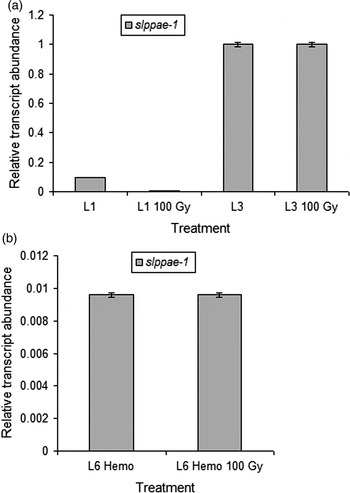
The slppo-2 and slppae-1 transcripts significantly downregulated (ca. 10-fold respectively) (P-value < 0.0001) in neonates (L1) that survived direct 100 Gy radiation stress (figs 1a and 2a). This suggests that neonates are highly susceptible to direct gamma radiation exposure.
Transcript profile of S. litura prophenoloxidase, slppo-2, upon gamma irradiation. S. litura neonates (L1) were irradiated at 100 Gy dose and reared until 6th-instar (L6). Total RNA was isolated from (a) whole body tissue of neonates (L1) and 3rd-instar larvae (L3) and (b) hemocytes of 6th-instar larvae (L6). Expression level of slppo-2 was measured by Real-time RT-PCR using Comparative CT method and normalized to internal control, β-actin. Error bars indicate the standard error of mean (SEM) for n = 3 technical replicates. Differences in gene expression were evaluated by performing an unpaired two-tailed t-test (P-value < 0.05).

Transcript profile of S. litura prophenoloxidase-activating enzyme, slppae-1, upon gamma irradiation. S. litura neonates (L1) were irradiated at 100 Gy dose and reared until 6th-instar (L6). Total RNA was isolated from (a) whole body tissue of neonates (L1) and 3rd-instar larvae (L3) and (b) hemocytes of 6th-instar larvae (L6). Expression level of slppae-1 was measured by Real-time RT-PCR using Comparative CT method and normalized to internal control, β-actin. Error bars indicate the standard error of mean (SEM) for n = 3 technical replicates. Differences in gene expression were evaluated by performing an unpaired two-tailed t-test (P-value < 0.05).

However, insignificant downregulation of slppo-2 (1-fold) (P-value = 0.059) and no fold change in slppae-1 (P-value = 1) transcripts was observed in L3 (whole body tissue) derived from irradiated neonates (figs 1a and 2a). A similar trend was observed in L6 (hemocytes) that survived 100 Gy radiation stress. A 2.4-fold downregulation of slppo-2 (P-value = 0.002) and no-fold change in slppae-1 transcript (P-value = 0.703) was noted in L6–100 Gy (hemocytes) as compared with naïve L6 larvae (figs 1b and 2b). This could be attributed to some additional factors present in whole body tissue (such as radio-protectors, anti-oxidants and other secondary metabolites), which are absent in hemocytes.
Both slppo-2 and slppae-1 transcripts were significantly downregulated (almost 100-fold and 12-fold) (P-value < 0.0001) in F 1 L3 (derived from 100 Gy-Adult) (Supplementary fig. 1A, B). In contrast, in F 1 L6 hemocytes, significant upregulation of slppo-2 and slppae-1 (ca. 10-fold) (P-value < 0.0001) was observed (Supplementary fig. 2A, B). These results suggest that radiosensitivity decreases with the age of the insect. An apparent effect of 100 Gy radiation was observed in slppo-2 and slppae-1 transcripts in F 1 larvae as compared with those that were derived from irradiated neonates (Supplementary figs 1 and 2A, B).
The slsod transcript was significantly downregulated (almost 10-fold) (P-value = 0.0004) while slcat transcript was downregulated ca. 2-fold (P-value = 0.0003) in neonates (L1) that survived direct 100 Gy radiation stress (figs 3a and 4a). Nearly, 2-fold downregulation of slsod (P-value < 0.0001) and ca. 1-fold downregulation of slcat (P-value < 0.0015) transcripts was observed in L3 (whole body tissue) derived from irradiated neonates (figs 3a and 4a). In contrast, upregulation of ca. 2-fold of slsod transcript (P-value < 0.0001) and 3.5-fold of slcat transcript (P-value = 0.001) was observed in L6 (hemocytes), which survived 100 Gy radiation stress (figs 3b and 4b).
Transcript profile of S. litura superoxide dismutase, slsod, upon gamma irradiation. S. litura neonates (L1) were irradiated at 100 Gy dose and reared until 6th-instar (L6). Total RNA was isolated from (a) whole body tissue of neonates (L1) and 3rd-instar larvae (L3) and (b) hemocytes of 6th-instar larvae (L6). Expression level of slsod was measured by Real-time RT-PCR using Comparative CT method and normalized to internal control, β-actin. Error bars indicate the standard error of mean (SEM) for n = 3 technical replicates. Differences in gene expression were evaluated by performing an unpaired two-tailed t-test (P-value < 0.05).

Transcript profile of S. litura catalase, slcat upon gamma irradiation. S. litura neonates (L1) were irradiated at 100 Gy dose and reared until 6th-instar (L6). Total RNA was isolated from (a) whole body tissue of neonates (L1) and 3rd-instar larvae (L3) and (b) hemocytes of 6th-instar larvae (L6). Expression level of slcat was measured by Real-time RT-PCR using Comparative CT method and normalized to internal control, β-actin. Error bars indicate the standard error of mean (SEM) for n = 3 technical replicates. Differences in gene expression were evaluated by performing an unpaired two-tailed t-test (P-value < 0.05).

The slsod transcript showed 5-fold downregulation (P-value < 0.0001) in F 1 L3 (derived from 100 Gy-Adult) in contrast to slcat transcript which was upregulated (ca. 4-fold) (P-value < 0.0001) (Supplementary fig. 1C, D). In contrast, in F 1 L6 hemocytes, significant upregulation of slsod and slcat (nearly 5.5-fold and 7-fold) (P-value < 0.0001) was observed (Supplementary fig. 2C, D). The impact of radiation was reduced on slsod and slcat transcripts when older stage (adults) was irradiated as compared with direct impact on neonates (L1).
Transcript pattern of PO pathway and anti-oxidant genes upon irradiation and bacterial challenge (dual stress)
Neonates of S. litura were exposed to 100 Gy (100 Gy-L1), reared to L6 and bacterially challenged with P. luminiscens. The F 1 progeny (100 Gy-Adult) derived from irradiated male moths and untreated normal females were reared to L6 and subjected to bacterial challenge. The effect of dual stress was examined on transcript abundance of slppo-2, slppae-1, slcat and slsod by Real-time PCR.
Bacterial challenge leads to significant up-regulation of slppo-2 (12-fold; P-value < 0.0001), slsod (6-fold; P-value < 0.0001) and slcat (3-fold; P-value < 0.0001) transcripts in naïve L6 larvae (untreated) (fig. 5a, c, d). An insignificant upregulation (1-fold; P-value = 0.0039)) of slppae-1 transcript was observed upon bacterial challenge in naïve L6 larvae (fig. 5b).
Temporal induction of PO cascade genes, slppo-2, slppae-1 and anti-oxidant defense genes, slsod and slcat upon dual stress of gamma radiation and Photorhabdus. S. litura neonates (L1) were irradiated at 100 Gy and reared until 6th-instar (L6; 100 Gy-L1). Male moths were irradiated at 100 Gy (100 Gy-Adult) and allowed to mate with un-irradiated females. The F 1 progeny was reared until L6 (F 1 L6; 100 Gy-Adult). Approximately, 100 cells of Photorhabdus were injected into the hemolymph of larvae [L6; 100 Gy-L1] and [F 1 L6; 100 Gy-Adult]. Hemocytes were isolated at 6 h post-infection. Larvae injected with only buffer (Ringer's solution) served as control. Naïve L6 (un-irradiated) challenged with same dose of Photorhabdus served as second control. Total RNA was isolated from buffer-injected (L6 Buff), un-irradiated (L6 Photo) and dual-challenged hemocytes (L6; 100 Gy-L1) and (F 1 L6; 100 Gy-Adult). Transcript levels of slppo-2 (a), slppae-1 (b), slsod (c) and slcat (d) were measured by Real-time RT-PCR and were normalized to β-actin expression using Comparative CT method. Error bars indicate the standard error of mean (SEM) for n = 3 technical replicates. Differences in gene expression were evaluated by performing an unpaired two-tailed t-test (P-value < 0.05).

When L6 (100 Gy-L1) were challenged with Photorhabdus, nearly 10-fold downregulation of slppo-2 transcript (P-value < 0.0001) was observed, while no-fold change (P-value = 0.0053) was observed in slppae-1 transcript level as compared with ‘only buffer’-injected L6 larvae derived from 100 Gy-L1 (fig. 5a, b). Both slsod and slcat transcripts showed insignificant upregulation (ca. 2.5-fold; P-value = 0.0001 and 1-fold; P-value = 0.0010) upon bacterial challenge (fig. 5c, d). These results clearly indicate that neonates are extremely susceptible to direct radiation exposure and their immunity is compromised upon bacterial challenge.
In contrast, when the F 1 L6 hemocytes (100 Gy-Adult) were bacterially challenged, the transcripts of slppae-1 (ca. 3-fold; P-value < 0.0001), slsod (4-fold; P-value < 0.0001), and slcat (6-fold; P-value < 0.0001), were significantly upregulated (P-value < 0.0001) as compared with L6 hemocytes (100 Gy-L1), except slppo-2 (4-fold downregulation; P-value < 0.0001) (fig. 5a–d). These results highlighted that dual stress caused by radiation plus microbial challenge was relatively lesser in F 1 progeny as compared with L6 reared from L1 exposed to direct radiation.
Discussion
The present study was conducted to understand the modulation of radio-sensitivity in (i) S. litura larvae exposed to direct radiation and (ii) F 1 progeny of irradiated S. litura adult male moths. The consequences of metabolic network specific to immune cascade with respect to larval survival and development have been elaborated. This is the first ever report of correlation of gamma radiation with PO cascade and anti-oxidant defense genes in S. litura at a gamma dose to be employed in radiation-mediated F 1 sterility technique.
Radiosensitivity of neonates and correlation to insect immunity and anti-oxidant defense system
The impact of irradiation was studied in early ontogenic stage, neonates (L1), mainly focusing on insect immunity and an anti-oxidant defense mechanism and correlated with growth and survival of the insect. Nearly identical transcript profiles of PO cascade enzymes, slppo-2 and slppae-1 was observed upon L1 irradiation until the final larval instar (L6). The coordinated expression of PPO and PPAE, co-localized in the insect hemolymph, justify a close metabolic relationship (Arora et al., Reference Arora, Hoque, Rajagopal, Sachdev and Bhatnagar2009). Similar debilitating effects of irradiation on PO activity have been demonstrated in Carribean fruit fly, Anastrepha suspensa when 1st-instar larvae were exposed to ≥20 Gy (Nation et al., Reference Nation, Smittle and Milne1995). Irradiation-induced age-correlated effect on reduced PO activity has been reported in 1st-instar larvae of Mediterranean fruit fly, Ceratitis capitata (Mansour & Franz, Reference Mansour and Franz1995, Reference Mansour and Franz1996) and Helicoverpa armigera (Sachdev et al., Reference Sachdev, Zarin, Khan, Malhotra, Seth and Bhatnagar2014).
A similar transcript regimen of ROS scavenging enzymes, SOD and CAT, was observed upon L1 radiation and transcripts of slsod and slcat were downregulated in early instars. Contrastingly, both slsod and slcat transcripts were upregulated in L6 hemocytes upon 100 Gy-L1 exposure, in agreement to our earlier report on H. armigera (Sachdev et al., Reference Sachdev, Zarin, Khan, Malhotra, Seth and Bhatnagar2014).
Consistent with the effect of L1 irradiation on PO cascade components and stress responses, the survival of 100 Gy irradiated larvae (L1) to the adult stage was significantly reduced (~2.8%) as compared with control larvae. In a similar study, 90 Gy irradiated neonates of Amorbia emigratella (Lepidoptera: Tortricidae) survived to the pupal stage with 9.5% formation, but no adults were formed (Follett, Reference Follett2008). In another attempt on quarantine control of Opogona sacchari (Lepidoptera: Tineidae), irradiation of neonates at 150 Gy resulted in 96% reduction in adult emergence (Hollingsworth & Follett, Reference Hollingsworth and Follett2007). The effect of electron beam radiation on survival of cut flower pest, S. litura revealed complete mortality in larval stages at >100 Gy (Dohino et al., Reference Dohino, Masaki, Takano and Hayashi1996). Radiation treatment in the larval stage of S. litura affected somatic growth and survival (Seth & Sehgal, Reference Seth and Sehgal1989). Our present study revealed that the developmental period, survival and growth rate, were adversely affected as a consequence of irradiation to S. litura larvae. These results are in close agreement with earlier reports on Heliothis virescens (Londono et al., Reference Londono, Vinson and Bartlett1968), S. littoralis (Zaki et al., Reference Zaki, El-Badry, Wakid and Souka1969), S. exigua (Zaki et al., Reference Zaki, El-Badry, Wakid and Ahmad1970) and H. armigera (Sachdev et al., Reference Sachdev, Zarin, Khan, Malhotra, Seth and Bhatnagar2014).
Molecular responses due to adult irradiation
In order to use adult irradiation in pre-harvest insect control through radio-genetic tactic, the immune and stress responses of F 1 progeny (100 Gy-Adult) were correlated with the growth and reproductive performance. This in turn validated the viability of F 1 progeny at a gamma dose, which could be utilized in F 1 sterility technique. Typically, adult male moths are sub-sterilized by exposure to ionizing radiation, usually a gamma source, causing randomly distributed double-strand breaks in genomic DNA. Chromosomal breaks are the result of both direct energy transfer to DNA and through secondary DNA damage caused by ROS produced during irradiation (von Sonntag, Reference von Sonntag1987). Anti-oxidant activity may reduce the somatic damage in insects caused by radiation-induced ROS, therefore, maintaining the viability in terms of competitiveness and insect fitness.
The immune cascade and anti-oxidant enzymes are parts of the crucial intrinsic system that might influence the reproductive performance of P 1 and F 1 adults to be employed for radiation-induced inherited sterility in wild population. It is indicated that competitiveness of fully sterile male can be improved by short-term anoxia exposure treatment (López-Martínez & Hahn, Reference López-Martínez and Hahn2012) or anti-oxidant rich artificial diet (El-Akhdar et al., Reference El-Akhdar, Hazaa and Alm El-Din2012). Till date, only few reports have investigated the molecular responses in insects towards irradiation and correlation of these stress-induced responses with biological and physiological activities of irradiated insects (Wang et al., Reference Wang, Wang, Zhu, Ma and Lei2012; Sachdev et al., Reference Sachdev, Zarin, Khan, Malhotra, Seth and Bhatnagar2014).
The slppo-2, slppae-1, slsod and slcat transcripts were significantly upregulated in F 1 L6 hemocytes (100 Gy-Adult) as compared with L6 hemocytes (100 Gy-L1). This clearly suggested that L1 was more radiosensitive than adult stage and the impact of radiation was relatively reduced when older stage (adult) was exposed. Previous studies have reported that expression level of SOD/CAT is upregulated in response to ROS resulting from exposure of direct sunlight in Belgica Antarctica (Lopez-Martinez et al., Reference Lopez-Martinez, Elnitsky, Benoit, Lee and Denlinger2008), UV-B radiation in Hyphantria cunae (Kim et al., Reference Kim, Kim, Kwon, Kang, Lee, Jin, Han, Cheon, Ha and Sheo2010), UV-A radiation in H. armigera (Wang et al., Reference Wang, Wang, Zhu, Ma and Lei2012), and gamma rays in H. armigera (Sachdev et al., Reference Sachdev, Zarin, Khan, Malhotra, Seth and Bhatnagar2014), and Chironomus ramosus (Datkhile et al., Reference Datkhile, Mukhopadhyaya, Dongre and Nath2009). The increased expression of SOD/CAT indicated that these enzymes had an important role in protecting cells against oxidative damage thereby maintaining the viability of insects.
The F 1 viability in terms of growth and development of F 1 progeny might reflect the behavioral potency of F 1 adults to be exercised in inherited sterility for pre-harvest pest management (Seth & Sehgal, Reference Seth and Sehgal1993; Seth & Sharma, Reference Seth and Sharma2001). The developmental rate of F 1 adult (100 Gy-Adult) was slower and could be attributed to the protracted development of F 1 progeny due to alteration in hormonal or enzymatic production caused by chromosomal rearrangements (Proshold & Bartell, Reference Proshold and Bartell1970, Reference Proshold and Bartell1972) and differential transcriptional regulation of PO pathway genes. The F 1 growth rate and GI (an indicator of somatic damage) showed a decrease as a consequence of irradiation to male parent (sub-sterilized).
Consequences of radiation in immune compromised S. litura larvae
Transcriptional analysis of PO cascade and ROS scavenging enzymes was studied in irradiated bacterially-challenged L6 larvae that survived dual stress.
Once inside the larval hemocoel, Photorhabdus infection leads to significant upregulation of slppo-2, slsod and slcat transcripts while insignificant upregulation of slppae-1 was observed in naïve L6 larvae. Similarly, infection with non-pathogenic E scherichia coli K12 leads to significant upregulation of PPO in S. litura (Rajagopal et al., Reference Rajagopal, Thamilarasi, Venkatesh, Srinivas and Bhatnagar2005). Bacterial infection with P. luminiscens and E. coli leads to transcriptional upregulation of anti-bacterial effector genes and pattern recognition proteins in Manduca sexta larvae (Felföldi et al., Reference Felföldi, Eleftherianos, Ffrench-Constant and Venekei2011; Eleftherianos et al., Reference Eleftherianos, Marokhazi, Millichap, Hodgkinson, Sriboonlert, ffrench-Constant and Reynolds2006a , Reference Eleftherianos, Millichap, Ffrench-Constant and Reynolds b , Reference Eleftherianos, Gökçen, Felföldi, Millichap, Trenczek, Ffrench-Constant and Reynolds2007). Activation of proPO-activating proteinase (PAP) has been observed in M. sexta fat body upon injection of E. coli (Jiang et al., Reference Jiang, Wang, Yu and Kanost2003). We have earlier reported that PPAE is triggered upon injury in S. litura larvae (Arora et al., Reference Arora, Hoque, Rajagopal, Sachdev and Bhatnagar2009). In the present study, we have demonstrated that slppae-1 transcript is minimally upregulated (ca. 1-fold) upon Photorhabdus challenge in naïve larvae. This is in consonance with previous findings on three different PAPs isolated from larval hemocytes of Plutella xylostella (px) (Shi et al., Reference Shi, Chen, Zhu and Chen2014). While transcript abundance of pxPAPa is significantly increased by Micrococcus luteus (G+) and E. coli (G−) but not Candida albicans. The pxPAPb is only induced upon infection with M. luteus and on the other hand, pxPAP3 transcript was induced by all three microbes (Shi et al., Reference Shi, Chen, Zhu and Chen2014).
Upon dual stress of radiation plus microbes, the slppo-2 transcript was significantly downregulated in L6 (100 Gy-L1) while slppae-1, slsod and slcat transcripts were insignificantly upregulated. These findings are very close to our previous report on dual stress in H. armigera. (Sachdev et al., Reference Sachdev, Zarin, Khan, Malhotra, Seth and Bhatnagar2014). A similar transcript regimen was also evaluated in F 1 progeny of irradiated adults. On the contrary to L6 (100 Gy-L1), the slppae-1, slsod and slcat transcripts were upregulated and the F 1 larvae regained their ability to respond to bacterial challenge while slppo-2 transcript level still remained low. These results not only suggest that neonates are much more radiosensitive than adult moths but also reflect that the F 1 progeny could counter the somatic damage inherited from sub-sterilized male parent. This could be attributed to the abundance of PO cascade and ROS scavenging enzymes in F 1 progeny, which is positively correlated with the reproductive viability of F 1 insect to be employed in F 1 sterility technique. The overall reproductive performance of P 1 moths (resulting in 50% sterility) and F 1 moths (resulting in 71% sterility) (Seth & Sehgal, Reference Seth and Sehgal1993; Seth & Sharma, Reference Seth and Sharma2001) and the developmental behavior of F 1 insects, supports the release of 100 Gy sub-sterilized males for inherited sterility technique towards suppression of S. litura populations. Furthermore, the degree of sterility along with the compromised insect immunity must be equated with the mating competitiveness, quality and quantity of sperm of P 1 and F 1 insects at optimized sub-sterilizing radiation dose (100–130 Gy) for employment in F 1 sterility technique (unpublished data). The present study investigating age-correlated molecular responses to irradiation might help optimize the gamma dose to be employed in phytosanitary treatment of S. litura as a quarantine pest, and also in operation of inherited sterility technique for the pest suppression.
Our results provide new insights into the molecular events that occur during immune response in S. litura, which are exposed to different microbes in the natural environment.
Radiation-mediated transcript responses of phenoloxidase cascade and anti-oxidant defense genes open up an avenue of coupling microbial control with nuclear technology used in integrated pest management (IPM) at pre-harvest and post-harvest level.
Supplementary material
The supplementary material for this article can be found at https://doi.org/10.1017/S0007485316000961
Acknowledgments
The financial support received from ICGEB core funds and International Atomic Energy Agency (IAEA), Vienna, Austria [Grant no. IAEA. RC- 15557/RB] is duly acknowledged. B.S is thankful to Department of Biotechnology (DBT), Govt. of India for Bio-CARe fellowship. The authors thank Dr. Maureen Gorman, Kansas State University, USA for correcting English language throughout the text. Her timely support is duly acknowledged. We also thank Ms. Lisa Brummett, Kansas State University, USA for helping with GraphPad Prism software for qPCR statistical analysis.