1. INTRODUCTION
With the increasing attention on Global Navigation Satellite Systems (GNSS) from countries and regions, a growing number of navigation signals have been and will be put into use (Zhen et al., Reference Zhen, Jie, Wang, Zhao and Chen2017a). Frequency allocation in satellite navigation bands is therefore becoming increasingly intense. Binary Offset Carrier (BOC) signal modulation, which uses a sine-phased or cosine-phased square wave subcarrier to modulate the Pseudo Random Noise (PRN) code (Benedetto et al., Reference Benedetto, Giunta, Lohan and Renfors2013), was proposed to separate military and civilian signals by frequency (Betz, Reference Betz1999; Reference Betz2001). In this paper, BOC modulation with a sine-phase or cosine-phase square wave subcarrier is denoted as BOCs(m,n) or BOCc(m,n), where n denotes the ratio of the spreading code rate f c to 1.023 MHz and m denotes the ratio of the square wave frequency f sc to 1.023 MHz. Due to its narrower autocorrelation main peak, a BOC signal has better code tracking performance and anti-multipath performance than a Binary Phase-Shift Keying (BPSK) signal with the same code rate (Li et al., Reference Li, Wei, Tang, Zhou and Wang2017). Due to these advantages, BOC signal modulation is widely employed in modernised GNSS (Cui et al., Reference Cui, Zhao, Liu, Wu and Ding2015). For example, the Global Positioning System (GPS) M code signal exploits the BOCs(10,5) signal (Barker et al., Reference Barker, Betz, Clark, Correia, Gillis, Lazar, Rehborn and Straton2006) and BOCs(14,2) and BOCs(15,2.5) are the candidate signals at the B1 and B3 frequencies in China's BeiDou System (BDS) (Tang et al., Reference Tang, Zhou, Xiulin, Ran and Liu2010) and BOCs(5,2.5) is selected as the L1SC signal in the GLONASS system (Lohan et al., Reference Lohan, Diego, Lopez-Salcedo, Seco-Granados, Boto and Fernandes2017). However, the price to pay for these potential performance improvements is a decrease in tracking reliability (Yao et al., Reference Yao, Gao, Gao and Lu2017). As there are many side peaks in the autocorrelation function of a BOC signal, the tracking loop can lock onto a side peak, leading to a biased tracking measurement, which is referred to as the ambiguity problem (Chae et al., Reference Chae, Liu and Yoon2014). The minimum error after the ambiguous problem occurs is 14.6 m for BOC(10,5) and 10.5 m for BOC(14,2), which is intolerable for navigation systems. Therefore, reliably eliminating ambiguity is the premise and focus of BOC signal processing.
Several solutions have been proposed to overcome the negative effects of ambiguity (Zhang et al., Reference Zhang, Ba, Chen and Zhou2017). As a well-known strategy, the main lobes of a BOC signal can be tracked with a BPSK method based on the fact that each main lobe of the BOC signal is obtained by frequency conversion of a square wave subcarrier, which means each main lobe can be seen as an independent BPSK signal. The sideband techniques (Fishman and Betz, Reference Fishman and Betz2000), BPSK-LIKE techniques (Martin et al., Reference Martin, Leblond, Guillotel and Heiries2003) and Modified Sideband (MSB) method (Lohan et al., Reference Lohan, Burian and Renfors2010) are typical examples of this category. These methods sacrifice the high tracking accuracy of the BOC signal. Furthermore, filtering and dual sideband processing increase the implementation complexity and cause correlation loss due to the mismatch between the received signal (BOC) and the local signal (shifted BPSK) (Shen et al., Reference Shen, Xu, Cheong and Feng2015). Another idea is to avoid ambiguity rather than eliminate it. The Bump-Jump (BJ) method (Fine and Wilson, Reference Fine and Wilson1999) adds two additional correlators, namely, Very Early (VE) and Very Late (VL), to determine whether the correct main peak is acquired or locked. The Double Estimation Technique (DET) (Hodgart et al., Reference Hodgart, Blunt and Unwin2007) and its variants, such as Double Phase Estimator (DPE) (Borio, Reference Borio2014) and the method using coherent combination of Dual sidebands Double Phase Estimator (DDPE) (Feng et al., Reference Feng, Kai and Liang2016), split the traditional Delay Lock Loop (DLL) into a Sub-carrier Lock Loop (SLL) and a PRN code loop (DLL). The tracking ambiguity is corrected by the unambiguous DLL estimator. Since the potential for ambiguity is not removed, these methods become unreliable under low carrier-to-noise ratios and in high-interference environments. The basic idea of Side-peak Cancellation (SC) techniques is to use local auxiliary signals whose chip waveforms are different from the received waveform in tracking (Yao and Lu, Reference Yao and Lu2011). The following methods can be classified as SC techniques. The Autocorrelation Side-Peak Cancellation Technique (ASPeCT) (Julien et al., Reference Julien, MacAbiau, Cannon and Lachapelle2007) can track BOC signals unambiguously, but it is only suitable for sine-phased BOC(n,n). Weighted discriminators (Kao and Juang Reference Kao and Juang2012) have the same limitation as ASPeCT. The Pseudo correlation function based Unambiguous Delay Lock Loop (PUDLL) (Yao et al., Reference Yao, Cui, Lu, Feng and Yang2010) designs two local step-shaped modulated signals to remove the ambiguity of the BOCs signal, but the code tracking performance decreases rapidly with increasing BOC order. A tracking method for multi-level coded symbol modulated signals is proposed in Zhen et al. (Reference Zhen, Zhang, Lu, Jie and Zhao2017b), PUDLL is the special case when the Multi-level Coding Signal (MCS) signal is a BOC signal. The tracking accuracy of the Symmetrical Pulse Ambiguity Removing (SPAR) technique (Qi et al., Reference Qi, Chen, Li and Zhang2012) is not very attractive. Yan et al. (Reference Yan, Wei, Tang, Qu and Zhou2015a; Reference Yan, Wei, Tang, Qu and Zhou2015b) proposed two unambiguous techniques for BOCs. The performance of both techniques is excellent, but two positive side-peaks remain in the final cross-correlation, which means that potential ambiguity remains.
In this paper, we propose a reliable unambiguous tracking algorithm based on the combination of correlation functions for sine BOC signals. There are two local reference waveforms in the proposed method: the BOCs signal waveform with no delay and a linear combination of a series of BOCs signals with different delays. A combined correlation function without positive side-peaks is obtained by multiplying the two correlation functions of the local reference waveform with the input BOCs signal. The code tracking accuracy in the tracking stage are analysed theoretically and through simulation. The multipath performance is also analysed and reported in this paper. The results show that the proposed method can completely remove the ambiguity threat and significantly improve tracking accuracy and anti-multipath capability compared with all the methods mentioned above.
The rest of this paper is organised as follows. Section 2 describes the method to implement the unambiguous correlation function. The unambiguous tracking loop is described and analysed in Section 3. In Section 4, we provide simulation results and performance comparison, and the conclusions are summarised in the final section.
2. UNAMBIGUOUS COMBINED CORRELATION FUNCTION
The BOCs signal received from one satellite is described as:
 $$\eqalign{ r(t) &= \sqrt {2A} S_{BOC}(t - \tau )\cos (2\pi f_{IF}t + \theta _0) + n(t) \cr & = \sqrt {2A} D(t - \tau )c(t - \tau )p_{BOC}(t - \tau )\cos (2\pi f_{IF}t + \theta _0) \cr & \,\, + n_c(t)\cos (2\pi f_{IF}t) - n_s(t)\sin (2\pi f_{IF}t),}$$
where A is the power of the received signal, D(t) is the navigation data message, c(t) is the PRN code waveform, τ is the code delay, f IF is the frequency of the carrier, θ0 is the initial phase of the carrier, and n(t) is band-limited white noise. n c(t) and n s(t) are independent zero-mean Gaussian random processes that have the same double-sided power spectrum density N 0. p BOC denotes the waveform of the chips and is expressed as p BOC(t) = sign(sin(2πf SCt)), where sign() is the signum function. S BOC(t) = D(t) c(t) P BOC(t) denotes the baseband BOC signal. We assume the PRN code sequence c is ideal; the expression of the autocorrelation function of the BOCs signal can be described as Equation (2):
 $$R_{BOC}(\tau )\left\{ {\matrix{ {{( - 1)}^l\left( {\displaystyle{{(k - l)(2l + 1) - l} \over k} - \displaystyle{{2k - 2l - 1} \over {T_c}} \vert \tau \vert } \right)} & {lT_s \le \vert \tau \vert < (l + 1)T_s} \cr 0 & { \vert \tau \vert \ge T_c} \cr } } \right.$$
where k = 2m/n is the order of the BOC signal, l = 0, 1, 2, …, k − 1, T c is the chip duration, and T S = T C/k is the half cycle of the sub-carrier.
As shown in Equation (2), there are 2k + 1 turning points in the autocorrelation function of the BOCs(0.5kn, n) signal, and the width between adjacent turning points is T S. For clarity, we label these 2k + 1 positions as [ − k, − k + 1, …, − 1, 0, 1, …, k − 1, k]. The focus of this method is to obtain an unambiguous correlation function by linear combination of autocorrelation functions, as shown in Equation (3).
 $$R_{combine}(\tau)=\sum_{j=-k}^{k}W_{j}R_{B}(\tau-jT_{S}),$$
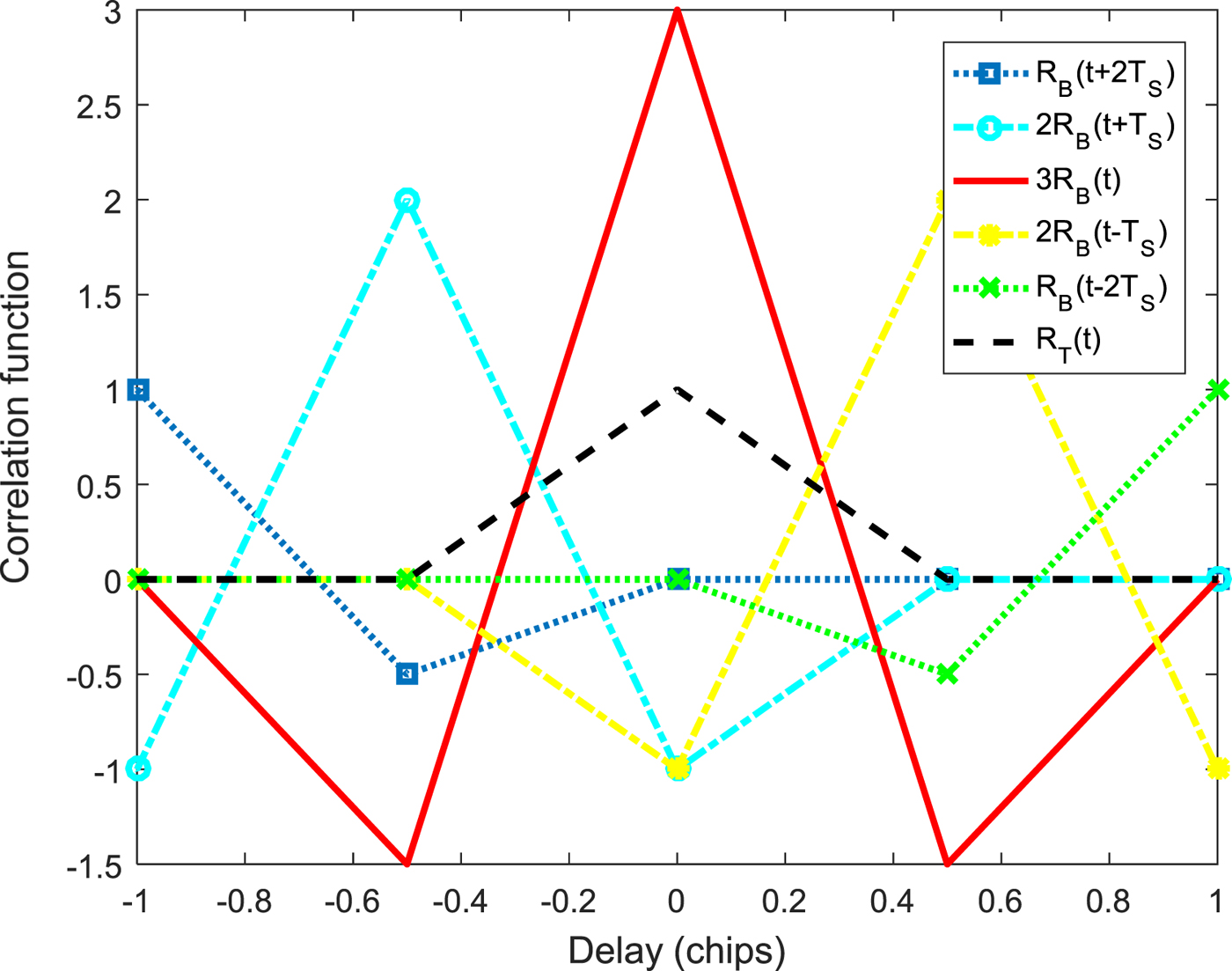
where W j is the weighted coefficient of position j. The shape of the target correlation function in this paper is a positive isosceles triangle, similar to that of BPSK. To achieve better tracking accuracy and anti-multipath performance, the correlation function should be as narrow as possible. As a result, the zero-crossing point of the target cross-correlation function is located at the first turning point of the BOCs signal autocorrelation function. The linear combination of BOCs(1,1) is shown in Figure 1, where R T(t) = R B(t + 2T S) + 2R B(t + T S) + 3R B(t) + 2R B(t − 2T S) + R B(t − 2T S) is the linearly combined correlation function, which is unambiguous. Next, we develop a method to calculate the weighted coefficient W of all BOCs signals. For clarity, we define a series of numbers that has the autocorrelation value of the 2k + 1 turning points:
 $$ACF_i = ( - 1)^{ \vert i \vert }\displaystyle{{k - \vert i \vert } \over k}$$
Linear combination of BOCs(1,1).

We need to establish 2k + 1 equations: the linear weighting results of the 2k + 1 correlation functions at position i are equal to those of the target correlation function mentioned before. For position i, the equation can be written as:
 $$\sum_{j=-k}^{k}ACF_{j-i}W_{j}=R_{j},$$
where R i is the target correlation value of position i. When |j − i| > k, ACF i−j = 0.
As shown in Equation (2), the section between adjacent turning points is linear, so the linear combination is also linear, which means the shape of the target correlation function can be controlled by controlling the values of the turning points. In other words, as long as the combination result of the correlation functions at zero delay is set to one and the combination results of the correlation functions at the other turning points are set to 0, that is, R = [0, · · · , 0, 1, 0, · · · , 0], the combination results will be consistent with the target correlation function mentioned above. According to the above analysis, the 2k + 1 equations can be written in a matrix form as C × WT = RT, as shown in Equation (6). C(i,j) is the autocorrelation value of position j − k − 1 at position i − k − 1, and it is equal to ACF j−i.
 $$\eqalign{& \left[ {\matrix{ {ACF_0} & {ACF_1} & \cdots & {ACF_{k - 1}} & {ACF_k} & 0 & \cdots & \cdots & 0 \cr {ACF_{ - 1}} & {ACF_0} & \cdots & {ACF_{k - 2}} & {ACF_{k - 1}} & {ACF_k} & 0 & \cdots & 0 \cr \vdots & \vdots & \vdots & \vdots & \vdots & \vdots & \vdots & \vdots & \vdots \cr {ACF_{ - k + 1}} & {ACF_{ - k + 2}} & \cdots & {ACF_0} & {ACF_1} & {ACF_2} & \cdots & {ACF_k} & 0 \cr {ACF_{ - k}} & {ACF_{ - k + 1}} & \cdots & {ACF_{ - 1}} & {ACF_0} & {ACF_1} & \cdots & {ACF_{k - 1}} & {ACF_k} \cr 0 & {ACF_{ - k}} & \cdots & {ACF_{ - 2}} & {ACF_{ - 1}} & {ACF_0} & \cdots & {ACF_{k - 2}} & {ACF_{k - 1}} \cr \vdots & \vdots & \vdots & \vdots & \vdots & \vdots & \vdots & \vdots & \vdots \cr 0 & \cdots & 0 & {ACF_{ - k}} & {ACF_{ - k + 1}} & {ACF_{ - k + 2}} & \cdots & {ACF_0} & {ACF_1} \cr 0 & \cdots & \cdots & 0 & {ACF_{ - k}} & {ACF_{ - k + 1}} & \cdots & {ACF_{ - 1}} & {ACF_0} \cr } } \right] \cr & \,\,\,\times \left[ {\matrix{ {W_{ - k}} \cr {W_{ - k + 1}} \cr \vdots \cr {W_{ - 1}} \cr {W_0} \cr {W_1} \cr \vdots \cr {W_{k - 1}} \cr {W_k} \cr } } \right] = \left[ {\matrix{ 0 \cr 0 \cr \vdots \cr 0 \cr 1 \cr 0 \cr \vdots \cr 0 \cr 0 \cr } } \right]}$$
Then, we can obtain the weighted coefficient matrix W from Equation (7).
 $$\eqalign{{\bf W} = &[{\bf C}^{ - 1}{\bf R}^T]^T \cr =& \left\{ {\matrix{ {\left[ {\displaystyle{{k + 1} \over 3}\;\displaystyle{{k + 2k} \over 3}\;\displaystyle{{4k + 1} \over 3}\;\displaystyle{{k + 2k} \over 3}\;\displaystyle{{k + 1} \over 3}} \right]} & {k = 2} \cr {\left[ {\displaystyle{{k + 1} \over {{( - 1)}^k3}}\;\displaystyle{k \over {{( - 1)}^k3}}\;0\; \cdots \;0\;\displaystyle{{2k} \over 3}\;\displaystyle{{4k + 1} \over 3}\;\displaystyle{{2k} \over 3}\;0\; \cdots \;0\;\displaystyle{k \over {{( - 1)}^k3}}\;\displaystyle{{k + 1} \over {{( - 1)}^k3}}} \right]} & {k > 2} \cr } } \right.}$$
It is worth noting that the correlation functions described above can be implemented as shown in Equation (8):
 $$R_{combin}(\tau)=\displaystyle{{1}\over{T_{P}}}\int_{t=0}^{T_{P}}S_{BOC}(\hbox{t})S_{base}(\hbox{t}-\tau)dt,$$
where:
 $$S_{base}(\hbox{t})=\sum_{j=-k}^{k}W_{j}S_{BOC}(\hbox{t}-\hbox{jT}_{S}).$$
Equations (3), (8) and (9) show the two processing modes used to achieve an unambiguous correlation function:
I. The local BOCs signals with different delays are correlated with the input signal, and the correlation results are linearly combined.
II. The different time delay signals are linearly combined to form a specific local auxiliary signal; then, the signal is correlated with the input signal.
Mode II is chosen as the proposed mode for tracking in this paper to reduce the number of correlators. It is worth noting that the local reference signal obtained by Equation (9) is not power normalised; its power can be expressed as follows:
 $$\eqalign{P &= \displaystyle{1 \over {T_P}}\int_{{\rm t} = 0}^{T_P} {\left[ {\sum\limits_{i = - k}^k {W_i} S_{BOC}(\hbox{t} - iT_s)} \right]} \left[ {\sum\limits_{j = - k}^k {W_j} S_{BOC}(\hbox{t} - jT_s)} \right]\hbox{dt} \cr & = \displaystyle{1 \over {T_P}}\sum\limits_{i = - k}^k {\sum\limits_{j = - k}^k {\int_{{\rm t} = 0}^{T_P} {W_i} } } S_{BOC}(\hbox{t} - iT_S)W_jS_{BOC}(\hbox{t} - jT_S)\hbox{dt} \cr & = \sum\limits_{i = - k}^k {\sum\limits_{j = - k}^k {W_i} } W_j\hbox{R}_B((i - j)T_S) \cr & = \displaystyle{{4k + 1} \over 3}.}$$
The normalised local reference waveform can be written as:
 $$\eqalign{ S_{base\_norm}(\hbox{t}) &= \sqrt {\displaystyle{3 \over {4k + 1}}} \sum\limits_{j = - k}^k {W_j} S_{BOC}(\hbox{t} - \hbox{j}\hbox{T}_S). \cr & = \sqrt {\displaystyle{3 \over {4k + 1}}} \sum\limits_{j = - k}^k {W_j} c(\hbox{t} - \hbox{j}\hbox{T}_S)\hbox{p}_{BOC}(\hbox{t} - \hbox{j}\hbox{T}_S).}$$
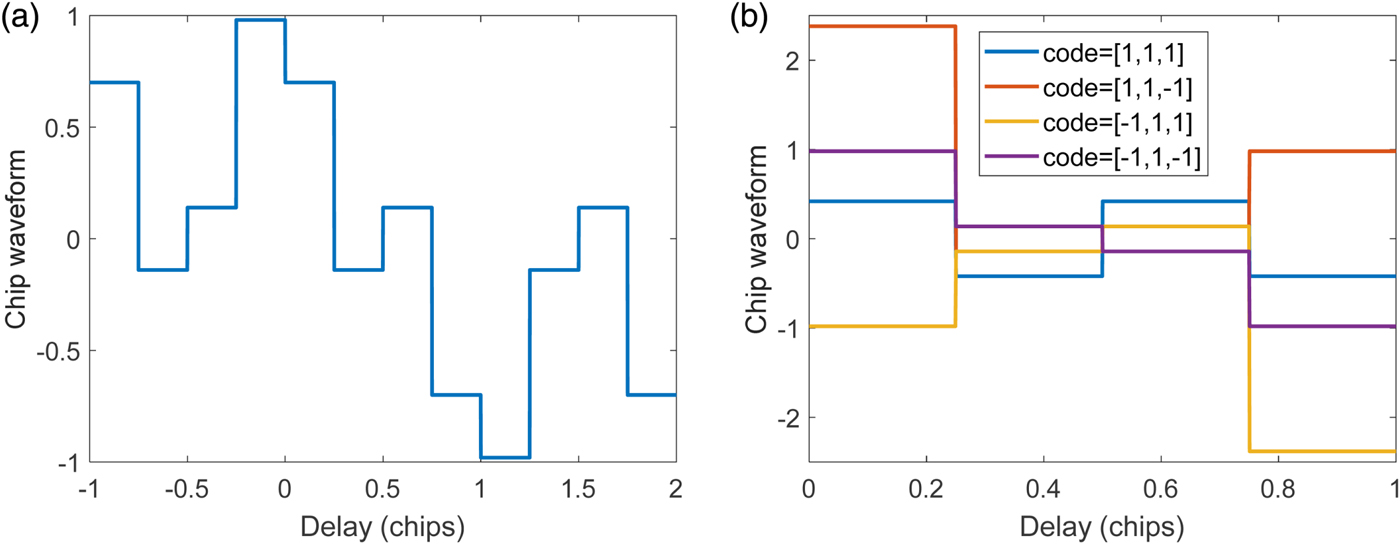
As shown in Equation (11), the width of the PRN code is broadened to 3T C and it is shown in Figure 2(a). For clarity, we divide it into three parts, the width of each is T C. Then, the waveform of the local reference signal is the linear combination of three adjacent waveforms of the PRN code: the third part of the early PRN code, the second part of the prompt PRN code and the first part of the late PRN code, as shown in Figure 2(b).
Waveform of local signal for BOCs(10,5).

The combined correlation function can be expressed as:
 $$R_c(\tau ) = \left\{ {\matrix{ {\sqrt {\displaystyle{3 \over {4k + 1}}} \left( {1 - \displaystyle{k \over {T_c}} \vert \tau \vert } \right)} & {0 \le \vert \tau \vert < T_{\rm S}} \cr 0 & {T_{\rm S} \le \vert \tau \vert \le T_{\rm C}} \cr } } \right.$$
To reduce the correlation loss and eliminate cross-correlation between T C and 2T C, the correlation function is designed as R B(τ) R′C(τ) rather than  $R_{C}^{2}\lpar \tau\rpar $. Assuming the signal carrier is totally stripped, and the residual carrier phase is Δθ, the expression of the correlation function is:
 $$\eqalign{ R_{UN}(\tau )& = R_B(\tau )\hbox{e}^{j\Delta \theta }\lpar {R_c(\tau )\hbox{e}^{j\Delta \theta }} \rpar ^{\prime} = R_B(\tau )R_c(\tau ) \cr & = \left\{ {\matrix{ {\sqrt {\displaystyle{3 \over {4k + 1}}} \left( {1 - \displaystyle{k \over {T_c}} \vert _T \vert } \right)\left( {1 - \displaystyle{{2k - 1} \over {T_c}} \vert _T \vert } \right)} & {0 \le \vert \tau \vert < T_S} \cr 0 & { \vert \tau \vert \ge T_S} \cr } } \right.}$$
Thus, the correlation loss is only  $1/\sqrt{P}$ instead of 1/P.
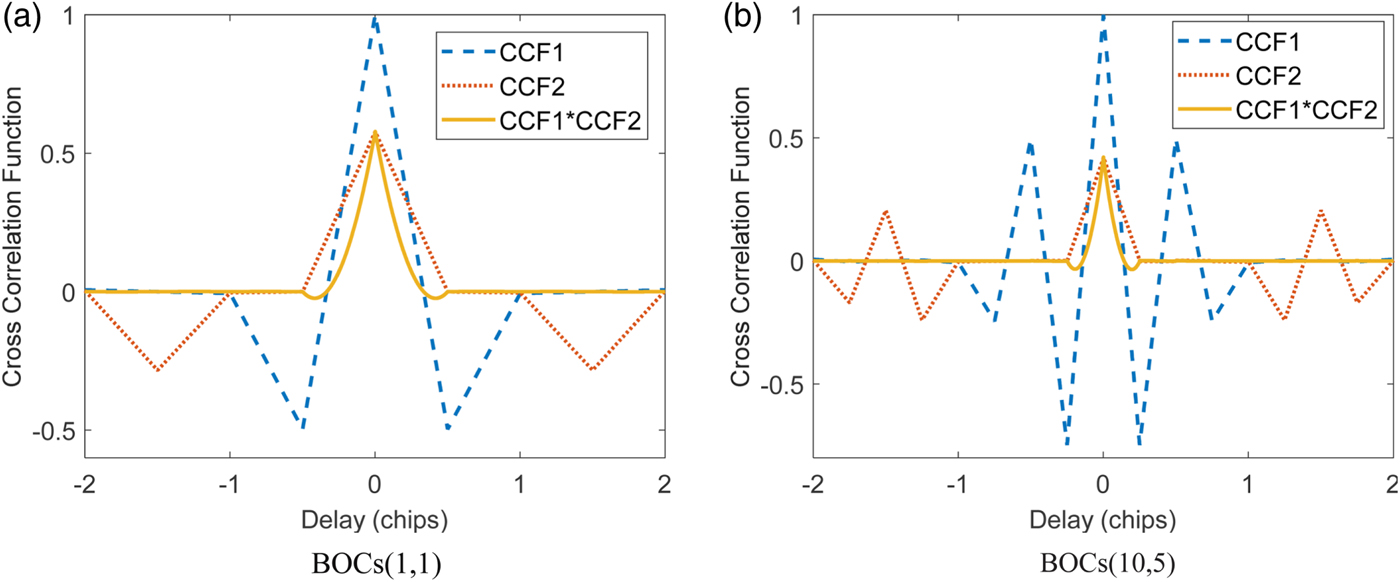
Figure 3(a) and Figure 3(b) show the normalised correlation functions of the BOCs(1,1) and BOCs(10,5), where “CCF1” depicts an autocorrelation function of the BOCs signal and “CCF2” depicts the second correlation function. “CCF1*CCF2” represents the unambiguous correlation function obtained by multiplying the two correlation functions mentioned above. The theoretical analysis and simulation results show that the proposed correlation function is an unambiguous correlation function without positive side peaks.
BOCs correlation functions.

3. TRACKING SCHEME AND PERFORMANCE ANALYSIS
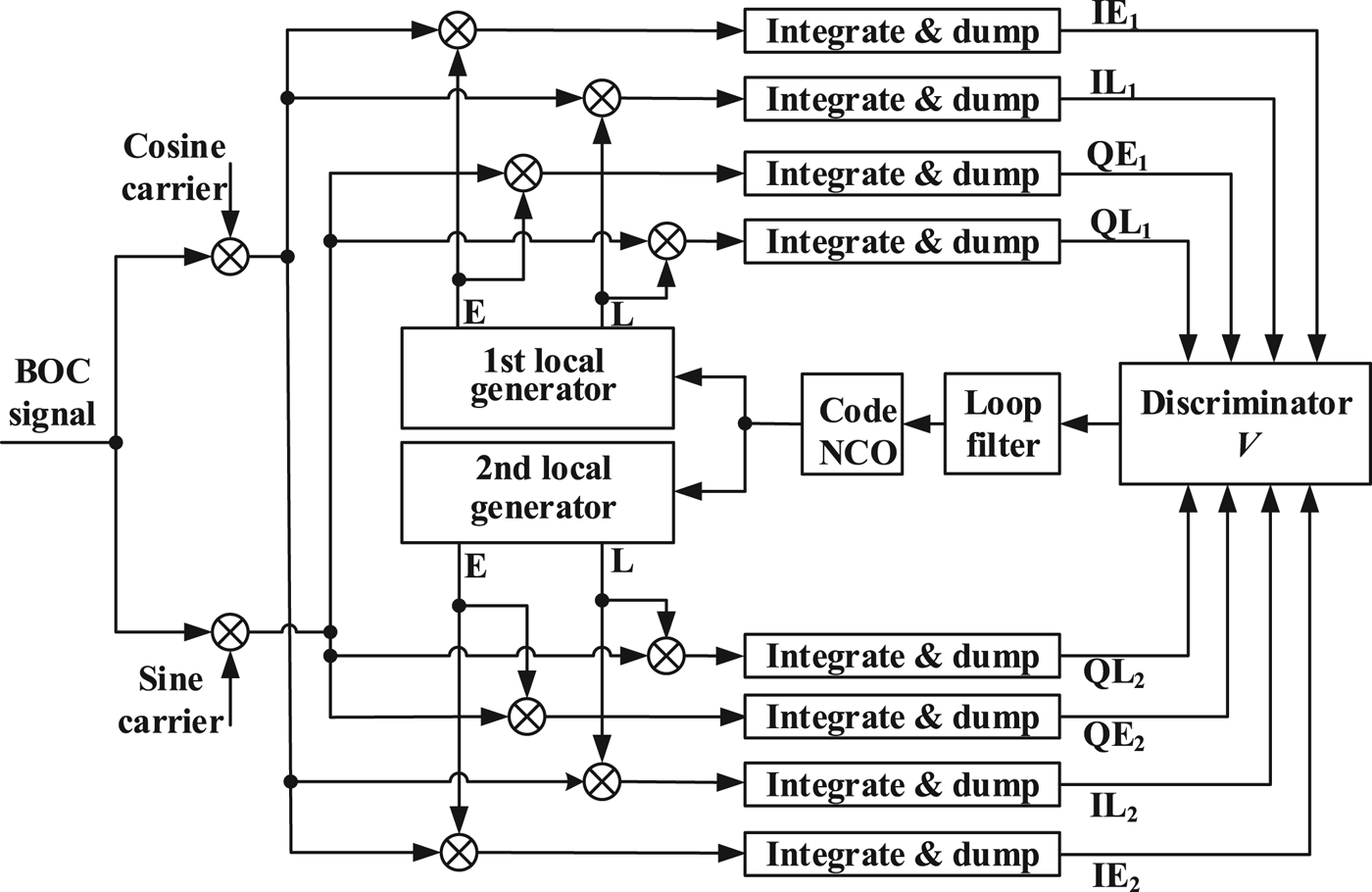
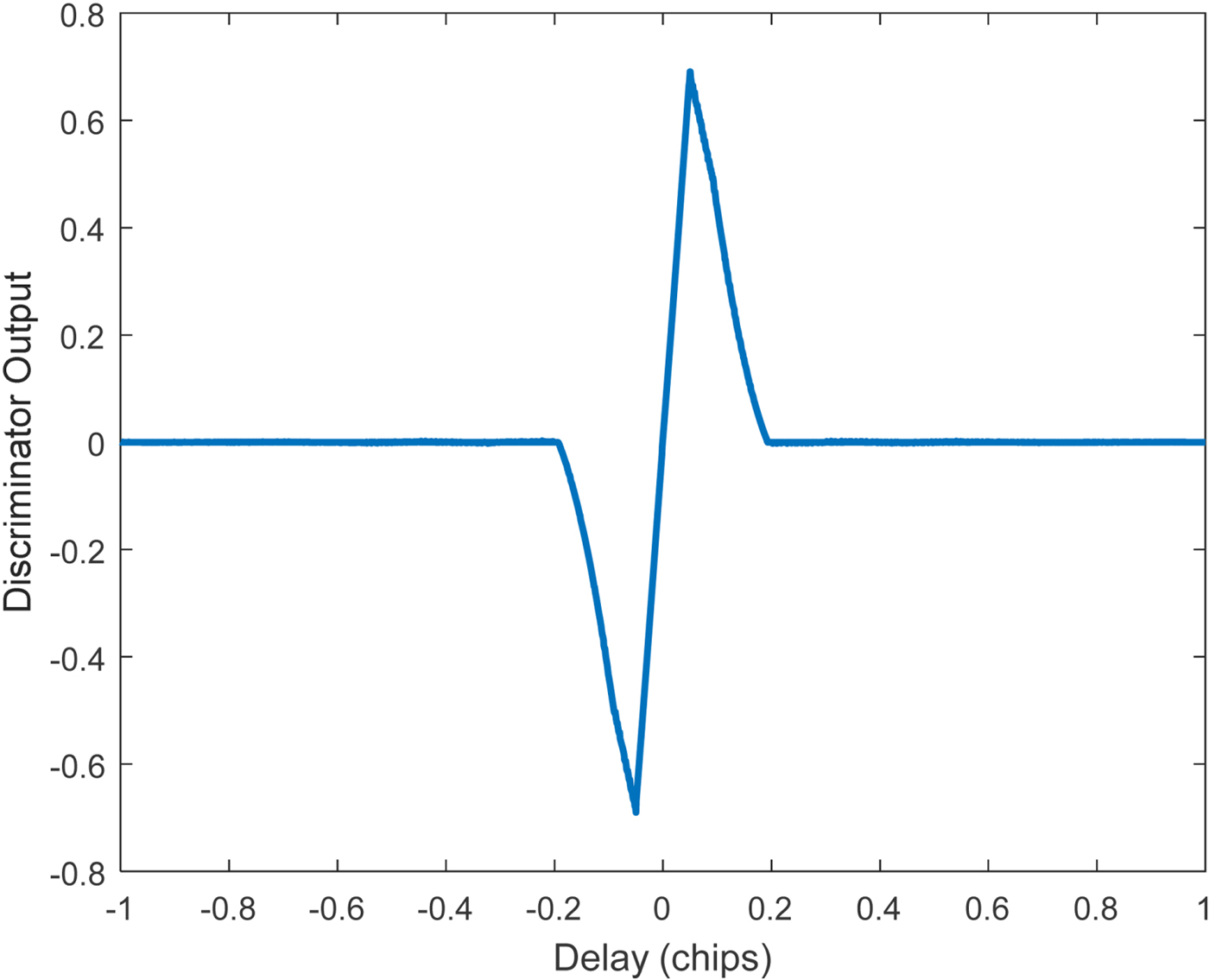
The tracking block diagram based on mode II is shown in Figure 4. The non-coherent discriminator function is shown in Equation (14) and Figure 5. The discriminator function V is unambiguous, and the linear pull-in range is from −d/2 to d/2.
 $$\eqalign{ V(\Delta \tau ) &= (\hbox{I}\hbox{E}_1\hbox{I}\hbox{E}_2 + \vert \hbox{I}\hbox{E}_1\hbox{I}\hbox{E}_2 \vert + Q\hbox{E}_1Q\hbox{E}_2 + \vert Q\hbox{E}_1Q\hbox{E}_2 \vert ) \cr &\,\,\,\,\,\, - (\hbox{I}L_1\hbox{I}L_2 + \vert \hbox{I}L_1\hbox{I}L_2 \vert + QL_1QL_2 + \vert QL_1QL_2 \vert ) \cr & = 2A\left( {\hbox{R}_{UN}\left( {\Delta \tau - \displaystyle{d \over 2}} \right) + \left \vert {\hbox{R}_{UN}\left( {\Delta \tau - \displaystyle{d \over 2}} \right)} \right \vert } \right) \cr & \,\,\,\,\,\,- 2A\left( {\hbox{R}_{UN}\left( {\Delta \tau + \displaystyle{d \over 2}} \right) + \left \vert {\hbox{R}_{UN}\left( {\Delta \tau + \displaystyle{d \over 2}} \right)} \right \vert } \right),}$$
where IE 1, IE 2, IL 1 and IL 2 are the in-phase correlator outputs with the local BOCs E and L and auxiliary E and L replicas, respectively. QE 1, QE 2, QL 1 and QL 2 are the quadrature-phase correlator outputs with the local BOCs E and L and auxiliary E and L replicas, respectively, and d is the early-late spacing. The joint distribution of the correlator outputs at Δτ = 0 is:
 $$\eqalign{({\rm I}{\rm E}_1,{\rm I}{\rm L}_1,{\rm I}{\rm E}_2,{\rm I}{\rm L}_2)^T & \sim N(\mu _0\cos (\Delta \theta ),\delta _0) \cr (Q{\rm E}_1,Q{\rm L}_1,Q{\rm E}_2,Q{\rm L}_2)^T & \sim N(\mu _0\sin (\Delta \theta ),\delta _0),}$$
with:
 $$\eqalign{\mu _0 &= \sqrt {2A} \sin \hbox{c}(\pi \Delta fT_P)\left[ {\hbox{R}_B\left( {\displaystyle{{ - d} \over 2}} \right)\;\hbox{R}_B\left( {\displaystyle{d \over 2}} \right)\;\hbox{R}_c\left( {\displaystyle{{ - d} \over 2}} \right)\;\hbox{R}_c\left( {\displaystyle{d \over 2}} \right)} \right]^T, \cr \delta _0 &= \displaystyle{{N_0} \over {T_P}}\left[ {\matrix{ {\hbox{R}_B(0)} & {\hbox{R}_B(d)} & {\hbox{R}_C(0)} & {\hbox{R}_C(d)} \cr {\hbox{R}_B(\hbox{d})} & {\hbox{R}_B(0)} & {\hbox{R}_C( - d)} & {\hbox{R}_C(0)} \cr {\hbox{R}_C(0)} & {\hbox{R}_C( - d)} & {\hbox{R}_L(0)} & {\hbox{R}_L(d)} \cr {\hbox{R}_C(d)} & {\hbox{R}_C(0)} & {\hbox{R}_L(d)} & {\hbox{R}_L(0)} \cr } } \right].}$$
R L is the auto-correlation function of the auxiliary signal.
Tracking block diagram of the proposed method.

Discriminator output of BOCs(10,5).

The code tracking error variance has been thoroughly discussed in (Kao and Juang, Reference Kao and Juang2012) and is given as Equation (17):
 $$\sigma ^2 = \displaystyle{{2B_L(1 - 0.5B_LT_P)T_P\sigma _V^2 } \over {K_V^2 }},$$
where B L is the single-sided code loop filter bandwidth [Hz], σ2 is the discriminator output standard deviation, and K V is the discriminator gain. The discriminator gain in the case of bandwidth limitation is given by Equation (18):
 $$\eqalign{ K_V = \displaystyle{{dV} \over {d\Delta \tau }} \vert _{\Delta \tau = 0} = &16\pi A\left[ {\int_{ - \infty }^\infty f H(f)\hbox{G}_B(f)\sin (\pi fd)df\int_{ - \infty }^\infty f H(f)\hbox{G}_{B/L}(f)\cos (\pi fd)df} \right. \cr & + \left. {\int_{ - \infty }^\infty f H(f)\hbox{G}_{B/L}(f)\sin (\pi fd)df\int_{ - \infty }^\infty f H(f)\hbox{G}_B(f)\cos (\pi fd)df} \right]}$$
where H(f) is the power spectrum density of the front-end filter, G B(f) is the power spectrum density of the BOCs signal, and G B/L(f) represents the cross-power spectrum density between the BOCs signal and the auxiliary signal. To facilitate the analysis, we set:
 $$\eqalign{ X_{IE} &= \;IE_1IE_2 + \vert IE_1IE_2 \vert \cr X_{IL} &= IL_1IL_2 + \vert IL_1IL_2 \vert \cr X_{QE} &= QE_1QE_2 + \vert QE_1QE_2 \vert \cr X_{QL} &= QL_1QL_2 + \vert QL_1QL_2 \vert }$$
Then, V = X IE − X IL + X QE − X QL. When the receiver is working at a stable tracking state, we can assume that Δf ≈ 0, Δθ ≈ 0 and Δτ ≈ 0; therefore:
 $$\eqalign{& E\lpar \hbox{V}\rpar = 0 \cr & \hbox{E}[ \lpar \hbox{X}_{IE} - \hbox{X}_{IL}\rpar \lpar \hbox{X}_{QE} - \hbox{X}_{QL}\rpar ] = 0 \cr & \sigma _V^2 = E\lpar \hbox{V}^2\rpar = \hbox{E}[ \lpar \hbox{X}_{IE} - \hbox{X}_{IL}\rpar ^2] + \hbox{E}[ \lpar \hbox{X}_{QE} - \hbox{X}_{QL}\rpar ^2 ] .}$$
We make an approximation in Equation (21), which can be calculated with the characteristic function of the joint Gaussian distribution,
 $$\eqalign{ E[(\hbox{X}_{IE} - \hbox{X}_{IL})^2] &= 2\hbox{E}[(\hbox{I}\hbox{E}_1\hbox{I}\hbox{E}_2)^2] + 2\hbox{E}[(\hbox{I}L_1\;\hbox{I}L_2)^2] \cr & \,\,\,\,+ 2\hbox{E}[(\hbox{I}\hbox{E}_1\hbox{I}\hbox{E}_2) \vert \hbox{I}\hbox{E}_1\hbox{I}\hbox{E}_2 \vert ] + 2\hbox{E}[(\hbox{I}L_1\;\hbox{I}L_2) \vert \hbox{I}L_1\;\hbox{I}L_2 \vert ] \cr & \,\,\,\,- 2\hbox{E}[(\hbox{I}\hbox{E}_1\hbox{I}\hbox{E}_2)(\hbox{I}L_1\hbox{I}L_2)] - 2\hbox{E}[(\hbox{I}\hbox{E}_1\hbox{I}\hbox{E}_2) \vert \hbox{I}L_1\;\hbox{I}L_2 \vert ] \cr & \,\,\,\,- 2\hbox{E}[(\hbox{I}L_1\hbox{I}L_2) \vert \hbox{I}\hbox{E}_1\hbox{I}\hbox{E}_2 \vert ] - 2\hbox{E}[ \vert \hbox{I}\hbox{E}_1\hbox{I}\hbox{E}_2 \vert \vert \hbox{I}L_1\;\hbox{I}L_2 \vert ] \cr & \approx 2\hbox{E}[(\hbox{I}\hbox{E}_1\hbox{I}\hbox{E}_2)^2] - 2\hbox{E}[(\hbox{I}\hbox{E}_1\hbox{I}\hbox{E}_2)]^2 \cr & = 2[(1 + \rho _0^2 )\sigma _0^4 + \cos ^2(\Delta \theta )(\mu _0^2 (1) + \mu _0^2 (3) + 2\mu _0(1)\mu _0(3)\rho _0)\sigma _0^2 ] \cr E[(\hbox{X}_{QE} - \hbox{X}_{QL})^2] &\approx 2\hbox{E}[(Q\hbox{E}_1Q\hbox{E}_2)^2] - 2\hbox{E}[(Q\hbox{E}_1\hbox{Q}\hbox{E}_2)]^2 \cr & = 2[(1 + \rho _0^2 )\sigma _0^4 + \sin ^2(\Delta \theta )(\mu _0^2 (1) + \mu _0^2 (3) + 2\mu _0(1)\mu _0(3)\rho _0)\sigma _0^2 ]}$$
where  $\rho_{0}=\hat{R}^{2}_{B/L}\lpar 0\rpar /\hat{R}^{2}_{B}\lpar 0\rpar $ and
 $\sigma^{2}=\displaystyle{{N_{0}}\over{T_{P}}}\hat{R}_{B}\lpar 0\rpar $, under the approximation that
 $\hat{R}_{B}\lpar 0\rpar =\hat{R}_{L}\lpar 0\rpar $. By substituting Equations (18), (20) and (21) into Equation (17), we can derive the expression of the code tracking error variance of the proposed method.
4. SIMULATION AND PERFORMANCE COMPARISON
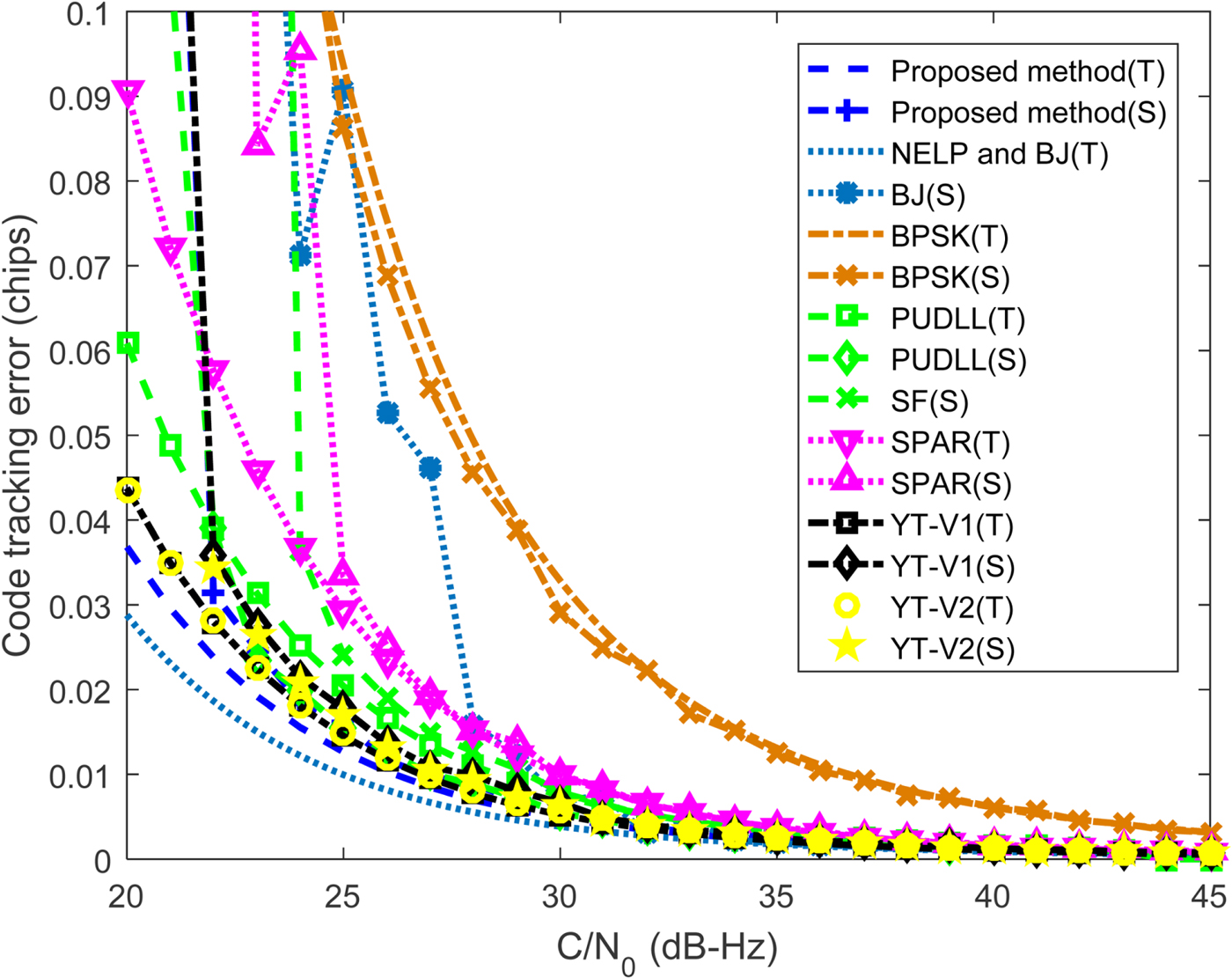
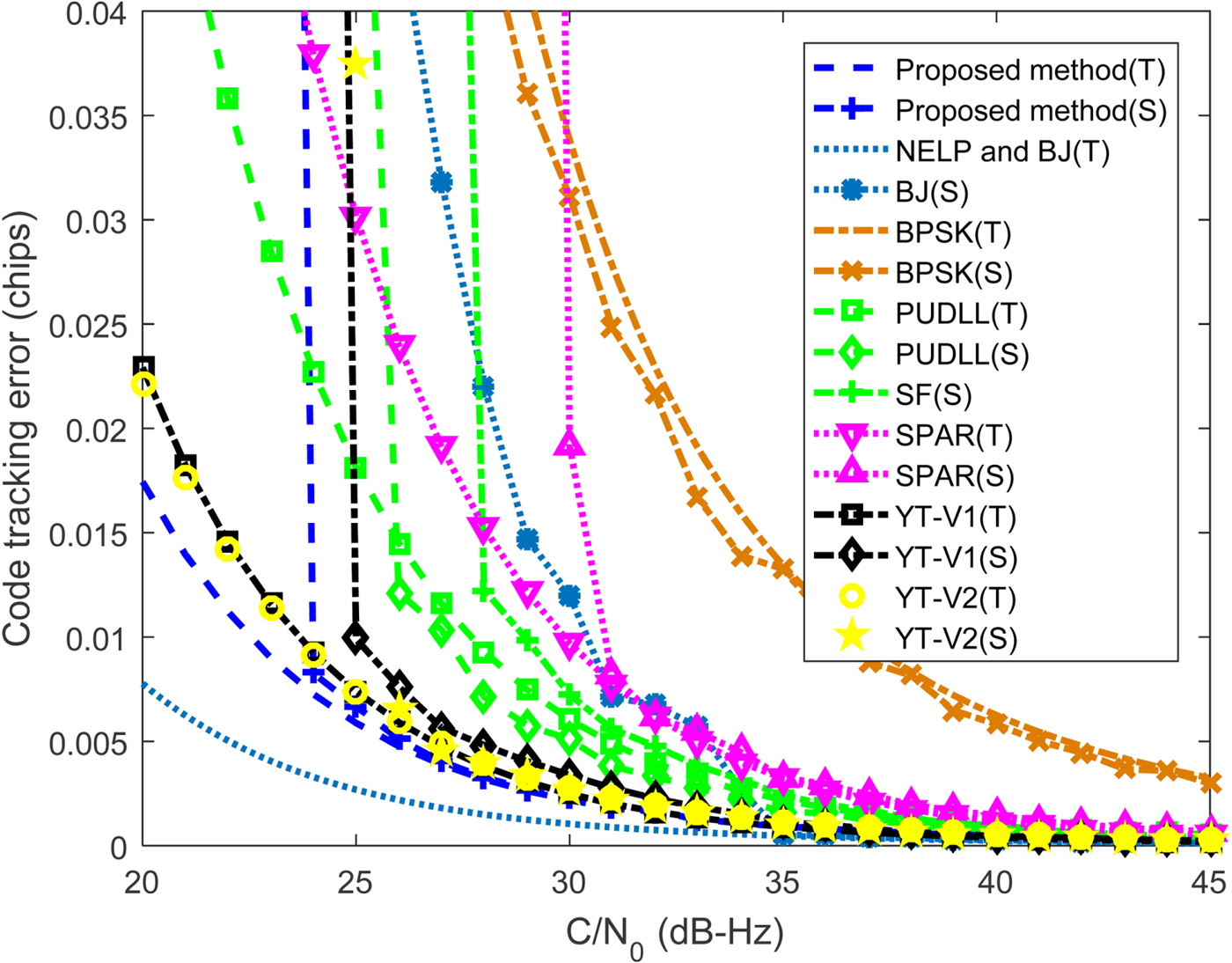
In order to fully reflect the performance of the proposed method, and taking the application of the sine BOC signal in the GNSS system into account, BOCs(10,5) and BOCs(14,2) are selected to evaluate the performance of the proposed method in low and high order BOCs signals, respectively. For comparison, the performance results of Non-coherent Early minus Late Power (NELP), Bump-jump (BJ), BPSK-LIKE, PUDLL, SF (Shen et al., Reference Shen, Xu, Cheong and Feng2015), SPAR and the two tracking methods proposed by Yan et al. (Reference Yan, Wei, Tang, Qu and Zhou2015a) (YT-V1) and Yan et al. (Reference Yan, Wei, Tang, Qu and Zhou2015b) (YT-V2) are also provided. Figures 6 and 7 show the code tracking performance of BOCs(10,5) and BOCs(14,2) in thermal noise. The code loop noise bandwidth B L = 1 Hz, T p = 1 ms, and the received bandwidth is 30.69 MHz and 32.736 MHz when the correlator interval is 0.1 chips and 0.03 chips, respectively. Compared with the traditional NELP method, because the proposed method is not fully matched with the input signal, there are approximately 2.5 dB and 4.5 dB losses in performance. However, the potential for ambiguity is completely eliminated. The proposed method has the best performance among BPSK-LIKE, PUDLL, SF, SPAR, YT-V1 and YT-V2. Bump-Jump (BJ) has the same tracking accuracy as NELP when the false lock does not occur or when it rapidly jumps back to the main peak. However, as the environment worsens, the performance of the BJ method rapidly deteriorates, as shown in Figure 6. The BJ method will lose lock when the C/N0 is less than 34 dB-Hz, whereas the proposed method will lose lock when the C/N0 is approximately 23 dB-Hz. For BOCs(14,2), these methods will lose lock when the C/N0 is less than 35 dB-Hz and 24 dB-Hz. Therefore, the proposed method has the best code tracking accuracy and robustness among the unambiguous tracking methods discussed.
Theory (T) and simulation (S) results of code tracking BOCs(10,5).

Theory (T) and simulation (S) results of code tracking BOCs(14,2).

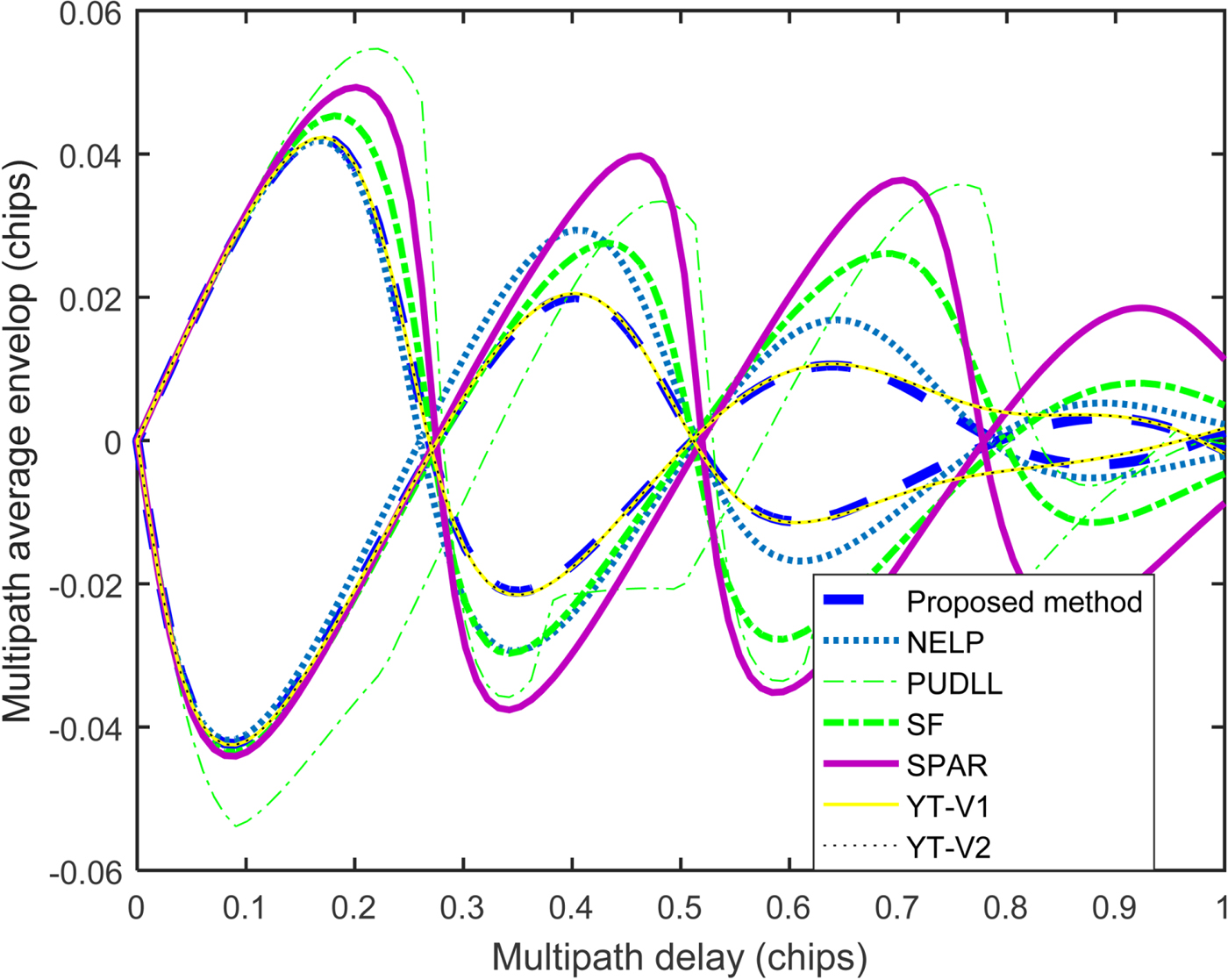
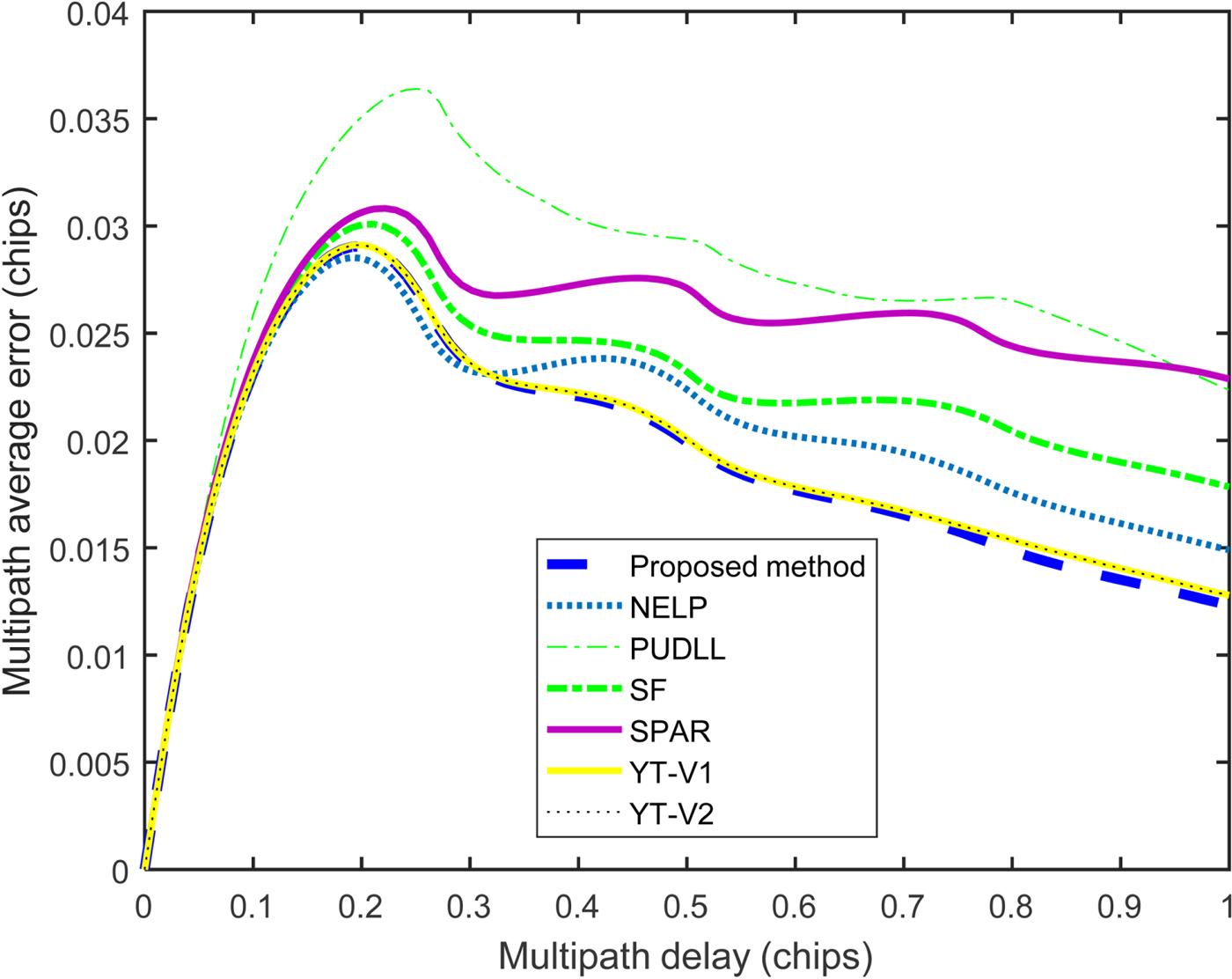
The performance of the proposed method in the presence of multipath interference is analysed and compared with the performance of SPAR, PUDLL, SF, NELP, YT-V1 and YT-V2. The multipath model considered here is similar to that in Julien et al. (Reference Julien, MacAbiau, Cannon and Lachapelle2007), which is a one-path specular reflection with some amplitude relative to the direct path and arriving at some phase and delay. Figures 8 and 9 show the code tracking multipath performance comparison when the multipath-to-direct ratio is −6 dB. Figure 8 depicts the multipath error envelope of BOCs(10,5) and Figure 9 depicts the average multipath error of BOCs(10,5). As shown in Figures 8 and 9, when the multipath delay is between 0 and 0.75 chips, the proposed method has the best performance, which is equivalent to that of YT-V1 and YT-V2. When the multipath delay is between 0.75 and 1 chips, the proposed method has the best performance.
Multipath error envelope of BOCs(10,5).

Average multipath error of BOCs(10,5).

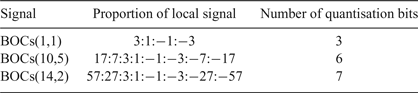
The main code tracking challenges in BOC signal processing are to avoid losing track of the signal (loss-of-lock situation), to operate well under noisy conditions, and to achieve high-accuracy code estimation under multipath channel conditions while preserving a reasonable receiver complexity (Lohan et al., Reference Lohan, Diego, Lopez-Salcedo, Seco-Granados, Boto and Fernandes2017). With the exception of BPSK-LIKE, most unambiguous tracking algorithms have no specific requirement for the receiver front-end, loop filter, etc. With the same parameters, the number and type of correlators affect the complexity of different algorithms. For the proposed method, the two local auxiliary signals are the BOCs signal and a linear combination of a series of BOCs signals with different delays. The BOCs signal is a traditional binary level signal, while the linear combination is multilevel. As shown in Equation (7), the proportion corresponding to the weighted coefficient matrix is a series of rational numbers. As a result, local signals can be constructed completely with only a limited number of bits. For BOCs(10, 5), the proportion of the weighted coefficient matrix is 5:4:8:17, and the proportion of the auxiliary signal in Figure 2(b) is 17:7:3:1: − 1: − 3: − 7: − 17, which can be quantised completely by six bits. The number of quantisation bits required for the proposed method varies with the order of the BOCs signals, as shown in Table 1.
The number of quantisation bits required for the proposed method.

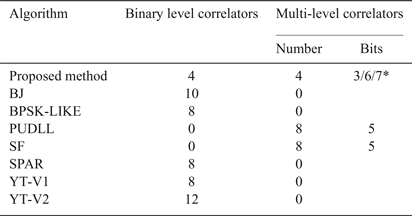
For comparison, the number of correlators of BJ, BPSK-LIKE, PUDLL, SF, SPAR YT-V1 and YT-V2 are listed in Table 2. PUDLL and SF also require multilevel correlators, and their local auxiliary signals are affected by a parameter K. In the simulation of this paper, K = 0.1 is used, which is the same as that utilised in Shen et al. (Reference Shen, Xu, Cheong and Feng2015) and Yao et al. (Reference Yao, Cui, Lu, Feng and Yang2010), and the local auxiliary signals of PUDLL and SF can be quantised by five bits.
Number of correlators.

* The number of quantisation bits required for the proposed method varies with the order of the BOCs signals as shown in Table 1.
As shown in Table 2, the implementation complexity of the proposed method is similar to that of PUDLL and SF. Compared with SPAR, BJ, etc., the complexity is higher because of the multilevel replicas. In conclusion, the proposed method can track the signal unambiguously, operate better under noisy conditions, and achieve higher-accuracy code estimation under multipath channel conditions compared with all the earlier methods mentioned above while preserving a reasonable receiver complexity. Thus, the proposed method is a good choice for the processing of sine BOC signals.
5. CONCLUSIONS
An unambiguous correlation function for sine BOC signals based on combined correlation functions has been proposed in this paper. Two reference signals are needed to obtain the unambiguous correlation function: the BOCs signal and a linear combination of BOCs signals with different delays. The unambiguous correlation function has only one main peak and no positive side peaks, which completely eliminates the potential tracking ambiguity.
The code tracking accuracy and multipath performance are evaluated in the code tracking process. In terms of code tracking accuracy, the proposed method has outstanding performance compared with BJ, BPSK-LIKE, PUDLL, SF and SPAR. The performance advantage is about 1 dB with respect to YT-V1 and YT-V2, and YT-V1 and YT-V2 are ambiguity mitigation techniques while the proposed method is an ambiguity elimination technique. In terms of multipath performance, the proposed method has the best performance. The drawback is that multilevel replicas are required, which results in additional effort for the receivers. In conclusion, the proposed method can completely eliminate the threat of ambiguity while achieving obvious performance advantages in terms of code tracking accuracy and anti-multipath, at the cost of an increase in complexity.
ACKNOWLEDGEMENTS
This work was supported by the National Natural Science Foundation of China (NSFC), Grant 61401171.