INTRODUCTION
It is widely recognized that the dyadic relationships between supervisor and subordinate, such as leader–member exchange (LMX), is a critical antecedent of subordinates’ outcomes (Dulebohn, Bommer, Liden, Brouer, & Ferris, Reference Dulebohn, Bommer, Liden, Brouer and Ferris2012; Mathieu, Fabi, Lacoursière, & Raymond, Reference Mathieu, Fabi, Lacoursière and Raymond2016). Given the paramount importance of guanxi in Chinese society, it should not be ignored when discussing Chinese supervisor–subordinate relationships (Chen, Chen, & Huang, Reference Chen, Chen and Huang2013; Hong, Zhu, & White, Reference Hong, Zhu and White2013). As both LMX and supervisor–subordinate guanxi (SSG) capture the relationship between employee and supervisor, what distinguishes SSG, as scholars have argued, lies in the fact that LMX is built upon task activities through which work-related resources and affect are exchanged, while SSG represents connections that arise from social interactions beyond the work domain (e.g., Law, Wong, Wang, & Wang, Reference Law, Wong, Wang and Wang2000; Zhang, Li, & Harris, Reference Zhang, Li and Harris2015).
As has been identified by Wei, Liu, Chen, & Wu (Reference Wei, Liu, Chen and Wu2010: 438), SSG is the most critical interpersonal relationship in various Chinese organizational settings. Much work has attempted to understand empirically the individual and organizational outcomes of it, and found its positive effect on bonus allocation (Law et al., Reference Law, Wong, Wang and Wang2000), career success (Wei et al., Reference Wei, Liu, Chen and Wu2010), and some attitudinal and organizational outcomes, for example, affective organizational commitment (Chen, Friedman, Yu, Fang, & Lu, Reference Chen, Friedman, Yu, Fang and Lu2009), trust in supervisor (Wong, Wong, & Wong, Reference Wong, Wong and Wong2010), job performance (Cheng, Chiu, & Tzeng, Reference Cheng, Chiu and Tzeng2013), and organizational citizenship behaviors (Liu & Wang, Reference Liu and Wang2011; Zhang, Li, & Harris, Reference Zhang, Li and Harris2015).
Indeed, in a Confucian relationalism society like China, guanxi is pursued for its own sake (Yang, Reference Yang1992) and most supervisors are willing to establish extra-role relationships, say guanxi, with their subordinates through off-the-job activities (Chang, Reference Chang2014). As stated above, close guanxi could bring the focal units a lot of benefits. However, a possible note worth issue is that Dose a good guanxi always lead to positive individual outcomes?
As has been identified by conservation of resources theory (COR) theory, social relation may be beneficial when it provides for situational needs and be harmful when it does not (Cohen & Wills, Reference Cohen and Wills1985; Riley & Eckenrode, Reference Riley and Eckenrode1986; Hobfoll, Reference Hobfoll1989; Brunetto, Farrwharton, Ramsay, & Shacklock, Reference Brunetto, Farrwharton, Ramsay and Shacklock2010; Jiang, Law, & Sun, Reference Jiang, Chen and Shi2014). As the most typical interpersonal relation in Chinese work settings (Jiang, Cannella, & Jiao, Reference Jiang, Cannella and Jiao2013), the positive impact of SSG on employees’ outcomes has been thoroughly studied, while little is known about the negative contributions of SSG, that is, in what situations SSG may cause negative impacts on employees’ outcomes, such as work–family conflict and turnover intention, and how these negative impacts occur.
Chinese guanxi is characterized by familial collectivism, which refers to a set of values, beliefs, and their associated behavioral norms that take the family as a model for relationships in other domains of life (Bond & Hwang, Reference Bond and Hwang1986; Yang, Reference Yang1988). Guided by familial collectivism, Chen et al. (Reference Chen, Friedman, Yu, Fang and Lu2009) conceptualized the quality of SSG as the extent to which a work relationship between supervisor and subordinate transforms into a more family-like relationship and identified three dimensions of SSG: affective attachment, personal-life inclusion, and deference to supervisor. According to the comparison tests, most of the discriminant validity between the three dimensions of SSG and LMX is due to the dimension named personal-life inclusion, which refers to ‘the degree to which subordinates and supervisors are included in each other’s private or family lives’ (Chen et al., Reference Chen, Friedman, Yu, Fang and Lu2009: 378–379). Thus, it suggests that personal-life inclusion captures the paramount distinctive features of Chinese SSG and ‘appears to have higher potential to encapsulate culturally distinctive aspects of guanxi relations’ (Smith et al., Reference Smith, Wasti, Grigoryan, Achoui, Bedford, Budhwar, Lebedeva, Leong and Torres2014: 933).
Given the critical role of personal-life inclusion in distinguishing SSG, however, previous work has indicated a somewhat controversial conclusion of its impacts: personal-life inclusion is positively correlated both to employees’ positive attitude: affective organizational commitment and to the negative outcome: turnover intention (Chen et al., Reference Chen, Friedman, Yu, Fang and Lu2009). Indeed, as these scholars argued, ‘This aspect of guanxi may be experienced as a burden by employees’ (Chen et al., Reference Chen, Friedman, Yu, Fang and Lu2009: 393) and thus leading to a higher turnover intention. However, they did not explicate what the ‘burden’ is and how personal-life inclusion impacts employees’ turnover intention. Therefore, one aim of this paper is to provide a possible explanation of how personal-life inclusion may cause the ‘burden’ for Chinese employees.
A quick glance at the studies on stress and turnover suggests that COR theory has a strong interpreting validity (Halbesleben, Harvey, & Bolino, Reference Halbesleben, Harvey and Bolino2009; Jiang, Law, & Sun, Reference Jiang, Chen and Shi2014). According to Hobfoll (Reference Hobfoll1989), the COR model proposes that individuals seek to acquire and maintain resources; and stress is a reaction to an environment, in which there is the threat of a loss of resources, an actual loss in resources, or lack of an expected gain in resources. Given the fact that personal-life inclusion derives from a transformation of a contract-based supervisor–subordinate relationship (a kind of market pricing relationship with formal authority characteristics) into a more family-like relationship, thus a high-level personal-life inclusion implies a lot of after-work social interactions with the supervisor and the subordinates’ devotions to the supervisor (Law et al., Reference Law, Wong, Wang and Wang2000; Chen et al., Reference Chen, Friedman, Yu, Fang and Lu2009).
As has been identified by numerous work–family studies (Skinner & Pocock, Reference Skinner and Pocock2008; Porter & Ayman, Reference Porter and Ayman2010; Xiao & Fang, Reference Xiao and Fang2012; Samad, Reaburn, & Milia, Reference Samad, Reaburn and Milia2015), time is a basic resource for fulfilling both work and family duties. Considering that after-work social interactions with – and devotions to – supervisor would consume subordinates’ limited time resource that they need to fulfill their family responsibilities, those subordinates who perceive high-level personal-life inclusion tend to hold higher perceptions of time-based work interference with family (WIF) and thus leading to higher turnover intention. Moreover, COR model also suggests that individual situational needs should be taken into account when examining the impacts of resource loss on stress or turnover intention (Cohen & Wills, Reference Cohen and Wills1985; Riley & Eckenrode, Reference Riley and Eckenrode1986; Hobfoll, Reference Hobfoll1989). As for the mediated relationship between personal-life inclusion, WIF, and turnover intention, one can see that perceived family demands could serve as a critical indicator of subordinates’ situational needs. Thus, in this study we propose that a moderated mediation mechanism exists between personal-life inclusion and turnover intention with the mediator (i.e., WIF) and the moderator (i.e., perceived family demands).
This paper makes three major contributions. First, we focused on the negative impacts of SSG on Chinese employees’ outcomes by examining and providing a possible explanation of how SSG’s most culturally remarkable dimension – personal-life inclusion – causes ‘burden’ for Chinese employees guided by COR theory. Second, we constructed an integrated moderated mediation model to reveal the effect mechanism underlying the relationship between personal-life inclusion and turnover intention by examining the mediating role of WIF and the moderating effect of perceived family demands. Third, this research sheds some light on the notions that social relations may cause turnover rather than stay intention in work settings, and which tends to be even more intense in China due to its guanxi-oriented and family-collectivism culture. Thus, Chinese organizations and managers need to recognize the possible negative impacts of high-levels of personal-life inclusion on employees’ outcomes.
THEORY AND HYPOTHESES
SSG, personal-life inclusion, and turnover intention
Guanxi, an indigenous Chinese construct, is defined as ‘a dyadic, particular and sentimental tie that has potential of facilitating favor exchanges between the parties connected by the tie’ (Bian, Reference Bian2006: 312). There are two major types of guanxi. One is inherited ties, especially those of kinship, which is an important base of guanxi in traditional China. The other is personal guanxi, which is usually developed through social occasions, such as lunches, dinners, and gift giving (Chen & Tjosvold, Reference Chen and Tjosvold2007). In conducting a survey of 105 senior- and middle-level managers in mainland China, Bu and Roy (Reference Bu and Roy2008) found that most of network ties were formed through work (60%) and nonwork (25.6%) interactions rather than through preexisting ties such as kinship (3.5%) or precareer friendships (11%) established in school or during military service. The general findings of this literature suggest that most relationships between supervisors and subordinates are not inherited but are built and enhanced through frequent informal interactions (Shih & Lin, Reference Shih and Lin2014). Although the percentage of kinships between supervisor and subordinate is really small, kinships still serve as the prototype of Chinese social relations, which means to have guanxi is to extend kin-relationships to people who are not kin. This extension is termed as the ‘familization’ or ‘pan-familization’ process (Yang, Reference Yang1992, see Chen et al., Reference Chen, Friedman, Yu, Fang and Lu2009: 378).
Drawing on the familial collectivism, Chen et al. developed a three-dimensional measure of SSG. The quality of SSG, in their study, is conceptualized as ‘the extent to which a contract-based supervisor–subordinate relationship (a kind of market pricing relationship with formal authority characteristics) transforms into a communal sharing relationship’ (Reference Chen, Friedman, Yu, Fang and Lu2009: 378). These transformations would form three dimensions of SSG: affective attachment, deference to supervisor, and personal-life inclusion. Among them, personal-life inclusion, which refers to ‘the degree to which subordinates and supervisors are included in each other’s private or family lives’ (Chen et al., Reference Chen, Friedman, Yu, Fang and Lu2009: 378), contributes to the most of the discriminant validity between the three dimensions of SSG and LMX as shown in the comparison tests results. Besides, in conducting a survey in Taiwan, Singapore, and six non-Chinese cultural contexts, Smith, Wasti, and Grigoryan suggested that personal-life inclusion ‘appears to have higher potential to encapsulate culturally distinctive aspects of guanxi relations’ (Reference Smith, Wasti, Grigoryan, Achoui, Bedford, Budhwar, Lebedeva, Leong and Torres2014: 933). Thus, it suggests that personal-life inclusion captures the paramount distinctive feature of Chinese SSG.
According to the findings of previous studies, SSG contributes to significant effects on several employees’ positive attitudinal and behavioral outcomes, such as commitment (Law et al., Reference Law, Wong, Wang and Wang2000; Chen et al., Reference Chen, Friedman, Yu, Fang and Lu2009), trust (Wong, Ngo, & Wong, Reference Wong, Ngo and Wong2003; Han, Peng, & Zhu, Reference Han, Peng and Zhu2012), and organizational citizenship behaviors (Lam, Liang, Ashford, & Lee, Reference Lam, Liang, Ashford and Lee2015; Zhang, Li, & Harris, Reference Zhang, Li and Harris2015), however, the relationship between SSG and turnover intention seems vague. On one hand, both Farh, Tsui, Xin, and Cheng (Reference Farh, Tsui, Xin and Cheng1998) and Wong, Ngo, and Wong (Reference Wong, Ngo and Wong2003) found that SSG is not significantly related to turnover intention, despite using different approaches to measure SSG. On the other hand, Chen et al. (Reference Chen, Friedman, Yu, Fang and Lu2009), using the three-dimensional scale of SSG, found that one dimension, comparing to the others, has different significant effects on turnover intention. Specifically, both affective attachment and deference to supervisor were negatively related to turnover intention, however, personal-life inclusion showed a significant positive correlation with turnover intention. To some extent, Chen et al.’s (Reference Chen, Friedman, Yu, Fang and Lu2009) findings may provide an explanation for the nonsignificant results of Farh et al. and Wong et al., that one dimension of SSG (i.e., personal-life inclusion) exerts opposite effects on turnover intention. Given the critical role of personal-life inclusion in distinguishing SSG, it is of paramount importance to explicate how personal-life inclusion leads to employee’ turnover intention.
To better understand the relationship between personal-life inclusion and turnover intention, we draw upon the COR theory. The COR theory has been widely applied in the stress and turnover literature (Hobfoll & Freedy, Reference Hobfoll and Freedy1993; Halbesleben, Harvey, & Bolino, Reference Halbesleben, Harvey and Bolino2009). It maintains that stress is a reaction to an environment in which there is the threat of a loss of resources, an actual loss in resources, or lack of an expected gain in resources (Hobfoll, Reference Hobfoll1989). These resources include objects (e.g., car and home), conditions (e.g., marriage, tenure, and seniority), personal characteristics (e.g., self-esteem), and energies (e.g., time, money, and knowledge). Especially, Hobfoll (Reference Hobfoll1989) added, social relations do not fit in any one category above. This is because although social relations are seen as resources that they may provide or facilitate the preservation of valued resources, they also can detract from individuals’ resources. This notion has been verified by the research findings of Cohen and Wills (Reference Cohen and Wills1985) and Riley and Eckenrode (Reference Riley and Eckenrode1986). Both indicated that social relation is beneficial when it provides for situational needs and is harmful or benign when it does not. Therefore, we argue that as a social relation, the effects of personal-life inclusion on turnover intention could be explicated by the COR theory.
Personal-life inclusion derives from the familization process between a Chinese supervisor and subordinate, while this process contrasts sharply with that in the Western society (Chen et al., Reference Chen, Friedman, Yu, Fang and Lu2009). In an individualistic culture such as the United States, supervisor–subordinate relationship can only legitimately transform into an ‘equity-matching’ relationship, where the exchange of effort and rewards between a supervisor and subordinate is based on the equity principle. Moreover in the Western organizations, it is not as easily accepted for the relationship to transform into a family-like one because the Protestant ethic prevents employees from mixing affective relations with business (Weber, Reference Weber1930, see Chen et al., Reference Chen, Friedman, Yu, Fang and Lu2009: 380). Thus, the relationship between a Western supervisor and subordinate is restricted to work-related exchanges.
However, Chinese guanxi highlights a quite different approach. On one hand, like in a family, the familization process advances through the frequent out-of-work interactions between the two parties, such as sharing meals, exchanging gifts, and home visits (Yang, Reference Yang1988; Fiske, Reference Fiske1992). On the other hand, given the high power distance of the Chinese culture (Leung, Su, & Morris, Reference Leung, Su and Morris2001) and the value of authority highlighted by the Confucian teaching of guanxi (Chen & Chen, Reference Chen and Chen2004), subordinates are expected to show unreserved loyalty and obedience toward their superiors and to make more devotions (Chen et al., Reference Chen, Friedman, Yu, Fang and Lu2009). Obviously, these interactions and devotions will no doubt consume the subordinates’ a lot of out-of-work time and energy.
Moreover, considering the huge population of China, the competition is extremely fierce (Lu, Wang, Siu, Lu, & Du, Reference Lu, Wang, Siu, Lu and Du2015) and consequently, the issues of overtime work are serious in most Chinese organizations. As has been identified by Xiao and Fang (Reference Xiao and Fang2012), Chinese employees usually work for longer hours than Western employees, as up to 47 hr/week. Imagine that after a long-day work, one subordinate gets an invitation of attending after-work interactions with his/her supervisor, or the supervisor asks this subordinate to do some favors, such as helping to deal with family errands, it will be very difficult for the subordinate to say ‘no’ because it may ‘offend’ the supervisor. We argue that although a high-quality SSG can provide the subordinate some benefits, such as more bonuses and promotion opportunities (Law et al., Reference Law, Wong, Wang and Wang2000; Wei et al., Reference Wei, Liu, Chen and Wu2010), the out-of-work interactions and the devotions to the supervisor will also put more pressures on the subordinate and then are more likely to be perceived as the ‘burden,’ thus leading to higher turnover intention. We hypothesized that:
Hypothesis 1: Personal-life inclusion is positively related to subordinate’s turnover intention.
The mediating role of WIF
Work–family conflict has been defined as a form of interrole conflict in which the role pressures from the work and family domains are mutually incompatible in some respect (Greenhaus & Beutell, Reference Greenhaus and Beutell1985). WIF, accordingly, refers to the potential for the role pressures from the work domain to interfere in the family role and has been identified as more prevalent than the family interference with work (Major, Fletcher, Davis, & Germano, Reference Major, Fletcher, Davis and Germano2008). Three types of WIF are identified: time based which refers to where time spent in one role takes away from time in another role, strain based which means where strain in one role either carries over to the other role or makes it difficult to fulfill obligations in the other role, and behavior based which refers to where behaviors expected in one role make it difficult to fulfill obligations in the other role.
Previous studies have demonstrated that numerous antecedents account for the contributions to WIF, such as work time, work demands, job engagement, perceived organization and supervisor support, and supervisor–subordinate relationship (e.g., LMX) (Major, Klein, & Ehrhart, Reference Major, Klein and Ehrhart2002; Spector, Allen, & Poelmans, Reference Spector, Allen and Poelmans2007; Major et al., Reference Major, Fletcher, Davis and Germano2008; Halbesleben, Harvey, & Bolino, Reference Halbesleben, Harvey and Bolino2009; Brunetto, Farrwharton, Ramsay, & Shacklock, Reference Brunetto, Farrwharton, Ramsay and Shacklock2012; Litano, Major, Landers, Streets, & Bass, Reference Litano, Major, Landers, Streets and Bass2016; Kailasapathy & Jayakody, Reference Kailasapathy and Jayakody2017). As for the outcomes of WIF, scholars have verified that WIF would lead to negative work attitudes, say reduced job satisfaction and affective organizational commitment, and increased psychological distress, depression and turnover intention (Netemeyer, Boles, & Mcmurrian, Reference Netemeyer, Boles and Mcmurrian1996; Major, Klein, & Ehrhart, Reference Major, Klein and Ehrhart2002; Spector, Allen, & Poelmans, Reference Spector, Allen and Poelmans2007; Lu et al., Reference Lu, Wang, Siu, Lu and Du2015; Boamah & Laschinger, Reference Boamah and Laschinger2016).
It is noteworthy that as one type of social relationship between the supervisor and the subordinate, LMX has shown its contradictory effects on WIF in previous work, that is, although some studies have showed that LMX is negatively related with WIF (Major et al., Reference Major, Fletcher, Davis and Germano2008; Litano et al., Reference Litano, Major, Landers, Streets and Bass2016), others have found the contrary conclusion that LMX is positively correlated to work–family conflict (Brunetto et al., Reference Brunetto, Farrwharton, Ramsay and Shacklock2010) and job demands (Jiang, Law, & Sun, Reference Jiang, Chen and Shi2014) which has been proved to be positively related with WIF (Spector, Allen, & Poelmans, Reference Spector, Allen and Poelmans2007). Therefore, the relationship between LMX and WIF may present as a variety of types, say negative or positive. This variety could be explained by COR theory which suggests that a social relationship may detract employees from some resources when it fails to provide support for situational needs and thus leading to stress and turnover (Hobfoll, Reference Hobfoll1989).
As has been characterized by familial collectivism, the quality of Chinese SSG improves with the transformation from a formal market pricing relationship into a kin-like relationship (Yang, Reference Yang1988; Fiske, Reference Fiske1992; Chen et al., Reference Chen, Friedman, Yu, Fang and Lu2009). Thus, the most distinction between LMX and SSG lies in the fact that SSG involves more social interactions with – and devotions to – the supervisor beyond the work domain (e.g., Law et al., Reference Law, Wong, Wang and Wang2000; Chen et al., Reference Chen, Friedman, Yu, Fang and Lu2009; Zhang, Li, & Harris, Reference Zhang, Li and Harris2015). This distinction may suggest that in comparison with LMX, SSG is more likely to be positively related with WIF. A quick glance at the definitions and the items of the three dimensions of SSG suggests that personal-life inclusion is the one which captures the most culturally distinctive feature of SSG by highlighting after-work social interactions and subordinates’ devotion to their supervisors (Chen et al., Reference Chen, Friedman, Yu, Fang and Lu2009).
As has been maintained by COR theory, an individual possesses a limited pool of resources that can be allocated to different domains of life, when demands for resources in one domain (e.g., interacting with one’s supervisor) are high, fewer resources are available for meeting demands in another domain (e.g., accompanying one’s family members) (Li, McCauley, & Shaffer, Reference Li, Mccauley and Shaffer2017). Thus, the higher level of personal-life inclusion tends to consume the subordinate more out-of-work time and energy which are supposed to be used to fulfill one’s family duties. Imagine that a subordinate who has high-level personal-life inclusion would often attend some social activities with his supervisor after-office hours or helping his/her supervisor deal with some family errands, instead of accompanying his/her own family members or participating in his/her own family activities. Thus, subordinates with high-level personal-life inclusion may find themselves not having enough time to fulfill their family responsibilities which leads to a high perception of time-based WIF, then this high perception of WIF will result in subordinate’s turnover intention. Therefore, we hypothesize that:
Hypothesis 2: WIF mediates the relationship between personal-life inclusion and subordinate’s turnover intention.
The moderating effect of perceived family demands
Previous work has verified that the role demands of the work and family domains are the paramount sources of work–family conflict (Yang, Chen, & Zou, Reference Yang, Chen and Zou2000; Xiao & Fang, Reference Xiao and Fang2012). Two types of demands in the work and family domains have been defined. One type exists in an individual’s objective environment, for example, quantitative workload (Fox, Dwyer, & Ganster, Reference Fox, Dwyer and Ganster1993) and task complexity (Xie & Johns, Reference Xie and Johns1995). The other is defined as subjective feelings and perceptions such as role overload (Karasek, Reference Karasek1979) and role pressure (Fox, Dwyer, & Ganster, Reference Fox, Dwyer and Ganster1993). This study adopted the subjective perceptions of Yang, Chen, and Zou (Reference Yang, Chen and Zou2000) and Choi and Chen (Reference Choi and Chen2006), and defined perceived family demands as commitments and pressures to assume responsibilities associated with fulfilling family-related role obligations, such as spending energy, time, and effort discharging family responsibilities.
According to Hobfoll (Reference Hobfoll1989), COR theory suggests that social relationship may detract from individuals’ resources and cause negative feelings when it does not provide for situational needs. Suppose that a subordinate who has high-level perceptions of family demands would expect to spend more time to fulfill the family-related duties, and this expectation highlights his/her specific situational need. However, having a high-level personal-life inclusion, according to Chen et al. (Reference Chen, Friedman, Yu, Fang and Lu2009), implies spending more after-work hours to participate in social activities with – and more devotions to – the supervisor rather than accompanying one’s family members. Obviously, such social relation, say high-level personal-life inclusion, cannot meet a subordinate’s need when he/she finds himself/herself in the situation of high-level perceived family demands, and thus leading to a higher WIF. While for those who has low-level perceived family demands, personal-life inclusion may not trigger nor has a weaker impact on the WIF since he/she could spend his/her after-office time to attend social activities with the supervisor and to help with the supervisor’s family errands without worrying about the failure to fulfill family duties. Thus, we hypothesize that perceived family demands moderates the relationship between personal-life inclusion and WIF.
Also, we argue that there may be a moderated mediation relationship between the variables. According to COR theory (Hobfoll, Reference Hobfoll1989), the threats of loss or actual loss of the resources to fulfill one’s family duties would be more sensitive for subordinates with higher perceived family demands. Once a subordinate’s guanxi with supervisor, say personal-life inclusion, constrains one from fulfilling family responsibilities, his/her valued family-related resources are inevitably be lost especially for those who has a high-level perceived family demands, and consequently further strengthen his/her negative feelings of WIF and turnover intention. That is, subordinates with higher perceived family demands may be more sensitive to the loss of valued family-related resources detracted by high-level personal-life inclusion than those with lower perceived family demands. Thus, we hypothesize that:
Hypothesis 3: Perceived family demands moderates the positive relationship between personal-life inclusion and WIF, such that the positive relationship between personal-life inclusion and WIF is strengthened when perceived family demands is high.
Hypothesis 4: Perceived family demands moderates the strength of the mediated relationships between personal-life inclusion and turnover intention via WIF, such that the mediated relationships are stronger for those who with high perceived family demands than with low perceived family demands.
METHODS
Sample
The participants in our study included employees from four enterprises located in Southwest China. To reduce potential concern about being evaluated, participants were told that their responses would be totally confidential and used for the present research only. With the help of the human resource departments, questionnaires were administered to 220 employees. A total of 194 completed questionnaires were received, however, 13 of them were deleted due to a large number of missing values. Consequently, the final sample consisted of 181 participants, representing a total effective rate of 82.3%. More than half of the participants were male (54.1%), between 21 and 30 years old (54.7%), and well educated (44.2% had a bachelor degree); 110 had worked in their current company for more than 4 years (60.7%), and 74.6% of them were from private enterprises.
Measures
Personal-life inclusion
We used the 4-item personal-life inclusion scale developed by Chen et al. (Reference Chen, Friedman, Yu, Fang and Lu2009). Two sample items were ‘My supervisor would ask me to help him/her deal with some family errands’ and ‘After office hours, I have social activities together with my supervisor, such as having dinner together or having entertainment together, which go beyond work duties.’ The Cronbach’s α was 0.77.
WIF
Time-based WIF was measured with the 5-item scale which has been adopted in Chinese settings by Wang and Jia (Reference Wang and Jia2009). It is a combined version of Carlson, Kacmar, and Williams’ (Reference Carlson, Kacmar and Williams2000) and Frone, Russell, and Cooper (Reference Frone, Russell and Cooper1992) measurement. A sample item was ‘I have to miss family activities due to the amount of time I must spend on work responsibilities.’ The Cronbach’s α was 0.83.
Perceived family demands
We adapted 4-item perceived family demands scale developed by Choi and Chen (Reference Choi and Chen2006). The four items uncovered family demands in terms of time, energy, and role pressure. A sample item was: ‘I spent a lot time on family responsibilities.’ The Cronbach’s α was 0.77.
Turnover intention
Just as Chen et al. (Reference Chen, Friedman, Yu, Fang and Lu2009), the 2-item scale developed by Camman et al. (1Reference Camman, Fichman, Jenkins and Klesh979) was used to measure turnover intention. The two items were: ‘I often think about quitting my job with my present organization’ and ‘I will probably look for a new job within the next year.’ In this study, the Cronbach’s α for this scale is 0.92.
Control variables
We included respondent gender, age, educational level, tenure (the length, in years, of employment by their current company), and the ownership type of his/her enterprise (i.e., private enterprise, state-owned enterprise, and foreign-owned enterprise) as control variables. For the coding of control variables see Table 2.
RESULTS
Confirmatory factor analysis and common method variance (CMV) caution
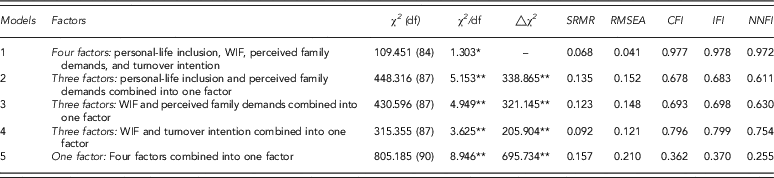
A series of confirmatory factor analysis procedures were performed to examine the discriminant validity of personal-life inclusion, WIF, perceived family demands, and turnover intention. Four alternative models were compared with the baseline four-factor model 1. As shown in Table 1, model 1 fit the data well and provided substantial improvement in fit indexes over the alternatives (models 2–5). The standardized loadings of all indicators on their specified constructs were significant at the 0.01 level. As such, we retained the four constructs for our analyses.
Comparison of alternative measurement models

Note. WIF=work interference with family.
*p<.05; **p<.01.
As suggested by Podsakoff, Mackenzie, Lee, and Podsakoff (Reference Podsakoff, Mackenzie, Lee and Podsakoff2003), we used Harman’s single-factor test and Controlling for the effects of a single unmeasured latent method to detect the CMV in our study. In Harman’s single-factor test, we contrasted the goodness of baseline four-factor model fit to several alternative models. The findings in Table 1 indicated that the baseline four-factor model provided an acceptable fit for the data (χ 2=109.451, df=84, χ 2/df=1.303, RMSEA=0.041, CFI=0.977, IFI=0.978, NNFI=0.972). The fit indices were superior to any other alternative models combining the theoretical variables. When combining all variables into one factor, the model revealed an unacceptable goodness of fit (χ 2=805.185, df=90, χ 2/df=8.946, RMSEA=0.210, CFI=0.362, IFI=0.370, NNFI=0.255). The results of Harman’s single-factor test revealed that CMV was not a significant concern in the present study.
Furthermore, we used the analysis ‘Controlling for the effects of a single unmeasured latent method,’ we constructed a latent variable called ‘CMV’ by loading all indicators of the four theoretical variables based on the baseline model, and the five-factor model (χ 2=85.737, df=69, χ 2/df=1.243, RMSEA=0.037, CFI=0.985, IFI=0.986, NNFI=0.977) fit the data better than the baseline four-factor model, but the improvement the goodness of fit was slight and not significant (Δχ 2=23.714, Δdf=15, p>.05). In conclusion, even though CMV may exist, it does not undermine the research validity of the present study.
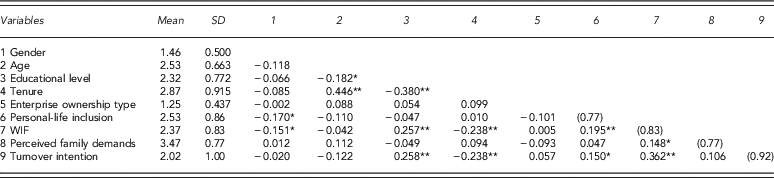
Table 2 presents means, standard deviations, reliabilities (Cronbach’s α), and correlations of all variables involved in the study. As shown, turnover intention were significantly related to personal-life inclusion (r=0.150, p<.05) and WIF (r=0.362, p<.00), lending preliminary support to Hypothesis 1.
Means, SD, correlations, and reliabilities of all variables involved in the study
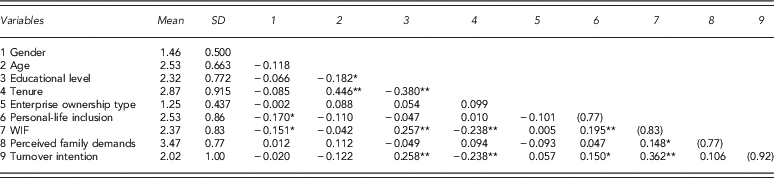
Note. N=181. Coefficient αs are in parentheses on the diagonal.
Gender (1=male; 2=female); Age (1=20 or under; 2=21–30; 3=21–40; 4=41 or over); Educational level (1=senior high school; 2=college; 3=university; 4=postgraduate); Tenure (1=6 months or less; 2=6 months–3 years; 3=4–7 years; 4=over 7 years); Enterprise ownership type (1=private enterprise; 2=state-owned enterprise; 3=foreign-owned enterprise; 4=sino-foreign joint enterprise).
WIF=work interference with family.
*p<.05; **p<.01; two-tailed tests.
Test of hypotheses
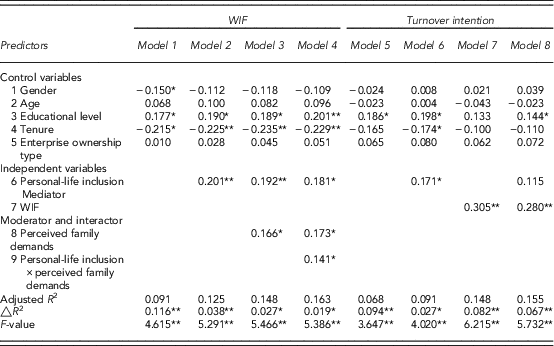
To test the hypotheses, we conducted a series of hierarchical regression analyses. The five control variables were entered in the first block; personal-life inclusion was in the second block. As shown in Table 3 (see model 6), personal-life inclusion was positively related to turnover intention (β=0.171, p<.05). Thus, Hypothesis 1 was supported.
Results of hierarchical regression analysis (N=181)
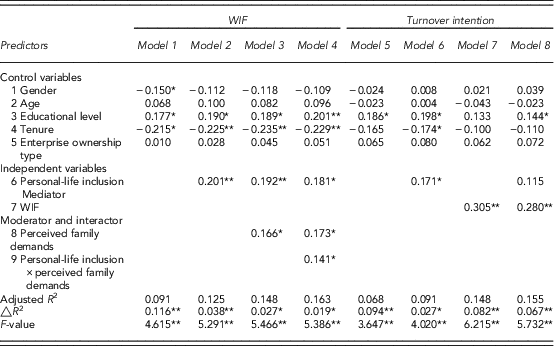
Note. WIF=work interference with family.
*p<.05; **p<.01; two-tailed tests.
Hypothesis 2, that WIF mediates the relationship between personal-life inclusion and turnover intention, was first assessed through hierarchical regression analysis and then through bootstrapping (Preacher, Rucker, & Hayes, Reference Preacher, Rucker and Hayes2007). Table 3 (see models 2, 6, 7, and 8) shows that personal-life inclusion was positively related to WIF (β=0.201, p<.01), and WIF was positively associated with turnover intention (β=0.305, p<.01). When WIF entered the regression model, the relationship between personal-life inclusion and turnover intention became not significant (β=0.115, ns), supporting Hypothesis 2.
In order to further confirm the mediated role of WIF, bootstrapping analysis was conducted. Table 4 provides the 95% bootstrap confidence intervals for the indirect effect of WIF. When the interval does not include zero, this indicates that the indirect effect is significant (Preacher, Rucker, & Hayes, Reference Preacher, Rucker and Hayes2007). As shown, the indirect effects of WIF on turnover intention was significant (indirect effect=0.079), further supporting Hypothesis 2.
Mediation effect of work interference with family (WIF) between personal-life inclusion and turnover intention

Note. BC=bias corrected; CI=confidence interval.
CIs not containing zero are interpreted as significant. Results are based on 5,000 bootstrap samples.
Hypothesis 3 was also tested by a series of hierarchical regression analyses. The results in Table 3 (see model 4) indicate that both personal-life inclusion (β=0.181, p<.05) and perceived family demands (β=0.173, p<.05) were positively related to WIF, and the interaction between these two variables had a significant effect on WIF (β=0.141, p<.05), which supported Hypothesis 3.
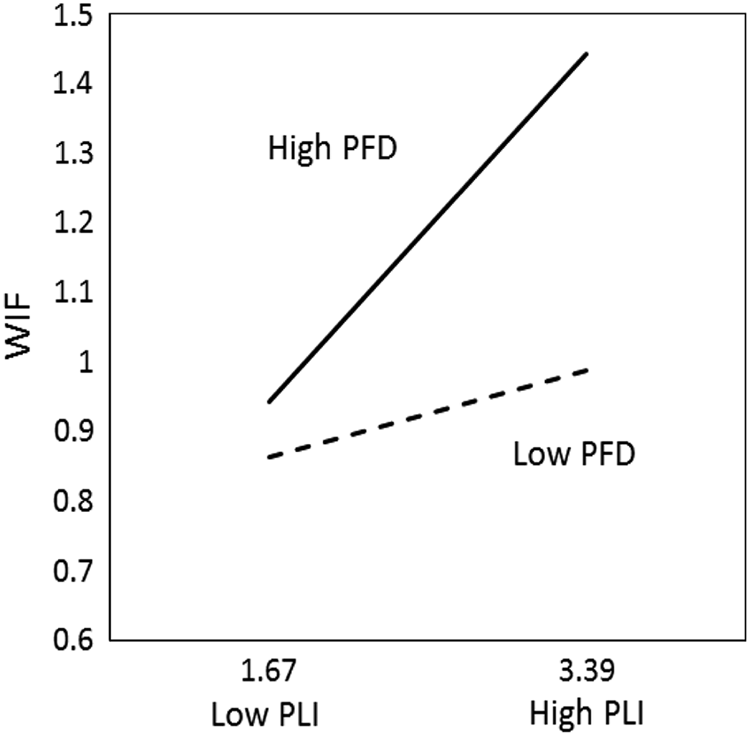
To explicate this interaction, we drew separate plots for individuals whose scores were 1 SD below and above the mean of perceived family demands (Cohen & Cohen, Reference Cohen and Cohen1983). Following Aiken and West’s (1991) suggestion, Figure 1 shows the interaction effect between personal-life inclusion and perceived family demands on WIF; the relationship between personal-life inclusion and WIF was positive and significant for the individuals with higher perceived family demands (β=0.296, p<.01), and this relation was weakened and not significant for the individuals with lower perceived family demands (β=0.053, ns). These results indicate that the positive relationship between personal-life inclusion and WIF is strengthened when perceived family demands is higher, thus supporting Hypothesis 3.
Interaction of personal-life inclusion (PLI) and perceived family demands (PFD) with work interference with family (WIF)

We used the moderated mediation analyses suggested by Hayes (Reference Hayes2013) and Stride, Gardner, Catley, and Thomas (Reference Stride, Gardner, Catley and Thomas2015) to test Hypothesis 4. The moderated mediation effect was first assessed by the products of coefficients approach proposed by Hayes (Reference Hayes2013), and the confidence band of the products of coefficients was [0.009, 0.174], leading support to Hypothesis 4.
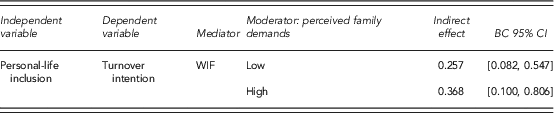
Moreover, we tested each indirect effect of WIF by operationalizing high and low perceived family demands as 1 SD above and below the mean score. Table 5 shows that the conditional indirect effects of personal-life inclusion on turnover intention via WIF, respectively, were significant at low perceived family demands (indirect effect=0.257) and also significant at high perceived family demands (indirect effect=0.368). The indirect effect is plotted at several values of perceived family demands with a 95% bias corrected and accelerated bootstrap confidence band. The moderated mediation effect is significant where the confidence band (dashed lines) does not contain zero (Preacher, Rucker, & Hayes, Reference Preacher, Rucker and Hayes2007). Therefore, Hypothesis 4 was supported.
Conditional mediation effect of perceived family demands on turnover intention through work interference with family (WIF)

Note. BC=bias corrected; CI=confidence interval.
CIs not containing zero are interpreted as significant. Results are based on 5,000 bootstrap samples.
DISCUSSION
The purpose of our study was to identify how personal-life inclusion may cause ‘burden’ for Chinese employees and to reveal an integrated moderated mediation mechanism between personal-life inclusion and turnover intention in Chinese work settings. Drawing on COR theory, we introduced and examined the mediating effect of WIF and the moderating effect of perceived family demands in the relationship of personal-life inclusion and turnover intention. The findings of our study contribute to existing knowledge in two ways. First, we focused on the negative impact of SSG on Chinese employees’ outcomes by providing a possible explanation of how its most culturally remarkable dimension, say personal-life inclusion, causes ‘burden’ for Chinese employees guided by COR theory. That is, personal-life inclusion may detract from employees’ valued resources (e.g., after-work time, energy, and money) which they need to fulfill their family duties and thus leads to higher-level turnover intention. The positive effect of SSG on Chinese employees’ outcomes has been thoroughly studied and most of these studies have indicated its significant effect on commitment (Chen et al., Reference Chen, Friedman, Yu, Fang and Lu2009), trust in supervisor (Wong, Wong, & Wong, Reference Wong, Wong and Wong2010), high levels of in-role performance (Cheng, Chiu, & Tzeng, Reference Cheng, Chiu and Tzeng2013), and organizational citizenship behaviors (Liu & Wang, Reference Liu and Wang2011; Zhang, Li, & Harris, Reference Zhang, Li and Harris2015), while little is known about the negative impacts caused by SSG. This present study, to somewhat fill this gap, examined the positive relationship between personal-life inclusion and turnover intention.
Second, drawing on the COR theory, we constructed an integrated moderated mediation model to reveal the mechanism underlying the relationship between personal-life inclusion and turnover intention. We found that WIF mediates the effects of personal-life inclusion on turnover intention, specifically, personal-life inclusion causes WIF which in turn gives rise to turnover intention. Indeed, high-level personal-life inclusion represents a high-quality relationship between supervisor and subordinate, which has been verified by some researchers that could bring the subordinate many benefits, such as more bonus, higher performance appraisals, and more promotion opportunities (Law et al., Reference Law, Wong, Wang and Wang2000; Wei et al., Reference Wei, Liu, Chen and Wu2010). However, given the features of the Chinese culture and the nature of Chinese guanxi, the subordinate with a high-level personal-life inclusion needs to put a lot of energy and after-work time into attending the social interactions and making devotions. Thus, they tend to be more easily to find himself/herself perceiving a high-level WIF, and thus leading to more turnover intention.
As to the moderator, say perceived family demands, the results showed that it plays the moderation role in personal-life inclusion to WIF path, thus leading supports to Hypothesis 3 that the positive relationship between personal-life inclusion and WIF is strengthened when perceived family demand is high. Also, the analyses supported the moderated mediation hypothesis (Hypothesis 4) that the mediated relationships are stronger for those who with high perceived family demands than with low perceived family demands. Drawing on the COR theory, a social relation would be harmful when it fails to provide supports for the individual’s situational need (Riley & Eckenrode, Reference Riley and Eckenrode1986; Hobfoll, Reference Hobfoll1989). Perceived family demands, in our study, is the indicator of a subordinate’s situational need. Generally, an individual has more needs in fulfilling family duties when he/she perceives larger amounts of family demands. However, personal-life inclusion takes up a lot of after-office time, and thus leading to a failure in providing supports for the individual’s high-family demands needs. Therefore, personal-life inclusion gives much more rise to WIF and then to turnover intention for those with high than those with low perceived family demands.
Third, this research sheds some light on the notions that social relations may cause turnover rather than stay intention in work settings, and which tends to be even more intense in China due to its guanxi-oriented and family-collectivism culture. Specifically, the quality of Chinese SSG improves with the transformation from a formal market pricing relationship into a kin-like relationship (Yang, Reference Yang1988; Fiske, Reference Fiske1992; Chen et al., Reference Chen, Friedman, Yu, Fang and Lu2009), which manifests more after-work social interactions and more devotions from subordinates to supervisors. However, these after-work social interactions and devotions are more likely to be perceived as the ‘burden’ because Chinese employees have already experienced high levels of pressures in their daily work. As has been stated by Xiao and Fang (Reference Xiao and Fang2012), Chinese employees usually work for longer hours than Western employees, as up to 47 hr/week. Imagine that after long-hours work a subordinate got an invitation of attending social interactions from the supervisor or was asked by the supervisor to help with family errands, he/she tends to easily find him/herself not having enough time to accompany with family members or to fulfill family demands. Thus, these extra ‘burdens’ caused by high-levels of personal-life inclusion are more likely to further lead to higher turnover intention, which needs more recognition by Chinese organizations and managers.
PRACTICAL IMPLICATIONS
Our findings have several practical implications for Chinese managers and organizations. In a Confucian relationalism society like China, which is said to be relation based or social oriented (King, Reference King1991; Yang, Reference Yang1992; Hwang, Reference Hwang2009), guanxi is pursued for its own sake (Yang, Reference Yang1992). However, a good guanxi does not always lead to positive individual outcomes. Our results indicate that personal-life inclusion tends to give rise to WIF among employees, which may further exert a deteriorating influence on their retention willingness. Indeed, a high-quality SSG tends to provide the focal subordinate with more work benefits (Law et al., Reference Law, Wong, Wang and Wang2000; Chen & Tjosvold, Reference Chen and Tjosvold2007; Wei et al., Reference Wei, Liu, Chen and Wu2010) which in turn helps improve subordinate’s commitment to and trust in the supervisor (Chen et al., Reference Chen, Friedman, Yu, Fang and Lu2009; Wong, Wong, & Wong, Reference Wong, Wong and Wong2010; Han, Peng, & Zhu, Reference Han, Peng and Zhu2012). However, every subordinate in modern society has to face and to deal with the demands both in work and family domains (Luk & Shaffer, Reference Luk and Shaffer2005; Lu et al., Reference Lu, Wang, Siu, Lu and Du2015). Apparently, if a subordinate spends a lot of after-office time on attending social interactions with the supervisor or helping the supervisor deal with family errands, he/she is more likely to perceive a high-level WIF and more turnover intention. In particular, the results of the examination on our moderated mediation model indicate that perceived family demands serves as a situational need indicator in the mediation relationship between personal-life inclusion, WIF, and turnover intention. That is, for those who perceives high-level family demands, the mediation effect caused by WIF tended to be strengthened. Therefore, Chinese managers needs to be aware of that although high-quality SSG can lead to some positive outcomes, such as better performance and more organizational citizenship behaviors (Cheng, Chiu, & Tzeng, Reference Cheng, Chiu and Tzeng2013; Zhang, Li, & Harris, Reference Zhang, Li and Harris2015), one dimension of this relationship, say personal-life incluison, is more likely to be positively related to subordinates’ WIF and turnover intention, especially when they perceiving the high-levels of family demands.
While, it is worth to note that personal-life inclusion may also lead to some positive outcomes. As has been identified by Chen et al. (Reference Chen, Friedman, Yu, Fang and Lu2009), personal-life inclusion also shows a positive correlation with subordinates’ affective organizational commitment. So it seems that Chinese managers need to identify that among the subordinates who prefer high-levels of personal-life inclusion and who do not. Moreover, with increasing economic development and globalization, it appears that interpersonal relationships at work are becoming more professional or business-like (Jiang, Cannella, & Jiao, Reference Jiang, Cannella and Jiao2013); there is a move toward a professional orientation, especially among those with high levels of education (Wright, Szeto, & Cheng, Reference Wright, Szeto and Cheng2002). Therefore, Chinese managers should recognize the fact that it may be more beneficial to form a more professional relationship with subordinates. Besides, considering the negative impacts of WIF, Chinese organizations should provide employees with more work–home balance trainings and plans (Ten Brummelhuis & Bakker, Reference Ten Brummelhuis and Bakker2012; Lu et al., Reference Lu, Wang, Siu, Lu and Du2015; Straub, Beham, & Islam, Reference Straub, Beham and Islam2017).
LIMITATIONS AND FUTURE DIRECTIONS
As with other empirical studies, our study has several limitations that should be addressed in future research. First, we focused on one dimension of SSG – personal-life inclusion – to examine its negative effects on employees’ outcomes. Although personal-life inclusion has been verified as the most discriminant validity contributor between the three dimensions of SSG and LMX (Chen et al., Reference Chen, Friedman, Yu, Fang and Lu2009) and appears to have higher potential to encapsulate culturally distinctive aspects of guanxi relations’ (Smith, Wasti, & Grigoryan, Reference Smith, Wasti, Grigoryan, Achoui, Bedford, Budhwar, Lebedeva, Leong and Torres2014), it will draw a much more integrated picture of the impacts of SSG if the consequences of all of three dimensions could be examined in future study. Second, the use of a cross-sectional design prevented the drawing of causal inference, especially for mediation effect test. Hence, a longitudinal replication of the findings using the design with data collecting at multiple time points is desirable. Third, the self-reported measures we used are all subject to the problem of common method bias. Although the results of ‘Harman’s single-factor test’ and ‘Controlling for the effects of a single unmeasured latent method’ showed that the CMV was not a serious problem in the data, meanwhile the confirmatory factor analysis results indicated that the constructs could be empirically discriminated, we still recommend that a multiple-source design be used to examine the impacts of SSG in future research.
CONCLUSION
Guided by COR theory, the current study shows that personal-life inclusion is likely to give rise to Chinese employees’ turnover intention when it causes role conflicts with their family duties. This notion concluded from the results that WIF totally mediated the relationships between personal-life inclusion and turnover intention. Moreover, perceived family demands serves as a moderator in this mediated relationship by exacerbating the mediation effects of WIF on the relationships between personal-life inclusion and turnover intention. This study not only focuses on the possible negative effects of one remarkable dimension of SSG (i.e., personal-life inclusion), but also provides a plausible explanation of how these negative impacts may occur by constructing and examining a moderated mediation framework.
Acknowledgements
The authors would like to thank the editor and anonymous referees for their helpful comments.
Financial Support
This work was supported by the National Science Foundation of China (grant number 71272210).