Implications
This study examined how forage particle length and the moisture content of the total mixed ration (TMR) affected feed consumption and feed sorting by dairy heifers. A TMR with medium particle size (where 65% of the particles>19 mm and 6% of particles<1.18 mm) minimized feed sorting. Adding water to the diet such that dry matter was lower than 65% (DM≤35%) tended to decrease consumption but did not reduce sorting of the TMR. Results of this study will help improve feeding management of heifers raised on high forage diets.
Introduction
Physical attributes of feeds can affect feeding behavior of replacement heifers. Heifers are fed in a variety of ways in the months after weaning; for example, some farms feed concentrate and forage separately, other top-dress forage with concentrates and other feed a total mixed ration (TMR). Feeding methods are intended to meet production goals and minimize health disorders, competition and hunger (Bach and Ahedo, Reference Bach and Ahedo2008). Feeding a TMR has some advantages over providing concentrate and forage separately. For example, TMR reduces competition at the feed bunk and decreases feed sorting (DeVries and von Keyserlingk, Reference DeVries and von Keyserlingk2009a; Greter et al., Reference Greter, Leslie, Mason, Mcbride and DeVries2010).
The distribution of particle size can affect feed intake, feeding behavior, feed sorting, rumination and rumen function (Tafaj et al., Reference Tafaj, Zebeli, Baes, Steingass and Drochner2007; DeVries and von Keyserlingk, Reference DeVries and von Keyserlingk2009a). Research on adult dairy cattle has focused on preventing rumen acidosis by varying particle size (Zebeli et al., Reference Zebeli, Aschenbach, Tafaj, Boguhn, Ametaj and Drochner2012), but less work has focused on rations for replacement heifers. These animals are typically fed more forage than adult cows and the risk of rumen acidosis is thought to be low.
Diets for heifers are typically based on hay or straw and thus are relatively low in moisture. Previous work on adult dairy cattle and older heifers has shown increased consumption (Lahr et al., Reference Lahr, Otterby, Johnson, Linn and Lundquist1983), reduced sorting (Leonardi and Armentano, Reference Leonardi and Armentano2003; Leonardi et al., Reference Leonardi, Giannico and Armentano2005), less dust (Arzola-Álvarez et al., Reference Arzola-Álvarez, Bocanegra-Viezca, Murphy, Salinas-Chavira, Corral-Luna, Romanos, Ruíz-Barrera and Rodríguez-Muela2010) and lower feed losses due to wind when the moisture content was increased by adding water, but other studies have reported either no effect (Fish and DeVries, Reference Fish and DeVries2012), or decreased feed intake (Kellems et al., Reference Kellems, Jones, Andrus and Wallentine1991; Felton and DeVries, Reference Felton and DeVries2010) and increased sorting (Miller-Cushon and DeVries, Reference Miller-Cushon and DeVries2009; Felton and DeVries, Reference Felton and DeVries2010) with greater dietary moisture. Furthermore, wetter rations are prone to spoilage especially at higher environmental temperatures (Felton and DeVries, Reference Felton and DeVries2010). Differences in results of previous studies may be due to variation in feed composition (e.g. forage to concentrate ratio, forage sources, and feed particle length), environmental conditions (temperature and humidity), moisture levels and methods used to manipulate moisture (e.g. water addition).
To our knowledge, the effects of feed particle length and moisture content in TMRs fed to younger heifers have not been evaluated. The objectives of this study were to examine the effects of differences in forage particle length and moisture on feeding behavior and sorting by replacement heifers. We hypothesized that heifers would consume more feed, spend less time eating, and sort less when fed a TMR containing small forage particles than one composed of long particles. Furthermore, adding water to a dry TMR would reduce sorting and increase dry matter intake (DMI).
Material and methods
This study was conducted at the UBC Dairy Education and Research Centre in Agassiz, BC, Canada. The Institutional Animal Care Committee (monitored according to CCAC, 2009) approved all procedures described in this study.
Experiment 1: effects of dietary particle size
Eighteen Holstein heifers (initial BW=203±23 kg and age 191±13 days) were used in a replicated 3×3 Latin square design with three periods of 9 days and three treatments (three heifers per treatment and replication). Heifers were housed in a single pen consisting of a sawdust bedded-pack area (4.6×9.0 m; width×depth) and alley (4.6×3.05 m) that divided the pack from the feeding area. Water was available ad libitum from a water bowl in the pen. Feed was provided using three automated feed intake control bins (Insentec BV, Marknesse, The Netherlands). Each individual feed bin was 0.8 m wide, 0.75 m high and had a depth of 0.74 m. The design of the feeding system allowed for each heifer to be assigned to a bin related to a specific feeding treatment. For 7 days before the start of each replicate heifers trained to bins (three heifers per bin) and fed long hay ad libitum and restricted amounts of starter (~3 kg/day). In each experiment, treatments (TMR) were switched among three bins rather changing bins for heifers. This allowed for using a shorter adaptation period during each experiment because the heifers were adapted to the pen environment and fed on the same bin throughout the entire study.
Individual feed consumption and feeding behavior were monitored continuously for all heifers. All heifers were weighed at the beginning and at the end of each period.
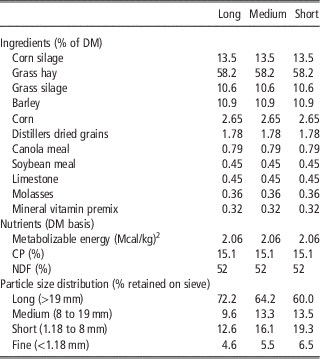
Nutrient and ingredient composition and particle size distribution of the experimental rations are presented in Table 1. Diets were identical in nutrient and ingredient composition and varied only in particle size of the hay component. Hay was chopped using a TMR mixer (Loewen Horizontal mixer; Loewen Welding & Manufacturing Ltd Matsqui, BC, Canada) at 1900 r.p.m. for 5, 20 and 60 min to achieve long, medium and short particle sizes, respectively. At each feeding, a TMR was prepared by mixing hay of different lengths with silage and concentrate providing three treatments: Long (72% particles>19 mm), Medium (64% particles>19 mm) and Short (~60% particles>19 mm). Orts were removed and heifers fed at 0900, 1500 and 2100 h daily for ad libitum intake and 10% refusals.
Ingredient and nutrient composition and particle size distribution of diets differing in the chop length of hay (Experiment 1)Footnote 1

Grass hay was chopped using a TMR mixer to attain SHORT (~70% particles>19 mm), MEDIUM (~65% particles>19 mm), and LONG (~60% particles>19 mm) particles. Throughout the experiment, particle size of the diets offered to heifers was kept constant within treatments. For the LONG treatment the CV for long, medium, short and fine particles was 10.2, 16.3%, 17.6% and 16.0%, respectively; for MEDIUM the CV was 11.4%, 17.7%, 19.9% and 14.3%, respectively; and for SHORT the CV was 14.6%, 20.1%, 16.6% and 19.6%, respectively.
1 All diets were identical in ingredient and chemical composition (calculated) and differed only in particle size distribution.
2 Estimated following NRC (2001).
Representative samples were taken from the orts and the fresh feed on days 6 and 8 of each period. The dry matter (DM) was determined by oven-drying at 55°C for 48 h. The particle size distribution was determined using the 3-screen Penn State Particle Separator (PSPS; Kononoff et al., Reference Kononoff, Heinrichs and Buckmaster2003b).
Experiment 2: effects of moisture content of the ration
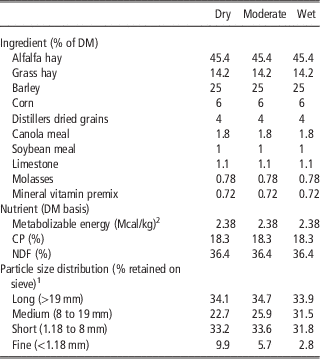
Following the design of Experiment 1, 18 Holstein heifers (initial BW=158±17 kg and age 159±11 days) were used in a replicated 3×3 Latin square design with three periods of 9 days and three treatments (three heifers per treatment and replication). Heifers were housed in a single pen as described above. Before the start of each replicate heifers were allocated to bins (three heifers per bin), trained for 7 days with long hay fed ad libitum and restricted amounts of starter (~3 kg/day). Nutrient and ingredient composition and particle size distribution of the experimental rations is presented in Table 2. In this experiment, each feed had the same TMR but contained different amounts of moisture. Differences in moisture were achieved by adding water at the rate of 0.475, 0.925 and 1.675 l/kg of TMR to obtain three treatments: Dry (65% DM), Moderate (50% DM) and Wet (35% DM). Feeding behavior measures as described in Experiment 1.
Ingredient and nutrient composition and particle size distribution of diets differing in moisture content (Experiment 2)Footnote 1
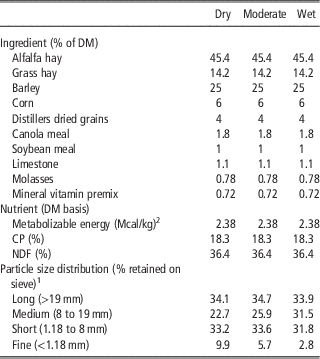
All diets were identical in ingredient and chemical composition (calculated) and differed only in moisture contents.
1 Differences in moisture were achieved by addition of water. Dry: 65% DM; Moderate: 50% DM; Wet: 35% DM.
2 Estimated following NRC (2001).
Statistical analysis
Analyses were identical for both experiments. The first 4 days of each period were considered as an adaptation period to new diet and data from these days were excluded. A 4-day adaptation period was used because the heifers remained in the same pen and accessed the feed from the same bin throughout the study (diets were switched among bins during the study). Meal criteria (maximum amount of time between visits to the feed bins to consider a visit as a part of the same meal) were calculated using a model composed of two normal distributions resulting from the natural logarithm of time (in seconds) between feed bin visits as described elsewhere (Tolkamp et al., Reference Tolkamp, Allcroft, Austin, Nielsen and Kyriazakis1998). Meal criteria were calculated for each heifer for the last 5 days of each period and treatment. The duration (min), amount of feed consumed (kg), and feed consumption rate for each visit (kg/min), daily DMI (kg/day), daily time spent feeding (min/day), and average feeding rate (kg/min) for each heifer were calculated. Sorting (per bin) was calculated as the DMI of each fraction of the PSPS expressed as a proportion of the predicted DMI of that fraction (Leonardi and Armentano, Reference Leonardi and Armentano2003). Predicted intake of each fraction was calculated as the product of the total DMI multiplied by the DM percentage of that fraction in the feed provided. Values equal to 1 indicate no sorting, <1 indicate selective refusals (sorting against), and >1 indicate preferential consumption (sorting for).
Initially, a mixed effects model that accounted for the fixed effects of treatment, day, period and the interaction between treatment and day, and the random effects of replication and animal within treatment and period was run. No interaction between treatment and day was present for any of the dependent variables, so data were summarized over the 5 days period yielding one value for each animal and treatment. Feed intake data were analyzed using the MIXED procedure of SAS (SAS Institute, 2009) with a mixed-effects model that accounted for the fixed effects of treatment and period and the random effects of replication and animal within treatment and period (n=18). Sorting activity was analyzed in similar matter, but without the effect of animal. In addition, sorting activity for each particle size fraction within treatment was tested for a difference from 1 using a t-test.
Results and discussion
Experiment 1: effects of dietary particle size
Within treatments, particle size of the diets offered was kept relatively constant. For the Long treatment the CV for long, medium, short and fine particles was 10.2%, 16.3%, 17.6% and 16.0%, respectively; for Medium the CV was 11.4%, 17.7%, 19.9% and 14.3%, respectively; and for Short the CV was 14.6%, 20.1%, 16.6% and 19.6%, respectively.
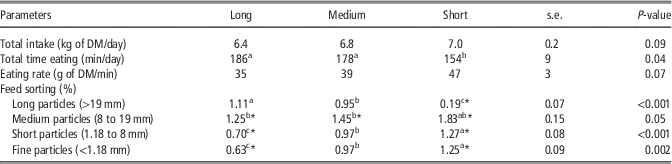
DMI tended (P=0.09) to increase as the particle size decreased (Table 3). Several studies have shown increased DMI with decreasing particle size (Teimouri Yansari et al., Reference Teimouri Yansari, Valizadeh, Naserian, Christensen, Yu and Shahroodi2004; Tafaj et al., Reference Tafaj, Zebeli, Baes, Steingass and Drochner2007; Alamouti et al., Reference Alamouti, Alikhani, Ghorbani and Zebeli2009). However, when feeding high-concentrate rations (>50% concentrate) particle size seems to have less of an effect on DMI (Allen, Reference Allen2000; Yang and Beauchemin, Reference Yang and Beauchemin2007). The higher DMI in the current study may have been due to the combined effects of increased passage and digestion rates (Tafaj et al., Reference Tafaj, Zebeli, Baes, Steingass and Drochner2007; Storm and Kristensen, Reference Storm and Kristensen2010), and the tendency (P=0.07) to increase eating rate as the particle size decreased (Table 3). It is well known that the distension of the reticulorumen could limit feed intake of high-forage diets (Montgomery and Baumgardt, Reference Montgomery and Baumgardt1965; Allen, Reference Allen2000). The high-forage diet fed in the current study (~80% of the dietary DM) may have increased the effects of particle size on DMI.
Feed consumption and feeding behavior as affected by particle length of the diet (Experiment 1)Footnote 1
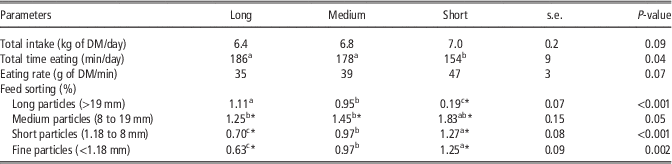
Sorting=actual DM intake of particle fraction/predicted DM intake of particle fraction. Values equal to 1 indicate no sorting, <1 indicate selective refusals (sorting against), and >1 indicate preferential consumption (sorting for).
a,b,cValues within row with uncommon superscripts differ at P<0.05.
1 Grass hay was chopped using a TMR mixer to attain Short (~70% particles>19 mm), Medium (~65% particles>19 mm) and Long (~60% particles>19 mm) particles.
* Denotes a value differing (P<0.05) from 1.
Meal criteria did not differ among treatments (3.8±0.27 min). Number of eating bouts (18.4±1.54/day), meal size (371±30.8 g of DM/meal), and meal duration (9.23±0.7 min/meal) also did not vary with treatment. Other studies have reported effects on eating bouts, meal size, and meal duration in heifers fed in a competitive environment (DeVries and von Keyserlingk, Reference DeVries and von Keyserlingk2009b), offered a TMR or separated rations (DeVries and von Keyserlingk, Reference DeVries and von Keyserlingk2009a; Greter et al., Reference Greter, Leslie, Mason, Mcbride and DeVries2010) or diluting the diet with a forage source (Greter et al., Reference Greter, DeVries and von Keyserlingk2008). Total eating time (min/day) was lower (P<0.05) for heifers fed Short compared with those fed Long or Medium diets. Increased eating time in response to longer particle sizes has been reported for adult cows in some studies (Maulfair et al., Reference Maulfair, Fustini and Heinrichs2010) but not others (Kononoff et al., Reference Kononoff, Heinrichs and Lehman2003a; Yang and Beauchemin, Reference Yang and Beauchemin2006). This discrepancy may be due to differences in other dietary factors i.e. moisture contents, forage NDF and forage DM in TMR.
Sorting behavior was affected (P<0.05) by particle size (Table 3). In all treatments, heifers selected for feed particles classified as medium (8 to 19 mm), but the effect was greatest for heifers that received the Short ration. Previous work reported that cows sort against long particles and in favor of fine particles (Kononoff et al., Reference Kononoff, Heinrichs and Lehman2003a; Leonardi and Armentano, Reference Leonardi and Armentano2003; DeVries et al., Reference DeVries, Beauchemin and von Keyserlingk2007). Likewise, Greter et al. (Reference Greter, DeVries and von Keyserlingk2008) reported sorting against long and for short particles in older (226±6 days) heifers. Heifers fed the Long ration did not (P=0.72) select against long (>19 mm) particles, despite selecting (P<0.05) against short (1.18 to 8 mm) and fine (0.63 mm) particles. Differences between our results and those of Greter et al. (Reference Greter, Leslie, Mason, Mcbride and DeVries2010) may be attributed the differences in particle size distributions of the diets. Greter et al. (Reference Greter, Leslie, Mason, Mcbride and DeVries2010) fed rations containing between 26% and 43% of long particles; in current study the TMR contained between 60% and 70% long particles (Table 1). It is possible that the high proportion of long particle sizes in the Long ration prevented heifers from reaching the small proportion of short and fine particles. When the proportion of short particles is low, it is less likely that the animal will be able to preferentially consume these particles as they become increasingly difficult to differentiate. Heifers fed the SHORT ration clearly selected against long particles but heifers fed the Medium ration showed a preference for medium particles with no preference for the other particle sizes. This observation suggests that offering rations with about 64% of forage particles greater 19 mm in length may be ideal.
Reduced sorting is considered beneficial because it diminishes diurnal variation of nutrient intake (DeVries et al., Reference DeVries, von Keyserlingk and Beauchemin2005). The results of this experiment suggest that a ration with a particle size distribution similar to the Medium ration minimizes sorting activity and does not compromise DMI. A ration similar to Long may compromise intake. A ration similar to Short would not reduce DMI but would result in increased sorting against long particles. Traditionally the dairy heifers are fed diets in which the majority of the nutrients are derived from forages (Zanton and Heinrichs, Reference Zanton and Heinrichs2009). Under such feeding systems, DMI could be affected by the type and characteristics (physical and chemical) of forage used (Allen, Reference Allen1997; Allen, Reference Allen2000), and any reduction in feed consumption could compromise growth. However, the current studies were not designed to assess the long-term effects on growth performance. Further studies are required to understand the effects of various attributes (physical and chemical) of forage-based TMR on intake and performance of heifers.
Experiment 2: effects of moisture content of the ration
To our knowledge, ours is the first study to evaluate the effect of adding water to TMR for heifers. Heifers that received the Dry ration tended (P=0.09) to consume more DM (5.9 kg/day) than those fed the Moderate (4.8 kg/day) and Wet (5.1 kg/day) rations. Digestive dynamics, as well as the amount of water directly consumed by the heifers, could have been altered by the moisture content of the diet. Water consumption was not measured in the current study but we recommend that this be measured in future work. There were no treatment differences in eating time (165±17.7 min/day), number of eating bouts (12.8±1.68/day), meal size (423±55 g of DM/meal), meal duration (13.0±2.4 min/meal) or eating rate (35.7±2.5 g of DM/min). As in Experiment 1, meal criteria were not affected by treatment, with an average meal criterion of 5.2±0.56 min. Research on the effects of adding water to the TMR for adult cows has been inconclusive; some studies describe increases in DMI (Lahr et al., Reference Lahr, Otterby, Johnson, Linn and Lundquist1983) and others report negative effects (Kellems et al., Reference Kellems, Jones, Andrus and Wallentine1991).
Sorting activity was not affected by moisture content of the TMR (Table 4). Overall, heifers selected against long (>19 mm) particles and for short (1.18 to 8 mm) and fine particles (<1.18 mm). Some authors have suggested that adding water to TMR for adult cows diminishes sorting (Shaver, Reference Shaver2002; Leonardi et al., Reference Leonardi, Giannico and Armentano2005) but others have reported contrary findings (Miller-Cushon and DeVries, Reference Miller-Cushon and DeVries2009; Felton and DeVries, Reference Felton and DeVries2010) or no effect (Fish and DeVries, Reference Fish and DeVries2012). The results from the current study suggest that adding water to a TMR has no consequences on sorting activity but tends to reduce DMI.
Sorting activity of heifers as affected by moisture content of the diet (Experiment 2)Footnote 1

1 Dry: 65% DM; Moderate: 50% DM; Wet: 35% DM. Sorting=actual DM intake of particle fraction/predicted DM intake of particle fraction. Values equal to 1 indicate no sorting, <1 indicate selective refusals (sorting against), and >1 indicate preferential consumption (sorting for).
* Denotes a value differing (P<0.05) from 1.
Conclusion
Providing heifers with a TMR containing about 65% of the particles above 19 mm and <6% of particles below 1.18 mm minimizes sorting without affecting intake rates and feed consumption. Adding water to achieve moisture contents of a TMR above 65% is not desirable, as it may decrease feed consumption and fails to reduce sorting against long feed particles.
Acknowledgements
Alex Bach was supported by the Ministerio de Educación of the Spanish Government through the program Salvador de Madariaga expedient number PR2010-0081 is acknowledged. The authors thank Lori Vickers from University British Columbia and Matthieu Lacroix from the LaSalle Polytechnic Institute (Beauvais, France) for their assistance with the project. The Animal Welfare Program is funded by Canada’s NSERC Industrial Research Chair Program with industry contributions from the Dairy Farmers of Canada (Ottawa, ON, Canada), Westgen Endowment Fund (Milner, BC, Canada), Zoetis (Kirkland, QC, Canada), BC Cattle Industry Development Fund (Kamloops, BC, Canada), the BC Dairy Education and Research Association (Abbotsford, BC, Canada), and Alberta Milk (Edmonton, AB, Canada).