This paper investigates the question of how second language (L2) knowledge of a specific linguistic phenomenon develops when some properties of that phenomenon are explicitly covered by classroom instruction but others are neither covered by instruction nor frequently observable in the input. In common with much generative linguistic research, we investigate knowledge of what is ungrammatical in addition to what is grammatical (Ionin & Zyzik, Reference Ionin and Zyzik2014; Schütze & Sprouse, Reference Schütze, Sprouse, Podseva and Sharma2014). Ungrammatical instances of linguistic phenomena are not produced, therefore they are also not observable in the input that learners encounter, unless explanation of the ungrammaticality is covered by teaching. Our investigation includes such nonobservable phenomena, thus extending our question to the following: How does L2 knowledge of a linguistic phenomenon develop when some properties of that phenomenon are taught, others are not taught but may be observable in incidental input, and still others are neither taught nor observable in the input?
There is already a rich body of literature asking about the effectiveness of instruction in L2 development, much of which came out of early seminal work by Long (Reference Long1983, Reference Long, Ritchie and Bhatia1996). The core generalization from decades of research has been that instruction is effective, and that explicit instruction leads to larger effect sizes in aggregate than implicit instruction (Mackey & Goo, Reference Mackey, Goo and Mackey2007; Norris & Ortega, Reference Norris and Ortega2000, Reference Norris, Ortega and Ellis2001), although questions remain about how to overcome the many methodological challenges associated with classroom research (Doughty, Reference Doughty, Doughty and Long2003; Plonsky, Reference Plonsky2013). Regarding nonobservable linguistic properties, several generative L2 acquisition studies have provided evidence of acquisition of such properties—particularly in very advanced learners—through research into L2 poverty-of-the-stimulus phenomena (Dekydtspotter & Hathorn, Reference Dekydtspotter and Hathorn2005; Kanno, Reference Kanno1998; Marsden, Reference Marsden2008, Reference Marsden2009; among others). Much generative L2 acquisition research has also investigated phenomena that—to at least some extent—are regularly taught in the classroom and are also observable in incidental input, including gender morphology (Hawkins & Franceschina, Reference Hawkins, Franceschina, Prévost and Paradis2004; Montrul, Foote, & Perpiñan, Reference Montrul, Foote and Perpiñan2008; White, Valenzuela, Kozlowska-Macgregor, & Leung, Reference White, Valenzuela, Kozlowska-Macgregor and Leung2004), object clitics in Spanish and Italian (Bennati, Reference Bennati2007; Santoro, Reference Santoro2007; Slabakova & Rothman, Reference Slabakova and Rothman2012; among others), and articles in L2 English (Ionin, Zubizarreta, & Maldonado, Reference Ionin, Zubizarreta and Maldonado2008; Snape & Kupisch, Reference Snape and Kupisch2010; among others). However, most generative L2 acquisition research sets aside the question of how classroom instruction influences the development of L2 knowledge. An important exception was the seminal research by White (Reference White1991a, Reference White1991b, Reference White1992) and Trahey and White (Reference Trahey and White1993) into whether instruction about adverb placement in English could lead to unconscious resetting of a proposed verb-raising parameter argued to account for cross-linguistic differences in adverb and negation placement (among other properties). The findings showed gains by those French-speaking learners of English who had received the adverb instruction, when tested shortly after the teaching, but these gains were lost at a delayed posttest one year later. Moreover, even in the immediate posttesting, the learners did not stop accepting the nontargetlike word order even though their acceptance of the target word order increased. These results have been interpreted as evidence that unconscious linguistic knowledge is not affected by explicit instruction (Schwartz & Gubala-Ryzak, Reference Schwartz and Gubala-Ryzak1992), and they have been used to support Schwartz’s (Reference Schwartz1993) well-known articulation of the “no interface” position between knowledge that is consciously learned through instruction and knowledge that is unconsciously acquired. Assumption of this no interface position is a reason that much generative L2 acquisition research sets aside the issue of instruction.
However, a small number of generative L2 acquisition researchers have continued to engage with the relationship between classroom instruction and the development of L2 knowledge, including Slabakova (Reference Slabakova2002) and Rothman (Reference Rothman2008), with some beginning to explore classroom intervention (Whong, Gil, & Marsden, Reference Whong, Gil and Marsden2013). Slabakova (Reference Slabakova2002) investigated acquisition of several properties associated with a proposed compounding parameter (Snyder, Reference Snyder1995), in the L2 Spanish of L1-English speakers. Spanish and English are argued to have different settings of this parameter, with the result that N-N compounds, double objects, verb particle constructions (e.g., think through), and resultatives are all ungrammatical in Spanish but grammatical in English. As part of their regular Spanish language instruction, the participants had received explicit instruction about the ungrammaticality of N-N compounds and double objects but had not been instructed about verb-particle constructions or resultatives. Slabakova found that, on an acceptability judgment task, the participants had significantly higher rates of rejection of those structures they had received instruction on, but also that some individuals were additionally able to reject the ungrammatical structures that were not covered by instruction. She concluded that provision of explicit instruction about the ungrammaticality of two of the four structures had been instrumental in acquisition of the ungrammaticality of all four (i.e., in the resetting of the compounding parameter) because ungrammaticality is nonobservable, so the learners could not have deduced it from the input. Rothman’s (Reference Rothman2008) study compared instructed and naturalistic L2 learners of Spanish with respect to knowledge of the preterit and imperfect verb forms, and found a difference between the two groups that he attributed to an effect of knowledge learned from classroom instruction being applied by the instructed group to certain contexts for which the classroom rule was an oversimplification. The naturalistic learners had not been exposed to such a rule and were consequently more targetlike.
Slabakova (Reference Slabakova2002) interprets her findings as evidence against the no interface position, whereas Rothman (Reference Rothman2008) argues that his add support for such a position. These opposing conclusions about the epistemological status of L2 knowledge in the generative tradition have been argued to mirror similar debates about the relationship between implicit and explicit L2 knowledge in the cognitive tradition (Whong, Gil, & Marsden, Reference Whong, Gil and Marsden2014). Building on such debates, we ask how classroom input affects the development of L2 knowledge, with the question of the relationship between different types of knowledge deserving particular attention. Specifically, we investigate L2 knowledge of English polarity item any, by means of a paced acceptability judgment task, in L1 speakers of Najdi-Saudi Arabic of different proficiency levels. Any, along with its compounds, such as anyone and anything, is interesting because of its complex distribution properties (Chierchia, Reference Chierchia2013; Giannakidou, Reference Giannakidou1998, Reference Giannakidou2001; Klima, Reference Klima, Fodor and Katz1964; Zwarts, Reference Zwarts1995; among others). Basic rules about the use of any appear in most English-language coursebooks, but these rules do not account for every aspect of its distribution, as will be exemplified in the following text. Any thus makes a good test case for exploring the relationship between what learners potentially know from instruction and what they acquire of observable and nonobservable properties without instruction. Further, we investigate whether there is any correlation between learners’ knowledge of any on the acceptability judgment task, and their conscious awareness of the textbook “rules” for any.
The results indicate not only a facilitating role of instructed rules but also the development of knowledge beyond any explicit source or observable input. Moreover, this knowledge appears to be independent of the learner’s conscious awareness of the rules. We propose that this development is best understood within the Modular On-line Growth and Use of Language (MOGUL) framework (Sharwood Smith & Truscott, Reference Sharwood Smith and Truscott2014a, Reference Sharwood Smith and Truscott2014b; Truscott & Sharwood Smith, Reference Truscott and Sharwood Smith2004). MOGUL looks to general processing mechanisms to explain language development, while also maintaining a distinction between modular knowledge (i.e., knowledge that is specific to language) where the notion of acquisition is relevant, and nonmodular knowledge (i.e., domain-general cognitive knowledge) where development can be characterized as learning. Acquisition, within MOGUL, refers to the generative linguistic notion of development that is constrained by universal grammar (UG) within a module that is specific to language, whereas learning is a product of general cognitive processes that are not specific to language. Crucially, however, in MOGUL learned and acquired knowledge are implicated in language production and use, and this holds regardless of whether the language is one’s native, second or nth language. The difference between an individual’s languages in terms of accuracy and ease of use is attributed to how robust the relevant stores of (acquired and learned) knowledge are, which is, in turn, determined by the activation levels associated with any particular entry in each store of knowledge. We will use this framework to make sense of our results.
The organization of the paper is as follows. We outline the properties of any. We then consider the factors that could contribute to learners’ knowledge of any, identifying instructed versus noninstructed properties, observable versus nonobservable properties, and L1 properties. Research questions precede the experimental study, which is followed by a discussion in which we explore the findings from a MOGUL perspective.
LINGUISTIC PROPERTIES OF ANY
The complex properties of any have been a topic of research within generative linguistics for at least 50 years. In its indefinite or existential quantifier sense, any is known as a polarity sensitive item (Klima, Reference Klima, Fodor and Katz1964) with sensitivity limited to specific linguistic environments. For example, any can occur in questions (1), and under the scope of negation (3), but not in an affirmative declarative statement (2),Footnote 1 or outside the scope of negation (4).
(1) Do you want any cake?/Does anyone want any cake?
(2) *Jenny wants any cake. (Cf. Jenny wants some cake.)
(3) Jenny doesn’t want any cake.
(4) *Anyone doesn’t want (a/the/any) cake.
Any is also licensed in the complement clause of a semantically negative verb (5) and under the scope of a semantically negative adverb (7), whereas it is ungrammatical in structurally similar sentences that are not semantically negative (6, 8):
(5) Jenny denies that she ate any cake.
(6) *Jenny thinks that she ate any cake.
(7) Jenny hardly ate any cake.
(8) *Jenny probably ate any cake.
The sentence types in (1–8) represent the contexts for existential any that are investigated in our experimental study. There are other contexts that allow any as an existential quantifier, including conditionals (If you hear anything, let me know) and the scope of without (He left without any breakfast) or before (Think before you say anything). In addition to its existential use, any can function as a “free choice item,” which, for completeness, we illustrate in (9–10) although free choice any is excluded from the present study. The free choice use differs from the existential use in that it is associated with the sense of “every.” So (9) means “Every person can . . .” and (10) has the sense of “Every cake [in the context] is one that you can choose” (Dayal, Reference Dayal2005; Giannakidou, Reference Giannakidou1998; Horn, Reference Horn, Horn and Kato2000; Lee, Reference Lee1993; among others).
(9) Anyone can learn to bake a cake. (Cf. *Anyone learnt to bake a cake.)
(10) Choose any cake that you like. (Cf. *I chose any cake.)
The question of how to account for the full range of properties of any is a matter of ongoing research, with promising proposals based either on downward entailment (e.g., Chierchia, Reference Chierchia2013; Zwarts, Reference Zwarts1995) or nonveridicality (Giannakidou, Reference Giannakidou1998, Reference Giannakidou2001). A downward-entailing context is one that entails any subset of the claim in the context, and a nonveridical context is one that does not correspond to an actual event. The distribution of any is then accounted for by the specific semantic properties of the operator (whether downward entailment or nonveridicality) in whose scope any is licensed. Both accounts have distinct advantages but also face distinct challenges in explaining the full distribution of any. For the present paper, it is not necessary to adopt one account or the other. Rather, the important point is to observe that the complexity of the distribution of any is determined by its relationship with a semantic licensor. This means that the abstract representation of any must include a semantic feature that enters a relationship with the licensor, along the lines of the N(egative) P(olarity) I(tem) feature proposed by Szabolcsi (Reference Szabolcsi2004), the polarity feature employed by Tubau (Reference Tubau2008) or the nonveridical feature proposed by Gil and Marsden (Reference Gil and Marsden2013). Such a feature (or set of features) is assumed to be part of the innate inventory of UG. In a well-formed sentence, the licensing feature at the level of the sentence and the corresponding feature on the lexical item any come into a checking relationship in narrow syntax. The (unconscious) task of the language learner is to work out which lexical items (if any) that feature applies to. How this could play out in the specific context of Najdi-Saudi Arabic speakers learning English in the classroom is explored in the following section.
SOURCES OF EVIDENCE ABOUT ANY
Properties of “Any” in the L1
Given that our learner group consists of Saudi Arabic (Najdi) speakers, it is necessary to consider the relevant L1 properties that could serve as an internal source of knowledge in the development of the L2 knowledge of any. In the Najdi dialect of Saudi Arabic (spoken primarily in Riyadh), the Arabic form ʔayy corresponds in meaning to the English existential polarity item any. There has been little formal linguistic research on ʔayy as yet, but discussion with Najdi-Saudi Arabic-speaking linguists reveals that it is subject to nearly the same distribution restrictions as English any.Footnote 2 Specifically, the distribution of ʔayy “any” is the same as was illustrated for English any in (1–7): ʔayy is allowed in yes-no questions (11), negation (12), the complement clause of a semantically negative verb (13), and with negative adverbs (14); while it is not allowed in affirmative declaratives (15), outside the scope of negation (16), and in the complement clause of nonnegative verbs (17).
(11) Hal toried ʔayy kaʕk?
Do.Q want.2SG any cake
“Do you want any cake?”
(12) Sami la yoried ʔayy kaʕk.
Sami not want.3SGM any cake
“Sami does not want any cake.”
(13) Sami yunker’ anaho akala’ ʔayy kaʕk.
Sami denies. 3SGM that.3SGM ate.3SGM any cake
“Sami denies that he ate any cake.”
(14) Sami belkad hadhar ʔayy drous.
Sami barely attended. 3SGM any classes
“Sami barely attended any classes.”
(15) *ʔanaa šuf-t ʔayy waaћid/ћaagah.
I saw-1SG any one/thing
“*I saw anybody/anything.”
(16) *ʔAyy ʃaxsʕ la yoried ʔayy kaʕk.
Any person(one) not want.3SGM any cake
“*Anyone does not want any cake.”
(17) *Sami yaʕtaged anaho akala ʔayy kaʕk.
Sami think.3SGM that.3SGM ate.3SGM any cake
“*Sami thinks that she ate any cake.”
Unlike English, however, ʔayy is allowed with semantically nonnegative adverbs (e.g., ihtemal “probably”) in (18):
(18) Ihtemal anaho ra’a ʔayy ahad bel’ams.
probably that.3SGM saw.3SGM any one yesterday
“*He probably saw anyone yesterday.”
To account for this distribution, we assume that the abstract representation of Arabic ʔayy also includes a polarity feature, as proposed for English any. The feature sets for ʔayy and any must also differ in some respect, to account for the slight differences in distribution.Footnote 3
L1 transfer in L2 grammar is widely attested in L2 acquisition research. A useful, generative proposal about how L1 transfer works is Lardiere’s (Reference Lardiere2009) feature reassembly hypothesis, in which the learner unconsciously maps new L2 lexical items onto what are perceived to be corresponding L1 items. The new L2 item thereby inherits the L1 feature set, which can then be reassembled for the L2 lexical entry if subsequent input shows that this is necessary.
Assuming the features of ʔayy must largely overlap with the features of any, a prediction based purely on L1 transfer of ʔayy is that Najdi Arabic-speaking learners of English will demonstrate targetlike knowledge of where any is grammatical or ungrammatical in the contexts presented in (1–7), but, at least at lower L2 English proficiency levels, they will not recognize that any is ungrammatical in the scope of an adverb of uncertainty (8). While noting this prediction, the present study will not test explicitly for L1 transfer, because we focus only on learners who share the same L1, therefore any apparent L1 effect could also be a general, L1-independent developmental effect.
Instructed Properties of Any
English-language teaching materials designed for preintermediate and intermediate learners typically include a section on any, in which any is contrasted with some (e.g., Artusi, Manin, & McCallum, Reference Artusi, Manin and McCallum2008; Hughes & Jones, Reference Hughes and Jones2011; Naunton & Tulip, Reference Naunton and Tulip2005; Riley & Hughes, Reference Riley and Hughes2010; Soars & Soars Reference Soars and Soars2012; Tilbury, Clementson, Hendra, & Rea, Reference Tilbury, Clementson, Hendra and Rea2010; Werner, Nelson, & Spaventa, Reference Werner, Nelson and Spaventa1993). Typically, the instruction states that any is used in negative sentences containing not and in questions, while some is used in affirmative sentences. Examples are provided to illustrate these uses, and then exercises follow, such as choosing between any- and some- in given sentences, filling the blanks, and correcting the mistakes.
Instruction such as this clearly covers the use of any in questions and under the scope of negation illustrated in (1) and (3). It also implies that any in affirmative sentences is ungrammatical, as in (2), through instruction to use some in such sentences, with exercises reinforcing this implication. However, instruction does not tell learners that any cannot precede not in a negated sentence (4); nor does it cover the use of any in semantically negative contexts that do not contain not (5, 7). We asked some university-level English-language teachers in Saudi Arabia whether they ever provide information about the use of any in these specific contexts. None said that they would.
Assuming learners may also consult online sources, we conducted an Internet search for “grammar rules for any,” and examined the first 10 English-language learning Web site hits.Footnote 4 Nine of these described and illustrated the use of any in negated sentences and questions, while one mentioned questions but only illustrated negated sentences. None of the sites mentioned that any cannot precede negation. One site (EnglishClub; see appendix) provided instruction about the use of any in semantically negative contexts that do not include overt negation, giving examples using refuse any . . . and without any . . . In addition, one site presented the use of any in conditionals and one presented any in its free choice sense. Some sites also showed the use of some in questions, explaining that some refers to something specific while any does not imply a specific thing.
Taking this together, we assume that classroom learners of English encounter explicit instruction to the effect that any can be used in negated sentences and questions, but not in affirmative sentences (where they should use some instead), and this is often supported with practice exercises. However, given the limited evidence of explanations about other uses of any, we assume that learners do not typically receive explicit instruction about the fact that any cannot precede negation (4), or about its use in semantically negative contexts (5, 7) and incompatibility with contexts that are structurally the same as (5, 7) but that lack a semantically negative element.
In short, we expect that learners receive instruction on any in relation to only the first three of our eight sentence types to be investigated: questions (1), affirmative declaratives (2), and negation (3). Thus, our first research question asks: Do classroom learners of English with differing levels of proficiency demonstrate more robust knowledge of the (un)acceptability of any in those contexts where they have received instruction than in those that are not covered by instruction (Research Question 1)?
Observable and Nonobservable Properties
In addition to instruction, another type of external input is incidental positive input, which in this case means occurrences of any in the written or spoken English that the learners are exposed to. This constitutes evidence of “observable” properties. According to Biber et al. (Reference Biber, Johansson, Leech, Conrad, Finegan and Quirk1999), any is frequent in all genres of English, with at least 1,200 occurrences per million words across genres, and 200 occurrences per million words of each of anybody/anyone/anything in conversation (Biber et al., Reference Biber, Johansson, Leech, Conrad, Finegan and Quirk1999, p. 278, p. 352). Therefore, it is certainly possible that learners will encounter any incidentally in the input. Looking more closely at the different grammatical contexts for any, Lin (Reference Lin2015: 190, Appendix P) investigated a random selection of 1,000 instances of any from the British National Corpus, and found that the majority occurred in the scope of negation (42%) or in yes-no questions (23.5%). Uses of any with semantically negative verbs or adverbs accounted for only 1.8% of the total, and other contexts make up the remainder, including modals (17.8%), conditionals (7.6%), and the scope of negative indefinites (3.6%). We assume that any occurs in similar proportions in the English that learners are exposed to. Consequently, although contexts in which any is licensed by lexical semantic negation are certainly observable in the input, learners’ opportunities to encounter such are likely to be limited, whereas they will have more frequent opportunities to observe any in questions and following negation.
Turning to nonobservable properties, in principle, all ungrammatical contexts for any are nonobservable in incidental input because ungrammatical instances of any do not occur in natural speech or writing. Instruction may provide information about ungrammaticality, and we have argued in the preceding text that this is the case for any in affirmative declaratives (2). However, the ungrammaticality of any in other illegitimate contexts is not observable because it is not taught. Conceivably, incidental input could include correction, whether explicit or implicit. We cannot make claims about how often such correction takes place but we assume it to be infrequent because the topic of learner errors with any seems to be undiscussed in the literature (unlike errors with English articles or prepositions), which suggests that such errors do not evoke much attention. In short, we consider the ungrammaticality of any in all four of our ungrammatical contexts to be unobservable in incidental input, although the ungrammaticality of any in affirmative declaratives is observable through instruction.
Given that previous research has yielded evidence of L2 acquisition of obscure linguistic properties and even poverty-of-the-stimulus phenomena, we assume that classroom learners of English can potentially develop at least some knowledge of infrequently observable and even unobservable properties of any that are not covered by teaching. Therefore, more advanced learners may demonstrate knowledge of the distribution of any in all contexts. However, given Rothman’s (Reference Rothman2008) findings, it is also possible that what has been taught could be overgeneralized to contexts where the taught rules do not apply. Specifically, ungrammatical sentences in which any precedes negation may be accepted, following the textbook guidance to use any in negated sentences; and sentences with semantically negative licensors of any may be rejected because they do not contain grammatical negation (i.e., not). Our subsequent research questions are as follows: Do classroom learners of English with differing levels of proficiency demonstrate knowledge of the (un)acceptability of any in relation to observable and nonobservable properties of any that are not taught, accepting sentences where any is licensed by semantic negation and rejecting sentences where any is outside the scope of negation or a semantically negative licensor (Research Question 2)? Or, do they overgeneralize the textbook rules and accept ungrammatical negated sentences in which any is outside the scope of negation, and reject grammatical sentences in which any is licensed by a semantically negative verb or adverb (Research Question 3)? Finally, we investigate whether there is any relationship between conscious awareness of the textbook rules for any and knowledge of taught or untaught (observable and nonobservable) properties (Research Question 4).
THE STUDY
Participants
All 114 Najdi Saudi Arabic-speaking learners of English in this study were female English majors in third- or fourth-year classes at a university in Riyadh, Saudi Arabia. Their ages ranged from 20 to 38, with a mean age of 22. All had had English-language instruction throughout their school education in Saudi Arabia. Data were excluded from one participant who may have been bilingual from birth. Another six, who were retained in the study, had spent periods of 0.5 to 3 years living in an English-speaking country. Several participants reported using English regularly at home with domestic staff.
A 40-item cloze test (from Slabakova, Reference Slabakova2000) was used to measure proficiency. The cloze test method suited the time available for data collection, and it has been shown to provide a valid measure of overall L2 proficiency (Jonz, Reference Jonz1990; Oller, Reference Oller1979; Tremblay & Garrison, Reference Tremblay, Garrison, Prior, Watanabe and Lee2008). Scores out of 40 were obtained using an exact-word scoring method. This scoring method is simple and unambiguous to apply, but it means that scores are relatively low: Native English control groups in previous studies using the same test scored 21–38 (mean: 26) (Slabakova, Reference Slabakova2000) and 20–31 (mean: 23.63) (Whong-Barr, Reference Whong-Barr2005). In the current study, scores by the learners ranged from 2 to 24. The test has not been mapped onto standardized L2 English proficiency criteria. Therefore, following Tremblay and Garrison (Reference Tremblay, Garrison, Prior, Watanabe and Lee2008), we used k-means cluster analysis of the cloze test scores to divide the learners into three proficiency groups, which we label low intermediate, high intermediate, and advanced. One participant was excluded due to not completing the cloze test, and further participants were excluded on analysis of a designated set of fillers in the test instrument, described in the following section. The profiles of the resulting L2 groups are summarized in Table 2.
Additionally, 15 native speakers (NS) of English made up a control group. All of them were raised monolingually and undergraduate or postgraduate students in the United Kingdom at the time of testing.
Stimuli
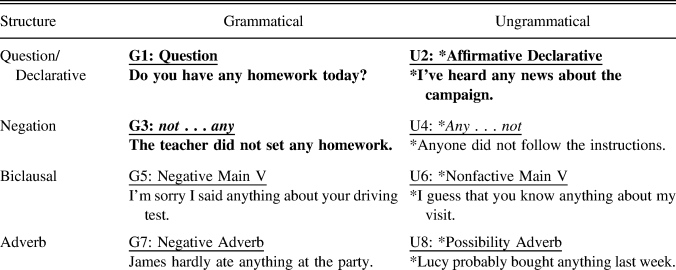
A paced acceptability judgement task (AJT) was used because this method (unlike production measures) yields evidence about what structures are disallowed by a speaker’s grammar, as well as what structures are allowed (Schütze & Sprouse, 2013). In a paced AJT, each test sentence is shown for only a few seconds so that participants must make their acceptability judgment based on their immediate impression. While there has been considerable debate in L2 acquisition research about whether AJTs tap into unconscious or conscious (explicit) knowledge, learner performance on paced AJTs has been shown to correlate with performance on other measures of unconscious knowledge (Bowles, Reference Bowles2011; Ellis, Reference Ellis2005; Loewen, Reference Loewen, Ellis, Loewen, Elder, Erlam, Philp and Reinders2009; among others). The design of the AJT, based on the eight sentence types presented in (1–8), is summarized in Table 1. As the table shows, four of the sentence types were grammatical because they included a licensor for any (G1, G3, G5, G7), and four were ungrammatical due to lacking a licensor (U2, U6, U8) or to any being outside the scope of a licensor (U4). Three types (G1, U2, G3) fall into the taught category, being covered in textbooks, and five are not taught (U4, G5, U6, G7, U8).
Summary of experimental sentence types

Note: G = grammatical; U = ungrammatical. Bold text indicates sentence types that are taught; regular text indicates types that are not taught.
There were four tokens of each of the eight types,Footnote 5 and 32 fillers (half grammatical, half ungrammatical) that did not contain the word any. The fillers served to mask the AJT’s focus on any and to provide a measure of individuals’ ability to pay attention to the task. Sixteen of these (8 grammatical, 8 ungrammatical) were designed to pilot a different study on never inversion (e.g., Never will the thief escape from this jail!). The remaining 16 fillers (8 grammatical, 8 ungrammatical) were designed to be straightforward for the target participants to judge (e.g., *I’m sorry that I was late tomorrow). As such, a high error rate (>25%) across these items was taken to indicate that the participant was not able to do the task properly, whether through failure to understand how to do the task, inattention, or some other reason, and such participants were excluded (see scoring and analysis section).
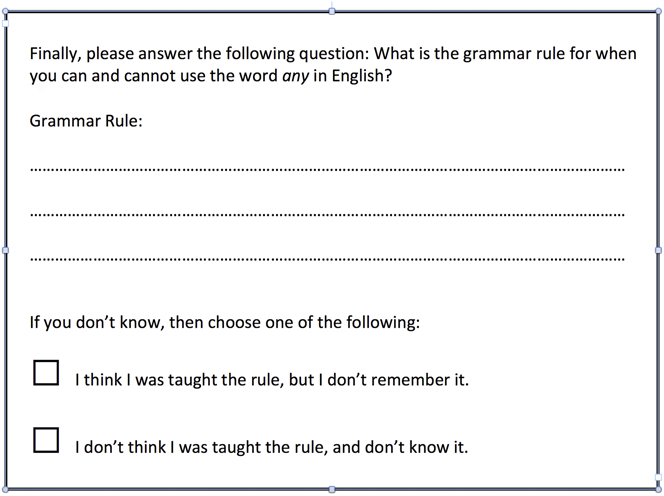
The data collection also included a question about learners’ metalinguistic knowledge of how to use any, as shown in Figure 1.
Question about knowledge of rule for any.

The full test instrument is archived in the IRIS database, www.irisdatabase.org.
PROCEDURE
The 64 test items were divided into two lists, with two items per type in each list, yielding 32-item lists each containing 16 experimental stimuli and 16 fillers. The items were randomized within each list. All participants judged both lists. Use of two lists was to avoid fatigue from judging 64 sentences at once. The test items were presented one by one on a screen at the front of the classroom, using a timed Microsoft PowerPoint presentation. Each sentence slide was displayed for nine seconds, with a recording of the sentence played at the start of each slide. Footnote 6 Participants used a pen-and-paper rating scale, with –2 indicating I’m sure this is wrong; –1, I think this is wrong; +1, I think this is right; and +2, I’m sure this is right. An additional option of Don’t know or can’t decide was also available. The reason for the four response options rather than a binary right-wrong choice was to facilitate learners indicating a sense of a sentence being acceptable or unacceptable, even if that sense was not strong. Use of a binary right-wrong choice could result in failure to capture less strong or certain perceptions, as learners may select “don’t know” when their perception of acceptability was subtle rather than strong. We were interested in participants’ spontaneous perception of acceptability whether subtle or certain. The sentences did not appear on the response sheet. Training on how to do the task was provided by means of four example sentences.
Data collection took place during the participants’ regularly scheduled classes, but it was made clear that individuals were free to not participate if they preferred (by indicating on the consent form). All elements of the data collection were completed in one session, with a background questionnaire first, then List 1 of the AJT, the cloze test, List 2 of the AJT, and finally the metalinguistic knowledge question.
SCORING AND ANALYSES
The AJT results were analysed in terms of sums of targetlike responses out of four for each participant on each AJT type. A targetlike response was defined as selection of +2 or +1 for grammatical tokens and –2 or –1 for ungrammatical tokens. Collapsing together the +2 with the +1 responses and the –2 with the –1 responses means that the analysis focuses on participants’ perception of acceptability versus unacceptability without considering degrees within those categories. However, the distribution of the different response options, including the Don’t know or can’t decide option, is reported descriptively in the Results section, for completeness.
Responses to the fillers measuring attention to the task led to the exclusion of 25 participants due to accuracy rates of lower than 75% across the 16 designated fillers. One further participant was excluded due to a spoiled answer sheet. Background information about the remaining 86 L2 participants is summarized in Table 2.
Summary of nonnative group profiles

For the experimental test types, the native and nonnative results are analysed separately. The native results for the AJT are reported first as validation of the assumed (un)grammaticality of the different types. The nonnative AJT results are then reported and used to address Research Questions 1, 2, and 3 about knowledge of the distribution of any in relation to evidence from textbook instruction and evidence from the input. For Research Question 4, about the effect of awareness of metalinguistic information on knowledge of any, the AJT results are used together with the results of the post-AJT metalinguistic knowledge question.
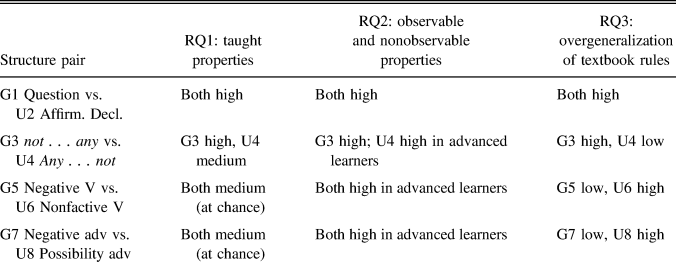
Table 3 summarises predicted levels of accuracy on each structure pair by the nonnative speakers, under Research Questions 1, 2, and 3. The predictions in this table are idealized because the effect of textbook instruction cannot occur in isolation from any effect of incidental evidence observable in the input.
Predicted level of accuracy on each structure pair

Mean accuracy on each type is calculated. “High” accuracy is informally defined as a mean score of ≥ 3 out of 4, and “low” as ≤ 1 out of 4. For the native speaker group, a paired-samples t-test is conducted for each structure, to compare scores on the grammatical and ungrammatical types within the structure. For the nonnative speakers, a repeated measures analysis of variance (ANOVA) is run for each structure, with Grammaticality (grammatical vs. ungrammatical) as the within-subjects variable and Group (low intermediate, high intermediate, advanced) as the between-subjects variable. Post hoc pairwise comparisons are run as appropriate to the outcomes of the ANOVAs. For the inferential statistical analyses, the a priori alpha level is set at .05 in accordance with typical practice in the field. However, noting Larson-Hall’s (Reference Larson-Hall2010) argument that alpha should be set at .10 in L2 acquisition research, we also pay attention to p-values of < .10.
To shed further light on Research Question 2 about whether nonnative speakers demonstrate knowledge of observable and nonobservable properties of any, an analysis is conducted of individuals’ consistent accuracy across all eight types. Consistent accuracy is defined as a score of at least three out of four on each type.
Responses to the post-AJT question about knowledge of a rule for use of any were coded according to three categories: “correct” for those who stated that any is used with negation and questions, “wrong” for those who cited a rule whose content was irrelevant to the distribution of any, and “don’t know” for those who indicated that they don’t know a rule. To address Research Question 4 about knowing the rule, two further mean targetlike response scores from the AJT data were calculated: one for all the taught types together (G1 Question, U2 Affirmative Declarative, and G3 not . . . any); and one for all the not-taught types together (U4 Any . . . not, G5 Negative Verb, U6 Nonfactive Verb, G7 Negative Adverb, and U8 Possibility Adverb). The prediction to be tested in relation to Research Question 4 is: Correct knowledge of the textbook rule for any will predict greater accuracy on the taught types G1, U2, and G3 than on the not-taught types. Given that general proficiency is also likely to correlate with greater accuracy, a repeated measures analysis of covariance (ANCOVA) is performed, with cloze test scores as the covariate, to separate any effects of knowledge of the textbook rule from effects of general proficiency. Rule Knowledge (Correct vs. Wrong vs. Don’t Know) is the between-subjects variable, and Teaching (Taught vs. Not-Taught) the within-subjects variable.
RESULTS
Distribution of response options on the experimental types
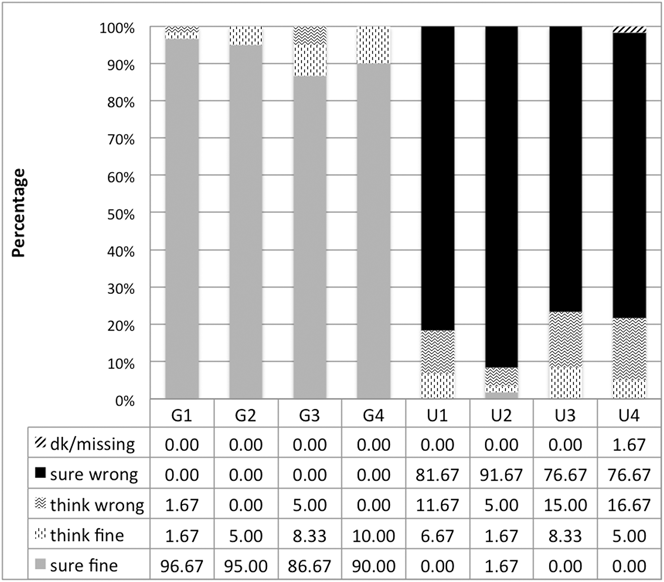
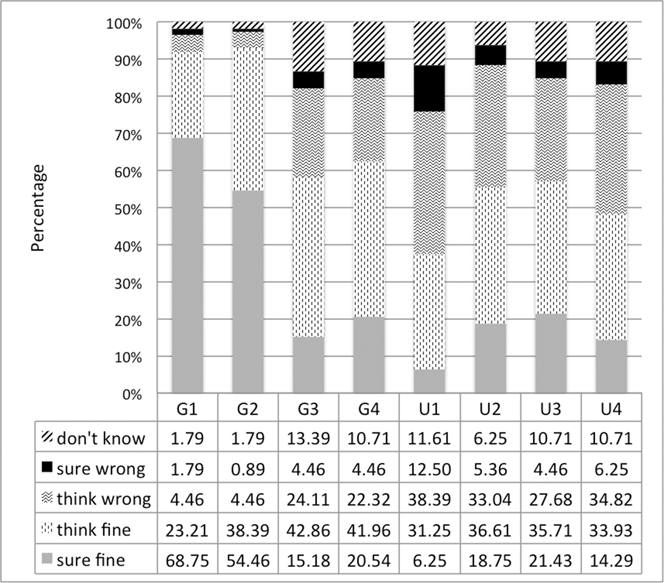
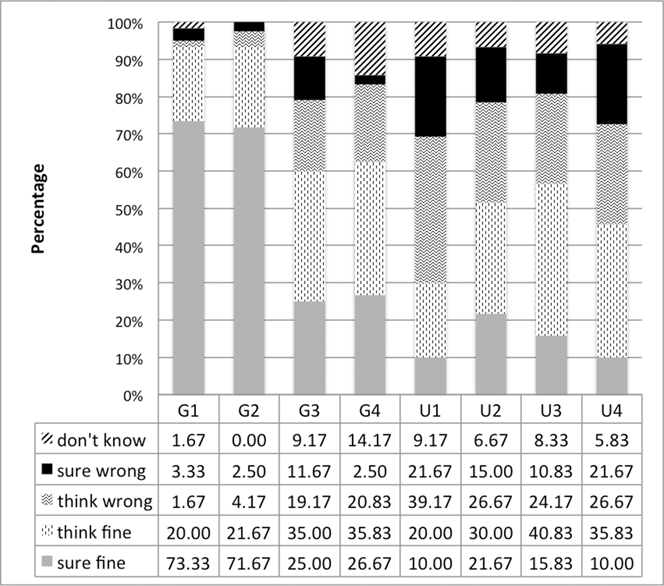
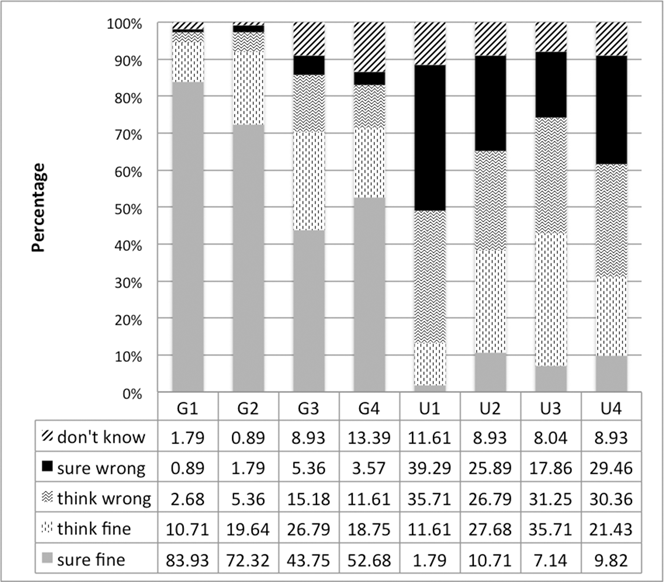
The rates of selection of each of the five response options, –2, I’m sure this is wrong; –1, I think this is wrong; +1, I think this is right; +2, I’m sure this is right; and Don’t know or can’t decide, are presented for each group in Figures 2–5.Footnote 7 From Figures 2–5, two main observations seem warranted about the response patterns for the native group compared with the learners. First, the native group predominantly selected +2 or –2: These options account for at least 74% of responses on each type, with +1 and –1 accounting for only 3.34% and 23.33%. By contrast, the learners have considerably higher rates of selection of +1 and –1: 27.67–69.44% by the low intermediate group; 21.67–65% by the high intermediate group; and 13.39–66.96% by the advanced group. Second, the native group has a very low rate of selection of Don’t know or can’t decide (1.67% on just one type); whereas this option was selected more frequently, and on all types, by the L2 groups: 1.79–13.39% by the low intermediate group; 0–14.17% by the high intermediate group; and 0.89–13.39% by the advanced group. In short, and unsurprisingly, the learner groups are less certain in their judgments than the native speakers.
Percentage selection of each response option for each type by the native control group.

Percentage selection of each response option for each type by the low intermediate L2 group.

Percentage selection of each response option for each type by the high intermediate L2 group.

Percentage selection of each response option for each type by the advanced L2 group.

Turning to response option patterns by type, for all groups, the highest levels of certainty occur on types G1 Question and G3 not . . . any, which have the highest rates of selection of +2 (54.46% by the low intermediate group to 96.67% by the native group) and the lowest rates of selection of Don’t know or can’t decide (0–1.67%). The other six types are characterized by considerably lower selection of +2 on grammatical and –2 on ungrammatical types by the learner groups. Similarly, the learners demonstrate higher rates of selection of Don’t know or can’t decide across these six types (5.83–13.39%).
While the analysis in the following sections does not consider these between-group and within-group differences in certainty, the main patterns described in this section—namely, contrasting behavior between the native group compared with the L2 groups; and a contrast in the L2 groups between types G1 Question and G3 not . . . any, on the one hand, and the remaining six types, on the other are evident in the analysis by accuracy.
NATIVE ENGLISH GROUP RESULTS
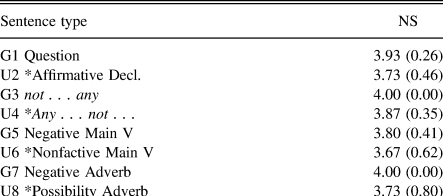
Table 4 summarizes the native English speakers’ accuracy scores on the AJT. The expectation that native English speakers would accept all the grammatical types and reject all the ungrammatical types with equal accuracy is met: Accuracy is high, ranging from 3.67 to 4 out of 4. The results of four two-tailed paired-samples t-tests, one for each grammatical-ungrammatical pair, confirm that there is no significant difference in accuracy within any pair: Question/Affirmative, t(14) = 1.38, p = .19, 95% CI [−.11, .51]; Negation, t(14) = 1.47, p = .16, 95% CI [−.06, .33]; Biclausal, t(14) = .81, p = .43, 95% CI [−.22, .49]; and Adverb, t(14) = 1.29, p = .22, 95% CI [−.18, .71].
Mean accuracy out of four for each AJT type: NS group

Note: Standard deviations are in parentheses.
L2 English Groups’ Results
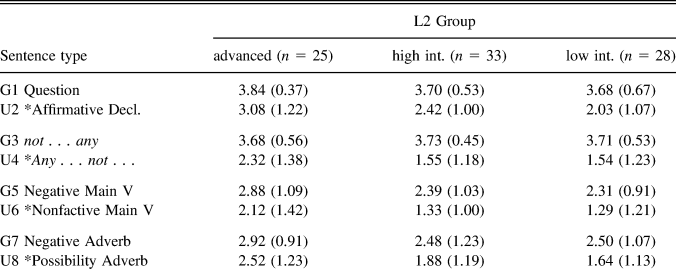
Table 5 summarizes the L2 English groups’ accuracy scores on the AJT. From Table 5, none of the nonnative groups have uniformly high accuracy across all types, in contrast to the NS group. While all the NS mean scores were higher than three out of four, scores higher than three are found only on types G1 Question and G3 not . . . any for all three nonnative groups, and additionally on type U2 Affirmative Declarative in the advanced group. The lowest scores are found in the low intermediate group, and the low and high intermediate groups have mean accuracies of < 2 on three of the four ungrammatical types. In the advanced group, the lowest mean accuracy is 2.12 on U6 Nonfactive Verb.
Mean accuracy out of four for each AJT type, by L2 group

Note: Standard deviations are in parentheses.
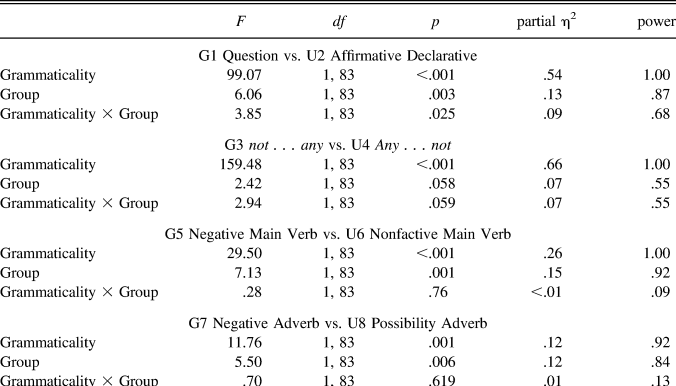
The results of the repeated measures ANOVAs are presented in Table 6. Table 6 shows that the effect of Group is significant at p < .05 for all structures except Negation; where p < .10. The effect of Grammaticality is significant in all four structure pairs. The interaction of Grammaticality with Group is significant at p < .05 only on the Question/Declarative pair (G1 vs. U2), while p < .10 on the Negation pair.
Results of repeated measures ANOVAs (Grammaticality × Group) for the four sentence type pairs

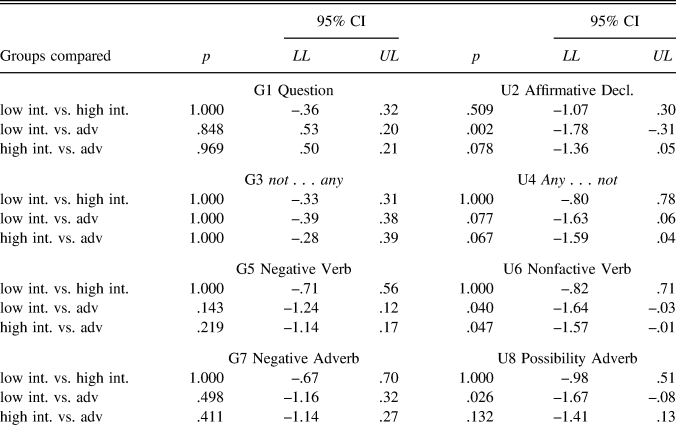
Given the accuracy scores in Table 5, it is clear that the significant main effects of Grammaticality are due to the ungrammatical type within each structure pair consistently having a lower accuracy rate than the grammatical type, and the main effects of Group are due to the low intermediate group generally having lower accuracy rates than the high intermediate group which in turn generally has lower accuracy rates than the advanced group. The Grammaticality-by-Group interactions in the Question/Declarative and, to a lesser extent, Negation structures suggest that the groups do not differentiate equally between grammatical and ungrammatical types. Post hoc pairwise comparisons were run, to shed further light on significant main effects and interactions. The comparisons of each Group on each Type are shown in Table 7. On all four grammatical types, there are no between-group significant differences. However, on the ungrammatical types, the advanced group has higher scores than the low intermediate group, at least p < .1, on all four types; and higher scores than the high intermediate group on all but U8 Possibility Adverb.
Post hoc pairwise comparisons of the groups on each type

Note: CI = confidence interval; LL = lower limit; UL = upper limit. A Bonferroni correction is applied to the p-values.
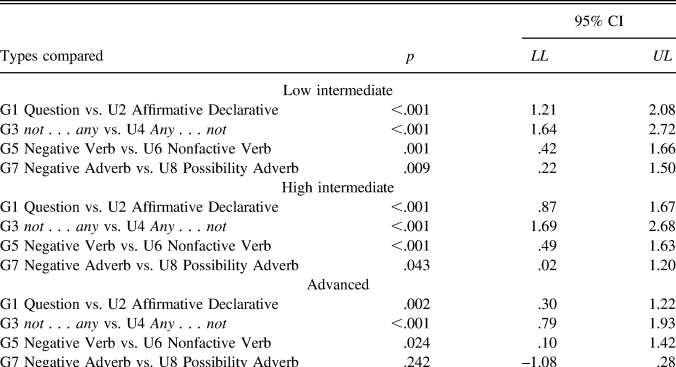
A second set of pairwise comparisons (Table 8) investigates whether, within each group, there is any contrast in accuracy between the grammatical and ungrammatical counterparts of each structure pair.
Post hoc pairwise comparisons of the types within each structure pair, for each group

Note: CI = confidence interval; LL = lower limit; UL = upper limit. A Bonferroni correction is applied to the p-values.
Table 8 shows that—except for the Adverb structure pair in the advanced group—the three L2 groups have significantly lower accuracy on the ungrammatical type than the grammatical type in each structure pair. This stands in contrast to the native group which demonstrated no difference in accuracy between grammatical and ungrammatical within each structure.
Turning to Research Question 4, about learners’ metalinguistic knowledge of classroom instruction on any, we found that only nine participants gave a correct textbook rule for the use of any, along the lines that it is used in questions and with negation. Another 10 gave a wrong rule due to its content not being relevant to the behavior of any.Footnote 8 The remaining 67 participants selected one of the options indicating that they did not know a rule. Of the nine who knew the classroom rule, four were in the advanced group and five in the high intermediate group. Of those who cited a wrong rule, four were in the advanced group, two in the high intermediate group, and five in the low intermediate group. Table 9 presents the mean accuracy of each of these three “rule knowledge” groups on the three taught types together compared with the five types that are not taught. The mean cloze test score for each group is also shown.
Mean scores out of 4 on taught vs. not-taught types, and cloze test mean out of 40, by knowledge group

Given the low numbers in the “correct” and “wrong” rule knowledge groups, any conclusions from statistical analysis of the data summarized in Table 9 must be treated with caution, and we proceed with this caveat in mind. The data show that accuracy was highest among those who cited a correct textbook rule for any and lowest for those who cited a wrong rule, with those who didn’t know a rule being in between. However, the correct group also has the highest mean cloze test score, which means that the relatively more accurate performance of this group could be due to higher general English proficiency rather than to explicit knowledge of an accurate classroom rule. The repeated measures ANCOVA confirmed that the main effect of the cloze test score was statistically significant (F(1, 82) = 21.49, p < .001, partial η2 = .21, power = .99). The main effect of rule knowledge, by contrast, did not reach statistical significance (F(2, 78) = 2.35, p = .01, partial η2 = .05, power = .46). The main effect of teaching was significant (F(1, 78) = 109.76, p < .001, partial η2 = .57, power = 1), as was the interaction of teaching with cloze score (F(1, 78) = 4.81, p = .03, partial η2 = .06, power = .58), but the interaction of teaching with rule knowledge was not significant (F(2, 78) = .19, p = .83, partial η2 = .005, power = .08).
INDIVIDUAL RESULTS
The native speaker and nonnative results were examined, to find out how many individuals consistently accepted at least three out four of the items within each grammatical type and consistently rejected at least three out of four of the items within each ungrammatical type. Among the native speakers, 14 out of 15 met this criterion for consistent accuracy. The remaining one was consistently accurate on just six of the eight types, with scores of lower than three on U6 Negative Verb and U8 Negative Adverb. Among the 86 nonnative speakers, 15 were consistently accurate across all eight types: 10 in the advanced group, three in the high intermediate group, and one in the low intermediate group. Of these, three (two advanced, one high intermediate) were among the nine participants in the correct rule knowledge group; one (advanced) had given a wrong rule for use of any, and the remaining 11 had indicated that they did not know a textbook rule for use of any.
DISCUSSION
None of the idealized predictions about learners’ knowledge of the taught, observable and unobservable properties of any (Table 3) is supported in full. Also, the prediction from Research Question 4, that nonnative speakers who can articulate the textbook rule about any will have higher accuracy on the taught types, was not borne out. Nonetheless, the data show evidence of L2 development with advancing proficiency, in ways that differ according to whether the property represented by a given type is taught, observable or nonobservable. In this section, we discuss details of the results in relation to the predictions and research questions. We then consider the findings further in relation to MOGUL to explore the connection between knowledge derived from instructed rules and knowledge that develops outside of those rules.
Research Question 1 asked whether classroom learners of English with differing levels of proficiency demonstrate more robust knowledge of the (un)acceptability of any in those contexts where they have received instruction than in those that are not covered by instruction. The predictions for each structure pair were that the learners would demonstrate high accuracy on G1 Questions and U2 Affirmative Declaratives, high accuracy on G3 not . . . any but accuracy at chance level on U4 Any . . . not, and chance-level accuracy on all G5 Negative Verb, U6 Nonfactive Verb, G7 Negative Adverb, and U8 Possibility Adverb. Descriptively, there is some evidence of this pattern within the advanced group, where the highest mean accuracy scores (> 3/4) are attained on the three taught types. However, in the low and high intermediate groups, although they demonstrate high accuracy on the grammatical taught types, G1 Question and G3 not . . . any, their mean scores on the ungrammatical taught type, U2 Affirmative Declarative, are around the mid-point at 2.03/4 and 2.42/4, respectively. Moreover, all three groups have significantly higher accuracy on the grammatical type in each structure pair than on the ungrammatical, except for the advanced group on the Adverb structure where accuracy is equal for the two types. Such a difference is predicted for the Negation structure pair, where the grammatical type G3 not . . . any is taught in textbook instruction but the ungrammaticality of U4 any . . . not is not. However, for the other structure pairs, higher scores on the grammatical types is not predicted on the basis of textbook instruction. The provisional answer to Research Question 1 is that knowledge of any in the taught contexts seems to be robustly more accurate than on the not-taught contexts in the advanced group, but that the tendency for significantly lower accuracy on certain ungrammatical contexts—the tendency to accept these types—cannot be accounted for in terms of the absence of textbook instruction.
Research Question 2 focused on the properties of any that are not taught, and are either potentially observable from incidental input (G5, G7) or not observable in the input at all due to being ungrammatical (U4, U6, U8). The question asked whether classroom learners of English demonstrate knowledge of the (un)acceptability of any in these contexts. The prediction was that the advanced learners would demonstrate high accuracy on all types. This was not the case: Particularly on U4 Any . . . not and U6 Nonfactive Verb, the advanced group’s scores are close to the mid-point (2.32/4, 2.12/4). However, the advanced group overall had higher accuracy than the other two groups, and on the ungrammatical types, its accuracy was significantly higher (p < .05) or close to significantly higher (p < .10) on all but the contrast with the high intermediate group on U8 Possibility Adverb. Thus, there is clear evidence of increasing accuracy on the properties of any as proficiency increases. Moreover, the advanced group’s performance on the nonobservable context of U8 Possibility Adverb is worthy of attention. On the Adverb structure pair, there is no significant difference between the advanced group’s accuracy in accepting the grammatical G7 Negative Adverb and in rejecting the ungrammatical U8 Possibility Adverb. Despite the accuracy scores on these two types (2.92 and 2.52 out of 4, respectively) being below 3 and thus not meeting our informal definition of “high,” they nonetheless suggest that the advanced group can differentiate between grammatical and ungrammatical in this context. We suggest that this provides evidence of emerging knowledge of the properties of any even when they are not observable in the input. It is worth recalling the properties of Arabic ʔayy “any” here. ʔayy is grammatical with a possibility adverb, therefore, this is the one context on which L1 transfer could not be facilitative.Footnote 9 This means that acquisition of the ungrammaticality of any with a possibility adverb is a poverty-of-the-stimulus problem. Consequently, the advanced group’s growing accuracy on this context suggests acquisition of the properties of any under poverty of the stimulus. Moreover, the analysis of the individual data showed that 15 individuals (10 among the 25 advanced learners) demonstrated consistent accuracy across all eight types. While this is a minority, it is nonetheless evidence that the properties of any relevant to all the contexts under investigation can be acquired. The individual data thus provide an affirmative answer to Research Question 2.
Research Question 3 asked about the potential effects from teaching on properties that are not taught. Specifically, do classroom learners of English overgeneralize the textbook rules and accept ungrammatical negated sentences in which any is outside the scope of negation, and reject grammatical sentences in which any is licensed by semantically negative verb or adverb? The prediction was that learners would show high accuracy on the taught types, G1 Question, U2 Affirmative Declarative, and G3 not . . . any; low accuracy on U4 Any . . . not, wrongly accepting it due to the presence of not; and low accuracy on G5 Negative Verb and G7 Negative Adverb but high accuracy on U6 Nonfactive Verb and U8 Possibility Adverb, with all four types being rejected due to the absence of not. This prediction was not supported because there was no evidence of lower accuracy on G5 and G7 than U6 and U8. As already noted in the preceding text, the ungrammatical types always had lower accuracy than the grammatical types.
Finally, Research Question 4 probed the relationship between conscious knowledge of the textbook rule for any and performance on the contexts that those rules apply to. The prediction tested was that conscious knowledge of the textbook rule for any will predict greater accuracy on the taught types than on the not-taught types. Only 9 out of the 86 nonnative participants stated a relevant rule for any (along the lines that it is used in questions and negated sentences), therefore we cannot draw strong conclusions from the statistical analysis, due to the small group size. With this caveat in mind, the results of the repeated measures ANCOVA suggest that the prediction is not met, because, even though the group that provided a correct rule also had higher mean scores on the taught types than those who provided an irrelevant rule and those who didn’t know any rule, the main effect of rule knowledge was not significant. By contrast, the main effect of the covariate—cloze test scores—was significant, as was the interaction of cloze test scores with the within-groups teaching variable. Taken together, this suggests that general proficiency is a better predictor of accuracy on the taught types than conscious awareness of the textbook rule for any.
The results presented in the preceding text lead to the conclusions that (a) knowledge of the distribution of any in the L2 English of Najdi Arabic-speaking learners develops as overall proficiency increases; (b) the most robust knowledge of any is in the contexts covered by textbook instruction; (c) it is possible to acquire knowledge of properties of any that are not taught and that are even not observable; and (d) conscious knowledge of the textbook rule about use of any does not predict accurate performance.
These findings are particularly interesting when set against the original intention of this study, which was to explore what learners know in relation to what is explicitly taught, on the one hand, and what lies beyond instruction, on the other. Our findings seem to show knowledge of that which is taught, with accuracy highest for the items that correspond to the pedagogical rule, but the learners do not explicitly know that rule. Additionally, there is evidence for acquisition of knowledge beyond the pedagogical rule: At group level, particularly in the advanced group’s increasing accuracy on the ungrammatical U8 Possibility Adverb type, and in the individual data, from the 15 individuals who were consistently accurate across all eight types. To explore our findings, we will look to the MOGUL framework of Sharwood Smith and Truscott (Reference Sharwood Smith and Truscott2014a, Reference Sharwood Smith and Truscott2014b), which assumes that acquired and learned knowledge depend on active processing. As such, our findings provide evidence for learning and acquisition.
We start at the initial state, where we assume that an absolute beginner would not find the existing L1 of much help when encountering sentences with any because the complexity of a string containing any would mean that a parse would fail before it could connect to any L1-based grammatical properties of this complex lexical item. In time, learners are told the pedagogical rule for any explicitly, but as an overgeneralization which only addresses negated sentences and interrogatives. Following MOGUL, the assumption is that learners can hold the pedagogical rule in conceptual structures (i.e., general memory) as they consider exercises asking them to use any correctly. As with other kinds of learning, students are assumed to apply reasoning and pattern matching strategies to develop a schema for any which associates it with interrogative and negative clauses. We speculate that the development of an any-based schema means that, in time, the corresponding pedagogical rule is no longer useful. This would explain why conscious knowledge of the textbook rule did not clearly predict accuracy on the taught types.
In MOGUL terms, this knowledge of any is nonmodular learned knowledge. That learners can know the correct usage of any in the taught context while not knowing the rule suggests that this learned knowledge is implicit knowledge. As MOGUL posits the existence of implicit nonmodular knowledge alongside acquired modular knowledge, the question is whether our data show any evidence for acquisition of any. We suggest that knowledge of the ungrammaticality of any in the unobservable context represented by U8 Possibility Adverb, which was demonstrated in group terms by the advanced learners and by those 15 individuals who had high individual consistency across all types, provides evidence of acquired knowledge under poverty of the stimulus, which could be attributed to modular processing.
Leaving open the precise nature of the modular linguistic representation of L2 knowledge of any, we speculate that the modular knowledge in question here is that which gives rise to sensitivity to any in semantically licensed environments. High accuracy by individual learners indicates the development of this knowledge: They successfully assemble a semantic licensing feature (or set of features) on their interlanguage representation of any, which allows any under the scope of a semantic negation licensor but precludes any when such a licensor is unavailable. In the advanced group’s results, knowledge of this semantic licensing condition led to successful rejection in U2 (Affirmative Declarative) and (to a lesser, but increasing, extent) U8 (Possibility Adverb). Why, then, does the accuracy of U4 (Any . . . not) and U6 (Nonfactive Verb) remain lower? First, we propose that responses to U4 reflect the effect of the teaching-based any schema (use “any” in negation) competing with the acquired knowledge of any (“any” should be within the scope of the licensor). This is why learners still face difficulties with any in the subject position in negation. For U6, compared to the relatively higher accuracy in the monoclausal structure of U8 (Possibility Adverb), the difficulty may be a result of increased licensing complexity in the biclausal structure. Given the evidence from the poverty-of-the-stimulus condition, U8, that acquisition of the target linguistic properties of any is possible, we assume that targetlike performance in all types could eventually emerge.
CONCLUSION
The key contribution of this paper is to add to the small body of L2 research that investigates how instruction impacts on modular L2 acquisition. We have done this through investigation of the distribution of any—a phenomenon that has received very little attention in L2 research despite the large body of theoretical linguistic research on this topic. Based on our experimental findings, we claim that while the development of robust knowledge of any can be traced to where there are instructed rules, learners can also come to know properties that go beyond instruction including those that are not observable in the input. We take this as evidence of the development of L2 knowledge shaped by learning and acquisition and we have attempted to explore these findings within the MOGUL framework. Our findings also show that, although learners’ conscious awareness of taught rules of any correlates with proficiency in general, crucially it does not correlate with accurate knowledge of any. Relating to this, some of our results for any suggest that L2 knowledge might be affected by the activation of instructed knowledge and acquired knowledge where the two are not compatible. This indication of interaction between the two different types of knowledge is an area in need of further research. The finding of a lack of conscious awareness of instructed rules suggests that this interaction takes places at an unconscious level. While our results can be explained by the processing account of MOGUL for learned and acquired knowledge, there are questions to be answered about the nature of the interaction between the two types of knowledge.
APPENDIX
LIST OF ONLINE ENGLISH GRAMMAR RESOURCES CONSULTED
EnglishClub. (n.d.). Some, any. Retrieved from http://www.englishclub.com/grammar/adjectives?determiners?some?any.htm (accessed prior to 24 July 2013).
English?at?home.com. (n.d.). Grammar rules: Some and any. Retrieved from http://www.english?at?home.com/grammar/some?and?any/ (accessed prior to 24 July 2013).
Englisch?hilfen.de. (n.d.). Some, any. Retrieved from http://www.englisch?hilfen.de/en/grammar/some_any.htm; http://www.dailywritingtips.com/7?grammatical?errors?that?aren%E2%80%99t/ (accessed prior to 24 July 2013).
engVid. (n.d.). English grammar: Some and any. Retrieved from http://www.engvid.com/english?grammar?some?any/ (accessed prior to 24 July 2013).
Grammarbook.com. (n.d.). Some vs. any. Retrieved from http://data.grammarbook.com/blog/definitions/some?v?any/ (accessed prior to 24 July 2013).
Grammarly Handbook. (n.d.). Some and any. Retrieved from http://www.grammarly.com/handbook/sentences/qualifiers?and?quantifiers/5/some?and?any/ (accessed prior to 24 July 2013).
My English Pages. (n.d.). Some and any. Retrieved from http://www.myenglishpages.com/site_php_files/grammar?lesson?some?any.php (accessed prior to 24 July 2013).
Shoebottom, P. (n.d.). Some/any. Retrieved from http://esl.fis.edu/grammar/rules/some.htm (accessed prior to 24 July 2013).
Speakspeak. (n.d.). Some, any—Difference and usage. Retrieved from http://speakspeak.com/resources/english?grammar?rules/various?grammar?rules/some?any?differences (accessed prior to 24 July 2013).
Woodward English. (2014). Some – Any – A – An. Retrieved from http://www.grammar.cl/Notes/Some_Any_A_An.htm (accessed prior to 30 December 2014).