Parents’ social comparison generally refers to parental behaviors of critically comparing the performance and accomplishments of children to their peers in a negative light (Camras, Sun, Li, & Wright, Reference Camras, Sun, Li and Wright2012). For example, some parents may often explicitly tell their children how other children (e.g., classmates and same-age neighbors) are better than them. Furthermore, parents also tend to make social comparisons between their children, especially within a family with more than one child (Jensen, McHale, & Pond, Reference Jensen, McHale and Pond2018). In other words, siblings provide parents with everyday opportunities for making social comparisons of one's child to his or her sibling(s). For example, parents may blame children when their sibling does better than them.
However, it should be noted that parents’ comparisons of siblings has received relatively little attention when examining the family factors on developmental outcomes of children with siblings (Jensen et al., Reference Jensen, McHale and Pond2018). Drawing on social comparison theory (Festinger, Reference Festinger1954; Suls, Martin, & Wheeler, Reference Suls, Martin and Wheeler2002) and expectancy value theory (Eccles & Wigfield, Reference Eccles and Wigfield2002), the current study explored how parents’ comparisons of siblings may be related to adolescents’ internalizing and externalizing problems in China where the one-child population policy has been relaxed since the 2000s and the two-child population policy has been implemented since 2016.
Parents’ Comparisons of Siblings
According to social comparison theory, comparisons are more likely to happen when one's own characteristics (e.g., age, gender, or physical condition) are similar to the comparison target (Suls et al., Reference Suls, Martin and Wheeler2002). Obviously, siblings inevitably become the potential comparison target given that siblings grow up under the same home roof and share same family backgrounds and 50% of their genes. Children may make a variety of daily comparisons with their sibling (e.g., “I have better academic achievement than my old sister”; Jensen & McHale, Reference Jensen and McHale2015). Although social comparison theory places greater emphasis on intrapersonal psychological processes, it can also be applied to interpersonal processes (Feinberg, Neiderhiser, Simmens, Reiss, & Hetherington, Reference Feinberg, Neiderhiser, Simmens, Reiss and Hetherington2000). Especially, in families with more than one child, parents tend to make sibling comparisons (Adler, Reference Adler1959; Feinberg et al., Reference Feinberg, Neiderhiser, Simmens, Reiss and Hetherington2000; Jensen & McHale, Reference Jensen and McHale2015). Therefore, in addition to the direct influence from siblings on child development (e.g., sibling comparison with each other), sibling influence can be achieved indirectly through parents (e.g., parents’ beliefs about their children's differences). Past research indicated that nearly 60% of parents perceived that their two children were different in various types of aspects, and such perceived sibling differences were the main reason why parents provided differential treatment toward their children (McHale & Crouter, Reference McHale, Crouter, Crouter and Booth2003). Parents’ comparisons of siblings may have a negative impact on children's self-worth and social competence when parents make unfavorable comparisons toward their children (Jensen et al., Reference Jensen, McHale and Pond2018; Santrock, Readdick, & Pollard, Reference Santrock, Readdick and Pollard1980).
In addition, expectancy value theory provides explanations of how parents’ social comparisons between siblings may play a role in children's adjustment (Jensen et al., Reference Jensen, McHale and Pond2018). According to this theory, parents’ socialization goal and expectation may influence children's self-concept, which in turn may affect their performance and behavior (Eccles & Wigfield, Reference Eccles and Wigfield2002). Recently, Jensen and McHale (Reference Jensen and McHale2015) integrated the viewpoints of parents’ comparisons of siblings with the assertion from expectancy value theory to examine the cross-lagged associations between parents’ comparisons of siblings and children's developmental adjustment in a three-wave study. They found that parents’ beliefs about sibling differences in academic ability were associated with greater GPA differences between siblings (Jensen & McHale, Reference Jensen and McHale2015).
Furthermore, based on expectancy value theory, Jensen and McHale (Reference Jensen and McHale2015) proposed that both “parent effect” and “child effect” might coexist in the associations between parents’ sibling comparisons and children's adjustment. It is possible that parents’ practices of sibling comparison may be both the cause and the consequence of children's adjustment. However, empirical evidence based on a three-wave longitudinal investigation has not been found to support this theoretical hypothesis (Jensen & McHale, Reference Jensen and McHale2015). Specifically, although parents’ beliefs about sibling differences in academic ability led to greater GPA differences between siblings later, GPA differences between siblings did not predict parents’ beliefs about sibling differences in academic ability later (Jensen & McHale, Reference Jensen and McHale2015), suggesting that there might not be a “child effect” in the academic domain. Despite these findings, the reciprocal relations between parents’ comparisons of siblings and other aspects of adolescent adjustment, such as internalizing and externalizing problems, remain unknown.
Additional Research Gaps in the Literature
Previous studies on parents’ comparisons of siblings are limited in several ways. First, little is known about the use and effects of parents’ comparisons of siblings in Chinese families, where a growing number of parents have raised more than one child since the government relaxed its one-child population policy (National Health and Family Planning Commission, 2017). Chinese families have unique characteristics, which have been influenced by Confucian cultural values (Bond, Reference Bond and Bond1996; Chao, Reference Chao2000). In the Chinese societies that emphasize social hierarchy, social comparison may serve as a key way to figure out one's status or position in a certain social group (Chan & Prendergast, Reference Chan and Prendergast2007). In contrast to Western parents who more likely see comparisons as unfair and tend to work hard for equal treatment and democratic responsiveness (Park, Coello, & Lau, Reference Park, Coello and Lau2014; Wu et al., Reference Wu, Robinson, Yang, Hart, Olsen, Porter and Wu2002), Chinese parents tend to use critical comparisons when they socialize their children (Camras et al., Reference Camras, Sun, Li and Wright2012; Fung & Lau, Reference Fung and Lau2012). For example, evidence showed that Chinese mothers tend to make unfavorable comparisons of their child to peers and siblings in the service of moral socialization (Fung, Reference Fung1999). It is mainly because Chinese parents have high expectations for their children's development (Chao & Tseng, Reference Chao, Tseng and Bornstein2002; Ng, Pomerantz, & Lam, Reference Ng, Pomerantz and Lam2007; Qu, Pomerantz, & Deng, Reference Qu, Pomerantz and Deng2016), and they may use the practice of sibling comparisons as a psychological discipline intended to help their children improve (Fung, Reference Fung2018), especially for those evaluated by parents as relatively poorer in performance compared to their siblings (Fung & Chen, Reference Fung and Chen2001). An ethnographic study provided a vivid description, documenting that Chinese parents made sibling comparisons in response to their children's behavioral problems (e.g., “Even your baby brother knows better”; Fung & Chen, Reference Fung and Chen2001). However, it should be noted that like in Western societies, parents’ critical comparison in China played a negative effect on children's adjustment (Camras et al., Reference Camras, Sun, Li and Wright2012), because parents’ critical comparisons might be an aversive parental discipline. As noted above, parents’ critical comparisons of siblings may also be seen as a specific form of aversive parenting practice, thereby jeopardizing the child's self-worth and leading to social adjustment difficulties.
Second, most previous research on parents’ comparisons of siblings utilized parents’ perceptions of differences in siblings’ behavior and performance to assess parents’ comparisons of siblings (Jensen & McHale, Reference Jensen and McHale2015; Jensen et al., Reference Jensen, McHale and Pond2018), which provides limited information about children's own understanding and perception of the parents’ behaviors of comparing themselves with their siblings. Some researchers (Feinberg et al., Reference Feinberg, Neiderhiser, Simmens, Reiss and Hetherington2000; Jensen et al., Reference Jensen, McHale and Pond2018) have suggested that children's understanding and subjective evaluations of parents’ social comparisons might provide more valuable information. Moreover, children may be sensitive to such information during the period of adolescence, which is marked by a main developmental task for seeking self-identity (Erikson, Reference Erikson1968). Adolescents’ perceived parents’ comparisons of siblings may reflect the important cues about their position in the family, which may influence self-identity, and hence their adjustment outcomes (Waterman, Reference Waterman, Adams, Gullotta and Montemayor1992).
Third, previous measures of parental comparisons of siblings were based on perceived relative ability (Jensen & McHale, Reference Jensen and McHale2015; Jensen et al., Reference Jensen, McHale and Pond2018). However, the quality of sibling comparisons parents make remains unclear. In other words, the negative or positive nature of parental comparisons of siblings has not been examined before. As mentioned above, Chinese parents tend to use social comparisons in a negative way (e.g., shaming, blaming, and being critical). On the one hand, such negative comparisons are in line with an upward comparison (e.g., “Even your baby brother knows better”) according to social comparison theory (Festinger, Reference Festinger1954). On the other hand, Chinese parents often use negative comparisons when they have higher expectation for their children's performance (e.g., “Why do your classmates get an A in the math exam, but you only get a C?”), place great emphasis on children's shortcomings and failures (Ng et al., Reference Ng, Pomerantz and Lam2007), and expect their children to be aware of their own weakness (Fung & Lau, Reference Fung and Lau2012), which seems to be consistent with the viewpoint from expectancy value theory (Eccles & Wigfield, Reference Eccles and Wigfield2002). Therefore, similar to parental comparisons of siblings based on perceived relative ability, Chinese adolescents’ perceived negative parental comparisons of siblings may influence their adjustment.
Fourth and finally, previous studies are limited in a way that they focused mainly on the role of parents’ comparisons of siblings in adolescents’ academic adjustment (e.g., GPA; Jensen & McHale, Reference Jensen and McHale2015). Other aspects of adolescents’ adjustment, such as internalizing and externalizing problems (Achenbach & Edelbrock, Reference Achenbach and Edelbrock1981), have been understudied in this line of research. Internalizing problems refer to emotional disorders including anxiety and withdrawal, whereas externalizing problems refer to disruptive behaviors including aggression and hyperactivity. Some evidence in the area of sibling research has shown that parental factors (e.g., parent–child relationship quality and parental differential treatment) may play different roles in children's internalizing and externalizing problems (Buist et al., Reference Buist, Verhoeven, Hoksbergen, ter Laak, Watve and Paranjpe2017; McGuire, Dunn, & Plomin, Reference McGuire, Dunn and Plomin1995). Yet, it is unclear whether children's internalizing and externalizing problems, in turn, play a role in parents’ comparisons of siblings (i.e., the child effect). There are several reasons to expect the child effect paths. First, adolescents’ internalizing problems may affect the perceptions of their relationships with parents over time (Buist, Deković, Meeus, & van Aken, Reference Buist, Deković, Meeus and van Aken2004). Specifically, adolescents with high levels of emotional disorders (e.g., anxiety and depression) tend to view parental practices and interactions as negative (Buist et al., Reference Buist, Deković, Meeus and van Aken2004). Second, externalizing problems may have disruptive consequences (Serbin, Kingdon, Ruttle, & Stack, Reference Serbin, Kingdon, Ruttle and Stack2015). Previous research has shown that externalizing problems may elicit increased aversive parenting practices (e.g., Larsson, Viding, Rijsdijk, & Plomin, Reference Larsson, Viding, Rijsdijk and Plomin2008; Verhoeven, Junger, Van Aken, Dekovic, & Van Aken, Reference Verhoeven, Junger, Van Aken, Dekovic and Van Aken2010). When adolescents with externalizing problems (e.g., aggression and delinquency) are criticized and punished by their parents, those adolescents are more likely to view their parents’ behaviors as negative (Buist et al., Reference Buist, Deković, Meeus and van Aken2004). In addition, existing literature has indicated that Chinese culture places great emphasis on parents’ responsibility for promoting children's optimal development (Chao & Tseng, Reference Chao, Tseng and Bornstein2002). Therefore, Chinese parents’ feelings and behaviors were more likely to be influenced by their children's performance relative to American parents (Ng, Pomerantz, & Deng, Reference Ng, Pomerantz and Deng2014). Furthermore, relative to internalizing problems, externalizing problems (e.g., aggression and delinquency), which are more likely to dampen the social harmony (Chen & Chang, Reference Chen and Chang2012; Ho, Reference Ho and Bond1986) and are more visible (Reitz, Deković, & Meijer, Reference Reitz, Deković and Meijer2006), may elicit greater concerns and more reactions from their parents. Previous evidence showed that externalizing problems were linked more strongly to parenting behaviors (e.g., involvement and autonomy granting) compared to internalizing problems (Reitz et al., Reference Reitz, Deković and Meijer2006). Therefore, it is possible that adolescents’ externalizing problems, relative to internalizing problems, would have a greater impact on parents’ negative comparisons of siblings in China.
The Present Study
This study aimed to explore the reciprocal relations between parents’ comparisons of siblings and adolescents’ psychological and behavioral adjustment in a Chinese context. It included both internalizing and externalizing problems in order to determine possible differential relations for internalizing and externalizing problems across time. Using a two-wave longitudinal survey, we modeled the cross-lagged links between parents’ comparisons of siblings and adolescents’ internalizing and externalizing problems so that bidirectional associations between parents’ comparisons of siblings and internalizing and externalizing problems were estimated simultaneously. Based on extant literature discussed above, it was expected that (a) there would be significant cross-lagged effects between parents’ comparisons of siblings and adolescents’ internalizing and externalizing problems; and (b) adolescents’ externalizing problems would have a stronger influence on parents’ comparisons of siblings than their internalizing problems.
In addition, given the existing literature on gender differences in internalizing and externalizing problems (Reitz et al., Reference Reitz, Deković and Meijer2006; Serbin et al., Reference Serbin, Kingdon, Ruttle and Stack2015), the moderating role of gender on the reciprocal relations between parents’ comparisons of siblings and adolescents’ internalizing and externalizing problems was explored. In addition, Chinese adolescents were found to commonly have a wide range of age spacing between siblings (Chen, Reference Chen2019). Sibling age spacing could be considered as a potential moderator given that comparisons seem to be more impactful when siblings are closer in age (Jensen et al., Reference Jensen, McHale and Pond2018). Predictions of gender and age spacing as moderators of reciprocal relations were exploratory due to a lack of empirical findings.
Method
Participants
Participants were recruited from a three-wave longitudinal study focused on middle school Chinese adolescents’ family relationships and adjustment in Huzhou, Zhejiang Province, in China. Huzhou is a city with a population of approximately 2.64 million (see Huzhou Municipal Government, 2019) located in the eastern part of China. There had been a partial policy relaxation that allowed parents to have a second child. At the initial recruitment, participants were Grade 7 and 8 students from an average-achieving middle school in Huzhou. Data at each wave was approximately 6 months apart. Data from the present study came from the Wave 2 and Wave 3 assessments. We used Wave 2 (Time 2; T2) and Wave 3 (Time 3; T3) data because data on parents’ comparisons of siblings were not available in Wave 1 (Time 1; T1).
T1 data was collected from 608 adolescents (M = 12.89 years, SD = 0.77; 48.4% girls). Because of our interest in adolescents with siblings, adolescents without siblings were not included in our analyzed sample. There was no difference in family socioeconomic status (i.e., parental educational level) between adolescents with and without siblings. Data in T2 and T3 were analyzed from 260 targeted adolescents with siblings (M = 13.22 years, SD = 0.76 at T2, and M = 13.81 years, SD = 0.71 at T3; 51.2% girls). All target adolescents in the present study had at least one sibling (approximately 90% had one sibling, and 10% had two or more siblings). For those target adolescents who had two or more siblings, a sibling close in age was chosen when completing the questionnaires. In the current sample, 119 target adolescents were first-borns, 133 adolescents were second-borns, and 8 adolescents’ birth order was not identified. The mean of absolute differences in age between the siblings was 6.55 years (SD = 3.30). The sibling sample comprised 147 same-sex pairs and 111 mixed-sex pairs (2 siblings’ gender was not identified). Mothers, on average, were 39.60 years old and had completed 9.4 years of education. Fathers, on average, were 41.32 years old and had completed 9.9 years of education.
Procedure
At each wave, questionnaires were administered by trained research assistants in schools, with all adolescents completing them in class. Extensive explanations were provided if adolescents had any questions about the questionnaire. Ethical approval for the study was obtained from the Ethics Committee of the Department of Psychology, Renmim University of China, and parents provided their written consent prior to data collection. Adolescents received small gifts for their participation.
Measures
Parents’ comparisons of siblings
To measure parents’ comparisons of siblings, adolescents completed an adapted version of the critical comparison and shaming scale (Camras et al., Reference Camras, Sun, Li and Wright2012). The Chinese version of the scale showed satisfactory discriminant validity and acceptable internal consistency reliability in the previous literature (Camras et al., Reference Camras, Sun, Li and Wright2012). Given the focus of the present research, five items, which were originally designed to assess parents’ practice of comparing target children with other kids, were chosen and then adapted specifically to assess parents’ practice of comparing the performance and accomplishments of one's child to his or her sibling. The five items represented criticism, comparison, and shaming practices (e.g., “My parents often are critical of me when they compare me with my sibling” and “My parents always blame me when my sibling does better than me”). Adolescents rated their agreement with each statement on a 5-point scale ranging from 1 (not true at all) to 5 (very true). The item scores were averaged to form a composite score for parents’ comparisons of siblings. The one-factor confirmatory model for the parents’ comparisons of siblings yielded an acceptable fit on the basis of a number of goodness-of-fit indices, including the comparative fit index (CFI) = .99 at T2 and .92 at T3 and the standardized root mean square residual (SRMR) = .02 at T2 and .05 at T3. Cronbach α = .82 at T2 and .82 at T3 in the present sample.
Internalizing and externalizing problems
Two subscales of the Chinese version (Chang et al., Reference Chang, Lu, Lansford, Skinner, Bornstein, Steinberg and Tapanya2019) of the Youth Self-Report (Achenbach, Reference Achenbach1991) were used to assess adolescents’ internalizing and externalizing problems. These measures showed satisfactory reliability and validity in the Chinese samples (e.g., Liu et al., Reference Liu, Kurita, Uchiyama, Okawa, Liu and Ma2000; Liu, Guo, Liu, & Sun, Reference Liu, Guo, Liu and Sun1997). The internalizing problem subscale consists of 30 items (e.g., “feel lonely” and “worry a lot”). The externalizing problem subscale consists of 30 items (e.g., “argues a lot” and “threatens people”). Adolescents were asked to complete the two subscales on a 3-point scale ranging from 0 (never) to 2 (often). The item scores were averaged to form composite scores for each subscale. Cronbach α = .92 and .93 for internalizing problems at T2 and T3, respectively, and .89 and .88 for externalizing problems at T2 and T3, respectively, in the present sample.
Test of common method bias
Due to the use of self-report methods to assess all the study variables, the measurement method is very similar. It may lead to a common method bias. Therefore, before conducting the main analyses, common method bias was tested. Following the method recommended by Podsakoff, MacKenzie, Lee, and Podsakoff (Reference Podsakoff, MacKenzie, Lee and Podsakoff2003), a confirmatory factor analysis was used to address the issue that a single factor may explain all of the variance. The results indicated a poor model fit (χ2/df = 24.96, root mean square error of approximation [RMSEA] = .31, CFI = .67, SRMR = .11), which suggested that the common method bias did not substantially influence the study findings.
Missing data analysis
Of 260 adolescents, 177 (68%) had complete data on all study variables. Retention rate at T3 was 99.2%. Missing data rate for internalizing and externalizing problems was 5% at T2 and 10.8% at T3. Missing data rate for parents’ comparisons of siblings was 15% at T2 and 23.8% at T3. The pattern of missingness was analyzed in SPSS 22. Result showed that Little's (Reference Little1988) test for missing completely at random was not statistically significant (p = .30). It indicated that the data of the study variables were missing at random.
Data analysis procedure
Two sets of analyses were performed in the present study. First, descriptive analyses were conducted. Second, to test the reciprocal relationships over time between parents’ comparisons of siblings and adolescents’ internalizing and externalizing problems, a path analysis was conducted using Mplus 7.0 (Muthén & Muthén, Reference Muthén and Muthén2012) and using full information maximum likelihood estimation procedures to handle missing data (Schafer & Graham, Reference Schafer and Graham2002). Evaluation of model fit was based on inferential goodness-of-fit statistics (χ2), and a number of other indices including the CFI, the RMSEA, and the SRMR. Values close to or greater than .95 are desirable on the CFI, while the RMSEA and SRMR should preferably be less than or equal to .06 (Hu & Bentler, Reference Hu and Bentler1999; Millsap, Reference Millsap, Drasgow and Schmitt2002).
Results
Descriptive analyses
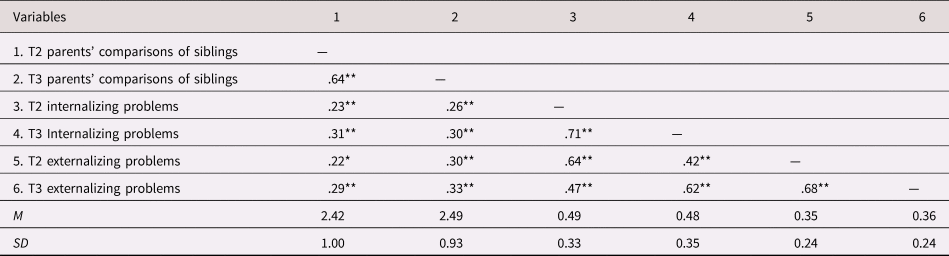
Table 1 shows descriptive statistics and the Pearson correlations among variables at T2 and T3. Parents’ comparisons of siblings at T2 and T3 were correlated with each other. Internalizing problems at T2 and T3 were correlated with each other. The same was true for externalizing problems. In addition, parents’ comparisons of siblings at T2 and T3 were correlated with both internalizing and externalizing problems at T2 and T3. Internalizing problems at T2 and T3 were correlated with externalizing problems at T2 and T3. Generally, the magnitudes of the autocorrelations were high. Correlations across the domains were moderate to high in size.
Descriptive statistics and correlations of variables

Note: Sample sizes range between 178 and 247 because of missing values. *p < .01. **p < .001.
In addition, a series of 2 (Adolescent Gender) × 2 (Sibling Gender Composition) × 2 (Birth Order) × 2 (Time Factor) repeated-measure multivariate analyses of variance were conducted for each study variable. It revealed that there was a significant effect of the time factor on parents’ comparisons of siblings, F (1, 167) = 4.87, p < .05. Post hoc analysis indicated that T3 parents’ comparisons of siblings was higher than T2 parents’ comparisons of siblings. In addition, it revealed that the Sibling Gender Composition × Birth Order × Time Factor interaction was significant for externalizing problems, F (1, 209) = 6.53, p < .05. Post hoc analysis indicated that the main effect of birth order on T2 externalizing problems approached marginal significance in the mixed-sex pair, t (133) = 1.65, p = .10. Specifically, first-born children had higher levels of T2 externalizing problems than second-born children. Finally, the same repeated-measure multivariate analyses of variance for internalizing problems showed that there was no significant effect at either T2 or T3.
Relations over time between parents’ comparisons of siblings and adolescents’ internalizing and externalizing problems
A cross-lagged model was used to test the reciprocal relations over time between parents’ comparisons of siblings and adolescents’ internalizing and externalizing problems. Following an analytic procedure used in previous research (e.g., Casper, Tremmel, & Sonnentag, Reference Casper, Tremmel and Sonnentag2019; Jensen & McHale, Reference Jensen and McHale2015), we constructed four competing path models: (a) a stability model (M1), which included only autoregressive paths from both parents’ comparisons of siblings and adolescents’ problem behaviors at T2 to both parents’ comparisons of siblings and adolescents’ problem behaviors at T3 and concurrent associations between parents’ comparisons of siblings and adolescents’ problem behaviors at each time; (b) a parent effect model (M2), which was based on the stability model but included paths from T2 parents’ comparisons of siblings to T3 adolescents’ problem behaviors; (c) a child effect model (M3), which was based on the stability model but included paths from T2 adolescents’ problem behaviors to T3 parents’ comparisons of siblings; and (d) a reciprocal model (M4), which was based on the stability model and additionally included cross-lagged paths of both parent effects and child effects. In all four models, paths from covariates (i.e., adolescent age, adolescent gender, birth order, sibling age gap, and sibling gender composition) to all constructs were included as demographic controls. However, none of the covariates significantly predicted parents’ comparisons of siblings and adolescents’ problem behaviors at either T2 or T3 except for two significant paths between adolescent gender and internalizing problems at T2 and between birth order and externalizing problems at T2. These nonsignificant covariates were removed from the final model analysis to avoid overcontrol.
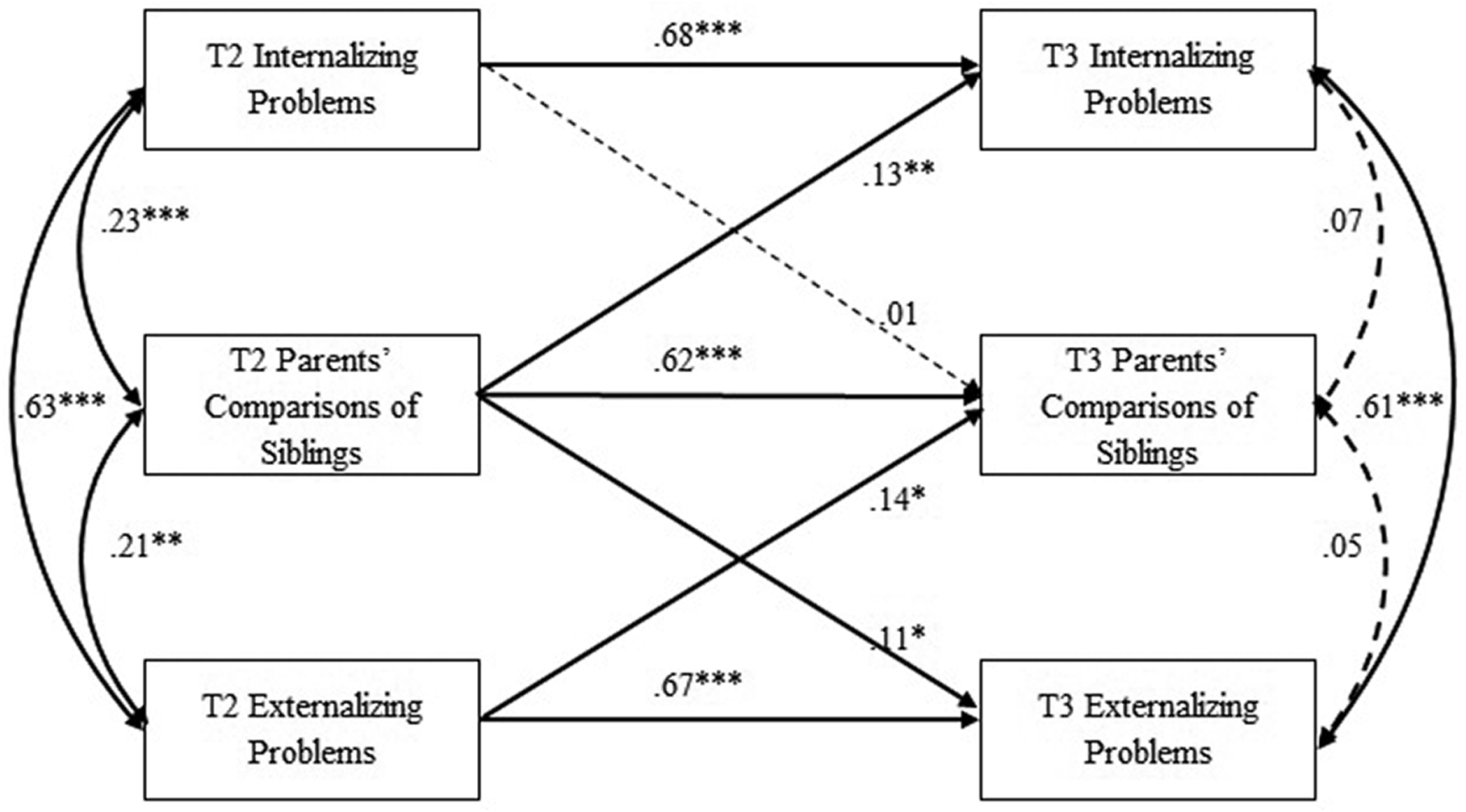
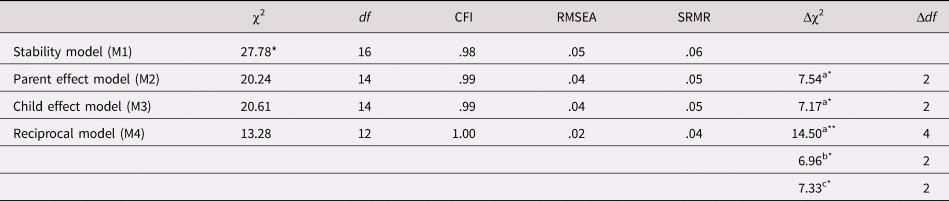
The fit indices of the four models and the results of the tests of chi-square difference by comparing the nested models are shown in Table 2. All four models had satisfactory model fit. The reciprocal model (i.e., M4) was a better fit with the data compared to the other three models. Thus, the reciprocal model was the final model (see Figure 1).
The final cross-lagged model. Dashed arrows indicate paths that were estimated but were not statistically significant (N = 260). The path coefficients are standardized.

Fit indices for competing models and results of chi-square difference tests
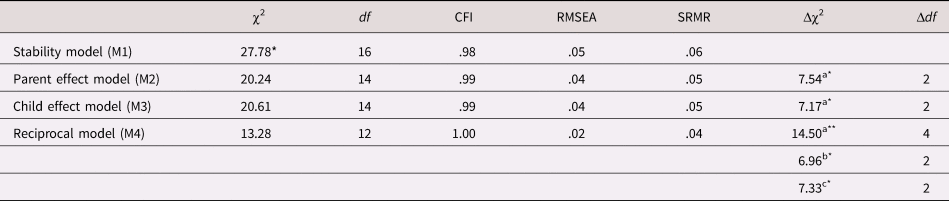
Notes: aIn comparison with Model 1.bIn comparison with Model 2. cIn comparison with Model 3. N = 260. *p < .05. **p < .01.
The model showed that T2 parents’ greater comparisons of siblings predicted more T3 internalizing problems after controlling for the temporal stability of internalizing problems. Similarly, T2 parents’ greater comparisons of siblings predicted more T3 externalizing problems after controlling for the temporal stability of externalizing problems. With respect to child effects, more T2 externalizing problems predicted T3 parents’ greater comparisons of siblings after controlling for the temporal stability of parents’ comparisons of siblings, whereas T2 internalizing problems did not predict T3 parents’ comparisons of siblings after controlling for its temporal stability.
Additional analyses
Gender differences in the reciprocal relations between parents’ comparisons of siblings and adolescents’ internalizing and externalizing problems were examined using the multigroup invariance test. The results showed a nonsignificant difference between the unconstrained model and the constrained model by constraining equal paths of all the reciprocal relations for male and female adolescents, Δχ2 (4) = 3.28, p = .51. Therefore, the reciprocal relations between parents’ comparisons of siblings and adolescents’ internalizing and externalizing problems were similar for boys and girls.
In addition, we explored whether sibling age gap moderated the reciprocal relations between parents’ comparisons of siblings and adolescents’ internalizing and externalizing problems. However, sibling age gap did not significantly influence the relation between T2 parents’ comparisons of siblings and T3 internalizing problems (β = –.04, p = .81), the relation between T2 parents’ comparisons of siblings and T3 externalizing problems (β = .10, p = .54), the relation between T2 internalizing problems and T3 parents’ comparisons of siblings (β = –.003, p = .99), and the relation between T2 externalizing problems and T3 parents’ comparisons of siblings (β = –.24, p = .19). Therefore, results indicated that sibling age gap did not moderate the reciprocal relations between parents’ comparisons of siblings and adolescents’ internalizing and externalizing problems.
Discussion
Decades of developmental research and theories suggest that parental practices and children's developmental outcomes influence each other reciprocally (e.g., Belsky, Fearon, & Bell, Reference Belsky, Fearon and Bell2007; Serbin et al., Reference Serbin, Kingdon, Ruttle and Stack2015), yet such influences are not thoroughly understood in families with more than one child. In this two-wave longitudinal study, we draw on social comparison theory (Festinger, Reference Festinger1954; Suls et al., Reference Suls, Martin and Wheeler2002) and expectancy value theory (Eccles & Wigfield, Reference Eccles and Wigfield2002) to explore how parents’ comparisons of siblings were related to adolescents’ internalizing and externalizing problems in the Chinese context. In general, we found reciprocal associations between Chinese parents’ comparisons of siblings and adolescents’ problem behaviors.
Consistent with previous studies (Jensen & McHale, Reference Jensen and McHale2015; Jensen et al., Reference Jensen, McHale and Pond2018), we found that adolescents’ perceived greater parents’ comparisons of siblings predicted an increase in adolescents’ internalizing and externalizing problems over time. These results indicated that experiences of parents’ critical comparisons of adolescents with their siblings may have negative effects on adolescents’ subsequent adjustment. Similar to other aversive parenting behaviors (e.g., love withdrawal), adolescents’ perceived negative comparisons that parents made with their siblings in daily life within families may threaten their sense of self-worth and their position in the family, which may in turn lead to internalizing and externalizing problems.
Furthermore, our findings showed that adolescents’ externalizing problems predicted more parents’ comparisons of siblings over time. These were consistent with the perspective that children also play an active role in affecting parents’ caregiving practices (i.e., child-driven effect on parenting; Belsky et al., Reference Belsky, Fearon and Bell2007; Serbin et al., Reference Serbin, Kingdon, Ruttle and Stack2015). Higher externalizing problems may increase parents’ social comparisons of siblings over time by eliciting more parental perception of target children's problems. In particular, in the Chinese context, externalizing problems may be seen as harmful to social harmony. Such externalizing problems may lead to more harsh parental discipline (e.g., parents’ critical comparisons of siblings) in China (Fung & Chen, Reference Fung and Chen2001; Olson et al., Reference Olson, Tardif, Miller, Felt, Grabell, Kessler and Hirabayashi2011). Our findings were consistent with past ethnographic evidence, demonstrating that Chinese parents tended to use unfavorable parental social comparisons of siblings in response to their children's behavioral problems (Fung & Chen, Reference Fung and Chen2001). Therefore, parents’ beliefs about sibling differences might be due, in part, to their children's explicit behaviors.
However, we did not find that adolescents’ internalizing problems predicted parents’ comparisons of siblings over time. Compared to externalizing problems (e.g., aggression), which were less likely to be accepted by Chinese parents, internalizing problems reflect emotional disorders such as anxiety, depression, and withdrawal, which were not necessarily seen as threatening to others in Chinese cultures (Chen, Reference Chen, Rubin and Coplan2010; Xu, Farver, Yu, & Zhang, Reference Xu, Farver, Yu and Zhang2009). In contrast, adolescents’ internalizing problems might receive more affective concerns from parents and invoke more positive parenting, which might subsequently help children recover from emotional disorders (Serbin et al., Reference Serbin, Kingdon, Ruttle and Stack2015). These findings suggest that due to the distinctive social meanings of internalizing and externalizing problems in Chinese society, reciprocal relations between parents’ comparisons of siblings and adolescents’ internalizing and externalizing problems might operate in different ways within the family system. Our findings add novel contributions to the sibling research by integrating child-to-parent effects and addressing a limitation in previous research, which only explored a one-way link from parental practices to children's adjustment (Jensen et al., Reference Jensen, McHale and Pond2018).
Limitations and directions for future research
There are some limitations in the present study. First, our study employed a short-term longitudinal design that spanned 6 months. It limited the interpretation about whether reciprocal relations remain relatively stable in a longer term investigation (Serbin et al., Reference Serbin, Kingdon, Ruttle and Stack2015), and whether higher levels of parents’ comparisons of siblings predicted increases in internalizing and/or externalizing problems, or lower levels of parents’ comparisons of siblings predicted decreases in internalizing and/or externalizing problems. Moreover, the current two-wave cross-lagged panel model (CLPM) did not segregate the within-person from the between-person changes. The random-intercept cross-lagged panel model (RI-CLPM) can resolve this issue (Hamaker, Kuiper, & Grasman, Reference Hamaker, Kuiper and Grasman2015). However, it requires at least three waves of data. Although there were only two waves of data in the present study, which cannot employ the RI-CLPM for analysis, it should be noted that the RI-CLPM may have an advantage over the CLPM if the constructs are of a traitlike, time-invariant nature (Hamaker et al., Reference Hamaker, Kuiper and Grasman2015). Future studies should collect three or more waves of data and use the RI-CLPM to separate the within-person from the between-person changes.
Second, despite the fact that self-reported assessment has its advantages in measuring both adolescents’ perceived parents’ comparisons of siblings and their internalizing and externalizing problems, it might cause a common method bias. Future research should use multiple methods for assessments (e.g., observation-based parents’ comparisons of siblings, and parents’ and teachers’ report of internalizing and externalizing problems) to confirm the association patterns in the present study. Third, we recruited only one sibling in the sample. Future studies should include both siblings given that siblings may have different perceptions of parents’ comparisons of siblings (Jensen et al., Reference Jensen, McHale and Pond2018). In addition, future studies should include the information about whether siblings are living in the same household or not. It remains unclear whether sibling comparisons are more or less salient in the presence of the sibling, and how this factor may moderate the reciprocal associations between parents’ comparisons of siblings and adolescents’ problem behaviors.
Fourth, and finally, the present study focused on adolescents’ problem behaviors as developmental outcomes. It is also possible that adolescents’ experiences of parents’ comparisons of siblings might influence their behaviors toward siblings. Therefore, future studies should measure adolescents’ sibling relationships to examine possible relations between parents’ comparisons of siblings and sibling relationship quality.
Despite these limitations, we believe the current study has important practical implications for Chinese parents who care for more than one child. Given that the Chinese population policy has relaxed to allow couples to have two children, how to raise two children in an appropriate and effective way has become a greater concern for Chinese parents (Chen, Reference Chen2019; Chen et al., Reference Chen, Han, Wang, Sui, Chen and Wan2018; Chen & Xu, Reference Chen and Xu2018). However, such practical information is extremely scarce given the last three decades of a one-child policy. The present study is one of the first empirical studies aiming to turn around this situation. The findings may help parents to raise awareness of the implications of their social comparisons of siblings on their children's adjustment during adolescence. In addition, the findings about the reciprocal relations between parents’ comparisons of siblings and externalizing problems suggest that intervention programs should include both parents and children to reduce externalizing problems. Not only adolescents’ problem behaviors themselves, but also parents’ caregiving practices should be included in the programs.
Conclusion
To conclude, this study provides valuable information about the associations between parental practices and adolescents’ adjustment in families with more than one child in China. Specifically, the present findings provide the first empirical evidence that reciprocal relations between parents’ comparisons of siblings and adolescents’ internalizing and externalizing problems might operate in different ways. As this study represents an initial but important step, more empirical work is highly needed to further this line of research and to provide accounts of the family dynamic interplay among parents, siblings, and children to understand child adjustment.
Financial Support
This study was supported by fund for building world-class universities (disciplines) of Renmin University China.